
Truth in the Tomb~The Rev Frank Bellino,OPI
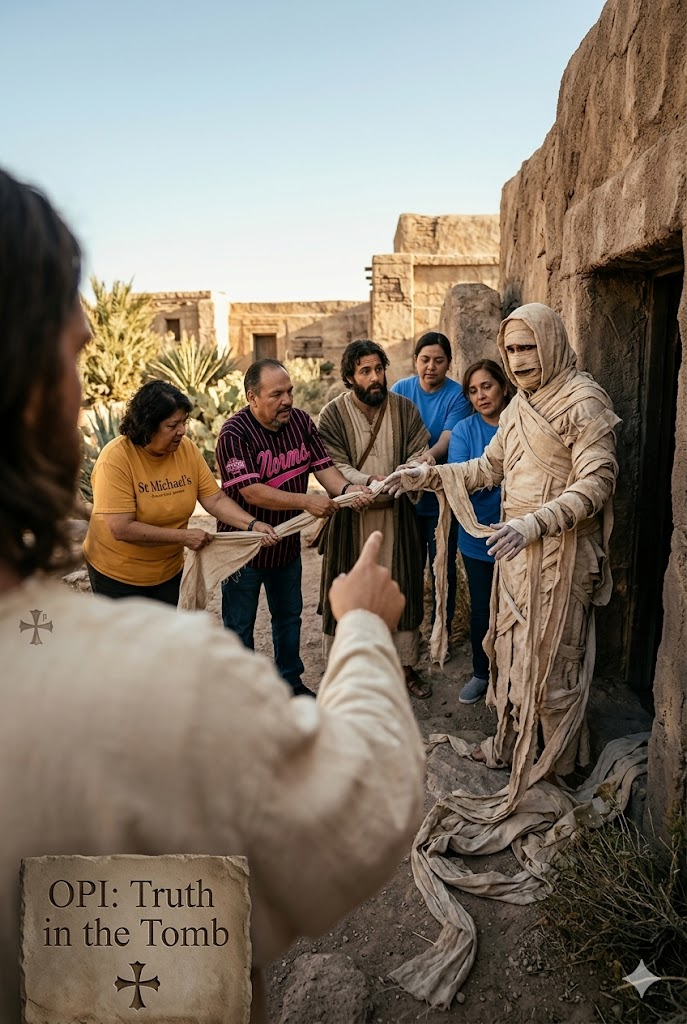
How many times have we heard the story of Lazarus? For many of us, the number is likely in the hundreds. We know the characters: the grieving sisters, the confused disciples, and the Jesus who weeps before he works. But if we treat this as a 2,000-year-old “magic trick,” we lose the Veritas—the Truth—that this Gospel is trying to breathe into us today. If it is just a miracle from the past, it’s a museum piece. If it’s just a “fortune-telling” of the Resurrection, it’s a trailer for a movie we’ve already seen. Through Dominican eyes, we must ask: What is the Truth of this story for a man or woman living in 2026?
Let’s look at this through a lens we rarely consider: the perspective of Lazarus himself. We often think of this as a “happily ever after” for him but think about that for a moment. Lazarus was on the doorstep of the Kingdom. He had passed through the veil; he was at rest. And yet, he is called back. He is made to “turn around” and re-enter a world of dust, pain, and eventually, a second death.
Why? Because the Truth is that our life is not our own. Lazarus was not raised for his own comfort; he was raised for the Mission. He became a living, breathing sermon—a walking protest against the finality of death. His very existence from that day forward forced everyone who looked at him to confront a reality they weren’t prepared for: that the stones we roll in front of our hearts are not permanent. Sometimes, God calls us back into difficult situations—into “stinky” circumstances—not to punish us, but because our presence there is the only way others will believe that light can penetrate the darkness.
Martha warns Jesus, “Lord, by now there will be a stench.” This is perhaps the most honest line in the New Testament. It acknowledges that some situations have gone on too long to be fixed by human hands. We all have “stinky” parts of our lives—addictions we can’t shake, bitterness we’ve nursed for decades, or a paralyzing fear of the future. The world tells us to leave those things behind the stone. The world tells us that once something starts to decay, it’s over.
But Christ stands at the mouth of our personal tombs and demands that the stone be rolled away. He isn’t afraid of the stench. The Dominican Truth is that God meets us exactly where we are “rotting.” He does not wait for us to get cleaned up before He calls us out. He calls us while we are still bound.
Perhaps the most profound Truth for us as a parish and an Order is what happens after the miracle. Jesus says the words that give life, but then He turns to the community and gives a command: “Untie him and let him go.” Notice that Jesus did not wave a hand and make the burial cloths vanish. He required the community to get their hands dirty. This is the mandate for St. Michael’s Catholic Parish/Unified Old Catholic Church. Christ provides the life-giving grace, but we are the ones called to the “Ministry of Unbinding.”
There are people sitting in these pews, or living in our neighborhoods, who have been “raised”—they have heard the call of God—but they are still walking around in burial cloths. They are bound by the labels the world has put on them, bound by the shame of their past, or bound by a lack of hope. As Dominicans and as followers of Christ, our job is to reach out and help peel back those bandages. We are called to be the hands that untie the knots of despair so that our brothers and sisters can truly walk in freedom.
As we move into Passiontide, we realize that the raising of Lazarus was the final catalyst for the death of Jesus. By giving Lazarus life, Jesus sealed His own earthly end. He traded His life for ours.
Today, let us ask ourselves: What stone are we keeping firmly in place? What “tomb” are we hiding in? The Voice that called Lazarus is calling you today. Not just to “live,” but to join the mission. To be a witness to the Truth that in Christ, nothing is ever truly “over.”
 The Order of Preachers, Independent
You must be logged in to post a comment.