
Category: Member Posts
Whose Stamp Is on Your Soul?~The Rev Frank Bellino,OPI
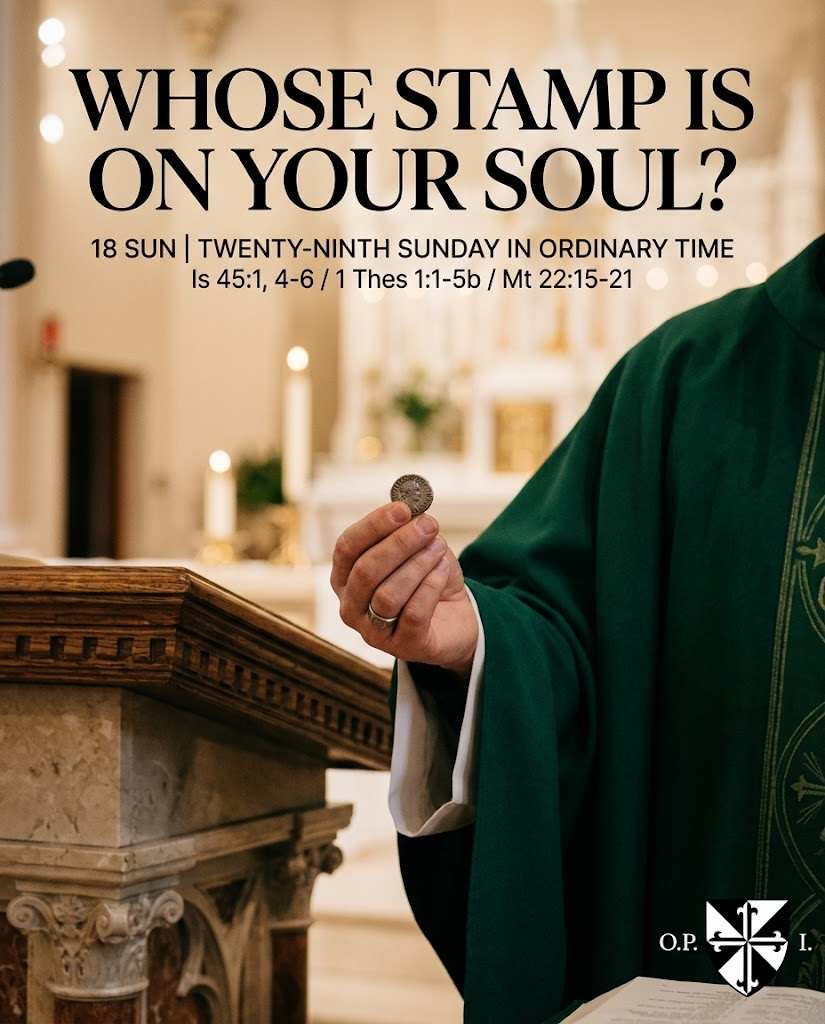
Look in your pockets right now, or check your wallet, your purse, or your phone. You’ve got a driver’s license, a credit card, a few bills, or an app linked directly to your bank account. Those things belong to this world. They represent the work we do, the bills we pay, the taxes we owe, and the rules of the society we live in every single day. In today’s Gospel, the Pharisees and Herodians try to corner Jesus with that exact reality, asking what they think is an impossible question: “Is it lawful to pay the census tax to Caesar or not?” They thought they had Him trapped. If He says yes, the crowd thinks He’s selling out to Rome. If He says no, they arrest Him for treason right on the spot.
Jesus doesn’t blink. As Dominicans, our motto is Veritas—Truth. And Truth doesn’t play games with politics. Jesus looks right past the setup and tells them to show Him the coin. When they hand Him a denarius, He looks at it and asks whose image and inscription is on it. They tell Him it’s Caesar’s, and that is when Jesus drops the hammer: “Repay to Caesar what belongs to Caesar, and to God what belongs to God.” A lot of folks hear that and think it’s just a nice civic lesson about paying your taxes, obeying the law, and keeping your faith quietly tucked into a corner on Sunday morning. That is not what Jesus is saying. Look at the coin. Caesar’s face is stamped onto a piece of metal pulled out of the dirt, minted by an empire that eventually crumbled to dust. Caesar’s face was on it, so Caesar had a claim on it. Fine. Hand Caesar his pocket change. But whose image is stamped on you?
The Book of Genesis tells us that on the sixth day, God made us in His own image and likeness—the imago Dei. You do not have the stamp of an emperor. You don’t belong to a government, an economy, a political party, or the culture of this world. Your soul bears the permanent, eternal seal of the Living God. When Jesus says give God what belongs to God, He isn’t talking about tipping a few dollars in the collection basket, and He isn’t talking about checking a religious box or going through the motions of dead routine. He is asking for your life: your marriage, your mind, your praise, and your whole heart.
Here is where we mess up: we think we know better than God. We get down to pray, and instead of asking for His will, we try to give God advice. We hand Him our timeline, we lay out our demands, and we treat the Creator of the universe like an employee we’re trying to manage. We do not know better than God—not in our trials, not when we’re waiting, not in our grief, and not when life feels like it’s falling apart. Whenever you pray, and whenever you act in this world, remember who you belong to. When you get on your knees, you aren’t managing God; you are surrendering to your Father. When you walk into your job, your home, or your neighborhood, you don’t carry your own badge. You represent the King of kings. When you remember who you belong to, you stop running on your own strength, fear loses its grip, and real faith takes over.
Paul tells the Thessalonians in our second reading that the Gospel didn’t come in word only—it came in power, in the Holy Spirit, and with full conviction. That is the charismatic heartbeat of this church. We aren’t here for empty routine. We are here because the Holy Spirit breaks chains, heals bodies, and restores families when we actually surrender. This hits close to home for Alma and me this month. October is the month both my dad, Vincent F. Bellino, and Alma’s dad, Arturo Noriega, finished their race and entered eternity. Both of these men were military veterans who wore the uniform of this country with pride. They understood duty, honor, discipline, and giving Caesar what was owed. More than that, both my dad and Arturo knew who held their real allegiance. They knew they didn’t know better than the Lord. When the uniform came off, and when their earthly breath finally gave out, they knew whose image was on their souls. They didn’t stand before Caesar; they stood before the God who called them home. They gave Caesar his due, but they gave God their lives.
That is the call on every single one of us today. You’ve got a life to live. Work hard, serve your community, and take care of your business with integrity. But do not ever hand this world the things that belong exclusively to God. Don’t give the culture your identity, don’t surrender your peace to political noise, and don’t let fear dictate your life. You belong to Jesus Christ. Let Caesar keep his silver. Before you leave this church today, I want you to ask yourself this question: Starting this afternoon, what part of your life are you going to stop holding back from God, so that the way you pray, the way you surrender, and the way you lead your family actually points them straight to heaven?
Amen.
Give to God???~The Rt Rev Michael Beckett,OPI

Y’all……..I have never claimed to be the sharpest knife in the drawer or the brightest bulb in the chandelier, but I do like to think of myself as pretty well educated and possessed of at least a modicum of intelligence. But I cannot understand, for the life of me, the way some folks act, or the way they think, or the things they say. It’s been a heckuva week with wildfires, and floods, and earthquakes, and yet another school shooting, and I have heard more than one person who should know better say, in all sincerity and smugness, that “God has a plan” and “it was God’s will” and “This is what God wants.”
This is what God wants????? Who in bloody thunder would dare say that God wants natural disasters, the death of innocent people, or any of the other terrible, horrible, no good, very bad things that happen in this world? This is patently not the case, and I’ve written several sermons about this very thing, but I digress…And who, I ask, WHO has the direct pipeline to God’s desires?
No, wait. Well….umm….Hold on a sec.
I actually do have the answer to that last question I posed: Who has the direct pipeline to God’s desires? The answer is actually pretty simple. We, all of us, do, and we can find that answer over and over and over again in just about every book of the Bible. Throughout the centuries encompassed in the entire history of humans interacting with God, we find that God simply wants our love and faithfulness and wants our actions to reflect that. Period, the end, that’s all.
In the Gospel reading appointed for today, the Pharisees, those evil-minded lawmakers (who are similar to so very many people in today’s world) tried to trick Jesus into saying some things that would get him into trouble. They said, “Teacher, we know that you are a truthful man and that you teach the way of God in accordance with the truth. And you are not concerned with anyone’s opinion, for you do not regard a person’s status. Tell us, then, what is your opinion: Is it lawful to pay the census tax to Caesar or not?”
And Jesus, being sharp as a tack, caught on pretty quickly and replied, “Why are you testing me, you hypocrites? Show me the coin that pays the census tax.” Then they handed him the Roman coin. He said to them, “Whose image is this and whose inscription?” They replied, “Caesar’s.” At that he said to them, “Then give to Caesar what belongs to Caesar and to God what belongs to God.” BOOM! Not what they were expecting or wanting. Can’t you just imagine the Pharisees saying, like the cartoon character, Snidely Whiplash, “Curses, foiled again!”
And so, again, that brings us to the question, “What does God want?” or, more pointedly, just what is it that we have that we’re supposed to give to God? You already know. Jesus told us. He said, “Love the Lord your God with all your heart, with all your soul, with all your mind, and with all your strength” (Mark 12:30). God wants your heart, your love. And how do we show that love to God? Again, Jesus taught us, “”If you love me, keep my commandments.” John 14:15. And what, besides loving God, were the other commandments Jesus gave us? There’s really just one: Jesus said,
I give you a new commandment: love one another. As I have loved you, so you also should love one another. This is how all will know that you are my disciples, if you have love for one another.”
After over 2,000 years, countless sermons, essays, and writings, and an infinite number of words, what is there left to say? The whole of Jesus’s ministry, the foundation of the Christian faith, the very basis of our being, our salvation, comes from that little central premise, love.
Love God. Love people. Love.
Love God. Show God’s Love by Loving People.
Love God. Show God’s Ways by Changing Your Ways By Loving People.
Love God. Show God’s Ways by Changing Your Ways By Loving People Who are Different Than You. Whose values, beliefs, bodies, and ways of Being are Different from Yours.
We, as followers of Jesus, must recognize that our society today is filled with numerous groups and communities facing systemic oppression, and we must act. We must be willing to admit and address the complex realities within our world that create such problems, and avoid the spiritual laziness that tempts us to rely on generic excuses and solutions. There’s a meme that pops up every now and then that says something like, “At times being a good Christian meant being a bad Roman.” Things to ponder, no? Loving as Jesus loved us is hard. Loving Jesus more than anything and anyone is harder.
People do a disservice to the gospel message by removing the cultural context from Jesus’s ministry and watering down his message to one of religious platitudes. We like to generalize the words of Jesus and transform his life into a one-size-fits-all model that can apply to all of humanity. He intentionally, purposefully, and passionately addressed very specific causes. He radically addressed the diverse and complicated conflicts of the time and shattered the status quo. Are we, as his followers, not called to do the same? By addressing racism, immigration, gender equality, gender expression, and a litany of other issues, we are following in the steps of Jesus.
We have to put our faith into action. Support charitable causes. Vote, keeping Jesus’s love uppermost in your mind, not by holding on to your prejudices. Support your local church if you have one. (Tending God’s flock and providing a worship space is expensive, especially for small, independent churches!) Support food banks. Volunteer. Do what needs to be done for the least, the lost, the forgotten. Love.
So, ask yourself, “What, exactly, am I giving to God?”
The Banquet, the Robe, and the Rags~The Rev Frank Bellino,OPI
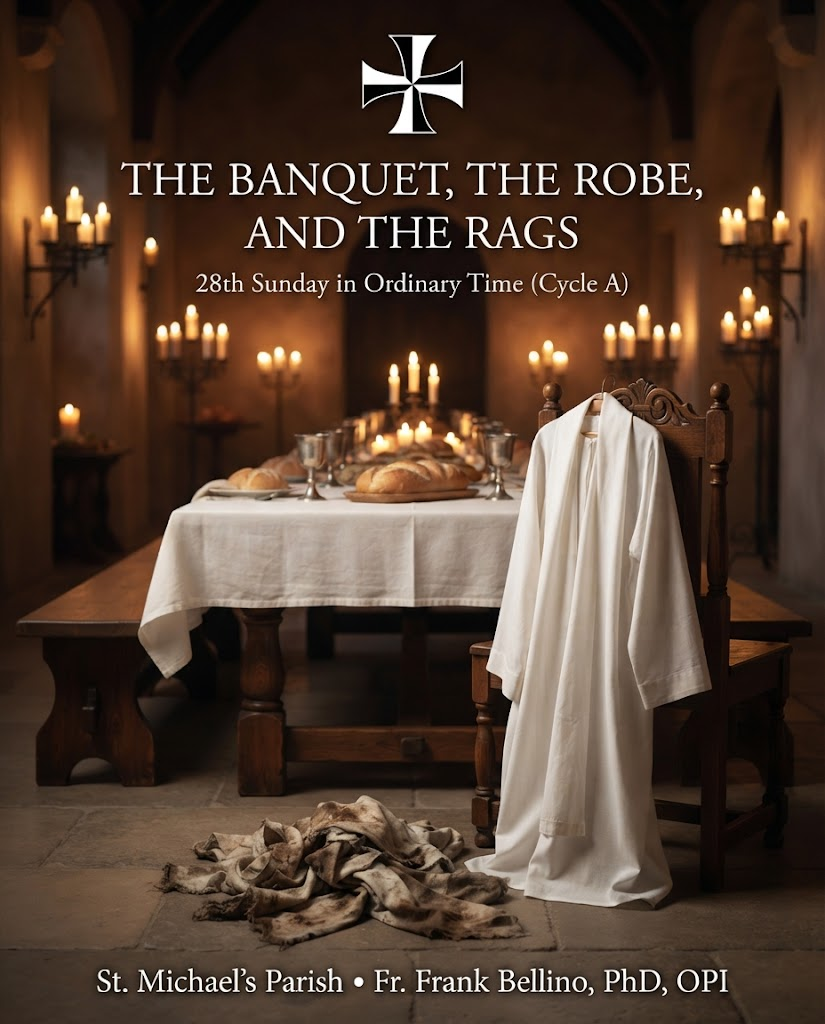
Let’s be honest about how human beings operate when we get an invitation. If someone sends you an invite to a high-end black-tie gala or a major celebration, what’s the first thing most folks do? They check their calendar. If they’re busy, if they’ve got a mountain of paperwork on the desk, if the weekend is jammed with chores, or if they’d rather just kick back on the couch with a game, what happens? They RSVP with regrets, or worse, they ghost. They make light of it. That’s exactly what happens at the beginning of Jesus’ parable today in Matthew 22. The king—representing Almighty God—puts on a massive wedding feast for his son. Everything is prepped, the table is loaded, the calves are butchered, and the invitation goes out. And what do the invited guests do? They treat the king of the universe like an annoying telemarketer. “They made light of it and went off, one to his farm, another to his business.” Sound familiar? It’s the easiest trap in the world. As a guy who spent decades on the street and in public service before answering the call to the altar, I’ve seen how fast people let everyday survival—the bills, the grind, the side hustles, the endless noise—crowd out the only thing that actually matters. We treat God like an optional weekend appointment. “Lord, I’ll drop in if I have time after I finish my checklist.”
Look at what God does when people blow Him off. A lesser king would have shut down the hall, canceled the catering, and sent out a punitive strike force. But God’s mercy doesn’t work like human ego. The king turns to his servants and says, “The banquet is ready, but those invited weren’t worthy. Go out to the main roads, the highways, the dark corners, and bring in whoever you find—the good and the bad.” He fills the hall with nobodies. People pulled straight off the street who never dreamed they’d sit at a royal table. That’s us. That’s the beauty of grace. God doesn’t wait for you to clean up your resume or get your life completely squared away before He invites you in. He reaches right into the mess of our daily lives and pulls us to the feast.
But then the story takes a sharp, uncomfortable turn—the kind of twist that makes you sit up straight in the pew. The king walks into the banquet hall, looks around, and spots a guy sitting at the table without a wedding garment. When the king asks him, “Friend, how did you get in here without a wedding garment?” the man is speechless. Total silence. And the outcome is severe—bound hands and feet, thrown out into the dark. For a long time, people read that and think, “Hold on, that’s harsh! The guy was just dragged off the street corner. How was he supposed to change clothes?” Here’s the historical reality check: In Jesus Time as a first century Jew, when a king threw a royal wedding, it was customary for the host to provide the proper garments right at the entrance for his guests. Everyone received the exact same robe of honor, wiping out all distinctions of who was rich, who was poor, who came from the highway, and who came from the estate. So when this guy refused or neglected the garment, it wasn’t a laundry issue. It was an attitude issue. It meant he walked through the king’s doors, took a seat at the king’s table, ate the king’s food, but said: “I’ll do it my way. I’ll keep wearing my own dirty rags.” He wanted the blessing without the transformation. He wanted the kingdom on his own terms. And brothers and sisters, that is where the rubber meets the road for us.
How many times do we show up to church—or walk through life—wanting God to fix our problems, bless our families, protect our health, and grant us peace, but we refuse to let His grace actually change our character? We want the feast, but we want to keep wearing our old bitterness, our old grudges, our secret sins, and our self-reliance like a comfortable old jacket. St. Paul nailed it in our second reading today from Philippians: “I have learned the secret of being content in any and every situation… I can do all things through him who strengthens me.” Paul wasn’t speaking from a position of ease; he wrote that from a Roman prison cell! He understood that true freedom isn’t found in managing your own life or defending your own ego. It’s found in total, radical surrender to Christ. As a Dominican-rooted, charismatic community, we love to talk about the fire of the Holy Spirit, the gifts, the worship, the movement of God. But the primary mark of the Spirit is holiness. The wedding garment is the righteousness of Jesus Christ. You can’t sneak into the Kingdom wearing your own self-righteousness. You can’t fake your way into eternal life holding onto resentment. God invites you out of the dirt of the highway, but He hands you a clean robe at the door. He asks you to put off the old life and put on Christ.
Look around this altar today. This is the mountain of the Lord. This is the banquet. Jesus isn’t asking you to clean yourself up before you come to Him. He’s asking you to stop pretending your old rags are good enough. Drop the excuses. Drop the self-reliance. Let the fire of the Holy Spirit burn away whatever is keeping you lukewarm. When we come up for Holy Communion today, let’s come with open hands and a surrendered heart. Let’s wear the garment of His grace, live out our faith with grit and joy, and remember that when God sets a table, He doesn’t hold back anything. So I leave you with this: Are you ready to strip off your old, comfortable rags of self-reliance, put on the garment of Christ’s grace, and actively pull someone else off the highway into the King’s banquet so that both you and they may gain heaven? To God be the glory, now and forever. Amen.
The Rhythm of the Contemplative Heart: Standing Firm on the Gospel
When life gets loud, messy, or complicated, the easiest thing in the world to do is cut a corner or make a compromise just to avoid an argument. We tell ourselves that if we just go along to get along, or keep our heads down and blend in with the crowd, everything will work itself out. But anyone who has lived long enough knows that real peace never comes from dodging the truth. Real peace comes from knowing who you are, knowing who you belong to, and keeping your feet planted firmly on solid ground.
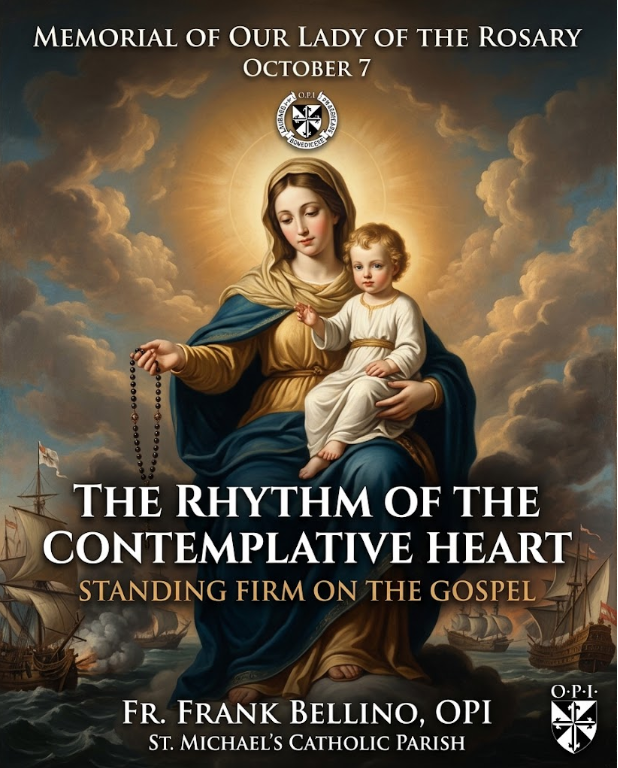
Today, we celebrate the Memorial of Our Lady of the Rosary. For us in the Dominican family, this feast is personal. It goes back to the victory at the Battle of Lepanto in 1571, when the Christian world was facing overwhelming odds and Pope Saint Pius V asked everyone to pick up their beads and pray. Our holy father St. Dominic didn’t hand people the Rosary as some kind of mechanical chore or magic charm; he gave it to them as a spiritual anchor against heresy and confusion. The purpose of this feast isn’t to look at a pair of beads like jewelry. It’s to teach us how to look at Jesus Christ through the eyes of His Blessed Mother—a woman who stood steady through uncertainty, grief, and the foot of the Cross because her entire life was fixed on doing God’s will.
That backbone is the exact thing Saint Paul is talking about in our first reading today. Paul goes up to Jerusalem to ensure that the core truth of the Gospel isn’t watered down. And when he sees Peter—Cephas—pulling away from eating with Gentile believers just because he was worried about what a certain group might think of him, Paul calls him out right to his face. He didn’t do it out of anger or disrespect; he did it because Peter wasn’t walking in line with the truth. Paul knew that the moment you start compromising the truth to please other people, you lose your footing.
Now, where do you get that kind of strength? How do you stay steady when the pressure is on? That brings us right to the Gospel of Luke. The disciples watch Jesus praying by Himself. When He finishes, they don’t ask Him how to win arguments, gain influence, or run an organization. They say, “Lord, teach us to pray.” They saw that His strength, His calm, and His authority came entirely from time spent alone with the Father. And Jesus doesn’t give them a complicated speech; He gives them the essentials: honor God’s name, pray for His kingdom, ask for daily bread, forgive others, and ask for protection from the test.
When you put Paul’s courage next to Luke’s Gospel, you see the real power of the Rosary. The Rosary takes the very prayer Jesus gave us—the Our Father—combines it with the biblical words of Gabriel and Elizabeth, and walks us step-by-step through the life, death, and resurrection of Christ. It calms the noise in our heads so we can actually listen to God, and it gives us the courage to stand tall for what’s right when everyone else is backing down.
So my question for each of us today is simple: When the pressure mounts and the world pushes you to compromise your faith just to keep the peace, are you willing to pick up your beads, sit quietly with the Lord, and let Mary teach you how to stand firm in the truth?
Mother Mary of the Rosary pray for us.
A Contemplative Journey Through the Beads: A Homily on Our Lady of the Rosary~The Very Rev Lady Sherwood,OPI
Dearest brothers and sisters in Christ, today we celebrate the Feast of Our Lady of the Rosary, a day that invites us to contemplate the profound power of simple, meditative prayer in the midst of a noisy world.
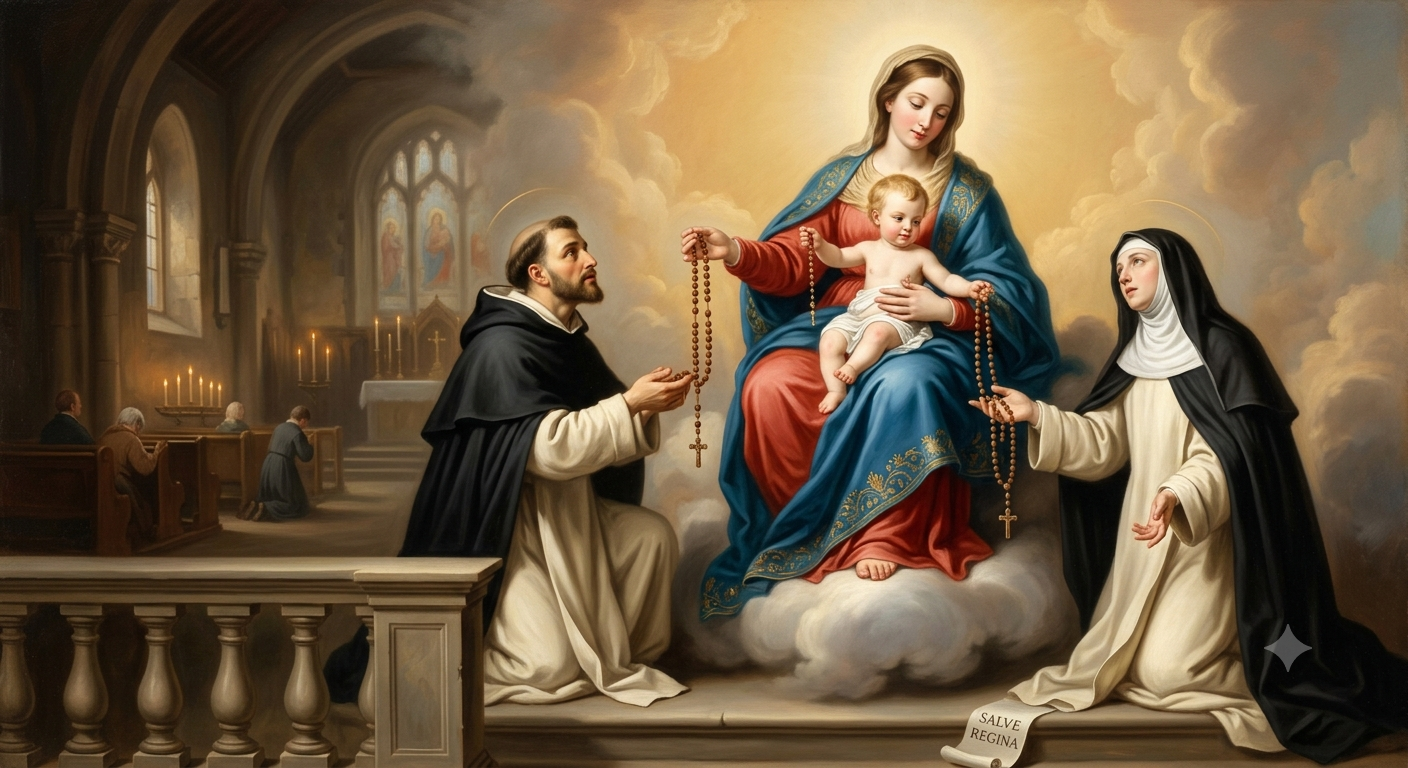
When we hold the rosary in our hands, we are not holding a superstitious talisman or repeating empty words. We are grasping a spiritual lifeline—a chain that links earth to heaven. The Rosary is fundamentally a Christ-centred prayer. Though the words of the Hail Mary echo through each decade, Mary’s sole purpose is always to point us directly to her Son, Jesus Christ.
As we pass the beads through our fingers, we walk through the Gospel. We enter into the Joyful, Luminous, Sorrowful, and Glorious mysteries of our faith:
The Joyful Mysteries teach us the beauty of surrender, from Mary’s courageous Fiat at the Annunciation to the quiet joy of the Nativity.
The Luminous Mysteries call us into active discipleship, urging us to “do whatever He tells you,” just as Mary instructed the servants at Cana.
The Sorrowful Mysteries remind us that we never suffer alone. Mary stood at the foot of the Cross, and she stands beside us in our darkest hours of heartbreak, grief, and doubt.
The Glorious Mysteries offer us ultimate hope, pointing to the truth that death and despair do not have the final word—resurrection and eternal life await us.
In our modern lives, we often complain that we are too busy or too distracted to pray. Yet the Rosary is a sanctuary we can carry in our pockets. It invites us to slow down, breathe, and sit with Jesus through the loving eyes of His Mother. When life feels chaotic, the steady beat of the beads grounds us in the peace of God.
Let us never underestimate the power of this simple prayer to bring peace to our hearts, heal broken families, and transform our world.
Let us pray:
O Holy Mary, Queen of the Most Holy Rosary,
We come to you today with open hearts, seeking your guidance and protection.
Teach us to treasure the mysteries of your Son’s life in our hearts, as you did.
In moments of joy, help us to give thanks.
In moments of sorrow, strengthen us to stand faithful at the foot of the Cross.
In moments of confusion, shine the light of Christ’s wisdom upon our path.
Intercede for our world, which aches so deeply for peace.
Bring reconciliation to our families, healing to the sick, and hope to the forgotten.
Wrap us in your motherly mantle, and draw us always closer to the Sacred Heart of Jesus.
Our Lady of the Rosary, pray for us.
Amen.
Mysteries of Grace: A Homily on Our Lady of the Rosary~The Very Rev Lady Sherwood,OPI
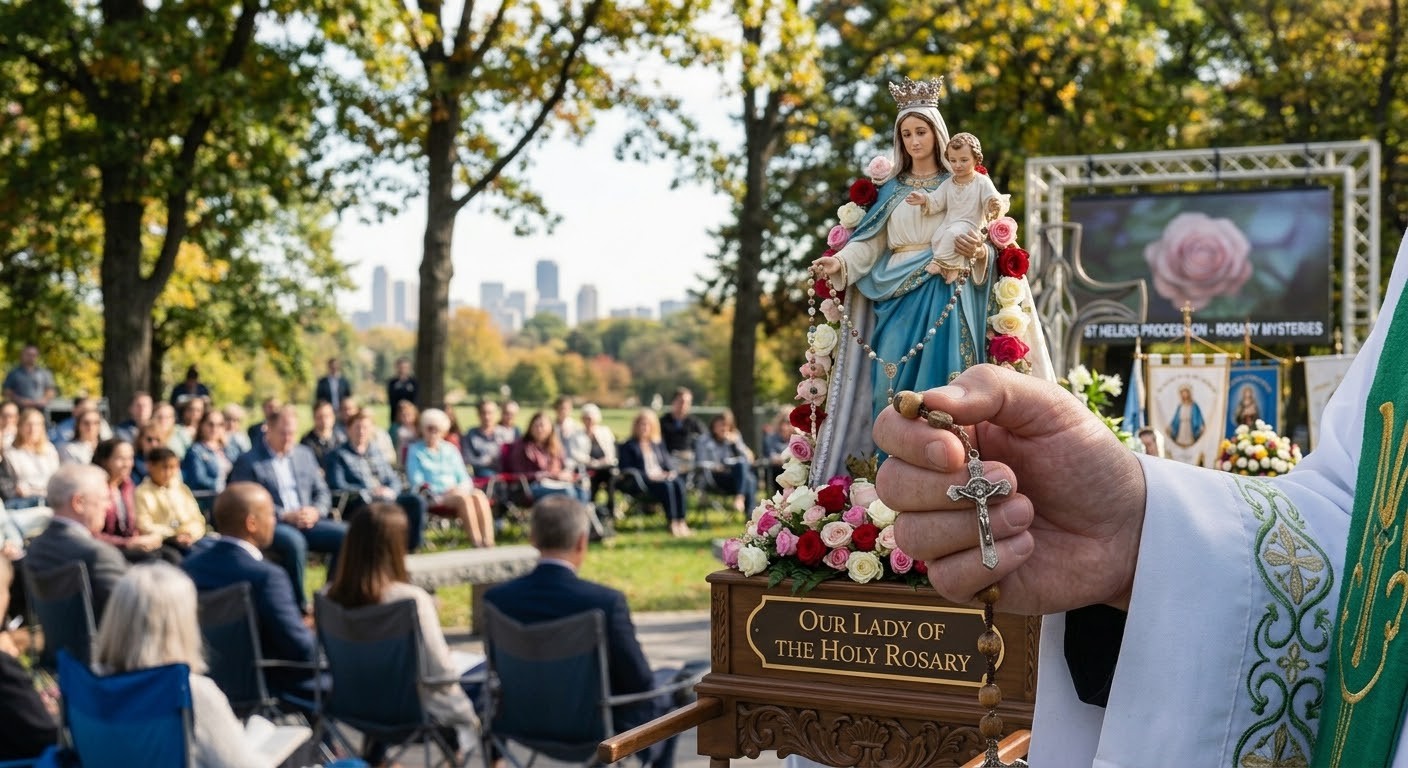
Scripture Readings: Luke 1:26–38 & Acts 1:12–14
My dear brothers and sisters in Christ,
Today we gather as The Church to celebrate the Feast of Our Lady of the Rosary, a title that carries both profound spiritual sweetness and rich historical strength. When we hold the humble string of beads in our hands, we are not engaging in a mechanical repetition of words, nor are we offering a distant, detached petition. Rather, we are taking the hand of the Blessed Virgin Mary and allowing her to lead us through the life, death, and triumphant resurrection of her Son, Jesus Christ.
The Rosary is, at its core, a deeply biblical prayer. It is often described as a compendium of the Gospel. In each decade, as our fingers move from one bead to the next, we are invited to gaze upon the mysteries of our redemption through the very eyes of the one who knew Christ best. Who better to teach us how to love the Saviour than His own Mother? Who better to guide us through the joys of Bethlehem, the light of His public ministry, the dark sorrow of Calvary, and the radiant glory of the Easter morning than the one who shared so intimately in every single step of His journey?
Consider for a moment the posture of Our Lady at the Annunciation. When the Archangel Gabriel appeared to her in Nazareth, her heart was filled with wonder, yet her response was one of radical, trustful surrender: “Behold the handmaid of the Lord; be it done unto me according to thy word.” That single moment of obedience—that holy Fiat—opened the floodgates of grace for the entire world. In the Joyful Mysteries of the Rosary, we reflect on this quiet assent, learning from Mary how to welcome Christ into the ordinary spaces of our own daily lives.
Yet, Mary’s journey was not without profound sorrow. As Simeon foretold, a sword of grief would pierce her soul. In the Sorrowful Mysteries, we walk alongside the Mother of Sorrows as her Son carries the weight of human sin up the hill of Golgotha. We see her standing at the foot of the Cross—steadfast, courageous, and faithful when others had fled. How often in our own lives do we face grief, uncertainty, or deep spiritual dryness? It is precisely in those moments that the Rosary becomes our lifeline. In repeating the Hail Mary, we join our small, fragile voices to the eternal choir of praise, anchoring our souls to the unwavering hope found at the foot of the Cross.
Finally, the Rosary turns our hearts towards victory and hope in the Luminous and Glorious Mysteries. We witness Christ’s divine light manifested in His ministry, His triumph over death, the descent of the Holy Spirit upon the nascent Church, and the heavenly coronation of His Blessed Mother. In the Acts of the Apostles, we read how the disciples gathered in the Upper Room, persevering in prayer with one accord alongside Mary, the Mother of Jesus. Just as she was present at the birth of the Church at Pentecost, so too is she present in our worshipping community today, interceding for us as we navigate the complexities and challenges of our present world.
The Rosary is not a burden to be borne, but a gift to be cherished. It is a refuge for the weary heart, a shield against spiritual despair, and a simple, accessible path to contemplative holiness for young and old alike. When the world around us seems chaotic, noise-filled, and restless, the Rosary offers a sanctuary of quiet rhythm, centring our thoughts on the unwavering love of Almighty God.
As we honour Our Lady under this glorious title, let us renew our devotion to this precious prayer. Let us commit to picking up our beads daily—whether in the quiet of early morning, during a busy commute, or together around the family table—offering our joys, anxieties, and petitions to the Lord through Mary’s blessed hands.
Let us pray:
O Most Holy Virgin Mary, Queen of the Holy Rosary,
you stand as a radiant beacon of faith, hope, and love for all generations.
We turn to you today with grateful hearts, placing our lives, our families,
and our burdens into your gentle and maternal care.
Obtain for us, we beseech you, a heart like yours—
ever open to the word of God, courageous in times of trial,
and steadfast in faithful service to your Divine Son.
Through the devout meditation on the sacred mysteries of the Rosary,
draw us closer to the heart of Jesus.
Help us to carry our daily crosses with patient trust,
and inspire us to be instruments of Christ’s peace, mercy, and truth in a broken world.
Protect our homes, guide our shepherd pastors,
comfort the sick and suffering, and lead all souls to the joy of eternal life.
Amen.
Guardians of Grace: Walking in the Presence of the Angels~The Very Rev Lady Sherwood,OPI

The Feast of the Holy Guardian Angels invites us to remember that divine protection and guidance are woven into the very fabric of our everyday lives.
In the busyness of our routines, it is easy to succumb to the feeling that we are navigating life’s storms entirely on our own. We face difficult decisions, emotional burdens, and moments of profound spiritual fatigue. Yet, Catholic tradition and Sacred Scripture assure us of a comforting truth: God’s care for us is so deeply personal that He assigns a dedicated heavenly companion to every human soul.
Our guardian angels are not distant mythical figures, nor are they mere symbols of good fortune. They are active, intelligent, and loving ministers of God’s grace who work quietly behind the scenes of our lives.
Constant Companions: From the moment of our birth to our final breath, our guardian angel remains steadfastly by our side. They witness our struggles, celebrate our victories, and quietly offer strength when we feel ready to give up.
Whispers of Truth: Angels rarely speak in loud, miraculous voices. Instead, they guide us through subtle inspirations—a sudden urge to do good, a quiet warning to avoid a near occasion of sin, or a moment of unexpected peace amidst chaos.
Defenders in Spiritual Battle: We often face subtle spiritual combat—discouragement, pride, anger, and anxiety. Our angels act as shields, interceding on our behalf and deflecting the unseen snares of the enemy.
Ambassadors of Prayer: When we pray, our guardian angels join their voices to ours. They carry our hidden tears, unspoken longings, and intentions directly to the throne of God, amplifying our humble petitions with their perfect adoration.
To truly honour our guardian angels, we must cultivate an inner stillness. When we slow down, practice silence, and invite the Holy Spirit into our day, we become far more attuned to the gentle promptings of our celestial guardians. Let us learn to speak to them daily, trusting that through their ministry, God is actively guiding our steps toward eternity.
Let us pray for intercession of Our Guardian Angel:
Angel of God, our guardian dear,
To whom God’s love commits us here,
Ever this day, be at our side,
To light and guard, rule and guide.
Deliver us from all harm,
Strengthen us in times of weakness,
And lead us safely along the path of salvation,
Until we are brought into the light of heavenly glory.
Amen.
The Feast of the Archangels~The Rt Rev Michael Beckett,OPI
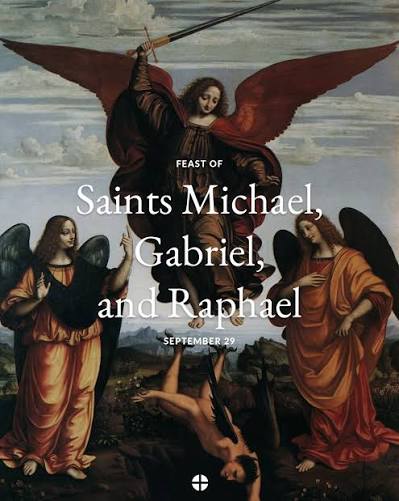
Today, y’all, is a holiday. Betcha didn’t know that. Today is the Feast of the Archangels. Now, I know every one of you knows who The Angel Gabriel is, since, you know, Christmas and all that. But, like those special offers on TV, WAIT THERE’S MORE! So, being me, and being who I am, I’m gonna teach for a second here, for those of you who are interested. Here we go……….
The liturgy celebrates the feast of these three archangels who are venerated in the tradition of the Church. Of the seven archangels, only three are named in Scripture. (Yes, according to the Book of Tobit, there are seven: The idea of seven archangels is most explicitly stated in the deuterocanonical Book of Tobit when Raphael reveals himself, declaring: “I am Raphael, one of the seven angels who stand in the glorious presence of the Lord, ready to serve him.” (Tobit 12,15) So, going on….. Michael (Who is like God?) was the archangel who fought against Satan and all his evil angels, defending all the friends of God. He is the protector of all humanity from the snares of the devil. Gabriel (Strength of God) announced to Zachariah the forthcoming birth of John the Baptist, and to Mary, the birth of Jesus. His greeting to the Virgin, “Hail, full of grace,” is one of the most familiar and frequent prayers of the Christian people. Raphael (Medicine of God) is the archangel who took care of Tobias on his journey.
Angels are pure, created spirits. The name angel means servant or messenger of God. Angels are celestial or heavenly beings, on a higher order than human beings. Angels have no bodies and do not depend on matter for their existence or activity. They are distinct from saints, which men can become. Angels have intellect and will, and are immortal. They are a vast multitude, but each is an individual person. Archangels are one of the nine choirs of angels listed in the Bible. In ascending order, the choirs or classes are 1) Angels, 2) Archangels, 3) Principalities, 4) Powers, 5) Virtues, 6) Dominations, 7) Thrones, 8) Cherubim, and 9) Seraphim.
St. Michael
The name of the archangel Michael means, in Hebrew, who is like unto God? and he is also known as “the prince of the heavenly host.” He is usually pictured as a strong warrior, dressed in armor and wearing sandals. St. Michael the Archangel is mentioned more than any other angel in the Bible. His name appears in Scripture four times, twice in the Book of Daniel, and once each in the Epistle of St. Jude and the Book of Revelation. From Revelation we learn of the battle in heaven, with St. Michael and his angels combatting Lucifer and the other fallen angels (or devils). We invoke St. Michael to help us in our fight against Satan; to rescue souls from Satan, especially at the hour of death; to be the champion of the Jews in the Old Testament and now Christians; and to bring souls to judgment.
This day is referred to as “Michaelmas” in many countries and is also one of the harvest feast days. In England this is one of the “quarter days”, which was marked by hiring servants, electing magistrates, and beginning of legal and university terms. This day also marks the opening of the deer and other large game hunting season. In some parts of Europe, especially Germany, Denmark, and Austria, a special wine called “Saint Michael’s Love” (Michelsminne) is drunk on this day. The foods for this day vary depending on nationality. In the British Isles, for example, goose was the traditional meal for Michaelmas, eaten for prosperity, France has waffles or Gaufres and the traditional fare in Scotland used to be St. Michael’s Bannock (Struan Micheil) — a large, scone-like cake. In Italy, gnocchi is the traditional fare.
Patron: Against temptations; against powers of evil; artists; bakers; bankers; battle; boatmen; cemeteries; coopers; endangered children; dying; Emergency Medical Technicians; fencing; grocers; hatmakers; holy death; knights; mariners; mountaineers; paramedics; paratroopers; police officers; radiologists; sailors; the sick; security forces; soldiers; against storms at sea; swordsmiths; those in need of protection; Brussels, Belgium; Caltanissett, Sicily; Cornwall, England; Diocese of Pensacola-Tallahassee Florida; England; Germany; Archdiocese of Mobile, Alabama; Papua, New Guinea; Puebla, Mexico; San Miguel de Allende, Mexico; Sibenik, Croatia; Archdiocese of Seattle, Washington; Diocese of Springfield, Massachusetts.
Symbols: Angel with wings; dressed in armour; lance and shield; scales; shown weighing souls; millstone; piercing dragon or devil; banner charged with a dove; symbolic colors orange or gold.
Prayer: Saint Michael the Archangel, defend us in battle. Be our protection against the wickedness and snares of the devil. May God rebuke him we humbly pray; and do Thou, O Prince of the Heavenly Host, by the Power of God, cast into hell Satan and all the evil spirits, who prowl through the world seeking the ruin of souls. Amen.
St. Gabriel
St. Gabriel’s name means “God is my strength”. Biblically he appears three times as a messenger. He had been sent to Daniel to explain a vision concerning the Messiah. He appeared to Zachary when he was offering incense in the Temple, to foretell the birth of his son, St. John the Baptist. St. Gabriel is most known as the angel chosen by God to be the messenger of the Annunciation, to announce to mankind the mystery of the Incarnation.
The angel’s salutation to our Lady, so simple and yet so full of meaning, Hail Mary, full of grace, has become the constant and familiar prayer of all Christian people.
Patron: Ambassadors; broadcasting; childbirth; clergy; communications; diplomats; messengers; philatelists; postal workers; public relations; radio workers; secular clergy; stamp collectors; telecommunications; Portugal; Archdiocese of Seattle, Washington.
Symbols: Archangel; sceptre and lily; MR or AM shield; lantern; mirror; olive branch; scroll with words Ave Maria Gratia Plena; Resurrection trumpet; shield; spear; lily; symbolic colors, silver or blue.
Prayer to St. Gabriel:
O Blessed Archangel Gabriel, we beseech thee, do thou intercede for us at the throne of divine Mercy in our present necessities, that as thou didst announce to Mary the mystery of the Incarnation, so through thy prayers and patronage in heaven we may obtain the benefits of the same, and sing the praise of God forever in the land of the living. Amen.
St. Raphael
Our knowledge of the Archangel Raphael comes to us from the book of Tobit. His mission as wonderful healer and fellow traveller with the youthful Tobias has caused him to be invoked for journeys and at critical moments in life. Tradition also holds that Raphael is the angel that stirred the waters at the healing sheep pool in Bethesda. His name means “God has healed”.
Patron: Blind; bodily ills; counselors; druggists; eye problems; guardian angels; happy meetings; healers; health inspectors; health technicians; love; lovers; mental illness; nurses; pharmacists; physicians; shepherds; against sickness; therapists; travellers; young people; young people leaving home for the first time; Archdiocese of Dubuque, Iowa; Archdiocese of Seattle, Washington.
Symbols: Staff; wallet and fish; staff and gourd; archangel; young man carrying a staff; young man carrying a fish; walking with Tobias; holding a bottle or flask; symbolic colors, gray or yellow.
Prayer to St. Gabriel:
O Raphael, lead us towards those we are waiting for, those who are waiting for us! Raphael, Angel of happy meetings, lead us by the hand towards those we are looking for! May all our movements, all their movements, be guided by your light and transfigured by your Joy.
Angel guide of Tobias, lay the request we now address to you at the feet of Him on whose unveiled face you are privileged to gaze. Lonely and tired, crushed by the separations and sorrows of earth, we feel the need of calling to you and of pleading for the protection of your wings, so that we may not be as strangers in the province of Joy, all ignorant of the concerns of our country.
Remember the weak, you who are strong–you whose home lies beyond the region of thunder, in a land that is always peaceful, always serene, and bright with the resplendent glory of God.
Amen.
Collect: O God, who dispose in marvelous order ministries both angelic and human, graciously grant that our life on earth may be defended by those who watch over us as they minister perpetually to you in heaven. Through our Lord Jesus Christ, your Son, who lives and reigns with you in the unity of the Holy Spirit, one God, for ever and ever.
Don’t Tell Me, Show Me: Faith That Works in the Vineyard~The Rev Frank Bellino,OPI
Before I begin, let me make one thing clear: I love this parish too much to stand at this ambo and feed you comfortable lies. What God has placed on my heart today isn’t polite, and it isn’t gentle. It convicts me just as much as it challenges every single person sitting in these pews. Truth spoken in love sometimes stings, but a shepherd’s job is to pull the sheep out of the ditch, even if the grab hurts. So, open your hearts, because Jesus is calling all of us to real, uncompromising accountability today.
I have spent an entire lifetime in service—in military uniform, in law enforcement, and now at this altar. My duty now is to get you to heaven. And if there is one hard, unshakeable truth that four decades on the front lines will burn into your soul, it is this: talk is cheap. In the real world, nobody gives a damn about what you said you were going to do. When the call comes in, when people are hurting, when the mission is on the line, words without action are nothing but hot air coming out of your mouth. Don’t tell me what you believe. Don’t tell me your good intentions. Show me. Put your boots on the ground and show me. Love is action.
That is the exact, brutal reality check Jesus drops on the religious establishment in today’s Gospel. He lays out two sons. The second son has all the right manners, the proper religious pedigree, and the polite church smile: “Yes, sir.” He talks a big game. He checks every outward social box. But his boots never touch the mud of the vineyard. He didn’t do a single thing he promised. And the prophet Ezekiel makes it crystal clear that God does not grade on a curve of past reputation, titles, or pious excuses. If you stand there professing righteousness while living a lie, you are dead in your tracks. God has zero patience for hollow lip-service, and neither should we.
Then Christ points to the first son. That son wasn’t polished. He wasn’t polite. He snapped back: “I will not.” He pushed back, he made the wrong call, and he failed right out of the gate. But the truth struck his conscience. He swallowed his stubborn pride, changed his mind, repented, and went out into the dirt and did the hard labor. And Jesus looks those high-and-mighty chief priests right in the eyes and delivers the verdict: the tax collectors and the prostitutes—the broken, messy sinners who actually listened, repented, and changed direction—are kicking down the doors of the Kingdom of God ahead of the church folks who smile, nod, and do nothing. As Dominicans, our motto is Veritas—Truth! But truth isn’t an academic theory you debate in an air-conditioned room. Truth is a fire that demands conversion and demands sweat.
And let’s call it what it is: too many people treat their faith like a cafeteria line. They stroll through the teachings of Christ and pick out the blessings, the forgiveness, and the easy grace, while sliding right past obedience, self-denial, accountability, and the hard commands of the Gospel. You don’t get to pick and choose which parts of Jesus you follow. Christ never said, “Take up your cross when it fits your schedule or aligns with your personal preferences.” He demanded everything. You cannot demand the privileges of being a son or daughter in the Father’s house if you refuse to step foot in His vineyard. You are either all in with Christ, or you are just standing on the sidelines playing church.
Look at our Lord Jesus Christ in Paul’s letter to the Philippians. He didn’t sit high and mighty in the comfort of heaven offering us inspirational slogans from a safe distance. He stripped Himself of His glory. He took the form of a servant. He put Himself in the dirt, took the cross on His bleeding shoulders, and was obedient even unto death. Calvary wasn’t a speech, it was raw, sacrificial, agonizing action. Jesus didn’t just say He loved us; He drove the nails through His own hands to prove it.
We cannot come into this church, raise our hands in praise, sing modern worship songs, receive the very Body and Blood of Christ, and then walk out those double doors into the parking lot and live like practical atheists until next Sunday. If your faith does not change how you treat your spouse, how you handle your business, how you stand up for the weak, and how you get down in the trenches to serve the hurting, then your religion is completely useless. Faith without boots-on-the-ground execution is stone-cold dead.
So look yourself in the mirror right now and cut through every excuse: are you doing lip service, or are you doing what it takes to get yourself and others to the Kingdom of Heaven?
From the Custom Post to the Cross: The Radical Mercy of St Matthew~The Feast of St Matthew~The Very Rev Lady Sherwood,OPI
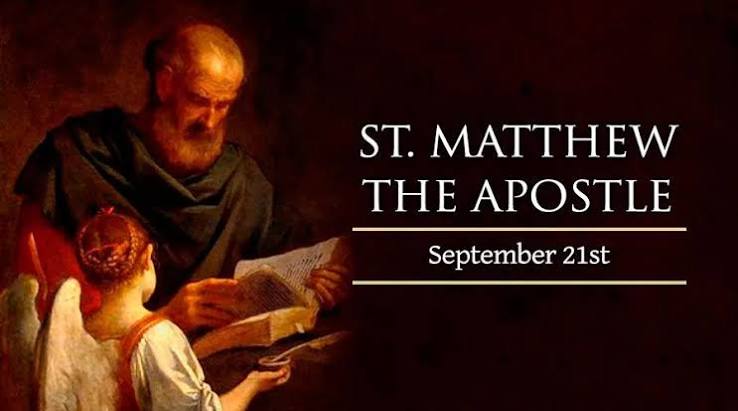
St Matthew’s transformation from a rejected tax collector into an apostle reminds us that no one is beyond the reach of divine mercy, and that God often chooses the most unlikely among us to accomplish extraordinary grace.
In first-century Capernaum, few figures were as deeply despised as the publicans—the tax collector. Matthew was seen as a collaborator with Roman oppressors, a man who extortionately traded the trust of his own community for personal wealth. He was, for all practical purposes, considered spiritually bankrupt and socially irredeemable by the religious establishment of his day.
Yet, when Jesus passed by the custom post, He did not look at Matthew with condemnation, cold judgement, or social disdain. He saw past the ledger books, the greed, and the isolation, beholding instead a soul ready for renewal. With two simple words—“Follow me”—Jesus offered an immediate path to redemption. Matthew’s response was radical and unhesitating: he left behind his wealth, his position, and his security to rise and follow Christ.
This dramatic turning point reveals fundamental truths about the nature of faith and discipleship:
Grace Precedes Merit: Jesus did not wait for Matthew to reform his life or abandon his tax booth before calling him. The invitation was extended while Matthew was still sitting in his sin, demonstrating that God’s mercy is an unmerited gift, not a reward for good behaviour.
Mercy as a Feast:
Immediately following his call, Matthew hosted a great banquet at his house for Jesus, opening his doors to “tax collectors and sinners.” When questioned by the Pharisees, Jesus declared His divine mission: “I desire mercy, not sacrifice. For I have not come to call the righteous, but sinners.”
A Transformed Purpose:
The meticulous record-keeping skills Matthew once used to tally debts and taxes were sanctified for a higher calling. He used his pen to write the Gospel that bears his name, recording the teachings, parables, and beatitudes of Jesus to enrich believers for millennia.
Matthew’s story serves as a profound comfort for anyone who feels unworthy, burdened by past mistakes, or trapped by societal labels. God does not write off what the world considers broken. Instead, Christ enters into the messy custom posts of our lives, calling us towards a purpose far greater than our past.
Let us pray:
O Almighty God, who by Your blessed Son didst call Matthew from the receipt of custom to be an Apostle and Evangelist:
Grant us grace to forsake all covetous desires and inordinate love of riches, and to follow the same Jesus Christ Your Son, who lives and reigns with You and the Holy Spirit, one God, now and for ever. Give us the courage to answer Your call without hesitation, the humility to welcome sinners as our brothers and sisters, and the faith to use whatever gifts we possess for the glory of Your kingdom.
Amen.


You must be logged in to post a comment.