
The Emmaus Mystery:The Story Behind the Story ~The Rev Frank Bellino, OPI
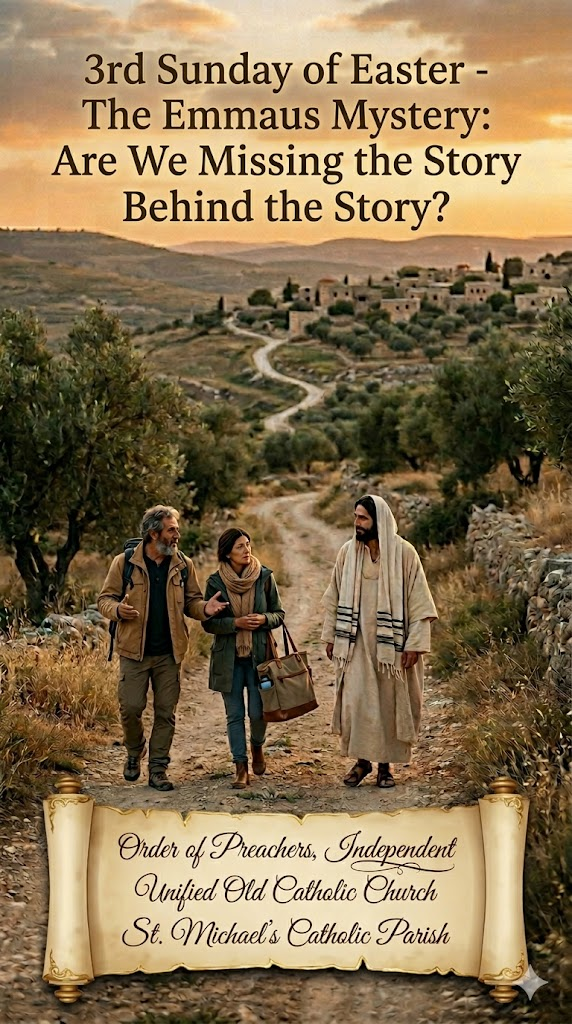
We have heard the account of the Road to Emmaus thousands of times; it has been immortalized in our hymns, captured in famous paintings, and dramatized on the big screen. It is easy to treat it as a beautiful, pious memory. But if we look at the 3rd Sunday of Easter (Cycle A) with fresh eyes, we must ask: what is the real story behind the story? When we strip away the familiar Sunday School version, we find a narrative that is raw, tense, and deeply relevant to the world we walk in today. Consider the scene: two disciples are walking seven miles away from Jerusalem. In the wake of a state execution and the chaos of an empty tomb, Jerusalem was a powder keg. As followers of a man just crucified as a criminal, these disciples were essentially “wanted” by association. Imagine their internal state. They are talking, processing their grief, and suddenly, a total stranger joins their stride. In a world of Roman informants and religious zealots, wouldn’t you be concerned? Wouldn’t you be looking over your shoulder, wondering if this “stranger” was an undercover guard sent to round up the rest of the group? This wasn’t a casual stroll; it was a walk defined by caution and a heavy sense of defeat. They were walking away from their dreams because, as far as they were concerned, the story was over.
This leads us to a deeper mystery: why did Jesus do it this way? If He wanted to prove He was resurrected, why not appear in a flash of blinding light? Why the secrecy? Why did He “prevent” them from recognizing Him at first? Jesus wasn’t playing a game of hide-and-seek; He was performing spiritual surgery. He kept His identity veiled so that these disciples would have to listen to the Word before they looked at the Wound. He wanted their hearts to burn with the truth of the Scriptures before their eyes were dazzled by His glory. He spent those seven miles teaching them—and us—that He is present even when He is “unrecognizable.” He was training them for an era of faith where we would no longer see Him physically but would find Him in the opening of the Scriptures and the Breaking of the Bread. If at the end He was going to tell them anyway, the “long way around” served to prove that the journey of faith is just as vital as the destination.
So, why does a “secret walk” from 2,000 years ago really matter to us today? It matters because we are all on a seven-mile walk. We all have moments when the world feels dangerous, when our hopes feel shattered, and when we are tempted to close ourselves off from the “strangers” around us. This Gospel is not just a great story to pass on for thousands of years; it is a direct challenge to how we live our lives. We are called to an “Emmaus Shift”—to realize that Jesus often meets us in the unrecognizable, the unexpected person, or the mundane moments of our week. We are called to be a people of the “Burning Heart,” coming to the Word not just for information, but for an encounter that changes our direction. Our ultimate call is to see Christ in the “Breaking of the Bread” on this altar and then to be His presence for others.
The disciples didn’t stay in Emmaus. Once their eyes were opened, they ran back to Jerusalem in the dark to tell the others. When we leave St. Michael’s today, we don’t just go back to our routines; we go out to patrol the faith, looking for the Risen Lord in the faces of our neighbors and the challenges of our city. The “meat” of this Gospel is that the walk isn’t over—the Savior is walking right beside you. The question remains: will you recognize Him?


You must be logged in to post a comment.