
Category: Dominican Saints

Blessed Anthony Neyrot

Blessed Anthony Neyrot occupies a unique place in Dominican history, as he is the only one among the beautified who ever renounced the faith. He expiated his sin with an act of heroism that merited heaven, washing away in his own blood the denial that might have cost him his soul.
Of the childhood of Blessed Anthony, we know nothing that he was born at Rivoli, in Italy. He was accepted into the Order by Saint Antoninus, who must have been particularly fond of the young man, since he gave him his own name. Completing his studies, Anthony was ordained and lived for a time at San Marco, the famous Dominican convent in Florence. Then, becoming restless and dissatisfied, he asked for a change of mission. He was sent to Sicily, but this did not prove to his liking either so he set out for Naples.
Brother Anthony was sailing from Sicily to Naples when pirates captured the ship. Anthony was taken to Tunis and sold as a slave. He was able to win his freedom, but fell away from the Church. He denied his faith in Jesus and abandoned his religious vocation. He accepted the Koran, the diabolical book of the Muslims. For several months, he practiced the Muslim religion. He also married.
In the meantime, his former Dominican prior, the saintly Antoninus, died. This led Anthony to have a shocking experience. It seems that one night, Anthony had something like a dream. St. Antoninus appeared to him. The conversation between the two men was to lead to a radical change in Anthony. He became truly sorry for having betrayed the Lord. He knew that in his heart he could never give up his faith in Jesus. He knew that he could only be a Catholic. And he realized that he still wanted very much to be a Dominican brother.
Blessed Anthony sent his wife back to her family. He then put on his white Dominican habit. In spite of his fear, he went to see the ruler of Tunis. A large crowd gathered and the ruler came out to the courtyard. Brother Anthony publicly admitted he had made a terrible mistake becoming a Muslim. He was a Catholic. He believed in and loved Jesus. He was a Dominican and wanted to be so for all his life. The ruler was angry. He threatened and then made promises of rewards if only Anthony would take back what he was saying. But Anthony would not. He knew this meant his death.
Anthony knelt and began to pray for the courage to give his life for Jesus. Suddenly he felt the large stones pounding him. He just kept praying for the strength to remain true to the Lord. Then he lost consciousness. Anthony died a martyr in 1460. Some merchants from Genoa, Italy, took his remains back to his own country.
Born: 1420
Died: Martyred on Holy Thursday, 1460
Blessed Anthony Pavonius

Antony grew up to diately was engaged in combatting the heresies of the Lombards. be a pious, intelligent youth. At 15, he was received into the monastery of Savigliano, was ordained in 1351.
Pope Urban V, in 1360, appointed him inquisitor-general of Lombardy and Genoa, making him one of the youngest men ever to hold that office. It was a difficult and dangerous job for a young priest of 34. Besides being practically a death sentence to any man who held the office, it carried with it the necessity of arguing with the men most learned in a twisted and subtle heresy.
Antony worked untiringly in his native city, and his apostolate lasted 14 years. During this time, he accomplished a great deal by his preaching, and even more by his example of Christian virtue. He was elected prior of Savigliano, in 1368, and given the task of building a new abbey. This he accomplished without any criticism of its luxury–a charge that heretics were always anxious to make against any Catholic builders.
The consistent poverty of Antony’s life was a reproach to the heretics, who had always been able to gain ground with the poor by pointing out the wealth of religious houses. He went among the poor and let them see that he was one of them. This so discomfited the heretics that they decided they must kill him. He was preaching in a little village near Turin when they caught him.
The martyrdom occurred in the Easter octave. On the Saturday after Easter, he asked the barber to do a good job on his tonsure because he was going to a wedding. Puzzled, the barber complied. On the Sunday after Easter, as he finished preaching a vigorous sermon against heresy at Brichera, seven heretics fell upon him with their daggers, and he hurried off to the promised “wedding.” He was buried in the Dominican church at Savigliano, where his tomb was a place of pilgrimage until 1827. At that time the relics were transferred to the Dominican church of Racconigi.
Oddly enough, this Dominican Antony takes after his Franciscan namesake. He is also invoked to find lost articles.
Born: 1326 at Savigliano, Italy
Died: Martyred in 1374 at Turino, Italy
Beatified: 1868
Patronage: Lost Articles
Blessed Sybil Biscossis
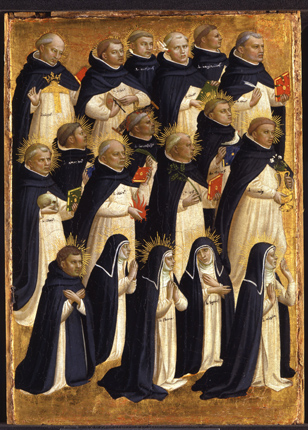 Sybillina’s parents died when she was tiny and as soon as she was old enough to be of use to anyone, the neighbors, who had taken her in at the time she was orphaned, put her out to work. She must have been very young when she started to work, because at the age of 12, when she became blind and could not work any more, she already had several years of work behind her.
The cause of her blindness is unknown, but the child was left doubly destitute with the loss of her sight. The local chapter of the Dominican tertiary sisters took compassion on the child and brought her home to live with them. After a little while of experiencing their kind help, she wanted to join them. They accepted her, young though she was, more out of pity than in any hope of her being able to carry on their busy and varied apostolate.
They were soon agreeably surprised to find out how much she could do. She learned to chant the Office quickly and sweetly, and to absorb their teaching about mental prayer as though she had been born for it. She imposed great obligations of prayer on herself, since she could not help them in other ways. Her greatest devotion was to Saint Dominic, and it was to him she addressed herself when she finally became convinced that she simply must have her sight back so that she could help the sisters with their work.
Praying earnestly for this intention, Sybillina waited for his feast day. Then, she was certain, he would cure her. Matins came and went with no miracle; little hours, Vespers–and she was still blind. With a sinking heart, Sybillina knelt before Saint Dominic’s statue and begged him to help her. Kneeling there, she was rapt in ecstasy, and she saw him come out of the darkness and take her by the hand.
He took her to a dark tunnel entrance, and she went into the blackness at his word. Terrified, but still clinging to his hand, she advanced past invisible horrors, still guided and protected by his presence. Dawn came gradually, and then light, then a blaze of glory. “In eternity, dear child,” he said. “Here, you must suffer darkness so that you may one day behold eternal light.”
Sybillina, the eager child, was replaced by a mature and thoughtful Sybillina who knew that there would be no cure for her, that she must work her way to heaven through the darkness. She decided to become a anchorite, and obtained the necessary permission. In 1302, at the age of 15, she was sealed into a tiny cell next to the Dominican church at Pavia. At first she had a companion, but her fellow recluse soon gave up the life. Sybillina remained, now alone, as well as blind.
The first seven years were the worst, she later admitted. The cold was intense, and she never permitted herself a fire. The church, of course, was not heated, and she wore the same clothes winter and summer. In the winter there was only one way to keep from freezing–keep moving–so she genuflected, and gave herself the discipline. She slept on a board and ate practically nothing. To the tiny window, that was her only communication with the outside world, came the troubled and the sinful and the sick, all begging for her help. She prayed for all of them, and worked many miracles in the lives of the people of Pavia.
One of the more amusing requests came from a woman who was terrified of the dark. Sybillina was praying for her when she saw her in a vision, and observed that the woman–who thought she was hearing things–put on a fur hood to shut out the noise. The next day the woman came to see her, and Sybillina laughed gaily. “You were really scared last night, weren’t you?” she asked. “I laughed when I saw you pull that hood over your ears.” The legend reports that the woman was never frightened again.
Sybillina had a lively sense of the Real Presence and a deep devotion to the Blessed Sacrament. One day a priest was going past her window with Viaticum for the sick; she knew that the host was not consecrated, and told him so. He investigated, and found he had indeed taken a host from the wrong container.
Sybillina lived as a recluse for 67 years. She followed all the Masses and Offices in the church, spending what few spare minutes she had working with her hands to earn a few alms for the poor (Attwater2, Benedictines, Dorcy).
Born: 1287 at Pavia, Lombardy, Italy
Died: 1367 of Natural Causes: Her body remains Incorrupt
Beatified: 1853 (Cultus confirmed); 1854 beautified
Patronage: Children whose parents are not married, illegitimacy, loss of parents
BLESSED ISNARD OF CHIAMPO
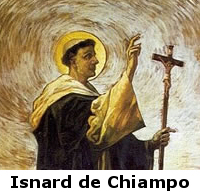 Blessed Isnard is another very distinguished and saintly first disciple of Saint Dominic whom Father Touron somehow overlooked. Of Isnard’s life up to the time he entered the Order practically nothing is known with certainty; whilst some of the statements anent his debut as a Friar Preacher are irreconcilable among themselves, and contrary to facts which have been ascertained in later years. Chiampo, a small town not far from Vicenza, Italy, was most likely the place of his birth; yet there are those who give the latter city this honor. Some think he was born of poor parents, and spent his youth in poverty. Others suggest that he belonged to a wealthy family by the name of Isnardi, which has been long extinct.(1)
It is beyond doubt that the future wonder-worker received the habit in Bologna, from Saint Dominic, in 1219; for this is a point on which nearly all the early authors are in accord. This truth seems certainly to prove that he was a student at the university there, and far advanced in his studies, At that time only such applicants were accepted; and this fact is a strong proof that his parents were well-to-do, for only the sons of this kind were given a higher education. Without exception the writers tell us of his singular purity of heart and religious disposition. His mind had been carefully guarded against the evils of the day, and in Bologna he proved faithful to the lessons of his earlier youth. Association with the holy man from Caleruega quickened his efforts for holiness of life and the salvation of souls.
For ten years after he entered the Order of Saint Dominic, we have no positive knowledge of where Isnard made his home. Yet the indications are that he spent this time between Bologna and Milan. In which case, of course, he labored energetically in those parts of Italy. Although a quite corpulent man, we are told, he was endowed with extraordinary energy, and was very gracious in action as well as in word. San Eustorgio, Milan, was most likely his convent for the greater part of this decade. So at least thinks Rudolph Majocchi, Blessed Isnard’s latest hagiographer.(2)
In more than one of our sketches, but especially in that of Saint Peter of Verona, we have seen how the Albigenses and kindred sects overran northern Italy at that date. Milan was one of the centers of Dominican activity against them; and it was from Milan that the convent of the Order in Pavia was founded. At Pavia the heretics were long in the ascendancy. The city was also a stronghold of Frederic II, whose Ghibellines, always opposed to the Holy See, constantly persecuted those who favored the authority of the Church. When, in 1230, zealous Rodobald Cipolla became bishop of Pavia, he found religion in a sad plight in his diocese, and began at once to seek means for a reformation.
Blessed Isnard’s reputation for holiness of life, zeal, eloquence, power over the souls of others, and fearlessness was broadcast. Most likely he had already preached in the Diocese of Pavia — perhaps many times; for the Friars Preacher of Milan carried their work in every direction. Possibly, too, he and Bishop Cipolla, himself an energetic character, had become friends at a prior date. Anyway, one of the new prelate’s first steps for the spiritual betterment of his flock was to invite the subject of our narrative from Milan, that he might establish a house of the Order at Pavia. This was in 1231; and before the close of the year we find the fathers actively engaged in their apostolate under the leadership of the man of God from Chiampo.(3)
The convent, which Rodobald Cipolla generously helped to erect, stood in the little village of Ticino, a short distance outside the walls of Pavia, and was given the name of Saint Mary of Nazareth. Throughout Italy the Friars Preacher were known as an effective aid to the hierarchy against the evils of the day. Thus Bishop Cipolla felt that, at least under Isnard, they would be an immense help to him in putting an end to the inroads of the enemy, and in freeing his diocese from the many ills in which it was enmeshed. He had not long to wait before he saw that his choice of auxiliaries was no mistake.
However, the task proved difficult, trying, and full of danger. On the one hand, the faithful, through long bad associations, had become so cold, careless, and wayward in the practice of their religious duties that it was exceeding hard to arouse them to a sense of their obligations. On the other, the Ghibellines and sectarians, ever of stubborn mood as well as violent in their methods, were even less subject to management. These possessed little or no faith. Besides they were loath to change their views, to amend their lives, or to part with the earthly goods which they had obtained by robbery or dishonesty.
As is ever the case in such conditions, the Friar Preacher’s success began with the poor and the laboring classes. For these he had a special love. He gathered them around him at the conventual church, instructed them in their religion, and inspired them with a love of its practice. Although he met with much opposition at first, it was not long before he had completely changed their lives. Reports of the good thus effected soon spread near and far. Meanwhile, he and his confrères preached throughout the City of Pavia and its environments — in churches, public squares, market places, or wherever they could find a space large enough for an audience. Gradually the wealthier Guelfs, and even not a few of the Ghibellines, began to harken to the call of grace and to receive the sacraments.
Among the little band of missioners Isnard shone with special brilliancy for his saintliness, zeal, and eloquence. The influence which he soon began to wield over the people caused the leaders of the heretics to single him out for their hatred. They mocked and ridiculed him, publicly spurned him, laughed at his corpulent figure, defamed him, threatened him, did everything in their power either to bring him into disrepute or to make him desist from his tireless apostolate. All was in vain. His sermons were incessant. He challenged his enemies wherever he met them. If they undertook to answer him, his inexorable logic put them to shame, or reduced them to silence. Never was he known to be ill natured, or to lose his patience; yet he showed the fire of divine love that glowed within his breast.
No doubt as much to demonstrate the holiness of His faithful servant as for the benefit of those to whom he preached, God blessed Isnard with the gift of miracles. The early writers mention many wrought by him both before and after his death.(4) These, quite naturally, quickened and strengthened the faith of the Catholics. They also gradually undermined the influence and broke the spirit of the heretics, many of whom were brought into the Church. By the time of the holy man’s death, the Diocese of Pavia was free from attacks by Albigenses, Catharists, and similar sects. They bad gone to other parts, been converted, or held their peace. No one could be found who would profess their principles. It was a glorious apostolate brought to a successful termination.
The Ghibellines, or adherents of Emperor Frederic II, gave Christ’s ambassador no end of worry and trouble. These were the rich who were not guided by their consciences in the acquisition of wealth; politicians without scruples; and soldiers of fortune, whose restless spirits ever led them into the service in which they might expect the greatest booty, license, and excitement. The machinations of the German monarch helped to keep them in keen antagonism to ecclesiastical authority and the interests of religion; which, of course, rendered them less responsive to our blessed’s impelling eloquence or the strong influence of his holiness and miracles. We may judge of the contempt of these friends of Frederic for the Holy See from the fact that their acts more than once led to a papal interdict on Pavia.
Still these men, who could laugh at an excommunication and interdict from the highest authority in the Church, perforce loved and admired Father Isnard. His charity, his zeal, his gentle goodness, his purity of heart, his constant efforts for the right, which they witnessed day by day, simply wrung respect from them. His dealings with Frederic II must have been much like those of John of Wildeshausen. Even when Bishop Cipolla was driven into exile, Isnard and his band of missionaries were left to continue their fruitful labors. In the absence of the ordinary, the clergy who still remained in the diocese seem to have gathered around the subject of our sketch for guidance. Possibly the saintly prelate, at the time of his departure, placed him in charge of his spiritual vineyard.(5)
Despite the turbulence and the anti-ecclesiastical spirit of the day, the holy Friar Preacher from Chiampo effected untold good even among this class of citizens. Documents which have escaped the ravages of time show that some, who deferred conversion until on their deathbeds, made him the instrument of their restitution. Others entrusted him with their charity and benefactions. Historians call him an apostle of Pavia, and largely attribute the preservation of the faith in the city to his zeal.
Another proof of the respect and confidence which Isnard enjoyed among all classes, as well as of his reputation abroad, is found in the incident which we have now to tell. From early times the Diocese of Tours, France, possessed landed estates in and around Pavia. Because of the political disturbances and the Ghibelline spirit, to which we have referred, the canons of the Tours cathedral found it impossible to collect their rents. In this dilemma, they appointed our Friar Preacher their agent; for they felt that he was the only man in northern Italy who either could obtain their dues for them, or would dare undertake the task. This was in 1240, the year after the historic excommunication of Frederic 11 by Gregory IX. The affair shows bow wisely Isnard steered his course, how all venerated him at home, and how well his courage and prudence were known even in France.(6)
Like a number of the early disciples of Saint Dominic whose lives we have outlined, the apostle and reformer of Pavia did not feel that he had done his all for the benefit of religion until he established a community of Dominican Sisters. These he placed in the immediate vicinity of his own convent, that he might the better look after their spiritual welfare. Their house bore the same name as that of the fathers — Saint Mary of Nazareth. Although he had perhaps never seen Prouille, his double institution at Pavia must have been much like that with which the Order started in southern France. The dowries of many of these sisters indicate that he founded them, in part, so that wealthy worldly dames, whom he had converted, might have a place in which they could more completely give themselves to the service of God. Saint Dominic, it will be recalled, established the community of Prouille principally with women converted from Albigensianism. When, some years after our blessed’s death, the fathers moved into the city proper, the original Saint Mary of Nazareth was turned over to the sisters.
Isnard had a profound devotion towards the Mother of God. He perpetually preached her protection over the faithful. In every way he propagated love and veneration for her. Father Majocchi thinks that this apostolate was of immense aid to him in his work of reformation; for no other piety seems to be more congenital to the affectionate Italian character. He labored zealously on almost to the very last. At least the Lives of the Brethren (Vitae Fratrum) say his final sickness was a matter of only a few days. The manuscript annals, or chronicles, of the old Friar-Preacher convent at Pavia tell us that he surrendered his pure soul to God on March 19, 1244. He knew that the end was near, prepared for it, and died as holily as he had lived.(7)
We have no account of the funeral of the man of God. Yet the great love and admiration in which he was held justify one in the belief that the Pavians attended it in immense numbers. Perhaps the sad event plunged the city in no less grief than his own community. He was buried in the Church of Saint Mary of Nazareth, where his tomb became at once a place of pilgrimage for the city and province of Pavia. Not a few miracles were wrought in answer to prayers to him. The name Isnard was often given to children at their baptism.
Later, for various reasons, the fathers moved into the city proper. First (1281), they took possession of San Marino, but gave up this place the next year for Saint Andrew’s. There they remained until 1302, when they exchanged Saint Andrew’s for Saint Thomas’, which was better suited to their purposes. At this last location they at once began a splendid temple of prayer, which was completed between 1320 and 1330. The body of Blessed Isnard, which had been brought from the extra-urban Church of Saint Mary of Nazareth to Saint Andrew’s, while the fathers lived in the latter convent, was again translated and enshrined in a marble sarcophagus built for the purpose in a chapel of the new Saint Thomas’ Church. The devotion of the people followed his relies to both of these places of rest. Nor is it any stretch of fancy to imagine that the two translations were times of great fervor for all Pavia.
Unfortunately, in a spirit of zeal and friendship, the fathers gave the use of Blessed Isnard’s Chapel, as it was called, to the University of Pavia for religious functions. Although its walls were afterwards decorated with paintings commemorative of the chief events in his life, these academic associations tended rather to decrease veneration for the saintly Friar Preacher. The misfortunes of Pavia during the Spanish-Austrian reigns of Charles V and Philip III, which lasted almost throughout the sixteenth century, well-nigh caused him (or rather his final resting-place) to be forgotten even by some members of his own Order, and his relies to be scattered to the winds. Happily the researches of Pavian historians helped to avert such a disaster.
In spite of the most thorough identification, however, and to the great sorrow of the fathers, the rector and senate of the university, though without authority in the matter, later compelled our blessed’s sarcophagus to be taken from the chapel and destroyed. This was in 1763. But, before its removal, the community reverently gathered up his relies and placed them in a wooden chest. All this was done in the presence of Cardinal Charles Francis Durini, who then closed the box, and fastened it with his seal. Thence until the suppression of Saint Thomas’ Convent by Emperor Joseph II, in 1785, Isnard’s relies were carefully preserved in the archives. The fathers then took the chest, with its precious contents, to Saint Peter’s. When, in 1799, they were also forced to leave this abode, they gave their spiritual treasure to Bishop Joseph Bertieri, O. S. A. This prelate, after an official examination, not only entrusted Isnard’s relies to the Church of Saints Gervasius and Protasius, but even ordered them to be exposed for public veneration.
It looks providential that, under all these changes and difficulties, popular devotion for Saint Dominic’s early disciple did not completely die out. That it continued to exist shows the unalterable love in which the Pavians held him. Bishop Bertieri’s act gave it new life. In 1850 portions of his relies were given to Chiampo and Vicenza. Old paintings of him here and there, which represented him as a saint, also helped the cause. In 1907 the diocesan authorities of Pavia approved of his cult, and requested the Holy See to accept their decision. The late Benedict XV, of happy memory, after a thorough investigation by the Sacred Congregation of Rites (that is, in 1919), granted his office and mass to the Friars Preacher and the Diocese of Pavia. March 22 was appointed as his feast day.
Isnard is the last of the original disciples of Dominic to be accorded the honors of the altar. The late date of his beatification affords the hope that several others of them may yet he similarly dignified by the Church.
Fra Angelico
 Fra Angelico (c. 1395 – February 18, 1455), born Guido di Pietro, was an Early Italian Renaissance painter described by Vasari in his Lives of the Artists as having “a rare and perfect talent”. He was known to his contemporaries as Fra Giovanni da Fiesole (Brother John from Fiesole) and by Vasari as Fra Giovanni Angelico (Brother John the Angelic One).
Fra Angelico is known in Italy as il Beato Angelico, the term “Il Beato” (“Blessed One”) being already in use during his lifetime or shortly thereafter, in reference to his skills in painting religious subjects. In 1982 Pope John Paul II conferred beatification, in recognition of the holiness of his life, thereby making this title official. Fiesole is sometimes misinterpreted as being part of his formal name, but it was merely the name of the town where he took his vows as a Dominican friar, and was used by contemporaries to separate him from other Fra Giovannis. He is listed in the Roman Martyrology as Beatus Ioannes Faesulanus, cognomento Angelicus—”Blessed Giovanni of Fiesole, nicknamed Angelico”.
Vasari wrote of Fra Angelico: But it is impossible to bestow too much praise on this holy father, who was so humble and modest in all that he did and said and whose pictures were painted with such facility and piety.
Early life, 1395–1436
Fra Angelico was born Guido di Pietro at Rupecanina,[7] in the Tuscan area of Mugello, near Fiesole towards the end of the 14th century and died in Rome in 1455. Nothing is known of his parents. He was baptized Guido or Guidolino. The earliest recorded document concerning Fra Angelico dates from October 17, 1417 when he joined a religious confraternity at the Carmine Church, still under the name of Guido di Pietro. This record also reveals that he was already a painter, a fact that is subsequently confirmed by two records of payment to Guido di Pietro in January and February 1418 for work done in the church of Santo Stefano del Ponte. The first record of Angelico as a friar dates from 1423, when he is first referred to as Fra Giovanni, following the custom of those entering a religious order of taking a new name. He was a member of the Dominican community at Fiesole. Fra, an abbreviation of frate (from the Latin frater), is a conventional title for a friar or brother.
According to Vasari, Fra Angelico initially received training as an illuminator, possibly working with his older brother Benedetto who was also a Dominican and an illuminator. San Marco in Florence holds several manuscripts that are thought to be entirely or partly by his hand. The painter Lorenzo Monaco may have contributed to his art training, and the influence of the Sienese school is discernible in his work. He had several important charges in the convents he lived in, but this did not limit his art, which very soon became famous. According to Vasari, the first paintings of this artist were an altarpiece and a painted screen for the Carthusian Monastery of Florence; none such exist there now.[2]
From 1408 to 1418 Fra Angelico was at the Dominican friary of Cortona where he painted frescoes, now destroyed, in the Dominican Church and may have been assistant to or follower of Gherardo Starnina. Between 1418 and 1436 he was at the convent of Fiesole where he also executed a number of frescoes for the church, and the Altarpiece, deteriorated but restored. A predella of the Altarpiece remains intact in the National Gallery, London which is a superb example of Fra Angelico’s ability. It shows Christ in Glory, surrounded by more than 250 figures, including beatified Dominicans.
San Marco, Florence, 1436–1445
In 1436 Fra Angelico was one of a number of the friars from Fiesole who moved to the newly-built Friary of San Marco in Florence. This was an important move which put him in the centre of artistic activity of the region and brought about the patronage of one of the wealthiest and most powerful members of the city’s Signoria, Cosimo de’ Medici, who had a large cell (later occupied by Savonarola) reserved for himself at the friary in order that he might retreat from the world. It was, according to Vasari, at Cosimo’s urging that Fra Angelico set about the task of decorating the monastery, including the magnificent Chapter House fresco, the often-reproduced Annunciation at the top of the stairs to the cells, the Maesta with Saints and the many smaller devotional frescoes depicting aspects of the Life of Christ that adorn the walls of each cell.
In 1439 he completed one of his most famous works, the Altarpiece for St. Marco’s, Florence. The result was unusual for its times. Images of the enthroned Madonna and Child surrounded by saints were common, but they usually depicted a setting that was clearly heavenlike, in which saints and angels hovered about as divine presences rather than people. But in this instance, the saints stand squarely within the space, grouped in a natural way as if they were able to converse about the shared experience of witnessing the Virgin in glory. Paintings such as this, known as Sacred Conversations, were to become the major commissions of Giovanni Bellini, Perugino and Raphael.
The Vatican, 1445–1455
In 1445 Pope Eugenius IV summoned him to Rome to paint the frescoes of the Chapel of the Holy Sacrament at St Peter’s, later demolished by Pope Paul III. Vasari claims that at this time Fra Angelico was offered by Pope Nicholas V the Archbishopric of Florence, and that he refused it, recommending another friar for the position. While the story seems possible and even likely, if Vasari’s date is correct, then the pope must have been Eugenius and not Nicholas. In 1447 Fra Angelico was in Orvieto with his pupil, Benozzo Gozzoli, executing works for the Cathedral. Among his other pupils were Zanobi Strozzi.
From 1447 to 1449 he was back at the Vatican, designing the frescoes for the Niccoline Chapel for Nicholas V. The scenes from the lives of the two martyred deacons of the Early Christian Church, St. Stephen and St. Lawrence may have been executed wholly or in part by assistants. The small chapel, with its brightly frescoed walls and gold leaf decorations gives the impression of a jewel box. From 1449 until 1452, Fra Angelico was back at his old convent of Fiesole, where he was the Prior.
Death and beatification
In 1455 Fra Angelico died while staying at a Dominican Convent in Rome, perhaps in order to work on Pope Nicholas’ Chapel. He was buried in the church of Santa Maria sopra Minerva.
When singing my praise, don’t liken my talents to those of Apelles.
Say, rather, that, in the name of Christ, I gave all I had to the poor.
The deeds that count on Earth are not the ones that count in Heaven.
I, Giovanni, am the flower of Tuscany.
—Translation of epitaph
Pope John Paul II beatified Fra Angelico on October 3, 1982 and in 1984 declared him patron of Catholic artists.
Angelico was reported to say “He who does Christ’s work must stay with Christ always”. This motto earned him the epithet “Blessed Angelico”, because of the perfect integrity of his life and the almost divine beauty of the images he painted, to a superlative extent those of the Blessed Virgin Mary.
From various accounts of Fra Angelico’s life, it is possible to gain some sense of why he was deserving of canonization. He led the devout and ascetic life of a Dominican friar, and never rose above that rank; he followed the dictates of the order in caring for the poor; he was always good-humored. All of his many paintings were of divine subjects, and it seems that he never altered or retouched them, perhaps from a religious conviction that, because his paintings were divinely inspired, they should retain their original form. He was wont to say that he who illustrates the acts of Christ should be with Christ. It is averred that he never handled a brush without fervent prayer and he wept when he painted a Crucifixion. The Last Judgment and the Annunciation were two of the subjects he most frequently treated.
Ambrose was born at Siena on 16 April 1220, of the noble family of Sansedoni. When about one year old, Ambrose was cured of a congenital deformity, in the Dominican church of St. Mary Magdalene. As a child and youth he was noted for his love of charity, exercised especially towards pilgrims, the sick in hospitals, and prisoners. He entered the novitiate of the Dominican convent in his native city at the age of seventeen, was sent to Paris to continue his philosophical and theological studies under Albert the Great and had for a fellow-student there, St. Thomas Aquinas.
In 1248 he was sent with St. Thomas to Cologne where he taught in the Dominican schools. In 1260 he was one of the band of missionaries who evangelized Hungary. In 1266 Sienna was put under an interdict for having espoused the cause of the Emperor Frederick II, then at enmity with the Holy See. The Siennese petitioned Ambrose to plead their cause before the Sovereign Pontiff, and so successfully did he do this that he obtained for his native city full pardon and a renewal of all her privileges. The Siennese soon cast off their allegiance; a second time Ambrose obtained pardon for them. He brought about a reconciliation between King Conradin of Germany and Pope Clement IV.
About this time he was chosen bishop of his native city, but he declined the office. For a time, he devoted himself to preaching the Eighth Crusade; and later, at the request of Pope Gregory X, caused the studies which the late wars had practically suspended to be resumed in the Dominican convent at Rome. After the death of Pope Gregory X he retired to one of the convents of his order, whence he was summoned by Innocent V and sent as papal legate to Tuscany. He restored peace there between Florence and Pisa and also between the dogal republics of Venice and Genoa, another pair of commercial rivals within Italy.
He died at Sienna, in 1286. His name was inserted in the Roman Martyrology in 1577. His biographers exhibit his life as one of perfect humility. He loved poetry, and many legends are told of victories over carnal temptations.
He was renowned as a preacher. His oratory, simple rather than elegant, was most convincing and effective. His sermons, although once collected, are not extant
Blessed Peter Geremia
 God has a mission for each of us and has given us the gifts to successfully complete the purpose for which He created us. Our job is to discern our role in His creation. The gifts He has given us can be the instrument of our damnation when used against His purposes; when we discern correctly through prayer and spiritual direction these same talents and abilities can sanctify us and those around us. It’s not too late to seek God’s will for your life–in fact, we should attempt to understand His will for our every action, each day, using all the gifts his has given us.
Peter Geremia was unusually gifted. He was sent early to the University of Bologna, where he passed his studies brilliantly, and attracted the attention and praise of all. On the brink of a successful career as a lawyer, he experienced a sudden and total conversion.
Having retired one night, he was pleasantly dreaming of the honors that would soon come to him in his work, when he heard a knock at the window. As his room was on the third floor, and there was nothing for a human to stand on outside his window, he sat up, in understandable fright, and asked who was there.
A hollow voice responded that he was a relative who had just died, a successful lawyer who had wanted human praise so badly that he had lied to win it, and now was eternally lost because of his pride. Peter was terrified, and acted at once upon the suggestion to turn, while there was still time, from the vanity of public acclaim. He went the next day to a locksmith and bought an iron chain, which he riveted tightly about him. He began praying seriously to know his vocation.
Soon thereafter, God made known to him that he should enter the Dominican Order. He did so as soon as possible. His new choice of vocation was a bitter blow to his father, who had gloried in his son’s achievements, hoping to see him become the most famous lawyer in Europe. He angrily journeyed to Bologna to see his son and demanded that he come home. The prior, trying to calm the excited man, finally agreed to call Peter. As the young man approached them, radiantly happy in his new life, the father’s heart was touched, and he gladly gave his blessing to the new undertaking.
Peter’s brilliant mind and great spiritual gifts found room for development in the order, and he became known as one of the finest preachers in Sicily. He was so well known that Saint Vincent Ferrer asked to see him, and they conversed happily on spiritual matters. He always preached in the open air, because there was no church large enough to hold the crowds that flocked to hear him.
Being prior of the abbey, Peter was consulted one day when there was no food for the community. He went down to the shore and asked a fisherman for a donation. He was rudely refused. Getting into a boat, he rowed out from the shore and made a sign to the fish; they broke the nets and followed him. Repenting of his bad manners, the fisherman apologized, whereupon Peter made another sign to the fish, sending them back into the nets again. The records say that the monastery was ever afterwards supplied with fish.
Peter was sent as visitator to establish regular observance in the monasteries of Sicily. He was called to Florence by the pope to try healing the Greek schism. A union of the opposing groups was affected, though it did not last. Peter was offered a bishopric (and refused it) for his work in this matter.
At one time, when Peter was preaching at Catania, Mount Etna erupted and torrents of flame and lava flowed down on the city. The people cast themselves at his feet, begging him to save them. After preaching a brief and pointed sermon on repentance, Peter went into the nearby shrine of Saint Agatha, removed the veil of the saint, which was there honored as a relic, and held it towards the approaching tide of destruction. The eruption ceased and the town was saved.
This and countless other miracles he performed caused him to be revered as a saint. He raised the dead to life, healed the crippled and the blind, and brought obstinate sinners to the feet of God. Only after his death was it known how severely he had punished his own body in memory of his youthful pride (Benedictines, Dorcy).
Born: Palermo, Sicily, Italy, in 1381
Died: March 7, 1432
Beatified: Pius VI confirmed cultus in 1784
Blessed Jordan of Pisa
 At a time when scholars believed that no colloquial tongue could ever replace Latin as a gentleman’s language, Jordan worked to make Italian the beautiful tongue that it is today. That’s not the reason he was beatified by the Church but it’s interesting and sometimes overlooked.
Jordan attended the University of Paris where he first encountered the Dominican friars in 1276. Four years later, probably after obtaining his degrees, he returned to Italy and took the habit. He began a long teaching career there as soon as he was qualified to do so.
Because of the excellence of his preaching in Florence, Jordan was appointed first lector there in 1305. He seems to have been fascinated with the whole question of preaching as an apostolic tool, and to have been one of the first to make a scientific study of it. He pointed out that the Greek church was “invaded by a multitude of errors,” because the Greeks had no preachers; he could never say enough in praise of Saint Dominic’s farsightedness in establishing an order specifically for preaching.
Jordan studied methods of making sermons more effective, both by using examples that would reach the people, and by the use of the vernacular. This latter was a much-disputed subject in his day (they had Dan Amon’s then, too); Jordan was considered a daring innovator. Because it was controversial, he strove to make Italian a beautiful instrument on which he could play the melodies of the Lord.
Blessed with an extraordinary memory, Jordan is supposed to have known the breviary by heart, as well as the missal, most of the Bible (with its marginal commentary), plus the second part of the Summa. This faculty of memory he used in his sermons, but he was quick to point out to young preachers that learning alone can never make a preacher. By the holiness of his own life he made this plain, and continually preached it to those he was training to preach.
Jordan of Pisa had two great devotions–to Our Blessed Mother and to Saint Dominic. Once he was favored with a vision of Our Lady; she came into the fathers’ refectory and served at table. Jordan, who was the only one who could see her, could barely eat for excitement. He spoke often of her in his sermons, and also of Saint Dominic. He founded a number of confraternities in Pisa, one of which has lasted until now.
Jordan died on his way to Paris to teach at Saint Jacques. His body was returned from Piacenza, where death overtook him, to rest in the church at Pisa (Benedictines, Dorcy).
Born:1255 at Pisa, Italy
Died: August 19, 1311 at Piacenza of natural causes while on his way to teach in Paris; relics venerated at the church of Saint Catalina at Pisa, Italy
Beatified: August 23, 1833 (cultus confirmed) by Pope Gregory XVI; 1838 (beatification)
Blessed Henry of Suso
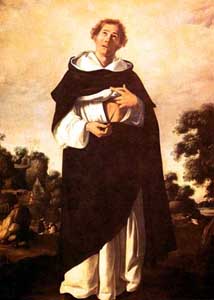 His father belonged to the noble family of Berg; his mother, a holy woman from whom he took his name, to a family of Sus (or Süs). When thirteen years of age he entered the Dominican convent at Constance, where he made his preparatory, philosophical, and theological studies.
From 1324 to 1327 he took a supplementary course in theology in the Dominican studium generale at Cologne, where he sat at the feet of Johann Eckhart, “the Master”, and probably at the side of Tauler, both celebrated mystics. Returning to Constance, he was appointed to the office of lector, from which he seems to have been removed some time between 1329 and 1334. In the latter year he began his apostolic career. About 1343 he was elected prior of a convent, probably at Diessenhofen. Five years later he was sent from Constance to Ulrn where he remained until his death.
Suso’s life as a mystic began in his eighteenth year, when giving up his careless habits of the five preceding years, he made himself “the Servant of the Eternal Wisdom”, which he identified with the Divine essence and, in a concrete form, with the personal Eternal Wisdom made man. Henceforth a burning love for the Eternal Wisdom dominated his thoughts and controlled his actions. He had frequent visions and ecstasies, practised severe austerities (which he prudently moderated in maturer years), and bore with rare patience corporal afflictions, bitter persecutions and grievous calumnies.
He became foremost among the Friends of God in the work of restoring religious observance in the cloisters. His influence was especially strong in many convents of women, particularly in the Dominican convent of Katherinenthal, a famous nursery of mysticism in the thirteenth and fourteenth centuries, and in that of Toss, where lived the mystic Elsbeth Stagel, who turned some of his Latin into German, collected and preserved most of his extant letters, and drew from him the history of his life which he himself afterwards developed and published.
In the world he was esteemed as a preacher, and was heard in the cities and towns of Swabia, Switzerland, Alsace, and the Netherlands. His apostolate, however, was not with the masses, but rather with individuals of all classes who were drawn to him by his singularly attractive personality, and to whom he became a personal director in the spiritual life.
It has often been incorrectly said that he established among the Friends of God a society which he called the Brotherhood of the Eternal Wisdom. The so-called Rule of the Brotherhood of the Eternal Wisdom is but a free translation of a chapter of his “Horologium Sapientiae”, and did not make its appearance until the fifteenth century.
HIS WRITINGS
The first writing from the pen of Suso was the “Büchlein der Wahrheit”, which he issued while a student at Cologne. Its doctrine was unfavourably criticized in some circles — very probably on account of its author’s close relations with Eckhart, who had just been called upon to explain or to reject certain propositions — but it was found to be entirely orthodox.
As in this, so in his other writings Suso, while betraying Eckhart’s influence, always avoided the errors of “the Master”. The book was really written in part against the pantheistic teachings of the Beghards, and against the libertine teachings of the Brethren of the Free Spirit. Father Denifle considers it the most difficult “little book” among the writings of the German mystics.
Whereas in this book Suso speaks as a contemplative and to the intellect, in his next, “Das Büchlein der ewigen Weisheit”, published early in 1328, he is eminently practical and speaks out of the fullness of his heart to “simple men who still have imperfections to be put off”. Bihlmeyer accepts Denifle’s judgment that it is the “most beautiful fruit of German mysticism”, and places it next to the “Homilies” of St. Bernard, and the “Imitation of Christ” by Thomas à Kempis. In the second half of the fourteenth and in the fifteenth century there was no more widely read meditation book m the German language.
In 1334 Suso translated this work into Latin, but in doing so added considerably to its contents, and made of it an almost entirely new book, to which he gave the name “Horologium Sapientiae”. Even more elevating than the original, finished in language, rich in figure, rhythmic in movement, it became a favourite book in the cloisters at the close of the Middle Ages, not only in Germany, but also in the Netherlands, France, Italy, and England.
To the same period of Suso’s literary activity may belong “Das Minnebüchlein” but its authenticity is doubtful.
After retiring to Ulm Suso wrote the story of his inner life (“Vita” or “Leben Seuses”), revised the “Büchlein der Wahrheit”, and the “Büchlein der ewigen Weisheit”, all of which, together with eleven of his letters (the “Briefbüchlein”), and a prologue, he formed into one book known as the “Exemplar Seuses”.
Suso is called by Wackernagel and others a “Minnesinger in prose and in the spiritual order.” The mutual love of God and man which is his principal theme gives warmth and colour to his style. He used the full and flexible Alamannian idiom with rare skill, and contributed much to the formation of good German prose, especially by giving new shades of meaning to words employed to describe inner sensations. His intellectual equipment was characteristic of the schoolmen of his age. In his doctrine there was never the least trace of an unorthodox tendency.
For centuries he exercised an influence upon spiritual writers. Among his readers and admirers were Thomas à Kempis and Bl. Peter Canisius.
The Catholic Encyclopedia, Volume VII
Nihil Obstat, June 1, 1910, Remy Lafort, S.T.D., Censor
Imprimatur. +John Cardinal Farley, Archbishop of Ne
Born: March 21, 1295 at Uberlingen, Germany as Heinrich von Berg
Died: January 25, 1361 at Ulm, Germany
Beatified: 1831 by Pope Gregory XVI
Representation: Dominican with the Holy Name on his chest
Works: Book of the Eternal Wisdom, The Thirst of God
Blessed Christopher of Milan
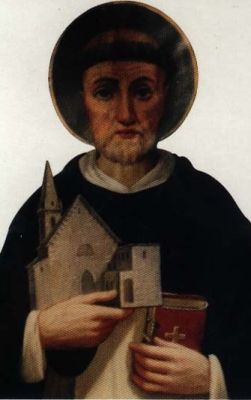 Nothing is known of the early years of Blessed Christopher. He received the Dominican habit in the convent of San Eustorgio in Milan, Italy, in the early 15th century. He is recorded as being “holy and abstemious, humble and studious”–the ordinary virtues that we have come to take for granted among the beati; there is nothing to indicate the type of person Christopher was, or what peculiar circumstances might have led him to the Dominicans. He is noted especially for his preaching and for his gift of prophecy.
The age in which Christopher lived was a rough and dangerous one, and a time for prophets and penitents to thrive. He was himself an apostolic preacher throughout Liguria and the Milanese, famous for the impact of his sermons on sinners. He had a vivid power of description and this, coupled with his gift of prophecy, made his sermons unforgettable.
Christopher worked in many parts of Italy, but his name is particularly venerated in Taggia, where he spent many years. As a result of his preaching, the people of Taggia built a monastery and church dedicated to Our Lady of Mercy and Christopher became its first abbot. A great wave of spiritual revival was felt in Taggia during his tenure, but he was not optimistic about the future.
In a vision he saw that most of the population would be carried off by plague. Twenty years before anyone was paying any attention to the Turks, he told the people of Taggia that Turks would invade the city, and they did, as he had prophesied. A disastrous flood swept the area, fulfilling another of his prophesies. He wrote four volumes of sermon aids, containing scriptural examples and quotations from the Fathers of the Church.
In 1484, when he was absent from Taggia preaching a mission, Christopher fell ill and knew that he was about to die. He insisted on returning to his own monastery at Taggia. There he received the last sacraments and immediately died (Benedictines, Dorcy).
Born: In the early part of the 15th century
Died: 1484 at Our Lady of Mercy convent, Taggia, Italy of natural causes
Beatified: 1875 by Pope Pius IX
Blessed Constantius

Constantius Bernocchi is as close to a ‘sad saint’ as it’s possible for a Dominican to get; he is said to have had the gift of tears. However, that is not his only claim to fame. Constantius had an remarkable childhood, not only for the usual signs of precocious piety, but also for a miracle that he worked when he was a little boy. Constantius had a sister who had been bedridden most of her nine years of life. One day, the little boy brought his parents in to her bedside and made them pray with him. The little girl rose up, cured, and she remained well for a long and happy life. Naturally, the parents were amazed, and they were quite sure it had not been their prayers that effected the cure, but those of their little son.
Constantius entered the Dominicans at age 15, and had as his masters Blessed Conradin and Saint Antoninus. He did well in his studies and wrote a commentary on Aristotle. His special forte was Scripture, and he studied it avidly. After his ordination, he was sent to teach in various schools in Italy, arriving eventually at the convent of San Marco in Florence, which had been erected as a house of strict observance. Constantius was eventually appointed prior of this friary that was a leading light in the reform movement. This was a work dear to his heart, and he himself became closely identified with the movement.
Several miracles and prophecies are related about Constantius during his stay in Florence. He one day told a student not to go swimming, because he would surely drown if he did. The student, of course, dismissed the warning and drowned. One day, Constantius came upon a man lying in the middle of the road. The man had been thrown by his horse and was badly injured; he had a broken leg and a broken arm. All he asked was to be taken to some place where care could be given him, but Constantius did better than that–he cured the man and left him, healed and astonished.
Constantius was made prior of Perugia, where he lived a strictly penitential life. Perhaps the things that he saw in visions were responsible for his perpetual sadness, for he foresaw many of the terrible things that would befall Italy in the next few years. He predicted the sack of Fabriano, which occurred in 1517. At the death of Saint Antoninus, he saw the saint going up to heaven, a vision which was recounted in the canonization process.
Blessed Constantius is said to have recited the Office of the Dead every day, and often the whole 150 Psalms, which he knew by heart, and used for examples on every occasion. He also said that he had never been refused any favor for which he had recited the whole psalter. He wrote a number of books; these, for the most part, were sermon material, and some were the lives of the blesseds of the order.
On the day of Constantius’s death, little children of the town ran through the streets crying out, “The holy prior is dead! The holy prior is dead!” On hearing of his death, the city council met and stated that it was a public calamity.
The relics of Blessed Constantius have suffered from war and invasion. After the Dominicans were driven from the convent where he was buried, his tomb was all but forgotten for a long time. Then one of the fathers put the relics in the keeping of Camaldolese monks in a nearby monastery, where they still remain (Benedictines, Dorcy, Encyclopedia).
Born: Born in the early part of the 15th century in Fabriano, Marches of Ancona, Italy
Died: 1481 of natural causes; the local senate and council assembled at the news of his death, proclaimed it a “public calamity”, and voted to pay for the funeral
Beatified: 1821 (cultus confirmed) by Pope Pius VII
 The Order of Preachers, Independent
You must be logged in to post a comment.