
Category: Dominican Saints

Blessed Peter Cambiano of Ruffia

Peter’s father was a city councilor, his mother was from a noble family, and the boy was raised in a pious household. He received a good education, and was drawn early to religious life, with a personal devotion to Our Lady of the Rosary. He joined the Dominicans in Piedmont, Italy at age 16. He continued his studies, and was ordained at age 25, and was a noted preacher throughout northern Italy. He worked to bring the heretical Waldensians back to the Church, and was appointed inquisitor-general of the Piedmont.
In January 1365 Peter and two Dominican brothers went on a preaching mission through the mountains between Italy and Switzerland, working from the Franciscan friary at Susa, Italy. Peter’s preaching brought many back to the faith, which earned him the anger of the Waldensians. Three of the heretics came to the friary, asked to see Peter, and then murdered him at the gate.
Blessed Simon Ballachi
Blessed Simon Ballachi was born to the nobility in 1240, the son of Count Ballachi. His family had a close association with the Church clergy; two of his uncles became archbishops of Rimini, Italy, and a younger brother was a priest. Trained as a soldier and in administration, he was expected to take over the family estates. Against his family wishes, he joined the Dominicans as a lay brother at age 27.
Assigned to work in the garden of his friary, something he knew nothing about but which he loved instantly. He saw God in everything, and prayed constantly as he worked. Noted for his simple life, his strict adherence to the Dominican Rule, and his excellent work as a catechist to children. A visionary, Simon was visited by the devil, by Saint Catherine of Alexandria, Saint Dominic de Guzman, Saint Peter Martyr, and the Blessed Virgin Mary; other brothers saw his cell glowing, and heard angelic voices. Blinded at age 57, he was nearly helpless during the last years of his life; he never despaired, and used the extra free time for prayer. He died on 5 November in 1391.
Blessed Benvenuta Bojani

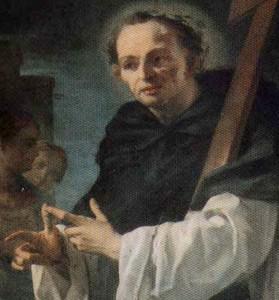
Benvenuta was the last of seven daughters. Her parents, too, must have been amazing people in comparison with so many in our time. When the silence of the midwife proclaimed that her father had been disappointed once again in his desire for a son, he exclaimed, “She too shall be welcome!” Remembering this she was christened by her parents Benvenuta (“welcome”), although they had asked for a son. A vain older sister unsuccessfully tried to teach the pious little Benvenuta to dress in rich clothing and use the deceits of society. Benvenuta hid from such temptations in the church where she developed a tender devotion to the Blessed Virgin. By the age of 12, Benvenuta was wearing hairshirts and a rope girdle. As she grew the rope became embedded in her flesh. When she realized the rope must be removed, she couldn’t get it off, so she prayed and it fell to her feet. For this reason she is often pictured in art holding a length of rope in her hands.
Having become a Dominican tertiary at an early age, she added the penances practiced by the sisters to those she had appropriated for herself. All her disciplines, fasting, and lack of sleep soon caused her health to fail and she was confined to bed for five years. Thereafter, she was too weak to walk, so a kind older sibling carried her to church once a week for Compline (Night Prayer) in the Dominican church, her favorite liturgy after the Mass.
After evening prayer on the Vigil of the Feast of Saint Dominic, Dominic and Saint Peter Martyr appeared to Benvenuta. Dominic had a surprise for her. The prior was absent at the Salve procession, but at the beginning of Compline she saw Dominic in the prior’s place. He passed from brother to brother giving the kiss of peace, then went to his own altar and disappeared. At the Salve procession, the Blessed Virgin herself came down the aisle, blessing the fathers while holding the Infant Jesus in her arms.
Benvenuta spent her whole life at home in Cividale busy with her domestic duties, praying, and working miracles. She was often attacked by the devil, who sometimes left her close to discouragement and exhaustion. When someone protested against the death of a promising young child, Benvenuta commented, “It is much better to be young in paradise than to be old in hell.” The devil often appeared to her in horrifying forms but was banished when Benvenuta called upon the Virgin.
Benvenuta’s companions called her “the sweetest and most spiritual of contemplatives, so lovable in her holiness that her touch and presence inspired gladness and drove away temptations.” This is amazing in light of the severe penances that she imposed upon herself–and another sign of blessedness that she didn’t judge others by her standards for herself (Benedictines, Dorcy).
Born: May 4, 1254 at Cividale, Friuli, Italy
Died: October 30, 1292 at Cividale, Friuli, Italy of natural causes
Beatified: February 6, 1763 by Pope Clement XIV (cultus confirmed)
Name Meaning: welcome (from her father’s statement at her birth: “She too shall be welcome!”)
Representation: holding a length of rope
Blessed Damian of Finario

One of the bright lights of the fifteenth century was Damian of Finario. Unfortunately we know very little about him, expect that he lived at a time and place not noted for sanctity, and he was known as a holy man.
Damian was born in Finario, near Genoa, at the end of the fourteenth century. His people were ich and noble, and also pious. We know nothing of his youth, except the not-too-revealing fact that when he was a baby he was kidnapped by a lunatic. His parents prayed to Our Lady, and the baby was returned unharmed.
Damian entered the order at Genoa and became a diligent student and a model Dominican. He was to be known especially for his preaching. The field of his endeavors was Italy. He seems never to have left the country. By the force of his preaching, he inspired many hundreds of sinners to repentance; and, since the fifteenth century produced many sinners who needed such preaching, he was kept supplied with works for a long lifetime.
Damian died in a little village near Modena, in 1884, and immediately became the object of much pious speculation, because of the miracles worked at his tomb. He was not, however, beatified until 1848, though his relics were by that time widely distributed and his cult well known.
Born: at Fulcheri, Liguria, Italy
Died:1484 at Modena, Reggio d’Emilia, Italy
Beatified: August 4, 1848 by Pope Pius IX (cultus confirmed)
Blessed Bartholomew de Braganza
 The historians of Vicenza agree with those of the Order of Preachers in placing Blessed Bartholomew di Braganza among the first and most illustrious of Saint Dominic’s disciples. As a matter of fact, he was a noted man in many ways. Nature endowed him with splendid gifts which he developed by tireless industry. The services that he rendered the Church as an apostolic preacher, as master of the Sacred Palace in Rome, as bishop, and as legate of the Holy See make him worthy of an honorable place in ecclesiastical history. An exceptional purity of heart and eminent piety gave the finishing touches, so to express it, to his grand character.
More than one Pope honored Bartholomew with implicit confidence. Saint Louis, king of France, held him in the highest esteem. His virtues endeared him to those placed under his charge. Italy reaped many and signal benefits from his preaching. He brought numbers into the Church, while the fervor of the faithful was increased by his example and labors.
The memory of such a man, our readers will doubtless agree, should not be suffered to die. Fortunately, he left a memoir or memorandum in the form of a last will and testament. Thanks to this document, one can write a part of his history and, to a certain extent, place the principal events of his life in their proper chronological setting. Such an order in these occurrences is the more important because historians have confused them to an astonishing degree.
Vicenza, an episcopal city of Italy forty miles west of Venice, and beautifully situated at the confluence of the Retrone and Bacchiglione, is where Bartholomew first saw the light of day. The precise date of his birth is not known; but it was in 1200 or 1201. He made a part of his studies at Padua. Anthony Godi, an author of the thirteenth century, tells us that he belonged to the family of the counts di Braganza long celebrated in Lombardy. Several other Italian writers make the same statement. Only the continuers of the Acta Sanctorum, begun by Father John Van Bolland, S. J., seem disposed to question the blessed’s ancient nobility.(1) Their doubt, however, led to a consultation of the Società Palatina of Milan, which had Godi’s Cronica della Città di Vicenza published in its great collection known as Writers of Italian History (Rerum Italicarum Scriptores). Signore Argelati, director of that learned and far-famed society, replied that old manuscripts prove to a certainty that Blessed Bartholomew, O. P., bishop of Vicenza, belonged to the line of the counts di Braganza, lords of the manor of the same name.(2)
It was during his studies at Padua, which he took care to season with the practice of piety, that the future bishop bad the good fortune to make the acquaintance of Saint Dominic, as well as to hear some of his sermons. The apostolic man inspired our student with so strong a dislike for the vanities of the world that he determined to devote his talents to the service of the Church. Nay, he made up his mind to follow the life which he saw exemplified in the founder of the Friars Preacher, and received the habit of the Order from the saint himself.(3)
Bartholomew must have been very young at this time. At least, he himself tells us that he was trained under the fatherly care of Saint Dominic and nourished in his Order from childhood.(4) From the beginning, he applied himself whole-heartedly to the studies of his new life and the development of the rare talent which nature bestowed upon him. In this way, through the assistance of divine grace and under the guidance of experienced teachers, he was soon regarded as a model religious, an able theologian, and a faithful exponent and defender of the word of God.
Immediately after his ordination the new priest was sent out to preach the Catholic faith to the people and to combat libertinage and heresy. At the same time, he labored for the pacification of the serious disturbances which were then prevalent in the cities of Italy, particularly in those of Lombardy. In this latter work, which took much of his time, he was associated with a number of other celebrated preachers of, his Order. Bishop Henry de Sponde speaks highly in praise of these men in his Annales Ecclesiastici, or epitome of the famed Annals of Cesare Baronio.(5)
Bartholomew, however, was not content to labor with tireless zeal for the suppression of the spirit of discord, and for the reconciliation of individuals, families, and communities. He felt that a standing remedy was necessary to hold in check the unhappy dissensions which continually disturbed the public peace. He was persuaded that, unless some such antidote was found, the preaching of the fathers could not bear the fruit they desired. Accordingly, he established a congregation, or new order, to which he gave the name of Chevaliers of Sancta Maria Gloriosa.
The end of this institute was the preservation or the restoration of peace and tranquility among the people. Its members were to carry the message of reconciliation everywhere. They were to employ all the means that Christian charity could suggest to put an end to dissensions, quarrels, enmities — in a word, to all that had led to the civil wars in which so much Italian blood had been shed, and treasure sacrificed. De Sponde, the bishop of Pamiers mentioned above, speaks of the establishment of this quasi military order. It soon met with approbation from the Holy See, and in 1261 was confirmed by a bull of Urban IV.(6)
Divine intervention was necessary to render the people of Italy docile to the earnest exhortations, prayers, and counsels of those who labored to bring about peace and harmony among them. Only punishment from on high could touch the hearts of the seditious whom nothing seemed able to bring to a sense of their duty. For this reason, de Sponde proceeds to say, God visited the country with scourge after scourge. First, there were destructive earthquakes. Then came unproductive seasons, followed by famine. To these succeeded pestilence and extraordinary cold weather. Finally, great floods brought desolation to the cities as well as to the country.(7)
These catastrophes, coming one after another, disposed the people to penance. What the greater number of them would probably not have done solely out of fear of God’s judgment, that they all did in order to avert the manifestations of His wrath whereby they were overwhelmed. Religious processions were held everywhere, in which persons of every age, sex, and condition took part. They walked in their bare feet, carried a crucifix or torch, and sang the praises of God. They practised every kind of mortification. All this caused 1233 to be called in Italy “the year of general devotion” (1’anno della devozion generale). Happy were the faithful whose contrite hearts and genuine humility rendered these outward expressions of penance and religion acceptable to God.(8)
Our pious Friar Preacher was busily engaged in explaining the nature and the necessity of interior sacrifice to the people in place after place, when the Pope summoned him to Rome to be his theologian.(9) Those who state that he was the immediate successor of Saint Dominic as master of the Sacred Palace overlook the fact that Bartholomew di Braganza was only twenty or twenty-one years of age at the time of the patriarch death. Besides, it was Gregory IX, not Honorius III (in whose reign Saint Dominic died), who conferred that honorable position on the subject of our sketch. The date of the appointment was about 1235. Ile continued to bold it under Innocent IV, whom he followed to Lyons in December, 1244,’ or the year after that Pontiff ascended the papal throne.
Whatever time was left him from the labors of this charge Bartholomew employed in writing. The old manuscripts of the convent at Vicenza long showed divers works of piety, some commentaries on Sacred Scripture and on the books formerly attributed to Denis the Areopagite, and a number of other treatises from his busy pen. Both the historians of Vicenza and Father James Echard, O. P., give a list of his works; but lack of space prevents us from reproducing it here, or making comments on their merit.(10)
Just how or when Saint Louis, king of France, became cognizant of the illustrious Friar Preacher’s accomplishments we do not know. It might have been through Bartholomew’s wide-spread fame.(11) Possibly, too, he was sent by the Pope on some commission to the French monarch. However it came to pass, it is certain that his majesty selected the learned and saintly son of Saint Dominic as his confessor. It is believed, and not without reason, that Bartholomew held this position when he wrote his little treatise on the education of princes (De Informatione Regiae Prolis), which he dedicated to Margaret of Provence, consort of Saint Louis.
Most likely Bartholomew was thus employed at Paris when Innocent IV appointed him bishop of Nemosia (or Nimesia), in the Isle of Cyprus. Ferdinand Ughelli, the Cistercian historian, places this event in 1250; but the opinion of the Bollandists, who date it from 1248, is more probable. In fact, Bartholomew himself tells us that the Holy Father nominated him bishop of that see at the time Saint Louis undertook his journey to the orient for the recovery of the Holy Land.(12) Quite probably the Friar-Preacher bishop accompanied the sainted French monarch as far as Cyprus; and we know that it was on September 17, 1248, that Louis reached the island.(13)
When the king left Cyprus, in the month of May, 1249, to lay siege to Damietta, Egypt, Bartholomew had taken possession of his diocese. Here he spent the next five or six years of his life in the fulfillment of the duties of a vigilant bishop. He applied himself heart and soul to the instruction of his flock, the regulation of the lives of his clergy, and the succor of the poor. For all he was a perfect example of Christian piety arid observance. He was regular and scrupulous in the visitation of the parishes of his see. With care did he correct the abuses that had crept in among the faithful, uproot superstition, reform religious practices, and restore the discipline of the Church.
While he was thus busily engaged with the affairs of his diocese, more pressing needs Of religion tore the pious bishop from his beloved people. The Pope ordered him to go immediately to King Louis in Palestine. However, it is not known whether he went on a secret mission, or to aid the French monarch with his advice after the disastrous defeat of the Christian army by the Saracens at Mansura, Egypt, subsequently to the capture of Damietta by Louis. Father Vincent Fontana, O. P., is of the opinion that Bartholomew was sent to Palestine in the capacity of legate a latere, and that he there again acted as the king’s confessor.(14) But we know that another Friar Preacher, Geoffrey de Beaulieu, was then Louis’ confessor, while Cardinal Eudes of Châteauroux was with the monarch as legate of the Holy See.
Bishop Bartholomew himself tells us, in his own brief memoir of his life, that he was with Saint Louis in Jaffa, Sidon, and Ptolemais. He also says that the king and queen, when they were about to sail for France, pressed him to come to see them in Paris, where he would receive new proofs of their royal favor.(15) We may place the prelate’s journey to Syria in 1254, the last year of King Louis’ stay in Palestine. Doubtless he advised and helped the saintly monarch in his efforts in behalf of religion and charity in the places of the Holy Land still under Christian domination.
If the bishop then returned to his see in Cyprus, he could not have remained there long. Alexander IV, who ascended the throne of Peter on December 12, 1254, felt that he was more needed in Italy, and appointed him bishop of his native city of Vicenza. In this new charge Bartholomew set to work with the same energy that characterized his whole life, accomplishing much good in a short time. Earnestly did he labor for the conversion of the Manicheans. His rare virtue won the admiration of all the well-meaning. His firmness threw the wicked into confusion. Indeed, it was not long before men of this character started a violent persecution against the holy prelate. The leader in this iniquity was one Ezzelino da Romano, a declared enemy of religion and a virulent oppressor of the Catholic clergy. Unable to withstand the tyranny of a man as powerful as he was cruel, Bartholomew withdrew to Rome, there to await an abatement in the dangers which confronted him in his diocese.(16)
Alexander IV now sent him as papal legate to Great Britain and France on matters of religion. From London he accompanied the English king and queen to Paris. There he was present at the conference between the two sovereigns. Having happily concluded this mission by the time the death of Ezzelino da Romano put an end to the long persecution carried on by that tyrant, Bartholomew started at once for Italy that he might rejoin his beloved people. Before he left Paris, Saint Louis made good his promise given in Palestine by bestowing on the legate some precious gifts. Among these were a portion of the true cross and a thorn from the crown of our Lord. The better to show the authenticity of the relics, Louis had an act of donation written and stamped with the royal seal. In this document the monarch declared that he had given them to Bartholomew di Braganza as a proof of the tender affection he bore him.(17)
Vicenza’s bishop, carrying the spiritual treasures which he placed beyond value, reached his episcopal city in 1260. Both clergy and people went out to welcome him. As they marched along in procession, they carried candles and olive branches, and often cried out in delight: “Blessed is he who cometh in the name of the Lord.” The holy man responded to these manifestations of joy and reverence with fatherly affection.(18) He began at once to restore his beloved church to its former beauty. With energy did he set about the restoration of the practice of religion, good order, and peace throughout the diocese, and to repair the ravage and devastation caused by the heretics or their abetters during his absence.
God blessed Bartholomew’s zeal. Indeed, his efforts met with a success far greater than he could have expected. In a short time the people of his diocese enjoyed the happiness of peace and tranquility, while their neighbors were continually in the turmoil of agitation and disturbance. The citizens of Vicenza, therefore, wished both to assure themselves of the continuance of the fortunate quiet in their city and to show their gratitude to their beloved chief pastor. Accordingly, they begged him, for the future, not only to be their guide in spiritual things as their bishop, but even in temporal affairs as their signor or podestà.(19)
Until this time the fathers of the Order to which the bishop belonged had had but one house in Vicenza. Blessed Bartholomew now induced them to build another convent, together with a magnificent temple of worship called the Church of the Crown. In this were placed the thorn from the crown of our Lord and the piece of the true cross which he brought from France. The historians of Vicenza tell us of the veneration of the faithful for these holy relics. In the same way we learn of the large gifts made in a spirit of emulation for the construction and decoration of the new church. This house of prayer was erected on an eminence which had long been profaned by the meetings of the Manicheans, that God might be perpetually and specially honored and served in a place which had been the rendezvous of sacrilege and impiety.(20)
While the people were engaged in building a material temple to God, the holy prelate tirelessly and successfully occupied himself with the erection of a more spiritual and worthy one by bringing sinners to repentance and sectarians into the fold of Christ. Many were benefited by his instructions. Some tried his zeal sorely; but they could not exhaust his patience. One of the would-be bishops of the heretics, called Jeremiah, and a doctor or minister, by the name of Gallo, resisted for a long time. The latter particularly, in several conferences with the man of God, defended the teaching of his sect with not a little obstinacy. However, the light of truth finally prevailed over the darkness of error. The defeat and conversion of Gallo practically put an end to the Catharists and other enemies of the Church in the City of Vicenza.(21)
Another action of the pious bishop in behalf of his country deserves mention here. A misunderstanding bad arisen between the people of Padua and those of Vicenza, which was equally baleful to both communities. It was a difficult problem to handle. However, through tact and diplomacy, Bartholomew effected a reconciliation that pleased both parties to the controversy.
For the sake of historical accuracy, attention should be called to a mistake of Father Ferdinand Ughelli. The Cistercian abbot and historian states that Bartholomew of Vicenza and the patriarch of Aquileia were appointed vicars of what was then known as the Roman Empire for all Italy. He places this event in 1262, and attributes the selection of these two men to Rudolf I.(22) But this prince did not become emperor until 1273, eleven years later, and at least three years after the death of our noted Friar Preacher.
It is more difficult to decide whether or not the distinguished divine was actually raised to the dignity of patriarch, as is held by some authors. The epitaph on his tomb might give a foundation for this opinion. Father Daniel von Papenbroeck (better known as Papebroch), S. J., follows it in his list of the patriarchs of Jerusalem. According to this learned critic, Urban IV appointed Bartholomew to this patriarchate in 1264, and he departed for the Holy Land at once to assume his new charge. However, says the same author, he returned to Italy after two years, resigned the higher position in the hands of Clement IV, and was reappointed to the See of Vicenza, which became vacant in 1266.(23) So much in favor of the subject of our sketch having held the dignity of patriarch.
On the other hand, it must be stated, we have been able to find no bull of Urban IV or Clement IV which shows this double transfer from Vicenza to Jerusalem and from Jerusalem back to Vicenza. The greater number of historians who have written of Blessed Bartholomew make no mention of such a fact. These, it is true, are arguments from silence. But to them must be added the difficulties which led other writers to decide against the opinion of Father von Papenbroeck. Taken as a whole, these reasons dispose one to consider it very doubtful that Bishop di Braganza was ever patriarch of Jerusalem.(24)
Furthermore, the metropolitan of Ravenna and the other bishops of that ecclesiastical province were at Bologna for the second translation of the relies of Saint Dominic. Bartholomew di Braganza also honored the occasion with his presence. He preached the sermon for the event, and announced to the people the indulgences granted by the archbishop and each of his suffragans. Both during the ceremonies and in the act testifying to the translation of the relics, which he himself drew up, he takes only the rank and title of Bishop of Vicenza. Similarly, in his last will and testament, which bears the date of September 23, 1270, and in which we have a faithful outline of his life, he simply calls himself bishop of Vicenza. However, he does not forget to state that the Holy See had successively appointed him to the dioceses of Nemosia (or Nimesia) and Vicenza.(25) He makes no mention whatever of the Patriarchate of Jerusalem. All this, again, constitutes a strong argument against his ever having had charge of the Holy City.
The precise date of the holy man’s death is not known. But it is agreed that he died a short time after writing his will and testament, which, as has been said, is dated September 23, 1270. Widows, orphans, and the poor were not the only ones who wept over his demise. His loss was universally regretted by those who loved their religion, as well as by those who knew how to esteem virtue and merit. His keen faith, his ardent zeal for the things of God and the salvation of souls, his gentle disposition, and his Christian humility were the virtues especially admired and praised in him. The practice of humility he ever knew well how to combine with rare learning and the most brilliant employments. His memory has always been held in benediction in the city and diocese of Vicenza.(26)
Historians assure us that, from the time of his death, the faithful not only held our Friar Preacher in veneration, but also gave him the title of blessed. The Bollandists have likewise proved this not only by the testimony of those who wrote on the spot, but also by other indications which serve to verify the fact.(27) Such, for instance, are the lamp which was burned before his relies and his likeness painted with rays of light around his head and placed in the Church of the Crown. The miracles said to have been wrought at Bartholomew’s grave induced the people of Vicenza to ask for a solemn translation of his remains. On this occasion, though he had been dead for eighty years, his body was found to have undergone no corruption. Quite naturally, this circumstance greatly increased the devotion of a people who were already accustomed to invoke his aid in their necessities.
So lived, labored, and died the saintly bishop of Vicenza. He was one of the earliest and greatest of Saint Dominic’s disciples, as well as one of the most learned. Such were the love and veneration in which the people held him. The devotion towards him may be said to have continued to grow until, more than five centuries after his death, and many years after Father Anthony Touron wrote his book, Pius VI granted the Order of Preachers and the clergy of the Diocese of Vicenza the favor of reciting the divine office and saying mass in his honor. His feast falls on the twenty-third day of October.
Born: at Vicenza, Ityaly towards the close of the 12th century
Died: September 23, 1270
Beatified: Pope Pius VI confirmed his cult in 1793
Blessed Peter of Tiferno
 After an uneventful childhood, Peter Capucci applied for admission to the Dominicans. He and the frail, youthful Saint Antoninus were both received into the order on the Vigil of the Feast of the Assumption 1405. Their novice master was Blessed Lawrence of Ripafratta. Peter counted the artist-brothers Fra Angelico and Fra Benedetto as his friends. Peter spent his novitiate at Cortona, remained there when some of his community moved to Fiesole, was ordained, and began his apostolate all in Cortona.
Not much about Peter is truly remarkable when he is viewed in the light of his neighboring luminaries, but he glittered enough to have gained the attention of the Church. He was noted for regularity, patience, and humility–virtues not terribly common in any age. He took upon himself the job of begging for alms as a means of atoning for his noble birth. Of course, just as we might treat the homeless, some treated Peter rudely but that did not disturb him. He quietly persisted in his humble work to ensure that his brothers had food and that there were alms for the poor. We are told that one rich wine merchant refused Peter saying that the barrels in the cellar were all empty. A little later he found to his horror that they were indeed all empty. He immediately sent for the friar, apologized, and begged him to bless the barrels and restore the wine–which Peter did without hesitation.
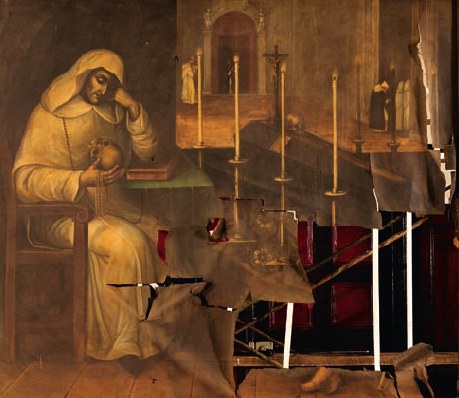
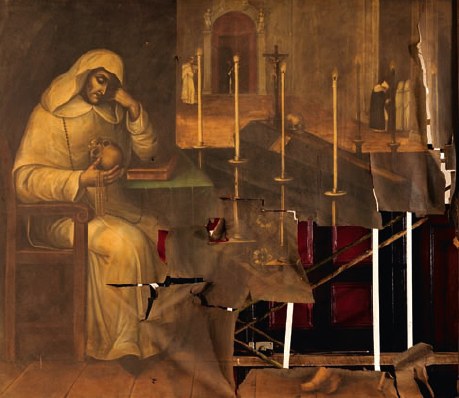
Other miracles were attributed to Peter, too. A woman’s withered hand was restored. Two unjustly condemned men were miraculously preserved from execution. Once, walking through the cloister, Peter came upon a disreputable man. Peter prophesied that the man would day within a day. The man laughed, but died in the middle of the night after having sent for Peter to give him the sacraments. Peter Capucci became known as “the preacher of death,” because he used to preach with a skull in his hands. He apparently had the ability to read hearts and could expertly point out uncomfortable truths to unwilling listeners.
When Peter died, he was buried in a humble grave. Miracles began to occur there; thus, his fame grew. A prominent man who had been paralyzed for three years, received the use of his limbs at the grave, after he had promised to pay the expenses for an annual celebration in Peter’s honor. In 1597, Peter’s relics were moved to a more suitable place (Benedictines, Dorcy).
Born: at Città di Castello (the ancient Tifernum), in 1390
Died: 1445
Beatified: cultus confirmed by Pius VII in 1816
Blessed Matthew Carreri
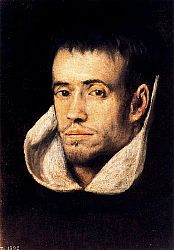
 John Francis Carreri was born in Mantua, in the late fourteenth century. He grew up a silent and prayerful child, a good student and a great reader. These qualities seemed to recommend him to the Preaching Friars, and at an early age, he presented himself at the convent in his home city and received the habit.
Matthews’s career as a preacher began soon after his ordination, when was sent to Lombardy to preach against the heretics. He succeeded admirably in his preaching and converted many to a spiritual way of life. Traveling from convent to convent he preached a revival of fervor and a deeper understanding of the spirit of St. Dominic, and many of the religious of Lombardy-both Dominicans and members of other Orders- were led by him to become more fervent.
At on time, when he was preaching in Vigevano, a troupe of jugglers came into town and set up their act. They were a particularly scandalous set of people, poking ridicule at the religious and the pope. Matthew sent them word to move on, which they ignored. So went after the with his walking-stick, and this proved more effective. They scattered and ran but soon came back , fortified with the presence of the Duke of Milan, who scolded Matthew for being so narrow-minded and humorless. Matthew patiently pointed out to him the bad spots in their humor, and, in spite of the duke’s natural aversion to friars, convinced him that he should keep the jugglers out of town.
At Lucina, there was a lady of noble birth and great talents who was wasting her time in frivolities. Never one to avoid an issue, Matthew aimed a powerful sermon in her direction, and she came to him afterwards in a torrent of tears and begged him to help her. He gave her the habit of the Third Order and outlined a stiff rule of life, which she afterwards faithfully followed. He also met and directed Blessed Stephanie Quinzan who proved to be an apt pupil.
Matthew was given the job of reforming the convents of the friars in Soncino, and in nearby towns, and he worked for many years in Milan. Going up and down the peninsula, he varied his approach but never his message: penance and love of God. So many were the conversions effected that a whole group of follow-up preachers had to be appointed to carry on, as he moved rapidly from place to place. Preaching his way, went through Tuscany, and took ship at Genoa.
The ship was soon captured by a Turkish corsair. The Mohammed captain called on the three Dominicans for an explanation of why they were there. Matthew spoke up so fearlessly and eloquently that the captain released all three of them. Just as they were being hustled off to a rescue boat, the wail of one of the woman passengers stopped them. The lady and her young daughter were not anxious to be taken to Algiers, and Matthew began pleading for them. The captain told him he had better let the affair alone and be satisfied that he has saved his own skin. Matthew thereupon volunteered to go to Algiers, in chains, if the captain would release the two women. Amazed at his courage as well as at his brashness, the captain released all of them and told them to get out of his ship quickly before he changed his mind.
Many miracles are credited to Matthew Carreri. One day, a young father who came to hear Matthew preach, had left his little son at home with the nurse. the baby fell into the fire and was badly burned. The distracted father brought the little one to Matthew, who cured him. the baby was well in a few days, and grew up to be a Franciscan friar. Matthew cured another man of hemorrhage, and worked many cures on the sick and possessed.
One day, , while meditating on the Passion, Matthew asked our Lord tp partake of His sufferings. He received the stigmata, in the form of an arrow that pierced his heart. For the remainder of his life, he suffered great pain from his wound.
Matthew Carreri died, in 1470, in a house composed entirely of religious he had rescued from a life a laxity. His cult was confirmed twelve years after his death, testifying to the great reputation for sanctity he enjoyed among the people of northern Italy.
Born: 1420 at Mantua, Italy
Died: October 5, 1470 of natural causes
Beatified: 1483 (cultus confirmed); December 2, 1625 by Pope Urban VIII (beatification)
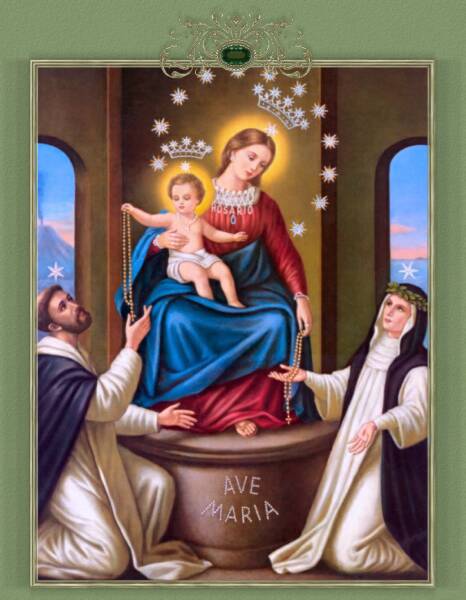
What? Where? Why? Who? Our Lady of the Rosary ~ The Rev. Deacon Br. Joshua Hatten, OPI
 Today the church celebrates an important Marian Feast, Our Lady of the Rosary. Why do celebrate this feast? Why do we bother with the rosary at all… it is just some ancient prayer of the church, right?? Wrong! Very wrong!
The Rosary is not a repetitious, boring, ‘religious’ activity… we can certainly make it feel like that… boring, words repeated by rote without any meaning. But that isn’t the Rosary. That is a waste of time. The rosary, when properly prayed, with intention – and with whatever YOUR intentions may be – is one of the most powerful and mountain moving forms of active prayer and meditation with which we are blessed. Archbishop Fulton J. Sheen once said, “The rosary is the book of the blind, where souls see and there enact the greatest drama of love the world has ever known; it is the book of the simple, which initiates them into mysteries and knowledge more satisfying than the education of other men; it is the book of the aged, whose eyes close upon the shadow of this world, and open on the substance of the next. The power of the rosary is beyond description.”
But the rosary began quite differently than that we know today. The use of “prayer beads” and the repeated recitation of prayers to aid in meditation stem from the earliest days of the Church and has roots in pre-Christian times. Evidence exists from the Middle Ages that strings of beads were used to count Our Fathers and Hail Marys. Actually, these strings of beads became known as “Paternosters,” the Latin for “Our Father.”
The structure of the rosary gradually evolved between the 12th and 15th centuries. Eventually 50 Hail Marys were recited and linked with verses of psalms or other phrases evoking the lives of Jesus and Mary. During this time, this prayer form became known as the rosarium (“rose garden”), actually a common term to designate a collection of similar material, such as an anthology of stories on the same subject or theme. During the 16th century, the structure of the five-decade rosary based on the three sets of mysteries prevailed.
Tradition does hold that St. Dominic (d. 1221) devised the rosary as we know it. Moved by a vision of our Blessed Mother, he preached the use of the rosary in his missionary work among the Albigensians, who had denied the mystery of Christ.
Originally, people prayed 150 Our Fathers representing the 150 Psalms. Then there was a parallel practice of praying 150 Hail Marys. Later, a mystery of Jesus’ life was attached to each Hail Mary.
Church Tradition and, let’s face it, LEGEND, tells us that St. Dominic (d. 1221) devised the rosary as we know it. Moved by a vision of our Blessed Mother, he preached the use of the rosary in his missionary work among the Albigensians, who had denied the mystery of Christ. Whilst that cannot by proved, and in fact may not be true, the development of the rosary as we know it owes much to the Dominican Order. One of St. Dominic’s Dominican contemporaries, Alan de la Roche, was known as “the apostle of the rosary.” He founded the first Confraternity of the Rosary in the 15th century. In the 16th century the rosary was developed to its present form—with the 15 mysteries (joyful, sorrowful and glorious). In 2002, Pope John Paul II added five Mysteries of Light to this devotion.
Let the rosary become YOUR BOOK, as Archbishop Sheen termed it, the book you ‘open’ when it seems like everything is just too much to bear or when you’re filled with such gratitude for love or when or when it is just a humdrum Wednesday. You will be amazed by the power of this beautiful prayer. The book opens when you realize you’re not merely praying the same words on the same beads every time, but when you actually begin to meditate and place yourself in the corresponding mysteries. You become an active participant in the life and times of Our Lord and His Mother.
Anyone who knows six easy prayers can pray a Rosary; you will also need to know twenty Mysteries to meditate upon as you pray. You do not have to be a Catholic.
The Order of Prayers
The Rosary begins with the Apostles Creed, followed by one Our Father, three Hail Marys (traditionally offered for an increase in faith, hope, and charity for those praying the Rosary), a Glory Be, and, if desired, the Fatima Prayers. Next come five mysteries, each consisting of one Our Father, ten Hail Marys, a Glory Be, and, if desired, the Fatima Prayers. Conclude with the Hail Holy Queen. Please say a few extra prayers after the Hail Holy Queen for the Pope.
Rosary Beads
If you do not have Rosary beads, it is perfectly okay to count with your fingers. Counting beads frees your mind to help you meditate.
Prayers for Praying the Rosary
THE APOSTLE’S CREED
I believe in God, the Father Almighty, Creator of Heaven and earth; and in Jesus Christ, His only Son, Our Lord, Who was conceived by the Holy Ghost, born of the Virgin Mary, suffered under Pontius Pilate, was crucified; died, and was buried. He descended into Hell; the third day He arose again from the dead; He ascended into Heaven, sitteth at the right hand of God, the Father Almighty; from thence He shall come to judge the living and the dead. I believe in the Holy Spirit, the holy Catholic Church, the communion of saints, the forgiveness of sins, the resurrection of the body, and the life everlasting. Amen.
OUR FATHER
Our Father, Who art in heaven, hallowed be Thy name; Thy kingdom come; Thy will be done on earth as it is in heaven. Give us this day our daily bread; and forgive us our trespasses as we forgive those who trespass against us; and lead us not into temptation, but deliver us from evil. Amen.
HAIL MARY
Hail Mary, full of grace. The Lord is with thee. Blessed art thou amongst women, and blessed is the fruit of thy womb, Jesus. Holy Mary, Mother of God, pray for us sinners, now and at the hour of our death, Amen.
GLORY BE
Glory be to the Father, and to the Son, and to the Holy Spirit, as it was in the beginning, is now, and ever shall be, world without end. Amen.
FATIMA PRAYER (OPTIONAL)
O my Jesus, forgive us of our sins. Save us from the fires of hell. Lead all souls into heaven, especially those in most need of thy mercy.
HAIL HOLY QUEEN
Hail, holy Queen, Mother of mercy, our life, our sweetness and our hope. To thee do we cry, poor banished children of Eve: to thee do we send up our sighs, mourning and weeping in this valley of tears. Turn then, most gracious Advocate, thine eyes of mercy toward us, and after this our exile, show unto us the blessed fruit of thy womb, Jesus. O clement, O loving, O sweet Virgin Mary!
Leader: Pray for us O Holy Mother of God,
All: That we may be worthy of the promises of Christ.
(Optional)
Leader: Let us pray.
All: O God whose only begotten Son by his life, death, and Resurrection has purchased for us the rewards of eternal life; grant we beseech thee, that meditating on these mysteries of the Most Holy Rosary of the Blessed Virgin Mary, we may imitate what they contain and obtain what they promise through the same Christ our Lord. Amen.
PRAYER FOR THE HOLY FATHER (FOR PRIVATE DEVOTION)
Leader: Upon this Rock He will build His Church…
All: …and the jaws of death shall not prevail against her.
Leader: O Mother of the Redeemer…
All: …Living Tabernacle of the Eucharist, and Luminous Rose of Heaven, with humble confidence we ask you to bestow upon the Holy Father all the graces and blessings reserved for him by the Holy Trinity from all eternity. Amen.
Leader: Help his friends…
All: …convert his enemies.
Leader: Saint Joseph…
All: …pray for us. Amen.
The Twenty Mysteries
Here is a brief listing and description of all twenty Mysteries.
THE JOYFUL MYSTERIES
- The Annunciation:The Archangel Gabriel “announces” to Mary that she shall conceive the Son of God.
- The Visitation:Mary visits her cousin Elizabeth, who is pregnant with John the Baptist.
- The Nativity:Jesus is born.
- The Presentation:Mary and Joseph “present” Jesus in the Temple where they meet Simeon.
- The Finding in the Temple:After losing Him, Mary and Joseph find young Jesus teaching the Rabbis in the Temple.
THE LUMINOUS MYSTERIES (THE MYSTERIES OF LIGHT)
- The Baptism in the Jordan:The voice of the Father declares Jesus the beloved Son.
- The Wedding at Cana:Christ changes water into wine, his first public miracle.
- The Proclamation of the Kingdom:Jesus calls to conversion (cf. Mk 1:15) and forgives the sins of all who draw near to him.
- The Transfiguration:The glory of the Godhead shines forth from the face of Christ.
- The Institution of the Eucharist:Jesus offers the first Mass at the Last Supper with his apostles, establishing the sacramental foundation for all Christian living.
THE SORROWFUL MYSTERIES
- The Agony in the Garden:Jesus sweats water and blood while praying the night before his passion.
- The Scourging at the Pillar:Pilate has Jesus whipped.
- The Crowning with Thorns:Roman soldiers crown Jesus’ head with thorns.
- The Carrying of the Cross:Jesus meets His mother and falls three times on the way up Calvary.
- The Crucifixion:Jesus is nailed to the cross and dies before His mother and His apostle John.
THE GLORIOUS MYSTERIES
- The Resurrection:Jesus rises from the dead.
- The Ascension:Jesus leaves the Apostles and bodily “ascends” to heaven.
- The Descent of the Holy Spirit:The Apostles receive the Holy Spirit in tongues of fire in the upper room with Mary.
- The Assumption:Mary is taken bodily–assumed–into heaven by God at the end of her life here on earth.
- The Coronation:Mary is crowned Queen of Heaven and Earth.
Mysteries for Certain Weekdays
Traditionally, many people say the Joyful Mysteries on Monday, the Sorrowful Mysteries on Tuesday, the Glorious Mysteries on Wednesday, and start again with the Joyful Mysteries on Thursday, the Sorrowful Mysteries on Friday. The Glorious Mysteries are then prayed on Saturday and Sunday. Now that the Luminous Mysteries have recently been added, the schedule is:
Monday – Joyful
Tuesday – Sorrowful
Wednesday – Glorious
Thursday – Luminous
Friday – Sorrowful
Saturday – Joyful
Sunday – Glorious
Try to place yourself “into” the scene of the particular mystery as you pray, imagining the sights, smells, sounds, and emotions that Jesus, Mary, Joseph, and other participants experienced during the actual events.
It is also okay to meditate on the meaning of the words of the prayers as you pray them, or even to meditate on the person for whom you are offering the Rosary.
GOD BLESS YOU.
Blessed Raymond of Capua
 The so called second founder of the Dominican Order. Born at Capua, Italy, in 1330, Raymond delle Vigne entered the Dominicans while attending the University of Bologna and subsequently held several posts, including prior of the Dominican house in Rome and lector in Florence and Siena. While at Siena, he made the acquaintance of St. Catherine of Siena, serving as her spiritual director from 1376 and becoming her closest advisor.
Through the years he was connected with most of Catherine’s important undertakings, including the call for a Crusade against the Turks, the negotiation of peace between the papacy and Florence, and the plea made to Pope Gregory XI to depart Avignon and return to Rome. Raymond also worked to bring aid and comfort to the victims of a plague which struck Siena, and when he fell sick with the disease, Catherine nursed him back to health. Upon the start of the Great Western Schism in 1378, both Raymond and Catherine gave their support to Pope Urban VI against antipope Clement Vll. Raymond traveled to France in an unsuccessful bid to win the support of that kingdom; during the sojourn he was nearly killed by overzealous partisans of Clement VII.
He continued to strive for a peaceful settlement of the crisis in the Church, even after Catherine’s death in 1380, and was elected master general of the Dominicans As head of the order until his death at Nuremberg, he brought reforms to its houses and demanded the strict adherence to the rules laid down by St. Dominic. He also wrote biographies of Catherine of Siena and St. Agnes of Montepulciano.
Born: 1330 at Capua, Italy as Raymond delle Vigne
Died: October 1399 at Nuremberg, Germany of natural causes
Beatified: 1899 by Pope Leo XIII
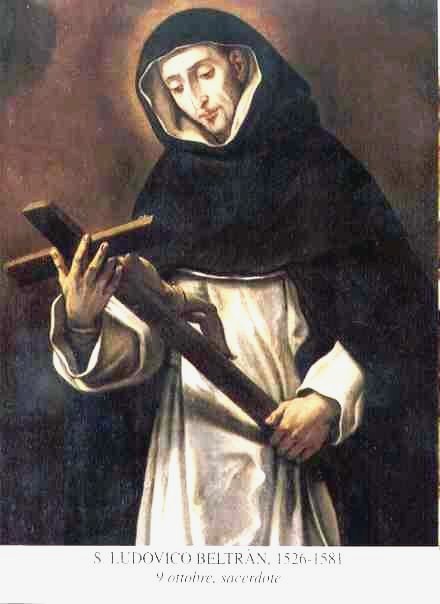
Saint Louis Bertrand
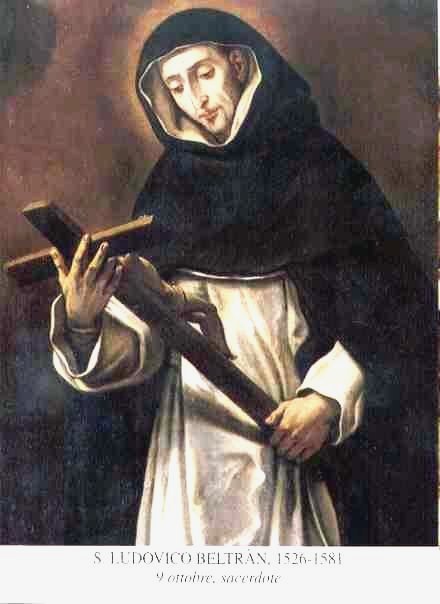 Born at Valencia, Spain, 1 Jan., 1526, his parents were Juan Bertrand and Juana Angela Exarch. Through his father he was related to the illustrious St. Vincent Ferrer, the great thaumaturgus of the Dominican Order. The boyhood of the saint was unattended by any of the prodigies that frequently forecast heroic sanctity. At an early age he conceived the idea of becoming a Friar Preacher, and despite the efforts of his father to dissuade him, was clothed with the Dominican habit in the Convent of St. Dominic, Valencia, 26 Aug., 1544. After the usual probation, in which he distinguished himself above all his associates in the qualities of an ideal religious, he pronounced the vows that irrevocably bound him to the life of perfection. The profound significance of his religious profession served as a stimulus to the increase of virtues that already gave evidence of being cast in heroic mould. In demeanor he was grave and apparently without any sense of humor, yet withal possessed of a gentle and sweet disposition that greatly endeared him to those with whom he came in contact. While he could lay no claim to the great intellectual gifts and ripe scholarship that have distinguished so many of the saints of the Dominican order, he applied himself assiduously to study, and stored his mind with the sacred truths expounded in the pages of the “Summa”. In 1547 he was advanced to the priesthood by the Archbishop of Valencia, St. Thomas of Villanova.
The extraordinary sanctity of the young Dominican’s life, and the remarkable influence he exercised on those about him, singled him out as one peculiarly fitted to lead others along the path of perfection. Consequently, he was appointed to the most responsible office of master of novices, in the convent at Valencia, the duties of which he discharged at different intervals for an aggregate of thirty years. The plague that decimated the inhabitants of Valencia and the vicinity in 1557, afforded the saint an excellent opportunity for the exercise of his charity and zeal. Tirelessly he ministered to the spiritual and physical needs of the afflicted. With the tenderness and devotion of a mother he nursed the sick. The dead he prepared for burial and interred with his own hands. When the plague had subsided, the zeal of the holy novice-master sought to extend the scope of his already large ministry into the apostolate of preaching. Though possessed of none of the natural qualities deemed essential for a successful career in the pulpit, he immediately attracted attention as a preacher of great force and far-reaching influence. The cathedral and most capacious churches were placed at his disposal, but proved wholly inadequate to accommodate the multitude that desired to hear him. Eventually it became necessary for him to resort to the public squares of the city. It was probably the fame of his preaching that brought him to the attention of St. Teresa, who at this time sought his counsel in the matter of reforming her order.
Unknown to his brethren, St. Louis had long cherished the desire to enter the mission fields of the New World. The hope that there he might find the coveted crown of martyrdom contributed not a little to sharpening the edge of his desire. Possessed of the necessary permission he sailed for America in 1562, and landed at Cartagena, where he immediately entered upon the career of a missionary. The work thus begun was certainly fruitful to an extraordinary degree, and bore unmistakably the stamp of Divine approbation. The process of his canonization bears convincing testimony to the wonderful conquest which the saint achieved in this new field of labor. The Bull of canonization asserts that, to facilitate the work of converting the natives to God, the apostle was miraculously endowed with the gift of tongues. From Cartagena, the scene of his first labors, St. Louis was sent to Panama, where in a comparatively short time he converted some 6,000 Indians. His next mission was at Tubera, situated near the sea-coast and midway between the city of Cartagena and the Magdalena River. The success of his efforts at this place is witnessed by the entries of the baptismal registers, in the saint’s own handwriting. These entries show that all the inhabitants of the place were received into the Church by St. Louis. Turon places the number of converts in Tubera at 10,000. What greatly enhances the merit of this wonderful achievement is that all had been adequately instructed in the teachings of the Church before receiving baptism, and continued steadfast in their faith.
From Tubera the Apostle bent his steps in the direction of Cipacoa and Paluato. His success at the former place, the exact location of which it is impossible to determine, was little inferior to that of Tubera. At Paluato the results of his zealous efforts were somewhat disheartening. From this unfruitful soil the saint withdrew to the province of St. Martha, where his former successes were repeated. This harvest yielded 15,000 souls. While laboring at St Martha, a tribe of 1500 Indians came to him from Paluato to implore the grace of baptism, which before they had rejected. The work at St. Martha finished, the tireless missionary undertook the work of converting the warlike Caribs, probably inhabitants of the Leeward Islands. His efforts among these fierce tribesmen seem not to have been attended with any great success. Nevertheless, the apostolate among the Caribs furnished the occasion again to make manifest the Divine protection which constantly overshadowed the ministry of St. Louis. A deadly draught was administered to him by one of the native priests. Through Divine interposition, the virulent poison failed to accomplish its purpose, thus fulfilling the words of St. Mark: “If they shall drink any deadly thing, it shall not hurt them” (xvi, 18). Teneriffe next became the field of the saint’s apostolic labors. Unfortunately, however, there are no records extant to indicate what was the result of his preaching. At Mompax, thirty-seven leagues south-east of Carthagena, we are told, rather indefinitely, that many thousands were converted to the Faith. Several of the West India islands, notably those of St. Vincent and St. Thomas, were visited by St. Louis in his indefatigable quest for souls.
After an apostolate the marvelous and enduring fruits of which have richly merited for him the title of Apostle of South America, he returned under obedience to his native Spain, which he had left just seven years before. During the eleven remaining years of his life many offices of honor and responsibility were imposed upon him. The numerous duties that attached to them were not permitted to interfere with the exacting regime of his holy life. The ever increasing fame of his sanctity and wisdom won the admiration and confidence of even the officials of the Government, who more than once consulted him in affairs of State. With the heroic patience that characterized his whole life he endured the ordeal of his last sickness.
WILBERFORCE, The Life of St. Louis Bertrand (London, 1882); TOURON, Histoire des Hommes Illustres de l’Ordre de Saint Dominique (Paris, 1747), IV 485-526; ROZE, Les Dominicains in Amérique (Paris, 1878), 290-310; BYRNE, Sketches of illustrious Dominicans (Boston, 1884), 1-95.
Born: January 1, 1526 at Valencia, Spain
Died: October 9, 1581 of natural causes at Valencia, Spain
Beatified: July 16, 1608 by Pope Paul V
Canonized: April 12, 1671 by Pope Clement X
Patronage: Columbia
Representation: surmounted by a serpent; extinguishing a fire; holding a chalice occupied by a serpent; holding a cross


You must be logged in to post a comment.