
Category: Dominican Saints
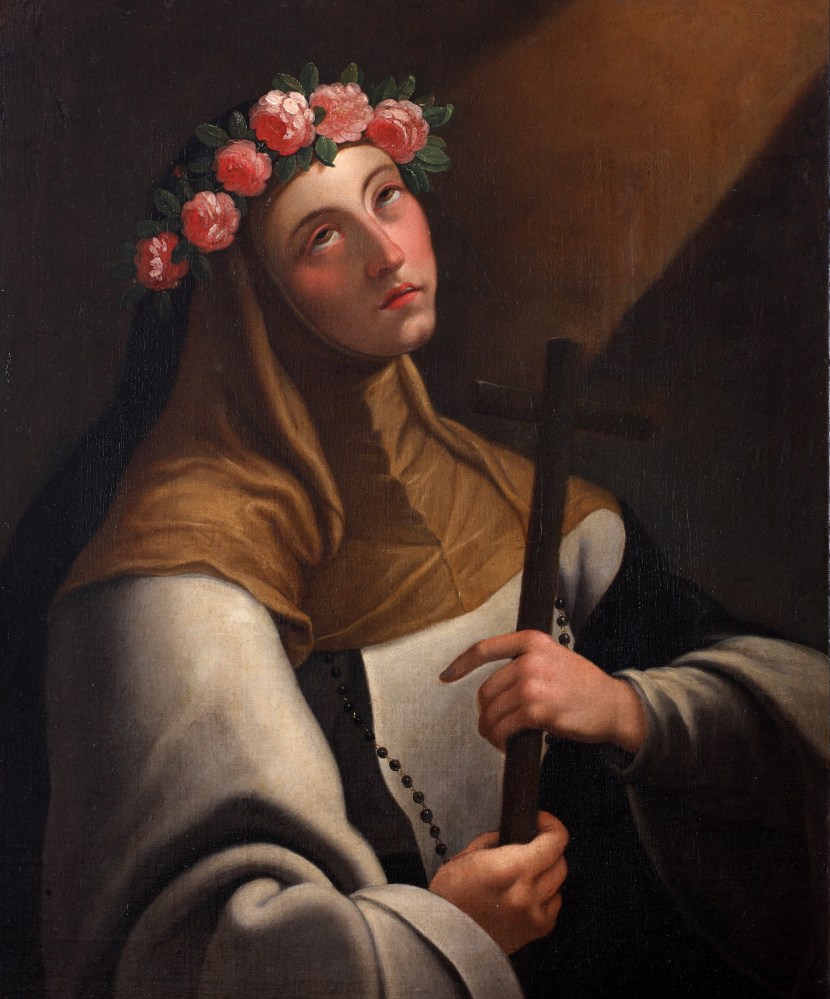
Saint Rose of Lima
At her confirmation in 1597, she took the name of Rose, because, when an infant, her face had been seen transformed by a mystical rose. As a child she was remarkable for a great reverence, and pronounced love, for all things relating to God. This so took possession of her that thenceforth her life was given up to prayer and mortification. She had an intense devotion to the Infant Jesus and His Blessed Mother, before whose altar she spent hours. She was scrupulously obedient and of untiring industry, making rapid progress by earnest attention to her parents’ instruction, to her studies, and to her domestic work, especially with her needle.
After reading of St. Catherine she determined to take that saint as her model. She began by fasting three times a week, adding secret severe penances, and when her vanity was assailed, cutting off her beautiful hair, wearing coarse clothing, and roughening her hands with toil. All this time she had to struggle against the objections of her friends, the ridicule of her family, and the censure of her parents. Many hours were spent before the Blessed Sacrament, which she received daily.
Finally she determined to take a vow of virginity, and inspired by supernatural love, adopted extraordinary means to fulfill it. At the outset she had to combat the opposition of her parents, who wished her to marry. For ten years the struggle continued before she won, by patience and prayer, their consent to continue her mission.
At the same time great temptations assailed her purity, faith, and constance, causing her excruciating agony of mind and desolation of spirit, urging her to more frequent mortifications; but daily, also, Our Lord manifested Himself, fortifying her with the knowledge of His presence and consoling her mind with evidence of His Divine love. Fasting daily was soon followed by perpetual abstinence from meat, and that, in turn, by use of only the coarsest food and just sufficient to support life.
Her days were filled with acts of charity and industry, her exquisite lace and embroidery helping to support her home, while her nights were devoted to prayer and penance. When her work permitted, she retired to a little grotto which she had built, with her brother’s aid, in their small garden, and there passed her nights in solitude and prayer. Overcoming the opposition of her parents, and with the consent of her confessor, she was allowed later to become practically a recluse in this cell, save for her visits to the Blessed Sacrament.
In her twentieth year she received the habit of St. Dominic. Thereafter she redoubled the severity and variety of her penances to a heroic degree, wearing constantly a metal spiked crown, concealed by roses, and an iron chain about her waist. Days passed without food, save a draught of gall mixed with bitter herbs. When she could no longer stand, she sought repose on a bed constructed by herself, of broken glass, stone, potsherds, and thorns. She admitted that the thought of lying down on it made her tremble with dread. Fourteen years this martyrdom of her body continued without relaxation, but not without consolation. Our Lord revealed Himself to her frequently, flooding her soul with such inexpressible peace and joy as to leave her in ecstasy four hours. At these times she offered to Him all her mortifications and penances in expiation for offences against His Divine Majesty, for the idolatry of her country, for the conversion of sinners, and for the souls in Purgatory.
Many miracles followed her death. She was beatified by Clement IX, in 1667, and canonized in 1671 by Clement X, the first American to be so honored. Her feast is celebrated 30 August. She is represented wearing a crown of roses.
Born:1586 at Lima, Peru as Isabel
Died: August 24, 1617 at Lima, Peru
Beatified: April 15, 1668 by Pope Clement IX
Canonized: April 2, 1671 by Pope Clement X
Representation: anchor; crown of flowers; crown of roses; Holy Infant; roses; Dominican tertiary holding roses; Dominican tertiary accompanied by the Holy Infant
Patronage: against vanity; Americas; Central America; embroiderers; florists; gardeners; India; Latin America; Lima, Peru; needle workers; New World; people ridiculed for their piety; Peru; Philippines; diocese of Santa Rosa, California; South America; vanity; Villareal Samar, Phillipines; West Indies
Saint Hyacinth
Saint Hyacinth, whom ecclesiastical writers are rightly wont to call the apostle of the north and one of the wonder-workers of his century, was of the house of the Odrowaz, counts of Konski, an old and noble Polish family. Some of his ancestors enjoyed palatine rights. To his line also belonged a number of military officers whose bravery and patriotism more than once proved their country’s bulwark against invasions by barbarian hordes. His great-grandfather, Saul Odrowaz, defeated the enemy in several bloody engagements. The saint’s grandfather, Saul Odrowaz, who gained an enviable reputation for courage by his martial exploits in the twelfth century, had two sons. Ivo, the younger, studied for the ministry, filled the office of chancellor for the king of Poland, became bishop of Cracow, and died with a great reputation for sanctity. Eustachius, the elder, married a lady whose piety ranked with her birth. God seems to have blessed their union with a fine family. Hyacinth, of whom we now write, was the eldest. According to the more common opinion he first saw the light of day in 1185. His birthplace was the Castle of Lanka, Kamin, in Silesian Poland, now a part of Prussia. The next sketch will be of a younger brother, or at least a near relative, Blessed Ceslas.
Almost from the cradle, nature seemed to have disposed Hyacinth to virtue. His parents not only studiously fostered this happy disposition, but also used great care to procure for their son teachers who would protect his innocence. In this way, he was so well grounded in his religious duties that he passed through his higher studies at Cracow, Prague, and Bologna, without tarnish to his pure soul. Doubtless his model life had not a little to do in helping him to win the admiration of both his professors and fellow-students. God also blessed him with, a splendid mind. Thus, through diligent study, at Bologna he obtained the degree of doctor in canon law and theology.
From Italy the future apostle returned to Cracow, whose bishop, Blessed Vincent Kadlubek, received him as a blessing sent by heaven for the good of his diocese. Father Hyacinth was at once appointed one of the canons at the cathedral, and soon afterwards became a member of the diocesan council. In this way, he not only took his part in the administration of the affairs of the great diocese; he was also a source of much consolation to the aged and saintly bishop. In whatever he undertook, or was entrusted to his care, the young priest showed rare prudence and ability. Furthermore, he ‘was zealous and pious.
However manifold were his duties, the future Friar Preacher did not permit them to interfere with his good works, or to dampen his spirit of prayer, or to lessen his practice of recollection. None were more punctual or exact in the recitation of the divine office by the canons. He mortified himself in many ways. He visited the hospitals regularly, and the sick found in him a sympathetic comforter. A friend to the poor, he distributed his income among them; for he felt that money received through the Church could not be devoted to a better or more advantageous use.
While Hyacinth was thus employed, edifying the clergy and people of the diocese, Bishop Kadlubek determined to resign his see that he might have more time to prepare to meet his God. This was in 1218. The Rev. Ivo Odrowaz, chancellor of Poland and uncle of Hyacinth, was then selected as Blessed Vincent’s successor. The bishop elect went to Rome in regard to his appointment. No doubt the journey was urged by King Leszek, the Right Rev. Vincent Kadlubek himself, and the cathedral chapter of Cracow, if not even by many of the hierarchy of Poland. On the one hand, the resigning prelate enjoyed too great a reputation for Honorius III readily to consent to his laying down the reigns of authority; on the other, the Polish authorities were not only content that the holy man should be allowed the rest he craved, but also anxious that the Diocese of Cracow should have as its head the one whom they judged the best fitted to take his place.
Ivo Odrowaz took with him to Italy Saint Hyacinth and Blessed Ceslas. Both of them, because of their zeal, piety, good judgment, and learning, were among the most influential clergymen of the diocese. Doubtless, therefore, the bishop elect chose them that he might have the advantage of their counsel and knowledge. In the episcopal retinue were also Henry of Moravia and Herman of Germany — a fact, which, in spite of some contrary opinions, seems to prove that they, too, stood high in the ecclesiastical circles of Cracow. The Journey appears to have assumed the added character of a pilgrimage. But, in the light of subsequent events, one is justified in the belief that it was guided by a special providence.
At Rome the little band met the Right Rev. Henry von Guttenstein, bishop of Prague. They also soon came in contact with Saint Dominic, the report of whose miracles resounded throughout the capital of Christendom, especially that of raising young Napoleon Orsini to life, which he had just performed. This was in 1218. The two bishops were so pleased with the holy man and his disciples that they besought him to establish his Order in Poland and Bohemia, where they held out every hope of great good that could be accomplished. This was precisely in line with Dominic’s wishes. Yet he felt that he should first attend to the needs of the countries nearer at hand; and his confrères were not yet sufficient in number to supply all demands. Another difficulty was the fact that none of those who had until then joined the new institute knew aught of the Polish or Bohemian languages and customs. The saint, therefore, urged the two dignitaries to wait until he should be better able to comply with their wishes.
Henry von Guttenstein seems to have been content with this promise. But Ivo Odrowaz pressed his case, for he wanted the missionaries without delay. He declared that he would protect them, nay, be a father to them, and that they would be as well cared for in Poland as in their own native lands. No one, he insisted, knew the needs of his diocese better than himself. They were extreme, and could not be met any too soon.
This appeal touched the saint’s heart. Perhaps God suggested a new idea to him. “Bishop,” he then said, “if you will let me have some of the virtuous young priests with you, I trust your wishes may be soon fulfilled. I will give them the habit; and I hope that, with the assistance of heaven, they will in a very short time be sufficiently drilled in the religious life to undertake the apostolic activities of the Order. Then I will turn them over to you. There is no doubt but that they will do in Poland what a number of my confr6res are accomplishing in Italy, France, Spain, and elsewhere.”
The suggestion pleased Cracow’s bishop. He spoke of it to those who had come with him — Hyacinth, Ceslas (both his nephews), Henry, and Herman. While, he said, his natural affections and personal interests disposed him to retain them about himself, he felt that he would render the country a great service by sacrificing them to the new Order, if they should like to join it. As it happened, all four of them had been no less impressed by Saint Dominic than Bishop Odrowaz himself. The holy man’s spirit had gained possession of their souls. Accordingly, the four, filled with the hope and desire of laboring as Friars Preacher, decided to enter the Order. They received the habit from the founder at Santa Sabina’s on the Aventine Hill.
Father Touron places this event about March, 1218. Others say that it took place a year later; while some assign it to 1220. The precise date, although important, is of less consequence than the fact that the calling of the four men seems certainly to have come from heaven. They had already been thoroughly formed, trained, and educated for the priesthood, and had had no little experience. This now stood them in good stead; for through this, the grace of God, and the masterful guidance of Dominic, they made marvellous progress in their preparation for their new life. The saint kept his promise to the bishop of Cracow. He did not wait until they had made a year’s novitiate. When he felt that they were prepared for the work of the Order, he used the extraordinary power given him by Honorius III, and permitted them to take their vows. Then he sent them, perhaps with a few others, to the field of labor which had been determined for them.
Possibly nowhere does a reflection, which often occurs to the reader of Saint Dominic’s history, present itself with greater force than in connection with Saint Hyacinth and his companions. How could the founder of the Friars Preacher prepare men in so short a time to announce the word of God with extraordinary success, while such a training, in the natural course of things, requires years? None of those mentioned in this sketch, though they were educated men, had been specially drilled in sacred oratory, or distinguished themselves by their eloquence. Yet, after the few months spent in the novitiate at Santa Sabina’s, their preaching was all but resistless, and drew immense crowds wherever it was known that they were to appear.
To the writer at least it appears that such a phenomenon can not be accounted for in any natural way, even though, as must be admitted, Saint Dominic possessed a marvellous personal magnetism, and was endowed with rare gifts for inspiring others with his enthusiasm. The only satisfactory explanation of the fact is that the great and sudden change was the work of grace. Like the apostles of old, after the day of Pentecost, they were different men.
Hyacinth, who was then thirty-three years of age, received the appointment of head of the little missionary band. Whether or not Bishop Ivo Odrowaz remained at Rome until the new Friars Preacher made their religious profession, as Father Touron thinks, they did not form a part of his episcopal train on the return journey.(11) Taking another course, they passed through the territory of the former Republic of Venice into Carinthia, and founded a convent at Friesach, in the northern part of that duchy. The Most Rev. Eberhard von Truchsen, archbishop of Salzburg, received them all the more cordially because he had met Saint Dominic at the fourth Lateran council, Rome, in 1215, and had asked him for some of his disciples. Doubtless it was at the archbishop’s request that the house was established at Friesach.
During his six months’ stay in Carinthia Saint Hyacinth really began his wonderful career. People flocked in enormous numbers to hear his sermons. He gave the habit of the Order to many, among whom were not a few clergymen. Then, with the powers conferred on him by Dominic, he instituted Father Herman of Germany superior of the house; for, as Polish historians tell us, he was a man of exemplary life, as well as possessed of great zeal, prudence, and oratorical ability.
Hyacinth, Ceslas, Henry, and some others now continued their way towards Cracow in accordance with their promise. However, they labored as they passed through Styria, Austria, Moravia, and Silesia. The report of their sanctity and eloquence had preceded them in all these places. As Father John Croiset, S. J., correctly states, the fervor of their preaching was such that the people everywhere soon recognized that the new religious institute was composed of truly apostolic men.
By this time our saint’s extraordinary life was fairly under way. Not in Cracow only, but throughout his native land word was scattered abroad of the wonderful things that God effected through his ministry. Thus, as he passed through Poland, immense crowds met him with every expression of joy and esteem; and it could easily be seen that it was the ambassador of Christ, not the nobleman, whom they sought to honor. In his well-balanced humility, Hyacinth, who had not been used to such things in his younger years, referred it all to God, of whom he was only an agent.
At Cracow itself, the bishop, his clergy, and crowds of every station in life received the former canon of the cathedral as an envoy from heaven. In accordance with the request sent by Honorius III, they left nothing undone in order to facilitate the Friar Preacher’s mission. God blessed his sermons from the start. Enmities, pride, and rivalries were laid aside. Sinners gave up their evil ways. Those who had long neglected their religious duties began to hear mass and receive the sacraments. Cracow soon became a different city. Bishop Ivo Odrowaz must have taken a keen spiritual pride in his nephew, as well as have been thoroughly convinced that his vocation was divine.
It must be admitted, writes Adrian Baillet, that such marvellous effects were the work of God rather than that of man. It is impossible to write a sketch of Hyacinth’s life that would be worth the while without playing the part of the hagiographer, no less than that of the historian. Indeed, however appealing his words and the example of his saintly life, there can be little doubt but that his labors would have been far less fruitful in good, had they not been supported by the gift of miracles. Writers of history mention many of these, which gave great éclat to his apostolate from the start.
However, as the saint himself ever sought to cover them under the cloak of humility, we shall follow his example, and mention only those marvels which are so connected with some trait or fact of his life that they can not be omitted without obscuring the course of his missions. Suffice it here to say that he was not content to tear up the cockle which the enemy had sown in with the Lord’s good grain. He ever sought to stabilize his work by the introduction of religious practices in the place of the vices against which he waged incessant war. This is what he accomplished in the city and diocese of Cracow, where even many of the high-born were soon so changed that they became models of docility.
While Hyacinth was engaged in this work of reformation, the bishop, his cathedral chapter, and the magistrates of the city acted in concert to bestow the Church of the Holy Trinity in Cracow on the Order, erect a convent, and furnish it with the necessaries for a religious community. Large as was the house, it was soon filled with ardent subjects. Trained under his care, and filled with his spirit, they extended the work of reform with signal success to the furthermost parts of Poland.
Among those whom the apostle of the north received into the Order at Cracow was a noted Roman doctor, James Crescenzi, whom an uncle, Cardinal Gregory Crescenzi, had brought from Italy in the capacity of secretary and counsellor when appointed papal legate to Bohemia and Poland. Hyacinth’s sermons so won the admiration of this young ecclesiastic, and fired his zeal, that he decided to become a Friar Preacher. He felt that in no other life could he more surely save his own soul, or do more for the extension of the kingdom. of Christ on earth. The cardinal legate, while he naturally disliked to lose the assistance of his kinsman, was too pious a man to interfere with his vocation. As a zealous preacher Father Crescenzi attained no little reputation.
Dominic’s promise to Bishop von Guttenstein of Prague had not yet been fulfilled. When, therefore, the convent of Cracow was well on its feet, Hyacinth sent Ceslas, Henry of Moravia, and others to establish themselves in Bohemia. He himself continued his, work through the provinces of Poland, where God sanctioned his efforts with frequent wonders. Everywhere he met with the same success that had crowned his toil in Cracow.
Requests for Friars Preacher came in from various places. For this reason, Hyacinth founded a convent at Sandomir, capital of a palatinate of the same name in Little Poland. He built another at Plock, on the Vistula and in the old Polish Province of Warsaw. At both these houses he gave the habit to many whom his preaching, saintly life, and miracles won to the Order. Thus, like that in Cracow, they became centers from which the entire kingdom was supplied with missionary workers.
It is in the Province of Warsaw that we first see the holy man walking on water dryshod. The account of the miracle is found in the bull of canonization by Clement VIII. While on his way, with three companions, to preach at Vissegrad, he found the Vistula in such a state of flood that the boatmen did not dare to undertake to cross it. In his strong faith, and unwilling to disappoint the people, he offered a prayer to heaven, made the sign of the cross, urged his confrères to follow him, and began to walk on the waves as if they were solid earth. As they were afraid to imitate his example, he returned to the bank. There he took off his cloak, spread it on the water, and said in a most confidential tone: “In the name of Christ our Lord, brothers, do not fear. Come on. This mantle will serve you as a bridge.”
Not only did the three missionaries obey; all four passed over the raging stream as though it had been the smoothest road. This marvellous occurrence happened in plain view of many in Vissegrad. One may thus easily imagine the effect his preaching had on the people of the town. It was one of the outstanding miracles brought up at the time of the saint’s canonization.
Hyacinth had drunk in deeply the spirit of Dominic. Like the founder of his Order, he ever dreamed of new spiritual conquests for the Church and more souls to be saved. When, therefore, religion was renewed in Poland, leaving his confrères to continue the good work there, he wended his way towards the remoter and more barbarous north. There he knew were vast numbers either still buried in the darkness of idolatry, or adherents of the eastern schism. No distance, no peril, no hardship, no lack of comfort or climatic condition could dampen the ardor of the zeal which consumed him, so Iono, as there was hope of extending the kingdom of Christ. He was ready joyously to suffer any and everything for God and the spiritual welfare of his fellow man.
From Poland the apostle took a number of Friars Preacher on this journey. Heaven blessed their endeavors with many conversions. Wherever he saw a prospect of permanent good he began a convent, and left some of his confrères to spread the light of the Gospel. Often he was left alone on his peregrinations. Although he was ignorant of the languages spoken by the various peoples in whose midst he came, he preached without an interpreter, and was understood as though he spoke their own tongues. It was like a renewal of the apostolic age. Miracles, so to express it, walked in his footsteps. While they did not always bring conversions, they at least combined with his sweet character to protect the ambassador of Christ and to make him loved.
Among the convents which the leading citizens of Pomerania, Prussia, and other places along the shores of the Baltic Sea had Hyacinth erect for them were several that became noted centers of spiritual activity. Such, for instance, was that at Kammin, on the Oder. Another was the convent of Przemysl, on the San. Kulm, Elbing, Königsberg, and Dantzic also had their great houses of Friars Preacher, which furnished many missionaries for the Lord’s vineyard. Nor must we forget the one situated on the island of Rügen, out in the Baltic Sea, just off the mainland of Prussia. All these, and more, were the fruit of the toil of the apostle of the north. That in Dantzic, as we shall soon see, has a beautiful and interesting bit of history attached to it.
To not a few of our readers, no doubt, it will be a surprise to learn that, when Saint Hyacinth went to Prussia, he found worship of the devil broadcast. Despite edicts against the impious and sacrilegious practice, myriads, who were still sunk in the darkness of idolatry, tenaciously clung to their idols, adored them with incense, and even honored them with abominable sacrifices. Others had tried to enlighten and convert these benighted people, but failed. Our Friar Preacher undertook the task, and succeeded. Here again, in the beginning, miracles were his most effective weapon against the powers of evil. Wonderful cures of the sick first won him the confidence and affection of the barbarians. Then by his sermons and instructions he not only led them to destroy their temples and burn their idols, but also to embrace the true faith. It was a glorious achievement.
That this good work, so happily begun, might be rendered durable by a thorough instruction of the people, the saint asked the duke of Pomerania for a piece of land on the River Vistula, not far from its mouth. It was almost an island; and in this secluded spot Hyacinth wished to erect a convent, whose members should devote themselves to further enlightenment of those just rescued from idolatry. At first, the duke told him that the place was not suited to his purpose, for it was practically abandoned, and inaccessible. The fathers, said the prince, would be able to effect greater good, were they located more within reach of those who needed their assistance so sadly.
But Hyacinth not merely held his ground, and won his point; he predicted that on this deserted spot would rise one of the most important cities in the north. This actually happened; for, about 1295, Przemyslaw, king of Poland, started there the present Dantzic, so well known for its commerce and manufactures. It is worthy of notice that, when, in the sixteenth century, the Lutherans gained possession of Dantzic, while they either destroyed all the other Catholic churches in the city, or converted them to their own or profane uses, they respected the one established by our saint. In 1739, when Father Touron published his book, the Dominicans still served the sacred edifice, but as a parochial church. They remained there until the expulsion of the religious orders from the German Empire.
The success of Hyacinth and his disciples, their zeal, their holy lives, and the religious observance they established in their houses of prayer were a source of the keenest delight and interest to Gregory IX. To this fact, besides the testimony of historians, we have that of the Pontiff himself in the many bulls he sent to the Friars Preacher. In a brief (of 1231), addressed to the princes of Pomerania and other places in the north, he tells of the joy given him by the conversion of so many by the labors of these missionaries, and exhorts the leaders of society in those parts to be ever docile to the teachings of the fathers, that all may be permanently brought under the sweet yoke of Christ.
Had Saint Hyacinth ceased from toil after his accomplishments in Pomerania and Prussia, he would still be one of the greatest missionaries the world has ever seen. But his thirst for the glory of God and the salvation of souls seemed insatiable. No sooner had he firmly established the missions of which we have just spoken, than he buried himself deeper in the northern forests. Denmark, Sweden, Gothland, Norway, and most likely Finland now became the scenes of his activity. Our Lord continued to follow him with the gift of miracles, which he did not hesitate to use in confirmation of his strong sermons against sin, idolatry, and superstition, as well as in favor of the Church of Christ.
Success again crowned his efforts. But the holy man seems to have moved with greater rapidity here than in his former spheres of labor. Perhaps it was because he felt age creeping upon him, while the world was large, and he still looked for other fields of spiritual conquest. However, for he always had an eye to the future, Hyacinth took good care to build convents in those outskirts of civilization, and to people them with fervent religious who could carry on the good work, when he should have passed to other parts.
Here we must pause in the historical part of our story, and consider a striking trait of Hyacinth’s character, which should not be overlooked, but to which we have hitherto scarcely called attention. It is his spirit of humility, prayer, penance, and mortification. The more God blessed his efforts, the more he prayed and sought to sink himself in self-annihilation. Like Saint Paul, he wished the glory of all that he did to be given to heaven. Like Paul also, he chastised his body, and brought it into subjection, lest, while he preached to others, he himself should become a castaway.
It should not be forgotten that these travels, through which we have traced the apostle, were all made on foot. He nearly always slept on the bare earth, or a bard board. Frequently, even in the frozen regions of the furthest north, he was overtaken by night during his journeys, and compelled to use the snow for a bed. One marvels how he stood it. Withal, he slackened not in the observance of his rule, or in his practice of penance and mortification.
From the extreme northwest of Continental Europe the man of God retraced his steps eastward, and passed into Little Russia. There, too, he made many conversions, the most noteworthy and helpful of which was that of Daniel, king of Ruthenia and an ardent adherent of the schismatical Greek Church. There can be no doubt but that the bringing of this sovereign into the true Catholic faith aided immensely in the work of converting his subjects, even if he did suffer politics to lead him back into his former way of error. Yet, it would seem, only an apostle like Hyacinth could have succeeded so happily with the Ruthenians; for obstinate schism, frightful moral corruption, and extreme ignorance prevailed among them. However, his patience and zeal triumphed over these obstacles. The night he gave largely to prayer; the day he spent in preaching, catechetical instruction, and the confessional.
Rome had given the apostolic man every faculty for his missions, which he did not hesitate to use for the good of souls. He never lost any time. Thus, as God always came to his assistance with miracles, he could accomplish in the course of a few months what would take years for others to do. His stay in the country of King Daniel was not long. Yet he built a convent in Lemberg (or Leopold), on the Peltew, and another in Haliez, on the Dniester. Both of these houses not only became the parent of others; they also sent forth numerous missionaries to preach the faith far and wide. Many of them crowned their lives with glorious martyrdom. Some also were made the first bishops in dioceses afterwards established by the Holy See in places which the subject of our narrative won for the true fold.
Our readers might fancy that surely the Friar Preacher’s zeal had reached its surfeit by this timeif we may use the expression, it was just getting a good start. From Little or Red Russia he passed eastward to the shores of the Black Sea or Euxine Sea. Thence he made his way southward into the numerous islands of the Grecian Archipelago in the Aegean Sea, that lies between Greece and Asia Minor. Later he proceeded north again, and entered ancient Muscovy which was called by the names of both Great and Black Russia.
What fruits Hyacinth reaped from these missionary exploits it would be hard to say, for we have no authorities from whom to draw on this part of his life. Father Touron himself does not tell us. But we can rest assured that the saint did all in his power to bring souls to God and His Church. One may readily imagine, yet not easily portray, the hardships he encountered on these journeys, as well as the difficulties he must have experienced in his efforts against the superstitions, errors, and evil ways in which these barbarous peoples had been sunk for some centuries.
Most likely our missionary left the Grecian Archipelago for Great or Black Russia on instructions from Rome, where the keenest anxiety prevailed to bring the Christians of that part of the north into communion with the Holy See. Be that as it may, he found there a medley of pagans, Mohammedans, and schismatic Greeks. Although they had a bishop, the Catholics were few in number, and without influence. They neither possessed a place of public worship, nor dared to make open profession of their faith. The situation fired Hyacinth’s zeal. Even though it had been hard even to civilize these northern hordes, he felt that it would not be impossible to convert them, if he could only bring their sovereign, Vladimir, into the Church. Redoubling his prayers and penances, therefore, the Friar Preacher sought to obtain an interview with the prince, either between themselves, or in the presence of the court, on affairs of the soul. It was a useless attempt. Education, schism, politics, and the influence of Vladimir’s counsellors combined to thwart every request for such a meeting. In none of his missions had the ambassador of Christ met with so strong an opposition. Another would have followed the advice of our Lord, shaken the dust of Russia off his feet, and gone to seek some more promising field of labor. Hyacinth did not lose courage. Probably in obedience to the Holy See, he resolved to undertake what seemed an impossibility; that is, to obtain permission to preach to the Catholics publicly.
It was as much in acknowledgment of the saint’s eminent virtues, which none could but see, as in consequence of his incessant solicitations, that the prince eventually granted him even this favor. Hyacinth now began not only to preach, but also, as was his wont in such cases, to, confirm his teaching by miracles. The report of these soon brought crowds of pagans, Mohammedans, and schismatic Greeks to his sermons. It goes without saying that the few Russian Catholics and their bishop were more than delighted. Although the others doubtless went to hear him more out of curiosity than out of any desire to learn the truth, the grace of God began at last to enkindle the light of faith in many Souls. Amy number of pagans became Christians, while not a few others gave up their schism in order to be received into the bosom of the Catholic Church.
As soon as such conversions, which included persons from every walk in life, justified it, our Friar Preacher began to stabilize his work, and to make preparations for its continuance, by the erection of a convent in Kiev (or Kieff), at that time the capital of both Russias. Then, with the assistance of confrères sent to him from elsewhere, he received subjects from among his converts and prepared them to perpetuate his apostolate.
Meanwhile, the saint continued his mission of spreading the light of the faith. One day, as he passed along the banks of the Borysthenes, now called the Dnieper, he beheld a crowd of people, bareheaded and on their knees before an oak tree, on an island in the river. Ile knew at once that they were pagans engaged in their idolatrous prayers and sacrifices. Under an impulse of charity, as there was no boat at hand, he confidently crossed over the arm of the stream which separated him from them, treading on the water as though it were solid earth. So extraordinary a spectacle not only caused these benighted people to receive the messenger of Christ with joy, but also prepared them to listen to his instructions. Indeed, before he left them, they made a pyre of their idols, felled the oak which they had considered sacred, because the throne of their false deity, and embraced Christianity.
The many conversions effected by our Friar Preacher and his confrères caused Prince Vladimir no little uneasiness. He was a headstrong member of the Russian or Greek schismatical Church, over which his position as leader of his dukedom gave him practically unlimited authority. The numbers embracing the Catholic faith made him fear a decrease of power in matters both spiritual and temporal. This was an erroneous notion, of course. Yet it led him to revoke the permission he had given to preach, and to begin a bitter persecution of the Church in order to undo the good work which the saint had accomplished. In this he was ardently abetted by politicians and schismatical clerics who had closed their eyes to the light.
But Hyacinth and his co-laborers were not to be frightened by hardships. They were ready to seal their faith with their blood, and continued to preach the truths which bad been confirmed by many miracles. Like the apostles, with Peter at their bead, they declared: “We ought to obey God, rather than man.” Divine punishment was not slow in coming upon the leaders in this persecution. The early historians are one in the opinion that the unspeakable calamity which soon befell Kiev was a chastisement of it. Unawares a large army of Tartars, who spread terror through Europe in the thirteenth century, laid siege to the city. It was defended with heroism. Still, in the end, it was taken by assault, pillaged, and reduced to ashes.
The missionaries were saved by a miracle. While the barbarians were engaged in the sack of Kiev and the butchery of its inhabitants, after the city had been captured, Saint Hyacinth, carrying a ciborium in one hand, and in the other a heavy alabaster statue of the Blessed Virgin which had appealed to him for protection, conducted his community in safety to the banks of the Dnieper. There he told them to follow him. He led the way, and they all walked dryshod across the waters of the deep river, which then protected them from the fury of the Tartars. All the Polish historians are one in recording this marvellous fact, although some of the later writers confuse it with the similar crossing of the Vistula mentioned earlier in our sketch.
A circumstance, which is recorded in connection with this miracle, renders it all the more remarkable. It is said that the footprints of the saint remained on the water, even after he had crossed the river; and that, when the stream was calm, they could be seen for centuries afterwards. Be it as it may, it is certain that, when the cause of the man of God was up for canonization, four hundred and eight witnesses were rigidly examined on this very matter, and they all attested on oath that they bad seen these footprints with their own eyes; which, they said, the natives of the country call “the way of Saint Hyacinth.” The comment of the learned Jesuit editors of the Acts of the Saints (Acta Sanctorum) on this point is well worthy of reproduction. They tell us:
Possibly the remaining of the footprints [of Saint Hyacinth] on the waters of the Dnieper, which are also said to be still seen on the water of another river, will appear incredible to some. But, as says our Father Peter Ribadeneyra (Flores Sanctorum, Part II — Vita Sancti Hyacinthi –, page 418), nothing is impossible to God. Although this miracle appears most singular and stupendous, it is not beyond His power. Since, therefore, we know that the arm of the Lord is not shortened, and numerous witnesses have given sworn testimony that they have seen these footprints, we advisedly admit this marvel, however extraordinary it is.
The Friars Preacher at Cracow claim that they have the statue of our Blessed Lady which Hyacinth carried away from Kiev. Some historians, however, say that he left it at the convent in Halicz, which was built in 1234, and that it was taken to Lemberg in 1414, when the archiepiscopal see was transferred thither from the former city. Be this as it may, the saint, for he was provincial in all those northern parts, placed at Halicz the youngest of the religious whom he brought from Kiev. The others he sent to preach in different places. Then he continued his way to Poland, delivering sermons in the various towns along his route.
It was in 1241 when he reached Cracow on this return journey. He was then in the fifty-sixth year of his age. For nearly two years he now remained at the Convent of the Holy Trinity, possibly in part to rest his body after so many arduous labors, and in part to refresh his soul in the greater quiet of the cloister. He was rejoiced to find that the number of missionaries, largely through the ardor of Father James Crescenzi, bad much increased since he left the place, and that the spirit of regularity which he had established there continued to flourish. He was edified, as well as gave edification. All regarded him as a model after whom to pattern their lives. Even during this retirement, for his zeal and charity ever urged him on to help others, he preached to the faithful, and consoled the afflicted, whether spiritually or physically.
It was apparently at this time that a distinguished lady, named Clementina, who lived at Kosczieliecz, some miles distant from Cracow, invited the Friar Preacher to preach to her vassals on Saint Margaret’s day. When he arrived at the village, on the eve of the feast, he found all the crops destroyed by a storm of wind and hail. Nothing bad been spared. To make matters worse, those who were prepared for an abundant harvest would now be unable to seed their fields for the ensuing year. Great want confronted everyone. The kindly lady who had invited him mingled her tears of sorrow with those of her dependents.
A less sad spectacle would have sufficed to move Hyacinth to besiege heaven for the performance of a miracle to relieve suffering. But here he saw an opportunity of reaching the hearts of sinners by the unexpected. He persuaded the poor people to spend the night in prayer, and to have confidence in the fatherly goodness of God. His own supplications blended with theirs. To the surprise and happiness of all, when the sun rose the next morning, every sign of disaster had disappeared. The grain was in as good condition as before the storm. Quite naturally, the holy man’s sermon bore rich fruit among these poor people.
Two other miracles, which, it would seem, belong to this period of his career, we may mention as illustrating the general course of our saint’s life. As he entered the cathedral of Cracow to preach, a distressed mother placed before him two blind children who had been born without even eyes. The man of God made the sign of the cross over them, and at once both became normal.
In the same city there lived a distinguished man and his wife, who, like Elcana and Anna (I Kings, Chapter 1), had no children. This circumstance rendered their married life unhappy, for they had no natural heir to whom they could leave their fortune. In her sorrow, the wife, Madam Felicia Gruszouska, went to Hyacinth to beg his prayers that God might bless her with a son. Having made his usual sign of the cross over her, he told the lady to be of good cheer, for heaven would give her a male heir who would be the progenitor of many bishops and princes. History proved the truth of his prophecy.
The houses which the saint himself founded, or caused to be built by others, in Poland and the northern countries (especially in the two Russias) were divided into two historical provinces, of which he is justly considered the father. A Polish historian, who wrote his life from reliable sources, is quite positive in his declaration that the subject of our narrative long governed all these convents in the capacity of provincial; and this statement is substantiated by an ancient document in the priory of Lemberg.
Some writers of the seventeenth century, it is true, do not accept this conclusion. But the argument on which they base their stand tends rather to refute their opinion. They tell us that his missionary journeys and engagements would not have permitted him to attend to the duties of a provincial. On the contrary, however, it was precisely the rapidity with which he passed from place to place that enabled him to visit so many monasteries scattered in such widely separated localities. Almost any other man would have been appalled by the very thought of the endless travel the position necessitated.
As a matter of fact, after somewhat less than two years spent in Cracow and its vicinity, the tireless Friar Preacher started on another tour of the north and extreme northwest, where he had either established, revived, or strengthened the faith. Sweden, Denmark, and the other countries, through which we have traced him, were not forgotten. Everywhere his memory was still treasured. His presence aided his own confrères, no less than the faithful. Through his preaching new members were added to the convents, and the fold of Christ was increased. Possibly some other religious houses rose along his path.
Hyacinth was a character to whom Saint Dominic would hardly have failed to reveal his wish to consecrate himself to missionary work among a people then known as Cumans. They were a wandering race, who seem to have made their principal habitat in a stretch of country extending from northeastern Hungary and Roumania into adjacent parts of Russia. A desire to bring this people into the fold of Christ was inherited by more than one of the early disciples of the founder of the Friars Preacher. Father Paul of Hungary (chosen by Dominic himself for this apostolate) and his companions had already sown the seed of faith there. Thither Hyacinth also turned his mind on his return from the missionary tour described in the preceding paragraph. Possibly he resigned his provincialship for that purpose.
With his usual zeal he began to toil hand in hand with his confrères. But, as he saw there was no special need of his labor in those parts, because of the number engaged in the mission, he soon cast about for some more distant center of action. The Tartars had driven him from Kiev, and largely destroyed the fruits of his labor in that part of Russia, where everything yielded to their arms. Why not, therefore, thought the saint, carry the sword of the cross into their own country? With the permission of his superiors, he now made his way to the very strongholds of this barbarous and warlike people. We are told that, through his miracles and holy life, he converted several thousand of them to the Christian faith.
Father Michael Pio tells us that a prince of Tartary was among Hyacinth’s converts, and that this leader, together with a number of his followers, attended the first council of Lyons (1245), and was baptized there. No proof of this statement can be found in the history of the council. On the contrary, we know that it considered measures for repressing the ceaseless and bloody incursions of these barbarians into Europe — particularly Poland, Russia, and Hungary. It is true that, in 1248, ambassadors of the great Tartar sovereign visited the French king, Saint Louis, in the Island of Cyprus. They said that their khan had become a Christian, and had sent them to offer assistance against the Saracens, who were no less enemies of the Tartars than of the Christians. The letter of the Tartar sovereign was given to Father Andrew de Longjumeau, O. P., to read; for he had been a papal envoy to Tartary, was acquainted with one of the ambassadors, and knew their language.
This fact, recorded both in ecclesiastical history and in the Life of Saint Louis, shows that Christianity was preached to these fearless barbarians, before whom the world trembled, prior to 1248. It is also proof that Hyacinth was neither the first nor the only Friar Preacher who labored for their salvation. Writers generally suppose that he was alone on this mission. Yet rarely did the sons of Saint Dominic take long journeys without companions. In any case, however, it seems certain that he remained longer among these intractable people than any of his confrères. Doubtless, too, for he was a man whose tireless zeal God ever supported with miracles, he made more conversions among them than any other.
Our Friar Preacher traversed a large portion of the immense stretches of Tartar territory. Then he made his way to the old Kingdom of Thibet, and continued his course northeast to Cathay, or the uppermost part of China. Everywhere the apostolic man preached redemption and salvation through Christ crucified. Everywhere he strove with all his might to revive the spark of faith which missionaries had enkindled there in the early centuries, but which war, persecution, paganism, and time bad combined to extinguish. Ambassadors of Christ, who traversed these regions in after times, found traces of Catholicity still in existence.
Our readers, we can but fancy, have marvelled at the prodigious labors and travelling of Saint Hyacinth, although we have given only a meager account of them. They extended over a period of nearly forty years, and carried him through a large part of Europe and Asia. Doubtless, if they were recorded in detail, and in proper sequence, they would be found infinitely more stupendous than we have painted them. He alone could have told them as they should be recounted. Yet it possibly never entered his mind to leave posterity any information on his life. The one thing that engaged his thoughts was, after saving his own soul, to help those of others, to make God known, and to extend the kingdom of Christ. The same idea filled the minds of the confrères who were often his companions in labor. In this way, it was only through the scanty records discovered in cities and the early convents that historians have been able to tell us the little we do know about him. Still perhaps never was there a life which should be more completely written than that of Saint Hyacinth Odrowaz.
From the east the missionary made his way back to Poland, travelling and preaching as he had done on the outward journey. Soon we find him again in Red Russia, where his efforts seem to have borne as much fruit as they had done in his younger days. Among the conversions he now made was that of Prince Coloman (or Koloman) and his wife, Princess Salomea. Not merely did the saint bring them out of schism into the Church; through his guidance they were led to the practice of heroic virtue.
At this period of his life, he gave practically all his attention to Volhynia, Podolia, and Lithuania. The people flocked in enormous numbers to hear the sermons of the Friar Preacher. Convents arose under his influence. That at Vilna, then the capital of the Duchy of Lithuania, became the chief house of a large Dominican province, whose members labored most earnestly for the spread or preservation of the faith in the northern parts which he had evangelized. The repute of Hyacinth’s sanctity, zeal, goodness of heart, self-sacrifice in behalf of religion, and what he had done for the Church, combined with the consequent love and veneration in which he was held not only to spur these religious on in their labors, but also to render the people more responsive to their efforts.
It is no wonder that the Catholics among the Slavonic races look upon Saint Hyacinth as the apostle of their various countries. In Poland especially he is as deeply loved as Saint Patrick in Ireland. No doubt this veneration has contributed not a little towards maintaining the inhabitants of that country true to the faith. The influence of his labors in Russia may be seen from the mere fact that, from 1320 to 1439, all the bishops of Kiev were taken from the Order of Preachers. There were six of them in succession.
In the three provinces mentioned in the last paragraph, but one, our Friar Preacher travelled four thousand leagues (that is, some twelve thousand miles) afoot. Then he returned to Cracow. This was in 1257. He was then in the seventy-second year of his age, and broken down by ceaseless toil. So he wished to end his days where he had begun his glorious career. The arrival of the holy man was an occasion of universal joy. Both the convent and the city received him with open arms. All classes, because of his sanctity and what he had done for religion in the diocese, called him their guardian angel. King Boleslaw V and his wife, Queen Cunegunda, held him in the highest esteem. Through his spiritual direction of their souls, they led such model Christian lives that his majesty has come down in history under the name of “Boleslaw the Chaste.”
Everyone had absolute confidence in the saint’s goodness of heart and power of miracles. An example of this is shown in Princess Przybislauska, a pious lady, who sent her only son to ask him to preach at Zernitz, not far from Cracow. Hyacinth consented, and said that he would start for the place in a short while. When on his way home, the young man accidentally fell into the River Raba, and was drowned. On reaching the stream, our Friar Preacher found the princess almost in despair over the loss of her child, who had been taken from the water. Moved to compassion, the saint said a prayer. Then, taking the youth by the hand, he commanded him to rise, and gave him to his mother. This was perhaps the holy man’s last miracle.
The great missioner knew perfectly well that not only were his days of labor over, but also that he was near the end of life’s journey. Like Saint Paul, he welcomed the dissolution of his body; for then his soul would be united to God, whom he had served so long, so faithfully, and with so much good to others. His communion with our Lord and our Blessed Lady were more intimate and tender than ever. Historians tell us of his great devotion to the Mother of God, and assure us that he received many of his greatest blessings through her. Now he placed himself under her protection in an especial manner. His last illness was not long. On August 14, 1257, he called the community of the Holy Trinity, Cracow, to his bedside. Then he addressed them somewhat after this fashion.
“My dear brothers, the time has come at last, when I must leave you. God calls me, and I must go to Him. Do not be sad, for I only go to join Christ our Lord. I have always loved you on earth. I will not cease to love you in heaven. Continue to strive to prepare a place for yourselves there; for you know our Saviour never refuses such a blessing to those who are faithful to grace, and persevere in His service until the end. That which our holy father, Saint Dominic, bequeathed to me I leave to you.
“Love one another. Be exact in the observance of the rules of the Order. Everything in it is important; for the smallest matters are so many aids to perfection. Love and practise poverty, charity, and obedience. Remember that your vocation requires that you ever labor for the glory of God and the salvation of souls. Be always eager to preach, and zealous in the propagation of the Order unto the end that more souls may be brought to love and serve God.”
Weak as he was, Saint Hyacinth attended the matins, and perhaps prime and tierce, of the divine office in choir on the morning of August 15. Then, because unable himself to offer up the holy sacrifice, he attended the community mass, after which he received communion at the foot of the altar. It was also the viaticum for him. Indeed, the prior, thinking that he was in the agony of death, gave him extreme unction in the same place. The holy man was anxious to die there. But his confrères persuaded him to let them carry him to his cell, where he died a few hours later in transports of love, while saying the psalm: “In thee, O Lord, have I hoped. Let me never be confounded. Deliver me in thy justice.” He retained perfect consciousness until the end.
The Blessed John Prandota, then bishop of Cracow, went to the church of the Friars Preacher just as soon as he heard of the death, in order to pay his last respects to one whom he regarded as a saint and treasured as a friend. Indeed, not only the city but even the entire diocese of Cracow was cast down by sorrow, which was equally felt by rich and poor, high-born, freeman, and serf.
Miracles began at once to be wrought at the saint’s grave. From Poland they gradually extended throughout the Christian world, as the faithful had recourse to him in prayer. During life he had been called a wonder-worker. After death the many marvels effected through his intercession gave him a still more just title to this name. We can not undertake to write of all those given by historians, or proved in the course of his canonization. The merest outline of them would require as much or more space than is given to this sketch. Page after page in large folio is taken up with them in the Acts of the Saints. Suffice it to reproduce the epilogue of the learned editors of the Acts to their treatise on the great Friar Preacher, where they say:
We have given the foregoing facts, dear candid reader, for the contemplation of the devout and for the glory of the holy man of God, Saint Hyacinth. His every act was consecrated to the propagation or maintenance of divine truth, or to enkindling devotion in the hearts of the faithful. These facts are drawn from original and authentic sources used in the process of the saint’s canonization. We have been very brief in the presentation of the miracles effected by him, lest a complete list of them, because it would be exceedingly long, should prove tiresome to many. Yet we have sought to include enough of them to give a good idea of this extraordinary man, and to show how God was ever with him. In fine, though in as short a space as possible, we have endeavored to do him a justice which can but redound to the glory of the Almighty.
In the cause of brevity, for instance, we omitted visions and apparitions of Saint Hyacinth at various times to different sick persons. We counted thirty-six of these from the original documents used for his canonization. Similarly, and for the same purpose, we passed over thirty witnesses to his sanctity and holy life in general. We felt justified in this course, for the reason that fathers of his Order and other men, who are absolutely trustworthy, and are described in the process of his canonization, mention almost innumerable prodigies performed by the blessed servant of God for the spiritual welfare of the faith. These marvels are in addition to those given in writing and universally sworn to by the witnesses called for his canonization, as recorded in our pages. In other words, we largely confined ourselves to miracles juridically attested. Yet we trust that we have left out nothing that might add materially to a knowledge of the saint’s life, character, and virtue.
One may consider the practical, lively faith of the Poles, whether in the home land or in others, as a perpetual miracle of Saint Hyacinth. In no small measure they owe it to him. To that keen faith we must attribute the magnificent institutions of learning, charity, benevolence, and the like, as well as the churches, monasteries, and similar edifices, in which Poland abounds, and in which it has found expression. All these are filled with the spirit which the people largely derived from him. They simply thrill with love and gratitude for him. This true spirit of Catholicity, we must remember, has been preserved undiminished for centuries through wars of every kind, division, hardships, persecution, and every sort of oppression-the like of which the world has seen few parallels. We have here, it would seem, the greatest miracle of the zealous apostle’s life. At least, it has contributed more to the glory of God, the good of the Church, and the salvation of souls than any miracle he performed.
Throughout the northern countries our saint found paganism, or idolatry, or atheism, or moral corruption, or schism, or superstition. In some places there was a mingling of all these evils. He soon learned from experience that they were often largely a result of ignorance, for his converts were ever ashamed of their former error. Accordingly, the holy man left nothing undone that the people might be enlightened. This was one of the reasons why he was so careful to establish houses of his Order wherever he could. Like Saint Dominic, through a special gift from heaven, he soon prepared those whom he clothed with the religious habit to carry on the work of instruction. His was a pre-eminently constructive genius.
How well he laid his foundations, and how thoroughly he trained those whom he received into the Order, may be seen from what we have now to relate. Not a few of them died a martyr’s death. Several became bishops in those northern lands. Indeed, for two hundred years after lie had ended his earthly career, subjects of the convents lie founded continued to be chosen for the miter. Among his immediate disciples thus honored we may mention one Father Vitus, whom Mindowe, duke of Lithuania, had appointed bishop of his duchy. After the murder of Mindowe, the prince’s eldest son, Vaisvilkas, began a persecution of the Catholic religion, and compelled the holy prelate to leave the country. He retired to the Convent of the Holy Trinity, Cracow, where he died before Saint Hyacinth. Bzovius (or Bzowski) claims that miracles were wrought at Vitus’ tomb.
Enormous numbers of apostolic Friars Preacher, in fact, went forth from Saint Hyacinth’s convents or schools, both before and after his death, to spread the light of the Gospel, or to die for the faith, far and wide. As has been noticed, bulls of Gregory IX and Innocent IV give eloquent testimony to the ardent zeal and extensive labors of those who toiled in Hyacinth’s own time.
His confrères in the north, in concert with the Polish sovereigns and grandees, began to urge the saint’s canonization shortly after his death. Still, owing to distance, slow and difficult communications, wars, the death of various Popes, and other tantalizing causes of delay, the case dragged along for more than two hundred years. Finally Lutheranism, with its condemnation of the cult and invocation of saints, and the danger with which it threatened Poland, aroused the zeal of Sigismund I and his successors on the throne. By them, rather than by some of the Polish hierarchy, was Hyacinth’s cause then ardently advocated. The people at large were most anxious to see him elevated to the honors of the altar.
Clement VII beatified the great missionary, and granted his office and mass to the Friars Preacher and all the dioceses of Poland. This was in 1527. The Holy Father could hardly have given the northern Catholics greater joy. In 1543, the Most Rev. Peter Gamrat, archbishop of Gnesen, having had a chapel erected in the Dominican Church of the Holy Trinity, Cracow, for the purpose, the first translation of Hyacinth’s relics took place. It was an occasion of gala, not for the city and diocese only, but for the entire country as well. In 1583 there was a second solemn translation of his relics, under the supervision of the Right Rev. Peter Miszkowski, bishop of Cracow. At this time, they were exposed on the altar of Archbishop Gamrat’s chapel for the veneration of the enormous crowds who flocked to the sacred edifice for the event.
The cup of spiritual joy for all the Catholics in northern Continental Europe, not less than that for those of the Polish tongue, was finally filled by the formal canonization of the saint. This took place on April 17, 1594, under Clement VIII. It was not without reason that the papal bull for the occasion declared that the miracles performed by Hyacinth were “almost countless.” It is quite possible that the multiplicity of these wonders, together with the extraordinary character of many of them, was in part the cause of the long delay in according Hyacinth so signal an honor; for Rome, in her usual prudence, wished to have them thoroughly examined before she placed on them the seal of her sanction.
However that may be, the action of Clement VIII met with universal favor. Prayers of gratitude rose to heaven everywhere. Poland and the Order of Preachers, as was but natural, outdid the rest of the world in their solemn celebration of the event. Other marvels now added to the renown of the new saint. In consequence of all this, February 1, 1625, Urban VIII extended his feast to practically the entire Church, with the rank of a duplex, and set August 16 as the day for its observance; but it has lately been transferred to the seventeenth of the same month. As a crowning glory of the Friar Preacher, Hyacinth was finally declared a patron saint of the Polish Church and people.
Born: 1185 at Lanka Castle, Kamin, Silesia, Poland
Died: August 15, 1257 at Krakow, Poland of natural causes; relics at Paris, France
Canonized: April 17,1594 by Pope Clement VIII
Patronage: Poland
Blessed John of Salerno
Although Father Touron failed to give a sketch of this distinguished Friar Preacher in his First Disciples of Saint Dominic, it is certain that he belonged to them, and that he was an outstanding character in the noble galaxy. Some authors say that John was a scion of the noted Guana family, and connected with the Norman princes who long reigned over the former kingdoms of Naples and Sicily. Whilst they do not give the date of his birth, practically all hold that he first saw the light of day at Salerno, some thirty miles south of Naples; that he studied at the University of Bologna; and that he entered the Order in that educational center. With one or two exceptions who give this honor to Blessed Reginald of Orleans, the writers maintain he received the habit from Saint Dominic himself. The year 1219 is the date assigned for the ceremony.
Evidently John was then a man of mature years, for he was soon placed at the head of twelve other confrères sent to establish the Order in Florence. A few date this commission in 1219; but 1220 is the time ordinarily given. The choice of him for superior in so important a city confirms the statement that his rare virtue, which he had practiced from early youth, made a strong impression on Saint Dominic. Although very small of stature, the future blessed possessed a mighty mind and a courage that nothing could awe. Doubtless these qualities also appealed to the patriarch, who seemed to judge of the characters ‘ of men almost by intuition, for an able, fearless leader was needed in Florence. Dominic and John are said to have been intimate, trustful friends-no doubt, a relationship born of grace. That the saint formed a correct estimate of his young disciple is shown by the fact that our blessed soon became one of the most influential Friars Preacher in Italy.
A curious story is told about the first house of the fathers at Florence. It was built, so it would seem, by one Deodate del Dado (possibly a merchant) who wished to make restitution for his dishonesty by devoting it to religious purposes. Situated in the “plain of Ripoli”, two or three miles from the city limits, on the way to Arezzo, it was better suited for a contemplative order than for one of the apostolic character of Saint Dominic’s. Mamachi thinks another community had occupied it. Be that as it may, it was free when the builder beard of the wonderful preaching of the holy man from Caleruega, in Bologna. So he hurried to that city, attended one of the saint’s sermons, and then offered the place to him. Some writers say that the proffer was accepted at once, and the delighted donor accompanied the first missionaries back to Florence.
When the fathers arrived at the hermitage of Ripoli, land saw its lonely, remote location, some of them likely wondered if their prayerful, mortified superior might intend to sacrifice the active side of their institute, which they had seen brought so prominently to the fore in Bologna, to the retired and cloistered side. They did not have long to wait before learning his views. Although the house was small, John of Salerno felt that it would suffice for a start. The first few days he spent in setting the place in order. Then he called the community together, and made known his plan of action. The life of a Friar Preacher, he said, is that of an energetic apostolate. They had come to humble Hipoli, not for their own sakes, but for the spiritual welfare of the faithful in the Province of Tuscany. The work would commence on the morrow, and every man would be expected to do his duty.
Day by day the little handful of soul harvesters left their hermitage at an early hour, in bands of two, that they might preach the word of God in Florence or elsewhere. In all things the diminutive superior, with a great mind and magnanimous soul, set the example, as well as led the way, which he would have the others follow. They assembled the people in churches, public squares, market places, open plains — wherever they could procure an audience. In the evening, unless too far away, they returned to their quiet abode for prayer and meditation.
Proud, cultivated Florence was stirred to the very core by the eloquence and zeal of the new religious, in whose lives there seemed to be naught of the worldly. The effect of their sermons was enhanced by the patience with which they trudged afoot back and forth between Ripoli and the city. They were on every tongue-in every mind. Their preaching was discussed in public, no less than in private. Repentant Deodate seems to have taken care of their secluded home while they were absent, as well as to have contributed towards their maintenance. No doubt he was happy in the realization that his work of amends bore such rich fruit.
Among the band of missioners, men of God though they all were, John of Salerno shone especially for his oratory, virtue, and quest for souls. None of them appeared quite so heroic as he. Whilst his example, fatherly government, and kindly admonition ever urged his confrères on in their exertions, his fine judgment and tact won the confidence of the faithful. All this combined with his superb scholarship and rare devotion to bring him the affection of the archbishop, John di Velletri, together with that of the vast majority of the diocesan clergy. Indeed, our Friar Preacher had every qualification for a perfect superior and a successful fisherman of men. Thus it is no matter for wonder that he was retained at the helm of his Order in one of Italy’s most beautiful cities, yet ever a maelstrom of political intrigue.
Saint Dominic is said to have been so impressed with the reports of the good’ effected by his brethren in Florence that he paid them at least one visit, and was delighted with their fervor and zeal. Their benefactor, Deodate, seems to have lived less than a year after they settled in his hermitage. His death deprived them of their principal source of support. This misfortune, together with the fatigue of walking back and forth each day between the city and the “plain of Ripoli,” caused the Florentines to obtain permission for them to use the hospice of Saint Pancratius, which stood at the side of the church of the same name within the municipal limits, until a more suitable place could be obtained for them. John of Salerno gladly acceded to the proposal, -and moved his community thither at once, for this more convenient location would be of great aid to his confr6res in their work.
From Saint Pancratius’ the fathers were soon transferred to Saint Paul’s. There, however, as was but natural, objections against their presence were raised by the clergy stationed at that church. John and his companions, while continuing their labors, bore all difficulties with admirable patience. Fortunately, no doubt in answer to their prayers, providence came to their aid. A Father Foresio, rector of Santa Maria Novella, touched by their virtue, zeal, and forbearance, offered them his church, together with the buildings attached to it, on condition that they would pay a moderate allowance each year for his support. Our blessed, in his capacity as superior, gratefully accepted the generous proffer. Cardinal Ugolino, the papal legate whom we have so often seen in the ro^le of a friend of the Order, and Archbishop di Velletri warmly approved of the project.
Santa Maria Novella passed into the hands of the Friars Preacher, November 8, 1221. Thus John of Salerno became the founder of the great convent at Florence, which was destined to become one of the most historic and beautiful in a religious institute renowned for its learning and deeds, as well as for its cultivation of the artistic. Many noted clergymen were trained and educated there. Not a few of Italy’s most famed painters, sculptors, and architects were employed there. It is still an object of delightful study for artists from every part of the world. Because of its exquisite decorations, Michael Angelo was wont to call it “The Bride.”
Florence had become one of the strongholds of the new Manicheans in Italy, whence their evil influence spread throughout Tuscany. They hesitated at nothing for the propagation of their destructive principles. In the subject of our sketch they met with a relentless foe. Day and night he opposed them, whether by deed or word. Never was he known to quail before their threats or attacks. His fearless action and preaching not only produced the most salutary effects, but even won for him the name of “hammer of heretics.” He must ever rank high amongst those brave Friars Preacher who helped to free the Italian Peninsula from the dangers of Manicheanism and Albigensianism.
The persuasive eloquence of the man of God combined with the odor of his sanctity and the fire of his zeal to draw many and brilliant subjects into his Order. They came from numerous places, but especially from Florence, Prato, and Pistoia. Among them was the noted Hugh of Sesto, a canon at Saint Paul’s who had led the opposition to the fathers at that church. Others who should not be omitted were: Roderic, a canon at Saint Peter’s; James Rabacante, who later succeeded John of Salerno as prior of Santa Maria Novella; Ottavente di Nerli; Roger Calcagni, who became the first papal inquisitor at Florence and bishop of Castro; Father Buoninsegna, a martyr at Antioch who is commonly called blessed; Ambrose of Rimini, a celebrated preacher who became bishop of his native city; Thomas Morandi, honored with the miter of Fano; and Aldobrandini Cavalcanti, entrusted with the charge of the Diocese of Orvieto. We might mention more, but those given above suffice to show the character of those whom the early disciple brought into his institute.
Blessed John had a special gift for governing others. He seemed to read dispositions almost as he would read a book. In all things he showed himself a father, brother, friend, and servant to those under his charge. He dominated their wills by kindness, quickened their zeal by his own, directed them along the path of perfection by his example and gentle words. The love which he bore them merited the affection which they gave him.
Whatever he did, the man of God was doubtless guided by the lessons which he had received from Saint Dominic. He had lived under the patriarch at Bologna, had met him in Florence, and of course bad come in contact with him at the general chapter of 1221. Some writers say he was the saint’s travelling companion on several apostolic journeys; but this statement seems doubtful. However, such was his love for the Order’s founder that he no sooner received word of his serious illness than he started in all haste for Bologna, where he arrived just in time to receive the dying man’s last blessing and the assurance that he would be more helpful to the infant institute in heaven than he could be on earth. Such is the importance which one saint attaches to the word of another, that we are justified in believing those of Dominic must have acted as an inspiration for Blessed John of Salerno the rest of his life.
God enriched the soul of this early disciple with many choice graces. One of the things which greatly aided him in the spiritual direction of others, whether in his Order or without it, was the faculty often accorded him of reading their consciences. Many a time did he make known to his penitents sins which they had forgotten. This gift, quite naturally, increased his influence; and he was careful to use it only for the spiritual betterment of those who sought his aid. Not a few miracles were also attributed to him, but these he did all in his power to conceal.
There is an adage which tells us that the ways of God are not the ways of man. Rare is it that providence does not permit even the most faithful servants of Christ to be tried in the crucible of temptation; but, as Saint Paul assures us, the temptation is always accompanied with the grace necessary to overcome it. So it was with John of Salerno. There were those who sought to lead him from the path of virtue. Yet his resistance not merely saved him from sin; it issued unto his greater glory before God and man. It made him “the good odor of Christ” even unto the conversion of those who thirsted for his ruin.
Among our Friar Preacher’s notable works for the benefit of religion in Tuscany must be placed the establisbment of the first community of Dominican Sisters in the province. These he started in the hermitage of Ripoli, built by Deodate del Dado, sometime after the fathers had left it. He had great faith in the prayers of these holy women, and trusted to their intercession as an aid to the success of his work and that of his confrères. In later years, because the neighborhood of Florence became infested with brigands, these sisters moved into the city. There they divided into two communities. One of them retained the old title of Ripoli, while the other took the name of Saint Dominic. Both long continued to edify the Florentines by their saintly lives and to bring blessings on the Church of the municipality by their perpetual orisons.
So labored on Blessed John of Salerno until the end of his useful life. Father John Caroli and other earlier writers speak of his toil and his heroic virtue in terms of the highest praise. They tell how he was loved and venerated, how his confr~res mourned his death, and how the people of Florence turned out in a body for his funeral; but they give us no further indication of its date than to say that it happened after many years of faithful labor (“quumque inultis jam annis . . . . . laborasset”). In the light of this assertion that he surrendered his pure soul to God in Florence after long years of constant service, one can not accept the statement of those later authors who say that he died in 1225. As a matter of fact, the Année Dominicaine assures us that Gregory IX, who ascended the papal throne in March, 1227, entrusted him with some reformation work in the Diocese of Chiusi, which he brought to a happy termination. The same publication, by way of guess, places the holy man’s death in the thirties of the thirteenth century. Yet it is just as probable that it occurred in the following decade.
Our blessed was buried with great honor in the Church of Santa Maria Novella, where his tomb immediately became a place of pilgrimage for the faithful. A number of miracles were attributed to him. It would seem that there were several translations of his relies, one of which doubtless took place when his body was removed from the old church to the new. On these occasions the faithful of the city and neighboring places came in immense crowds to pay honor to one whom they held in deep veneration. The last, and possibly the most notable, ceremony of the kind took place on February 18, 1571. At this time his relics were placed in a tomb and chapel specially dedicated to his memory. Pius VI, who reigned from 1775 to 1799, officially ratified the immemorial cult to John, permitted his Order to say mass and the divine office in his honor, and appointed August 9 for his feast day.
Born: c.1190 at Salerno, Italy
Died: 1272 of natural causes; buried at the church of Saint Maria Novella in Florence, Italy; relics translated several times, the last being on February 18,1571
Beatified:1783 by Pope Pius VI (cultus confirmed)
Blessed Jane of Aza, Mother of Saint Dominic
Devotion to Our Lady was typical of medieval Spaniards, as indeed of any Christian of the time. But the devotion to Mary bequeathed by Saint Dominic to his children was something more than ordinary , and in the natural course of events it could come from only one source-his own mother. her name, the scanty records tell us, was Jane of Aza, and neither the date of her birth nor that of her death is known with certainty. Not being of great material importance , she made little impression on history; but the print of her personality will be seen for all time on the order founded by her son. Dominic must have had a very tender love for his mother to make him turn so constantly, trustingly, instinctively to Our Lady in all the troubles and joys of his later life.
Legend relates that before the birth of Dominic, Blessed Jane beheld a vision in which she saw her son , running as a swift greyhound through the world, bearing in his mouth a torch with which he illumined the world (The son became the founder of the Order of Preachers, known as the Dominicans thus the prophetic dream was fulfilled as the Dominican friars took the light of the gospel throughout the world. They became known as the Dogs of the Lord. In Latin the word Dominican would be Domini Canes, literally Dogs of the Lord). It was for her to fan and shelter that flame at its very kindling, and to teach this child of predilection the prayers he would say with such rich results for a lifetime of saintly action. Not only was it Jane who first taught her son the words of the Hail Mary- that key with which he unlocked heaven for so many souls – but it was she that gave to him the living example of Christian womanhood. If in later years his sons were to cherish such a chivalrous love for the gracious Queen of Heaven, much of it was due to the reverential awe and tender love with which this truly Christian lady inspired her three priest-sons. to every priest, his own mother is the personification of all that is good and lovable in woman; she is the ideal to inspire him, the lighthouse to beckon him, and the living picture of the Mother of the first Priest. It could have been no different for Dominic. Where else would he , brought up amid the scenes of war and the mans world of thee university, see in action the ideals of womanly purity, gentleness, and never failing help that he was to cherish as the attributes of his heavenly Queen?
History is silent regarding events in the Life of Blessed Jane. probably there were no great events to record. As the wife of the Castellan of Calaruega, a fortress castle on the border of Christian Spain, she would have led a life filled with the monotony of small things. Tradition relates that her two older sons, Anthony and Manez, were already preparing for the priesthood when Dominic was born. She named her youngest son for Saint Dominic of Silos, at whose shrine she was frequent pilgrim . Knowing that her solider/husband expected their third son to carry on the family name and fortunes, Jane seems still to have cherished for him the goal of the priesthood. Very likely Dominic- and we – owe to his understanding Mother the fortune that placed a book in his hands instead of a sword.
Pope Leo XII beatified Jane of Aza in 1828. Devotion to her has persisted through the centuries despite the poverty of records. The mother of three priest, one of whom died a death of heroic charity and two who were raised to altars of the Church, can safely be judged to have been not only a valiant woman but also a saintly one. Her picture, as that of any mother, can best be seen reflected in her sons.
Born: in Aza, Unknown date
Died: about 1202 in Calaroga
Beatified: Pope Leo XII in 1828 approved her cultus
Blessed Mannes de Guzman
None of the early historical writers of the Order fail to mention Blessed Mannes. His stock was not the least noble among the grandees of Catholic Spain. His parents were Felix Guzman and Jane of Aza, in whose veins also ran some of the best blood of Old Castile. On both sides Mannes could count brave defenders of his country. But what was of infinitely greater importance to him were the holy lives of his own immediate family. His father was a splendid type of the Christian gentleman. His mother has been raised to the honors of the altar under the name of Blessed Jane. His eldest brother, Anthony, became a model priest, who devoted his life to the care of souls, the welfare of the poor, and the aid of the sick, and died with a great reputation for sanctity. Dominic, the youngest and perhaps the only other child, became the founder of the Friars Preacher. He is canonized. Surely this is a record of which any one might well be proud.
Blessed Mannes first saw the light of day in the ancestral castle, Caleruega, Old Castile. The date of his birth can only be estimated from that of Saint Dominic (1170), than whom, we are told, he was a number of years older. Like Anthony, he chose the ecclesiastical state at an early age. Of his ordination to the priesthood and where he made his studies we know nothing. However, Spain was most likely the theater of both. The earlier writers of the Order, while reticent about these things, all tell us that he was of a retiring disposition, and much given to prayer and contemplation.
Yet an apostolic zeal evidently burned in his breast. Almost immediately after the return to Spain of the Right Rev. Didacus (or Diego) de Azebes (often called de Azevedo), bishop of Osma, whom Saint Dominic had accompanied to Rome, Mannes set out for France. From the bishop he learned the need of missionaries in Languedoc, where Dominic had been left to combat the errors of the Albigenses. Possibly de Azebes, for he was a saintly prelate, suggested that Mannes should also take up this work. At any rate, we find him with his younger brother before the close of 1207. From this time the two men, for they were cast in the same spiritual mold, toiled hand in hand for nearly ten years that they might free the Church of southern France from the poison and turmoil of heresy, and restore it to its former peace and beauty.
Not once in all this time did Mannes take a vacation, or pay a visit to his native land, which he loved none the less because he had dedicated himself to the service of God. He felt that his place was where religion needed his attention so sadly. His zeal was tireless; his efforts unceasing. Perhaps on no other did Dominic depend so much. Doubtless, if the full truth were known, history would have to associate Mannes more closely with the saint’s success, as well as give him more credit for the part he played in the conversion of the Albigenses. No danger or hardship could cause him to falter in his labors. He was a splendid preacher. Like Dominic, he intermingled prayer with his sermons and instructions. By his shining virtues and mortified life he wielded a stronger influence for good, whether among the faithful or those who had wandered from the path of truth, than by his eloquence.
One of Blessed Mannes’ most striking traits seems to have been his humility. He knew not the meaning of the word pride or jealousy. The one thing he sought was the glory of God and the salvation of souls. Although older in years, he obeyed his brother as a dutiful son does the will of his father. When Saint Dominic established his Order, Mannes was among the first to place himself under his standard, and to receive the habit. Thus we find him among the “sixteen” zealous men whom God selected as the foundation stones on which to build the Order of Friars Preacher. One would be perfectly safe in the assertion that, when (August 15, 1217) the chosen little band took their religious vows on bended knees before the patriarch, not one of them entered into the ceremony with a better heart, or in more of a spirit of self-sacrifice, than Blessed Mannes.
This event took place in the conventual church of the Dominican Sisters, Prouille, southern France. The annals of Prouille are very explicit in the matter. From their statement and that of Father John of Navarre about the time of his entrance into the Order, which he made in his testimony to the holy life of Dominic to the papal commission appointed to examine the saint’s cause for canonization, it would seem that the sixteen brethren had taken their vows at Saint Romanus’, Toulouse, after Innocent III sanctioned the foundation of the Order. However, after its confirmation by Honorius III, Dominic had them renew their profession. Such was his love for Prouille, around which so much of his work centered, that he chose this place for the ceremony, and as the point of their departure for the various countries to which he sent them.
Blessed Mannes was chosen as one of those who were to start a house of the new Order in Paris. He had six companions — Matthew of France, who was the superior; Bertrand of Garrigue, so called from the place of his birth, a little town in southern France; Lawrence of England; the two Spaniards, John of Navarre and Michael de Fabra; and Oderic of Normandy. The last mentioned has the distinction of being the Order’s first lay brother. They travelled in two parties. That composed of Mannes, Michael, and Oderic reached their destination first, September 12, 1217, being the day of their arrival in the great French capital.
For a while the fathers were obliged to live in a house near Notre Dame Hospital, in the center of the city. But their zeal, eloquence, and model lives soon won them many friends. Among these was John de Barastre, a celebrated master of the University of Paris, dean of Saint Quentin, and a royal chaplain. The noted ecclesiastic had established a hospice for strangers near the gate of the city called “Porte d’Orleans.” The hospice bore the name of Saint James. This he now conferred on the homeless Friars Preacher, and they took possession of it August 6, 1218. It became the famed Saint James’ Convent and Studium, than which none is more celebrated in the Order.
Thus Blessed Marines was one of the founders of this well-known institution, which played a conspicuous part in the history of the University of Paris. His sermons are said to have borne rich fruit in the French capital, for he had a splendid gift of oratory. Besides, he was endowed with an extraordinary personal magnetism; while his kindly, open, and friendly disposition exercised a strong influence over souls. Few could resist his appeals for a better life.
Just when the subject of this sketch left Paris, where he was much beloved, the writers do not tell us. But it is known that Saint Dominic himself sent him from there to Madrid, Spain; and from this we can form a most reasonable conjecture as to the time when Mannes returned to his native land, which he does not appear to have seen since 1207. While in Spain in connection with affairs of his Order, Dominic found Peter of Madrid organizing some pious ladies for a religious community in that city. The saint gave them the habit, admitted them to their vows, and started the construction of a convent for them. This was early in 1219. From Spain he made his way to Paris. While in this city, which he reached before the middle of the same year, he evidently appointed Blessed Mannes to take charge of the sisters in Madrid, and sent him to the Spanish capital; for we find him there shortly afterwards.
Several things, no doubt, conspired to bring about the choice of Mannes for this position. He was growing old, and long years of hard missionary labor must have begun to tell upon his strength. He was a most spiritual, devout, and prudent man, which recommended him for such a charge. His disposition led him to prefer a quiet, retired life, in which he could give himself more to prayer and contemplation, to one of activity among the people. Besides, his practical turn of mind rendered him a suitable person to superintend the temporal affairs of the sisters, whose cloistered state made this difficult for themselves. The holy man called their convent Saint Dominic of Silos, which he doubtless did because his own brother was named after the Cistercian abbot.
From Madrid Blessed Mannes attended the second general chapter of the Order, which was held at Bologna in 1221. Through him, on his return, Saint Dominic sent a letter to the youthful community of Spanish sisters, which is of no little interest because it is the only authentic writing of the saint which has survived the ravages of time. In it he tells them, briefly, of the joy it gave him to hear, through his brother Mannes, of their piety and of the completion of their convent. Both the one and the other are largely due to Mannes’ exertions. He is, therefore, constituted their ecclesiastical superior, with almost plenary powers.
Very probably the holy man held this position the rest of his days, for we find no record of him elsewhere. With this work, we doubt not, he combined no little preaching in and around Madrid. At times perhaps his confrères took his place at the sisters’ convent, while he labored in more distant localities. His life as a religious is said ever to have been edifying to his brethren and useful to his fellow man. Some place his death in 1230. Others say that he died about this time (“circiter 1230″).
But the Année Dominicaine informs us that Roderic “de Cerrate,” a Spanish Dominican of the thirteenth century, states (in his Vitae Sanctorum) that, after Saint Dominic’s canonization, Mannes went to Caleruega and persuaded the people to erect a church in honor of his brother; that he told them a modest edifice would do for the time being, for Dominic would see that a larger one should be built later; and that this prophecy was fulfilled some thirty years later. This would make the holy Friar Preacher die, at the earliest, in 1234 or 1235. It would also explain how he came to be buried in the Church of Saint Peter attached to the Cistercian monastery near Gumiel de Izan. The monastery is not far from the birthplace of Dominic and Mannes, whose ancestors were laid to rest in its temple of prayer. Most probably, therefore, Mannes became sick while engaged in this work of piety, died with the Cistercians, and was buried in their church, for the simple reason that his own Order had no house in that part of Spain.
During life the missionary bad been considered a saintly man and a perfect imitator of the virtues of his brother, Saint Dominic. Not long after his death, miracles began to be wrought at his tomb in such numbers that it became a place of pilgrimage. Because of this his relics were transferred to a more honorable place. Strange to say, Father Chrysostom Henriquez, a Cistercian writer, (in his Menologium Cistersiense) represents the Friar Preacher as a Cistercian. However, this author has been criticized more than once for inaccuracies and carelessness. Not only did Dominican writers correct him in this instance; for Mamachi, who says that Henriquez could not have read the epitaph on Blessed Mannes’ tomb, informs us that another Cistercian author, Father Angelus Manrique, states most positively (in his Annales Cistercienses) that he was a Dominican and a brother of Saint Dominic Guzman.
Reports of the cures obtained through intercession to the man of God soon became widespread. Devotion towards him grew particularly pronounced throughout Spain. In the Diocese of Osma, and especially around Caleruega, he was considered one of the popular saints. More than once petitions for at least his beatification were forwarded to Rome. Although these were not acted upon, the veneration in which Mannes was held rather waxed stronger than decreased with the course of time. For this reason, some six hundred years after his death, the former Camaldolese monk, Mauro Cappellari, who ascended the throne of Peter in 1831 under the name of Gregory XV1, beatified him, and granted his office and mass to the Order of Preachers. July 30 was set apart as his feast day.
Born: in Calaruega, Burgos, Spain
Died: at Saint Peter’s Monastery, Gumiel d’Izan, near Calaruega, in 1230 (there is a possibility that he may not have died until 1235)
Beatified:cultus approved by Pope Gregory XVI in 1834.
Blessed Antony Della Chiesa
Antony was born into the nobility, the family of the Marquis della Chiesa, and a collateral ancestor of Pope Benedict XV. He was well educated. Showing a taste early in life for he things of God, he grew up with the hope of becoming a religious. His father, who was a man of some importance, opposed this wish. Not until Antony was 22 was he able to make the break with his family and enter the monastery at Vercelli.
Here he distinguished himself for both sanctity and learning. Being a good preacher, he was for some years the companion of Saint Bernardine of Siena, in his missionary journeys through Italy. Antony was prior at the friaries of Como, Savona, Florence, and Bologna.
Antony gives us a picture of one who followed the Dominican life perfectly, managing, most of the time, to escape public notice. There is in his life very little of the glamorous or the unusual. He kept the rule, was a good superior, and a just administrator. Shunning applause, he was always serene.
The legends mention that he was particularly devoted to Our Lady, which is something one takes for granted in a Dominican, and that he conversed with her, in ecstasy, several times. He had the gift of reading hearts and was a sought-after director of souls. He also healed many sick people with his blessing. However, if any miracles are ordinary ones, these may be so described; they could be given as typical of most of early Dominicans.
At one time, Antony was on a ship that was captured by pirates, but at his prayer, the pirates spared the passengers and brought them safely to land. One of the very few things of unusual nature that in Antony’s life is a legend told of him when he was prior of Savona. It makes a lovely ghost story, and it also provides food for thought.
According to the story, Antony was praying one night in the church. Disturbed by the sound of horses hooves clattering on the flagstones outside, he went to see who could possibly be there at such a late hour. There were several horsemen, all mounted on black horses. He addressed them, but received no answer. Thinking that they might be foreigners, he tried several languages, and still there was no response.
Aware, then, that something was wrong, he commanded them in the name of the Lord to tell him who they were and where they were going. They said that they were devils, and that they were on their way to meet the soul of a dying sinner, a usurer, and escort him to hell. “I will pray for him,” said Antony. The demons laughed and told him he was too late. “Then at least come back and tell me whether you succeed or not,” said the prior.
A short while later, the group returned, and they had succeeded. They held the unhappy usurer captive, and, while the prior watched in horror, they bore him off. The man was screaming. The next day, the usurer’s relatives came to arrange an elaborate funeral. “You would do much better to have Masses said for yourselves and other poor sinners,” he said.
Antony died at Como and was buried there in the Dominican church Miracles at his tomb led to his beatification.
Born: in San Germano, near Vercelli, the Piedmont, Italy, in 1395;
Died: Como, Italy, January 22, 1459;
Beatified: 1819 by Pope Pius VII
St. James the Apostle (the Greater)
 James, The Apostle – (Hebrew Yakob; N.T. Greek Iakobos)
Son of Zebedee and Salome, and brother of John the Apostle.
July 25
It was surely no coincidence that James and his brother John were sons of a fisherman and made their living off the Sea of Galilee. To live near and fish on a lake of that magnitude requires strength, knowledge, understanding, and at certain times of the year, bravery. It also takes fortitude, attention to detail, and temperance. Without all those qualities one could end up seriously hurt or worse yet, tangled in nets sinking to the bottom of the lake. James wasn’t alone in his calling – three others with whom he shared communal life were likewise called by Jesus to follow Him. Eventually they were even called upon to proclaim all they saw to the world. (Simon) Peter and Andrew who were coworkers, and his brother John were also called to follow Jesus around the same time as James. Jesus gathered together those He could trust who would witness the miracle of God’s love.
James was only one of three people Jesus invited to pray with Him in the Garden of Gethsemane. It was there James witnessed the transfiguration and was himself transformed in mind and spirit.
Saint James the apostle is sometimes referred to as the Greater to distinguish him from James the son of Joseph (who is sometimes called James the Lesser). Called to serve, he became a trusted friend and was instructed to serve and love those who followed our Lord. But there is more to James than his being a saint or follower of Jesus – he was first and foremost a hard worker, a friend, and a companion.
James was the first of the 12 apostles to be martyred for the newly forming community of believers. He was killed on the order of King Herod Agrippa I of Judea, about 44 A.D. (Acts 12:1-2) “1- It was about this time that King Herod arrested some who belonged to the church, intending to persecute them. 2 – He had James, the brother of John, put to death with the sword”.
Though we do not know much about the life of James the Greater, we know he was a man trusted by our Lord and he died for the early church. His strength and wisdom continue to guide and direct us all.
Blessed Augustine Fangi of Biella
Miracles around the tomb of Augustine of Biella led to his beatification in 1878, after he had long been forgotten by everyone, except the residents of the little town at the foot of the Alps where he lived. His is another example of a life noted for piety and regularity, but quite unremarkable for unusual events or venturesome projects.
Augustine’s father was a member of the Fangi family, who were wealthy and noble, and, because of this, he had planned a secular career for his son. But when the Dominicans came to Biella, his plans were changed, for Augustine was completely charmed by their way of life and begged to be admitted. He entered, while quite young, the new convent that the Dominicans had built at Biella.
Augustine’s had a reputation for penance, even at a time when people were not as squeamish as they are today. Not only did he inflict harsh penances upon himself, he also bore with patience whatever pain and annoyance life granted him gratuitously. At one time he was required to undergo a surgical operation without, of course, any anesthetic. He did so without making the slightest outcry. In fact, he said afterwards that his mind was so intensely focused on something else that he hardly noticed what was being done to him. His mind was on that “something else” most of the time, for he prayed continually.
In 1464, Augustine was made prior at Soncino. Several of his best known miracles were performed there. At one time, a deformed child, who had died without baptism, was restored to life, by Augustine’s prayer, long enough to be baptized. At another time, when he was passing down the street, he met a little boy who was crying bitterly, because he had broken a jug of wine. Augustine gathered up the shards and put them back together again. Then, with a prayer, he refilled the jug and handed it back to the startled child. Still another time, through his intercession, a woman was delivered from possession of five devils.
Augustine spent his last ten years in the convent in Venice, and he died there on the Feast of Saint Mary Magdalene. He was buried in a damp place. Forty years later, on the occasion of some repairs to the church, his coffin, found floating on water, was opened. His body and habit were still intact. This did much to promote interest in his cause. Nevertheless, it was more than three centuries before he was finally beatified.
Born: at Biella, Italy, 1430
Died: feast of Saint Mary Magdalen 1493 at Venice, Italy; in the 1530s, workmen found his coffin floating in the water that had seeped into the burial chamber – when opened, Augustine’s body and clothing were found to be incorrupt
Cultus Confirmed: in 1872 by Pope Pius IX
Beatified: in 1878 by Pope Leo XIII
Blessed Jane of Orvieto
One of the stigmatists of the Order who deserves to be better known is Blessed Jane of Orvieto, whose marvel-filled life was the edification of Umbria in the latter half of the thirteenth century. Jane was born near Orvieto, in 1264, and both parents died when she was very small. Left to the care of casual neighbors, the little girl gre up with a special reliance of her guardian angel. She was a pious and intelligent child, , spending her time in prayer , even when very young.
Since it was necessary for her to earn her living , Jane studied dressmaking and became proficient at it. For several years she worked at this trade , prayerful and happy and undisturbed about her future. However, she had a number of unhappy experiences on the street on her way to work, for young men were attracted by her beauty. It became apparent to her that she must make some public declaration of her intentions if she wanted any peace. She decided to enter the Third Order of St. Dominic. Dressed in the habit of the mantellate, she would be safe from rude remarks and from any misunderstandings.
Jane’s friends opposed her plans, because they had already helpfully chosen a husband for her, and were trying to arrange a meeting of Jane and the man they had selected. Because of her youth, the Dominicans delayed in accepting her. Only after a long period of prayer and fasting was she able to win the privilege of putting on the Third Order habit and living with the other members of the Tertiary chapter. Once a member of the Order she so much desired , she set her goal at the highest sanctity and worked at attaining it. She prayed all morning and part of the afternoon, leaving herself only time to do enough work to care for her few needs and some alms to give the poor. She soon reached a remarkable state of prayer; she participated bodily in whatever she was contemplating. Her director learned not to say anything that would send her into ecstasy until he was through instructing her. Once he mentioned the martyrdom of Catherine of Alexandria and said piously, “Arise, O blessed Catherine,” and Jane arose, in ecstasy, and remained suspended in the air for an hour. If he talked about the Crucifixion her arms would go out in the form of a cross, and she would rise in the air like a figure on a crucifix. On Good Fridays she experienced the terrible agony of the Passion, and one could hear her bones cracking and see the bloody sweat. She received the stigmata, but it was not always visible.
Along with her remarkable life of prayer, Jane had to contend with physical pain. Once she was cured of a serious illness by a miraculous appearance of our Lord on the cross. He appeared to her in the midst of a bright light and gave her a cup of wine to drink. She obediently drank it, and she was instantly cured. Another time, when she was too ill to go to church to receive Communion , Our Lady came and brought the Holy Child to her.
One of Jane’s principal crosses was the lack of privacy. The whole town knew about her ecstasies. As soon as she fell into one, people came running to look. Jane tired to persuade the prioress to keep them out, but the prioress was interested herself, and saw no reason why anybody should object to being watched if they were not doing anything wrong. Jane wept with embarrassment when people asked for her blessing, and assured them over and over that she was not a saint but a wicked sinner, a diagnosis which nobody believed but herself.
Blessed Jane died, in 1306, and was buried in the Third Order cemetery in Orvieto. The following year her body was transferred to the chapel of the Three Kings, and many prodigies occurred at that time, giving impetus to the process for beatification, which, however, was not completed until more than 400 years later, in 1754.
Born: c.1264 at Carniola, near Orvieto
Died: 1306
Beatified: September 11, 1754 by Pope Benedict XIV (cultus confirmed)
Saint Mary Magdalen, Protectress of the Order
Mary Magdalen is a model of contemplation, and is thus a suitable proctectress for an Order whose end is the salvation of souls by the preaching of the truths contemplated
Mary Magdalen, a sister of Lazarus and of Martha, of Bethany, was a notorious sinner in Jerusalem. Moved by the preaching of Jesus, she did public penance. She went openly into the house of the Pharisee with whom Jesus was sitting at table, threw herself at His feet, anointed them with precious ointment, washed them with her tears, and wiped them with her hair. Jesus, knowing her contrite heart, forgave her her sins (Luke 7:37, 38), and from that time forward she became the most zealous and faithful of the women who were disciples of Our Lord. She followed Him, always ministered unto Him of her substance (Luke 8:3), and when He died was standing under the cross.
Epistle: Canticle 3:2-5; 8:6,7
I will rise and will go about the city; in the streets and the broad ways I will seek him whom my soul loveth; I sought him and I found him not. The watchmen who keep the city found me: Have you seen him whom my soul loveth? When I had a little passed by them, I found him whom my soul loveth. I held him; and I will not let him go till I bring him into my mother’s house, and into the chamber of her that bore me. I adjure you, O daughters of Jerusalem, by the roes and the harts of the fields, that you stir not up, nor awake my beloved till she please. Put me as a seal upon thy heart, as a seal upon thy arm, for love is strong as death; jealousy as hard as hell; the lamps thereof are fire and flame. Many waters cannot quench charity, neither can the floods drown it; if a man should give all the substance of his house for love, he shall despise it as nothing.
The soul that, following the direction of the watchmen, that is, the priests, teachers, and rulers of the Church, seeks Jesus, He goes to meet, gives Himself up to, takes up His abode in, with all His love, with all His treasures. The soul which has found Christ for delight forgets all outward things, and no longer has love or joy but for and in Christ. How should it be otherwise? What can be wanting to him who truly possesses Christ? This love for Him Who loved us unto death shows itself by outward acts that are heroic. So Mary Magdalen loved Jesus. Follow her example.
Gospel: Luke 7:36-50
At that time: One of the Pharisees desired Jesus to eat with him. And He went into the house of the Pharisee, and sat down to meat. And behold a woman that was in the city, a sinner, when she knew that He sat at meat in the Pharisee’s house, brought an alabaster box of ointment, and standing behind, at His feet, she began to wash His feet with tears, and wiped them with the hairs of her head, and kissed His feet, and anointed them with the ointment. And the Pharisee, who had invited Him, seeing it, spoke within himself, saying: This man, if He were a prophet, would know surely who and what manner of woman this is that toucheth Him, that she is a sinner. And Jesus answering, said to him: Simon, I have somewhat to say to thee. But he said: Master, say it. A certain creditor had two debtors, the one owed five hundred pence, and the other fifty. And whereas they had not wherewith to pay, he forgave them both. Which, therefore, of the two loveth him most? Simon answering, said: I suppose that he to whom he forgave most. And He said to him: Thou hast judged rightly. And turning to the woman, He said unto Simon: Dost thou see this woman? I entered into thy house, thou gavest Me no water for My feet; but she with tears hath washed My feet, and with her hairs hath wiped them. Thou gavest Me no kiss; but she, since she came in, hath not ceased to kiss My feet. My head with oil thou didst not anoint; but she with ointment hath anointed My feet. Wherefore I say to thee: Many sins are forgiven her, because she hath loved much. But to whom less is forgiven, he loveth less. And He said to her: Thy sins are forgiven thee. And they that sat at meat with Him began to say within themselves: Who is this that forgiveth sins also? And He said to the woman: Thy faith hath made thee safe, go in peace.
Magdalen, who had sinned openly, openly did penance. In like manner, he who has given public scandal must seek to make amends for it by public good example.
Magdalen confessed her sins, says Saint Ambrose, not with words, but with abundant tears of penitence. To tell her sins to Christ, the All-knowing, was not necessary; but what a confession was there in the posture of humiliation, and in the tears that flowed from the contrite sinner. Would you obtain forgiveness? Confess with contrition, like Magdalen.
The words, “Thy faith hath made thee safe,” denote a faith active as love. Faith and love are in truth never separated, for he only truly believes who also loves; and he only loves according to God’s will who believes in Him. Therefore believe in truth, love, and show your love by earnest hatred of every sin, by flying from occasions of sin, by fighting against your passions, by change of your life, and by humble confession, and as true as God lives you will be saved, as was Magdalen; the peace of God will enter into your heart.


You must be logged in to post a comment.