
Category: Dominican Saints
Blessed Gonsalvo
Born in 1187 at Vizella, in the diocese of Braga, Portugal, Gonsalvo de Amarante was a true son of the Middle Ages. In his boyhood Gonsalvo Pereira gave indications of his holiness. While still small, he was consecrated to study for the Church, and received his training in the household of the archbishop of Braga. After his ordination he was given charge of a wealthy parish.
There was no complaint with Gonsalvo’s governance of the parish of Saint Pelagius. He was penitential himself, but indulgent with everyone else. Revenues that he might have used for himself were used for the poor and the sick. The parish, in fact, was doing very well when he turned it over to his nephew, whom he had carefully trained as a priest, before making a pilgrimage to the Holy Land.
Gonsalvo would have remained his entire life in the Holy Land, but after 14 years his archbishop commanded him to return to Portugal. Upon his arrival, he was horrified to see that his nephew had not been the good shepherd that he had promised to be, the money left for the poor had gone to purchase a fine stable of thoroughbred horses and a pack of fine hounds. The nephew had told everyone that his old uncle was dead, and he had been appointed pastor in his place by an unsuspecting archbishop. When the uncle appeared on the scene, ragged and old, but very much alive, the nephew was not happy to see him. Gonsalvo seems to have been surprised as well as pained.
The ungrateful nephew settled the matter by turning the dogs on his inconvenient uncle. They would have torn him to pieces, but the servants called them off and allowed the ragged pilgrim to escape. Gonsalvo decided then that he had withstood enough parish life, and went out into the hills to a place called Amarante. Here he found a cave and other necessities for an eremitical life and lived in peace for several years, spending his time building a little chapel to the Blessed Virgin. He preached to those who came to him, and soon there was a steady stream of pilgrims seeking out his retreat.
Happy as he was, Golsalvo felt that this was not his sole mission in life, and he prayed for help to discern his real vocation. It is said that the Virgin Mary appeared to him one night as he prayed and told him to enter the order that had the custom of beginning the office with “Ave Maria gratia plena.” She told him that this order was very dear to her and under her special protection. Gonsalvo set out to learn what order she meant, and eventually came to the convent of the Dominicans. Here was the end of the quest, and he asked for the habit.
Blessed Peter Gonzales was the prior, and he gave the habit to the new aspirant. After Gonsalvo had gone through his novitiate, he was sent back to Amarante, with a companion, to begin a regular house of the order. The people of the neighborhood quickly spread the news that the hermit was back. They flocked to hear him preach, and begged him to heal their sick.
One of the miracles of Blessed Gonsalvo concerns the building of a bridge across a swift river that barred many people from reaching the hermitage in wintertime. It was not a good place to build a bridge, but Gonsalvo set about it and followed the heavenly directions he had received. Once, during the building of the bridge, he went out collecting, and a man who wanted to brush him off painlessly sent him away with a note for his wife.
Gonsalvo took the note to the man’s wife, and she laughed when she read it. “Give him as much gold as will balance with the note I send you,” said the message. Gonsalvo told her he thought she ought to obey her husband, so she got out the scales and put the paper in one balance. Then she put a tiny coin in the other balance, and another, and another–the paper still outweighed her gold–and she kept adding. There was a sizeable pile of coins before the balance with the paper in it swung upwards.
Gonsalvo died 10 January 1259, after prophesying the day of his death and promising his friends that he would still be able to help them after death. Pilgrimages began soon, and a series of miracles indicated that something should be done about his beatification. Forty years after his death he appeared to several people who were apprehensively watching a flood on the river. The water had arisen to a dangerous level, just below the bridge, when they saw a tree floating towards the bridge, and Gonsalvo was balancing capably on its rolling balk. The friar carefully guided the tree under the bridge, preserving the bridge from damage, and then disappeared. He was beatified by Pius IV in 1560.

Blessed Francis of Capillas, OP
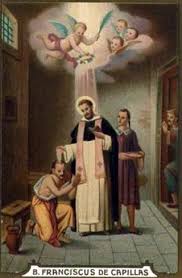
The 17th century was a period of great missionary activity. Many martyrs shed their blood on distant shores. Dominicans and Jesuits contributed a great share to the blood of martyrs. Among this glorious company, the Dominican Francis de Capillas has become the type and exemplar of them.
Francis was born in 1608 in Old Castile, Spain. Nothing is known of his childhood. He entered the Dominicans at Valladolid at age 17. The Spain of his youth was still ringing with the missionary zeal of Saints Louis Bertrand, Philip de las Casas, and Francis Xavier; the report of the martyrdom of Alphonsus Navarette (June 1), in Japan, was news at the time. Perhaps the bravery of these men helped to fire the young Francis with apostolic longing, for he volunteered for the Philippine mission while he was a deacon. In 1631 at the age of 23, he left Spain and was ordained in Manila. Here, at the gateway to the Orient, the Dominicans had founded a university in 1611, and the city teemed with missionaries traveling throughout the Orient.
The young priest labored for 10 years in the province of Cagayan, the Philippines, where heat, insects, disease, and paganism made life very hard. But it was not hard enough for Francis. He begged for a mission field that was really difficult; perhaps, like many of the eager young apostles of that time, he was hoping for an assignment in Japan, where the great persecution was raging. He was sent to Fukien, China, where he worked uneventfully for some years. Then a Tartar invasion put his life in jeopardy. He was captured by a band of Tartars and imprisoned as a spy.
Francis was subjected to a mock trial. Civil, military, and religious officials questioned him, and they accused him of everything from political intrigue to witchcraft. He was charged with disregarding ancestor worship, and, finally, since they could “find no cause in him,” he was turned over to the torturers.
He endured the cruel treatment of these men with great courage. Seeing his calmness, the magistrates became curious about his doctrines. They offered him wealth, power, and freedom, if he would renounce his faith, but he amazed and annoyed them by choosing to suffer instead. They varied the tortures with imprisonment, and he profitably used the time to convert his jailor and fellow prisoners. Even the mandarin visited him in prison, asking Francis if he would renounce his faith or would he prefer to suffer more. Being told that he was glad to suffer for Christ, the mandarin furiously ordered that he be scourged again “so he would have even more to be glad about.”
Francis was finally condemned, and was beheaded on 15 January 1640. He was beatified on 2 May 1919 by Pope Pius X.
Blessed Margaret of Savoy, Widow, OP
Margaret of Savoy, daughter of Duke Amadeo II, is one of three royal princesses who wore the Dominican habit and were beatified. In the 15th century, she was the glory of a family that has given several beati to the Church.
Born into the royal house of Savoy, Margaret grew up in a household in which piety and wealth were ordinary. Her own parents died when she was small, and she was educated by an uncle, who arranged an early marriage for her to the Marquis of Montferrat, Theodore Paleologus.
As queen of her fairly large domain, Margaret was the model of Christian rulers. She felt that it was her duty to exceed in charity and humility in the proportion that she was wealthier than those around her, and she devoted all of her time to God and to her neighbors. Her husband was a widower with two children, to whom she gave the greatest care. The hundreds of dependents on the large estates came to her for charity and instruction.
Disaster stuck Savoy several times in the years when she was wife and mother. Famine and plague came, making great demands on her time and her courage. Unhesitatingly, she went out to nurse the plague-stricken with her own hands, and she sent out food and clothing from her husband’s stores until it was doubtful if anything would be left. After this crisis passed, war hovered over the kingdom, and she prayed earnestly that they would be delivered from the horrors of invasion.
In 1418, the marquis died. His young widow was one of the most eligible women in Europe. Margaret sorrowed for her husband, but she made it clear to her relatives that they need not plan another marriage for her, as she was going to enter a convent. In order to live a life of complete renunciation, she decided to found a convent of her own at Alba in Liguria that would follow the ancient rule of Saint Dominic. Accordingly, she took over a cloister which had fallen into ruin, having only a few poor inhabitants, and rebuilt it for Dominican use. She dedicated the house to St. Mary Magdalen.
There is one very delightful story told of her sojourn in the convent. When she had been there many years, she one day had a young visitor; he was the son of one of her step-children. Hunting nearby, he had killed a doe, and he brought her the motherless fawn to tend. It was a pretty little animal, and it soon grew to be a pet. One legend was that the fawn was able to go and find any sister she would name, and, for several years, the animal had free rein of the halls and cells of the sisters. Perhaps it was true, though, since the house confessor told her that the deer must go. She took it to the gate and told it to go. It fled into the forest, and returned only when Margaret was about to die.
Margaret attained a high degree of contemplative prayer. One time Our Lord appeared to her and asked her whether she would rather suffer calumny, sickness, or persecution. Margaret generously accepted all three. Her offer was taken, and for the remaining years of her life she suffered intensely from all three sorrows (Dorcy). It should be noted that Saint Vincent Ferrer influenced Margaret to join the Dominican tertiaries (Benedictines).
Blessed Sebastian Maggi
Sebastian Maggi lived in a colorful and troubled age, the time of Savonarola; he was, in fact, a friend of the friar of Ferrara and always staunchly defended him.
Sebastian entered the Dominican Order as Brescia as soon as he was old enough. His early years were remarkable only for his devotion to the rule, for the purity of his life, and the zeal with which he enforced religious observance. He was superior of several houses of the order, and finally was made vicar of the reformed congregation of Lombardy, which made him the superior of Jerome Savonarola, the dynamic reformer around whom such a tragic storm was brewing.
Perhaps, if Sebastian Maggi had lived, he might have saved Savonarola from the political entanglements that sent him to his death. Sebastian was his confessor for a long time, and always testified in his favor when anyone attacked the reformer’s personal life. It is hard to say just where he stood politically in the long and complex series of events concerning the separation of Lombard province from the province of Italy. But all that has been written of him conveys the same impression: he was a kind and just superior, who kept the rule with rigid care, but was prudent in exacting it of others.
Several times Sebastian Maggi was sent on missions of reform, and he died on one of these. On his way to a convent for visitation, he became ill at Genoa and died there in 1496. His body is incorrupt at the present time (1963) (Benedictines, Dorcy).
Born: 1414 at Brescia, Italy
Died: 1496 at Genoa, Italy of natural causes; body was still incorrupt in 1963
Beatified: April 15,1760 by Pope Clement XIII (cultus confirmed)
Blessed John of Vercelli, COP
Blessed John of Vercelli, C.O.P.
1 December John Garbella was born early in the 13th century, somewhere near Vercelli. He studied at Paris and was ordained priest before 1229. He taught canon law at the University of Paris. While he was professor there, Jordan of Saxony (who was a friend of Saint Albert the Great) came to Paris, and John saw one after another of his best pupils desert their careers to join the Dominicans. He seems to have considered them quite objectively, without reference to himself, until one day he had an interior voice that spoke to him that it was God’s will for him to join the Dominicans. No one can say that John did not respond with alacrity; he dropped everything and ran down the street. (“Let me go; I am on my way to God!”) Jordan received him happily and gave him the habit.
In 1232, John was sent to Vercelli to establish a convent there. He built this and several other convents in Lombardy as houses of regular observance. While provincial of Lombardy, he also became inquisitor. It was a particularly difficult moment. His brother in religion, Peter of Verona, had just been killed by the heretics in Como. The entire countryside was in a state of war, with roving bands of heretics and robbers. It was the task of the new inquisitor to try to bring order out of this chaos, and what John did was remarkable, considering the situation. In spite of his heavy labors, which included the supervision of 600 friars in 28 different cities (he reached them only by walking), John of Vercelli established the ideals of study and regular observance in all of his houses.
It was the good fortune of John of Vercelli to live in an age that was well peopled by saints. He formed a close friendship with Saint Louis, the king of France. Several of his tasks in the order, particularly the Commission on the Program of Studies, he shared with Saint Albert the Great, Saint Thomas Aquinas, and Peter of Tarentaise (the future Pope Innocent V). In such company one would need to have a superior set of talents; John did.
In 1264 the chapter of the order met at Paris. Blessed Humbert had resigned as master general of the order. John went to the chapter hoping that he could resign as provincial of Lombardy. Instead of escaping one office, he fell heir to a still more difficult one. He was elected master general in 1264 and served in that capacity until 1283. John was then a man in his sixties and was, moreover, handicapped by a crippled leg. However, he accepted the office which would require him to walk, not only all over Lombardy, but all over Europe. It took a brand of courage and obedience that was little short of heroic.
During the generalate of John of Vercelli, the relics of Saint Dominic were transferred to the new tomb that had been prepared for it by Nicholas of Pisa. When the transfer was made, John of Vercelli fixed his seal on the tomb; the seals were still intact on their examination in 1946. During the translation of the relics, according to the account in the Vitae Fratrum, when the body of Saint Dominic was exposed to view, the head was seen to turn towards John of Vercelli. John, embarrassed, moved to another part of the church and gave his place to a cardinal. Whereupon, the head of Saint Dominic was seen by all to turn again in John’s direction.
On the death of Clement IV, John of Vercelli was very nearly elected pope. Being warned of the possibility, he fled in fright. However, his good friend Cardinal Visconti, was elected and took the name Gregory X. He appointed John as legate on several different missions.
He was commissioned by the pope to draw up the Schema for the second ecumenical council of Lyons in 1274–that council to which Saint Thomas Aquinas was hurrying when death found him on the road. At the council John distinguished himself for his assistance by offering to the council the talents of his best men. At the council, he accepted for the Dominican Order the special commission of promoting reverence for the Holy Name of Jesus and fighting blasphemy, which was, in that day as in ours, a prevalent vice. He can thus be considered the founder of the Holy Name Society, even though the Confraternity was not formed until 1432.
Several precious relics were suitably enshrined by John of Vercelli. These included several thorns from the Crown of Our Lord, which had been given him by Saint Louis of France. The cord of Saint Thomas, with which he had been guided by the angels and which he had worn until death, was given into the care of the master general, who gave it to the convent of Vercelli for safe keeping.
John’s career was rapidly reaching its end. In 1279, he presided over the famous chapter of Paris at which the order made the doctrine of Saint Thomas officially its own. The following year he laid the foundations of the Church of Santa Maria Sopra Minerva. One of his last official acts was to provide for a work on the instruction of novices (Benedictines, Dorcy).
Born: 1205 at Mosso Santa Maria, Italy as John Garbella
Died: September 1283 at Montpelier, France of natural causes; buried at the Dominican convent at Montpelier; his tomb was desecrated by Calvinists in 1562, and his body disappeared.
Beatified: 1903 by Pope Pius X (cultus confirmed), 1909 elevated him to the honors of the altar
St. Catherine of Alexandria
Saint Catherine of Alexandria. According to the traditional story, Catherine was the daughter of Costus, a pagan governor of Alexandria, where she was born. She is said to have announced to her parents that she would only marry someone who surpassed her in beauty, intelligence, wealth, and social status. This has been interpreted as an early foreshadowing of her eventual discovery of Christ. “His beauty was more radiant than the shining of the sun, His wisdom governed all creation, His riches were spread throughout all the world.” Though raised a pagan, she converted to Christianity in her late teens. It is said that she visited her contemporary, the Roman Emperor Maximinus Daia, and attempted to convince him of the moral error in persecuting Christians. She succeeded in converting his wife, the Empress, and many pagan philosophers whom the Emperor sent to dispute with her, all of whom were subsequently martyred. Upon the failure of the Emperor to win Catherine over, he ordered her to be put in prison; and when the people who visited her converted, she was condemned to death on the breaking wheel, an instrument of torture. According to legend, the wheel itself broke when she touched it, so she was beheaded.
According to Christian tradition, angels carried her body to Mount Sinai, where, in the 6th century, the Eastern Emperor Justinian established Saint Catherine’s Monastery, Mount Sinai, the church being built between 548 and 565 in Saint Catherine, Egypt, on the Sinai peninsula. Saint Catherine’s Monastery survives, a famous repository of early Christian art, architecture and illuminated manuscripts that is still open to visiting scholars. The historian Harold T. Davis says that Catherine’s story dates only from the 10th century AD, and that “assiduous research has failed to identify Catherine with any historical personage”; Davis suggests that the invention of Catherine may have been inspired by the story of the martyred pagan philosopher Hypatia of Alexandria. She did certainly form an exemplary counterpart to Hypatia in the medieval mindset; and it has been suggestedthat she was invented specifically for that purpose. Like Hypatia, she is said to have been highly learned (in philosophy and theology), very beautiful, sexually pure, and to have been brutally murdered for publicly stating her beliefs. The story of Catherine is placed a hundred years before Hypatia’s death, but there are no contemporary sources for her life.
Because of the fabulous character of the account of her martyrdom and the lack of reliable documentation, the Roman Catholic Church in 1969 removed her feast day from the Calendar. But she continued to be commemorated in the Roman Martyrology on November 25. In 2002, her feast was restored to the General Roman Calendar as an optional memorial.
The 1908 Catholic Encyclopedia describes the historical importance of the belief in her as follows:
Ranked with St Margaret and St Barbara as one of the fourteen most helpful saints in heaven, she was unceasingly praised by preachers and sung by poets. It is believed that Jacques-Benigne Bossuet dedicated to her one of his most beautiful panegyrics and that Adam of St. Victor wrote a magnificent poem in her honour: Vox Sonora nostri chori, etc. In many places her feast was celebrated with the utmost solemnity, servile work being suppressed and the devotions being attended by great numbers of people. In several dioceses of France it was observed as a Holy Day of Obligation up to the beginning of the seventeenth century, the splendor of its ceremonial eclipsing that of the feasts of some of the Apostles. Numberless chapels were placed under her patronage and her statue was found in nearly all churches, representing her according to medieval iconography with a wheel, her instrument of torture. Meanwhile, owing to several circumstances in his life, Saint Nicholas of Myra was considered the patron of young bachelors and students, and Saint Catherine became the patroness of young maidens and female students. Looked upon as the holiest and most illustrious of the virgins of Christ after the Blessed Virgin Mary, it was natural that she, of all others, should be worthy to watch over the virgins of the cloister and the young women of the world. The spiked wheel having become emblematic of the saint, wheelwrights and mechanics placed themselves under her patronage. Finally, as according to tradition, she not only remained a virgin by governing her passions and conquered her executioners by wearying their patience, but triumphed in science by closing the mouths of sophists, her intercession was implored by theologians, apologists, pulpit orators, and philosophers. Before studying, writing, or preaching, they besought her to illumine their minds, guide their pens, and impart eloquence to their words. At the beginning of the fifteenth century, it was rumored that she had spoken to Joan of Arc
Feast of All Saints of the Dominican Order
“Blessed are the pure in heart, for they shall see God.” (Mt. 5:8)
While last week’s’ solemnity of All Saints was of an ecclesial nature, today’s Feast of All Saints of the Order of Preachers is definitely one more of a family quality. Not only do we rejoice that some of our brothers and sisters have been held in honor by the Church and raised to the altars and some are even great saints, like St. Thomas, St. Albert, St. Catherine and in a more hidden way, St. Dominic, but we also celebrate our “little saints”—those Servants of God we read about in the Dominican Calendar whose “cult was confirmed” by Pope Such and Such. In others words, their cause for beatification has been closed but the Church still upholds them as holy men and women and models for us.
We also remember today those brothers and sisters we have known or lived with. These are the servants of God that were chosen in God’s providence to help us come to holiness through their example, encouragement and prayers.
Dominicans have a not so very good track record of promoting other Dominicans for canonization. The story even goes that it was only because St. Francis was canonized that the Dominicans thought they’d better do something about St. Dominic! Still, God knows those whom He wishes to give to the Church as an example and today there continues to be many Friars, Nuns, Sisters and Laity whose causes are up for beatification and canonization.
We come together as one Dominican Family today to celebrate not only Our Saints, but also our many Blesseds, Holy Friars, Nuns, sisters and Laity who have lived over the past 800 years.
We are so priviledged to celebrate them as they provide us with an example by which we follow in our religious lives, by their wondorous fellowship in their communion and in their much needed aid to us by their intercessions to God on our behalf.
We include in our celebrations also all the “forgotten” saints because according to the General Chapter of Valencia in 1337, there were 13,370 martyrs between 1234 and 1335. There were another 26,000 in the 16th century alone. Martyrs, confessors, virgins, and holy men and women all have their place of honor in the Order. Friars, worn down through constant contemplation, study, and preaching; nuns who lived lives of great prayer, silence, and penance; sisters who educated 1000’s of souls; and third order members who sanctified the world.
We celebrate our thanks to God on this Important feast day for our Order and turn to the examples of our Saints, their lives and their intercessions for us so that they may guide us on our spiritual Dominican life’s journey.
Our Order Father, Saint Dominic left us a wondrous legacy of teaching and preaching by word and example of how we should live our lives. It is, then, joyous and encouraging that so many of our Dominican brothers and sisters have been beatified and canonized.
Let us pray then in the example we have been taught to ask our dear saints to intercede for us, and to thank our God for all the saints of our Dominican Order and for the fruits of our order to be pleasing in his sight…..
God, source of all holiness, you have enriched your Church with many gifts in the saints of the Order of Preachers. By following the example of our brothers and sisters, may we come to enjoy their company for ever in the Kingdom of our Lord Jesus Christ, Your Son, who lives and reigns with You and the Holy Spirit, one God, for ever and ever.
Amen.
Blessed Peter Cambiano of Ruffia
Blessed Peter Cambiano of Ruffia. Peter’s father was a city councilor, his mother was from a noble family, and the boy was raised in a pious household. He received a good education, and was drawn early to religious life, with a personal devotion to Our Lady of the Rosary. He joined the Dominicans in Piedmont, Italy at age 16. He continued his studies, and was ordained at age 25, and was a noted preacher throughout northern Italy. He worked to bring the heretical Waldensians back to the Church, and was appointed inquisitor-general of the Piedmont.
In January 1365 Peter and two Dominican brothers went on a preaching mission through the mountains between Italy and Switzerland, working from the Franciscan friary at Susa, Italy. Peter’s preaching brought many back to the faith, which earned him the anger of the Waldensians. Three of the heretics came to the friary, asked to see Peter, and then murdered him at the gate.
Blessed Jerome, Valentine, Francis, Hyacinth @ Companions
Blessed Jerome, Valentine, Francis, Hyacinth & Companions (Martyrs of Tonkin) Between the arrival of the first Portuguese missionary in 1533, through the Dominicans and then the Jesuit missions of the 17th century, the politically inspired persecutions of the 19th century, and the Communist-led terrors of the twentieth, there have been many thousands upon thousands murdered for their faith in Vietnam. Some were priests, some nuns or brothers, some lay people; some were foreign missionaries, but most were native Vietnamese killed by their own government and people.
Jerome Hermosilla, a Dominican missionary to Manila, Philippines, and a priest, he went as a missionary to Vietnam in 1828 where he was the Vicar Apostolic of Eastern Tonking, Vietnam and titular bishop of Miletopolis. H was martyred with Saint Valentin Faustino Berri Ochoa.
Valentin Faustinao Berri Ochoa. Born in the Basque country, and ordained on June 14, 1851, Valentin was a missionary to the Philippines and then to Vietnam. He was appointed coadjutor vicar apostolic of Central Tonking, (the modern diocese of Bùi Chu) Vietnam and titular bishop of Centuria on December 25, 1857. He was martyred with Saint Jerome Hermosilla.
Francis Gil de Frederich was educated in Barcelona, Spain where he joined the Dominicans. He was a missionary to the Philippines first and then a missionary to Vietnam in 1732. He spent nine years in prison for his faith during which time he converted fellow prisoners and supervised evangelists on the outside.
Hyacinth Castaneda was a Dominican Priest and missionary to China. He then was sent as a missionary to Vietnam. He was beheaded for his faith in 1773 in Vietnam
Blessed Simon Ballachi
Blessed Simon Ballachi was born to the nobility in 1240, the son of Count Ballachi. His family had a close association with the Church clergy; two of his uncles became archbishops of Rimini, Italy, and a younger brother was a priest. Trained as a soldier and in administration, he was expected to take over the family estates. Against his family wishes, he joined the Dominicans as a lay brother at age 27.
Assigned to work in the garden of his friary, something he knew nothing about but which he loved instantly. He saw God in everything, and prayed constantly as he worked. Noted for his simple life, his strict adherence to the Dominican Rule, and his excellent work as a catechist to children. A visionary, Simon was visited by the devil, by Saint Catherine of Alexandria, Saint Dominic de Guzman, Saint Peter Martyr, and the Blessed Virgin Mary; other brothers saw his cell glowing, and heard angelic voices. Blinded at age 57, he was nearly helpless during the last years of his life; he never despaired, and used the extra free time for prayer. He died on 5 November in 1391.
 The Order of Preachers, Independent
You must be logged in to post a comment.