
Category: Lesson
Come to the Wedding! ~ The Rev. Frank Bellino, OPI
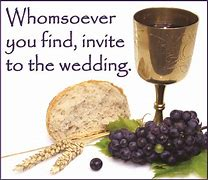
Today’s gospel passage seems straightforward enough to understand, if we compare the characters in the parable to key figures in the history of salvation.
We have the king and his son, who stand for God and Jesus. The wedding can be compared to God’s own invitation to us all to follow him and his way, entering into communion with him just as wedding guests participate in the festivities.
The messengers that were sent out to announce the wedding — they stand for the prophets. Similarly, to many of the prophets working for the Church, these messengers were also badly treated by the people to whom they were sent.
What of the people themselves, those who declined the wedding invitation? They stand for the people to whom the original invitation to follow God was given — and even more people in real life turned away from God for whatever reason so they did in the parable.
So, enter the other people, those who were found at the crossroads. Jesus is referring to any group of people who did not make up a polite society in those days, and letting his listeners know that the message of the Kingdom of God is now open to everyone. After all, we read that the servants went out to collect together ‘everyone they could find, bad and good alike’.
Although the ‘proper’ people had been invited at first, due to their refusal of sinners are now invited. This gives us hope — both for today, when we know ourselves to be at odds with the Gospel message (and therefore sinners) at times, and also in those times — for perhaps there were those hearing the invitation who took it to heart and acted appropriately.
Once we have accepted the call to follow God, we cannot stop there just resting on our laurels, saying, “I have been invited by God to the Kingdom of Heaven. And that’s it!” Once we are in a relationship with God, we are called to go deeper into a relationship with Him, and that implies that we do not and cannot sit still, doing nothing.
Is it fair enough — but what about the other part of the parable? If someone has been called and accepted by God, just as the guests eventually joined the wedding banquet and joined in all the feasting, wouldn’t that be the case? No, no, is the answer.
The key word here is “wedding-garment”. For in the days when this parable was first told, whatever state of life you found yourself to be in carried certain obligations – correct behavior or observance of wedding customs applying to all, no matter what.
This guest has no wedding attire. In other words, he is not bothering to do something fundamental to his state in life, not bothering to observe the customs he should, neither growing nor pursuing a closer relationship with God in his life.
So, it was with the king at the wedding feast. He had put himself out for the guests, but that meant that they should put themselves out for him. Not doing so, and not even addressing or apologizing shows a lack of concern or desire to follow what God has asked us to do.
Compare that with daily life, and you will see that God’s call is clear — it is not enough to be called and accept that call, but there is the obligation to follow it in whatever way we are called to do. We are recognizing what God has done for us, and we are doing whatever we are called to do in return.
In other words, not only have we been called, but also (as a result of our actions) we are being chosen by God to share in his eternal wedding feast in heaven.
Power! ~ The Rev. Frank Bellino, OPI
There is a story of two politicians engaged in conversation, and one asks the other, ‘But how do you know for sure you’ve got power, unless you abuse it?’ It is clear that this story is intended to illustrate a certain image of politicians.
However, it also mentions how we understand the power of God, an issue that is central to Christianity. For Christians to preach a strange Gospel about power: that the power of God was once the most visible in a naked man dying on a tree. If that is the case, then what Christians refer to as ‘power’ must be transformed in the light of this.
What we often understand by ‘power’ is more the misuse of power, using it in ways we should not. The Christian power is that capacity, that openness to love, depicted in the life of Christ, not something to be understood in terms of domination, manipulation, adulation or force. A sign of the depth of our Christianity is how that approach of looking at things has become part of our own lives and how we act.
To love freely and honestly is power because it takes a great deal of effort to not be swayed from loving by circumstances that come our way, or impulses within ourselves. It takes guts. It took immense courage to die on a cross out of love for us. That was powerful. It took immense courage for people throughout the centuries not to give in to inhuman forces.
The history of history is filled with such stories. Edith Stein, a Carmelite nun of Jewish origin, who, when summoned by the Nazis and greeted by the commandant with the words, “Heil Hitler!” replied, “Jesus Christ be praised!” That also was power. It may have caused her delivery to Auschwitz, perhaps the most notorious example we have of how badly we misunderstand what power is.
Today’s Gospel is about the power and the abuse of power. The vineyard is the House of Israel, the servants are the prophets who were sent to Israel; and the delivery of the landowner’s son, referring to the coming of Christ. The tenants are for those who mistreated them, Christ and the prophets, even to the extent of death.
However, the merest reflection should be sufficient to remind us that the themes of this story of violence and abuse of power remain very much part of our present day world. Part of this contemporary story is the power struggles that occur across the globe, as well as the violence we encounter in our neighborhoods and towns.
We must also examine our own attitudes towards the misuse of power. It is easy to shift the attention towards others, as though these issues are not part of our lives. They are. Our lives are filled with the consequences of this: broken and damaged relationships, a loss of ability to hear what others are saying to us, and a deafness to the voice of God in our daily lives.
This may sound sober, but it is actually a story of the greatest hope. It appears depressing when we forget what power really is. When we do this, we consider the tenants in today’s Gospel as powerful. In the light of the Christian faith’s understanding of power, what gives hope is that they are not really powerful, but they are severely weak. They practice the misuse of power, not its exercise. If the consequence of their actions is destruction, then the Christian must respond by proclaiming that the consequence of real power is a victory of the deepest level.
This is to reduce our expectations. However, Christianity does that. At its core, it is the story of a man who died that seemed to be a failure, yet who was vindicated by his Father raising him up. If that is true of Jesus Christ, “the first-born of many brothers and sisters,” then it is true for us also. We view the life of great people like Edith Stein as a triumph, not only because we admire her courage, but because we see in it a powerful overcoming of what is wrong with our world and with ourselves.
What makes this victory an ultimate one, an example of real power, is that we believe that this overcoming will be eternally a result of this victory.
That is our Christian hope, and just one example of how the world looks very different, and for the better, when seen in the light of the death and Resurrection of Jesus Christ.
The Feast of the Guardian Angels~The Rt. Rev. Michael Beckett, OPI
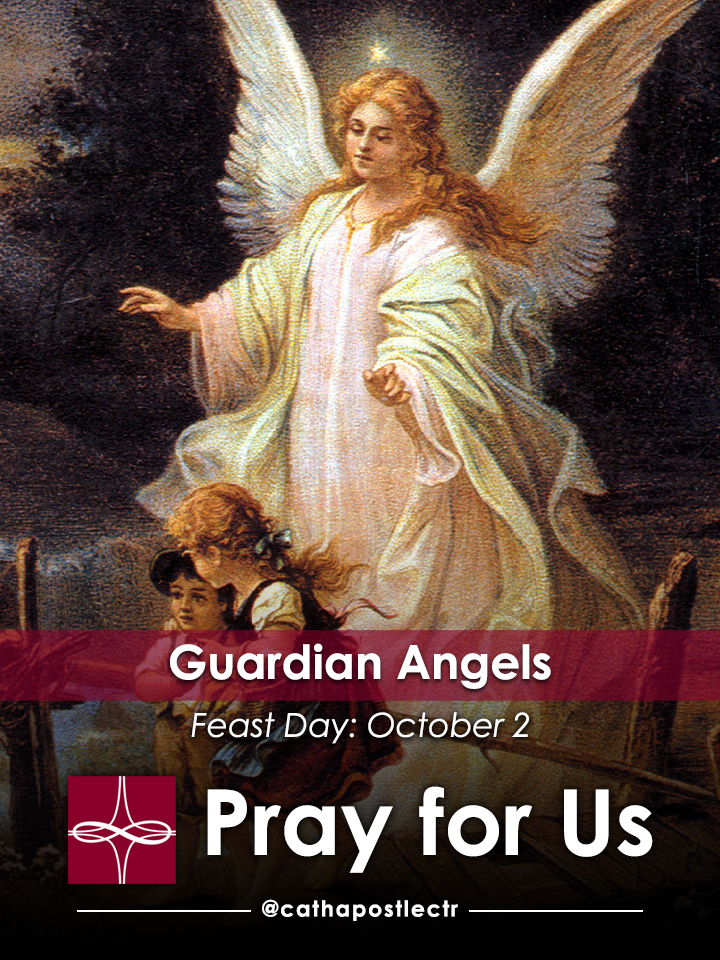
We often think of guardian angels as a special angel only for children, but the truth is that we all have a guardian angel for our entire lives. Our angels are a gift from God. They watch over us, aid us in prayer, enlighten us, guide us and protect us. Angels are mentioned in both the Old and New Testament and many saints have had visions of their guardian angels. We can hope that our Guardian Angel will help us during our journey to eternal happiness in Heaven. The Feast of the Guardian Angels is celebrated on October 2nd. Although Guardian Angels have been venerated since the early days of the Church, it wasn’t until the 17th century that Pope Clement X extended the feast day to the universal Church. It comes just two days after the Feast of the Archangels Gabriel, Michael, and Raphael.
On this Feast of the Guardian Angels in 2011, Pope Benedict XVI said,
“Dear friends, the Lord is always near and active in human history, and follows us with the unique presence of His angels, that today the Church venerates as ‘Guardian,’ in other words those who minister God’s care for every man. From the beginning until death human life is surrounded by their constant protection.”
It is an established Catholic belief that each individual person has their own guardian angel assigned to watch over their soul. There are three important verses in the Catholic Bible from which this belief is drawn:
Psalm 90:11: “For he shall give his angels charge over thee, to keep thee in all thy ways.”
Matthew 18:10: “See that ye despise not one of these little ones; for I say unto you, that in heaven their angels do always behold the face of my Father which is in heaven.”
Hebrews 1:14: “Are they not all ministering spirits, sent forth to do service for the sake of them that shall inherit salvation?”
These verses have led St. Jerome, one of our early Church Fathers, to conclude, “How great the dignity of the soul, since each one has from his birth an angel commissioned to guard it.” Many others wrote about our guardian angels, including St. John Chrysostom, St. Basil, and St. Thomas Aquinas. According to Aquinas, our guardian angels have a good influence over us, but they cannot control our free will. Guardian angels influence or guide us by acting upon our intellect through our senses and our imagination. When they do this, they are influencing our will to do good and avoid evil. So really, their job is to help you get to heaven. Thus guardian angels do not control us by any means, but they do greatly assist us in finding and doing God’s will. Our guardian angels are also able to protect us from danger as well as assist us in prayer and meditation on the divine things of God.
We don’t only have the Scriptures and the Early Fathers of the Church who tell us about our Guardian Angels. We also have the saints, some of which actually witnessed their guardian angel in action. In many cases their Guardian Angel was visible to them. These include St. Padre Pio, who could see his guardian angel, which would often send him on special missions; St. Faustina Kowalska, whose Guardian Angel accompanied her to observe the pains of the Holy Souls in Purgatory; and St. Gemma Galgani, to name a few. St. Gemma Galgani wrote much about her Guardian Angel in her autobiography, including this account:
“One evening, when I was suffering more than usual, I was complaining to Jesus and telling him that I would not have prayed so much if I had known that He was not going to cure me, and I asked Him why I had to be sick this way. My angel answered me as follows: ‘If Jesus afflicts you in your body, it is always to purify you in your soul. Be good.’”
Ask yourself this question today: How is my relationship with my guardian angel? Do I listen to him? Do I say good morning to him in the morning? Do I ask him: Watch over me when I sleep?’ Do I speak with him? Do I ask his advice? He is by my side. We can answer this question today, each of us: How is our relationship with this angel that the Lord has sent to watch over me and accompany me on my journey, and who always sees the face of the Father who is in heaven?” So, today is the day to tell your guardian angel “Thank You” for their daily guidance, and to show gratitude to God for assigning a powerful heavenly protector for your personal care. It is also a good time to make the resolution to pray to your Guardian Angel daily as our Holy Father admonishes us.
As St. Bernard of Clairvoux plainly states in his sermon:
“‘He has given his angels charge over you to guard you in all your ways’. These words should fill you with respect, inspire devotion and instill confidence; respect for the presence of angels, devotion because of their loving service, and confidence because of their protection. And so the angels are here; they are at your side, they are with you, present on your behalf. They are here to protect you and to serve you.
But even if it is God who has given them this charge, we must nonetheless be grateful to them for the great love with which they obey and come to help us in our great need. So let us be devoted and grateful to such great protectors; let us return their love and honor them as much as we can and should. Yet all our love and honor must go to Him, for it is from Him that they receive all that makes them worthy of our love and respect. Even though we are children and have a long, a very long and dangerous way to go, with such protectors what have we to fear? They who keep us in all our ways cannot be overpowered or led astray, much less lead us astray. They are always loyal, prudent, and powerful.
Guardian Angel Novena:
Loving God, you are so good that you gave me a Guardian Angel to protect my body and my soul. Help me to know and follow my angel so that, with their guidance, I will be worthy of being in Heaven with You!
My sweet Guardian Angel, you are my defender every day of my life. Protect me from sin and bodily harm. Help me to learn to defend and protect myself so that I can be the person that God is calling me to be.
You are with me all the time so you already know these my intentions that I ask you to deliver to the Lord. (Mention your intentions here…)
My guardian angel, my defender, protect me!
Gifts ~ The Rev. Frank Bellino, OPI
Can we expect to receive gifts? If a friend, having received a gift, turns to us and says, ‘I was anticipating this,’ will we not be a little hurt? However, there are some gifts that meet our expectations and, if not given, can cause us to be upset.
There are cultures in which the receiving of gifts is arranged by formal rules, often elaborate ones. In our less formal western society, we may like to think that our gift-giving is more spontaneous, less constrained by social expectations, but any parent can tell you how limiting the effort to provide this year’s toy at Christmas can be.
Should we stop giving gifts? Would life without gifts be easier, so that whatever we receive from others is based on what we are owed? The difficulty with this is that in many cultures, modern western culture included, gifts are not included as extras. Perhaps it is too far to discuss our right to receive gifts, but many of us certainly experience a need to have gifts on certain occasions and more importantly from certain individuals. This is due to the fact that a gift can create, express, and maintain something essential in our relationships. In giving someone a gift, we can express to them that they have an intrinsic value beyond the meeting of their basic needs, and that we are giving them this gift not because we owe it to them, but because we love them.
Our giving of gifts reflects and expresses our relationships with each other. Where our relationships are unhealthy, the way we give and receive gifts will also be unhealthy.
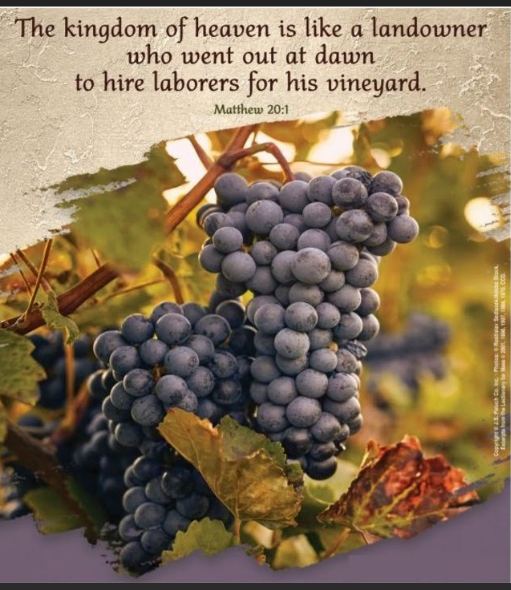
If we turn to the Gospel today, we find Jesus comparing the kingdom of heaven to a householder who went out early in the morning to hire laborer’s for his vineyard.
It is important to bear in mind that this parable, like all the parables we find in the gospels, is not a literal representation of the kingdom of heaven. God can be compared to a householder with a vineyard, but unlike the householder, he has no need of laborers, nor even need to plant and cultivate a vineyard.
The vineyard here stands for Israel, and God had no need to plant and tend Israel in order to provide salvation to all peoples. He had no need to plant or tend any instrument for our salvation. Unlike the householder, God does not hire laborers because he needs their help to cultivate his vineyard. Rather, in love, he wants all individuals to enter his vineyard and thus to receive the reward of eternal life.
The hiring of the laborer’s in the parable is itself a gift. Moreover, once the laborer has been hired, God does not require them to work in his vineyard. Rather, he invites them to share his mission of salvation.
This again is a gift, and although the gift can often be a difficult one for us to accept, especially for those ‘who have borne the burden of the day and the scorching heat’, it is a gift fitting to the dignity of the human person, who was created to ‘fill the earth and subdue it'(Gen 1:28). Through the gift of planting, tending and inviting us to labor in his vineyard, God establishes a relationship of love with us, which acknowledges our inherent worth as human beings and goes beyond this in providing us with a share in his own life.
One of the dangers in our lives as Christians is that we forget that our invitation to labor in God’s vineyard is a gift. This is the danger that the householder and his vineyard illustrate.
Jesus is reminding us that every gift comes from the generosity of his Father, and it is not for us to put any restrictions on this generosity. For while human gifts are often things we expect, even where we don’t take them for granted, the Father’s divine gift in giving us his Son is greater than anything we could expect or imagine.
The Feast of St Matthew~The Very Rev Lady Sherwood, OPI

When our Lord Jesus called Matthew (originally named Levi) to follow him, He was a tax collector by profession for the Roman Empire. His profession was at that time extremely hated by the devout Jews as it reminded them of their subjection and also the Pharisees saw his profession which was classed as publican, as work for the typical sinner.
St Mathew is one of the Lord Jesus’ twelve apostles and by christian tradition is also seen as one of the four Evangelists. He was the first to put down in writing as his Gospel the Lord’s teachings and the account of our Lord Jesus’ life. Mathew wrote his Gospel in Aramaic, which is the language which was spoken by Jesus himself.
No one was shunned more than a publican by the devout Jews because a publican was a Jew who in their eyes worked for their enemy, the Romans and who duly robbed their own people making themselves fat cat personal profits. Publicans were despised to the extent that they were not allowed to trade, not to eat or even to pray with other Jews.
One day when Mathew was seated at his table containing his books and his money, Jesus looked at him and said unto him two words, “follow me”. For Mathew, these two words were all it took for him to immediately rise, leaving all his pieces of silver exactly where they lay, to follow our Lord Jesus Christ.
Mathew’s original name was ‘Levi’ which in Hebrew signified ‘Adhesion’ whilst his new name given to him by our Lord Jesus of Mathew means ‘Gift of God’.
The only other major mention of Mathew in the Gospels is regarding the dinner party for Jesus and his companions to which Mathew invited his fellow tax collectors.
The Jews showed surprise at seeing our Lord Jesus eating in the company of a publican, but Jesus explained to the Jews that he had come “not to call the just, but sinners.”
Not much else is known about the life of Mathew but according to tradition, he is reported to have preached in such places as Egypt, Ethiopia and other further Eastern areas.
Some say Mathew lived into his nineties before dying a natural death, but other Christian traditions say he died the death of a martyr.
The Gospel according to Matthew is one of the four canonical gospels, one of the three synoptic gospels, and is the first book of the New Testament. The narrative tells how Messiah, our Lord Jesus was rejected by Israel, and how he finally sends his disciples to preach his Gospel to the whole world. Most Scholars believe the Gospel of Matthew was composed between 80 and 90 CE, with the possibility of between 70110 CE. The Gospel of Matthew is a creative reinterpretation of Mark, stressing Jesus’ teachings as much as his acts, making subtle changes to reveal Jesus’ divine nature for example, Mark’s “young man” who appears at Jesus’ tomb becomes a radiant angel in the Gospel of Matthew. The Gospel of Matthew shows Jesus as the Son of God from his birth, the fulfillment of the Old Testament. The Gospel of Matthew was the favourite Gospel of St.Dominic de Guzman, who always would carry it wherever he went.
Let us pray to St Mathew to ask him to intercede on our behalf:
O Glorious St Mathew, in your Gospel you portray Jesus as the longed-for Messiah who fulfilled the prophets of the Old Covenant and as the new lawgiver who founded a church of the New Covenant. Obtain for us the grace to see Jesus living in his church and to follow his teachings in our lives on earth so that we may live forever with him in heaven. Amen.
Seek Ye First~Br. Milan Komandina

I will start this sermon with a quote from Isaiah 55:6 – Seek the Lord while he may be found, call on him while he is near. Dear friends, have you ever experience going to the church and feeling that the church is not a place where the Lord dwells. Unfortunately in my country I experienced that many times. As you know I was born and raised in Orthodox Christian environment. While growing up I was attending the local Orthodox Church. I was seeking the Lord and seeking the Lord. But it seems that many times I could not find him in Orthodox Church. In my country priests in their sermons very often do not preach about Jesus. They rather preach about politics. They preach about Kosovo, in a way that we (Serbian people) need to go in war to free Orthodox churches and monasteries and the entire Kosovo. They preach about brother`s Russia and Ukraine presenting Russia as a victim of war happening in Ukraine. They support Putin`s aggression. And many times they justify things that are against common sense. They also preach about homophobia. They strongly oppose to all people who are LGBTQ+ trying to make their life even harder. The materialism is highly present within the church where many people invest a lot of money which priests use for their own benefit instead of giving charity and doing things according to the Bible. I don’t want to judge them I just feel the need to say that there are many churches like that. Churches seem to not having Christ. Not only Orthodox. Roman Catholic is not far from that. Croatian Catholic priests as well as Serbian Orthodox priests were blessing weapons in the wars between these two countries. They also like preaching about nationalism and homophobia in a positive way rather than talking about Christ. After many disappointments during my seeking for the Lord I kept seeking and seeking. And I am happy that back to 2016 I found Unified Old Catholic Church. In the coming years I found Anglican and Episcopal churches and in Serbia and in Germany where I live now. The church where Jesus is preached. The church where people love each other, pray for each other, encourage each other and respect each other no matter if they are ethnic Albanians, Hungarians, Serbs, Croats and no matter if they are straight, gay or trans no matter if they are while or black. The churches where ALL are welcome, where ALL are respected and loved. The words from Isaiah 55:6 – Seek the Lord while he may be found, could really have their fulfillment if you keep seeking. Maybe you live in a small village and you miss the real congregation. Maybe you live in a big town but there is no church. Thanks God, today we live in era of Internet and we can connect online from the places worldwide. There is a church. There is the Lord. There is Love. Just keep searching. Keep seeking. Maybe you feel uncomfortable in a local community, or you do not understand hate that you may encounter there. Maybe there is a lot of judgment, nationalism, homophobia, hypocrisy. Just keep seeking. This is what the Bible says.
Philippians 1:27 – Whatever happens, conduct yourselves in a manner worthy of the gospel of Christ. Then, whether I come and see you or only hear about you in my absence, I will know that you stand firm in the one Spirit, striving together as one for the faith of the gospel.
Are You An Island? ~The Rev. Frank Bellino, OPI

If someone hurts you, what action do you take? Do you respond to your anger and pain? Do you retaliate or respond? Do you seek reconciliation and recovery?
Paul Simon’s song ‘I am a Rock’ tells the story of someone who has been hurt and has withdrawn from the world. ‘I am a rock,’ he sings, ‘I am an island. A rock feels no pain. And an island never cries.’ (“Lyrics for I Am a Rock by Simon & Garfunkel – Songfacts”)From time to time, we all feel like stepping into our shell. We would all like the world to go away. Today’s world is a good reminder that we are not meant to live in isolation; we are all much too interconnected. We need each other, and when we’re separated, we become unhappy.
When God created humankind, he told, ‘It’s not good for man to be alone’ (Gen.2:18). So, he gave Adam a wife, they had a family and we’ve been living in community ever since. Or at least, we are meant to be living in a community.The famous English preacher Charles Spurgeon once visited a man who had isolated himself from his church community. Spurgeon walked into the man’s residence without saying a word and sat with him by his fireplace. The man felt a bit uncomfortable. Spurgeon took a lump of coal from the fire and placed it on a brick. The two men stared at that solitary coal as it dimmed and cooled. Spurgeon then stood up, and as he opened the door to leave, the man said, ‘I understand pastor; I’ll see you next Sunday’.It is not always easy to live with others. Often, tension and conflict arise, particularly when someone does something wrong. However, as Christians, we have a responsibility to look out for others, even when they disappoint us. This is the message from today’s readings, which provides us with three ways to respond when we find ourselves in conflict with someone.
These three methods are speaking, respecting and healing.In our first reading, God asks the prophet Ezekiel to watch over his people in Jerusalem. He is responsible for protecting the people by speaking up if they do anything wrong or if they put themselves in danger.
That’s what we are asked to do. As Christians, we all have a duty to speak up if someone’s doing something wrong. It is not necessary to change their behavior, but we must speak the truth to those we care about. Otherwise, our silence can be taken as tacit approval and we become partly responsible for their mistake.However, speaking up can be challenging, so St Paul in our second reading reminds us to always respect others. He refers to the Ten Commandments, saying that it is important to respect the other person’s life, marriage, property and integrity.
Indeed, seven of the Ten Commandments are about our connection with others, and they can all be summed up in one rule: ‘Love your neighbor as yourself’. If we really love and respect our neighbors, we wouldn’t harm them at all, and they’d be much more likely to stay in contact with us. In our gospel, Jesus states that before talking, make sure you have a humble, compassionate, and forgiving heart. These are essential factors in healing relationships.Then go and talk openly and honestly with the person who has hurt you, he says, but do it privately, to avoid any embarrassment. If that doesn’t work, invite one or two others into the conversation, not to gang up on them, but to help them reconnect. If necessary, invite someone else, perhaps a mediator, to resolve the matter.
But whatever happens, Jesus says, always pray for reconciliation and keep the doors of communication open, since we all need to heal.In his book, The Great Divorce, CS Lewis describes hell as a large, dark place, where there is no connection between people. Hell started out small, he says, but people quarreled with one another and split apart. At the same time, there were other squabbles and people moved even further away, until no one could even see anyone. And there they lived, alone in the darkness. Jesus wants us to avoid this hell.
When we realize how flawed and broken, we all are, it becomes much easier to understand that we all have the same basic need for healing and wholeness.We are not solitary rocks or islands. As the poet John Donne wrote, ‘No man is an island entirely; every man is a piece of the continent, a part of the main’. We are all meant to live and grow and flourish together, in our families and communities.
Christian love isn’t an emotion or a feeling; it’s a responsibility and a decision.Success?~The Rev. Frank Bellino, OPI
What is your definition of success? What would you define a successful life?
Let’s all close our eyes for a moment and envision what we would look like if we were successful. What would your home look like? How would your children or spouse be like? What would be my waistline? What would your life look like? What concrete examples of what a successful life looks like for you? Have a picture of that in your mind. I believe this is an important spiritual exercise, as you will see in a moment. Nonetheless, if your answer to this question was, my life is successful just the way it is. Congrats! Good for you. I think we all desire that for ourselves. However, you are not off the hook. Ask yourself, why did you answer in this way? What are some examples of why you feel like your life is successful right now? Imagine it in your mind.
The reason why I am asking all of us to consider our definition of success is because our definition of success and the bible’s definition of success don’t always see eye to eye. Take our first reading for example. Jeremiah laments, “All day I am an object of laughter; everyone mocks me.” Why was Jeremiah an object of laughter? What caused everyone to mock him? The reason for this was because he was trying to do God’s will.
Imagine for a moment how that would feel right now, to be an object of laughter, for everyone to mock you? It wouldn’t be enjoyable, would it? In our second reading, St. Paul tells us, “To offer your bodies as a living sacrifice, holy and pleasing to God, your spiritual worship.” It is important to understand what Paul meant by the word “sacrifice” in this context. He is referring to the actual sacrifices that were conducted on the temple altars of his time that everyone listening to him would have known about. It is not a pleasant image. He is urging us to offer our bodies as a living sacrifice, holy and pleasing to God, our spiritual adoration. Doesn’t really sound like fun, does it?
And, just in case if we misunderstood what St. Paul was saying, we have our Lord himself challenging his disciples in our Gospel reading, “Whoever wishes to come after me must deny himself, take up his cross, and follow me.” What is Jesus talking about when he says take up your cross and follow him? He is talking about that. He is talking about the cross. Does he look successful to you? And yet, Jesus is the most successful person the world has ever known.
Remember last week, Jesus asked his disciples, “Who do you say that I am? This is the most fundamental question we can ever ask if we call ourselves Christians: who is Jesus? Peter shined like the prince of apostles he is by answering correctly, “You are the Christ, the Son of the living God.” This week we discover that after Peter’s bright and shiny moment, he simultaneously answered the question incorrectly. And it underscores why the final exams for neurosurgeons should never be multiple choice.
Peter had the correct answer, but he also had the wrong answer. Peter believed Jesus was going to be the new King David. He believed that Jesus was going to liberate Israel from all oppression. He thought Jesus was going to usher in a new era of prosperity and peace for his country. Peter believed all this because if Jesus was the Messiah, who is what he had in his mind what a successful messiah would look like.
What was Jesus’ view of a successful messiah? Jesus says, “He must go to Jerusalem and suffer greatly from the elders, the chief priests, and the scribes, and be killed and on the third day be raised.” That is what success looks like. And what was Jesus’ definition of a successful disciple? ““Whoever wishes to come after me must deny himself, take up his cross, and follow me.” (“Matthew 16:24 – Take Up Your Cross – Bible Hub”) For whoever wishes to save his life will lose it, but whoever loses his life for my sake will find it.” (“Matthew 16:25 AMP – For whoever wishes to save his life [in – Bible Gateway”)
My friends, I believe it is appropriate to search and ask ourselves the question, how do I define success? In our society, people who have bigger homes, better cars, better clothes, perfect spouses, perfect waistlines, and children without acne, are all somehow seen as more successful. The Bible defines success in a different way. In the Bible, success is about achieving God’s will, period, what may, even if this requires, we must suffer for it. Or as St. Paul tells us in our second reading, and this is good advice by the way for anyone suffering from any anxiety right now, from what is going on in our country today. Success according to St. Paul states, “Do not conform yourselves to this age but be transformed by the renewal of your mind, that you may discern what is the will of God, what is good and pleasing and perfect.” (“Romans 12:2 – BibleGateway.com”) How about that? It would be beneficial for us all to take some time this week and reflect on what St. Paul is saying here and ask ourselves the question, what does this look like? What does this require me to do?
Two Minute Mendicant~Br. Christian Ventura

Are religious brothers/sisters lay or ordained?
The answer is typically neither!
This is a tough question.
Ordered life in and of itself is not considered laity or holy orders (i.e. priest, deacon). Religious are set apart as having “consecrated life” that subscribe to a specific rule of life. They do not fall into either category, it exists in a separate space.
By virtue of this, some religious serve as extraordinary ministers or in other ministerial roles that sometimes overlap with duties traditionally seen as clerical. Religious are not inherently granted faculties as ministers of the sacraments. Instead, they usually serve as educators, chaplains, counselors etc. since it is customary for them to acquire proficiency in pastoral care with significant theological education.
However, some religious are also ordained or in the process of becoming ordained. This is an entirely distinct vocation. In the Dominican styling, we refer to brothers who are not called to ordination, not as “lay brothers”, but rather “cooperator brothers” who live out and enjoy a full vocation. In new monasticism, generally speaking, religious brothers and sisters are subject to their direct superior (prior/abbot, etc), and are not usually under the jurisdiction of the local diocese (although this varies). Dominicans have traditionally been granted dispensation to have preaching faculties wherever they go without needing to seek permission from the local Bishop. Diocesan clergy are usually subject to the authority of the local ordinary (the Bishop (s)).
Love and Common Sense~Br. Milan Komadina
Reading Bible and understanding Bible in the right way is a very responsible activity. During the history many evil things were happening because of the wrong Bible interpretations. Many people were killed in the name of Jesus and many wars were started for the sake of church. Today we also have many evil activities that Christians do for the sake of God. There is a special group of people who are victims of satanic and anti-Christian propaganda that certain Christians spread by saying that LGBTQ+ people deserve to be persecuted and to disappear from this Earth. Recently I have joined an online meeting conducted by LGBTQ+ Ministry within Church of Christ the King, here in Frankfurt. We were discussing about the issues and hardships that LGBTQ+ Christian people are struggling with for years just because of wrong interpretations of the Bible. The story about Sodom and Gomorra talking about the violence and violent people who were punished because of the violence. Violent gang bang raping was also included and their desire to hurt angels. But first of all it was about violence. There are some other verses condemning ritual same-sex activities which in the context of that time might be related to pedophilia and worship satanic rituals. There is not a single sentence talking about the love between two same sex people including mutual respect, dedication, emotional and physical affection and love. As straight sexual activities are also defined sinful as we know that Jesus even said that when a men even for a moment think sexually about the women he already did adultery in his heart and further we know that adulterers should be eternally condemned. Does that mean that the Bible talks about straight people that all straight population is not going to enter the Kingdom of God? If we would interpret the Bible in a wrong way we could say so. This is why it is very wrong to interpret Bible in a way that it should not be interpreted. I would also like to add here that God when giving us Bible he has also given us a common sense to understand that if one’s biblical interpretation could lead to discrimination and make another human being feel endangered and hated just because of who he or she was born to be, a healthy functional brain and a common sense would realize that something is wrong with this interpretation. One of these wrong interpretations exists for the centuries and centuries and they are related to the definition of the Roman Catholic Pope. In today’s reading Matthew 16/13:20 we read promise to Apostle Peter that Jesus will give him the keys of the kingdom of heaven:
13 When Jesus came to the region of Caesarea Philippi, he asked his disciples, “Who do people say the Son of Man is?”
14 They replied, “Some say John the Baptist; others say Elijah; and still others, Jeremiah or one of the prophets.”
15 “But what about you?” he asked. “Who do you say I am?”
16 Simon Peter answered, “You are the Messiah, the Son of the living God.”
17 Jesus replied, “Blessed are you, Simon son of Jonah, for this was not revealed to you by flesh and blood, but by my Father in heaven. 18 And I tell you that you are Peter, and on this rock I will build my church, and the gates of Hades will not overcome it. 19 I will give you the keys of the kingdom of heaven; whatever you bind on earth will be[c] bound in heaven, and whatever you loose on earth will be[d] loosed in heaven.” 20 Then he ordered his disciples not to tell anyone that he was the Messiah.
Even though it does not have much common sense and that it totally runs out of the entire Biblical context many people believe today that the Pope is the new Peter and representative of God on Earth. There is an interpretation that by this sentence Lord Jesus gave the power to Apostle Peter to be a new representative of God, in Latin we would say Vicarius Filii Dei which means Representative of the Son of God. Roman Catholics believe that after Peter every new bishop of Rome (read Pope) has a special privilege to be called as a representative of the Son of God on the Earth. Through the history churches have done many evils because of wrong interpretations of the Bible. And people were lacking to use brain and simply have common sense. Today that same church is fighting against human rights to love and create a family. Unless straight family. God is still showing them that it is wrong while there are over 8.000 pedophiles within Roman Catholic clergy said Pope Francis. There are many gay sex scandals happening within all traditional and homophobic churches, not only in Roman Catholic but also in Orthodox Church and other conservative protestant churches. We lack of scandals in Old Catholic, Episcopal, Anglican, Lutheran and all of those churches that respect equality and human right to love a person of same sex. And look, there are no more scandals, no more hidden sexual activities of self-called saints just because church (read believers) use the God-given common sense to admit that everyone is free to love who they want to love and that the core of our faith is love. And that is a real natural condition. For someone that is astrophysics but for someone it is just a logical thing and a common sense. And I would like to end this sermon with a message while reading the Bible please use your brain and use your heart. Your brain will tell you the common sense, your heart will tell you that where love is there is no sin. And only in this way you would have the power to understand and to preach the Bible. In the name of Love. Amen.
 The Order of Preachers, Independent
You must be logged in to post a comment.