
Category: Lesson
The Feast of The Nativity of St John the Baptist~The Very Rev Lady Sherwood,OPI

Today, we as come together as the church to commemorate the Nativity of St John the Baptist, who is often referred to as the ‘Forerunner’.
John was the son of Zechariah and Elizabeth. In the Gospel of Luke, we are informed that Zechariah was told beforehand about the birth, and that he was to be named John. The meaning of the name John is “God is Gracious” (LK 1 :8=2:3).
John whilst still forming within his mother’s womb, instantly recognised the presence of Our Lord Jesus, who was also still in his mother’s womb, when Mary went to visit her cousin Elizabeth (LK 1 :41). John lept for joy in Elizabeth’s womb as soon as Mary and Elizabeth met, and this is when John was cleansed of original sin. This came to pass just as the Angel Gabriel had previously promised Zechariah in LK 1 :15.When John was older, he left the home of his parents and went to live in the desert. He wore only a garment made of camel skin and only had Locusts and wild honey to eat. John would preach in the desert (MK 1:6; Matt 3:4).
John went about preaching and proclaiming about the Kingdom of God and of a time of coming judgement. He invited those who wanted to repent, to accept him to baptise them as a sign of their repentance.
John, just like the prophets, disturbed the comfortable and gave much comfort to the disturbed. The message of John spread far and wide. The Gospel of Mark tells us that all peoples of both Jerusalem and Judea travelled to him and confessed their sins as John baptised them in the river Jordan (MK 1:5).
John clearly shows his humility because he never wanted attention for himself, he always directed people to Jesus. Some wondered if John was the Messiah, but John reassured them that indeed he wasn’t and he declared that his ministry was merely for to prepare for the coming of the Messiah. John said, “I have baptised you with water, but He will baptise you with the Holy Spirit.” (MK 1:8)
Then Jesus himself came to John to be baptised and John immediately recognised Jesus as the Messiah and he declared, “This is the Lamb of God who takes away the sins of the world”. (JN 1 :29). This statement from John is still used in Mass prayer today, when the Priest holds up the sacred Host as we prepare for the Holy Eucharist, as the Priest says, “This is the Lamb of God who takes away the sins of the world…”.
It was after being baptised by John, that our Lord Jesus began his Earthly ministry. When John had been baptised by John, John again showed his humility as again, he turned his attention to Jesus, declaring, “He must increase, I must decrease”(JN 3:30).
St John the Baptist is an excellent example that we as Christians should take much notice of within our lives of faith. Just as John always showed his humility by turning his attention away from himself and towards our Lord Jesus, we too, also need to show this same humility if we are truly to serve and follow the Lord. We also, must turn attention away from ourselves and towards Jesus. Just as John himself declared, “He must increase, I must decrease”.
Let us pray:
O glorious St John the Baptist, greatest prophet among those born of woman, although you were sanctified in your mother’s womb and lived a most innocent life, nevertheless, it was your will to live in the wilderness of the desert, there to devote yourself to the practice of austerity, penance and humility;
Obtain for us by your intercession, the grace of the Lord to be wholly detached within our hearts, from earthly goods and self attention. Increasing our humility and service, by making ourselves far lesser and in the never ending increasing, to be ever greater within our hearts and lives.
Amen.
Do Not Enter!~The Rt Rev Michael Beckett, OPI

Have y’all seen those signs in front of many churches? The one’s that say, “All Are Welcome,” or “We love everyone,” or “Come as you are!” They’re pretty great, huh?
Not so much.
I continue to be amazed and appalled at some of the things that our “good Christian” brothers and sisters are saying and doing in our country, in our churches today. No immigrants. No Democrats. No Trans folks. No gay folks. No black folks. No Native American folks. If you do not fit this exact profile, if you are not this exact kind of person, you are not allowed.
Exclude. Exclude. Exclude. Exclude.
Today is a great Feast Day in the life of the liturgical church throughout Christendom: The Solemnity of Corpus Christi. This day is celebrated in recognition of the Eucharist, and everything the Eucharist is and means. Today we celebrate, literally, the Body of Christ. We all know that the Eucharist was instituted by Christ at the Last Supper. We all know that Catholics believe that the bread and the wine become the body and blood of Our Lord. We all know that our Protestant brothers and sisters believe that the bread and the wine are symbolic of the body and blood of our Lord. We all know that wars have been fought over these two basic, yet entirely different, beliefs. We also know that from many, if not most, of the liturgical pulpits in the world, today the Word will be proclaimed concerning the Eucharist.
Today, however, I would like to put a different spin on Corpus Christi. I would like for us to leave the upper room of Christ and the disciples, and jump ahead a few years to Corinth, and to listen to what the Apostle Paul had to say about “the body of Christ” in his first letter to the Corinthians:
12 For as the body is one and has many members, but all the members of that one body, being many, are one body, so also is Christ. 13 For by one Spirit we were all baptized into one body—whether Jews or Greeks, whether slaves or free—and have all been made to drink into[c] one Spirit. 14 For in fact the body is not one member but many.
We, the Church, we, the people of God, we, those of us who confess Christ as our Lord, puny imperfect people that we are, WE are the body of Christ. Some of us dress funny. Some of us talk funny. Some of us have emotional issues. Some of us just have issues. But we, ALL of us, together, make up the body of Christ. Warts and all. Some of us are wildly and multiply talented. Some of us are incredibly intelligent. Some of us have been blessed with physical beauty. Some of us have none of those things. Some of us have been blessed with spiritual beauty. Be we, ALL of us together, make up the body of Christ.
Because we are all of us different, it can be said that we make up different parts of the body of Christ. We each of us have different gifts. Some make up the head, some the heart. Others are the feet and the hands of the body of Christ. Granted there are parts of the body of Christ that we would rather keep hidden, under wraps (oh I want to be snarky here… I’m really trying, y’all.) But are these parts any less important? Do these parts not serve a major and important function in the working of the body? I believe that they do.
My point, here, folks, if I haven’t made it already is simply this: WE, all of us, make up the body of Christ. What one person brings to the table may not be of particular interest or value to another person, but there is someone at that table who needs just that. Perhaps we feel that this person or that person isn’t quite what we would like to see in our church, or in our family, or in our lives, but to someone, somewhere, that person is exactly who is needed. The very person whom we consider to be “less than worthy” to represent Christ and His church may just be the exact one who is needed in certain situations.
Can you imagine Jesus saying to anyone, “You’re not a member of the club. You don’t belong here.”
So, that drag queen you’re hating on? That transman or transwoman? That politician? That bigot down the street? That news anchor? Those immigrants? Yep. God loves ‘em. They are part of the body of Christ.
The music artist, John Michael Talbot, sums it up nicely:
One bread, one body, one Lord of all, one cup of blessing which we bless.
And we, though many, throughout the earth, we are one body in this one Lord.
Gentile or Jew, woman or man, no more. Many the gifts, many the works, one in the Lord of all.
Grain for the fields, scattered and grown, gathered to one, for all.
One bread, one body, one Lord of all, one cup of blessing which we bless. And we, though many, throughout the earth, we are one body in this one Lord.
So….who are you excluding? Should you be? Would Jesus tell ‘em no?
As we go along in our daily lives, let us remember the lessons of today, this Feast of Corpus Christi, that we all of us make up the One Bread, the One Body, the One Cup, that is the Body of Christ. Amen.
The Feast of St Barnabas, the Son of Encouragement~The Very Rev Lady Sherwood, OPI
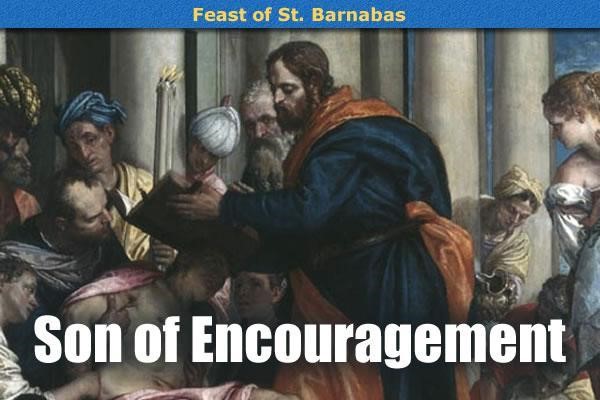
The Book of Acts tells the story of a man called Barnabas, which translates to, “son of Encouragement. We come together as the church today to commemorate his Feast day.” Barnabas’ gift of encouragement shows us five ways in we can encourage others in the world today.
Firstly, Barnabas encouraged others by practicing stewardship.
In Acts 4:36, We read that Barnabas sold his property and then he gave all the profits from that sale to the Church. He decided to meet the needs of others with the resources which God had blessed him, no matter what the personal cost was to himself. Encouragers like Barnabas understand that each and every person has something they are able to give. Encouragers find needy people and enrich them, whether it’s by their money, by giving of their time, or by their service.
Secondly, Barnabas encouraged others by extending the hand of friendship.
After the Apostle Paul’s conversion, Barnabas was despised by his old colleagues, and was feared by his new brothers and sisters in Christ. He was a man who needed a friend; Barnabas found him and became a friend to this very lonely new disciple. A lot of new Christians need somebody to find and to befriend them. We must seek out the lonely and the neglected and the vulnerable, put our outstretched arms around them, and bring them into the Lord’s fold.
Thirdly, Barnabas encouraged others by building partnerships with others.
In Acts 11, the Gospel was spreading quickly, and new believers were sprouting up everywhere. There were some concerns that some of them were not truly sincere. But Barnabas’s encouragement validated and affirmed those who were misunderstood by others.
Fourthly, Barnabas encouraged others by developing leaders within the Lord’s church.
He found the hidden gifts and talents within the new followers of the Lord and he helped them to develop these gifts and talents. Our churches are full of very talented people with abilities vast array of blessed abilities which are waiting to be discovered and to be developed. But it takes a person who encourages such as “Barnabas” to find them.
Finally, Barnabas encouraged others by rebuilding relationships.
After the disciple Mark ran away from his calling, Barnabas sought him out and gave him a second chance. This young disciple went on to write the Gospel of Mark. Thank God for the encouragers in our churches and in our world, who see second chances in us when no one else seems to be able to.
We should apply the examples given to us in the life of Barnabas within our own lives today.
Barnabas was indeed a good man, who was filled with the Holy Spirit; it was God who acted within Him. We can all be encouragers like Barnabas. We need to ask God the Father to fan the Holy Spirit within us to meet the needs of others, to befriend the lonely, to affirm the misunderstood, to develop disciples, and to offer people second chances.
Let us pray:
St. Barnabas, you who were known as the ‘son of encouragement,’ We ask for your intercession. Help us to find strength and perseverance in our faith, especially when we feel discouraged or weary. May we be like you, a source of comfort and hope to others, and may we have the courage to stand up for what is right. Help us to be a beacon of light and love in this world. Pray for us, that we may live a life of faith and devotion, just as you did.
Amen.”
Pentecost!~The Rev Frank Bellino,OPI

My dear brothers and sisters in Christ and fellow seekers of Truth,
Grace and peace be with you this radiant Pentecost Sunday!
As a Dominican priest, one called to a life of study, contemplation, and preaching, there is no more vibrant feast for the soul than this one. Fifty days ago, we celebrated the glorious Resurrection of our Lord, and then His Ascension, leaving His disciples with a promise: “I will send you another Advocate.” Today, that promise explodes into reality.
Just as we heard in our first reading from the Acts of the Apostles, the disciples were gathered, perhaps still a little bewildered, certainly anxious, locked away for fear. Then, suddenly, there came from the sky a noise like a strong driving wind, filling the entire house. And tongues as of fire, which parted and came to rest on each one of them. And they were all filled with the Holy Spirit and began to speak in different tongues, as the Spirit enabled them to proclaim.
What an extraordinary moment! This isn’t just a historical event; it’s the very birth of the Church, the moment when God’s Spirit transforms a fearful huddle of followers into a courageous, outward-looking community. It’s the reversal of Babel, where instead of division, the Spirit brings understanding. People from every nation, every language, heard the Good News in their own tongue. This is a profound truth for us in the Unified Old Catholic Church, a Church committed to bridging divides, to embracing the glorious diversity of God’s creation, and to seeking unity in Christ.
The Spirit that descended on that first Pentecost is not a historical relic, but a living, breathing, active presence in our world, and most profoundly, within each one of us. As our Gospel from John reminds us, Jesus promised the Spirit of Truth, who “will teach you everything and remind you of all that I told you.” The Spirit is our constant guide, our divine teacher, our Advocate in a world often confused and disheartened.
So, how does this Pentecost, this ancient outpouring, apply to our lives today?
Firstly, the Spirit empowers us to overcome fear. Look at the Apostles: timid, hiding. After Pentecost, they are bold, proclaiming the Risen Christ even unto martyrdom. In our own lives, we often face fear: fear of failure, fear of judgment, fear of uncertainty, fear of speaking truth to power. The Holy Spirit instills fortitude, courage, and a holy boldness. It’s strength to stand up for justice, to speak out against injustice, to forgive when it’s hard, to love when it feels impossible.
Secondly, the Spirit calls us to unity in diversity. In a world increasingly fragmented by politics, ideologies, and even religious differences, Pentecost reminds us that the Spirit unites without erasing our distinctiveness. We don’t have to be uniform to be united. The Spirit allows us to hear and understand one another, even across seemingly insurmountable barriers. This is a core calling for us as Old Catholics: to be a bridge, to foster understanding, and to exemplify a Church where all are welcome and all gifts are honored, regardless of gender, orientation, or marital status. We are called to be a visible sign of God’s unifying love in a divided world.
Thirdly, the Spirit ignites our mission. The disciples weren’t just filled with the Spirit to feel good; they were filled to go forth. Each one of us, through our Baptism and Confirmation, has received the same Holy Spirit. We have been endowed with gifts: wisdom, understanding, counsel, fortitude, knowledge, piety, and fear of the Lord. And beyond these, charismatic gifts for the building up of the Body of Christ. You might think, “I’m just a layperson,” but Pentecost reminds us that the Spirit falls on all flesh. Your unique talents, your compassionate heart, your discerning mind, these are tools for the Kingdom. Are you called to serve the poor? To teach? To console? To bring beauty into the world? To advocate for change? The Spirit is your guide and your strength.
Finally, as Dominicans, we speak of Veritas – Truth. The Holy Spirit is the Spirit of Truth, leading us deeper into the mysteries of God and the reality of creation. In a world awash with misinformation and conflicting narratives, the Spirit empowers us to discern, to seek what is truly good and true, and to proclaim it not with arrogance, but with conviction born of love and rigorous inquiry.
My friends, Pentecost is not merely a commemoration of what happened long ago. It is a vibrant, ongoing reality. The same Holy Spirit who descended upon the Apostles is waiting to fill us anew today. Open your hearts, pray for a fresh outpouring of grace. Let your fears be transformed into fortitude. Let your divisions be healed into authentic communion. And let your lives become living homilies, proclaiming the boundless love and truth of God, empowered by the very breath of God.
Come, Holy Spirit, fill the hearts of your faithful, and kindle in us the fire of your love. Renew the face of the earth, and through us, renew the face of your Church.
Amen.
“Poof! I’m Out”: Jesus ~ The Rt Rev Michael Beckett, OPI

Today we celebrate the most important day of the year. Wait, lemme try again. TODAY WE CELEBRATE THE MOST IMPORTANT DAY OF THE YEAR!!!!
Yeah, that’s better. And no, it’s not any day that you or I think is the most important day of the year. I’m gonna give you a couple of hints coz I’m a nice guy like that. It’s not Christmas. It’s not Easter. It’s MORE important than either of those days.
“What?” you say to me, mystified. “What could be more important than celebrating our Lord’s birth?” Meh. Without celebrating today’s importance, Jesus’s birth is no more important than any other baby born at any time in history.
“What?” you say to me, getting a bit hot under the collar. “What could be more important than celebrating the Lord’s resurrection, when He died for us all and rose again, saving us all?” Meh. Without celebrating today’s importance, Jesus’s resurrection is no more important than that of those folks Elijah and Elisha raised, or Lazarus of Bethany, or the widow of Nain’s son, or Jairus’s daughter, or Tabitha, or any and all of those other folks who made an encore appearance when Jesus rose from the dead on Easter. “But, but, but…….” you say. OK, calm down….lemme finish. Yeah, it was a pretty great thing that Lazarus was resurrected, as well as those other folks who popped out of their tombs when Jesus did, but super important??? Not so much.
And I can hear you going all “Michael what are you talking about. So…. Imma tell ya. All those resurrected folks? Lazarus and all the others included? THEY DIED AGAIN and stayed that way. They all got up and did whatever it was that newly un-unalived people do, and then, when it was time, they died. Again.
However, Jesus? He did not. He. Did. Not. We read what happened in the Book of Luke (Luke 24:51) and in Acts (Acts 1:1-9) In a nutshell, Jesus kinda levitates and then levitates a bunch more and soon He’s levitated himself so high that He is surrounded by the clouds and goes out of sight. Gone. Ascended into Heaven. Not Dead.
St. Augustine, the great fifth century theologian, called the ascension the most important Christian festival of the year, more important than Christmas, more important than Pentecost, even more important than Easter. (See, told ya. It’s not just me!) For the ascension reminds us just how high Jesus was raised, and what that means. Aquinas states:
‘This is that festival which confirms the grace of all the festivals together, without which the profitableness of every festival would have perished. For unless the Saviour had ascended into heaven, his Nativity would have come to nothing…and his Passion would have borne no fruit for us, and his most holy Resurrection would have been useless.’
What Saint Augustine says here resonates with the passage in Ephesians 4:10, where Saint Paul says that ‘He who descended is he who also ascended far above all the heavens, that he might fill all things’ – i.e.; that by ascending into Heaven, and taking our human nature up with Him into the heavenly places, He completed the process of redemption by reclaiming His place as rightful sovereign of the universe, so that He might be present to us in a different way. If He had not so returned, the process would not have been completed, and as Jesus said in John 16:7, ‘it is to your advantage that I go away, for if I do not go away, the Counselor will not come to you; but if I go, I will send him to you’.
The gospel writer Luke is renowned as a careful historian. When he recorded the birth of Jesus he rooted the event in its historical setting within the Roman Empire. He continues that same preciseness at the end of our Lord’s earthly ministry by recalling the place of the Ascension – at Bethany. He dates the event – 40 days after the resurrection on Easter Day. He emphases the presence of eyewitnesses – the Ascension took place he writes “before their very eyes” (Acts 1:9). Yes, the Ascension was a real event of history.
Some people are puzzled as to why Jesus waited around on Earth 40 days after his resurrection, but that period is no accident, and Jesus had things to do.
Jesus had endured the Devil’s temptation for 40 days in the wilderness at the beginning of his public ministry, but now the tables were turned. In the period after Jesus’ resurrection, He triumphantly paraded his victory over the Satan. During this time, the conqueror of death displayed his supremacy before his faithful followers so that they might share in the joy of his victory. But there was another reason. Those 40 days of his appearing after the resurrection were of immense value to the believers for they established the reality of his lordship. A single sighting of the risen Christ may have been open to question, but his continuous encounters with the disciples would remove the doubts of the most skeptical among them and assure them of his power and authority.
The resurrection of Jesus marked the ending of a chapter in his earthly life. Things could never be the same again and it was essential that there should be a clear-cut event to bring the chapter to a close. It’s true that Jesus was making a series of appearances to his followers, but they couldn’t go on forever.
It would have been odd if Jesus’ post-resurrection appearances had grown fewer until finally they just stopped – that would only cause confusion and even loss of faith. No, there had to be a single, miraculous occurrence, separating the time when the Jesus of Earth would become the Christ of heaven. The Ascension was the only fitting conclusion to the life of Jesus on Earth.
Luke tells us of the disciples with their eyes straining to catch the last glimpse of the cloud bearing up their Lord. But then they were quickly brought back to earth. It would seem that with their eyes heavenward they didn’t notice the two heavenly beings that slipped quietly alongside them until they spoke: “Men of Galilee, why do you stand looking unto heaven?,” as if to remind the disciples of the work that they had been given to do. The angels, for angels they were, had to tell the disciples to get to business.
And so it is with us. Ascension Day reminds us of the Mystery of Faith: “Christ has died, Christ is risen, Christ will come again.”
Christ will come again. And as we await the “coming again” of Christ, we, like the disciples, have a job to do, business to attend to. Although we live in the time between Jesus’ Ascension and his coming again, we have something to do now. In Matthew 28:18-20, Jesus says, “Go to the people of all nations and make them my disciples. Baptize them in the name of the Father, the Son, and the Holy Spirit, and teach them to do everything I have told you. I will be with you always, even until the end of the world.”
Where do we start? Jesus has the answer for that, too. In John 13 Jesus says to us, “ But I am giving you a new commandment. You must love each other, just as I have loved you. If you love each other, everyone will know that you are my disciples.” We are to continue to change the world in the work that Jesus has given us to do by helping others to see Jesus through and in us, by showing that love that he demonstrated, by bringing that love to everyone.
Jesus told us to love everyone. Love. Everyone. Period. Not just those whose politics are the same as ours. Not only those whose religion is the same as ours, not only those whose lifestyles are the same as ours. Love. Everyone. Period.
Come Lord Jesus.
Amen.
Peace Y’all! ~The Rt Rev Michael Beckett OPI
Y’all….. So here’s a little riddle for ya!!! What do a song by recording artist Lynn Anderson, a novel about nuns, and some of the words spoken by Jesus all have in common? I’ll give you a minute.
Ya got nothing? I didn’t figure. So here are a few hints:
Way back, a hundred and ninety-‘leven years ago when I was a wee baby gay, Lynn Anderson sang the hit song, “I Never Promised You a Rose Garden.”
And from the Gospel Reading appointed for today:
Jesus said to his disciples: “Whoever loves me will keep my word, and my Father will love him, and we will come to him and make our dwelling with him. Whoever does not love me does not keep my words; yet the word you hear is not mine but that of the Father who sent me.
“I have told you this while I am with you. The Advocate, the Holy Spirit, whom the Father will send in my name, will teach you everything and remind you of all that I told you. Peace I leave with you; my peace I give to you. Not as the world gives do I give it to you. Do not let your hearts be troubled or afraid.
And finally, from the first page of my very favorite, much beloved, read, and internalized novel, “In This House of Brede” by Rumer Godden, she writes:
The motto was “pax” but the word was set in a circle of thorns. Pax: Peace, but what a strange peace, made of unremitting toil and effort—seldom with a seen result: subject to constant interruptions, unexpected demands, short sleep at nights, little comfort, sometimes scant food: beset with disappointments and usually misunderstood, yet peace all the same, undeviating, filled with joy and gratitude, and love. “it is my own peace I give unto you.’ Not, notice, the world’s peace.
So the answer to the riddle, is this: It’s gonna be OK.
Do y’all remember what the deal was when Jesus was asleep in a boat on the sea nd then it stormed??? Not just your average run of the mill storm, but a STORM…..at sea even. Thunder. BOOM! Lightening. FLASH! Waves so high over the little boat that it was tossed about. CRASH! And to top it off, the boat started filling up with water. SLOSH…..Sink? And Jesus slept on. And on. And on.
And then it happened. The disciples, those stalwart fishermen, panicked; so much so that they wanted Jesus to panic, too. So, they woke him.
Now, I dunno about Jesus, and I’m pretty sure they didn’t have a Keurig on that boat, but anyone who knows me well, knows, that no matter what, one does NOT speak to the Bishop when he first wakes up until after his (at least) first cup of coffee. Can you not see Jesus? He throws the blanket off and says, WHAT?
Y’all….we’re in the midst of a storm now, even as I type. Many of us are fearful and dismayed. Many of us are angry. Many of us are in turmoil. And rightly so. With so much uncertainty on the horizon, many of us feel that we are in danger of sinking. And, I rather suspect, that many of us wonder if God is, indeed, sleeping, or if the Creator exists at all.
The disciples point out the storm, Jesus’s eyes focus, and then he gets it. He understands what all the fuss is about…..and then, like so many of us, he says,
“Really?”
I can just imagine him rolling his eyes, and then saying to the storm, in much the way I talk to our cats, he says, “Stoppit!” The storm quiets, Jesus grumbles about nonbelieving disciples, and goes back to sleep…..and the (nonbelieving) disciples are tripped!
But ya know, I can assure you that God is very much awake, and involved, in our lives. Or at least the Redeemer wants to be. How, you ask?
Remember that reading from the Gospel a minute ago? Here:
Jesus said to his disciples: “Whoever loves me will keep my word, and my Father will love him, and we will come to him and make our dwelling with him. Whoever does not love me does not keep my words; yet the word you hear is not mine but that of the Father who sent me.
So that’s how. By living through and with and in us. By us showing forgiveness. Charity. Good will. Reaching out. Love. By standing up for what is right and good and true. By peacefully protesting. By donating time and money to those who are less fortunate that we ourselves. By examining what we believe, what we hold dear, and comparing that to what Jesus has taught us that we SHOULD hold dear and believe. (For those of you who may be wondering what that is, focus on the Beatitudes and Matthew 25. Oh, and the greatest commandment (hint: it’s not one of the 10.)) Try: Love one another.
This storm is far from over. FAR from over. Before this storm ends, hearts will have to change, attitudes will have to change, laws, rules, regulations, the government, will have to change, society will have to change. And before any of that can happen, WE will have to change. We will, ALL of us, have to examine ourselves carefully, and honestly, to find the roots of our prejudice, our fears of those who are ‘other’ than ourselves. We will have to look with new eyes at all of those with whom we come into contact, ALL of them, EVERY ONE of them, and strive to find the Jesus in each of them. The Jesus in us must reach out to the Jesus in our brothers and sisters, regardless of race, creed, color, gender, gender identity, sexual preference, ability or disability, political affiliation, or any of the other million and one things we use to denigrate, disgrace, and damn our brothers and sisters.
Like the disciples, we will be afraid. Sometimes we may even panic. But I can assure you that, like the disciples, we can go to Jesus. And when we do, he will say to us, “Peace. Be still.” And in the calm and quiet that results from our trust in Him, we will be able, with full hearts, to grow, and to learn to love our neighbors as ourselves.
Christopher West used the words of St Francis to write this hymn:
Make me a channel of your peace.
Where there is hatred let me bring your love.
Where there is injury, your pardon, Lord
And where there’s doubt, true faith in you.
Make me a channel of your peace
Where there’s despair in life, let me bring hope
Where there is darkness, only light
And where there’s sadness, ever joy.
Oh, Master grant that I may never seek
So much to be consoled as to console
To be understood as to understand
To be loved as to love with all my soul.
Make me a channel of your peace
It is in pardoning that we are pardoned
In giving to all men that we receive
And in dying that we’re born to eternal life.
Oh, Master grant that I may never seek
So much to be consoled as to console
To be understood as to understand
To be loved as to love with all my soul.
Make me a channel of your peace
It is in pardoning that we are pardoned
In giving to all men that we receive
And in dying that we’re born to eternal life.
Peace. It’s up to us.
Amen.
Love and Cymbals~The Rt Rev Michael Beckett,OPI
Y’all……Do you ever get tired of saying the same thing over and over and over again, ad infinitum? Do you ever struggle to try to find a different way to say the same thing over and over and over again? It occurs to me that this is exactly what I do. Ya see, the Gospel reading appointed for today is this:
Jesus said,
I give you a new commandment: love one another.
As I have loved you, so you also should love one another.
This is how all will know that you are my disciples,
if you have love for one another.”
After over 2,000 years, countless sermons, essays, and writings, and an infinite number of words, what is there left to say? The whole of Jesus’s ministry, the foundation of the Christian faith, the very basis of our being, our salvation, comes from that little central premise, love.
Love God. Love people. Love.
Love God. Show God’s Love by Loving People.
Love God. Show God’s Ways by Changing Your Ways By Loving People.
Love God. Show God’s Ways by Changing Your Ways By Loving People Who are Different Than You. Whose values, beliefs, bodies, and ways of Being are Different from Yours.
Jesus said to his disciples:
“To you who hear I say, love your enemies, do good to those who hate you, bless those who curse you, pray for those who mistreat you.
To the person who strikes you on one cheek, offer the other one as well, and from the person who takes your cloak, do not withhold even your tunic.
Give to everyone who asks of you, and from the one who takes what is yours do not demand it back.
Do to others as you would have them do to you. For if you love those who love you, what credit is that to you? Even sinners love those who love them.
And if you do good to those who do good to you, what credit is that to you? Even sinners do the same.
If you lend money to those from whom you expect repayment, what credit is that to you? Even sinners lend to sinners, and get back the same amount.
But rather, love your enemies and do good to them, and lend expecting nothing back; then your reward will be great and you will be children of the Most High, for he himself is kind to the ungrateful and the wicked. Be merciful, just as your Father is merciful.
“Stop judging and you will not be judged. Stop condemning and you will not be condemned. Forgive and you will be forgiven. Give, and gifts will be given to you; a good measure, packed together, shaken down, and overflowing, will be poured into your lap. For the measure with which you measure will in return be measured out to you.” Luke 6:27-38
Paul teaches us in Galatians that, “There is neither Jew nor Greek, slave or free, male nor female, for you are all one in Christ Jesus”. (Galatians 3:28) And again in Colossians, “Here there is not Greek and Jew, circumcised and uncircumcised, barbarian, Scythian, slave, free; but Christ is all, and in all.” (Colossians 3:11)
And again from Paul: If I speak in the tongues of men or of angels, but do not have love, I am only a resounding gong or a clanging cymbal. If I have the gift of prophecy and can fathom all mysteries and all knowledge, and if I have a faith that can move mountains, but do not have love, I am nothing. If I give all I possess to the poor and give over my body to hardship that I may boast, but do not have love, I gain nothing. Love is patient, love is kind. It does not envy, it does not boast, it is not proud. It does not dishonor others, it is not self-seeking, it is not easily angered, it keeps no record of wrongs. Love does not delight in evil but rejoices with the truth.
Love God. Love people. Love.
Flat out: If your politics, your posts, your premises, your words, your actions, your beliefs don’t show a love of God and his people, you cannot rightly claim to be of Christ. Period. So the question remains, are you a Christian, or a clanging cymbal?
Herding Cats~The Rt Rev Michael Beckett,OPI

We have four cats, and ya know that phrase, “It’s like herding cats” that’s used to describe something possible, but rather difficult? It’s kinda dead on. One does not “herd” cats. One suggests, coaxes, begs, pleads, or bribes, cats. One does not force cats to do much of anything, or one comes away bloody with an angry cat to boot.
Now, sheep. Sheep are, supposedly, easily led, have no claws (Can you imagine the size of the claws if sheep did, indeed, have claws?), and are not, generally, independent thinkers. This being the case, one can, without much fuss, herd sheep.
And just who, you might ask, has that cushy job of herding those sheep? Why, shepherds, of course! Way, way back when and long, long, long ago in ancient times, shepherds and sheep were as common as Wal-Mart, telephones, and convenience stores. So, what IS a shepherd?
Simply put, a shepherd is the man or woman who takes care of the sheep and goats. Easy enough. But what does this mean? What did it mean in Biblical times for a shepherd to care for his sheep? The duties of a shepherd in an unenclosed country like Palestine were very onerous. In early morning he led the flock from the fold, marching at its head to the spot where they were to be pastured. Here he watched them all day, taking care that none of the sheep strayed, and if any for a time did stray from his watch and wandered away from the rest, he would have to seek diligently till he found and brought it back. In those lands sheep require to be supplied regularly with water, and the shepherd for this purpose had to guide them either to some running stream or to wells dug in the wilderness or furnish them with troughs. At night he brought the flock home to the fold, counting them as they passed under the rod at the door to assure himself that none were missing. Nor did his labors always end with sunset. Often, he had to guard the fold through the dark hours from the attack of wild beasts, or the wily attempts of the prowling thief.
Shepherds in ancient Israel likely worked with, among others, the broadtail Syrian variety of sheep, which have large fatty tails and a thick fleece. The rams of this breed are horned, and the ewes are not. These docile animals are easily led and completely at the mercy of their environment and predators.
The shepherd faced the ongoing challenge of teaching the sheep and goats to obey his commands. Even so, good shepherds took tender care of the animals in their charge, even giving them names to which they would respond. —(John 10:14, 16.)
It was a tough job.
Great men such as Abraham, Moses, and King David were shepherds. The image of the shepherd as one who cares for flocks and people is one that is pretty easy to understand and runs deep in the imagery of ancient times. In Mesopotamia, the region along the Tigris and Euphrates rivers, the model for kings was the shepherd. The king-as-shepherd was to “rule kindly, counsel and protect the people,” and “guide them through every difficulty.” Babylon’s Hammurabi, credited with the world’s first written law code, was described as a shepherd of his people. In ancient Egypt, the shepherd’s crook was used “as an insignia of kings, princes, and chieftains.” In the Iliad and the Odyssey from ancient Greece, ship captains are called “shepherds of ships.” Plato uses the shepherd analogy to define justice in the Republic, and in the “Statesman” uses the shepherd to symbolize the work of a good ruler.
So, now that you’ve had the “Shepherding for Dummies” course, you might ask, “Why is he going on about shepherds today?” I’m ever so happy you asked! Here we go…….
If you know about sheep and shepherds, then today’s Gospel, John 10:27-30, is a pretty simple one to understand: Jesus said:
“My sheep hear my voice; I know them, and they follow me. I give them eternal life, and they shall never perish. No one can take them out of my hand. My Father, who has given them to me, is greater than all, and no one can take them out of the Father’s hand. The Father and I are one.”
And reckon wonder, just how are we supposed to be those ‘sheep who know their shepherd?’ More importantly, how are we supposed to KNOW we are ‘those sheep who know their shepherd’???? Jesus tells us in pretty no uncertain terms and more than once: Love. Dig this:
A new command I give you: Love one another. As I have loved you, so you must love one another. – John 13:34
This is my command: Love each other. – John 15:17
Love the Lord your God with all your heart and with all your soul and with all your mind and with all your strength. – Mark 12:30
But I tell you: Love your enemies and pray for those who persecute you – Matthew 5:44
My command is this: Love each other as I have loved you. – John 15:12
Greater love has no one than this, that he lay down his life for his friends. – John 15:13
But I tell you who hear me: Love your enemies, do good to those who hate you – Luke 6:27
By this all men will know that you are my disciples, if you love one another. – John 13:35
If you love me, you will obey what I command. – John 14:15
Pretty simple, right? Not so much. Sometimes loving is hard. What about those who disagree with you politically? Those who talk trash about you? Those who make your life crazy? Those folks who you really, really, REALLY can’t stand? Gotta love ‘em. No, we don’t have to like ‘em, but love ‘em we gotta. Just remember, you will never look into the eyes of someone God doesn’t love.
As I’ve said a zillion times, we are called to love and to serve the Lord with gladness and singleness of heart. We are called to take care of each other, regardless of our politics or ideologies. We are commanded to ‘bless those who persecute us,’ and we are called to ‘pray for our enemies.’ We are called to feed the hungry, clothe the naked, house the homeless. (Matthew 25:31-46).
And then, we have to ask ourselves, does the shepherd we follow also follow what Jesus commands? Who are WE following?
Now, here’s the scary part. We are, all of us, in some way, a shepherd with our own flocks. Every one of us has influence in some way, and what we do with that influence, how we ‘herd our flocks’ so to speak truly matters. In Jeremiah 23:1-6m we have, to me, probably the most terrifying scripture in the whole of Holy Writ. “Woe to the shepherds who mislead and scatter the flock of my pasture, says the LORD. Therefore, thus says the LORD, the God of Israel, against the shepherds who shepherd my people:
You have scattered my sheep and driven them away. You have not cared for them, but I will take care to punish your evil deeds. I myself will gather the remnant of my flock from all the lands to which I have driven them and bring them back to their meadow; there they shall increase and multiply. I will appoint shepherds for them who will shepherd them so that they need no longer fear and tremble; and none shall be missing, says the LORD.”
So think for a minute. Who is your flock? Who are those folks who look to you for advice, for guidance? Who is that that you influence? Your children? Your families? Co-workers? Neighbors? The kids you eat lunch with and have classes with? The folks on your sports team? Your golf buddies? What about those people who see you but don’t know you? Those folks in the line with you at the grocery store?
I have said it time and time and time again: YOU are the only Bible some folks will ever read. YOU are the only Jesus some folks will ever see. While it is true that it is the job of the clergy to lead the church, what about you? Saint Peter teaches us that “You also, as living stones, are being built up a spiritual house, a holy priesthood, to offer up spiritual sacrifices acceptable to God through Jesus Christ … But you are a chosen generation, a royal priesthood, a holy nation, His own special people, that you may proclaim the praises of Him who called you out of darkness into His marvelous light” (1 Peter 2:5-9).
Is this who you are? Who is your flock? Who are your sheep? What kind of shepherd are you? Do you, by your words and actions, reflect the Gospel? Where are you leading your sheep?
WE MUST OBEY GOD RATHER THAN MEN~The Rt Rev Michael Beckett,OPI
Well now, y’all….The Epistle Reading for today is a humdinger. For those of you who want to know, it’s from Acts 5:27-32,40-41. Ya see, Peter and the Apostles were dragged in front of the powers that were (as opposed to the powers that be, but we’ll get there in a minute) and got into a heap of trouble because they had been told, in no uncertain terms, that they were to keep their mouths shut and not preach about Jesus’s love, forgiveness, salvation, resurrection, and all things Christ related. However, rather than meekly submitting, Peter and the apostles said, “”We must obey God rather than men.
The God of our ancestors raised Jesus, though you had him killed by hanging him on a tree. God exalted him at his right hand as leader and savior to grant Israel repentance and forgiveness of sins. We are witnesses of these things, as is the Holy Spirit whom God has given to those who obey him.”
Did ya get that? What’s the most important thing Peter said? He said, “We must obey God rather than men.” For the life of me, I just don’t understand why people don’t get it. WE MUST OBEY GOD RATHER THAN MEN. Period. Hands down. However, we frequently hear certain politicians claiming to be “Christian” and actively espousing the desire to ‘take the country back’ and to ‘put God first,’ and to make sure that the United States follows only their brand of “Christianity.” These are the folks who distort the Scriptures, using selective editing and mental gymnastics to claim they say things they don’t say. Often they claim the Bible doesn’t mean what it says or they ignore the explanations given by Biblical linguists and other experts in the field. This is hypocrisy, something Jesus repeatedly condemns.
WE MUST OBEY GOD RATHER THAN MEN. Jesus taught us to love our neighbors — no exceptions. (How very “woke” of him!) The Gospels emphasize this commandment in dozens of different verses about love (particularly in the Gospel of John) and lay out specific blueprints about what love in action looks like throughout Matthew 25, the Sermon on the Mount in Matthew, the Sermon on the Plain in Luke, the beginning of his ministry in Luke 4:18, Mary’s song about the rich and the lowly in Luke 1, and more.
There are those who claim that America was founded to be – and should remain – a so-called “Christian nation,” despite the clear intent of the Constitution to separate church and state and to honor religious liberty for all. It most assuredly was not. Many of our Founding Fathers were not Christian. Many of them were Deists, among them were Benjamin Franklin, Thomas Jefferson and George Washington. (Yes, I know some of you will disagree with me. However, check out the “Jefferson Bible” before you say anything. Heck, check out your own Bible, in a direct translation and proper context, before you say anything.) These same people claim to be all about defending “the Jesus that they love and worship” whilst not caring at all about those whom Jesus asked them to care: the hopeless, the hungry, the homeless, the downtrodden, those who are “other.” The prisoner, the immigrant. They yell about freedom of speech without understanding what that means, and not caring, except for the speech with which they agree, and heaven forbid anyone disagree with them.
These are also the people who advocate for oppressive legislation — rooted in far-right religious beliefs — that strips away equal rights from those same LGBTQ folks, non-Christians, women, people of color, and immigrants, among others.
They cry, “It’s a baby!” and then do their best to take food out of babies’ mouths, refuse them health care, or any care at all. They demand the 10 Commandments be posted in classrooms but shun The Sermon on the Mount as being woke. They cry to “teach religion in our schools,” but only that bit of religion with which they agree (most of which comes from the holiness codes in the Hebrew Scriptures) but refuse to practice. And heaven forbid any other religion but theirs be even mentioned in schools.
Where is God in all this? Where is the love that Jesus has said that we are to show to all? It is time to stop giving lip service to our faith and actually live it. It is time for us to, as they say, “put up or shut up.” It is up to each of us to conduct ourselves in a manner fitting our faith. By all means, pray for America. But don’t you DARE then sit back and do nothing to heal our nation.
We are taught in Galatians 3:28 that “There is neither Jew nor Greek, there is neither slave nor free, there is no male and female, for you are all one in Christ Jesus.” That also means, by extension, no race, no nationality. Isn’t it time we act like it? Isn’t it time that we hold those in power accountable if this is what we wish? We are taught in the book of James to “ show no partiality as you hold the faith in our Lord Jesus Christ, the Lord of glory. For if a man wearing a gold ring and fine clothing comes into your assembly, and a poor man in shabby clothing also comes in, and if you pay attention to the one who wears the fine clothing and say, “You sit here in a good place,” while you say to the poor man, “You stand over there,” or, “Sit down at my feet,” have you not then made distinctions among yourselves and become judges with evil thoughts?” James 2:1-26 Further, we are taught, again in James, that faith without works is dead. In other words, if the faith inside of us doesn’t get expression through our actions and words, it will no longer be alive. If we don’t use it, we will lose it, so to speak. We have to step out in faith in order to keep faith alive. (James 2:26: For as the body apart from the spirit is dead, so also faith apart from works is dead. But be doers of the word, and not hearers only, deceiving yourselves.)
WE MUST OBEY GOD RATHER THAN MEN. It is up to us, each of us, every one of us who profess to be followers of Christ, to BE the change, to work for the change, we so desperately need in this world. Again from James: But be doers of the word, and not hearers only, deceiving yourselves. For if anyone is a hearer of the word and not a doer, he is like a man who looks intently at his natural face in a mirror. For he looks at himself and goes away and at once forgets what he was like. But the one who looks into the perfect law, the law of liberty, and perseveres, being no hearer who forgets but a doer who acts, he will be blessed in his doing. James 1:22-25 I have said, over and over again, that WE are the only Bible some folks will ever read. WE are the only Jesus some folks will ever see.
The Feast of Saints Philip and James, Apostles~The Very Rev Lady Sherwood,OPI

My dearest brothers and sisters in Christ, today we come together to celebrate the feast of not just one, but two of Christ’s Twelve Apostles, these being, St. Philip and St. James. Both of these Apostles worked tirelessly for the sake of the people of God, and just as the other Apostles had done, they spread the Good News to many.
St. Philip is also known as Nathanael, he was a learned and a wise man of Israel. He was told he needed to be fluent in Greek, and eventually he went on to preach about the Lord and His truth in regions of Greece and of Roman Asia, he went from city to city, preaching to the masses and he gained for the Church many new converts and members.
St. Philip even managed to convert the wife of the proconsul of a region where he ministered, by his miracles and from his preaching. The proconsul was enraged and ordered St. Philip to be arrested, and he together with the other Apostle, St. Bartholomew, and other disciples were crucified upside down. And St. Philip preached to the crowd gathering there from his execution cross, in such a way, that they wanted to release him, but St. Philip refused to allow this.
The other Apostle which we celebrate today, St. James the Greater, was the brother of St. John the Apostle, a fisherman along the Lake of Galilee, whom Jesus called together with His other Apostles, St. Peter, St. Andrew and St. John his brother. St. James played an important role in the early Church, spreading the Good News of God’s salvation after Christ’s resurrection and ascension into heaven.
St. James went to preach the Good News to faraway regions such as the province of Iberia in what today we know as the country of Spain, where he spread the Gospel to the people there and helped to establish the Church far from its origins in Jerusalem. He was renowned especially in the region known as Santiago de Compostela, where his body lies buried, because it was there where he apparently did his works of evangelisation.
king Herod arrested St. James when he returned to the Holy Land, and in order to please the Jewish authorities, the Pharisees and the chief priests, had him executed. St. James was among the first of the Apostles to meet his end on earth through martyrdom.
The tireless works and commitment to the salvation of mankind of St. James and St. Philip can still be felt as making an impact even today. Like these Apostles of the Lord, we need more and more people who are willing to commit themselves to the Lord’s service, and to walk in His path just as these two Apostles did.
Truly, it will not be an easy task for us, as there is worldly opposition against all those who are faithful in the Lord’s service and who keep their faith. But Jesus reminds us yet again in the Gospel, that we who believe in Him, have seen the Lord Himself through Jesus, and by our faith in Him, we have been justified. And because we know the Lord, we will also be obedient to Him, we would be blessed and saved.
During the last remaining part of the season of Eastertide, let us reflect on our own lives, and on how we have acted in our lives so far. Have we been fully committed to our Lord, and have we been truly faithful to Him? Can we call truly ourselves Christians? Do we not only believe in the Lord through our mere words, but also through our actions?
The examples of the lives and service of the Apostles St. Philip and St. James show us that there are still many things that we can do as the followers of Christ in order to fulfil the commands which our Lord has given us, within our lives in His service. Both these Apostles served with tireless zeal and with vigour, and despite the challenges and the difficulties that faced them, these did not prevent them from carrying out the missions which the Lord had entrusted to them.
Let us all therefore look forward, and as we soon will celebrate the Solemnity of Pentecost Sunday, let us all recommit ourselves, and rediscover the true gifts of the Holy Spirit which have been given to us, and to make use of these gifts in order to help those who are still in darkness, by showing them the love of God manifested through each and every one of us as the faithful servants of our Lord, so that more and more souls may see the light of God and be saved.
 The Order of Preachers, Independent
You must be logged in to post a comment.