
Category: Lesson
The Unknown Disciple ~ The Rt. Rev. Michael Beckett, OPI
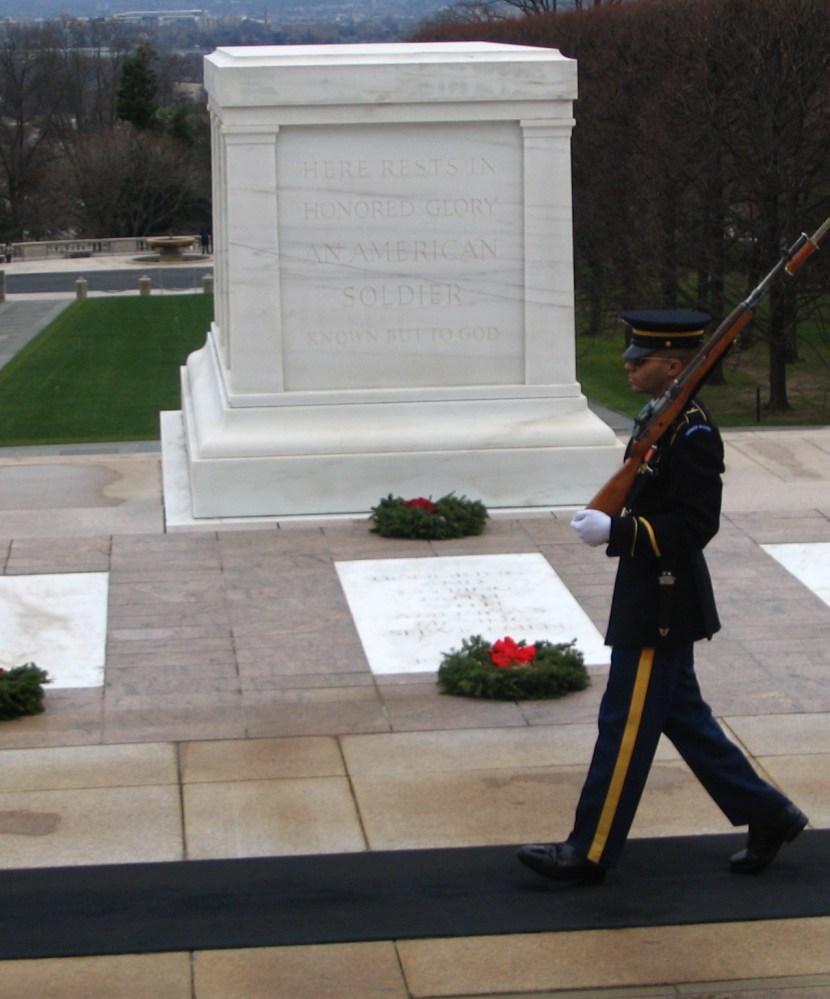
In Arlington National Cemetery, there is a tomb; a beautiful tomb, the Tomb of the Unknown Soldiers. In this tomb lie the remains of soldiers who were not able to be identified after their deaths from America’s wars since the 1st World War. Britain, Australia, France, Belgium, Bulgaria, Serbia, and a host of other countries also honor their unknown warriors. Those who lie in repose have no known names, no known family, no known history, but they are celebrated for what they did, for what they represent. They gave their all.
In the church, we don’t necessarily have a “Tomb of the Unknowns” but we do have a Feast Day to honor our unknown heroes. That day is, of course, 1 November, The Solemnity of All Saints, in honor of all the saints, known and unknown.
Now you’re saying to me, what in the world does All Saints Day have to do with the last Sunday in Eastertide???? Well, let’s think about that for a minute. In the first reading of the Scriptures appointed for today, from the first chapter of Acts, we learn that a new Apostle is chosen to replace Judas Iscariot. It would seem that there were two choices for the job. Matthias and Judas Barsabbas. Both of these men had been with Jesus FROM THE BEGINNING WHEN JESUS WAS BAPTIZED. What? There were more than the 12 original disciples? We tend to forget that, don’t we? In Luke 10: 1-24, we are told that Jesus sent out 70 men, 2 by 2 into every place that he was planning on going.
Church tradition holds that both of these men were 2 of that 70.
In the first sentence of our readings today, we learn that Peter was speaking to 120 folks.
Now, granted, you can ask just about anyone who knows me, and they will tell you that I’m pretty inept when it comes to math, but I DO know that 70 minus 2 is 68, and 120 – 2 is 118. Which leads me to ask, “Who are these people? Who are these 118 people who figured so prominently in spreading the Gospel? Who are these 118 people who were so devoted to Jesus that they risked imprisonment, some of them death; who risked losing everything to hang out in Jerusalem after the crucifixion and resurrection because Jesus told them to be there and to wait?”
Let’s think about that for a minute. We can whittle that number down some more…… Acts 1:13-15 says, “And when they were come in, they went up into an upper room, where abode both Peter, and James, and John, and Andrew, Philip, and Thomas, Bartholomew, and Matthew, James the son of Alphaeus, and Simon Zelotes, and Judas the brother of James. These all continued with one accord in prayer and supplication, with the women, and Mary the mother of Jesus, and with his brethren.” So there are a few of them. And then, we would expect that those mentioned in Acts 6:5 had been among the 70 and the 120 (Stephen, Philip, Prochorus, Nicanor, Timon, Parmenas, Nicolas), also Barnabas. These were men of good reputation, full of the Holy Spirit and wisdom.
Women were also identified to be among the 120. The wives of the apostles were there (1 Cor. 9:5 “Have we not power to lead about a sister, a wife, as well as other apostles, and as the brethren of the Lord, and Cephas?”). Each of the wives was a devout believer in Christ. Part of the number of women would be those mentioned in Luke 8:1-3. “And it came to pass afterward, that he went throughout every city and village, preaching and shewing the glad tidings of the kingdom of God: and the twelve were with him, And certain women, which had been healed of evil spirits and infirmities, Mary called Magdalene, out of whom went seven devils, And Joanna the wife of Chuza Herod’s steward, and Susanna, and many others, which ministered unto him of their substance.” See also Matt. 27:55-56; Luke 23:49,55. We would expect that the sisters of Jesus were also believers by this time, as His brothers had become.
Jesus brothers, had not been believers before the Crucifixion (John 7:3-5). Now they were firm in their faith and devotion to Him. These were: James, Joses, Simon, Judas (Matt. 13:55-56). James the Just was the leader of the Jerusalem Church in Acts 15:13. He is called an apostle in Gal. 1:19, although not one of the Twelve. James was the author of the Book of James. Judas was the author of the Book of Jude.
So….that leaves us with how many folks we don’t know? I lost count, I hate math, and it really doesn’t matter does it? What DOES matter is that we don’t know who, exactly, all of these people were. What we DO know, is what they did.
These were they who supported the Apostles. These were they who were in the upper room on the day of Pentecost. These were they who worked so diligently, some to the point of sacrificing their lives, to spread the message of the Gospel. These were they who were on fire for Christ. These were they to whom we look to be, or we should look to be, examples.
Who were they? Their names don’t matter. They lived 2000 years ago and they are lost to us. In 2000 years, in 100 years, most of our names will be lost. But what matters is what won’t be lost. What matters is what we do and say and proclaim, so that those who come after us will know, will experience, will be able to live, the truth and the joy of the Gospel.
My dear friends, we do not live in a vacuum. Everything that we do, everything that we say, has an effect on someone. And that someone has an effect on someone else. We see this everyday of our lives. You hear of things ‘going viral’ on the internet. Someone had to start it. Some ONE posted something that was liked….and liked….and shared and shared and shared. Is this not what those 120 people in the upper room did? Is this not what we are called to do?
In your everyday life, how often do you reference Christ? Now, I’m not talking about quoting Scripture. I’m talking about demonstrating who Christ is, showing the world Christ’s love, his Salvation? What is it that you do, or say, or write, or post, that will touch someone in a way you never imagined? I dare say you will never know. BUT, we all of us need to remember that we DO touch lives, lives we don’t even know exist. We touch lives that are unknown to us. We are touched by people who are unknown to us.
Besides those 100+ folks in the upper room, besides us, how many others have there been? How many saints? How many martyrs? How many unnamed, unwritten about people have left us with the legacy of Our Lord? Revelations 7 tells us: “I beheld, and, lo, a great multitude, which no man could number, of all nations, and kindreds, and people, and tongues, stood before the throne, and before the Lamb, clothed with white robes, and palms in their hands; These are they which came out of great tribulation, and have washed their robes, and made them white in the blood of the Lamb.” The unnamed disciples.
I plan on being in that ‘great multitude.’ I plan on being one of those “unnamed disciples.” Won’t you join me? Won’t you work to spread the love, the message, the salvation of our Lord and Savior? Amen.
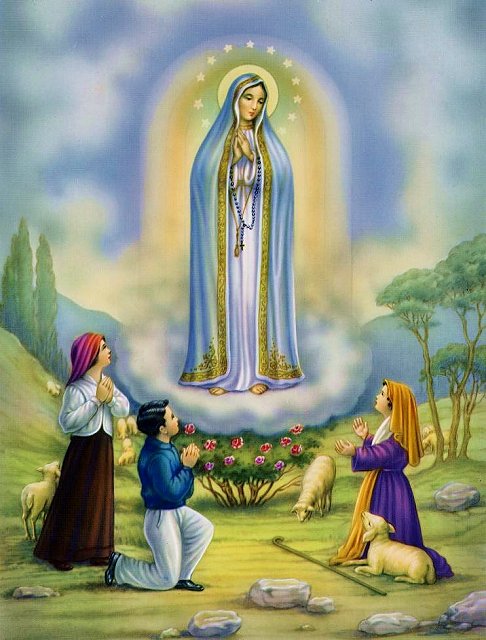
Our Lady of Fatima
 May 13 is the anniversary of the apparition of Our Lady to three shepherd children in the small village of Fatima in Portugal in 1917. She appeared six times to Lucia, 9, and her cousins Francisco, 8, and his sister Jacinta, 6, between May 13, 1917 and October 13, 1917.
The story of Fatima begins in 1916, when, against the backdrop of the First World War which had introduced Europe to the most horrific and powerful forms of warfare yet seen, and a year before the Communist revolution would plunge Russia and later Eastern Europe into six decades of oppression under militant atheistic governments, a resplendent figure appeared to the three children who were in the field tending the family sheep. “I am the Angel of Peace,” said the figure, who appeared to them two more times that year exhorting them to accept the sufferings that the Lord allowed them to undergo as an act of reparation for the sins which offend Him, and to pray constantly for the conversion of sinners.
Then, on the 13th day of the month of Our Lady, May 1917, an apparition of ‘a woman all in white, more brilliant than the sun’ presented itself to the three children saying “Please don’t be afraid of me, I’m not going to harm you.” Lucia asked her where she came from and she responded, “I come from Heaven.” The woman wore a white mantle edged with gold and held a rosary in her hand. The woman asked them to pray and devote themselves to the Holy Trinity and to “say the Rosary every day, to bring peace to the world and an end to the war.”
She also revealed that the children would suffer, especially from the unbelief of their friends and families, and that the two younger children, Francisco and Jacinta would be taken to Heaven very soon but Lucia would live longer in order to spread her message and devotion to the Immaculate Heart.
In the last apparition the woman revealed her name in response to Lucia’s question: “I am the Lady of the Rosary.”
That same day, 70,000 people had turned out to witness the apparition, following a promise by the woman that she would show the people that the apparitions were true. They saw the sun make three circles and move around the sky in an incredible zigzag movement in a manner which left no doubt in their minds about the veracity of the apparitions. By 1930 the Bishop had approved of the apparitions and they have been approved by the Church as authentic.
The messages Our Lady imparted during the apparitions to the children concerned the violent trials that would afflict the world by means of war, starvation, and the persecution of the Church and the Holy Father in the twentieth century if the world did not make reparation for sins. She exhorted the Church to pray and offer sacrifices to God in order that peace may come upon the world, and that the trials may be averted.
Our Lady of Fatima revealed three prophetic “secrets,” the first two of which were revealed earlier and refer to the vision of hell and the souls languishing there, the request for an ardent devotion to the Immaculate Heart of Mary, the prediction of the Second World War, and finally the prediction of the immense damage that Russia would do to humanity by abandoning the Christian faith and embracing Communist totalitarianism. The third “secret” was not revealed until the year 2000, and referred to the persecutions that humanity would undergo in the last century: “The good will be martyred; the Holy Father will have much to suffer; various nations will be annihilated’”. The suffering of the popes of the 20th century has been interpreted to include the assassination attempt on Pope John Paul II in 1981, which took place on May 13, the 64th anniversary of the apparitions. The Holy Father attributed his escape from certain death to the intervention of Our Lady: “… it was a mother’s hand that guided the bullet’s path and in his throes the Pope halted at the threshold of death.”
What is the central meaning of the message of Fatima? Nothing different from what the Church has always taught: it is, as Cardinal Ratzinger, now Pope Benedict the XVI, has put it, “the exhortation to prayer as the path of “salvation for souls” and, likewise, the summons to penance and conversion.”
Perhaps the most well known utterance of the apparition of Our Lady at Fatima was her confident declaration that, “My Immaculate Heart will triumph”. Cardinal Ratzinger has interpreted this utterance as follows: “The Heart open to God, purified by contemplation of God, is stronger than guns and weapons of every kind. The fiat of Mary, the word of her heart, has changed the history of the world, because it brought the Savior into the world—because, thanks to her, God could become man in our world and remains so for all time. The Evil One has power in this world, as we see and experience continually; he has power because our freedom continually lets itself be led away from God. But since God himself took a human heart and has thus steered human freedom towards what is good, the freedom to choose evil no longer has the last word. From that time forth, the word that prevails is this: “In the world you will have tribulation, but take heart; I have overcome the world” (John 16:33). The message of Fatima invites us to trust in this promise.

All You Need Is Love ~ Br. Dominic Ferrante, Novice

Why is it so hard now a days to practice the main point in Jesus’ teaching. Recent events such as the riots in Baltimore and Ferguson show how far we are from living up to the standard Christ has set for us. Racial intolerance, homophobia, and general dislike of other people permeate our society today. So called Christians such as the Westboro Baptist Church will picket fallen military personnel’s funerals and had even planned to picket the funeral of nine Amish children who were killed in a fire in Pennsylvania. How can this be Christianity? These actions go against all Christ has taught us and exemplified in his life.
Is this love, is this following Christ’s teaching? In today’s gospel Christ says “ This is my commandment : Love one another as I love you. No one has greater love than this.” It sounds pretty simple doesn’t it? Christ’s commandment to us was love each other unconditionally as he loves us unconditionally. We may personally not like some of the things others do, but Christ implores us to love them and forgive them.
As true Christians we must enlighten people to the fact that Christ loves unconditionally. There is no “ I love you only if….” or “I love you only if you do this….” it is simply I love you and I accept you for who you are flaws and all because I myself am flawed. We can practice this in our daily lives by being more tolerant towards what we do not understand and by forgiving others short comings as we hope they will forgive them in us.
Just by showing kindness, acceptance, and love towards people of all religions and faiths we are helping to improve ourselves and truly practice what Christ teaches.
If we are truly to be disciples of Christ this would seem obvious wouldn’t it? To love one another with the purity and passion Christ has for us is the ultimate ideal. It takes much more emotional effort to hate and misunderstand then to love and accept. Love breeds love, hate breeds hate. Will we always be able to live up this ideal? Probably not, for we are human and not infallible like Christ was. All we can do is try to hold ourselves to Christ’s commandment and strive to succeed at all times.
Christ has chosen us to go forth and practice the love He has for us upon other people. By doing this we are tending a garden and by nurturing and loving this garden as He did we can insure that Christ’s message of love is spread and practiced throughout the world. “ This I command you : love one another.”
And in the words of Paul McCartney and John Lennon “ All you need is love!”
John 15: 9-17 Jesus said to his disciples: “As the Father loves me, so I also love you. Remain in my love. If you keep my commandments, you will remain in my love,
just as I have kept my Father’s commandments and remain in his love.
“I have told you this so that my joy may be in you and your joy might be complete. This is my commandment: love one another as I love you. No one has greater love than this,
to lay down one’s life for one’s friends. You are my friends if you do what I command you. I no longer call you slaves, because a slave does not know what his master is doing.
I have called you friends, because I have told you everything I have heard from my Father. It was not you who chose me, but I who chose you and appointed you to go and bear fruit that will remain,
so that whatever you ask the Father in my name he may give you.
This I command you: love one another.”

Pope Saint Pius V

People who know nothing else about Pius V are quite apt to remember him as the Pope of the Rosary, recalling his remarkable connection with the Battle of Lepanto.
Antonio Michael was born into the distinguished but impoverished Ghisleri. His parents could not afford to educate their alert little boy, who seemed far too talented to be a shepherd. One day, as he was minding his father’s small flock, two Dominicans came along the road and fell into conversation with him. Recognizing immediately that he was both virtuous and intelligent, they obtained permission from his parents to take the child with them and educate him. He left home at age 12 and did not return until his ordination many years later.
After a preliminary course of studies, he received the Dominican habit at the priory of Voghera at age 14 and, as a novice, was sent to Lombardy. Here, for the first time, he met the well-organized forces of heresy which he was to combat so successfully in later years.
After his ordination in 1528, he went home to say his first Mass, and he found that Bosco had been razed by the French. There was nothing left to tell him if his parents were alive or dead. He finally found them, however, in a nearby town. After he said Mass, he returned to a career that would keep him far from home for the rest of his life. He began as a lector in theology and philosophy for 16 years.
Then he served as novice-master, than as prior of several convents, Michael proved to be a wise and charitable administrator. He was made inquisitor at Como, Italy, where many of his religious brethren had died as martyrs to the heretics. By the time of Michael’s appointment there, the heretics’ chief weapon was the printed word; they smuggled books in from Switzerland, causing untold harm by spreading them in northern Italy. The new inquisitor set himself to fight this wicked traffic, and it was not the fault of the heretics that he did not follow his brethren to martyrdom. They ambushed him several times and laid a number of complicated plots to kill him, but only succeeded in making him determined to explain the situation more fully to the pope in Rome.
He arrived in Rome on Christmas Eve, tired, cold, and hungry, and here it was not the heretics that caused him pain, but his own brothers in Christ. The prior of Santa Sabina saw fit to be sarcastic and inhospitable to the unimportant looking friar, who said he was from Lombardy. The pope knew very well who he was, however, and immediately gave him the commission of working with the heretics in the Roman prisons.
He was a true father to these unfortunates, and he brought many of them back to the faith. One of his most appealing converts was a young Franciscan, a converted Jew of a wealthy family, who had lapsed into heresy through pride in his writing. Michael proceeded to straighten out his thinking, to give him the Dominican habit, and to assure him of his personal patronage, thus securing for the Church a splendid Scripture scholar and writer.
In 1556, Michael was chosen bishop of Nepi and Sutri. The next year he was named inquisitor general against the Protestants in Italy and Spain and was appointed cardinal, in order, as he said, that irons should be riveted to his feet to prevent him from creeping back into the peace of the cloister. In 1559, Pope Pius IV made him bishop of the war-depleted Piedmont see of Mondovi, to which he soon brought order. Insofar as possible, Michael continued to adhere to the Dominican Rule.
He constantly opposed nepotism. Michael opposed Pius IV’s attempt to make 13-year-old Ferdinand de’Medici a cardinal, and defeated the attempt of Emperor Maximilian II of Germany to abolish clerical celibacy.
January 7, 1565, when the papal chair was vacant following the death of Pius IV, the cardinals, chiefly through the influence of Saint Charles Borromeo, elected Cardinal Ghislieri pope. With great grief, he accepted the office and chose the name Pius V. Charles Borromeo had backed Michael during the election, trusting that he would act as a much-needed reformer.
His judgment proved true: on Pius’s coronation, the money usually distributed to the crowds was given to the hospitals and the poor, and money for a banquet for the cardinals and other dignitaries was given to poor convents. When someone criticized this, he observed that God would judge us more on our charity to the poor than on our good manners to the rich. Such an attitude was bound to make enemies in high places, but it endeared him to the poor, and it gave right-thinking men the hope that here was a man of integrity, and one who could help to reform the clergy and make a firm stand against the Lutheran heresy.
There were massive problems of immediate urgency during the brief reign of Pius V. From within, the peace of the Church was disturbed by the several heresies of Luther, Calvin, and the Lombards, and by the need for clerical reform. In addition, England was tottering on the brink of a break with Rome. The Netherlands were trying to break away from Spain and had embraced Protestantism. The missions across the sea needed attention. And all through the Mediterranean countries, the Turkish were ravaging Christian cities, creeping closer to world conquest. In the six years of his reign, Pope Pius V had to deal with all these questions–any one of which was enough to occupy his entire time.
One of Pius’s first actions was to demand that bishops should live in their dioceses and parish priests in their parishes. His efforts at regulating his see embraced issues ranging from the abolition of bullfighting, bear-baiting and prostitution, to cleaning out the Roman curia and eliminating nepotism, to cutting down the activities of bandits. He insisted that Sunday must be hallowed. Once a month he held a special court for anyone who felt they had been treated unjustly. He also brought in shipments of corn during a famine at his own expense.
In his personal life he continued to be a devout mendicant friar; as pope he set himself to enforce the decrees of the Council of Trent with energy and effect. The catechism ordered by the Council of Trent was completed during his rule (1566), and he ordered translations made. The breviary reformed (1568) and missal (1570). He also commissioned the best edition to date of the writings of Saint Thomas Aquinas; it was he who made Thomas a Doctor of the Church in 1567.
His was a rigorous character; he made full use of the Inquisition and his methods of combating Protestantism were ruthless. Pius had hoped to convert Queen Elizabeth of England. The unfortunate Mary Queen of Scots enjoyed his sympathy and encouragement. He sent reassuring letters to her, and once, at a time when no priest was allowed to go near her, he granted her special permission to receive Holy Communion by sending her a tiny pyx that contained consecrated Hosts. It was he who finally had to pronounce excommunication on Elizabeth of England in 1570, after he had given her every possible chance of repentance.
Pope Pius V had a high estimate of papal power in secular matters. When he excommunicated Elizabeth I, he absolved her subjects of the allegiance to her as queen. Some would say that this served only to endanger the Catholics in her realm, but essentially the attempt to save the souls of his flock was the prominent concern, however, many were accused of treason and martyred. That he also came into conflict with Philip II of Spain shows with what consistency he applied his principles.
He encouraged the new society founded by Saint Ignatius of Loyola and established the Jesuits in the Gregorian University. He consecrated three Jesuit bishops for India, gave Saint Francis Borgia his greatest cooperation, and helped to finance missionaries to China and Japan. He built the church of Our Lady of the Angels for the Franciscans and helped Saint Philip Neri in his establishment of the Oratory. Probably the act for which he will be longest remembered in his leadership at the time of the Battle of Lepanto.
In 1565, the Knights of Saint John defended Malta against a tremendous attack by the Turkish fleet and lost nearly every fighting man in the fortress. It was the pope who sent encouragement and money with which to rebuild their battered city. The pope called for a crusade among the Christian nations and appointed a leader who would be acceptable to all. He ordered the Forty Hours Devotion to be held in Rome, and he encouraged all to say the Rosary.
When the Christian fleet sailed out to meet the enemy, every man on board had received the sacraments, and all were saying the Rosary. The fleet was small, and numerically it was no match for the Turkish fleet, which so far had never met defeat. They met in the Bay of Lepanto on Sunday morning, October 7, 1565. After a day of bitter fighting, and, on the part of the Christians, miraculous help, the Turkish fleet–what was left of it–fled in disgrace, broken and defeated, its power crushed forever.
Before the victorious fleet returned to Rome, the pope had knowledge of the victory through miraculous means. He proclaimed a period of thanksgiving; he placed the invocation, “Mary, Help of Christians” in the Litany of Loreto and established the feast in commemoration of the victory. It was almost the last act of his momentous career for he fell victim to a painful illness that killed him in less than a year. He was attempting to form an alliance of the Italian cities, France, Poland, and other Christian nations of Europe to march against the Turks when he died. He is enshrined at Santa Maria Maggiore in Rome.
Although he was criticized for ‘wanting to turn Rome into a monastery,’ Saint Pius had the respect of the Roman people, who knew his personal goodness and concern for everybody’s welfare. He gave large sums to the poor, lived a life of austerity and piety, and personally visited the sick in hospitals. Pius V is remembered as one of the most important popes of the Counter-
Born: in Bosco (near Alessandria), Italy, on January 17, 1504
Died: May 1, 1572
Papal Ascension: elected January 7, 1566; crowned January 17, 1566
Beatified: May 1, 1672 by Pope Clement X
Canonized: On May 22, 1712, Pope Clement XI enrolled him in the catalogue of the Saints
Representation: In art, he is shown reciting a rosary; or with a fleet in the distance; or with the feet of a crucifix withdrawn as he tried to kiss them.
Got Fruit??? ~ The Rt. Rev. Michael Beckett, OPI

Late spring has come to the beach and Scott has planted a garden of sorts. Because our soil is mostly non-existent and mostly sand, he is doing the ‘container gardening thing.’ He has planted cucumbers, and squash (two kinds), and tomatoes (4 kinds). He has managed to put together a trellis system so that all of these vining plants can grow, and grow, and grow. He feeds, fertilizes, and waters, and really pays attention to these plants. Why? Why go through all that trouble?
So these plants can produce fruit. The goal of the garden is the fruit.
And so it is with God. Did you know that God is a farmer?
Jesus said to his disciples: “I am the true vine, and my Father is the vine grower. He takes away every branch in me that does not bear fruit, and every one that does he prunes so that it bears more fruit. You are already pruned because of the word that I spoke to you. Remain in me, as I remain in you. Just as a branch cannot bear fruit on its own unless it remains on the vine, so neither can you unless you remain in me. I am the vine, you are the branches. Whoever remains in me and I in him will bear much fruit, because without me you can do nothing. Anyone who does not remain in me will be thrown out like a branch and wither; people will gather them and throw them into a fire and they will be burned. If you remain in me and my words remain in you, ask for whatever you want and it will be done for you. By this is my Father glorified, that you bear much fruit and become my disciples.”
God has planted people. We are his garden, and he wants to produce fruit. You and I were created by God for a purpose—to produce fruit for God. But what kind of fruit is God looking for? He is looking for obedience, righteousness, worship, and glory from his creation. But if we are God’s garden, and if we are created to produce fruit for him, we arrive at a fundamental question: How can we be sure that God is pleased with our fruit?
Each and every religion has a different way of answering that question. What will it take for us to be acceptable to God? Do we need to follow a strict set of rules and regulations? Do we need to perform certain sacrifices and rituals? What do we do with the nagging feeling that we do not measure up?
Let’s talk about that.
In verse 1 of our reading today, Jesus says, “I am the true vine, and my Father is the vine grower.” Did you notice the “the” in there? Jesus did not say, “I am like a vine.” He is not just comparing himself to a vine. He is the vine. Similarly, he doesn’t say, “I am a vine,” as though there were many vines, and he is just one of them. No, Jesus says, “I am the vine,” the one and only vine.
But that is not all. Instead of simply saying, “I am the vine,” he says, “I am the true vine.” But what does that mean? How can a vine be true? The word true is the whole point. We then ask the question: If Jesus is the true vine, who or what is the untrue vine?
In today’s world, there are many “untrue vines:” money, popularity, power. All of these produce fruit. But is it fruit that matters?
Jesus is the vine, and He said that we are the branches. In verse 5 Jesus tells his disciples, “I am the vine, and you are the branches.” Jesus makes it clear that there are two different kinds of branches: fruitful branches and unfruitful branches.
Which one are you? Are you a fruitful branch? Do you produce what is pleasing to God? Or are you an unfruitful branch? How can you be sure of which one you are? This passage tells us there is only one difference between the two. Fruitful branches abide in the vine. Verses 5 and 6 explain this clearly:
Whoever abides in me and I in him, he it is that bears much fruit, for apart from me you can do nothing. If anyone does not abide in me he is thrown away like a branch and withers; and the branches are gathered, thrown into the fire, and burned.
So the secret of the fruitful branches is that they abide in Jesus. What does it mean to abide? Abide basically means “to remain,” “to stay put,” “to linger in one place,” “to dwell,” “to stay connected.” The most important thing for a branch to do is to stay connected to the vine. Only a branch that receives life-giving sap from the vine will live and bear fruit.
And so it is with us. Are you connected to Jesus? Picture a lamp. What is the purpose of a lamp? What is the “fruit” of the lamp? Light. What has to happen before that lamp can work? It has to have a bulb. It has to be turned on. It has to be connected to a power source. And you say to me, Bishop, what does this have to do with vines? Let me tell you. The bulb of the lamp is our soul, our faith. We have to turn on our faith by prayer and study….but does that shed any light? Not if the lamp isn’t plugged in it doesn’t. In order for the lamp to work properly, or at all, it must be plugged in to the power source. Like us. We must be “plugged in” to Jesus. Before we can bear any fruit at all, we must be connected to Jesus. He must be our Power, our Strength, our Source.
And what, exactly, is our fruit to be? We are told in Paul’s letter to the Galatians, Chapter 5, verses 22-23, “But the fruit of the Spirit is love, joy, peace, patience, kindness, goodness, faithfulness, gentleness and self-control.” The fruit of the Holy Spirit is the result of the Holy Spirit’s presence in the life of a Christian. And so, what is it that our Christ expects of us? He was pretty specific about it. In Matthew 22: 36-40, Jesus says, “’Love the Lord your God with all your heart and with all your soul and with all your mind.’ This is the first and greatest commandment. And the second is like it: ‘Love your neighbor as yourself.’ All the Law and the Prophets hang on these two commandments.”
How can you, how DO you, show the world Christ’s love? How do you show the world that our Christ IS love? DO you produce fruit? What kind of branch are you?
Father God, You are indeed the Supreme Gardener. We ask that you tend to us, nurture us, help us to grow and to bear fruit for You, that the world might see your love, and that we may bring others to the Light of your Salvation. Through Christ our Lord, Amen.
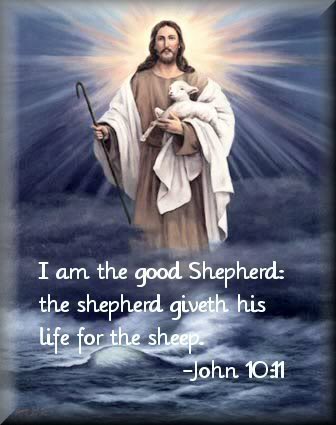
Jesus, The Good Shepherd ~ The Rev. Lady Sherwood, OPI
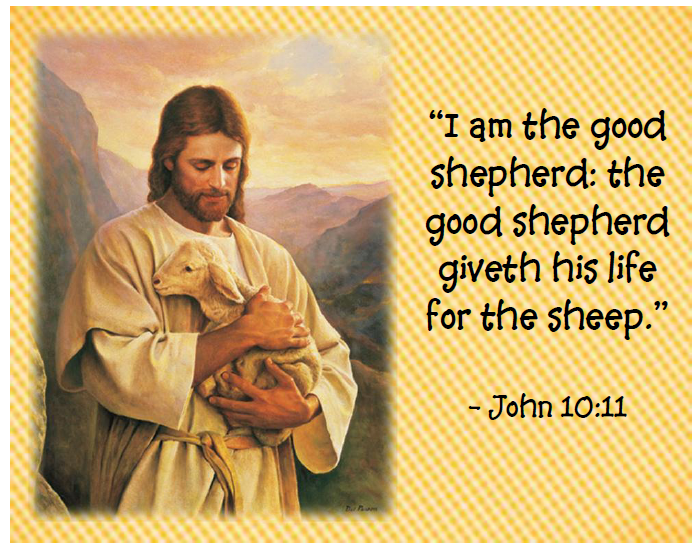 Good Shepherding is all about feeding the lambs and the sheep, bringing them together in good pastures. It is about making sure they have enough water, and that when needed the sheep are groomed, clipped and sheared. It is about delivering new lambs, and leading the sheep. It is about going to find them when they wander and returning them to the fold. It is about protecting the sheep from danger. Our Lord Jesus is the Good Shepherd and we as his people are his sheep. Just like sheep, we need feeding. Our Lord feeds and nourishes us by the true word in the Holy Scriptures. We are given water by baptism into the Holy Spirit.
The Lord grooms us by keeping us clean and free from the contamination of the world through his forgiveness of sins for all who truly love and believe in him. When we need it, we are sheared by discipline. He encourages and rebukes us so to prepare us more fully for eternal life with him. The Lord delivers new lambs as we are born again in newness of life in him. The Lord protects us and saves us from sin, the evil of the devil and from death. A Good Shepherd will lay down his life for his sheep just as the Lord Jesus willingly came to earth, was made man and willingly suffered death by being crucified on our behalf so that our sins would be forgiven and we could have the chance of eternal life in him. (JN 10: 11)-I am the good shepherd. A good shepherd lays down his life for his sheep.
Let us thank the Lord with all our hearts for Him being the Good Shepherd, who loves each and every one of us, even though we are not worthy.
The Feast of St. Mark the Evangelist ~ Sr. Dollie Wilkinson, OPI
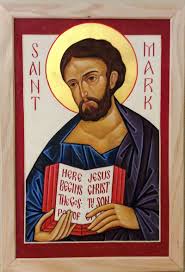
Saint Mark
Feast Day-April 25
The greatest invention since the dawn of civilization has to be the printing press, since it made possible the reproduction and distribution of our most Holy Bible, to every living soul in the world. Prior to the development of print, the Bible had been accessible only in the cumbersome handwritten copies found primarily in houses of worship. It is just as sacred today in its ubiquitous form as it was in its sparsely circulated script form nearly two thousand years ago, not only because it is the everlasting truth of the word of God, but also because it is literary art, written by dedicated men of God, one of whom was St. Mark, author of the book of the New Testament which bears his name.
St. Mark the apostle, was born in Cyrene (one of the five Western cities, Pentapolis, in North Africa). His father’s name was Aristopolus, His mother’s name was Mary and he was a kinsman of the Apostle Barnabas. They were, Jewish in faith, rich and of great honor. They educated him with the Greek and Hebrew cultures. He was called Mark after they immigrated to Jerusalem, where St. Peter had become a disciple of Jesus Christ. St. Peter was married to the cousin of Aristopolus. Mark visited St. Peter’s house often, and from him he learned the Christian teachings. His house was the first Christian church, where they ate the Passover, hid after the death of the Lord Christ, and in its upper room the Holy Spirit came upon them.
The book of Acts mentions a Mark, or John Mark, a kinsman of Barnabas (Col 4:10). The house of his mother Mary was a meeting place for Christians in Jerusalem (Acts 12:12). When Paul and Barnabas, who had been in Antioch, came to Jerusalem, they brought Mark back to Antioch with them (12:25), and he accompanied them on their first missionary journey (13:5), but left them prematurely and returned to Jerusalem (13:13). When Paul and Barnabas were about to set out on a second missionary journey, Barnabas proposed to take Mark, but Paul thought him unreliable, so that eventually Barnabas made one journey taking Mark, and Paul another journey taking Silas (15:36-40). Mark is not mentioned again in Acts. However, it appears that he became more reliable, for Paul mentions him as a trusted assistant in Colossians 4:10 and again in 2 Timothy 4:11.
The Apostle Peter had a co-worker whom he refers to as “my son Mark” (1 Peter 5:13). Papias, an early second century writer, in describing the origins of the Gospels, tells us that Mark was the “interpreter” of Peter, and that he wrote down (“but not in order”) the stories that he had heard Peter tell in his preaching about the life and teachings of Jesus.
The Gospel of Mark, in describing the arrest of Jesus (14:51f), speaks of a young man who followed the arresting party, wearing only a linen cloth wrapped around his body, whom the arresting party tried to seize, but who left the cloth in their hands and fled naked. It is speculated that this young man was the writer himself, since the detail is hardly worth mentioning if he were not.
Tradition has it that after the death of Peter, Mark left Rome and went to preach in Alexandria, Egypt, where he was eventually martyred. When he entered the city, his shoe was torn because of the amount he had walked during his preaching and evangelism. He went to a cobbler in the city, called Anianus, to repair it. While Anianus was repairing the shoe, the awl pierced his finger. Anianus shouted in Greek saying “Eis Theos!” which means “O, one God!” When St. Mark heard these words his heart rejoiced exceedingly. He found it suitable to talk to him about the one God. The apostle took some clay, spat on it, and applied it to Anianus’ finger, saying “in the Name of Jesus Christ the Son of God,” and the wound healed immediately, as if nothing had happened to it.
Anianus was exceedingly amazed by this miracle that happened in the name of Jesus Christ, and his heart opened to the word of God. The apostle asked him about who was the only God that he cried for when he was injured. Anianus replied “I heard about him, but I do not know him.” St. Mark started explaining to him from the beginning, from the creation of heaven and earth all the way to the prophecies that foretold the coming of Christ. Anianus then invited him to go to his house and brought to him his children. The saint preached and baptized them.
When the believers in the name of Christ increased and the pagan people of the city heard of it, they were enraged and thought of slaying St. Mark. The faithful advised him to leave for a short while, for the sake of the safety of the church and its care. St. Mark ordained St. Anianus as bishop of Alexandria as well as three priests and seven deacons. He went to the five Western cities, and remained there for two years preaching, where he ordained more bishops, priests, and deacons. Finally he returned to Alexandria, where he found the believers had increased in number, and built a church for them in the place known as Bokalia (the place of cows), east of Alexandria on the sea shore.
It came to pass when he was celebrating the feast of the Resurrection in the year 68 A.D. that the same day coincided with the great pagan celebration for the feast of the god Syrabis. Thus a multitude of pagans assembled, attacked the church at Bokalia, and forced their way in. They seized St. Mark, bound him with a thick rope, and dragged him through the streets crying, “Drag the dragon to the place of cows.” They continued dragging him with severe cruelty. His flesh was torn and scattered everywhere, and the ground of the city was covered with his blood. They cast him that night into a dark prison.
The angel of the Lord appeared to him and told him: “O Mark, the good servant, rejoice, for your name has been written in the book of life, and you have been counted among the congregation of the saints.” The angel disappeared, then the Lord Christ appeared to him and gave him peace. His soul rejoiced and was glad. The next morning, the pagans took St. Mark from the prison. They tied his neck with a thick rope and did the same as the day before, dragging him over the rocks and stones. Finally, St. Mark delivered up his pure soul into the hands of God and received the crown of martyrdom. Nevertheless, St. Mark’s death did not satisfy the rage of the pagans. They gathered much firewood and prepared an inferno to burn him. But a severe storm blew in, and heavy rains fell. The pagans became frightened and fled in fear.
The believers came and took the holy body, carried it to the church at Bokalia, wrapped it up, prayed over the saint, and placed him in a coffin. They laid the coffin in a secret place in this church. In 828 A.D. the body of St. Mark was stolen by Italian sailors and was removed from Alexandria to Venice in Italy. However, the head remained in Alexandria.
Many different miracles are attributed to Saint Mark. One that relates to Mark’s patronage of lions happened when Mark and his father Aristopolus were walking near the Jordan River and encountered a male and female lion who eyed them with hunger and seemed about to attack them. Mark prayed in Jesus’ name that the lions wouldn’t harm them, and immediately after his prayer, the lions fell down dead. Mark’s symbol in art is a Lion, usually winged. In the book of Revelation, the visionary sees about the throne of God four winged creatures: a lion, an ox, a man, and an eagle. It has customarily been supposed that these represent the four Gospels, or the four Evangelists (Gospel-writers).
PRAYER (traditional language)
Almighty God, who by the hand of Mark the evangelist hast given To thy Church the Gospel of Jesus Christ the Son of God: We thank thee for this witness, and pray that we may be firmly grounded in its truth; through the same Jesus Christ our Lord, who liveth and reigneth with thee and the Holy Spirit, one God, for ever and ever. Amen
An historical event:
On the 17th of Baounah (Coptic month), of the year 1684 A.M. (Coptic calendar), which was Monday, June 24, 1968 A.D., and in the tenth year of the papacy of Pope Kyrillos the Sixth, 116th Pope of Alexandria, the relics of St. Mark the Apostle, the Evangelist of the Egyptian land and the first Patriarch of Alexandria, were returned to Egypt. After eleven centuries outside Egypt, St. Mark’s body has at last returned to the same country (Cairo, Egypt) where he was martyred, and where his head is preserved to this day in the city of Alexandria, Egypt.
Pope Kyrillos had sent an official delegation to travel to Rome to receive the relics of St. Mark the Apostle from the Roman Catholic Pope Paul VI. The papal delegation consisted of ten metropolitans and bishops, seven of whom were Coptic and three Ethiopians, and three of the prominent Coptic, lay leaders. The Alexandrian delegation received the relics of St. Mark the Apostle on Saturday,June 22, 1968 A.D., from Pope Paul VI. The moment of handing over the holy relics, after eleven centuries, during which the body of St. Mark was kept in the city of Venice, Italy, was a solemn and joyful moment.
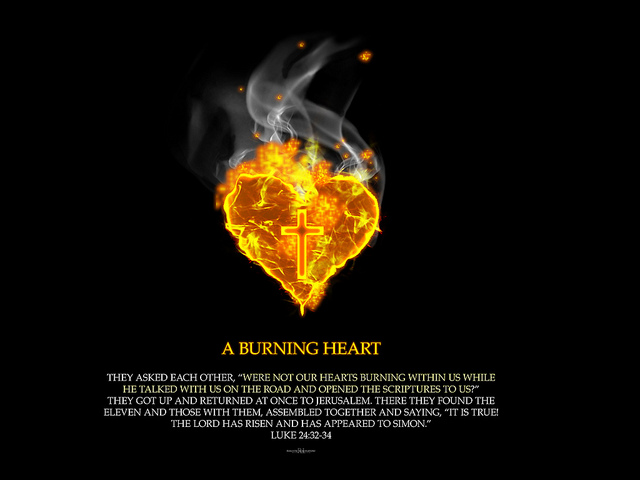
Heartburn? ~ Br. Chip Noon, Novice

“Were not our hearts burning [within us] while he spoke to us on the way and opened the scriptures to us?”
Were not our hearts burning?…to me these are some of the most comforting words in all of the Bible. Were not our hearts burning? The intimations of immortality that each of us experience in our lives, if we are lucky, the knowledge that, yes, indeed He is Risen.
Poets have felt this, and perhaps unknowingly, set it to paper, this feeling that there is a truth and a comfort deep within us waiting for the right word, the right gesture, to bring us into the light. Wordsworth wrote:
O joy! that in our embers
Is something that doth live,
That nature yet remembers
What was so fugitive!
Yet we read, as the father of the stricken boy in Mark says to Jesus, “Lord, I believe; help thou mine unbelief.” And even here, in acknowledging doubt and the fear of having no faith at all, don’t we find the slightest light still burning? An ember never extinguished that will always be glowing deep within us – the promise of immortality shown us by Jesus?
In today’s reading from Acts, Peter goes even further and, teaching the people the Good News, reveals his own faith and even the small saving words “Now I know, brothers, that you acted out of ignorance….” Even here, we see the glow of salvation fanned by the Apostle and offered to the people. All he asked them to do was repent, as John in today’s second reading urges us to do as well: “The way we may be sure that we know him is to keep his commandments.”
And what are those commandments? The 10 Moses brought down from the mountain? The Laws in Leviticus? The observance of the rituals of piety?
Jesus gave us two commandments: “Love the Lord your God with all your heart and with all your soul and with all your strength and with all your mind’; and, ‘Love your neighbor as yourself.”
Two commandments. His task is easy and his burden is light. Love God and Love Your Neighbor.
Love God. Love Your Neighbor.
Don’t those words make your hearts burn within you? Don’t those words explain all the laws and the prophets found in the scriptures? Don’t those words release from you your unbelief and bring you boundless joy? This is the meaning of the teachings on this Third Sunday of Easter: that Jesus has suffered and died for us so that we might have eternal life. All we need to do is acclaim this through our Love of God and Love of Our Neighbor.
Lord, we come before you willing, longing for your peace this Easter Season. We trust that as we walk our own paths to Emmaus, you will teach us to love, and that you will help our unbelief. Amen.
Reference Scriptures:
Reading 1ACTS 3:13-15, 17-19
“The God of Abraham,
the God of Isaac, and the God of Jacob,
the God of our fathers, has glorified his servant Jesus,
whom you handed over and denied in Pilate’s presence
when he had decided to release him.
You denied the Holy and Righteous One
and asked that a murderer be released to you.
The author of life you put to death,
but God raised him from the dead; of this we are witnesses.
Now I know, brothers,
that you acted out of ignorance, just as your leaders did;
but God has thus brought to fulfillment
what he had announced beforehand
through the mouth of all the prophets,
that his Christ would suffer.
Repent, therefore, and be converted, that your sins may be wiped away.”
Reading 21 JN 2:1-5A
so that you may not commit sin.
But if anyone does sin, we have an Advocate with the Father,
Jesus Christ the righteous one.
He is expiation for our sins,
and not for our sins only but for those of the whole world.
The way we may be sure that we know him is to keep
his commandments.
Those who say, “I know him,” but do not keep his commandments
are liars, and the truth is not in them.
But whoever keeps his word,
the love of God is truly perfected in him.
GospelLK 24:35-48
The two disciples recounted what had taken place on the way,
and how Jesus was made known to them
in the breaking of bread.
While they were still speaking about this,
he stood in their midst and said to them,
“Peace be with you.”
But they were startled and terrified
and thought that they were seeing a ghost.
Then he said to them, “Why are you troubled?
And why do questions arise in your hearts?
Look at my hands and my feet, that it is I myself.
Touch me and see, because a ghost does not have flesh and bones
as you can see I have.”
And as he said this,
he showed them his hands and his feet.
While they were still incredulous for joy and were amazed,
he asked them, “Have you anything here to eat?”
They gave him a piece of baked fish;
he took it and ate it in front of them.
He said to them,
“These are my words that I spoke to you while I was still with you,
that everything written about me in the law of Moses
and in the prophets and psalms must be fulfilled.”
Then he opened their minds to understand the Scriptures.
And he said to them,
“Thus it is written that the Christ would suffer
and rise from the dead on the third day
and that repentance, for the forgiveness of sins,
would be preached in his name
to all the nations, beginning from Jerusalem.
You are witnesses of these things.”
Ya Gotta Have Faith!!! ~ Br. Dominic Ferrante, Novice
On the evening of that first day of the week, when the doors were locked, where the disciples were, for fear of the Jews,
Jesus came and stood in their midst and said to them, “Peace be with you.”
When he had said this, he showed them his hands and his side. The disciples rejoiced when they saw the Lord.
Jesus said to them again, “Peace be with you. As the Father has sent me, so I send you.”
And when he had said this, he breathed on them and said to them, “Receive the Holy Spirit.
Whose sins you forgive are forgiven them, and whose sins you retain are retained.”
Thomas, called Didymus, one of the Twelve, was not with them when Jesus came.
So the other disciples said to him, “We have seen the Lord.”
But he said to them, “Unless I see the mark of the nails in his hands and put my finger into the nailmarks
and put my hand into his side, I will not believe.”
Now a week later his disciples were again inside and Thomas was with them.
Jesus came, although the doors were locked, and stood in their midst and said, “Peace be with you.”
Then he said to Thomas, “Put your finger here and see my hands, and bring your hand and put it into my side,
and do not be unbelieving, but believe.”
Thomas answered and said to him, “My Lord and my God!”
Jesus said to him, “Have you come to believe because you have seen me? Blessed are those who have not seen and have believed.”
Now Jesus did many other signs in the presence of his disciples that are not written in this book.
But these are written that you may come to believe that Jesus is the Christ, the Son of God,
and that through this belief you may have life in his name. John 20:19-31
What is faith? Some people define it as belief without proof. Almost everyone, if you ask them will say they have faith in different things, whether it be Christ, a loved one, or even something as silly as a sports team. But what does it mean to truly have faith? While I was living alone in Ohio I always had faith that God would reunite me with my family. My faith may have wavered sometimes, but I truly did believe that God would provide and I took comfort in that.
In today’ s Gospel, Christ appears before the disciples, except for Thomas, who wasnt’ around. He proclaims to them peace be with you. Naturally the disciples are overjoyed to see their Lord and receive the Holy Spirit from him. After Jesus left and Thomas had returned, the disciples eagerly told him what happened; yet he refused to believe, stating he needed proof before he could accept this.
We could ask ourselves why couldn’t Thomas believe these men? Men he had lived with, traveled with, and became as close as brothers to? He needed proof he said. This shows an astonishing lack of faith on his behalf. After Christ appeared to him and he was shown proof, his faith was restored. Christ said, “You believe because you’ve seen, blessed are those who believe without seeing.”
There are times when our faith is sometimes overshadowed by doubt . Doubt makes things easy for us, it lets us second guess ourselves and leads us to easier choices than faith often does, even when those choices are not really in our best interests. Our faith in Christ must be unshakable. We must believe in His glory without having to have the burden of proof. Faith leads us down the path of salvation and to eternal life. Faith keeps us close to God and helps us to lead the life he has chosen for us.
So how do we as Christians keep unwavering faith amidst the challenges we face in the modern world? Financial trouble, sickness, tragedy, and an increase in inhumanity amongst the people of the world all pose serious challenges to one’s faith.
Ask God for more faith. Jesus instructed His disciples to ask, seek and to knock (Matthew 7:7–12). James offers the same advice (James 1:5). This is why the disciples asked Jesus to increase their faith. We can do the same. Pray earnestly about this.
Prove what you believe. Follow Paul’s admonition (1 Thessalonians 5:21) and prove that God exists, that the Bible is His inspired word, where the true Church is and who are God’s true ministers. Prove what the Bible actually says, and hold fast to what you prove to be the truth.
Study what the Bible reveals about faith. Read and meditate on the examples of faith described in Hebrews 11. Read the original accounts in the Old Testament.Determine what lessons you can draw from these accounts. Learn and grow.
Stir up God’s Spirit. Faith is a gift of the Holy Spirit. God gives His Spirit to those who repent and obey Him. Pray, study, meditate and fast regularly. Nourish and use God’s Spirit. Doubts will disappear as our faith grows (2 Timothy 1:6–7).
Live by faith. Put into practice what you read in the Scriptures. Trust God and His Word. If the Bible says to do it, then do it—don’t argue with the Scriptures. The American writer, Ralph Waldo Emerson stated, “We live by faith or we do not live at all. Either we venture or we vegetate. If we venture, we do so by faith simply because we cannot know the end of anything at its beginning. We risk marriage or we stay single. We prepare for a profession by faith or we give up before we start. By faith we move mountains of opposition or we are stopped by mole hills.”
Endure trials that will arise as you strive to live by every word of God. Enduring and overcoming the trials will help us build both faith and patience (James 1:2–4). It has been said, “If we desire to increase faith we must consent to its testing.” Remember that God has promised to get us through the trials (1 Corinthians 10:13) and the trials He allows are for our ultimate good (Romans 8:28).
Don’t compromise or deny the true faith. The Bible warns repeatedly about false teachers who will undermine and overthrow the faith of others by promoting misleading doctrines and ideas. We are also told many will depart from or discard the true faith. However, the Scriptures clearly state there is one faith and one body [church], and it is the job of the ministry to promote the unity of the faith (Ephesians 4:4–6, 12–13). The role of the church is to maintain true doctrines (1 Timothy 3:15–16, see also Acts 15). This is why it is so important to know where God’s true Church is today and what the Bible actually says. The Scriptures are not to be interpreted as each individual sees fit in his or her own mind (2 Peter 1:20). This only leads to confusion, which damages and destroys faith. As we approach the end of this age and Satan increases his attacks on true believers, we will have to “contend earnestly for the faith which was once and for all delivered to the saints” (Jude :3).
Faith is important to God. Faithfulness is as important in our physical life as it is for our eternal life. As the apostle Paul saw the end of his life approaching he concluded, “I have fought the good fight, I have finished the race, I have kept the faith” (2 Timothy 4:7–8). He knew—he had faith and total confidence—his reward awaited him. The God of this universe has big things in store for all mankind—especially for those He is calling to be His firstfruits—those who learn now to trust Him. Let’s make a diligent effort to grow in faith. Let’s hold on faithfully to the Truth God has revealed to His Church. Let’s strive to build an atmosphere of faith in the Living Church of God—so when Jesus Christ returns He will find real faith in those He has called.
So do not be a doubting Thomas keep your faith strong, and the Lord will provide for you. As our Savior told the disciples in the Garden of Gethsemene, watch and pray that ye might not be deceived. Reading and studying the Gospel gives us a solid foundation to build our faith upon. Remembering that God is with us at all times, even the dark ones, will help us to live and rejoice in the Glory of the Father. By attending mass and listening to what our wonderful clergy says is also an invaluable resource for us to infuse new vitality to our faith. Remember, keeping foremost in your mind: Ya gotta have faith!!!
He’s Alive!!! Really???

The gates and doors were barred
And all the windows fastened down
I spent the night in sleeplessness
And rose at every sound
Half in hope of sorrow
And half in fear the day
Would find the soldiers breakin’ through
To drag us all away
And just before the sunrise
I heard something at the wall
The gate began to rattle
And a voice began to call
I hurried to the window
Looked down into the street
Expecting swords and torches
And the sound of soldiers’ feet
But there was no one there but Mary
So I went down to let her in
John stood there beside me
As she told me where she’d been
She said they’ve moved Him in the night
And none of us know where
The stone’s been rolled away
And now His body isn’t there
We both ran towards the garden
Then John ran on ahead
We found the stone and empty tomb
Just the way that Mary said
But the winding sheet they wrapped Him in
Was just an empty shell
And how or where they’d taken Him
Was more than I could tell
Oh something strange had happened there
Just what I did not know
John believed a miracle
But I just turned to go
Circumstance and speculation
Couldn’t lift me very high
‘Cause I’d seen them crucify Him
Then I saw Him die
Back inside the house again
The guilt and anguish came
Everything I’d promised Him
Just added to my shame
When at last it came to choices
I denied I knew His name
And even if He was alive
It wouldn’t be the same
But suddenly the air was filled
With a strange and sweet perfume
Light that came from everywhere
Drove shadows from the room
And Jesus stood before me
With His arms held open wide
And I fell down on my knees
And I just clung to Him and cried
Then He raised me to my feet
And as I looked into His eyes
The love was shining out from Him
Like sunlight from the skies
Guilt in my confusion
Disappeared in sweet release
And every fear I ever had
Just melted into peace
He’s alive yes He’s alive
Yes He’s alive and I’m forgiven
Heaven’s gates are open wide
He’s alive yes He’s alive
Oh He’s alive and I’m forgiven
Heaven’s gates are open wide
He’s alive He’s alive
Hallelujah He’s alive
He’s alive and I’m forgiven
Heaven’s gates are open wide
He’s alive He’s alive He’s alive
I believe it He’s alive
Sweet Jesus
(words and music by Dolly Parton)
He’s Alive!!!!
Really? Is he? How can we prove this to the world? In what way do our lives reflect this? It is so easy for us to celebrate Easter, with all the accompanying fanfare, the music, the bunnies and chicks and eggs and ham….. We dress up in our best, go to church, and celebrate. And then what happens on Monday? We talk about how nice Easter was and go back to business as usual.
If Christ is alive as we proclaim he is, if Christ rose again from the grave to save us from our sins, to change our lives, then should our lives not reflect a profound change? One that is visible to all with whom we come into contact?
If Jesus Christ is the very God we claim, come in the flesh of humanity, if He is the Lord “through Whom all things were made,” as we recite in the Nicene Creed, it is up to us to proclaim this with all that we are, with all that we do. Think about those whom Jesus had following Him: sailors, insurgents, tax-farmers, prostitutes, widows, lepers, and, on occasion wealthy folks. Rulers, workers, and the dregs of society. Young and old. Their lives were changed in such a drastic measure that they died for their faith. Many of them left all that they had, the security of their homes, their jobs, their families, to follow Jesus. Would you? Our Christian brothers and sisters are under attack in the Mid East, in the Philippines, in Africa. Many of them have died in order to proclaim their faith. Would you do as much? Would you die for Christ?
If then, the answer is yes, would you not LIVE for Christ? You say to me, “Bishop Michael, how do you expect us to do that?” The answer to that was given to us by our Lord, Himself:
“As I have loved you, love one another.” He lived out the ultimate example of what this means. Then he said, “No greater love hath any man than this, that he lay down his life for his friends.” Then He did just that. But it was not only to save us from our sins, though it was most assuredly that. It was the sign, the seal, that proved He was Who He said He was and that His word was true.
If He really is risen, then we have an obligation one to another to serve our fellow man as He served us. And we have an obligation to share this Good News with our fellow man. We have to make the blessings we have gained available to every human. And we have an obligation to show that there really is truth to the old song, “And they’ll know we are Christians by our love, by our love. And they’ll know we are Christians by our love.” We have an obligation or reflect Christ’s goodness, His holiness, in our lives. By our speech, by our actions, by our very thoughts.
He is alive! Let us allow Him to live anew through our lives, reflecting His love and His promise in all that we do, in all that we say, in all that we are. He is alive!!!!! Amen.
 The Order of Preachers, Independent
You must be logged in to post a comment.