
Category: Member Posts
Good Sheep and Baaahd Goats???
Ezekiel 34:11-16, 20-24
34:11 For thus says the Lord GOD: I myself will search for my sheep, and will seek them out. 12 As shepherds seek out their flocks when they are among their scattered sheep, so I will seek out my sheep. I will rescue them from all the places to which they have been scattered on a day of clouds and thick darkness. 13 I will bring them out from the peoples and gather them from the countries, and will bring them into their own land; and I will feed them on the mountains of Israel, by the watercourses, and in all the inhabited parts of the land. 14 I will feed them with good pasture, and the mountain heights of Israel shall be their pasture; there they shall lie down in good grazing land, and they shall feed on rich pasture on the mountains of Israel. 15 I myself will be the shepherd of my sheep, and I will make them lie down, says the Lord GOD. 16 I will seek the lost, and I will bring back the strayed, and I will bind up the injured, and I will strengthen the weak, but the fat and the strong I will destroy. I will feed them with justice. 20 Therefore, thus says the Lord GOD to them: I myself will judge between the fat sheep and the lean sheep. 21 Because you pushed with flank and shoulder, and butted at all the weak animals with your horns until you scattered them far and wide, 22 I will save my flock, and they shall no longer be ravaged; and I will judge between sheep and sheep. 23 I will set up over them one shepherd, my servant David, and he shall feed them: he shall feed them and be their shepherd.
24 And I, the LORD, will be their God, and my servant David shall be prince among them; I, the LORD, have spoken.
Psalm 95:1-7a
95:1 O come, let us sing to the LORD; let us make a joyful noise to the rock of our salvation! 2 Let us come into his presence with thanksgiving; let us make a joyful noise to him with songs of praise! 3 For the LORD is a great God, and a great King above all gods. 4 In his hand are the depths of the earth; the heights of the mountains are his also. 5 The sea is his, for he made it, and the dry land, which his hands have formed. 6 O come, let us worship and bow down, let us kneel before the LORD, our Maker! 7a For he is our God, and we are the people of his pasture, and the sheep of his hand.
Ephesians 1:15-23
1:15 I have heard of your faith in the Lord Jesus and your love toward all the saints, and for this reason 16 I do not cease to give thanks for you as I remember you in my prayers. 17 I pray that the God of our Lord Jesus Christ, the Father of glory, may give you a spirit of wisdom and revelation as you come to know him, 18 so that, with the eyes of your heart enlightened, you may know what is the hope to which he has called you, what are the riches of his glorious inheritance among the saints, 19 and what is the immeasurable greatness of his power for us who believe, according to the working of his great power. 20 God put this power to work in Christ when he raised him from the dead and seated him at his right hand in the heavenly places, 21 far above all rule and authority and power and dominion, and above every name that is named, not only in this age but also in the age to come. 22 And he has put all things under his feet and has made him the head over all things for the church, 23 which is his body, the fullness of him who fills all in all.
Matthew 25:31-46
25:31 “When the Son of Man comes in his glory, and all the angels with him, then he will sit on the throne of his glory. 32 All the nations will be gathered before him, and he will separate people one from another as a shepherd separates the sheep from the goats, 33 and he will put the sheep at his right hand and the goats at the left. 34 Then the king will say to those at his right hand, ‘Come, you that are blessed by my Father, inherit the kingdom prepared for you from the foundation of the world; 35 for I was hungry and you gave me food, I was thirsty and you gave me something to drink, I was a stranger and you welcomed me, 36 I was naked and you gave me clothing, I was sick and you took care of me, I was in prison and you visited me.’ 37 Then the righteous will answer him, ‘Lord, when was it that we saw you hungry and gave you food, or thirsty and gave you something to drink? 38 And when was it that we saw you a stranger and welcomed you, or naked and gave you clothing? 39 And when was it that we saw you sick or in prison and visited you?’ 40 And the king will answer them, ‘Truly I tell you, just as you did it to one of the least of these who are members of my family, you did it to me.’ 41 Then he will say to those at his left hand, ‘You that are accursed, depart from me into the eternal fire prepared for the devil and his angels; 42 for I was hungry and you gave me no food, I was thirsty and you gave me nothing to drink, 43 I was a stranger and you did not welcome me, naked and you did not give me clothing, sick and in prison and you did not visit me.’ 44 Then they also will answer, ‘Lord, when was it that we saw you hungry or thirsty or a stranger or naked or sick or in prison, and did not take care of you?’ 45 Then he will answer them, ‘Truly I tell you, just as you did not do it to one of the least of these, you did not do it to me.’ 46 And these will go away into eternal punishment, but the righteous into eternal life.”
What a lot of sheep in the scriptures for today! In spite of what many people think, West Virginia is not made up totally of backwoods hillbillies who have farm animals running in and out of their houses. In fact, West Virginia DOES have some major metropolitan areas. I’ve lived in one of those metropolitan areas my entire life. It is for that reason I never really “got” the parable of the sheep and the goats. Yes, I was in 4-H, and no, I didn’t raise any kind of critter for the County Fair. The amount of knowledge I have about most farm animals comes to me second hand from reading books and watching television. I have no experience with sheep or goats, and what I know about them could really fit into a thimble.
I know that we get wool from sheep, and some people get milk from goats. Female sheep are called ewes, male sheep are rams, and baby sheep are lambs and are cute. Lambs show up on cue in the spring around Easter time, and Jesus is the Lamb of God. One serves mint jelly when serving lamb. When someone is called a “lamb” it is considered to be a compliment. Goats have horns and beards and are said to be stubborn. A female goat is a nanny, a male a buck, and a baby a kid. Sheep and goats can mate and produce (usually sterile) offspring. There are pigmy goats (cute too), and fainting goats (weird.) Sheep and goats are often in the same fields and herds, being watched by a shepherd.
Because of my lack of knowledge of animal husbandry, I had to do some research when commenting on the scriptures appointed for Christ the King Sunday. From my childhood on, it has always seemed to me that the goats in the Scriptures got the raw end of the deal, and I wanted to find out just why this is. I mean, what’s wrong with the goats? This is what I learned:
Sheep are gentle, quiet, animals and do not give their shepherds a lot of problems. They are not aggressive; they are very docile animals. The word “docile” as described in the Webster’s dictionary means, “easily managed or handled, readily trained or taught.” Sheep love to follow the shepherd, and can often be quite affectionate.
Goats, on the other hand, tend to be more independent, are rather aggressive and quarrelsome, and goats are pushy, self-sufficient, and headstrong. They rear and butt in order to establish dominance. Goats will easily revert back to their wild conditions if given the chance. Goats are naturally smelly animals.
Overall, a goat’s reputation is less than positive. Even goat metaphors are negative. For instance, “Look at the old goat” refers to an old fool or dirty old man. “You get my goat!” applies to a person who irritates another. The nursery rhyme, “Mary had a little lamb, its fleece was white as snow; and everywhere that Mary went, the lamb was sure to go” gives a positive view of the little lamb, but when the gypsy girl, Esmeralda, in The Hunchback of Notre Dame, has a pet goat that performs tricks, the people want to hang the girl because they presume she’s using witchcraft. The Jewish Heritage Online magazine reports: While goat’s milk was reported to have some medicinal benefits, goats were regarded as “armed robbers who would jump over people’s fences and destroy their plants.” The ancient rabbis were said to have told this story:
There was once a certain pious person who suffered from heart trouble, and the physicians said the only hope for his recovery was for him to drink warm milk every morning. A cow was not available to this fellow but his family was able to come up with a goat. After some days the sick man’s colleagues came to visit him, but as soon as they noticed the goat they turned back and said: An armed robber is at the house of this man, how can we come to see him? They then sat down and inquired into their friend’s conduct, but they did not find any fault in him except this sin of the goat….
Anyway you look at it; goats tend to be seen in a negative way.
So what about the shepherd? The shepherd is the man or woman who takes care of the sheep and goats. It’s that simple, and even I knew that. Christ as shepherd is a pretty easy analogy to understand. We are his flock and he takes care of us. What I didn’t realize or know is that the analogy runs deep in the literature of the ancient world. In Mesopotamia, the region along the Tigris and Euphrates rivers, the model for kings was the shepherd. The king-as-shepherd was to “rule kindly, counsel and protect the people,” and “guide them through every difficulty.” Babylon’s Hammurabi, credited with the world’s first written law code, was described as a shepherd of his people. In ancient Egypt, the shepherd’s crook was used “as an insignia of kings, princes, and chieftains.” In the Iliad and the Odyssey from ancient Greece, ship captains are called “shepherds of ships.” Plato uses the shepherd analogy to define justice in the Republic, and in the “Statesman” uses the shepherd to symbolize the work of a good ruler. And of course today, the shepherd’s crook is a symbol of our bishops, representing them as the shepherds of Christ’s flocks.
Having learned all of this, what then, does the parable of the sheep and the goats mean for us? How do we apply this to our lives? Remember, all the nations are gathered before the judge, before the throne of the Son of Man, before the King, THE Shepherd, and the Shepherd separates them
– the right from the left, the sheep from the goats,
and he judges them
– and those on the right are saved, and those on the left are
condemned.
The judgment is made on the basis of the compassion, the love, or the
lack of it, that is shown by those who are gathered before the throne of judgment.
“I was hungry and you gave me food, I was thirsty and you gave me drink, I was a stranger and you took me in” the Son of Man tells those on his right. To those on his left he says the exact opposite. “I was naked” he tells them, “and you did not give me clothing, I was sick and in prison and you did not visit me.”
Awesome words these. Words of great clarity. Words with a powerful message for those who have ears to hear it.
Yet, in the end, despite our knowledge of the story and of its message, the message about the vital importance of our acts of sharing and caring, especially with those who are numbered among the least of us – the poor, the hungry, the imprisoned, despite our knowledge of this parable there are elements to it that are not often talked about, or if talked about which are glossed over.
I speak of course, about the surprise expressed by the sheep and the goats when they hear the Son of Man say – “I was hungry and you fed me. I was thirsty and you gave me drink.” or “I was naked and you did not clothe me” and “I was in prison and you did not visit me”
Why is that? Why are they surprised?
What is it that both the sheep and the goats seem to be missing when they perform their good works – or when they fail to?
I think that they are missing a sense of how the sacred penetrates and is interwoven in the ordinary – indeed in the less than the ordinary, in those places – those persons – that we might consider far from holy – far from being a part of Christ, much less Christ embodied.
Remember the words that Jesus uses.
He doesn’t talk about how blessed are we when we visit our friends who are sick, or how wonderful it is when we give good things to our family members and our fellow believers, or how nice it is when we clothe the folks who are just like us.
No. Jesus talks about the least among us – the least within this world, those whom conventional wisdom might even regard as accursed,
– the poor,
– the thirsty,
– the sick in the wards and in the deserts and jungle floors,
-those who are in prison
– perhaps sex offenders
– perhaps murderers
– perhaps only those who have stolen so that their families may eat.
We don’t know. But we do know that they are the least amongst us. Those persons whom we might think don’t count. Those people whose opinions we might regard as unimportant or invalid, because of their age – or their sex, their gender identity, their socio-economic status, educational level, or sexual orientation. Those people whose cries we might ignore because of their race.
And that the Son of Man, that Jesus the Christ, claims to be among them – indeed IN them. And that is surprising is it not – at least to most of us? In fact, it might even be considered to be outrageous.
There is no question raised in this parable of what creed either the sheep or the goats had believed; or whether they had sworn allegiance to one whom the Bible calls the Son of Man – the Good Shepherd – the King of Kings and the Lord of Lords.
There is only the surprise that this exalted one – who is – in fact – Christ Jesus himself – has been present in every person they had ever met, and most especially, in the needy ones and the least important ones – the ones that Jesus calls “the least.”
And that judgment is based on whether we treat this king, this son of man, present in these the least, well; or ignore him in his suffering and his want and his need.
That is – to say the least – a bit disconcerting. We sometimes think that religion is about believing “stuff”, and that if we believe the right “stuff” we are safe.
But it seems not to be so. Rather our faith seems to be about awareness,
about having our eyes opened to the real world, and responding compassionately to it. Whether or not we are “aware” that the Christ is there.
The parable is calling to us to see the Christ in the squalling child who is getting in our way, and to hear God in the voice of the beggars who so often come and sit with us on Sunday in their dirty and smelly clothes – waiting for a chance to get a free lunch. The parable is calling us to see the Christ in those who irritate us, who have done us wrong. In those whom we don’t particularly care for. The parable is alerting us to the importance of compassion and to the fact that the Son of Man is present in the needy of our world, that Christ is present in each and every human being with whom we come into contact, regardless of who they are, how they act, how they have treated us, or what they believe.
To encounter the least of the brothers and sisters of the Son of Man, however, we don’t need to go to Calcutta, or the Sudan or to one of the
overcrowded prisons in our land do we?? Aren’t there many who are marginalized, many whom we are regarded of little significance of not being equal to those close to us right here amongst us – here in our hometowns, in our parishes, or even in our own families?
Remember the first and the greatest commandment – the one about how we are to love God with all our heart, soul, strength and mind?
Consider what John the Divine, John the Apostle, the disciple of Christ says about that love in his First Letter. He writes in Chapter three, verse seventeen:
If anyone has material possessions and sees his brother in
need, but has no pity on him, how can the love of God be in
him?
and again in the 4th chapter, verses 20 and 21:
Anyone who does not love his brother, whom he has seen,
cannot love God, whom he has not seen. And he has given us
this command: Whoever loves God must also love his brother.
The sheep – those on the right – have shown love for their brothers and sisters, and in doing so they have shown love to God, and so they enter the kingdom prepared for them. Their faith is alive – even if they have not grasped the fullness of it. Even if they have not recognized how the Son of Man is everywhere about them. One might say the law has been written on their hearts and guided their actions, if not their thoughts and words.
But think of it. Think of the fullness of it. If our eyes were opened to the depth of the real world and not the shallow world of conventional wisdom, then we would see God present in everyone and everything, especially in the needy and the least important ones.
And that would be even more transforming, – not only for the sheep, for those who are doing good, and for those to whom they are showing the compassion of God, – but also for the goats, for those who may have the right creed and doctrine but who may have judged the least among us as not being deserving of their love and care, as not being people in whom the Holy One dwells.
What a priceless thing if the sheep are not surprised – by the presence of the Son of Man in everyone – and in joy remind those who may risk being judged as goats that all people are wonderfully made and all need to be treated as we would treat the Son of Man.
Provocative isn’t it? It raises a thousand questions in your minds I am sure.
How far should we go in our caring? Whom should we care for – and whom, if any, should we not care for? How can we prioritize our caring so that the truly needy get what they need while those who would suck us dry do not. Or should we even worry about that?
I can’t answer these questions for you. It is something that each of us needs to struggle with on a case-by-case, day by day basis.
But I can tell you that Christ is all around us. That Christ is in the least among us. In the single welfare mothers – and the AIDS patients, and in the prisoners in our jails and in the homeless upon our streets.
Think about this one last time with me. Think of it some 2000 years ago when the Son of Man – the one who is King of King and Lord of Lords, wandered as a poor preacher in a poor land, having no home to call his own, much less a throne of righteousness.
Think of when the Son of Man was tried for blasphemy and flogged 39 times as a common criminal and then was hung on a cross to die as one who was accursed. Think about how the Son of Man came among us – that first time – as we prepare for his coming with Advent starting next week. Think about the circumstances of his life and his death.
The prophet Isaiah, some 700 years before the birth of Christ puts it
this way:
He had no form or majesty that we should look at him,
nothing in his appearance that we should desire him. He was
despised and rejected by others; a man of suffering and
acquainted with infirmity; and as one from whom others hide
their faces he was despised – and we held him of no account.
Where is Christ to be found today? Where is the Son of Man? He is most certainly here among us, and in you my brothers and sisters. But he is also here in ways we do not so easily grasp.
I understand the surprise of those sheep on the right of the Son of Man – and of the goats on the left. I understand because it is so easy to not see him in those who are reckoned to be the least among us. I understand because I have some decisions to make.
Do I want to be a sheep or a goat? I most definitely want to be a sheep, and I can think I am a sheep, but literally act like a goat. Am I feeding the hungry? Giving drink to the thirsty? Taking in a stranger? Clothing the naked? Visiting the sick and imprisoned? Recognizing the Christ in every person? Respecting every person? Looking for the good in every person? If I am not, then who am I? Clearly the goat, not the sheep.
If we think we are sheep, we should be acting like sheep. We have all talked and talked about serving Christ in some way, but like goats we often have gone our own way, too caught up in our own needs and desires. The buck stops here (pun intended!)
As we celebrate Christ as King, and prepare for Christ’s coming during the season of Advent, the beginning of the liturgical year, let us make a new (liturgical) year’s resolution, to love and care for our fellow human beings, to treat every person with whom we come into contact with dignity and respect, to serve our Lord with gladness, to exorcise our individual goats, and to truly become the sheep of Christ’s pasture. Amen.

Show Me Thy Glory ~ The Rev. Dcn. Sr. Dollie Wilkinson, OPI
 Have you ever argued with your boss at work, demanding better pay or possibly better working conditions? If you are a parent, how many times has your child come to you, complaining about their chores, or maybe what they are having for dinner, or most definitely, asking why they cannot spend more time playing with friends? Or how many complaints do you imagine our President hears in a day? Well, this is what is happening here in Exodus 33:12-23. Moses had a difficult job assignment that he was given by the Lord. His duty was to lead a rebellious, self-centered, stubborn people through a desert to the promised land. To get this job accomplished, Moses needed a close relationship with the Lord. Now, when we come to chapter 33, Moses has just received the 10 Commandments and the Law from the Lord. He was gone for 40 days and nights while he received the Law’ and while he was away, the people made a golden calf, began to worship it as a god, and committed terrible sins of immorality. When Moses came down from the mountain, he saw what they were doing and threw down the stone tablets containing the Law and broke them. The Lord became angry with the people and He refused to go with them into Canaan, Exodus 33:1-3. Moses responded by reminding the Lord that the Israelites are God’s people and that if the Lord didn’t go with them, then Moses isn’t going either. So Moses and the Lord discuss the matter and God decides to go with them and to bring them into the land of promise.
“Moses said to the LORD, “See, you have said to me, ‘Bring up this people’; but you have not let me know whom you will send with me. Yet you have said, ‘I know you by name, and you have also found favor in my sight.’ Now if I have found favor in your sight, show me your ways, so that I may know you and find favor in your sight. Consider too that this nation is your people.” He said, “My presence will go with you, and I will give you rest.” And he said to Him, “If your presence will not go, do not carry us up from here. For how shall it be known that I have found favor in your sight, I and your people, unless you go with us? In this way, we shall be distinct, I and your people, from every people on the face of the earth.” The LORD said to Moses, “I will do the very thing that you have asked; for you have found favor in my sight, and I know you by name.” Moses said, “Show me your glory, I pray.” And He said, “I will make all my goodness pass before you, and will proclaim before you the name, ‘The LORD’; and I will be gracious to whom I will be gracious, and will show mercy on whom I will show mercy. But,” He said, “you cannot see my face; for no one shall see me and live.” And the LORD continued, “See, there is a place by me where you shall stand on the rock; and while my glory passes by I will put you in a cleft of the rock, and I will cover you with my hand until I have passed by; then I will take away my hand, and you shall see my back; but my face shall not be seen.””
When these things happened, it put Moses in a place of discouragement and doubt. He needed something from the Lord if he was to continue to lead these people, and so he asked the Lord to show him His glory. Moses has nerve, there is no doubt about it. He’s not afraid to use the Lord’s own words against Him. In effect, he is telling the Lord, “Look, you tell me, ‘Lead this people,’ but you don’t let me know whom you’re going to send with me. You tell me, ‘I know you well and you are special to me.’ If I am so special to you, let me in on your plans. That way, I will continue being special to you. Don’t forget, this is your people, your responsibility.” Pretty persuasive argument, don’t you think?!
As a parent, a boss, the President, or church leader, sometimes decisions need to be made that may not always go over well with those entrusted in our care. Of course, none of us have ever been given an assignment quite like the one Moses received, but we have been called to follow the Lord and to represent Him in this world. At times, this task becomes difficult and discouraging, and we need something from the Lord. Something we cannot do on our own, something that will recharge our spiritual batteries and that will rekindle the old flames of excitement and passion for the Lord. And once again, the Lord understood Moses’ plea, and sends him a sign of His Glory – “I will make all my goodness pass before you, and will proclaim before you the name, ‘The LORD’; and I will be gracious to whom I will be gracious, and will show mercy on whom I will show mercy.” Exodus 33-17
Moses asked for a sign from the Lord, and thus receives God’s Glory. Often times we wish we could be so fortunate, to be given a sign that we do indeed find favor with the Lord, that our presence matters. A clear sign that we are on the right path, following His commandments. As Moses learned, it does not hurt to ask. And though we may not receive such a stupendous showing of God’s favor and mercy, I do feel that if we just listen, look around with an open heart and mind, the signs of the Lord’s Glory, will most definitely present themselves.
The Feast of Ignatius of Antioch ~ Early Church Father
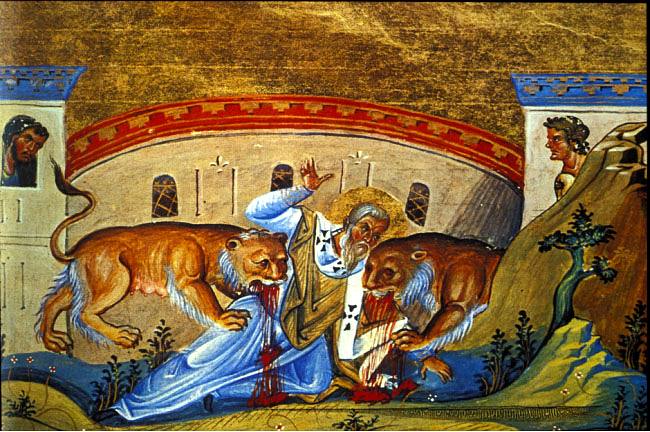 About St. Ignatius’s life little is known. He was born ca. 35 or 50 and died in 107.[i] It is known to be a fact that he was the Bishop of Antioch after Saint Peter and Saint Evodius, and that Peter himself appointed Ignatius to the see of Antioch (as recorded by the author and theologian Theordoret). And it is known that he was a martyr and died in 107 C.E. during the reign of the Emperor Trajan[ii].
Authorities from the 500s C.E. report that Ignatius served as bishop of Antioch for 40 years. Antioch was one of the most important Christian communities of that era, (Acts 11:26) and Ignatius would have been well known in those Christian communities. Antioch was a major metropolitan area; it was the capital of the Roman province of Syria and the second city of the empire, following Rome. If Ignatius were Antioch’s bishop for 40 years, then he would have been a man of tremendous fame.
Besides his Greek name, Ignatius, he also called himself Theophorus (“God Bearer”), and tradition says he was one of the children Jesus took in His arms and blessed. He based his authority on his being a bishop of the Church, living his life in the imitation of Christ. It is believed that St. Ignatius, along with his friend Polycarp, with great probability were disciples of the Apostle St. John. The Eucharistic spirituality of his letters seems to give this credence.
What we know of his martyrdom comes from letters that are attributed to him. St. Ignatius reports his arrest by the authorities and his travel to Rome:
From Syria even to Rome I fight with wild beasts, by land and sea, by night and by day, being bound amidst ten leopards, (meaning guards), even a company of soldiers, who only grow worse when they are kindly treated. —Ignatius to the Romans, 5.
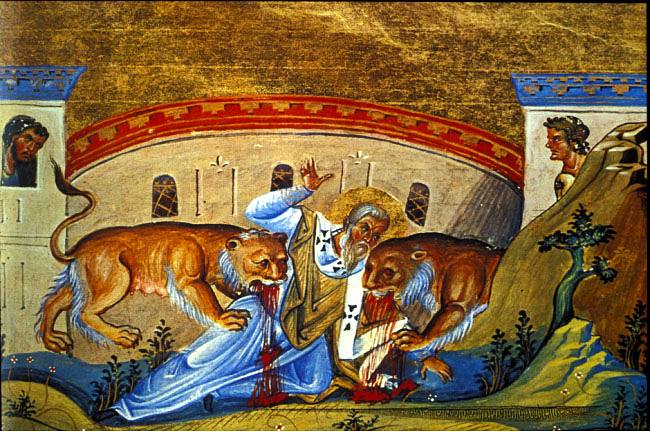
He was sentenced to die, to be devoured by lions. As he approached execution, Ignatius identified himself more and more with the sacrifice of the altar. He wrote:
“I am writing to all the Churches and I enjoin all, that I am dying willingly for God’s sake, if only you do not prevent it. I beg you, do not do me an untimely kindness. Allow me to be eaten by the beasts, which are my way of reaching to God. I am God’s wheat, and I am to be ground by the teeth of wild beasts, so that I may become the pure bread of Christ.” Ignatius to the Romans, 4.
After Ignatius’ martyrdom in the Flavian Amphitheatre, his remains were honorably carried back to Antioch by his companions, and were first interred outside the city gates, then removed by the Emperor Theodosius II to the Tychaeum, or Temple of Tyche, which was then converted into a church dedicated to Ignatius. In 637 the relics were translated to the Church of St. Clement in Rome.
Along the route to his execution, he wrote six letters to the churches in the region, and one to a fellow bishop, his friend, Polycarp. These letters have been preserved as an example of early Christian theology. Important topics addressed in these letters include ecclesiology, the sacraments, and the role of bishops. The letters of Ignatius have proved to be an important testimony to the development of Christian theology, and affect our ecclesiology to this day. They bear signs of being written in great haste and without a proper plan, such as the use of run-on sentences and an unsystematic succession of thought. Ignatius is the earliest known Christian writer to emphasize loyalty to a single bishop in each city (or diocese) who is assisted by both presbyters possibly elders and deacons. Earlier writings only mention either bishops or presbyters, and give the impression that there was usually more than one bishop per congregation. Ignatius is an indisputable witness to the hierarchical constitution of the church at the beginning of the second century. Also, it is in Ignatius’s writings that we first encounter the word, “priest” among orders of the clergy:
“See that you follow the bishop, even as Jesus Christ follows the Father. Follow the priest as you would follow the apostles. And reverence the deacons as you would reverence the command of God. Let no man do anything connected with the Church without the Bishop.” – Smyrnaeans 6-8.
“Take care to do all things in harmony with God, with the bishop presiding in the place of God, and with the priests in the place of the council of the apostles, and with the deacons, who are most dear to me, entrusted with the business of Jesus Christ, who was with the Father from the beginning and is at last made manifest.” —Letter to the Magnesians 2, 6:1.
Ignatius is known to have taught the deity of Christ,:
“There is one Physician who is possessed both of flesh and spirit; both made and not made; God existing in flesh; true life in death; both of Mary and of God; first possible and then impossible, even Jesus Christ our Lord.”
Ignatius stressed the value of the Eucharist, calling it a “medicine of immortality” (Ignatius to the Ephesians 20:2). He also wrote:
“Unless you eat the flesh of the Son of man and drink his blood, you have no life in you. He who eats this bread will live forever.”
The very strong desire for bloody martyrdom in the arena, which Ignatius expresses rather graphically in places, may seem quite odd and disturbing to the modern reader. An examination of his theology of soteriology (his beliefs about salvation) shows that he regarded salvation as one being free from the powerful fear of death and thus to bravely face martyrdom. He wrote:
“Let fire and the cross; let the crowds of wild beasts; let tearings, breakings, and dislocations of bones; let cutting off of members; let shatterings of the whole body; and let all the dreadful torments of the devil come upon me; only let me attain to Jesus Christ.[iii]
Ignatius is claimed to be the first known Christian writer to argue in favor of Christianity’s replacement of the Sabbath with the Lord’s Day:
“Be not seduced by strange doctrines nor by antiquated fables, which are profitless. For if even unto this day we live after the manner of Judaism, we avow that we have not received grace…. If then those who had walked in ancient practices attained unto newness of hope, no longer observing Sabbaths but fashioning their lives after the Lord’s day, on which our life also arose through Him and through His death which some men deny … how shall we be able to live apart from Him? … It is monstrous to talk of Jesus Christ and to practice Judaism. For Christianity did not believe in Judaism, but Judaism in Christianity.” — Ignatius to the Magnesians 8:1, 9:1-2, 10
He is also responsible for the first known use of the Greek word “katholikos” meaning “universal”, “complete” and “whole” to describe the church, writing:
“Wherever the bishop appears, there let the people be; as wherever Jesus Christ is, there is the Catholic Church. It is not lawful to baptize or give communion without the consent of the bishop. On the other hand, whatever has his approval is pleasing to God. Thus, whatever is done will be safe and valid.” — Letter to the Smyrnaeans 8.
It is from the word katholikos (“according to the whole”) that the word catholic comes. When Ignatius wrote the Letter to the Smyrnaeans in about the year 107 and used the word “catholic,” he used it as if it were a word already in use to describe the Church. This has led many scholars to conclude that the appellation “Catholic Church” with its ecclesial connotation may have been in use as early as the last quarter of the 1st century.
On the Eucharist, Ignatius wrote in his letter to the Smyrnaeans:
Take note of those who hold heterodox opinions on the grace of Jesus Christ which has come to us, and see how contrary their opinions are to the mind of God. . . . They abstain from the Eucharist and from prayer because they do not confess that the Eucharist is the flesh of our Savior Jesus Christ, flesh which suffered for our sins and which that Father, in his goodness, raised up again. They who deny the gift of God are perishing in their disputes. — Letter to the Smyrnaeans 6:2–7:1.
In Western and Syriac Christianity Saint Ignatius’s feast is celebrated on 17 October. He is celebrated on 1 February by the Roman Catholics following the General Roman Calendar of 1962.
[i] Brauer, Jerald, (ed.) The Westminster Dictionary of Church History, (Philadelphia: Westminster Press, 1971).
[ii] Aquilina, Mike, The Mass of the Early Christians, (Huntington, IN: Our Sunday Visitor, Inc., 2007) p. 75.
[iii] Aquilina, Mike, The Fathers of the Church, (Huntington, IN: Our Sunday Visitor, Inc., 1999) p. 68.
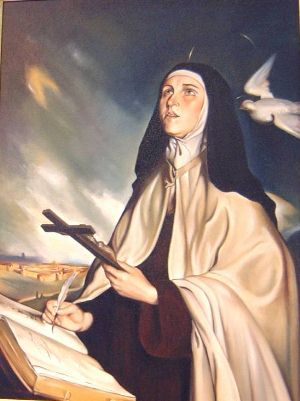
“God Alone Is Enough” — St. Teresa of Avila ~ The Rev. Dcn. Sr. Dollie Wilkinson, OPI
 Saint Teresa of Avila (Saint Theresa of Jesus)
Born in Avila, Spain March 28, 1515; died in Alba de Tormes, October 4 [15], 1582
Foundress of the Discalced Carmelites, 1560-62.
Canonized by Gregory XV, 1622; declared a Doctor of the Church in 1970.
Spanish mystic, writer and reformer of the Carmelite order.
St Terese of Avila was an influential and pivotal figure of her generation.St Teresa (Teresa de Cepeda y Ahumada) was born in Avila, Spain on 28th March 1515. Her parents were both pious Catholics and in some ways inspired their daughter to take up a life of prayer. As a young child Teresa showed signs of a deeply religious nature; she would often retreat into silence for prayer and would enjoy giving alms to the poor. She was very close to her Mother, who provided a warm counterbalance, to the strictness of her father. However in her teens, Teresa’s mother passed away, leaving the young Teresa distraught at the void she felt. The young St Teresa tells of her despair and how she turned instinctively to the Virgin Mary for comfort.
“I threw myself down in despair before an image of the Mother of God. With many tears, I implored the Holy Virgin to become my mother now. Uttered with the simplicity of a child, this prayer was heard. From that hour on, I never prayed to the Virgin in vain.”
During her later teen years Avila lost some of her early piety and religious zeal. She recounted how she became interested in worldly matters and enjoyed the company of a wide circle of friends. She had a natural charm and found it easy to make friends. In return she enjoyed the compliments and friendships of others. However, she was not at peace, considering herself to be a miserable sinner; later she would look back in guilt at her early life. However this sense of being a “miserable sinner” was probably the result of a harsh self-judgment, encouraged by her fathers exacting religious standards. At the age of 16, her father decided to send Teresa to a convent school to be educated.
This re-ignited in Avila an interest in following a spiritual life and after some deliberation resolved to become a nun of the Carmelite Order. At the time the convent rules were not very strict; it was probably more relaxed than living with her father. At the time the convent accepted many people into the order, often for financial reasons. The convent became overcrowded and people were often judged not on the basis of spiritual intensity but on material possessions. In this climate, Teresa struggled to find time for quite reflection; although she did start teaching people on the virtues of mental prayer.
Shortly after becoming a nun, Avila experienced a severe illness (malaria), which left her in great pain for a long period. At one point it was feared that her illness was so severe that she would not be able to recover. However during this period of intense physical pain, she began to increasingly experience divine visions and an inner sense of peace. These inner experiences of joy and peace seemed to transcend the intense physical pain of the body.
When she was a little better she resumed her prayers with renewed vigor. However after telling others of her visions and spiritual experiences, she was dissuaded from persuading them. Certain clergy felt they were just delusions of the devil. As a result, for many years Teresa lost the confidence to pursue her prayers and her spiritual life was almost put on hold. However, when Teresa was 41, she met a Priest who convinced her to go back to her prayers and implore God to come back. Initially, she had some difficulty sitting through prayers. She wryly remarked the end of the hour’s prayer couldn’t come soon enough. However, in the course of time, she became absorbed in deep contemplation in which she felt an ever growing sense of oneness with God. At times she felt overwhelmed with divine love. The experiences were so transforming, she at times felt the illumining grace of God would wash her soul away. She was so filled with divine contemplation it is said at times her body would spontaneously levitate. Teresa, however was not keen on these public displays of “miracles”. When she felt it happening she would ask other nuns to sit on her to prevent her floating away.
Teresa was not a just a quiet, placid saint. She had an endearing, natural quality; her life energy attracted and inspired many who were close. They admired her for both her outer charm and inner serenity. But at the same time her religious ecstasies also caused jealousy and suspicion. Unfortunately she was born into the period of the Spanish inquisition, during this time any deviation from the orthodox religious experience came under the strict observation and scrutiny. On one occasion Teresa complained to God about her mistreatment from so many different people. God replied to her saying “That is how I always treat my friends” with good humour St Teresa replied “That must be why you have so few friends”. St Teresa struggled because there were few who could understand or appreciate her inner ecstasies. However on the one hand she felt these experiences to be more real than ordinary events.
At the age of 43, St Teresa decided she wanted to found a new order recommitting to the values of poverty and simplicity. She wanted to move away from her present convent which made a life of prayer more difficult. Initially her aims were greeted with widespread opposition from within the town of Avila. However, with the support of some priests, the opposition waned and she was allowed to set up her first convent. St Teresa proved to be an influential leader and founder. She guided the nuns not just through strict disciplines, but also through the power of love, and common sense. Her way was not the way of rigid asceticism and self denial. Although she underwent many tribulations herself, to others she stressed the importance of experiencing God’s love.
St Teresa devoted much of the rest of her life to traveling around Spain setting up new convents based along the ancient monastic traditions. Her travels and work were not always greeted with enthusiasm, many resented her reforms and the implied criticism of existing religious orders. She often met with criticism including the papal nuncio who used the rather descriptive phrase “a restless disobedient gadabout who has gone about teaching as though she were a professor” St Teresa also had to frequently contend with difficult living conditions and her frail health. However she never let these obstacles dissuade her from her life’s task. She eventually died on October 4 at the age of 67. In 1566 she wroteCamino de perfeccion (Way of Perfection) in about 1566, to tell the nuns how to reach their goal. In 1580 she wrote what is considered her greatest work; the Castillo interior/ Las moradas(Interior castle/ The mansions) this involved describing the various stages of spiritual evolution leading to full prayer; she wrote Las Fundaciones (Foundations) from 1573 to 1582, so they would remember the early history of their order.
“God alone is enough.”
St. Theresa’s most popularly known writing, is a brief poem, which is known as her “Bookmark”, because it was found in her prayer book after her death in 1582. It has been variously translated into English, and has been very widely circulated.
Let nothing disturb you,
Let nothing frighten you,
All things are passing away:
God never changes.
Patience obtains all things.
Whoever has God lacks nothing;
God alone suffices.
Teresa lived in an age of exploration as well as political, social and religious upheaval. It was the 16th century, a time of turmoil and reform. She was born before the Protestant Reformation and died almost 20 years after the closing of the Council of Trent.
The gift of God to Teresa in and through which she became holy and left her mark on the Church and the world is threefold: She was a woman; she was a contemplative; she was an active reformer.
As a woman, Teresa stood on her own two feet, even in the man’s world of her time. She was “her own woman,” entering the Carmelites despite strong opposition from her father. She is a person wrapped not so much in silence as in mystery. Beautiful, talented, outgoing, adaptable, affectionate, courageous, enthusiastic, she was totally human. Like Jesus, she was a mystery of paradoxes: wise, yet practical; intelligent, yet much in tune with her experience; a mystic, yet an energetic reformer. A holy woman, a womanly woman.
Teresa was a woman “for God,” a woman of prayer, discipline and compassion. Her heart belonged to God. Her ongoing conversion was an arduous lifelong struggle, involving ongoing purification and suffering. She was misunderstood, misjudged, opposed in her efforts at reform. Yet she struggled on, courageous and faithful; she struggled with her own mediocrity, her illness, her opposition. And in the midst of all this she clung to God in life and in prayer. Her writings on prayer and contemplation are drawn from her experience: powerful, practical and graceful. A woman of prayer; a woman for God.
Teresa was a woman “for others.” Though a contemplative, she spent much of her time and energy seeking to reform herself and the Carmelites, to lead them back to the full observance of the primitive Rule. She founded over a half-dozen new monasteries. She traveled, wrote, fought—always to renew, to reform. In her self, in her prayer, in her life, in her efforts to reform, in all the people she touched, she was a woman for others, a woman who inspired and gave life.
Her writings, especially the “Way of Perfection”and “The Interior Castle”, have helped generations of believers.
In 1970, the Church gave her the title she had long held in the popular mind: Doctor of the Church. She and St. Catherine of Siena were the first women so honored.
Ready? Set! What?????? ~Br. Michael Marshall, Postulant

Gospel Matt 22:1-14
1 Jesus again in reply spoke to the chief priests and elders of the people in parables, saying, 2 “The kingdom of heaven may be likened to a king who gave a wedding feast for his son.
3 He dispatched his servants to summon the invited guests to the feast, but they refused to come. 4 A second time he sent other servants, saying, ‘Tell those invited: “Behold, I have prepared my banquet,
my calves and fattened cattle are killed, and everything is ready; come to the feast.”’ 5 Some ignored the invitation and went away, one to his farm, another to his business. 6 The rest laid hold of his servants,
mistreated them, and killed them. 7 The king was enraged and sent his troops, destroyed those murderers, and burned their city. 8 Then he said to his servants, ‘The feast is ready, but those who were invited were not worthy to come.
9 Go out, therefore, into the main roads and invite to the feast whomever you find.’ 10 The servants went out into the streets and gathered all they found, bad and good alike, and the hall was filled with guests.
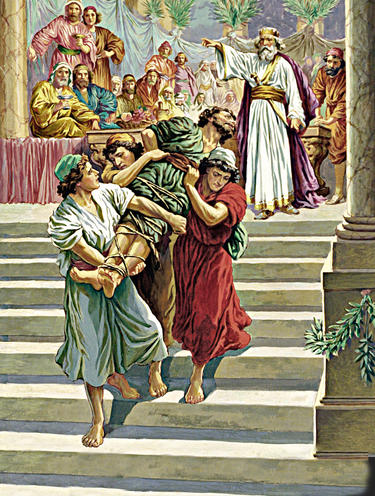
11 But when the king came in to meet the guests, he saw a man there not dressed in a wedding garment. 12 The king said to him, ‘My friend, how is it that you came in here without a wedding garment?’
But he was reduced to silence. 13 Then the king said to his attendants, ‘Bind his hands and feet, and cast him into the darkness outside, where there will be wailing and grinding of teeth.’ 14 Many are invited, but few are chosen.”
A young man entered college to fulfill his dream of becoming an architect, and initially he succeeded in his studies. He really enjoyed college, and made many friends during the first semester. Even though he was only a freshman, he was invited to many parties. Because of attending parties, the second semester ended up not going so well. He was more into socializing with friends instead of studying, and what studying he did was short of cramming. On the day of a mid-term exam, he scurried out of bed to get to there on time. The syllabus stated if a student was late for an exam, the exam would have to be made up with a percentage of the score deducted from 100% based upon the amount of time late. He barely made it to the exam before the materials were passed out.
He figured he would be able to pass the exam because he had showed up to at least half of the class sessions and took decent notes. For this exam he did not study for the exam thinking he could answer the questions based on what he thought he remembered from his notes and other things from the lectures when attending class. Unfortunately, most of the questions on the exam had to deal with material he missed when not attending class. Only a third of the questions pertained to the material in his notes. He recognized those questions, but had not studied enough to answer every question correctly. Needless to say, he failed the exam, and flunked out of college.
The most important events in life take being prepared for them. The Gospel reading from Matthew speaks to being prepared. The man in the street invited to the wedding feast shows up without a wedding garment, which is required to attend the wedding celebration. The man was not prepared for the wedding feast, therefore put back on the street. The college student did not devote the proper amount of time to studying for his courses, and his lack of preparedness resulted in failing exams and flunking out of college after only one year.
Unlike the person in the street and the college student, it is not always easy to be prepared for situations in life, but we should try to be. Not every situation is like an exam. We might be thrown into a situation which catches us off guard, yet when we have the “know how” we will be able to achieve what is supposed to happen. Let’s take the example of someone driving down the road and a tire goes flat. People generally do not check their tires for leaks every time they get into their car to go somewhere, and even if they did they might run over a nail to cause a tire to go flat. So now a tire has gone flat… The “know how” would be understanding how to remove the tire to put on the spare or temporary tire. Learning how to do that would at least be some preparation because the problem would be addressed easier. If the person did not know how to change the tire out for the spare, they would have to get help from someone else or possibly be stranded. Someone with the knowledge of how to change a tire should recognize the person needs help and change the tire for them.
What are you doing to prepare yourself? Have you studied for your exam? Have you checked your tires? Are you ready, prepared, and able to go out into the world and be a witness for Our Lord? Are you dressed in your wedding garments?
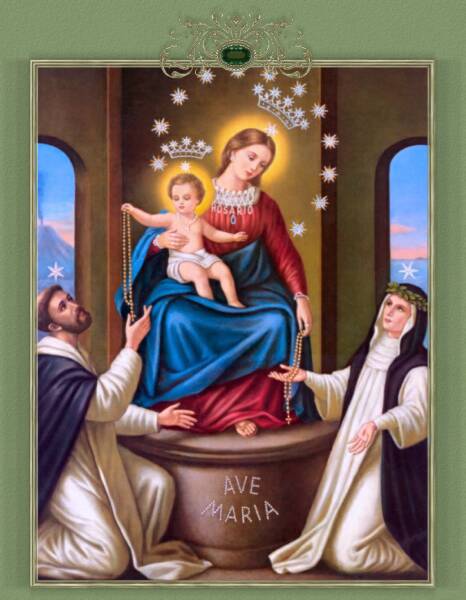
What? Where? Why? Who? Our Lady of the Rosary ~ The Rev. Deacon Br. Joshua Hatten, OPI
 Today the church celebrates an important Marian Feast, Our Lady of the Rosary. Why do celebrate this feast? Why do we bother with the rosary at all… it is just some ancient prayer of the church, right?? Wrong! Very wrong!
The Rosary is not a repetitious, boring, ‘religious’ activity… we can certainly make it feel like that… boring, words repeated by rote without any meaning. But that isn’t the Rosary. That is a waste of time. The rosary, when properly prayed, with intention – and with whatever YOUR intentions may be – is one of the most powerful and mountain moving forms of active prayer and meditation with which we are blessed. Archbishop Fulton J. Sheen once said, “The rosary is the book of the blind, where souls see and there enact the greatest drama of love the world has ever known; it is the book of the simple, which initiates them into mysteries and knowledge more satisfying than the education of other men; it is the book of the aged, whose eyes close upon the shadow of this world, and open on the substance of the next. The power of the rosary is beyond description.”
But the rosary began quite differently than that we know today. The use of “prayer beads” and the repeated recitation of prayers to aid in meditation stem from the earliest days of the Church and has roots in pre-Christian times. Evidence exists from the Middle Ages that strings of beads were used to count Our Fathers and Hail Marys. Actually, these strings of beads became known as “Paternosters,” the Latin for “Our Father.”
The structure of the rosary gradually evolved between the 12th and 15th centuries. Eventually 50 Hail Marys were recited and linked with verses of psalms or other phrases evoking the lives of Jesus and Mary. During this time, this prayer form became known as the rosarium (“rose garden”), actually a common term to designate a collection of similar material, such as an anthology of stories on the same subject or theme. During the 16th century, the structure of the five-decade rosary based on the three sets of mysteries prevailed.
Tradition does hold that St. Dominic (d. 1221) devised the rosary as we know it. Moved by a vision of our Blessed Mother, he preached the use of the rosary in his missionary work among the Albigensians, who had denied the mystery of Christ.
Originally, people prayed 150 Our Fathers representing the 150 Psalms. Then there was a parallel practice of praying 150 Hail Marys. Later, a mystery of Jesus’ life was attached to each Hail Mary.
Church Tradition and, let’s face it, LEGEND, tells us that St. Dominic (d. 1221) devised the rosary as we know it. Moved by a vision of our Blessed Mother, he preached the use of the rosary in his missionary work among the Albigensians, who had denied the mystery of Christ. Whilst that cannot by proved, and in fact may not be true, the development of the rosary as we know it owes much to the Dominican Order. One of St. Dominic’s Dominican contemporaries, Alan de la Roche, was known as “the apostle of the rosary.” He founded the first Confraternity of the Rosary in the 15th century. In the 16th century the rosary was developed to its present form—with the 15 mysteries (joyful, sorrowful and glorious). In 2002, Pope John Paul II added five Mysteries of Light to this devotion.
Let the rosary become YOUR BOOK, as Archbishop Sheen termed it, the book you ‘open’ when it seems like everything is just too much to bear or when you’re filled with such gratitude for love or when or when it is just a humdrum Wednesday. You will be amazed by the power of this beautiful prayer. The book opens when you realize you’re not merely praying the same words on the same beads every time, but when you actually begin to meditate and place yourself in the corresponding mysteries. You become an active participant in the life and times of Our Lord and His Mother.
Anyone who knows six easy prayers can pray a Rosary; you will also need to know twenty Mysteries to meditate upon as you pray. You do not have to be a Catholic.
The Order of Prayers
The Rosary begins with the Apostles Creed, followed by one Our Father, three Hail Marys (traditionally offered for an increase in faith, hope, and charity for those praying the Rosary), a Glory Be, and, if desired, the Fatima Prayers. Next come five mysteries, each consisting of one Our Father, ten Hail Marys, a Glory Be, and, if desired, the Fatima Prayers. Conclude with the Hail Holy Queen. Please say a few extra prayers after the Hail Holy Queen for the Pope.
Rosary Beads
If you do not have Rosary beads, it is perfectly okay to count with your fingers. Counting beads frees your mind to help you meditate.
Prayers for Praying the Rosary
THE APOSTLE’S CREED
I believe in God, the Father Almighty, Creator of Heaven and earth; and in Jesus Christ, His only Son, Our Lord, Who was conceived by the Holy Ghost, born of the Virgin Mary, suffered under Pontius Pilate, was crucified; died, and was buried. He descended into Hell; the third day He arose again from the dead; He ascended into Heaven, sitteth at the right hand of God, the Father Almighty; from thence He shall come to judge the living and the dead. I believe in the Holy Spirit, the holy Catholic Church, the communion of saints, the forgiveness of sins, the resurrection of the body, and the life everlasting. Amen.
OUR FATHER
Our Father, Who art in heaven, hallowed be Thy name; Thy kingdom come; Thy will be done on earth as it is in heaven. Give us this day our daily bread; and forgive us our trespasses as we forgive those who trespass against us; and lead us not into temptation, but deliver us from evil. Amen.
HAIL MARY
Hail Mary, full of grace. The Lord is with thee. Blessed art thou amongst women, and blessed is the fruit of thy womb, Jesus. Holy Mary, Mother of God, pray for us sinners, now and at the hour of our death, Amen.
GLORY BE
Glory be to the Father, and to the Son, and to the Holy Spirit, as it was in the beginning, is now, and ever shall be, world without end. Amen.
FATIMA PRAYER (OPTIONAL)
O my Jesus, forgive us of our sins. Save us from the fires of hell. Lead all souls into heaven, especially those in most need of thy mercy.
HAIL HOLY QUEEN
Hail, holy Queen, Mother of mercy, our life, our sweetness and our hope. To thee do we cry, poor banished children of Eve: to thee do we send up our sighs, mourning and weeping in this valley of tears. Turn then, most gracious Advocate, thine eyes of mercy toward us, and after this our exile, show unto us the blessed fruit of thy womb, Jesus. O clement, O loving, O sweet Virgin Mary!
Leader: Pray for us O Holy Mother of God,
All: That we may be worthy of the promises of Christ.
(Optional)
Leader: Let us pray.
All: O God whose only begotten Son by his life, death, and Resurrection has purchased for us the rewards of eternal life; grant we beseech thee, that meditating on these mysteries of the Most Holy Rosary of the Blessed Virgin Mary, we may imitate what they contain and obtain what they promise through the same Christ our Lord. Amen.
PRAYER FOR THE HOLY FATHER (FOR PRIVATE DEVOTION)
Leader: Upon this Rock He will build His Church…
All: …and the jaws of death shall not prevail against her.
Leader: O Mother of the Redeemer…
All: …Living Tabernacle of the Eucharist, and Luminous Rose of Heaven, with humble confidence we ask you to bestow upon the Holy Father all the graces and blessings reserved for him by the Holy Trinity from all eternity. Amen.
Leader: Help his friends…
All: …convert his enemies.
Leader: Saint Joseph…
All: …pray for us. Amen.
The Twenty Mysteries
Here is a brief listing and description of all twenty Mysteries.
THE JOYFUL MYSTERIES
- The Annunciation:The Archangel Gabriel “announces” to Mary that she shall conceive the Son of God.
- The Visitation:Mary visits her cousin Elizabeth, who is pregnant with John the Baptist.
- The Nativity:Jesus is born.
- The Presentation:Mary and Joseph “present” Jesus in the Temple where they meet Simeon.
- The Finding in the Temple:After losing Him, Mary and Joseph find young Jesus teaching the Rabbis in the Temple.
THE LUMINOUS MYSTERIES (THE MYSTERIES OF LIGHT)
- The Baptism in the Jordan:The voice of the Father declares Jesus the beloved Son.
- The Wedding at Cana:Christ changes water into wine, his first public miracle.
- The Proclamation of the Kingdom:Jesus calls to conversion (cf. Mk 1:15) and forgives the sins of all who draw near to him.
- The Transfiguration:The glory of the Godhead shines forth from the face of Christ.
- The Institution of the Eucharist:Jesus offers the first Mass at the Last Supper with his apostles, establishing the sacramental foundation for all Christian living.
THE SORROWFUL MYSTERIES
- The Agony in the Garden:Jesus sweats water and blood while praying the night before his passion.
- The Scourging at the Pillar:Pilate has Jesus whipped.
- The Crowning with Thorns:Roman soldiers crown Jesus’ head with thorns.
- The Carrying of the Cross:Jesus meets His mother and falls three times on the way up Calvary.
- The Crucifixion:Jesus is nailed to the cross and dies before His mother and His apostle John.
THE GLORIOUS MYSTERIES
- The Resurrection:Jesus rises from the dead.
- The Ascension:Jesus leaves the Apostles and bodily “ascends” to heaven.
- The Descent of the Holy Spirit:The Apostles receive the Holy Spirit in tongues of fire in the upper room with Mary.
- The Assumption:Mary is taken bodily–assumed–into heaven by God at the end of her life here on earth.
- The Coronation:Mary is crowned Queen of Heaven and Earth.
Mysteries for Certain Weekdays
Traditionally, many people say the Joyful Mysteries on Monday, the Sorrowful Mysteries on Tuesday, the Glorious Mysteries on Wednesday, and start again with the Joyful Mysteries on Thursday, the Sorrowful Mysteries on Friday. The Glorious Mysteries are then prayed on Saturday and Sunday. Now that the Luminous Mysteries have recently been added, the schedule is:
Monday – Joyful
Tuesday – Sorrowful
Wednesday – Glorious
Thursday – Luminous
Friday – Sorrowful
Saturday – Joyful
Sunday – Glorious
Try to place yourself “into” the scene of the particular mystery as you pray, imagining the sights, smells, sounds, and emotions that Jesus, Mary, Joseph, and other participants experienced during the actual events.
It is also okay to meditate on the meaning of the words of the prayers as you pray them, or even to meditate on the person for whom you are offering the Rosary.
GOD BLESS YOU.
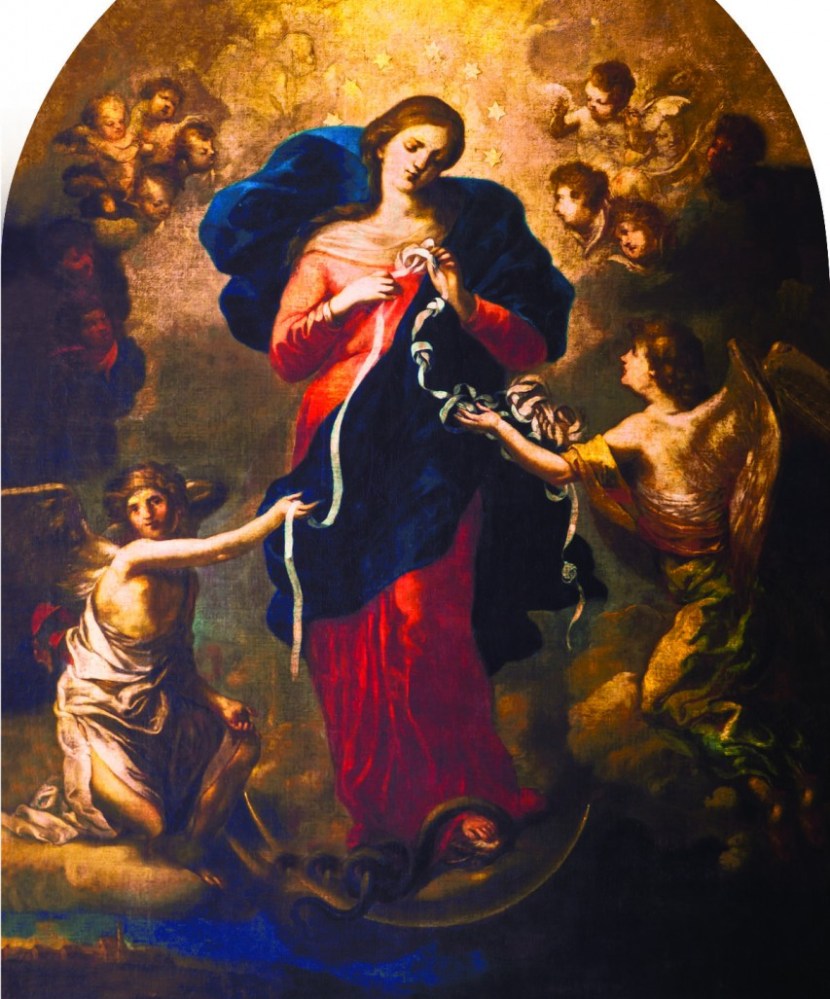
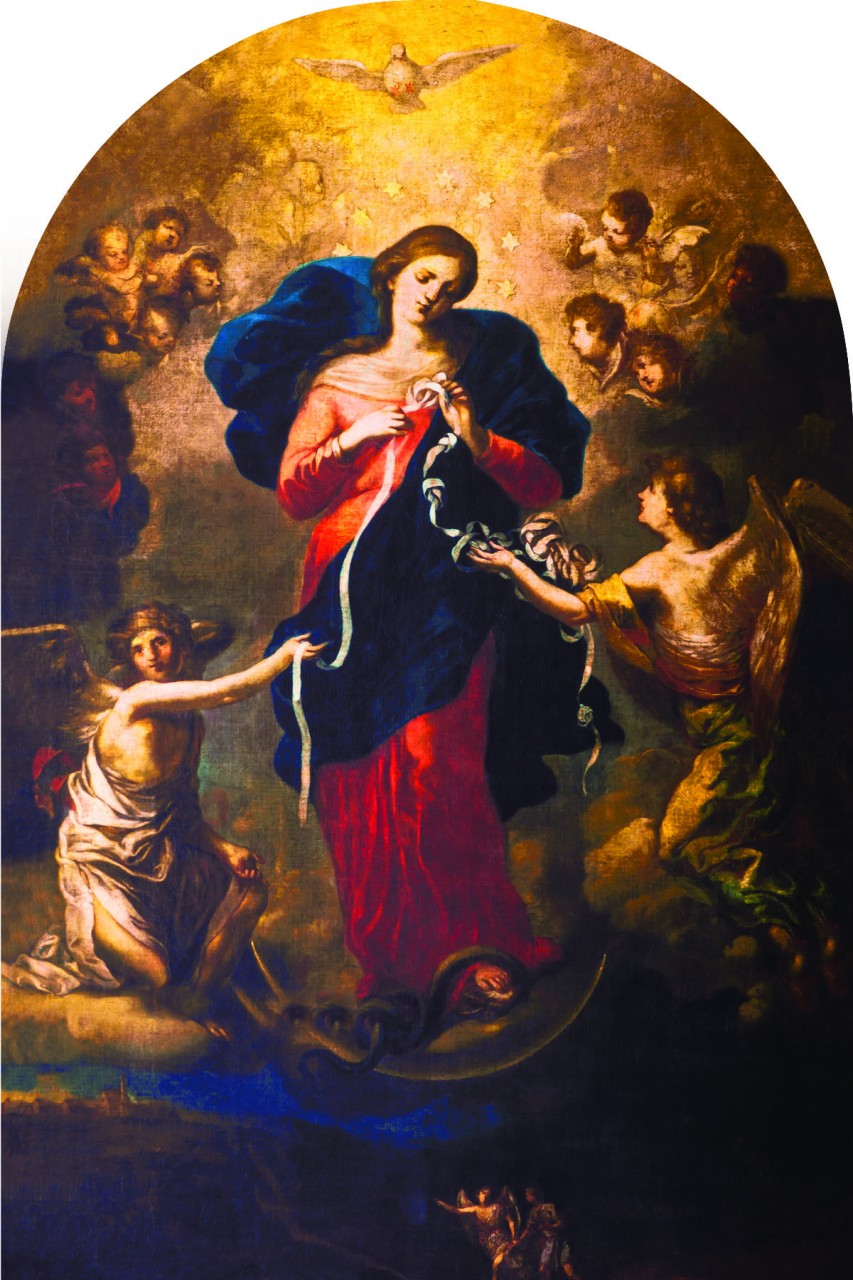
Got Knots? The Feast of Our Lady, Undoer of Knots ~ Br. Dominic Ferrante, Novice

Jesus’ Cross: Barbaric Baggage or Blessed Beacon? ~ Br. Jay Van Lieshout, Postulant
 Symbols: since the dawning of human society, we have used symbols to convey thoughts, ideas and concepts. We have developed a whole system by which we can pass on ideas and information from person to person, from generation to generation: spoken language where complex patterns of sounds recreate the stories and emotions of our daily lives, the written word where lines and squiggles are phonic representations and signals of rhythm and inflection. We humans have filled our universe with the echoes of our history, our knowledge, our emotions, our joys, our pain, our hate and our love; from sounds fading into the ether to our graffiti marks in the hard surfaces of our environment or on leaflets of skin and cellulose. But still the greatest and most powerful, and often the simplest, of all human symbols is the image. Whether it is a handprint on the wall of a subterranean cavern to say “I was here”, or an emoticon of a smiling face, recognition is immediate and the attached emotions are clear and powerful.
For Christians, the most powerful of all symbols is a simple set of two lines intersected to form a cross. Simple, elegant in design and filled with emotion; one simple icon that conveys more in a single flash of viewing than has been scribbled in 2000 years; or is it? During his homily for the Feast of the Exultation of the Holy Cross, the Arch Bishop talked about a new offshoot of Christian teaching in which the cross is stripped of much of its power and is relegated to nothing more than a barbaric symbol of execution; no more fulfilling of prophecy, no more sacrificial lamb of salvation, no more looking to the cross, being healed and given life- just a symbol of meaningless death and the potential death of a symbol.
Needless to say I was appalled and my mind filled with screams of “what about” this or that; for a moment I felt like Peter staring at Jesus after hearing one of His parables. Once the dust settled it was time to contemplate, to stare at the cross and ask “ok, so why should you be so important to a Christian, why should you be so venerated, why should you be such a powerful symbol of our faith?”
Our journey begins with the Old Testament reading for the feast. A typical Moses in the wilderness story, God is leading the Israelites to the promised land, Moses is co piloting, the masses are in the proverbial back seat whining “I’m hungry, I’m thirsty, she’s touching me, it’s hot, are we there yet, when are we gonna get there?” God the Father gets mad, sends some venomous snakes, cleans house and then tells Moses to make a bronze serpent, put it on a pole and if anyone gets bitten, they are to look at the serpent and live. Seemingly another old story which doesn’t really fit anywhere so let’s just attached to one of the Sundays and hope no one notices. But is it really just that? Instant message from God: “ Think Symbols”.
This recount of the journey of the Israelites is more than just a simple story if you think in terms of the symbolic. We have the people of God wandering the desert looking for the Promised Land, the Eden here on earth where the people and God live in harmony. This is a straight forward enough analogy of our daily spiritual journey where each of us seeks to be closer to God and find the joy and freedom from our transgressions. There is Moses, God’s man on Earth, trying to teach and lead God’s people to this Earthly Eden, a man with power and knowledge who is often at his wits end on what to do with this stubborn flock of well meaning but unruly sheep. Then there are the serpents, a symbol for yetzer ha-ra,, the Hebrew version of Satan, the provocateur sent by God, but unlike the modern Christian view of Satan, this is a minion under God’s control, it is the ambition in each human and hot desire in each of us, the DRIVE with which we can do great things for the good of all as God so desires, or by which we can do evil and so turn away from God; it’s our choice for He has given us free will. And lastly there is the Serpent on a Stick (it almost sounds almost like some ancient fast food delicacy), a Hebrew version of the caduceus, the rod of Alcepius, the Greek god of healing, seen in most medical offices today, and for the Hebrew a symbol which when looked upon restores life to the bitten.
The stage is set, the symbols defined, it’s time for lights, camera, and action! Moses is attempting to lead his people along the path of righteousness; back to God, to the promised ancestral homeland, to Eden on earth, all the while God the Father is watching the trials and tribulations from a good distance. Enter stage left, yetzer ha-ra whose venomous bit leads some people astray and they become lost, confused, crazed. God then tells Moses to erect a standard, a serpent on a pole for the people to see. Some people choose to turn their back to this desert lighthouse, they wander away and by their actions separated from God and die. Others who look on this symbol, this beacon from God are healed, are redirected toward the right path, returning to God and the life that the Father gives to his people; they have been saved. And cut. And thus the message has been delivered, turn your eyes from God, choose sin and die or look to God, see His light, follow the path of righteousness and LIVE.
And so let us return our focus on the cross, this symbol of Christianity; how does veneration of the cross of Christ relate to Moses’ serpent on a stick? Like Moses, Jesus was sent by the Father to guide His people back along the path of righteousness; Moses’ standard had been destroyed, the people were wandering like lost sheep. Yetzer ha-ra had filled their hearts with ambition and they ran about in a frenzied state as if they had been bitten by venomous vipers. Jesus called out to these sheep and some saw and heard his call and so followed Him out of the wilderness, others ignored his call and wandered farther and farther away, only to fall prey to the poison and die. Now Jesus knew there still were other lost sheep who did not hear his call; and He also knew that the sound of his voice would echo and fade into the ether with time. So God the Father told him to erect a standard that would stand for all time as a beacon to guide the lost sheep back to His flock. I sign post to the Promised Land where the flock may safely graze on the fine grasses of Eden. A sign where the fires of yetzer ha-ra are soothed with a healing balm of love so great that the ultimate gift of a life for the life of another life is given. And so Jesus does as His Father willed, and willingly was nailed to a post, was erected and hung for all to see His choice to yetzer ha-ra’s temptations: to shed his blood and give his life so that all who look to him may be healed and LIVE.
So is veneration of the cross important to the followers of Christ or is it just a remnant of some barbaric medieval church tradition? The cross is a reminder of our free will, of our choices in life, of our transgressions we have committed, of those we might commit and of the grace of God given to use when we repent and not only seek forgiveness, but give it in equal and overflowing measure. The cross is the symbol of what we need to be reminded of each and every minute of each and every day. To me the spirit of the cross is best reflected by the words of Kierkegaard “Father in Heaven! Hold not our sins up against us but hold us up against our sins so that the thought of You when it wakens in our soul, and each time it wakens, should not remind us of what we have committed but of what You did forgive, not of how we went astray but of how You did save us!” The cross, like the brass serpent on a pole IS the fundamental symbol of Christ’s mission, of God’s gift to His people, the perfect example of how we are to live, a statement that we are so loved that Christ gave his life so that we might look to him and find life everlasting! So I ask each and everyone one of you, should we as Christians, bitten by yetzer ha-ra, look to the cross as THE symbol of our faith? Verily I tell you only if you wish to LIVE!

Jesus, Our Lord and Optician ~ Br. Jay Van Lieshout, Postulant

Jesus told his disciples a parable:
“Can a blind person guide a blind person? Will not both fall into a pit? No disciple is superior to the teacher; but when fully trained, every disciple will be like his teacher.
Why do you notice the splinter in your brother’s eye, but do not perceive the wooden beam in your own? How can you say to your brother,
‘Brother, let me remove that splinter in your eye,’ when you do not even notice the wooden beam in your own eye? You hypocrite! Remove the wooden beam from your eye first;
then you will see clearly to remove the splinter in your brother’s eye.”
Jesus loved parables; and rightfully so, they are an excellent way of teaching, of conveying concepts and are a continuation of the techniques in the Torah. Today’s gospel shows how well this teaching technique can be used to present ideas in a way that withstands the cloudy nature of time. But there is another side to parables, a side again well used in this gospel: you can critique people without ever pointing a finger or mentioning names and yet it will be clear about who or what the parable is referencing; it is in this manner that Jesus aims strip us of our arrogant ways so that we may begin to walk in his footsteps.
Jesus has found the perfect “teaching moment” for his disciples and one that they and all of us need if we hope to spread the good news. We know that Jesus thought of the practices of the Pharisees and Sadducees, and one can imagine that his disciples would gossip and lambaste the church leaders among themselves as well as to those they encountered. We also know that this type of behavior is contrary to Jesus’ methods of conflict resolution and the path to salvation. Thus, we have the parable of the blind leading the blind. It’s important to note that Jesus prefaces this parable with teachings on loving one’s enemies and the perils of judging and condemning others the result of which will be return judgment and condemnation. But if you love your enemy and forgive them their transgressions, this favor will be returned and “A good measure, pressed down, shaken together and running over, will be poured into your lap. For with the measure you use, it will be measured to you.”
Now the parable begins with Jesus rhetorically asking his disciples “Can the blind lead the blind? Will they not both fall into a pit?” On the surface this seems to be an almost comic image about the visually impaired, but underneath the disciples understood Jesus was referencing the blind of faith, those who know and enforce the law but are blinded to their own transgressions, such as the Pharisees and Sadducees, and the pit isn’t a hole in the ground, but is the eternal grave that such arrogance digs here on Earth. It is very likely that the disciples immediately understood the implications of this parable and, before one of them could utter the standard “but Rabbi” , Jesus turns his attention to his followers and says “No disciple is superior to the teacher; but when fully trained, every disciple will be like his teacher.” This is clearly meant quell their growing self righteousness and remind them they still have a long journey, much to learn and even more to change before they are ready to fill his shoes.
I surmise that there must have been some discussion and perhaps even rumblings among the disciples after Jesus so aptly adjusted their attitudes, though any such parlay has was not recorded by the writer of Luke. Yet the next few stanzas of this gospel are a pointed critique and chastisement of one or more of his student’s seemingly lofty and pretentious behavior. “Why do you notice the splinter in your brother’s eye, but do not perceive the wooden beam in your own? How can you say to your brother, ‘Brother, let me remove that splinter in your eye,’ when you do not even notice the wooden beam in your own eye? You hypocrite! Remove the wooden beam from your eye first; then you will see clearly to remove the splinter in your brother’s eye.” I imagine the wide eyed and astonished look on his disciples faces in response to this stern tongue lashing by their Mentor. But, like all of us now and then, they needed to learn an important message if they ever hoped to emulate their teacher: don’t judge other’s behavior until you are sure that your behavior is above reproach!
We all must consider how our actions are perceived in the eyes of those around us. To them we are no better than the way we act and if our actions do not reflect our words we are no better than a liar and a fraud. Jesus is reminding us that we must focus on KNOWING and CHANGING ourselves on the inside and only then could we be like the teacher and lead by example. Jesus finishes this lesson with a charge to his disciples to actively respond to his words for “someone who listens and does nothing is like the man who built a house on soil, with no foundations; as soon as the river bore down on it, it collapsed; and what a ruin that house became!”
Like the original disciples, we must see our own flaws, hear the words of Jesus and with them build a foundation of love and mercy, of openness, forgiveness and unity and equality. Only then will our eyes be clear enough to guide the blind in faith past the perilous pit and follow in the footsteps of our Lord and Teacher.
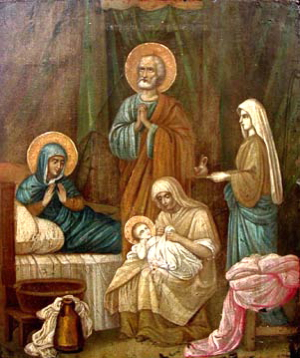
The Birth of the Virgin Mary ~ The Very Rev. Lady Elizabeth Sherwood, OPoc
 There are many Marian feast days celebrated in the Catholic Church, but the principal ones are the Solemnity of Mary the Mother of God, the Presentation of Our Lord in the Temple, the Annunciation, the Assumption, the Immaculate Conception and the Nativity of our Lady. The Feasts of our Lady are dear to us. Before we are born, our mothers are our entire world; they enfold, nourish, and protect us. When we are born they continue to care for us, by comforting, nursing, and teaching us as we grow. Mothers do not stop being mothers just because we are grown. Our mother will always be our mother. So it is with our Blessed Mother, the Virgin Mary. She will always be Jesus’ Mother, and she will always be our Mother with Jesus our brother. And if, for whatever reason, our own birth mother is not quite all we would like her to be, our Blessed Mother stands ready, with arms open to take us in. As our Mother, she will continue to nourish, protect, comfort, and teach us as we grow. Daily prayers that greet and thank her for her love and care, and intercessory prayers that ask for her aid, ensure her place in our families, our homes, and our hearts. She is the Mother of God, the Queen of the Saints, the humble spouse of the Church, and attentive patron of hundreds. It is not surprising that there are So many feast days dedicated, to Mary.
The feast of the Nativity of Mary celebrated on the 8th of September is closely connected with the Immaculate Conception of Mary. Mary who is prepared by divine providence to be the Mother of Jesus the son of God, is conceived in the womb of her mother Anna, her father being Joachim, without the stain of sin and her birth is considered by the Church as a Solemn event. Our Lady’s birthday has been described as “the hope of the entire world and the dawn of salvation”. That is why the Liturgy of the day says: “Let us celebrate with joy the birth of the Virgin Mary, of who was born the Sun of Justice…. Her birth constitutes the hope and the light of salvation for the whole world…. Her image is light for the whole Christian people”. St. Augustine connects Mary’s birth with Jesus’ saving work. He tells the earth to rejoice and shine forth in the light of her birth. “She is the flower of the field from whom bloomed the precious lily of the valley. Through her birth the nature inherited from our first parents is changed.” The opening prayer at Mass speaks of the birth of Mary’s Son as the dawn of our salvation and asks for an increase of peace.
The origin of this Feast is thought in Syria or Palestine at the beginning of the 6th century. It goes back to the consecration of a church in Jerusalem, which tradition identifies as that of the present basilica of St. Ann. At Rome the Feast began to be kept toward the end of the 7th century, brought there by Eastern monks. Gradually and in varied ways, it spread to the other parts of the West in the centuries that followed. From the 13th century on, the celebration assumed notable importance, becoming a Solemnity with a major Octave and preceded by a Vigil calling for a fast. The Octave was reduced to a simple one during the reform of St. Pius X and was abolished altogether under the reform of Pius XII in 1955. The present Calendar characterizes the Birth of Mary as an important “Feast.”
This Feast provides us with an occasion for praise and thanksgiving in honour of the personal sanctity and vocation of the Blessed Virgin Mary as the mother of the Lord Jesus. There is nothing contained in Scripture about the birth of Mary or her parentage, though Joseph’s lineage is given in the first chapter of the Gospel of Matthew. The names of Mary’s parents, Joachim and Anna, appear in the apocryphal “Gospel of James”, a book dating from the 2nd Century AD, not part of the authentic canon of Scripture. According to this account, Joachim and Anna were also beyond the years of child-bearing, but prayed and fasted that God would grant their desire for a child. God listened to their prayers and granted them the child. According to tradition, the house in which Mary was born in Nazareth is the same one in which the Annunciation took place. As a child she was offered in God’s holy temple and remained there, showing to all a great example of zeal and holiness, withdrawn from frivolous society. When, however, she reached full age and the law required that she should leave the temple, she was entrusted by the priests to Joseph, her bridegroom, as the guardian of her virginity, a steadfast observer of the law from his youth.
In celebrating the nativity of Mary, Christians anticipate the Incarnation and the birth of her Divine Son, and give honour to the mother of Our Lord and Saviour. This Feast provides us with an occasion for praise and thanksgiving in honour of the personal sanctity and vocation of the Blessed Virgin Mary as the mother of Jesus. The Church’s calendar observes the birthdays of only three persons: St. John the Baptist and Mary, Mother of Jesus, and that of Jesus, Son of God. John the Baptist was sanctified even before his birth. Luke tells us that Elizabeth felt the infant John “leap in her womb” when Mary approached her soon after the Annunciation.
The Feast of the Nativity of Mary has two aspects: first, the Heaven’s view that enables us to enter into God’s plan for the salvation of the world; and the second, what happens on earth has the freshness of dawn and of a first morning. As seen from Heaven it is a Trinitarian Feast. On the other hand the Feast of the Nativity of Mary affects our Christian life and family. Her Birth is an event which belongs at the very heart of the History of Salvation. She is the symbol of the hope and expectation of God’s faithful people and at the same time she is the beginning of a new hope, the beginning of the dawn of that newness which her Son would bring for all creation. With Mary’s birth, sorrow and darkness begin to be dispersed. Each of us comes here with our hopes and aspirations, with our problems, concerns and anxieties which trouble our hearts. As we begin our pilgrimage we must allow Mary to change our hearts. We ask Mary for the gift of that freedom which she would show in her willingness to accept the word of the Angel.
Mary’s birth is the fulfillment of the faith of the Church. Faith is the gift that comes from God. One of the favourite stories in the Gospels is the story told in the Gospel of Saint Mark chapter 5, is the visit of Jesus to his home town and his own people do not accept him. They knew him too well and could not expect great things from so familiar a person. Jesus “was amazed at their lack of faith” and that therefore “he could work no miracle there”. But we have the response of Jesus when Mary and his cousins visit him and he says his family is the one which hears the word of God and keeps it. This applies to Mary who always listened to the word and meditated in her heart and is reflected in her nativity. Her total faith fulfills the faith of the Church.
St Paul speaking to the Romans tells us that Jesus descended from David according to the flesh that is he became a human person, and was declared to be Son of God by the Spirit. Mary was created, gave birth to the Son of God in holiness, lived a holy life in the Presence of the Lord God and was taken to Heaven in the fullness of her holiness. Truly, she shall be blessed every generation. That message of faith given to us on the nativity of Mary challenges all of us. There are times when our self sufficient society would willingly banish the sight of suffering. In Lourdes Mary has created a city where the sick and the weak are the privileged partners of our care and concern. That is a sign from Mary also of the type of society we should be building. May we experience the presence and the faith of Mary in our lives in these days.
September 8 is specially remembered for social celebrations. It marks the end of summer and beginning of fall, this day has many thanksgiving celebrations and customs attached to it. In the Old Roman Ritual there is a blessing of the summer harvest and fall planting seeds for this day. The winegrowers in France called this feast “Our Lady of the Grape Harvest”. The best grapes are brought to the local church to be blessed and then some bunches are attached to hands of the statue of Mary. A festive meal which includes the new grapes is part of this day. In the Alps section of Austria this day is “Drive-Down Day” during which the cattle and sheep are led from their summer pastures in the slopes and brought to their winter quarters in the valleys. This was usually a large caravan, with all the finery, decorations, and festivity. In some parts of Austria, milk from this day and all the leftover food are given to the poor in honour of Our Lady’s Nativity.
So with all this in mind, let us as Christians, as a church and as children of Mary through our Lord Jesus Christ rejoice in this Holy celebration of Our Blessed Heavenly Mother, who is and forever will be Mother of all!
Blessed Mother Mary, We celebrate your Wondrous birth, life and your eternal Motherhood Of Our Lord Jesus and of each of us. We praise thee, Thou that art “blessed amongst women.”
 The Order of Preachers, Independent
You must be logged in to post a comment.