
Category: Member Posts

Love in Action~ by Fr. Bryan Wolf
 “Love must be sincere. Hate what is evil; cling to what is good. Be devoted to one another. Honor one another above yourselves. Never be lacking in zeal, but keep your spiritual fervor, serving the Lord. Be joyful in hope, patient in affliction, faithful in prayer. Share with the Lord’s people who are in need. Practice hospitality.
“Bless those who persecute you; bless and do not curse. Rejoice with those who rejoice; mourn with those who mourn. Live in harmony with one another. Do not be proud, but be willing to associate with people of low position. Do not be conceited.
“Do not repay anyone evil for evil. Be careful to do what is right in the eyes of everyone. If it is possible, as far as it depends on you, live at peace with everyone. ” Romans 12:9-18
Our scripture lesson this Twelfth Sunday after Pentecost is from Paul’s Epistle to the Romans and might simply be entitled, Love in Action. Because in these few short sentences, Paul is reminding us of what it is to be truly followers of Christ. All to often, we believe ourselves to be Christian but in reflection~ are we?
Sadly, I find myself the victim of this litmus test. Recent events surrounding a police shooting in Ferguson, Missouri have me questioning my beliefs. As priestly as I try to keep myself, I cannot repress those thirty years of being a police officer. I look at the situation not with compassion, but with a critical eye. Was the shooting justified? Was the police response excessive? Were the actions of the protestors reserved? Can the looting and the violence be any means to an end?
It is indeed a difficult test. Nevertheless, it is a test we all must undergo. Not just because of this incident in Missouri, but with the escalation of violence throughout the world. We find ourselves, our belief in the fact that we are followers of Christ; challenged by the very concept that developments in the world today do not make being truly Christian, easy. But nothing truly worth while ever is.
Christ tasks us in today’s Gospel to, “Whoever wants to be my disciple must deny themselves and take up their cross and follow me. ” [ Matthew 16:24 ] This not only implies worldly tangibles but also our opinions and judgments. We must look at people and their conditions in life with a new perspective. To seek to understand and appreciate that which influences their reactions and beliefs. ” Why do you look at the speck in your brother’s eye and pay not attention to the beam in your own? You hypocrite, first remove the beam from your own eye and then you will see clearly to remove the speck from your brother’s eye. ” [ Mathew 7:3-5 ]
As difficult as we find the situations that present themselves to us, we must pray to resolve them as Christians. In doing so, we provide examples to others as to the compassion and charity of Christ. We can condemn that which is wrong and unjust, as long as we serve up solutions and answers which are fair and just. ” If you love only those who love you, what is your reward? “; Christ ask us. [ Matthew 5:46 ]
For the most part, these are personal opinions that must be overcome. We need to look at the world through the eyes of Christ. So that not only our actions are compassionate and charitable, but that we are truly as well. Easily, not easy but if we put on love and put love into action, surely this can be done.
“Therefore, clothe yourselves with compassion, kindness, humility and patience. Forgive one another, as Christ forgave you. For of all virtues, put on love. It is love that binds us together. Let the peace of Christ be in your hearts.” [Colossians 3:12-15]
Spend, Spend, Spend ~ The Very Rev. Lady Sherwood, OPoc
Isaiah 55:1-5 55:1 Ho, everyone who thirsts, come to the waters; and you that have no money, come, buy and eat! Come, buy wine and milk without money and without price. 55:2 Why do you spend your money for that which is not bread, and your labor for that which does not satisfy? Listen carefully to me, and eat what is good, and delight yourselves in rich food. 55:3 Incline your ear, and come to me; listen, so that you may live. I will make with you an everlasting covenant, my steadfast, sure love for David. 55:4 See, I made him a witness to the peoples, a leader and commander for the peoples. 55:5 See, you shall call nations that you do not know, and nations that do not know you shall run to you, because of the LORD your God, the Holy One of Israel, for he has glorified you.
I was looking around the town the other day and many sights and thoughts came to my attention. I passed an real estate agent’s office so decided to look at the houses and prices to see what was on offer. There were a wide range of properties with varying sizes, rooms and amenities, but yet the one thing in common between them all were the thousands of pounds (even hundreds of thousands) that we as people spend on these items. Further down the road there was a car showroom with red, blue, yellow, and other various coloured types of shiny new cars for sale, again at very expensive prices which we seem happy to pay to attain them. I passed clothes shops galore with all the very latest fashions of all different shapes, sizes and designs, and saw the prices of what many people see as ‘must haves’.
It was then that John passed by me. John is a well known homeless gentleman with only one set of clothing to his name. The thing I notice often when coming across John, is his happy demeanor. Even in his poor circumstances, he is always smiling and always greets everyone with a happy and polite greeting. John, I know, is a Christian, who despite being poor and homeless gets his true happiness from his love, trust and faith in God. He never asks for anything but always wants others to have a blessed day. He doesn’t feel that he “needs” the things others do.
Houses, cars, holidays, clothes and other earthly materialistic items, and money do not bring true happiness, although to some they may get an extremely temporary period of satisfaction. As the Lord quite clearly tells us, we should not live a life of spending money or buying earthly things as these things are fleeting and will surely pass away. The only way to eternal happiness is from the bread and wine, gifts of the body and blood of true life, and by hearing, understanding and living the word of God! Anything which we truly need, the Lord will provide for us when the Lord sees it is time to do so. Some may be happy to spend, spend, spend on earthly things but as for me, I choose the only true happiness and salvation of our Heavenly Father to fill my life. I choose to use my money to show the Lords love to others who are in need instead of for unrighteous materialistic things that hold no hope of true happiness!!
What about you? On what do you spend your money? Do you really need that new outfit? A bigger house? How many people could be fed by what you spend on that new gadget? So what is your choice? On what, or whom, will you spend, Spend, Spend?
That’s Some Expensive Dirt Ya Got Mustard On! ~ Fr. Ken Nelan
1st Reading – 1 Kings 3:5-12
Responsorial – Psalm 119: 57, 72, 76-77, 127-130
2nd Reading – Romans 8: 26-39
Gospel – Matthew 13: 31-333, 44-52
13:31-32 … “The kingdom of heaven is like a mustard seed that someone took and sowed in his field; it is the smallest of all the seeds, but when it has grown it is the greatest of shrubs and becomes a tree, so that the birds of the air come and make nests in its branches.”
13:44 “The kingdom of heaven is like treasure hidden in a field, which someone found and hid; then in his joy he goes and sells all that he has and buys that field.
Here we go again – all these parables all at once telling me what, to go out and plant a bush in really expensive land? Well, if you really must ask then sure, let’s go with that for a second. What today’s gospel is saying is that we should take something infinitely small and cherish it so much that it becomes the sole focus of our lives. Be thankful for what you’ve got. and when you find something worthwhile, be sure to invest all you are into what you’re doing. Yes, that is the one of the many lessons embedded within the Pearl of Great Price, but there is another focus or tangent I’d like to follow – would you ever recognize the treasure or seed if you saw it? How do you know you’ve invested all you are into what you believe to be valuable? Or – are you like the one who finds treasure in someone else’ field? Do you hide the treasure so that you alone can reap its rewards? See – today’s Gospel isn’t so cut and dry. It may or may not be about the value we find. It could be about the evil we do when we hide something that rightfully belongs to someone else only to claim it for ourselves.
Rather than create a shadow over a great parable, let’s look at this in terms of the treasures already in our lives. I’d like to borrow from a great friend who mentioned the great works coming out of special people in his life. How do we treat those treasures in our life; the ones we are surrounded by day in and day out, those we might take for granted or rely on daily, and those who give of themselves so freely that we assume they will be there at every moment of our own needs – how well do we take care of our treasures? Do we even see them as we move through our busy lives?
Things we see as being small and insignificant sometimes contain within them enough energy and power that they could alter the very fabric of our realities, yet we pass them by leaving them hidden in the soil until we see them too late in our lives to do anything about them. Fear grips us and prevents us from moving forward and grabbing the pearl in a moment’s notice. We forget how to fish or make loaves of bread. We even forget how to plant a seed so that later we can cherish the resulting fruit or flowers.
Living today’s Gospel isn’t as easy as planting a seed, baking bread, or fishing an ocean with nets. Our complacency has kept us from recognizing the good things in our lives so we instead focus on the weeds, the stale bread, and the rotting fish on the shores. BUT — Our Gospel today teaches us to be thankful for the good things we’ve got and to move in the Lord when we recognize +His presence in our lives. It also means helping and empowering those around us to do the same.
We have a chance to be like the one who finds, after years of what seems like endless searching, a great pearl – THE BEST PEARL – who then goes to do all he can so that he can own it. He sells off some of his possessions, possibly even gets a second job for a while hoping no one else will buy that great pearl. His hard work and dedication is rewarded when he is able to own that one great pearl.
The pearls are all around us. They help us move through our lives and give us comfort in times of need. They are often invisible until we need them, but they are there.
Be thankful for what you have and then be a pearl for someone else. Be great and thankful. Yes, I think those two words are the greatest of lessons within our Gospel today – be thankful and then be all you can be for someone else.
St. James the Apostle (the Greater)
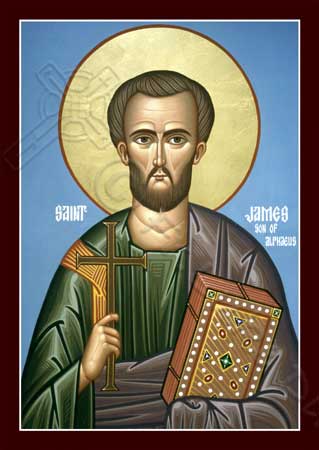 James, The Apostle – (Hebrew Yakob; N.T. Greek Iakobos)
Son of Zebedee and Salome, and brother of John the Apostle.
July 25
It was surely no coincidence that James and his brother John were sons of a fisherman and made their living off the Sea of Galilee. To live near and fish on a lake of that magnitude requires strength, knowledge, understanding, and at certain times of the year, bravery. It also takes fortitude, attention to detail, and temperance. Without all those qualities one could end up seriously hurt or worse yet, tangled in nets sinking to the bottom of the lake. James wasn’t alone in his calling – three others with whom he shared communal life were likewise called by Jesus to follow Him. Eventually they were even called upon to proclaim all they saw to the world. (Simon) Peter and Andrew who were coworkers, and his brother John were also called to follow Jesus around the same time as James. Jesus gathered together those He could trust who would witness the miracle of God’s love.
James was only one of three people Jesus invited to pray with Him in the Garden of Gethsemane. It was there James witnessed the transfiguration and was himself transformed in mind and spirit.
Saint James the apostle is sometimes referred to as the Greater to distinguish him from James the son of Joseph (who is sometimes called James the Lesser). Called to serve, he became a trusted friend and was instructed to serve and love those who followed our Lord. But there is more to James than his being a saint or follower of Jesus – he was first and foremost a hard worker, a friend, and a companion.
James was the first of the 12 apostles to be martyred for the newly forming community of believers. He was killed on the order of King Herod Agrippa I of Judea, about 44 A.D. (Acts 12:1-2) “1- It was about this time that King Herod arrested some who belonged to the church, intending to persecute them. 2 – He had James, the brother of John, put to death with the sword”.
Though we do not know much about the life of James the Greater, we know he was a man trusted by our Lord and he died for the early church. His strength and wisdom continue to guide and direct us all.
St. Benedict of Nursia
St Benedict was born around the year 480. He was the son of a Roman noble of Nursia and the twin brother of St. Scholastica. St. Benedict spent his childhood mainly living in Rome with his parents where he attended school until he reached his higher studies. He gave up life with his parents and their wealth, giving his books away and leaving Rome to seek a place where he might manage to attain the Holy purpose he had in mind of only serving God. It is supposed he left his childhood home in about A.D 500 aged about 19-20 years old. Benedict took with him his nurse as a servant and set off to leave the city. Benedict and his nurse settled in Enfide, close to a church which was dedicated to St. Peter, and in some way was associated with a company of virtuous men who shared the same sympathies, feelings, and views of life.
Enfide is in the Simbrucini mountains, about forty miles from Rome and two miles from Subiaco. It was there at Enfide where Benedict worked his first miracle by restoring to perfect condition an earthenware wheat-sifter which his old servant had accidentally broken. This miracle brought Benedict notoriety and this, in turn, drove Benedict to further withdraw from social life. He fled secretly from his old nurse and sought the more retired district of Subiaco.
Now Benedict chose to live the poor life and for the sake of God decided to take up a life of hardship, weariness and labour.On his way from Enfide, Benedict met a monk, Romanus, whose monastery was on the mountain above the cliff overhanging a cave. Here Benedict and Romanus discussed Benedict’s purpose for coming to Subiaco, and it was there that he received the monk’s habit. For a period of three years on the advice of Romanus, Benedict lived the life of a hermit and unknown to men in a cave above a lake. Romanus continued to serve Benedict in any way which he was able and visited the monk regularly. On set days would bring him food.
During these three years of solitude Benedict matured both in mind and in body. He gained much knowledge both of himself and also of his fellow men, and over time became known to and respected by those who knew him., to the extent that when an abbot of a monastery in the neighbourhood died, the community begged Benedict to become the new Abbot of the monastery. Benedict knowing the ways of the monastery life and its discipline, knew that it would be difficult to get all to live in harmony. He eventually Benedict consented, and after a period of time of managed things with their entreaty. Sadly the experiment failed after certain of the monks tried to poison, because they found his rule to be too strict.
He returned to living in his cave. From this time forward the miracles of Benedict seemed to happen frequently and many people, attracted by his sanctity and character, came to Subiaco to be under his guidance. For these Benedict built twelve monasteries in the valley and allocated to each one a superior and twelve monks. Benedict then built a thirteenth monastery in which he lived with a few chosen whom Benedict believed would profit and be better instructed by his presence. Although living in the thirteenth monastery, Benedict remained the Father and Abbot of all the monasteries and with the establishment of these monasteries began schools for children; amongst the first to be brought were Maurus and Placid.
The Reminder of Benedict’s life was spent realizing the ideal of monasticism and this is what became known as the Rule of St. Benedict, which is still followed in many monastery orders even today.
St, Benedict died of a fever on 21 March 543 or 547 in Monte Cassino, not long after the death of his sister St. Scholastica. He died on the day on which God had told him he was going to die, and Benedict was buried with his sister.
Benedict was named in 1964 by Pope Paul VI as the patron protector of Europe, and then in 1980 Benedict was declared co-patron of Europe by Pope John Paul II.
No Explanation Necessary~ by Fr. Bryan Wolf
“Now Thomas, one of the Twelve, was not with the disciples when Jesus came. So the other disciples told him, ‘We have seen the Lord.’ But Thomas said to them, ‘Unless I see the nail marks in his hands and put my finger where the nails were, and put my hand into his side, I will not believe.’ A week later his disciples were in the house again, and Thomas was with them. Though the doors were locked, Jesus came and stood among them, and said ‘Peace be with you.’ Then he said to Thomas, ‘Put you finger there. See my hands. Reach out and put your hand into my side. Stop doubting and believe.’ Thomas said to him, ‘My Lord and my God.’ Then Jesus told him, ‘Because you have seen me, you have believed; blessed are those who have not seen me and yet believe.'” ( John 20:24-29 )
We have all heard the phrase, “a Doubting Thomas.” Rooted in the scripture above, it tends to come from the scientific and critical aspect of our culture. We have science to prove or disprove claims. We require evidence to make things a certainty. After all it is said, “seeing is believing.” ut in this day and age, can a faith in Jesus Christ and his deeds from oh so long ago- be rational? We have our holy scriptures and our teachings, but is this something we can hold up to the ‘litmus test’ of debate against a skeptic? A cynic? Someone who; by disaster, tragedy or death of a loved one, demands further proof from us of a loving and compassionate God? We must admit, there are days when even we ourselves, can become a “Doubting Thomas”.
First, it is important to remember Christianity is built upon faith. “For faith is confidence in what we hope for and an assurance about what we do not see.” ( Hebrews 11:1 ) The First Chapter of the Book of Hebrews goes on to serve up as evidence, all those who have lived by faith… Moses, Noah, Abraham, Isaac, Jacob, Sarah… the list goes on and on. For if we are Christians, we truly do, “…walk by faith, not by sight.” ( 2 Corinthians 5:7 ) Life is full of uncertainty. The key is, to surrender ourselves to our faith.
“For to have faith, we must also have doubt. We must become like Thomas…” – Thomas Merton. Merton (b.1915-d1968) was a mystic and social activist, as well as a Cistercian Trappist monk. He wrote more than seventy books on spirituality, including his autobiography – The Seven Story Mountain, a New York Times best seller. From it, he writes, “Faith means having doubt, not the suppression of doubt. The only way to fully overcome you doubt is to live through it. Someone who says they have no doubt, cannot be a person of faith.” Merton agreed with Saint Paul, “To have faith, is a gift from God.” ( ref. Ephesians 28 ) And even centuries earlier, Saint Augustine agreed, “Doubt is but an element of faith.”
In his book, Threshold of Hope, Saint John Paul II wrote; “We must be allowed to have doubt. To search for God and truth on our own terms. To do this is nothing but a manifestation of the grace of the Holy Spirit at work. Questioning God, reveals your faith in him.”
It seems paradoxical; for clerics, religious, or even firm Christians to admit they have doubt. To question faith, even to dare and question God, seems like an insurmountable offense. It can be frightening. Perhaps a sign of weakness or sinful spirit; vulnerable to temptation and even rebellion. But people, good people of faith, facing critical circumstances, terminal illness or unexpected loss, wrestle with these emotions and ‘doubts’ all the time. And they need not be life-altering; even slight bump in the road can cause many of us to question. Just like Thomas. Mother Teresa often wrote of “dark periods of spiritual desolation; questioning whether God cared, loved or even existed at all.”
So when all is said and done, when all is really questioned and considered, we do end up sometimes being Thomas. It is then however, that we must surrender ourselves to our faith. For it is our faith upon which we build everything else. It is on our faith that we fix upon our most trusted and inspired promise given to us by our Lord, Jesus Christ: life everlasting.
Ahhh, I can sense the skeptics circling. Prove to me, there is a life everlasting. No need. Christ tells me so. I have faith enough to believe. In this, I can answer just like a most famous Dominican and yet another Thomas, Saint Thomas Aquinas. Considered one of the great teachers and early doctors of the Church, Saint Thomas said: “To one who has faith, no explanation is necessary. To one who has no faith, no explanation is possible.”
Passing the Test~The Very Rev. Lady Sherwood
Genesis 22:1-14
22:1 After these things God tested Abraham. He said to him, “Abraham!” And he said, “Here I am.” 22:2 He said, “Take your son, your only son Isaac, whom you love, and go to the land of Moriah, and offer him there as a burnt offering on one of the mountains that I shall show you.” 22:3 So Abraham rose early in the morning, saddled his donkey, and took two of his young men with him, and his son Isaac; he cut the wood for the burnt offering, and set out and went to the place in the distance that God had shown him. 22:4 On the third day Abraham looked up and saw the place far away.22:5 Then Abraham said to his young men, “Stay here with the donkey; the boy and I will go over there; we will worship, and then we will come back to you.” 22:6 Abraham took the wood of the burnt offering and laid it on his son Isaac, and he himself carried the fire and the knife. So the two of them walked on together. 22:7 Isaac said to his father Abraham, “Father!” And he said, “Here I am, my son.” He said, “The fire and the wood are here, but where is the lamb for a burnt offering?” 22:8 Abraham said, “God himself will provide the lamb for a burnt offering, my son.” So the two of them walked on together. 22:9 When they came to the place that God had shown him, Abraham built an altar there and laid the wood in order. He bound his son Isaac, and laid him on the altar, on top of the wood. 22:10 Then Abraham reached out his hand and took the knife to kill his son. 22:11 But the angel of the LORD called to him from heaven, and said, “Abraham, Abraham!” And he said, “Here I am.” 22:12 He said, “Do not lay your hand on the boy or do anything to him; for now I know that you fear God, since you have not withheld your son, your only son, from me.” 22:13 And Abraham looked up and saw a ram, caught in a thicket by its horns. Abraham went and took the ram and offered it up as a burnt offering instead of his son. 22:14 So Abraham called that place “The LORD will provide”; as it is said to this day, “On the mount of the LORD it shall be provided.”
When we have times in our lives of severe hardship or difficulties, Illness, bereavement, debts, homelessness,or employment issues ,it can be all too easy for us to either blame God or to think God has abandoned us. But this is far from the truth. As true Christians and children of God we should know that our Father in heaven loves us far too much to abandon us. Just as in the scripture above when the Lord tested Abraham’s trust and faith when he asked him to sacrifice his son Isaac, we also must from time to time have our faith and trust tested. This is because it is far too easy for us to say we love and follow the Lord when we are in the good times and all is going well. It is in the difficult and trying times when we prove to our heavenly Father that we are indeed sincere in our relationship with him and as such, at times we need to be tested. Abraham shows us by his actions just how strong his love and faith in God truly was and we should strive to be likewise.Even the hard times that may not in themselves be a test of faith may indeed be true blessings in disguise which the Lord will show us if we love and have true faith in him as our heavenly father and saviour. An example of this from my own life is that I was brought up in an extremely abusive family, where I was put in care and forgotten as I was not loved and wanted. I was placed in horrid places with locked doors at aged 10 because they mistook my young age temper tantrums as bad instead of realising I was hurting inside. Everyone always treated me as a nuisance to the world. However my love and faith even at that young age was strong and I knew in my heart that the Father loved me and had plans for my life.Yes, I went through years of illness and trauma, but no matter what, my faith remained, and in fact heightened. The Lord showed me the hate and dischord that was in the world, and I knew more and more as I grew older that I was being called to show the Father’s light of love to those we as human’s have placed in darkness by hardening our hearts. I remained strong in my faith and the Lord brought me to a place where now I can do that which the Lord has called and prepared me to do for his people. Although not the same test as was given Abraham, it still has shown my sincere love, trust and faith in God. There has been, and no doubt there will be further, tests, but my heart will remain strong and faithful to God as did Abraham’s. The Lord will always be there eternally for each of us, we only need to trust and have faith in him and he will never fail us. So we should accept troubles and tests with joy in our hearts. My trust and faith in our God is strong, How about yours?
E Pluribus….WHAT? Trinity Sunday
Trinity Sunday is a difficult day for priests, who often feel they have to try to explain the idea of God as Trinity. It’s sometimes an even more difficult day for our parishioners, because they have to listen to us priests, trying to explain the Trinity. It’s a difficult day for priests because we find we have to talk about God. You may think we are always talking about God, but in my experience most of us actually talk rather little about God. We talk a lot about what God wants of us. We talk even more of what God has done for us and is doing for us. That, after all, is the Gospel. But we don’t talk very much about who God is. Perhaps they leave that to the liturgy and the hymns, which probably do it better than sermons usually can.
Have you ever tried to express your feelings when you feel something very deeply? That’s what usually happens when we talk about God, really talk about God, actually trying to say who God is – this is one of those times when language fails us. The only words you can find are terribly makeshift, totally inadequate, and not at all what you want to express, but you must use what you’ve got and try to express yourself. Not to say anything would be worse. You must say what you can and hope the words point to what you can’t really say. So it is with the Trinity. There are several Christian ways of trying to say who God is. The one that says the most about God is the one we use in the creeds, when we say we believe in God the Father, God the Son and God the Holy Spirit. God is those Three and the Three are one God. The Christian shorthand for that is: God is Trinity. But if that says the most about God, it is also the most difficult thing Christians say about God.
How to explain the Trinity? We haven’t done that yet, simply because we can’t wrap our heads around the concept. The story is told of St Augustine of Hippo, the great philosopher and theologian. He was preoccupied with the doctrine of the Trinity. He wanted so much to understand the doctrine of one God in three persons and to be able to explain it logically. One day he was walking along the sea shore and trying to understand just how one God can be in three persons. Suddenly, he saw a child all alone on the shore. The child made a hole in the sand, ran to the sea with a little cup, filled her cup with sea water, ran up and emptied the cup into the hole she had made in the sand. Back and forth she went to the sea, filled her cup and went and poured it into the hole. Augustine drew up and said to her, “Little child, what are you doing?” She replied, “I am trying to empty the sea into this hole.” “How do you think,” Augustine asked her, “that you can empty this immense sea into this tiny hole and with this tiny cup?” She answered back, “And you, how do you suppose that with your small head you can comprehend the immensity of God?” With that the child disappeared.
The doctrine of the inner relationship of the Father, Son and Holy Spirit in such a way that each of them is fully and equally God, yet there are not three Gods but one, cannot be fully comprehended by the human mind. It is a mystery. But, we continue to try. St. Patrick certainly did it his best. He gave us a visual example in the shamrock or three leaf clover. As the shamrock is one composed of three, so, he said, is the Trinity: Three in One and One in Three. In the story of salvation we usually attribute creation to the Father, redemption to the Son and sanctification to the Holy Spirit. Nevertheless, though they are distinct as persons, neither the Father nor the Son nor the Holy Spirit ever exists or acts in isolation from the other two persons of the Godhead, just as a three leaf clover without all three leaves is incomplete.
If we expected today’s readings to give us a clear and elaborate presentation of the doctrine of the Blessed Trinity, we have found out that they simply do not. The doctrine of three persons in one God, equal in divinity yet distinct in personality, is not explicitly spelled out in the Bible. In fact the very word “Trinity” is not found in the Bible. Early Christians arrived at the doctrine when they applied their God-given reason to the revelation which they had received in faith. Jesus spoke about the Father who sent him (the Son) and about the Holy Spirit whom he was going to send. He said that the Father had given him (the Son) all that he has and that he in turn has given to the Holy Spirit all that he has received from the Father. In this we see the unity of purpose among the three persons of the Trinity.
We believe in the Triune God, and to embrace a doctrine we cannot fully comprehend or explain. It is another thing entirely to base our understanding of God on what we see God doing. So, let me make the most important statement about the Trinity that I can make, and that is — Our understanding of the Trinity, or as much as we can understand of the Trinity, is based on what we see God has done and is doing in the world. Let me give you some examples.
In the Old Testament, God is Creator of both the world, and of the nation of Israel through whom he will bless the world. Of course, God is present as Spirit, and the Messiah is both prophesied and foreshadowed in various theophanies (appearances of God, such as the angel who wrestles with Jacob). But primary on the stage of the unfolding drama of the Old Testament is the God of Israel, Yahweh, El-Shaddai, Elohim, Adonai, and all the other names by which God is called and worshipped.
In the New Testament Gospel accounts, the emphasis is upon Jesus — his birth, his baptism, his message, his life, his death, and his resurrection. But God the Father approves his Son, and the Holy Spirit descends upon — anoints — Jesus for ministry.
In the New Testament Book of Acts and the epistles, the Holy Spirit is at the forefront, equipping, enabling, guiding, empowering the early church. In the Book of Revelation, God the Father, Son, and Spirit are all present, each featured in a way that is both consistent with the Old Testament, witnesses to the New Testament, and brings fully into being the Kingdom of God in its closing chapters.
Okay, that surveys the “What is the Trinity?” question, even though I am sure you probably have more questions now than when we began. But to keep this from being merely an academic exercise, we need to turn our attention to “Why do we care?” This is what’s important and what we need to understand. Doctrine is important, but doctrine comes from the lived experiences of God’s people as they interpret the work of God in the real world. First, the reason we should care about the Trinity, and be aware of the uniqueness of the One-in-Three and Three-in-One is this: Without a balanced view of all three persons of the Trinity, we can misinterpret the work of God in this world. For instance, if we emphasize some aspects of God in the Old Testament, and subordinate Jesus and the Spirit, then we come away with a picture of a god of wrath and judgment, who has little compassion. One very well known Baptist preacher did just that after the tornadoes in Oklahoma last week, when he compared the tornadoes that hit Oklahoma with the story of Job who lost all of his children to a mighty wind that collapsed Job’s house. If we emphasize the person of Jesus to the exclusion of God the Father and the Holy Spirit, we miss out on the fact that God sent Jesus because “God so loved the world…” The purpose of God is to redeem the world, not just the individuals in it. Salvation is the work of God, and that salvation extends not just to individuals but to God’s creation as well. Another famous and trendy preacher was quoted as saying that Jesus is coming back to burn up the world, so he can drive a huge SUV because he’s not worried about this physical earth. Not a good theological position, in my estimation. Finally, if we emphasize the Holy Spirit, and the charismatic experiences and gifts of the Spirit, it it is easy to loose sight of God as Creator, Son as Redeemer, and the role that the Holy Spirit played and plays in both of those aspects of God’s work.
Who is God? He is our heavenly Father who made us, takes cares of us and calls us his dear children.
Who is God? He is Jesus Christ who gave his life on the cross to re-establish our relationship with God. He reveals the way to God and to eternal life.
Who is God? God is the Spirit in you giving you faith in God and guiding you in your daily walk as a Christian.
Faith in the Triune God acknowledges the might and majesty of God but at the same trusts in a God who cares. Amen.
Towers to Heaven?
The Tower of Babel in Genesis 11:1-9 is one of those Bible stories that we tend to learn as children and rarely revisit. We remember the unsuccessful effort of the people to build a tower to heaven so they could get to God. Perhaps we were even given the chance to color this tower or build one with Popsicle sticks and glue. The lesson I remember learning from this as a child is that God punished the tower builders by making life more difficult for them. What is your memory from your first hearing of the Tower of Babel?
I am very grateful for the spiritual discipline of daily Bible reading which gives me the opportunity to return to stories like the Tower of Babel and bring my adult sense to bear on its meaning. The lesson I draw from it now is different from my Sunday school days.
What I find now in Genesis is an endearing depiction of both people and God as we figure out how life in community is going to work.
When the story starts, all people share one language with the same words. The people set about building a city and conceive the idea of building a tower by which they will “make a name for” themselves. Their fear is, if they don’t do this, then they “shall be scattered abroad upon the face of the earth” (Genesis 11:4). However, this tower building provokes exactly that response from God.
Seeing the city and the tower, God concludes, “This is only the beginning of what they will do; nothing that they propose to do will now be impossible to them.” God’s solution to limiting possibility is to “confuse their language so that they will not understand one another’s speech” and to scatter them abroad over the face of all the earth.
What are we to make of this encounter between God and us?
I find in the Tower of Babel an encouraging indication of how God holds together our unity and our diversity as God’s creation — God’s children. In order to keep us humble — that is, knowing that we are human beings and not God — God ends the period of one language. God then establishes within humanity the same diversity that was given to all creation in the opening chapters of Genesis, a wealth of variety that remains throughout Scripture.
In a nutshell – the key to humility is diversity. Wow!
Of course, God provides unity for human beings after restoring the covenant with us through Jesus’ death and resurrection. On the day of Pentecost in Acts 2, the inspiration of the Holy Spirit brings one understanding even as the people from different nations across the world continue to speak and hear their own language. Here is an amazing moment of both unity and diversity held together by God’s loving Spirit at work in us.
Of course, language is not the only thing that is different about people. We have come to understand that God has endowed human beings with diversity in race, gender identity, sexual orientation, culture and perspective. Future generations may discover other realms of diversity still not revealed to us. And the Holy Spirit gives us the means by which we find unity even as we delight, as God does, in such variety.
This is how the parable of the Tower of Babel informs my faith.
Divine Mercy~by Fr. Bryan Wolf
“I desire to grant unimaginable graces to those souls who trust in My mercy. Even a sinner most hardened, if only once recite the Chaplet, he will obtain grace from My infinite mercy.” The Diary of Sister Mary Faustina
The Sunday after Easter has been designated Divine Mercy Sunday, a devotion actively promoted by Pope John Paul II before his death and instituted edictally by him in 2000 when he Canonized Sister Mary Faustina a Saint. In fact it was Pope John Paul II, when being Archbishop of Krakow in 1965 began the informative process to certify the testaments of Sister Faustina.
Born in 1905 Maria Faustina Kowalska, became a nun at the young age of 20 after relating her many visions of a suffering Christ she had through her childhood and adolescents. So passionate were her claims that, even without much formal education, she so moved superiors to admit her to the Convent of the Sisters of Our Lady of Mercy. There in 1931, after having been diagnosed the year before with tuberculosis, she records in her spiritual diary of having mystic visitations from Jesus; who she described as appearing to her as the “King of Divine Mercy.”
In her diary, Sister Faustina details how Christ delegated to her a sacred mission to have people implore His Divine Mercy. Jesus commanded her to have painted His image, as it appears in Divine Mercy representations. Jesus told her to accompany the image with the prayerful words, “Jesus, I trust in you.” Lastly Jesus inspired Sister Faustina to compose a simple prayer that He begged people recite- The Chaplet of Divine Mercy. “Whoever will recite it will receive great mercy at the hour of death. When prayed in the presence of a dying person, truly I shall stand between them and My Father not as a judge, but as the Merciful Savior. Even a sinner most hardened, if only once recite the Chaplet, he will obtain grace from My infinite mercy. Truly I tell you, the greater the sin- the greater claim they have to My mercy and justice.”
This final thoughts are the ones that strike me as the most profound. No matter what transgressions, how far removed we might feel from the promise of salvation because of our own failings- through His Divine Mercy and the Chaplet to pray, Christ assures us of His infinite mercy. This is key.
Without doubt many of us- dare I say all of us, fall short in our desire to be a good Christian. We may pray, attend church and even do good works- but the road is narrow and difficult. Our tempers get the best of us. Pressed for time, our religious responsibilities become moved to “the back burner”. We procrastinate ( I know I do, often ) and waste away time on things that seem important at the moment and then, truly are not at all.
But through Sister Faustina, Christ tells us He knows this. He understands this. “Tell them to surrender to My mercy and to call upon Me. To trust in Me and My infinite mercy.” Almost knowing there would be many who will not even find the time or ability to recite the prayerful Chaplet, Jesus inspired Sister Faustina to record the one sentence summation- “Jesus, I trust in you.”
Furthermore, I am struck by the investigation of then Archbishop Wojtyla ( Pope John Paul II ) where he considers the writings of Sister Faustina and her claims of mystical visitation. “I feel obliged to believe. For one so simple, so inwardly reflective- ( Sister Faustina ) possessed a great knowledge. She knew of the Trisagion without any formal exposure. Indeed, Our Lord has spoken to her.” The Trisagion ( Holy Three Times ) is an introductory prayer of sorts used in the Divine Liturgies of the Eastern Orthodox and Byzatine Rite Churches. It are these words, “Holy God, Holy Mighty One, Holy Immortal One” that were written by Sister Faustina to conclude the Chaplet of Divine Mercy. Archbishop Wojityla discovered that these words dismayed Sister Faustina as she found them obscure, thought this evidence that Jesus desired to unify the many Christians religions unto himself. ( We ourselves should take example from the devotion of Pope John Paul II to Sister Faustina and The Divine Mercy Chaplet, as he himself today is to be Canonized Saint by Pope Francis.)
Sister Faustina died from her illness at the young age of 33, the same age as our Savior. She left us a beautiful prayer and legacy to impart Christ’s mercy upon even the most stubborn of us. In all the hectic moments of our day- in the constant whirlwind of unimportant things that seem to demand our attention, we are offered a moment of pause and reflection. A sublime prayer that offers up the Divine Mercy of Christ himself, as King of Divine Mercy, to stand- not before us, but with us- at our hour of greatest need.
“Eternal Father, I offer you the Body and Blood, Soul and Divinity of your dearly beloved Son, Our Lord Jesus Christ, in atonement for our sins and those of the whole world. For the sake of His sorrowful Passion, have mercy on us and on the whole world. Holy God, Holy Mighty One, Holy Immortal One, have mercy on us and on the whole world.” ( The basic foundation of The Divine Mercy Chaplet, though structure and recited to accord with Rosary beads. )
“Eternal God, in whom mercy is endless and the treasure of compassion inexhaustible, look kindly upon us and increase your mercy in us; that in difficult moments we might not despair nor become despondent, but with great confidence submit ourselves to your Holy will- which is love and mercy itself. Amen.”
 The Order of Preachers, Independent
You must be logged in to post a comment.