
Category: Sermon

So You Need Healed? ~ The Rev. Deacon Scott Brown, OPI

OLYMPUS DIGITAL CAMERA
2 Kings 5:1-3 New International Version (NIV)
Naaman Healed of Leprosy
5 Now Naaman was commander of the army of the king of Aram. He was a great man in the sight of his master and highly regarded, because through him the Lord had given victory to Aram. He was a valiant soldier, but he had leprosy.[a]
2 Now bands of raiders from Aram had gone out and had taken captive a young girl from Israel, and she served Naaman’s wife. 3 She said to her mistress, “If only my master would see the prophet who is in Samaria! He would cure him of his leprosy.”
2 Kings 5:7-15 New International Version (NIV)
7 As soon as the king of Israel read the letter, he tore his robes and said, “Am I God? Can I kill and bring back to life? Why does this fellow send someone to me to be cured of his leprosy? See how he is trying to pick a quarrel with me!”
8 When Elisha the man of God heard that the king of Israel had torn his robes, he sent him this message: “Why have you torn your robes? Have the man come to me and he will know that there is a prophet in Israel.” 9 So Naaman went with his horses and chariots and stopped at the door of Elisha’s house. 10 Elisha sent a messenger to say to him, “Go, wash yourself seven times in the Jordan, and your flesh will be restored and you will be cleansed.”
11 But Naaman went away angry and said, “I thought that he would surely come out to me and stand and call on the name of the Lord his God, wave his hand over the spot and cure me of my leprosy. 12 Are not Abana and Pharpar, the rivers of Damascus, better than all the waters of Israel? Couldn’t I wash in them and be cleansed?” So he turned and went off in a rage.
13 Naaman’s servants went to him and said, “My father, if the prophet had told you to do some great thing, would you not have done it? How much more, then, when he tells you, ‘Wash and be cleansed’!” 14 So he went down and dipped himself in the Jordan seven times, as the man of God had told him, and his flesh was restored and became clean like that of a young boy.
15 Then Naaman and all his attendants went back to the man of God. He stood before him and said, “Now I know that there is no God in all the world except in Israel. So please accept a gift from your servant.”
People in pain want help. Whether that pain is from emotional or physical scars. Jesus encountered people in pain all the time such as the man the leprosy and the sick servant of a Centurion in Matthew 8:1-13. These people were desperate. So was an Old Testament character by the name of Naaman. He was in need of healing. And he was healed in a rather unusual way. That way and that healing changed his life forever.
Naaman was the “Chairman of the Joint Chiefs of Staff” of his day. The military leader of one of the region’s most powerful nations, he was a definite candidate for Who’s Who in the World. He was the cream of the crop, lived among the upper crust, and caroused among the elite. The Bible says, “Naaman, commander of the army for the king of Aram, was a great man in his master’s sight and highly regarded because through him, the Lord had given victory to Aram. The man was a brave warrior . . .” (2 Kings 5:1). Did you hear those descriptive words? Don’t we all want people to use them of us? Commander. Great. Highly regarded. Victorious. Valiant. Here was a man that had power, position, and prestige. He was successful. He was a winner. He was wealthy. He was a hero. He was respected. He was admired. He was envied.
“But” – a three-letter conjunction. That small word changes everything.
Notice how first one concludes. “. . . but he had a skin disease” (2 Kings 5:1). He could think about all of his accomplishments; he could enjoy his power and position and prestige; he could admire his home and his wealth; but they all seemed to vanish as he stared into the mirror each day. Each time he looked at himself there was something looking back that defined his life. He was a leper, and nothing could change that fact.
The fact is Naaman was a leper. They were outcasts – the original untouchables. They were forced to wear torn clothing and shout, “Unclean, unclean!” anytime they encountered an uninfected person. Leprosy was the most feared disease of the day. It was extremely contagious and, in many cases, incurable. In its worst forms, leprosy led to death. Granted, Naaman’s leprosy was probably in its infant stage or a mild form. He had concealed it, but now his clothing would not cover it up. While people treated him respectfully, now nobody would touch him. The lack of touch hurt Naaman deeply. Can you imagine stumbling through life without being touched? Without someone holding your hand when you are lost? Without someone rubbing your back when it is sore? Without someone slapping you on the shoulder for a job well done? Without being embraced after being gone on a two-week business trip?
Naaman did not have to imagine. It was reality. His leprosy was his birthmark.
By the way, what is your hideous birthmark? What is your leprosy? What problem are you trying to conceal? What hurt are you trying to cover up? What prevents you from getting close to other people? Where do you need to be touched?
We, too, like Naaman have our disfigurements. We, too, have become very proficient in covering up our problems. We, too, need God’s healing touch. We, too, like the ol’ spiritual says, “It’s not my brother or my sister, but it’s me, O Lord, standing in the need of prayer.”
o what do we do? Where do we find help? Where do we go for healing? In a word, we go down. While down is contrary to the direction we are encouraged, challenged, and even rewarded to go in our world, down is the way we must go if we are to find healing. Down is the route we must take if we are going to feel the touch of God.
Notice the contrasts in Naaman’s journey. Naaman, the commander-in-chief, finds direction through a captive servant – his wife’s slave. Naaman, the conqueror, finds help in a conquered nation – Israel. Naaman, the highly regarded man, learns of his treatment from a lowly prophet – Elisha. Naaman, the wealthy and valiant soldier, is cured in a dirty river – the Jordan.
What can we learn from this downward descent?
- We need people in our lives who look past our haughtiness to see our hurt.
Naaman’s wife’s servant had been taken hostage from an Aramian raid into Israel. Now she served in Naaman’s home tending to his wife’s every need. She was not intimidated by Naaman’s power, position, or prestige. She saw his pain. Called it by name. Knew of a pain reliever. And told Naaman where he could find help.
- We need humble people in our lives who look past us …
… who look past our job titles, our bank accounts, our cars, and our houses – and see our loneliness and our need and our hurt. We need people who will touch us at our point of need. We need people who will call our problems like they see them. We need people who see our blind spots. We need people in our lives who love us enough to not let us make stupid mistakes.
- We need people in our lives who will demonstrate the four C’s of loving relationships.
- Concern – speak the truth in love to us
- Commitment – walk through the pain with us
- Confidentiality – know the struggles are kept between us
- Consistency – maintain regular contact with us
In practicing these steps these trusted partners are saying, “I believe the best in you. And, I’m going to help you become the best.”
These relationships are our balcony people. Everybody has balcony people and basement people in their lives. Basement people drag you down. Balcony people lift you up. Who are the balcony people in your life? Who are the people that are pulling you up? Who are the people that believe the best about you and are helping you become your best? Who are the people that look beyond your outward appearance and see your inward hurt?
- We need places in our lives that will provide us with safety and security.
Israel was a conquered nation. To Naaman it was a second rate, third world country. What did it have to offer? Militarily it did not present much of a threat, but spiritually it provided refuge.
You’ve seen those homes in your neighborhoods that have a poster of a white hand on a red background that is positioned in their front windows. The sign indicates to lost and confused children that this is a place of safety. If they are in danger, the children know that if they can get to the home with the hand in the window they will find a touch of a caring adult that will protect them from harm. As an adult that safe place has become my church. Church is more than a building. It is a place to speak to God and to hear from God. And, if you are honestly seeking to feel the touch of God, you will discover it. The fact is that many people come to the right place each Sunday – the church, but speak to the wrong person. They come to impress their friends with the money they have, to astound their classmates and pew mates with the clothes they wear, to amaze the pastor with the credentials they possess, and all the while miss the main event. They talk to their friends, to their classmates, even to the pastor. Don’t misunderstand there is nothing wrong with talking with these people. It is right that we do. But, if that is all we dialogue with, we have missed talking to the right person – God. In fact, it is becoming increasingly easy in western Christianity to come to church and not pray a prayer to God, or sing a song to God, or hear a word from God. Christian worship has given away to religious theatrics. Entertainment has replaced experience. By the way, do you talk to God when you go to church? He is the one who wants to heal you. To touch you. To scoop you in his arms and hug you. To heal you! Allow God to heal you of whatever ails you, whatever disfigures you, and whatever you keep hidden from the rest of the world. Open your heart to his healing love.
Lord in your awesome wisdom, please heal us of our disfigurements and what we feel makes us “untouchable”. Allow your Church to be the great physician, the doctor of the body and soul. Take away our physical and emotional scars and show us your healing love. In Jesus name we pray; Amen

How Long, O Lord, How Long??? ~ The Rt. Rev. Michael Beckett, OPI

In today’s Old Testament Reading, we hear the prophet lament:
How long, O LORD? I cry for help but you do not listen! I cry out to you, “Violence!” but you do not intervene. Why do you let me see ruin; why must I look at misery? Destruction and violence are before me; there is strife, and clamorous discord. Then the LORD answered me and said: Write down the vision clearly upon the tablets, so that one can read it readily. For the vision still has its time, presses on to fulfillment, and will not disappoint; if it delays, wait for it, it will surely come, it will not be late. The rash one has no integrity;
but the just one, because of his faith, shall live.
How many times have we heard, “I’ve been through alot this past year and I’ve always wanted to believe in God.. I’ve tried.. but I don’t understand why there’s so much suffering in the world.. why do people beg and plead and pray to God to not let loved ones die.. and they die anyway? What kind of God would allow that? The horrific things people go through and see while praying to God for help.. I don’t get it and saying it’s a part of God’s plan or you just have to have faith doesn’t work for me either.. I’ve prayed about it and listened and tried to understand but I just don’t.. I’m an open-minded person and I respect everyone’s beliefs but I’m just not able to accept that a loving God would let good people suffer.”?
This question is as old as humanity. First of all, God does not ‘give’ us the terrible, horrible, no good, very bad things that happen in our lives. Life happens. Crap happens. People make poor choices. Natural disasters occur. We get sick. Nowhere does Holy Writ support the claim that any of these things is God’s doing. What kind of God would we worship if he, indeed, sent us all the trials and tribulations and suffering and horror for which He is blamed?
We have to remember that, even though God is firmly in control, Satan has power and he fights against our Lord. Ephesians 2:2 says: “And you were dead in the trespasses and sins in which you once walked, following the course of this world, following the prince of the power of the air, the spirit that is now at work in the sons of disobedience” (Ephesians 2:1–2, emphasis added). In this text the apostle Paul describes Satan first as a “prince” with power, because he has authentic power in the world (1 John 5:19). This power has been given him by God (Luke 4:6). Satan has power over some illnesses (Luke 13:16; see also 2 Corinthians 12:7—it’s unknown if Paul’s “thorn” was an illness or something else). In some sense, Satan has power over death (Hebrew 2:14). The reason Satan is called a prince rather than a king is because there is only one King—Jesus Christ (1 Timothy 6:15).
Satan also has power over some people. The “sons of disobedience” referred to in Ephesians 2:2 are those who have not trusted Christ as Lord and Savior (cf. Acts 26:18; 2 Corinthians 4:4; Revelation 13:12). The demons are also under the rule of Satan (Matthew 12:24), and one of his titles is “prince of demons” (Matthew 9:34). Satan has a kingdom (Matthew 12:26) and a throne (Revelation 2:13). Satan is called a prince because he is a ruler and possesses power to manifest evil in the world through influencing people and commanding demons.
“The air” in Ephesians 2:2 may refer to the invisible realm above the earth where Satan and his demons move and exist. This space, of course, is the location of the earth’s atmosphere or “air.” In Ephesians 6:12, Paul writes, “We do not wrestle against flesh and blood, but against the rulers, against the authorities, against the cosmic powers over this present darkness, against the spiritual forces of evil in the heavenly places.” This evil realm called the “air” could be an actual locality, but it could also be synonymous with the “world” of John 12:31. This whole world is Satan’s domain (Matthew 4:8–9).
Although Satan has power and authority in the current world system in which we exist, his power is limited, always under the sovereign control of God (Job 1:12), and it is temporary (Romans 16:20). God has not revealed all of the why’s and when’s concerning Satan’s rule, but He has made it clear that there is only one way to escape the power of Satan’s dominion, and that is through His Son, Jesus (Acts 26:18; Colossians 1:13–14). It is Jesus who, speaking of the impending cross, declared victory: “Now the prince of this world will be driven out” (John 12:31).
Now, when Satan has so much power, what are we left with? The Bible DOES say that that he will, when we are suffering temptation provide a way of escape (1 Cor. 10:13). But never does it say that God will not give us more pain and suffering than we can handle.
Many Christians have suffered to the point of death at the hands of executioners, (consider the Holy Martyrs.) Many suffer to the point of death at their own hands. All we can say is that “the sufferings of this present time are not worth comparing with the glory that is to be revealed to us” (Romans 8:18). This may not solve our depression, but it does give us perspective. Even if our depression has caused us enormous doubt, this can be helpful.
When “bad” things happen to any of God’s children, God is grieved and suffers with us, and this was experienced most vividly in the hurt and suffering of Jesus Christ for all humanity. Any “bad” thing which happens is never the last word. Rather, God is the deepest and last word, and that word is love and eternal life with God.
The Bible clearly teaches that God does not cause us to suffer. For example, the Bible says that when we go through trials, it would be a mistake to say: “I am being tried by God.” Why? Because “with evil things God cannot be tried, nor does he himself try anyone.” (James 1:13) In other words, God never causes the trials we face or the suffering that follows. To do so would be wicked, but “God does not act wickedly.” (Job 34:12.)
If God does not cause us to suffer, then who or what does? Sadly, humans are often victimized by other imperfect humans. (Ecclesiastes 8:9) Additionally, we may face calamities because of “unexpected events”—that is, because of simply being in the wrong place at the wrong time. (Ecclesiastes 9:11) The Bible teaches that ultimately “the ruler of this world,” Satan the Devil, is responsible for human suffering, for “the whole world is lying in the power of the wicked one.” (John 12:31; 1 John 5:19) It is Satan—not God—who causes people to suffer.
God is aware of our suffering. From the very start of human suffering, not a single teardrop has gone unnoticed by our loving Father, whose “watchful eyes” see everything. (Psalm 11:4; 56:8) For example, when his worshippers in ancient times were being oppressed, God said: “I have certainly seen the affliction of my people.” But was he only vaguely aware of their pain? No, for he added: “I well know the pains they suffer.” (Exodus 3:7) Many people have found comfort in that truth alone—the thought that God is aware of everything we suffer, even the trials that we or others may not be aware of or fully understand. (Psalm 31:7; Proverbs 14:10.)
God feels for us when we suffer. Our Heavenly Father is not only aware of human suffering but also deeply moved by it. For example, God was sincerely troubled when his ancient worshippers faced trials. “During all their distress it was distressing to him,” says the Bible. (Isaiah 63:9) Although God is vastly superior to humans, he feels empathy for those who suffer—as if their pain were in his heart! Indeed, “Our Heavenly Father is very compassionate and merciful.” (James 5:11) Additionally, Our Heavenly Father helps us to bear our suffering. (Philippians 4:12, 13.)
We must also remember that our Lord Jesus knows what it is to suffer, to mourn. He wept at the grave of Lazarus, he wept over Jerusalem, and he suffered horrifically during His Passion.
God will end all human suffering. According to the Bible, God will bring an end to the suffering of every human on the planet. By means of His Heavenly Kingdom, God will drastically change the human condition—for the better. Regarding that time, the Bible promises that God “will wipe out every tear from their eyes, and death will be no more, neither will mourning nor outcry nor pain be anymore. The former things have passed away.” (Revelation 21:4) What about those who have already died? God will bring them back to life here on earth so that they too can enjoy life free from suffering. (John 5:28, 29) Will anyone be plagued by painful memories of past suffering? No, for Our Heavenly Father promises: “The former things will not be called to mind, nor will they come up into the heart.” (Isaiah 65:17.)
Jesus could have come and healed Lazarus when he was still alive.
Instead, He waited to raise him from the dead when he was already in his grave.
God could have made David become king the day after he was anointed.
Instead, He waited 15 years to rise to the throne, many of those years spent fearing for his life, hiding out and running away from his own father-in-law.
God could have spoken to Moses in the desert about sending him to help free His people from slavery 40 days after he ran away from Egypt.
Instead, He made him wait for 40 long years.
God could have gotten Joseph out of prison one year after he was sentenced there.
Instead, he was stuck in that dungeon for 10 years before he was finally set free.
God could have given Abraham the son He promised him when he was still a young man.
Instead, He waited until he was 100 years old and because of physical reasons would have a more difficult time conceiving at that age.
God could have answered prayers and met the needs of these men of God much quicker, but He didn’t.
He made them wait instead.
And He often makes us do the same.
He makes us wait for healing to come after we’ve been praying for years and there is no sign of recovery.
He makes us wait to fulfill His call in our lives after He puts the desire and passion in our hearts to serve Him in a certain way.
He makes us wait to give us the desires of our hearts, whether it’s a baby, a spouse, or a new job.
He makes us wait for direction when we are stuck at a dead end and we don’t know where to go or what to do.
He could answer that same prayer that you’ve been praying for years every night in a millisecond.
That same prayer that has been bringing you to tears.
That same prayer that the longer that it goes unanswered, the more it makes you question whether He even hears.
He kept Moses in a desert for 40 years.
Joseph in a prison cell for 10 years.
Abraham without a child for 100 years.
David on the run for 15 years.
And maybe He is keeping you right where you’re at for the same reason He kept these men for so many years: to build your faith.
To build your faith in a dungeon cell, during the valley in your life where it’s too dark to see and too hard to believe.
To build your dependence on Him when you are barren and empty to see if He is truly all you desire and all you need.
To see how well you will trust and serve Him when you are still stuck in the background somewhere, doing seemingly nothing too significant for Him.
To build your trust in Him when the storm keeps raging, the battle keeps going and breakthrough and victory doesn’t seem near.
That we grow in faith.
That we learn to only depend on Him.
What are you waiting for today?
What longing do you have that seems so far from ever being fulfilled?
What prayer do you keep on praying that seems to never reach God’s ears?
I want to remind you that God is not deaf to your prayers.
He is not blind to your constant tears, to your desires, and to your needs.
IF He is making you wait, there is a very good reason for it.
If He is telling you “no” today, maybe it’s because He has a better “yes” waiting for you tomorrow.
If He is keeping you in the same place you’ve always been today, maybe it’s because He’s helping build your faith before you enter your Promised Land tomorrow.
If He is not healing you or bringing you victory today, maybe it’s because you will have a greater testimony when He waits to help you be an overcomer tomorrow.
Wherever you are at today know that God is right beside you and that there is a purpose for you. Even if that purpose is to wait.
Don’t give up just because you don’t see anything happening today.
Maybe there is nothing physically happening that your eyes can see but there is definitely something happening in the spiritual realm as you learn to rely on Christ.
Don’t allow your waiting period to make you hopeless about what tomorrow will bring.
Instead, let it build your faith and give you even greater hope for what God has prepared for you.
He made some of the greatest men of faith wait.
Don’t be discouraged if He makes you wait as well.
He will come through for you, just like He came through for them.
“Wait for the LORD; be strong and take heart and wait for the LORD.” – Psalm 27:14
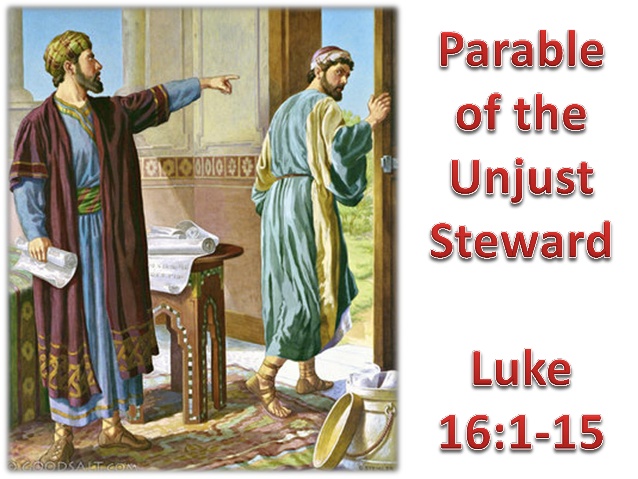
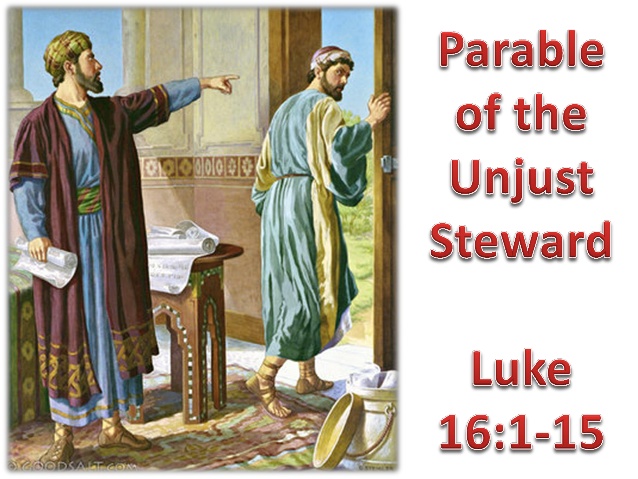
Being A True Steward for God: The Unjust Servant ~ The Very Rev. Lady Sherwood, OPI
Readings and Responsorial psalm:
Reading 1: AM 8:4-7
Responsorial Psalm: PS 113:1-2, 4-6, 7-8
Reading 2: 1 TM 2:1-8
Liturgical colour: Green.
The Parable of the Unjust Servant which we are told about in Today’s Holy Gospel readings, is not the first occasion that Jesus has used a Parable about an unrighteous person to illustrate the point which he’s telling us in regard to righteousness. The Parable of the Unrighteous Judge in Luke 18:1-8 is an example of another such case of usage. But to fully understand Jesus’ point, we need to break down the symbolism to see the true principle which is being illustrated.
The Lord in this Parable is recognized easily as being the Lord Our God. To Our Lord and Saviour, every one of us are the earthly stewards of His creation and of the blessings God our Father lovingly grants to us. When God created the earth, He gave mankind dominion over it. “Then God blessed them, and God said to them, “Be fruitful and multiply; fill the earth and subdue it; have dominion over the fish of the sea, over the birds of the air, and over every living thing that moves on the earth”” (Genesis 1:28).
A steward is a fit description of our roles upon earth. A steward owns not the things which they manage. In the same way God gives us our lives to manage, but our lives and indeed everything that we have belongs to God. “And the Lord said, “Who then is that faithful and wise steward, whom his master will make ruler over his household, to give them their portion of food in due season? Blessed is that servant whom his master will find so doing when he comes. Truly, I say to you that he will make him ruler over all that he has. But if that servant says in his heart, ‘My master is delaying his coming,’ and begins to beat the male and female servants, and to eat and drink and be drunk, the master of that servant will come on a day when he is not looking for him, and at an hour when he is not aware, and will cut him in two and appoint him his portion with the unbelievers. And that servant who knew his master’s will, and did not prepare himself or do according to his will, shall be beaten with many stripes. But he who did not know, yet committed things deserving of stripes, shall be beaten with few. For everyone to whom much is given, from him much will be required; and to whom much has been committed, of him they will ask the more” (Luke 12:42-48).
With the blessings God has granted to each and every one of us comes a varying amount of skills, talents and abilities. We each have our different given blessings to use and God expects us to use those abilities well and for God’s purpose. “As each one has received a gift, minister it to one another, as good stewards of the manifold grace of God” (I Peter 4:10). One of the major duties God has given us as Christians is the spreading of the gospel. “Let a man so consider us, as servants of Christ and stewards of the mysteries of God. Moreover it is required in stewards that one be found faithful” (I Corinthians 4:1-2).
We naturally expect that a servant entrusted with a master’s possessions and given critical tasks would be faithful in fulfilling the trust which the master placed in the servant. But how many of us are truly faithful stewards of God? Have we not all wasted precious time on the job, time that could have been profitably used in the Master’s service at some time within our lives? We have all bypassed opportunities that could have brought great profit to our Master. Instead, we often apply our talents toward things that our Master is not interested in. In short, we “all have sinned and fall short of the glory of God” (Romans 3:23). Just like the man in today’s parable, each one of us are in truth unjust stewards.
The unjust steward in today’s Parable didn’t want to work for a living; he was too lazy to put in much effort. Doesn’t that describe you and I at some stage of our life? How many of us would prefer to seek the easiest way out, the way that requires least effort from us? The unjust steward refused to beg; because he had too prideful. Here too most of us are guilty at some point of our lives.
Being forewarned that he is about to lose his job, the unjust steward brilliantly provides for himself by making use of his Lord’s resources. But note carefully that the lord doesn’t commend the mismanagement of his possessions. “So the master commended the unjust steward because he had dealt shrewdly” (Luke 16:8). Jesus is not praising his unrighteous actions. The admiration is for the brilliant planning.
We too have been warned that we don’t have much time left for our stewardship upon the earth as our earthly Life is short. It is merely passing through and will not last forever. “For what is our life? It is even a vapor that appears for a little time and then vanishes away” (James 4:14). In real terms, it won’t be long before we will have to stand before our Lord and give an account of our stewardship. “And as it is appointed for mankind to die once, but after this to have the judgement” (Hebrews 9:27). “So then each of us shall give account of ourselves to God” (Romans 14:12).
All parables are aimed toward illustrating to us a particular point. They start to break down when they are stretched too far or applied to the wrong point. In essence, Jesus is stating that the ungodly people in this world know the ways how to achieve the most from the worldly things that, in truth, they don’t even own; but, the so-called godly people don’t know how to get the most from spiritual things of God. “For the sons of this world are more shrewd in their generation than the sons of light” (Luke 16:8). The Pharisees were squandering precious resources. There were people in their midst who needed to be brought back to God and they refused to see their value.
Application
If we are to receive praises from God in the time of our Judgement, we need to make the most of the resources that God has given us, to His purpose. We are not aiming for a better life in this world because our life here is only of a transient nature. We won’t be around long to enjoy it. The only lasting treasure is our eternal heavenly home. “Do not lay up for yourselves treasures on earth, where moth and rust destroy and where thieves break in and steal; but lay up for yourselves treasures in heaven, where neither moth nor rust destroys and where thieves do not break in and steal. For where your treasure is, there your heart will be also” (Matthew 6:19-21). Importantly, what benefits God also benefits us in the long run. If we use God’s gifts to us to provide for ourselves in the hereafter, then we are not wasting our Lord’s resources; we are fufilling God’s will.
“And I say to you, make friends for yourselves by unrighteous mammon, that when you fail, they may receive you into an everlasting home” (Luke 16:9). The friends of whom Jesus is speaking are not worldly friends, but are indeed spiritual friends, for they are awaiting to receive us into our eternal heavenly home. As children of God, we need to use the things of this physical world to accomplish the spiritual goals of our Lord Jesus Christ. “Command those who are rich in this present age not to be haughty, nor to trust in uncertain riches but in the living God, who gives us richly all things to enjoy. Let them do good, that they be rich in good works, ready to give, willing to share, storing up for themselves a good foundation for the time to come, that they may lay hold on eternal life” (I Timothy 6:17-19). It is our obedience to Christ that creates a lasting friendship with him. “You are My friends if you do whatever I command you” (John 15:14).
Jesus also informs us that God is watching all that we do with the smaller things that He gives us in our judge if we are faithful enough to handle the more important things. “He who is faithful in what is least is faithful also in much; and he who is unjust in what is least is unjust also in much. Therefore if you have not been faithful in the unrighteous mammon, who will commit to your trust the true riches? And if you have not been faithful in what is another man’s, who will give you what is your own?” (Luke 16:10-12). We use this principle in business. You don’t put a young person, fresh from college or training, to be in charge of your company. You start them out on small jobs. If they can handle it, you promote the person. The fact is that people tend to behave in the same way, whether dealing with little or bigger things. A person who is willing to steal small change will have not have any restraint if an opportunity arises to steal a larger fortune. Thus, we can view this life as a test for promotion to the next and eternal life. “For to everyone who has, more will be given, and they will have abundance; but from him who does not have, even what he has will be taken away” (Matthew 25:29). If we can’t make profitable use of our borrowed lives from God, why should we be given eternal life?
The Pharisees and scribes true problem was that they were too caught up in their current lives. They had lost the true perspective. They had lost sight of the spiritual goal and had made their priority living in the earthly realm. “No servant can serve two masters; for either they will hate the one and love the other, or else they will be loyal to one and will despise the other. You cannot serve God and mammon” (Luke 16:13). Something must give. You have to make a choice regarding who you will serve.
What will you do with the earthly life God has loaned to you?
Let us pray:
God, Creator and Giver of all that is good, we thank you for our many blessings. Mindful of your generosity, we acknowledge that all that we have is from you. Daily, we offer you thanks and praise for the beauty of the earth, our work, our family and our loved ones.
In the dawning of a new day, You are with us. In each dark hour, You are here. Blessed by Your grace, we show gratitude by sharing what we have. By serving our brothers and sisters, we serve You.
As You protect and guide us on our journey, we, Your stewards, remain ever grateful for Your constant love.
Amen
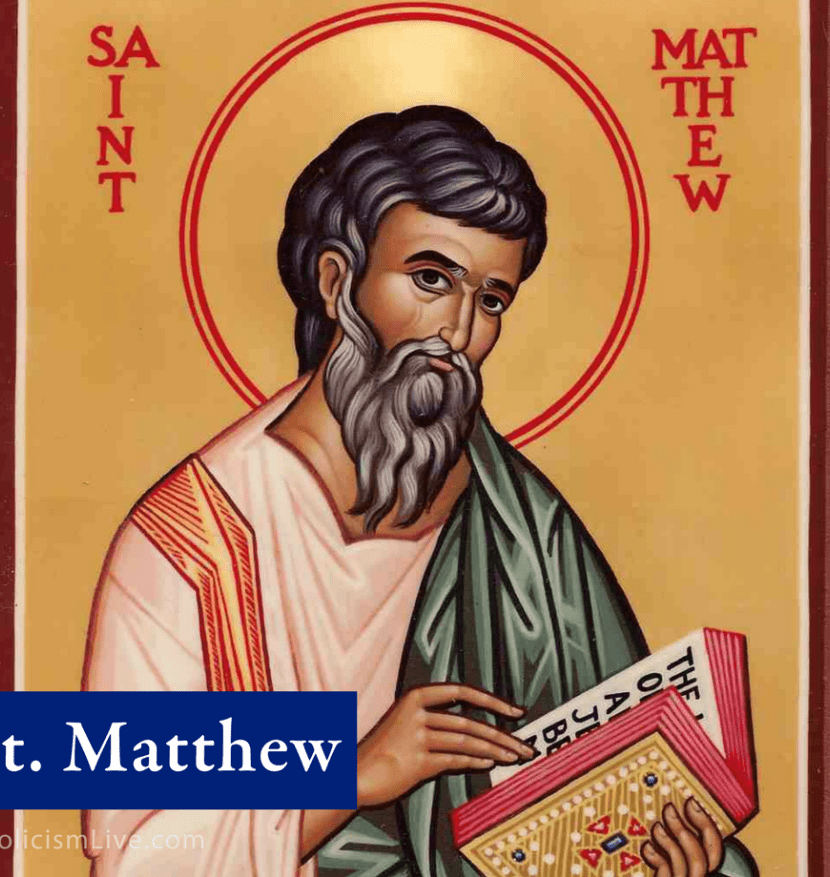
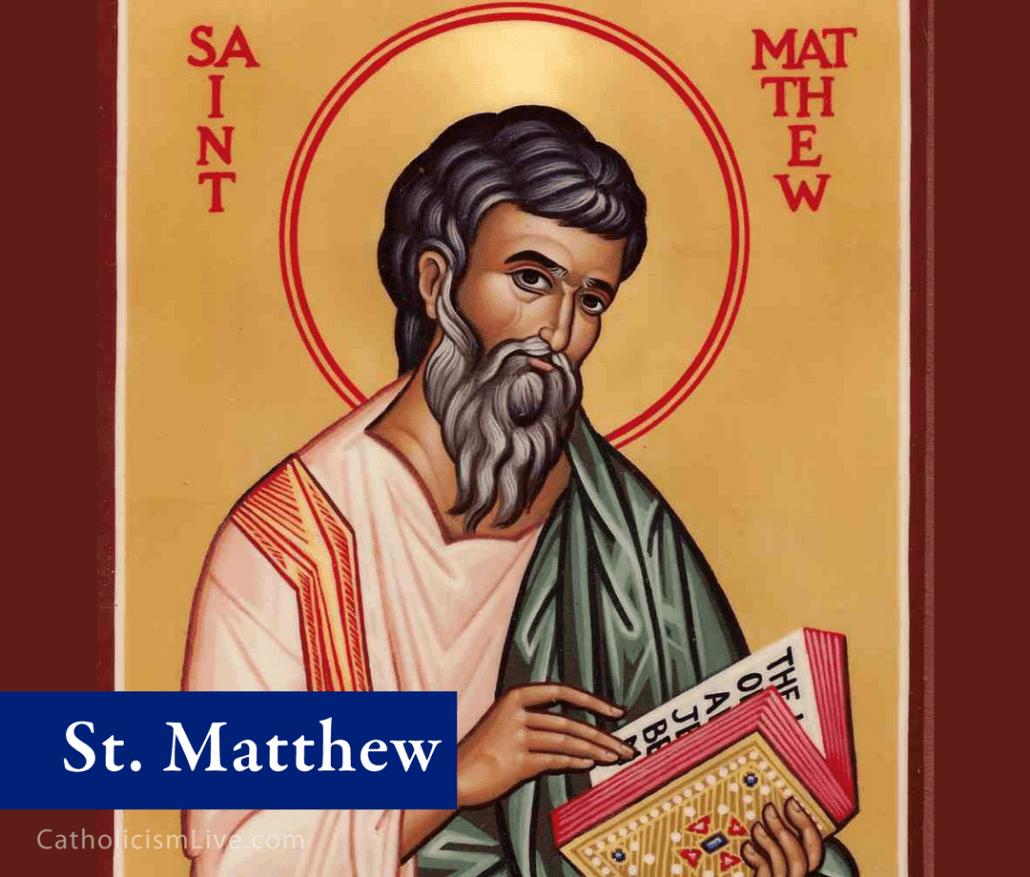
The Feast of S. Matthew ~ The Very Rev. Lady Sherwood, OPI
Liturgical colour: Red.
Reading 1: EPH 4:1-7, 11-13
Responsorial Psalm: PS 19:2-3, 4-5
Holy Gospel Reading: MT 9:9-13
The Life of St. Matthew
Before hearing the voice of Christ and leaving all to follow Him, Matthew was a tax collector. Tax collectors in those days worked for the Roman government, and were hated by the Jewish people. So Christ’s calling of Matthew represents the calling of people from even the worst walks of life. The offering of salvation to all mankind—the transforming power of the Grace of God. The Tradition says that at Christ’s call St. Matthew acknowledged his sinfulness, repaid fourfold anyone he had cheated, and he distributed his remaining possessions to the poor, and he followed after Christ. He listened to the Words of Christ, he witnessed His many miracles, and he knew from experience that this was the Son of God who had come to earth for the salvation of mankind. Having received the grace of the Holy Spirit, which descended upon the Apostles on the day of Pentecost, St Matthew preached in Palestine for several years. At the request of the Jewish converts at Jerusalem, he wrote his Gospel describing the earthly life of the Saviour, before leaving to preach the Gospel in faraway lands. His Gospel manifests itself as proof that Jesus Christ is the Messiah foretold by the prophets, and that there would not be another (Mt. 11:3). The holy Apostle then brought the Gospel of Christ to Syria, Media, Persia, Parthia, and finished his preaching in Ethiopia with a martyr’s death. This land was inhabited by tribes of peoples with primitive customs and beliefs. The holy Apostle Matthew converted some of the idol-worshippers to faith in Christ. He founded the Church and built a temple in the city of Mirmena, establishing his companion Platon as the bishop there. But the ruler did not want his people to become Christians and to cease worshipping the pagan gods. He accused St. Matthew of sorcery and gave orders to execute him. They put St Matthew head downwards, piled up brushwood and ignited it. When the fire flared up, everyone then saw that the fire did not harm St Matthew. Then the ruler gave orders to add more wood to the fire, and frenzied with boldness, he commanded to set up twelve idols around the fire. But the flames melted the idols and flared up toward the king. The frightened Ethiopian turned to the saint with an entreaty for mercy, and by the prayer of the martyr the flame went out. The body of the holy apostle remained unharmed, and he departed to the Lord. The ruler, Fulvan, converts to Christ, leaves his throne to be a priest, and later replaces Platon as bishop of Ethiopia.
And so our calling is…
What are we being called to as follows of Christ by the example of the Holy Apostle and Evangelist Matthew? To be an Apostle of Christ, we must first be His disciples. Disciples follow the Master, learn from His life and teachings, and strive daily to grow closer to Him and to be more like Him in every way. In other words, the first step in the life of an Apostle of Christ is a fervent engaging of the ascetic life laid out in the teachings of Christ in the Gospel. Love the Lord your God, Love your neighbour, to avoid sin, to increase virtue. And at some point in the lives of the disciples of Christ, some were appointed to be Apostles. Christ chose 12 of His disciples, known by Him from the beginning, to be Apostles and leaders of the Church. The word “apostle” means “one who is sent.” So Christ chooses 12 to go into the world as leaders—building up the Body of the Church, teaching the Gospel, and converting souls to Christ. But also, in the pages of the New Testament, we see very clearly that the 12 Apostles were not the only ones sent to the world. All Christians, as followers of Christ, are called to be apostles. We’re not all chosen to be bishops or priests or even leaders in our local parishes. But all Christians are sent into the world to share Christ with those in need. “Let your light so shine before men that seeing your good works men will glorify your Father in Heaven.” Always be prepared, St. Paul tells us, to share the reason for the joy and the hope that we have in us as followers of Jesus Christ. We represent Christ to the world around us. We should always be happy to share out faith with others, bring them to the Church, introduce them to what it means to be a follower of Christ. This is what all Christians in all places do—we struggle to live according to Christ, and in doing so we issue the call to others—come and see the great things the Lord has done for me. St. Matthew calls us to be disciples, he calls us to be apostles, and he calls us to be martyrs. In following Christ we give up everything—we give up our passions and our sins, our wants and our desires, we give up all the things that the world tells us makes us who we are. But in giving up everything, in becoming a martyr—a witness to Christ by abandoning the way of this world—in this type of martyrdom we find Christ. As long as we hold on to our will, our wants, our sins—as long as we hold on to these things, we can never grasp hold of Christ But in setting our own will to the side, we can clearly see Christ and accept His salvation. As we celebrate the patronal feast of this mission, and as we enter into the season of the Nativity Fast, let us rededicate ourselves to letting go of all of the things keeping us from a fuller relationship with our Lord and Saviour Jesus Christ. Just as St. Matthew gave up everything—first his career, then his ability to direct his own life, and finally even his life—are we willing to sacrifice everything for sake of our Lord? As we struggle to be better disciples, let us also embrace our calling to be apostles and even martyrs for the sake of the Gospel. Glory to Jesus Christ! Glory forever!
Let us pray:
Through the intercession of St Matthew, Apostle and Evangelist, may we always put aside worldly distractions and follow You, O Lord, as quietly as St Matthew left his work and immediately became one of Your disciples. By his example and prayers help us to follow You without counting the cost and to always remain faithful in Your service.
Lord hear us, Lord graciously hear us.
Amen.
Honouring the Cross of Christ: Exaltation of the Cross ~ The Very Rev. Lady Sherwood, OPI
Liturgical colour: White.
Reading 1: NM 21:4B-9
Responsorial Psalm: PS 78:1BC-2, 34-35, 36-37, 38
Reading 2: PHIL 2:6-11
Holy Gospel Reading: JN 3:13-17
Today we come together to celebrate the symbol of our Christianity, We have marked ourselves with it upon entering the Church. We begin Mass with it. We end Mass with it. We begin almost every period of prayer with it. Most likely, every one of our homes has them in pride of place adorning our room walls. People wear it around their necks in necklace form, From clergy, to pop stars, to housewives, to newly baptized babies. The priest holds his arms in the shape of it during each Eucharistic prayer. And it is the centre and focal point of every Christian Church. We of course, are talking about the Cross of Our Lord Jesus Christ. . The Cross is the greatest summary of our faith. St. Francis of Assisi used to call it his “book,” where he learned all of his wisdom. The Cross is also the key which opens wide the doors of heaven for us. St. Rose of Lima, the first saint of the Americas, said, “Apart from the Cross, there is no other ladder by which we may get to heaven.” If we wish to get to eternal life with God, we must climb up with Jesus by means of the Cross. We celebrate the Feast of the Exaltation of the Cross each year on September 14th, because this is the day in 335 when the relics of the true Cross that had been miraculously rediscovered nine years earlier were brought outside the Church of the Holy Sepulcher in Jerusalem for public veneration. Because September 14 falls on a Sunday on average only once every seven years, only daily communicants regularly celebrate this feast liturgically. But all of us indeed are called to celebrate this feast existentially, We need to allow its meaning to penetrate our the whole of our daily lives. In order to do so, however, we first need to grasp better the shocking aspect of what we’re doing.
To those who do not have faith and believe, to celebrate the feast of the Cross makes no absolutely no sense whatsoever. They may even sadly see it as being sheer lunacy. To those who don’t believe, the Cross is merely a symbol of pain and o a horrendous death. Crucifixion was the worst and indeed the cruelest death imaginable in the ancient world. The modern day equivalent would be the electric chair. To the mind of the unbelievers, celebrating or “exalting” the Cross would be likened to our “lifting up the electric chair” in jubilation. To centre every Church with an image of Christ’s suffering on the Cross would be likened to constructing a place of worship in which one would put a gruesome image of someone convulsing and dying in an electric chair or placing a sculpture of someone baying and broiling at being burned at the stake. We’ve become so used to seeing the Cross that we’ve become somewhat anaesthetized to the normal shock that should be any person’s first reaction to it and we need to recover a little of the initial human horror we should have before the Cross.
St. Paul wrote that Christ on the Cross is “a stumbling block to the Jews and is foolishness to the Gentiles.” The pagans used to mock the early Christians for worshipping someone who was killed on the Cross, someone who suffered such a horrendous death. Because that derision was still happening even centuries after his death, many of the first Christians were somewhat embarrassed by the Cross and didn’t use it as the main Christian symbol until the 300s. Today, there are sadly still some Christians who are embarrassed by the Cross. We see it in those places such as in Christian schools who have removed the Cross from their classrooms just in case anyone would be “offended.” by it’s presence. We’ve seen similar happen in some hospitals who have removed crosses from the patients’ rooms even though in the hospital people need to derive meaning from their sufferings from uniting them to Christ’s. We’ve seen them in various “modern” Church parishes that, instead of putting up a Crucifix in the sanctuary as is required in every Church, they erect an image of the Risen Jesus, as if that “book” of St. Francis no longer had anything to teach. Don’t get me wrong, I love celebrating Jesus’ resurrection, too, but there’s a reason why the Church requires a Crucifix instead of a sculpture of the Resurrected Jesus: it’s because the Risen Jesus is a sign of the fact of his triumph over sin and death but a Crucifix is the image of his unbelievable love for us.
The true message of the Cross
The Cross, for all who believe, is not merely a symbol of pain, but rather, is mainly the symbol of the great Love for us of Our Lord and Saviour Jesus Christ that made even that much suffering worth it. Jesus said during the Last Supper, “No one has any greater love than to lay down his life for his friends” and that’s precisely what Jesus as our Good Shepherd did for each and every single one of us, when he gave his own life on the Cross so that we, might live. The Cross is a picture not principally of agonizing suffering but of this mind-blowing love of God for us. St. Paul — after he stated that the Cross is a scandal to the Jews and a folly to everyone else — declared that “to those who are called, the Crucified Christ is the ‘power of God and the wisdom of God.’” Christ on the cross manifests the power of Christ’s love and the wisdom of God’s plan of salvation
We can clearly this message of love in today’s Holy Gospel Reading of JN 3:13-17
Jesus said to Nicodemus:
“No one has gone up to heaven
except the one who has come down from heaven, the Son of Man.
And just as Moses lifted up the serpent in the desert,
so must the Son of Man be lifted up,
so that everyone who believes in him may have eternal life.”
For God so loved the world that he gave his only Son,
so that everyone who believes in him might not perish
but might have eternal life.
For God did not send his Son into the world to condemn the world,
but that the world might be saved through him.
Each one of Jesus’s wounds are clearly telling saying to each of us, “I love you this much!” God’s love was so great that he was willing to bear such torture and death for each of us. The Cross is the great sign of God’s humility. Real love is willing to do anything for the beloved, and God was willing not just to come down from heaven and take on our human nature, but to allow those he created, those he was about to redeem, to torture, abuse and kill him in order to save them and us. Jesus was willing out of love to undergo everything we might undergo as human beings, and much worse. Whatever pain we might suffer, Christ has suffered more. Whatever injustice we might bear, Christ bore it before us. Whatever loneliness we experience, Jesus felt it, too. This is what led the writer of the Letter of the Hebrews to exclaim one of the most consoling truths in all of Sacred Scripture: “We do not have a high priest who is unable to sympathize with our weaknesses, but one who has been tested in every way that we are, yet he never sinned.”
The cross marks the victory of Our Lord and Saviour. On Calvary, those who mocked him would say to him: ‘If you are the Son of God, come down from the cross’ (cf. Mt. 27,40). But the opposite was true: precisely because he was the Son of God, Jesus was there, on the cross, faithful to the end to the loving plan of the Father. It is precisely this reason why God ‘exalted’ Jesus (Phil. 2,9), conferring on Him a universal kingship.” Each of us should prayerfully look at Jesus on the Cross. “What do we see, then, when we turn our gaze towards the Cross where Jesus was nailed? We contemplate the sign of the infinite love of God for each and every one of us and the roots of our salvation. From that Cross flows the mercy of the Father who embraces the whole world. Through the cross of Christ, evil is overcome, death is defeated, life is given to us, hope is restored.”
Let us pray:
O God, who willed that your Only Begotten Son should undergo the Cross to save the human race, grant, we pray, that we, who have known his mystery on earth, may merit the grace of his redemption in heaven. Through our Lord Jesus Christ, your Son, who lives and reigns with you in the unity of the Holy Spirit, one God, for ever and ever. Amen.
Love Your Who? Say WHAT?? ~ Br. Chip Noon, Novice
“Go and do likewise.”
Four words upon which kingdoms have fallen, thousands wounded or killed, the message of Jesus torn to shreds and replaced by…what? Hate, contention, violence, and many seriously nasty things.
Martin Luther, who, along with other dissenters of his time, insisted that “by faith alone” (sola fide) are people saved. In fact, this Gospel alludes to that when we hear:
“You shall love the Lord, your God,
with all your heart,
with all your being,
with all your strength,
and with all your mind,
and your neighbor as yourself.”
We can interpret this to mean that we don’t have to perform good works, buy indulgences, or do any physical thing to achieve salvation. Luther was wrestling with his faith and understanding of the Bible for a long time – and quite fervently – when he happened upon this concept as a new door opened for him by the Holy Spirit. “By faith alone.”
Well, it turns out that Luther added the word “alone” (allein in German in which he was later writing to explain his epiphany. He said that he had to add it because that was how colloquial German would say it. This is a long historical/philological argument that we don’t have to delve into here. Let Luther sum it up by saying that in his reading, both Ambrose and Augustin used the word “alone.”
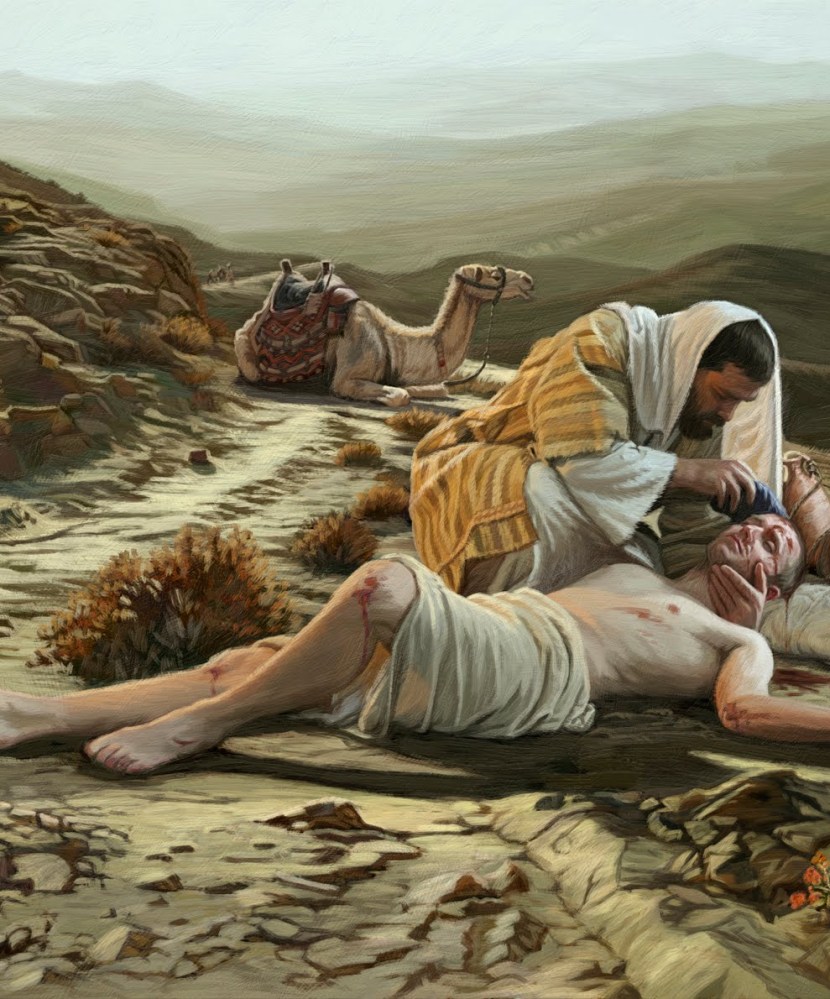
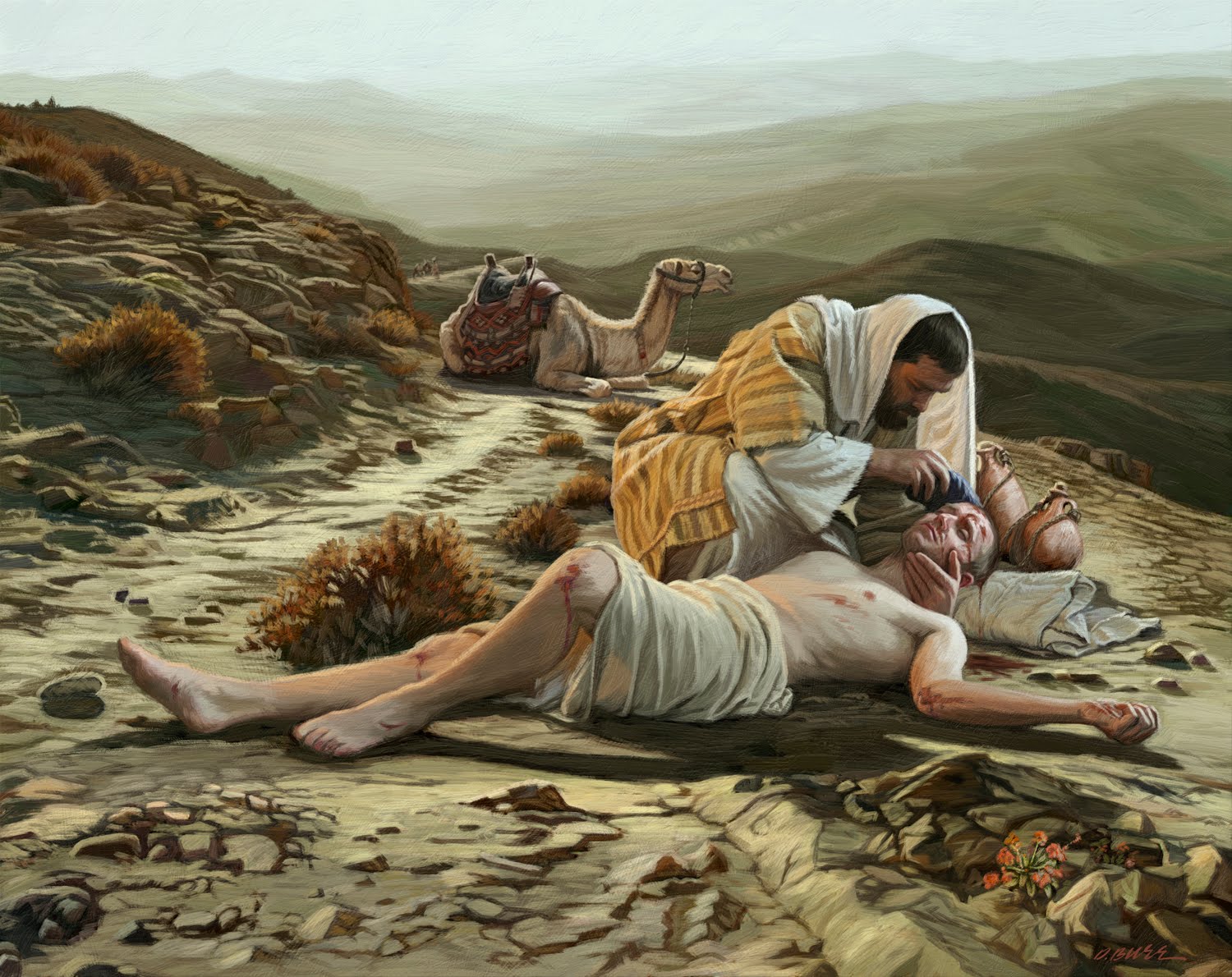
And so, back and forth for ages is the concept bantered. And fought over. And worse. But I was struck by Jesus’ command, “Go and do likewise.” And where did this phrase come from? It came from the scholar of Jewish law when he asked “And who is my neighbor?”
Thus, the parable of The Good Samaritan.
So then if we are to be saved, we must treat our neighbors as ourselves. And in this example, the Samaritan tends to the victim, takes him to an inn, continues to care for him, and then gives money to the innkeeper to continue to care for the man.
What then? Is it sola fide or do we have to perform acts in following the law?
Even the readings for today are not definitive. Moses says we already have this love of the Lord in our hearts and in our mouths. “In our mouths” implies to me that we have to act and profess what we believe. Take an action.
In the Psalm, God will protect us and rebuild the cities. But also “Turn to the Lord in your need and you will live.”
And in the Second Reading…but wait, now I’m even getting caught up in the maelstrom.
Look, we can sit in our warm studies and contemplate God and never see or talk to another person…so long as we love the Lord our God we’ll be saved. But if we see a person in need, we must help her or him.
Yet for the Love of God, we cannot go out and do battle to make others believe as we do! We cannot kill in God’s name. We cannot lay cities waste to get our point across. We cannot not love our neighbor as ourselves.
And one more thing from today’s Gospel: We really shouldn’t try to test Jesus our God. We are the only ones who may need testing.
Lord, today help us to recognize our neighbor in everyone we meet, and yes Lord, help us to find ways to help our neighbor.
Amen.
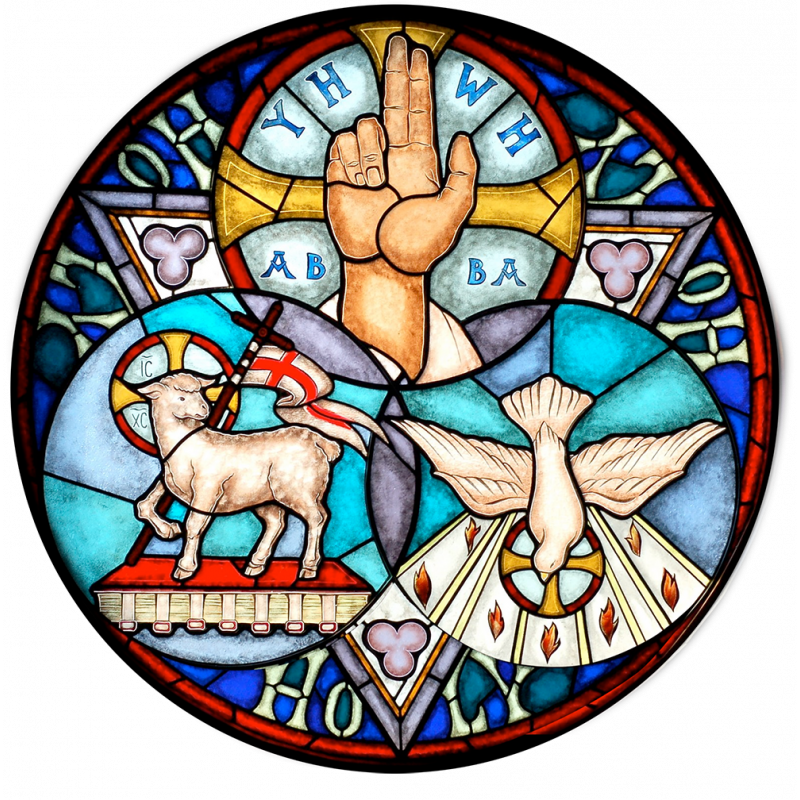
Three In One??? Trinity Sunday ~ The Rt. Rev. Michael Beckett, OPI
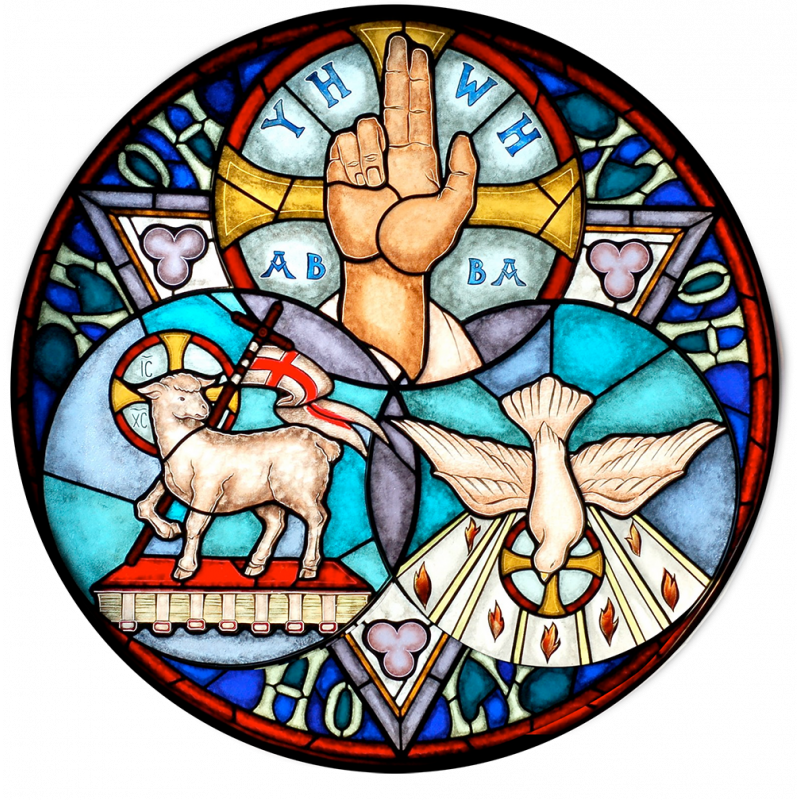
Today is Trinity Sunday.
Trinity Sunday is a difficult day for priests, who often feel they have to try to explain the idea of God as Trinity. It’s sometimes an even more difficult day for our parishioners, because they have to listen to us priests, trying to explain the Trinity. It’s a difficult day for priests because we find we have to talk about God. You may think we are always talking about God, but in my experience most of us actually talk rather little about God. We talk a lot about what God wants of us. We talk even more of what God has done for us and is doing for us. That, after all, is the Gospel. But we don’t talk very much about who God is. Perhaps they leave that to the liturgy and the hymns, which probably do it better than sermons usually can.
Have you ever tried to express your feelings when you feel something very deeply? That’s what usually happens when we talk about God, really talk about God, actually trying to say who God is – this is one of those times when language fails us. The only words you can find are terribly makeshift, totally inadequate, and not at all what you want to express, but you must use what you’ve got and try to express yourself. Not to say anything would be worse. You must say what you can and hope the words point to what you can’t really say. So it is with the Trinity. There are several Christian ways of trying to say who God is. The one that says the most about God is the one we use in the creeds, when we say we believe in God the Father, God the Son and God the Holy Spirit. God is those Three and the Three are one God. The Christian shorthand for that is: God is Trinity. But if that says the most about God, it is also the most difficult thing Christians say about God.
How to explain the Trinity? We haven’t done that yet, simply because we can’t wrap our heads around the concept. The story is told of St Augustine of Hippo, the great philosopher and theologian. He was preoccupied with the doctrine of the Trinity. He wanted so much to understand the doctrine of one God in three persons and to be able to explain it logically. One day he was walking along the sea shore and trying to understand just how one God can be in three persons. Suddenly, he saw a child all alone on the shore. The child made a hole in the sand, ran to the sea with a little cup, filled her cup with sea water, ran up and emptied the cup into the hole she had made in the sand. Back and forth she went to the sea, filled her cup and went and poured it into the hole. Augustine drew up and said to her, “Little child, what are you doing?” She replied, “I am trying to empty the sea into this hole.” “How do you think,” Augustine asked her, “that you can empty this immense sea into this tiny hole and with this tiny cup?” She answered back, “And you, how do you suppose that with your small head you can comprehend the immensity of God?” With that the child disappeared.
The doctrine of the inner relationship of the Father, Son and Holy Spirit in such a way that each of them is fully and equally God, yet there are not three Gods but one, cannot be fully comprehended by the human mind. It is a mystery. But, we continue to try. St. Patrick certainly did it his best. He gave us a visual example in the shamrock or three leaf clover. As the shamrock is one composed of three, so, he said, is the Trinity: Three in One and One in Three. In the story of salvation we usually attribute creation to the Father, redemption to the Son and sanctification to the Holy Spirit. Nevertheless, though they are distinct as persons, neither the Father nor the Son nor the Holy Spirit ever exists or acts in isolation from the other two persons of the Godhead, just as a three leaf clover without all three leaves is incomplete.
If we expected today’s readings to give us a clear and elaborate presentation of the doctrine of the Blessed Trinity, we have found out that they simply do not. The doctrine of three persons in one God, equal in divinity yet distinct in personality, is not explicitly spelled out in the Bible. In fact the very word “Trinity” is not found in the Bible. Early Christians arrived at the doctrine when they applied their God-given reason to the revelation which they had received in faith. Jesus spoke about the Father who sent him (the Son) and about the Holy Spirit whom he was going to send. He said that the Father had given him (the Son) all that he has and that he in turn has given to the Holy Spirit all that he has received from the Father. In this we see the unity of purpose among the three persons of the Trinity.
We believe in the Triune God, and to embrace a doctrine we cannot fully comprehend or explain. It is another thing entirely to base our understanding of God on what we see God doing. So, let me make the most important statement about the Trinity that I can make, and that is — Our understanding of the Trinity, or as much as we can understand of the Trinity, is based on what we see God has done and is doing in the world. Let me give you some examples.
In the Old Testament, God is Creator of both the world, and of the nation of Israel through whom he will bless the world. Of course, God is present as Spirit, and the Messiah is both prophesied and foreshadowed in various theophanies (appearances of God, such as the angel who wrestles with Jacob). But primary on the stage of the unfolding drama of the Old Testament is the God of Israel, Yahweh, El-Shaddai, Elohim, Adonai, and all the other names by which God is called and worshipped.
In the New Testament Gospel accounts, the emphasis is upon Jesus — his birth, his baptism, his message, his life, his death, and his resurrection. But God the Father approves his Son, and the Holy Spirit descends upon — anoints — Jesus for ministry.
In the New Testament Book of Acts and the epistles, the Holy Spirit is at the forefront, equipping, enabling, guiding, empowering the early church. In the Book of Revelation, God the Father, Son, and Spirit are all present, each featured in a way that is both consistent with the Old Testament, witnesses to the New Testament, and brings fully into being the Kingdom of God in its closing chapters.
Okay, that surveys the “What is the Trinity?” question, even though I am sure you probably have more questions now than when we began. But to keep this from being merely an academic exercise, we need to turn our attention to “Why do we care?” This is what’s important and what we need to understand. Doctrine is important, but doctrine comes from the lived experiences of God’s people as they interpret the work of God in the real world. First, the reason we should care about the Trinity, and be aware of the uniqueness of the One-in-Three and Three-in-One is this: Without a balanced view of all three persons of the Trinity, we can misinterpret the work of God in this world. For instance, if we emphasize some aspects of God in the Old Testament, and subordinate Jesus and the Spirit, then we come away with a picture of a god of wrath and judgment, who has little compassion. One very well known Baptist preacher did just that after destructive tornadoes, when he compared the tornadoes that hit Oklahoma with the story of Job who lost all of his children to a mighty wind that collapsed Job’s house. If we emphasize the person of Jesus to the exclusion of God the Father and the Holy Spirit, we miss out on the fact that God sent Jesus because “God so loved the world…” The purpose of God is to redeem the world, not just the individuals in it. Salvation is the work of God, and that salvation extends not just to individuals but to God’s creation as well. Another famous and trendy preacher was quoted as saying that Jesus is coming back to burn up the world, so he can drive a huge SUV because he’s not worried about this physical earth. Not a good theological position, in my estimation. Finally, if we emphasize the Holy Spirit, and the charismatic experiences and gifts of the Spirit, it it is easy to loose sight of God as Creator, Son as Redeemer, and the role that the Holy Spirit played and plays in both of those aspects of God’s work.
Who is God? He is our heavenly Father who made us, takes cares of us and calls us his dear children.
Who is God? He is Jesus Christ who gave his life on the cross to re-establish our relationship with God. He reveals the way to God and to eternal life.
Who is God? God is the Spirit in you giving you faith in God and guiding you in your daily walk as a Christian.
Faith in the Triune God acknowledges the might and majesty of God but at the same trusts in a God who cares. Amen.
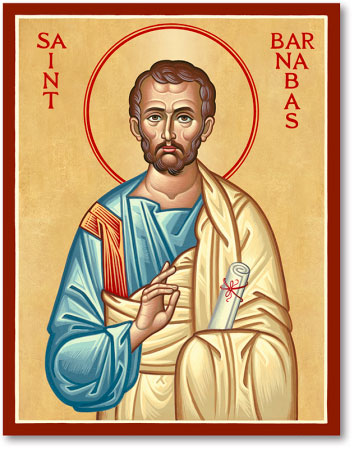
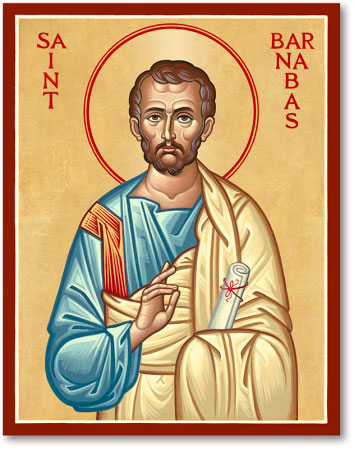
A Better World: The Feast of St. Barnabas ~ Fr. Shawn Gisewhite, OPI
Do you ever wonder what it would take to make the world a better place. Less rotten? Less foolish? Less stupid? Less tasteless? Less dark?
I do. People at large would come up with a range of suggestions. Some people put their confidence in the political system. The government is there to improve things, and once a decade we change who is in power because we’re not convinced the current lot are fixing things well enough, so we try somebody else.
Others would say that capitalism is the answer. A video was put on the internet in November. It starts with a picture of a girl running in a field. The voice-over runs like this. “This child was born in the past year. She is expected to live to at least the age of 70. If she had been born just two centuries earlier, she would not have been expected to survive beyond her 30th birthday. The almost miraculous increase in life expectancy of the past two centuries is mainly the result of capitalism. By making life healthier, easier and better, capitalism has made life longer for billions of people around the world. Capitalism has given each of us a future, the chance to experience all that life offers. To defend and advance capitalism is to defend and advance our lives and those of our loved ones. What could be more important?” Get the world to embrace capitalism, things will improve further.
Others don’t like that, so they protest against capitalism, as if anti-capitalism were the answer.
Christians by and large reach for some better answers. Some would say that society will improve if we go back to the traditional values that we’ve lost. If the next generation can grow up once again knowing the Lord’s Prayer and the Ten Commandments, things might be a little less hopeless. Others would say that religion in general holds the key. Others would say that God can make things better. Others would be more precise still, and say that the answer is Jesus.
Jesus tells us in these verses from Matthew’s gospel what it will take to make the world a better place. The answer is surprising. It’s not God, or Jesus. It’s the Christian church. It’s groups of disciples. It’s ordinary Christians. It’s you, and it’s me.
But it’s not automatic. If the Christian church is to be God’s answer to improve a world that is frequently dark, rotten and lacking taste, two things must happen.
First, we must not lose our distinctiveness.
The first thing that needs to happen is this: We must not lose our distinctiveness. We must not lose our distinctiveness.
Verse 13: “You are the salt of the earth, but if salt has lost its taste, how shall its saltiness be restored? It is no longer good for anything except to be thrown out and trampled under people’s feet.”
Jesus compares us to salt. He says we are like salt. You are the salt of the earth. What point is he making?
In the ancient world, there were two main uses for salt. It was used as a preservative. People didn’t have fridges, so they would put salt on meat to stop it from going bad. If that is what Jesus means, he is saying that the world will go rotten all by itself, just as surely as a sirloin steak won’t smell or taste good after a day in the hot sun. We are the salt that stops the rot. Today, he might have said (although there would be problems with saying it): You are the deep freeze of the earth. When society goes rotten, we shouldn’t criticize society in pious “letters to the editor”, but ask why the salt was not applied. It’s not the meat’s fault if it goes bad if nobody put it back in the fridge.
The other use for salt was to flavor things, a use it still has today. If that is what Jesus means, he is saying that we are in society to make it a better place, to give the place a little more taste.
Jesus doesn’t tell us which he means. Perhaps he’s being deliberately ambiguous, so that we think of it from both angles. In any case, the exact way in which the salt helps isn’t his point. He tells us that we are like salt so that he can say one thing: The salt must not lose its saltiness. Literally, it must not lose its taste, or it must not become foolish.
How does salt lose its saltiness? Like this. In the ancient world, they didn’t have beautifully white refined table salt. They used something a bit like rock-salt. You remember the recent snow? There were footpaths that looked like they were gritted but the snow was still settling. That was salt that had lost its saltiness. The water and snow had leached the actual salt out of it. What you had left you might still call salt, but it had no actual salt in it.
So that is what he is saying. We are here to have an influence on the world of some kind. There’s some positive influence involved, as we improve the flavor of the world. There’s some negative influence involved, as we stop the rot. But we can’t do either of those things if we have lost the distinctive thing that we are supposed to contribute to society. And without that, there is no hope. The word “You” at the start of this is emphatic. “You are the salt of the earth”, and I mean “only you”.
So we must not lose our distinctiveness. Those qualities we thought about last time, Jesus’ portrait of what makes the follower of his different from other people: They really matter.
Sadly, though, the salt often loses its saltiness. The history of the Christian church contains many episodes where Christians compromised. Where they looked little to no different to the world around them.
Instead of being a source of influence, preventing decay and working for good, the church merely adopts the world around. It takes its culture, its morals and its values from the world. Sometimes this has been so much so, that the church has actually promoted the world’s values, when in fact it should have been standing against them.
It’s not just the church, considered corporately, that can lose its saltiness. Which of us does not feel this pressure individually as well. We feel the pressure to have the same standards of living as those around us, to drink the same amount at a party, to have the same standard of truthfulness when it comes to our expenses claims or our taxes, to have the same casual attitude to the speed limit, and so on. And then we adopt the world’s standards rather than living the way Jesus set out last time: We too quickly become proud, self-satisfied, glib, brutal and self-indulgent.
The pressure is on for us to lose our saltiness, to lose it as a church, and to lose it individually. But we must not. Because we are the salt of the earth. We must not lose our distinctiveness.
Secondly, we must not hide our discipleship
The second thing that must happen if we are to be God’s agent to improve the world, is that we must not hide our discipleship. We must not hide our discipleship.
Verse 14: “You are the light of the world. A city set on a hill cannot be hidden. Nor do people light a lamp and put it under a basket, but on a stand, and it gives light to all in the house. In the same way, let your light shine before others, so that they may see your good works and give glory to your Father who is in heaven.”
Jesus has changed his picture. He’s no longer comparing us to salt. Now we are light.
Light is a big Old Testament image. We remember it from those readings we get at Christmas time from Isaiah. The people walking in darkness have seen a great light. In the Old Testament, darkness is frequently an expression of God’s judgment, whereas light is an expression of his favor and blessing.
Jesus came to fulfill those Old Testament promises. He came to bring the light of God’s blessing. He even said: “I am the light of the world”. And so it is that those who follow him live in the light of God’s favor. They are blessed by God. The start of this chapter, remember, told us again and again how blessed we are to follow Jesus.
What Jesus is saying in these verses is that the light that we have been given needs to shine, so that others can see that we are in Jesus’ kingdom, and that we are among those God is blessing. And the reason we are to shine in this way is so that God gets the glory.
Thirdly, we must not hide our discipleship.
One detail we must notice is that the light here is corporate. Jesus is saying “We must not hide our discipleship”, not “I must not hide my discipleship”. The “you” is plural.
Jesus develops this picture of a city on a hill. That seems like an abrupt change of subject. One minute, he’s talking about us being lights, and then he takes about a prominent city. It stands out like a sore thumb… until you see that what he’s talking about is the visibility of a city on a hill at night, in a country with no electric lighting. Here’s the point: The city is so bright, because it is a beacon made up of lots and lots of little lights.
The church is made up of many lights. We are that city. When people look at our church, they will see the brightness that is the cumulative shine of all of our lights. We must not hide our discipleship.
You may know the old chorus – I won’t sing it! The first verse goes like this: Jesus bids us shine with a pure, clear light, like a little candle burning in the night in this world of darkness So let us shine— You in your small corner, and I in mine.
That is not what Jesus is saying here. He’s not saying we’ll all stay in our own small corners, and shine into the dark world. He’s saying that each of us has experienced God’s blessing individually. And when we come together, we are the light of the world. We must not hide our discipleship.
You’ve doubtless heard of sea pollution, and you’re used to the idea that beaches can be polluted or clean. Well until recently, I hadn’t heard of light pollution. There’s an organization called the International Dark Sky Association that aims to reduce light pollution. And just as the EU can declare a beach to be clean, so they can designate a place a “Dark Sky Park”, meaning it’s free of artificial light – you can see the stars at night. There is currently one of these in the UK, its Galloway Forest Park in South-West Scotland. Exmoor National Park is working to get its recognition.
From what I read of studies, in the South-East they have no chance. Kemsing for example has no street lights, but they are too near to Sevenoaks and to London. Go to Galloway, and on a cloudy, moonless night, you can’t see your own hand. But all you need is one major town with electric light, and it bounces off the clouds, and for tens or hundreds of miles the night sky is no longer black.
That is what the Christian church is. It’s that city on the hill. But we must let the light shine. We must not hide our discipleship.
We must not hide it as individuals. Jesus has already said that we will fail to influence the world around us or to spread the kingdom if there is nothing distinctive about us. But we will also fail if we are distinctive, but that is so hidden that nobody would ever know!
Here are some of the questions we could ask ourselves: So when you’re at work, are you a Christian? Or is it too well hidden for anyone to know? Do you talk about your faith, or does shame or the fear of rejection mean that you stay quiet? How about at home: Are you a Christian? Do people know that the reason you are distinctive is because you are a follower of Jesus Christ, or is that detail buried?
We mustn’t hide it as individuals, but we also mustn’t hide it corporately. Remember the city on the hill. Just as our life together must be salty and distinctive, so it needs to shine out. It’s no use keeping it hidden.
It’s no use expecting people to come to us to hear the good news of the kingdom; we need to take it to them. That is one reason why I’m so keen that we have at least one, if not several, open-air services during the Festival in September. Recently, someone in the church said to me, “Where else in the village can we take the church?”
You probably know that the basket Jesus refers to in verse 15 is called a “bushel”. It was a measure, used for measuring grain. We could paraphrase Jesus: “Don’t light a lamp, and put it under a measuring jug”. Now, this building makes an excellent bushel. It’s no use reforming our worship to make it God-honoring in every way we can, it’s no use having excellent relationships with each other, being supportive, and living the life Christ called us to, if we then place this bushel of a church building over the top, and contain it and hide it away.
When we meet here, we look at the face of God in Jesus Christ. We confess our failures, and we find forgiveness. We hear God’s word, that is an active, shaping word, and we get brighter. But it’s when we go out of here that the light can shine.
So if you, like me, long to see this world a better place, a brighter place, a wiser place, a less rotten place, then we need Jesus to point us in the right direction. You are the salt of the earth. You are the light of the world. God wants us to be the means he uses to brighten this world with his kingdom. To be that, Jesus calls us to follow him. Then he tells us that as salt, we must not lose our saltiness, and, as light, we must not be hidden.
Amen.
Is That All There Is? ~ Br. Chip Noon
Transitions are often hard to live through, aren’t they?
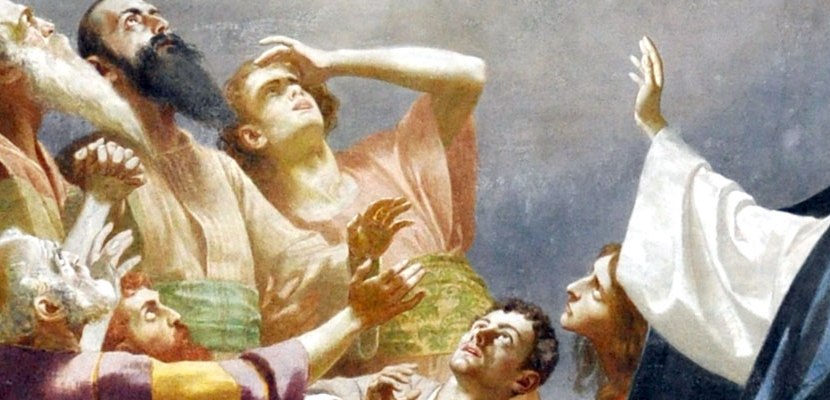
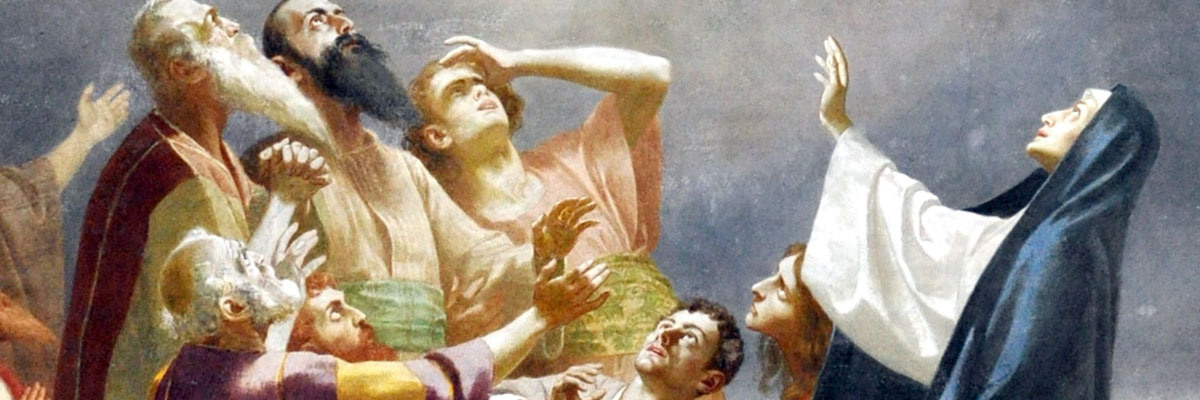
Today we celebrate probably one of the toughest transitions that human beings had to suffer: The Ascension of our Lord. I remember as a kid thinking about this day, and feeling with the disciples, that they had really lost a great friend and source of strength. I also imagined myself in their place and staring up into the sky, looking into the clouds. One of my personal traumas as a child was watching my father storm out of the house when he was angry. So I acutely identified with the disciples on this day.
Now today our family is going through a particularly poignant transition. We have been told by my mother-in-law’s nursing home staff, and by our own observations, that she is in the last stage of her life. She is 93 and has been bedridden for the past nine months. She has also prayed every day for God to take her home. Particularly heart-wrenching prayers to accompany her physical sufferings.
But what did Jesus tell us, over and over, about times like this? He said that this is not all there is, didn’t he? Even as he was ascending, he promised that the disciples would receive some gift in the future. The gift of the power of the Holy Spirit.
And yet, even at these last moments, his disciples continued to show that somehow, they were not really getting the message. “It is not for you to know the times or seasons that the Father has established by his own authority…”
But as we watch Irene in her nursing home bed, I sense around the room a true feeling for her that this is not all there is. Yes, there is sadness and anxiety, but as her oldest daughter said, “I think Mom is continuing on the path to her new life.”
You see, time and again in these days after Easter we hear Jesus telling us, “I am with you always, until the end of the world.” It is in today’s Alleluia. It is in the 2nd Reading: “…the fullness of the one who fills all things in every way.” It is in the 1st Reading: “This Jesus…will return in the same way as you have seen him going into heaven.” The Promise. The Prize. The knowledge that while we may suffer today, mourn today, and weep today, that is not all there is.
Yes, Jesus had to tell his disciples many times, sometimes in exasperation, that his kingdom is not of this earth, but also that his kingdom is indeed all around us. Again, this sounds like a Zen koan, “the identity of opposites” as the Buddhist monk and teacher says.
But that is what I was seeing in Irene’s room…her children and grandchildren recognizing that while their parent and grandparent was lying peacefully in bed, there was the realization that this mortal coil was unwinding to a grander and incomprehensible shape.
And that’s what Jesus was telling his apostles. Don’t worry, I may be physically gone, but all that I have taught you will finally be made clear through the power of the holy spirit.
Now I suppose that these people who had close daily contact with the person of Jesus, whom most of them could barely understand, would need an overt presentation of this comforting concept by the physical descent of the Holy Spirit. But we, who have been immersed in this salvation story all our lives, may just need the echoes of the Gospel, the readings, the Psalms, and the teachings of our ministers.
That’s what was in Irene’s room, at least for many of us. We could see her slowly slipping away from us, yes. But the thought was expressed – and silent – that she was going to the promised land and would soon be rid of her constant physical torments.
One final thought for today. This isn’t just a holy story out of our Bible and preachers’ mouths. This is much more. This is a call from Jesus show to the next generation, and those around us, that there is more to come than anything we could expect. “…you will be my witnesses in Jerusalem, throughout Judea and Samaria, and to the ends of the earth.”
There it is.
Yes, the kingdom is at hand. There is more than our physical senses. There is something beyond what we know and see every day. So let’s rejoice! Let’s sing and dance! Let’s laugh and cry with joyful expectation.
But mark my words, let’s all go out and tell the whole world this story. It doesn’t belong just to us who have gotten the message. It belongs to everyone.
Go forth and proclaim the Good News!
Amen.
Father, help us to proclaim your word. Help us to share our joy. And help us to see your kingdom all around us as we profess it. And may Irene rest in peace.
Amen.

Hardships and Heaven ~ Br. Chip Noon

“It is necessary for us to undergo many hardships to enter the kingdom of God.”
Today’s First Reading from the Acts of the Apostles is from the story of Paul and Barnabas who were spreading the good news to the Gentiles. It comes directly after the end of their first mission.
One of the things they said to the disciples of Lystra, Iconium, and Antioch was the quote “I started with hardships.” In Paul’s case, one hardship was that he had just been stoned in Lystra, a town in the center of what is now Turkey. Stoned! And still Paul and Barnabas believed in Jesus and continued to spread the good news, even with the wounds of the stoning.
Let us put ourselves in Paul’s place. A stone is thrown at us and hits us in the arm. Then another in the stomach. As we curl up and turn our backs, more stones are thrown and strike us in the back, buttocks, and legs. And eventually one or more hit us in the head. I have a lot of trouble imagining that. I have never had that kind of beating. But it had to be brutal, since the people stoning him thought Paul was dead, so they dragged him out of the city.
But Paul got up when the disciples gathered around him. He got up!
I don’t know about you, but I’m felled by a cold, in agony over a stubbed toe, laid low by spinal stenosis. Yet Paul was almost stoned to death! I cannot even imagine what he went through. Or what Jesus went through during his passion.
And in the Second Reading, I find what strengthened Paul. “He will wipe every tear from their eyes, and there shall be nor more death or mourning, wailing or pain.” Paul was not living in this world. He was living the world of Heaven, the world of God because the new Jerusalem had already come down to him.
This past week I went to one of my physical therapy sessions. The pain of spinal stenosis I mentioned before has got me in its grasp. And the therapist said to me, “You can’t give in to it. You must move on. You can’t get down because of the pain.”
What? My physical therapist is preaching the Gospel to me! “You can’t get down.” Is that how Paul was handling his pain? He was living in the new Jerusalem. He was spreading the good news. He was loving the people as Jesus had loved him. If Paul is living like that, does he have room to consider the pain? Does he have time to worry about his back? Or the slashes in his skull? Or the bruising of his legs?
“For the old order has passed away.” The “old order.” And Paul and Barnabas have moved on. As Mark says: “If anyone will not welcome you or listen to your words, leave that home or town and shake the dust off your feet.” And if I may be a little more up to date, as Jimmy Dugan says to Evelyn in the movie A League of Their Own, “There’s no crying. There’s no crying in baseball!”
We are not taught that once we become Christians there will be no more pain. Of course, there is pain. This is the world. But we can live in this world, or, as Paul did, we can live in the new Jerusalem. But believe me, I can talk about that, recommend that, suggest that, preach that…but ask me if I have found the open gate to the new Jerusalem. Go ahead, ask. I ask myself that every day.
The answer is no, I haven’t. But I can see it. I can almost feel it. No more death or mourning, wailing or pain. It takes that step through the gate, and try as I might, my feet stumble.
But I have God to lean on, and my patron saints to pray for me, and my community to say to me, You must move on.” I can taste it. I can smell it. I can almost feel it. I can remember what Jesus told us, “I have loved you.” And in the loving of others, I can knock on the gate and be sure that eventually it will be opened to me.
So the answer? I can try to be “not of this world.” I can watch the new Jerusalem constantly coming down to earth, to replace earth, to offer us the way of God. I can work every day to remember that there is no crying in baseball.
Brothers and sisters, as I look into your eyes, I can see a new heaven and a new earth. Talk to me of your love.
Lord, let us continue to look above and move forward, shaking the dust off our sandals and stepping into your glory.
Amen.
 The Order of Preachers, Independent
You must be logged in to post a comment.