
Category: Sermon
That Still Small Voice ~ The Rev. Dcn. Scott Brown, OPI

At the mountain of God, Horeb,
Elijah came to a cave where he took shelter.
Then the LORD said to him,
“Go outside and stand on the mountain before the LORD;
the LORD will be passing by.”
A strong and heavy wind was rending the mountains
and crushing rocks before the LORD—
but the LORD was not in the wind.
After the wind there was an earthquake—
but the LORD was not in the earthquake.
After the earthquake there was fire—
but the LORD was not in the fire.
After the fire there was a tiny whispering sound.
When he heard this,
Elijah hid his face in his cloak
and went and stood at the entrance of the cave. First Kings 9, 11-13
I say to Michael (Bishop Beckett) all the time “did you hear that?” he says, “hear what?” Everybody hears and listens differently. Some people can hear grass grow, and some people cannot hear bombs going off next to them. But this is not the kind of listening God was telling Elijah to use. I believe God wanted Elijah to listen with his heart, not with his ears. When you want to hear what God has to say to you, just shut the rest of the world out and listen with your mind and heart. God was showing Elijah that He was not in the crushing rocks, or the earthquake, the fire, or anything else that was happening around him. God wanted Elijah to clear his mind, relax, and open his mind up to God. God was in the whisper, that little tiny voice you hear when you lay down in bed at night and start going to sleep. God is in that voice you hear when you are sitting by a quiet lake just enjoying nature; that little voice in the back of your head that gets you thinking about things. That is God talking to you. He is not going to open the clouds up and be a booming loud voice that shakes the ground and knocks acorns out of trees. I believe that God reserves that booming voice for when He is upset or giving out laws and orders for all His people. Instead of the booming voice, that little whisper is when He is speaking directly to you. When He is speaking directly to you, you are the only one that can hear Him. You could be in a football stadium with 30,000 other people, and you will still be the only one who hears Him. Some people call it your conscience: well possibly when your conscience is bothering you that could be God telling you something. Listen to that conscience voice and reflect on it and think about what it is telling you.
The point of God speaking in the still small voice was to show Elijah that the work of God need not always be accompanied by dramatic revelation or manifestations. Divine silence does not necessarily mean divine inactivity. Zechariah 4:6 tells us that God’s work is “not by might nor by power, but by My Spirit,” meaning that overt displays of power are not necessary for God to work. I have always heard that “God works in mysterious ways.” Wouldn’t hearing quiet whispers be more mysterious than a loud booming voice coming from the heavens. I believe the loud booming voice would be scary, while the quiet whisper would be comforting.
The difference between God speaking through the thunder and the whirlwind, than through the still, small voice, can be also considered as showing the difference between the two dispensations of law and grace. The law is a voice of terrible words and was given amidst a tempest of wind, thunder, and lightning, attended by an earthquake (Hebrews 12:18–24), but the gospel is a gentle voice of love, grace, and mercy, of peace, pardon, righteousness, and the free gift of salvation through Christ. The law breaks the rocky hearts of men into pieces, shakes their consciences, and fills their minds with a sense of God’s fiery wrath and the punishment they deserve, and then the Gospel speaks gently to them of the peace and pardon available in Christ.
Listen to the little whisper, the quiet voice, that little voice in your head, it is most likely the Lord giving you some advice, encouragement, or guidance. The point is not how God speaks to us, but what we do with what he tells us. Do not ignore it; listen with all your heart.
Father, teach us to open our hearts and listen to the small still voice; teach us to hear your words of encouragement and guidance. Let us learn to be still and quiet so that we can hear that tiny whispering sound in the still of the night that is Your calming voice reassuring us that we will be loved and comforted by you. Amen
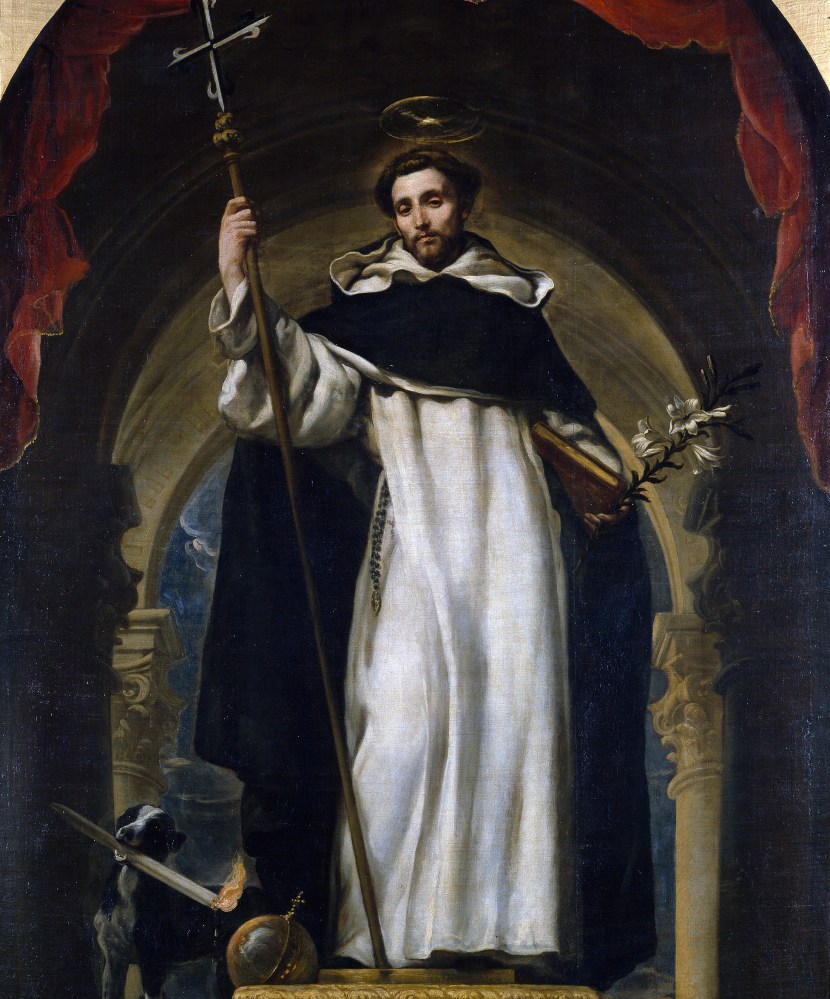
The Feast of Our Holy Father St. Dominic
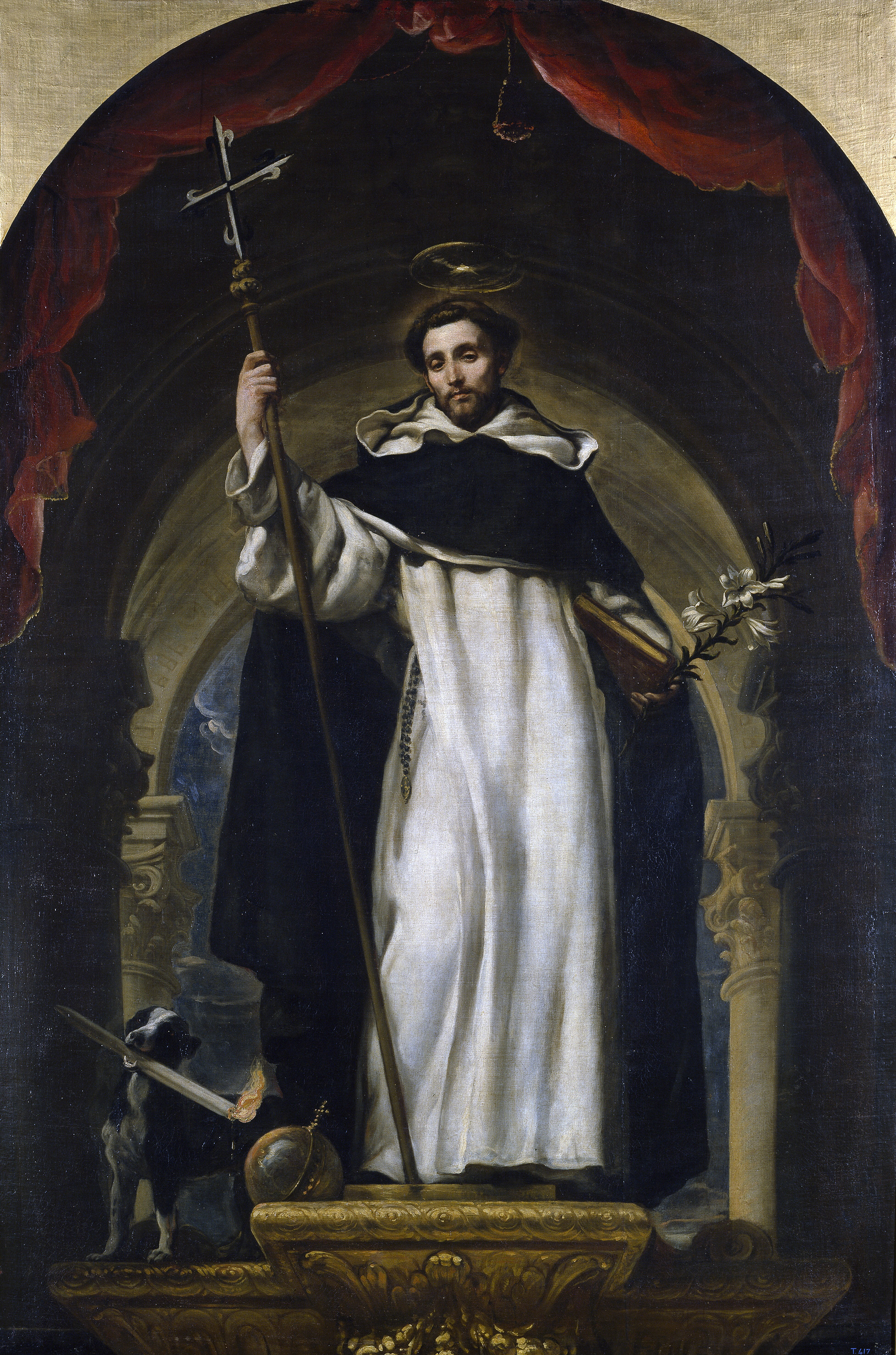
“A man who governs his passions is master of his world. We must either command them or be enslaved by them. It is better to be a hammer than an anvil.”
– Saint Dominic
Founder of the Order of Preachers, commonly known as the Dominican Order; born at Calaroga, in Old Castile, c. 1170; died 6 August, 1221. His parents, Felix Guzman and Joanna of Aza, undoubtedly belonged to the nobility of Spain, though probably neither was connected with the reigning house of Castile, as some of the saint’s biographers assert. Of Felix Guzman, personally, little is known, except that he was in every sense the worthy head of a family of saints. To nobility of blood Joanna of Aza added a nobility of soul which so enshrined her in the popular veneration that in 1828 she was solemnly beatified by Leo XII. The example of such parents was not without its effect upon their children. Not only Saint Dominic but also his brothers, Antonio and Manes, were distinguished for their extraordinary sanctity. Antonio, the eldest, became a secular priest and, having distributed his patrimony to the poor, entered a hospital where he spent his life minis ministering to the sick. Manes, following in the footsteps of Dominic, became a Friar Preacher, and was beatified by Gregory XVI.
The birth and infancy of the saint were attended by many marvels forecasting his heroic sanctity and great achievements in the cause of religion. From his seventh to his fourteenth year he pursued his elementary studies tinder the tutelage of his maternal uncle, the archpriest of Gumiel d’lzan, not far distant from Calaroga. In 1184 Saint Dominic entered the University of Palencia. Here he remained for ten years prosecuting his studies with such ardour and success that throughout the ephemeral existence of that institution he was held up to the admiration of its scholars as all that a student should be. Amid the frivolities and dissipations of a university city, the life of the future saint was characterized by seriousness of purpose and an austerity of manner which singled him out as one from whom great thin might be expected in the future. But more than one he proved that under this austere exterior he carried a heart as tender as a woman’s. On one occasion he sold his books, annotated with his own hand, to relieve the starving poor of Palencia. His biographer and contemporary, Bartholomew of Trent, states that twice he tried to sell himself into slavery to obtain money for the liberation of those who were held in captivity by the Moors. These facts are worthy of mention in view of the cynical and saturnine character which some non-Catholic writers have endeavoured to foist upon one of the most charitable of men. Concerning the date of his ordination his biographers are silent; nor is there anything from which that date can be inferred with any degree of certainty. According to the deposition of Brother Stephen, Prior Provincial of Lombardy, given in the process of canonization, Dominic was still a student at Palencia when Don Martin de Bazan, the Bishop of Osma, called him to membership in the cathedral chapter for the purpose If assisting in its reform. The bishop realized the importance to his plan of reform of having constantly before his canons the example of one of Dominic’s eminent holiness. Nor was he disappointed in the result. In recognition of the part he had taken in converting its members into canons regular, Dominic was appointed sub-prior of the reformed chapter. On the accession of Don Diego d’Azevedo to the Bishopric of Osma in 1201, Dominic became superior of the chapter with the title of prior. As a canon of Osma, he spent nine years of his life hidden in God and rapt in contemplation, scarcely passing beyond the confines of the chapter house.
In 1203 Alfonso IX, King of Castile, deputed the Bishop of Osma to demand from the Lord of the Marches, presumably a Danish prince, the hand of his daughter on behalf of the king’s son, Prince Ferdinand. For his companion on this embassy Don Diego chose Saint Dominic. Passing through Toulouse in the pursuit of their mission, they beheld with amazement and sorrow the work of spiritual ruin wrought by the Albigensian heresy. It was in the contemplation of this scene that Dominic first conceived the idea of founding an order for the purpose of combating heresy and spreading the light of the Gospel by preaching to the ends of the then known world. Their mission having ended successfully, Diego and Dominic were dispatched on a second embassy, accompanied by a splendid retinue, to escort the betrothed princess to Castile. This mission, however, was brought to a sudden close by the death of the young woman in question. The two ecclesiastics were now free to go where they would, and they set out for Rome, arriving there towards the end of 1204. The purpose of this was to enable Diego to resign his bishopric that he might devote himself to the conversion of unbelievers in distant lands. Innocent III, however, refused to approve this project, and instead sent the bishop and his companion to Languedoc to join forces with the Cistercians, to whom he had entrusted the crusade against the Albigenses. The scene that confronted them on their arrival in Languedoc was by no means an encouraging one. The Cistercians, on account of their worldly manner of living, had made little or no headway against the Albigenses. They had entered upon their work with considerable pomp, attended by a brilliant retinue, and well provided with the comforts of life. To this display of worldliness the leaders of the heretics opposed a rigid asceticism which commanded the respect and admiration of their followers. Diego and Dominic quickly saw that the failure of the Cistercian apostolate was due to the monks’ indulgent habits, and finally prevailed upon them to adopt a more austere manner of life. The result was at once apparent in a greatly increased number of converts. Theological disputations played a prominent part in the propaganda of the heretics. Dominic and his companion, therefore, lost no time in engaging their opponents in this kind of theological exposition. Whenever the opportunity offered, they accepted the gage of battle. The thorough training that the saint had received at Palencia now proved of inestimable value to him in his encounters with the heretics. Unable to refute his arguments or counteract the influence of his preaching, they visited their hatred upon him by means of repeated insults and threats of physical violence. With Prouille for his head-quarters, he laboured by turns in Fanjeaux, Montpellier, Servian, Béziers, and Carcassonne. Early in his apostolate around Prouille the saint realized the necessity of an institution that would protect the women of that country from the influence of the heretics. Many of them had already embraced Albigensianism and were its most active propagandists. These women erected convents, to which the children of the Catholic nobility were often sent-for want of something better-to receive an education, and, in effect, if not on purpose, to be tainted with the spirit of heresy. It was needful, too, that women converted from heresy should be safeguarded against the evil influence of their own homes. To supply these deficiencies, Saint Dominic, with the permission of Foulques, Bishop of Toulouse, established a convent at Prouille in 1206. To this community, and afterwards to that of Saint Sixtus, at Rome, he gave the rule and constitutions which have ever since guided the nuns of the Second Order of Saint Dominic.
The year 1208 opens a new epoch in the eventful life of the founder. On 15 January of that year Pierre de Castelnau, one of the Cistercian legates, was assassinated. This abominable crime precipitated the crusade under Simon de Montfort, which led to the temporary subjugation of the heretics. Saint Dominic participated in the stirring scenes that followed, but always on the side of mercy, wielding the arms of the spirit while others wrought death and desolation with the sword. Some historians assert that during the sack of Béziers, Dominic appeared in the streets of that city, cross in hand, interceding for the lives of the women and children, the aged and the infirm. This testimony, however, is based upon documents which Touron regards as certainly apocryphal. The testimony of the most reliable historians tends to prove that the saint was neither in the city nor in its vicinity when Béziers was sacked by the crusaders. We find him generally during this period following the Catholic army, reviving religion and reconciling heretics in the cities that had capitulated to, or had been taken by, the victorious de Montfort. it was probably I September, 1209, that Saint Dominic first came in contact with Simon de Montfort and formed with him that intimate friendship which was to last till the death of the brave crusader under the walls of Toulouse (25 June, 1218). We find him by the side of de Montfort at the siege of Lavaur in 121 1, and again in 1212, at the capture of La Penne d’Ajen. In the latter part of 1212 he was at Pamiers labouring, at the invitation of de Montfort, for the restoration of religion and morality. Lastly, just before the battle of Muret. 12 September, 1213, the saint is again found in the council that preceded the battle. During the progress of the conflict, he knelt before the altar in the church of Saint-Jacques, praying for the triumph of the Catholic arms. So remarkable was the victory of the crusaders at Muret that Simon de Montfort regarded it as altogether miraculous, and piously attributed it to the prayers of Saint Dominic. In gratitude to God for this decisive victory, the crusader erected a chapel in the church of Saint-Jacques, which he dedicated, it is said, to Our Lady of the Rosary. It would appear, therefore, that the devotion of the Rosary, which tradition says was revealed to Saint Dominic, had come into general use about this time. To this period, too, has been ascribed the foundation of the Inquisition by Saint Dominic, and his appointment as the first lnquisitor. As both these much controverted questions will receive special treatment elsewhere in this work, it will suffice for our )resent purpose to note that the Inquisition was in operation in 1198, or seven years before the saint took part in the apostolate in Languedoc, and while ie was still an obscure canon regular at Osma. If he was for a certain time identified-with the operations of the Inquisition, it was only in the capacity of a theologian passing upon the orthodoxy of the accused. Whatever influence he may have had with the judges of that much maligned institution was always employed on the side of mercy and forbearance, as witness the classic case of Ponce Roger.
In the meantime, the saint’s increasing reputation for heroic sanctity, apostolic zeal, and profound learning caused him to be much sought after as a candidate for various bishoprics. Three distinct efforts were made to miss him to the episcopate. In July, 1212, the chapter of Béziers chose him for their bishop. Again, the canons of Saint-Lizier wished him to succeed Garcias de l’Orte as Bishop of Comminges. Lastly, in 1215 an effort was made by Garcias de l’Orte himself, who had been transferred from – Comminges to Auch, to make him Bishop of Navarre. But Saint Dominic absolutely refused all episcopal honours, saying that he would rather take flight in the night, with nothing but his staff, than accept the episcopate. From Muret Dominic returned to Carcassonne, where he resumed his preaching with unqualified success. It was not until 1214 that he returned to Toulouse. In the meantime the influence of his preaching and the eminent holiness of his life had drawn around him a little band of devoted disciples eager to follow wherever he might lead. Saint Dominic had never for a moment forgotten his purpose, formed eleven years before, of founding a religious order to combat heresy and propagate religious truth. The time now seemed opportune for the realization of his plan. With the approval of Bishop Foulques of Toulouse, he began the organization of his little band of followers. That Dominic and his companions might possess a fixed source of revenue Foulques made him chaplain of Fanjeaux and in July, 1215, canonically established the community as a religious congregation of his diocese, whose mission was the propagation of true doctrine and good morals, and the extirpation of heresy. During this same year Pierre Seilan, a wealthy citizen of Toulouse, who had placed himself under the direction of Saint Dominic, put at their disposal his own commodious dwelling. In this way the first convent of the Order of Preachers was founded on 25 April, 1215. But they dwelt here only a year when Foulques established them in the church of Saint Romanus. Though the little community had proved amply the need of its mission and the efficiency of its service to the Church, it was far from satisfying the full purpose of its founder. It was at best but a diocesan congregation, and Saint Dominic had dreamed Of a world-order that would carry its apostolate to the ends of the earth. But, unknown to the saint, events were shaping themselves for the realization of his hopes. In November, 1215, an ecumenical council was to meet at Rome “to deliberate on the improvement of morals, the extinction of heresy, and the strengthening of the faith”. This was identically the mission Saint Dominic had determined on for his order. With the Bishop of Toulouse, he was present at the deliberations of this council. From the very first session it seemed that events conspired to bring his plans to a successful issue. The council bitterly arraigned the bishops for their neglect of preaching. In canon X they were directed to delegate capable men to preach the word of God to the people. Under these circumstances, it would reasonably appear that Dominic’s request for confirmation of an order designed to carry out the mandates of the council would be joyfully granted. But while the council was anxious that these reforms should be put into effect as speedily as possible, it was at the same time opposed to the institution of any new religious orders, and had legislated to that effect in no uncertain terms. Moreover, preaching had always been looked upon as primarily a function of the episcopate. To bestow this office on an unknown and untried body of simple priests s seemed too original and too bold in its conception to appeal to the conservative prelates who influenced the deliberations of the council. When, therefore, his petition for the approbation of his infant institute was refused, it could not have been wholly unexpected by Saint Dominic.
Returning to Languedoc at the close of the council in December, 1215, the founder gathered about him his little band of followers and informed them of the wish of the council that there should be no new rules for religious orders. Thereupon they adopted the ancient rule of Saint Augustine, which, on account of its generality, would easily lend itself to any form they might wish to give it. This done, Saint Dominic again appeared before the pope in the month of August, 1216, and again solicited the confirmation of his order. This time he was received more favourably, and on 22 December, 1216, the Bull of confirmation was issued.
Saint Dominic spent the following Lent preaching in various churches in Rome, and before the pope and the papal court. It was at this time that he received the office and title of Master of the Sacred Palace, or Pope’s Theologian, as it is more commonly called. This office has been held uninterruptedly by members of the order from the founder’s time to the present day. On 15 August, 1217, he gathered the brethren about him at Prouille to deliberate on the affairs of the order. He had determined upon the heroic plan of dispersing his little band of seventeen unformed followers over all europe. The result proved the wisdom of an act which, to the eye of human prudence at least, seemed little short of suicidal. To facilitate the spread of the order, Honorius III, on 11 Feb., 1218, addressed a Bull to all archbishops, bishops, abbots, and priors, requesting their favour on behalf of the Order of Preachers. By another Bull, dated 3 Dec., 1218, Honorius III bestowed upon the order the church of Saint Sixtus in Rome. Here, amid the tombs of the Appian Way, was founded the first monastery of the order in Rome. Shortly after taking possession of Saint Sixtus, at the invitation of Honorius, Saint Dominic begin the somewhat difficult task of restoring the pristine observance of religious discipline among the various Roman communities of women. In a comparatively short time the work was accomplished, to the great satisfaction of the pope. His own career at the University of Palencia, and the practical use to which he had put it in his encounters with the Albigenses, as well as his keen appreciation of the needs of the time, convinced the saint that to ensure the highest efficiency of the work of the apostolate, his followers should be afforded the best educational advantages obtainable. It was for this reason that on the dispersal of the brethren at Prouille he dispatched Matthew of France and two companions to Paris. A foundation was made in the vicinity of the university, and the friars took possession in October, 1217. Matthew of France was appointed superior, and Michael de Fabra was placed in charge of the studies with the title of Lecturer. On 6 August of the following year, Jean de Barastre, dean of Saint-Quentin and professor of theology, bestowed on the community the hospice of Saint-Jaques, which he had built for his own use. Having effected a foundation at the University of Paris, Saint Dominic next determined upon a settlement at the University of Bologna. Bertrand of Garrigua, who had been summoned from Paris, and John of Navarre, set out from Rome, with letters from Pope Honorius, to make the desired foundation. On their arrival at Bologna, the church of Santa Maria della Mascarella was placed at their disposal. So rapidly did the Roman community of Saint Sixtus grow that the need of more commodious quarters soon became urgent. Honorius, who seemed to delight in supplying every need of the order and furthering its interests to the utmost of his power, met the emergency by bestowing on Saint Dominic the basilica of Santa Sabina.
Towards the end of 1218, having appointed Reginald of Orléans his vicar in Italy, the saint, accompanied by several of his brethren, set out for Spain. Bologna, Prouille, Toulouse, and Fanjeaux were visited on the way. From Prouille two of the brethren were sent to establish a convent at Lyons. Segovia was reached just before Christmas. In February of the following year he founded the first monastery of the order in Spain. Turning southward, he established a convent for women at Madrid, similar to the one at Prouille. It is quite probable that on this journey he personally presided over the erection of a convent in connexion with his alma mater, the University of Palencia. At the invitation of the Bishop of Barcelona, a house of the order was established in that city. Again bending his steps towards Rome he recrossed the Pyrenees and visited the foundations at Toulouse and Paris. During his stay in the latter place he caused houses to be erected at Limoges, Metz, Reims, Poitiers, and Orléans, which in a short time became centres of Dominican activity. From Paris he directed his course towards Italy, arriving in Bologna in July, 1219. Here he devoted several months to the religious formation of the brethren he found awaiting him, and then, as at Prouille, dispersed them over Italy. Among the foundations made at this time were those at Bergamo, Asti, Verona, Florence, Brescia, and Faenza. From Bologna he went to Viterbo. His arrival at the papal court was the signal for the showering of new favours on the order. Notable among these marks of esteem were many complimentary letters addressed by Honorius to all those who had assisted the Fathers in their vinous foundations. In March of this same year Honorius, through his representatives, bestowed upon the order the church of San Eustorgio in Milan. At the same time a foundation at Viterbo was authorized. On his return to Rome, towards the end of 1219, Dominic sent out letters to all the convents announcing the first general chapter of the order, to be held at Bologna on the feast of the following Pentecost. Shortly before, Honorius III, by a special Brief, had conferred upon the founder the title of Master General, which till then he had held only by tacit consent. At the very first session of the chapter in the following spring the saint startled his brethren by offering his resignation as master general. It is needless to say the resignation was not accepted and the founder remained at the head of the institute till the end of his life.
Soon after the close of the chapter of Bologna, Honorius III addressed letters to the abbeys and priories of San Vittorio, Sillia, Mansu, Floria, Vallombrosa, and Aquila, ordering that several of their religious be deputed to begin, under the leadership of Saint Dominic, a preaching crusade in Lombardy, where heresy had developed alarming proportions. For some reason or other the plans of the pope were never realized. The promised support failing, Dominic, with a little band of his own brethren, threw himself into the field, and, as the event proved, spent himself in an effort to bring back the heretics to their allegiance to the Church. It is said that 100,000 unbelievers were converted by the preaching and the miracles of the saint. According to Lacordaire and others, it was during his preaching in Lombardy that the saint instituted the Militia of Jesus Christ, or the third order, as it is commonly called, consisting of men and women living in the world, to protect the rights and property of the Church. Towards the end of 1221 Saint Dominic returned to Rome for the sixth and last time. Here he received many new and valuable concessions for the order. In January, February, and March of 1221 three consecutive Bulls were issued commending the order to all the prelates of the Church-. The thirtieth of May, 1221, found him again at Bologna presiding over the second general chapter of the order. At the close of the chapter he set out for Venice to visit Cardinal Ugolino, to whom he was especially indebted for many substantial acts of kindness. He had scarcely returned to Bologna when a fatal illness attacked him. He died after three weeks of sickness, the many trials of which he bore with heroic patience. In a Bull dated at Spoleto, 13 July, 1234, Gregory IX made his cult obligatory throughout the Church.
The life of St. Dominic was one of tireless effort in the, service of god. While he journeyed from place to place he prayed and preached almost uninterruptedly. – His penances were of such a nature as to cause the brethren, who accidentally discovered them. to fear the effect upon his life. While his charity was boundless he never permitted it to interfere with the stern sense of duty that guided every action of his life. If he abominated heresy and laboured untiringly for its extirpation it was because he loved truth and loved the souls of those among whom he laboured. He never failed to distinguish between sin and the sinner. It is not to be wondered at, therefore, if this athlete of Christ, who had conquered himself before attempting the reformation of others, was more than once chosen to show forth the power of God. The failure of the fire at Fanjeaux to consume the dissertation he had employed against the heretics, and which was thrice thrown into the flames; the raising to life of Napoleone Orsini; the appearance of the annals in the refectory of Saint Sixtus in response to his prayers, are but a few of the supernatural happenings by which God was pleased to attest the eminent holiness of His servant. We are not surprised, therefore, that, after signing the Bull of canonization on 13 July, 1234, Gregory IX declared that he no more doubted the saintliness of Saint Dominic than he did that of Saint Peter and Saint Paul.
Born: 1170 at Calaruega, Burgos, Old Castile
Died: August 6, 1221 at Bologna
Beatified: July 13, 1234 by Pope Gregory IX at Rieti, Italy
Patronage: astronomers; astronomy; prelature of Batanes-Babuyanes, Philippines; diocese of Bayombong, Philippines; Dominican Republic; falsely accused people; scientists
Representation: chaplet, Dominican carrying a rosary and a tall cross; Dominican holding a lily; Dominican with dog and globe; Dominican with fire; Dominican with star shining above his head; rosary; star
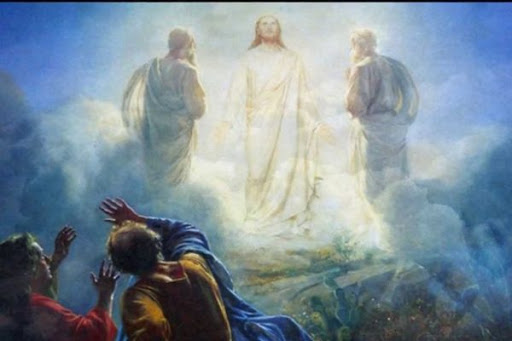
The Transfiguration of the Lord ~ The Very Rev. Lady Sherwood, OPI
Reading 1: DN 7:9-10, 13-14
Responsorial Psalm: 97:1-2, 5-6, 9
Reading 2: 2 PT 1:16-19
Gospel: MT 17:1-9
 In the Name of the Father +, and of the Son +, and of the Holy Spirit+!
Today, my dearest brothers and sisters in Christ, we come together as the church to commemorate the miraculous occasion of when our Lord’s human nature was transfigured by the Holy Spirit, which proceeded from Our Heavenly Father.
This miraculous and wondrous occasion shows us firstly that both the human and the divine natures of Our dear Lord Jesus Christ are indeed both united in the One Person, secondly, it shows that therefore, there cannot possibly be any unity without the Holy Spirit, and thirdly that our Saviour and Lord, dominates over both Life and over Death, for prophet Moses, who died, and prophet Elijah, who did not die, both came to worship Him on the Mount, which was The Mount Tabor.
The tiniest of details of this miraculous and wondrous event is, indeed, full of a profound significance to us as Christians. Today, I would like to mention the aspect of this Feast which is very often overlooked: the symbolical meaning of Mount Tabor, the Mountain where the Transfiguration actually occurred. This Mount Tabor is for us a figure of repentance., but also one of hope. I note that, like for the disciples in biblical history, in order for us to see the transfiguration or to hope to be transfigured ourselves, we will first have to climb the Mountain, from our present condition. Otherwise any transfiguration or change for the better in our lives is impossible…
Our transfiguration and salvation is like Mount Tabor: however hard we try, we will not be guaranteed salvation through a fast, if strenuous, climb within a day, a week, a month or a year. . To climb our Mountain to Salvation takes a us our whole lifetime, it is an exceedingly long climb up an extremely long and ever upwards steep slope. Salvation is a long struggle which requires our determination, our perseverance, and patient longsuffering…
Our spiritual progress is not one of a sudden and dramatic nature. There are will be so many obstacles along our path within our daily life’s climb. At times, even to pick up our prayer books in the morning and again in the evening may be a struggle, and there are always those pesky hindrances in our lives such as having meals to prepare, or trains to catch, phones to answer or chores to do, or maybe even unpleasant appointments to do in our day. Our Christian life, is indeed made up of little sacrifices, and obstacles to overcome: there are prayers to be said, fasts to be kept, a donation to be made where we are able, the washing-up to be done, flowers to be bought, our homes to be cleaned, a job to go to, a vigil service to be attended, a hospital visit to do, a homeless or vulnerable person to help.
We may well ask ourselves what little sacrifices we have made since the Feast of Transfiguration last year? How far have we ascended on our journey to salvation climbing up our own individual Mount Tabor? How have we changed over the past year? What have we done to lead a better life since that of a year ago? How have we improved? What have we given to God that we had not given Him previously? It is this that we call progress: in what way are we a better Christian than we were a year ago?
In our faith we are called to struggle on a daily basis, whatever the rocks or pitfalls in our way: whether they be issues of pride or selfishness, maybe those of lust or of discouragement, maybe issues of envy or of being judgemental to others, – we have to struggle to ascend our personal Mount Tabor, we have to fight for our personal transfiguration.
We must constantly remember that it is possible to both climb up and also to climb down a slope. We can spiritually progress, but it is also possible to spiritually regress. We can continually stride forward so we will be transfigured by the love of God or we can let ourselves be disfigured and stranded by the love of worldly sin. And just as in making progress, regression also is not a sudden and dramatic thing, regression, too, is like a slope, indeed, it is a very slippery slope.
Let us, therefore, take heed and continually strive to climb our faith mountain to our salvation and transition, and give God what He really wants from us – our hearts and minds to be continually spiritually progressing.
May Our Lord and Saviour bless you!
Amen.
NOT the Will of God. ~ The Rt. Rev. Michael R. Beckett, OPI
AAAAARRGGGHHHH! If I hear, one more time, “It’s God’s Will,” or “God’s gonna save me from this virus,” or “God is punishing this country,” or “God has abandoned us,” or …and this is the BIG one: “I can’t believe a loving God would let this happen,” or anything even vaguely related to those things, I may just have to……….well…….I dunno…..do something. It makes me crazy….craziER???
I’m gonna say it one more time for those folks in the back who seem to have difficulty getting the message: We are not puppets. God does not control us.
How many times have we heard, “I’ve been through a lot this past year and I’ve always wanted to believe in God.. I’ve tried.. but I don’t understand why there’s so much suffering in the world.. why do people beg and plead and pray to God to not let loved ones die.. and they die anyway? What kind of God would allow that? The horrific things people go through and see while praying to God for help.. I don’t get it and saying it’s a part of God’s plan or you just have to have faith doesn’t work for me either.. I’ve prayed about it and listened and tried to understand but I just don’t.. I’m an open-minded person and I respect everyone’s beliefs but I’m just not able to accept that a loving God would let good people suffer.”?
This question is as old as humanity. First of all, God does not ‘give’ us the terrible, horrible, no good, very bad things that happen in our lives. Life happens. Crap happens. People make poor choices. Natural disasters occur. We get sick. Nowhere does Holy Writ support the claim that any of these things is God’s doing. What kind of God would we worship if he, indeed, sent us all the trials and tribulations and suffering and horror for which He is blamed?
Remember ‘The Church Lady’ and ‘The devil made me do it’ and her “Could it be…mmmm…. Sataaan?” Well, yeah, it very well COULD be Satan! We have to remember that, even though God is firmly in control, Satan has power and he fights against our Lord. Ephesians 2:2 says: “And you were dead in the trespasses and sins in which you once walked, following the course of this world, following the prince of the power of the air, the spirit that is now at work in the sons of disobedience.” In this text the apostle Paul describes Satan first as a “prince” with power, because he has authentic power in the world (1 John 5:19). This power has been given him by God (Luke 4:6). Satan has power over some illnesses (Luke 13:16; see also 2 Corinthians 12:7—it’s unknown if Paul’s “thorn” was an illness or something else). In some sense, Satan has power over death (Hebrew 2:14). The reason Satan is called a prince rather than a king is because there is only one King—Jesus Christ (1 Timothy 6:15).
So yeah, Satan also has power over some people. The “sons of disobedience” referred to in Ephesians 2:2 are those who have not trusted Christ as Lord and Savior (cf. Acts 26:18; 2 Corinthians 4:4; Revelation 13:12). The demons are also under the rule of Satan (Matthew 12:24), and one of his titles is “prince of demons” (Matthew 9:34). Satan has a kingdom (Matthew 12:26) and a throne (Revelation 2:13). Satan is called a prince because he is a ruler and possesses power to manifest evil in the world through influencing people and commanding demons.
“The air” in Ephesians 2:2 may refer to the invisible realm above the earth where Satan and his demons move and exist. This space, of course, is the location of the earth’s atmosphere or “air.” In Ephesians 6:12, Paul writes, “We do not wrestle against flesh and blood, but against the rulers, against the authorities, against the cosmic powers over this present darkness, against the spiritual forces of evil in the heavenly places.” This evil realm called the “air” could be an actual locality, but it could also be synonymous with the “world” of John 12:31. This whole world is Satan’s domain (Matthew 4:8–9).
Although Satan has power and authority in the current world system in which we exist, his power is limited, always under the sovereign control of God (Job 1:12), and it is temporary (Romans 16:20). God has not revealed all of the why’s and when’s concerning Satan’s rule, but He has made it clear that there is only one way to escape the power of Satan’s dominion, and that is through His Son, Jesus (Acts 26:18; Colossians 1:13–14). It is Jesus who, speaking of the impending cross, declared victory: “Now the prince of this world will be driven out” (John 12:31).
Now, when Satan has so much power, what are we left with? The Bible DOES say that he will, when we are suffering temptation provide a way of escape (1 Cor. 10:13). But never does it say that God will not give us more pain and suffering than we can handle.
Many Christians have suffered to the point of death at the hands of executioners, (consider the Holy Martyrs.) Many suffer to the point of death at their own hands. All we can say is that “the sufferings of this present time are not worth comparing with the glory that is to be revealed to us” (Romans 8:18). This may not solve our depression, but it does give us perspective. Even if our depression has caused us enormous doubt, this can be helpful.
When “bad” things happen to any of God’s children, God is grieved and suffers with us, and this was experienced most vividly in the hurt and suffering of Jesus Christ for all humanity. Any “bad” thing which happens is never the last word. Rather, God is the deepest and last word, and that word is love and eternal life with God.
The Bible clearly teaches that God does not cause us to suffer. For example, the Bible says that when we go through trials, it would be a mistake to say: “I am being tried by God.” Why? Because “with evil things God cannot be tried, nor does he himself try anyone.” (James 1:13) In other words, God never causes the trials we face or the suffering that follows. To do so would be wicked, but “God does not act wickedly.” (Job 34:12.)
If God does not cause us to suffer, then who or what does? Sadly, humans are often victimized by other imperfect humans. (Ecclesiastes 8:9) Additionally, we may face calamities because of “unexpected events”—that is, because of simply being in the wrong place at the wrong time. (Ecclesiastes 9:11) The Bible teaches that ultimately “the ruler of this world,” Satan the Devil, is responsible for human suffering, for “the whole world is lying in the power of the wicked one.” (John 12:31; 1 John 5:19) It is Satan—not God—who causes people to suffer.
God is aware of our suffering. From the very start of human suffering, not a single teardrop has gone unnoticed by our loving Father, whose “watchful eyes” see everything. (Psalm 11:4; 56:8) For example, when his worshippers in ancient times were being oppressed, God said: “I have certainly seen the affliction of my people.” But was he only vaguely aware of their pain? No, for he added: “I well know the pains they suffer.” (Exodus 3:7) Many people have found comfort in that truth alone—the thought that God is aware of everything we suffer, even the trials that we or others may not be aware of or fully understand. (Psalm 31:7; Proverbs 14:10.)
God feels for us when we suffer. Our Heavenly Father is not only aware of human suffering but also deeply moved by it. For example, God was sincerely troubled when his ancient worshippers faced trials. “During all their distress it was distressing to him,” says the Bible. (Isaiah 63:9) Although God is vastly superior to humans, he feels empathy for those who suffer—as if their pain were in his heart! Indeed, “Our Heavenly Father is very compassionate and merciful.” (James 5:11) Additionally, Our Heavenly Father helps us to bear our suffering. (Philippians 4:12, 13.)
We must also remember that our Lord Jesus knows what it is to suffer, to mourn. He wept at the grave of Lazarus, he wept over Jerusalem, and he suffered horrifically during His Passion.
And perhaps, most importantly, is our reading from Romans today:
Brothers and sisters: What will separate us from the love of Christ? Will anguish, or distress, or persecution, or famine, or nakedness, or peril, or the sword? No, in all these things we conquer overwhelmingly through him who loved us. For I am convinced that neither death, nor life, nor angels, nor principalities, nor present things, nor future things, nor powers, nor height, nor depth, nor any other creature will be able to separate us from the love of God in Christ Jesus our Lord. (ROM 8:35, 37-39)
Nothing. Nothing can separate us from the love of God in Jesus Christ. Not Corona virus. Not cancer. Not politics. Not social unrest. Jesus loves you. Jesus will help you get through whatever it is from which you are suffering. He gives us strength. He gives us perseverance. He gives us patience. He gives us his love. Won’t you accept that love?
The Feast of St. Martha ~ The Very Rev. Lady Sherwood, OPI
Reading 1: JER 15:10, 16-21
Responsorial Psalm: 59:2-3, 4, 10-11, 17, 18
Gospel: JN 11:19-27
Liturgical colour: White.
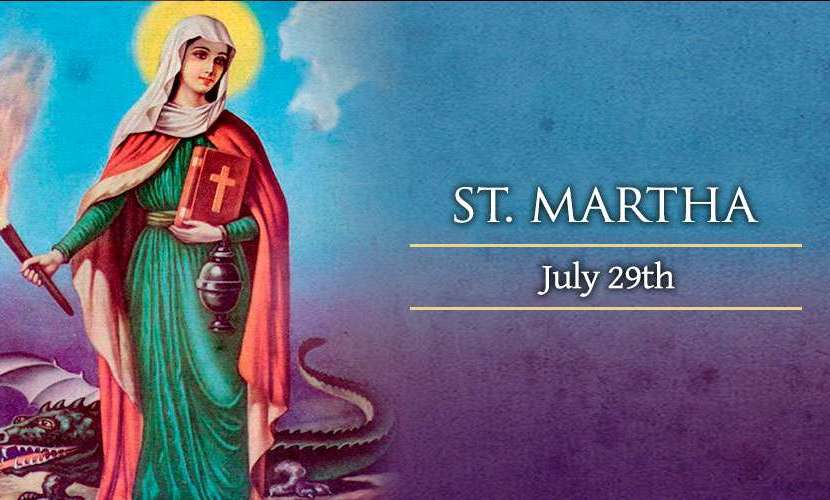
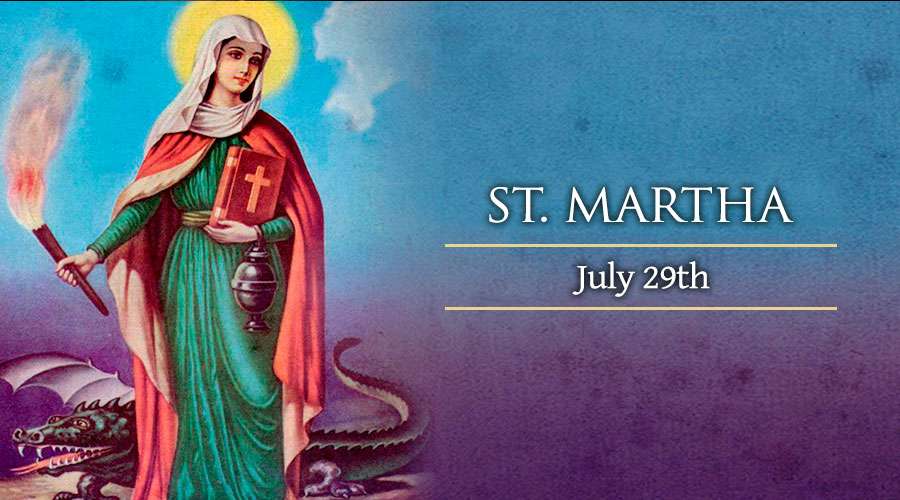
Today, we come together to celebrate The Memorial of St Martha.
Let us begin by looking at what the Holy Gospel is telling us today?
JN 11:19-27
Many of the Jews had come to Martha and Mary
to comfort them about their brother [Lazarus, who had died].
When Martha heard that Jesus was coming,
she went to meet him;
but Mary sat at home.
Martha said to Jesus,
“Lord, if you had been here,
my brother would not have died.
But even now I know that whatever you ask of God,
God will give you.”
Jesus said to her,
“Your brother will rise.”
Martha said to him,
“I know he will rise,
in the resurrection on the last day.”
Jesus told her,
“I am the resurrection and the life;
whoever believes in me, even if he dies, will live,
and anyone who lives and believes in me will never die.
Do you believe this?”
She said to him, “Yes, Lord.
I have come to believe that you are the Christ, the Son of God,
the one who is coming into the world.”
The feeling of Sorrow and grief is that dark feeling of trauma and distress that comes to us all after experiencing a loss or tragedy. Such an experience can often be all consuming. As children of God, our hearts ought to be filled with a genuine sense of compassion and care for our troubled brother or sister in their times of suffering and pain. We ought to love them (Rom. 12:10), cry with them (Rom. 12:15) and pray for them (James 5:13).
We have all felt this grief of loss of a dear loved one at some point in our lives. I personally have experienced it so many times. So, we can imagine exactly how Mary and Martha were feeling and the painful heavy grief atmosphere that they were experiencing within their family home. We can also understand their deep yearning that their dear brother would’ve been cured of his illness before it came to the point of his death.
In today’s Holy Gospel, we can clearly see a demonstration of the care Jesus showed toward Mary and Martha in the midst of their grief. When it comes to the death of God’s people the Bible says, “Precious in the sight of the LORD is the death of His saints” (Psalm 116:15).
The loss of a loved one naturally produces much grief and anguish within our hearts. When Martha, the sister of Lazarus and a close friend of Jesus, heard that Jesus was coming to pay his respects for the loss of Lazarus who had by then been dead for 4 days, she immediately went out to meet him before he could get to her house. What was it which compelled Martha to leave their home where Lazarus lay in death in order to seek Jesus out? I personally believe the reason could well have been two=fold in nature. I believe the companionship and consolation of her dear friend who also loved her brother deeply was one reason, as was that Martha recognized in Jesus the hope that God would restore life.
Martha, like many Jews, believed in the eternal life to come. The loss of her brother did not diminish her hope in the resurrection in the least. She even gently chides Jesus for not coming soon enough to save her brother Lazarus from his untimely death. Jesus does something unexpected and remarkable with the intention of both strengthening her faith and hope in the life to come and also to give her a sign of what he was to accomplish through his own death and resurrection. Jesus gave to her belief a new and profound meaning: He came from the Father to defeat all sin and death for us and to restore life to all who believe in him.
Jesus states unequivocally that he himself is the Resurrection and the Life. The life he offers is abundant – life which comes from God the Father himself. And also gives everlasting life – the fullness of life which is without end. Do we truly seek that abundant and eternal life which Jesus offers to all who believe in him?
“Lord Jesus, you are the Resurrection and the Life. Strengthen our faith and hope in your promises that we may radiate the joy of the Gospel to others.”
Psalm 126:1-6 NIV
1 When the Lord restored the fortunes of Sion,
we were like those who dreamed.
2 Our mouths were filled with laughter,
our tongues with songs of joy.
Then it was said among the nations,
“The Lord has done great things for them.”
3 The Lord has done great things for us,
and we are filled with joy.
4 Restore our fortunes, Lord,
like streams in the Negev.
5 Those who sow with tears
will reap with songs of joy.
6 Those who go out weeping,
carrying seed to sow,
will return with songs of joy,
carrying sheaves with them.
Let me finish with The voice of life and joy that awakens the dead, by Athanasius of Alexandria (295-373 AD):
“I am the voice of life that wakens the dead. I am the good odor that takes away the foul odor. I am the voice of joy that takes away sorrow and grief.… I am the comfort of those who are in grief. Those who belong to me are given joy by me. I am the joy of the whole world. I gladden all my friends and rejoice with them. I am the bread of life”

Wisdom and Who Matters ~ The Rt. Rev. Michael R. Beckett, OPI

Long ago in a galaxy far away….no. Wait! I mean…..Long ago in a COUNTRY far away….yeah, that’s better… there was a young king. And said young king, (we’ll call him Sol, coz that was his name) wasn’t really sure about this king-business. He was a good and responsible young man, but he just wasn’t sure he had what it took to do king stuff, you know, like run a country, protect his people, all that stuff. He lost sleep over it. One night, he actually managed to get to sleep and he had this dream……and in this dream, God appeared to him and said, “Solomon, ask for anything you want, and I will give it to you.”
Now, Sol, like we said, wasn’t really sure about his king-stuff he had goin’ on, and he recognized that this was his chance to be able to handle it, so he said, “Lord God, I’m your servant, and you’ve made me king in my father’s place. But I’m very young and know so little about being a leader. And now I must rule your chosen people, even though there are too many of them to count. Please make me wise and teach me the difference between right and wrong. Then I will know how to rule your people. If you don’t, there is no way I could rule this great nation of yours.
God said: DUDE!!!!! I’m pleased that you asked for this. You could have asked to live a long time or to be rich. Or you could have asked for your enemies to be destroyed. Instead, you asked for wisdom to make right decisions. So I’ll make you wiser than anyone who has ever lived or ever will live. 1 Kings 3:5;7-12 (the Bible translation according to me)
So….We have the leader of a great nation who has asked for and been granted wisdom. Solomon, also called Jedidiah, was, according to the Hebrew Bible (The Old Testament), Quran, and Hadiths, a fabulously wealthy and wise king of the United Kingdom of Israel who succeeded his father, King David. The conventional dates of Solomon’s reign are about 970 to 931 BCE. According to the Talmud, Solomon is one of the 48 prophets. In the Quran, he’s considered a major prophet, and Muslims generally refer to him by the Arabic variant Sulayman, son of David. The Hebrew Bible (Old Testament) identifies him as the builder of the First Temple in Jerusalem, beginning in the fourth year of his reign, using the vast wealth he and his father had accumulated. He dedicated the temple to Yahweh, the God of Israel. He is portrayed as great in wisdom, wealth and power beyond either of the previous kings of the country.
We all know the saying, “As wise as Solomon.” So, what is wisdom? According to the dictionary, wisdom is the quality of having experience, knowledge, and good judgment. The whole of Proverbs 8, tells us what wisdom is and it is Wisdom (Jesus) who speaks to us. Verses 12 and 13 (especially 13) are especially important: 12 “I, wisdom, dwell together with prudence; I possess knowledge and discretion. 13 To fear the Lord is to hate evil; I hate pride and arrogance, evil behavior and perverse speech.
Hate pride and arrogance, evil behavior, and perverse speech. Isn’t that, yet again, a paraphrase of The Golden Rule? Lemme repeat that for ya: Do unto others as you would have them do unto you. Treat others the way you want to be treated. (Matthew 7:12) And again in Matthew 22:37-40: “You shall love the Lord your God with all your heart and with all your soul and with all your mind. This is the great and first commandment. And a second is like it: You shall love your neighbor as yourself. On these two commandments depend all the Law and the Prophets.” (Matt. 22:37-40) That, my friends, is wisdom according to Jesus.
When we live out the golden rule, and truly love others, we are a witness for the gospel because we live in a way the world doesn’t because the world doesn’t give without getting. The world doesn’t really care. According to the world, NO lives matter. We must live our lives and be a witness to the power of the gospel. When we live out the Golden Rule, we also promote peace and societal flourishing. In other words, we make the world a better place, and give others a glimpse of what the world to come will look like simple by doing unto others what we would have them do to us. Live so that every person with whom you come into contact realizes that they matter, regardless of who they are. Prove to the world that we believe what Jesus said. Throughout his earthly ministry:
Jesus said, “Samaritan lives matter.”
Jesus said, “Children’s lives matter.”
Jesus said, “Gentile lives matter.”
Jesus said, “Jewish lives matter.”
Jesus said, “Women’s lives matter.”
Jesus said, “Lepers’ lives matter.”
Prove to the world that we, as followers of Jesus, are wise enough to believe that:
Black lives matter.
Gay lives matter.
Indian lives matter.
Trans lives matter.
Homeless lives matter.
Republican lives matter.
Democrats lives matter.
Police lives matter.
Protesters lives matter.
Jesus died for all of us. Jesus died for you. Shouldn’t we, in all wisdom, act accordingly?
Amen.
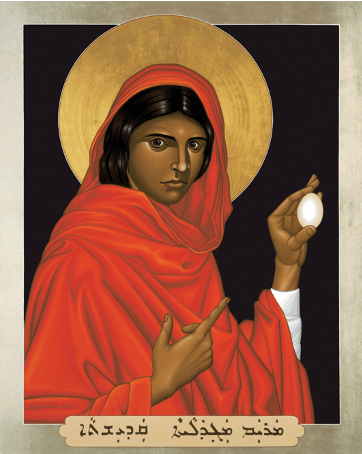
Unity: The Feast of St. Mary Magdalene ~ The Rev. Dcn. Igor Kalinski, OPI
Hello my dear family and friends. You know I am witnessing and living my vocation serving The Old Catholic Unified community in my town Gevgelija and all around Macedonia, serving as a Dominican friar to the poor, marginalized and LGBTQ communities.
As a Dominican friar I want to share that today we celebrate the legacy, the life and the ministry with her example of serving of this holy mother Mary Magdalene, equal to the apostle.
Many centuries ago, the General Chapter of our Order Dominican declared her as a Defender and Protector of our order.
Me living in such a conservative and anti LGBTQ society makes me motivated through her example and intercessions for all of us as a very close friend of Jesus.
She faced daily struggles of rejection, not acceptance and bigotry, because she was honored to be the very first human creation to see the empty tomb and our risen Lord Jesus.
She was the first ever to talk to Jesus on the resurrection morning.
While the humanity in that age treated the woman badly, Jesu embraced her, accepted her, blessed her and gave her authority to preach the gospel even in Rome to the emperor. In the eastern European tradition, she was the first lady to paint a red egg and to announce the resurrection gospel to the world. (Red represents the blood of Christ and it’s the most important color when painting eggs.)
Do you think it was easy in that time? Certainly not easy. It was very difficult, and there was much suffering because of the gender inequality with which she struggle. Even the apostles laughed at her and did not believe her when she told them what she sow and with whom she talked.
Are we not the same today? Racial hatred, LGBTQ phobia, divisions in the nations? This is not t God’s agenda.
Our goal and our agenda is acceptance, integrity, equality and integration.
I have learned a lot through her example and suffering.
I fight daily for improving of this marginalized people toward equality for everyone.
Its still the same today like in that time, people still want us to be put in box, just because they have built themselves to hate. Is that correct?
Is that the Gospel of Jesus?
NO!
Our goal and ministry is to be fully integrated, regardless of gender, sexuality, races. We are taught in Galatians 3:28 that there is “There is neither Jew nor Gentile, neither slave nor free, nor is there male and female, for we are all one in Christ Jesus. We are all equal in Gods eyes.
By the way, Mary Magdalene is considered to be the first woman priest in Christian. This is only a part of the legacy of this great woman who fought hatred in the ancient times. We are called to do the same.
But for God, all genders are equal, and we have to work to be improved this for the better common life. Jesus wants us before we go in heaven, to build heaven in our hearts and our societies.
If we heal division and embrace diversity, and love all our neighbors we can improve all of our common and private lives.
So I pray through her intercession about these divisions, Its time for us to live as true Christians. We are only one human race, and we are all equal. If the church does not preach this is a dead church.
I will never stop fighting for this people, that’s why I’m a Dominican.
St Mary Magdalene pray for us.
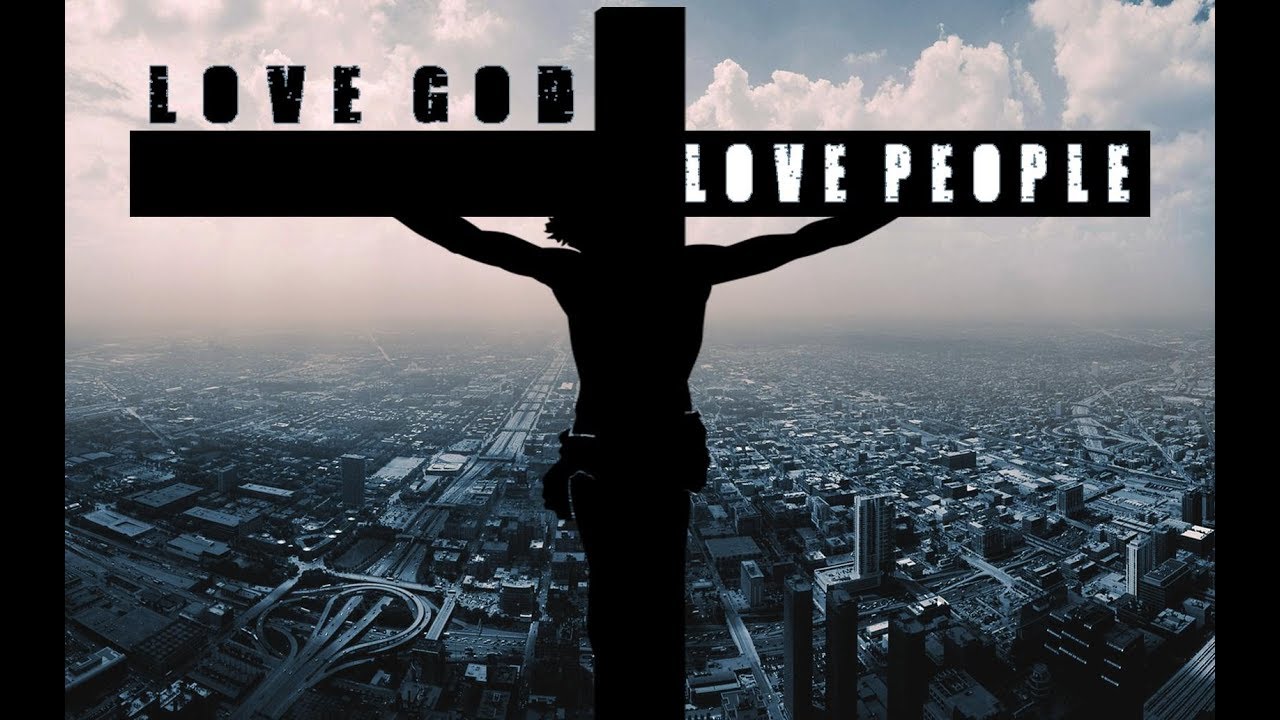
Love God. Love People. Say What? ~ The Rt. Rev. Michael R Beckett, OPI
Our Old Testament Reading today comes from the book of Wisdom, or as some call it, The Wisdom of Solomon. Now, most scholars agree that King Solomon, did not, in fact, write this book, but say that it was written in honor of him, using things he did write and things he said. During the Reformation, Martin Luther discarded this book of the Bible, along with others, whilst the more Liturgical churches retained them. Melito of Sardis in the 2nd century AD, Augustine (c. 397 AD) and Pope Innocent I (405 AD) considered Wisdom of Solomon as part of the Old Testament. Athanasius writes that the Book of Wisdom along with three other deuterocanonical books, while not being part of the Canon, “were appointed by the Fathers to be read”. In Matthew 12 Jesus quotes from this book. SO….having said all that, this is today’s reading:
There is no god besides you who have the care of all, that you need show you have not unjustly condemned. For your might is the source of justice; your mastery over all things makes you lenient to all. For you show your might when the perfection of your power is disbelieved; and in those who know you, you rebuke temerity. But though you are master of might, you judge with clemency, and with much lenience you govern us; for power, whenever you will, attends you. And you taught your people, by these deeds, that those who are just must be kind; and you gave your children good ground for hope that you would permit repentance for their sins. WIS 12:13, 16-19
At the risk of being accused of “cherry picking,” I want to focus on these verses: For your might is the source of justice, you judge with clemency, and with much lenience you govern us; And you taught your people, by these deeds, that those who are just must be kind;
So let’s think about that. The author(s) of the Book of Wisdom, in praising God have said that God judges with clemency, he judges with leniency, and has taught us that those who are just must be kind.
Well now…….Three key words: clemency, leniency, kindness. Clemency is defined as “mercy.” Leniency is defined as “quality of being more merciful or tolerant than expected.” Kindness is defined as “the quality of being friendly, generous, and considerate.”
How many times must it be repeated? Be merciful. Be kind. Show love. It’s pretty much one of the key recurring factors of Jesus’s ministry. Love God. Love people. Love God. Love people.
Jesus tells us in John 13:34-35, “A new commandment I give to you, that you love one another: just as I have loved you, you also are to love one another. By this all people will know that you are my disciples, if you have love for one another.” How do we show that love? Again, Jesus tell us, and again, very specifically in Matthew 25:35-45: For I was hungry and you gave me something to eat, I was thirsty and you gave me something to drink, I was a stranger and you invited me in, I needed clothes and you clothed me, I was sick and you looked after me, I was in prison and you came to visit me.’ “Then the righteous will answer him, ‘Lord, when did we see you hungry and feed you, or thirsty and give you something to drink? When did we see you a stranger and invite you in, or needing clothes and clothe you? When did we see you sick or in prison and go to visit you?’ “The King will reply, ‘Truly I tell you, whatever you did for one of the least of these brothers and sisters of mine, you did for me.’ “Then he will say to those on his left, ‘Depart from me, you who are cursed, into the eternal fire prepared for the devil and his angels. For I was hungry and you gave me nothing to eat, I was thirsty and you gave me nothing to drink, I was a stranger and you did not invite me in, I needed clothes and you did not clothe me, I was sick and in prison and you did not look after me.’ “They also will answer, ‘Lord, when did we see you hungry or thirsty or a stranger or needing clothes or sick or in prison, and did not help you?’
45 “He will reply, ‘Truly I tell you, whatever you did not do for one of the least of these, you did not do for me.’
The least of these….who then, are ‘the least of these’ in today’s society? Probably those who make many of us uncomfortable. The homeless? People who are a different color? People who are of a different color? Sexual orientation? Ethnicity? Who are “the least of these” to you?
Stephen Mattson writes:
Throughout his ministry, Jesus showed that he did, indeed, love everyone, even to the point of dying for their sins, but you know, he went out of his way to intentionally help specific groups of people — the alienated, mistreated, and those facing injustice. Throughout his earthly ministry:
Jesus said, “Samaritan lives matter.”
Jesus said, “Children’s lives matter.”
Jesus said, “Gentile lives matter.”
Jesus said, “Jewish lives matter.”
Jesus said, “Women’s lives matter.”
Jesus said, “Lepers’ lives matter.”
Christians must recognize that our society today is filled with numerous groups and communities facing systemic oppression, and we must act. We must be willing to admit and address the complex realities within our world that create such problems, and avoid the spiritual laziness that tempts us to rely on generic excuses and solutions.
Christians do a disservice to the gospel message by removing the cultural context from Jesus’s ministry and watering down his message to one of religious platitudes. We like to generalize the words of Jesus and transform his life into a one-size-fits-all model that can apply to all of humanity. He intentionally, purposefully, and passionately addressed very specific causes. He radically addressed the diverse and complicated conflicts of the time and shattered the status quo. Are we, as Christians, not called to do the same? By addressing racism, immigration, gender equality, and a litany of other issues, we are following in the steps of Jesus.
Justice. Mercy. Kindness. Love God. Love people.
Amen.
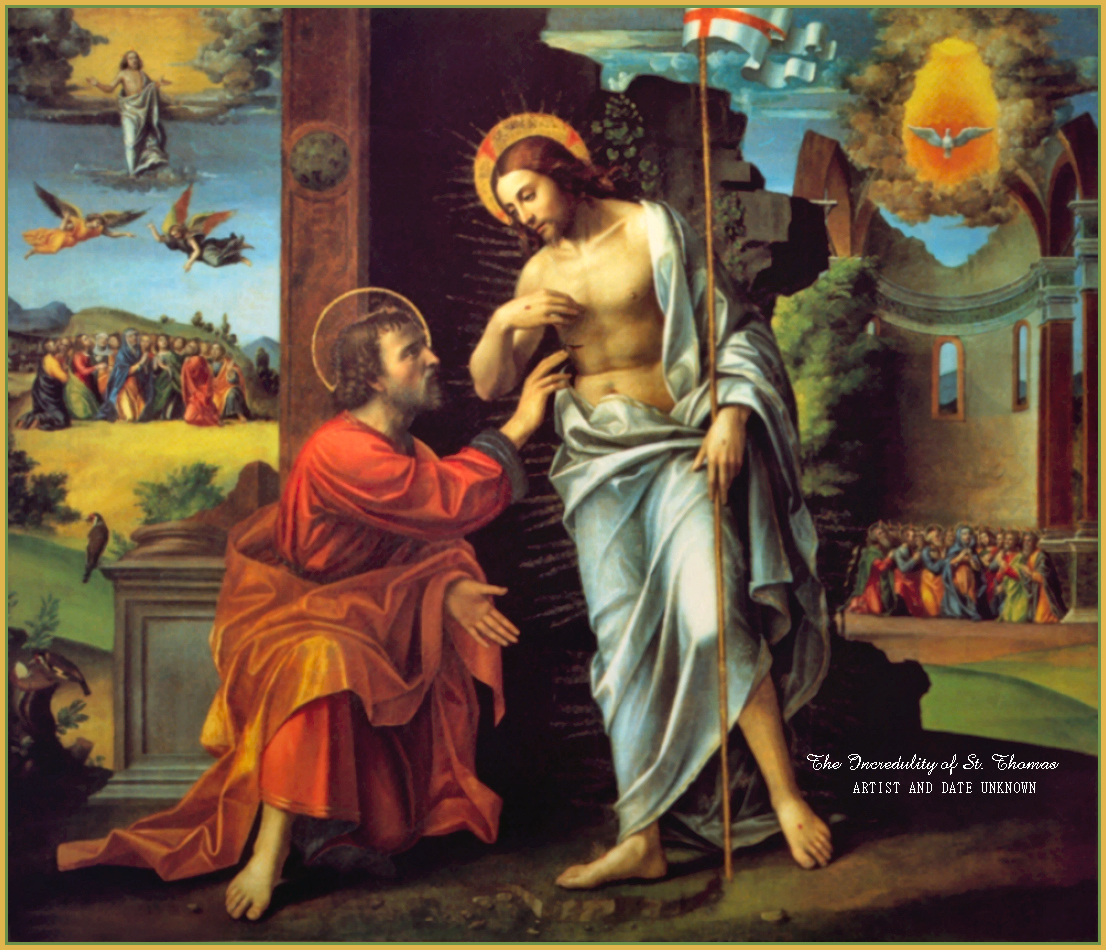
Faith and Doubt: The Feast of St. Thomas ~ The Very Rev. Lady Sherwood, OPI
Reading 1: EPH 2:19=22
R psalm: Mark 6:15
Gospel: JN 20:24=29
Today’s we come together to commemorate the Feast of St Thomas the Apostle, often nicknamed ‘Doubting Thomas’,because on Easter Sunday after Mary had seen Jesus, he went to the room where the disciples were and suddenly appears to them despite locked doors and they could clearly see the wounds to His hands and side. Jesus tells them, “Peace be with you”. The disciples believed.
Thomas however, wasn’t with the other Apostles when Jesus had appeared to them, and when Thomas arrived after Jesus had left them, the other disciples told Thomas about Jesus visiting them, but Thomas didn’t believe, he told them, “Unless I see Jesus for myself, and can touch His wounds, I won’t believe.” I can easily imagine that Thomas may have thought the other apostles were teasing him; or why wouldn’t Jesus have stayed long enough until he had managed to arrive?
The next week however, the disciples are gathered together again, this time Thomas was with them. Jesus suddenly appeared and told Thomas to put his hands on His and to feel his wounds. Thomas does so, and Jesus asked Thomas, “Do you believe because you have seen me?” and he tells him, “Blessed are those who do not see yet believe.”
Can you imagine what it would be like to be mainly remembered by many because of our greatest moment of doubt? Haven’t we all doubted at one time or another? I can tell you that I have once or twice. Thomas therefore, is the disciple to whom all of us can relate. Most of us have experienced what it is to live between faith and doubt at some point.
Most people tend to think that Faith and doubt are opposites, but in true fact, it is often a part of our faith journey. It is a stop, or a bump in the road that most of us would’ve made more than once on our journey. This doesn’t make us bad Christians or believers. Indeed, rather, it can be seen as a sign that we take our relationship with God seriously that we allow ourselves to walk the journey of faith without knowing for certain through what we will be travelling.
Christian tradition tells us that Thomas set sail for India and indeed was the first to spread Christianity there. He is the Patron Saint of India.
The doubt that Thomas previously had, was what brought him faith and that faith was such that he brought the message of Christ to many.
We all have times of doubt, at least all of us that see faith as a true journey, not a one=time stop gap. Doubt can actually propel us to faith, and can be what gives us the shake up we may at times need. It can be what sends us out of our comfort zones and into a new and better world. Doubt can act like a ticket that starts us truly on our journey to a whole new life of faith. It can be a sign of not the absence of God as many may think, but rather of God working within us to do something new.
Let us pray:
O Glorious St Thomas, your grief for Jesus was such that it wouldn’t allow you to to believe that he had risen until you saw him and touched his wounds. But your love for Jesus was equally great and it led you to give up your life for Him.
Pray for us, that we may grieve for our sins which were the cause of Christ’s sufferings. Help us to spend our lives in His service and so to be Blessed, which Our Lord Jesus applied to those who would believe in Him without seeing Him.
Amen.
The Feast of Sts. Peter and Paul: We Can Be Saints, Too! ~ The Rev. Deacon Igor Kalinski, OPI
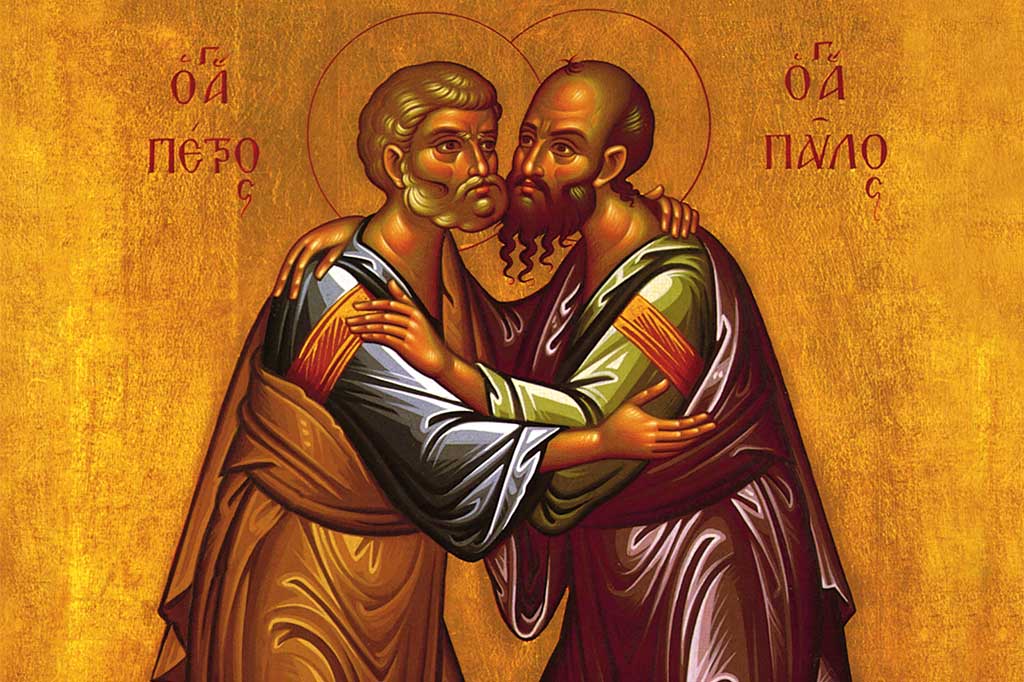
During this month June, in this very difficult year for all the humanity, I have realized how miserable, hypocrite, unfaithful to myself after all that I have passed during this life in a very conservative environment, and above all I found again Jesus , the ultimate love, and that is impossible to please God, if you don’t support all groups of people that share and endure daily struggle of acceptance, bigotry, and the rejection of some leading churches towards liberty and freedom of all people regardless , their color skin, sexual identity.
I realized that is not only that you should stick to the tradition, so that we can worship our heavenly Father, forgetting that “mercy I seek not holocaust” if God is love, and indeed He is, lets follow the example of these greatest among apostles and martyrs for Christ, Saints Peter and Paul.
How many hardships, beatings, arresting, assassinations attempts had occurred to them?
How many time Peter failed?
Paul was training over Christians.
But God revealed to Him in full power and might, in His majesty, then he became blind.
How many times Peter denied Jesus?
Believe me, I am worst sadly of failures, daily denials, and above all not having love for the people as they did all love and lately payed with their lives.
Let us preach the Gospel of the love, the gospel of acceptance, lets strive to bear one another these hardships and struggles, bold as Peter and steady as St Paul.
The bible has many holy books written from St Paul. We can nourish ourselves daily in his epistles, to study and pray, that’s pure Dominican charism, study and later preach from the fruits of your study.
Let us be penitent like St Peter that after he denied Christ and have the repentance and meek heart of Paul, that after sinful evil way of having been a religious fanatic, to become brave barefoot preacher of the nations.
St Peter and Paul apostles pray for us. Amen


You must be logged in to post a comment.