Happy Birthday!!! ~ Br. Michael Marshall, Novice

Cake

Let’s all sing…

Happy Birthday to You,

Happy Birthday to You,

Happy Birthday, Church,

Happy Birthday to You!!!

Streamers, balloons, a banner, people blowing through noise makers… and a big cake!  Well okay, Pentecost is not that kind of birthday party, but it is a celebration of the beginning of the Church.  Instead of these fun festive things, we remember things which took place that are even more awesome!

And they were all filled with the Holy Spirit and began to speak in different tongues, as the Spirit enabled them to proclaim. Now there were devout Jews from every nation under heaven staying in Jerusalem. At this sound, they gathered in a large crowd, but they were confused because each one heard them speaking in his own language. (Acts 2:3-6)

The Holy Spirit put things into motion for Christianity as it descended upon the Apostles and others present. If the Holy Spirit had not come down, the Church would not be what it is today because the Gospel would not have spread beyond Jesus’ closest followers. The fact the people received the gift of the ability to speak in various languages; they could go off to spread the Gospel to others than of their own native language. We would not be able to be a witness to others today. Jesus makes the point in the Gospel:

“I have much more to tell you, but you cannot bear it now. But when he comes, the Spirit of truth, he will guide you to all truth. He will not speak on his own, but he will speak what he hears, and will declare to you the things that are coming. He will glorify me, because he will take from what is mine and declare it to you. Everything that the Father has is mine; for this reason I told you that he will take from what is mine and declare it to you.” (John 16:12-15)

The message of Jesus is the truth, and because the disciples were given the gift to teach what Jesus instructed in languages other than their own, teaching the truth of what is yet to come has been passed on. The message was not to stay with the disciples. Because the Gospel has been spread throughout the world and through history, it is not intended to remain with us.  We are called to be witnesses of the Gospel for others to spread the message so that they may also spread the message.

There are so many individuals and groups who need to hear the Gospel, and they often hear the opposite of the Gospel.  They hear the message of ignorance, indifference, or even hate because of social status, ethnicity, gender preference, or disability. I have seen posters at “Christian” rallies which say, “God hates Gays” and “God is White”. I read a news article which was about a city making it illegal to aid the homeless, and it hurts me deeply to see people who claim they are Christian only turn away from the Gospel. Jesus did not avoid the leper and other “impure” people, but instead he reached out to also minister to them. It is not always easy to love our neighbor, but it is our call to be witnesses of the Gospel to everybody.  Are you spreading the Gospel???


Feast of the Translation of our Holy Father Saint Dominic

dominics-tomb

The body of the holy patriarch, Saint Dominic, had been laid to rest, according to his own desire, in the Church of Saint Nicholas at Bologna, beneath the feet of his Brethren, and, in spite of continual prodigies and Divine favors granted to the faithful who prayed day and night at his tomb, his children allowed the sacred deposit to remain under the plain flagstone originally laid over it and took no steps for obtaining his canonization. Lest they should be thought to be seeking their own emolument under the appearance of piety, the Friars even broke and threw away the votive offerings brought by the people and would not permit any exterior marks of devotion to be exhibited. It was necessity which at length compelled them to undertake the first translation of the sacred relics. The ever-increasing numbers of the Community obliged them to enlarge the Convent, and to pull down the old church and build a new and more spacious one. To do this the tomb of Saint Dominic would have to be disturbed. They accordingly applied for the requisite permission to Pope Gregory IX., who was no other than the Saint’s old friend, Cardinal Ugolino. He joyfully granted the petition, at the same time administering a sharp rebuke to the Friars for their long negligence.

The solemn translation accordingly took place on Whit-Tuesday, May 24, 1233 A.D., during the General Chapter, which was held that year at Bologna. The Pope wished to have attended in person, but, being prevented from doing so, he deputed the Archbishop of Ravenna to represent him, in company with a number of other distinguished prelates. Three hundred Friars Preachers from all countries assembled to assist at this function, not without a secret fear on the part of some as to the state in which the sacred remains might be found, as they had long been exposed to rain and heat, owing to the dilapidated condition of the church. The opening of the tomb took place before daybreak, in the presence of Blessed Jordan, then Master-General of the Order, and the fathers of the Chapter, together with the Bishops, Prelates and Magistrates who were to assist at the ceremony. All stood round in silence while the Procurator, Father Rodolph of Faenza, raised the stone. Hardly had he begun to remove the earth and mortar that lay beneath an extraordinary odor became perceptible , which increased in power and sweetness as they dug deeper, until at length, when the coffin appeared and was lifted out of the grave , the whole church was filled with the perfume as though from the burning of some rich and precious gums. The bystanders knelt on the pavement, shedding tears and emotion as the lid was raised, and the exposed to their eyes.

It was the Master-General who raised the body of his beloved father and reverently laid it in a new coffin. The faithful were then admitted, and the Archbishop of Ravenna sang the Mass of the day, while the fragrance diffused from the open coffin flooded the whole of the sacred edifice. Blessed Jordan in his circular letter to the Order thus described the solemn function: “As the choir intoned the Introit, ‘Receive the joy of your glory, giving thanks to God, who was called you to the celestial kingdom,’ the Brethren in their gladness of heart took the words as if spoken from heaven. The trumpets sounded, the people displayed a countless multitude of tapers; and, as the procession moved along, there everywhere resounded the words, ‘Blessed be Jesus Christ!” He goes on to speak of the vast number of miraculous graces which were poured forth both before and after the ceremony. ‘Sight “he says , “was granted to the blind, power of walking to the lame, soundness to the paralyzed, speech to the dumb…..I myself saw Nicholas, an Englishman, who had long been paralyzed, leaping at this solemnity.”

The coffin was then laid in the marble tomb prepared for it. But eight days later, to satisfy the devotion of some distinguished persons who had not been present on the previous occasion. The holy remains were again exposed to view. Then it was that Blessed Jordan, taking the sacred head between his hands, kissed it, while tears of tenderness flowed from his eyes; and, so holding it, he desired all the fathers of the Chapter to approach and gaze at it for the last time. One by one they came and kissed the venerable relics. All were conscious of the same extraordinary fragrance; it remained on the hands and clothes of those who touched or came near the body. Nor was this the case merely when the grave was first opened. The tomb remained unclosed for fifteen days, during which interval it was guarded by officers appointed by the city magistrates; and all this times the same exquisite odor was sensible to all who visited the spot; and Flaminius, who lived three hundred years later, thus writes (1527 A.D.): “This divine odor adheres to the relics even to the present day.”

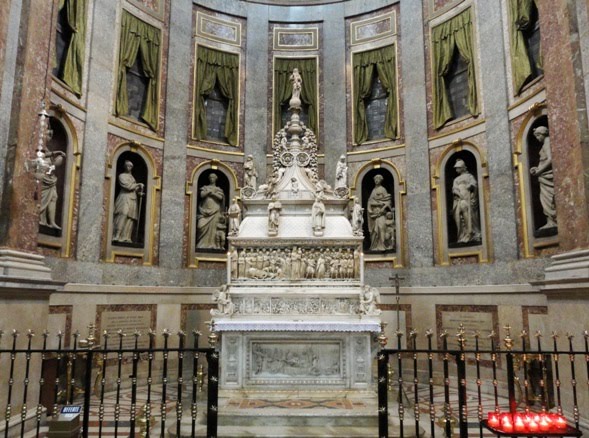
A second translation of Saint Dominic’s relics took place in the year 1267 A.D., when the holy body was removed to amore richly ornamented tomb. This translation, like the first, was made at a time of the General Chapter; and the head of the Saint, after being devoutly kissed by the Brethren and several Bishops who were present, was exposed to the veneration of the people from a lofty stage erected outside the Church of Saint Nicholas. The tomb was again opened in 1383 A.D., when apportion of the head was placed in a silver reliquary, in order the more easily to satisfy the devotion of the faithful. Finally, 1469 A.D., the remains of the Saint were deposited in the magnificently sculptured shrine in which they now rest, which is regarded as the masterpiece of Nicholas Pisano.

Saint Servatius, Bishop & Confessor

Servatius

Saint Servatius was of noble birth, and he was renewed alike for his learning and sanctity. He became Bishop of Tongres in Belgium, which then formed part of Gaul, and in that capacity assisted at the Council of Sardica, where he strenuously defended the Catholic Faith against the Arians. He likewise stoutly resisted these heresies at the Council of Rimini, and labored to prevent the ill consequences which threatened the Church through their frauds and the weakness of the Bishops. Being sent by the tyrant Magnentius, together with Saint Maximin, Bishop of Treves, as ambassador to the Emperor Constantius, he was honorably entertained by Saint Athanasius at Alexandria.

Saint Gregory of Tours states that Saint Servatius foretold the invasion of Gaul by the Huns and implored the Divine mercy by watching. fasting, prayers and many tears to avert so great a calamity from the flock entrusted to his care. For this intention he undertook a penitential pilgrimage to the tomb of Saint Peter in Rome. As he was weeping and praying there, the Prince of the Apostles appeared to him and thus addresses him: “Wherefore dost thou importune me? The Lord has decreed that the Huns should enter Gaul and lay it waste in a terrible manner. Take my counsel, therefore; lose no time; set thy house in order, prepare thy grave, make ready a clean winding-sheet. Behold , thou shalt depart this life and shalt not witness the evils which the Huns are to bring upon Gaul, as the Lord our God hath spoken.”


The holy Bishop, therefore returned in all haste to his diocese, and with many tears imparted the sad tidings to his heart-broken flock. “Holy Father , do not abandon us,” they exclaimed; “Good Shepherd, forget us not.” Very shortly afterwards he fell ill, as Saint Peter had foretold, and closed his saintly life by a holy death on May 13th, 384 A.D., after an episcopate of thirty-seven years. It is recorded that when all the country round was white with snow his tomb at Maestricht always remained free from it until the time a church was raised over his holy remains.


Saint Servatius was declared Protector of the Dominican Order in consequences of the following circumstances. In the fourteenth century the Church and the Order of Preachers were suffering bitter persecution from the schismatical Emperor, Lewis of Bavaria. Learning that the General Chapter was convoked to meet in his dominions , at the city of Cologne, 1330, A.D., this prince secretly plotted the death of the capitular Fathers. They had just assembled, when Saint Servatius appeared in a dream to one of their number, a very holy religious, warned him of the danger which threatened himself and his brethren , and bade them to flee to Maestricht. This they accordingly did, thus escaping the snares which had been laid for them. And though their coming to Maestricht was wholly unexpected, God disposed the hearts of the inhabitants to receive them with the utmost kindness.


In gratitude for this providential intervention, the Fathers decreed that the festival of Saint Servatius should henceforth be celebrated in the Order to the end of time. But, as it was at first instituted only under the rite of a Feast of the Three Lessons, the great increase of festivals of higher rank caused it, after the lapse of years, to fall into disuse. To preserve the memory of so great a benefit, the Fathers, therefore, obtained permission from Pope Leo XII that the festival of Saint Servatius should be henceforth celebrated throughout the entire Order with the rank of a Totum Duplex, or Greater Double.


Born: Armenia, unknown date

Died: May 13th 384 at Tongres, Belgium of fever

Canonized: Pre- Congregation

Patronage: against foot problems, against lameness, against leg problems, against mice/rats, against rheumatism, success

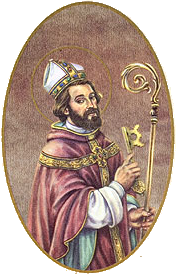
Representation: bishop holding a key and accompanied by an angel meeting burghers at a city gate, bishop holding a key in one hand while placing his crozier on a dragon, bishop reading desk where nearby sits a shield with three wooden shoes, bishop with three wooden shoes, man striking water with a staff, pilgrim sleeping in the sun while an eagle fans him

Blessed Columba of Rieti

Columba_of_Rieti

Blessed Colomba of Rieti is always called after her birthplace, though she actually spent the greater part of her life away from it. Her celebrity is based — as it was even in her lifetime — mainly on two things: the highly miraculous nature of her career from its very beginning, and her intense devotion to the Blessed Sacrament. She was one amongst a number of saintly Dominican women who seem to have been expressly raised up by God in protest against, and as a sharp contrast to, the irreligion and immorality prevalent in Italy during the fifteenth and sixteenth centuries. These women, nearly all of the Third Order, had an intense devotion to St. Catherine of Siena, and made it their aim to imitate her as nearly as possible. Many seculars, men as well as women, shared this devotion, amongst these being Ercole I, Duke of Ferrara, who had a deep admiration for Colomba and for some other holy Dominican religious, her contemp oraries, the most notable of whom were Blessed Osanna of Mantua and Blessed Lucy of Narni.

For the latter Ercole’s veneration was so great that he never rested until he had got her to come with some of her nuns to live in Ferrara, where he built her a convent and where she died after many troubles. She began when quite a girl to practice austere penances and to subsist almost entirely on the supernatural food of the Holy Eucharist, and continued this for the greater part of her life. At nineteen she joined the Dominican Tertiaries, of whom there were many in town, though still living at home; and she soon won the veneration of her fellow townspeople by her personal holiness as well as by some miracles that she worked. But Colomba was not destined to remain in Rieti. In 1488 she left home and went to Perugia, where the inhabitants received her as a saint, and in the course of time built her the convent of St. Catherine, in which she assembled all the Third Order Dominicanesses, who desired her as superior in spite of her youth. In 1494, when a terrible plague was raging in Perugia, she offered herself as victim for the city. The plague was stayed, but Colomba herself was struck down by the scourge. She recovered only to save her sanctity severely tried by widely spread calumnies, which reached Rome, whence a commission was sent to examine into her life. She was treated for some time as an imposter, and deposed from her office of prioress; but finally her innocence triumphed.

In 1495 Alexander VI, having heard of Colomba’s holiness and miracles from his son the Cardinal Caesar Borgia, who had been living in Perugia, went himself to the city and saw her. She is said to have gone into ecstasy at his feet, and also to have boldy told him of all personal sins. The pope was fully satisfied of her great sanctity, and set the seal of approval on her mode of life. In the year of 1499 she was consulted, by authorities who were examining into the manner, concerning the stigmata of Blessed Lucy of Narni, and spoke warmly in favor of their being genuine, and of her admiration for Blessed Lucy’s holiness. Her relics are still venerated at Perugia, and her feast is kept by her order on 20 May.

Born: February 2, 1467 at Rieti, Umbria, Italy as Angelella Guardagnoli

Died: May 20, 1501 at Perguia, Italy of natural causes; at the moment of her death, her friend, Blessed Osanna Andreasi, saw Columba’s soul as a radiance rising to heaven; the whole city turned out for her funeral, which was paid for by the city fathers

Beatified: February 25, 1625 by Pope Urban VIII

Patronage: against sorcery; against temptation and Perugia, Italy

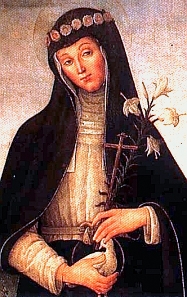
Representation: Dominican tertiary receiving the Eucharist from a hand reaching down from heaven; Dominican tertiary receiving the Eucharist from an angel; Dominican tertiary with a dove, lily, and book; Dominican tertiary with a wreath of roses, cross, lily, and rosary

The Unknown Disciple ~ The Rt. Rev. Michael Beckett, OPI

51GoekeWQnL._SY344_BO1,204,203,200_
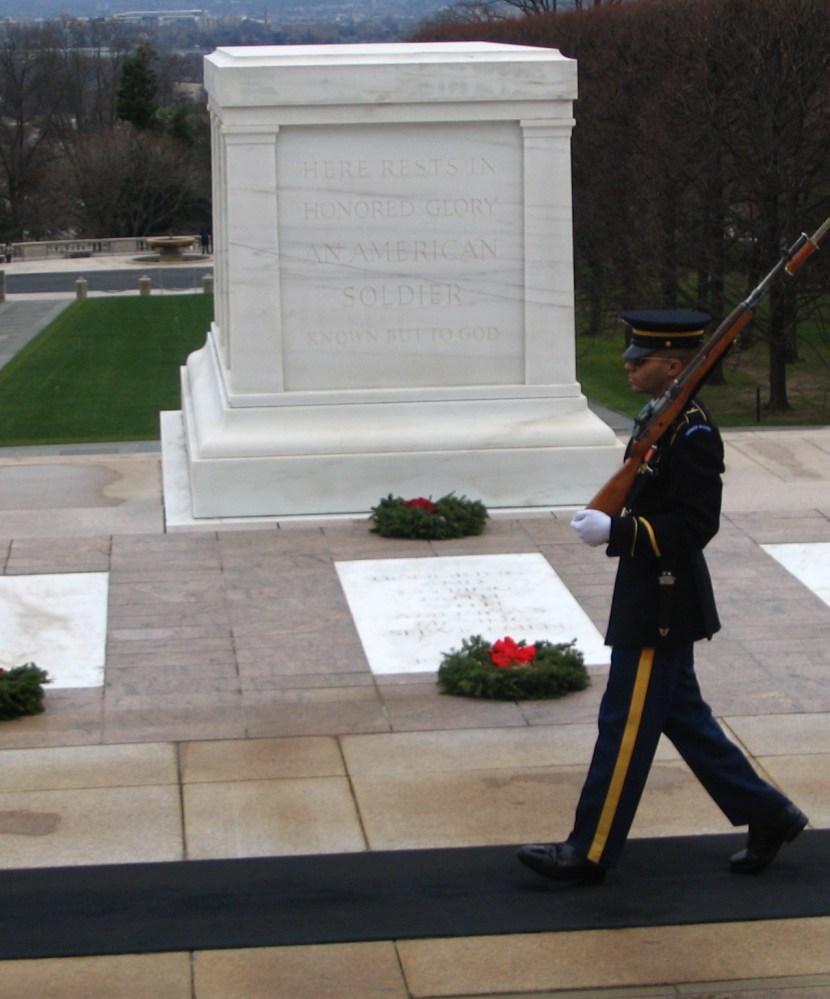
In Arlington National Cemetery, there is a tomb; a beautiful tomb, the Tomb of the Unknown Soldiers. In this tomb lie the remains of soldiers who were not able to be identified after their deaths from America’s wars since the 1st World War. Britain, Australia, France, Belgium, Bulgaria, Serbia, and a host of other countries also honor their unknown warriors. Those who lie in repose have no known names, no known family, no known history, but they are celebrated for what they did, for what they represent. They gave their all.

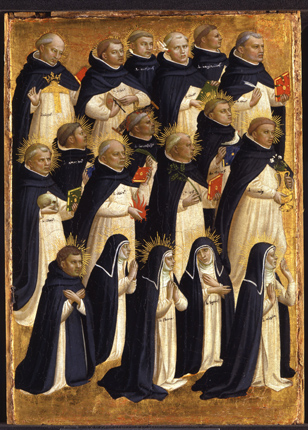
In the church, we don’t necessarily have a “Tomb of the Unknowns” but we do have a Feast Day to honor our unknown heroes. That day is, of course, 1 November, The Solemnity of All Saints, in honor of all the saints, known and unknown.

Now you’re saying to me, what in the world does All Saints Day have to do with the last Sunday in Eastertide???? Well, let’s think about that for a minute. In the first reading of the Scriptures appointed for today, from the first chapter of Acts, we learn that a new Apostle is chosen to replace Judas Iscariot. It would seem that there were two choices for the job. Matthias and Judas Barsabbas. Both of these men had been with Jesus FROM THE BEGINNING WHEN JESUS WAS BAPTIZED. What? There were more than the 12 original disciples? We tend to forget that, don’t we? In Luke 10: 1-24, we are told that Jesus sent out 70 men, 2 by 2 into every place that he was planning on going.

Church tradition holds that both of these men were 2 of that 70.

In the first sentence of our readings today, we learn that Peter was speaking to 120 folks.

Now, granted, you can ask just about anyone who knows me, and they will tell you that I’m pretty inept when it comes to math, but I DO know that 70 minus 2 is 68, and 120 – 2 is 118. Which leads me to ask, “Who are these people? Who are these 118 people who figured so prominently in spreading the Gospel? Who are these 118 people who were so devoted to Jesus that they risked imprisonment, some of them death; who risked losing everything to hang out in Jerusalem after the crucifixion and resurrection because Jesus told them to be there and to wait?”

Let’s think about that for a minute. We can whittle that number down some more…… Acts 1:13-15 says, “And when they were come in, they went up into an upper room, where abode both Peter, and James, and John, and Andrew, Philip, and Thomas, Bartholomew, and Matthew, James the son of Alphaeus, and Simon Zelotes, and Judas the brother of James. These all continued with one accord in prayer and supplication, with the women, and Mary the mother of Jesus, and with his brethren.” So there are a few of them. And then, we would expect that those mentioned in Acts 6:5 had been among the 70 and the 120 (Stephen, Philip, Prochorus, Nicanor, Timon, Parmenas, Nicolas), also Barnabas. These were men of good reputation, full of the Holy Spirit and wisdom.

Women were also identified to be among the 120. The wives of the apostles were there (1 Cor. 9:5 “Have we not power to lead about a sister, a wife, as well as other apostles, and as the brethren of the Lord, and Cephas?”). Each of the wives was a devout believer in Christ. Part of the number of women would be those mentioned in Luke 8:1-3. “And it came to pass afterward, that he went throughout every city and village, preaching and shewing the glad tidings of the kingdom of God: and the twelve were with him, And certain women, which had been healed of evil spirits and infirmities, Mary called Magdalene, out of whom went seven devils, And Joanna the wife of Chuza Herod’s steward, and Susanna, and many others, which ministered unto him of their substance.” See also Matt. 27:55-56; Luke 23:49,55. We would expect that the sisters of Jesus were also believers by this time, as His brothers had become.

Jesus brothers, had not been believers before the Crucifixion (John 7:3-5). Now they were firm in their faith and devotion to Him. These were: James, Joses, Simon, Judas (Matt. 13:55-56). James the Just was the leader of the Jerusalem Church in Acts 15:13. He is called an apostle in Gal. 1:19, although not one of the Twelve. James was the author of the Book of James. Judas was the author of the Book of Jude.

So….that leaves us with how many folks we don’t know? I lost count, I hate math, and it really doesn’t matter does it? What DOES matter is that we don’t know who, exactly, all of these people were. What we DO know, is what they did.

These were they who supported the Apostles. These were they who were in the upper room on the day of Pentecost. These were they who worked so diligently, some to the point of sacrificing their lives, to spread the message of the Gospel. These were they who were on fire for Christ. These were they to whom we look to be, or we should look to be, examples.

Who were they? Their names don’t matter. They lived 2000 years ago and they are lost to us. In 2000 years, in 100 years, most of our names will be lost. But what matters is what won’t be lost. What matters is what we do and say and proclaim, so that those who come after us will know, will experience, will be able to live, the truth and the joy of the Gospel.

My dear friends, we do not live in a vacuum. Everything that we do, everything that we say, has an effect on someone. And that someone has an effect on someone else. We see this everyday of our lives. You hear of things ‘going viral’ on the internet. Someone had to start it. Some ONE posted something that was liked….and liked….and shared and shared and shared. Is this not what those 120 people in the upper room did? Is this not what we are called to do?

In your everyday life, how often do you reference Christ? Now, I’m not talking about quoting Scripture. I’m talking about demonstrating who Christ is, showing the world Christ’s love, his Salvation? What is it that you do, or say, or write, or post, that will touch someone in a way you never imagined? I dare say you will never know. BUT, we all of us need to remember that we DO touch lives, lives we don’t even know exist. We touch lives that are unknown to us. We are touched by people who are unknown to us.
Besides those 100+ folks in the upper room, besides us, how many others have there been? How many saints? How many martyrs? How many unnamed, unwritten about people have left us with the legacy of Our Lord? Revelations 7 tells us: “I beheld, and, lo, a great multitude, which no man could number, of all nations, and kindreds, and people, and tongues, stood before the throne, and before the Lamb, clothed with white robes, and palms in their hands; These are they which came out of great tribulation, and have washed their robes, and made them white in the blood of the Lamb.” The unnamed disciples.

I plan on being in that ‘great multitude.’ I plan on being one of those “unnamed disciples.” Won’t you join me? Won’t you work to spread the love, the message, the salvation of our Lord and Savior? Amen.


Blessed Andrew Abellon

Blessed+Andrew+Abellon

Blessed Andrew was born near the world-famous shrine of Mary Magdalen. His entire life was centered around the shrine, and it is greatly due to his efforts that devotion to the great penitential has become so well established.

As a young man, Andrew may have heard the stirring sermons of Saint Vincent Ferrer, who was at that time preaching in France. Perhaps the purity and penitential zeal for which this great preacher was renowned gave the young Andrew the pattern for his own life. He soon demonstrated his choice of purity and penance by joining the Dominicans in his home town. After a happy and holy novitiate, he made his profession and was ordained. In a few years, a preacher and a guide for souls, he turned his attention to the neglected shrine of Saint Mary Magdalen.

This rugged and penitential region of France had been honored from the time of the Apostles as the chosen retreat for Mary Magdalen, who did penance there for the sins of her youth. From earliest days, it had been a place of pilgrimage, but had no definite arrangements for the care of pilgrims, nor any way of supplying their spiritual needs. In Blessed Andrew’s time, Dominican fathers from Saint-Maximin had taken over the spiritual care of the pilgrims as a mission work, but without financial help, and in the face of great trials.

Seeing the need of a permanent foundation at the shrine, Andrew set about creating one. He interested the queen in his project, and obtained enough money from her to build a monastery, which was a gem of architecture as well as a source of spiritual power. Andrew had studied art before his entry into the order, and he used his talents in building, beautifully and permanently, whatever he was called upon to do.

A lover of great beauty in the physical order, Andrew was the same in the spiritual. He was famous as a confessor, and his wise government as prior gave help to the spiritual growth of the new convent. A practical man as well as deeply spiritual, Andrew established two mills near the shrine that would provide the people with a means of earning a living while remaining there. Quite naturally, a priest who interested himself in the welfare of the people to this extent could hope for great influence with them, and this he had, both at Saint Maximin and at Aix, where an altarpiece he painted may still be seen.

After his death, Blessed Andrew was buried in the Church of the Magdalen. His tomb soon became a place of pilgrimage; his help especially was sought in the cure of fevers.

Born: 1375 at Saint Maximin, Provence, France

Died: May 15, 1450 at Aix-en-Provence, France of natural causes; buried in the Church of the Magdalen; his tomb became known as a site of miraculous cures.

Beatified:1902 (cultus confirmed) by Pope Leo XIII

Patronage: against fever

Blessed Giles of Portugal

arms-of-the-dominican-order

So many romantic legends intertwine themselves with the story of Blessed Giles that it is difficult to see the man himself. His life, even stripped of its legend, however, is the story of the triumph of grace in the human soul.

He was the son of Rodrigues de Vagliaditos, governor of Coimbra under King Sancho the Great. From his childhood, Giles was destined for the priesthood for which he studied at Coimbra. He was ordained at an early age, but with no good intention, for he saw in the priesthood only a chance to wield power. His father’s influence gained for him a number of rich benefices, which he used sinfully for power and pleasure.

Being a brilliant student, he advanced rapidly in his chosen field of medicine, an art that was at the time often linked with necromancy or black magic. He neglected his priestly duties and seemed bent only on the pleasures of life.

Thoroughly irreligious and pleasure-seeking young man, set out for Paris to work for higher degrees in medicine. On the advice of a stranger he met on the way, he went to Toledo instead and became a student of the black arts. According to one story, he met the devil and signed a contract with him, in which he promised his soul in return for a universal knowledge of medicine. Thereupon he spent seven years in bondage to his evil master, learning all his arts.

Having gained the highest degrees in medicine, Giles went to Paris and became a successful physician. At the peak of worldly success, he began to have horrible visions. He saw himself in a cemetery of a monastery of which he enjoyed the revenues. There he saw a specter who carried a skull and an hourglass. The specter knocked at one and then another of the tombs, calling out, “Arise, faithful monk!” At each summons another fearful specter appeared, until at one tomb there was no answer.

“Giles,” he called. “What–not there?” He poised the hourglass and murmured, “There are yet a few sands to run!” After this fearful vision, says the legend, Giles repented of his misspent life, destroyed his magic books and potions, and set out in haste for Coimbra on foot.

At Palencia he met the friars of the newly founded Order of Preachers. He was still troubled by diabolical attacks, but they helped him to make his peace with God. Joining them, he spent seven years in terrible penance, after which Our Lady returned to him the fateful scroll he had signed with Satan.

It is known that Giles had spent his youth badly, and that after entering the Dominicans he did fervent penance. By nature he was witty and charming, and he found the silence hard to keep. Actual violence to his natural disposition was necessary to make him into the humble and reserved religious he later became.

Blessed Giles occupied several positions of authority in the order, including provincial of Portugal, and his medical skill proved to be a blessing in the care of his sick brethren. He made a practice of going about the dormitories, cleaning up the students’ rooms while they were at class. His heroic penance did much to undo the scandal he had caused in his early years.

Giles was sent back to Portugal after his early training, and his preaching was noteworthy, even in that age of renowned preachers. He founded a number of monasteries and did much to establish the Dominicans in Portugal. His last years were filled with visions and ecstasies. He lived to be very old, regarded by all but himself as a very great saint.

Born: Born 1185 at Vaozela

Died: 1265 of natural causes

Beatified: May 9, 1748 by Pope Benedict XIV (cultus confirmed)

The Ascension of Our Lord ~ Br. Igor Kalinski

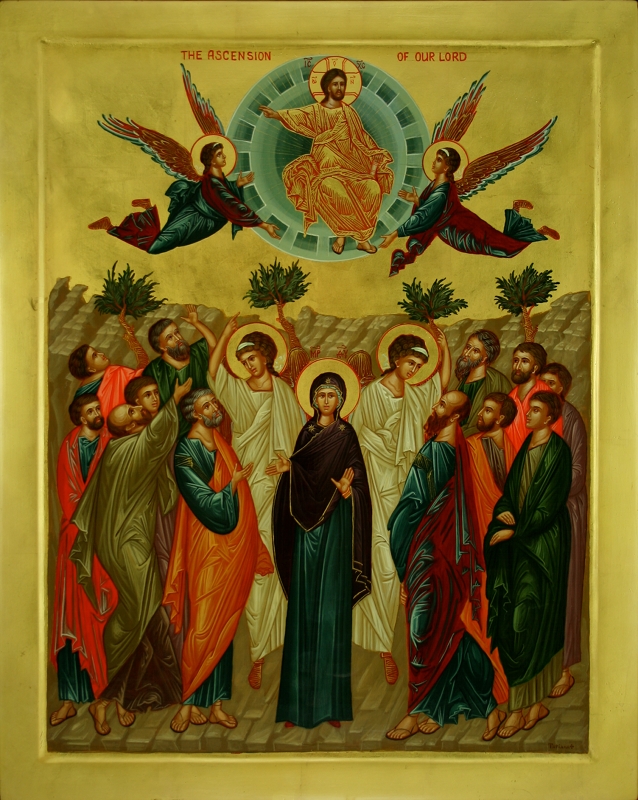
IMG_4245-e1396378590211Today is the Feast of the Ascension of our Lord. I want to respond of one question that some  people are asking in regards to the ascension of our Lord. They are asking,  “Why did the Lord have to ascend to heaven?  Would it not be much better for him to have remained eternally here on Earth, helping the people in sadness and poverty?”

But brothers and sisters if it was necessary and more useful for us for Lord Jesus Christ to stay on the Earth, he would stay. We know His endless love for us, we know his sacrifice for us. We have to believe that if it was better for Him to stay forever on the Earth, He would have done just that, but he ascended, and that means that it better for us that He left the Earth. Why? Because he wanted to destroy that spiritual wall that separated Heaven from Earth, and to pour on the Earth those merciful gifts of the Holy Spirit which though was designed for humans, they were not yet made available.

All barriers to the reconciliation of humans with God were removed when  our Savior ascended into the Heavens and he sent to the earth heavenly treasures, prepared since the creation of the world, in the form of the Gifts of the Spirit.

Jesus Christ says to his disciples in John 16:7 “But very truly I tell you, it is for your good that I am going away. Unless I go away, the Advocate will not come to you; but if I go, I will send him to you.”  He left and on Pentecost he sent the Holy Spirit who came down upon the apostles and to those that believed (Acts 2:1-4).  It is this Holy Spirit who now resides in the Holy Church, and his gifts we are given in the Holy Sacraments.

The other reason for the ascension of our Lord is revealed by our Lord Jesus Christ. At the last supper He told to his disciples “My Father’s house has many rooms; if that were not so, would I have told you that I am going there to prepare a place for you? (John 14:2).  Humanity is not designed to live eternally on the earth. In Psalm 89 it says: 48 What man is he that liveth, and shall not see death? shall he deliver his soul from the hand of the grave?  Ps 89:48

We are newcomers in that Earth. We are travelers. Saint Paul the Apostle Paul writes: For here we do not have an enduring city, but we are looking for the city that is to come (Hebrews 13:14).  We travel in the city of Living God (Hebrew 12:22) to the home of Heavenly Father (John 14:2)

But that “home” was closed until we were redeemed by Jesus Christ. The Savior with his glorified (though human) body ascended into heaven; he went home  to his Father.

There are, according to our Lord Jesus Christ: “many mansions” prepared for us.  (John 14:2) (John 14:2-3)

Brothers and sisters, lets live well, let us work toward receiving those mansions.  Let us work to show the love of our Lord to the world, so that we, too, may ascend to heaven to be with our Lord.

With thoughts, with feelings, with wishes, with aspirations, with acts, more and more to lift up high, let us strive to  the pure, the holy, the heavenly, and the divine.

Amen.

Our Lady of Fatima

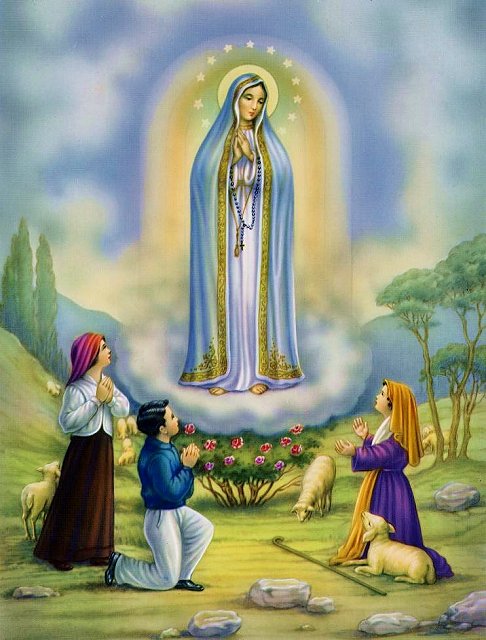
fatima-maryMay 13 is the anniversary of the apparition of Our Lady to three shepherd children in the small village of Fatima in Portugal in 1917. She appeared six times to Lucia, 9, and her cousins Francisco, 8, and his sister Jacinta, 6, between May 13, 1917 and October 13, 1917.

The story of Fatima begins in 1916, when, against the backdrop of the First World War which had introduced Europe to the most horrific and powerful forms of warfare yet seen, and a year before the Communist revolution would plunge Russia and later Eastern Europe into six decades of oppression under militant atheistic governments, a resplendent figure appeared to the three children who were in the field tending the family sheep. “I am the Angel of Peace,” said the figure, who appeared to them two more times that year exhorting them to accept the sufferings that the Lord allowed them to undergo as an act of reparation for the sins which offend Him, and to pray constantly for the conversion of sinners.

Then, on the 13th day of the month of Our Lady, May 1917, an apparition of ‘a woman all in white, more brilliant than the sun’ presented itself to the three children saying “Please don’t be afraid of me, I’m not going to harm you.” Lucia asked her where she came from and she responded, “I come from Heaven.” The woman wore a white mantle edged with gold and held a rosary in her hand. The woman asked them to pray and devote themselves to the Holy Trinity and to “say the Rosary every day, to bring peace to the world and an end to the war.”

She also revealed that the children would suffer, especially from the unbelief of their friends and families, and that the two younger children, Francisco and Jacinta would be taken to Heaven very soon but Lucia would live longer in order to spread her message and devotion to the Immaculate Heart.

In the last apparition the woman revealed her name in response to Lucia’s question: “I am the Lady of the Rosary.”

That same day, 70,000 people had turned out to witness the apparition, following a promise by the woman that she would show the people that the apparitions were true. They saw the sun make three circles and move around the sky in an incredible zigzag movement in a manner which left no doubt in their minds about the veracity of the apparitions. By 1930 the Bishop had approved of the apparitions and they have been approved by the Church as authentic.

The messages Our Lady imparted during the apparitions to the children concerned the violent trials that would afflict the world by means of war, starvation, and the persecution of the Church and the Holy Father in the twentieth century if the world did not make reparation for sins. She exhorted the Church to pray and offer sacrifices to God in order that peace may come upon the world, and that the trials may be averted.

Our Lady of Fatima revealed three prophetic “secrets,” the first two of which were revealed earlier and refer to the vision of hell and the souls languishing there, the request for an ardent devotion to the Immaculate Heart of Mary, the prediction of the Second World War, and finally the prediction of the immense damage that Russia would do to humanity by abandoning the Christian faith and embracing Communist totalitarianism. The third “secret” was not revealed until the year 2000, and referred to the persecutions that humanity would undergo in the last century: “The good will be martyred; the Holy Father will have much to suffer; various nations will be annihilated’”. The suffering of the popes of the 20th century has been interpreted to include the assassination attempt on Pope John Paul II in 1981, which took place on May 13, the 64th anniversary of the apparitions. The Holy Father attributed his escape from certain death to the intervention of Our Lady: “… it was a mother’s hand that guided the bullet’s path and in his throes the Pope halted at the threshold of death.”

What is the central meaning of the message of Fatima? Nothing different from what the Church has always taught: it is, as Cardinal Ratzinger, now Pope Benedict the XVI, has put it, “the exhortation to prayer as the path of “salvation for souls” and, likewise, the summons to penance and conversion.”

Perhaps the most well known utterance of the apparition of Our Lady at Fatima was her confident declaration that, “My Immaculate Heart will triumph”. Cardinal Ratzinger has interpreted this utterance as follows: “The Heart open to God, purified by contemplation of God, is stronger than guns and weapons of every kind. The fiat of Mary, the word of her heart, has changed the history of the world, because it brought the Savior into the world—because, thanks to her, God could become man in our world and remains so for all time. The Evil One has power in this world, as we see and experience continually; he has power because our freedom continually lets itself be led away from God. But since God himself took a human heart and has thus steered human freedom towards what is good, the freedom to choose evil no longer has the last word. From that time forth, the word that prevails is this: “In the world you will have tribulation, but take heart; I have overcome the world” (John 16:33). The message of Fatima invites us to trust in this promise.

Blessed Imelda Lambertini

bl_imelda_lambertini

One of the most charming legends in Dominican hagiography is that of little Imelda, who died of love on her first Communion day, and who is, by this happy circumstance, patroness of all first communicants.

Tradition says that Imelda was the daughter of Count Egano Lambertini of Bologna. Her family was famous for its many religious, including a Dominican preacher, a Franciscan mother foundress, and an aunt of Imelda’s who had founded a convent of strict observance in Bologna.

Imelda was a delicate child, petted and favored by her family, and it was no surprise that she should be religious by nature. She learned to read from the Psalter, and early devoted herself to attending Mass and Compline at the Dominican church. Her mother taught her to sew and cook for the poor, and went with her on errands of charity. When Imelda was nine, she asked to be allowed to go to the Dominicans at Val di Pietra. She was the only child of a couple old enough not to hope for any more children; it was a wrench to let her go. However, they took her to the convent and gave her to God with willing, if sorrowing, hearts.

Imelda’s status in the convent is hard to discern. She wore the habit, followed the exercises of the house as much as she was allowed to, and longed for the day when she would be old enough to join them in the two things she envied most–the midnight Office and the reception of Holy Eucharist. Her age barred her from both. She picked up the Divine Office from hearing the sisters chant, and meditated as well as she could.

It was a lonely life for the little girl of nine, and, like many another lonely child, she imagined playmates for herself–with this one difference–her playmates were saints. She was especially fond of Saint Agnes, the martyr, who was little older than Imelda herself. Often she read about her from the large illuminated books in the library, and one day Agnes came in a vision to see her. Imelda was delighted. Shut away from participation in adult devotions, she had found a contemporary who could tell her about the things she most wanted to know. Agnes came often after this, and they talked of heavenly things.

Her first Christmas in the convent brought only sorrow to Imelda. She had been hoping that the sisters would relent and allow her to receive Communion with them, but on the great day, when everyone except her could go receive Jesus in the Eucharist, Imelda remained in her place, gazing through tears at the waxen figure in the creche. Imelda began to pray even more earnestly that she might receive Communion.

When her prayer was answered, spring had come to Bologna, and the world was preparing for the Feast of the Ascension. No one paid much attention to the little girl as she knelt in prayer while the sisters prepared for the Mass. Even when she asked to remain in the chapel in vigil on the eve of the feast, it caused no comment; she was a devout child. The sisters did not know how insistently she was knocking at heaven’s gate, reciting to herself, for assurance, the prayer that appeared in the Communion verse for the Rogation Days: “Ask and it shall be given to you, seek and you shall find, knock and it shall be opened to you.”

The door was opened for Imelda on the morning of the Vigil of the Ascension. She had asked once more for the great privilege of receiving Communion, and, because of her persistence, the chaplain was called in on the case. He refused flatly; Imelda must wait until she was older. She went to her place in the chapel, giving no outward sign that she intended to take heaven by storm, and watched quietly enough while the other sister went to Communion.

After Mass, Imelda remained in her place in the choir. The sacristan busied herself putting out candles and removing the Mass vestments. A sound caused her to turn and look into the choir, and she saw a brilliant light shining above Imelda’s head, and a Host suspended in the light. The sacristan hurried to get the chaplain.

The chaplain now had no choice; God had indicated that He wanted to be communicated to Imelda. Reverently, the chaplain took the Host and gave it to the rapt child, who knelt like a shining statue, unconscious of the nuns crowding into the chapel, or the laypeople pushing against the chapel grille to see what might be happening there.

After an interval for thanksgiving, the prioress went to call the little novice for breakfast. She found her still kneeling. There was a smile on her face, but she was dead.

The legend of Blessed Imelda is firmly entrenched in Dominican hearts, though it is difficult now to find records to substantiate it. She may have been eleven, rather than ten when she died. The convent where she lived has been gone for centuries and its records with it.

Several miracles have been worked through her intercession, and her cause for canonization has been under consideration for many years. As recently as 1928 a major cure was reported of a Spanish sister who was dying of meningitis. Other miracles are under consideration. The day may yet come when the lovable little patroness of first communicants can be enrolled in the calendar of the saints.

Born: Born in Bologna, Italy, in 1322

Died: died on the Feast of the Ascension, May 13, 1333

Beatified: cultus confirmed in 1826 by Pope Leo VII

Patronage: named patron of first communicants by Pope Pius X.

Representation: In art, Imelda is a very young Dominican novice, kneeling before the altar with a sacred Host appearing above her. She is venerated at Bologna and Valdipietra.