
Blessed John of Salerno

Although Father Touron failed to give a sketch of this distinguished Friar Preacher in his First Disciples of Saint Dominic, it is certain that he belonged to them, and that he was an outstanding character in the noble galaxy. Some authors say that John was a scion of the noted Guana family, and connected with the Norman princes who long reigned over the former kingdoms of Naples and Sicily. Whilst they do not give the date of his birth, practically all hold that he first saw the light of day at Salerno, some thirty miles south of Naples; that he studied at the University of Bologna; and that he entered the Order in that educational center. With one or two exceptions who give this honor to Blessed Reginald of Orleans, the writers maintain he received the habit from Saint Dominic himself. The year 1219 is the date assigned for the ceremony.

Evidently John was then a man of mature years, for he was soon placed at the head of twelve other confrères sent to establish the Order in Florence. A few date this commission in 1219; but 1220 is the time ordinarily given. The choice of him for superior in so important a city confirms the statement that his rare virtue, which he had practiced from early youth, made a strong impression on Saint Dominic. Although very small of stature, the future blessed possessed a mighty mind and a courage that nothing could awe. Doubtless these qualities also appealed to the patriarch, who seemed to judge of the characters ‘ of men almost by intuition, for an able, fearless leader was needed in Florence. Dominic and John are said to have been intimate, trustful friends-no doubt, a relationship born of grace. That the saint formed a correct estimate of his young disciple is shown by the fact that our blessed soon became one of the most influential Friars Preacher in Italy.

A curious story is told about the first house of the fathers at Florence. It was built, so it would seem, by one Deodate del Dado (possibly a merchant) who wished to make restitution for his dishonesty by devoting it to religious purposes. Situated in the “plain of Ripoli”, two or three miles from the city limits, on the way to Arezzo, it was better suited for a contemplative order than for one of the apostolic character of Saint Dominic’s. Mamachi thinks another community had occupied it. Be that as it may, it was free when the builder beard of the wonderful preaching of the holy man from Caleruega, in Bologna. So he hurried to that city, attended one of the saint’s sermons, and then offered the place to him. Some writers say that the proffer was accepted at once, and the delighted donor accompanied the first missionaries back to Florence.

When the fathers arrived at the hermitage of Ripoli, land saw its lonely, remote location, some of them likely wondered if their prayerful, mortified superior might intend to sacrifice the active side of their institute, which they had seen brought so prominently to the fore in Bologna, to the retired and cloistered side. They did not have long to wait before learning his views. Although the house was small, John of Salerno felt that it would suffice for a start. The first few days he spent in setting the place in order. Then he called the community together, and made known his plan of action. The life of a Friar Preacher, he said, is that of an energetic apostolate. They had come to humble Hipoli, not for their own sakes, but for the spiritual welfare of the faithful in the Province of Tuscany. The work would commence on the morrow, and every man would be expected to do his duty.

Day by day the little handful of soul harvesters left their hermitage at an early hour, in bands of two, that they might preach the word of God in Florence or elsewhere. In all things the diminutive superior, with a great mind and magnanimous soul, set the example, as well as led the way, which he would have the others follow. They assembled the people in churches, public squares, market places, open plains — wherever they could procure an audience. In the evening, unless too far away, they returned to their quiet abode for prayer and meditation.

Proud, cultivated Florence was stirred to the very core by the eloquence and zeal of the new religious, in whose lives there seemed to be naught of the worldly. The effect of their sermons was enhanced by the patience with which they trudged afoot back and forth between Ripoli and the city. They were on every tongue-in every mind. Their preaching was discussed in public, no less than in private. Repentant Deodate seems to have taken care of their secluded home while they were absent, as well as to have contributed towards their maintenance. No doubt he was happy in the realization that his work of amends bore such rich fruit.

Among the band of missioners, men of God though they all were, John of Salerno shone especially for his oratory, virtue, and quest for souls. None of them appeared quite so heroic as he. Whilst his example, fatherly government, and kindly admonition ever urged his confrères on in their exertions, his fine judgment and tact won the confidence of the faithful. All this combined with his superb scholarship and rare devotion to bring him the affection of the archbishop, John di Velletri, together with that of the vast majority of the diocesan clergy. Indeed, our Friar Preacher had every qualification for a perfect superior and a successful fisherman of men. Thus it is no matter for wonder that he was retained at the helm of his Order in one of Italy’s most beautiful cities, yet ever a maelstrom of political intrigue.

Saint Dominic is said to have been so impressed with the reports of the good’ effected by his brethren in Florence that he paid them at least one visit, and was delighted with their fervor and zeal.  Their benefactor, Deodate, seems to have lived less than a year after they settled in his hermitage. His death deprived them of their principal source of support. This misfortune, together with the fatigue of walking back and forth each day between the city and the “plain of Ripoli,” caused the Florentines to obtain permission for them to use the hospice of Saint Pancratius, which stood at the side of the church of the same name within the municipal limits, until a more suitable place could be obtained for them. John of Salerno gladly acceded to the proposal, -and moved his community thither at once, for this more convenient location would be of great aid to his confr6res in their work.

From Saint Pancratius’ the fathers were soon transferred to Saint Paul’s. There, however, as was but natural, objections against their presence were raised by the clergy stationed at that church. John and his companions, while continuing their labors, bore all difficulties with admirable patience. Fortunately, no doubt in answer to their prayers, providence came to their aid. A Father Foresio, rector of Santa Maria Novella, touched by their virtue, zeal, and forbearance, offered them his church, together with the buildings attached to it, on condition that they would pay a moderate allowance each year for his support. Our blessed, in his capacity as superior, gratefully accepted the generous proffer. Cardinal Ugolino, the papal legate whom we have so often seen in the ro^le of a friend of the Order, and Archbishop di Velletri warmly approved of the project.

Santa Maria Novella passed into the hands of the Friars Preacher, November 8, 1221. Thus John of Salerno became the founder of the great convent at Florence, which was destined to become one of the most historic and beautiful in a religious institute renowned for its learning and deeds, as well as for its cultivation of the artistic. Many noted clergymen were trained and educated there. Not a few of Italy’s most famed painters, sculptors, and architects were employed there. It is still an object of delightful study for artists from every part of the world. Because of its exquisite decorations, Michael Angelo was wont to call it “The Bride.”

Florence had become one of the strongholds of the new Manicheans in Italy, whence their evil influence spread throughout Tuscany. They hesitated at nothing for the propagation of their destructive principles. In the subject of our sketch they met with a relentless foe. Day and night he opposed them, whether by deed or word. Never was he known to quail before their threats or attacks. His fearless action and preaching not only produced the most salutary effects, but even won for him the name of “hammer of heretics.” He must ever rank high amongst those brave Friars Preacher who helped to free the Italian Peninsula from the dangers of Manicheanism and Albigensianism.

The persuasive eloquence of the man of God combined with the odor of his sanctity and the fire of his zeal to draw many and brilliant subjects into his Order. They came from numerous places, but especially from Florence, Prato, and Pistoia. Among them was the noted Hugh of Sesto, a canon at Saint Paul’s who had led the opposition to the fathers at that church. Others who should not be omitted were: Roderic, a canon at Saint Peter’s; James Rabacante, who later succeeded John of Salerno as prior of Santa Maria Novella; Ottavente di Nerli; Roger Calcagni, who became the first papal inquisitor at Florence and bishop of Castro; Father Buoninsegna, a martyr at Antioch who is commonly called blessed; Ambrose of Rimini, a celebrated preacher who became bishop of his native city; Thomas Morandi, honored with the miter of Fano; and Aldobrandini Cavalcanti, entrusted with the charge of the Diocese of Orvieto. We might mention more, but those given above suffice to show the character of those whom the early disciple brought into his institute.

Blessed John had a special gift for governing others. He seemed to read dispositions almost as he would read a book. In all things he showed himself a father, brother, friend, and servant to those under his charge. He dominated their wills by kindness, quickened their zeal by his own, directed them along the path of perfection by his example and gentle words. The love which he bore them merited the affection which they gave him.

Whatever he did, the man of God was doubtless guided by the lessons which he had received from Saint Dominic. He had lived under the patriarch at Bologna, had met him in Florence, and of course bad come in contact with him at the general chapter of 1221. Some writers say he was the saint’s travelling companion on several apostolic journeys; but this statement seems doubtful. However, such was his love for the Order’s founder that he no sooner received word of his serious illness than he started in all haste for Bologna, where he arrived just in time to receive the dying man’s last blessing and the assurance that he would be more helpful to the infant institute in heaven than he could be on earth. Such is the importance which one saint attaches to the word of another, that we are justified in believing those of Dominic must have acted as an inspiration for Blessed John of Salerno the rest of his life.

God enriched the soul of this early disciple with many choice graces. One of the things which greatly aided him in the spiritual direction of others, whether in his Order or without it, was the faculty often accorded him of reading their consciences. Many a time did he make known to his penitents sins which they had forgotten. This gift, quite naturally, increased his influence; and he was careful to use it only for the spiritual betterment of those who sought his aid. Not a few miracles were also attributed to him, but these he did all in his power to conceal.

There is an adage which tells us that the ways of God are not the ways of man. Rare is it that providence does not permit even the most faithful servants of Christ to be tried in the crucible of temptation; but, as Saint Paul assures us, the temptation is always accompanied with the grace necessary to overcome it. So it was with John of Salerno. There were those who sought to lead him from the path of virtue. Yet his resistance not merely saved him from sin; it issued unto his greater glory before God and man. It made him “the good odor of Christ” even unto the conversion of those who thirsted for his ruin.

Among our Friar Preacher’s notable works for the benefit of religion in Tuscany must be placed the establisbment of the first community of Dominican Sisters in the province. These he started in the hermitage of Ripoli, built by Deodate del Dado, sometime after the fathers had left it. He had great faith in the prayers of these holy women, and trusted to their intercession as an aid to the success of his work and that of his confrères. In later years, because the neighborhood of Florence became infested with brigands, these sisters moved into the city. There they divided into two communities. One of them retained the old title of Ripoli, while the other took the name of Saint Dominic. Both long continued to edify the Florentines by their saintly lives and to bring blessings on the Church of the municipality by their perpetual orisons.

So labored on Blessed John of Salerno until the end of his useful life. Father John Caroli and other earlier writers speak of his toil and his heroic virtue in terms of the highest praise. They tell how he was loved and venerated, how his confr~res mourned his death, and how the people of Florence turned out in a body for his funeral; but they give us no further indication of its date than to say that it happened after many years of faithful labor (“quumque inultis jam annis . . . . . laborasset”). In the light of this assertion that he surrendered his pure soul to God in Florence after long years of constant service, one can not accept the statement of those later authors who say that he died in 1225. As a matter of fact, the Année Dominicaine assures us that Gregory IX, who ascended the papal throne in March, 1227, entrusted him with some reformation work in the Diocese of Chiusi, which he brought to a happy termination. The same publication, by way of guess, places the holy man’s death in the thirties of the thirteenth century. Yet it is just as probable that it occurred in the following decade.

Our blessed was buried with great honor in the Church of Santa Maria Novella, where his tomb immediately became a place of pilgrimage for the faithful. A number of miracles were attributed to him. It would seem that there were several translations of his relies, one of which doubtless took place when his body was removed from the old church to the new. On these occasions the faithful of the city and neighboring places came in immense crowds to pay honor to one whom they held in deep veneration. The last, and possibly the most notable, ceremony of the kind took place on February 18, 1571. At this time his relics were placed in a tomb and chapel specially dedicated to his memory. Pius VI, who reigned from 1775 to 1799, officially ratified the immemorial cult to John, permitted his Order to say mass and the divine office in his honor, and appointed August 9 for his feast day.

Born: c.1190 at Salerno, Italy

Died: 1272 of natural causes; buried at the church of Saint Maria Novella in Florence, Italy; relics translated several times, the last being on February 18,1571

Beatified:1783 by Pope Pius VI (cultus confirmed)
 

Feast of our Holy Father Saint Dominic

“A man who governs his passions is master of his world. We must either command them or be enslaved by them. It is better to be a hammer than an anvil.”

– Saint Dominic

Founder of the Order of Preachers, commonly known as the Dominican Order; born at Calaroga, in Old Castile, c. 1170; died 6 August, 1221. His parents, Felix Guzman and Joanna of Aza, undoubtedly belonged to the nobility of Spain, though probably neither was connected with the reigning house of Castile, as some of the saint’s biographers assert. Of Felix Guzman, personally, little is known, except that he was in every sense the worthy head of a family of saints. To nobility of blood Joanna of Aza added a nobility of soul which so enshrined her in the popular veneration that in 1828 she was solemnly beatified by Leo XII. The example of such parents was not without its effect upon their children. Not only Saint Dominic but also his brothers, Antonio and Manes, were distinguished for their extraordinary sanctity. Antonio, the eldest, became a secular priest and, having distributed his patrimony to the poor, entered a hospital where he spent his life minis ministering to the sick. Manes, following in the footsteps of Dominic, became a Friar Preacher, and was beatified by Gregory XVI.

The birth and infancy of the saint were attended by many marvels forecasting his heroic sanctity and great achievements in the cause of religion. From his seventh to his fourteenth year he pursued his elementary studies tinder the tutelage of his maternal uncle, the archpriest of Gumiel d’lzan, not far distant from Calaroga. In 1184 Saint Dominic entered the University of Palencia. Here he remained for ten years prosecuting his studies with such ardour and success that throughout the ephemeral existence of that institution he was held up to the admiration of its scholars as all that a student should be. Amid the frivolities and dissipations of a university city, the life of the future saint was characterized by seriousness of purpose and an austerity of manner which singled him out as one from whom great thin might be expected in the future. But more than one he proved that under this austere exterior he carried a heart as tender as a woman’s. On one occasion he sold his books, annotated with his own hand, to relieve the starving poor of Palencia. His biographer and contemporary, Bartholomew of Trent, states that twice he tried to sell himself into slavery to obtain money for the liberation of those who were held in captivity by the Moors. These facts are worthy of mention in view of the cynical and saturnine character which some non-Catholic writers have endeavoured to foist upon one of the most charitable of men. Concerning the date of his ordination his biographers are silent; nor is there anything from which that date can be inferred with any degree of certainty. According to the deposition of Brother Stephen, Prior Provincial of Lombardy, given in the process of canonization, Dominic was still a student at Palencia when Don Martin de Bazan, the Bishop of Osma, called him to membership in the cathedral chapter for the purpose If assisting in its reform. The bishop realized the importance to his plan of reform of having constantly before his canons the example of one of Dominic’s eminent holiness. Nor was he disappointed in the result. In recognition of the part he had taken in converting its members into canons regular, Dominic was appointed sub-prior of the reformed chapter. On the accession of Don Diego d’Azevedo to the Bishopric of Osma in 1201, Dominic became superior of the chapter with the title of prior. As a canon of Osma, he spent nine years of his life hidden in God and rapt in contemplation, scarcely passing beyond the confines of the chapter house.

In 1203 Alfonso IX, King of Castile, deputed the Bishop of Osma to demand from the Lord of the Marches, presumably a Danish prince, the hand of his daughter on behalf of the king’s son, Prince Ferdinand. For his companion on this embassy Don Diego chose Saint Dominic. Passing through Toulouse in the pursuit of their mission, they beheld with amazement and sorrow the work of spiritual ruin wrought by the Albigensian heresy. It was in the contemplation of this scene that Dominic first conceived the idea of founding an order for the purpose of combating heresy and spreading the light of the Gospel by preaching to the ends of the then known world. Their mission having ended successfully, Diego and Dominic were dispatched on a second embassy, accompanied by a splendid retinue, to escort the betrothed princess to Castile. This mission, however, was brought to a sudden close by the death of the young woman in question. The two ecclesiastics were now free to go where they would, and they set out for Rome, arriving there towards the end of 1204. The purpose of this was to enable Diego to resign his bishopric that he might devote himself to the conversion of unbelievers in distant lands. Innocent III, however, refused to approve this project, and instead sent the bishop and his companion to Languedoc to join forces with the Cistercians, to whom he had entrusted the crusade against the Albigenses. The scene that confronted them on their arrival in Languedoc was by no means an encouraging one. The Cistercians, on account of their worldly manner of living, had made little or no headway against the Albigenses. They had entered upon their work with considerable pomp, attended by a brilliant retinue, and well provided with the comforts of life. To this display of worldliness the leaders of the heretics opposed a rigid asceticism which commanded the respect and admiration of their followers. Diego and Dominic quickly saw that the failure of the Cistercian apostolate was due to the monks’ indulgent habits, and finally prevailed upon them to adopt a more austere manner of life. The result was at once apparent in a greatly increased number of converts. Theological disputations played a prominent part in the propaganda of the heretics. Dominic and his companion, therefore, lost no time in engaging their opponents in this kind of theological exposition. Whenever the opportunity offered, they accepted the gage of battle. The thorough training that the saint had received at Palencia now proved of inestimable value to him in his encounters with the heretics. Unable to refute his arguments or counteract the influence of his preaching, they visited their hatred upon him by means of repeated insults and threats of physical violence. With Prouille for his head-quarters, he laboured by turns in Fanjeaux, Montpellier, Servian, Béziers, and Carcassonne. Early in his apostolate around Prouille the saint realized the necessity of an institution that would protect the women of that country from the influence of the heretics. Many of them had already embraced Albigensianism and were its most active propagandists. These women erected convents, to which the children of the Catholic nobility were often sent-for want of something better-to receive an education, and, in effect, if not on purpose, to be tainted with the spirit of heresy. It was needful, too, that women converted from heresy should be safeguarded against the evil influence of their own homes. To supply these deficiencies, Saint Dominic, with the permission of Foulques, Bishop of Toulouse, established a convent at Prouille in 1206. To this community, and afterwards to that of Saint Sixtus, at Rome, he gave the rule and constitutions which have ever since guided the nuns of the Second Order of Saint Dominic.

The year 1208 opens a new epoch in the eventful life of the founder. On 15 January of that year Pierre de Castelnau, one of the Cistercian legates, was assassinated. This abominable crime precipitated the crusade under Simon de Montfort, which led to the temporary subjugation of the heretics. Saint Dominic participated in the stirring scenes that followed, but always on the side of mercy, wielding the arms of the spirit while others wrought death and desolation with the sword. Some historians assert that during the sack of Béziers, Dominic appeared in the streets of that city, cross in hand, interceding for the lives of the women and children, the aged and the infirm. This testimony, however, is based upon documents which Touron regards as certainly apocryphal. The testimony of the most reliable historians tends to prove that the saint was neither in the city nor in its vicinity when Béziers was sacked by the crusaders. We find him generally during this period following the Catholic army, reviving religion and reconciling heretics in the cities that had capitulated to, or had been taken by, the victorious de Montfort. it was probably I September, 1209, that Saint Dominic first came in contact with Simon de Montfort and formed with him that intimate friendship which was to last till the death of the brave crusader under the walls of Toulouse (25 June, 1218). We find him by the side of de Montfort at the siege of Lavaur in 121 1, and again in 1212, at the capture of La Penne d’Ajen. In the latter part of 1212 he was at Pamiers labouring, at the invitation of de Montfort, for the restoration of religion and morality. Lastly, just before the battle of Muret. 12 September, 1213, the saint is again found in the council that preceded the battle. During the progress of the conflict, he knelt before the altar in the church of Saint-Jacques, praying for the triumph of the Catholic arms. So remarkable was the victory of the crusaders at Muret that Simon de Montfort regarded it as altogether miraculous, and piously attributed it to the prayers of Saint Dominic. In gratitude to God for this decisive victory, the crusader erected a chapel in the church of Saint-Jacques, which he dedicated, it is said, to Our Lady of the Rosary. It would appear, therefore, that the devotion of the Rosary, which tradition says was revealed to Saint Dominic, had come into general use about this time. To this period, too, has been ascribed the foundation of the Inquisition by Saint Dominic, and his appointment as the first lnquisitor. As both these much controverted questions will receive special treatment elsewhere in this work, it will suffice for our )resent purpose to note that the Inquisition was in operation in 1198, or seven years before the saint took part in the apostolate in Languedoc, and while ie was still an obscure canon regular at Osma. If he was for a certain time identified-with the operations of the Inquisition, it was only in the capacity of a theologian passing upon the orthodoxy of the accused. Whatever influence he may have had with the judges of that much maligned institution was always employed on the side of mercy and forbearance, as witness the classic case of Ponce Roger.

In the meantime, the saint’s increasing reputation for heroic sanctity, apostolic zeal, and profound learning caused him to be much sought after as a candidate for various bishoprics. Three distinct efforts were made to miss him to the episcopate. In July, 1212, the chapter of Béziers chose him for their bishop. Again, the canons of Saint-Lizier wished him to succeed Garcias de l’Orte as Bishop of Comminges. Lastly, in 1215 an effort was made by Garcias de l’Orte himself, who had been transferred from – Comminges to Auch, to make him Bishop of Navarre. But Saint Dominic absolutely refused all episcopal honours, saying that he would rather take flight in the night, with nothing but his staff, than accept the episcopate. From Muret Dominic returned to Carcassonne, where he resumed his preaching with unqualified success. It was not until 1214 that he returned to Toulouse. In the meantime the influence of his preaching and the eminent holiness of his life had drawn around him a little band of devoted disciples eager to follow wherever he might lead. Saint Dominic had never for a moment forgotten his purpose, formed eleven years before, of founding a religious order to combat heresy and propagate religious truth. The time now seemed opportune for the realization of his plan. With the approval of Bishop Foulques of Toulouse, he began the organization of his little band of followers. That Dominic and his companions might possess a fixed source of revenue Foulques made him chaplain of Fanjeaux and in July, 1215, canonically established the community as a religious congregation of his diocese, whose mission was the propagation of true doctrine and good morals, and the extirpation of heresy. During this same year Pierre Seilan, a wealthy citizen of Toulouse, who had placed himself under the direction of Saint Dominic, put at their disposal his own commodious dwelling. In this way the first convent of the Order of Preachers was founded on 25 April, 1215. But they dwelt here only a year when Foulques established them in the church of Saint Romanus. Though the little community had proved amply the need of its mission and the efficiency of its service to the Church, it was far from satisfying the full purpose of its founder. It was at best but a diocesan congregation, and Saint Dominic had dreamed Of a world-order that would carry its apostolate to the ends of the earth. But, unknown to the saint, events were shaping themselves for the realization of his hopes. In November, 1215, an ecumenical council was to meet at Rome “to deliberate on the improvement of morals, the extinction of heresy, and the strengthening of the faith”. This was identically the mission Saint Dominic had determined on for his order. With the Bishop of Toulouse, he was present at the deliberations of this council. From the very first session it seemed that events conspired to bring his plans to a successful issue. The council bitterly arraigned the bishops for their neglect of preaching. In canon X they were directed to delegate capable men to preach the word of God to the people. Under these circumstances, it would reasonably appear that Dominic’s request for confirmation of an order designed to carry out the mandates of the council would be joyfully granted. But while the council was anxious that these reforms should be put into effect as speedily as possible, it was at the same time opposed to the institution of any new religious orders, and had legislated to that effect in no uncertain terms. Moreover, preaching had always been looked upon as primarily a function of the episcopate. To bestow this office on an unknown and untried body of simple priests s seemed too original and too bold in its conception to appeal to the conservative prelates who influenced the deliberations of the council. When, therefore, his petition for the approbation of his infant institute was refused, it could not have been wholly unexpected by Saint Dominic.

Returning to Languedoc at the close of the council in December, 1215, the founder gathered about him his little band of followers and informed them of the wish of the council that there should be no new rules for religious orders. Thereupon they adopted the ancient rule of Saint Augustine, which, on account of its generality, would easily lend itself to any form they might wish to give it. This done, Saint Dominic again appeared before the pope in the month of August, 1216, and again solicited the confirmation of his order. This time he was received more favourably, and on 22 December, 1216, the Bull of confirmation was issued.

Saint Dominic spent the following Lent preaching in various churches in Rome, and before the pope and the papal court. It was at this time that he received the office and title of Master of the Sacred Palace, or Pope’s Theologian, as it is more commonly called. This office has been held uninterruptedly by members of the order from the founder’s time to the present day. On 15 August, 1217, he gathered the brethren about him at Prouille to deliberate on the affairs of the order. He had determined upon the heroic plan of dispersing his little band of seventeen unformed followers over all europe. The result proved the wisdom of an act which, to the eye of human prudence at least, seemed little short of suicidal. To facilitate the spread of the order, Honorius III, on 11 Feb., 1218, addressed a Bull to all archbishops, bishops, abbots, and priors, requesting their favour on behalf of the Order of Preachers. By another Bull, dated 3 Dec., 1218, Honorius III bestowed upon the order the church of Saint Sixtus in Rome. Here, amid the tombs of the Appian Way, was founded the first monastery of the order in Rome. Shortly after taking possession of Saint Sixtus, at the invitation of Honorius, Saint Dominic begin the somewhat difficult task of restoring the pristine observance of religious discipline among the various Roman communities of women. In a comparatively short time the work was accomplished, to the great satisfaction of the pope. His own career at the University of Palencia, and the practical use to which he had put it in his encounters with the Albigenses, as well as his keen appreciation of the needs of the time, convinced the saint that to ensure the highest efficiency of the work of the apostolate, his followers should be afforded the best educational advantages obtainable. It was for this reason that on the dispersal of the brethren at Prouille he dispatched Matthew of France and two companions to Paris. A foundation was made in the vicinity of the university, and the friars took possession in October, 1217. Matthew of France was appointed superior, and Michael de Fabra was placed in charge of the studies with the title of Lecturer. On 6 August of the following year, Jean de Barastre, dean of Saint-Quentin and professor of theology, bestowed on the community the hospice of Saint-Jaques, which he had built for his own use. Having effected a foundation at the University of Paris, Saint Dominic next determined upon a settlement at the University of Bologna. Bertrand of Garrigua, who had been summoned from Paris, and John of Navarre, set out from Rome, with letters from Pope Honorius, to make the desired foundation. On their arrival at Bologna, the church of Santa Maria della Mascarella was placed at their disposal. So rapidly did the Roman community of Saint Sixtus grow that the need of more commodious quarters soon became urgent. Honorius, who seemed to delight in supplying every need of the order and furthering its interests to the utmost of his power, met the emergency by bestowing on Saint Dominic the basilica of Santa Sabina.

Towards the end of 1218, having appointed Reginald of Orléans his vicar in Italy, the saint, accompanied by several of his brethren, set out for Spain. Bologna, Prouille, Toulouse, and Fanjeaux were visited on the way. From Prouille two of the brethren were sent to establish a convent at Lyons. Segovia was reached just before Christmas. In February of the following year he founded the first monastery of the order in Spain. Turning southward, he established a convent for women at Madrid, similar to the one at Prouille. It is quite probable that on this journey he personally presided over the erection of a convent in connexion with his alma mater, the University of Palencia. At the invitation of the Bishop of Barcelona, a house of the order was established in that city. Again bending his steps towards Rome he recrossed the Pyrenees and visited the foundations at Toulouse and Paris. During his stay in the latter place he caused houses to be erected at Limoges, Metz, Reims, Poitiers, and Orléans, which in a short time became centres of Dominican activity. From Paris he directed his course towards Italy, arriving in Bologna in July, 1219. Here he devoted several months to the religious formation of the brethren he found awaiting him, and then, as at Prouille, dispersed them over Italy. Among the foundations made at this time were those at Bergamo, Asti, Verona, Florence, Brescia, and Faenza. From Bologna he went to Viterbo. His arrival at the papal court was the signal for the showering of new favours on the order. Notable among these marks of esteem were many complimentary letters addressed by Honorius to all those who had assisted the Fathers in their vinous foundations. In March of this same year Honorius, through his representatives, bestowed upon the order the church of San Eustorgio in Milan. At the same time a foundation at Viterbo was authorized. On his return to Rome, towards the end of 1219, Dominic sent out letters to all the convents announcing the first general chapter of the order, to be held at Bologna on the feast of the following Pentecost. Shortly before, Honorius III, by a special Brief, had conferred upon the founder the title of Master General, which till then he had held only by tacit consent. At the very first session of the chapter in the following spring the saint startled his brethren by offering his resignation as master general. It is needless to say the resignation was not accepted and the founder remained at the head of the institute till the end of his life.

Soon after the close of the chapter of Bologna, Honorius III addressed letters to the abbeys and priories of San Vittorio, Sillia, Mansu, Floria, Vallombrosa, and Aquila, ordering that several of their religious be deputed to begin, under the leadership of Saint Dominic, a preaching crusade in Lombardy, where heresy had developed alarming proportions. For some reason or other the plans of the pope were never realized. The promised support failing, Dominic, with a little band of his own brethren, threw himself into the field, and, as the event proved, spent himself in an effort to bring back the heretics to their allegiance to the Church. It is said that 100,000 unbelievers were converted by the preaching and the miracles of the saint. According to Lacordaire and others, it was during his preaching in Lombardy that the saint instituted the Militia of Jesus Christ, or the third order, as it is commonly called, consisting of men and women living in the world, to protect the rights and property of the Church. Towards the end of 1221 Saint Dominic returned to Rome for the sixth and last time. Here he received many new and valuable concessions for the order. In January, February, and March of 1221 three consecutive Bulls were issued commending the order to all the prelates of the Church-. The thirtieth of May, 1221, found him again at Bologna presiding over the second general chapter of the order. At the close of the chapter he set out for Venice to visit Cardinal Ugolino, to whom he was especially indebted for many substantial acts of kindness. He had scarcely returned to Bologna when a fatal illness attacked him. He died after three weeks of sickness, the many trials of which he bore with heroic patience. In a Bull dated at Spoleto, 13 July, 1234, Gregory IX made his cult obligatory throughout the Church.

The life of St. Dominic was one of tireless effort in the, service of god. While he journeyed from place to place he prayed and preached almost uninterruptedly. – His penances were of such a nature as to cause the brethren, who accidentally discovered them. to fear the effect upon his life. While his charity was boundless he never permitted it to interfere with the stern sense of duty that guided every action of his life. If he abominated heresy and laboured untiringly for its extirpation it was because he loved truth and loved the souls of those among whom he laboured. He never failed to distinguish between sin and the sinner. It is not to be wondered at, therefore, if this athlete of Christ, who had conquered himself before attempting the reformation of others, was more than once chosen to show forth the power of God. The failure of the fire at Fanjeaux to consume the dissertation he had employed against the heretics, and which was thrice thrown into the flames; the raising to life of Napoleone Orsini; the appearance of the annals in the refectory of Saint Sixtus in response to his prayers, are but a few of the supernatural happenings by which God was pleased to attest the eminent holiness of His servant. We are not surprised, therefore, that, after signing the Bull of canonization on 13 July, 1234, Gregory IX declared that he no more doubted the saintliness of Saint Dominic than he did that of Saint Peter and Saint Paul.

Born: 1170 at Calaruega, Burgos, Old Castile

Died: August 6, 1221 at Bologna

Beatified: July 13, 1234 by Pope Gregory IX at Rieti, Italy

Patronage: astronomers; astronomy; prelature of Batanes-Babuyanes, Philippines; diocese of Bayombong, Philippines; Dominican Republic; falsely accused people; scientists

Representation: chaplet, Dominican carrying a rosary and a tall cross; Dominican holding a lily; Dominican with dog and globe; Dominican with fire; Dominican with star shining above his head; rosary; star

Blessed Jane of Aza, Mother of Saint Dominic

Devotion to Our Lady was typical of medieval Spaniards, as indeed of any Christian of the time. But the devotion to Mary bequeathed by Saint Dominic to his children was something more than ordinary , and in the natural course of events it could come from only one source-his own mother. her name, the scanty records tell us, was Jane of Aza, and neither the date of her birth nor that of her death is known with certainty. Not being of great material importance , she made little impression on history; but the print of her personality will be seen for all time on the order founded by her son. Dominic must have had a very tender love for his mother to make him turn so constantly, trustingly, instinctively to Our Lady in all the troubles and joys of his later life.

Legend relates that before the birth of Dominic, Blessed Jane beheld a vision in which she saw her son , running as a swift greyhound through the world, bearing in his mouth a torch with which he illumined the world (The son became the founder of the Order of Preachers, known as the Dominicans thus the prophetic dream was fulfilled as the Dominican friars took the light of the gospel throughout the world. They became known as the Dogs of the Lord. In Latin the word Dominican would be Domini Canes, literally Dogs of the Lord). It was for her to fan and shelter that flame at its very kindling, and to teach this child of predilection the prayers he would say with such rich results for a lifetime of saintly action. Not only was it Jane who first taught her son the words of the Hail Mary- that key with which he unlocked heaven for so many souls – but it was she that gave to him the living example of Christian womanhood. If in later years his sons were to cherish such a chivalrous love for the gracious Queen of Heaven, much of it was due to the reverential awe and tender love with which this truly Christian lady inspired her three priest-sons. to every priest, his own mother is the personification of all that is good and lovable in woman; she is the ideal to inspire him, the lighthouse to beckon him, and the living picture of the Mother of the first Priest. It could have been no different for Dominic. Where else would he , brought up amid the scenes of war and the mans world of thee university, see in action the ideals of womanly purity, gentleness, and never failing help that he was to cherish as the attributes of his heavenly Queen?

History is silent regarding events in the Life of Blessed Jane. probably there were no great events to record. As the wife of the Castellan of Calaruega, a fortress castle on the border of Christian Spain, she would have led a life filled with the monotony of small things. Tradition relates that her two older sons, Anthony and Manez, were already preparing for the priesthood when Dominic was born. She named her youngest son for Saint Dominic of Silos, at whose shrine she was frequent pilgrim . Knowing that her solider/husband expected their third son to carry on the family name and fortunes, Jane seems still to have cherished for him the goal of the priesthood. Very likely Dominic- and we – owe to his understanding Mother the fortune that placed a book in his hands instead of a sword.

Pope Leo XII beatified Jane of Aza in 1828. Devotion to her has persisted through the centuries despite the poverty of records. The mother of three priest, one of whom died a death of heroic charity and two who were raised to altars of the Church, can safely be judged to have been not only a valiant woman but also a saintly one. Her picture, as that of any mother, can best be seen reflected in her sons.

Born: in Aza, Unknown date

Died: about 1202 in Calaroga

Beatified: Pope Leo XII in 1828 approved her cultus


Be Transformed! ~ by Fr. Bryan Wolf

“After six days Jesus took with him Peter, James and John the brother of James, and led them up a high mountain by themselves. There he was transfigured before them. His face shone like the sun, and his clothes became as white as the light. Just then there appeared before them Moses and Elijah, talking with Jesus. Peter said to Jesus, “Lord it is good for us to be here. If you wish, I will put up three shelters- one for you, one for Moses and one for Elijah.”  While he was still speaking, a bright cloud covered them, and a voice from the cloud said, “This is my Son, whom I love; with him I am well pleased. Listen to him!”  When the disciples heard this, they fell facedown to the ground, terrified. But Jesus came and touched them. “Get up,” he said. “Do not be afraid.”  When they looked up, they saw no one except Jesus.”  Matthew 17:1-8

Today we celebrate the Feast of the Transfiguration. This is an important event in Christianity which extends into most of the major branches; Catholicism, Anglicanism, Orthodoxy and even some Protestant churches (Episcopal, Lutheran and Presbyterian). It is an event of which Saint Thomas Aquinas considered “the greatest miracle”, in that with His Transfiguration; Jesus demonstrated His true divinity. In fact, by His Transfiguration the Holy Trinity is revealed.  God the Father is present in the voice of God, Jesus the Son of God is present in His being transformed and God the Holy Spirit is thought to be present in the enveloping cloud which enables the disciples to witness the miracle. This event is one of only a handful of documented personal occurrences to Jesus himself.  (The others being His Baptism, Crucifixion, Resurrection and Ascension.)  Appearing together with Moses, the great law giver; and Elijah, the great prophet; serves to provide testimony as to the validity of Christ. (Listen to him!)  This is important, for it is in the previous chapter of Matthew (Matthew 16: 13 et.seq.) that Jesus asks his disciples who he is thought to be and who they believe him to be.

There is no doubt that the Transfiguration of Jesus finally provides a solid foundation from which to build, as to Christ’s true nature and divinity. (Except maybe for Thomas.)  We who were not present, or even alive at this time, can take from Scripture this account that Jesus truly was the Christ. But what more subtle and realistic lesson can we take from the account of the Transfiguration, and use today?

We must use our faith in Christ, our personal declaration that we are Christians- to make a personal transformation of our own!  As Jesus himself was transfigured, so too must we be in the attributes of Christ.  To assume His compassion and charity. Not to judge people based upon our own opinions and beliefs. To extend to others; family, friends and strangers alike, a kind word and comforting hand. To attempt to live fully “Christ-like”.  This is after all, why we are here and why we live as Christians. Not just to enjoy the love of our Lord and His promise of eternal life, but to give the love He gives to us and give it away to others. In doing so, Christ lives among us here and now!

So, be transformed!  Free yourself from prejudice and preconceptions. Embrace Christ fully and His message of love and forgiveness, and pass it forward onto others. Let your own personal transformation be reason enough for someone to ask: What is up with you? Why are you so happy? So helpful? And then share with them, The Good news!

Almighty God. Create within me a new heart- a new spirit. Help me to see Your potential within me and within others. As Jesus was transfigured before the disciples for Your glory, so too grace upon us the resolve to transform ourselves- to proclaim Your glory!  Be Transformed!  Amen.


St. John Vianney

John Vianney  was  born as Jean-Baptiste-Marie Vianney on 8 May 1786 in Dardilly in France and  was baptized on the day of his birth. John was the fourth of six children to his parents Matthieu Vianney and Marie Beluze, who were both devout Catholics.  Matthieu and Marie helped the poor and even gave hospitality to St. Benedict Joseph Labre, the patron saint of tramps, who passed through Dardilly whilst on his pilgrimage to Rome.  In 1770, due to the French Revolution many priests had to hide to do the sacraments in their parishes because of the government.  Even thought it was illegal, the Vianneys would travel to distant farms to pray and attend mass in secret. Because of the risks taken daily by priests, John Vianney began to look upon them as heroes. John had his first Communion lessons carried out by three priests in a public home, and he made his First Communion at the age of 13. During this mass and the lessons for communion, all the windows had to be covered so that the light from the candles couldn’t be seen from the outside.  The Catholic Church was re-established in France in 1802, resulting in religious peace throughout the country. By this time, Vianney was worried about his future vocation and yearned for education. He was 20 when his father allowed him to leave the farm to be taught at a “presbytery-school” in the neighbouring village of Écully, conducted by the Abbé Balley. The school taught the subjects of arithmetic, history, geography, and Latin. Because Vianney had previously had his education interrupted by the French Revolution, he struggled at the school, especially with the Latin but he perservered because of his deep desire to join the priesthood. Vianney continued to study until his studies were interrupted again when he was drafted into Napoleon’s armies in 1809. The exemption Vianney should have had with being an ecclesiastical student was withdrawn in certain dioceses because of the need of soldiers for Napoloeon to fight against Spain. Vianney became ill only two days after having to report at Lyons and was hospitalised.  This meant the other drafted soldiers left without him but he was redrafted on his release from hospital on Jan 5th.  He went to a church to pray and so fell behind the group. He met a man who offered to guide him back to the group but who then led him deep into the mountains of Le Forez, to the village of Les Noes, where deserters had gathered, and where he lived hidden in a farmhouse for the next fourteen months  under the care of Claudine Fayot, a widow with four children. Vianney assumed the name Jerome Vincent, and under that name he opened a school for village children and because of the harsh weather they were isolated from trouble from the army. In the warmer weather, the army would search regularly for him so Vianney would hide inside stacks of fermenting hay in the barn.  An imperial decree in March 1810 granted amnesty to all deserters, which enabled Vianney to go back legally to Ecully, where he resumed his studies. He was tonsured in 1811, and in 1812 he went to the minor seminary at Verrières-en-Forez. In autumn of 1813, he was sent to major seminary at Lyons. Considered too slow, he was returned to Abbe Balley. However, Balley persuaded the Vicars General that Vianney’s piety was great enough to compensate for his ignorance, and the seminarian received minor orders and the subdiaconate on 2 July 1814, was ordained a deacon in June 1815, and was ordained priest on 12 August 1815 in the Couvent des Minimes de Grenoble. He said his first Mass the next day, and was appointed assistant to Balley in Écully.n 1818, shortly after the death of Balley, Jean-Marie Vianney was appointed parish priest of the parish of Ars, a town of 230 inhabitants.  When Vianney’s bishop first assigned him to Ars, he got lost trying to find the town. Two young men tending flocks in the fields pointed him in the right direction.With Catherine Lassagne and Benedicta Lardet, he established La Providence, a home for girls. As parish priest, Vianney realized that the Revolution’s aftermath had resulted in religious ignorance and indifference, due to the devastation wrought on the Catholic Church in France. At the time, Sundays in rural areas were spent working in the fields, or dancing and drinking in taverns. Vianney spent time in the confessional and gave homilies against blasphemy and dancing. If his parishioners did not give up dancing, he refused them absolution. Abbe Balley had been Vianney’s greatest inspiration, since he was a priest who remained loyal to his faith, despite the Revolution. Vianney felt compelled to fulfill the duties of a curé, just as did Balley, even when it was illegal. Vianney came to be known internationally, and people from distant places began traveling to consult him as early as 1827.”By 1855, the number of pilgrims had reached 20,000 a year. During the last ten years of his life, he spent 16 to 18 hours a day in the confessional. Even the bishop forbade him to attend the annual retreats of the diocesan clergy because of the souls awaiting him yonder”. He spent at least 11 or 12 hours a day in the confessional during winter, and up to 16  hours during the summer. Vianney had a great devotion to St. Philomena. Vianney regarded her as his guardian and erected a chapel and shrine in honor of the saint. During May 1843, Vianney fell so ill he thought that his life was coming to its end. He asked St Philomena to cure him and promised to say 100 Masses at her shrine. Twelve days later, Vianney was cured and he attributed his cure to her intercession. Vianney yearned for the contemplative life of a monk, and four times ran away from Ars, the last time in 1853.  He was a champion of the poor as a Franciscan tertiary and was a recipient of the coveted French Legion of Honour, which, he sold, donating the money to the orphanage. On 4 August 1859, Vianney died at age of 73. The bishop presided over his funeral with 300 priests and more than 6,000 people in attendance. Before he was buried, Vianney’s body was fitted with a wax mask. Biographers recorded miracles performed throughout his life, obtaining money for his charities and food for his orphans; he had supernatural knowledge of the past and future, and could heal the sick, especially children. The body of Saint John Mary Vianney  was found to be incorrupt by the Catholic Church. The body is entombed above the main altar in the Basilica at Ars, France.  On 3 October 1874 Pope Pius IX proclaimed him “venerable”; on 8 January 1905, Pope Pius X declared him Blessed and proposed him as a model to the parochial clergy. In 1925 John Marie Vianney was canonized by Pope Pius XI, who in 1929 made him patron saint of parish priests. In 1928 his feast day was inserted into the General Roman Calendar for celebration on 9 August. Pope John XXIII’s 1960 revision, in which the Vigil of Saint Lawrence had a high rank, moved the feast to 8 August. Finally, the 1969 revision placed it on 4 August, the day of his death. In 1959, on the 100th anniversary of his death, Pope John XXIII issued Sacerdotii Nostri Primordia, an encyclical on Vianney. St. John Paul II himself visited Ars in 1986 at the 200th anniversary of Vianney’s birth and referred to the great saint as a “rare example of a pastor acutely aware of his responsibilities…and a sign of courage for those who today experience the grace of being called to the priesthood. St. John Vianney is the Patron Saint of Priests.

Spend, Spend, Spend ~ The Very Rev. Lady Sherwood, OPoc

Isaiah 55:1-5    55:1 Ho, everyone who thirsts, come to the waters; and you that have no money, come, buy and eat! Come, buy wine and milk without money and without price.  55:2 Why do you spend your money for that which is not bread, and your labor for that which does not satisfy? Listen carefully to me, and eat what is good, and delight yourselves in rich food.  55:3 Incline your ear, and come to me; listen, so that you may live. I will make with you an everlasting covenant, my steadfast, sure love for David.  55:4 See, I made him a witness to the peoples, a leader and commander for the peoples.  55:5 See, you shall call nations that you do not know, and nations that do not know you shall run to you, because of the LORD your God, the Holy One of Israel, for he has glorified you.

I  was looking around the town the other day and many sights and thoughts came to my attention. I passed an real estate agent’s office so decided to look at the houses and prices to see what was on offer. There were a wide range of properties with varying sizes, rooms and amenities, but yet the one thing in common between them all were the thousands of pounds (even hundreds of thousands) that we as people spend on these items. Further down the road there was a car showroom with red, blue, yellow, and other various coloured  types of shiny new cars for sale, again at very expensive prices which we seem happy to pay to attain them. I passed clothes shops galore with all the very latest fashions of all different shapes, sizes and designs, and saw the prices of what many people see as ‘must haves’.

It was then that John passed by me. John is a well known homeless gentleman with only one set of clothing to his name. The thing I notice often when coming across John, is his happy demeanor. Even in his poor circumstances, he is always smiling and always greets everyone with a happy and polite greeting. John, I know, is a Christian, who despite being poor and homeless gets his true happiness from his love, trust and faith in God. He never asks for anything but  always wants others to have a blessed day.  He doesn’t feel that he “needs” the things others do.

Houses, cars, holidays, clothes and other earthly materialistic items, and money do not bring true happiness, although to some they may get an extremely temporary period of satisfaction. As the Lord quite clearly tells us, we should not live a life of spending money or buying earthly things as these things are fleeting and will surely pass away. The only way to eternal happiness is from the bread and wine, gifts of the body and blood of true life, and by hearing, understanding and living the word of God! Anything which we truly need, the Lord will provide for us when the Lord sees it is time to do so. Some may be happy to spend, spend, spend on earthly things but as for me, I choose the only true happiness and salvation of our Heavenly Father to fill my life.  I choose to use my money to show the Lords love to others who are in need instead of for  unrighteous materialistic things that hold no hope of true happiness!!

What about you?  On what do you spend your money?  Do you really need that new outfit?  A bigger house?  How many people could be fed by what you spend on that new gadget?  So what is your choice?   On what, or whom,  will you spend, Spend, Spend?

Blessed Mannes de Guzman

None of the early historical writers of the Order fail to mention Blessed Mannes. His stock was not the least noble among the grandees of Catholic Spain. His parents were Felix Guzman and Jane of Aza, in whose veins also ran some of the best blood of Old Castile. On both sides Mannes could count brave defenders of his country. But what was of infinitely greater importance to him were the holy lives of his own immediate family. His father was a splendid type of the Christian gentleman. His mother has been raised to the honors of the altar under the name of Blessed Jane. His eldest brother, Anthony, became a model priest, who devoted his life to the care of souls, the welfare of the poor, and the aid of the sick, and died with a great reputation for sanctity. Dominic, the youngest and perhaps the only other child, became the founder of the Friars Preacher. He is canonized. Surely this is a record of which any one might well be proud.

Blessed Mannes first saw the light of day in the ancestral castle, Caleruega, Old Castile. The date of his birth can only be estimated from that of Saint Dominic (1170), than whom, we are told, he was a number of years older. Like Anthony, he chose the ecclesiastical state at an early age. Of his ordination to the priesthood and where he made his studies we know nothing. However, Spain was most likely the theater of both. The earlier writers of the Order, while reticent about these things, all tell us that he was of a retiring disposition, and much given to prayer and contemplation.

Yet an apostolic zeal evidently burned in his breast. Almost immediately after the return to Spain of the Right Rev. Didacus (or Diego) de Azebes (often called de Azevedo), bishop of Osma, whom Saint Dominic had accompanied to Rome, Mannes set out for France. From the bishop he learned the need of missionaries in Languedoc, where Dominic had been left to combat the errors of the Albigenses. Possibly de Azebes, for he was a saintly prelate, suggested that Mannes should also take up this work. At any rate, we find him with his younger brother before the close of 1207. From this time the two men, for they were cast in the same spiritual mold, toiled hand in hand for nearly ten years that they might free the Church of southern France from the poison and turmoil of heresy, and restore it to its former peace and beauty.

Not once in all this time did Mannes take a vacation, or pay a visit to his native land, which he loved none the less because he had dedicated himself to the service of God. He felt that his place was where religion needed his attention so sadly. His zeal was tireless; his efforts unceasing. Perhaps on no other did Dominic depend so much. Doubtless, if the full truth were known, history would have to associate Mannes more closely with the saint’s success, as well as give him more credit for the part he played in the conversion of the Albigenses. No danger or hardship could cause him to falter in his labors. He was a splendid preacher. Like Dominic, he intermingled prayer with his sermons and instructions. By his shining virtues and mortified life he wielded a stronger influence for good, whether among the faithful or those who had wandered from the path of truth, than by his eloquence.

One of Blessed Mannes’ most striking traits seems to have been his humility. He knew not the meaning of the word pride or jealousy. The one thing he sought was the glory of God and the salvation of souls. Although older in years, he obeyed his brother as a dutiful son does the will of his father. When Saint Dominic established his Order, Mannes was among the first to place himself under his standard, and to receive the habit. Thus we find him among the “sixteen” zealous men whom God selected as the foundation stones on which to build the Order of Friars Preacher. One would be perfectly safe in the assertion that, when (August 15, 1217) the chosen little band took their religious vows on bended knees before the patriarch, not one of them entered into the ceremony with a better heart, or in more of a spirit of self-sacrifice, than Blessed Mannes.

This event took place in the conventual church of the Dominican Sisters, Prouille, southern France. The annals of Prouille are very explicit in the matter. From their statement and that of Father John of Navarre about the time of his entrance into the Order, which he made in his testimony to the holy life of Dominic to the papal commission appointed to examine the saint’s cause for canonization, it would seem that the sixteen brethren had taken their vows at Saint Romanus’, Toulouse, after Innocent III sanctioned the foundation of the Order. However, after its confirmation by Honorius III, Dominic had them renew their profession. Such was his love for Prouille, around which so much of his work centered, that he chose this place for the ceremony, and as the point of their departure for the various countries to which he sent them.

Blessed Mannes was chosen as one of those who were to start a house of the new Order in Paris. He had six companions — Matthew of France, who was the superior; Bertrand of Garrigue, so called from the place of his birth, a little town in southern France; Lawrence of England; the two Spaniards, John of Navarre and Michael de Fabra; and Oderic of Normandy. The last mentioned has the distinction of being the Order’s first lay brother. They travelled in two parties. That composed of Mannes, Michael, and Oderic reached their destination first, September 12, 1217, being the day of their arrival in the great French capital.

For a while the fathers were obliged to live in a house near Notre Dame Hospital, in the center of the city. But their zeal, eloquence, and model lives soon won them many friends. Among these was John de Barastre, a celebrated master of the University of Paris, dean of Saint Quentin, and a royal chaplain. The noted ecclesiastic had established a hospice for strangers near the gate of the city called “Porte d’Orleans.” The hospice bore the name of Saint James. This he now conferred on the homeless Friars Preacher, and they took possession of it August 6, 1218. It became the famed Saint James’ Convent and Studium, than which none is more celebrated in the Order.

Thus Blessed Marines was one of the founders of this well-known institution, which played a conspicuous part in the history of the University of Paris. His sermons are said to have borne rich fruit in the French capital, for he had a splendid gift of oratory. Besides, he was endowed with an extraordinary personal magnetism; while his kindly, open, and friendly disposition exercised a strong influence over souls. Few could resist his appeals for a better life.

Just when the subject of this sketch left Paris, where he was much beloved, the writers do not tell us. But it is known that Saint Dominic himself sent him from there to Madrid, Spain; and from this we can form a most reasonable conjecture as to the time when Mannes returned to his native land, which he does not appear to have seen since 1207. While in Spain in connection with affairs of his Order, Dominic found Peter of Madrid organizing some pious ladies for a religious community in that city. The saint gave them the habit, admitted them to their vows, and started the construction of a convent for them. This was early in 1219. From Spain he made his way to Paris. While in this city, which he reached before the middle of the same year, he evidently appointed Blessed Mannes to take charge of the sisters in Madrid, and sent him to the Spanish capital; for we find him there shortly afterwards.

Several things, no doubt, conspired to bring about the choice of Mannes for this position. He was growing old, and long years of hard missionary labor must have begun to tell upon his strength. He was a most spiritual, devout, and prudent man, which recommended him for such a charge. His disposition led him to prefer a quiet, retired life, in which he could give himself more to prayer and contemplation, to one of activity among the people. Besides, his practical turn of mind rendered him a suitable person to superintend the temporal affairs of the sisters, whose cloistered state made this difficult for themselves. The holy man called their convent Saint Dominic of Silos, which he doubtless did because his own brother was named after the Cistercian abbot.

From Madrid Blessed Mannes attended the second general chapter of the Order, which was held at Bologna in 1221. Through him, on his return, Saint Dominic sent a letter to the youthful community of Spanish sisters, which is of no little interest because it is the only authentic writing of the saint which has survived the ravages of time. In it he tells them, briefly, of the joy it gave him to hear, through his brother Mannes, of their piety and of the completion of their convent. Both the one and the other are largely due to Mannes’ exertions. He is, therefore, constituted their ecclesiastical superior, with almost plenary powers.

Very probably the holy man held this position the rest of his days, for we find no record of him elsewhere. With this work, we doubt not, he combined no little preaching in and around Madrid. At times perhaps his confrères took his place at the sisters’ convent, while he labored in more distant localities. His life as a religious is said ever to have been edifying to his brethren and useful to his fellow man. Some place his death in 1230. Others say that he died about this time (“circiter 1230″).

But the Année Dominicaine informs us that Roderic “de Cerrate,” a Spanish Dominican of the thirteenth century, states (in his Vitae Sanctorum) that, after Saint Dominic’s canonization, Mannes went to Caleruega and persuaded the people to erect a church in honor of his brother; that he told them a modest edifice would do for the time being, for Dominic would see that a larger one should be built later; and that this prophecy was fulfilled some thirty years later. This would make the holy Friar Preacher die, at the earliest, in 1234 or 1235. It would also explain how he came to be buried in the Church of Saint Peter attached to the Cistercian monastery near Gumiel de Izan. The monastery is not far from the birthplace of Dominic and Mannes, whose ancestors were laid to rest in its temple of prayer. Most probably, therefore, Mannes became sick while engaged in this work of piety, died with the Cistercians, and was buried in their church, for the simple reason that his own Order had no house in that part of Spain.

During life the missionary bad been considered a saintly man and a perfect imitator of the virtues of his brother, Saint Dominic. Not long after his death, miracles began to be wrought at his tomb in such numbers that it became a place of pilgrimage. Because of this his relics were transferred to a more honorable place. Strange to say, Father Chrysostom Henriquez, a Cistercian writer, (in his Menologium Cistersiense) represents the Friar Preacher as a Cistercian. However, this author has been criticized more than once for inaccuracies and carelessness. Not only did Dominican writers correct him in this instance; for Mamachi, who says that Henriquez could not have read the epitaph on Blessed Mannes’ tomb, informs us that another Cistercian author, Father Angelus Manrique, states most positively (in his Annales Cistercienses) that he was a Dominican and a brother of Saint Dominic Guzman.

Reports of the cures obtained through intercession to the man of God soon became widespread. Devotion towards him grew particularly pronounced throughout Spain. In the Diocese of Osma, and especially around Caleruega, he was considered one of the popular saints. More than once petitions for at least his beatification were forwarded to Rome. Although these were not acted upon, the veneration in which Mannes was held rather waxed stronger than decreased with the course of time. For this reason, some six hundred years after his death, the former Camaldolese monk, Mauro Cappellari, who ascended the throne of Peter in 1831 under the name of Gregory XV1, beatified him, and granted his office and mass to the Order of Preachers. July 30 was set apart as his feast day.

Born: in Calaruega, Burgos, Spain

Died: at Saint Peter’s Monastery, Gumiel d’Izan, near Calaruega, in 1230 (there is a possibility that he may not have died until 1235)

Beatified:cultus approved by Pope Gregory XVI in 1834.

Blessed Antony Della Chiesa

Antony was born into the nobility, the family of the Marquis della Chiesa, and a collateral ancestor of Pope Benedict XV. He was well educated. Showing a taste early in life for he things of God, he grew up with the hope of becoming a religious. His father, who was a man of some importance, opposed this wish. Not until Antony was 22 was he able to make the break with his family and enter the monastery at Vercelli.

Here he distinguished himself for both sanctity and learning. Being a good preacher, he was for some years the companion of Saint Bernardine of Siena, in his missionary journeys through Italy. Antony was prior at the friaries of Como, Savona, Florence, and Bologna.

Antony gives us a picture of one who followed the Dominican life perfectly, managing, most of the time, to escape public notice. There is in his life very little of the glamorous or the unusual. He kept the rule, was a good superior, and a just administrator. Shunning applause, he was always serene.

The legends mention that he was particularly devoted to Our Lady, which is something one takes for granted in a Dominican, and that he conversed with her, in ecstasy, several times. He had the gift of reading hearts and was a sought-after director of souls. He also healed many sick people with his blessing. However, if any miracles are ordinary ones, these may be so described; they could be given as typical of most of early Dominicans.

At one time, Antony was on a ship that was captured by pirates, but at his prayer, the pirates spared the passengers and brought them safely to land. One of the very few things of unusual nature that in Antony’s life is a legend told of him when he was prior of Savona. It makes a lovely ghost story, and it also provides food for thought.

According to the story, Antony was praying one night in the church. Disturbed by the sound of horses hooves clattering on the flagstones outside, he went to see who could possibly be there at such a late hour. There were several horsemen, all mounted on black horses. He addressed them, but received no answer. Thinking that they might be foreigners, he tried several languages, and still there was no response.

Aware, then, that something was wrong, he commanded them in the name of the Lord to tell him who they were and where they were going. They said that they were devils, and that they were on their way to meet the soul of a dying sinner, a usurer, and escort him to hell. “I will pray for him,” said Antony. The demons laughed and told him he was too late. “Then at least come back and tell me whether you succeed or not,” said the prior.

A short while later, the group returned, and they had succeeded. They held the unhappy usurer captive, and, while the prior watched in horror, they bore him off. The man was screaming. The next day, the usurer’s relatives came to arrange an elaborate funeral. “You would do much better to have Masses said for yourselves and other poor sinners,” he said.

Antony died at Como and was buried there in the Dominican church Miracles at his tomb led to his beatification.

Born: in San Germano, near Vercelli, the Piedmont, Italy, in 1395;

Died: Como, Italy, January 22, 1459;

Beatified: 1819 by Pope Pius VII

That’s Some Expensive Dirt Ya Got Mustard On! ~ Fr. Ken Nelan

1st Reading – 1 Kings 3:5-12
Responsorial – Psalm 119: 57, 72, 76-77, 127-130
2nd Reading – Romans 8: 26-39
Gospel – Matthew 13: 31-333, 44-52

13:31-32 … “The kingdom of heaven is like a mustard seed that someone took and sowed in his field; it is the smallest of all the seeds, but when it has grown it is the greatest of shrubs and becomes a tree, so that the birds of the air come and make nests in its branches.”

13:44 “The kingdom of heaven is like treasure hidden in a field, which someone found and hid; then in his joy he goes and sells all that he has and buys that field.

Here we go again – all these parables all at once telling me what, to go out and plant a bush in really expensive land? Well, if you really must ask then sure, let’s go with that for a second. What today’s gospel is saying is that we should take something infinitely small and cherish it so much that it becomes the sole focus of our lives. Be thankful for what you’ve got. and when you find something worthwhile, be sure to invest all you are into what you’re doing. Yes, that is the one of the many lessons embedded within the Pearl of Great Price, but there is another focus or tangent I’d like to follow – would you ever recognize the treasure or seed if you saw it? How do you know you’ve invested all you are into what you believe to be valuable? Or – are you like the one who finds treasure in someone else’ field? Do you hide the treasure so that you alone can reap its rewards? See – today’s Gospel isn’t so cut and dry. It may or may not be about the value we find. It could be about the evil we do when we hide something that rightfully belongs to someone else only to claim it for ourselves.

Rather than create a shadow over a great parable, let’s look at this in terms of the treasures already in our lives. I’d like to borrow from a great friend who mentioned the great works coming out of special people in his life. How do we treat those treasures in our life; the ones we are surrounded by day in and day out, those we might take for granted or rely on daily, and those who give of themselves so freely that we assume they will be there at every moment of our own needs – how well do we take care of our treasures? Do we even see them as we move through our busy lives?

Things we see as being small and insignificant sometimes contain within them enough energy and power that they could alter the very fabric of our realities, yet we pass them by leaving them hidden in the soil until we see them too late in our lives to do anything about them. Fear grips us and prevents us from moving forward and grabbing the pearl in a moment’s notice. We forget how to fish or make loaves of bread. We even forget how to plant a seed so that later we can cherish the resulting fruit or flowers.

Living today’s Gospel isn’t as easy as planting a seed, baking bread, or fishing an ocean with nets. Our complacency has kept us from recognizing the good things in our lives so we instead focus on the weeds, the stale bread, and the rotting fish on the shores. BUT — Our Gospel today teaches us to be thankful for the good things we’ve got and to move in the Lord when we recognize +His presence in our lives. It also means helping and empowering those around us to do the same.

We have a chance to be like the one who finds, after years of what seems like endless searching, a great pearl – THE BEST PEARL – who then goes to do all he can so that he can own it. He sells off some of his possessions, possibly even gets a second job for a while hoping no one else will buy that great pearl. His hard work and dedication is rewarded when he is able to own that one great pearl.

The pearls are all around us. They help us move through our lives and give us comfort in times of need. They are often invisible until we need them, but they are there.

Be thankful for what you have and then be a pearl for someone else. Be great and thankful. Yes, I think those two words are the greatest of lessons within our Gospel today – be thankful and then be all you can be for someone else.

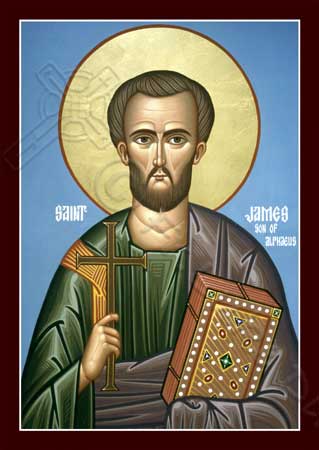
St. James the Apostle (the Greater)

jamesalphaeus-apostle1James, The Apostle – (Hebrew Yakob; N.T. Greek Iakobos)
Son of Zebedee and Salome, and brother of John the Apostle.
July 25

It was surely no coincidence that James and his brother John were sons of a fisherman and made their living off the Sea of Galilee. To live near and fish on a lake of that magnitude requires strength, knowledge, understanding, and at certain times of the year, bravery. It also takes fortitude, attention to detail, and temperance. Without all those qualities one could end up seriously hurt or worse yet, tangled in nets sinking to the bottom of the lake. James wasn’t alone in his calling – three others with whom he shared communal life were likewise called by Jesus to follow Him. Eventually they were even called upon to proclaim all they saw to the world. (Simon) Peter and Andrew who were coworkers, and his brother John were also called to follow Jesus around the same time as James. Jesus gathered together those He could trust who would witness the miracle of God’s love.

James was only one of three people Jesus invited to pray with Him in the Garden of Gethsemane. It was there James witnessed the transfiguration and was himself transformed in mind and spirit.

Saint James the apostle is sometimes referred to as the Greater to distinguish him from James the son of Joseph (who is sometimes called James the Lesser). Called to serve, he became a trusted friend and was instructed to serve and love those who followed our Lord. But there is more to James than his being a saint or follower of Jesus – he was first and foremost a hard worker, a friend, and a companion.

James was the first of the 12 apostles to be martyred for the newly forming community of believers. He was killed on the order of King Herod Agrippa I of Judea, about 44 A.D.  (Acts 12:1-2)  “1- It was about this time that King Herod arrested some who belonged to the church, intending to persecute them. 2 – He had James, the brother of John, put to death with the sword”.

Though we do not know much about the life of James the Greater, we know he was a man trusted by our Lord and he died for the early church. His strength and wisdom continue to guide and direct us all.