What Now? ~ The Rt Rev Michael Beckett, OPI

Many of us wear a crucifix around our necks to proclaim our faith, as do many of our Catholic brothers and sisters.  Many of our Protestant brothers and sisters wear a cross.  Churches throughout the world are marked by a cross.  When we pray, we “cross” ourselves.  The cross is the universal symbol of Christianity.  What’s up with that?

Crucifixion was, at one time, one of the most common methods of capital punishment used.  Lots and lots and lots of unfortunate men and women were crucified. We believe that Jesus was totally innocent of the crimes for which he was executed.  Of course, there are many men and women who have been executed for crimes which they did not commit.   Some view Jesus’ crucifixion as an honorable sacrifice made by gifted teacher. Others would point to the cross as a failure of Jesus to demonstrate His power. Like the thief who mocked Jesus saying, “If you are the Messiah then get us down from here,” critics view the cross as an insignificant death. They see Jesus as one of many who rebelled against the Roman Empire and suffered the consequences.

So what makes Jesus crucifixion so different?  Why does a world religion focus so much on the cross?  Is it that important?  Volumes and volumes of books have been written on that subject.  Wars have been fought over the cross.  The hymnist wrote: “In the cross of Christ I glory,” and we, as Christians, are called to proclaim the cross, right???

Ummm….not so much.

Proclaiming the cross means nothing……(Yes, I can hear you gasp and I can see your blood pressure rising.  Let me finish the sentence.)…..without proclaiming the resurrection.

Many contemporary Christians assume the cross has always been the focal point of Christian faith. They view the cross as the touchdown and the resurrection as the extra point. Certainly, the cross is vital to our faith, for it was the means through which Jesus atoned for our sins. But listen to Paul’s words: “If Christ has not been raised, our preaching is useless and so is your faith . . . if Christ has not been raised then you are still in you sins” (1 Cor. 15:14, 17).  If Christ had not been raised, then he would have been no better than Dismas (the “good” thief) or anyone else who has ever been executed.

On Easter we turn our attention to the resurrection. While every Sunday worship service is a testimony that Jesus rose from the dead, Easter provides a wonderful opportunity to consider the significance of the resurrection to our faith. An interesting aspect of early Christian history is that the resurrection, not the cross, was the central theme of Christian preaching.

The early believers saw themselves as “witnesses to the resurrection” (Acts 1:15-16). Peter and John created an uproar because they were preaching about Jesus and the resurrection (Acts 4:1-2). The Bible says with great power the apostles testified to the resurrection (Acts 4:33). Several years after the crucifixion while preaching in Athens, Paul preached the “good news about Jesus and the resurrection” (Acts 17:18).

The resurrection proclaims the deity of Christ. His death on the cross may have accomplished our redemption as He paid for the sins of the world, but it did not prove to the world that Christ was God in the flesh.  Saint Paul declared that the resurrection proved that Jesus was the Son of God (Rom. 1:4). In this text of First Corinthians 15, we read that Christ conquers all enemies and destroys all dominion, and hands the kingdom over to God the Father (vv. 24-27). Everything is under the authority of Christ because of the resurrection.

But the tomb is empty, and Jesus is alive. He is the Holy Son of God who is worthy to receive glory, honor, and praise!  Jesus died for your sins and rose again to prove His sacrifice was not in vain. He is alive to declare to you and to the world that you are a unique creation of God with significant role to play in His kingdom. You are one of those precious souls who are too many to name, but considered to be the fruit or blessing of the resurrection.  The resurrection is an invitation to receive what Christ has prepared for you. His offer of eternal life is a gift that must be received. What have you done with your invitation? Jesus is alive and calling for you to receive Him today. Will you be made alive to spend eternity with the risen Savior?

Will you proclaim the cross?  Sure.  But let us even more loudly proclaim the resurrection.  Let all that we do, all that we say, proclaim that JESUS IS ALIVE!!!

Amen

The Entrance of our LORD Jesus Christ in Jerusalem ~Palm Sunday~The RevDcn Igor Kalinski, OPI

Today we remind ourselves of the solemn entrance of Jesus Christ into Jerusalem as we read in Matthew 21:1-17; Mark 11:1-11; Luke 19:29-44 and John 12:12-19

Yeah, truly solemn entrance!  Seated on a donkey like the ancient kings as we read in 1 Kings 1:38, to fulfill the prophecy of the prophet  in Zacharias 9:9. Our Lord travels from Vitfagia through the Mount of Olives  headed for Jerusalem,  while the crowd of people with joy and excitement are welcoming our Lord shouting Hosanna to the son of David, Hosanna in the Highest.

But something happened that does not match with the magnificence of the entrance of our LORD, as Saint Luke the evangelist is saying that when he came close to the city, Jesus wept. (Luke 19:41)

Listen brethren, the LORD is weeping, our Lord Jesus  has  falling tears. Him who  comforted so many crying souls, like the widow of Nain with her only son, Jesus is telling her, don’t cry Luke 7:13, and now himself weeping.

That view is so horrifying that I can’t describe it. Only the soul can somehow feel and sense what will survive Jesus can join to cry for him like a little child who cry for his mother, without understanding those mother’s tears that are falling.

The tears as saint Augustine  says is the blood of the soul. They speak for enormous  spiritual survival, there are tears also of sorrow, tears of joy, tears of repentance…

What kind of tears did Jesus have that he was so sorrowful for Jerusalem? Saint Luke evangelist is telling us in chapter 19:41-44.

It’s obvious that this kind of tears of our Lord Jesus are tears of deep sorrow for the unhappy destiny of the inhabitants of Jerusalem.

In front of God’s view who sees everything appeared those horrible days when the enemies will encircle the city, will destroy and kill their children and inhabitants, which been fulfilled in every detail as have been recorder from the historian of that age, the Jewish historian Joseph Flavian.

Our Lord wept not only for Jerusalem , but for all people throughout the history, he saw the failing of Adam, the killing of Abel, he saw the betrayal of Judas, he saw all the sins and failing of the humanity til the end of the times.

How could He not weep? He wept for us, for our sins and transgressions, for our bad and unchristian lifestyle.

The tears of our Lord Jesus Christ remind us and calls us to repentance and sanctification of the new life and new beginning, to come back to ourselves, to crucify our body with the fallen nature (Glatians5:24) to remove from us the old man and to renew and clothe with new human made according God with justice and sanctity of truthfulness (Ephesians 4:22-24)

Holy Mother the Church have prepared during the liturgical year , several weeks, the weeks of the great lent for meditation and preparation for spiritual uplifting and spiritual salvation.

We ourselves let weep for our sins, with repentant tears to wash the sinful dots and marks from our heart.

To those who weep for their own sins and who repent, the Saviour has promised them great comfort in Matthew 5:4

That comfort is truly sure, because it is the comfort of the Holy Ghost (Acts9:31) Amen

Rev. Deacon Igor Kalinski OPI

Sharing Your Gifts~Br. Christian Ventura, Novice

In the Name of Almighty God: ✠ Father, Son, and Holy Spirit. 

Amen.

There is an old monastic joke that goes as follows–: 

“There are only three things that God doesn’t know: 

1. How many Franciscan Friars there are;

2. What in the world the Jesuits are doing; 

And 3. What a Dominican Friar is saying when they’re preaching”.

And as for most Dominicans on the day of the Annunciation, (or the day after, in this case) it is hard to not fall into this stereotype, as we are often quick to get excited whenever we have an opportunity to preach on the Blessed Virgin Mary. Afterall, our habits are white to represent our protection under the mantle of our Blessed Mother, (and also because it was the cheapest material at the time), but we don’t lead with that. 

We also carry a 15-decade rosary on the left side of our cincture to remind us to take up prayer instead of a sword. And if you didn’t already know, the modern rosary prayed by many today is believed to come from a Marian visitation to St. Dominic in his petition for peace during a time of death and despair. This 5-decade rosary is an abbreviated version inspired by the original 150 beaded Marian psalter given to St. Dominic. 

But we aren’t the only monastics to wear a rosary as part of our habit. The Franciscans share this practice, as do many nuns, brothers, and monks of various other orders as well. Although this is usually due to a shared desire to represent our cinctured obedience to almighty God in our vocation(s). 

Likewise, you’ll note that the Canticle of Mary or the Magnificat also has its roots in early monasticism. When we pray “my soul proclaims the greatness of the Lord, my spirit rejoices in God my savior” during evening prayer, we join the voices of the benedictine monks in the monastery who have chanted it during evening vespers since the 6th century.

The veneration of Mary the God bearer as influenced by early monasticism is an integral part of our history as Christians, and we know it to begin as early as the story of the Annunciation. Where, an Angel of God visits our mother and says “hail, full of grace, the Lord is with thee: blessed art thou among women”. 

But aside from the angelic imagery of this breathtaking event, what personally strikes me the most is Mary’s faithful consent to God in her special vocation. She says “behold the handmaid of the Lord, be it done unto me according to thy word”.

Imagine a world where we all said yes to our callings from God. And even better yet, imagine a world where we supported everyone and their special calls. And no, not necessarily a call to be a monk or a nun, but rather our call to be a brother, a sister, a friend, mother, a beloved child of God. Our call to take up our cross, our call to be imitators of the Word made flesh that dwelt among us. 

I urge you to take a moment to think about: what is God calling you to? What experiences, both good and bad, have placed you here– right where you need to be? 

And, how can you say “yes!”? Lent is a phenomenal time to discern our own special vocations and deepen our relationship with God: where we fast from our own will to make room for God’s. 

How are you called to share your special gifts and talents to help make it on earth as it is in heaven? Are you called to be a teacher, a healer, or a musician? Has God asked you to leverage your career in healthcare, law, hospitality, or leadership to help love your neighbors? Are you an artist? Do you cook? What are you really good at doing, and how can you use it to help bring peace, comfort, or joy to others? 

Lent is a time to embrace our callings from God not in spite of our flaws, but partly because of them. Whatever God is calling you to, know that he is calling you in the fullness of who you are now, with the vision of who you will become. 

Through the intercession of our Blessed Virgin Mary , Mother of God, may you come to hear your call and find confidence to say “yes”, and may our Loving Father help you bring it to fruition.

The Annunciation~Br Milan Komadina

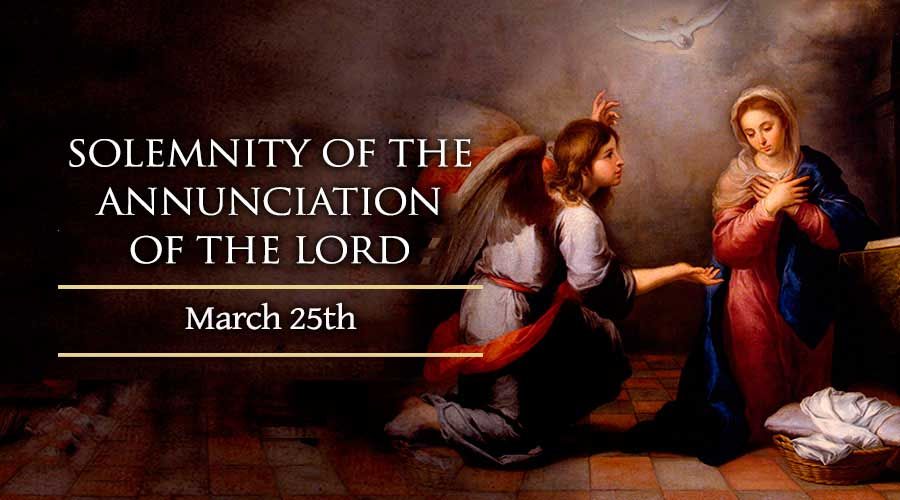
The Annunciation (from Latin annuntiatio), also referred to as the Annunciation to the Blessed Virgin Mary, the Annunciation of Our Lady, or the Annunciation of the Lord, is the announcement by the archangel Gabriel to Mary that she would conceive and bear a son through a virgin birth and become the mother of Jesus Christ, the Christian Messiah and Son of God, marking the Incarnation. Gabriel told Mary to name her son Immanuel, meaning “God is with us”. In the Old Testament we could read the prophecy in Isaiah 7/13,14 saying: The moment that will change World’s history was announced in the Old Testament. Today we remember this moment by reading the New Testament and the fulfilment of this prophecy in Luke 1/26,38:

“Then Isaiah said, “Hear now, you house of David! Is it not enough to try the patience of humans? Will you try the patience of my God also? Therefore the Lord himself will give you a sign: The virgin will conceive and give birth to a son, and will call him Immanuel.“

The moment that will change the World’s history was announced in the Old Testament. This prophecy was fulfilled in the coming centuries as we remember this moment by reading the New Testament Luke 1/26,38:

”In the sixth month of Elizabeth’s pregnancy, God sent the angel Gabriel to Nazareth, a town in Galilee, to a virgin pledged to be married to a man named Joseph, a descendant of David. The virgin’s name was Mary. The angel went to her and said, “Greetings, you who are highly favored! The Lord is with you.” Mary was greatly troubled at his words and wondered what kind of greeting this might be. But the angel said to her, “Do not be afraid, Mary; you have found favor with God. You will conceive and give birth to a son, and you are to call him Jesus. He will be great and will be called the Son of the Most High. The Lord God will give him the throne of his father David, and he will reign over Jacob’s descendants forever; his kingdom will never end.” “How will this be,” Mary asked the angel, “since I am a virgin?” The angel answered, “The Holy Spirit will come on you, and the power of the Most High will overshadow you. So the holy one to be born will be called the Son of God. Even Elizabeth your relative is going to have a child in her old age, and she who was said to be unable to conceive is in her sixth month. For no word from God will ever fail.” “I am the Lord’s servant,” Mary answered. “May your word to me be fulfilled.” Then the angel left her. ”

The time of lent is the time when we abstain from meat and delicious food. But it is also a good time for practice of humility. As we read in the chapter above, Mary was full of humility. She carefully accepted angel’s words and she was ready to serve God. When we talk about Mary we may talk also about humility because she was a great example of it. I found tree tips for practicing humility and I hope that those will be very useful to all of us as we try our best to practice it.

  • Do not interrupt when someone is voicing a concern. Instead of formulating a defense in your mind when confronted about a situation and jumping in with an excuse, simply apologize and move forward to mend the relationship. Give the other person their due apology without excuses.
  • Be more aware of the needs of others. It is human nature to firstly look after our own physical, spiritual, or emotional needs. Self-preservation is a human instinct that must be tamed lest we act to the detriment of others.
  • Be ready to put the needs of others ahead of your own and act with charity. Practice voluntary patience. Stand at the end of the line. Let other drivers go ahead of you at an intersection. Take the smallest piece or the last piece of the pie. Delayed satisfaction will help us train ourselves in patience, self-denial, and humility.

Lent is about connecting with Jesus in a deeper way and experiencing spiritual growth, you can try something new this year by forming a new habit rather than giving up an old one. Here are additional five ways you could participate in the Lenten season this year: 1. Read the Bible daily 2. Pray throughout the day. 3. Give money to a cause or local organization. 4. Do random acts of kindness. 5. Find your place to serve at church or with a local organization. My prayer for today is that we all may serve God in a perfect way as Mary did and to let the Holy Spirit come in our hearts.

Do Flowers Sin?

friarjayopi's avatarErmitage de Saint Dominic San Souci

Do Flowers Sin?

I grow a lot of flowers; I love the shapes, colors and all the critters they attract, especially the bees, butterflies and hummingbirds. One of my favorites to grow is Celosia, more commonly called Prince feather because of its colorful, feather-like plumage. Now the ones I grow are red to purple, produce a plethora of tiny seeds (about the size of this period “.”) and reseed themselves year after year. Yet unlike those varieties one might buy at the market, mine are deformed and produce blooms that range from the normal feather-like plums to large flat crests reminiscent of rooster’s comb (giving rise to another common name of Coxcomb flowers) or equally large dome-shaped clusters which look very much like some alien’s brain!

No matter the shape or color, I enjoy watching them grow and blossom through the summer and fall.  I do, however, wonder what sin…

View original post 1,320 more words

St Joseph, Spouse of the Blessed Virgin Mary~The Very Rev. Lady Sherwood, OPI

My dear brothers and sisters in Christ,

Mother Sherwood, OPI

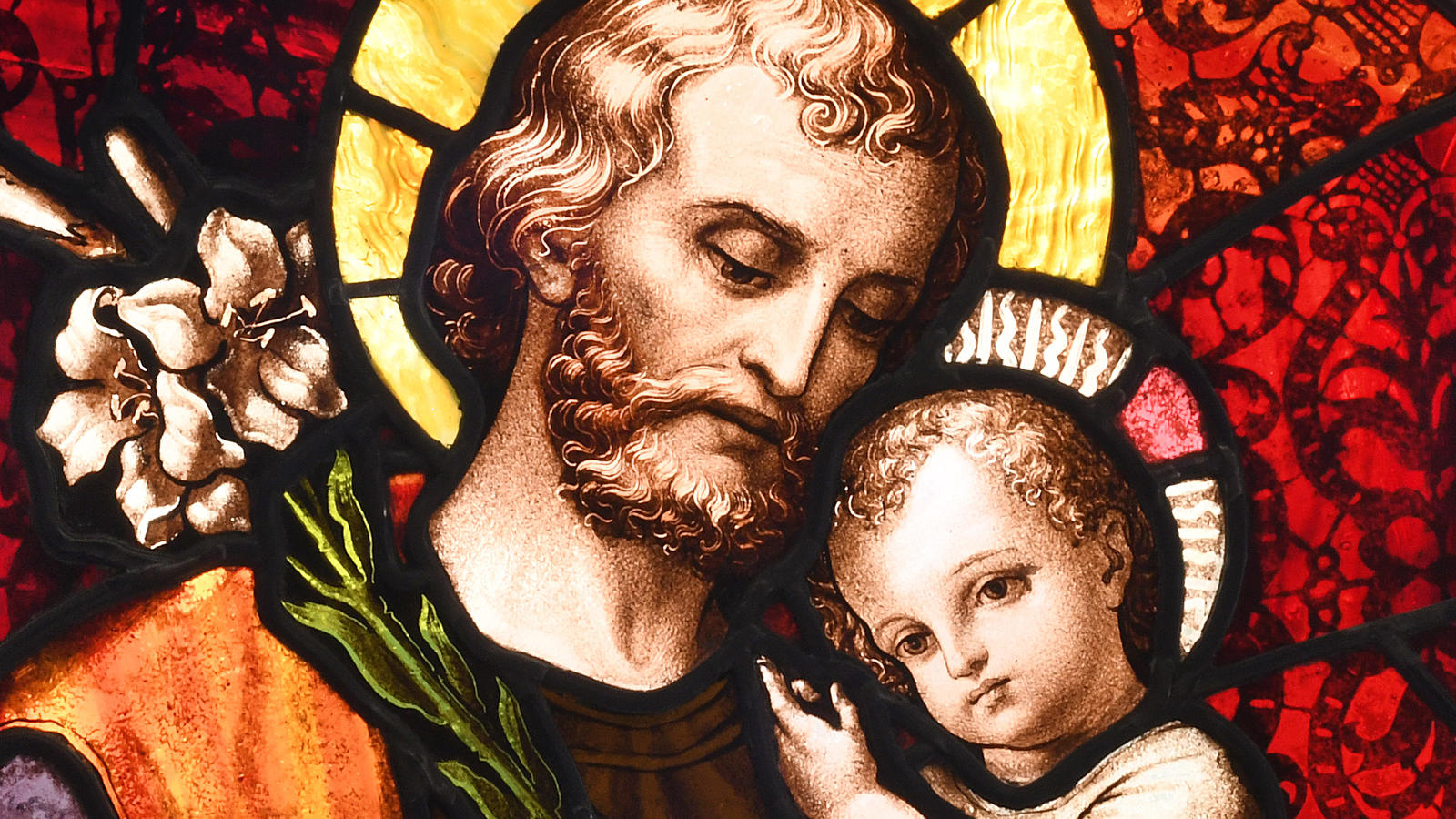
Today, we come together as the Church to commemorate St. Joseph, the Spouse of The Blessed Virgin Mary, and the foster Father of our Lord and Saviour,Jesus, when he became one of us here upon the Earth.

In the same way in which God, our Heavenly Father, who gives each of us as his children, unconditional love, care, stability and who sets us the standard with which we should strive to live our lives with his holy word in the scriptures, a true Father to each and every single one of us, who only ever wants the very best for all his children.  St. Joseph follows our Father’s example, as both husband and foster father.  He gives us examples which men should follow in their lives. Joseph cared for and provided for the Holy Household. There are many qualities that Joseph had which we could use to be the role model for Christian husbands and fathers. Joseph was a very compassionate man.  We can see an example of this when he suspected his wife of infidelity; he planned to divorce her quietly rather than denounce her publicly and expose her to public shame and penalty.

Joseph was always obedient to God and did what he knew was God’s will without thought or hesitation.  Examples of this are that he kept Mary as his wife; he protected and provided for his family when they had to flee to foreign lands to protect them from danger.

Joseph led a life of deep prayer and was in communion with God, and would always seek out that which was God’s will. God often told Joseph his will using dreams.

Joseph was a provider of care, When Jesus’s life was threatened, Joseph would take them out of danger. He took his family to Egypt and only returned when it was safe to do so, and when Jesus went missing at aged twelve, Joseph went searching for him because obviously, both parents were obviously extremely worried about Jesus’s safety.

Joseph also brought much more to Jesus’s life, he taught him his trade which Jesus worked in for about twenty years, he gave Jesus the love and stability he as any child needs, and was his earthly male role model, which was and still is vitally important for a good father to give any child.

He was a man with a firm faith in God coupled with a resilient personality, who did not complain and was not appalled nor distressed in the midst of trials and tribulations, St. Joseph knew how to face, carry and solve the burden of his vocation, of life’s difficulties and responsibilities with serenity, with complete faith and love, entrusting himself totally and unconditionally to God’s plans.

Sadly not all children are brought up in such a way today, but husbands and fathers truly should seek to follow this sincere man of God in the way they run their lives. Are you married? Do you give all the love, trust and respect to your spouse? Or with stresses and strains do you always argue or not truly make time for each other? If you have children, do you know where they are and if they are safe, or who they might be talking to online? Do you give emotional stability, patience and unconditional love? Do your children see you as the role model they need in a Father?  We should always strive to be as our heavenly Father is to each of us, whether that be to our spouses, to our children, and in fact to all as our brothers and sisters.

While the Gospels do not shed much light on St. Joseph’s life, it is believed that he died before Jesus’ public ministry.

St. Joseph is the patron of fathers, spouses, priests and seminarians. But also, St. Joseph teaches  us so much by his silent example of his life, and just how we should love God faithfully and obediently.

Let us pray:

Blessed St. Joseph, husband of Mary,

be with us this day.

You protected and cherished the Virgin;

loving the Child Jesus as your Son,

you rescued Him from the danger of death.

Defend the Church,

the household of God,

purchased by the Blood of Christ.

Guardian of the Holy Family,

be with us in our trials.

May your prayers obtain for us

the strength to flee from error

and wrestle with the powers of corruption

so that in life we may grow in holiness

and in death rejoice in the crown of victory.

Amen.

Are You Blind?~The Rt.Rev. Michael Beckett, OPI

Y’all, I only have one more pair of contacts before I have to get new ones.  That means, eye exam, new prescription, and hassle.  Of course, I’m really thankful that contacts and glasses exist, because I am blind as a bat without my glasses or contacts.  Without my glasses, I really am legally blind.  Ugh. 

In the Gospel for today, we read of Jesus and a blind man.  Picture it:  Jerusalem in A.D. 32 or so;  Jesus is bee-bopping along  with his disciples, and they see a blind dude and the disciples say, “What is up with this?  Who sinned, this man or his parents, that he was born blind?”

And Jesus answered, “Neither he nor his parents sinned; it is so that the works of God might be made visible through him.”  And what did Jesus do, you ask?  He made a bit of mud with spit and dirt and applied it to the blind dude’s eyes, told him to go wash it off, and BOOM, the guy could see!  Pretty kewl, huh?

Well, WE think so, but the Pharisees?  Not so much.  They were pretty bummed because they thought, like many evangelicals today do, that bad stuff happens to bad people, or that bad stuff happens coz God punishes folks who don’t toe the line, and, they say, “It says so in the Bible.”

Ummmmmm…….no.   And not just ‘no,’ but NO.   First of all, God does not ‘give’ us the terrible, horrible, no good, very bad things that happen in our lives.  Life happens.  Crap happens.  People make poor choices.  Natural disasters occur.  We get sick.  Nowhere does Holy Writ support the claim that any of these things is God’s doing.  What kind of God would we worship if he, indeed, sent us all the trials and tribulations and suffering and horror for which He is blamed?  When “bad” things happen to any of God’s children, God is grieved and suffers with us, and this was experienced most vividly in the hurt and suffering of Jesus Christ for all humanity. Any “bad” thing which happens is never the last word. Rather, God is the deepest and last word, and that word is love and eternal life with God.

The Bible clearly teaches that God does not cause us to suffer. For example, the Bible says that when we go through trials, it would be a mistake to say: “I am being tried by God.” Why? Because “with evil things God cannot be tried, nor does he himself try anyone.” (James 1:13) In other words, God never causes the trials we face or the suffering that follows. To do so would be wicked, but “God does not act wickedly.” (Job 34:12.)

If God does not cause us to suffer, then who or what does? Sadly, humans are often victimized by other imperfect humans. (Ecclesiastes 8:9) Additionally, we may face calamities because of “unexpected events”—that is, because of simply being in the wrong place at the wrong time. (Ecclesiastes 9:11) The Bible teaches that ultimately “the ruler of this world,” Satan the Devil, is responsible for human suffering, for “the whole world is lying in the power of the wicked one.” (John 12:31; 1 John 5:19) It is Satan—not God—who causes people to suffer.

God is aware of our suffering. From the very start of human suffering, not a single teardrop has gone unnoticed by our loving Father, whose “watchful eyes” see everything. (Psalm 11:4; 56:8) For example, when his worshippers in ancient times were being oppressed, God said: “I have certainly seen the affliction of my people.” But was he only vaguely aware of their pain? No, for he added: “I well know the pains they suffer.” (Exodus 3:7) Many people have found comfort in that truth alone—the thought that God is aware of everything we suffer, even the trials that we or others may not be aware of or fully understand. (Psalm 31:7; Proverbs 14:10.)

God feels for us when we suffer. Our Heavenly Father is not only aware of human suffering but also deeply moved by it. For example, God was sincerely troubled when his ancient worshippers faced trials. “During all their distress it was distressing to him,” says the Bible. (Isaiah 63:9) Although God is vastly superior to humans, he feels empathy for those who suffer—as if their pain were in his heart! Indeed, “Our Heavenly Father is very compassionate and merciful.” (James 5:11) Additionally, Our Heavenly Father helps us to bear our suffering. (Philippians 4:12, 13.)

We must also remember that our Lord Jesus knows what it is to suffer, to mourn.  He wept at the grave of Lazarus, he wept over Jerusalem, and he suffered horrifically during His Passion.

God will end all human suffering. According to the Bible, God will bring an end to the suffering of every human on the planet. By means of His Heavenly Kingdom, God will drastically change the human condition—for the better. Regarding that time, the Bible promises that God “will wipe out every tear from their eyes, and death will be no more, neither will mourning nor outcry nor pain be anymore. The former things have passed away.” (Revelation 21:4) What about those who have already died? God will bring them back to life here on earth so that they too can enjoy life free from suffering. (John 5:28, 29) Will anyone be plagued by painful memories of past suffering? No, for Our Heavenly Father promises: “The former things will not be called to mind, nor will they come up into the heart.” (Isaiah 65:17.)

So there’s that.  Now, Jesus said that God would be glorified through Blind Dude’s gift of sight.  It was a miracle!   Whilst Jesus isn’t around in the flesh these days to make mud and lay on hands, our God has granted us the miracles (yes plural) of modern medicine.  And I would imagine many of us have experienced a ‘miracle’ or two in our lives.  I know I have, more than once.  And for those blessings and miracles, we give thanks to God. 

But we have to ask, in what ways are WE blind, spiritually speaking?  What do we will ourselves not to see?  The homeless?  Inequality?  Inequity?  The poor?  People who are “other” than we ourselves?  I am reminded of a hymn by Clara H. Scott, “Open My Eyes That I May See.”

Open my eyes that I may see glimpses of truth thou hast for me. Place in my hands the wonderful key that shall unclasp and set me free.  Silently now I wait for thee, ready, my God, thy will to see.  Open my eyes, illumine me, Spirit divine!

Amen.

Like the Woman at the Well~The Rev. Frank Bellino, OPI

The Rev Frank Bellino, OPI

There can be times in this life when everything seems to be going wrong, or one massive problem is overshadowing everything else. It could be because of illness or grief, uncertainty, complicated or broken relationships. Whatever the cause, we can often feel swamped and unable to see any way through.

At times like that it doesn’t help to be reminded that things could be worse. Almost certainly they could be, but if you can’t cope with what’s happening now, the thought of going under completely is no support. And it’s no better to be told that someone else is in an even worse position. In fact, it can be quite distasteful to think that we should be taking comfort from the fact that someone else’s pain is even greater than our own.

The first reaction can often be to wish that the weight of what is troubling us could just be lifted, that by some miracle or magic the problems would dissolve. Problems can sometimes fade away but in most cases difficulties don’t disappear. Fairytale endings belong in fairytales not in real life.

So the only alternative is to try to find the inner strength or resources to be able to deal with what is facing us, the confidence to believe that things are not beyond us. That is not easy and one thing that can sometimes block our progress is looking for the solution in the wrong place, looking for the outside world to change instead of working for a change inside ourselves.

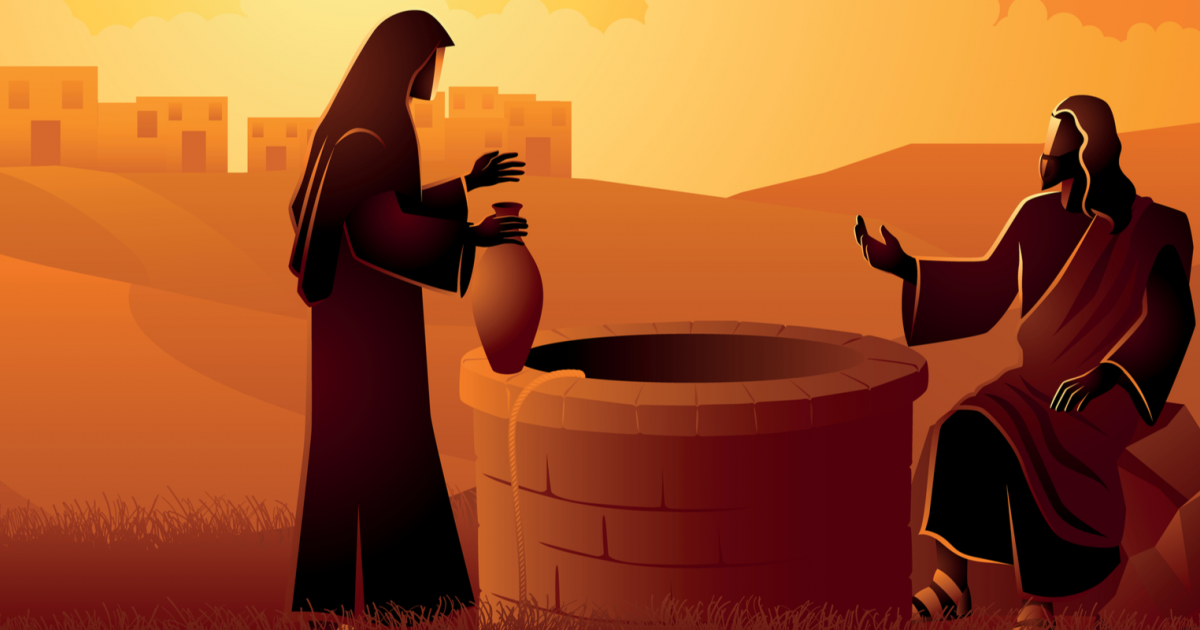
That confusion between changing the world and changing ourselves is what we see in the gospel story of the woman at Jacob’s well. She thought Jesus was referring to the water in the well and suggesting that she wouldn’t have to cope with carrying buckets or pitchers backwards and forwards every day. She didn’t realize he was talking about the resources that she could find in herself.

But how do we tap into these resources? Where do they come from? After all, it is precisely when we feel that we don’t have any resources left and that the problem is worse. I can only give a very personal answer, but I hope others can see echoes in their own lives too.

I often find I become too preoccupied with trying to sort out things which are really beyond me. I once heard a distortion of a common saying: when all else fails, lower your standards. We can become very depressed and dispirited if we constantly blame ourselves for not achieving the impossible. I think it is often better to take some pride and satisfaction in what we can achieve, even if that seems very little in the midst of the messy situations that life presents us with.

So perhaps the first step is to begin to let go of a pressing sense of being responsible for everything. If we do let go, I think it can have two effects. It can take some of the panic out of situations, leave us a little bit more relaxed and perhaps allow us to focus what little energy we have in the most productive way.

And then again it can give us space to notice support and help that we may have been too preoccupied to recognize. It is not a coincidence that the gospel story tells of the Samaritan woman meeting Jesus at a well. Wells were sources of water but they were also meeting places. People used to go there to do business, to catch up on gossip, even to meet their future partners.

So when Jesus told the woman she could have a spring welling up inside her, I don’t think he was just telling her that she could have a source of inner life and refreshment. I think he was also suggesting that she could have space to meet God inside herself, just as she had met Jesus at Jacob’s well. And meeting God, she could find support from God too.

If I take that seriously, it means that instead of constantly rushing against the odds to try and complete everything I expect of myself, I need to try and be still at times and make some space in my life, space to recognize what other people are already doing and allow space to bump into God and let God carry some of what I cannot carry myself. It can be effective relief.

Transfiguring~The Rt. Rev. Michael Beckett, OPI

Y’all!  The most exciting thing happened yesterday!  I was out with Ginger (our Sheltie), and I saw a butterfly!  I love this time of year here in the desert!  Yes, the weather is wonky with snow one day and temps in the upper 60s the next, but we get signs that spring is well on its way!   Our tulips are breaking ground and our irises are showing!  Things are changing!

Speaking of changing, here we are in the second week of the Lenten season.  For many folks, the weeks leading up to Easter are all about penance and “giving up something for Lent” and eating fish on Fridays.  For others of us, these weeks are about working on making new and better habits, adding additional studies of the scriptures, and trying to be more and more like Jesus.  At any rate and in any case, we focus on “changing” ourselves during Lent to make us better people, better followers of Jesus, and better “spreaders of His love.” 

In other words, we work to transfigure ourselves.  The dictionary tells us that the word “transfigure” means to transform into something more beautiful or elevated.  Kinda like that butterfly I saw;  you know, yucky worm like caterpillar to beautiful butterfly? 

In the Gospel reading appointed for today, we read in Matthew of “The Transfiguration of the Lord”:   Jesus took Peter, James, and John his brother, and led them up a high mountain by themselves.  And he was transfigured before them; his face shone like the sun and his clothes became white as light.
And behold, Moses and Elijah appeared to them, conversing with him.  Then Peter said to Jesus in reply, “Lord, it is good that we are here.  If you wish, I will make three tents here,
one for you, one for Moses, and one for Elijah.”  While he was still speaking, behold, a bright cloud cast a shadow over them,
then from the cloud came a voice that said, “This is my beloved Son, with whom I am well pleased;  listen to him.”
When the disciples heard this, they fell prostrate and were very much afraid.  But Jesus came and touched them, saying, “Rise, and do not be afraid.”  And when the disciples raised their eyes,
they saw no one else but Jesus alone. As they were coming down from the mountain, Jesus charged them, “Do not tell the vision to anyone until the Son of Man has been raised from the dead.”

Whoa.  Can you even imagine seeing something like that?  Of course, instead of constructing tents like Peter wanted to, we would quickly be updating our status on Facebook, or posting like a gazillion pics on Instagram. Or just as likely, our fingers would quickly be flying across our keyboards and phones, sending out Tweets about what an awesome time we had hanging out with Jesus.

When we talk about THE Transfiguration, we usually focus on Jesus and how he was “changed” for a bit into something more “dazzling and heaven-like.”  Peter, John, and James witnessed a rare sight, the Transfiguration or change, of Jesus. Just as we strive to experience change during these days of Lent, so did Jesus on top of the mountain. But what I find interesting is that these men still recognized Jesus as, well, Jesus. Though He was clothed in “dazzling white”. He was the same teacher, and friend, that these gentlemen had always known. They recognized Him still, and were humbled by the change that manifested in Him at the time. 

But how much more so were the disciples who were with Jesus changed?  They witnessed Jesus’ Transfiguration, as well as a booming voice in the cloud declaring exactly who Jesus is, and are instructed to listen to Him.  Whoa again.  Can you imagine?  No?  Me either.  Often times when the going gets rough and I’m  walking on wobbly stones in my faith, I often ask God, “Give me a big ol’ sign, show me you are You.” Well as you can imagine, that doesn’t happen. And honestly, if it would, I wouldn’t be so sure that I could even believe my own eyes.

Yet, don’t we all strive to witness the true face of God, to see with our own eyes that He really is just who He says He is, and can do what He unequivocally declares to be done? As we read in the Bible, true visitations by our heavenly Father are rare. But He is still just as real to us today as He was so long ago on top of that mountain.

As we use this time to manifest changes in ourselves, as we strive to develop a deeper relationship with our blessed Father, let us never forget that He is right here with us. He is sitting at the kitchen table as you sip that first cup of coffee. He is standing in the checkout line at the store. He is in the car on our daily commute home in the evening. And, He is there when we finally decide to put our daily cares to rest, and before we close our eyes at night, whispering “Thank you God for another day.” 

And, more importantly, He is expecting us to prove that He is with us to the folks with whom we come into contact every minute of every day of our lives.  Remember, there is not one person on this planet who God does not love.  Who Jesus didn’t die for.  Yes, even that…….….fill in your own blank.  Democrat?  Yep.  Republican.  Yep.  Trans person, gay person, bigot, other-race person, criminal, gossip, and irritating next door neighbor? Yep.  Yes.  Affirmative. Positively.  Absolutely.  Yep, and yes again.  We who claim to love the Lord, must show that love.  I’ll say it again, you are the only Jesus some folks will ever see, the only Bible some folks will ever read.   We must show that we have, indeed, been transfigured.

Let us pray:

 Lord,

You met with Moses on the top of a mountain, and when he descended his face was shining.  In your power he brought your laws to a needy people.  You met with Christ on top of a mountain,  and he was transformed with brightness and descended with renewed strength.  Lord, we want to meet with you and be transformed by you, and to bring your transformation to the world around us.  Help us to bring your presence to the lives of those burdened with sickness or pain,

and those weighed down with confusion or grief.  Bring your healing touch to those lives today, nd let us support those we know who are in need with a constant friendship.  Help us to bring your change to a troubled society, where people are unsure of so much and where change comes so fast.  Give us the grace to understand people’s problems and anxieties and the strength to tackle difficult issues head on.  Help us to work together to transform a needy world, whether through giving or educating or leading by example.  Give us the wisdom to see through big and complex issues and the love that will keep us going when problems are overwhelming.  Help us to always be a beacon for you, Individually and together.  We don’t stand on any lofty mountain but we have a God who is changing us every day and through whom we can reach out to change a broken world.  Be with us today Lord and help us take whatever step is next for us.  We ask this through the power of your love.

Amen

Growing Pains – Humanity’s Teens!

By our beloved Bishop Jay, OPI

friarjayopi's avatarErmitage de Saint Dominic San Souci

1st Sunday in Lent: A 2023

Today’s Old Testament reading, the infamous fall of man, the beginning of sin, the old Eve ruined everything, scripture is one of my favorites and also one I detest the most.  Why one I detest you ask: because it is so often misused by religion for purposes of fear mongering and control.  On the other hand, it is  a beautiful allegory on the difficulties of watching your children grow up, watching them make poor choices, knowing their innocence is slowly fading away.  After all, the Creator gave humanity free will, the gift of choosing right from wrong, of choosing our own paths as individual, cognizant creatures and yet, like any loving parent, wanted to extend our life in Eden and spare our loss of rose tinted glasses, the loss of our childhood innocence.

View original post 1,224 more words