Moments With Mother ~ The Very Rev. Lady Sherwood, OPI
Click the link above to be taken to today’s installment of Moments With Mother!

Click the link above to be taken to today’s installment of Moments With Mother!
As a child, Andrew Grego lived on the southern shore of Lake Garda, in northern Italy. His training for a life of heroic sanctity began early, with voluntary penances and unquestioning obedience to his father. Andrew’s first desire was to be a hermit, an ambition that was met with ridicule from his brothers. Failing to realize this hope, he made for himself a severe schedule of prayer and penance, and, in his own house, lived the life of one wholly given to God.
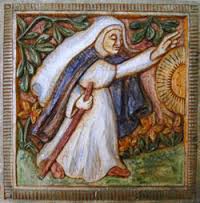
After the death of his father, it became increasingly difficult to carry out his plan, so he resolved to enter the cloister. Although his brothers had persecuted him without mercy, he knelt and humbly begged their prayers and forgiveness for having annoyed them. Then he gave them the only possession he had, a walking-stick. This stick, thrown carelessly in a corner by the brothers, was forgotten until, long afterwards, it bloomed like the legendary rod of Saint Joseph in token of Andrew’s holiness.
The 15-year old received the Dominican habit at Brescia and then was sent to San Marco in Florence. This convent was then at its peak of glory, stamped with the saintly personalities of Saint Antoninus and the Blesseds of Lawrence of Riprafratta, Constantius, and Antony della Chiesa. Andrew’s soul caught the fire of their apostolic zeal, and set forth on his mission in the mountains of northern Italy.
Heresy and poverty had combined to draw almost this entire region from the Church. It was a country of great physical difficulties, and, in his travels in the Alps, he risked death from snowstorms and avalanches as often as from the daggers of the heretics. Nevertheless, he travelled tirelessly, preaching, teaching, and building–for his entire lifetime.
Churches, hospitals, schools, and orphanages were built under Andrew’s direction. He would retire from time to time to these convents for periods of prayer and spiritual refreshment, so that he could return with renewed courage and zeal to the difficult apostolate. He was known as “the Apostle of the Valtelline,” because of the district he evangelized.
Blessed Andrew performed many miracles. Probably his greatest miracle was his preaching, which produced such fruits in the face of great obstacles. At one time, when he was preaching to the people, the heretics presented him with a book in which they had written down their beliefs. He told them to open the book and see for themselves what their teachings amounted to. They did so, and a large viper emerged from the book.
Blessed Andrew closed a holy life by an equally holy death, and died in 1485. He was buried in Morbegno. He had labored so long among the poor and the neglected that his place in their hearts was secured. Because of the miracles worked at his tomb, and the persistent devotion of the people, his relics were twice transferred to more suitable tombs. He was beatified in 1820.
Born in at Forli, Italy in 1317, Marcolino Amanni entered the Dominicans at age 10. He occupies a place unique in Dominican annals because he was almost purely contemplative . There is outwardly little to record of Blessed Marcolino, except that for 70 years he kept the Dominican Rule in all its rigor. That is a claim to sanctity that can be made by very few, and is of itself enough to entitle him to canonization. He did accomplish the reform of several convents that had fallen from their primitive fervor, but this he did by his prayers and his example rather than by teaching or preaching.
It is said that Marcolino was most at home with the lay brothers, or with the neighborhood children who enjoyed talking to him. He seldom went out of his cell, and could not have engaged in any active works; neither did he leave any writings. His work was the unseen labor presided over by the Holy Spirit, the work of contemplation. “To give to others the fruits of contemplation,” is the Dominican motto and one might be curious to know how Blessed Marcolino accomplished this. In order to understand the need for just such a type of holiness, it is well to remember the state of the Church in the 14th century. Devastated by plague and schism, divided and held up to scorn, preyed upon by all manner of evils, the Church militant was in need, not only of brave and intelligent action, but also of prayer. Consistently through the centuries, God has raised up such saints as could best avert the disasters that threatened the world in their day, and Marcolino was one answer to the need for mystics who would plead ceaselessly for the Church.
The interior life of Marcolino was not recorded by himself or by others. He lived the mystical life with such intensity that he was nearly always in ecstasy and unconscious of the things around him. One of his brothers recorded that he seemed “a stranger on earth, concerned only with the things of heaven.” Most of his brethren thought him merely sleepy and inattentive, but actually he was, for long periods, lost in converse with God. Some had heard him talking earnestly to the statue of Our Lady in his cell; some fortunate few had heard Our Lady replying to his questions, with the same simplicity.
At the death of Marcolino, on 2 January, 1397, a beautiful child appeared in the streets, crying out the news to the little town that the saintly friar was dead. As the child disappeared when the message was delivered, he was thought to have been an angel. Many miracles were worked at the tomb of Marcolino. One was the miraculous cure of a woman who had been bedridden for 30 years. Hearing of the death of the blessed, she begged him to cure her so that she could visit his tomb.
He was confirmed as a saint in 1750 by Pope Benedict XIV.
Reading 1 – Isaiah 8:23—9:3
First the Lord degraded the land of Zebulun and the land of Naphtali; but in the end he has glorified the seaward road, the land west of the Jordan, the District of the Gentiles. Anguish has taken wing, dispelled is darkness: for there is no gloom where but now there was distress. The people who walked in darkness have seen a great light; upon those who dwelt in the land of gloom a light has shone. You have brought them abundant joy and great rejoicing, as they rejoice before you as at the harvest, as people make merry when dividing spoils. For the yoke that burdened them,
the pole on their shoulder, and the rod of their taskmaster you have smashed, as on the day of Midian.
Responsorial Psalm – Psalm 27:1, 4, 13-14
(1a) The Lord is my light and my salvation.
The LORD is my light and my salvation; whom should I fear? The LORD is my life’s refuge; of whom should I be afraid?
R. The Lord is my light and my salvation.
One thing I ask of the LORD; this I seek: To dwell in the house of the LORD all the days of my life, That I may gaze on the loveliness of the LORD and contemplate his temple.
R. The Lord is my light and my salvation.
I believe that I shall see the bounty of the LORD in the land of the living. Wait for the LORD with courage; be stouthearted, and wait for the LORD.
R. The Lord is my light and my salvation.
Reading 2 – 1 Corinthians 1:10-13, 17
I urge you, brothers and sisters, in the name of our Lord Jesus Christ, that all of you agree in what you say, and that there be no divisions among you, but that you be united in the same mind and in the same purpose. For it has been reported to me about you, my brothers and sisters, by Chloe’s people, that there are rivalries among you. I mean that each of you is saying, “I belong to Paul,” or “I belong to Apollos,” or “I belong to Cephas,” or “I belong to Christ.” Is Christ divided? Was Paul crucified for you? Or were you baptized in the name of Paul? For Christ did not send me to baptize but to preach the gospel, and not with the wisdom of human eloquence, so that the cross of Christ might not be emptied of its meaning.
Gospel – Matthew 4:12-23
When Jesus heard that John had been arrested, he withdrew to Galilee. He left Nazareth and went to live in Capernaum by the sea, in the region of Zebulun and Naphtali, that what had been said through Isaiah the prophet might be fulfilled: Land of Zebulun and land of Naphtali, the way to the sea, beyond the Jordan, Galilee of the Gentiles, the people who sit in darkness have seen a great light, on those dwelling in a land overshadowed by death a light has arisen. From that time on, Jesus began to preach and say, “Repent, for the kingdom of heaven is at hand.” As he was walking by the Sea of Galilee, he saw two brothers, Simon who is called Peter, and his brother Andrew, casting a net into the sea; they were fishermen. He said to them, “Come after me, and I will make you fishers of men.” At once they left their nets and followed him. He walked along from there and saw two other brothers, James, the son of Zebedee, and his brother John. They were in a boat, with their father Zebedee, mending their nets. He called them, and immediately they left their boat and their father and followed him. He went around all of Galilee, teaching in their synagogues, proclaiming the gospel of the kingdom, and curing every disease and illness among the people.
Have you ever had an identity crisis? Like a full-on, genuine, “Who am I?” and “What is it about me that makes me, me?” I believe that many of us have had this at least once in our lives when we genuinely question who it is that we are and who it is that God has created us to be and what it is that makes us truly unique.
In our second reading today from the first letter to the Corinthians, St. Paul is dealing with this very issue with the Church at Corinth. Paul had heard reports from others that the Church at Corinth had been divided, claiming that “I belong to Paul” or “I belong to Cephas” or “I belong to Apollos” according to who came and brought the message of the Gospel to them. This so divided the Church at Corinth that they had an identity crisis, forgetting who it is that we worship and who we celebrate and who we follow in being Christians. They were creating division among themselves based upon trivial differences which made no difference at all to the status of their salvation. They touted the source of their learning of the Gospel, and not the Word Himself, in whom there is all unity and truth.
But it’s a good thing that this doesn’t happen to us in the modern Church, right? WRONG! How often do we hear quarrels and squabbles amongst the Christian people saying “I belong to Pope Francis,” “I belong to Franklin Graham,” or “I belong to (Archbishop of Canterbury) Justin Welby.” We focus on the silly and paltry divisions and do not look at what it is that makes us all one: we are brothers and sisters in Christ, just as Paul tells the Church at Corinth. We are all Christians, in whom we find our identity. For we do not find our identity as Christians in Francis, Franklin, Justin, or even Michael. We find our identity as Christians in Jesus Christ, the perfect Lamb of God who came to take away the sins of the world and to bring us to the Father.
If you notice, in the Gospel passage, Jesus says to Simon and Andrew, “Come after ME, and I will make you fishers of men.” He does not say “Follow after Pope Francis, and he will make you fishers of men.” He does not say “Follow after Franklin Graham, and he will make you fishers of men.” He does not say “Follow after Justin Welby, and he will make you fishers of men.” NO! He says, simply and clearly, “Come after ME, and I will make you fishers of men.”
In our world, I would recommend that we all take a look at our own identity crisis, for it is in Christ that we find our identity. In our world that turns more uncertain and precarious by the day, let us look to Christ as our identity, as the one who claims us as His own, in whom we live, move, and have our being. It is only then that we will be sure of who we are, and it is only then that we will be able to work together as the Body of Christ to make effective work for the Kingdom of God.
Margaret, the daughter of King Bela IV, and Queen Mary Lascaris of Hungary, was offered to God before her birth, in petition that the country would be delivered from the terrible scourge of the Tartars. The prayer having been answered in 1242, the king and queen made good their promise by placing the rich and beautiful three-year-old in the Dominican convent at Vesprim. Here, in company with other children of nobility, she was trained in the arts thought fitting for royalty.
Margaret was not content with simply living in the house of God; she demanded the religious habit–and received it–at the age of four. Furthermore, she took upon herself the austerities practiced by the other sisters–fasting, hairshirts, the discipline (scourge), and night vigils. She soon learned the Divine Office by heart and chanted it happily to herself as she went about her play. She chose the least attractive duties of the nuns for herself. She would starve herself to keep her spirit humble. No one but Margaret seemed to take seriously the idea that she would one day make profession and remain as a sister, for it would be of great advantage to her father if she were to make a wise marriage.
This question arose seriously when Margaret was 12. She responded in surprise. She said that she had been dedicated to God, even before her birth, and that she intended to remain faithful to that promise. Some years later her father built for her a convent on the island in the Danube between Buda and Pest. To settle the matter of her vocation, here she pronounced her vows to the master general of the order, Blessed Humbert of the Romans, in 1255, and took the veil in 1261.
Again, when Margaret was 18, her father made an attempt to sway her from her purpose, because King Ottokar of Bohemia, hearing of her beauty, had come seeking her hand. He even obtained a dispensation from the pope and approached Margaret with the permission. Margaret replied as she had previously, “I esteem infinitely more the King of Heaven and the inconceivable happiness of possessing Jesus Christ than the crown offered me by the King of Bohemia.” Having established that she was not interested in any throne but a heavenly one, she proceeded with great joy to live an even more fervent religious life than she had before.
Margaret’s royal parentage was, of course, a matter of discussion in the convent. But the princess managed to turn such conversation away from herself to the holy lives of the saints who were related to her by blood–King Saint Stephen, Saint Hedwig, Saint Elizabeth of Hungary, and several others. She did not glory in her wealth or parentage, but strove to imitate the saints in their holiness. She took her turn in the kitchen and laundry, seeking by choice much heavy work that her rank might have excused her from doing. She was especially welcome in the infirmary, which proves that she was not a sad-faced saint, and she made it her special duty to care for those who were too disagreeable for anyone else to tend.
Margaret’s austerities seem excessive to us of a weaker age. The mysteries of the Passion were very real to her and gave reason for her long fasts, severe scourgings, and other mortifications detailed in the depositions of witnesses taken seven years after her death (of which records are still in existence). Throughout Lent she scarcely ate or slept. She not only imitated the poverty- stricken in their manual labor and hunger, but also in their lack of cleanliness–a form of penance at that time. Some of her acts of self-immolation have been described as “horrifying” and verging on fanaticism, and there seems to have been an element of willfulness in her mortifications.
She had a tender devotion to Our Lady, and on the eve of her feasts, Margaret said a thousand Hail Marys. Unable to make the long pilgrimage to the Holy Land, to Rome, or to any of the other famous shrines of Christendom, the saint developed a plan by which she could go in spirit: she counted the miles that lay between herself and the desired shrine, and then said an Ave Maria for every mile there and back. On Good Friday she was so overcome at the thoughts of Our Lord’s Passion that she wept all day. She was frequently in ecstasy, and very embarrassed if anyone found her so and remarked on her holiness.
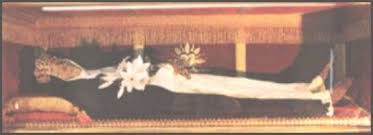
A number of miracles were performed during Margaret’s lifetime and many more after her death because Margaret had an implicit faith in the power and efficacy of prayer. The princess nun was only 28 when she died. Most of the particulars of her life are recorded in existing depositions of witnesses taken in 1277. Her friends and acquaintances petitioned for her to be acclaimed a saint almost immediately after her death. Among them was her own servant, Agnes, who rightly observed that this daughter of a monarch showed far more humility than any of the monastery’s maids. Although their testimony expressed Margaret’s overpowering desire to allow nothing to stand between her and God, the process of canonization was not complete until 1943. The island where her convent stood, called first the “Blessed Virgin’s Isle,” was called “Isle of Margaret” after the saint. She died 18 January 1271 at Budapest, Hungary. Her remains were given to the Poor Clares at Pozsony when the Dominican Order was dissolved, and most of her relics were destroyed in 1789, but portions are still preserved at Gran, Gyor, Pannonhalma.
She was beatified on 28 July 1789 by Pope Pius XII.
Born in 1187 at Vizella, in the diocese of Braga, Portugal, Gonsalvo de Amarante was a true son of the Middle Ages. In his boyhood Gonsalvo Pereira gave indications of his holiness. While still small, he was consecrated to study for the Church, and received his training in the household of the archbishop of Braga. After his ordination he was given charge of a wealthy parish.
There was no complaint with Gonsalvo’s governance of the parish of Saint Pelagius. He was penitential himself, but indulgent with everyone else. Revenues that he might have used for himself were used for the poor and the sick. The parish, in fact, was doing very well when he turned it over to his nephew, whom he had carefully trained as a priest, before making a pilgrimage to the Holy Land.
Gonsalvo would have remained his entire life in the Holy Land, but after 14 years his archbishop commanded him to return to Portugal. Upon his arrival, he was horrified to see that his nephew had not been the good shepherd that he had promised to be, the money left for the poor had gone to purchase a fine stable of thoroughbred horses and a pack of fine hounds. The nephew had told everyone that his old uncle was dead, and he had been appointed pastor in his place by an unsuspecting archbishop. When the uncle appeared on the scene, ragged and old, but very much alive, the nephew was not happy to see him. Gonsalvo seems to have been surprised as well as pained.
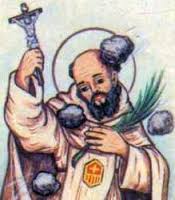
The ungrateful nephew settled the matter by turning the dogs on his inconvenient uncle. They would have torn him to pieces, but the servants called them off and allowed the ragged pilgrim to escape. Gonsalvo decided then that he had withstood enough parish life, and went out into the hills to a place called Amarante. Here he found a cave and other necessities for an eremitical life and lived in peace for several years, spending his time building a little chapel to the Blessed Virgin. He preached to those who came to him, and soon there was a steady stream of pilgrims seeking out his retreat.
Happy as he was, Golsalvo felt that this was not his sole mission in life, and he prayed for help to discern his real vocation. It is said that the Virgin Mary appeared to him one night as he prayed and told him to enter the order that had the custom of beginning the office with “Ave Maria gratia plena.” She told him that this order was very dear to her and under her special protection. Gonsalvo set out to learn what order she meant, and eventually came to the convent of the Dominicans. Here was the end of the quest, and he asked for the habit.
Blessed Peter Gonzales was the prior, and he gave the habit to the new aspirant. After Gonsalvo had gone through his novitiate, he was sent back to Amarante, with a companion, to begin a regular house of the order. The people of the neighborhood quickly spread the news that the hermit was back. They flocked to hear him preach, and begged him to heal their sick.
One of the miracles of Blessed Gonsalvo concerns the building of a bridge across a swift river that barred many people from reaching the hermitage in wintertime. It was not a good place to build a bridge, but Gonsalvo set about it and followed the heavenly directions he had received. Once, during the building of the bridge, he went out collecting, and a man who wanted to brush him off painlessly sent him away with a note for his wife.
Gonsalvo took the note to the man’s wife, and she laughed when she read it. “Give him as much gold as will balance with the note I send you,” said the message. Gonsalvo told her he thought she ought to obey her husband, so she got out the scales and put the paper in one balance. Then she put a tiny coin in the other balance, and another, and another–the paper still outweighed her gold–and she kept adding. There was a sizeable pile of coins before the balance with the paper in it swung upwards.
Gonsalvo died 10 January 1259, after prophesying the day of his death and promising his friends that he would still be able to help them after death. Pilgrimages began soon, and a series of miracles indicated that something should be done about his beatification. Forty years after his death he appeared to several people who were apprehensively watching a flood on the river. The water had arisen to a dangerous level, just below the bridge, when they saw a tree floating towards the bridge, and Gonsalvo was balancing capably on its rolling balk. The friar carefully guided the tree under the bridge, preserving the bridge from damage, and then disappeared. He was beatified by Pius IV in 1560.
First Reading – Isaiah 49:3, 5-6
The LORD said to me: You are my servant, Israel, through whom I show my glory. Now the LORD has spoken who formed me as his servant from the womb, that Jacob may be brought back to him and Israel gathered to him; and I am made glorious in the sight of the LORD, and my God is now my strength! It is too little, the LORD says, for you to be my servant, to raise up the tribes of Jacob, and restore the survivors of Israel; I will make you a light to the nations, that my salvation may reach to the ends of the earth.
Responsorial Psalm – Psalm 40:2, 4, 7-8, 8-9, 10
(R.) Here am I, Lord; I come to do your will.I have waited, waited for the LORD,
and he stooped toward me and heard my cry. And he put a new song into my mouth, a hymn to our God.
(R.) Here am I, Lord; I come to do your will.
Sacrifice or offering you wished not, but ears open to obedience you gave me. Holocausts or sin-offerings you sought not; then said I, “Behold I come.”
(R.) Here I am, Lord; I come to do your will.
“In the written scroll it is prescribed for me, to do your will, O my God, is my delight, and your law is within my heart!”
(R.) Here am I, Lord; I come to do your will.
I announced your justice in the vast assembly; I did not restrain my lips, as you, O LORD, know.
(R.) Here am I, Lord; I come to do your will.
Second Reading – 1 Corinthians 1:1-3
Paul, called to be an apostle of Christ Jesus by the will of God, and Sosthenes our brother, to the church of God that is in Corinth, to you who have been sanctified in Christ Jesus, called to be holy,
with all those everywhere who call upon the name of our Lord Jesus Christ, their Lord and ours. Grace to you and peace from God our Father and the Lord Jesus Christ.
Gospel – John 1:29-34
John the Baptist saw Jesus coming toward him and said,”Behold, the Lamb of God, who takes away the sin of the world. He is the one of whom I said, ‘A man is coming after me who ranks ahead of me because he existed before me.’ I did not know him, but the reason why I came baptizing with water was that he might be made known to Israel.” John testified further, saying, “I saw the Spirit come down like a dove from the sky and remain upon him. I did not know him, but the one who sent me to baptize with water told me, ‘On whomever you see the Spirit come down and remain, he is the one who will baptize with the Holy Spirit.’ Now I have seen and testified that he is the Son of God.”
The term servant often has a negative “definition”, especially here in the United States because of our unfortunate history. People often think of a servant being a slave to a master. But that is not the only “definition” for a servant. In fact, a servant does not have to be subject to a master, but a servant can be of assistance with positive results. We find this theme being a servant in the Readings for today.
Despite all of the unfortunate circumstances that the Israelites faced, especially their exile and slavery, Isaiah comes to the people as a servant of the Lord to explain that God does have favor with the people even though they faced so much adversity. In the response for the Psalm, we read, “Here am I, Lord; I come to do your will.” David recognizes his purpose. In the First Letter to the Corinthians, Paul is addressing the people of Corinth, setting up the message which he has to share; as he states his mission is to spread the message of Jesus, called upon by Jesus to do so. In the Gospel, John the Baptist had been going around speaking of the “coming of the Lord” in his ministry. And so, along comes Jesus who John the Baptist acknowledges as the one who takes away the sins of the world. John’s purpose was to prepare the way of the Lord.
This is where things get interesting though; because God takes on human flesh as Jesus, only to end up being crucified. How does the death of Jesus present positive results, as I mentioned being a servant can be of assistance with positive results? The answer is this. Jesus knew his mission was to serve the Father, to spread God’s message; through parables and other methods of teaching. The night before his death on the cross, he sat in the garden knowing that in order to be a “servant to save humanity from sin” he had to do God’s will. So ultimately, John the Baptist was sharing with the people present at the baptism of Jesus who this servant was.
How do we apply all of this to our lives? Each of us has been called by God to do something. We are a servant with a mission and purpose. It may take longer for some of us to know what that mission and purpose is than it takes others, but we have to accept the call once we understand what we have been called to do. W all have various gifts and talents given to us, BUT we have to use them! If we do not accept the call, then we are not going to reach those who need to hear the message of the Gospel. We are servants of the Lord!
Father, may we come to recognize our gifts and talents in order to fulfill our mission and purpose you have asked of us, just as people before us have fulfilled their mission. This we ask through Christ, Our Lord. Amen.
The 17th century was a period of great missionary activity. Many martyrs shed their blood on distant shores. Dominicans and Jesuits contributed a great share to the blood of martyrs. Among this glorious company, the Dominican Francis de Capillas has become the type and exemplar of them.
Francis was born in 1608 in Old Castile, Spain. Nothing is known of his childhood. He entered the Dominicans at Valladolid at age 17. The Spain of his youth was still ringing with the missionary zeal of Saints Louis Bertrand, Philip de las Casas, and Francis Xavier; the report of the martyrdom of Alphonsus Navarette (June 1), in Japan, was news at the time. Perhaps the bravery of these men helped to fire the young Francis with apostolic longing, for he volunteered for the Philippine mission while he was a deacon. In 1631 at the age of 23, he left Spain and was ordained in Manila. Here, at the gateway to the Orient, the Dominicans had founded a university in 1611, and the city teemed with missionaries traveling throughout the Orient.
The young priest labored for 10 years in the province of Cagayan, the Philippines, where heat, insects, disease, and paganism made life very hard. But it was not hard enough for Francis. He begged for a mission field that was really difficult; perhaps, like many of the eager young apostles of that time, he was hoping for an assignment in Japan, where the great persecution was raging. He was sent to Fukien, China, where he worked uneventfully for some years. Then a Tartar invasion put his life in jeopardy. He was captured by a band of Tartars and imprisoned as a spy.
Francis was subjected to a mock trial. Civil, military, and religious officials questioned him, and they accused him of everything from political intrigue to witchcraft. He was charged with disregarding ancestor worship, and, finally, since they could “find no cause in him,” he was turned over to the torturers.
He endured the cruel treatment of these men with great courage. Seeing his calmness, the magistrates became curious about his doctrines. They offered him wealth, power, and freedom, if he would renounce his faith, but he amazed and annoyed them by choosing to suffer instead. They varied the tortures with imprisonment, and he profitably used the time to convert his jailor and fellow prisoners. Even the mandarin visited him in prison, asking Francis if he would renounce his faith or would he prefer to suffer more. Being told that he was glad to suffer for Christ, the mandarin furiously ordered that he be scourged again “so he would have even more to be glad about.”
Francis was finally condemned, and was beheaded on 15 January 1640. He was beatified on 2 May 1919 by Pope Pius X.
You must be logged in to post a comment.