
Gifts ~ The Rev. Frank Bellino, OPI
Can we expect to receive gifts? If a friend, having received a gift, turns to us and says, ‘I was anticipating this,’ will we not be a little hurt? However, there are some gifts that meet our expectations and, if not given, can cause us to be upset.
There are cultures in which the receiving of gifts is arranged by formal rules, often elaborate ones. In our less formal western society, we may like to think that our gift-giving is more spontaneous, less constrained by social expectations, but any parent can tell you how limiting the effort to provide this year’s toy at Christmas can be.
Should we stop giving gifts? Would life without gifts be easier, so that whatever we receive from others is based on what we are owed? The difficulty with this is that in many cultures, modern western culture included, gifts are not included as extras. Perhaps it is too far to discuss our right to receive gifts, but many of us certainly experience a need to have gifts on certain occasions and more importantly from certain individuals. This is due to the fact that a gift can create, express, and maintain something essential in our relationships. In giving someone a gift, we can express to them that they have an intrinsic value beyond the meeting of their basic needs, and that we are giving them this gift not because we owe it to them, but because we love them.
Our giving of gifts reflects and expresses our relationships with each other. Where our relationships are unhealthy, the way we give and receive gifts will also be unhealthy.
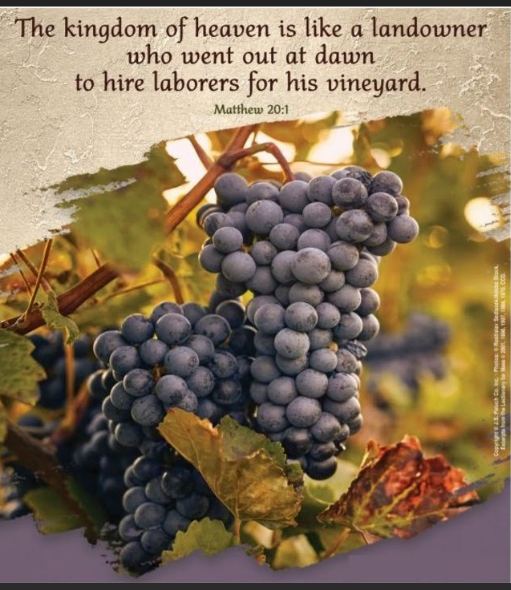
If we turn to the Gospel today, we find Jesus comparing the kingdom of heaven to a householder who went out early in the morning to hire laborer’s for his vineyard.
It is important to bear in mind that this parable, like all the parables we find in the gospels, is not a literal representation of the kingdom of heaven. God can be compared to a householder with a vineyard, but unlike the householder, he has no need of laborers, nor even need to plant and cultivate a vineyard.
The vineyard here stands for Israel, and God had no need to plant and tend Israel in order to provide salvation to all peoples. He had no need to plant or tend any instrument for our salvation. Unlike the householder, God does not hire laborers because he needs their help to cultivate his vineyard. Rather, in love, he wants all individuals to enter his vineyard and thus to receive the reward of eternal life.
The hiring of the laborer’s in the parable is itself a gift. Moreover, once the laborer has been hired, God does not require them to work in his vineyard. Rather, he invites them to share his mission of salvation.
This again is a gift, and although the gift can often be a difficult one for us to accept, especially for those ‘who have borne the burden of the day and the scorching heat’, it is a gift fitting to the dignity of the human person, who was created to ‘fill the earth and subdue it'(Gen 1:28). Through the gift of planting, tending and inviting us to labor in his vineyard, God establishes a relationship of love with us, which acknowledges our inherent worth as human beings and goes beyond this in providing us with a share in his own life.
One of the dangers in our lives as Christians is that we forget that our invitation to labor in God’s vineyard is a gift. This is the danger that the householder and his vineyard illustrate.
Jesus is reminding us that every gift comes from the generosity of his Father, and it is not for us to put any restrictions on this generosity. For while human gifts are often things we expect, even where we don’t take them for granted, the Father’s divine gift in giving us his Son is greater than anything we could expect or imagine.
 The Order of Preachers, Independent
You must be logged in to post a comment.