
Seeing Jesus~The Rev Frank Bellino, OPI
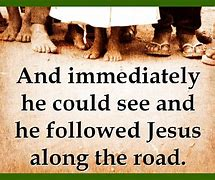
This Sunday’s Gospel passage tells us of the physical healing of a blind man. The gift of sight. Yet it also sets out for us a journey of insight which the man undergoes as he comes into contact with Christ and which leads not just to his being healed of a bodily handicap, but to his becoming a full disciple of Christ, to his following Jesus ‘on the way,’ that ancient phrase for being a Christian. It is as a story of insight that the man born blind becomes a model for all of us as we look to understand what it means for us to be ‘on the way’ to and with Christ.
We see this journey of insight unfold in the different names the blind man uses for Christ, as he calls on Christ with ever increasing determination and as he becomes known to Christ.
At the beginning, the blind man is named Bar Timaeus. Not just a blind man, but someone known. Although Bar Timaeus was known to the early Church as a disciple of Christ, one of the Church’s own members.
At the beginning of the Gospel story, he is just a blind beggar on the roadside from Jericho to Jerusalem. A man who hears that Jesus of Nazareth, the famous healer, is passing by. Now, it is his own chance to get his own physical sight back.
What he cries out is, ‘Jesus son of David, have mercy on me.’ What does he mean? Is it just an honorable title, a way to get attention, or does he recognize Jesus as the Messiah? At least, when others around him try to shut him up, he keeps on ever more loudly and insistently, ‘Jesus, Son of David, have mercy on me.’
The blind beggar has the words of recognition, but if he is aware of their significance, it is another thing. He wants the gift of sight, but at the same time, he is also on the way to understand who the Jesus of Nazareth truly is, but how far he is away from this situation is uncertain. It is at this point that the blind man encounters Christ. He has received Christ’s attention, and, in his enthusiasm, the blind man casts off his cloak and rushes to where Jesus is.
When Christ asks him what he wishes to do for him, the blind man changes the way he addresses Christ. No longer, ‘Son of David, but ‘Master’ – a more intimate and committed term, a term no longer of distant recognition, but of one who confesses himself to be a disciple. In fact, the English of the RSV does not do full justice to the significance of the term being used, for the Greek text preserves the Aramaic ‘Rabbuni,’ ‘My master, my rabbi,’ the same term preserved in encounter between Mary Magdalene and the Risen Christ. ‘My master,’ the one to whom I come to for teaching and insight, the one in whom I have placed my trust and love.
The blind man has shifted to a greater recognition of who the Jesus of Nazareth is. How much he understands the term he is using at this point, again we do not know. He is using the term and is right to do so. Certainly, some changes, some deepening in his understanding of Christ, have occurred. When Christ asks him what he wants, even though he clearly still wants physical sight, he begins to prove that he is open to the gift of insight.
And, thus, when the passage ends, as the man is healed and sees again, he also comes to have the insight that Christ is more than just the miracle worker, more than someone who meets his immediate physical needs, that Christ is the master from whom he wants to know and experience the truth about human life and flourishing. Not to go on his own way, but to follow Christ on Christ’s way, the way of discipleship. The blind man has become the Bar Timaeus of the Church, one who in his encounter with Christ and in his own enthusiastic response to Christ has also to be recognized himself as more than a blind beggar, and as a human being with a distinct identity and value in the sight of God and his fellow human beings.
This journey of insight Bar Timaeus is a model for us. In our own encounter with Christ, we also embark on a journey of increasing recognition of who Christ is and a corresponding purification of our desires. As with Bar Timaeus, it is only when we make demands on Christ and come closer to him and he to us that we discover ourselves confronted with the question of who we truly believe Christ is and what we do desire Christ to do for us. Are we using titles for him without any real grasp of their significance? Or, is Christ the one who teaches us about the proper meaning and reality of human life – and who offers the realization of it.
When we make demands of Christ and as we ask these question, our ideas about him and desires are challenged and purified, as Christ becomes more than a figure of the past or of ancient texts or religious traditions, and becomes, ‘My master.’ And it is at that point that we ourselves start to follow him on ‘his way,’ not ‘our own way.’
 The Order of Preachers, Independent
You must be logged in to post a comment.