
What’s the Price?~The Rev. Frank Bellino,OPI
It is possible to win all the battles and yet in a certain manner, the war will be lost. I have come to see this, but it has been a long time. I recall being a teenager, causing a family feud because I wanted to watch a film that no one else wanted to see. I got my way, and I enjoyed the movie, but did I? However, even in the absence of a loving family, there was a price to pay, the aftermath of a small family dispute. Was it worth it? The movie was excellent, but I can barely recall it now. Memories of the dispute remain much stronger. Like many trivial battles, when one is caught in the midst of it, it appears to be so important. Once one takes a step back, the victory appears to be very small.
It is easy to think of dominant individuals as victorious. They get what they want pretty much all the time. Lives are carefully constructed for personal comfort. However, this lacks the amount that usually must be paid. The price is love, whether it is the ability to love or the condition of being loved. People tend to avoid those who always insist on their way; family members visit out of a sense of obligation. Even if cherished, there is not the same trust, the same desire to be in their company, who would have been otherwise. That is a loss, a serious loss. It is a loss that is often not recognized. Haven’t they got everything they want? However, it is possible to win all the battles and yet lose the war. Despite all the victories, victories that occur in the end of the day rarely exceed much.
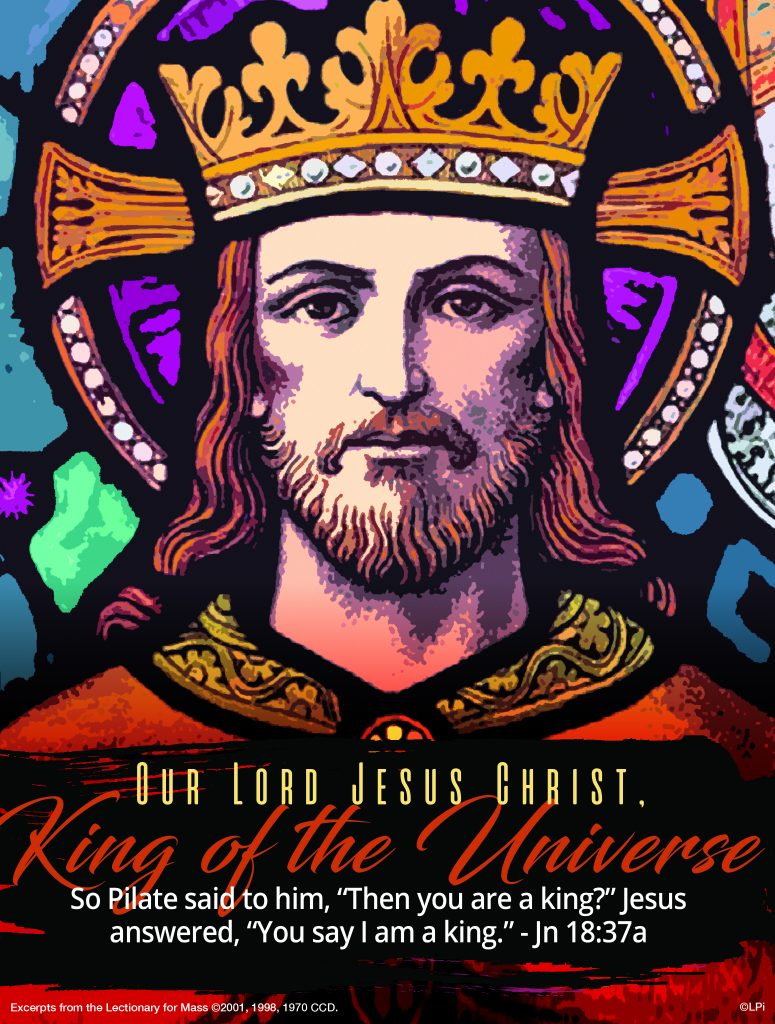
In the meeting of Pilate and Jesus, we meet the representative of Imperial Rome with Christ the Universal King. To convey Christ as Universal King is, among other things, to be reminded that while there is a kind of kingship that is built on power and domination, the true kingship, that of Christ, is not like that. However, if we understand that it can be difficult to understand as a cliché and do not convey the profound truth at its center.
A good way to enter the mystery of the Kingship of Christ is to observe as best we can on the nature of power as it works in reality. Think about our own lives, or, more dramatically, about the lives of some of the important figures of history. Did their splendor or admiration show them really provide genuine peace or happiness? Is it more an attempt to calm down without never-ending desires? To ask questions like these is not to adopt a plan to make us feel more confident about our meagre state. It is to ask challenging questions about what is essential to us, where our priorities should be, and what it is to be truly human.
The Feast of Christ as Universal King is, among other things, a reminder of a profound truth about our lives, about where true happiness is to be found and where it is not to be found. When Christ asserts that his kingdom is not of this world, he is not only telling us that to put our trust in power and domination is emptiness and folly, but also providing us with an alternative. The alternative is love. That may sound stale, and it can be presented as stale, but nothing could be further from the truth.
This is something that is not always easy to see. It can be much easier to acknowledge the Kingship of Christ in our daily lives than deep in our hearts. I believe most of us are like that at times, if we’re honest about it.
When we take a step back from our lives, when we reflect and pray, is there a deep understanding of where true happiness is to be found and where it is not to be found? It may be a sense that the daily grind of life may try to drown, that we may even try to extinguish, but it is a sense that refuses to go away. It refuses to go away because it reveals a profound understanding of God’s plan for us. We may not always perceive it, but if we reflect on what true victory and power really are, as revealed in the loving Kingship of Christ, we can see that there is a kind of victory that makes such complete sense that we might well wonder why we so often fail to see it.
 The Order of Preachers, Independent
You must be logged in to post a comment.