
Joy!~The Rev. Frank Bellino, OPI
What kind of things do you enjoy? Everyone will have things that come to mind in answer to that question, but I suspect for most of us they will be experiences of some kind or other which make us feel good, from playing sport to reading books to seeing our family happily spending time together. That is the primary meaning of enjoyment, and it’s not surprising that those are the kinds of answers we give. It’s what makes some of the other senses of ‘enjoyment’ sound a bit strange. After all, we can talk about enjoying good health, or even enjoying someone’s 50th Wedding Anniversary, where it’s clear we’re not talking about an emotional response to pleasant experiences.
We wouldn’t describe our attitude to the second situation as one of joy – perhaps quiet contentment at best – but then, maybe that’s because, in the grand scheme of things, we have not lived the trials and the joys and disappointments in a long marriage. What these different senses of enjoyment can provide us with, however, is that the meaning of joy is connected to our response to something good that is present.
Thus, in today’s first reading, Zephaniah calls on the daughter of Zion to shout for joy because ‘the Lord, the king of Israel, is in your midst’ (Zeph 3:15). It is the news of God’s present amongst his people that is to be for them the source of joy. In the responsorial “psalm” too (in fact, a passage from the prophet Isaiah), the people of Zion are to ‘sing and shout for joy, for great in your midst is the Holy One of Israel’ (Is 12:6).
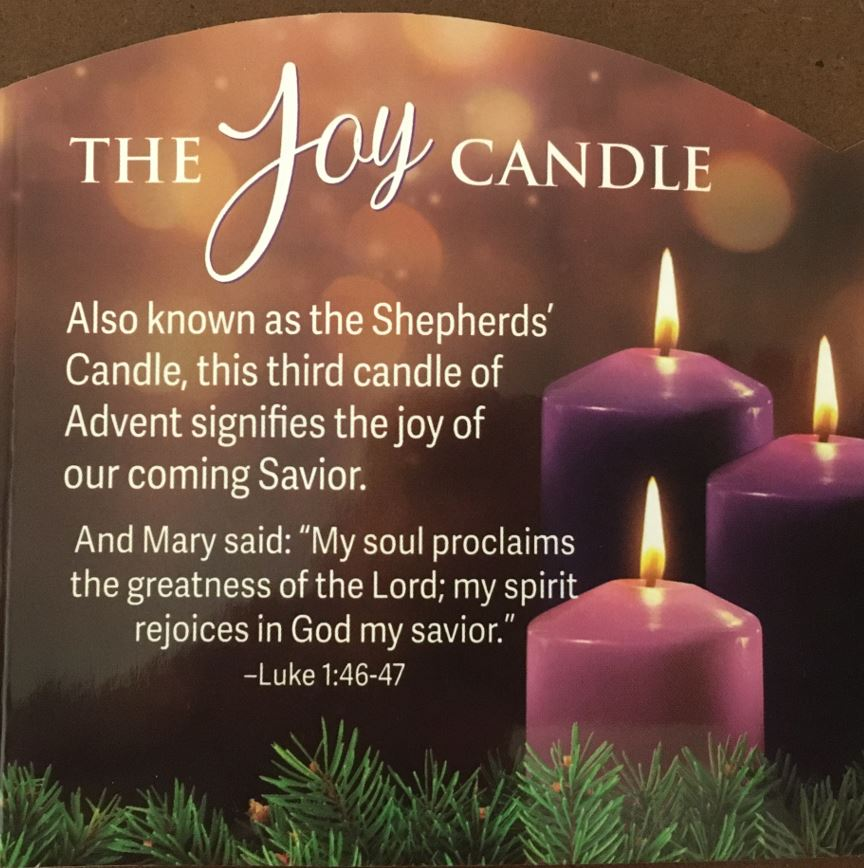
The question that springs to mind is why joy at God’s presence should be the theme of the liturgy of this Third Sunday of Advent, or Gaudete (‘Rejoice’) Sunday, as it’s known. Of course, from the perspective of 2024 we know that the Incarnation, God’s coming to dwell among us, is something that has already happened, but isn’t Advent meant to be a time of anticipation, of learning that longing for the Messiah before we get to celebrate the fulfilment of that longing at Christmas? Wouldn’t hope – our attitude to a good which we do not yet enjoy – be a more obvious theme for this season?
A first answer might be that these passages of Scripture speaking of joy at God’s presence among his people are both from the Old Testament. In the case of Isaiah, the words form part of a prophecy: they are what the people ‘will say in that day’ (Is 12:3) when the shoot comes forth from the stock of Jesse (cf. Is 11:1). The words of Zephaniah come amid his prophecy of the day of the Lord. As we prepare to celebrate that day when the Word of God took flesh and dwelt amongst us, we call to mind the joy which the prophets foretold with anticipation as the response of God’s people to his coming to redeem them.
More than simply preparing us for Christmas, though, Advent also reminds us of the in-between situation we find ourselves in, after Christ’s first coming but awaiting his second coming, redeemed by his saving Incarnation, Death and Resurrection, but awaiting the full working out of all that that entails for humanity and for the whole of creation. We rejoice at his presence in the Sacraments and in the Holy Spirit given to the Church, even as we wait and hope to hear those words, ‘well done, good and faithful servant … enter into the joy of your master’ (Mt 25:21). In the reading we heard from St Paul’s letter to the Philippians, he instructs them always to rejoice even as he reminds them the Lord is at hand (Phil 4:4,5). It is what God has already given to us, what already now we can rejoice in, that enables us to prepare with hope for that day on which, as St John the Baptist’s words in the Gospel remind us, he will ‘gather the wheat into his barn; but the chaff he will burn in a fire that will never go out’ (Lk 3:17).
On this Sunday, when the priest’s rose-colored vestments mix the darkness of penitential purple with festive white, that color expresses the joy which is already ours even as we still recognize the struggles and fears of this life in anticipation of that fullness of joy which God’s coming among us teaches to await ‘with blessed hope’ (Titus 2:13).
 The Order of Preachers, Independent
You must be logged in to post a comment.