
My Lord and My God~The Rev Frank Bellino,OPI
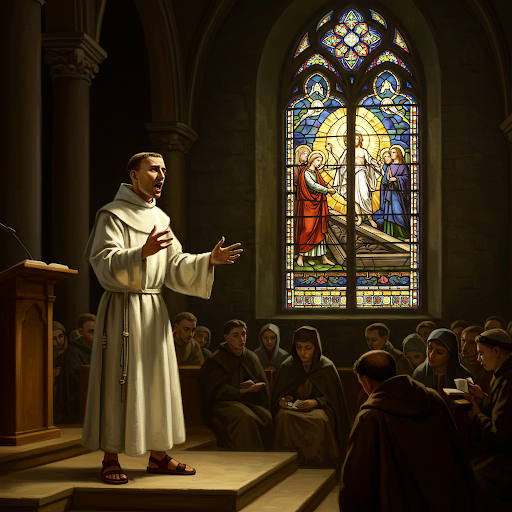
My dear brothers and sisters in Christ, grace and peace be with you on this glorious Second Sunday of Easter, a day we have come to know and love as Divine Mercy Sunday.
Today, as we gather in the radiant light of the Resurrection, our Gospel reading from John (20:19-31) draws us back to those pivotal first days after Christ’s triumph over death. As Dominicans, we are called to contemplate the Truth and to share it with you, and this passage is overflowing with truths that speak directly to our hearts, especially on this day dedicated to God’s boundless mercy.
Imagine, if you will, the scene in the Upper Room on that first Easter night. The Apostles, the very men chosen by Christ to be the pillars of His Church, are huddled together, their hearts gripped by fear. The shadow of Good Friday still looms large. Their Lord, their hope, had been brutally crucified. Now, whispers and rumors of an empty tomb, of fleeting appearances, must have filled them with a mixture of confusion and trepidation. They were likely wrestling with their own failures – the flight, the denial – a heavy burden of guilt weighing upon them.
And then, in the midst of their fear and uncertainty, Jesus appears. He stands among them, and His first words are a balm to their wounded souls: “Peace be with you” – Shalom. But this is no mere greeting, my brothers and sisters. This is the peace that only Christ can give, a peace born of profound reconciliation, a settling of the ultimate debt, the forgiveness of sins won through His sacrifice. This is the dawn of a new era, and He, the risen Lord, is entrusting its beginnings to these very men who had faltered.
And what does He do next? He breathes on them and says, “Receive the Holy Spirit. If you forgive the sins of any, they are forgiven then; if you retain the sins of any, they are retained.” In these powerful words, the Church has long recognized the institution of the Sacrament of Confession, the very sacrament through which we, even today, can encounter that same reconciling and merciful peace offered by the risen Christ. It is a tangible way for us to experience the forgiveness that flows from His wounded side.
But the story doesn’t end there. John then introduces us to Thomas, who was absent during this first encounter. Thomas, a man of honesty and perhaps a touch of stubbornness, voices his doubt with stark clarity. He needs physical proof. He needs to touch the wounds. His skepticism, while seemingly a challenge to faith, also underscores the reality of the Resurrection. This was not a ghost; this was the same Jesus, bearing the marks of His suffering, now gloriously alive.
And so, the Lord, in His infinite patience and mercy, appears again eight days later, on that first Sunday after the Resurrection – the very day we now celebrate as Divine Mercy Sunday. The doors are open, and Thomas is present. Jesus directly addresses his doubt, inviting him to touch His wounds. And in that moment, Thomas’ heart is transformed. His doubt gives way to a powerful profession of faith: “My Lord and my God!”
This exclamation, “My Lord and my God!” is the very heart of Easter faith. It is the recognition of Jesus not just as a man, but as the divine Son of God, the victor over sin and death. And Jesus’ gentle words to Thomas, “Have you believed because you have seen me? Blessed are those who have not seen and yet have believed,” speak directly to us, to the countless generations who have come to faith not through direct encounter, but through the witness of the Apostles, the Church, and the power of the Holy Spirit.
My dear St. Michael’s family, this Gospel is a profound testament to the divine mercy that flows from the heart of the risen Christ. Just as He met the fearful and doubting Apostles in the Upper Room, He meets us in our own moments of fear, doubt, and guilt. Through the Sacrament of Reconciliation, He offers us that same peace, that same forgiveness, that same new beginning.
Thomas’ journey reminds us that it is okay to question, to seek understanding. But ultimately, faith is a gift, a grace that allows us to believe even when we cannot see. And Jesus’ words to those who believe without seeing are a powerful encouragement to us all.
On this Divine Mercy Sunday, let us open our hearts to the boundless mercy of God, a mercy that reached its zenith on the Cross and burst forth in the glory of the Resurrection. Let us embrace the peace that Christ offers, a peace that reconciles and restores. And let us, like Thomas, proclaim with unwavering faith: “My Lord and my God!”
May the mercy of our Risen Lord Jesus Christ fill your hearts and guide you always. Amen.
 The Order of Preachers, Independent
You must be logged in to post a comment.