
Gratitude~The Rev Frank Bellino,OPI
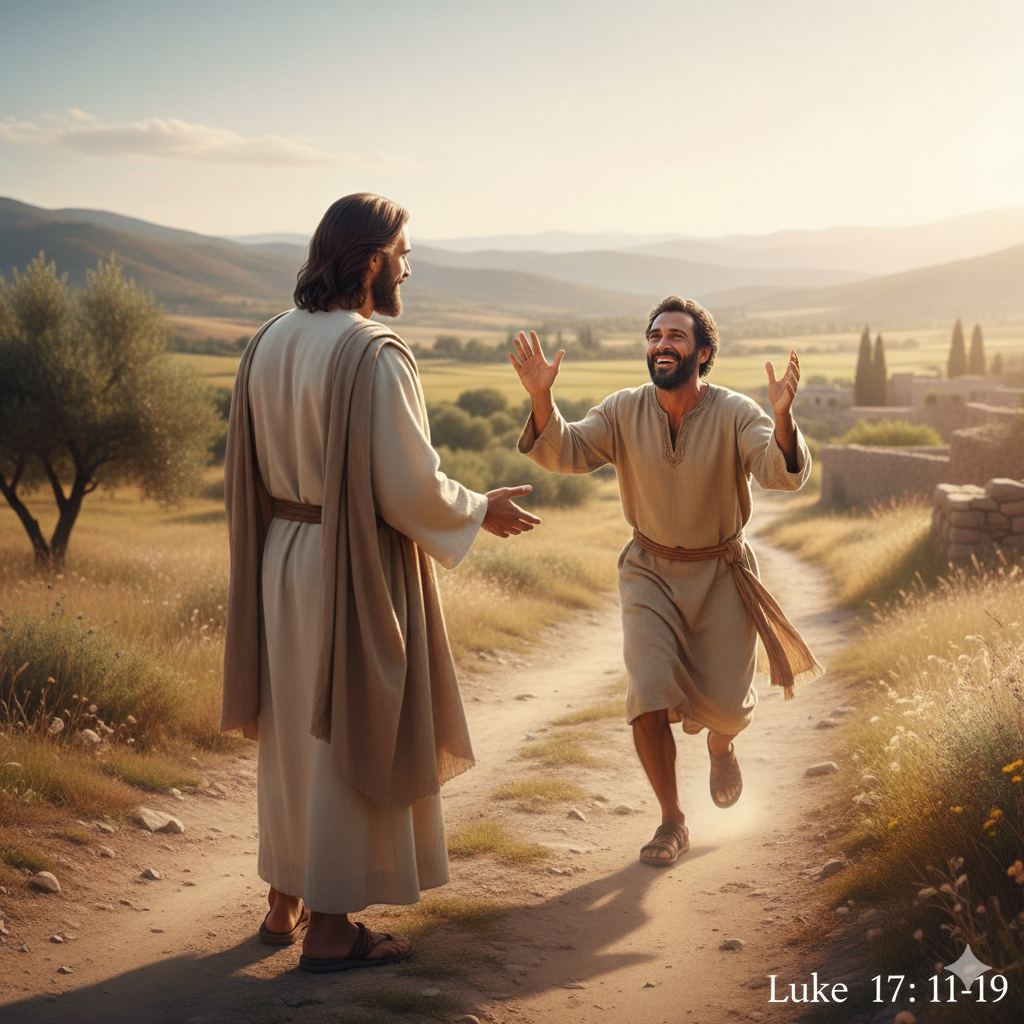
My brothers and sisters in Christ, we hear today a familiar story—the healing of the ten lepers. A quick reading might tempt us to see this as a simple lesson in good manners: nine men were rude, and one was polite. But this Gospel, proclaimed today as we journey through Ordinary Time, is far more than an etiquette lesson. It is a profound instruction on what it means to be saved.
The Cry for Mercy
The story begins with ten men—Jew and Samaritan, united only by their tragic isolation. They are lepers, standing apart, forced by law and disease to shout their misery. Their shared cry is simple and desperate: “Jesus, Master! Have pity on us!” They are the living embodiment of our own spiritual condition. Like them, we stand at a distance, afflicted by the contagion of sin, separated from God and one another.
Jesus’s response is immediate, but it requires an act of faith. He tells them, “Go show yourselves to the priests.” The healing is not instantaneous. They are asked to obey, to walk toward the required ritual, while still diseased. It is only as they went that they were cleansed. Their healing was a gift, given not because of their perfect understanding, but because of their active obedience in faith.
The Missing Nine vs. The Returning One
All ten received the miracle; all ten had their lives restored. But only one stopped short of his destination—the priest—and turned back. And who was this one? St. Luke, ever mindful of the outcast, tells us: He was a Samaritan, a social, religious, and political enemy of the other nine.
The nine, understandably, rushed toward the re-entry—to family, to home, to work, to society. They got the gift, and they ran off to enjoy it. They received the physical blessing. But their hurry, their spiritual amnesia, caused them to miss the Giver in favor of the gift.
The Samaritan, the “foreigner,” does something different. He returns, glorifying God in a loud voice, and falls prostrate at Jesus’s feet, giving thanks. This is not mere gratitude; this is worship.
And here is the crucial moment, the point of the whole passage: Jesus asks, “Ten were cleansed, were not? Where are the other nine? Has none but this foreigner returned to give thanks to God?” Then, to the Samaritan, He says, “Stand up and go; your faith has saved you.”
Gratitude as True Salvation
My friends, the nine were healed; the one was saved.
The Greek word Jesus uses for the Samaritan’s action is related to Eucharist—the very act of thanksgiving we celebrate right now. It is the recognition that gratitude is the highest form of faith.
In our world today, we are often like the nine. We are consumers of grace. We pray in distress, God answers with a blessing—health, a job, safety, the forgiveness of sin—and we race off to enjoy the restored life. We treat God like an ATM: we make a withdrawal when we need it, and then we forget the Source.
This Gospel calls us to be the Samaritan. It calls us to the counter-cultural, transformative act of intentional gratitude in an age of entitlement.
When you rush through your morning, do you pause to acknowledge the gift of the new day?
When a prayer is answered, do you take the time to return to the altar, in prayer and deed, to glorify the Giver?
When you look at your life, do you recognize that everything—your breath, your talent, your very existence—is an unearned grace?
The Samaritan was saved because his gratitude was a posture of the soul. It was his complete acknowledgment of dependence on Jesus, which deepened his relationship with God far more than his physical cleansing.
Furthermore, his identity as a foreigner reminds us that true faith is often found on the margins. We must look for Christ in the places we least expect—in the faces of the poor, the marginalized, and those whom society, or even our own prejudices, would label as “outsiders.”
So let us, as we approach the altar to receive the Eucharist—the ultimate act of thanksgiving—resolve to return to the Lord not just in moments of petition, but in a lifelong act of radical, humble gratitude. May our faith be the faith of thanksgiving, so that we too may hear Christ’s voice saying, “Go; your faith has saved you.” Amen.
 The Order of Preachers, Independent
You must be logged in to post a comment.