
The Power of Persistent Prayer~The Rev Frank Bellino,OPI
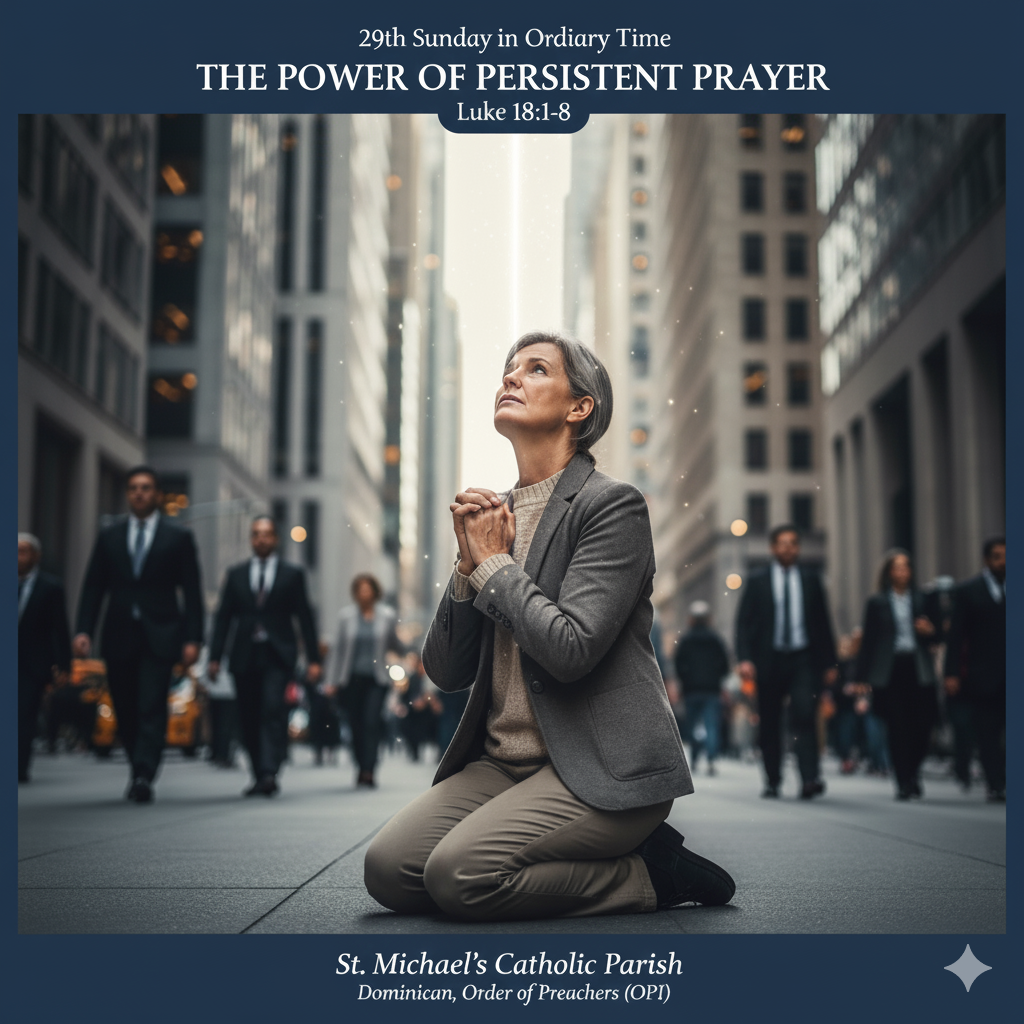
Today, the 29th Sunday in Ordinary Time, we gather to hear the Word of the Lord, and it is a powerful word—one that challenges our habits and refocuses our hope. We turn to the Gospel of Luke, chapter 18, the Parable of the Persistent Widow and the Unjust Judge.
But before we dive into this reading, let us pause for just a moment. This past Saturday, October 18th, was the Feast Day of the great Evangelist, St. Luke himself—the very man whose meticulous pen gifted us this powerful parable and the entire Gospel we are meditating upon throughout this year.
Recalling the Evangelist: St. Luke
St. Luke, the “beloved physician” and a companion of St. Paul, was more than just a careful historian; he was the Evangelist of Mercy. He is the one who took pains to gather the stories that reveal the deep compassion of Jesus: the story of the Good Samaritan, the overflowing joy of the father welcoming the Prodigal Son, and, significantly, the many places where Jesus lifts the forgotten and the marginalized, especially women. It is from Luke that we receive the Magnificat—Mary’s great song of justice that proclaims how God “has cast down the mighty from their thrones and lifted up the lowly.” St. Luke’s life of loyalty to St. Paul and his passion for recording the truth of God’s mercy is, in itself, a perfect model of the perseverance Jesus calls for today.
The Gospel: Luke 18:1-8 and the Dominican Call
Jesus introduces this parable with an unmistakable intention: He “told his disciples a parable about the necessity for them to pray always without becoming weary.”
The parable presents us with a harsh contrast. On one side is a judge who “neither feared God nor respected any human being.” On the other is a widower figure in the ancient world who was utterly powerless, vulnerable, and alone. Her only defense, her only strength, was her persistence. She kept coming to the judge, day after day, demanding justice against her adversary.
The unjust judge finally caves, not because his heart changes, but because he says, “Because this widow keeps bothering me I shall deliver a just decision for her lest she finally come and strike me.” He acts out of sheer, weary self-interest.
And here is the pivot, the heart of the message: If this corrupt, selfish judge grants justice because of sheer persistence, will not God—who is infinitely good and utterly just—secure the rights of his chosen ones who cry out to him day and night?
For us, the family of Saint Dominic, the Order of Preachers (OPI), this Gospel calls us to embody our four pillars in two immediate, profound ways:
1. Our Response to the Gospel: Persistent Prayer
This parable is an urgent call for us to live the Dominican vow of Prayer. It is a command to be contemplatives in our busy world, to talk to God not just in moments of panic, but in a sustained, daily relationship.
If you have grown tired, discouraged, or feel that your prayers go unanswered, Jesus gives you the widow as your model. God’s answer may be delayed—not because He is weary of us, but because our spiritual growth, and the working of His will in a fallen world, takes time. Our persistence is not meant to change God’s mind; it is meant to change our own heart, transforming our superficial desires into an unshakeable trust in His perfect will and perfect timing.
2. Our Response to the Gospel: Justice in the World
The widow was crying out for justice. Her prayer was not about comfort, but about correcting a profound wrong. This connects our persistent prayer directly to the Dominican mission of Preaching the Truth and establishing justice.
We, who are so blessed by God, are called to be advocates for those in our community who feel forgotten, powerless, and denied their due—the modern-day “widows.” We cannot pray persistently for justice in our personal lives while ignoring the cries of the poor, the marginalized, and the oppressed in our community and in our world. Our contemplation must bear fruit in a commitment to social action, to being the voice that persistently challenges the “unjust judges” of our time—those systems and prejudices that diminish the dignity of human life.
We must pray, and pray, and pray again—for our family, for our community, and for the conversion of the world, knowing that our God will see that justice is done for His chosen ones speedily.
The Final Challenge
Jesus concludes with a profound, almost frightening question: “But when the Son of Man comes, will he find faith on earth?”
This is the ultimate challenge of the parable. Will the pressures of the world—the delays, the discouragements, the weariness—cause our faith to evaporate? Or will we be like the persistent widow? Will we, in our constant, tireless cry for God’s justice, demonstrate that the answer to His question is a resounding, confident Yes, Lord, You will find faith on earth!
Let us leave this place today with the conviction to be tireless in our prayer and relentless in our pursuit of justice, embodying the spirit of St. Luke and the heart of the Gospel.
Amen.
 The Order of Preachers, Independent
You must be logged in to post a comment.