
The Discipline of Dust~The Rev Frank Bellino,OPI
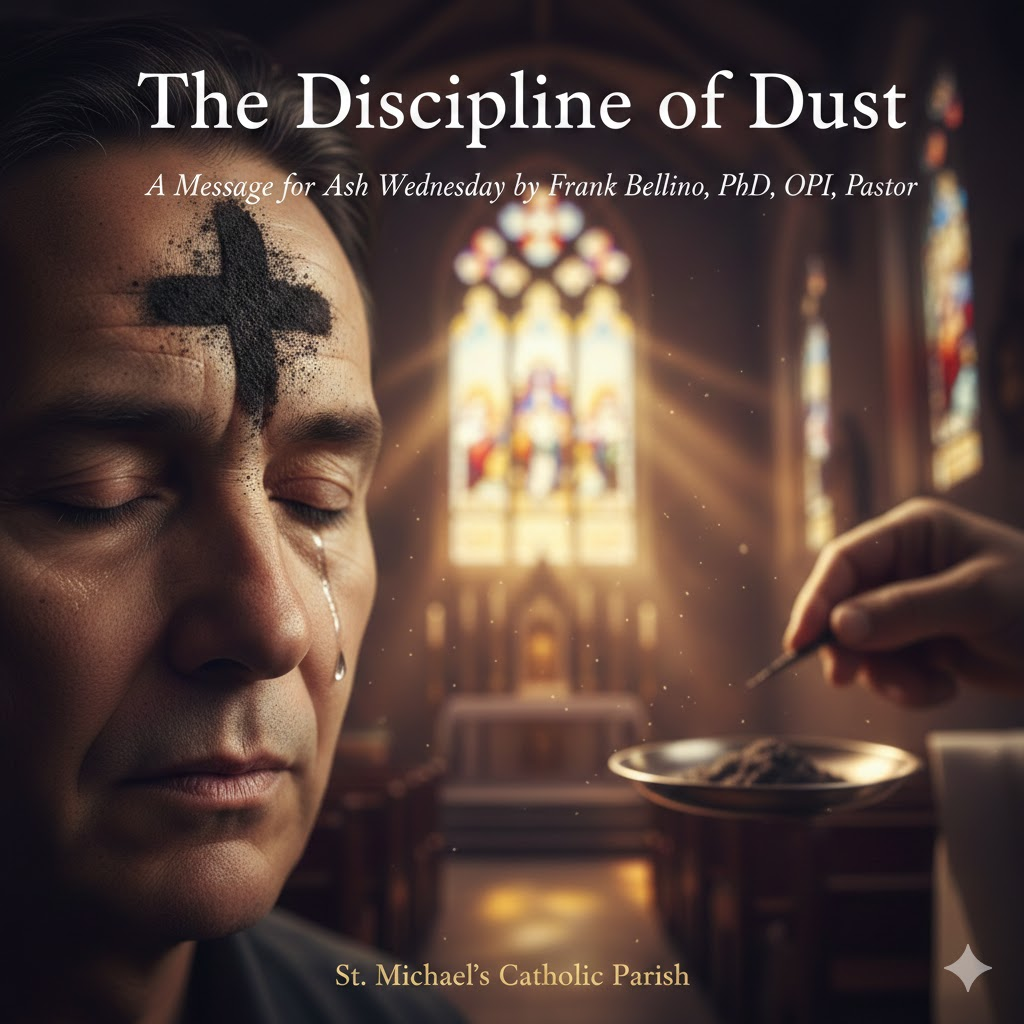
For over a thousand years, the Church has gathered on this day to perform a ritual that
the modern world often finds jarring. We take the remains of last year’s victory—the
palms of Palm Sunday—and we burn them into a gray, lifeless powder. In the ancient
world, to “sit in sackcloth and ashes” was the ultimate sign of a soul stripped bare; it
was the mark of the exile and the public penitent. As we begin this holy season,
we must realize that the Prophet Joel’s ancient call to “blow the trumpet in
Zion” is not a call to celebration, but a declaration of a spiritual emergency. These ashes
are the “uniform” of those who recognize that the world is broken, and more importantly,
that we are part of that brokenness.
The theological heart of this day lies in the uncompromising command: Memento
Mori—”Remember that you are dust, and to dust you shall return.” This is the “Law of
the Garden” from the Book of Genesis. It serves as a stark reminder that despite our
ranks, our titles, or our years of service, we are contingent beings who do not own our
next breath. Ash Wednesday is the Great Equalizer of the liturgical year. Whether you
are a student, a retiree, a first responder, or a priest, we all receive the same smudge of
dust. It is a necessary confrontation with our mortality, intended to strip away the illusion
that we are the masters of our own destiny. We are creatures in desperate need of a
Creator, and we have forty days to re-align our lives with that reality.
The Prophet Joel challenges us to “rend your hearts, not your garments.” In the Hebrew
tradition, tearing one’s clothes was a sign of extreme grief, but God sees through the
theater of outward signs. He is looking for a strategic rupture in the soul—a deep,
internal surrender. A “strong” Lent is not defined by the quantity of our sacrifices, but by
the quality of our conversion. We fast to prove to our bodies that our souls are in
charge; we pray to prove to our egos that God is in charge; and we give alms to prove
to our hearts that we do not own the world. This is why we commit to forty days—the
biblical timeframe required for the “old man” to die so that the “new man” can be born.
As we embark on this campaign of Christian service, let us not wear these ashes as a
badge of holiness, but as a confession of our need. History teaches us that those who
forget they are dust eventually attempt to act like gods, a path that always leads to ruin.
I invite the community of the Unified Old Catholic Church to enter this season with
discipline and clear eyes. The orders for the journey ahead are simple yet profound:
Repent, believe in the Gospel, and remember who you truly are in the eyes of God. The
campaign has begun.
 The Order of Preachers, Independent
You must be logged in to post a comment.