
Mountains, Valleys, and Light~The Rev Frank Bellino,OPI
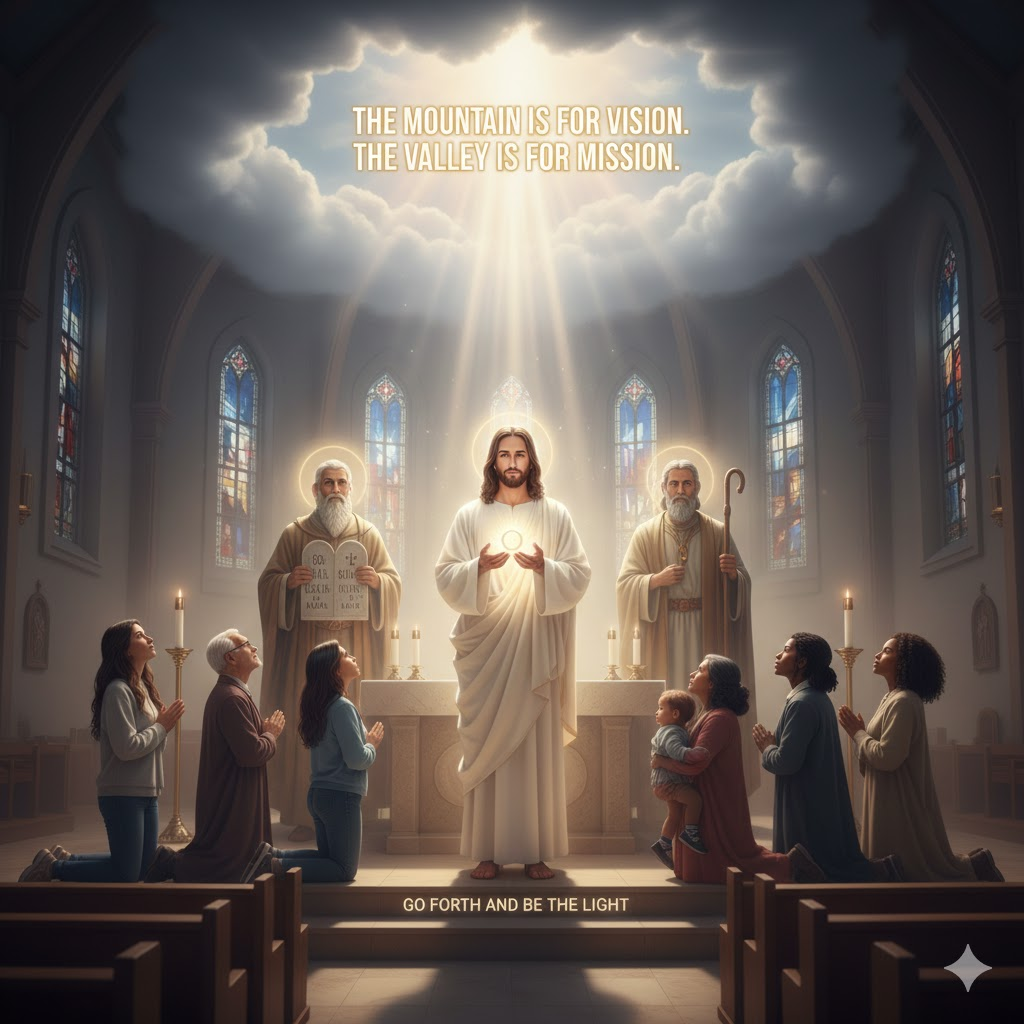
As we ascend the spiritual slopes of this Second Sunday of Lent, we encounter the Transfiguration—a moment where the Veritas we seek in our Dominican study ceases to be an abstract concept and becomes a visible, blinding reality. We immediately face the striking selectivity of this event: why did Jesus leave the nine at the base of the mountain and bring only Peter, James, and his brother John? In a modern culture obsessed with a hollow version of “inclusion” that demands everyone get a participation trophy, the economy of Grace works with a more rugged logic. Jesus chose these three not for their comfort, but for their coming trials. He brought this “Inner Circle” to the summit because they were the leaders destined to carry the heaviest burdens of the infant Church; they were being given a “preventative grace,” a spiritual anchor to hold them steady when the sky would eventually turn black over Calvary. To those of you today who feel you are being tested more than your neighbor—who feel the weight of leadership in your families, your careers, or your community—we must realize that the Lord often allows a deeper “Tabor moment” precisely for those He knows must endure the greatest weight of the Cross. This vision was not a reward for their status, but a necessary foundation for their survival in a world that was about to try and break them.
This encounter with the Divine, however, was not one of easy consolation, as evidenced by the disciples falling prostrate in terror. This is the Timor Domini—the Fear of the Lord—which serves as a vital correction to a 21st-century world that tries to domesticate the Divine, reducing God to a “life coach,” a cosmic vending machine, or a convenient political ally. They were afraid because the “Raw Truth” of our Dominican tradition is naturally overwhelming to the human ego; to stand in the presence of the Transfigured Christ is to realize with jarring clarity that we are not the center of the universe. In an age where the “self” is marketed as the ultimate authority, this fear is a healthy reality check. Yet it is in this very moment of holy dread that we see the essence of the Gospel: Jesus reaches out to touch them, saying, “Rise, and do not be afraid.” At St. Michael’s, we do not worship a distant, cold light, but a Majesty that reaches into the dust of our human frailty to lift us up. This balance of awe and intimacy is exactly what our modern world lacks—we have replaced the awe of God with the anxiety of the world. We must rediscover the scale of God so that we can truly appreciate the radical humility of His touch in our daily lives.
This depth of experience leads to the often-confusing command of the “Messianic Secret,” where Jesus instructs them to remain silent until after the Resurrection. In our age of “instant sharing,” where we are tempted to post every spiritual impulse on social media before it has had ten minutes to settle in our hearts, Jesus’s command is a radical call to discipline. He understands that glory without the Cross is a dangerous delusion. If the disciples had descended the mountain preaching only of glowing garments and ancient prophets, they would have been peddling a “cheap grace” that skips the sacrifice of Friday, the kind of “feel-good” spirituality that collapses the moment real life gets hard. As Dominicans, we are bound by the principle of Contemplata Aliis Tradere—to contemplate and then hand on the fruits of that contemplation—and that requires the discipline of silence. We cannot truly speak of the Transfiguration until we have stood at the foot of the Cross, for the silence Jesus demands is the time required for Truth to mature in the soul. Our world is saturated with noise, yet our calling within the Unified Old Catholic Church is to a deeper, more disciplined quiet—one where the Word is digested before it is proclaimed to a world starving for something substantial.
Ultimately, the Transfiguration offers a blueprint for our lives between the mountain and the valley. We do not gather at the Altar to escape the world’s problems or to hide in a “religious bubble.” We come to the mountain of the Eucharist to be “re-visioned” by the light of Christ so that we may have the eyes to recognize His hidden, suffering presence in the poor, the marginalized, and the broken whom we encounter in the plain below. The mountain is for the vision, but the valley is for the mission. Like Abraham in our first reading, who was told to leave everything he knew and “Go forth,” we are called to move. we leave this sacred space today not merely with a memory of a miraculous light, but with the fortitude to face our own personal Fridays. We rise, we cast off our fear, and we walk back into our neighborhoods and our workplaces, certain that the light we witnessed on the mountain is a glory that the darkness of this 21st-century world can never, and will never, overcome.
 The Order of Preachers, Independent
You must be logged in to post a comment.