
Prayer Makes You Better; Surrender Makes You Holy~The Rev Frank Bellino,OPI
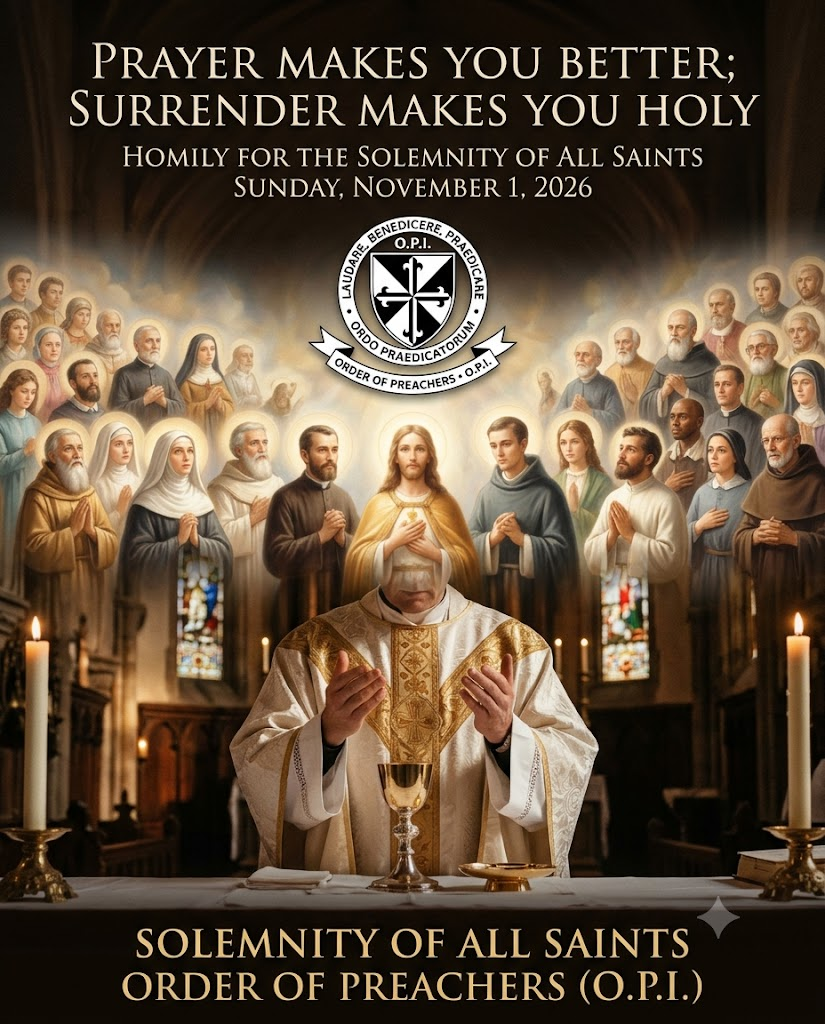
Prayer Makes You Better; Surrender Makes You Holy
When we hear the word saint, our minds almost immediately picture the stained-glass windows, marble statues, and historic icons of our tradition. We think of the towering figures whose names grace basilicas and the liturgical calendar—the great martyrs who faced down empires, the profound theologians whose writings shaped civilizations, and the mystics whose visions carried them beyond the veil of this world. Those men and women are genuine gifts to the Church but today is not simply an encore for the saints we already know by name. Today is Solemnity of All Saints. It is the feast of that vast, uncounted multitude Saint John beheld in the Book of Revelation: men and women from every nation, race, people, and tongue, clothed in white robes and holding palm branches before the throne of God.
Who is this multitude that no man could number? They are the quiet, faithful souls who never had a feast day established in their honor. They are the mothers and fathers who spent forty years getting up before dawn, sacrificing in silence so their families could know warmth, security, and the love of God. They are the honest men and women who gave a full day’s work for an honest wage and refused to cut ethical corners. They are the neighbors who sat in quiet hospital rooms holding the hands of the sick, the public servants and peace officers who stood in the gap when duty called, and the countless faithful who simply kept showing up, doing what was right when no one was watching. Today is their feast, and it is a reminder to each of us that holiness was never meant to be a rare museum piece—it is meant to be lived in the grit and reality of our everyday lives.
In our Dominican tradition, we return constantly to that sacred word: Veritas—Truth. Not truth as an intellectual theory or an abstract argument, but Truth made flesh in Jesus Christ. One of the greatest insights handed down to us by Saint Thomas Aquinas is that grace does not destroy our human nature; grace perfects it. God does not ask you to become someone else to make you holy. Holiness does not require you to erase your personality, deny your history, abandon your sense of humor, or pretend you don’t carry scars. Sanctity is what happens when the grace of God enters directly into who you are, meeting you right where your boots hit the ground, and redeeming your life from within. Saint John notes that the great multitude standing in white robes are those who came out of the “great distress.” They didn’t bypass the heartache, the grief, or the heavy trials of human existence; they simply allowed the mercy and grace of Christ to carry them through it.
Now, we must be honest about what holiness actually demands. We often fall into the trap of thinking that a dedicated spiritual life is merely about self-improvement. We come to church, we say our prayers, we read scripture, and we assume that because we feel a little more peaceful, we are on the express train to canonization. But let’s be very clear: prayer can make you a better person, but prayer alone does not make you a saint. Prayer can steady your temper, it can sharpen your moral compass, and it can bring peace to your mind. Those are good fruits. But becoming a saint isn’t about becoming a polished, polite, better version of yourself. Sanctity requires surrender. It requires dying to yourself, picking up your cross daily, and allowing Christ to take the wheel completely. The saints aren’t just people who had great prayer routines; they are the ones whose prayer drove them out into the world to be broken and poured out for others, even when it cost them everything.
That brings us directly to the Gospel we just heard proclaimed. When Christ ascends the mount and begins to teach, He does not hand down a set of self-help principles. He gives us the Beatitudes—a portrait of His own sacred heart, and the compass for ours. Look closely at what He blesses, because it turns everything our culture values completely upside down. The world preaches self-sufficiency, leverage, and climbing to the top at any cost; Christ says, “Blessed are the poor in spirit,” reminding us that our true freedom begins only when we admit how much we need God. The world constantly mistakes volume for strength and arrogance for leadership; Christ says, “Blessed are the meek,” because genuine meekness is not weakness—it is strength under control, power held entirely in service of others. The world thrives on division, outrage, and striking back; Christ calls the peacemakers blessed, knowing that true peacemaking requires real backbone. It means standing in the breach between divided hearts, speaking the truth with charity, and absorbing injury without passing the wound along to the next person.
Saint John writes to us with incredible tenderness in our second reading: “See what love the Father has bestowed on us that we may be called the children of God. Yet so we are.” We are not running this race alone, and we are not striving for holiness in isolation. There is no wall separating the Church on earth from the Church in heaven. When we gather at this altar, when bread and wine are consecrated and the veil between time and eternity grows thin, we do not stand here by ourselves. We worship alongside that entire great multitude. Every faithful soul who has run their race and gone before us with the sign of faith stands with us right now, cheering us on and lifting us up before the throne of God.
Tomorrow morning, you will walk back out into the world—back to your routines, your workplaces, your family duties, your daily aches, and your private worries. Do not leave the Gospel behind at the church door. Take heart from the countless saints known only to God who walked these same roads before you. Don’t just settle for being a good person with a disciplined prayer life; dare to let God transform you. Act with justice, walk with patience, stand firm in charity, and remember that holiness is found in doing the ordinary duties of your day with extraordinary love.
So I want to leave you with one direct question to take with you when you leave here today: What concrete action are you going to take this week that makes the road to heaven clearer—not just for yourself, but for someone God has placed in your life? None of us get to heaven alone. We are called to bring others along with us. Is there an apology you need to make to restore peace in your home? Is there a coworker who is sinking in despair whom you need to encourage with real kindness and truth? Is there someone in need whom you can quietly lift up without expecting anything in return? Real sanctity isn’t theoretical. It happens in the decisions we make in our living rooms, on the job, and across our kitchen tables. If you want to know what your path to heaven looks like this week, look at the person standing right in front of you and ask: “How can I reflect the mercy of Christ to them today?”


You must be logged in to post a comment.