
Category: Article
Feast of Saint James, Apostle ~ Br. Michael Marshall, Novice
Feast of Saint James, Apostle – July 25th
A boy who was in middle school showed sincere interest because he knew the fundamentals of the game and so his parents signed him up in a recreational soccer league. He was able to play the game better than the other boys who were on his team. While at practice he saw others having a hard time with fundamentals, such as dribbling the ball and how to head the ball with accuracy. Because he thought he was better than the other team members, he felt as if practice was a joke. Instead of assisting the coaches to help the rest of us learn the skills, he decided he was going to skip practice because he did not need to be there, and his dad agreed it was a waste of time.
When the kid showed up for the first game, he expected to be in the starting rotation and play a position in which he would have control of the ball most of the game. To his surprise, he was placed on the substitute list and never was put in the game. The team lost the game by a significant margin. When the game was over the kid’s dad gave one of the coaches an earful about why the “best player on the team” was not put in the game, and that the team would have won if his son had been in the game. The dad was disappointed that he could not see his son play, more than wanting to win the game, but he used that argument in defense of his son. The coach asked the boy’s dad if he knew what it meant to be a team player, but the boy’s dad retorted with the request that his son simply be in the next game, and evading the question. So the coach was bold enough to say that that being at practice is part of being on the team and required in order to play in the games, regardless of how good a player is.
We see the same desire from the mother of James and John when she approaches Jesus.
The mother of the sons of Zebedee approached Jesus with her sons
and did him homage, wishing to ask him for something.
He said to her,
“What do you wish?”
She answered him,
“Command that these two sons of mine sit,
one at your right and the other at your left, in your Kingdom.” (Matthew (20:20-21)
She wanted good things for her sons as followers of Jesus, and we read that James and John wanted the same. Yet Jesus states that it is not that simple; that just because they long to sit beside him in the Kingdom, it is not going to happen unless they accept the responsibility in order to do so.
Jesus said in reply,
“You do not know what you are asking.
Can you drink the chalice that I am going to drink?”
They said to him, “We can.”
He replied,
“My chalice you will indeed drink,
but to sit at my right and at my left, this is not mine to give
but is for those for whom it has been prepared by my Father.” (Matthew 20:22-23)
The dad of the boy sat down and had a talk about what the coach had said about being part of the team. The boy still felt it was not fair, and his dad asked him if he was really serious about playing, and if so, the needed to understand that the coach has the right to decide who plays and does not play; the reward of playing in the games results from being a team player, and not being a team player results in being benched. The following Scripture ties into this point.
But it shall not be so among you.
Rather, whoever wishes to be great among you shall be your servant;
whoever wishes to be first among you shall be your slave.
Just so, the Son of Man did not come to be served
but to serve and to give his life as a ransom for many.” (Matthew 20:26-28)
Now let’s apply this to ourselves… Are we so into ourselves to the point we claim to be followers of Jesus, yet we do not reach out to those in need? Are we being superior over others, and telling them we can do ministry better? Are we part of a Christian community? Essentially, are we like the boy who plays soccer for himself? If so, it’s time to change!

1+1+1+1=1???? ~ Br. Chip Noon, Novice
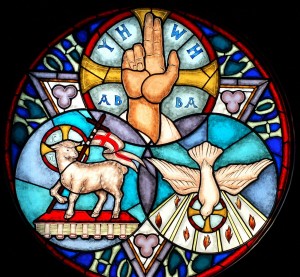
Holy, holy, holy! Lord God Almighty!
Early in the morning our song shall rise to thee.
Holy, holy, holy! Merciful and mighty,
God in three persons, blessed Trinity!
In the Baltimore Catechism, of ancient (and not so venerable) memory, I learned in Number 27:
- Q. What is the Blessed Trinity?
- The Blessed Trinity is one God in three Divine Persons.
I may have learned the words, and I knew I had to recite them, but this was one of the most difficult concepts for me…and for many others, as I have found out. How can there be three persons and still one person?
Unfortunately for those of us speaking English, “person” is not a proper translation from the Greek. This is not to say that the original Greek-speaking Christians were not also perplexed by the divinity and the humanity of Jesus.
Let me start again. There are two words in Greek that translate to “person”: prosopon and hypostasis. The first means the “self-manifestation of an individual” that can be extended by other means and the second means “being” or “substantive reality.” The early church fathers had as much trouble with the concepts as I do now. But the point is that we are not talking about three distinct human beings…
OK, let me start again. The philosopher Kierkegaard wrote that the dual nature of Christ is the “ultimate paradox.” God is perfectly wise, good, powerful who became fully human, tempted by sin, limited in goodness, knowledge, and understanding. This paradox, he believed, can only be resolved by a leap of faith, away from reason and understanding toward belief in God.
And so now, I will start for the fourth time. In the first reading, Moses is exhorting the Israelites to acknowledge that the Lord is God by reminding them of the manifestations that God performed to free them all from slavery in Egypt. In the Old Testament understanding, we are still relying on proof to come to the belief in one God. In the second reading, St. Paul is exhorting the Romans to recognize that as they received the Holy Spirit, they are then heirs of God and joint heirs with Christ. Not proof, but simply remembering and accepting the gift of the Spirit.
But here is where he throws in the kicker: “…if only we suffer with him so that we may also be glorified with him.”
In the early days of Christianity, to suffer was a real and present possibility. Today, some around the world still face this kind of physical suffering. But we, fortunate as we are, can only suffer with him in our prayer, our study, our life of preaching, our throwing aside proof and evidence; and through contemplation and proactive living accept in our minds, hearts, and souls the faith which we proclaim.
And Jesus said,
“All power in heaven and on earth has been given to me.
Go, therefore, and make disciples of all nations,
baptizing them in the name of the Father,
and of the Son, and of the Holy Spirit,
teaching them to observe all that I have commanded you.
And behold, I am with you always, until the end of the age.”
Ultimately, the Trinity is not about Greek words, theological concepts, metaphysical speculation, but about observing all that Jesus commanded – the heart of our salvation, and recognizing finally that he is with us always, until the end of the age.
Lord, as we celebrate the Solemnity of the Holy Trinity, may we enter into your peace with calm gratitude and joyful acceptance of your message, that we love you and we love our neighbors as ourselves. Help us in our faith and help us in our suffering to become one with you, your Son, and the Holy Spirit.
Amen.

Dust to Dust ~ Sr. Dollie Wilkinson, OPI
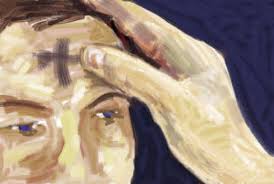
“‘Excuse me, you’ve got some dirt on your head.”
How many times have you heard this, and felt yourself heave a heavy sigh. But this simple question can serve as a catalyst for a very important discussion. So why exactly do we have this smudge on our foreheads?
Ash Wednesday begins Lent, a time when we stop and assess how we’re doing in our walk with God. Lent helps us identify spiritual areas in which we can grow and sinful areas that we need to avoid. To repent, put simply, means to turn away from sin and turn toward God. We use ashes as an outward expression of our need to begin again.
For over twelve hundred years on the dies cinerum (day of ashes) faithful followers have approached the altar and received ashes upon their foreheads. These ashes are made from the burnt palm fronds that were blessed on the Palm Sunday of the previous year. The ashes are sprinkled with holy water, usually fragranced with incense and blessed using four prayers that are thousands of years old. The use of ashes for repentance and penance can be traced even further back and is practiced throughout the world. On Ash Wednesday ashes are applied to believers’ foreheads in the shape of the cross.
So today we begin a 40 day period of wilderness wandering, 40 days because that’s how long Jesus was tempted in the wilderness. Even those in our society who have never really observed Lent know that it’s the time of year when pious people suffer and give things up not so God will be impressed with us, but to press upon ourselves the need for repentance and reform. As stated in this passage from the prophet Joel –
“Yet even now, says the Lord,
return to me with all your heart,
with fasting, with weeping, and with mourning;
rend your hearts and not your clothing.
return to the LORD, your God,
for he is gracious and merciful,
slow to anger, and abounding in steadfast love.
Amen.”
Seems to sum things up pretty well…..Fasting, Weeping, Mourning. For those of us who act like Lent is a competitive sport, this text from Joel is a pretty awesome starting place. But Lent isn’t a contest, and other than the outward sign of a cross of ashes on our forehead, is meant to be very private. As we are cautioned to do in Matthew 6:1-6, 16-18:
“Beware of practicing your piety before others in order to be seen by them; for then you have no reward from your Father in heaven. “So whenever you give alms, do not sound a trumpet before you, as the hypocrites do in the synagogues and in the streets, so that they may be praised by others. Truly I tell you, they have received their reward. But when you give alms, do not let your left hand know what your right hand is doing, so that your alms may be done in secret; and your Father who sees in secret will reward you. “And whenever you pray, do not be like the hypocrites; for they love to stand and pray in the synagogues and at the street corners, so that they may be seen by others. Truly I tell you, they have received their reward. But whenever you pray, go into your room and shut the door and pray to your Father who is in secret; and your Father who sees in secret will reward you. “And whenever you fast, do not look dismal, like the hypocrites, for they disfigure their faces so as to show others that they are fasting. Truly I tell you, they have received their reward. But when you fast, put oil on your head and wash your face,so that your fasting may be seen not by others but by your Father who is in secret; and your Father who sees in secret will reward you.”
But, why does God say to return to God with all of our heart rather than return to God when we get our crap together? I mean in Lent we tend to really focus on our behavior, and there’s nothing wrong with that, but if God says return to me with all your heart, I think that maybe the implication is that we give our hearts to a whole lot of things that are not God. So if we think Lent is about giving things up so we can impress God maybe we should ask ourselves: which is harder – the fasting part or the returning to God with all our heart part?
I don’t think that my problem is that I eat too much sugar or spend too much time on Facebook. My problem…and maybe yours too, is that I sort of give my heart out to things, and even people, that cannot love me back. I mean, by the time I even get to the table of God’s grace, I’ve tried to love so many things and people, and hopes and doubts – I’ve given myself to them so completely that there’s very little left. So little to be fed by God’s grace since my starving little heart is doled out in so many pieces trying to get it’s own needs met. And so, thank God, once a year we gather to speak the truth of how we piece out our hearts, how we sin and fall short, how we rely on every single other thing to love us – everything but God. How we love each other and are loved by each other so poorly with the small leftover bits of our hearts after we’ve given most of them and time to career advancement, saving the world, saving for our future, buying fake cows on Facebook and the dull pain of chemical dependency, sugar binges or the next spiritual practice or restricted diet that promises to make us whole. It’s not our time that’s so wasted with all of it…I think it’s something so much more valuable… I think it’s our hearts.
So we gather again this Ash Wednesday with the faithful all across the world, to gather all the pieces of our broken selves…all the pieces of our starving little hearts and we come again here to be told, of all things, that we are dust and to dust we shall return. The very thing we are trying to pretend is not true. I think we give our hearts away because we’re afraid of the limits of our earthly bodies. In other words, we sin. And all of it…and I hate to be so cliché, but basically, when it comes down to it, all of it is about the fact that we’re afraid to die. But even though we may be afraid to die, then you’d think hearing you are dust and to dust you shall return would be pretty bad news, but not so. Because here’s the thing: in the creation story in Genesis 2 it says that the Lord God formed man from the dust of the ground, and breathed into his nostrils, the breath of life; and the man became a living being. So, yes, children of God…you are dust and to dust you shall return. But remember this: it is from dust and the very breath of God that you were created out of divine love. A divine love which mends the pieces of your heart back together whenever you return to it. Always, always always! And to do this, to gather the given away pieces of our hearts so that in returning to God, God can make them whole, well, there’s a term for that …it’s repentance.
I used to think that repentance meant to feel so bad about being bad that you promise to not be bad anymore. But now I see repentance as just returning again to God. Just as in the story of a certain Carmelite nun, who found contemplative prayer to be very hard because her thoughts would wander a thousand times during a 20 minute prayer session. She was sure her teacher Thomas Merton would rebuke her for such a failure, so she was surprised when instead Merton said that her wandering thoughts were just 1,000 opportunities to return to God.
That’s what Ash Wednesday and Lent are…a thousand opportunities to return to God with all your heart. Returning again to the only thing in which we are once again whole…and that is the eternal and divine love of God. The eternal and divine love of God who created you from dust and breath. The eternal and divine love of God to which you will return after your last breath when again you are dust.
Our Lady of Guadalupe ~ Br. Michael Marshall

Our Lady of Guadalupe is known as the Patroness of the Americas. In December of 1531, the Blessed Virgin appeared to an Aztec Indian Man by the name of Juan Diego on Tepeyac Hill, outside of what is now known as Mexico City. This was a very significant event in the history of religion in Latin America because the Aztec culture and religion was centered on the gods, while the Conquistadors brought Catholicism; there was a clash between the two for a number of years, and eventually the Indian religions disappeared. Many Indian folks converted to Catholicism due to missionary presence in Latin America.
Our Lady of Guadalupe appeared to Juan Diego, as an indigenous woman, asking that a church be built at that location. She told Juan Diego to go to his bishop to tell of this request. His story was only believed after the fourth apparition. Castilian roses appeared on the hill where Our Lady appeared; roses which do not grow in that region, or in December for that matter. To prove that the Virgin had appeared again, he cut the roses and put them in his cloak to show the bishop. When Juan Diego addressed the bishop, the image of Our Lady of Guadalupe appeared in the cloak after the roses fell on the ground. The fifth and last apparition was to Juan Diego’s uncle who was ill. Juan Diego was worried about his uncle and the Virgin told him that his ill uncle who was on his deathbed would return to good health.
Images of Our Lady of Guadalupe show her wearing a dress with jasmine flowers and a mantle which has stars. These have reference to the Aztec culture and the Winter Solstice, as she appeared to Juan Diego as an indigenous woman. The impact of her apparition was a huge event because this was a turning point in which the indigenous people connected with Catholicism, instead of through the influence from the Europeans.
First Reading: Revelation 11:19a; 12:1-6a, 10ab
God’s temple in heaven was opened,
and the ark of his covenant could be seen in the temple.
A great sign appeared in the sky, a woman clothed with the sun,
with the moon under her feet,
and on her head a crown of twelve stars.
She was with child and wailed aloud in pain as she labored to give birth.
Then another sign appeared in the sky;
it was a huge red dragon, with seven heads and ten horns,
and on its heads were seven diadems.
Its tail swept away a third of the stars in the sky
and hurled them down to the earth.
Then the dragon stood before the woman about to give birth,
to devour her child when she gave birth.
She gave birth to a son, a male child,
destined to rule all the nations with an iron rod.
Her child was caught up to God and his throne.
The woman herself fled into the desert
where she had a place prepared by God.
Then I heard a loud voice in heaven say:
“Now have salvation and power come,
and the Kingdom of our God
and the authority of his Anointed.”
Responsorial Psalm: Judith 13:18bcde, 19
- (15:9d) You are the highest honor of our race.
Blessed are you, daughter, by the Most High God,
above all the women on earth;
and blessed be the LORD God,
the creator of heaven and earth.
R. You are the highest honor of our race.
Your deed of hope will never be forgotten
by those who tell of the might of God.
R. You are the highest honor of our race.
Gospel: Luke 1:26-38
The angel Gabriel was sent from God
to a town of Galilee called Nazareth,
to a virgin betrothed to a man named Joseph,
of the house of David,
and the virgin’s name was Mary.
And coming to her, he said,
“Hail, full of grace! The Lord is with you.”
But she was greatly troubled at what was said
and pondered what sort of greeting this might be.
Then the angel said to her,
“Do not be afraid, Mary,
for you have found favor with God.
Behold, you will conceive in your womb and bear a son,
and you shall name him Jesus.
He will be great and will be called Son of the Most High,
and the Lord God will give him the throne of David his father,
and he will rule over the house of Jacob forever,
and of his Kingdom there will be no end.”
But Mary said to the angel,
“How can this be,
since I have no relations with a man?”
And the angel said to her in reply,
“The Holy Spirit will come upon you,
and the power of the Most High will overshadow you.
Therefore the child to be born
will be called holy, the Son of God.
And behold, Elizabeth, your relative,
has also conceived a son in her old age,
and this is the sixth month for her who was called barren;
for nothing will be impossible for God.”
Mary said, “Behold, I am the handmaid of the Lord.
May it be done to me according to your word.”
Then the angel departed from her.
Waking up at 3 o’clock in the morning to go to Church… Who in the world does that? It seems so strange, doesn’t it? I understood why when I lived in Chicago and ministered to the Mexican immigrant population. One of the parishes at which I spent time ministering was named Our Lady of Guadalupe, and every December 12th the community would go to church early in the morning to serenade the Blessed Virgin. This serenade was known to the Mexican people as Mañanaitas; mañana being morning in Spanish. This event is an expression of love for Mary, as her apparition had a significant impact on religion in Mexico.
In the Gospel we find Mary confused as to why she would be chosen to be the mother of the Son of God, but she recognized it was her calling from the Lord. Juan Diego was also confused as to why Mary would ask him to approach the bishop to have a church built, but he did as she asked; and the miracle proved why he was chosen.
People called to ministry sometimes feel unworthy to take on something which is asked of them because it is outside of the box of everyday ministry. Here is an example… A priest knows they are good at preaching because someone affirmed this ministerial gift, but then the archbishop sees potential in leadership of a diocese; so they are chosen to become a bishop. The priest may not feel worthy but understands that they have been chosen for a purpose. It is important for anyone to listen to what is being asked of us in ministry. There is a reason why, and something great will result if willing to accept it.

Merry Christmas OR Happy Holidays?? X that!!!

It’s that time of year again. The time for all and sundry to argue the finer points of holiday greetings: Merry Christmas versus Happy Holidays. At the risk of being seen as a non-Christian priest, or a politically correct one, and abandoning or at least not defending my faith and my Lord, I feel compelled for some odd reason, to offer a treatise on the use of Happy Holidays. So here goes….
“Happy Holidays.” Now really, what’s wrong with that? It’s a pleasant wish that encompasses good wishes for an entire month and a half long season. Granted, that “season” is usually meant to be the period between Thanksgiving and New Year’s Day, and is usually understood to include only Christmas and New Year’s Day. However, in that time period, what other holidays are there? “Happy Holidays” is a collective and inclusive wish for the period encompassing Thanksgiving, Kwanzaa, Hanukkah, the Immaculate Conception of the Blessed Virgin Mary, the Feast of Our Lady of Guadalupe, the Winter solstice, Christmas Day (The Nativity of the Lord), Boxing Day and St. Stephen’s Day, St. John’s Day, the New Year and Epiphany, and it would take me forever to get through the list, if I could remember the list at all, just to give a pleasant hello to someone! “Happy Holidays” is just easier! Most of the aforementioned holidays ARE Christian holidays, though, so what’s wrong with “Happy Holidays?”
Leaving those “Happy Holidays” that are in the Christian calendar for a few minutes; let’s look at the ones that aren’t Christian holidays. Granted, I don’t really consider the Winter solstice a holiday and don’t think I know any Wiccans personally, so I can omit that one altogether and not feel too bad about it. Kwanzaa is celebrated by our African American brothers and sisters and is not a substitute for Christmas, nor is it a religious holiday. Wishing someone a happy Kwanzaa does nothing to deny Christianity, but it’s a holiday that I personally don’t celebrate, since I’m not African American. I DO have many African American friends, however, and most certainly wish them all a happy and joyous Kwanzaa, as well as Merry Christmas!
Hanukkah is a Jewish festival, celebrating a miracle that occurred way back in the 2nd century BCE. Also known as the Festival of Lights, it is an eight-day Jewish holiday commemorating the rededication of the Holy Temple (the Second Temple) in Jerusalem at the time of the Maccabean Revolt. The story of Hanukkah is alluded to in the book of 1 Maccabees and 2 Maccabees, but Hanukkah is not specially mentioned; rather, a story similar in character, and obviously older in date, is the one alluded to in 2 Maccabees 1:18, according to which the relighting of the altar fire by Nehemiah was due to a miracle which occurred on the 25th of Kislev, and which appears to be given as the reason for the selection of the same date for the rededication of the altar by Judah Maccabee. Now, 1 and 2 Maccabees are not considered canonical books by most Protestants, but are included in the Apocrypha, which IS in Catholic and Orthodox Bibles. So while Hanukkah is not a Christian holiday, per se, it can be considered Biblical. And since it celebrates the lighting of the rededication of the Temple and is celebrated with lights, and Christ is “the Light of the World,” and the fact that Christianity has its roots in Judaism, Happy Hanukkah to my Jewish friends!
The day after Christmas is Boxing Day, which is celebrated in the Commonwealth countries. The tradition of Boxing Day has long included giving money and other gifts to those who are needy and in service positions, and this European tradition has been dated to the Middle Ages. Shouldn’t we, as Christians, do this year round, and not just during the “holidays”?
New Years Day: Now, there’s a pagan holiday for you! The Romans dedicated this day to Janus, the god of gates, doors, and beginnings. The month of January was named after Janus, who had two faces, one looking forward and the other looking backward. It is from this Roman custom that we get the making of New Year’s resolutions: looking backward, we resolve to not do something or other, and looking forward, we resolve TO do something or other. Among the 7th century pagans of Flanders and the Netherlands, it was the custom to exchange gifts at the New Year. So, I guess I’m asking, should we as Christians NOT celebrate the new year and not wish everyone a “Happy New Year”? If this is the case, then we should certainly avoid making New Year’s resolutions, too. (Especially those that include diets and exercise!)
And then, there are the religious holidays that most Christians don’t really celebrate, and some don’t even know about. The Feast of Saint Stephen, who was the first Christian martyr on 26 December, the Feast of St. John who was the “Beloved Disciple” on 27 December, the Immaculate Conception of the Blessed Virgin Mary on 8 December, and the Feast of Our Lady of Guadalupe on 12 December have already been mentioned.
Finally, there is Epiphany, which is perhaps one of the most important holidays of the liturgical or church year. It is the last day of the Twelve Days of Christmas of which we sing in the (often-denigrated) Christmas carol, and which is overlooked by most non-liturgical churches. Epiphany, which falls on January 6, is a Christian feast day that celebrates the revelation of God the Son as a human being in Jesus Christ. Western Christians commemorate principally (but not solely) the visitation of the Biblical Magi to the Baby Jesus, and thus Jesus’ physical manifestation to the Gentiles. The early Christian Fathers fixed the date of the feast on January 6. Ancient liturgies noted Illuminatio, Manifestatio, Declaratio (Illumination, Manifestation, Declaration) taken from Matthew 3:13–17; Luke 3:22; and John 2:1–11; where the Baptism and the Marriage at Cana were dwelt upon. Western Christians have traditionally emphasized the “Revelation to the Gentiles” mentioned in Luke, where the term Gentile means all non-Jewish peoples. The Biblical Magi, who represented the non-Jewish peoples of the world, paid homage to the infant Jesus in stark contrast to Herod the Great (King of Judea), who sought to kill him. In this event, Christian writers also inferred a revelation to the Children of Israel. Saint John Chrysostom identified the significance of the meeting between the Magi and Herod’s court: “The star had been hidden from them so that, on finding themselves without their guide, they would have no alternative but to consult the Jews. In this way, the birth of Jesus would be made known to all.” The earliest reference to Epiphany as a Christian feast was in A.D. 361, by Ammianus Marcellinus. St. Epiphanius says that January 6 is hemera genethlion toutestin epiphanion (Christ’s “Birthday; that is, His Epiphany”). He also asserts that the Miracle at Cana occurred on the same calendar day, and it was on this day, too, that John the Baptist baptized Jesus in the Jordan River. So on 6 January, after all the Christmas trimmings have been put away, the gifts exchanged, New Years resolutions have been made (and some broken already), and the kids are back in school, we can still say, with all feeling, “Happy Holidays.”
Honestly, don’t you think “Happy Holidays” is so much easier? And besides, I really like Bing Crosby’s Christmas carol, “Happy Holidays!”
Now, What about that pesky “Xmas” that annoys so many people?
To begin: Look around in your churches, my friends, especially those of you from a liturgical background, and see how many X’s you can find.
“Xmas” is a common abbreviation of the word “Christmas“. The “-mas” part is from the Latin-derived Old English word for “Mass“, while the “X” comes from the Greek letter Chi, which is the first letter of the Greek word Χριστός, translated as “Christ“. There is a common misconception that the word Xmas is a secular attempt to remove the religious tradition from Christmas by taking the “Christ” out of “Christmas”. While “Xmas” is considered to be an informal abbreviation, and should never be used in formal writing, it is historically correct.
The word “Christ” and its compounds, including “Christmas”, have been abbreviated in English for at least the past 1,000 years, long before the modern “Xmas” was commonly used. “Christ” was often written as “XP” or “Xt”; there are references in the Anglo-Saxon Chronicle as far back as AD 1021. This X and P arose as the uppercase forms of the Greek letters χ and ρ used in ancient abbreviations for Χριστος (Greek for “Christ”), and are still widely seen in many Eastern Orthodox icons depicting Jesus Christ. The labarum, an amalgamation of the two Greek letters rendered as ☧, is a symbol often used to represent Christ in Catholic, Protestant, and Orthodox Christian Churches.
The Oxford English Dictionary (OED) and the OED Supplement have cited usages of “X-” or “Xp-” for “Christ-” as early as 1485. The terms “Xpian” and “Xtian” have also been used for “Christian”. The dictionary further cites usage of “Xtianity” for “Christianity” from 1634. According to Merriam-Webster’s Dictionary of English Usage, most of the evidence for these words comes from “educated Englishmen who knew their Greek”.
In ancient Christian art, χ and χρ are abbreviations for Christ’s name. In many manuscripts of the New Testament and icons, Χ is an abbreviation for Χριστος, as is XC (the first and last letters in Greek, using the lunate sigma); compare IC for Jesus in Greek.
Thus, really and truly, the use of the “X” isn’t taking Christ out of Christmas at all. And instead of protesting the use of “X” during the Christmas season, wouldn’t we ALL be better people, the world be a better place, and Christ be better served, if we kept that “X” in our words and deeds every day of the year? Should we not celebrate Him always, 24/7/365?
So, having said all of the above, Happy Holidays (all of them) to all of you, and may you keep Christ, not only in Christmas, but also in your hearts and minds and lives, every day and always. Amen.
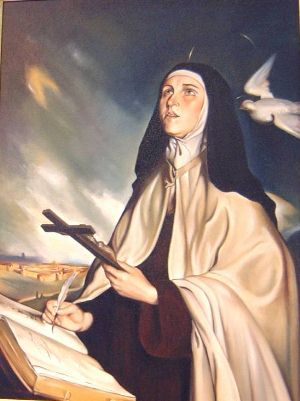
“God Alone Is Enough” — St. Teresa of Avila ~ The Rev. Dcn. Sr. Dollie Wilkinson, OPI
 Saint Teresa of Avila (Saint Theresa of Jesus)
Born in Avila, Spain March 28, 1515; died in Alba de Tormes, October 4 [15], 1582
Foundress of the Discalced Carmelites, 1560-62.
Canonized by Gregory XV, 1622; declared a Doctor of the Church in 1970.
Spanish mystic, writer and reformer of the Carmelite order.
St Terese of Avila was an influential and pivotal figure of her generation.St Teresa (Teresa de Cepeda y Ahumada) was born in Avila, Spain on 28th March 1515. Her parents were both pious Catholics and in some ways inspired their daughter to take up a life of prayer. As a young child Teresa showed signs of a deeply religious nature; she would often retreat into silence for prayer and would enjoy giving alms to the poor. She was very close to her Mother, who provided a warm counterbalance, to the strictness of her father. However in her teens, Teresa’s mother passed away, leaving the young Teresa distraught at the void she felt. The young St Teresa tells of her despair and how she turned instinctively to the Virgin Mary for comfort.
“I threw myself down in despair before an image of the Mother of God. With many tears, I implored the Holy Virgin to become my mother now. Uttered with the simplicity of a child, this prayer was heard. From that hour on, I never prayed to the Virgin in vain.”
During her later teen years Avila lost some of her early piety and religious zeal. She recounted how she became interested in worldly matters and enjoyed the company of a wide circle of friends. She had a natural charm and found it easy to make friends. In return she enjoyed the compliments and friendships of others. However, she was not at peace, considering herself to be a miserable sinner; later she would look back in guilt at her early life. However this sense of being a “miserable sinner” was probably the result of a harsh self-judgment, encouraged by her fathers exacting religious standards. At the age of 16, her father decided to send Teresa to a convent school to be educated.
This re-ignited in Avila an interest in following a spiritual life and after some deliberation resolved to become a nun of the Carmelite Order. At the time the convent rules were not very strict; it was probably more relaxed than living with her father. At the time the convent accepted many people into the order, often for financial reasons. The convent became overcrowded and people were often judged not on the basis of spiritual intensity but on material possessions. In this climate, Teresa struggled to find time for quite reflection; although she did start teaching people on the virtues of mental prayer.
Shortly after becoming a nun, Avila experienced a severe illness (malaria), which left her in great pain for a long period. At one point it was feared that her illness was so severe that she would not be able to recover. However during this period of intense physical pain, she began to increasingly experience divine visions and an inner sense of peace. These inner experiences of joy and peace seemed to transcend the intense physical pain of the body.
When she was a little better she resumed her prayers with renewed vigor. However after telling others of her visions and spiritual experiences, she was dissuaded from persuading them. Certain clergy felt they were just delusions of the devil. As a result, for many years Teresa lost the confidence to pursue her prayers and her spiritual life was almost put on hold. However, when Teresa was 41, she met a Priest who convinced her to go back to her prayers and implore God to come back. Initially, she had some difficulty sitting through prayers. She wryly remarked the end of the hour’s prayer couldn’t come soon enough. However, in the course of time, she became absorbed in deep contemplation in which she felt an ever growing sense of oneness with God. At times she felt overwhelmed with divine love. The experiences were so transforming, she at times felt the illumining grace of God would wash her soul away. She was so filled with divine contemplation it is said at times her body would spontaneously levitate. Teresa, however was not keen on these public displays of “miracles”. When she felt it happening she would ask other nuns to sit on her to prevent her floating away.
Teresa was not a just a quiet, placid saint. She had an endearing, natural quality; her life energy attracted and inspired many who were close. They admired her for both her outer charm and inner serenity. But at the same time her religious ecstasies also caused jealousy and suspicion. Unfortunately she was born into the period of the Spanish inquisition, during this time any deviation from the orthodox religious experience came under the strict observation and scrutiny. On one occasion Teresa complained to God about her mistreatment from so many different people. God replied to her saying “That is how I always treat my friends” with good humour St Teresa replied “That must be why you have so few friends”. St Teresa struggled because there were few who could understand or appreciate her inner ecstasies. However on the one hand she felt these experiences to be more real than ordinary events.
At the age of 43, St Teresa decided she wanted to found a new order recommitting to the values of poverty and simplicity. She wanted to move away from her present convent which made a life of prayer more difficult. Initially her aims were greeted with widespread opposition from within the town of Avila. However, with the support of some priests, the opposition waned and she was allowed to set up her first convent. St Teresa proved to be an influential leader and founder. She guided the nuns not just through strict disciplines, but also through the power of love, and common sense. Her way was not the way of rigid asceticism and self denial. Although she underwent many tribulations herself, to others she stressed the importance of experiencing God’s love.
St Teresa devoted much of the rest of her life to traveling around Spain setting up new convents based along the ancient monastic traditions. Her travels and work were not always greeted with enthusiasm, many resented her reforms and the implied criticism of existing religious orders. She often met with criticism including the papal nuncio who used the rather descriptive phrase “a restless disobedient gadabout who has gone about teaching as though she were a professor” St Teresa also had to frequently contend with difficult living conditions and her frail health. However she never let these obstacles dissuade her from her life’s task. She eventually died on October 4 at the age of 67. In 1566 she wroteCamino de perfeccion (Way of Perfection) in about 1566, to tell the nuns how to reach their goal. In 1580 she wrote what is considered her greatest work; the Castillo interior/ Las moradas(Interior castle/ The mansions) this involved describing the various stages of spiritual evolution leading to full prayer; she wrote Las Fundaciones (Foundations) from 1573 to 1582, so they would remember the early history of their order.
“God alone is enough.”
St. Theresa’s most popularly known writing, is a brief poem, which is known as her “Bookmark”, because it was found in her prayer book after her death in 1582. It has been variously translated into English, and has been very widely circulated.
Let nothing disturb you,
Let nothing frighten you,
All things are passing away:
God never changes.
Patience obtains all things.
Whoever has God lacks nothing;
God alone suffices.
Teresa lived in an age of exploration as well as political, social and religious upheaval. It was the 16th century, a time of turmoil and reform. She was born before the Protestant Reformation and died almost 20 years after the closing of the Council of Trent.
The gift of God to Teresa in and through which she became holy and left her mark on the Church and the world is threefold: She was a woman; she was a contemplative; she was an active reformer.
As a woman, Teresa stood on her own two feet, even in the man’s world of her time. She was “her own woman,” entering the Carmelites despite strong opposition from her father. She is a person wrapped not so much in silence as in mystery. Beautiful, talented, outgoing, adaptable, affectionate, courageous, enthusiastic, she was totally human. Like Jesus, she was a mystery of paradoxes: wise, yet practical; intelligent, yet much in tune with her experience; a mystic, yet an energetic reformer. A holy woman, a womanly woman.
Teresa was a woman “for God,” a woman of prayer, discipline and compassion. Her heart belonged to God. Her ongoing conversion was an arduous lifelong struggle, involving ongoing purification and suffering. She was misunderstood, misjudged, opposed in her efforts at reform. Yet she struggled on, courageous and faithful; she struggled with her own mediocrity, her illness, her opposition. And in the midst of all this she clung to God in life and in prayer. Her writings on prayer and contemplation are drawn from her experience: powerful, practical and graceful. A woman of prayer; a woman for God.
Teresa was a woman “for others.” Though a contemplative, she spent much of her time and energy seeking to reform herself and the Carmelites, to lead them back to the full observance of the primitive Rule. She founded over a half-dozen new monasteries. She traveled, wrote, fought—always to renew, to reform. In her self, in her prayer, in her life, in her efforts to reform, in all the people she touched, she was a woman for others, a woman who inspired and gave life.
Her writings, especially the “Way of Perfection”and “The Interior Castle”, have helped generations of believers.
In 1970, the Church gave her the title she had long held in the popular mind: Doctor of the Church. She and St. Catherine of Siena were the first women so honored.
Blessed Mannes de Guzman
None of the early historical writers of the Order fail to mention Blessed Mannes. His stock was not the least noble among the grandees of Catholic Spain. His parents were Felix Guzman and Jane of Aza, in whose veins also ran some of the best blood of Old Castile. On both sides Mannes could count brave defenders of his country. But what was of infinitely greater importance to him were the holy lives of his own immediate family. His father was a splendid type of the Christian gentleman. His mother has been raised to the honors of the altar under the name of Blessed Jane. His eldest brother, Anthony, became a model priest, who devoted his life to the care of souls, the welfare of the poor, and the aid of the sick, and died with a great reputation for sanctity. Dominic, the youngest and perhaps the only other child, became the founder of the Friars Preacher. He is canonized. Surely this is a record of which any one might well be proud.
Blessed Mannes first saw the light of day in the ancestral castle, Caleruega, Old Castile. The date of his birth can only be estimated from that of Saint Dominic (1170), than whom, we are told, he was a number of years older. Like Anthony, he chose the ecclesiastical state at an early age. Of his ordination to the priesthood and where he made his studies we know nothing. However, Spain was most likely the theater of both. The earlier writers of the Order, while reticent about these things, all tell us that he was of a retiring disposition, and much given to prayer and contemplation.
Yet an apostolic zeal evidently burned in his breast. Almost immediately after the return to Spain of the Right Rev. Didacus (or Diego) de Azebes (often called de Azevedo), bishop of Osma, whom Saint Dominic had accompanied to Rome, Mannes set out for France. From the bishop he learned the need of missionaries in Languedoc, where Dominic had been left to combat the errors of the Albigenses. Possibly de Azebes, for he was a saintly prelate, suggested that Mannes should also take up this work. At any rate, we find him with his younger brother before the close of 1207. From this time the two men, for they were cast in the same spiritual mold, toiled hand in hand for nearly ten years that they might free the Church of southern France from the poison and turmoil of heresy, and restore it to its former peace and beauty.
Not once in all this time did Mannes take a vacation, or pay a visit to his native land, which he loved none the less because he had dedicated himself to the service of God. He felt that his place was where religion needed his attention so sadly. His zeal was tireless; his efforts unceasing. Perhaps on no other did Dominic depend so much. Doubtless, if the full truth were known, history would have to associate Mannes more closely with the saint’s success, as well as give him more credit for the part he played in the conversion of the Albigenses. No danger or hardship could cause him to falter in his labors. He was a splendid preacher. Like Dominic, he intermingled prayer with his sermons and instructions. By his shining virtues and mortified life he wielded a stronger influence for good, whether among the faithful or those who had wandered from the path of truth, than by his eloquence.
One of Blessed Mannes’ most striking traits seems to have been his humility. He knew not the meaning of the word pride or jealousy. The one thing he sought was the glory of God and the salvation of souls. Although older in years, he obeyed his brother as a dutiful son does the will of his father. When Saint Dominic established his Order, Mannes was among the first to place himself under his standard, and to receive the habit. Thus we find him among the “sixteen” zealous men whom God selected as the foundation stones on which to build the Order of Friars Preacher. One would be perfectly safe in the assertion that, when (August 15, 1217) the chosen little band took their religious vows on bended knees before the patriarch, not one of them entered into the ceremony with a better heart, or in more of a spirit of self-sacrifice, than Blessed Mannes.
This event took place in the conventual church of the Dominican Sisters, Prouille, southern France. The annals of Prouille are very explicit in the matter. From their statement and that of Father John of Navarre about the time of his entrance into the Order, which he made in his testimony to the holy life of Dominic to the papal commission appointed to examine the saint’s cause for canonization, it would seem that the sixteen brethren had taken their vows at Saint Romanus’, Toulouse, after Innocent III sanctioned the foundation of the Order. However, after its confirmation by Honorius III, Dominic had them renew their profession. Such was his love for Prouille, around which so much of his work centered, that he chose this place for the ceremony, and as the point of their departure for the various countries to which he sent them.
Blessed Mannes was chosen as one of those who were to start a house of the new Order in Paris. He had six companions — Matthew of France, who was the superior; Bertrand of Garrigue, so called from the place of his birth, a little town in southern France; Lawrence of England; the two Spaniards, John of Navarre and Michael de Fabra; and Oderic of Normandy. The last mentioned has the distinction of being the Order’s first lay brother. They travelled in two parties. That composed of Mannes, Michael, and Oderic reached their destination first, September 12, 1217, being the day of their arrival in the great French capital.
For a while the fathers were obliged to live in a house near Notre Dame Hospital, in the center of the city. But their zeal, eloquence, and model lives soon won them many friends. Among these was John de Barastre, a celebrated master of the University of Paris, dean of Saint Quentin, and a royal chaplain. The noted ecclesiastic had established a hospice for strangers near the gate of the city called “Porte d’Orleans.” The hospice bore the name of Saint James. This he now conferred on the homeless Friars Preacher, and they took possession of it August 6, 1218. It became the famed Saint James’ Convent and Studium, than which none is more celebrated in the Order.
Thus Blessed Marines was one of the founders of this well-known institution, which played a conspicuous part in the history of the University of Paris. His sermons are said to have borne rich fruit in the French capital, for he had a splendid gift of oratory. Besides, he was endowed with an extraordinary personal magnetism; while his kindly, open, and friendly disposition exercised a strong influence over souls. Few could resist his appeals for a better life.
Just when the subject of this sketch left Paris, where he was much beloved, the writers do not tell us. But it is known that Saint Dominic himself sent him from there to Madrid, Spain; and from this we can form a most reasonable conjecture as to the time when Mannes returned to his native land, which he does not appear to have seen since 1207. While in Spain in connection with affairs of his Order, Dominic found Peter of Madrid organizing some pious ladies for a religious community in that city. The saint gave them the habit, admitted them to their vows, and started the construction of a convent for them. This was early in 1219. From Spain he made his way to Paris. While in this city, which he reached before the middle of the same year, he evidently appointed Blessed Mannes to take charge of the sisters in Madrid, and sent him to the Spanish capital; for we find him there shortly afterwards.
Several things, no doubt, conspired to bring about the choice of Mannes for this position. He was growing old, and long years of hard missionary labor must have begun to tell upon his strength. He was a most spiritual, devout, and prudent man, which recommended him for such a charge. His disposition led him to prefer a quiet, retired life, in which he could give himself more to prayer and contemplation, to one of activity among the people. Besides, his practical turn of mind rendered him a suitable person to superintend the temporal affairs of the sisters, whose cloistered state made this difficult for themselves. The holy man called their convent Saint Dominic of Silos, which he doubtless did because his own brother was named after the Cistercian abbot.
From Madrid Blessed Mannes attended the second general chapter of the Order, which was held at Bologna in 1221. Through him, on his return, Saint Dominic sent a letter to the youthful community of Spanish sisters, which is of no little interest because it is the only authentic writing of the saint which has survived the ravages of time. In it he tells them, briefly, of the joy it gave him to hear, through his brother Mannes, of their piety and of the completion of their convent. Both the one and the other are largely due to Mannes’ exertions. He is, therefore, constituted their ecclesiastical superior, with almost plenary powers.
Very probably the holy man held this position the rest of his days, for we find no record of him elsewhere. With this work, we doubt not, he combined no little preaching in and around Madrid. At times perhaps his confrères took his place at the sisters’ convent, while he labored in more distant localities. His life as a religious is said ever to have been edifying to his brethren and useful to his fellow man. Some place his death in 1230. Others say that he died about this time (“circiter 1230″).
But the Année Dominicaine informs us that Roderic “de Cerrate,” a Spanish Dominican of the thirteenth century, states (in his Vitae Sanctorum) that, after Saint Dominic’s canonization, Mannes went to Caleruega and persuaded the people to erect a church in honor of his brother; that he told them a modest edifice would do for the time being, for Dominic would see that a larger one should be built later; and that this prophecy was fulfilled some thirty years later. This would make the holy Friar Preacher die, at the earliest, in 1234 or 1235. It would also explain how he came to be buried in the Church of Saint Peter attached to the Cistercian monastery near Gumiel de Izan. The monastery is not far from the birthplace of Dominic and Mannes, whose ancestors were laid to rest in its temple of prayer. Most probably, therefore, Mannes became sick while engaged in this work of piety, died with the Cistercians, and was buried in their church, for the simple reason that his own Order had no house in that part of Spain.
During life the missionary bad been considered a saintly man and a perfect imitator of the virtues of his brother, Saint Dominic. Not long after his death, miracles began to be wrought at his tomb in such numbers that it became a place of pilgrimage. Because of this his relics were transferred to a more honorable place. Strange to say, Father Chrysostom Henriquez, a Cistercian writer, (in his Menologium Cistersiense) represents the Friar Preacher as a Cistercian. However, this author has been criticized more than once for inaccuracies and carelessness. Not only did Dominican writers correct him in this instance; for Mamachi, who says that Henriquez could not have read the epitaph on Blessed Mannes’ tomb, informs us that another Cistercian author, Father Angelus Manrique, states most positively (in his Annales Cistercienses) that he was a Dominican and a brother of Saint Dominic Guzman.
Reports of the cures obtained through intercession to the man of God soon became widespread. Devotion towards him grew particularly pronounced throughout Spain. In the Diocese of Osma, and especially around Caleruega, he was considered one of the popular saints. More than once petitions for at least his beatification were forwarded to Rome. Although these were not acted upon, the veneration in which Mannes was held rather waxed stronger than decreased with the course of time. For this reason, some six hundred years after his death, the former Camaldolese monk, Mauro Cappellari, who ascended the throne of Peter in 1831 under the name of Gregory XV1, beatified him, and granted his office and mass to the Order of Preachers. July 30 was set apart as his feast day.
Born: in Calaruega, Burgos, Spain
Died: at Saint Peter’s Monastery, Gumiel d’Izan, near Calaruega, in 1230 (there is a possibility that he may not have died until 1235)
Beatified:cultus approved by Pope Gregory XVI in 1834.
Blessed Antony Della Chiesa
Antony was born into the nobility, the family of the Marquis della Chiesa, and a collateral ancestor of Pope Benedict XV. He was well educated. Showing a taste early in life for he things of God, he grew up with the hope of becoming a religious. His father, who was a man of some importance, opposed this wish. Not until Antony was 22 was he able to make the break with his family and enter the monastery at Vercelli.
Here he distinguished himself for both sanctity and learning. Being a good preacher, he was for some years the companion of Saint Bernardine of Siena, in his missionary journeys through Italy. Antony was prior at the friaries of Como, Savona, Florence, and Bologna.
Antony gives us a picture of one who followed the Dominican life perfectly, managing, most of the time, to escape public notice. There is in his life very little of the glamorous or the unusual. He kept the rule, was a good superior, and a just administrator. Shunning applause, he was always serene.
The legends mention that he was particularly devoted to Our Lady, which is something one takes for granted in a Dominican, and that he conversed with her, in ecstasy, several times. He had the gift of reading hearts and was a sought-after director of souls. He also healed many sick people with his blessing. However, if any miracles are ordinary ones, these may be so described; they could be given as typical of most of early Dominicans.
At one time, Antony was on a ship that was captured by pirates, but at his prayer, the pirates spared the passengers and brought them safely to land. One of the very few things of unusual nature that in Antony’s life is a legend told of him when he was prior of Savona. It makes a lovely ghost story, and it also provides food for thought.
According to the story, Antony was praying one night in the church. Disturbed by the sound of horses hooves clattering on the flagstones outside, he went to see who could possibly be there at such a late hour. There were several horsemen, all mounted on black horses. He addressed them, but received no answer. Thinking that they might be foreigners, he tried several languages, and still there was no response.
Aware, then, that something was wrong, he commanded them in the name of the Lord to tell him who they were and where they were going. They said that they were devils, and that they were on their way to meet the soul of a dying sinner, a usurer, and escort him to hell. “I will pray for him,” said Antony. The demons laughed and told him he was too late. “Then at least come back and tell me whether you succeed or not,” said the prior.
A short while later, the group returned, and they had succeeded. They held the unhappy usurer captive, and, while the prior watched in horror, they bore him off. The man was screaming. The next day, the usurer’s relatives came to arrange an elaborate funeral. “You would do much better to have Masses said for yourselves and other poor sinners,” he said.
Antony died at Como and was buried there in the Dominican church Miracles at his tomb led to his beatification.
Born: in San Germano, near Vercelli, the Piedmont, Italy, in 1395;
Died: Como, Italy, January 22, 1459;
Beatified: 1819 by Pope Pius VII
Blessed Augustine Fangi of Biella
Miracles around the tomb of Augustine of Biella led to his beatification in 1878, after he had long been forgotten by everyone, except the residents of the little town at the foot of the Alps where he lived. His is another example of a life noted for piety and regularity, but quite unremarkable for unusual events or venturesome projects.
Augustine’s father was a member of the Fangi family, who were wealthy and noble, and, because of this, he had planned a secular career for his son. But when the Dominicans came to Biella, his plans were changed, for Augustine was completely charmed by their way of life and begged to be admitted. He entered, while quite young, the new convent that the Dominicans had built at Biella.
Augustine’s had a reputation for penance, even at a time when people were not as squeamish as they are today. Not only did he inflict harsh penances upon himself, he also bore with patience whatever pain and annoyance life granted him gratuitously. At one time he was required to undergo a surgical operation without, of course, any anesthetic. He did so without making the slightest outcry. In fact, he said afterwards that his mind was so intensely focused on something else that he hardly noticed what was being done to him. His mind was on that “something else” most of the time, for he prayed continually.
In 1464, Augustine was made prior at Soncino. Several of his best known miracles were performed there. At one time, a deformed child, who had died without baptism, was restored to life, by Augustine’s prayer, long enough to be baptized. At another time, when he was passing down the street, he met a little boy who was crying bitterly, because he had broken a jug of wine. Augustine gathered up the shards and put them back together again. Then, with a prayer, he refilled the jug and handed it back to the startled child. Still another time, through his intercession, a woman was delivered from possession of five devils.
Augustine spent his last ten years in the convent in Venice, and he died there on the Feast of Saint Mary Magdalene. He was buried in a damp place. Forty years later, on the occasion of some repairs to the church, his coffin, found floating on water, was opened. His body and habit were still intact. This did much to promote interest in his cause. Nevertheless, it was more than three centuries before he was finally beatified.
Born: at Biella, Italy, 1430
Died: feast of Saint Mary Magdalen 1493 at Venice, Italy; in the 1530s, workmen found his coffin floating in the water that had seeped into the burial chamber – when opened, Augustine’s body and clothing were found to be incorrupt
Cultus Confirmed: in 1872 by Pope Pius IX
Beatified: in 1878 by Pope Leo XIII
Blessed Jane of Orvieto
One of the stigmatists of the Order who deserves to be better known is Blessed Jane of Orvieto, whose marvel-filled life was the edification of Umbria in the latter half of the thirteenth century. Jane was born near Orvieto, in 1264, and both parents died when she was very small. Left to the care of casual neighbors, the little girl gre up with a special reliance of her guardian angel. She was a pious and intelligent child, , spending her time in prayer , even when very young.
Since it was necessary for her to earn her living , Jane studied dressmaking and became proficient at it. For several years she worked at this trade , prayerful and happy and undisturbed about her future. However, she had a number of unhappy experiences on the street on her way to work, for young men were attracted by her beauty. It became apparent to her that she must make some public declaration of her intentions if she wanted any peace. She decided to enter the Third Order of St. Dominic. Dressed in the habit of the mantellate, she would be safe from rude remarks and from any misunderstandings.
Jane’s friends opposed her plans, because they had already helpfully chosen a husband for her, and were trying to arrange a meeting of Jane and the man they had selected. Because of her youth, the Dominicans delayed in accepting her. Only after a long period of prayer and fasting was she able to win the privilege of putting on the Third Order habit and living with the other members of the Tertiary chapter. Once a member of the Order she so much desired , she set her goal at the highest sanctity and worked at attaining it. She prayed all morning and part of the afternoon, leaving herself only time to do enough work to care for her few needs and some alms to give the poor. She soon reached a remarkable state of prayer; she participated bodily in whatever she was contemplating. Her director learned not to say anything that would send her into ecstasy until he was through instructing her. Once he mentioned the martyrdom of Catherine of Alexandria and said piously, “Arise, O blessed Catherine,” and Jane arose, in ecstasy, and remained suspended in the air for an hour. If he talked about the Crucifixion her arms would go out in the form of a cross, and she would rise in the air like a figure on a crucifix. On Good Fridays she experienced the terrible agony of the Passion, and one could hear her bones cracking and see the bloody sweat. She received the stigmata, but it was not always visible.
Along with her remarkable life of prayer, Jane had to contend with physical pain. Once she was cured of a serious illness by a miraculous appearance of our Lord on the cross. He appeared to her in the midst of a bright light and gave her a cup of wine to drink. She obediently drank it, and she was instantly cured. Another time, when she was too ill to go to church to receive Communion , Our Lady came and brought the Holy Child to her.
One of Jane’s principal crosses was the lack of privacy. The whole town knew about her ecstasies. As soon as she fell into one, people came running to look. Jane tired to persuade the prioress to keep them out, but the prioress was interested herself, and saw no reason why anybody should object to being watched if they were not doing anything wrong. Jane wept with embarrassment when people asked for her blessing, and assured them over and over that she was not a saint but a wicked sinner, a diagnosis which nobody believed but herself.
Blessed Jane died, in 1306, and was buried in the Third Order cemetery in Orvieto. The following year her body was transferred to the chapel of the Three Kings, and many prodigies occurred at that time, giving impetus to the process for beatification, which, however, was not completed until more than 400 years later, in 1754.
Born: c.1264 at Carniola, near Orvieto
Died: 1306
Beatified: September 11, 1754 by Pope Benedict XIV (cultus confirmed)
 The Order of Preachers, Independent
You must be logged in to post a comment.