
Category: Dominican Life
Truth in the Tomb~The Rev Frank Bellino,OPI
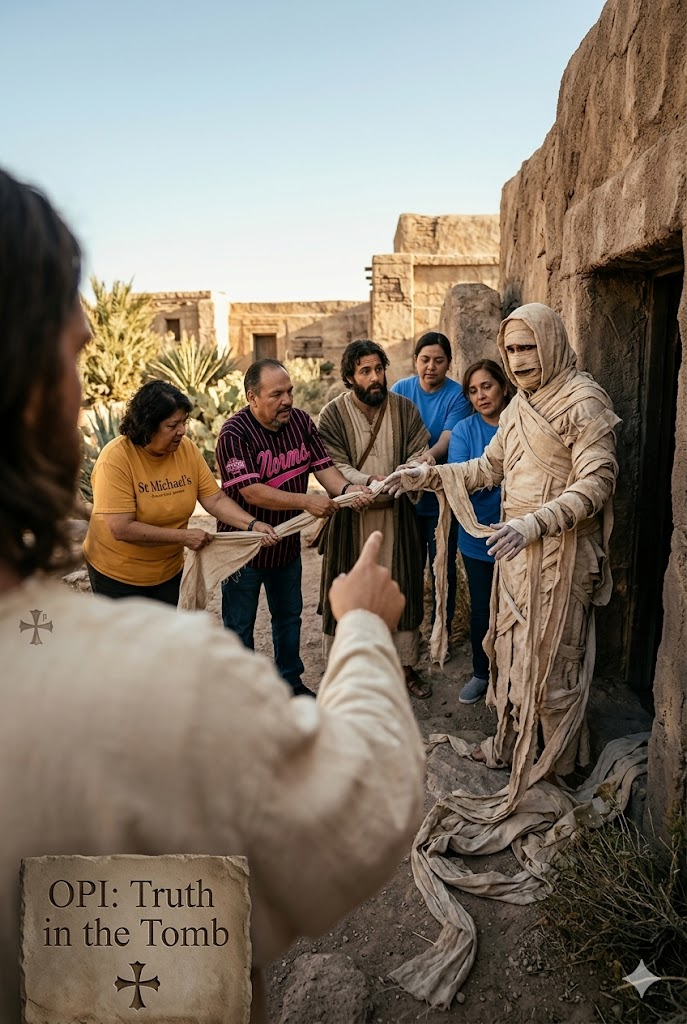
How many times have we heard the story of Lazarus? For many of us, the number is likely in the hundreds. We know the characters: the grieving sisters, the confused disciples, and the Jesus who weeps before he works. But if we treat this as a 2,000-year-old “magic trick,” we lose the Veritas—the Truth—that this Gospel is trying to breathe into us today. If it is just a miracle from the past, it’s a museum piece. If it’s just a “fortune-telling” of the Resurrection, it’s a trailer for a movie we’ve already seen. Through Dominican eyes, we must ask: What is the Truth of this story for a man or woman living in 2026?
Let’s look at this through a lens we rarely consider: the perspective of Lazarus himself. We often think of this as a “happily ever after” for him but think about that for a moment. Lazarus was on the doorstep of the Kingdom. He had passed through the veil; he was at rest. And yet, he is called back. He is made to “turn around” and re-enter a world of dust, pain, and eventually, a second death.
Why? Because the Truth is that our life is not our own. Lazarus was not raised for his own comfort; he was raised for the Mission. He became a living, breathing sermon—a walking protest against the finality of death. His very existence from that day forward forced everyone who looked at him to confront a reality they weren’t prepared for: that the stones we roll in front of our hearts are not permanent. Sometimes, God calls us back into difficult situations—into “stinky” circumstances—not to punish us, but because our presence there is the only way others will believe that light can penetrate the darkness.
Martha warns Jesus, “Lord, by now there will be a stench.” This is perhaps the most honest line in the New Testament. It acknowledges that some situations have gone on too long to be fixed by human hands. We all have “stinky” parts of our lives—addictions we can’t shake, bitterness we’ve nursed for decades, or a paralyzing fear of the future. The world tells us to leave those things behind the stone. The world tells us that once something starts to decay, it’s over.
But Christ stands at the mouth of our personal tombs and demands that the stone be rolled away. He isn’t afraid of the stench. The Dominican Truth is that God meets us exactly where we are “rotting.” He does not wait for us to get cleaned up before He calls us out. He calls us while we are still bound.
Perhaps the most profound Truth for us as a parish and an Order is what happens after the miracle. Jesus says the words that give life, but then He turns to the community and gives a command: “Untie him and let him go.” Notice that Jesus did not wave a hand and make the burial cloths vanish. He required the community to get their hands dirty. This is the mandate for St. Michael’s Catholic Parish/Unified Old Catholic Church. Christ provides the life-giving grace, but we are the ones called to the “Ministry of Unbinding.”
There are people sitting in these pews, or living in our neighborhoods, who have been “raised”—they have heard the call of God—but they are still walking around in burial cloths. They are bound by the labels the world has put on them, bound by the shame of their past, or bound by a lack of hope. As Dominicans and as followers of Christ, our job is to reach out and help peel back those bandages. We are called to be the hands that untie the knots of despair so that our brothers and sisters can truly walk in freedom.
As we move into Passiontide, we realize that the raising of Lazarus was the final catalyst for the death of Jesus. By giving Lazarus life, Jesus sealed His own earthly end. He traded His life for ours.
Today, let us ask ourselves: What stone are we keeping firmly in place? What “tomb” are we hiding in? The Voice that called Lazarus is calling you today. Not just to “live,” but to join the mission. To be a witness to the Truth that in Christ, nothing is ever truly “over.”
The Feast of St Joseph, Spouse of the Virgin Mary~The Very Rev Lady Sherwood, OPI
My dearest Brothers and sisters in Christ,
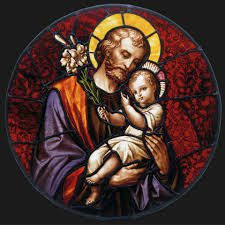
Today, we come together as the Church to commemorate St. Joseph, the Spouse of The Blessed Virgin Mary, and the foster Father of our Lord and Saviour,Jesus, when he became one of us here upon the Earth.
In the same way in which God, our Heavenly Father, who gives each of us as his children, unconditional love, care, stability and who sets us the standard with which we should strive to live our lives with his holy word in the scriptures, a true Father to each and every single one of us, who only ever wants the very best for all his children. St. Joseph follows our Father’s example, as both husband and foster father. He gives us examples which men should follow in their lives. Joseph cared for and provided for the Holy Household. There are many qualities that Joseph had which we could use to be the role model for Christian husbands and fathers. Joseph was a very compassionate man. We can see an example of this when he suspected his wife of infidelity; he planned to divorce her quietly rather than denounce her publicly and expose her to public shame and penalty.
Joseph was always obedient to God and did what he knew was God’s will without thought or hesitation. Examples of this are that he kept Mary as his wife; he protected and provided for his family when they had to flee to foreign lands to protect them from danger.
Joseph led a life of deep prayer and was in communion with God, and would always seek out that which was God’s will. God often told Joseph his will using dreams.
Joseph was a provider of care, When Jesus’s life was threatened, Joseph would take them out of danger. He took his family to Egypt and only returned when it was safe to do so, and when Jesus went missing at aged twelve, Joseph went searching for him because obviously, both parents were obviously extremely worried about Jesus’s safety.
Joseph also brought much more to Jesus’s life, he taught him his trade which Jesus worked in for about twenty years, he gave Jesus the love and stability he as any child needs, and was his earthly male role model, which was and still is vitally important for a good father to give any child.
He was a man with a firm faith in God coupled with a resilient personality, who did not complain and was not appalled nor distressed in the midst of trials and tribulations, St. Joseph knew how to face, carry and solve the burden of his vocation, of life’s difficulties and responsibilities with serenity, with complete faith and love, entrusting himself totally and unconditionally to God’s plans.
Sadly not all children are brought up in such a way today, but husbands and fathers truly should seek to follow this sincere man of God in the way they run their lives. Are you married? Do you give all the love, trust and respect to your spouse? Or with stresses and strains do you always argue or not truly make time for each other? If you have children, do you know where they are and if they are safe, or who they might be talking to online? Do you give emotional stability, patience and unconditional love? Do your children see you as the role model they need in a Father? We should always strive to be as our heavenly Father is to each of us, whether that be to our spouses, to our children, and in fact to all as our brothers and sisters.
While the Gospels do not shed much light on St. Joseph’s life, it is believed that he died before Jesus’ public ministry.
St. Joseph is the patron of fathers, spouses, priests and seminarians. But also, St. Joseph teaches us so much by his silent example of his life, and just how we should love God faithfully and obediently.
Let us pray:
Blessed St. Joseph, husband of Mary,
be with us this day.
You protected and cherished the Virgin;
loving the Child Jesus as your Son,
you rescued Him from the danger of death.
Defend the Church,
the household of God,
purchased by the Blood of Christ.
Guardian of the Holy Family,
be with us in our trials.
May your prayers obtain for us
the strength to flee from error
and wrestle with the powers of corruption
so that in life we may grow in holiness
and in death rejoice in the crown of victory.
Amen.
Aha!: The Feast of the Epiphany~The Rt Rev Michael Beckett, OPI
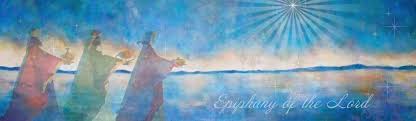
Y’all………Today is a big day! The Sunday closest to 6 January is the day the Church celebrates Epiphany, which marks the end of the Christmas season and reflects on the visit of the Magi, or wisemen, to the baby Jesus. Our good friends, the dictionary makers, define “epiphany” as a sudden, profound moment of insight or realization, often a spiritual or philosophical breakthrough, where a deeper truth about something is revealed, changing one’s perception. In more simple terms, it’s an “aha!” moment, or when one realizes something that’s pretty profound, pretty life changing.
“So,” you ask, “what does this have to do with the wisemen or three kings, or whoever?” Imma tell ya. Those wisemen were the first folks outside of the Nativity story to recognize Jesus as Someone Important. So important that they traveled for quite some time, over long distances, to reach Jesus, and in doing so, let the world know that Jesus was Somebody.
Y’all remember when our dear friend, Ebeneezer Scrooge, had his own personal Epiphany? Like, BOOM!, a big realization and life change! He went from being mean and hateful and dreadful to being kind and loving and generous. That’s what Epiphany is and does.
Epiphany is about Jesus and his message being available and relevant to people of every age and race. Epiphany is about God made present amongst us and available to all of us to worship and follow. Epiphany is about God’s love and how that love reaches beyond the everyday barriers of race, class, sexuality, political party, or anything else that separates us from each other.
Simply put and bottom line, is that Epiphany is all about realizing that no matter who we are, what we are, we need to become more. More loving. More caring. More forgiving. More Christlike. Jesus himself clues us in to what Epiphany is all about:
Jesus tells us in John 13:34-35, “A new commandment I give to you, that you love one another: just as I have loved you, you also are to love one another. By this all people will know that you are my disciples, if you have love for one another.”
We, all of us, need to have this kind of Epiphany every day of our lives. Every. Day. We need to remind ourselves, every day, of who we claim to serve, of how we are supposed to conduct ourselves, of how our own epiphanies have changed us and our lives. Of the qualities we are required to show: Justice. Mercy. Kindness. Forgiveness. Love. Regardless of anything else that might separate us, divide us, or causes us to see people as “other.” There is no one on this planet who God doesn’t love. There is no one on this planet who Jesus didn’t die for. Period. Love. One. Another.
And maybe, just maybe, because of the epiphanies in our lives, we can help others to have their own. Amen.
The Wood of the Manger, The Wood of the Cross The Rev Frank Bellino,OPI

We gather here in the middle of the night, surrounded by darkness, to celebrate the Light of the World. It is a beautiful tradition. But as we sit here, let’s start with a bit of honesty—something we Dominicans call Veritas.
If we were to look at the historical records, the meteorological charts of ancient Judea, or the shepherding schedules of the first century, we would likely find that Jesus was not born on a cold night in late December. Shepherds don’t keep flocks in open fields in the dead of winter. It’s likely He was born in the spring or perhaps the autumn during the Feast of Tabernacles.
So, why are we here on December 25th?
We are here because in the 4th Century, Pope Julius I decided. He looked at a world that was celebrating the return of the sun—the pagan winter solstice—and he said, “No. We do not worship the sun; we worship the Son of God.” He planted the flag of Christ right in the middle of the darkest time of the year to say: The Light has conquered the darkness.
But here is the important part: The date is liturgical. The event is reality.
It does not detract from the truth one bit. Whether it happened in April, October, or December, the fact remains: The Infinite God became a finite infant. The Creator entered His creation. The Word became Flesh.
However, we must be careful not to get stuck in the sentimentality of the scene. We look at the Nativity set, the peaceful animals, the glowing baby, the silent night—and it feels cozy. It feels safe.
But if we look closer, we realize that His birth means absolutely nothing without the Cross.
Archbishop Fulton Sheen once said that every other person who ever came into this world came into it to live. Jesus Christ is the only person who came into this world to die. His death was the goal of His life.
From the very first moment He drew breath in Bethlehem, He was marching toward Calvary.
He was placed in a manger, a feeding trough for animals, signifying that He would become Bread for the world—the Eucharist.
He was wrapped in swaddling clothes, bands of cloth that looked suspiciously like the burial shrouds that would wrap Him in the tomb.
And most importantly, He was laid on wood.
The wood of the manger prefigures the wood of the Cross. You cannot have Bethlehem without Golgotha. You cannot have the Crib without the Crucifix. If He had just been born a great teacher, a great philosopher, or a nice man, we wouldn’t be here tonight. We are here because that Baby is the Victim who would pay the price for my sins and for yours.
So, with that heavy reality in mind, what does Jesus want us to take away from this night?
He doesn’t want a birthday cake. He doesn’t want us to just feel warm and fuzzy for an hour and then go back to our lives.
He wants us to realize why He came.
He saw us in our mess. He saw us in our addiction to sin. He saw us lost in the darkness of our own making. And He didn’t send a representative; He came Himself. He “got a guy”—and that guy was Himself.
What He wants from us tonight is surrender. He wants us to look at the manger and see the Cross, and say, “Lord, if You went to these lengths—from the glory of heaven to a dirty stable, all the way to a Roman cross—just to save me… then the least I can do is give You my life.”
He wants us to leave this church different than we walked in. He wants us to carry the Light out those doors. The world is still dark, just like it was under Caesar Augustus. It needs Light. It needs Truth. It needs you to be the carrier of that Light.
Tonight, let us not just admire the Baby. Let us adore the Savior. Let us embrace the Cross that allowed us to be here.
A Blessed Christmas to you all.
In the name of the Father, and of the Son, and of the Holy Spirit. Amen.
The Joy of Seeing the Truth: Advent III~The Rev Frank Bellino,OPI
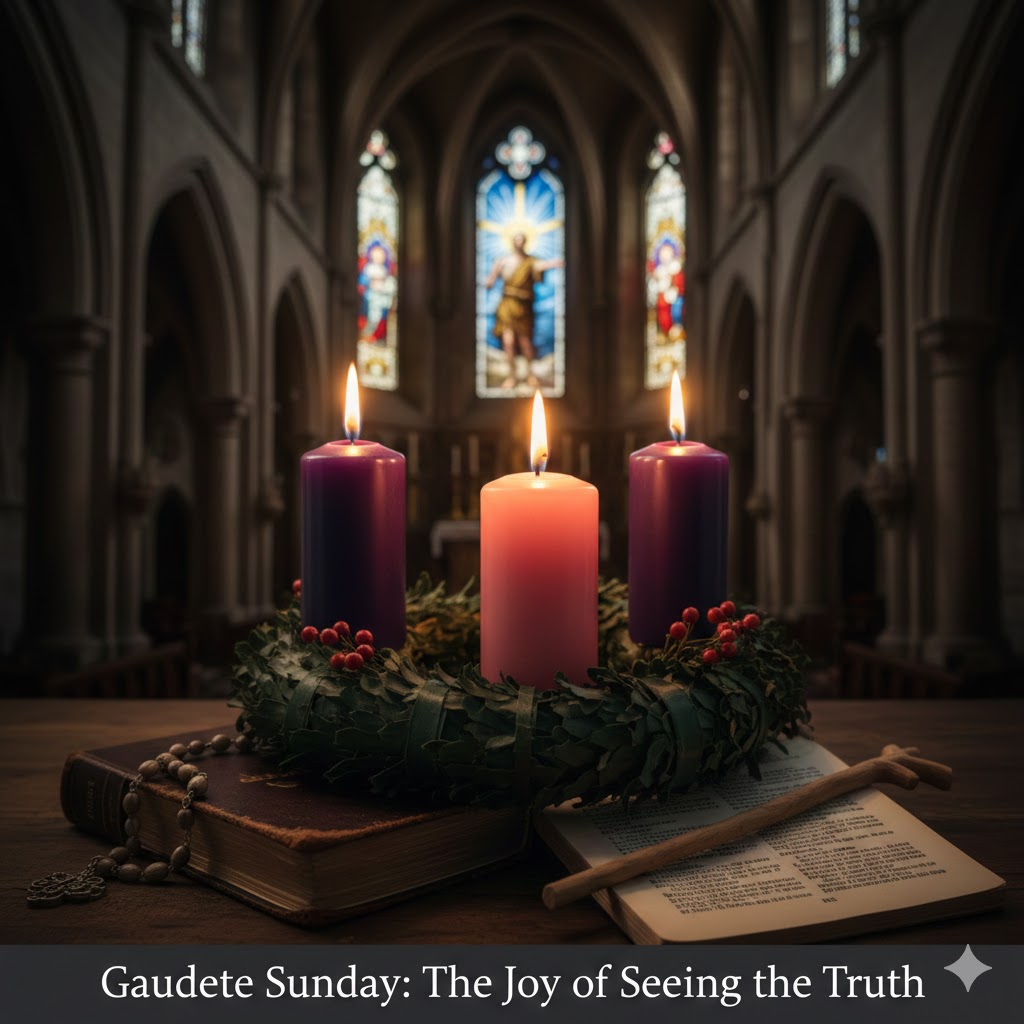
We light the rose candle today—Gaudete Sunday—because the Lord is near, and our deep, abiding joy is rooted not in fleeting happiness, but in the certainty of our hope. Yet, the Gospel reminds us that even the greatest prophet, John the Baptist, the powerful voice crying in the wilderness, struggled. He was confined, suffering, and sends his disciples to ask Christ the fundamental, agonizing question of truth: “Are you the one who is to come, or should we look for another?” This question, asked from the prison of his doubt, teaches us that faith engages intellectual struggle; the Dominican quest for Veritas begins with the honesty of a difficult question. If the one who prepared the way can doubt, how much more must we, the faithful, admit to our own moments of uncertainty?
Christ’s reply, however, is the very substance and meat of the Gospel. He does not offer a simple declaration, but points to the evidence of God’s tangible action, fulfilling the prophecy of Isaiah: “Go and tell John what you hear and see: the blind regain their sight, the lame walk… and the poor have the good news proclaimed to them.” The joy of Advent is found in recognizing that the desert of prophecy is blossoming into the garden of the Church. Christ is telling John and telling us: Look at the facts. Look at the transformed lives. This evidence—this testimony of grace—is our anchor. It proves that the Truth is not an abstract concept but a living Person, manifested in acts of mercy and the saving power of the preached Word. The certainty of this Truth then empowers us.
This assurance demands the virtue of patience, as Saint James urges in the second reading: “Be patient, therefore, brothers, until the coming of the Lord. See how the farmer waits for the precious fruit of the earth.” As the Order of Preachers, we understand this patience is tied to our vocation: we preach the Word and trust in God’s timetable for the spiritual harvest. The true Gaudete joy is not found when our trial is over, but in the certainty that Christ’s Word is infallible, and our temporary suffering prepares us for His eternal glory. This promise brings profound peace and transforms our anxious waiting into active, productive hope.
So, how does this apply to your life right now? You, too, are a traveler, a pilgrim on a road marked by both joy and inevitable doubt. Perhaps you feel like John the Baptist, waiting in a personal “prison” of anxiety, illness, or unresolved problems. The Gospel tells you that your response to doubt is not to abandon faith, but to look for the signs of Christ’s presence right where you are. Has Christ helped you forgive a great wrong, offered you unexpected comfort, or inspired you to perform a costly kindness? These are the real-life miracles—the deaf hearing, the blind seeing—happening in your everyday life. Your life, like that of Mary and Joseph who were travelers on a road of uncertain promise, is a testament to the fact that God meets us precisely in our doubt. Let the rose color remind us that Christ has already come, is here now in the Word and Sacrament, and is certainly coming again. Go forth and live this joyful Truth by being a sign of Christ’s presence to every weary traveler you meet!
Prepare: Advent 2~The Rev Frank Bellino,OPI
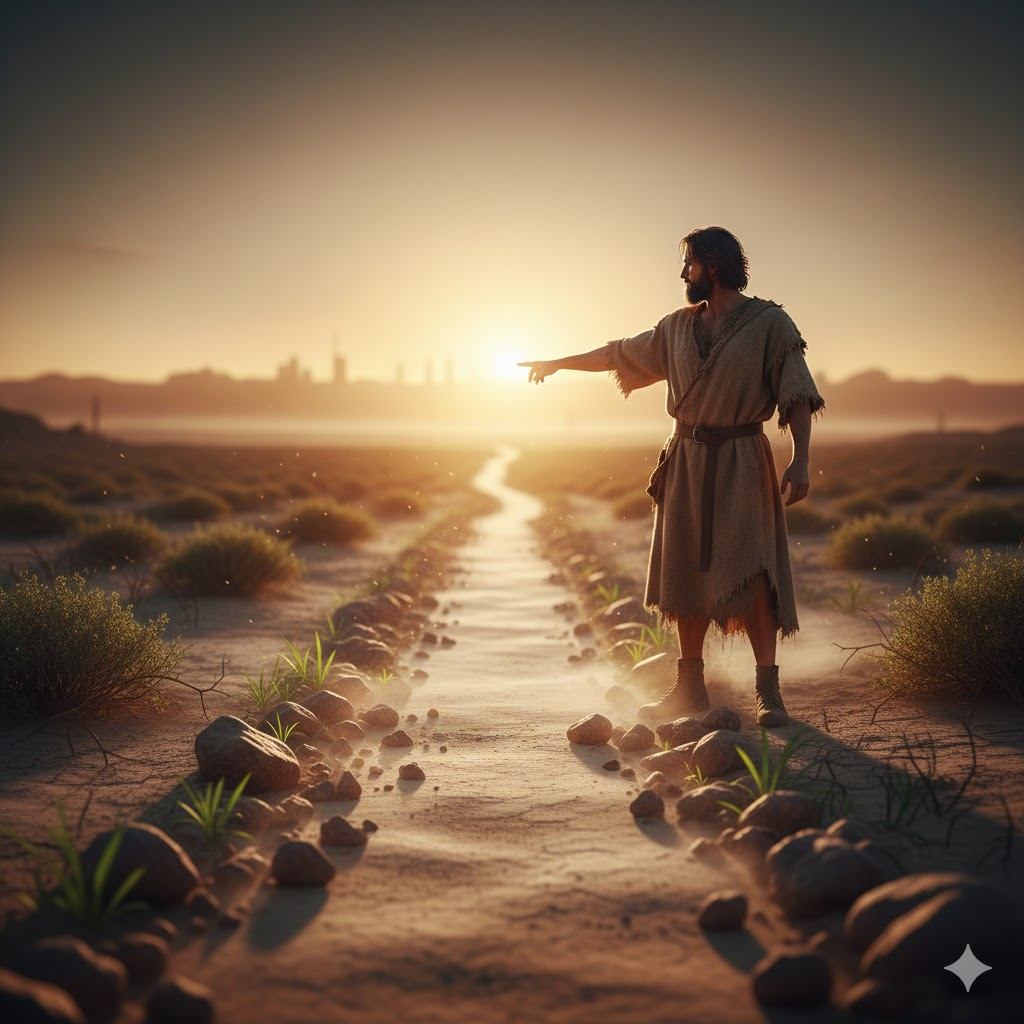
We find ourselves two weeks into Advent, a season the Church calls holy preparation. But for many of us, preparation is simply the relentless, daily state of being a hard-working American. Our life is a constant tension: preparing for the next bill, preparing for a medical expense that could shatter the budget, and preparing our children for a world that feels more uncertain every day. This stress, this endless worry, this anxiety, this is the real-life wilderness in which we struggle to find God.
As Dominicans, we are called to bring the penetrating light of Truth (Veritas) into this darkness. Our task today is to see how the Scripture speaks directly to our reality, offering us a foundation that cannot be shaken by the economy or by fear.
The prophet Isaiah speaks to a people whose security has been utterly cut down, reduced to nothing more than a lifeless stump of Jesse. They had no reliable foundation left. Does that not perfectly capture our fear when we see our wages stagnate while every cost of living—housing, groceries, childcare—climbs higher and higher? Our human foundation, that comfortable feeling of being “securely middle-class,” often feels just as dead as that stump.
But Isaiah gives us the ultimate object of our contemplation: true security lies not in the next budget plan or a stable interest rate, but in the shoot that springs from that stump. This Messiah is endowed with the Spirit of Counsel and Might—the perfect Wisdom of God. This calls us to re-evaluate what we are building our lives on. When financial anxieties create friction at home, or when the pressure of work threatens to steal our family time, we must contemplate this liberating Truth: Our ultimate well-being is not secured by a perfect 401k, but by a perfect God who promises a reign of ultimate peace and justice. Our hope is in the Christ who stands above the wilderness we currently inhabit.
And how do we enter into this reign? By heeding the uncompromising Voice in the Wilderness—John the Baptist, whose message is the exact antidote to our ceaseless anxiety: “Repent, for the kingdom of heaven is at hand!”
For the hard-working person, repentance is not just about avoiding some far-off, “big” sin. It is about clearing out the spiritual and emotional debt that burdens our soul as much as any credit card. John demands “fruit worthy of repentance.” What is this fruit for us? It is making a profound turn-around from the consumerist lie that tells us we need more—a bigger, newer, better version of everything—and that our worth is measured by our income. This lie is what drains our peace and drives our exhaustion. The fruit of repentance is stopping the endless, anxious striving and instead, giving our dedicated time and full attention to our family, our children—the true assets God has given us—instead of giving our exhaustion and worry to them after a long day. This is the real, gritty work of making straight the path: clearing the internal clutter that prevents Christ from reigning at the very center of our lives.
Yet, this transformation is not done in isolation. St. Paul reminds us in Romans that our strength and endurance is found in the encouragement of the Scriptures and in our community. The anxiety of our middle-class life is often suffered in secret. We are conditioned to hide our struggles and maintain the appearance of success. But the Dominican call to live the Truth in community means we cannot afford isolation.
Paul prays that we may “accord in welcoming one another, as Christ welcomed you, for the glory of God.” Our unity must be practical. We welcome one another by sharing the truth of our struggle, by refusing to judge the neighbor whose finances are strained, and by recognizing that every person in this parish is carrying a weight. Our community, therefore, must be a place of refuge, where the burden is eased by spiritual solidarity, and where we use the Truth of Christ’s welcome to break down the walls of status and striving that silently divide us.
My brothers and sisters, we are called to be the voice and the hands of Christ in this demanding age. Let the Root of Jesse be your foundation, offering the only security that will never be devalued by inflation. Let the Voice of John drive you to repentance that brings rest to your soul, not just rules to your conscience. And let the call of Paul inspire a unity in this parish that reminds the anxious world of what it means to be truly rich—rich in hope, rich in truth, and rich in one another.
Amen.
Who Are These? The Feast of All Souls~The Rt Rev Michael Beckett,OPI
Y’all…….Those of you who have hung around with me for more than a minute know that I’m all about some words. They fascinate me. And I play LOTS of Words With Friends and Word Solitaire and other word games. When I was teaching I was all about spelling and grammar and vocabulary (words, meanings, and how to effectively use them.)
Here of late, there has been one word that seemingly has been on a recurring loop in my head; the word “dumbfounded.” Interestingly enough, the word ‘dumbfounded’ comes from a blend of ‘dumb’ and ‘confounded’, and we know that this word first came into use in the mid 1600s and meant ‘amazed, surprised, caught off guard. The word ‘dumb’ as we know it today comes from the Old Norse ‘dumbr’, the Gothic ‘dumbs’ which meant ‘mute’, the Dutch ‘dom’, and the German ‘dumm’, the latter two of these would be translated into ‘stupid.’
And I have certainly been struck mute, been confused, and made speechless by some of the things I’ve seen and heard lately. I am dumbfounded by folks who one day ask for prayer, who proudly and happily post about following Jesus, and then the next day (sometimes the next 15 minutes) post or say something that completely negates and is in direct conflict with, everything that Jesus taught and stood for. They’re all about bringing ‘religion’ back into schools and posting the 10 Commandments everywhere, but completely ignore the “not bearing false witness” part and post dis-and mis-information and flat out lies. And they do it happily and proudly. They excitedly promote those in authority who publish pictures of their “prayer groups” but who trample on the Gospel. They denigrate those who they feel are “less than” and completely ignore the words our Lord spoke in Matthew, yet happily say they are all about Jesus, want to bring folks to Jesus, and say “Come to church with us!.” For me, personally, this saddens and terrifies me, and it should them. They, in their ignoring what Jesus has said, completely ignore His words in Matthew 18:6: “If anyone causes one of these little ones—those who believe in me—to stumble, it would be better for them to have a large millstone hung around their neck and to be drowned in the depths of the sea.”
Conversely, today is the Feast of All Souls, (closely akin to All Saints which was yesterday,) wherein we honor all of those devout folks who have gone on before us. One of the Scriptures that is associated with today comes from the Book of Revelation:
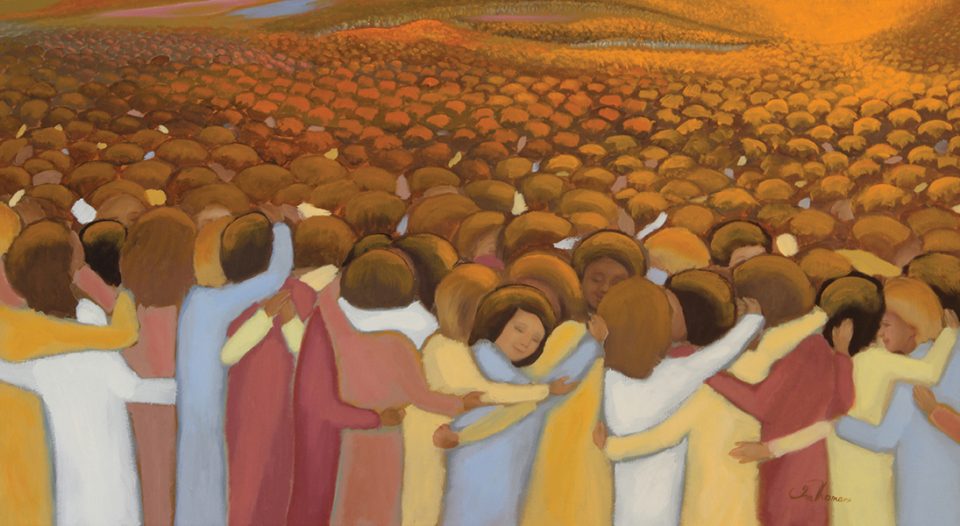
I had a vision of a great multitude, which no one could count, from every nation, race, people, and tongue. They stood before the throne and before the Lamb, wearing white robes and holding palm branches in their hands. They cried out in a loud voice: “Salvation comes from our God, who is seated on the throne, and from the Lamb.” All the angels stood around the throne and around the elders and the four living creatures. They prostrated themselves before the throne, worshiped God, and exclaimed: “Amen. Blessing and glory, wisdom and thanksgiving, honor, power, and might be to our God forever and ever. Amen.”
Then one of the elders spoke up and said to me, “Who are these wearing white robes, and where did they come from?” I said to him, “My lord, you are the one who knows.” He said to me, “These are the ones who have survived the time of great distress; they have washed their robes and made them white in the Blood of the Lamb.”
Well now. Just who ARE these folks in white robes? Their anonymity teaches us that sainthood is not reached through great achievements or rare acts of bravery. Sainthood comes from simply loving God and doing our best to live our lives in a way consistent with Jesus’ commandment. I would dare say that none of the saints actually set out to be saints. They simply loved God and lived their lives to follow Him.
Revelation goes on to remind us that giving our lives over to God will not protect us or insulate us from hardship. Living in, for, with, and through God, however, will make sure that we can and will endure whatever “great distress” comes our way. In this passage of Revelation, John is speaking specifically of those who have given their lives for their faith. Whilst there is talk about a “War on Christianity,” in reality, it is very unlikely that any of us will be called upon to sacrifice our lives for our faith.
Our challenge, then, is to actually LIVE for Christ, rather than to die for Christ. Jesus does ask to lay down our lives for Him. Peter said to the Lord, “I will lay down my life for Your sake,” and he meant it (John 13:37). Has the Lord ever asked you, “Will you lay down your life for My sake?” (John 13:38). It is much easier to die once than to lay down your life day in and day out with the sense of the high calling of God. We are not made for the bright-shining moments of life, but we have to walk in the light of them in our everyday ways. For thirty-three years Jesus laid down His life to do the will of His Father. “By this we know love, because He laid down His life for us. And we also ought to lay down our lives for the brethren” (1 John 3:16).
If we are true followers of Jesus, we must deliberately and carefully lay down our lives for Him. It is a difficult thing to do, and thank God that it is, for great is our reward. Salvation is easy for us, however, because it cost God so much. But the exhibiting of salvation in our lives is difficult.
God saves a person, fills him with the Holy Spirit, and then says, in effect, “Now you work it out in your life, and be faithful to Me, even though the nature of everything around you is to cause you to be unfaithful.” And Jesus says to us, “…I have called you friends….” Remain faithful to your Friend and remember that His honor is at stake in your bodily life. We are called to remain faithful, despite the reasons the world gives us to not, despite the politics, despite the crowd pressure, despite the differences in our lives.
Who are these dressed in white robes? It is my prayer to be counted among them. What about you? Amen.
The Fire of Faith and the Cost of Discipleship~The Rev Frank Bellino,OPI
Brothers and Sisters in Christ,
In the Gospel of Luke, Jesus delivers a message that can be startling to our modern ears: “I have come to cast fire upon the earth, and how I wish it were already kindled!” and “Do you think that I have come to give peace on earth? No, I tell you, but rather division.”
These words challenge the comfortable, domesticated image of Jesus we sometimes hold. This fire is not a fire of worldly war, but the transformative and purifying fire of the Holy Spirit. It is a fire that tests our faith, burns away our apathy, and demands a radical commitment to God’s kingdom. It is a divine fire meant to refine us, not to destroy us.
The division Jesus speaks of is a natural consequence of this fire. When we embrace the Gospel, we are choosing a path that may lead us away from the values and priorities of the world, and sometimes, even from those closest to us. Our faith can create a schism—not because we seek to divide, but because our convictions are so profound that they set us apart.
As Dominicans, our call is to be both bearers and kindlers of this fire. We are the Order of Preachers, commissioned to proclaim the Truth of the Gospel with our lives and our words. This is a profound and serious responsibility. We are called to be beacons of light in a world that can be steeped in darkness, and that often means standing for truth, justice, and love even when it is unpopular.
This commitment can, and often does, cause a quiet division. We may find ourselves at odds with our families, our colleagues, or our friends over matters of faith and morals. It is in these moments that we must remember the words of our Lord. Our primary allegiance is to Him. Our peace is not the absence of conflict, but the unwavering certainty of being in His presence.
This passage is a powerful reminder that our faith is not a passive or private affair. It is an active, public, and sometimes disruptive force that demands a choice. Let us pray for the courage to embrace this fire, to live our faith so authentically that it becomes a light for the world, and to find our ultimate peace in Christ alone.
Are You Ready?~The Rev Frank Bellino,OPI
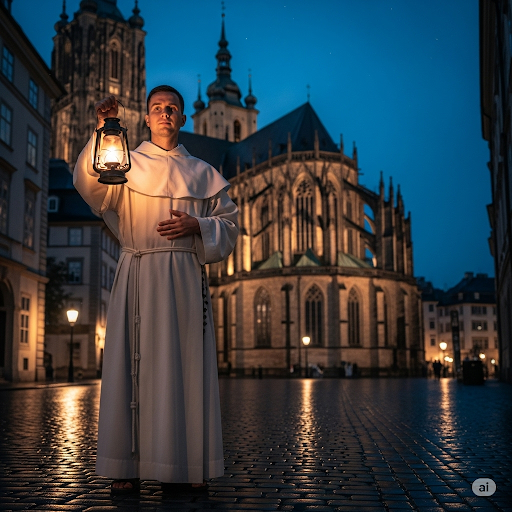
Our Gospel reading today from Luke 12:35-40 echoes with an urgency that cuts through the noise of our 21st-century lives: “Let your loins be girt and your lamps burning; and be like men who are waiting for their master to come home from the marriage feast, so that they may open to him at once when he comes and knocks.”
As Dominicans, preachers of the Word and seekers of Truth, we are compelled to ask: How do these ancient words speak to us, here and now, in a world shaped by algorithms, instant gratification, and perpetual distraction?
“Let your loins be girt.” In an age where we are constantly “logged on” but often disengaged, this command takes on new meaning. To gird our loins today means to discipline our digital lives, to resist the constant pull of the ephemeral, the superficial, and the sensational. Are we so engrossed in endless scrolling, virtual worlds, and digital debates that we become spiritually flabby, unready for the real challenges and opportunities God places before us? Girding our loins means setting boundaries, cultivating silence, and intentionally seeking wisdom in a world saturated with information but starved for truth. It means being prepared for genuine engagement – with God, with our families, with our neighbors – rather than passively consuming.
“And your lamps burning.” What are our lamps today? They are our faith, hope, and charity, yes, but also our critical thinking in an era of misinformation, our compassion in a polarized society, and our courage to speak truth in a culture that often shies away from difficult conversations. Are our lamps burning brightly, fueled by prayer and study, so that we can discern truth from falsehood in a news cycle that often blurs the lines? Are they shining forth as beacons of Christ’s love in a world too often marked by division, cynicism, and despair? Or are our lamps dim, obscured by our own anxieties, consumerism, or simply the sheer overwhelming nature of modern life? A truly burning lamp in today’s world means being a source of light, not just passively absorbing it.
Jesus speaks of servants waiting for their master from a wedding feast. Consider our society’s obsession with instant gratification. We expect immediate responses, express delivery, and always-on connectivity. Yet, spiritual readiness is about patient vigilance, a sustained posture of expectation and faithful living, even when the “master seems delayed.” This patience is a profound counter-cultural virtue. It challenges the anxiety of always needing to be “doing something” and calls us to a deeper, more abiding presence to God’s ongoing work in the world.
And then, the stark warning: “But know this, that if the householder had known at what hour the thief was coming, he would not have left his house to be broken into. You also must be ready; for the Son of man is coming at an unexpected hour.” In our world, where threats can emerge from anywhere – be it a cybersecurity breach, a global pandemic, or a sudden economic downturn – we are acutely aware of vulnerability. Jesus’ warning isn’t about fearmongering; it’s a call to spiritual cybersecurity. It’s a reminder that we must not allow the “thief” of apathy, materialism, or spiritual complacency to break into our souls and rob us of the precious grace God offers.
So, for us, as Catholics living in this contemporary society, what does it mean to be “ready”?
It means being intentional in our faith, actively choosing Christ amidst a sea of competing ideologies and fleeting pleasures. It means using our intellects, sharpened by Dominican study, to engage with the pressing issues of our time – justice, charity, peace – not shying away from them, but bringing the light of the Gospel to bear.
It means fostering genuine community, resisting the isolation that digital life can foster, and truly being present to one another in our parishes, our families, and our neighborhoods. Our communal life becomes a witness to a world starved for authentic connection.
And above all, it means cultivating a deep prayer life that grounds us in the timeless truth of God’s love, enabling us to be vigilant and active, prepared for whatever God calls us to, knowing that ultimately, He will serve us at the eternal banquet.
Let us not be caught off guard. Let us not allow the distractions of this age to extinguish the flame of our faith. Instead, let us, with girt loins and brightly burning lamps, live lives of expectant vigilance, witnessing to the coming Kingdom, and radiating Christ’s light in every corner of our modern world.
Amen.
The Feast of our Holy Father, St. Dominic~The Rev Frank Bellino,OPI
My dear brothers and sisters in Christ,
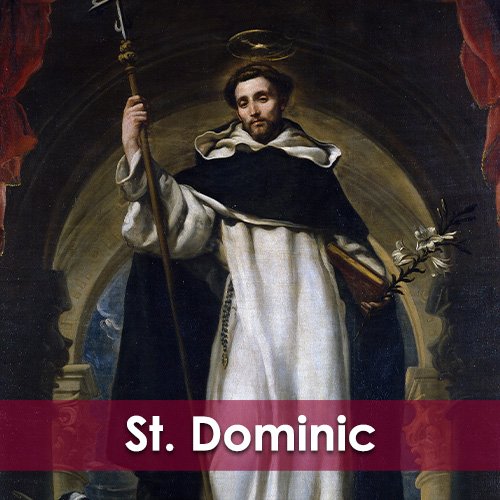
Today, as we gather, our hearts and minds turn to a towering figure in our Church’s history: Saint Dominic de Guzman, whose feast we celebrate. Born in 12th-century Spain, Dominic lived in a time of great intellectual ferment and spiritual challenge, much like our own. He was a man consumed by a singular passion: the salvation of souls and the proclamation of God’s truth. As we reflect on his life and virtues, we will discover that St. Dominic is not merely a historical figure, but a profound inspiration and a relevant guide for us in today’s complex world.
Who was this remarkable saint? Dominic was a canon regular who, on a journey through southern France, encountered the widespread Albigensian heresy. This dualistic belief system denied the goodness of creation, the Incarnation of Christ, and the value of human life. Dominic quickly realized that the prevailing methods of combating this error were ineffective. He saw that the heretics, though misguided, lived lives of apparent austerity, which contrasted sharply with the often-wealthy lifestyle of some Church leaders.
Inspired by the apostolic life, Dominic chose a radical path: to preach the Gospel with intellectual rigor, profound poverty, and fervent prayer. He gathered a small band of followers, and with papal approval, founded the Order of Preachers – the Dominicans – a mendicant order dedicated to Veritas, to Truth, and to the salvation of souls through preaching.
Let us consider some of the virtues that shone so brightly in St. Dominic, and how they speak to us today:
First, and perhaps most central, was his zeal for souls and his unwavering commitment to Truth. Dominic literally wept for sinners, driven by an ardent desire for everyone to know and embrace the saving truth of Christ. In an age rife with misinformation, relativism, and competing narratives, Dominic’s passion for Veritas is a powerful beacon. He understood that true freedom and authentic human flourishing are found only in the truth. Today, we are called to be seekers and proclaimers of truth, not with arrogance or condemnation, but with the same compassionate zeal that characterized Dominic, engaging in dialogue and persuasion, just as he did with the innkeeper who became his first convert.
Second, Dominic embodied profound poverty and simplicity. He sold his precious, hand-annotated books to feed the starving, famously declaring that he could not study on “dead skins” when people were dying of hunger. He traveled barefoot, embraced austerity, and insisted that his friars live simply, depending on God’s providence. In our consumer-driven society, where material possessions often define worth and happiness, Dominic’s radical detachment challenges us. His example reminds us that true richness lies not in what we accumulate, but in our relationship with God and our solidarity with the poor. His spirit calls us to examine our own priorities and to live with greater freedom from worldly attachments, advocating for justice for the marginalized, as Dominicans continue to do today on issues of economic inequality, racism, and human dignity.
Third, St. Dominic placed immense emphasis on study and intellectual formation. He established houses of study near the great universities of his time, like Paris and Bologna, ensuring that his preachers were not only fervent but also well-educated in theology and contemporary issues. In our rapidly changing and intellectually diverse world, an informed faith is more crucial than ever. Dominic teaches us that faith and reason are not opposed but balancing. We are called to deepen our understanding of our faith, to engage with the world’s questions, and to articulate the Gospel message intelligently and persuasively.
Finally, Dominic’s life was rooted in deep prayer and contemplation. He famously said he would “speak only of God or with God.” His active ministry flowed from his profound union with Christ in prayer. He spent countless hours in vigil, often weeping, interceding for the world. In our fast-paced, often noisy lives, Dominic reminds us of the indispensable need for quiet contemplation. It is in prayer that we encounter the living God, receive strength, and discern His will. From this wellspring of prayer, we are then empowered to “pass on the fruits of contemplation” (contemplata tradere) to a world desperately in need of Christ’s light.
My brothers and sisters, St. Dominic’s legacy is not confined to the pages of history. His virtues – zeal for truth, radical poverty, intellectual pursuit, and profound prayer – are not relics of a bygone era. They are urgent calls to action for us, here and now.
May we, like St. Dominic, be consumed by a passion for the salvation of souls, courageously proclaiming the truth of Christ in word and deed. May we embrace simplicity and work for justice in a world fractured by inequality. May we dedicate ourselves to lifelong learning, deepening our faith with both heart and mind. And above all, may our lives be rooted in constant prayer, so that, like Dominic, we may truly be “hounds of the Lord,” setting the world ablaze with the fire of God’s love.
St. Dominic, pray for us. Amen.
 The Order of Preachers, Independent
You must be logged in to post a comment.