
Category: Dominican Life

Saint Catherine of Alexandria
According to the traditional story, Catherine was the daughter of Costus, a pagan governor of Alexandria, where she was born. She is said to have announced to her parents that she would only marry someone who surpassed her in beauty, intelligence, wealth, and social status. This has been interpreted as an early foreshadowing of her eventual discovery of Christ. “His beauty was more radiant than the shining of the sun, His wisdom governed all creation, His riches were spread throughout all the world.” Though raised a pagan, she converted to Christianity in her late teens. It is said that she visited her contemporary, the Roman Emperor Maximinus Daia, and attempted to convince him of the moral error in persecuting Christians. She succeeded in converting his wife, the Empress, and many pagan philosophers whom the Emperor sent to dispute with her, all of whom were subsequently martyred. Upon the failure of the Emperor to win Catherine over, he ordered her to be put in prison; and when the people who visited her converted, she was condemned to death on the breaking wheel, an instrument of torture. According to legend, the wheel itself broke when she touched it, so she was beheaded.

According to Christian tradition, angels carried her body to Mount Sinai, where, in the 6th century, the Eastern Emperor Justinian established Saint Catherine’s Monastery, Mount Sinai, the church being built between 548 and 565 in Saint Catherine, Egypt, on the Sinai peninsula. Saint Catherine’s Monastery survives, a famous repository of early Christian art, architecture and illuminated manuscripts that is still open to visiting scholars. The historian Harold T. Davis says that Catherine’s story dates only from the 10th century AD, and that “assiduous research has failed to identify Catherine with any historical personage”; Davis suggests that the invention of Catherine may have been inspired by the story of the martyred pagan philosopher Hypatia of Alexandria. She did certainly form an exemplary counterpart to Hypatia in the medieval mindset; and it has been suggested that she was invented specifically for that purpose. Like Hypatia, she is said to have been highly learned (in philosophy and theology), very beautiful, sexually pure, and to have been brutally murdered for publicly stating her beliefs. The story of Catherine is placed a hundred years before Hypatia’s death, but there are no contemporary sources for her life.
Because of the fabulous character of the account of her martyrdom and the lack of reliable documentation, the Roman Catholic Church in 1969 removed her feast day from the Calendar. But she continued to be commemorated in the Roman Martyrology on November 25. In 2002, her feast was restored to the General Roman Calendar as an optional memorial.
The 1908 Catholic Encyclopedia describes the historical importance of the belief in her as follows:
Ranked with St Margaret and St Barbara as one of the fourteen most helpful saints in heaven, she was unceasingly praised by preachers and sung by poets. It is believed that Jacques-Benigne Bossuet dedicated to her one of his most beautiful panegyrics and that Adam of St. Victor wrote a magnificent poem in her honour: Vox Sonora nostri chori, etc. In many places her feast was celebrated with the utmost solemnity, servile work being suppressed and the devotions being attended by great numbers of people. In several dioceses of France it was observed as a Holy Day of Obligation up to the beginning of the seventeenth century, the splendor of its ceremonial eclipsing that of the feasts of some of the Apostles. Numberless chapels were placed under her patronage and her statue was found in nearly all churches, representing her according to medieval iconography with a wheel, her instrument of torture. Meanwhile, owing to several circumstances in his life, Saint Nicholas of Myra was considered the patron of young bachelors and students, and Saint Catherine became the patroness of young maidens and female students. Looked upon as the holiest and most illustrious of the virgins of Christ after the Blessed Virgin Mary, it was natural that she, of all others, should be worthy to watch over the virgins of the cloister and the young women of the world. The spiked wheel having become emblematic of the saint, wheelwrights and mechanics placed themselves under her patronage. Finally, as according to tradition, she not only remained a virgin by governing her passions and conquered her executioners by wearying their patience, but triumphed in science by closing the mouths of sophists, her intercession was implored by theologians, apologists, pulpit orators, and philosophers. Before studying, writing, or preaching, they besought her to illumine their minds, guide their pens, and impart eloquence to their words. At the beginning of the fifteenth century, it was rumored that she had spoken to Joan of Arc and, together with St. Margaret, had been divinely appointed Joan’s adviser.
Blessed Lucy of Narni
Blessed Lucy of Narni was the eldest of eleven children of Bartolomeo Broccadelli and Gentilina Cassio. When she was only five years old, she had a vision of the Virgin Mary. Two years later, she had another vision, this time of the Virgin Mary accompanied by Saint Dominic. Dominic is said to have given her the scapular at this time. When she was twelve years old, Lucy made a private vow of chastity, and determined to become a Dominican nun.
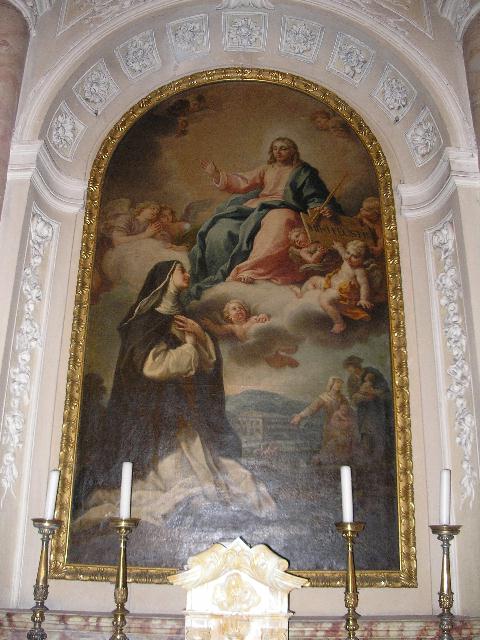
Circumstances, however, changed to make doing so difficult. The next year her father died, leaving her in the care of an uncle. This uncle determined that the best course of action he could take would be to get Lucy married as quickly as possible.
He made several attempts to do so. One of these included holding a large family party. He had invited the man he had chosen as Lucia’s husband to the party, with the intention of having the couple publicly betrothed. He however had not informed Lucia of his intentions. The suitor made an attempt to put a ring on Lucia’s finger, only to be slapped repeatedly for his efforts by Lucia.
A later attempt involved Count Pietro de Alessio of Milan, an acquaintance of the family. Lucia was actually quite fond of him, but felt her earlier vow to become a nun made the possibility of marriage impossible. The strain Lucia felt as a result of the conflicting feelings made her seriously ill. During this time, the Virgin Mary and Saint Dominic again appeared to her, this time accompanied by Catherine of Siena. They reportedly advised Lucia to contract a legal marriage to Pietro, but to explain that her vow of virginity would have to be respected and not violated. Pietro agreed to the terms, and the marriage was formalized.
In 1491 Lucia became Pietro’s legal wife and the mistress of his household, which included a number of servants and a busy social calendar. Despite her busy schedule, Lucia made great efforts to instruct the servants in Christianity and soon became well known locally for her charity to the poor.
Pietro observed Lucia’s behavior, and occasional quirks, quite indulgently. He never objected when she gave away clothing and food nor when she performed austere penances, which included regularly wearing a hair shirt under her garments and spending most of the night in prayer and acting to help the poor. He also seemed to have taken in stride the story he was told by the servants that Lucia was often visited in the evenings by Saint Catherine, Saint Agnes, and Saint Agnes of Montepulciano who helped her make bread for the poor.
However, when one of the servants came up to him one day and told him that Lucia was privately entertaining a handsome young man she appeared to be quite familiar with, he did react. He took up his sword and went to see who this person was. When he arrived, he found Lucia contemplating a large crucifix. The servant told him that the man he had seen Lucia with looked like the figure on the crucifix.
Lucia left one night for a local Franciscan monastic community, only to find it closed. She returned home the following day, stating that she had been led back by two saints. That was enough for Pietro. He had her locked away for the bulk of one Lenten season. She was only visited by servants who brought her food. When Easter arrived, however, she managed to escape from Pietro back to her mother’s house and on 1494 May 8 became a Dominican tertiary. Pietro expressed his disapproval of this in a rather dramatic form, by burning down the monastery of the prior who had given her the habit.
In 1495 Lucia went to Rome and joined a group of Third order Dominican tertiaries. The next year she was sent to Viterbo and here she found she was frequently the object of unwanted attention. It was here, on February 25, 1496 that she is reported to have received the stigmata. Lucia did her best to hide these marks, and was frequently in spiritual ecstasy. The house had a steady stream of visitors who came to speak to Lucia, and, often, just look at her. Even the other nuns were concerned about her, and at one point called in the local bishop who watched Lucia go through the drama of the Passion for twelve hours straight.
The bishop would not make a decision on Lucia, and called in the local inquisition. Reports here vary, some indicating that he referred the case directly to the Pope, who is said to have spoken with her and, with the assistance of Columba of Rieti, ultimately decided in her favor, telling her to go home and pray for him. Other sources question the accuracy of these reports.
At that time Pietro also came to her, making a final plea to persuade Lucia to return with him as his wife. She declined, and Pietro left alone. He would himself later become a Franciscan monk and a famous preacher.
When Lucy returned to the convent in Viterbo, she found that the Duke of Ferrara, Ercole d’Este I, had determined to build a convent in Ferrara and that, having heard of her, he determined that she would be its prioress. In summer of 1497, he invited her to be the founder of this new monastery. Lucia herself, the Dominican order, and the Pope all agreed quickly to the new proposal. The municipal council of Viterbo, however, objected, not wanting to lose Lucy. Lucia had been praying for some time for a way to create a new convent of strict observance, and agreed to go to the new convent.
Lucia’s departure precipitated a conflict between Ferrara and Viterbo which would continue for two years. Viterbo wanted to keep the famous mystic for themselves, and the duke wanted her in Ferrara. After extensive correspondence between the parties, on April 15, 1499 Lucia escaped secretly from Viterbo and was officially received in Ferrara on May 7, 1499. Thirteen young girls immediately applied for admission to her new community; the construction of the monastery began in June and was completed two years later, in August 1501. It contained 140 cells for sisters and the novices, but to fill it with suitable vocations proved to be very difficult. Lucia expressed the wish to have there some of her former friends from Viterbo and Narni. Duke Ercole, in September 1501 sent his messenger to Rome asking for the help of the pope’s daughter Lucrezia Borgia, who was preparing to marry Duke’s son Alfonso. She collected all eleven candidates Lucia had indicated and sent them, as a special wedding present to Lucia and to the Duke, a few days ahead of her bridal party. She herself solemnly entered Ferrara on February 2, 1502.
The Duke petitioned the local bishop for some help for Lucia in governing her new community, and he sent ten nuns from another community to join Lucia’s convent. Unfortunately, these ten nuns were members of the Dominican second order, who were canonically permitted to wear black veils, something Lucia and the members of the Dominican third order community were not allowed to do.
Tensions were heightened when one of these veiled outsiders, Sister Maria da Parma, was made the prioress of the convent on September 2, 1503. When Duke Ercole died on January 24, 1505 the new prioress quickly found Lucia to be guilty of some unrecorded transgression, most probably of the support for the Savonarolan church reform, and placed her on a strict penance. Lucia was not allowed to speak to any person but her confessor, who was chosen by the prioress. The local provincial of the Dominican order would also not permit any member of the order to see Lucia. There are records that at least one Dominican, Catherine of Racconigi, did visit her, evidently by bilocation, and that Lucia’s earlier visitation by departed saints continued. In response to Lucia’s insistent prayer her stigmata eventually disappeared, which caused some of the other nuns to question whether they had ever been there at all. When Lucia finally died, in 1544, many people were surprised to find that she had not died years earlier.
Then suddenly everything changed. When her body was laid out for burial so many people wanted to pay their last respects that her funeral had to be delayed by three days. Her tomb in the monastery church was opened four years later and her perfectly preserved body was transferred to a glass case. When Napoleon in 1797 suppressed her monastery the body was transferred to the Cathedral of Ferrara; and on 1935 May 26 – to the Cathedral of Narni.
Lucia was beatified by Pope Clement XI on March 1, 1710

Show Me Thy Glory ~ The Rev. Dcn. Sr. Dollie Wilkinson, OPI
 Have you ever argued with your boss at work, demanding better pay or possibly better working conditions? If you are a parent, how many times has your child come to you, complaining about their chores, or maybe what they are having for dinner, or most definitely, asking why they cannot spend more time playing with friends? Or how many complaints do you imagine our President hears in a day? Well, this is what is happening here in Exodus 33:12-23. Moses had a difficult job assignment that he was given by the Lord. His duty was to lead a rebellious, self-centered, stubborn people through a desert to the promised land. To get this job accomplished, Moses needed a close relationship with the Lord. Now, when we come to chapter 33, Moses has just received the 10 Commandments and the Law from the Lord. He was gone for 40 days and nights while he received the Law’ and while he was away, the people made a golden calf, began to worship it as a god, and committed terrible sins of immorality. When Moses came down from the mountain, he saw what they were doing and threw down the stone tablets containing the Law and broke them. The Lord became angry with the people and He refused to go with them into Canaan, Exodus 33:1-3. Moses responded by reminding the Lord that the Israelites are God’s people and that if the Lord didn’t go with them, then Moses isn’t going either. So Moses and the Lord discuss the matter and God decides to go with them and to bring them into the land of promise.
“Moses said to the LORD, “See, you have said to me, ‘Bring up this people’; but you have not let me know whom you will send with me. Yet you have said, ‘I know you by name, and you have also found favor in my sight.’ Now if I have found favor in your sight, show me your ways, so that I may know you and find favor in your sight. Consider too that this nation is your people.” He said, “My presence will go with you, and I will give you rest.” And he said to Him, “If your presence will not go, do not carry us up from here. For how shall it be known that I have found favor in your sight, I and your people, unless you go with us? In this way, we shall be distinct, I and your people, from every people on the face of the earth.” The LORD said to Moses, “I will do the very thing that you have asked; for you have found favor in my sight, and I know you by name.” Moses said, “Show me your glory, I pray.” And He said, “I will make all my goodness pass before you, and will proclaim before you the name, ‘The LORD’; and I will be gracious to whom I will be gracious, and will show mercy on whom I will show mercy. But,” He said, “you cannot see my face; for no one shall see me and live.” And the LORD continued, “See, there is a place by me where you shall stand on the rock; and while my glory passes by I will put you in a cleft of the rock, and I will cover you with my hand until I have passed by; then I will take away my hand, and you shall see my back; but my face shall not be seen.””
When these things happened, it put Moses in a place of discouragement and doubt. He needed something from the Lord if he was to continue to lead these people, and so he asked the Lord to show him His glory. Moses has nerve, there is no doubt about it. He’s not afraid to use the Lord’s own words against Him. In effect, he is telling the Lord, “Look, you tell me, ‘Lead this people,’ but you don’t let me know whom you’re going to send with me. You tell me, ‘I know you well and you are special to me.’ If I am so special to you, let me in on your plans. That way, I will continue being special to you. Don’t forget, this is your people, your responsibility.” Pretty persuasive argument, don’t you think?!
As a parent, a boss, the President, or church leader, sometimes decisions need to be made that may not always go over well with those entrusted in our care. Of course, none of us have ever been given an assignment quite like the one Moses received, but we have been called to follow the Lord and to represent Him in this world. At times, this task becomes difficult and discouraging, and we need something from the Lord. Something we cannot do on our own, something that will recharge our spiritual batteries and that will rekindle the old flames of excitement and passion for the Lord. And once again, the Lord understood Moses’ plea, and sends him a sign of His Glory – “I will make all my goodness pass before you, and will proclaim before you the name, ‘The LORD’; and I will be gracious to whom I will be gracious, and will show mercy on whom I will show mercy.” Exodus 33-17
Moses asked for a sign from the Lord, and thus receives God’s Glory. Often times we wish we could be so fortunate, to be given a sign that we do indeed find favor with the Lord, that our presence matters. A clear sign that we are on the right path, following His commandments. As Moses learned, it does not hurt to ask. And though we may not receive such a stupendous showing of God’s favor and mercy, I do feel that if we just listen, look around with an open heart and mind, the signs of the Lord’s Glory, will most definitely present themselves.
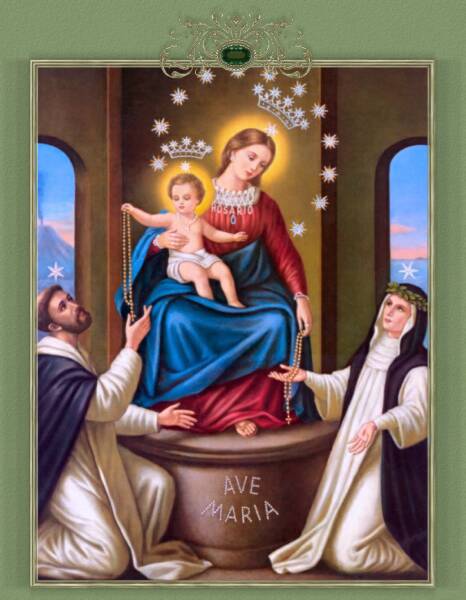
What? Where? Why? Who? Our Lady of the Rosary ~ The Rev. Deacon Br. Joshua Hatten, OPI
 Today the church celebrates an important Marian Feast, Our Lady of the Rosary. Why do celebrate this feast? Why do we bother with the rosary at all… it is just some ancient prayer of the church, right?? Wrong! Very wrong!
The Rosary is not a repetitious, boring, ‘religious’ activity… we can certainly make it feel like that… boring, words repeated by rote without any meaning. But that isn’t the Rosary. That is a waste of time. The rosary, when properly prayed, with intention – and with whatever YOUR intentions may be – is one of the most powerful and mountain moving forms of active prayer and meditation with which we are blessed. Archbishop Fulton J. Sheen once said, “The rosary is the book of the blind, where souls see and there enact the greatest drama of love the world has ever known; it is the book of the simple, which initiates them into mysteries and knowledge more satisfying than the education of other men; it is the book of the aged, whose eyes close upon the shadow of this world, and open on the substance of the next. The power of the rosary is beyond description.”
But the rosary began quite differently than that we know today. The use of “prayer beads” and the repeated recitation of prayers to aid in meditation stem from the earliest days of the Church and has roots in pre-Christian times. Evidence exists from the Middle Ages that strings of beads were used to count Our Fathers and Hail Marys. Actually, these strings of beads became known as “Paternosters,” the Latin for “Our Father.”
The structure of the rosary gradually evolved between the 12th and 15th centuries. Eventually 50 Hail Marys were recited and linked with verses of psalms or other phrases evoking the lives of Jesus and Mary. During this time, this prayer form became known as the rosarium (“rose garden”), actually a common term to designate a collection of similar material, such as an anthology of stories on the same subject or theme. During the 16th century, the structure of the five-decade rosary based on the three sets of mysteries prevailed.
Tradition does hold that St. Dominic (d. 1221) devised the rosary as we know it. Moved by a vision of our Blessed Mother, he preached the use of the rosary in his missionary work among the Albigensians, who had denied the mystery of Christ.
Originally, people prayed 150 Our Fathers representing the 150 Psalms. Then there was a parallel practice of praying 150 Hail Marys. Later, a mystery of Jesus’ life was attached to each Hail Mary.
Church Tradition and, let’s face it, LEGEND, tells us that St. Dominic (d. 1221) devised the rosary as we know it. Moved by a vision of our Blessed Mother, he preached the use of the rosary in his missionary work among the Albigensians, who had denied the mystery of Christ. Whilst that cannot by proved, and in fact may not be true, the development of the rosary as we know it owes much to the Dominican Order. One of St. Dominic’s Dominican contemporaries, Alan de la Roche, was known as “the apostle of the rosary.” He founded the first Confraternity of the Rosary in the 15th century. In the 16th century the rosary was developed to its present form—with the 15 mysteries (joyful, sorrowful and glorious). In 2002, Pope John Paul II added five Mysteries of Light to this devotion.
Let the rosary become YOUR BOOK, as Archbishop Sheen termed it, the book you ‘open’ when it seems like everything is just too much to bear or when you’re filled with such gratitude for love or when or when it is just a humdrum Wednesday. You will be amazed by the power of this beautiful prayer. The book opens when you realize you’re not merely praying the same words on the same beads every time, but when you actually begin to meditate and place yourself in the corresponding mysteries. You become an active participant in the life and times of Our Lord and His Mother.
Anyone who knows six easy prayers can pray a Rosary; you will also need to know twenty Mysteries to meditate upon as you pray. You do not have to be a Catholic.
The Order of Prayers
The Rosary begins with the Apostles Creed, followed by one Our Father, three Hail Marys (traditionally offered for an increase in faith, hope, and charity for those praying the Rosary), a Glory Be, and, if desired, the Fatima Prayers. Next come five mysteries, each consisting of one Our Father, ten Hail Marys, a Glory Be, and, if desired, the Fatima Prayers. Conclude with the Hail Holy Queen. Please say a few extra prayers after the Hail Holy Queen for the Pope.
Rosary Beads
If you do not have Rosary beads, it is perfectly okay to count with your fingers. Counting beads frees your mind to help you meditate.
Prayers for Praying the Rosary
THE APOSTLE’S CREED
I believe in God, the Father Almighty, Creator of Heaven and earth; and in Jesus Christ, His only Son, Our Lord, Who was conceived by the Holy Ghost, born of the Virgin Mary, suffered under Pontius Pilate, was crucified; died, and was buried. He descended into Hell; the third day He arose again from the dead; He ascended into Heaven, sitteth at the right hand of God, the Father Almighty; from thence He shall come to judge the living and the dead. I believe in the Holy Spirit, the holy Catholic Church, the communion of saints, the forgiveness of sins, the resurrection of the body, and the life everlasting. Amen.
OUR FATHER
Our Father, Who art in heaven, hallowed be Thy name; Thy kingdom come; Thy will be done on earth as it is in heaven. Give us this day our daily bread; and forgive us our trespasses as we forgive those who trespass against us; and lead us not into temptation, but deliver us from evil. Amen.
HAIL MARY
Hail Mary, full of grace. The Lord is with thee. Blessed art thou amongst women, and blessed is the fruit of thy womb, Jesus. Holy Mary, Mother of God, pray for us sinners, now and at the hour of our death, Amen.
GLORY BE
Glory be to the Father, and to the Son, and to the Holy Spirit, as it was in the beginning, is now, and ever shall be, world without end. Amen.
FATIMA PRAYER (OPTIONAL)
O my Jesus, forgive us of our sins. Save us from the fires of hell. Lead all souls into heaven, especially those in most need of thy mercy.
HAIL HOLY QUEEN
Hail, holy Queen, Mother of mercy, our life, our sweetness and our hope. To thee do we cry, poor banished children of Eve: to thee do we send up our sighs, mourning and weeping in this valley of tears. Turn then, most gracious Advocate, thine eyes of mercy toward us, and after this our exile, show unto us the blessed fruit of thy womb, Jesus. O clement, O loving, O sweet Virgin Mary!
Leader: Pray for us O Holy Mother of God,
All: That we may be worthy of the promises of Christ.
(Optional)
Leader: Let us pray.
All: O God whose only begotten Son by his life, death, and Resurrection has purchased for us the rewards of eternal life; grant we beseech thee, that meditating on these mysteries of the Most Holy Rosary of the Blessed Virgin Mary, we may imitate what they contain and obtain what they promise through the same Christ our Lord. Amen.
PRAYER FOR THE HOLY FATHER (FOR PRIVATE DEVOTION)
Leader: Upon this Rock He will build His Church…
All: …and the jaws of death shall not prevail against her.
Leader: O Mother of the Redeemer…
All: …Living Tabernacle of the Eucharist, and Luminous Rose of Heaven, with humble confidence we ask you to bestow upon the Holy Father all the graces and blessings reserved for him by the Holy Trinity from all eternity. Amen.
Leader: Help his friends…
All: …convert his enemies.
Leader: Saint Joseph…
All: …pray for us. Amen.
The Twenty Mysteries
Here is a brief listing and description of all twenty Mysteries.
THE JOYFUL MYSTERIES
- The Annunciation:The Archangel Gabriel “announces” to Mary that she shall conceive the Son of God.
- The Visitation:Mary visits her cousin Elizabeth, who is pregnant with John the Baptist.
- The Nativity:Jesus is born.
- The Presentation:Mary and Joseph “present” Jesus in the Temple where they meet Simeon.
- The Finding in the Temple:After losing Him, Mary and Joseph find young Jesus teaching the Rabbis in the Temple.
THE LUMINOUS MYSTERIES (THE MYSTERIES OF LIGHT)
- The Baptism in the Jordan:The voice of the Father declares Jesus the beloved Son.
- The Wedding at Cana:Christ changes water into wine, his first public miracle.
- The Proclamation of the Kingdom:Jesus calls to conversion (cf. Mk 1:15) and forgives the sins of all who draw near to him.
- The Transfiguration:The glory of the Godhead shines forth from the face of Christ.
- The Institution of the Eucharist:Jesus offers the first Mass at the Last Supper with his apostles, establishing the sacramental foundation for all Christian living.
THE SORROWFUL MYSTERIES
- The Agony in the Garden:Jesus sweats water and blood while praying the night before his passion.
- The Scourging at the Pillar:Pilate has Jesus whipped.
- The Crowning with Thorns:Roman soldiers crown Jesus’ head with thorns.
- The Carrying of the Cross:Jesus meets His mother and falls three times on the way up Calvary.
- The Crucifixion:Jesus is nailed to the cross and dies before His mother and His apostle John.
THE GLORIOUS MYSTERIES
- The Resurrection:Jesus rises from the dead.
- The Ascension:Jesus leaves the Apostles and bodily “ascends” to heaven.
- The Descent of the Holy Spirit:The Apostles receive the Holy Spirit in tongues of fire in the upper room with Mary.
- The Assumption:Mary is taken bodily–assumed–into heaven by God at the end of her life here on earth.
- The Coronation:Mary is crowned Queen of Heaven and Earth.
Mysteries for Certain Weekdays
Traditionally, many people say the Joyful Mysteries on Monday, the Sorrowful Mysteries on Tuesday, the Glorious Mysteries on Wednesday, and start again with the Joyful Mysteries on Thursday, the Sorrowful Mysteries on Friday. The Glorious Mysteries are then prayed on Saturday and Sunday. Now that the Luminous Mysteries have recently been added, the schedule is:
Monday – Joyful
Tuesday – Sorrowful
Wednesday – Glorious
Thursday – Luminous
Friday – Sorrowful
Saturday – Joyful
Sunday – Glorious
Try to place yourself “into” the scene of the particular mystery as you pray, imagining the sights, smells, sounds, and emotions that Jesus, Mary, Joseph, and other participants experienced during the actual events.
It is also okay to meditate on the meaning of the words of the prayers as you pray them, or even to meditate on the person for whom you are offering the Rosary.
GOD BLESS YOU.
A New Postulant!!!
We are thrilled to announce that Jay Van Lieshout has completed his application for postulancy, has been accepted into the Order, and is now working toward his Novitiate. Please congratulate him and keep him in your prayers as he continues his journey in service to Our Lord.
Blessed Diane, Blessed Cicely & Blessed Amata
Diana, Caecilia, and Amata were the first members of Saint Agnes Dominican Convent in Bologna, Italy. They all knew Saint Dominic personally. Little is known of Sister Amata except that she was a good friend of Saint Dominic, who, according to legend, gave her the name Amata (‘beloved’). Dominic either sent her to the reformed convent of Saint Sixtus when the nuns left Saint Mary’s across the Tiber during a time of drastic reform, or he was instrumental in allowing her to stay there. There was an Amata from whom Dominic cast out seven devils, but it was probably not this Amata.
Caecilia Caesarini was a high-spirited young Roman of an ancient family; she threw her considerable influence into the reform movement at the time Saint Dominic was attempting to get the sisters into Saint Sixtus and under a strict rule. When the saint came to speak to the sisters at Saint Mary’s, it was Caecilia (then 17) who urged the prioress to support his cause. She was the first to throw herself at Dominic’s feet and beg for the habit and the rule he was advocating, and her hand is evident in the eventual working out of the touchy situation. In 1224, Caecilia and three other sisters from Saint Sixtus, including Amata, went to Saint Agnes in Bologna to help with the new foundation. Sister Caecilia was the first prioress there and proved to be a very strict one.
Caecilia is responsible for relating nearly everything now known about the personal appearance and habits of Saint Dominic. In her extreme old age, she was asked by Theodore of Apoldia to give him all the details of the saint’s personality, and all that she could recall of the early days of the order, so that he could record them for posterity. Though nearly 90, her memory was keen and specific. She recalled how Dominic used his hands, the precise shade of his hair, the exact line of his tonsure. If she erred, there were still people alive who could have corrected her, though there was probably no one with her descriptive power left to tell the tale.
Through a woman’s eyes, she saw the founder from a different angle than his fellow preachers were apt to see, and remarked on his gentleness with the sisters, and the little touches of thoughtfulness so characteristic of him. While the men who worked with him would recall his great mind and his penances, and appreciate the structural beauty of the order he had founded, Caecilia saw the glow of humanity that so many historians miss.
The most colorful of the three was Sister Diana, the spoiled and beautiful daughter of the d’Andalo and Carbonesi families of Bologna, who lost her heart to the ideal of the Dominicans when listening to Reginald of Orléans preach. She espoused the cause of the friars, who were new in Bologna, and begged her father until she obtained from him the church of Saint Nicholas of the Vineyards, of which he had the patronage.
Having established the brethren, she wanted a convent of the Dominican sisters in Bologna. When Saint Dominic came there on his last journey, she talked with him, and all her worries departed. She knelt at his feet and made a vow to enter the Dominicans as soon as it should be possible to build a convent at Bologna. Saint Dominic, going away to Venice on a trip from which he would only return to die, made sure before leaving that the brethren understood about Diana. Four of the fathers from the community of Saint Nichola were under obedience to see that her convent was built.
In the meantime, Diana’s father refused her permission to enter the convent. Stealing a leaf from the life of Saint Clare, she ran away to the Augustinians outside the city. In full armor, her brothers came after he, and Diana was returned, battered but unconvinced, to the paternal home. She nursed a number of broken ribs and several explosive ideas in silence.
The death of Saint Dominic was a great grief to Diana, as she was still living in a state of siege at home, waiting for some action on the question of the new convent. However, she soon acquired a new friend, who was to be her greatest joy in the years of her mortal life–Jordan of Saxony, master general of the order following Dominic. Jordan, as provincial of Lombardy, inherited the job of building the Bologna convent, but his relations with Diana were not to be merely mundane. Their friendship, of which we have the evidence in Jordan’s letters, is a tribute to the beauty of all friendship, and a pledge of its place in religious life.
Diana was resourceful. She made another attempt to elope to the convent. This time her family gave up in despair. She remained peacefully with the Augustinians until the new convent was built. In 1223, Diana and several other young women received the Dominican habit from Jordan of Saxony. Diana was the prioress for a time, but perhaps Jordan felt that she was too volatile for ruling others, because, as soon as the sisters came from Saint Sixtus, he established Sister Caecilia as prioress. Diana, who was used to being not only her own boss, but the one who gave orders to others, seems to have made no protest.
If we had the letters written by Diana, we should possess a fascinating picture of the early years of the order and the people who made it what it is. We are indebted to Diana for what we do have of the correspondence, for she carefully saved all of Jordan’s letters. They tell us of the progress made by the friars in various lands, and ask her to remind the sisters to pray for the missionaries. Jordan counts the successes when many good novices have come into the order, begging her prayers in the low moments when promising novices leave.
More than this, these are letters of spiritual direction, which should give a pattern to all such correspondence, for they infer that Diana is a willing and energetic Christian who will follow the advice she is given, not simply keep the correspondence going for the joy of it.
Diana died in 1236. She was buried in the convent of Saint Agnes. Her remains were transferred when a new convent was built, and Sister Caecilia–who died 60 years later–was buried near her, along with Sister Amata. The relics were transferred several times, all three together. The head of Blessed Diana was placed in a reliquary near the tomb of Saint Dominic.
Born: twelfth century
Died: thirteenth century
Beatified: Pope Leo XIII confirmed their cult in 1891
Blessed James Salomonio (Salomone),
In a little chapel in Forli, built as a tomb for honored dead, there are three Dominicans laid in close proximity. One side is occupied by Blessed Marcolino of Forli. The center position is held by Carino of Balsamo, the assassin of saint Peter Martyr, whose long penance and popular holiness are now under consideration for his possible beatification; the third place is that of Blessed James of Saomomio, who was the spiritual director of Carino.
James was born in Venice, in 1231, the only child of noble parents. His father died when he was very small, and his mother became a Cistercian nun, leaving him to the care of his grandmother. She did well by her orphaned grandson, and James became a good and studious boy who responded eagerly to any spiritual suggestions. Under the direction of a Cistercian monk, he learned to meditate, and on the monk’s counsel, James became a Dominican at the convent of Sts. John and Paul, in Venice, as soon as he was old enough. He gave most of his money to the poor, and arrived at the convent with just enough left to buy a few books. Seeing that one of the lay brothers there was in need of clothing, he gave his small sum to the lay brother and entered empty-handed.
James wore the Dominican habit with dignity and piety, if not with any worldly distinction, for sixty-six years. He was humble and good and obedient, and there was nothing spectacular about his spirituality. He was well-known for his direction of souls, but he fled even from the distinction this work brought him.
Even his retiring habits did not protect him, for the people of Venice beat a path to his door. In self -defense, he transferred to another house, that of Forli. This was a house of strict observance and very poor. Nothing could suit him better. For the remainder of his life he worked and prayed in Forli, going out to visit the sick in the hospitals and spending long hours in the confessional. His charity to the poor and the sick gave him the name ” Father of the Poor.” He is represented in art surrounded by a horde of petitioners of this sort.
Born: 1231 at Venice, Italy
Died: March 31,1314 of cancer at Forli, Italy; buried in the chapel at Forli
Beatified: He was beatified in 1526 by Clement VII
Patronage: invoked against cancer
Representation: Dominican surrounded by a horde of petitioners; Dominican with a staff and book and the Christ-child over his heart; Dominican holding a heart with the letters “IHS” on it.
Blessed Peter Sanz, B., & Companions
The viceroy of Peking wrote this about the five martyrs that included Peter Sanz: “What are we to do with these men? Their lives are certainly irreproachable; even in prison they convert men to their opinions, and their doctrines so seize upon the heart that their adepts fear neither torments nor captivity. They themselves are joyous in their chains. The jailors and their families become their disciples, and those condemned to death embrace their religion. To prolong this state is only to give them the opportunity of increasing the number of Christians.”
Peter Sanz was among the first group of martyrs in Tonkin, which also included Bishop Francis Serrano, Father Joachim Royo, Father John Alcober, and Father Francis Diaz.
Peter Sanz was professed a Dominican at Lerida when he was 18 (1697). He was ordained in 1704, volunteered for the Chinese missions, and was sent to Manila, The Philippines, in 1713. After studying the language for two years, he entered China where he spent 31 years evangelizing the Chinese before he was captured. In 1730, he was nominated vicar apostolic of Fukien and titular bishop of Mauricastro. When a renewed persecution of Christians flared up in 1746, he was accused of breaking the laws by converting thousands to Christianity by a man to whom he had refused to lend money, according to one account.
The five men, bound together by their vows and their work, were brought more closely together during their imprisonment at Foochow. Fathers Serrano, Alcober, and Diaz were captured first, and tortured to reveal the whereabouts of Bishop Sanz. They did not break down, but the bishop and Father Royo, hearing about the torture, surrendered in the hope of sparing their brothers’ suffering, says another account.
The five priests were dragged in chains to the emperor’s court, where they were subjected to frightful torments. All of them, with a catechist named Ambrose Kou, were sentenced to death in December 1746. During the long imprisonment, a Dominican, Father Thomas Sanchez, managed to see them. He brought them some clothes and a little money, and all the news he could find.
On May 25, 1747, Bishop Sanz was beheaded at Fu-tsheu. Even the pagans were impressed with his gentle demeanor as he was led out to die, and a fellow prisoner who had been converted in prison, followed him closely through the mob, openly proclaiming his sanctity. As the headsman prepared to swing the axe, the venerable bishop looked at him and said, “Rejoice with me, my friend; I am going to heaven!”
“I wish I were going with you!” blurted out the unhappy man.
Laying his head upon the block, the bishop preached his last sermon: “If you want to save your soul, my friend, you must obey the law of God!” Pagan friends of the priests scurried through the crowd, gathering up the relics which they saved for the Christians. Many of these people, including the executioner, were later baptized.
On October 20, 1747, after the death of Sanz, word arrived that Father Serrano was had been appointed titular bishop of Tipsa and coadjutor to Blessed Peter Sanz. At that point, he and the others were summarily executed at Fukien.
Born: September 22, 1680 in Ascó, Catalonia, Spain
Died: beheaded on May 26, 1747 in Fuzou, China
Beatified: May 14, 1893 by Pope Leo XIII
Blessed Andrew Franchi
Blessed Andrew was born into the noble dei Franchi Boccagni family. He entered the Dominican Order at Pistoia about 1351, when the Italian peninsula was still under the shadow of the plague and was deeply involved in fratricidal wars. Another theory has it that he entered at Florence in 1348, which was the year the plague reached its peak. Whichever date he entered, he did so to give attention to his immortal soul, at a time when the world around him was apparently falling to pieces.
Andrew proved to be a good religious and an able administrator. He served as prior in three convents while still quite young. In 1378, he was appointed bishop of Pistoia, an office he filled with distinction and holiness for 23 years.
It is written of Andrew that he devoted himself to the poor, and spent his revenues to relieve their misery and to rebuild the ruined churches. He had a great personal devotion to Our Lady, to the Holy Childhood, and to the Three Holy Kings. As bishop, he lived a life of extreme simplicity, retaining his religious habit, and as much as he could of the rule. A year before his death, he resigned his office and retired to die at his old convent of Pistoia.
Born: Born in Pistoia, Italy, in 1335
Died: died 1401
Beatified: Benedict XV in 1921 declared him Blessed
Blessed Sybil Biscossis
Sybillina’s parents died when she was tiny and as soon as she was old enough to be of use to anyone, the neighbors, who had taken her in at the time she was orphaned, put her out to work. She must have been very young when she started to work, because at the age of 12, when she became blind and could not work any more, she already had several years of work behind her.
The cause of her blindness is unknown, but the child was left doubly destitute with the loss of her sight. The local chapter of the Dominican tertiary sisters took compassion on the child and brought her home to live with them. After a little while of experiencing their kind help, she wanted to join them. They accepted her, young though she was, more out of pity than in any hope of her being able to carry on their busy and varied apostolate.
They were soon agreeably surprised to find out how much she could do. She learned to chant the Office quickly and sweetly, and to absorb their teaching about mental prayer as though she had been born for it. She imposed great obligations of prayer on herself, since she could not help them in other ways. Her greatest devotion was to Saint Dominic, and it was to him she addressed herself when she finally became convinced that she simply must have her sight back so that she could help the sisters with their work.
Praying earnestly for this intention, Sybillina waited for his feast day. Then, she was certain, he would cure her. Matins came and went with no miracle; little hours, Vespers–and she was still blind. With a sinking heart, Sybillina knelt before Saint Dominic’s statue and begged him to help her. Kneeling there, she was rapt in ecstasy, and she saw him come out of the darkness and take her by the hand.
He took her to a dark tunnel entrance, and she went into the blackness at his word. Terrified, but still clinging to his hand, she advanced past invisible horrors, still guided and protected by his presence. Dawn came gradually, and then light, then a blaze of glory. “In eternity, dear child,” he said. “Here, you must suffer darkness so that you may one day behold eternal light.”
Sybillina, the eager child, was replaced by a mature and thoughtful Sybillina who knew that there would be no cure for her, that she must work her way to heaven through the darkness. She decided to become a anchorite, and obtained the necessary permission. In 1302, at the age of 15, she was sealed into a tiny cell next to the Dominican church at Pavia. At first she had a companion, but her fellow recluse soon gave up the life. Sybillina remained, now alone, as well as blind.
The first seven years were the worst, she later admitted. The cold was intense, and she never permitted herself a fire. The church, of course, was not heated, and she wore the same clothes winter and summer. In the winter there was only one way to keep from freezing–keep moving–so she genuflected, and gave herself the discipline. She slept on a board and ate practically nothing. To the tiny window, that was her only communication with the outside world, came the troubled and the sinful and the sick, all begging for her help. She prayed for all of them, and worked many miracles in the lives of the people of Pavia.
One of the more amusing requests came from a woman who was terrified of the dark. Sybillina was praying for her when she saw her in a vision, and observed that the woman–who thought she was hearing things–put on a fur hood to shut out the noise. The next day the woman came to see her, and Sybillina laughed gaily. “You were really scared last night, weren’t you?” she asked. “I laughed when I saw you pull that hood over your ears.” The legend reports that the woman was never frightened again.
Sybillina had a lively sense of the Real Presence and a deep devotion to the Blessed Sacrament. One day a priest was going past her window with Viaticum for the sick; she knew that the host was not consecrated, and told him so. He investigated, and found he had indeed taken a host from the wrong container.
Sybillina lived as a recluse for 67 years. She followed all the Masses and Offices in the church, spending what few spare minutes she had working with her hands to earn a few alms for the poor (Attwater2, Benedictines, Dorcy).
Born: 1287 at Pavia, Lombardy, Italy
Died: 1367 of Natural Causes: Her body remains Incorrupt
Beatified: 1853 (Cultus confirmed); 1854 beautified
Patronage: Children whose parents are not married, illegitimacy, loss of parents


You must be logged in to post a comment.