
Category: Dominican Life
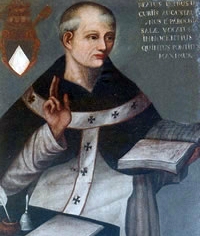
Blessed Innocent V

Peter of Tarentaise was barely 10 years old when he was admitted to the Dominican Order by Blessed Jordan of Saxony as a boy-novice and sent to Paris to study. Like Saint Thomas Aquinas, Blessed Ambrose of Siena, and other luminaries of the 13th century, he fell under the masterly tutelage of Saint Albert the Great.
He received his master’s degree in theology in 1259, then he taught for some years in Paris, where he contributed a great deal to the order’s reputation for learning. He wrote a number of commentaries on Scripture and the Commentary on the Sentences of Peter Lombard, but he devoted most of his time to the classroom. He soon became famous as a preacher and theologian, and in 1259, with a committee including his friend Thomas Aquinas, composed a plan of study that is still the basis of Dominican teaching.
At age 37, Peter began the long years of responsibility in the various offices he was to hold in his lifetime as prior provincial of France. He visited on foot all Dominican houses under his care, and was then sent to Paris to replace Thomas Aquinas at the University of Paris. Twice provincial, he was chosen archbishop of Lyons in 1272 and administered the affairs of the diocese for some time, though he was never actually consecrated for that see.
The next year Peter was appointed cardinal-archbishop of Ostia, Italy, while still administering the see of Lyons. With the great Franciscan, Saint Bonaventure, assumed much of the labor of the Council of Lyons to which Saint Thomas was hastening at the time of his death. To the problems of clerical reform and the healing of the Greek schism the two gifted friars devoted their finest talents. Before the council was over, Bonaventure died, and Peter of Tarentaise preached the funeral panegyric.
In January 1276, Peter was with Blessed Pope Gregory X when the latter died at Arezzo. The conclave was held in the following month. On January 21, 1276, Peter of Tarentaise received every vote except his own. With a sad heart, he left the seclusion of his religious home to ascend the Fisherman’s Throne as Pope Innocent V.
The reign of the new pope, which promised so much to a harassed people, was to be very brief. But, imbued with the spirit of the early apostles, he crowded a lifetime into the short space given him.
He instigated a new crusade against the Saracens and began reforms in the matter of regular observance. He actually succeeded in solving many of the questions of the Greek schism and in establishing a short-lived truce. He struggled to reconcile the Guelphs and Ghibellines, restored peace between Pisa and Lucca, and acted as mediator between Rudolph of Hapsburg and Charles of Anjou. He restored the custom of personally assisting at choral functions with the canons of the Lateran, and he inspired all with the love that animated his heart.
Had the measures begun by Innocent V had time to be fully realized, he might have accomplished great good for the Church; he did at least open the way for those who were to follow him. Death stopped the hand of the zealous pope when he had reigned only five months. Like his friends Saint Thomas and Saint Bonaventure, he was untouched by the honors and dignity with which he had been favored, and death found him exactly what he had been for more than 40 years–a simple, humble friar.
Born: 1245 at Tarentaise, Burgundy, France as Petrus a Tarentasia
Papal Ascension: 1276
Died: 1277 at Rome of natural causes
Beatified: cult was confirmed by Leo XIII in 1898

Blessed Hosanna of Mantua
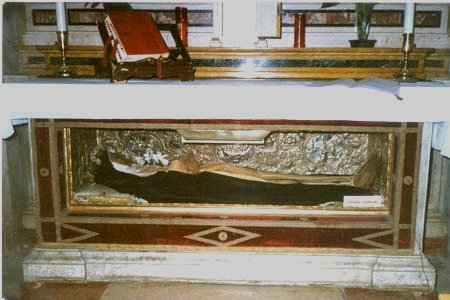
Osanna Andreassi was the daughter of the wealthy patrician Andreasio. She experienced visions from her early childhood, but kept the experiences to herself. At the age of six, she saw the Child Jesus carrying a cross and wearing a crown of thorns. He told her that He has a special love of children and purity. She was so impressed, as we all would be, that she immediately consecrated her entire life to God.
Osanna begged her father to allow her to learn to read so that she might be able to pray the Divine Office. He refused her request because it was a waste for a woman who was expected simply to raise a family. Osanna couldn’t explain why she wanted to learn; she couldn’t reveal her plans to him. When she was 14 and knew that he was arranging a marriage for her, she furtively went to the Dominican church and received the habit of its tertiaries. When she appeared at home in her religious garb, she explained that she had made a vow and must wear it until she had fulfilled her promise.
Now, this should not be understood as condoning deceit, but it served God’s purpose. Her pious father accepted her explanation for a time. As the months passed he began to suspect what had happened. He had already refused to give her permission to enter the convent, and he was displeased that she should try to live as a tertiary in his own home. Eventually, his father’s heart melted and he allowed Osanna to continue her routine of prayer, penance, and charity for the rest of her life. She was not professed until a few months before her death forty-two years later.
After the early death of both her parents, Osanna spent her fortune in the service of the poor. Her house became a center for people to discuss spiritual matters, for the needy and the sick, for the wealthy and the noble.
It is said that like Saint Catherine, she miraculously learned to read. One day she saw a piece of paper with two words and said, “Those words are ‘Jesus’ and ‘Mary.'” From that time she could read anything pertaining to spiritual matters. By the same sort of favor, she also learned to write.
At age 28 (1477), Osanna received the mark of the wound in Jesus’ side, caused by a long nail. For the next year various of the sacred wounds would appear, including the crown of thorns. Others saw them only on Wednesdays, Fridays, and during Holy Week, but it appears that they were visible to her and caused both pain and joy.
At this time Osanna felt the need for a spiritual director and prayed for one with wisdom, patience, and understanding. She found him during Mass when an interior voice said to her, “That’s the one you need, the one who is saying Mass.” Osanna thought he was too young, but, upon meeting him in the confessional a few days later, all doubts were erased.
Before her death, the soul of Blessed Columba of Rieti, another Dominican tertiary, appeared to her and told Osanna to prepare for death.
Born: January 17, 1449 at Mantua, Italy
Died: 1505 of natural causes
Beatified: November 24, 1694 Pope Innocent XII (cultus confirmed)
Representation: In art, Osanna is a Dominican tertiary wearing a crown of thorns, surrounded by rays of light (not the halo of a saint), a lily, a broken heart with a crucifix springing from it, the devil under her feet, two angels (one with a lily, one with a cross). This is similar to the image of Saint Catherine of Siena, who has a halo. Osanna is the patroness of school girls.
Blessed Stephen Bandelli
Stephen Bandelli was born into a noble family. Little is known of his early years except that he applied for admission to the Dominicans in his hometown and received the habit while still very young.
Stephen earned a degree in canon law and a master’s degree in theology, and lectured at the University of Pavia. He was a man of superior intellect and a careful student. Tradition holds that he was “another Saint Paul,” and that his sermons were effective in bringing many Christians to a more fervent life and many sinners back into the fold. Aside from this, one reads only the traditional assurances–that he was prayerful, penitential, had a spirit of poverty, was charitable, and was a model religious.
When Stephen died, he was buried in the Dominican church of Saluzzo. Many miracles were worked at his tomb, and the citizens of Saluzzo invoked him, in 1487, when the town was attacked by one of their neighbors. Their preservation was attributed to Stephen’s intercession, as it was claimed that he had appeared in the sky above them while they were fighting. An annual feast was kept there in his honor for many years.
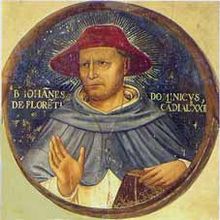
Blessed John Dominici
John is an example of the triumph of spirit over difficulty, and an indication that God can use any type of instrument He chooses, if He has a certain work to be done. John was almost rejected by the Dominicans because he had such a severe speech defect that the superior felt he would never be able to preach–a real impediment in the Order of Preachers.
The saint was born into a poor Florentine family. His early years were noted for piety. In fact, if anyone came looking for him, his mother would say, “Go and look in the church. He spends most of his time there.” He had a special love for the Dominican church of Santa Maria Novella, and he haunted it from early morning to late at night. It was not a surprise to anyone when, at the age of 17, he decided to enter the Dominican order.
Here several difficulties presented themselves. John had no background of education, which was absolutely necessary in an order of scholars. To make matters worse, he had the speech defect. Some of the fathers felt that he should support his parents, although they protested that this should not stand in the way of their son’s vocation. It was two years before John was allowed to begin his novitiate at Santa Maria Novella. The order soon discovered the treasure they had. John excelled in theology and Sacred Scripture, and so he was sent, with the other superior students, to finish his studies in Paris.
Now he was face to face with the difficulty that his superiors had seen from the beginning. An ordained priest, member of a preaching order, he must fulfill his vocation by preaching. His superiors attempted to forestall any embarrassment by assigning him work in the house. John felt that the intervention of heaven was required, so with the utmost simplicity he prayed to Saint Catherine of Siena, who had just died, to cure him. The impediment disappeared, and John joyfully began to preach. He became one of the most famous Dominican preachers.
In 1392, after years of successful missionary work in all the cities of Italy, John was appointed vicar-provincial of the Roman province. It was a task that, both intellectually and spiritually, called for a giant.
The plague had cut into the order with such devastating effect that regular life barely existed. The convent of Santa Maria Novella had lost 77 friars within a few months; other convents were in even worse condition. The mortality had been higher among the friars than anywhere else, because they had gone quite unselfishly to the aid of the stricken people. However, this misfortune had left the order perilously understaffed, and there were a good many members who believed quite sincerely that the conditions of the time called for a mitigated observance of the rule. Many of the houses were already operating in this fashion. It was to be the principal work of Blessed John Dominici to right this condition, and bring back the order to its first fervor.
He began his work with a foundation at Fiesole. Before he had even erected the new convent, four young men received the habit, one of whom was Antoninus–future saintly archbishop of Florence. Two years later, two of the most gifted young artists in Italy, whom history would know as Fra Angelico and his brother, Fra Benedetto, received the habit. With these and other earnest young men, John Dominici set about the difficult work of building anew an order that had suffered a diminution of its original fervor. Soon the house at Fiesole,and others modeled upon it, could be described, as the first houses of the order were, the “homes of angels.”
Difficult days were in preparation for John Dominici. He was appointed cardinal in 1407, named archbishop of Ragusa, and chosen as confessor to the pope. Due to schism, there were two claimants to the papacy. The situation grew even worse when, after another election, no less than three powerful men claimed to have been lawfully elected pope.
Largely through the diplomacy and wise counsel of John Cardinal Dominici, the rival claimants to the papal throne agreed to withdraw their claims, and the groundwork was laid for the election of a new and acceptable candidate. At this time, John Dominici publicly renounced his cardinalate, thus indicating to the enemies who accused him of political ambition that he cared nothing for honors in this world.
John was preaching in Hungary against the heresies of John Hus at the behest of the pope when he died. He was buried in the Church of Saint Paul the Hermit in Buda. Many miracles were worked at his tomb before it was destroyed by the Turks (Benedictines, Dorcy).
Born: 1356 at Florence, Italy
Died: June 10, 1419 of a fever at Buda, Hungary; buried in the Church of Saint Paul the Hermit in Buda; his tomb became noted for miracles, and was briefly a pilgrimage point; it was destroyed by the Turks
Beatified: 1832 (cultus confirmed); 1837 (beatified) by Pope Gregory XVI
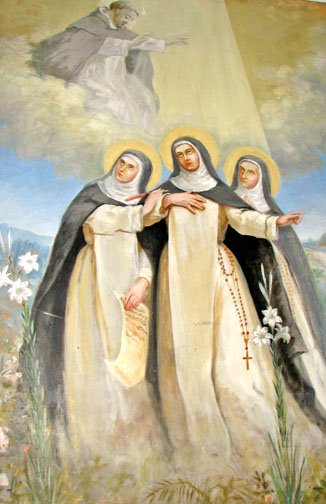
Blessed Diane, Blessed Cicely & Blessed Amata
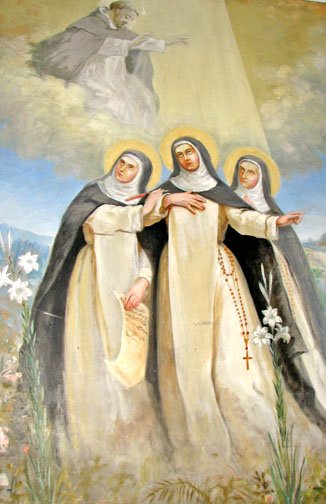
Diana, Caecilia, and Amata were the first members of Saint Agnes Dominican Convent in Bologna, Italy. They all knew Saint Dominic personally. Little is known of Sister Amata except that she was a good friend of Saint Dominic, who, according to legend, gave her the name Amata (‘beloved’). Dominic either sent her to the reformed convent of Saint Sixtus when the nuns left Saint Mary’s across the Tiber during a time of drastic reform, or he was instrumental in allowing her to stay there. There was an Amata from whom Dominic cast out seven devils, but it was probably not this Amata.
Caecilia Caesarini was a high-spirited young Roman of an ancient family; she threw her considerable influence into the reform movement at the time Saint Dominic was attempting to get the sisters into Saint Sixtus and under a strict rule. When the saint came to speak to the sisters at Saint Mary’s, it was Caecilia (then 17) who urged the prioress to support his cause. She was the first to throw herself at Dominic’s feet and beg for the habit and the rule he was advocating, and her hand is evident in the eventual working out of the touchy situation. In 1224, Caecilia and three other sisters from Saint Sixtus, including Amata, went to Saint Agnes in Bologna to help with the new foundation. Sister Caecilia was the first prioress there and proved to be a very strict one.
Caecilia is responsible for relating nearly everything now known about the personal appearance and habits of Saint Dominic. In her extreme old age, she was asked by Theodore of Apoldia to give him all the details of the saint’s personality, and all that she could recall of the early days of the order, so that he could record them for posterity. Though nearly 90, her memory was keen and specific. She recalled how Dominic used his hands, the precise shade of his hair, the exact line of his tonsure. If she erred, there were still people alive who could have corrected her, though there was probably no one with her descriptive power left to tell the tale.
Through a woman’s eyes, she saw the founder from a different angle than his fellow preachers were apt to see, and remarked on his gentleness with the sisters, and the little touches of thoughtfulness so characteristic of him. While the men who worked with him would recall his great mind and his penances, and appreciate the structural beauty of the order he had founded, Caecilia saw the glow of humanity that so many historians miss.
The most colorful of the three was Sister Diana, the spoiled and beautiful daughter of the d’Andalo and Carbonesi families of Bologna, who lost her heart to the ideal of the Dominicans when listening to Reginald of Orléans preach. She espoused the cause of the friars, who were new in Bologna, and begged her father until she obtained from him the church of Saint Nicholas of the Vineyards, of which he had the patronage.
Having established the brethren, she wanted a convent of the Dominican sisters in Bologna. When Saint Dominic came there on his last journey, she talked with him, and all her worries departed. She knelt at his feet and made a vow to enter the Dominicans as soon as it should be possible to build a convent at Bologna. Saint Dominic, going away to Venice on a trip from which he would only return to die, made sure before leaving that the brethren understood about Diana. Four of the fathers from the community of Saint Nichola were under obedience to see that her convent was built.
In the meantime, Diana’s father refused her permission to enter the convent. Stealing a leaf from the life of Saint Clare, she ran away to the Augustinians outside the city. In full armor, her brothers came after he, and Diana was returned, battered but unconvinced, to the paternal home. She nursed a number of broken ribs and several explosive ideas in silence.
The death of Saint Dominic was a great grief to Diana, as she was still living in a state of siege at home, waiting for some action on the question of the new convent. However, she soon acquired a new friend, who was to be her greatest joy in the years of her mortal life–Jordan of Saxony, master general of the order following Dominic. Jordan, as provincial of Lombardy, inherited the job of building the Bologna convent, but his relations with Diana were not to be merely mundane. Their friendship, of which we have the evidence in Jordan’s letters, is a tribute to the beauty of all friendship, and a pledge of its place in religious life.
Diana was resourceful. She made another attempt to elope to the convent. This time her family gave up in despair. She remained peacefully with the Augustinians until the new convent was built. In 1223, Diana and several other young women received the Dominican habit from Jordan of Saxony. Diana was the prioress for a time, but perhaps Jordan felt that she was too volatile for ruling others, because, as soon as the sisters came from Saint Sixtus, he established Sister Caecilia as prioress. Diana, who was used to being not only her own boss, but the one who gave orders to others, seems to have made no protest.
If we had the letters written by Diana, we should possess a fascinating picture of the early years of the order and the people who made it what it is. We are indebted to Diana for what we do have of the correspondence, for she carefully saved all of Jordan’s letters. They tell us of the progress made by the friars in various lands, and ask her to remind the sisters to pray for the missionaries. Jordan counts the successes when many good novices have come into the order, begging her prayers in the low moments when promising novices leave.
More than this, these are letters of spiritual direction, which should give a pattern to all such correspondence, for they infer that Diana is a willing and energetic Christian who will follow the advice she is given, not simply keep the correspondence going for the joy of it.
Diana died in 1236. She was buried in the convent of Saint Agnes. Her remains were transferred when a new convent was built, and Sister Caecilia–who died 60 years later–was buried near her, along with Sister Amata. The relics were transferred several times, all three together. The head of Blessed Diana was placed in a reliquary near the tomb of Saint Dominic.
Born: twelfth century
Died: thirteenth century
Beatified: Pope Leo XIII confirmed their cult in 1891
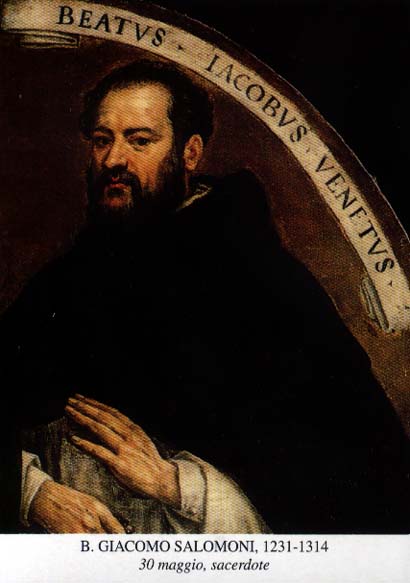
Blessed James Salomonio
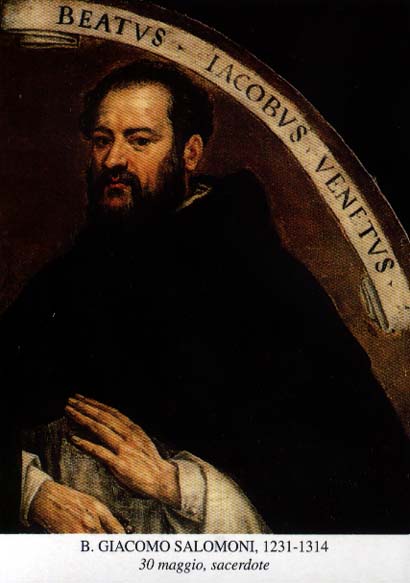
In a little chapel in Forli, built as a tomb for honored dead, there are three Dominicans laid in close proximity. One side is occupied by Blessed Marcolino of Forli. The center position is held by Carino of Balsamo, the assassin of saint Peter Martyr, whose long penance and popular holiness are now under consideration for his possible beatification; the third place is that of Blessed James of Saomomio, who was the spiritual director of Carino.
James was born in Venice, in 1231, the only child of noble parents. His father died when he was very small, and his mother became a Cistercian nun, leaving him to the care of his grandmother. She did well by her orphaned grandson, and James became a good and studious boy who responded eagerly to any spiritual suggestions. Under the direction of a Cistercian monk, he learned to meditate, and on the monk’s counsel, James became a Dominican at the convent of Sts. John and Paul, in Venice, as soon as he was old enough. He gave most of his money to the poor, and arrived at the convent with just enough left to buy a few books. Seeing that one of the lay brothers there was in need of clothing, he gave his small sum to the lay brother and entered empty-handed.
James wore the Dominican habit with dignity and piety, if not with any worldly distinction, for sixty-six years. He was humble and good and obedient, and there was nothing spectacular about his spirituality. He was well-known for his direction of souls, but he fled even from the distinction this work brought him.
Even his retiring habits did not protect him, for the people of Venice beat a path to his door. In self -defense, he transferred to another house, that of Forli. This was a house of strict observance and very poor. Nothing could suit him better. For the remainder of his life he worked and prayed in Forli, going out to visit the sick in the hospitals and spending long hours in the confessional. His charity to the poor and the sick gave him the name ” Father of the Poor.” He is represented in art surrounded by a horde of petitioners of this sort.
Born: 1231 at Venice, Italy
Died: March 31,1314 of cancer at Forli, Italy; buried in the chapel at Forli
Beatified: He was beatified in 1526 by Clement VII
Patronage: invoked against cancer
Representation: Dominican surrounded by a horde of petitioners; Dominican with a staff and book and the Christ-child over his heart; Dominican holding a heart with the letters “IHS” on it.
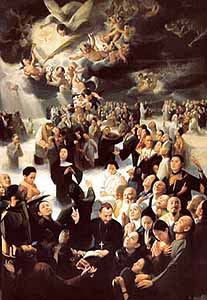
Blessed Peter Sanz, & Companions

The viceroy of Peking wrote this about the five martyrs that included Peter Sanz: “What are we to do with these men? Their lives are certainly irreproachable; even in prison they convert men to their opinions, and their doctrines so seize upon the heart that their adepts fear neither torments nor captivity. They themselves are joyous in their chains. The jailors and their families become their disciples, and those condemned to death embrace their religion. To prolong this state is only to give them the opportunity of increasing the number of Christians.”
Peter Sanz was among the first group of martyrs in Tonkin, which also included Bishop Francis Serrano, Father Joachim Royo, Father John Alcober, and Father Francis Diaz.
Peter Sanz was professed a Dominican at Lerida when he was 18 (1697). He was ordained in 1704, volunteered for the Chinese missions, and was sent to Manila, The Philippines, in 1713. After studying the language for two years, he entered China where he spent 31 years evangelizing the Chinese before he was captured. In 1730, he was nominated vicar apostolic of Fukien and titular bishop of Mauricastro. When a renewed persecution of Christians flared up in 1746, he was accused of breaking the laws by converting thousands to Christianity by a man to whom he had refused to lend money, according to one account.
The five men, bound together by their vows and their work, were brought more closely together during their imprisonment at Foochow. Fathers Serrano, Alcober, and Diaz were captured first, and tortured to reveal the whereabouts of Bishop Sanz. They did not break down, but the bishop and Father Royo, hearing about the torture, surrendered in the hope of sparing their brothers’ suffering, says another account.
The five priests were dragged in chains to the emperor’s court, where they were subjected to frightful torments. All of them, with a catechist named Ambrose Kou, were sentenced to death in December 1746. During the long imprisonment, a Dominican, Father Thomas Sanchez, managed to see them. He brought them some clothes and a little money, and all the news he could find.
On May 25, 1747, Bishop Sanz was beheaded at Fu-tsheu. Even the pagans were impressed with his gentle demeanor as he was led out to die, and a fellow prisoner who had been converted in prison, followed him closely through the mob, openly proclaiming his sanctity. As the headsman prepared to swing the axe, the venerable bishop looked at him and said, “Rejoice with me, my friend; I am going to heaven!”
“I wish I were going with you!” blurted out the unhappy man.
Laying his head upon the block, the bishop preached his last sermon: “If you want to save your soul, my friend, you must obey the law of God!” Pagan friends of the priests scurried through the crowd, gathering up the relics which they saved for the Christians. Many of these people, including the executioner, were later baptized.
On October 20, 1747, after the death of Sanz, word arrived that Father Serrano was had been appointed titular bishop of Tipsa and coadjutor to Blessed Peter Sanz. At that point, he and the others were summarily executed at Fukien.
Born: September 22, 1680 in Ascó, Catalonia, Spain
Died: beheaded on May 26, 1747 in Fuzou, China
Beatified: May 14, 1893 by Pope Leo XIII
Blessed Sadoc & Companions

Saint Dominic’s dreams of converting the Tartars found realization in his sons. Missionaries did, in fact, go to the North during his lifetime, and many more were sent out by Blessed Jordan of Saxony. The more settles tribes of Poland and Hungary readily accepted the Gospel, and the North was not long in blooming with Dominican convents. But, in the thirteenth century, the restless millions of the East were riding down upon the fertile plains of Central Europe. Wild Tartar tribes soon destroyed what has been done for their more peaceful relatives, and scarcely a missionary survived to preach his message of peace to them.
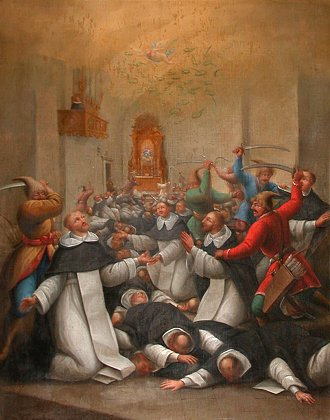
Paul of Hungary and his band of ninety died as martyrs, probably in 1241. They were popularly honored as saints from earliest times. Soon to follow was the group headed by Blessed Sadoc, which had its headquarters at Sandomir, in Poland. So tragic was the early history of the Dominicans in Poland that, even in that martyred country, it is remembered. Polish Dominicans today wear a red cincture to recall the martyred hundreds who shed their blood that Poland might receive the light of truth.
Blessed Sadoc was a student at the university of Bologna when he met Saint Dominic and was received unto the Order. Being himself a Slav, he was eager to go to the North to preach the word of God. This he was given a chance to do when he and Paul of Hungary were given charge of the northern mission band. He soon accumulated a number of eager young students and novices, and proceeded to Poland with them. On his first night in the mission field, so say the old chronicles, the devil appeared to Sadoc and reproached him for disturbing his works: “And with such children as these,” he said bitterly, pointing to the young novices. With such as these, Sadoc did make havoc with the kingdom of evil: he won many souls to God, and, in Sandomir, he soon had the satisfaction of seeing a large community working for the glory of God.
In 1260, the Tartars made a fresh invasion into Poland and attacked Sandomir. Blessed Sadoc and his community had assembled for midnight Matins when they received warning of their approaching deaths. A novice, reading the martyrology for the following day, was amazed to see, lettered in gold across the pages of the martyrology, the words: ” At Sandomir, the passion of forty-nine martyrs.” On investigation, it was discovered that it was not merely a novice’s mistake, but an actual warning which they understood to be from heaven.
They spent the day in preparation for death. During the singing of the “Salve Regina,” after Compline, the Tarttars broke into the church and the slaughter began. One novice, terrified at the thought of death, fled to the choir loft to hide, but hearing his brothers singing, he realized that they were going off to heaven without him, and he returned to the choir to die with the others.
From this martyrdom came the customs of singing the “Salve Regina” at the deathbed of a Dominican-priest, sister, or brother. It is fitting that a life dedicated to God and Our Lady should end thus, with the battle cry “HAIL HOLY QUEEN!” echoing up from this valley of tears to be joined by the voices of Dominicans in heaven, who can now see forever the clement, loving, and sweet Virgin Mary.
Born: Various years within the Thirteenth century
Died: died 1260
Beatified: Their cult was confirmed in 1807 by Pope Pius VI

Blessed Alphonsus Navarette & Companions

Dominicans were the first missionaries to Japan, and 1530 is given as the date of their martyrdom. However, no conclusive proof exists regarding their names or number, and Saint Francis Xavier rightly holds the title of apostle to this island kingdom.
Following in Xavier’s footsteps came other missionaries, and, for about 40 years, they worked with great results among the people. Then, in the closing years of the century, persecution flared, and the blood of martyrs cried out with a louder voice than that of the preachers.
Ferdinand took the Augustinian habit in Mentilla, and in 1603, was sent to Mexico, and thence to Japan in 1605 as vicar provincial. He worked at Osaka with great success until his capture and execution en route to Omura.
The first Dominican to die in the great persecution was Alphonsus Navarrete. When Alphonsus was very young, he gave up his inheritance to enter the Dominican Order in Valladolid and, after he had completed his studies, was sent to the Philippine missions. The great persecution had just begun in Japan. The year before Alphonsus left Spain, a group of 26 Christians, including many Franciscans and three Japanese Jesuits, were crucified in Nagasaki.
Despite the dangers, the Dominicans, who had been excluded from Japan for several years, yearned to go into the perilous mission field. Alphonsus in particular, after a trip to Europe to recruit missionaries in 1610, begged to be allowed to go to Japan. In the following year his offer was accepted and he was sent as superior of the missionary band. During the short interval of peace, they began their work, and, during six years of growing danger, they instructed the people and prepared them for the dreadful days to come.
The missionary career of Alphonsus was brief, and it was always overshadowed by the threat of death that beset the Christians in that unhappy country. However, in the few years of his apostolate, his accomplishment was immeasurable. Like his Divine Master, he went about teaching and baptizing the people. He is called the “Vincent de Paul of Japan,” because it was he who first began the tremendous task of caring for the abandoned babies there. He anticipated the work of the Holy Childhood Society by gathering up the homeless waifs and providing for their support from money he begged of wealthy Spaniards.
The warning bell of the great persecution was sounded with the martyrdom in Omura of two priests, a Franciscan and a Jesuit. Alphonus Navarrete and his Augustinian companion Ferdinand went to Omura with the intention of rescuing the relics of the martyrs and consoling the Christians. They were captured on the way, and with a young native catechist, were beheaded. Their bodies were thrown into the sea.
Five years later, on the hill of the holy martyrs of Nagasaki, more than 50 Christians sealed their faith with their blood. Some of the martyrs were beheaded, some were burned at the stake. In the group were nine Jesuits, including the famous Father Charles Spinola, nine Franciscans, and nine Dominicans, among whom were the Blesseds Alphonsus de Mena, Angelo Orsucci, and Hyacinth Orphanel. Louis Bertrand, a nephew of the saint of that same name, perished in the same persecution.
Thousands of Japanese Christians, from tiny children to old grandparents, died amid terrible torments in the profession of their faith. The anger of the persecutors was turned against all priests, brothers, and catechists, tertiaries, and Rosarians, and they made fearful attempts to stamp out all traces of the hated religion in the country. Pope Pius IX, in 1867, solemnly beatified 205 of the martyrs, among whom were 59 Dominicans of the first and third orders and 58 members of the Rosary Confraternity. Although all did not die at the same time nor place, they are listed under the name of Alphonsus Navarrete, who was the first to die.
Born: Various dates in the sixteenth century
Died: died the most terrible torments in Japan in 1617
Beatified: Pius IX beatified them in 1867
Our Lady of Fatima
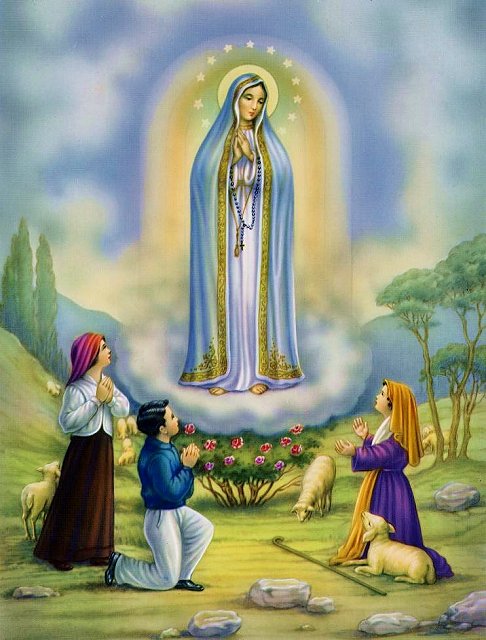
 May 13 is the anniversary of the apparition of Our Lady to three shepherd children in the small village of Fatima in Portugal in 1917. She appeared six times to Lucia, 9, and her cousins Francisco, 8, and his sister Jacinta, 6, between May 13, 1917 and October 13, 1917.
The story of Fatima begins in 1916, when, against the backdrop of the First World War which had introduced Europe to the most horrific and powerful forms of warfare yet seen, and a year before the Communist revolution would plunge Russia and later Eastern Europe into six decades of oppression under militant atheistic governments, a resplendent figure appeared to the three children who were in the field tending the family sheep. “I am the Angel of Peace,” said the figure, who appeared to them two more times that year exhorting them to accept the sufferings that the Lord allowed them to undergo as an act of reparation for the sins which offend Him, and to pray constantly for the conversion of sinners.
Then, on the 13th day of the month of Our Lady, May 1917, an apparition of ‘a woman all in white, more brilliant than the sun’ presented itself to the three children saying “Please don’t be afraid of me, I’m not going to harm you.” Lucia asked her where she came from and she responded, “I come from Heaven.” The woman wore a white mantle edged with gold and held a rosary in her hand. The woman asked them to pray and devote themselves to the Holy Trinity and to “say the Rosary every day, to bring peace to the world and an end to the war.”
She also revealed that the children would suffer, especially from the unbelief of their friends and families, and that the two younger children, Francisco and Jacinta would be taken to Heaven very soon but Lucia would live longer in order to spread her message and devotion to the Immaculate Heart.
In the last apparition the woman revealed her name in response to Lucia’s question: “I am the Lady of the Rosary.”
That same day, 70,000 people had turned out to witness the apparition, following a promise by the woman that she would show the people that the apparitions were true. They saw the sun make three circles and move around the sky in an incredible zigzag movement in a manner which left no doubt in their minds about the veracity of the apparitions. By 1930 the Bishop had approved of the apparitions and they have been approved by the Church as authentic.
The messages Our Lady imparted during the apparitions to the children concerned the violent trials that would afflict the world by means of war, starvation, and the persecution of the Church and the Holy Father in the twentieth century if the world did not make reparation for sins. She exhorted the Church to pray and offer sacrifices to God in order that peace may come upon the world, and that the trials may be averted.
Our Lady of Fatima revealed three prophetic “secrets,” the first two of which were revealed earlier and refer to the vision of hell and the souls languishing there, the request for an ardent devotion to the Immaculate Heart of Mary, the prediction of the Second World War, and finally the prediction of the immense damage that Russia would do to humanity by abandoning the Christian faith and embracing Communist totalitarianism. The third “secret” was not revealed until the year 2000, and referred to the persecutions that humanity would undergo in the last century: “The good will be martyred; the Holy Father will have much to suffer; various nations will be annihilated’”. The suffering of the popes of the 20th century has been interpreted to include the assassination attempt on Pope John Paul II in 1981, which took place on May 13, the 64th anniversary of the apparitions. The Holy Father attributed his escape from certain death to the intervention of Our Lady: “… it was a mother’s hand that guided the bullet’s path and in his throes the Pope halted at the threshold of death.”
What is the central meaning of the message of Fatima? Nothing different from what the Church has always taught: it is, as Cardinal Ratzinger, now Pope Benedict the XVI, has put it, “the exhortation to prayer as the path of “salvation for souls” and, likewise, the summons to penance and conversion.”
Perhaps the most well known utterance of the apparition of Our Lady at Fatima was her confident declaration that, “My Immaculate Heart will triumph”. Cardinal Ratzinger has interpreted this utterance as follows: “The Heart open to God, purified by contemplation of God, is stronger than guns and weapons of every kind. The fiat of Mary, the word of her heart, has changed the history of the world, because it brought the Savior into the world—because, thanks to her, God could become man in our world and remains so for all time. The Evil One has power in this world, as we see and experience continually; he has power because our freedom continually lets itself be led away from God. But since God himself took a human heart and has thus steered human freedom towards what is good, the freedom to choose evil no longer has the last word. From that time forth, the word that prevails is this: “In the world you will have tribulation, but take heart; I have overcome the world” (John 16:33). The message of Fatima invites us to trust in this promise.
 The Order of Preachers, Independent
You must be logged in to post a comment.