
Category: Dominican Saints
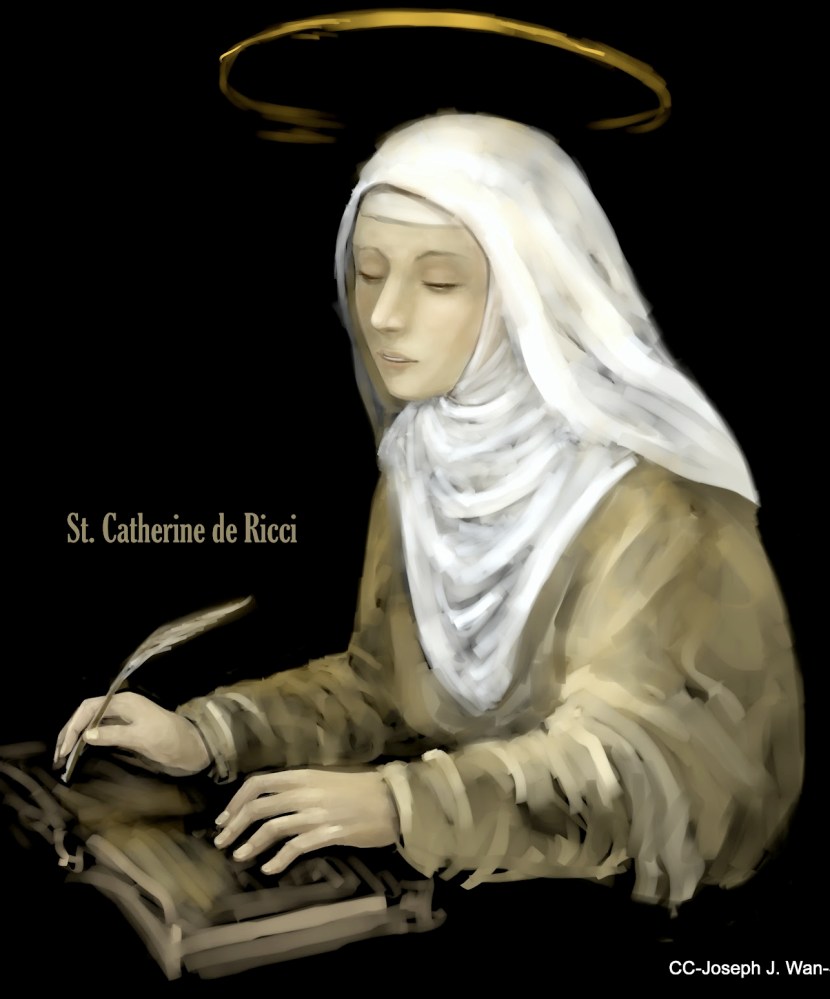
Saint Catherine of Ricci

Alexandrina dei Ricci was born of a patrician family, but Catharine Bonza died leaving her motherless in her infancy. She was trained in virtue by a very pious godmother. The little girl took Our Lady as her mother and had for her a tender devotion. The child held familiar conversations with her guardian angel, who taught her a special manner of saying the rosary and assisted her in the practice of virtue.
As soon as Alexandrina was old enough to go away from home (age 6 or 7), she was sent to the convent school of Monticelli, where her aunt, Louisa dei Ricci, was the abbess. Besides learning her lessons for which she was sent, the little girl developed a great devotion to the Passion. She prayed often before a certain picture of Our Lord, and at the foot of a crucifix, which is still treasured as “Alexandrina’s crucifix.” Returning from the monastery when her education was completed according to the norm for girls, she turned her attention to her vocation.
In her plans to enter a monastery of strict observance, she met with great opposition from her father Peter. She loved the community life that had allowed her to serve God without impediment or distraction. She continued her usual exercises at home as much as she was able, but the interruptions and dissipations that were inseparable from her station, made her uneasy.
Finally, Peter allowed her to visit St. Vincent’s convent in Prato, Tuscany, which had been founded by nine Third Order Dominicans who were great admirers of Savonarola. Alexandrina begged to remain with them; however, her father took her away, promising to let her return. He did not keep his promise, and the girl fell so ill that everyone despaired of her life. Frightened into agreement, her father gave his consent; Alexandrina, soon recovering, entered the convent of Saint Vincent.
In May 1535, Alexandrina received the habit from her uncle, Fr. Timothy dei Ricci, who was confessor to the convent. She was given the name Catherine in religion, and she very happily set about imitating her beloved patron. Lost in celestial visions, she was quite unaware that the sisters had begun to wonder about her qualifications for the religious life: for in her ecstasies she seemed merely sleepy, and at times extremely stupid. Some thought her insane. Her companions did not suspect her of ecstasy when she dozed at community exercises, spilled food, or broke dishes.
Neither did it occur to Sister Catherine that other people were not, like herself, rapt in ecstasy. She was about to be dismissed from the community when she became aware of the heavenly favors she had received. From then on there was no question of dismissing the young novice, but fresh trials moved in upon her in the form of agonizing pain from a complication of diseases that remedies seemed only to aggravate. She endured her sufferings patiently by constantly meditating on the passion of Christ, until she was suddenly healed. After her recovery, she was left in frail health.
Like Saint John of Egypt and Saint Antony, Catherine met Philip Neri in a vision while he was still alive and in Rome. They had corresponded for a long time and wanted to meet each other but were unable to arrange it. Catherine appeared to Philip in a vision and they conversed for a long time. Saint Philip, who was also cautious in giving credence to or publishing visions, confirmed this. This blessed ability to bilocate, like Padre Pio, was confirmed by the oaths of five witnesses. Also like those desert fathers, Antony and John, she fasted two or three times weekly on only bread and water, and sometimes passed an entire day without taking any nourishment.
Like Saint Catherine of Siena, she is said to have received a ring from the Lord as a sign of her espousal to him–a mysterious ring made of gold set with a diamond, invisible to all except the mystic. Others saw only a red lozenge and a circlet around her finder.
Sister Catherine was 20 when she began a 12-year cycle of weekly ecstasies of the Passion from noon each Thursday until 4:00 p.m. each Friday. The first time, during Lent 1542, she meditated so heart-rendingly on the crucifixion of Jesus that she became seriously ill, until a vision of the Risen Lord talking with Mary Magdalene restored her to health on Holy Saturday.
She received the sacred stigmata, which remained with her always. In addition to the five wounds, she received, in the course of her Thursday-Friday ecstasies, many of the other wounds which our Lord suffered. Watching her face and body, the sisters could follow the course of the Passion, as she was mystically scourged and crowned with thorns. When the ecstasy was finished, she would be covered with wounds and her shoulder remained deeply indented where the Cross had been laid.
Soon all Italy was attentive and crowds came to see her. Skeptics and the indifferent, sinners and unbelievers, were transformed at the sight of her. Soon there was no day nor hour at which people did not come, people in need and in sin, people full of doubt and tribulation, who sought her help, and, of course, the merely curious. Because of the publicity that these favors attracted, she and her entire community asked our Lord to make the wounds less visible, and He did in 1554.
Her patience and healing impressed her sisters. While still very young, Catherine was chosen to serve the community as novice- mistress, then sub-prioress, and, at age 30, she was appointed prioress in perpetuity, despite her intense mystical life of prayer and penance. She managed the material details of running a large household well, and became known as a kind and considerate superior. Catherine was particularly gentle with the sick. Troubled people, both within the convent and in the town, came to her for advice and prayer, and her participation in the Passion exerted a great influence for good among all who saw it. Three future popes (Cardinals Cervini later known as Pope Marcellus II, Alexander de Medici (Pope Leo XI), and Aldobrandini (Pope Clement VIII)) were among the thousands who flocked to the convent to beseech her intercession.
Of the cloister that Catherine directed, a widow who had entered it observed: “If the world only knew how blessed is life in this cloister, the doors would not suffice and the thronging people would clamber in over all the walls.”
A contemporary painting of Catherine attributed to Nardini (at the Pinacoteca of Montepulciano) shows a not unattractive, though relatively plain woman. Her eyes protrude a bit too much and her nose is too flared to account her a classic beauty, but she possessed high cheekbones, dark hair, widely spaced eyes, and full lips. Her mein is that of a sensitive woman who has experience pain and now has compassion.
Catherine’s influence was not confined within the walls of her convent. She was greatly preoccupied by the need for reform in the Church, as is apparent from her letters, many of them addressed to highly-placed persons. This accounts, too, for her reverence for the memory of Savonarola, who had defied the evil-living Pope Alexander VI and been hanged in Florence in 1498. Saint Catherine was in touch with such contemporary, highly-orthodox reformers as Saint Charles Borromeo and Saint Pius V.
After Catherine’s long and painful death in 1589, many miracles were performed at her tomb. Her cultus soon spread from Prato throughout the whole of Italy and thence to the whole world. The future Pope Benedict XIV, the “devil’s advocate” in Catherine’s cause for canonization, critically examined all relevant claims. As in the case of her younger contemporary, Saint Mary Magdalene de’Pazzi, canonization was not granted because of the extraordinary phenomenon surrounding her life, but for heroic virtue and complete union with Christ (Attwater, Benedictines, Bentley, Dorcy, Encyclopedia, Farmer, Husenbeth, Schamoni, Walsh).
Born: April 23rd 1522 at Florence, Italy
Died: February 2, 1590 at Prato, Italy
Beatified: November 23, 1732 by Pope Clement XII
Canonized: June 29, 1746 by Pope Benedict XIV
Patronage: bodily ills; illness; sick people; sickness
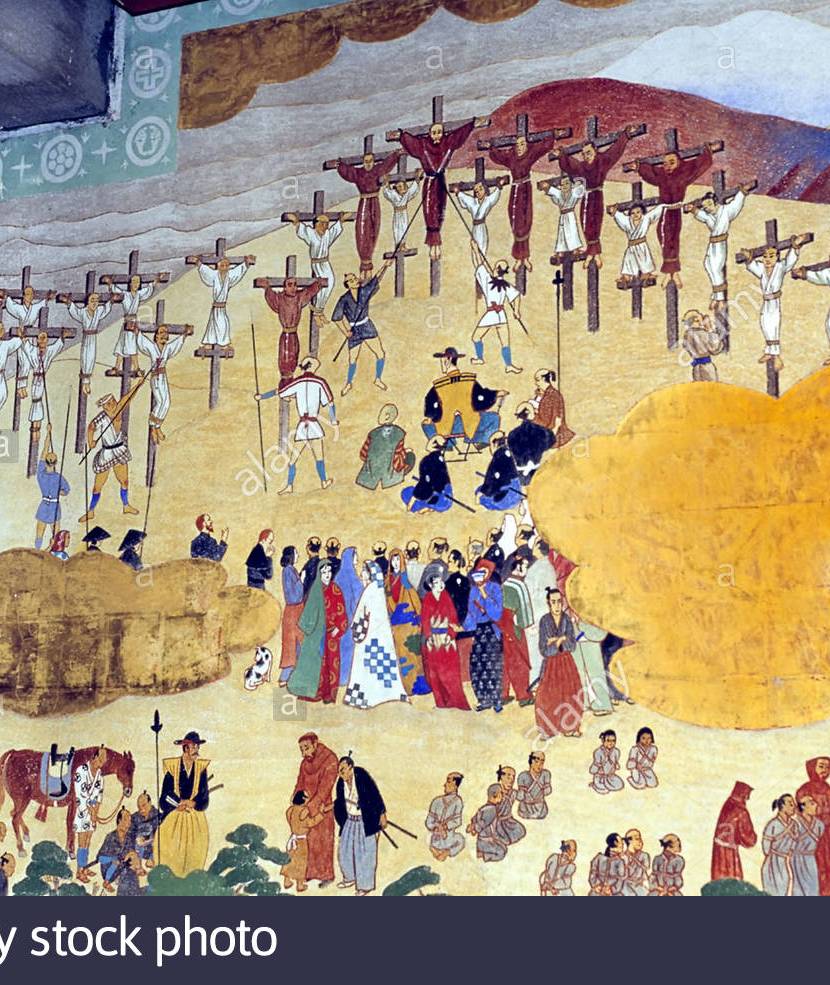
Defending the Faith – Memorial of Saint Paul Miki and Companions, Martyrs – Br. Michael Marshall, Novice
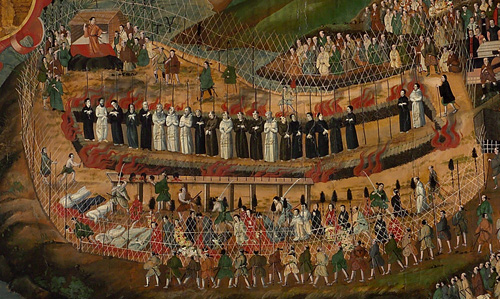
First Reading – Genesis 1:1-19
In the beginning, when God created the heavens and the earth,
the earth was a formless wasteland, and darkness covered the abyss,
while a mighty wind swept over the waters.
Then God said,
“Let there be light,” and there was light.
God saw how good the light was.
God then separated the light from the darkness.
God called the light “day,” and the darkness he called “night.”
Thus evening came, and morning followed–the first day.
Then God said,
“Let there be a dome in the middle of the waters,
to separate one body of water from the other.”
And so it happened:
God made the dome,
and it separated the water above the dome from the water below it.
God called the dome “the sky.”
Evening came, and morning followed–the second day.
Then God said,
“Let the water under the sky be gathered into a single basin,
so that the dry land may appear.”
And so it happened:
the water under the sky was gathered into its basin,
and the dry land appeared.
God called the dry land “the earth,”
and the basin of the water he called “the sea.”
God saw how good it was.
Then God said,
“Let the earth bring forth vegetation:
every kind of plant that bears seed
and every kind of fruit tree on earth
that bears fruit with its seed in it.”
And so it happened:
the earth brought forth every kind of plant that bears seed
and every kind of fruit tree on earth that
bears fruit with its seed in it.
God saw how good it was.
Evening came, and morning followed–the third day.
Then God said:
“Let there be lights in the dome of the sky,
to separate day from night.
Let them mark the fixed times, the days and the years,
and serve as luminaries in the dome of the sky,
to shed light upon the earth.”
And so it happened:
God made the two great lights,
the greater one to govern the day,
and the lesser one to govern the night;
and he made the stars.
God set them in the dome of the sky,
to shed light upon the earth,
to govern the day and the night,
and to separate the light from the darkness.
God saw how good it was.
Evening came, and morning followed–the fourth day.
Gospel – Mark 6:53-56
After making the crossing to the other side of the sea,
Jesus and his disciples came to land at Gennesaret
and tied up there.
As they were leaving the boat, people immediately recognized him.
They scurried about the surrounding country
and began to bring in the sick on mats
to wherever they heard he was.
Whatever villages or towns or countryside he entered,
they laid the sick in the marketplaces
and begged him that they might touch only the tassel on his cloak;
and as many as touched it were healed.
Not until I was in seminary in Chicago, did I learn about a little bit of the history of Christianity in Japan; as I became a little familiar because of a course on world mission. Yet I had not encountered someone from Japan who is a Christian until seminary. In fact, prior to seminary, when I thought of religion in Japan, the beautiful pagodas and temples with ornate flower gardens stuck out in my mind. These structures are traditionally places of worship for the Shinto and Buddhist religions, so the idea of Christianity in Japan never crossed my mind. Nor did I ever think I would meet a Japanese Christian, but I met Toshio who was a fellow seminarian and a member of a different religious order than the one to which I belonged; and I truly wish I could have talked with him more about Christianity in Japan because there is more history than I ever learned in that world mission course, but never got the chance to learn more from him.
When doing some research about Saint Paul Miki and the other Martyrs, I learned that Christianity in Japan dates back to the mid-16th century with Saint Xavier bringing Catholicism to Japan. Initially, Christianity was rather well received in Japan because the government felt it would assist in the trade with Spain and Portugal, as well as limit the power that the Buddhist monks had within society. Unfortunately, this support did not last long because the government saw how the Spanish gained control of the Philippines through colonialization, and the local government had no real power. Practicing Christianity in Japan was banned in the 17th century and if anyone refused to give up their faith would be executed. In turn, Christianity became an underground religion until the return of missionaries in the 19th century. During the time of the persecution over 200 people were killed in a forty year span, and they came from various walks of life; some laity including children, while others were diocesan priests or belonged to the Jesuit, Franciscan, and Dominican religious orders.
Even though there were a large number of Japanese Christian martyrs who were beatified in 1867 and 1981, Saint Paul Miki and his companions belong to a group of 26 martyrs who were canonized by Pope Pius IX in 1862. What makes Paul Miki special is that he was the first Japanese Christian to belong to any religious order – the Jesuits. Along with the other 25, he was crucified one month prior to his ordination.
As we see in the reading from Genesis, God has started to create things of this Earth and each has its specific purpose. We do not get to see the part of the Creation story where God creates humans, but we are part of that story. EVERYTHING, including humans, has a purpose intended of us by God. We are to be stewards of Creation, and be evangelists of the Gospel. These are part of our mission, regardless if others reject and persecute us for our faith; just as the Japanese government persecuted Christians and those defending their faith were executed for not abandoning the faith.
Saint Paul Miki and his companions mirrored the Gospel reading. As missionaries, they ministered to the people of Japan, doing whatever had been called of them by God. We see in the Gospel that people from all over sought care and healing from Jesus. We know how the story ends, yet Jesus had His purpose; he was on Earth to preach the Good News of God, even until death on the cross.
We as Christians today, do not face a banning of our faith by our governments, yet there are times in which we need to stand up for our faith because of persecution of non-believers. We may even be attacked by other Christians because of certain beliefs about social issues. It may seem so easy to just give in and “follow the masses” to avoid the persecution, but we need to defend the faith and hold to our principles when they teach the Gospel. The life and mission Saint Paul Miki and all of the Christian martyrs is the example we should look to in our everyday Christian life.
Father, provide us with the strength and courage to defend the faith every day of our lives, especially when it seems so easy to just give in to avoid persecution. This we ask through Christ, Our Lord. Amen.
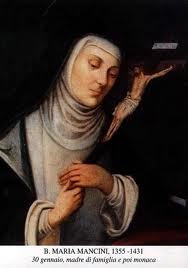
Blessed Mary Mancini of Pisa
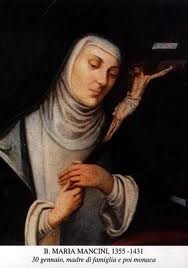
Catherine Mancini was born in Pisa in 1355, of noble parentage, and from infancy began enjoying the miraculous favors with which her life was filled. At the age of three, she was warned by some heavenly agency that the porch on which she had been placed by a nurse was unsafe. Her cries attracted the nurse’s attention, and they had barely left the porch when it collapsed. When she was five, she beheld in an ecstasy the dungeon of a place in Pisa in which Peter Gambacorta, one of the leading citizens, was being tortured. At Catherine’s prayer, the rope broke and the man was released. Our Lady told the little girl to say prayers every day for this man, because he would one day be her benefactor.
Catherine would have much preferred the religious life to marriage, but she obeyed her parents and was married at the age of twelve. Widowed at sixteen, she was compelled to marry again. Of her seven children, only one survived the death of her second husband, and Catherine learned through a vision that this child, too, would soon be taken from her. Thus she found herself, at the age of twenty five, twice widowed and bereft of all her children. Refusing a third marriage, she devoted herself to prayers and works of charity.
She soon worked out for herself a severe schedule of prayers and good works, fasting and mortifications. She tended the sick and the poor, bringing them into her own home and regarding them as Our Lord Himself. She gave her goods to the poor and labored for them with her own hands. Our Lord was pleased to show her that He approved of her works by appearing to her in the guise of a poor young man, sick, and in need of both food and medicine. She carefully dressed his wounds, and she was rewarded by the revelation that it was in reality her redeemer whom she had served.
St. Catherine of Siena visited Pisa at about this time, and the two saintly women were drawn together into a holy friendship. As they prayed together in the Dominican church one day, they were surrounded by a bright cloud, out of which flew a white dove. They conversed joyfully on spiritual matters, and were mutually strengthened by the meeting.
On the advice of St. Catherine of Siena, Catherine (Mary Mancini) retired to an enclosed convent of the Second Order. In religion, she was given the name Mary, by which she is usually known. She embraced the religious life in all its primitive austerity, and, with Blessed Clare Gambarcota and a few other members of the convent, she founded a new and much more austere house, which had been built by Peter Gambacorta. Our Lady’s prophecy of his benefactions was thus fulfilled.
Blessed Mary was favored with many visions and was in almost constant prayer. She became prioress of the house on the death of her friend Blessed Clare Gambacorta, and ruled it with justice and holiness until her death.
She died in 1431 and was beatified by Pius IX in 1855.

Holding Fast to the Faith ~ The Feast of St. Thomas Aquinas ~ Br. Brent Whetstone, Novice

The Church is faced with a dilemma. We are losing people to modernism in droves and the church has a decision to make: change who you are to conform to society or hold fast to the teachings of the Faith. Unfortunately may mainline denominations are doing the latter, they are changing to conform to the pressures that society is putting on them to change. They have stopped talking about the crucifixion, the resurrection, and the redemptive power of Christ. They deny the miracles we are told of in sacred scripture and have compromised the very foundations of Christianity. Bishops and Archbishops are on television preaching universalism and offering alternatives to salvation, through everything from Wicca to Islam to nothing at all. So the church has a choice. Change who you are or hold fast to the Faith. As a Dominican the answer is crystal clear to me. We hold on to the Faith and teach the Faith like our lives depended on it, because not only do our lives depend on it, but our souls do as well, and what better an appropriate time to talk about faith, and reason, than on the feast day of our Holy Brother and Teacher Saint Thomas Aquinas.
At the young age of five, Thomas was sent to live at the Benedictine monastery at Monte Cassino, as was the custom of the time. His parents’ hope was that he would chose the Benedictine life and eventually become abbot. In 1239 he was sent to Naples where he was to complete his studies and it was then that he was introduced to Aristotle’s philosophy. By 1243, however Thomas abandoned his family’s plans for him and it is then that he joined the Dominicans.
Once with the Dominicans Thomas traveled to Paris where he would finish his studies under Albert the Great, and he would live at the court of Pope Urban IV. He would direct the Dominican school in Rome, but his greatest contribution to the Church was the fact that he showed us that we could reconcile faith and reason. Because even then people were struggling with how this was possible and Saint Thomas was able to give us timeless teachings that we as Christians can use today.
Thomas believed that the existence of God could be proven in five ways. First by observing movement in the world as proof of God, the “Immovable Mover.” Second by observing cause and effect and identifying God as the cause of everything. Third by concluding that the impermanent nature of beings proves the existence of a necessary being, God, who originates only from within himself. Fourth by noticing varying levels of human perfection and determining that a supreme, perfect being must therefore exist, and fifth by knowing that natural beings could not have intelligence without it being granted to them it by God..
Thomas used faith and reason to establish his arguments, something that we must do as well. As Christians we are called to evangelize, a task that is met with much criticism and one that many people shy away from simply because they are not prepared to counter some of the very same arguments that Saint Thomas has already provided us with a foundation to argue.
As a Dominican I am committed to sharing the Word of God, I am committed to sharing it boldly and I am committed to sharing it from a place of faith and reason, being able to meet people where they are on their journey. But the greatest gift that we have because of Aquinas is that when we wrestle with doubt and when we wrestle with uncertainty, we have the example that he has set for us. We know that we can approach faith with reason to find our answers, we know that they complement each other not cancel each other out. Because of that we can grow stronger in our faith and be bold to proclaim the saving message of Christ.
We do not need to change who we are as a Church, we do not need to deny basic tenets of the Faith to be popular with the skeptics, instead we need to meet our skeptics with knowledge not only of faith but faith combined with reason so that their eyes may be opened to the truth of God. Let us pray:
O God, who made Saint Thomas Aquinas outstanding in his zeal for holiness
and his study of sacred doctrine, grant us, we pray, that we may understand what he taught
and imitate what he accomplished. Through our Lord Jesus Christ, your Son,
who lives and reigns with you in the unity of the Holy Spirit, one God, for ever and ever. Amen.
*Another great hymn from the great St. Thomas Aquinas. This version of the hymn does not include the 3rd or 4th verses. The art is “The temptation of St. Thomas Aquinas” by Diego Velazquez; “Triumph of St. Thomas Aquinas over the heretics” by Filippino Lippi; “The Apotheosis of Thomas Aquinas” by Francisco de Zurbaran. License Standard YouTube License Music “Adoro Te Devote” by Richard Proulx
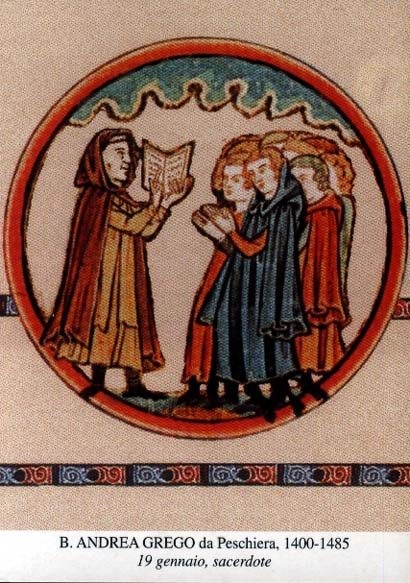
Blessed Andrew of Peschiera

As a child, Andrew Grego lived on the southern shore of Lake Garda, in northern Italy. His training for a life of heroic sanctity began early, with voluntary penances and unquestioning obedience to his father. Andrew’s first desire was to be a hermit, an ambition that was met with ridicule from his brothers. Failing to realize this hope, he made for himself a severe schedule of prayer and penance, and, in his own house, lived the life of one wholly given to God.
After the death of his father, it became increasingly difficult to carry out his plan, so he resolved to enter the cloister. Although his brothers had persecuted him without mercy, he knelt and humbly begged their prayers and forgiveness for having annoyed them. Then he gave them the only possession he had, a walking-stick. This stick, thrown carelessly in a corner by the brothers, was forgotten until, long afterwards, it bloomed like the legendary rod of Saint Joseph in token of Andrew’s holiness.
The 15-year old received the Dominican habit at Brescia and then was sent to San Marco in Florence. This convent was then at its peak of glory, stamped with the saintly personalities of Saint Antoninus and the Blesseds of Lawrence of Riprafratta, Constantius, and Antony della Chiesa. Andrew’s soul caught the fire of their apostolic zeal, and set forth on his mission in the mountains of northern Italy.
Heresy and poverty had combined to draw almost this entire region from the Church. It was a country of great physical difficulties, and, in his travels in the Alps, he risked death from snowstorms and avalanches as often as from the daggers of the heretics. Nevertheless, he travelled tirelessly, preaching, teaching, and building–for his entire lifetime.
Churches, hospitals, schools, and orphanages were built under Andrew’s direction. He would retire from time to time to these convents for periods of prayer and spiritual refreshment, so that he could return with renewed courage and zeal to the difficult apostolate. He was known as “the Apostle of the Valtelline,” because of the district he evangelized.
Blessed Andrew performed many miracles. Probably his greatest miracle was his preaching, which produced such fruits in the face of great obstacles. At one time, when he was preaching to the people, the heretics presented him with a book in which they had written down their beliefs. He told them to open the book and see for themselves what their teachings amounted to. They did so, and a large viper emerged from the book.
Blessed Andrew closed a holy life by an equally holy death, and died in 1485. He was buried in Morbegno. He had labored so long among the poor and the neglected that his place in their hearts was secured. Because of the miracles worked at his tomb, and the persistent devotion of the people, his relics were twice transferred to more suitable tombs. He was beatified in 1820.
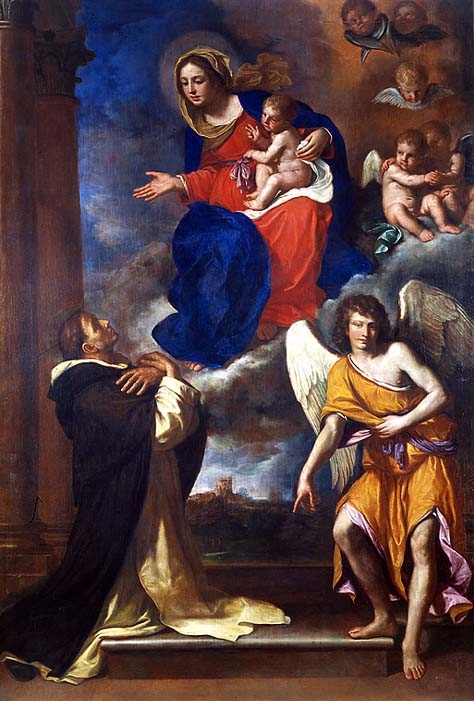
Marcolinus of Forli

Born in at Forli, Italy in 1317, Marcolino Amanni entered the Dominicans at age 10. He occupies a place unique in Dominican annals because he was almost purely contemplative . There is outwardly little to record of Blessed Marcolino, except that for 70 years he kept the Dominican Rule in all its rigor. That is a claim to sanctity that can be made by very few, and is of itself enough to entitle him to canonization. He did accomplish the reform of several convents that had fallen from their primitive fervor, but this he did by his prayers and his example rather than by teaching or preaching.
It is said that Marcolino was most at home with the lay brothers, or with the neighborhood children who enjoyed talking to him. He seldom went out of his cell, and could not have engaged in any active works; neither did he leave any writings. His work was the unseen labor presided over by the Holy Spirit, the work of contemplation. “To give to others the fruits of contemplation,” is the Dominican motto and one might be curious to know how Blessed Marcolino accomplished this. In order to understand the need for just such a type of holiness, it is well to remember the state of the Church in the 14th century. Devastated by plague and schism, divided and held up to scorn, preyed upon by all manner of evils, the Church militant was in need, not only of brave and intelligent action, but also of prayer. Consistently through the centuries, God has raised up such saints as could best avert the disasters that threatened the world in their day, and Marcolino was one answer to the need for mystics who would plead ceaselessly for the Church.
The interior life of Marcolino was not recorded by himself or by others. He lived the mystical life with such intensity that he was nearly always in ecstasy and unconscious of the things around him. One of his brothers recorded that he seemed “a stranger on earth, concerned only with the things of heaven.” Most of his brethren thought him merely sleepy and inattentive, but actually he was, for long periods, lost in converse with God. Some had heard him talking earnestly to the statue of Our Lady in his cell; some fortunate few had heard Our Lady replying to his questions, with the same simplicity.
At the death of Marcolino, on 2 January, 1397, a beautiful child appeared in the streets, crying out the news to the little town that the saintly friar was dead. As the child disappeared when the message was delivered, he was thought to have been an angel. Many miracles were worked at the tomb of Marcolino. One was the miraculous cure of a woman who had been bedridden for 30 years. Hearing of the death of the blessed, she begged him to cure her so that she could visit his tomb.
He was confirmed as a saint in 1750 by Pope Benedict XIV.
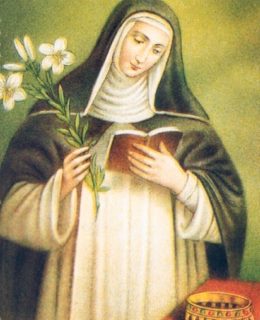
Saint Margaret of Hungary
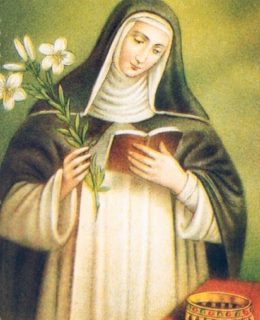
Margaret, the daughter of King Bela IV, and Queen Mary Lascaris of Hungary, was offered to God before her birth, in petition that the country would be delivered from the terrible scourge of the Tartars. The prayer having been answered in 1242, the king and queen made good their promise by placing the rich and beautiful three-year-old in the Dominican convent at Vesprim. Here, in company with other children of nobility, she was trained in the arts thought fitting for royalty.
Margaret was not content with simply living in the house of God; she demanded the religious habit–and received it–at the age of four. Furthermore, she took upon herself the austerities practiced by the other sisters–fasting, hairshirts, the discipline (scourge), and night vigils. She soon learned the Divine Office by heart and chanted it happily to herself as she went about her play. She chose the least attractive duties of the nuns for herself. She would starve herself to keep her spirit humble. No one but Margaret seemed to take seriously the idea that she would one day make profession and remain as a sister, for it would be of great advantage to her father if she were to make a wise marriage.
This question arose seriously when Margaret was 12. She responded in surprise. She said that she had been dedicated to God, even before her birth, and that she intended to remain faithful to that promise. Some years later her father built for her a convent on the island in the Danube between Buda and Pest. To settle the matter of her vocation, here she pronounced her vows to the master general of the order, Blessed Humbert of the Romans, in 1255, and took the veil in 1261.
Again, when Margaret was 18, her father made an attempt to sway her from her purpose, because King Ottokar of Bohemia, hearing of her beauty, had come seeking her hand. He even obtained a dispensation from the pope and approached Margaret with the permission. Margaret replied as she had previously, “I esteem infinitely more the King of Heaven and the inconceivable happiness of possessing Jesus Christ than the crown offered me by the King of Bohemia.” Having established that she was not interested in any throne but a heavenly one, she proceeded with great joy to live an even more fervent religious life than she had before.
Margaret’s royal parentage was, of course, a matter of discussion in the convent. But the princess managed to turn such conversation away from herself to the holy lives of the saints who were related to her by blood–King Saint Stephen, Saint Hedwig, Saint Elizabeth of Hungary, and several others. She did not glory in her wealth or parentage, but strove to imitate the saints in their holiness. She took her turn in the kitchen and laundry, seeking by choice much heavy work that her rank might have excused her from doing. She was especially welcome in the infirmary, which proves that she was not a sad-faced saint, and she made it her special duty to care for those who were too disagreeable for anyone else to tend.
Margaret’s austerities seem excessive to us of a weaker age. The mysteries of the Passion were very real to her and gave reason for her long fasts, severe scourgings, and other mortifications detailed in the depositions of witnesses taken seven years after her death (of which records are still in existence). Throughout Lent she scarcely ate or slept. She not only imitated the poverty- stricken in their manual labor and hunger, but also in their lack of cleanliness–a form of penance at that time. Some of her acts of self-immolation have been described as “horrifying” and verging on fanaticism, and there seems to have been an element of willfulness in her mortifications.
She had a tender devotion to Our Lady, and on the eve of her feasts, Margaret said a thousand Hail Marys. Unable to make the long pilgrimage to the Holy Land, to Rome, or to any of the other famous shrines of Christendom, the saint developed a plan by which she could go in spirit: she counted the miles that lay between herself and the desired shrine, and then said an Ave Maria for every mile there and back. On Good Friday she was so overcome at the thoughts of Our Lord’s Passion that she wept all day. She was frequently in ecstasy, and very embarrassed if anyone found her so and remarked on her holiness.
A number of miracles were performed during Margaret’s lifetime and many more after her death because Margaret had an implicit faith in the power and efficacy of prayer. The princess nun was only 28 when she died. Most of the particulars of her life are recorded in existing depositions of witnesses taken in 1277. Her friends and acquaintances petitioned for her to be acclaimed a saint almost immediately after her death. Among them was her own servant, Agnes, who rightly observed that this daughter of a monarch showed far more humility than any of the monastery’s maids. Although their testimony expressed Margaret’s overpowering desire to allow nothing to stand between her and God, the process of canonization was not complete until 1943. The island where her convent stood, called first the “Blessed Virgin’s Isle,” was called “Isle of Margaret” after the saint. She died 18 January 1271 at Budapest, Hungary. Her remains were given to the Poor Clares at Pozsony when the Dominican Order was dissolved, and most of her relics were destroyed in 1789, but portions are still preserved at Gran, Gyor, Pannonhalma.
She was beatified on 28 July 1789 by Pope Pius XII.
Blessed Gonsalvo
Born in 1187 at Vizella, in the diocese of Braga, Portugal, Gonsalvo de Amarante was a true son of the Middle Ages. In his boyhood Gonsalvo Pereira gave indications of his holiness. While still small, he was consecrated to study for the Church, and received his training in the household of the archbishop of Braga. After his ordination he was given charge of a wealthy parish.
There was no complaint with Gonsalvo’s governance of the parish of Saint Pelagius. He was penitential himself, but indulgent with everyone else. Revenues that he might have used for himself were used for the poor and the sick. The parish, in fact, was doing very well when he turned it over to his nephew, whom he had carefully trained as a priest, before making a pilgrimage to the Holy Land.
Gonsalvo would have remained his entire life in the Holy Land, but after 14 years his archbishop commanded him to return to Portugal. Upon his arrival, he was horrified to see that his nephew had not been the good shepherd that he had promised to be, the money left for the poor had gone to purchase a fine stable of thoroughbred horses and a pack of fine hounds. The nephew had told everyone that his old uncle was dead, and he had been appointed pastor in his place by an unsuspecting archbishop. When the uncle appeared on the scene, ragged and old, but very much alive, the nephew was not happy to see him. Gonsalvo seems to have been surprised as well as pained.
The ungrateful nephew settled the matter by turning the dogs on his inconvenient uncle. They would have torn him to pieces, but the servants called them off and allowed the ragged pilgrim to escape. Gonsalvo decided then that he had withstood enough parish life, and went out into the hills to a place called Amarante. Here he found a cave and other necessities for an eremitical life and lived in peace for several years, spending his time building a little chapel to the Blessed Virgin. He preached to those who came to him, and soon there was a steady stream of pilgrims seeking out his retreat.
Happy as he was, Golsalvo felt that this was not his sole mission in life, and he prayed for help to discern his real vocation. It is said that the Virgin Mary appeared to him one night as he prayed and told him to enter the order that had the custom of beginning the office with “Ave Maria gratia plena.” She told him that this order was very dear to her and under her special protection. Gonsalvo set out to learn what order she meant, and eventually came to the convent of the Dominicans. Here was the end of the quest, and he asked for the habit.
Blessed Peter Gonzales was the prior, and he gave the habit to the new aspirant. After Gonsalvo had gone through his novitiate, he was sent back to Amarante, with a companion, to begin a regular house of the order. The people of the neighborhood quickly spread the news that the hermit was back. They flocked to hear him preach, and begged him to heal their sick.
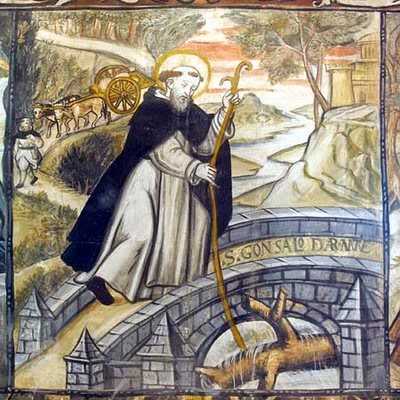
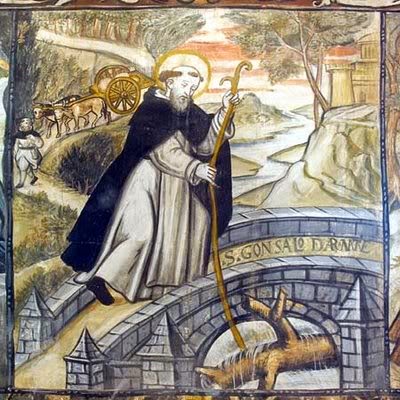
One of the miracles of Blessed Gonsalvo concerns the building of a bridge across a swift river that barred many people from reaching the hermitage in wintertime. It was not a good place to build a bridge, but Gonsalvo set about it and followed the heavenly directions he had received. Once, during the building of the bridge, he went out collecting, and a man who wanted to brush him off painlessly sent him away with a note for his wife.
Gonsalvo took the note to the man’s wife, and she laughed when she read it. “Give him as much gold as will balance with the note I send you,” said the message. Gonsalvo told her he thought she ought to obey her husband, so she got out the scales and put the paper in one balance. Then she put a tiny coin in the other balance, and another, and another–the paper still outweighed her gold–and she kept adding. There was a sizeable pile of coins before the balance with the paper in it swung upwards.
Gonsalvo died 10 January 1259, after prophesying the day of his death and promising his friends that he would still be able to help them after death. Pilgrimages began soon, and a series of miracles indicated that something should be done about his beatification. Forty years after his death he appeared to several people who were apprehensively watching a flood on the river. The water had arisen to a dangerous level, just below the bridge, when they saw a tree floating towards the bridge, and Gonsalvo was balancing capably on its rolling balk. The friar carefully guided the tree under the bridge, preserving the bridge from damage, and then disappeared. He was beatified by Pius IV in 1560.
Blessed Francis of Capillas

The 17th century was a period of great missionary activity. Many martyrs shed their blood on distant shores. Dominicans and Jesuits contributed a great share to the blood of martyrs. Among this glorious company, the Dominican Francis de Capillas has become the type and exemplar of them.
Francis was born in 1608 in Old Castile, Spain. Nothing is known of his childhood. He entered the Dominicans at Valladolid at age 17. The Spain of his youth was still ringing with the missionary zeal of Saints Louis Bertrand, Philip de las Casas, and Francis Xavier; the report of the martyrdom of Alphonsus Navarette (June 1), in Japan, was news at the time. Perhaps the bravery of these men helped to fire the young Francis with apostolic longing, for he volunteered for the Philippine mission while he was a deacon. In 1631 at the age of 23, he left Spain and was ordained in Manila. Here, at the gateway to the Orient, the Dominicans had founded a university in 1611, and the city teemed with missionaries traveling throughout the Orient.
The young priest labored for 10 years in the province of Cagayan, the Philippines, where heat, insects, disease, and paganism made life very hard. But it was not hard enough for Francis. He begged for a mission field that was really difficult; perhaps, like many of the eager young apostles of that time, he was hoping for an assignment in Japan, where the great persecution was raging. He was sent to Fukien, China, where he worked uneventfully for some years. Then a Tartar invasion put his life in jeopardy. He was captured by a band of Tartars and imprisoned as a spy.
Francis was subjected to a mock trial. Civil, military, and religious officials questioned him, and they accused him of everything from political intrigue to witchcraft. He was charged with disregarding ancestor worship, and, finally, since they could “find no cause in him,” he was turned over to the torturers.
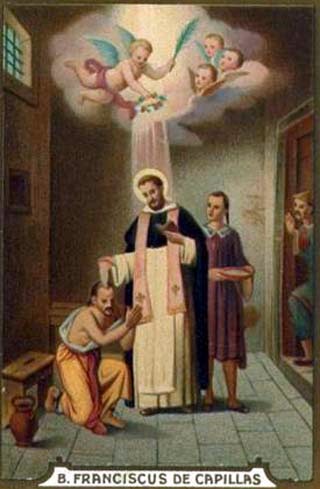
He endured the cruel treatment of these men with great courage. Seeing his calmness, the magistrates became curious about his doctrines. They offered him wealth, power, and freedom, if he would renounce his faith, but he amazed and annoyed them by choosing to suffer instead. They varied the tortures with imprisonment, and he profitably used the time to convert his jailor and fellow prisoners. Even the mandarin visited him in prison, asking Francis if he would renounce his faith or would he prefer to suffer more. Being told that he was glad to suffer for Christ, the mandarin furiously ordered that he be scourged again “so he would have even more to be glad about.”
Francis was finally condemned, and was beheaded on 15 January 1640. He was beatified on 2 May 1919 by Pope Pius X.
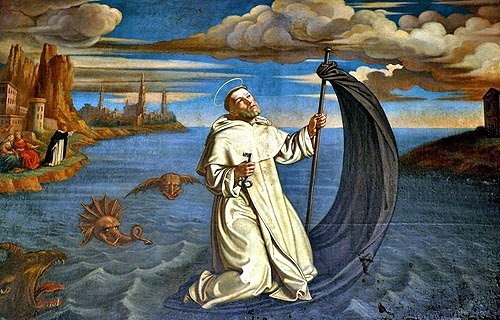
Saint Raymund of Pennafort

From the bull of his canonization, by Clement VIII in 1601, and his life, written by several Spanish, Italian and French authors. See Fleury, b. 78, n. 55, 64, and chiefly Touron Hommes Illustres de l’Ordre de S. Domin. t. 1, p. I
The house of Pegnafort, or, as it is pronounced, Pennafort, was descended from the counts of Barcelona, and nearly allied to the kings of Aragon. Raymund was born in 1175, at Pennafort, a castle in Catalonia, which in the fifteenth century was changed into a convent of the order of St. Dominick. Such was his rapid progress in his studies, that at the age of twenty he taught philosophy at Barcelona, which he did gratis, and with so great reputation, that he began then to be consulted by the ablest masters. His principal care was to instil into his scholars the most perfect maxims of a solid piety and devotion, to compose all differences among the citizens, and to relieve the distressed. He was about thirty years of age when he went to Bologna, in Italy, to perfect himself in the study of the canon and civil law, commenced Doctor in that faculty, and taught with the same disinterestedness and charity as he had done in his own country. In 1219 Berengarius, bishop of Barcelona, who had been at Rome, took Raymund home with him, to the great regret of the university and senate of Bologna; and, not content with giving him a canonry in his church, made him his archdeacon, grand vicar, and official. He was a perfect model to the clergy, by his innocence, zeal, devotion, and boundless liberalities to the poor, whom he called his creditors. In 1222 he took the religious habit of St. Dominick at Barcelona, eight months after the death of the holy founder, and in the forty-seventh year of his age. No person was ever seen among the young novices more humble, more obedient, or more fervent. To imitate the obedience of a Man-God, who reduced himself to a state of subjection to his own creatures, to teach us the dangers and deep wound of self-will, and to point out to us the remedy, the saint would depend absolutely on the lights of his director in all things. And it was upon the most perfect self-denial that he laid the foundation of that high sanctity which he made the object of his most earnest desires. The grace of prayer perfected the work which mortification had begun. In a spirit of compunction he begged of his superiors that they would enjoin him some severe penance, to expiate the vain satisfaction and complacency which he said he had sometimes taken in teaching. They indeed imposed on him a penance, but not such a one as he expected. It was to write a collection of cases of conscience for the instruction and conveniency of confessors and moralists. This produced his Sum the first work of that kind. Had his method and decisions been better followed by some later authors of the like works, the holy maxims of Christian morality had been treated with more respect by some moderns than they have been, to our grief and confusion.
Raymund joined to the exercises of his solitude the functions of an apostolic life, by laboring without intermission in preaching, instructing, hearing confessions with wonderful fruit, and converting heretics, Jews, and Moors Among his penitents were James, king of Aragon, and St. Peter Nolasco, with whom he concerted the foundation of the Order of the B. Virgin of mercy for the redemption of captives. James, the young king of Aragon had married Eleonora of Castile within the prohibited degrees, without a dispensation. A legate was sent by Pope Gregory IX. to examine and judge the case. In a council of bishops of the two kingdoms, held at Tar rayon, he declared the marriage null, but that their son Don Alphonso should be reputed lawfully born, and heir to his father’s crown. The king had taken his confessor with him to the council, and the cardinal legate was so charmed with his talents and virtue, that he associated him in his legation and gave him a commission to preach the holy war against the Moors. The servant of God acquitted himself of that function with so much prudence, zeal, and charity, that he sowed the seeds of the total overthrow of those infidels in Spain. His labors were no less successful in the reformation of the manners of the Christians detained in servitude under the Moors which were extremely corrupted by their long slavery or commerce with these infidels. Raymund showed them, by words full of heavenly unction and fire, that, to triumph over their bodily, they must first conquer their spiritual enemies, and subdue sin in themselves, which made God their enemy. Inculcating these and the like spiritual lessons, he ran over Catalonia, Aragon, Castile, and other countries. So general a change was wrought hereby in the manners of the people, as seemed incredible to all but those who were witnesses of it. By their conversion the anger of God was appeased, and the arms of the faithful became terrible to their enemies. The kings of Castile and Leon freed many places from the Moorish yoke. Don James, king of Aragon, drove them out of the islands of Majorca and Minorca, and soon after, in 1237, out of the whole kingdom of Valentia. Pope Gregory IX. having called St. Raymund to Rome in 1230, nominated him his chaplain, (which was the title of the Auditor of the causes of the apostolic palace,) as also grand penitentiary. He made him likewise his own confessarius, and in difficult affairs came to no decision but by his advice. The saint still reserved himself for the poor, and was so solicitous for them that his Holiness called him their father. He enjoined the pope, for a penance, to receive, hear, and expedite immediately all petitions presented by them. The pope, who was well versed in the canon law, ordered the saint to gather into one body all the scattered decree of popes and councils, since the collection made by Gratian in 1150. Raymund compiled this work in three years, in five books, commonly called the Decretals, which the same pope Gregory confirmed in 1234. It is looked upon as the best finished part of the body of the canon law; on which account the canonists have usually chosen it for the texts of their comments. In 1235, the pope named St. Raymund to the archbishopric of Tarragon, the capital of Aragon: the humble religious man was not able to avert the storm, as he called it, by tears and entreaties; but at length fell sick through anxiety and fear. To restore him to his health, his Holiness was obliged to consent to excuse him, but required that he should recommend a proper person. The saint named a pious and learned canon of Gironne. He refused other dignities with the like constancy.
For the recovery of his health he returned to his native country, and was received with as much joy as if the safety of the whole kingdom. and of every particular person, had depended on his presence. Being restored again to his dear solitude at Barcelona, he continued his former exercises of contemplation, preaching, and administering the sacrament of penance. Except on Sundays, he never took more than one very small refection in the day. Amidst honors and applause he was ever little in his own eyes: he appeared in the schools like a scholar, and in his convent begged the superior to instruct him in the rules of religious perfection, with the humility and docility of a novice. Whether he sung the divine praises with his brethren, or prayed alone in his cell, or some corner of the church, ho poured forth an abundance of tears; and often was not able to contain within himself the ardor of his soul. His mildness and sweetness were unalterable. The incredible number of conversions of which he was the instrument, is known only to Him who, by his grace, was the author of them. He was employed frequently in most important commissions, both by the holy see and by the king. But he was thunderstruck by the arrival of four deputies from the general chapter of his order at Bologna, in 1238, with the news that he was chosen third general, Jordan of Saxony being lately dead. He wept and entreated, but at length acquiesced in obedience. He made the visitation of his order on foot, without discontinuing any of his penitential austerities, or rather exercises. He instilled into his spiritual children a love of regularity, solitude, mortification, prayer, sacred studies, and the apostolic functions, especially preaching. He reduced the constitutions of his order into a clearer method, with notes on the doubtful passages. This his code of rules was approved in three general chapters. In one held at Paris in 1239, he procured the establishment of this regulation, that a voluntary demission of a superior, founded upon just reasons, should be accepted. This he contrived in his own favor; for, to the extreme regret of the order, he in the year following resigned the generalship, which he had held only two years. He alleged for his reason his age of sixty-five years. Rejoicing to see himself again a private religious man, he applied himself with fresh vigor to the exercises and functions of an apostolic life, especially the conversion of the Saracens. Having this end in view he engaged St. Thomas to write his work ‘Against the Gentiles;’ procured the Arabic and Hebrew tongues to be taught in several convents of his order; and erected convents, one at Tunis, and another at Murcia, among the Moors. In 1256, he wrote to his general that ten thousand Saracens had received baptism. King James took him into the island of Majorca. The saint embraced that opportunity of cultivating that infant church. This prince was an accomplished soldier and statesman, and a sincere lover of religion, but his great qualities were sullied by a base passion for women. He received the admonitions of the saint with respect, and promised amendment of life, and a faithful compliance with the saint’s injunctions in every particular; but without effect. St. Raymund, upon discovering that he entertained a lady at his court with whom he was suspected to have criminal conversation, made the strongest instances to have her dismissed, which the king promised should be done, but postponed the execution. The saint, dissatisfied with the delay, begged leave to retire to his convent at Barcelona. The king not only refused him leave, but threatened to punish with death any person that should undertake to convey him out of the island. The saint, full of confidence in God, said to his companion, “A king of the earth endeavors to deprive us of the means of retiring; but the King of heaven will supply them.” He then walked boldly to the waters, spread his cloak upon them, tied up one corner of it to a staff for a sail, and having made the sign of the cross, stepped upon it without fear, while his timorous companion stood trembling and wondering on the shore. On this new kind of vessel the saint was wafted with such rapidity, that in six hours he reached the harbor of Barcelona, sixty leagues distant from Majorca. Those who saw him arrive in this manner met him with acclamations. But he, gathering up his cloak dry, put it on, stole through the crowd, and entered his monastery. A chapel and a tower, built on the place where he landed, have transmitted the memory of this miracle to posterity. This relation is taken from the bull of his canonization, and the earliest historians of his life. The king became a sincere convert, and governed his conscience, and even his kingdoms, by the advice of St. Raymund from that time till the death of the saint. The holy man prepared himself for his passage to eternity, by employing days and nights in penance and prayer. During his last illness, Alphonsus, king of Castile, with his queen, sons, and brother; and James, king of Aragon, with his court, visited him, and received his last benediction. He armed himself with the last sacraments; and, in languishing sighs of divine love, gave up his soul to God, on the 6th of January, in the year 1275, and the hundredth of his age. The two kings, with all the princes and princesses of their royal families, honored his funeral with their presence: but his tomb was rendered far more illustrious by miracles. Several are recorded in the bull of his canonization, published by Clement VIII. in 1601. Bollandus has filled fifteen pages in folio with an account of them. His office is fixed by Clement X. to the 23d of January.
The saints first learned in solitude to die to the world and themselves, to put on the spirit of Christ, and ground themselves in a habit of recollection and a relish only for heavenly things, before they entered upon the exterior functions even of a spiritual ministry. Amidst these weighty employments, not content with reserving always the time and means of frequent retirement for conversing with God and themselves, in their exterior functions by raising their minds to heaven with holy sighs and desires, they made all their actions in some measure an uninterrupted prayer and exercise of divine love and praise. St. Bonaventure reckons it among the general exercises of every religious or spiritual men, “that he keep his mind always raised, at least virtually, to God: hence, whensoever a servant of God has been distracted from attending to him for ever so short a space, he grieves and is afflicted, as if he was fallen into some misfortune, by having been deprived of the presence of such a friend who never forgets us. Seeing that our supreme felicity and glory consists in the eternal vision of God, the constant remembrance of him is a kind of imitation of that happy state: this the reward, that the virtue which entitles us to it. Till we are admitted to his presence, let us in our exile always bear him in mind: every one will behold him in heaven with so much the greater joy, and so much the more perfectly, as he shall more assiduously and more devoutly have remembered him on earth. Nor is it only in our repose, but also in the midst of our employments, that we ought to have him present to our minds, in imitation of the holy angels, who, when they are sent to attend on us, so acquit themselves of the functions of this exterior ministry as never to be drawn from their interior attention to God. As much as the heavens exceed the earth, so much larger is the field of spiritual meditation than that of all terrestrial concerns.”
(Taken from Vol. I of “The Lives or the Fathers, Martyrs and Other Principal Saints” by the Rev. Alban Butler, the 1864 edition published by D. & J. Sadlier, & Company)


You must be logged in to post a comment.