
Category: Dominican Saints
The Chosen Replacement: The Feast of St. Matthias the Apostle~The Very Rev Lady Sherwood, OPI
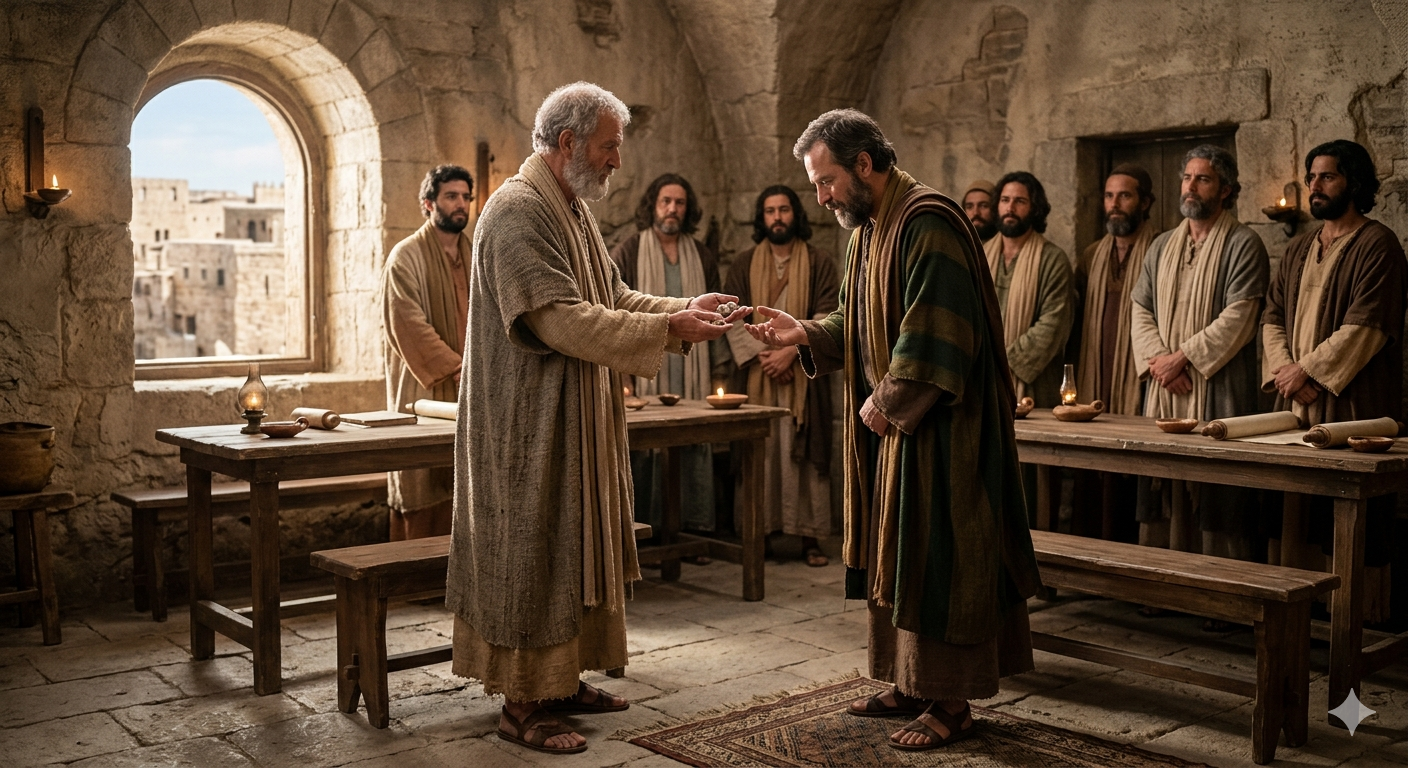
Today, we gather to celebrate a man who lived most of his life in the shadows of giants, only to be called into the light by a roll of the dice—or rather, by the mysterious providence of God. We often think of the Apostles as a fixed “dream team,” but the story of St. Matthias reminds us that the Kingdom of God is dynamic, resilient, and always moving forward. After the tragedy of Judas Iscariot, there was a hole in the heart of the Twelve. To the world, that empty seat looked like a failure, a permanent scar on the mission of Christ. But to the early Church, it was a space waiting for God’s next move, proving that while individuals may falter, the Divine plan remains unshakeable.
What is most striking about Matthias is his unwavering presence. When Peter stood up to find a replacement, the criteria were strict: it had to be someone who had been with them from the very beginning—from the baptism of Jesus by John until the day of the Ascension. This means Matthias was there all along, a silent but steadfast companion in the background of the greatest story ever told. He was there for the feeding of the five thousand. He likely heard the Sermon on the Mount firsthand. He may have been one of the seventy sent out in pairs to heal and preach. Yet, his name is never mentioned in the Gospels. He was a faithful follower who didn’t need a title or a spotlight to stay committed to the Master. His life asks us a difficult question: Are we willing to serve God in the “unnamed” seasons of our lives? Matthias proves that God is watching our consistency even when the world isn’t, and that the “quiet” followers are often the ones God prepares for the greatest tasks.
The Apostles cast lots to choose between Matthias and Joseph called Barsabbas. While it looks like a game of chance to the secular eye, it was an act of total surrender to the Holy Spirit. They were saying, “Lord, we’ve done our homework and assessed the candidates, but the final decision is Yours.” Matthias didn’t lobby for the position. He didn’t campaign for votes or highlight his qualifications. He simply stood ready. When the lot fell to him, he stepped into a role that promised no earthly glory—only the certainty of persecution, the rigours of travel, and the heavy weight of the Great Commission. He reminds us that our true “call” isn’t about our personal ambition; it’s about our availability to God’s will.
We all face “empty seats” in our lives—roles we are suddenly asked to fill, shoes that feel far too big for us, or unexpected transitions that leave us feeling ill-equipped. St. Matthias teaches us that preparation happens in those hidden, quiet years of service. Your current faithfulness in small, unrecognised things is preparing you for a future call you cannot yet see. God fills every void; no betrayal, loss, or vacancy can stop the mission of His Church. Ultimately, success in the Kingdom is measured not by fame, but by witness. Matthias’s primary job was to be a witness to the Resurrection. Our job is exactly the same: to show a weary world that Christ is alive through the way we love, the way we serve, and the way we remain faithful when no one is looking.
A Prayer for the Feast of St. Matthias:
Heavenly Father, You chose Saint Matthias to share in the office of the Apostles, ensuring that the saving message of the Gospel would reach the ends of the earth. We thank You for his quiet faithfulness and his humble readiness to serve when called from the shadows. Lord, grant us the same spirit of steady devotion. When we feel overlooked or hidden, remind us that You see our hearts and value our presence. When we are called to step into new responsibilities or difficult transitions, give us the courage of Matthias to say “yes” without hesitation. May we, like him, be true and living witnesses to the Resurrection of Your Son in everything we do. Help us to fill the gaps in our own communities with love, to mend what is broken by grace, and to always trust in Your divine providence rather than our own luck. We ask this through Christ our Lord, Amen.
The Pillar of Truth: Honouring St. Athanasius~
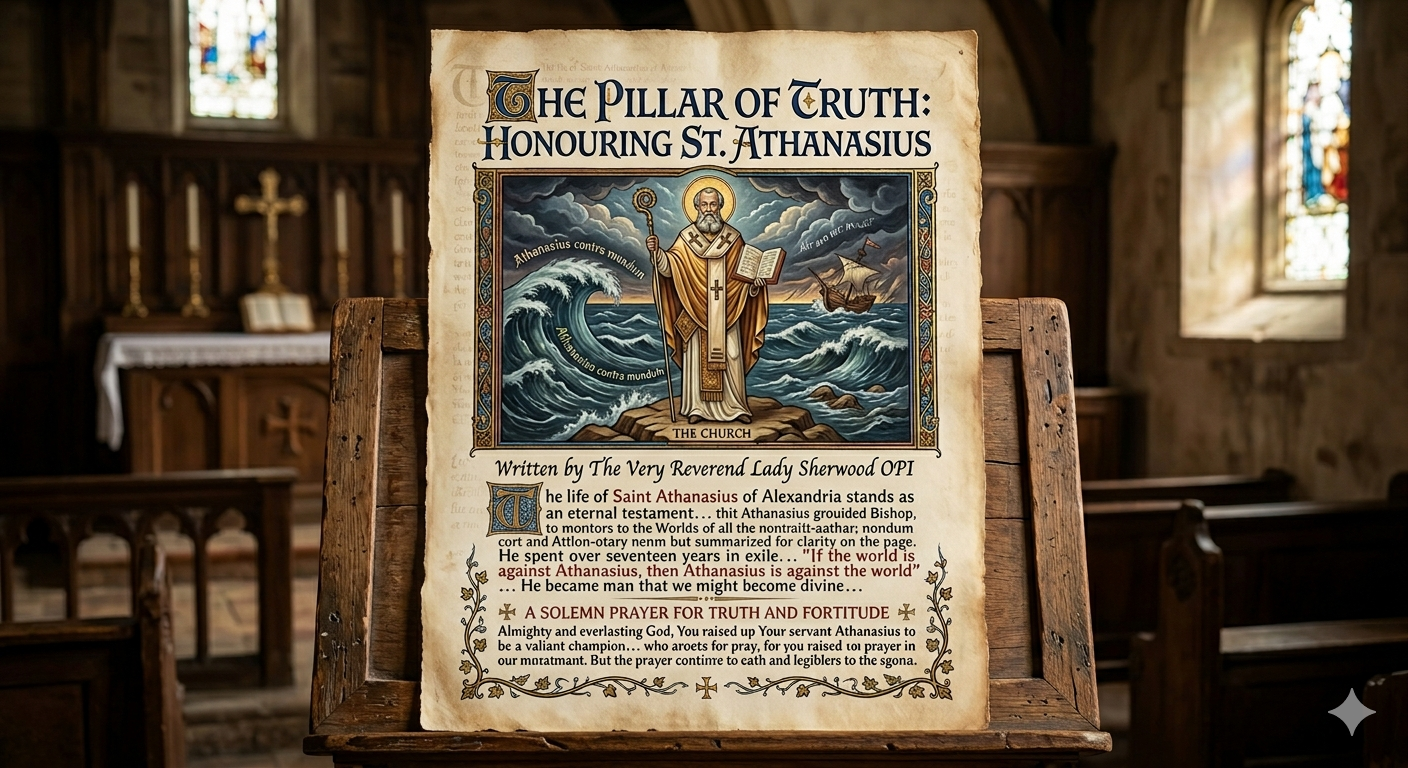
The life of Saint Athanasius of Alexandria stands as an eternal testament to the power of a single soul anchored in the Divine. Known to history as the “Father of Orthodoxy,” his path was defined by a singular, unwavering focus: the preservation of the true nature of Jesus Christ.
In an era where the Arian heresy threatened to unravel the very fabric of the Church by denying the divinity of the Son, Athanasius stood as a solitary bulwark. His lived experience was one of radical sacrifice; he spent over seventeen years of his life in exile, hunted by emperors and misunderstood by peers, yet he famously declared, “If the world is against Athanasius, then Athanasius is against the world.”
This was not a cry of arrogance, but a profound commitment to the reality that the Truth is not subject to the whims of the majority.
Athanasius understood with perfect clarity that our salvation depends entirely on the Incarnation. He taught that if Christ were merely a created being, He could not bridge the chasm between the Creator and the created. “He became man,” Athanasius wrote, “that we might become divine.” This transformative hope was worth every hardship, every cold night in the Egyptian desert, and every moment of isolation.
His resilience serves as a vital mirror for our own lives today. We often face pressures to dilute our convictions or to blend into the cultural landscape for the sake of comfort.
Athanasius challenges us to consider what we are building our foundations upon. Are we swayed by the shifting winds of popular opinion, or are we rooted in the ancient, Apostolic faith that has survived empires and outlasted every storm?
To honour Athanasius is to embrace the “long obedience in the same direction.” It is a call to intellectual rigour, spiritual fervour, and a courage that does not flee when the cost of discipleship rises. Even in his darkest hours of banishment, Athanasius remained a shepherd, writing letters of encouragement and composing treatises that continue to light the way for the faithful centuries later.
Let us draw strength from his example, remembering that even when we feel outnumbered or overwhelmed, the Word of God remains sovereign. Like the Great Bishop of Alexandria, may we find our peace not in the approval of the world, but in the steadfast confession that Christ is truly God and truly man, our Saviour and our King.
A Solemn Prayer for Truth and Fortitude:
Almighty and everlasting God, You raised up Your servant Athanasius to be a valiant champion of the faith and a witness to the glory of Your Son. We yield You hearty thanks for the courage he displayed and the wisdom he bequeathed to Your Church throughout the ages.
I pray, O Lord, that You would grant us, who are part of the order he inspired, and all the faithful, a portion of his unwavering spirit. In a world of uncertainty and shifting shadows, steady our hearts upon the rock of Your unchanging Truth. When we are tempted to compromise, grant us Your strength; when we are weary from the struggle, grant us Your peace.
Let the light of the Incarnate Word guide our every thought and action, that we may live as faithful stewards of the mysteries You have revealed.
Strengthen our resolve to contend for the Gospel with both charity and conviction. May our lives reflect the beauty of the Truth we profess, so that in all things, Your holy Name may be glorified.
Through Jesus Christ our Lord, who lives and reigns with You and the Holy Spirit, one God, world without end. Amen.
Dignity in the Workshop: St. Joseph’s Blueprint for Faith~The Very Rev Lady Sherwood,OPI
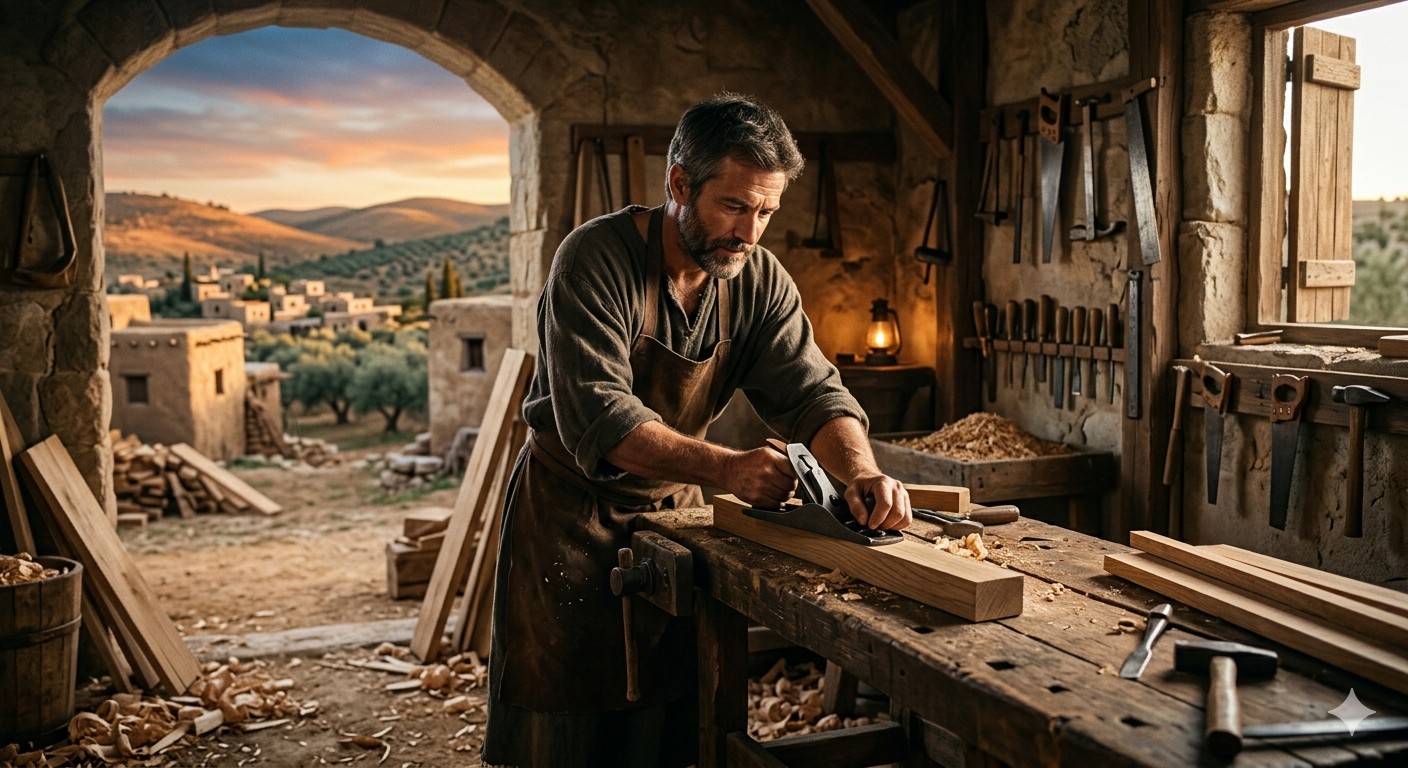
Today we honour St. Joseph not as a silent figure in the background, but as a man of action whose hands shaped the world. In the quiet rhythm of his workshop, Joseph transformed labour into a form of prayer, teaching us that our daily work—no matter how humble—is a primary way we participate in God’s ongoing creation. He reminds us that dignity is found in diligence and that our “everyday” is holy ground.
St. Joseph did not seek recognition; he sought faithfulness. In our modern world, we are often pressured to define ourselves by our status, our titles, or the size of our paycheck. Yet, Joseph’s life tells a different story. He shows us that there is profound holiness in the mundane—in the sweeping of a floor, the fixing of a door, or the patient tending to a task. He didn’t just work to live; he worked to love, providing for the Holy Family with a heart tethered to the Divine. His workshop was not a place of drudgery, but a sanctuary of service where the Son of God learned the value of a day’s honest toil.
This feast day invites us to examine our own relationship with our vocations. Do we see our tasks as burdens to be endured, or as opportunities to serve? Joseph’s silence in the Gospels speaks volumes about his character; he didn’t need words to justify his existence because his actions testified to his devotion. He accepted the responsibility of protecting and providing for Mary and Jesus with a steady hand and an unwavering spirit.
As we reflect on his life, let us find purpose in our own tasks, offering our sweat and skill as a living sacrifice to the Lord. Whether we lead, build, or serve, may we do so with the same quiet strength and integrity that defined the Carpenter of Nazareth. Let us remember that when we work with integrity, we are not just earning a living; we are echoing the creative power of God. May we strive to make our workplaces spaces of justice, kindness, and excellence, mirroring the workshop of Nazareth in our own communities.
Let us pray:
Heavenly Father, We thank you for the example of St. Joseph the Worker. Grant us the grace to approach our daily tasks with a spirit of service and love. We pray for those who find no meaning in their labour, that they may discover the hidden dignity within their roles. Support those who are seeking employment and protect those who labour in difficult or dangerous conditions.
Bless the work of our hands and the intentions of our hearts, that all we do may bring glory to your name and comfort to our neighbours. Through our efforts, may your kingdom come and your will be done on earth as it is in heaven.
Amen.
The Call of the Word: A Homily on St. Mark the Evangelist~The Very Rev Lady Sherwood,OPI
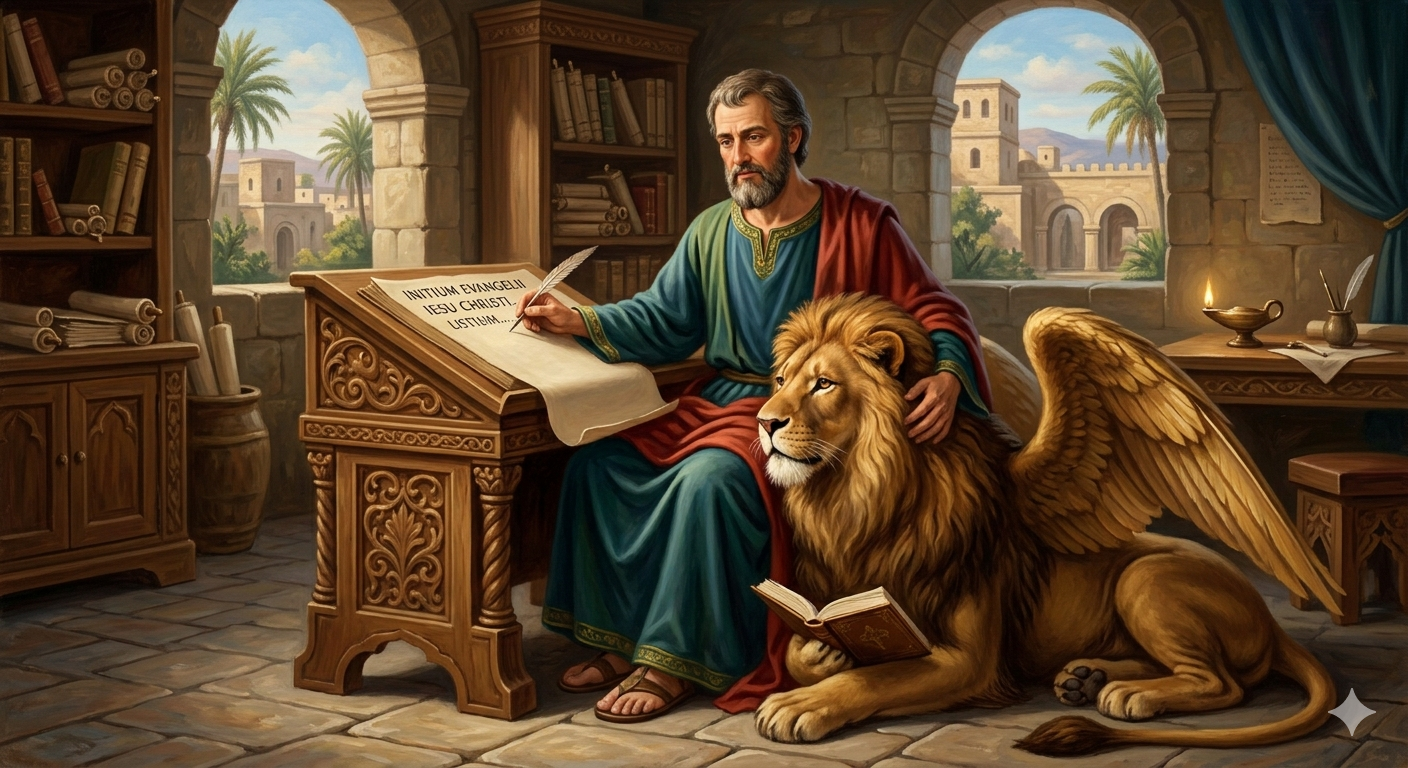
Beloved, we gather today to celebrate the feast of St. Mark, a man whose life reminds us that the greatest stories are often written by those who start in the shadows. Mark was not one of the original twelve, yet his contribution to our faith is foundational. He was a witness to the witnesses, a tireless companion to Paul and Peter, and the first to commit the “Good News” to written form.
Mark’s Gospel is unique in its urgency. He uses the word “immediately” over and over, painting a portrait of a Christ who is constantly on the move, healing, teaching, and marching toward the Cross. For Mark, the Gospel was not a static philosophy to be debated; it was a fire that had been lit in the world—a fire that required an immediate response. This urgency teaches us that when God moves, the world changes instantly, and our obedience should be just as swift.
We see in Mark a journey of resilience. Early in his ministry, he faced failure and desertion, causing a rift between Paul and Barnabas. Yet, he did not allow his past stumbles to define his future. He matured, reconciled, and eventually became so vital to the mission that Paul later requested his presence in prison, calling him “profitable for the ministry.” Tradition even suggests he was the young man who fled naked from Gethsemane—the ultimate image of a “messy” beginning transformed into a pillar of the Church.
The Church symbolizes Mark as a winged lion, representing the “voice crying in the wilderness.” This reminds us that the Gospel is a roar of truth meant to awaken the world. However, Mark also reminds us of the “Messianic Secret,” showing that Christ’s glory is inseparable from his suffering. We do not just follow a miracle worker; we follow a Suffering Servant.
Mark teaches us that being a disciple doesn’t require perfection; it requires persistence. Whether you are a scholar of the Word or a seeker in the pews, you are called to be an evangelist in your own sphere. Like Mark, we are called to take the raw, often messy experiences of our lives and translate them into a testimony of God’s grace.
The Mercy of the Wounded Word: Touching Christ through the Saints~The Rev Frank Bellino,OPI
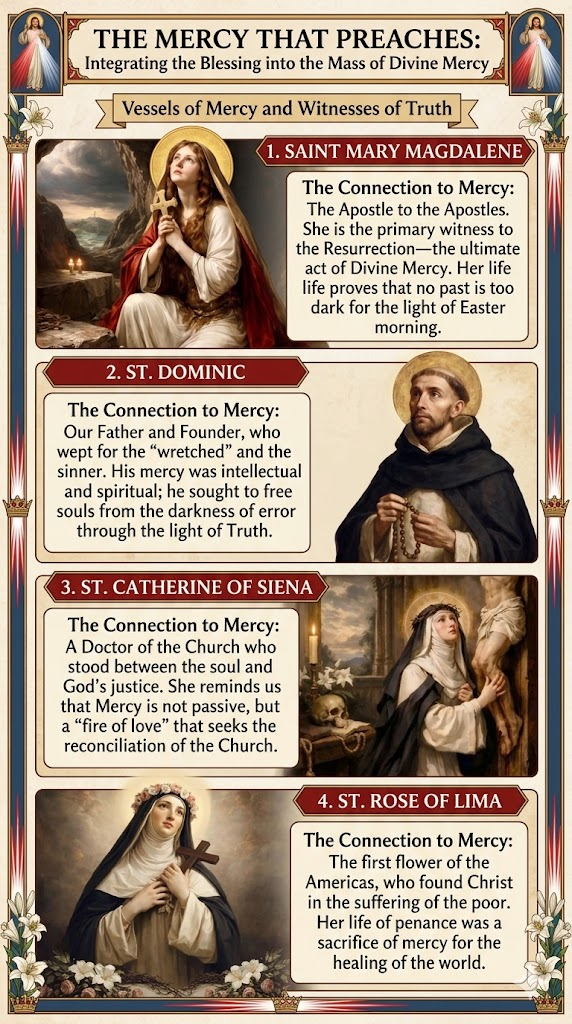
On this Second Sunday of Easter, the Octave Day of the Resurrection, we stand in a sanctuary illuminated by a singular, breathtaking reality: the victory of Divine Mercy. Today, our celebration carries a unique weight and beauty as we have just blessed the new images of four giants of our faith—Mary Magdalene, Dominic, Catherine, and Rose. These are not merely artistic additions to our walls; they are windows into the very Heart of Christ that we see in the Divine Mercy image itself. To look upon these saints is to see the diverse ways the Mercy of God breaks through the locked doors of the human heart, transforming fear into fortitude and doubt into a “Preaching of Truth.”
In the Gospel today, we find the Apostles huddled in fear behind barred doors. They were men paralyzed by their own failures, by the memory of their desertion in the Garden, and by the terrifying silence of the tomb. Yet, the Risen Christ does not enter that room with a word of condemnation; He enters with the word of Peace ($Shalom$). He shows them His wounds—the indelible marks of His suffering that have now become the fountains of His Mercy. This is the first movement of our Dominican charism: to recognize that Mercy is the only force capable of walking through the walls we build around ourselves. We see this most clearly in St. Mary Magdalene, the first of our new images. She was the one who stood weeping at the tomb, the one from whom seven demons had been cast out, and yet she was the first to hear her name spoken by the Risen Lord. Her life proves that no past is too dark for the light of Easter morning. As a laywoman, she became the “Apostle to the Apostles,” reminding us that the mission of Mercy begins the moment we allow Christ to call us by name.
As we move from the garden of the Resurrection to the mission of the Church, we look to St. Dominic, our holy Father and the clerical heart of our Order. Dominic’s mercy was a “Mercy of the Word.” He looked upon a world wounded by error and confusion, and his heart was moved to pity. He knew that to love someone is to give them the Truth. Like the Apostles in the Upper Room who received the Holy Spirit to forgive sins, Dominic sought to “forgive” the debt of ignorance by preaching the Light of Christ. He reminds us that mercy is not a vague sentiment; it is a rigorous, intellectual, and spiritual commitment to the salvation of souls. In this Parish of St. Michael’s, we follow his lead by being vigilant in our study and joyful in our proclamation, ensuring that the “Bread of the Word” is broken for all who hunger.
But the fire of Dominic’s preaching found its most vibrant expression in the lives of the laity, exemplified by St. Catherine of Siena and St. Rose of Lima. These two women, as Dominican Tertiaries, took the Mercy of the Upper Room into the streets and the hospitals. Catherine stood before popes and kings, a laywoman with the “fire of love” in her soul, demanding that the Church return to its wounded Spouse. Rose, the first flower of the Americas, found Christ in the wounds of the poor and the marginalized, turning her life into a perpetual sacrifice of praise. They show us that Mercy is tangible—it has hands that heal and a voice that speaks for the voiceless. They represent the “Order of Penance,” a life where the red and white rays of Divine Mercy flow through the ordinary actions of a lay life lived in extraordinary union with God.
Therefore, as we gaze upon the Divine Mercy image today—with the pale ray of Water and the red ray of Blood—let us see the lives of these four saints reflected there. The Water of Truth that Dominic preached; the Blood of Sacrifice that Catherine and Rose offered; and the Joy of the Resurrection that Mary Magdalene announced. Like St. Thomas, we are invited today to touch the wounds of Christ—not just in the bread and wine upon this altar, but in the wounds of our neighbors here in San Antonio. We are sent forth from this Mass not merely as observers of Mercy, but as its conduits. “As the Father has sent me, so I send you.” Let us go forth, then, with the courage of Magdalene and the zeal of Dominic, to be the living images of Divine Mercy in a world that so desperately needs to hear: “My Lord and my God!”
In Vigilance and Joy.
The Feast of St Joseph, Spouse of the Virgin Mary~The Very Rev Lady Sherwood, OPI
My dearest Brothers and sisters in Christ,
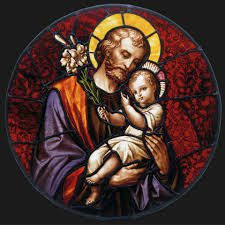
Today, we come together as the Church to commemorate St. Joseph, the Spouse of The Blessed Virgin Mary, and the foster Father of our Lord and Saviour,Jesus, when he became one of us here upon the Earth.
In the same way in which God, our Heavenly Father, who gives each of us as his children, unconditional love, care, stability and who sets us the standard with which we should strive to live our lives with his holy word in the scriptures, a true Father to each and every single one of us, who only ever wants the very best for all his children. St. Joseph follows our Father’s example, as both husband and foster father. He gives us examples which men should follow in their lives. Joseph cared for and provided for the Holy Household. There are many qualities that Joseph had which we could use to be the role model for Christian husbands and fathers. Joseph was a very compassionate man. We can see an example of this when he suspected his wife of infidelity; he planned to divorce her quietly rather than denounce her publicly and expose her to public shame and penalty.
Joseph was always obedient to God and did what he knew was God’s will without thought or hesitation. Examples of this are that he kept Mary as his wife; he protected and provided for his family when they had to flee to foreign lands to protect them from danger.
Joseph led a life of deep prayer and was in communion with God, and would always seek out that which was God’s will. God often told Joseph his will using dreams.
Joseph was a provider of care, When Jesus’s life was threatened, Joseph would take them out of danger. He took his family to Egypt and only returned when it was safe to do so, and when Jesus went missing at aged twelve, Joseph went searching for him because obviously, both parents were obviously extremely worried about Jesus’s safety.
Joseph also brought much more to Jesus’s life, he taught him his trade which Jesus worked in for about twenty years, he gave Jesus the love and stability he as any child needs, and was his earthly male role model, which was and still is vitally important for a good father to give any child.
He was a man with a firm faith in God coupled with a resilient personality, who did not complain and was not appalled nor distressed in the midst of trials and tribulations, St. Joseph knew how to face, carry and solve the burden of his vocation, of life’s difficulties and responsibilities with serenity, with complete faith and love, entrusting himself totally and unconditionally to God’s plans.
Sadly not all children are brought up in such a way today, but husbands and fathers truly should seek to follow this sincere man of God in the way they run their lives. Are you married? Do you give all the love, trust and respect to your spouse? Or with stresses and strains do you always argue or not truly make time for each other? If you have children, do you know where they are and if they are safe, or who they might be talking to online? Do you give emotional stability, patience and unconditional love? Do your children see you as the role model they need in a Father? We should always strive to be as our heavenly Father is to each of us, whether that be to our spouses, to our children, and in fact to all as our brothers and sisters.
While the Gospels do not shed much light on St. Joseph’s life, it is believed that he died before Jesus’ public ministry.
St. Joseph is the patron of fathers, spouses, priests and seminarians. But also, St. Joseph teaches us so much by his silent example of his life, and just how we should love God faithfully and obediently.
Let us pray:
Blessed St. Joseph, husband of Mary,
be with us this day.
You protected and cherished the Virgin;
loving the Child Jesus as your Son,
you rescued Him from the danger of death.
Defend the Church,
the household of God,
purchased by the Blood of Christ.
Guardian of the Holy Family,
be with us in our trials.
May your prayers obtain for us
the strength to flee from error
and wrestle with the powers of corruption
so that in life we may grow in holiness
and in death rejoice in the crown of victory.
Amen.
The Feast of St Elizabeth Ann Seton~The Very Rev Lady Sherwood,OPI
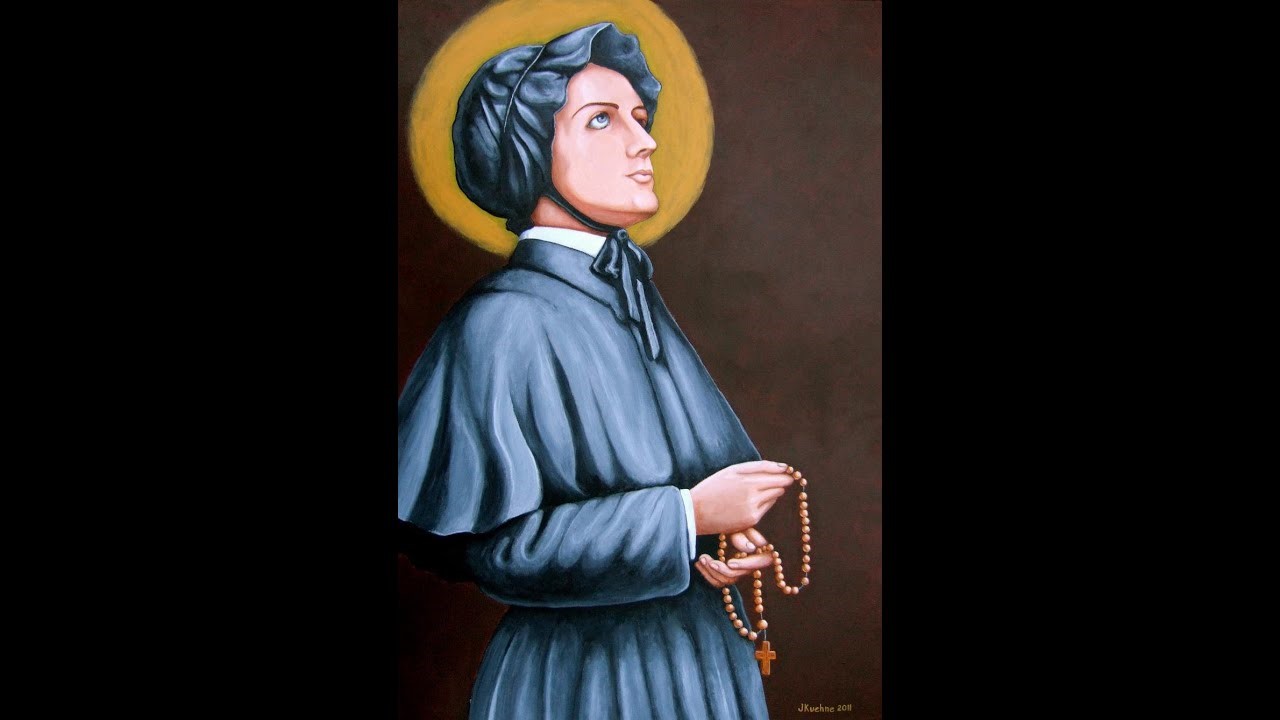
Today we come together as the Church, to commemorate the Memorial of my Dominican Order Name
Saint, that being St. Elizabeth Ann Seton.
This particular Saint was given as my order Name Saint because my Bishop noticed there seemed to be
many similarities between the life of St Elizabeth Ann Seton and the life of myself. We both share the
fact that we have both overcome many life traumas and adversities, but yet, we both always have
remained strong of faith regardless of the things life has thrown at us.
Mother Seton founded the first American religious community for women, named the sisters of charity,
and so she was a keystone of the American Catholic church. Mother Seton also opened the first
American parish school, and the first American Catholic orphanage. All this, she had accomplished by
the age of 46, whilst also raising her own five children.
Mother Seton is a true daughter of the American Revolution, she was born on Aug 28th 1774, which was
only two years prior to the declaration of Independence.
By both birth and marriage, Mother Seton was linked to the first families of New York and enjoyed the
rich fruits of high society, but this situation wasn’t to last.
Mother Seton suffered the early deaths of both her mother in 1777, and of her baby sister in 1778, but
far from letting it get her down, she faced each new ‘holocaust’ as she called it, with a hopeful
cheerfulness.
At only aged 19, she married a handsome wealthy businessman named William Magee Seton and they
had five children together. But William’s business failed, and he died of Tuberculosis when Elizabeth was
aged 30, leaving her widowed, penniless and with five young children to support. Many of her family
and friends rejected her when she converted to the Catholic faith in March 1805.
As a means to support her children, mother Seton opened a school in Baltimore which always followed a
religious community pathway and her religious order of the sisters of charity was officially founded in
1807.
The thousands of letters of Mother Seton reveal the development of her Spiritual life from that of a
person of Ordinary goodness, to one of heroic sanctity. She suffered many great trials within her life yet
with her strong faith, she overcame them all. Trials of sickness, of misunderstanding, the deaths of her
loved ones (mother, baby sister, husband, and even two of her own children), and the heartache of
having a wayward son.
St Elizabeth Anne Seton died on January 4th 1821, she became the first American=born citizen to be
beatified in 1963, then Canonized in 1975. She is buried in Emmitsburg in Maryland.
Let us pray:
O Father, the first rule of our dear Saviour’s life was to do your will. Let His Will of the present moment
be the first rule of our daily life and work, with no other desire but for it’s complete accomplishment.
Help us to follow it faithfully, so that doing your Will may be pleasing in your sight.
Amen.
The Feast of St John~The Very Rev Lady Sherwood,OPI
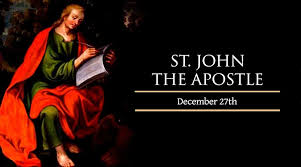
Today, we come together as the church to commemorate St John the Apostle.
But, who was John the Apostle?
Who is this disciple whom Jesus loved so very much? Is he a secretive person that does not want to
identify himself to us? Our dear Lord Jesus chose him, he was a fisherman, and was called the son of
Zebedee, the brother to James. He also wrote the gospel of John and the Epistles of I, II, and III, John and
Revelation.
The famously known portrait which was painted by Leonardo DaVinci which shows the disciples sitting
next to Jesus, and the one closest to Jesus in this portrait is John as he is shown to be leaning on the
shoulder of Jesus which is symbolic of his love for Jesus. This comes from the Bible “Now there was
leaning on Jesus bosom one of his disciples whom Jesus loved. (John 13:23) Then verse 25, says, “He
then lying on Jesus’ breast said unto him, Lord, is it I?” John never mentions his name in the gospel but
we believe this to be him.
Again, at the crucifixion of Jesus, John is there next to the Blessed Mother Mary. identified as ‘the
disciple whom Jesus loved. (JN 19:26) At the resurrection, he is identified as the disciple whom Jesus
loved. (20:2) Then next, on the fishing trip with the other disciples, he is mentioned as ‘the other
disciple.” (21:7,20,24) Why, is his name never mentioned? He was giving honour to our Lord Jesus only,
John knew this wasn’t about himself!
So Who is this John, the Disciple? They called him “The Son of Thunder”. The Big Fisherman! The man
with a Big heart, a loving heart for people. Whatever he did, John always did it wholeheartedly! He was
not one to ask questions like the other disciples would do. He never critized. He was always straight
forward and precisely to the point! They described him as being a deep thinker, he was the silent
disciple. He was determined to always do what was the correct thing. Most of all, John was the
spokesperson like Peter also became later in his ministry. He was in his wholehearted believing, the
greatest friend to the Lord Jesus.
John had an intense deep love for Jesus. HE LOVED JESUS SO VERY MUCH! And he loved his brothers just
as much in the Kingdom of God. They described John as being courageous and bold in his love for Jesus.
In a quiet way, he served his Master with all his body and soul. The love of Jesus was totally within his
heart and this deep love is what energized him each and every single day. John was intense, he was
sincere, he was unselfish as he wrote his gospel and his epistles, and also revelation.
An eagle would be the best way in which to describe John. He was Soaring high, but with eyes looking
out for the young who needed to learn to fly and who also needed to be fed. He spoke the truth and in
love for the followers of Jesus. When he was with Jesus for 3 years, He was easily teachable and was
very much impressed by the love Jesus showed to him and he couldn’t wait to tell the whole world
about the Love of Jesus. He may have been the silent disciple but he will never forget those last days of
Jesus’s life upon on the earth, because his experience of this made him one of the strongest of all of
Jesus’s disciples.
Jesus looked to John to care for Mary, his Mother. But Peter was about to fail Jesus, but Jesus needed
John to look after Peter as well. He did not say to John ‘feed my sheep’ because John would do it
automatically anyway. Whilst the other disciples scattered at the cross, not John! It was John who had
the visions of Jesus, who told us in writing and it is John who is still standing in the end!
CONCLUSION: A friend told the story of his son when he was down in the basement and was carrying his
books up the stairs. His son wanted to also help him, so the son walked in front with some books as well.
And of course, half way up the boy tripped and fell backwards and safely into his dad’s arms. So now
they both went up the stairs together and were so relieved that nothing serious happened! Jesus walked
behind John and numerous times rescued him. To become known as “The Disciple Whom Jesus Loved”
leaning on the bosom of Jesus. Amen.
Standing Firm~The Feast of St Stephen, the First Martyr~The Very Rev Lady Sherwood,OPI

Standing Firm: St. Stephen the First Martyr
Today, the day after we have celebrated the joyous birth of Our Lord and Saviour, and after all the
enjoyment of festive food and the giving of gifts which we traditionally do at Christmas, and with this
being the first time many of us have been able to have any joyous type of occasion this year amid all the
covid19 pandemic situation, we now come in total contrast to that of the celebrations of Christmas day,
to the Feast of St. Stephen who was the first Martyr to die for his faith in Our Lord.
Throughout the Old Testament we see time and time again, of the faithful being persecuted and often
even killed by those without faith. But it’s not just an Old Testament phenomenon. This is what humans
can do in their natural and unredeemed state. We as humans don’t like our sins to be pointed out to
us. We manage to make ourselves believe that we’re really not all that bad. We work hard to justify our
sins and failings. We find the really, really sinful people in history—men such as Nero or Stalin—and we
tend to compare ourselves to them and actually start to feel pretty good about where we stand before
God because we don’t believe our sins are as bad as those of such people. And that’s when one of
God’s faithful workers comes along—someone who, while by no means perfect, is living a life renewed
by grace and who is indwelt by the Holy Spirit—and suddenly all the illusions we’ve built up about our
own goodness are shattered and we get angry. Like Cain, instead of acknowledging our sins and instead
of repenting, we torment, persecute, and sometimes even kill God’s people when they show us up.
Jesus weeps over Jews, knowing that they will continue to kill those whom he sends as his messengers.
They won’t stop at only Jesus’s messengers, but they will indeed kill our Lord and Saviour himself soon
also They won’t heed the warnings. But brothers and sisters, Jesus warns us—the faithful—too. To his
disciples he says:
Blessed are those who are persecuted for righteousness’ sake, for theirs is the kingdom of heaven.
Blessed are you dear brothers and sisters when others revile you and persecute you and utter all kinds
of evil against you falsely on the Lord’s account. Rejoice and be glad, for your reward is great in heaven,
for so they persecuted the prophets who were before you.
Jesus prepares us for the fact that as we joyfully follow him, and joyfully do the work of his kingdom,
and as we witness the great Christmas joy we’ve found in the manger and at the cross—as we live a life
of joy before our King—we will face persecution from the world. To submit ourselves to that seems
nonsensical. How can we find joy in persecution? We find it there, because when we make Christ our
Lord, he gives us that eternal perspective we’ve been hearing about all throughout Advent. Suddenly
the things of this world are so much less important. Our focus is on Jesus and on building his kingdom.
Our focus is on being witnesses of his new life and taking his Good News to the world. And that change
in perspective means that if we can effectively communicate the Gospel to others whilst being
tormented or with the risk of even being killed, well then, so be it. Our joy in living in and sharing Christ
is greater than our joy in the things of this world—even in life itself, because we know that our share in
eternal life is so much greater than anything this world could ever possibly give. But it’s not just about
joy. It’s about love too. That’s another theme that is carried throughout the season of Advent. We saw
Love Incarnate in the manger yesterday. And now because God has so changed our perspective by
loving us, we start loving as he did— if we are indeed true children of God and his faithful servants, we
simply can’t help it! And it’s not just that we love God’s Church or that we love our brothers and sisters
in Christ, but that we even love our enemies and do good to those who persecute us. That’s the hardest
command of all for us to obey, but the reason it’s so hard is because we haven’t been perfect in love
ourselves. The closer we grow to Christ, the better able we’ll be to live it. But it’s also true that the
better we live it, the closer we will be to Christ! It is a never ending circle.
However, we fully know that Living that way is hard. We so often get bogged down in matters of this
world. We focus more on life here than we do on life in the Kingdom of Heaven. . We fall back into
living in fear instead of living in faith. The witness of St. Stephen should focus our eyes on our Lord and
Saviour and on living the life he has given us. No one knows for sure why this feast falls on the day after
Christmas, but one thing I’ve realised is that it’s easy to be excited about grace and to live as Christmas
people on Christmas Day. But dear brothers and sisters, as humans we’re incredibly fickle, and the next
day many forget about being Christmas people and go back to living in fear and in faithlessness. We
forget our witness. How often do you come to worship God on a Sunday morning, getting excited about
grace, and yet even as you drive home someone on the road does something that makes you angry and
you forget all about grace; or you get bad service while you’re out having lunch, and you forget all about
grace; or you get a bad news the next morning about your job, and you forget all about grace. The
Church reminds us today that being Christmas people requires real commitment on our part and that as
much as it’s joyful work, it’s extremely hard work and work that requires truth and devout faith in the
promises of God.
The story of Stephen actually begins in Acts Chapter 6. He was among the group of seven men
appointed the first deacons by the apostles. They were the servant-ministers of the Church in
Jerusalem. Stephen was excited about his work. Acts 6:8 tells us:
Stephen, full of grace and power, was doing great wonders and signs among the people.
He was doing what he was supposed to do as a Christmas person and he attracted attention. The
problem was that he attracted the attention of Jews who didn’t like what he was doing. Now, I say “the
problem”. That just shows how our perspective isn’t fully where it should be. We see it as a “problem”
when we face persecution. We forget that God is sovereign and that he’s working everything out for the
good of his people and the spread of his kingdom. Persecution is hard and painful, but it’s still “good”.
Remember, Jesus tells us that we find blessing in it. So it was a “problem” that the Jews were upset by
what Stephen was doing, but it wasn’t really a problem. God was still in control. We need to keep that
in mind in our own lives: Christians don’t have “problems”, we have “opportunities” to exercise our
faith.
And Stephen knew that, even as these angry men dragged him before the Sanhedrin and produced all
sorts of false witnesses who attested that he was as a blasphemer. He was on trial and it wasn’t going in
his favour. And yet even as these men told lies about him, St. Luke tells us that Stephen sat there with
the face of an angel—he was peaceful even in the face of condemnation. The one other place in
Scripture we hear a description like this is of the face of Moses after he had been with God. Stephen
was close to his Saviour and was experiencing the “peace of the Lord”.
In fact, when the high priest gave Stephen a chance to defend himself, what did Stephen do? He didn’t
try to explain away the things he had said and done that he got him into trouble in the first place. No.
He took the opportunity to preach the Gospel to the whole Sanhedrin! He addressed them and started
with Abraham and told the story of redemption down through Joseph and Moses. He told them the
stories of their fathers who were rescued from slavery in Egypt and then again how God cared for them
in the wilderness and drove out their enemies in Canaan to give them a home—and he stressed how all
these things were made possible by God and were his gifts. And as he told the story, he noted how over
and over the people rejected God—gladly claiming the great things he gave them, but never truly
receiving God himself. And with that Stephen brings them right down to Jesus and he says:
You stiff-necked people, uncircumcised in heart and ears, you always resist the Holy Spirit. As your
fathers did, so do you. Which of the prophets did your fathers not persecute? And they killed those who
announced beforehand the coming of the Righteous One, whom you have now betrayed and murdered,
you who received the law as delivered by angels and did not keep it. (Acts 7:51-53)
He doesn’t pull any punches. He tells them that in rejecting Christ, they’re doing the same things that
their fathers had done before them in rejecting the grace of God and in being disobedient. We don’t
have time this morning to read Stephen’s full sermon, but I urge you to read through it—Acts
7—sometime this next week. This was a man who was full of passion for his Lord. He was full of passion
to share the Good News, even when he was in the lion’s den. What strikes me is how what Stephen
does here runs counter to so much of what the Church today tells us to do in terms of evangelism.
We’re told today not to be confrontational; we’re told not to talk too much about sin—or not to talk
about it all—because that might turn people off; we’re told to focus on the positive; we’re told to
witness the Gospel with our lives and that we might get into trouble sharing it with our mouths. Look at
what Stephen does! Not only does he live the Gospel, but he speaks it out loud and clear! He confronts
these men right for being the religious hypocrites they are. Stephen didn’t just sit there, quietly and say
to himself: “I’m not going to bother with these guys. I’d just be casting my pearls before swine.” No, he
shared the Good News with them and he did it peacefully and joyfully. And he did it because he was
living in the grace and love of Christmas. He knew that these men might never come to know the
Saviour but for his witness, but he also knew that if they were truly reprobate, their rejection of his
Gospel sermon would simply confirm to them and to the world their rejection of the Saviour, and God
would have greater glory in their condemnation. God’s Word never returns void. Stephen knew that.
St. Luke continues the story and tells us their response:
Now when they heard these things they were enraged, and they ground their teeth at him. But he, full
of the Holy Spirit, gazed into heaven and saw the glory of God, and Jesus standing at the right hand of
God. And he said, “Behold, I see the heavens opened, and the Son of Man standing at the right hand of
God.” But they cried out with a loud voice and stopped their ears and rushed together at him. Then
they cast him out of the city and stoned him. And the witnesses laid down their garments at the feet of a
young man named Saul. And as they were stoning Stephen, he called out, “Lord Jesus, receive my
spirit.” And falling to his knees he cried out with a loud voice, “Lord, do not hold this sin against them.”
And when he had said this, he fell asleep. (Acts 7:54-60)
We might read that story and think, “Wow. Stephen certainly had a bad day!” Our eyes are blind to
God at his work. Stephen took a faithful stand for his Lord, and even as they got ready to drag him out
to be stoned, God granted him a vision of his own glory and of Jesus enthroned beside him. Stephen’s
“bad day” was a good day for the Church, because on that day God set Stephen before the rest of us as
a witness—a lesson as to what it means to be Christmas people—people of his grace and his love and his
power. He showed himself to Stephen so that Stephen could show himself and his faith in Christ to the
rest of us.
But Stephen’s story does more than just encourage us to share the Good News and to stand firm in our
faith. He reminds us what it means to witness the Gospel in our deeds. Stephen had that vision of the
Lord Jesus before his eyes, and so even as these evil men started hurling stones at him, he responded
with Christlike love. When Jesus was hanging on the cross, do you remember what he prayed? He said,
“Father, forgive them, for they know now what they do.” To the last Jesus was concerned with the souls
and with the eternal state of the people around him—even his enemies. He was an evangelist to the
end, even when there were no more words to say to his persecutors and murderers, he was praying for
them. And Stephen, with his eyes on Jesus, does the same. There was nothing left to say to these men
and there was nothing left for him to do, and so he prayed for them: “Lord, do not hold this sin against
them.”
Luke tells us that St. Paul was there that day. He was holding coats so that people could do a better job
throwing rocks at Stephen. Of course, this is when he was known as Saul—before he met Jesus on the
Damascus Road and had his life changed forever. The next verse, 8:1, tells us that Paul approved of
Stephen’s execution. What we don’t know is what impact Stephen’s loving and gracious response had
on Paul’s future conversion. But Luke certainly included this detail for a reason.
Brothers and sisters, Stephen reminds us that we need to be living as Christmas people, not just on
Christmas, but each and every day. But he also shows us very dramatically what it means to live in the
life and grace of Christmas—especially in light of St. Luke’s note that Paul was there that day. We never
know who is witnessing us and how those around us may, or may not, be impacted for the Gospel by
what we say and what we do and by how we deal with the circumstances of life. Who would have
thought on that day that Saul of Tarsus—Hebrew of Hebrews and member of the Sanhedrin, the man
who hunted down Christians and brought them to trial before the Jewish authorities—who would have
thought that Stephen’s witness of love and grace that day might change the whole course of Church
history as Saul later became Paul, the apostle to the gentiles.
And lastly, Stephen teaches us something about the extreme nature of grace and love and forgiveness.
These men were more than just run-of-the-mill enemies. These weren’t just men who didn’t like him or
were just angry with him. These were men who saw him as a threat to their existence and wanted to kill
him—who did kill him. Stephen didn’t reciprocate their anger. No, he saw them as Jesus saw them:
sinful men whom he loved and who would face eternal damnation without the Gospel of love and grace.
Stephen knew the love that overcomes a multitude of sins and he knew it because he had experienced it
himself through Jesus Christ. St. John reminds us that anyone who claims to love God, but hates his
brother is a liar—that you can’t have experienced the redeeming love of God and still hold grudges and
hate in your heart against those who have wronged you. Friends, to hold a grudge, to resent the sins of
others, to fail to show a forgiving spirit, is to be self-righteous—it’s to ignore what God had done for
you! Stephen could look on these angry men with love, precisely because he had himself experienced
the love of Christ and God’s forgiveness—and he knew that there was nothing these men could do to
him that was as bad as even his own smallest offences against God. God had forgiven him so
much—and he realise that so well—that it was a “small” thing for him to forgive these men and to show
them love. Lest we think that Jesus and John are just speaking in hyperbole when they tell us to love our
enemies, St. Stephen shows us how the love of Christ really does work out in our lives—or at least how it
should, if we truly claim to love God and to have experienced his grace and forgiveness.
So remember today: We are a Christmas people, living in the grace and love of God. But remember too
that God calls us to be Christmas people every day of our lives and not just in the Christmas season..
The joy of Christmas is something that should permeate every aspect of our lives that we might be
witnesses, even to our enemies and even to those who would kill us, of the love and grace that God has
shown us through his Son. And so we pray, “Grant, O Lord, that in all our sufferings for the testimony of
your truth we may look up steadfastly to heaven and see by faith the glory that is to be revealed and,
filled with the Holy Spirit, may learn to love and pray for our persecutors as St. Stephen your first martyr
prayed for his murderers to you, blessed Jesus, where you stand at the right hand of God to help all who
suffer for you, our only mediator and advocate.
Who Are These? The Feast of All Souls~The Rt Rev Michael Beckett,OPI
Y’all…….Those of you who have hung around with me for more than a minute know that I’m all about some words. They fascinate me. And I play LOTS of Words With Friends and Word Solitaire and other word games. When I was teaching I was all about spelling and grammar and vocabulary (words, meanings, and how to effectively use them.)
Here of late, there has been one word that seemingly has been on a recurring loop in my head; the word “dumbfounded.” Interestingly enough, the word ‘dumbfounded’ comes from a blend of ‘dumb’ and ‘confounded’, and we know that this word first came into use in the mid 1600s and meant ‘amazed, surprised, caught off guard. The word ‘dumb’ as we know it today comes from the Old Norse ‘dumbr’, the Gothic ‘dumbs’ which meant ‘mute’, the Dutch ‘dom’, and the German ‘dumm’, the latter two of these would be translated into ‘stupid.’
And I have certainly been struck mute, been confused, and made speechless by some of the things I’ve seen and heard lately. I am dumbfounded by folks who one day ask for prayer, who proudly and happily post about following Jesus, and then the next day (sometimes the next 15 minutes) post or say something that completely negates and is in direct conflict with, everything that Jesus taught and stood for. They’re all about bringing ‘religion’ back into schools and posting the 10 Commandments everywhere, but completely ignore the “not bearing false witness” part and post dis-and mis-information and flat out lies. And they do it happily and proudly. They excitedly promote those in authority who publish pictures of their “prayer groups” but who trample on the Gospel. They denigrate those who they feel are “less than” and completely ignore the words our Lord spoke in Matthew, yet happily say they are all about Jesus, want to bring folks to Jesus, and say “Come to church with us!.” For me, personally, this saddens and terrifies me, and it should them. They, in their ignoring what Jesus has said, completely ignore His words in Matthew 18:6: “If anyone causes one of these little ones—those who believe in me—to stumble, it would be better for them to have a large millstone hung around their neck and to be drowned in the depths of the sea.”
Conversely, today is the Feast of All Souls, (closely akin to All Saints which was yesterday,) wherein we honor all of those devout folks who have gone on before us. One of the Scriptures that is associated with today comes from the Book of Revelation:
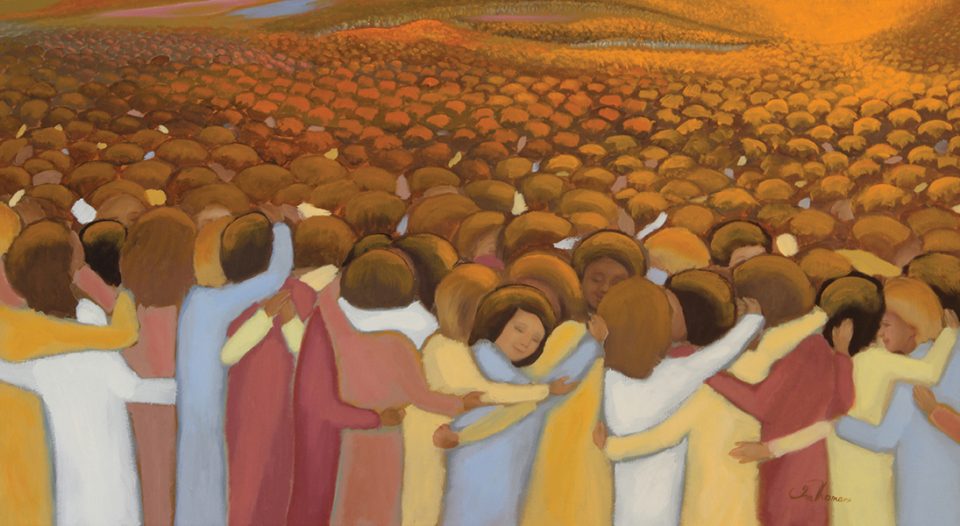
I had a vision of a great multitude, which no one could count, from every nation, race, people, and tongue. They stood before the throne and before the Lamb, wearing white robes and holding palm branches in their hands. They cried out in a loud voice: “Salvation comes from our God, who is seated on the throne, and from the Lamb.” All the angels stood around the throne and around the elders and the four living creatures. They prostrated themselves before the throne, worshiped God, and exclaimed: “Amen. Blessing and glory, wisdom and thanksgiving, honor, power, and might be to our God forever and ever. Amen.”
Then one of the elders spoke up and said to me, “Who are these wearing white robes, and where did they come from?” I said to him, “My lord, you are the one who knows.” He said to me, “These are the ones who have survived the time of great distress; they have washed their robes and made them white in the Blood of the Lamb.”
Well now. Just who ARE these folks in white robes? Their anonymity teaches us that sainthood is not reached through great achievements or rare acts of bravery. Sainthood comes from simply loving God and doing our best to live our lives in a way consistent with Jesus’ commandment. I would dare say that none of the saints actually set out to be saints. They simply loved God and lived their lives to follow Him.
Revelation goes on to remind us that giving our lives over to God will not protect us or insulate us from hardship. Living in, for, with, and through God, however, will make sure that we can and will endure whatever “great distress” comes our way. In this passage of Revelation, John is speaking specifically of those who have given their lives for their faith. Whilst there is talk about a “War on Christianity,” in reality, it is very unlikely that any of us will be called upon to sacrifice our lives for our faith.
Our challenge, then, is to actually LIVE for Christ, rather than to die for Christ. Jesus does ask to lay down our lives for Him. Peter said to the Lord, “I will lay down my life for Your sake,” and he meant it (John 13:37). Has the Lord ever asked you, “Will you lay down your life for My sake?” (John 13:38). It is much easier to die once than to lay down your life day in and day out with the sense of the high calling of God. We are not made for the bright-shining moments of life, but we have to walk in the light of them in our everyday ways. For thirty-three years Jesus laid down His life to do the will of His Father. “By this we know love, because He laid down His life for us. And we also ought to lay down our lives for the brethren” (1 John 3:16).
If we are true followers of Jesus, we must deliberately and carefully lay down our lives for Him. It is a difficult thing to do, and thank God that it is, for great is our reward. Salvation is easy for us, however, because it cost God so much. But the exhibiting of salvation in our lives is difficult.
God saves a person, fills him with the Holy Spirit, and then says, in effect, “Now you work it out in your life, and be faithful to Me, even though the nature of everything around you is to cause you to be unfaithful.” And Jesus says to us, “…I have called you friends….” Remain faithful to your Friend and remember that His honor is at stake in your bodily life. We are called to remain faithful, despite the reasons the world gives us to not, despite the politics, despite the crowd pressure, despite the differences in our lives.
Who are these dressed in white robes? It is my prayer to be counted among them. What about you? Amen.


You must be logged in to post a comment.