
Category: Dominican Saints
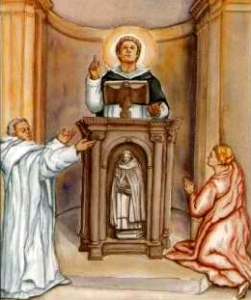
Blessed Amio
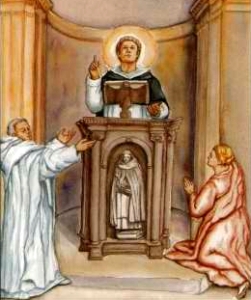
Aimo was one of the few inquisitors in the Piedmont who lived to die in peace at about 100 years of age. One of his first tasks on assuming the office was to give honorable burial to two of his predecessors, who had been martyred. Why is it that we only seem to think of the cruelties of the Inquisition, but rarely of the wrongs of the opposing forces? Could it be that we assume that representatives of the holy Catholic Church will always act like angels?
In any case, Aimo, scion of the counts of Lagnasco, became a Dominican in his hometown at an early age. He was a good student and made such rapid strides in his studies that he was asked to teach at the University of Turin. Much of his life was spent preaching and teaching.
He served for a time as confessor at the court of Blessed Amadeus of Savoy, but did not like that life. So, he was offered the even less attractive position of inquisitor-general of Lombardy and Liguria when he was 71 years old. He replaced Blessed Bartholomew Cerverio, who had just been martyred.
It had taken all the strength of the young and vigorous, 46-year- old Bartholomew to hold such a position; therefore, Aimo went to the Piedmont with considerable misgivings. Nevertheless, he seems to have been a great success in the difficult office. He converted many of his listeners by the sincerity and sweetness of his preaching. His example was a beacon of hope to the Catholics of the area, who had sometimes been embarrassed by the affluence of Church authorities and the obvious poverty of the heretics.
One of Aimo’s first acts was to arrange for the relics of Blessed Anthony of Pavoni to be brought home to Savigliano and interred in the Dominican church there.
Born: in Savigliano, Piedmont, Italy, c. 1395
Died: 1495
Beatified: cultus confirmed in 1856 by Pope Pius IX
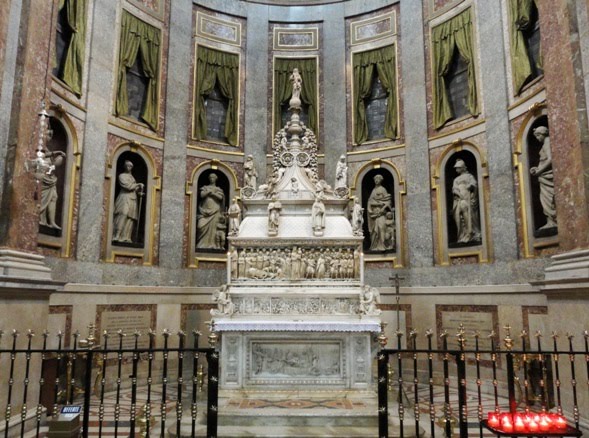
Feast of our Holy Father Saint Dominic
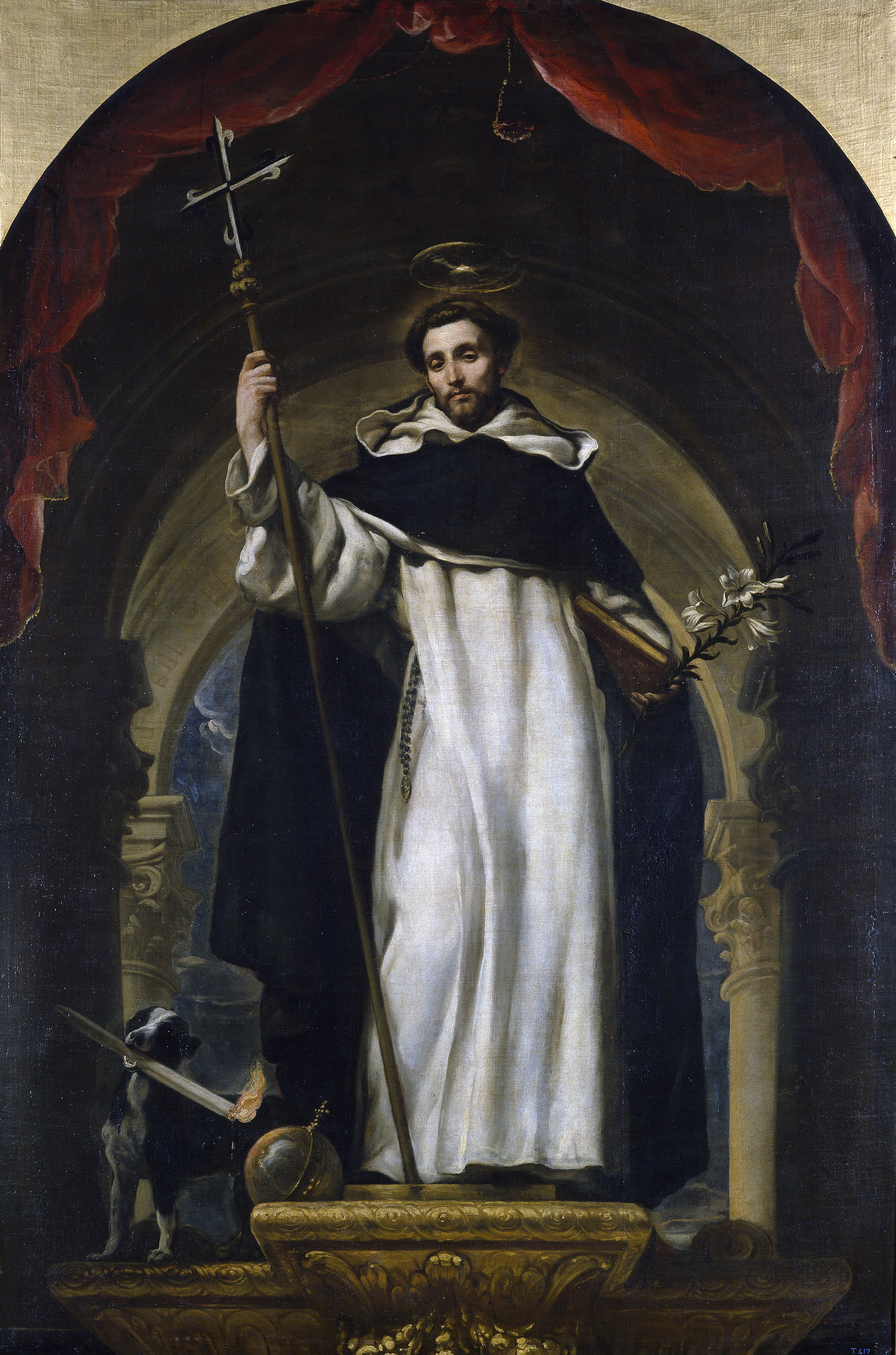 Founder of the Order of Preachers, commonly known as the Dominican Order; born at Calaroga, in Old Castile, c. 1170; died 6 August, 1221. His parents, Felix Guzman and Joanna of Aza, undoubtedly belonged to the nobility of Spain, though probably neither was connected with the reigning house of Castile, as some of the saint’s biographers assert. Of Felix Guzman, personally, little is known, except that he was in every sense the worthy head of a family of saints. To nobility of blood Joanna of Aza added a nobility of soul which so enshrined her in the popular veneration that in 1828 she was solemnly beatified by Leo XII. The example of such parents was not without its effect upon their children. Not only Saint Dominic but also his brothers, Antonio and Manes, were distinguished for their extraordinary sanctity. Antonio, the eldest, became a secular priest and, having distributed his patrimony to the poor, entered a hospital where he spent his life minis ministering to the sick. Manes, following in the footsteps of Dominic, became a Friar Preacher, and was beatified by Gregory XVI.
The birth and infancy of the saint were attended by many marvels forecasting his heroic sanctity and great achievements in the cause of religion. From his seventh to his fourteenth year he pursued his elementary studies tinder the tutelage of his maternal uncle, the archpriest of Gumiel d’lzan, not far distant from Calaroga. In 1184 Saint Dominic entered the University of Palencia. Here he remained for ten years prosecuting his studies with such ardour and success that throughout the ephemeral existence of that institution he was held up to the admiration of its scholars as all that a student should be. Amid the frivolities and dissipations of a university city, the life of the future saint was characterized by seriousness of purpose and an austerity of manner which singled him out as one from whom great thin might be expected in the future. But more than one he proved that under this austere exterior he carried a heart as tender as a woman’s. On one occasion he sold his books, annotated with his own hand, to relieve the starving poor of Palencia. His biographer and contemporary, Bartholomew of Trent, states that twice he tried to sell himself into slavery to obtain money for the liberation of those who were held in captivity by the Moors. These facts are worthy of mention in view of the cynical and saturnine character which some non-Catholic writers have endeavoured to foist upon one of the most charitable of men. Concerning the date of his ordination his biographers are silent; nor is there anything from which that date can be inferred with any degree of certainty. According to the deposition of Brother Stephen, Prior Provincial of Lombardy, given in the process of canonization, Dominic was still a student at Palencia when Don Martin de Bazan, the Bishop of Osma, called him to membership in the cathedral chapter for the purpose If assisting in its reform. The bishop realized the importance to his plan of reform of having constantly before his canons the example of one of Dominic’s eminent holiness. Nor was he disappointed in the result. In recognition of the part he had taken in converting its members into canons regular, Dominic was appointed sub-prior of the reformed chapter. On the accession of Don Diego d’Azevedo to the Bishopric of Osma in 1201, Dominic became superior of the chapter with the title of prior. As a canon of Osma, he spent nine years of his life hidden in God and rapt in contemplation, scarcely passing beyond the confines of the chapter house.
In 1203 Alfonso IX, King of Castile, deputed the Bishop of Osma to demand from the Lord of the Marches, presumably a Danish prince, the hand of his daughter on behalf of the king’s son, Prince Ferdinand. For his companion on this embassy Don Diego chose Saint Dominic. Passing through Toulouse in the pursuit of their mission, they beheld with amazement and sorrow the work of spiritual ruin wrought by the Albigensian heresy. It was in the contemplation of this scene that Dominic first conceived the idea of founding an order for the purpose of combating heresy and spreading the light of the Gospel by preaching to the ends of the then known world. Their mission having ended successfully, Diego and Dominic were dispatched on a second embassy, accompanied by a splendid retinue, to escort the betrothed princess to Castile. This mission, however, was brought to a sudden close by the death of the young woman in question. The two ecclesiastics were now free to go where they would, and they set out for Rome, arriving there towards the end of 1204. The purpose of this was to enable Diego to resign his bishopric that he might devote himself to the conversion of unbelievers in distant lands. Innocent III, however, refused to approve this project, and instead sent the bishop and his companion to Languedoc to join forces with the Cistercians, to whom he had entrusted the crusade against the Albigenses. The scene that confronted them on their arrival in Languedoc was by no means an encouraging one. The Cistercians, on account of their worldly manner of living, had made little or no headway against the Albigenses. They had entered upon their work with considerable pomp, attended by a brilliant retinue, and well provided with the comforts of life. To this display of worldliness the leaders of the heretics opposed a rigid asceticism which commanded the respect and admiration of their followers. Diego and Dominic quickly saw that the failure of the Cistercian apostolate was due to the monks’ indulgent habits, and finally prevailed upon them to adopt a more austere manner of life. The result was at once apparent in a greatly increased number of converts. Theological disputations played a prominent part in the propaganda of the heretics. Dominic and his companion, therefore, lost no time in engaging their opponents in this kind of theological exposition. Whenever the opportunity offered, they accepted the gage of battle. The thorough training that the saint had received at Palencia now proved of inestimable value to him in his encounters with the heretics. Unable to refute his arguments or counteract the influence of his preaching, they visited their hatred upon him by means of repeated insults and threats of physical violence. With Prouille for his head-quarters, he laboured by turns in Fanjeaux, Montpellier, Servian, Béziers, and Carcassonne. Early in his apostolate around Prouille the saint realized the necessity of an institution that would protect the women of that country from the influence of the heretics. Many of them had already embraced Albigensianism and were its most active propagandists. These women erected convents, to which the children of the Catholic nobility were often sent-for want of something better-to receive an education, and, in effect, if not on purpose, to be tainted with the spirit of heresy. It was needful, too, that women converted from heresy should be safeguarded against the evil influence of their own homes. To supply these deficiencies, Saint Dominic, with the permission of Foulques, Bishop of Toulouse, established a convent at Prouille in 1206. To this community, and afterwards to that of Saint Sixtus, at Rome, he gave the rule and constitutions which have ever since guided the nuns of the Second Order of Saint Dominic.
The year 1208 opens a new epoch in the eventful life of the founder. On 15 January of that year Pierre de Castelnau, one of the Cistercian legates, was assassinated. This abominable crime precipitated the crusade under Simon de Montfort, which led to the temporary subjugation of the heretics. Saint Dominic participated in the stirring scenes that followed, but always on the side of mercy, wielding the arms of the spirit while others wrought death and desolation with the sword. Some historians assert that during the sack of Béziers, Dominic appeared in the streets of that city, cross in hand, interceding for the lives of the women and children, the aged and the infirm. This testimony, however, is based upon documents which Touron regards as certainly apocryphal. The testimony of the most reliable historians tends to prove that the saint was neither in the city nor in its vicinity when Béziers was sacked by the crusaders. We find him generally during this period following the Catholic army, reviving religion and reconciling heretics in the cities that had capitulated to, or had been taken by, the victorious de Montfort. it was probably I September, 1209, that Saint Dominic first came in contact with Simon de Montfort and formed with him that intimate friendship which was to last till the death of the brave crusader under the walls of Toulouse (25 June, 1218). We find him by the side of de Montfort at the siege of Lavaur in 121 1, and again in 1212, at the capture of La Penne d’Ajen. In the latter part of 1212 he was at Pamiers labouring, at the invitation of de Montfort, for the restoration of religion and morality. Lastly, just before the battle of Muret. 12 September, 1213, the saint is again found in the council that preceded the battle. During the progress of the conflict, he knelt before the altar in the church of Saint-Jacques, praying for the triumph of the Catholic arms. So remarkable was the victory of the crusaders at Muret that Simon de Montfort regarded it as altogether miraculous, and piously attributed it to the prayers of Saint Dominic. In gratitude to God for this decisive victory, the crusader erected a chapel in the church of Saint-Jacques, which he dedicated, it is said, to Our Lady of the Rosary. It would appear, therefore, that the devotion of the Rosary, which tradition says was revealed to Saint Dominic, had come into general use about this time. To this period, too, has been ascribed the foundation of the Inquisition by Saint Dominic, and his appointment as the first lnquisitor. As both these much controverted questions will receive special treatment elsewhere in this work, it will suffice for our )resent purpose to note that the Inquisition was in operation in 1198, or seven years before the saint took part in the apostolate in Languedoc, and while ie was still an obscure canon regular at Osma. If he was for a certain time identified-with the operations of the Inquisition, it was only in the capacity of a theologian passing upon the orthodoxy of the accused. Whatever influence he may have had with the judges of that much maligned institution was always employed on the side of mercy and forbearance, as witness the classic case of Ponce Roger.
In the meantime, the saint’s increasing reputation for heroic sanctity, apostolic zeal, and profound learning caused him to be much sought after as a candidate for various bishoprics. Three distinct efforts were made to miss him to the episcopate. In July, 1212, the chapter of Béziers chose him for their bishop. Again, the canons of Saint-Lizier wished him to succeed Garcias de l’Orte as Bishop of Comminges. Lastly, in 1215 an effort was made by Garcias de l’Orte himself, who had been transferred from – Comminges to Auch, to make him Bishop of Navarre. But Saint Dominic absolutely refused all episcopal honours, saying that he would rather take flight in the night, with nothing but his staff, than accept the episcopate. From Muret Dominic returned to Carcassonne, where he resumed his preaching with unqualified success. It was not until 1214 that he returned to Toulouse. In the meantime the influence of his preaching and the eminent holiness of his life had drawn around him a little band of devoted disciples eager to follow wherever he might lead. Saint Dominic had never for a moment forgotten his purpose, formed eleven years before, of founding a religious order to combat heresy and propagate religious truth. The time now seemed opportune for the realization of his plan. With the approval of Bishop Foulques of Toulouse, he began the organization of his little band of followers. That Dominic and his companions might possess a fixed source of revenue Foulques made him chaplain of Fanjeaux and in July, 1215, canonically established the community as a religious congregation of his diocese, whose mission was the propagation of true doctrine and good morals, and the extirpation of heresy. During this same year Pierre Seilan, a wealthy citizen of Toulouse, who had placed himself under the direction of Saint Dominic, put at their disposal his own commodious dwelling. In this way the first convent of the Order of Preachers was founded on 25 April, 1215. But they dwelt here only a year when Foulques established them in the church of Saint Romanus. Though the little community had proved amply the need of its mission and the efficiency of its service to the Church, it was far from satisfying the full purpose of its founder. It was at best but a diocesan congregation, and Saint Dominic had dreamed Of a world-order that would carry its apostolate to the ends of the earth. But, unknown to the saint, events were shaping themselves for the realization of his hopes. In November, 1215, an ecumenical council was to meet at Rome “to deliberate on the improvement of morals, the extinction of heresy, and the strengthening of the faith”. This was identically the mission Saint Dominic had determined on for his order. With the Bishop of Toulouse, he was present at the deliberations of this council. From the very first session it seemed that events conspired to bring his plans to a successful issue. The council bitterly arraigned the bishops for their neglect of preaching. In canon X they were directed to delegate capable men to preach the word of God to the people. Under these circumstances, it would reasonably appear that Dominic’s request for confirmation of an order designed to carry out the mandates of the council would be joyfully granted. But while the council was anxious that these reforms should be put into effect as speedily as possible, it was at the same time opposed to the institution of any new religious orders, and had legislated to that effect in no uncertain terms. Moreover, preaching had always been looked upon as primarily a function of the episcopate. To bestow this office on an unknown and untried body of simple priests s seemed too original and too bold in its conception to appeal to the conservative prelates who influenced the deliberations of the council. When, therefore, his petition for the approbation of his infant institute was refused, it could not have been wholly unexpected by Saint Dominic.
Returning to Languedoc at the close of the council in December, 1215, the founder gathered about him his little band of followers and informed them of the wish of the council that there should be no new rules for religious orders. Thereupon they adopted the ancient rule of Saint Augustine, which, on account of its generality, would easily lend itself to any form they might wish to give it. This done, Saint Dominic again appeared before the pope in the month of August, 1216, and again solicited the confirmation of his order. This time he was received more favourably, and on 22 December, 1216, the Bull of confirmation was issued.
Saint Dominic spent the following Lent preaching in various churches in Rome, and before the pope and the papal court. It was at this time that he received the office and title of Master of the Sacred Palace, or Pope’s Theologian, as it is more commonly called. This office has been held uninterruptedly by members of the order from the founder’s time to the present day. On 15 August, 1217, he gathered the brethren about him at Prouille to deliberate on the affairs of the order. He had determined upon the heroic plan of dispersing his little band of seventeen unformed followers over all europe. The result proved the wisdom of an act which, to the eye of human prudence at least, seemed little short of suicidal. To facilitate the spread of the order, Honorius III, on 11 Feb., 1218, addressed a Bull to all archbishops, bishops, abbots, and priors, requesting their favour on behalf of the Order of Preachers. By another Bull, dated 3 Dec., 1218, Honorius III bestowed upon the order the church of Saint Sixtus in Rome. Here, amid the tombs of the Appian Way, was founded the first monastery of the order in Rome. Shortly after taking possession of Saint Sixtus, at the invitation of Honorius, Saint Dominic begin the somewhat difficult task of restoring the pristine observance of religious discipline among the various Roman communities of women. In a comparatively short time the work was accomplished, to the great satisfaction of the pope. His own career at the University of Palencia, and the practical use to which he had put it in his encounters with the Albigenses, as well as his keen appreciation of the needs of the time, convinced the saint that to ensure the highest efficiency of the work of the apostolate, his followers should be afforded the best educational advantages obtainable. It was for this reason that on the dispersal of the brethren at Prouille he dispatched Matthew of France and two companions to Paris. A foundation was made in the vicinity of the university, and the friars took possession in October, 1217. Matthew of France was appointed superior, and Michael de Fabra was placed in charge of the studies with the title of Lecturer. On 6 August of the following year, Jean de Barastre, dean of Saint-Quentin and professor of theology, bestowed on the community the hospice of Saint-Jaques, which he had built for his own use. Having effected a foundation at the University of Paris, Saint Dominic next determined upon a settlement at the University of Bologna. Bertrand of Garrigua, who had been summoned from Paris, and John of Navarre, set out from Rome, with letters from Pope Honorius, to make the desired foundation. On their arrival at Bologna, the church of Santa Maria della Mascarella was placed at their disposal. So rapidly did the Roman community of Saint Sixtus grow that the need of more commodious quarters soon became urgent. Honorius, who seemed to delight in supplying every need of the order and furthering its interests to the utmost of his power, met the emergency by bestowing on Saint Dominic the basilica of Santa Sabina.
Towards the end of 1218, having appointed Reginald of Orléans his vicar in Italy, the saint, accompanied by several of his brethren, set out for Spain. Bologna, Prouille, Toulouse, and Fanjeaux were visited on the way. From Prouille two of the brethren were sent to establish a convent at Lyons. Segovia was reached just before Christmas. In February of the following year he founded the first monastery of the order in Spain. Turning southward, he established a convent for women at Madrid, similar to the one at Prouille. It is quite probable that on this journey he personally presided over the erection of a convent in connexion with his alma mater, the University of Palencia. At the invitation of the Bishop of Barcelona, a house of the order was established in that city. Again bending his steps towards Rome he recrossed the Pyrenees and visited the foundations at Toulouse and Paris. During his stay in the latter place he caused houses to be erected at Limoges, Metz, Reims, Poitiers, and Orléans, which in a short time became centres of Dominican activity. From Paris he directed his course towards Italy, arriving in Bologna in July, 1219. Here he devoted several months to the religious formation of the brethren he found awaiting him, and then, as at Prouille, dispersed them over Italy. Among the foundations made at this time were those at Bergamo, Asti, Verona, Florence, Brescia, and Faenza. From Bologna he went to Viterbo. His arrival at the papal court was the signal for the showering of new favours on the order. Notable among these marks of esteem were many complimentary letters addressed by Honorius to all those who had assisted the Fathers in their vinous foundations. In March of this same year Honorius, through his representatives, bestowed upon the order the church of San Eustorgio in Milan. At the same time a foundation at Viterbo was authorized. On his return to Rome, towards the end of 1219, Dominic sent out letters to all the convents announcing the first general chapter of the order, to be held at Bologna on the feast of the following Pentecost. Shortly before, Honorius III, by a special Brief, had conferred upon the founder the title of Master General, which till then he had held only by tacit consent. At the very first session of the chapter in the following spring the saint startled his brethren by offering his resignation as master general. It is needless to say the resignation was not accepted and the founder remained at the head of the institute till the end of his life.
Soon after the close of the chapter of Bologna, Honorius III addressed letters to the abbeys and priories of San Vittorio, Sillia, Mansu, Floria, Vallombrosa, and Aquila, ordering that several of their religious be deputed to begin, under the leadership of Saint Dominic, a preaching crusade in Lombardy, where heresy had developed alarming proportions. For some reason or other the plans of the pope were never realized. The promised support failing, Dominic, with a little band of his own brethren, threw himself into the field, and, as the event proved, spent himself in an effort to bring back the heretics to their allegiance to the Church. It is said that 100,000 unbelievers were converted by the preaching and the miracles of the saint. According to Lacordaire and others, it was during his preaching in Lombardy that the saint instituted the Militia of Jesus Christ, or the third order, as it is commonly called, consisting of men and women living in the world, to protect the rights and property of the Church. Towards the end of 1221 Saint Dominic returned to Rome for the sixth and last time. Here he received many new and valuable concessions for the order. In January, February, and March of 1221 three consecutive Bulls were issued commending the order to all the prelates of the Church-. The thirtieth of May, 1221, found him again at Bologna presiding over the second general chapter of the order. At the close of the chapter he set out for Venice to visit Cardinal Ugolino, to whom he was especially indebted for many substantial acts of kindness. He had scarcely returned to Bologna when a fatal illness attacked him. He died after three weeks of sickness, the many trials of which he bore with heroic patience. In a Bull dated at Spoleto, 13 July, 1234, Gregory IX made his cult obligatory throughout the Church.
The life of St. Dominic was one of tireless effort in the, service of god. While he journeyed from place to place he prayed and preached almost uninterruptedly. – His penances were of such a nature as to cause the brethren, who accidentally discovered them. to fear the effect upon his life. While his charity was boundless he never permitted it to interfere with the stern sense of duty that guided every action of his life. If he abominated heresy and laboured untiringly for its extirpation it was because he loved truth and loved the souls of those among whom he laboured. He never failed to distinguish between sin and the sinner. It is not to be wondered at, therefore, if this athlete of Christ, who had conquered himself before attempting the reformation of others, was more than once chosen to show forth the power of God. The failure of the fire at Fanjeaux to consume the dissertation he had employed against the heretics, and which was thrice thrown into the flames; the raising to life of Napoleone Orsini; the appearance of the annals in the refectory of Saint Sixtus in response to his prayers, are but a few of the supernatural happenings by which God was pleased to attest the eminent holiness of His servant. We are not surprised, therefore, that, after signing the Bull of canonization on 13 July, 1234, Gregory IX declared that he no more doubted the saintliness of Saint Dominic than he did that of Saint Peter and Saint Paul.
Born: 1170 at Calaruega, Burgos, Old Castile
Died: August 6, 1221 at Bologna
Beatified: July 13, 1234 by Pope Gregory IX at Rieti, Italy
Patronage: astronomers; astronomy; prelature of Batanes-Babuyanes, Philippines; diocese of Bayombong, Philippines; Dominican Republic; falsely accused people; scientists
Representation: chaplet, Dominican carrying a rosary and a tall cross; Dominican holding a lily; Dominican with dog and globe; Dominican with fire; Dominican with star shining above his head; rosary; star
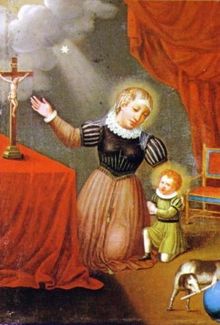
Blessed Jane of Aza, Mother of Saint Dominic
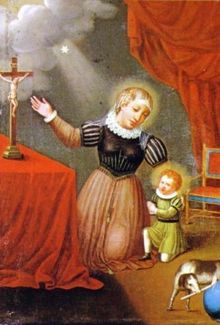 Devotion to Our Lady was typical of medieval Spaniards, as indeed of any Christian of the time. But the devotion to Mary bequeathed by Saint Dominic to his children was something more than ordinary , and in the natural course of events it could come from only one source-his own mother. her name, the scanty records tell us, was Jane of Aza, and neither the date of her birth nor that of her death is known with certainty. Not being of great material importance , she made little impression on history; but the print of her personality will be seen for all time on the order founded by her son. Dominic must have had a very tender love for his mother to make him turn so constantly, trustingly, instinctively to Our Lady in all the troubles and joys of his later life.
Legend relates that before the birth of Dominic, Blessed Jane beheld a vision in which she saw her son , running as a swift greyhound through the world, bearing in his mouth a torch with which he illumined the world (The son became the founder of the Order of Preachers, known as the Dominicans thus the prophetic dream was fulfilled as the Dominican friars took the light of the gospel throughout the world. They became known as the Dogs of the Lord. In Latin the word Dominican would be Domini Canes, literally Dogs of the Lord). It was for her to fan and shelter that flame at its very kindling, and to teach this child of predilection the prayers he would say with such rich results for a lifetime of saintly action. Not only was it Jane who first taught her son the words of the Hail Mary- that key with which he unlocked heaven for so many souls – but it was she that gave to him the living example of Christian womanhood. If in later years his sons were to cherish such a chivalrous love for the gracious Queen of Heaven, much of it was due to the reverential awe and tender love with which this truly Christian lady inspired her three priest-sons. to every priest, his own mother is the personification of all that is good and lovable in woman; she is the ideal to inspire him, the lighthouse to beckon him, and the living picture of the Mother of the first Priest. It could have been no different for Dominic. Where else would he , brought up amid the scenes of war and the mans world of thee university, see in action the ideals of womanly purity, gentleness, and never failing help that he was to cherish as the attributes of his heavenly Queen?
History is silent regarding events in the Life of Blessed Jane. probably there were no great events to record. As the wife of the Castellan of Calaruega, a fortress castle on the border of Christian Spain, she would have led a life filled with the monotony of small things. Tradition relates that her two older sons, Anthony and Manez, were already preparing for the priesthood when Dominic was born. She named her youngest son for Saint Dominic of Silos, at whose shrine she was frequent pilgrim . Knowing that her solider/husband expected their third son to carry on the family name and fortunes, Jane seems still to have cherished for him the goal of the priesthood. Very likely Dominic- and we – owe to his understanding Mother the fortune that placed a book in his hands instead of a sword.
Pope Leo XII beatified Jane of Aza in 1828. Devotion to her has persisted through the centuries despite the poverty of records. The mother of three priest, one of whom died a death of heroic charity and two who were raised to altars of the Church, can safely be judged to have been not only a valiant woman but also a saintly one. Her picture, as that of any mother, can best be seen reflected in her sons.
Born: in Aza, Unknown date
Died: about 1202 in Calaroga
Beatified: Pope Leo XII in 1828 approved her cultus
Blessed Augustine of Lucera

Augustine was born into a wealthy family who provided him with an excellent education. At 18, he and an Italian friend headed to the Dominican novitiate in France. Near Pavia, Italy, they were attacked by enemies of his family, who left the bodies of the two boys in the snow by the side of the road. Augustine was badly injured; his friend died. When he recovered from his injuries, Augustine continued to the novitiate. Augustine spent most of his life battling heresy: In his native Dalmatia, he fought the Manichæen heresy; in Sicily, Islam; in Hungary both. In every situation in which he found himself, Augustine gave proof of his virtue and good judgment. When Cardinal Boccasini came to Hungary as legate, he noted the wisdom and tact of his brother Dominican, and when he himself ascended the papal throne as Benedict XI, he appointed Augustine bishop of Zagreb in Croatia in 1303.
This diocese was in chaos when Augustine assumed the cathedra. His three predecessors had all tried, but failed, to repair the ravages of heresy, plague, and schism. The new bishop began by reforming the clergy. He finished building the cathedral and made a complete visitation of his diocese. His work was to bring him into violent conflict with the government, but, spiritually, he restored the entire see during his episcopacy.
Several charming miracles are related about Augustine. The river water of Zagreb was unfit to drink, so the Dominican fathers asked Augustine to pray for a new supply. At his prayer a fountain sprang up in the yard of the convent, abundantly supplying their needs. Another time he planted a tree in a little village and the leaves turned out to have healing properties. On one occasion, when Bishop Augustine was dining with Benedict XI, the pope, feeling that a missionary bishop must eat well to preach well, had a dish of partridge set before Augustine, who never ate meat. Because he did not want to offend the pope, he prayed for a resolution to the situation. The legend says that God turned the partridges into fish!
Augustine was transferred from Zagreb to Lucera (Nocera), Sicily. Here he continued his holy government, using his characteristic gentleness and his gift of healing. He promoted devotion to Saints Dominic, Thomas Aquinas, and Peter Martyr–all brother Dominicans. Feeling that he was near death, he returned to the Dominican convent in Nocera to die among his brethren. Under his statue in the cathedral of Nocera is the legend, “Sanctus Augustine Episcopus Lucerinus Ordinis Praedicatorum,” an indication of the veneration in which he is held.
Born: in Trau, Dalmatia, c. 1260-1262
Died: 1323
Beatified: cultus reconfirmed by Pope Clement XI in 1702

Blessed Mannes de Guzman

None of the early historical writers of the Order fail to mention Blessed Mannes. His stock was not the least noble among the grandees of Catholic Spain. His parents were Felix Guzman and Jane of Aza, in whose veins also ran some of the best blood of Old Castile. On both sides Mannes could count brave defenders of his country. But what was of infinitely greater importance to him were the holy lives of his own immediate family. His father was a splendid type of the Christian gentleman. His mother has been raised to the honors of the altar under the name of Blessed Jane. His eldest brother, Anthony, became a model priest, who devoted his life to the care of souls, the welfare of the poor, and the aid of the sick, and died with a great reputation for sanctity. Dominic, the youngest and perhaps the only other child, became the founder of the Friars Preacher. He is canonized. Surely this is a record of which any one might well be proud.
Blessed Mannes first saw the light of day in the ancestral castle, Caleruega, Old Castile. The date of his birth can only be estimated from that of Saint Dominic (1170), than whom, we are told, he was a number of years older. Like Anthony, he chose the ecclesiastical state at an early age. Of his ordination to the priesthood and where he made his studies we know nothing. However, Spain was most likely the theater of both. The earlier writers of the Order, while reticent about these things, all tell us that he was of a retiring disposition, and much given to prayer and contemplation.
Yet an apostolic zeal evidently burned in his breast. Almost immediately after the return to Spain of the Right Rev. Didacus (or Diego) de Azebes (often called de Azevedo), bishop of Osma, whom Saint Dominic had accompanied to Rome, Mannes set out for France. From the bishop he learned the need of missionaries in Languedoc, where Dominic had been left to combat the errors of the Albigenses. Possibly de Azebes, for he was a saintly prelate, suggested that Mannes should also take up this work. At any rate, we find him with his younger brother before the close of 1207. From this time the two men, for they were cast in the same spiritual mold, toiled hand in hand for nearly ten years that they might free the Church of southern France from the poison and turmoil of heresy, and restore it to its former peace and beauty.
Not once in all this time did Mannes take a vacation, or pay a visit to his native land, which he loved none the less because he had dedicated himself to the service of God. He felt that his place was where religion needed his attention so sadly. His zeal was tireless; his efforts unceasing. Perhaps on no other did Dominic depend so much. Doubtless, if the full truth were known, history would have to associate Mannes more closely with the saint’s success, as well as give him more credit for the part he played in the conversion of the Albigenses. No danger or hardship could cause him to falter in his labors. He was a splendid preacher. Like Dominic, he intermingled prayer with his sermons and instructions. By his shining virtues and mortified life he wielded a stronger influence for good, whether among the faithful or those who had wandered from the path of truth, than by his eloquence.
One of Blessed Mannes’ most striking traits seems to have been his humility. He knew not the meaning of the word pride or jealousy. The one thing he sought was the glory of God and the salvation of souls. Although older in years, he obeyed his brother as a dutiful son does the will of his father. When Saint Dominic established his Order, Mannes was among the first to place himself under his standard, and to receive the habit. Thus we find him among the “sixteen” zealous men whom God selected as the foundation stones on which to build the Order of Friars Preacher. One would be perfectly safe in the assertion that, when (August 15, 1217) the chosen little band took their religious vows on bended knees before the patriarch, not one of them entered into the ceremony with a better heart, or in more of a spirit of self-sacrifice, than Blessed Mannes.
This event took place in the conventual church of the Dominican Sisters, Prouille, southern France. The annals of Prouille are very explicit in the matter. From their statement and that of Father John of Navarre about the time of his entrance into the Order, which he made in his testimony to the holy life of Dominic to the papal commission appointed to examine the saint’s cause for canonization, it would seem that the sixteen brethren had taken their vows at Saint Romanus’, Toulouse, after Innocent III sanctioned the foundation of the Order. However, after its confirmation by Honorius III, Dominic had them renew their profession. Such was his love for Prouille, around which so much of his work centered, that he chose this place for the ceremony, and as the point of their departure for the various countries to which he sent them.
Blessed Mannes was chosen as one of those who were to start a house of the new Order in Paris. He had six companions — Matthew of France, who was the superior; Bertrand of Garrigue, so called from the place of his birth, a little town in southern France; Lawrence of England; the two Spaniards, John of Navarre and Michael de Fabra; and Oderic of Normandy. The last mentioned has the distinction of being the Order’s first lay brother. They travelled in two parties. That composed of Mannes, Michael, and Oderic reached their destination first, September 12, 1217, being the day of their arrival in the great French capital.
For a while the fathers were obliged to live in a house near Notre Dame Hospital, in the center of the city. But their zeal, eloquence, and model lives soon won them many friends. Among these was John de Barastre, a celebrated master of the University of Paris, dean of Saint Quentin, and a royal chaplain. The noted ecclesiastic had established a hospice for strangers near the gate of the city called “Porte d’Orleans.” The hospice bore the name of Saint James. This he now conferred on the homeless Friars Preacher, and they took possession of it August 6, 1218. It became the famed Saint James’ Convent and Studium, than which none is more celebrated in the Order.
Thus Blessed Marines was one of the founders of this well-known institution, which played a conspicuous part in the history of the University of Paris. His sermons are said to have borne rich fruit in the French capital, for he had a splendid gift of oratory. Besides, he was endowed with an extraordinary personal magnetism; while his kindly, open, and friendly disposition exercised a strong influence over souls. Few could resist his appeals for a better life.
Just when the subject of this sketch left Paris, where he was much beloved, the writers do not tell us. But it is known that Saint Dominic himself sent him from there to Madrid, Spain; and from this we can form a most reasonable conjecture as to the time when Mannes returned to his native land, which he does not appear to have seen since 1207. While in Spain in connection with affairs of his Order, Dominic found Peter of Madrid organizing some pious ladies for a religious community in that city. The saint gave them the habit, admitted them to their vows, and started the construction of a convent for them. This was early in 1219. From Spain he made his way to Paris. While in this city, which he reached before the middle of the same year, he evidently appointed Blessed Mannes to take charge of the sisters in Madrid, and sent him to the Spanish capital; for we find him there shortly afterwards.
Several things, no doubt, conspired to bring about the choice of Mannes for this position. He was growing old, and long years of hard missionary labor must have begun to tell upon his strength. He was a most spiritual, devout, and prudent man, which recommended him for such a charge. His disposition led him to prefer a quiet, retired life, in which he could give himself more to prayer and contemplation, to one of activity among the people. Besides, his practical turn of mind rendered him a suitable person to superintend the temporal affairs of the sisters, whose cloistered state made this difficult for themselves. The holy man called their convent Saint Dominic of Silos, which he doubtless did because his own brother was named after the Cistercian abbot.
From Madrid Blessed Mannes attended the second general chapter of the Order, which was held at Bologna in 1221. Through him, on his return, Saint Dominic sent a letter to the youthful community of Spanish sisters, which is of no little interest because it is the only authentic writing of the saint which has survived the ravages of time. In it he tells them, briefly, of the joy it gave him to hear, through his brother Mannes, of their piety and of the completion of their convent. Both the one and the other are largely due to Mannes’ exertions. He is, therefore, constituted their ecclesiastical superior, with almost plenary powers.
Very probably the holy man held this position the rest of his days, for we find no record of him elsewhere. With this work, we doubt not, he combined no little preaching in and around Madrid. At times perhaps his confrères took his place at the sisters’ convent, while he labored in more distant localities. His life as a religious is said ever to have been edifying to his brethren and useful to his fellow man. Some place his death in 1230. Others say that he died about this time (“circiter 1230″).
But the Année Dominicaine informs us that Roderic “de Cerrate,” a Spanish Dominican of the thirteenth century, states (in his Vitae Sanctorum) that, after Saint Dominic’s canonization, Mannes went to Caleruega and persuaded the people to erect a church in honor of his brother; that he told them a modest edifice would do for the time being, for Dominic would see that a larger one should be built later; and that this prophecy was fulfilled some thirty years later. This would make the holy Friar Preacher die, at the earliest, in 1234 or 1235. It would also explain how he came to be buried in the Church of Saint Peter attached to the Cistercian monastery near Gumiel de Izan. The monastery is not far from the birthplace of Dominic and Mannes, whose ancestors were laid to rest in its temple of prayer. Most probably, therefore, Mannes became sick while engaged in this work of piety, died with the Cistercians, and was buried in their church, for the simple reason that his own Order had no house in that part of Spain.
During life the missionary bad been considered a saintly man and a perfect imitator of the virtues of his brother, Saint Dominic. Not long after his death, miracles began to be wrought at his tomb in such numbers that it became a place of pilgrimage. Because of this his relics were transferred to a more honorable place. Strange to say, Father Chrysostom Henriquez, a Cistercian writer, (in his Menologium Cistersiense) represents the Friar Preacher as a Cistercian. However, this author has been criticized more than once for inaccuracies and carelessness. Not only did Dominican writers correct him in this instance; for Mamachi, who says that Henriquez could not have read the epitaph on Blessed Mannes’ tomb, informs us that another Cistercian author, Father Angelus Manrique, states most positively (in his Annales Cistercienses) that he was a Dominican and a brother of Saint Dominic Guzman.
Reports of the cures obtained through intercession to the man of God soon became widespread. Devotion towards him grew particularly pronounced throughout Spain. In the Diocese of Osma, and especially around Caleruega, he was considered one of the popular saints. More than once petitions for at least his beatification were forwarded to Rome. Although these were not acted upon, the veneration in which Mannes was held rather waxed stronger than decreased with the course of time. For this reason, some six hundred years after his death, the former Camaldolese monk, Mauro Cappellari, who ascended the throne of Peter in 1831 under the name of Gregory XV1, beatified him, and granted his office and mass to the Order of Preachers. July 30 was set apart as his feast day.
Born: in Calaruega, Burgos, Spain
Died: at Saint Peter’s Monastery, Gumiel d’Izan, near Calaruega, in 1230 (there is a possibility that he may not have died until 1235)
Beatified: cultus approved by Pope Gregory XVI in 1834.
Blessed Antony Della Chiesa
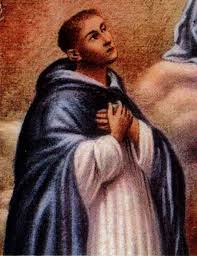
Antony was born into the nobility, the family of the Marquis della Chiesa, and a collateral ancestor of Pope Benedict XV. He was well educated. Showing a taste early in life for he things of God, he grew up with the hope of becoming a religious. His father, who was a man of some importance, opposed this wish. Not until Antony was 22 was he able to make the break with his family and enter the monastery at Vercelli.
Here he distinguished himself for both sanctity and learning. Being a good preacher, he was for some years the companion of Saint Bernardine of Siena, in his missionary journeys through Italy. Antony was prior at the friaries of Como, Savona, Florence, and Bologna.
Antony gives us a picture of one who followed the Dominican life perfectly, managing, most of the time, to escape public notice. There is in his life very little of the glamorous or the unusual. He kept the rule, was a good superior, and a just administrator. Shunning applause, he was always serene.
The legends mention that he was particularly devoted to Our Lady, which is something one takes for granted in a Dominican, and that he conversed with her, in ecstasy, several times. He had the gift of reading hearts and was a sought-after director of souls. He also healed many sick people with his blessing. However, if any miracles are ordinary ones, these may be so described; they could be given as typical of most of early Dominicans.
At one time, Antony was on a ship that was captured by pirates, but at his prayer, the pirates spared the passengers and brought them safely to land. One of the very few things of unusual nature that in Antony’s life is a legend told of him when he was prior of Savona. It makes a lovely ghost story, and it also provides food for thought.
According to the story, Antony was praying one night in the church. Disturbed by the sound of horses hooves clattering on the flagstones outside, he went to see who could possibly be there at such a late hour. There were several horsemen, all mounted on black horses. He addressed them, but received no answer. Thinking that they might be foreigners, he tried several languages, and still there was no response.
Aware, then, that something was wrong, he commanded them in the name of the Lord to tell him who they were and where they were going. They said that they were devils, and that they were on their way to meet the soul of a dying sinner, a usurer, and escort him to hell. “I will pray for him,” said Antony. The demons laughed and told him he was too late. “Then at least come back and tell me whether you succeed or not,” said the prior.
A short while later, the group returned, and they had succeeded. They held the unhappy usurer captive, and, while the prior watched in horror, they bore him off. The man was screaming. The next day, the usurer’s relatives came to arrange an elaborate funeral. “You would do much better to have Masses said for yourselves and other poor sinners,” he said.
Antony died at Como and was buried there in the Dominican church Miracles at his tomb led to his beatification.
Born: in San Germano, near Vercelli, the Piedmont, Italy, in 1395;
Died: Como, Italy, January 22, 1459;
Beatified: 1819 by Pope Pius VII
Blessed Augustine Fangi of Biella

Miracles around the tomb of Augustine of Biella led to his beatification in 1878, after he had long been forgotten by everyone, except the residents of the little town at the foot of the Alps where he lived. His is another example of a life noted for piety and regularity, but quite unremarkable for unusual events or venturesome projects.
Augustine’s father was a member of the Fangi family, who were wealthy and noble, and, because of this, he had planned a secular career for his son. But when the Dominicans came to Biella, his plans were changed, for Augustine was completely charmed by their way of life and begged to be admitted. He entered, while quite young, the new convent that the Dominicans had built at Biella.
Augustine’s had a reputation for penance, even at a time when people were not as squeamish as they are today. Not only did he inflict harsh penances upon himself, he also bore with patience whatever pain and annoyance life granted him gratuitously. At one time he was required to undergo a surgical operation without, of course, any anesthetic. He did so without making the slightest outcry. In fact, he said afterwards that his mind was so intensely focused on something else that he hardly noticed what was being done to him. His mind was on that “something else” most of the time, for he prayed continually.
In 1464, Augustine was made prior at Soncino. Several of his best known miracles were performed there. At one time, a deformed child, who had died without baptism, was restored to life, by Augustine’s prayer, long enough to be baptized. At another time, when he was passing down the street, he met a little boy who was crying bitterly, because he had broken a jug of wine. Augustine gathered up the shards and put them back together again. Then, with a prayer, he refilled the jug and handed it back to the startled child. Still another time, through his intercession, a woman was delivered from possession of five devils.
Augustine spent his last ten years in the convent in Venice, and he died there on the Feast of Saint Mary Magdalene. He was buried in a damp place. Forty years later, on the occasion of some repairs to the church, his coffin, found floating on water, was opened. His body and habit were still intact. This did much to promote interest in his cause. Nevertheless, it was more than three centuries before he was finally beatified.
Born: at Biella, Italy, 1430
Died: feast of Saint Mary Magdalen 1493 at Venice, Italy; in the 1530s, workmen found his coffin floating in the water that had seeped into the burial chamber – when opened, Augustine’s body and clothing were found to be incorrupt
Cultus Confirmed: in 1872 by Pope Pius IX
Beatified: in 1878 by Pope Leo XIII
Blessed Jane of Orvieto

One of the stigmatists of the Order who deserves to be better known is Blessed Jane of Orvieto, whose marvel-filled life was the edification of Umbria in the latter half of the thirteenth century. Jane was born near Orvieto, in 1264, and both parents died when she was very small. Left to the care of casual neighbors, the little girl gre up with a special reliance of her guardian angel. She was a pious and intelligent child, , spending her time in prayer , even when very young.
Since it was necessary for her to earn her living , Jane studied dressmaking and became proficient at it. For several years she worked at this trade , prayerful and happy and undisturbed about her future. However, she had a number of unhappy experiences on the street on her way to work, for young men were attracted by her beauty. It became apparent to her that she must make some public declaration of her intentions if she wanted any peace. She decided to enter the Third Order of St. Dominic. Dressed in the habit of the mantellate, she would be safe from rude remarks and from any misunderstandings.
Jane’s friends opposed her plans, because they had already helpfully chosen a husband for her, and were trying to arrange a meeting of Jane and the man they had selected. Because of her youth, the Dominicans delayed in accepting her. Only after a long period of prayer and fasting was she able to win the privilege of putting on the Third Order habit and living with the other members of the Tertiary chapter. Once a member of the Order she so much desired , she set her goal at the highest sanctity and worked at attaining it. She prayed all morning and part of the afternoon, leaving herself only time to do enough work to care for her few needs and some alms to give the poor. She soon reached a remarkable state of prayer; she participated bodily in whatever she was contemplating. Her director learned not to say anything that would send her into ecstasy until he was through instructing her. Once he mentioned the martyrdom of Catherine of Alexandria and said piously, “Arise, O blessed Catherine,” and Jane arose, in ecstasy, and remained suspended in the air for an hour. If he talked about the Crucifixion her arms would go out in the form of a cross, and she would rise in the air like a figure on a crucifix. On Good Fridays she experienced the terrible agony of the Passion, and one could hear her bones cracking and see the bloody sweat. She received the stigmata, but it was not always visible.
Along with her remarkable life of prayer, Jane had to contend with physical pain. Once she was cured of a serious illness by a miraculous appearance of our Lord on the cross. He appeared to her in the midst of a bright light and gave her a cup of wine to drink. She obediently drank it, and she was instantly cured. Another time, when she was too ill to go to church to receive Communion , Our Lady came and brought the Holy Child to her.
One of Jane’s principal crosses was the lack of privacy. The whole town knew about her ecstasies. As soon as she fell into one, people came running to look. Jane tired to persuade the prioress to keep them out, but the prioress was interested herself, and saw no reason why anybody should object to being watched if they were not doing anything wrong. Jane wept with embarrassment when people asked for her blessing, and assured them over and over that she was not a saint but a wicked sinner, a diagnosis which nobody believed but herself.
Blessed Jane died, in 1306, and was buried in the Third Order cemetery in Orvieto. The following year her body was transferred to the chapel of the Three Kings, and many prodigies occurred at that time, giving impetus to the process for beatification, which, however, was not completed until more than 400 years later, in 1754.
Born: c.1264 at Carniola, near Orvieto
Died: 1306
Beatified: September 11, 1754 by Pope Benedict XIV (cultus confirmed)
Saint Mary Magdalen, Protectress of the Order
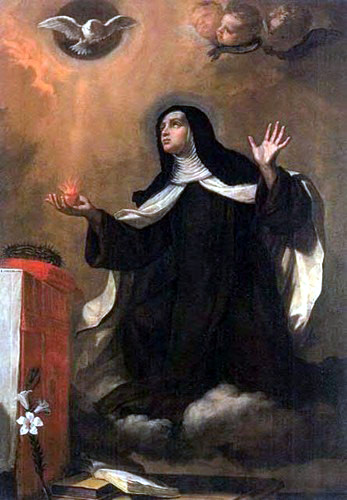
Mary Magdalen, a sister of Lazarus and of Martha, of Bethany, was a notorious sinner in Jerusalem. Moved by the preaching of Jesus, she did public penance. She went openly into the house of the Pharisee with whom Jesus was sitting at table, threw herself at His feet, anointed them with precious ointment, washed them with her tears, and wiped them with her hair. Jesus, knowing her contrite heart, forgave her her sins (Luke 7:37, 38), and from that time forward she became the most zealous and faithful of the women who were disciples of Our Lord. She followed Him, always ministered unto Him of her substance (Luke 8:3), and when He died was standing under the cross.
Epistle: Canticle 3:2-5; 8:6,7
I will rise and will go about the city; in the streets and the broad ways I will seek him whom my soul loveth; I sought him and I found him not. The watchmen who keep the city found me: Have you seen him whom my soul loveth? When I had a little passed by them, I found him whom my soul loveth. I held him; and I will not let him go till I bring him into my mother’s house, and into the chamber of her that bore me. I adjure you, O daughters of Jerusalem, by the roes and the harts of the fields, that you stir not up, nor awake my beloved till she please. Put me as a seal upon thy heart, as a seal upon thy arm, for love is strong as death; jealousy as hard as hell; the lamps thereof are fire and flame. Many waters cannot quench charity, neither can the floods drown it; if a man should give all the substance of his house for love, he shall despise it as nothing.
The soul that, following the direction of the watchmen, that is, the priests, teachers, and rulers of the Church, seeks Jesus, He goes to meet, gives Himself up to, takes up His abode in, with all His love, with all His treasures. The soul which has found Christ for delight forgets all outward things, and no longer has love or joy but for and in Christ. How should it be otherwise? What can be wanting to him who truly possesses Christ? This love for Him Who loved us unto death shows itself by outward acts that are heroic. So Mary Magdalen loved Jesus. Follow her example.
Gospel: Luke 7:36-50
At that time: One of the Pharisees desired Jesus to eat with him. And He went into the house of the Pharisee, and sat down to meat. And behold a woman that was in the city, a sinner, when she knew that He sat at meat in the Pharisee’s house, brought an alabaster box of ointment, and standing behind, at His feet, she began to wash His feet with tears, and wiped them with the hairs of her head, and kissed His feet, and anointed them with the ointment. And the Pharisee, who had invited Him, seeing it, spoke within himself, saying: This man, if He were a prophet, would know surely who and what manner of woman this is that toucheth Him, that she is a sinner. And Jesus answering, said to him: Simon, I have somewhat to say to thee. But he said: Master, say it. A certain creditor had two debtors, the one owed five hundred pence, and the other fifty. And whereas they had not wherewith to pay, he forgave them both. Which, therefore, of the two loveth him most? Simon answering, said: I suppose that he to whom he forgave most. And He said to him: Thou hast judged rightly. And turning to the woman, He said unto Simon: Dost thou see this woman? I entered into thy house, thou gavest Me no water for My feet; but she with tears hath washed My feet, and with her hairs hath wiped them. Thou gavest Me no kiss; but she, since she came in, hath not ceased to kiss My feet. My head with oil thou didst not anoint; but she with ointment hath anointed My feet. Wherefore I say to thee: Many sins are forgiven her, because she hath loved much. But to whom less is forgiven, he loveth less. And He said to her: Thy sins are forgiven thee. And they that sat at meat with Him began to say within themselves: Who is this that forgiveth sins also? And He said to the woman: Thy faith hath made thee safe, go in peace.
Magdalen, who had sinned openly, openly did penance. In like manner, he who has given public scandal must seek to make amends for it by public good example.
Magdalen confessed her sins, says Saint Ambrose, not with words, but with abundant tears of penitence. To tell her sins to Christ, the All-knowing, was not necessary; but what a confession was there in the posture of humiliation, and in the tears that flowed from the contrite sinner. Would you obtain forgiveness? Confess with contrition, like Magdalen.
The words, “Thy faith hath made thee safe,” denote a faith active as love. Faith and love are in truth never separated, for he only truly believes who also loves; and he only loves according to God’s will who believes in Him. Therefore believe in truth, love, and show your love by earnest hatred of every sin, by flying from occasions of sin, by fighting against your passions, by change of your life, and by humble confession, and as true as God lives you will be saved, as was Magdalen; the peace of God will enter into your heart.
Blessed Ceslaus Odrowatz of Poland
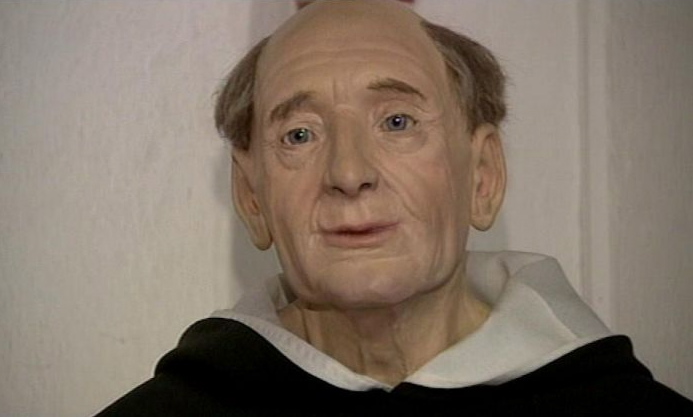
Ceslaus Odrowatz was a near relative, probably a brother, of Saint Hyacinth, and shared with him the apostolate of Northern Europe. Little is known of his youth. He was born in the ancestral castle and educated with Saint Hyacinth, by his uncle, a priest of Cracow.
Both young men became priests and, being well-known for their holiness, were chosen to be canons in the cathedral chapter in Cracow. When their uncle received an appointment as bishop of Cracow, the two young priests accompanied him on his trip to Rome, where he would be consecrated.
It was in Rome that the two zealous young priests first heard of the work of Saint Dominic. The order was then only four years old, and its eager members had penetrated to almost all parts of Christendom and were pushing into the lands of the Tartars and the Mohammedans.
The new bishop strongly desired that some of the friars should come to Poland. Since Saint Dominic was then in Rome, they went to him for missionaries. Dominic was deeply regretful that he had no friars who were able to speak the languages of the North. However, he was much drawn to the bishop’s two young nephews, and promised to make them Dominican apostles if they would remain with him.
After their novitiate training, Hyacinth and Ceslaus went home. Ceslaus went to Prague, and other parts of Bohemia, where he founded convents of Friar Preachers and also established a group of nuns. Then he went to Silesia, where he founded the convent of Breslau that was to become his center of activities. He also acted as the spiritual director for duchess Saint Hedwig of Poland.
The life of Blessed Ceslaus, like that of Saint Hyacinth, is a record of almost countless miracles, of unbelievable distances travelled on foot through wild and warlike countries, and of miracles of grace. He cured the sick and the maimed, raised the dead to life, and accomplished wonders in building convents. His most remarkable miracle was the raising to life of a boy who had been dead for eight days.
In 1241 the Tartars swooped down upon the Christian kingdoms and laid waste the labor of centuries. Blessed Ceslaus was in Breslau at the time the Tartars laid siege to the city. He and his community fasted and prayed incessantly that the city would be saved, and when the cause looked darkest, Ceslaus mounted the ramparts with a crucifix in his hand. While the Tartars gazed in astonishment, a huge ball of fire descended from heaven and settled above him. Arrows of fire shot out from the heavenly weapon, and the Tartars fled in terror, leaving the city unmolested.
Our Lady came to receive the soul of Blessed Ceslaus, who had been tireless in preaching her glories.
Born: c.1180 at Cracow, Poland
Died: July 16, 1242
Beatified: August 27, 1712 by Pope Clement XI (cultus confirmed)
 The Order of Preachers, Independent
You must be logged in to post a comment.