
Category: Dominican Saints
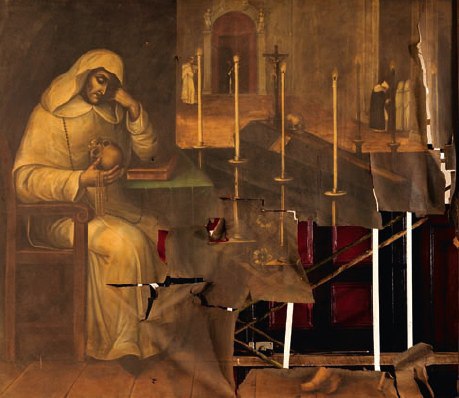
Blessed Peter of Tiferno
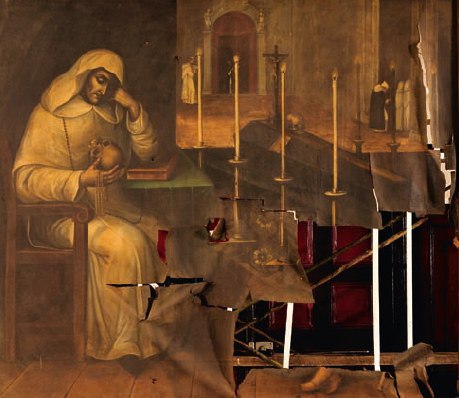
After an uneventful childhood, Peter Capucci applied for admission to the Dominicans. He and the frail, youthful Saint Antoninus were both received into the order on the Vigil of the Feast of the Assumption 1405. Their novice master was Blessed Lawrence of Ripafratta. Peter counted the artist-brothers Fra Angelico and Fra Benedetto as his friends. Peter spent his novitiate at Cortona, remained there when some of his community moved to Fiesole, was ordained, and began his apostolate all in Cortona.
Not much about Peter is truly remarkable when he is viewed in the light of his neighboring luminaries, but he glittered enough to have gained the attention of the Church. He was noted for regularity, patience, and humility–virtues not terribly common in any age. He took upon himself the job of begging for alms as a means of atoning for his noble birth. Of course, just as we might treat the homeless, some treated Peter rudely but that did not disturb him. He quietly persisted in his humble work to ensure that his brothers had food and that there were alms for the poor. We are told that one rich wine merchant refused Peter saying that the barrels in the cellar were all empty. A little later he found to his horror that they were indeed all empty. He immediately sent for the friar, apologized, and begged him to bless the barrels and restore the wine–which Peter did without hesitation.
Other miracles were attributed to Peter, too. A woman’s withered hand was restored. Two unjustly condemned men were miraculously preserved from execution. Once, walking through the cloister, Peter came upon a disreputable man. Peter prophesied that the man would day within a day. The man laughed, but died in the middle of the night after having sent for Peter to give him the sacraments. Peter Capucci became known as “the preacher of death,” because he used to preach with a skull in his hands. He apparently had the ability to read hearts and could expertly point out uncomfortable truths to unwilling listeners.
When Peter died, he was buried in a humble grave. Miracles began to occur there; thus, his fame grew. A prominent man who had been paralyzed for three years, received the use of his limbs at the grave, after he had promised to pay the expenses for an annual celebration in Peter’s honor. In 1597, Peter’s relics were moved to a more suitable place (Benedictines, Dorcy).
Born: at Città di Castello (the ancient Tifernum), in 1390
Died: 1445
Beatified: cultus confirmed by Pius VII in 1816
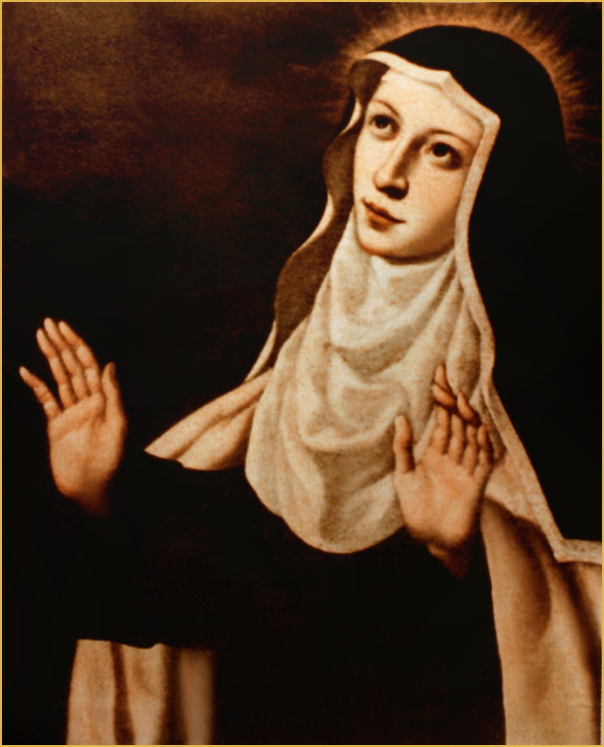
Blessed Magdalen dei Panattieri
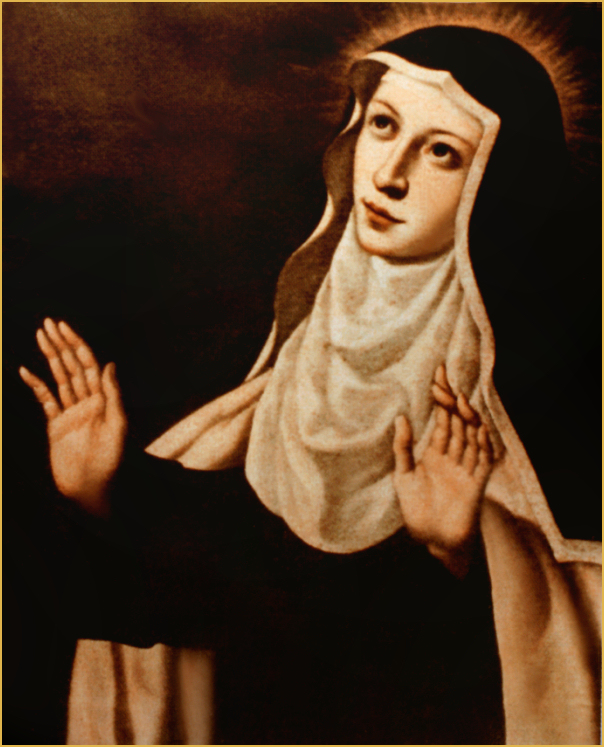
One hears so much about the detachment necessary for sanctity that it is refreshing to read about someone beatified who unblushingly loved her family, her country, her friends, and all little children.
Magdalen Pannatieri was born at Trino, near Vercelli, in 1443, of deeply religious parents. She was a devout child, who made a vow of virginity while she was quite young. Before she was twenty years old, she took her vows as a Dominican Tertiary, an exceptional circumstance, showing that she was held in high esteem. The Tertiary chapter was made up principally of widows and older woman who centered their apostolate of active charities around the Dominican Church. Magdalen fitted into this work with ease, and she brought to the chapter a spirit of penance that few of her companions could match . The delightful part of it all was that her penances never rendered her dreary; she was a cheerful, resourseful person to have around. People drew as much good from her spirit of joy as from any other feature of her spirtuality.
Magdalen had a special fondness for little children, and what we now call baby-sitting, and used her influence witht he children to bring their parents to a better way of life. Childless women won her sympathy , and several times her prayers brought the blessing of motherhood to such people. She taught catechism to children, and gradually the older folk of her acquaintance began to sit in on her classes. She was quite unaware that she had great powers of description and could make the truths of religion clear to simple people. The Dominican fathers allowed her to use a large room attached to the church for a class room, and the class grew. Not only the parents of the children and the simple folk of the neighborhood, but also a number of priest and religious were attending regularly.
When the reform movement started by Blessed Raymond of Capua got underway, Magdalen Parnatieri promoted it in Trino. Though her influence, Blessed Sebastian Maggio was invited to preach there, and he accomplished great good.
Magdalen was considered the protectress of the city of Trino. Whatever disaster threatened it, the citizens expected her to look out for their interests, and she usually did. In her life there is no mention of a “dark night of the soul” or of grim detachment from all things of earth. Her love of God kept her from attaching herself to any illegitimate pleasures, but she thoroughly enjoyed the lawful ones- she loved her family and her townspeople and was happy in their company. Her favorite brother was a good-for-nothing- he was always in trouble. When his conduct had gone beyond the patience of everyone but Magdalene, she threw herself on her knees in front of her crucifix, and she stayed there until our Lord assured her that He would take a hand with the black sheep: ” I cannot refuse you anything,” He said.
The Dominican fathers received her solitude when they were persecuted by a wealthy man of the town. This person carried his hatred so far that he was finally excommunicated for persecuting the Church. there was of course, a good deal of blood shed before the affair was over, and one of the reprobate’s followers made the mistake of hitting Magdalene and calling her names. Before the irate townspeople could deal out justice to him, God did; the man died a violent death.
God revealed to Magdalen the coming political troubles of Italy: the French invasion of the country. She did not live to see this prophecy accomplished, but she persistently asked God’s mercy for her people. During the violent quarrels and bloodshed of the time, Trino was always spared, though the villages all around were in a shambles. The townsfolk unhesitatingly gave credit to Magdalen.
Born: Trino, diocese of Vercelli, Piedmont, Italy, in 1443
Died: 1503
Beatified: beatified by Leo XIII
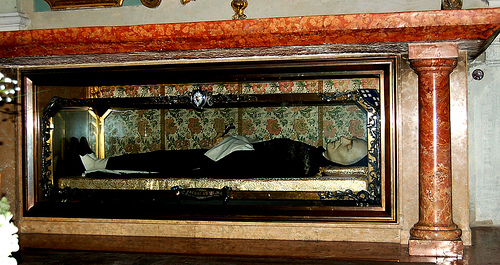
Blessed James of Ulm

James was born at Ulm, and spent a fortunate childhood. He was thoroughly instructed both in his father’s trade of glass painting and in the practices of piety. He assisted his father in the making of stained glass, which was at the time a fine art in Germany, and he passed a sinless and happy youth in his native city. Wishing to make a pilgrimage to Rome, he asked his father’s blessing on the enterprise and set forth on his long journey, arriving in time to spend Lent in the holy city.
Having run out of funds, James enlisted with the army in Sicily. Here his pious nature received a rude shock from the soldiers with whom he lived. They were given to every manner of vice and resented any effort to change their lives. Disgusted with the corrupt morals and practices around him, James made haste to free himself as soon as his enlisted was up. He went into service with a lawyer, who soon entrusted him with his most important affairs and would gladly have adopted him as his own son. Having worked with this man for several years, James became anxious to return home to see his aging father, so he once more set forth on the road.
In Bologna, while he was praying before the tomb of Saint Dominic, an interior voice made known to him that his vocation was to be a Dominican. He sought no further, but went immediately to the prior to beg admission as a lay-brother in the Order.
James set for himself no extraordinary program of sanctity when he entered the Order, but resolved to keep the rule perfectly. He did this with great success. His humility and obedience were particularly remarkable.
James resumed his father’s trade of making stained-glass windows, and all his working time was devoted to making windows for the churches and convents that desired them. At one time, when he had a particularly large and elaborate window for firing in the furnace, the prior called for him to go out begging. Without a backward glance at his precious window, he went. He was gone all day, and it was only to be expected that his window would be in ashes when he returned, but God rewarded his obedience with a miracle-the window was more beautiful than he would ever hoped.
On another occasion, the prior, who had been telling a visiting bishop of James’ virtue, called him and told him to take a letter to Paris- a journey of some three weeks. James, bowing his head, asked only that he might first go to his cell to get his walking stick. The prior did not send him: he had only wished to try his obedience.
James was silent and recollected at his work, diligent and prayerful, and always ready to leave one kind of work for another when obedience called him, even though he had a craftsman’s regard for finishing for work well. His chief distinction was in keeping the rule perfectly, though he also performed a number of miracles.
Two windows made by Blessed James are still in existence; one in the chapel of the Bentivoglio palace, the other in the cathedral of St. Petronius in Bloogna.
Born: 1407 at Ulm, Swabia (modern Germany)
Died: 1491 of natural causes
Beatified: In 1825 by Pope Leo XII
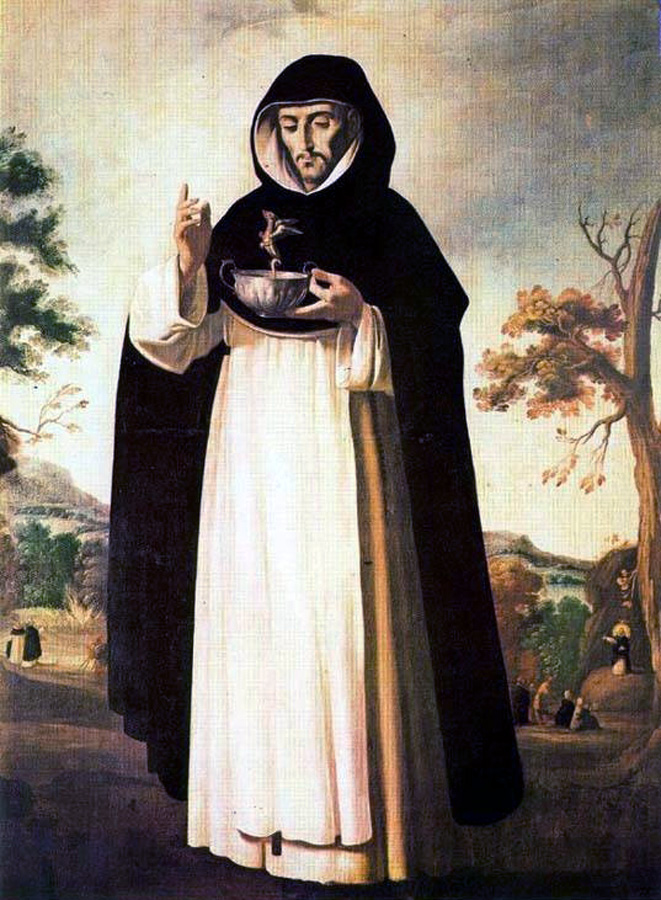
Saint Louis Bertrand
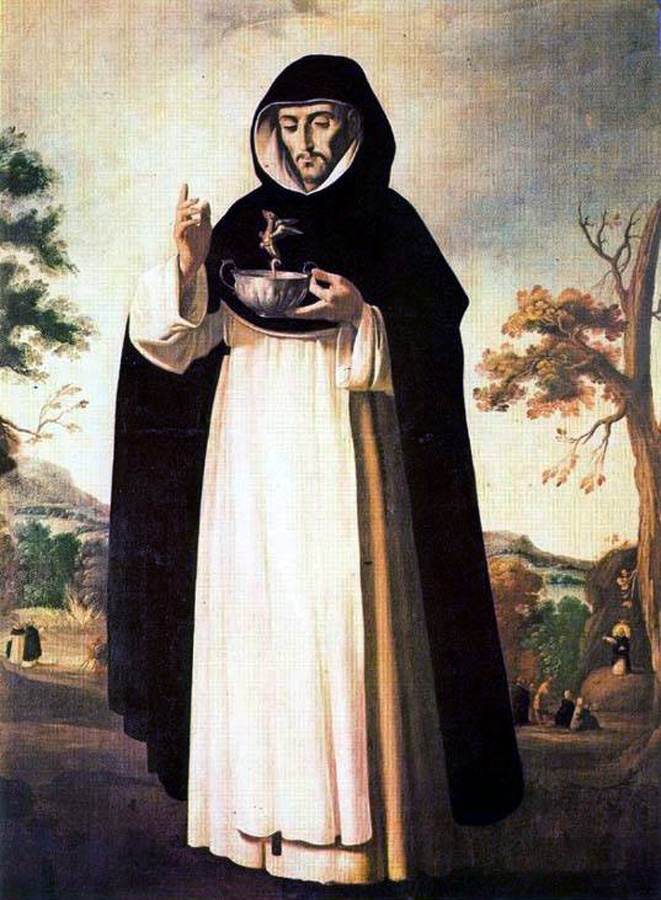
Born at Valencia, Spain, 1 Jan., 1526, his parents were Juan Bertrand and Juana Angela Exarch. Through his father he was related to the illustrious St. Vincent Ferrer, the great thaumaturgus of the Dominican Order. The boyhood of the saint was unattended by any of the prodigies that frequently forecast heroic sanctity. At an early age he conceived the idea of becoming a Friar Preacher, and despite the efforts of his father to dissuade him, was clothed with the Dominican habit in the Convent of St. Dominic, Valencia, 26 Aug., 1544. After the usual probation, in which he distinguished himself above all his associates in the qualities of an ideal religious, he pronounced the vows that irrevocably bound him to the life of perfection. The profound significance of his religious profession served as a stimulus to the increase of virtues that already gave evidence of being cast in heroic mould. In demeanor he was grave and apparently without any sense of humor, yet withal possessed of a gentle and sweet disposition that greatly endeared him to those with whom he came in contact. While he could lay no claim to the great intellectual gifts and ripe scholarship that have distinguished so many of the saints of the Dominican order, he applied himself assiduously to study, and stored his mind with the sacred truths expounded in the pages of the “Summa”. In 1547 he was advanced to the priesthood by the Archbishop of Valencia, St. Thomas of Villanova.
The extraordinary sanctity of the young Dominican’s life, and the remarkable influence he exercised on those about him, singled him out as one peculiarly fitted to lead others along the path of perfection. Consequently, he was appointed to the most responsible office of master of novices, in the convent at Valencia, the duties of which he discharged at different intervals for an aggregate of thirty years. The plague that decimated the inhabitants of Valencia and the vicinity in 1557, afforded the saint an excellent opportunity for the exercise of his charity and zeal. Tirelessly he ministered to the spiritual and physical needs of the afflicted. With the tenderness and devotion of a mother he nursed the sick. The dead he prepared for burial and interred with his own hands. When the plague had subsided, the zeal of the holy novice-master sought to extend the scope of his already large ministry into the apostolate of preaching. Though possessed of none of the natural qualities deemed essential for a successful career in the pulpit, he immediately attracted attention as a preacher of great force and far-reaching influence. The cathedral and most capacious churches were placed at his disposal, but proved wholly inadequate to accommodate the multitude that desired to hear him. Eventually it became necessary for him to resort to the public squares of the city. It was probably the fame of his preaching that brought him to the attention of St. Teresa, who at this time sought his counsel in the matter of reforming her order.
Unknown to his brethren, St. Louis had long cherished the desire to enter the mission fields of the New World. The hope that there he might find the coveted crown of martyrdom contributed not a little to sharpening the edge of his desire. Possessed of the necessary permission he sailed for America in 1562, and landed at Cartagena, where he immediately entered upon the career of a missionary. The work thus begun was certainly fruitful to an extraordinary degree, and bore unmistakably the stamp of Divine approbation. The process of his canonization bears convincing testimony to the wonderful conquest which the saint achieved in this new field of labor. The Bull of canonization asserts that, to facilitate the work of converting the natives to God, the apostle was miraculously endowed with the gift of tongues. From Cartagena, the scene of his first labors, St. Louis was sent to Panama, where in a comparatively short time he converted some 6,000 Indians. His next mission was at Tubera, situated near the sea-coast and midway between the city of Cartagena and the Magdalena River. The success of his efforts at this place is witnessed by the entries of the baptismal registers, in the saint’s own handwriting. These entries show that all the inhabitants of the place were received into the Church by St. Louis. Turon places the number of converts in Tubera at 10,000. What greatly enhances the merit of this wonderful achievement is that all had been adequately instructed in the teachings of the Church before receiving baptism, and continued steadfast in their faith.
From Tubera the Apostle bent his steps in the direction of Cipacoa and Paluato. His success at the former place, the exact location of which it is impossible to determine, was little inferior to that of Tubera. At Paluato the results of his zealous efforts were somewhat disheartening. From this unfruitful soil the saint withdrew to the province of St. Martha, where his former successes were repeated. This harvest yielded 15,000 souls. While laboring at St Martha, a tribe of 1500 Indians came to him from Paluato to implore the grace of baptism, which before they had rejected. The work at St. Martha finished, the tireless missionary undertook the work of converting the warlike Caribs, probably inhabitants of the Leeward Islands. His efforts among these fierce tribesmen seem not to have been attended with any great success. Nevertheless, the apostolate among the Caribs furnished the occasion again to make manifest the Divine protection which constantly overshadowed the ministry of St. Louis. A deadly draught was administered to him by one of the native priests. Through Divine interposition, the virulent poison failed to accomplish its purpose, thus fulfilling the words of St. Mark: “If they shall drink any deadly thing, it shall not hurt them” (xvi, 18). Teneriffe next became the field of the saint’s apostolic labors. Unfortunately, however, there are no records extant to indicate what was the result of his preaching. At Mompax, thirty-seven leagues south-east of Carthagena, we are told, rather indefinitely, that many thousands were converted to the Faith. Several of the West India islands, notably those of St. Vincent and St. Thomas, were visited by St. Louis in his indefatigable quest for souls.
After an apostolate the marvelous and enduring fruits of which have richly merited for him the title of Apostle of South America, he returned under obedience to his native Spain, which he had left just seven years before. During the eleven remaining years of his life many offices of honor and responsibility were imposed upon him. The numerous duties that attached to them were not permitted to interfere with the exacting regime of his holy life. The ever increasing fame of his sanctity and wisdom won the admiration and confidence of even the officials of the Government, who more than once consulted him in affairs of State. With the heroic patience that characterized his whole life he endured the ordeal of his last sickness.
WILBERFORCE, The Life of St. Louis Bertrand (London, 1882); TOURON, Histoire des Hommes Illustres de l’Ordre de Saint Dominique (Paris, 1747), IV 485-526; ROZE, Les Dominicains in Amérique (Paris, 1878), 290-310; BYRNE, Sketches of illustrious Dominicans (Boston, 1884), 1-95.
Born: January 1, 1526 at Valencia, Spain
Died: October 9, 1581 of natural causes at Valencia, Spain
Beatified: July 16, 1608 by Pope Paul V
Canonized: April 12, 1671 by Pope Clement X
Patronage: Columbia
Representation: surmounted by a serpent; extinguishing a fire; holding a chalice occupied by a serpent; holding a cross
Blessed Raymond of Capua

The so called second founder of the Dominican Order. Born at Capua, Italy, in 1330, Raymond delle Vigne entered the Dominicans while attending the University of Bologna and subsequently held several posts, including prior of the Dominican house in Rome and lector in Florence and Siena. While at Siena, he made the acquaintance of St. Catherine of Siena, serving as her spiritual director from 1376 and becoming her closest advisor.
Through the years he was connected with most of Catherine’s important undertakings, including the call for a Crusade against the Turks, the negotiation of peace between the papacy and Florence, and the plea made to Pope Gregory XI to depart Avignon and return to Rome. Raymond also worked to bring aid and comfort to the victims of a plague which struck Siena, and when he fell sick with the disease, Catherine nursed him back to health. Upon the start of the Great Western Schism in 1378, both Raymond and Catherine gave their support to Pope Urban VI against antipope Clement Vll. Raymond traveled to France in an unsuccessful bid to win the support of that kingdom; during the sojourn he was nearly killed by overzealous partisans of Clement VII.
He continued to strive for a peaceful settlement of the crisis in the Church, even after Catherine’s death in 1380, and was elected master general of the Dominicans As head of the order until his death at Nuremberg, he brought reforms to its houses and demanded the strict adherence to the rules laid down by St. Dominic. He also wrote biographies of Catherine of Siena and St. Agnes of Montepulciano.
Born: 1330 at Capua, Italy as Raymond delle Vigne
Died: October 1399 at Nuremberg, Germany of natural causes
Beatified: 1899 by Pope Leo XIII
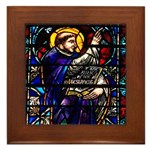
Blessed Lawrence of Ripafratta
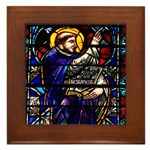
One of the outstanding characters in the Dominican reform of the late fourteenth century was Blessed Lawrence of Ripafratta, who was novice-master of several saints and blesseds of our Order.
Lawrence was born in the fortified city of Ripafratta, in 1359. His noble family had the duty of guarding the outer defenses of the city of Pisa against the depredations of its powerful neighbor cities. It was a warlike place and time to come into the world, but Lawrence gave early evidence of being a man of peace. At the age of twenty, after innocent and promising youth, he entered the convent of Saint Catherine, in Pisa. He made rapid progress, both in prayer and in study, and busied himself with the works of the Order for several years before being called upon to help in the reform movement that was headed by Blessed John Dominici.
In 1402, Lawrence was made novice-master in the novitiate of the reformed congregation of Tuscany, in Cortona. Here the novices were to be trained in the primitive rigor of the Order, in an attempt to by-pass the destructive elements of the past half century, which had reduced religious observance to an alarming state of indifference. Plague and schism had taken toll both in numbers and quality of the religious orders, and the remaining houses were living under a relaxed observance of the rule, in a struggle for survival. John Dominici, under the inspiration of Raymond of Capua, felt that the time had come to tighten up the observance once more and return to the first practices of penance and silence. His suggestions were not popular among those who lived in the relaxed convents. The only alternative was to begin again, with a new novitiate, and hope that the idea would take hold gradually and effect internal reform among the other houses.
Excellent novices soon made their appearances at Cortona: Saint Antoninus and Blessed Peter Capucci, and the artist brothers, Fra Angelico and Fra Benedetto. Several others who were to attain fame in the order came under Lawrence’s influence and were shaped by him and to saintly and useful members of the apostolate, not all in the same fashion- Saint Antoninus was to become Archbishop of Florence, Fra Angelico and his brother made San Marco world famous for its art. Blessed Lawrence is, indeed, an interesting study; a severe and exacting man when it came to keeping the rule, a man of broad vision and great resourcefulness in carrying out the work of preaching. He was obviously not at all afraid of talented people going astray if they were allowed to use their talents for God, and he displayed great insight into the development of each of his novices as individuals.
Eventually, Blessed Lawrence was appointed vicar-general of the reformed congregation and moved to the convent of St. Dominic of Pistoia. Here he preached almost continually, and had a reputation for compassion to the poor whom he tended, taught and visited, even in time of plague.
Lawrence of Ripafratta lived to be ninety-eight, and in his old age we have a touching picture of his novices-now men of distinction and authority- coming back to consult him about this or that detail of their work. He wrote often to St. Antoninus, perhaps feeling that being archbishop of Florence was a job with many worries.
Lawrence of Ripafratta died in 1457, and was beatified, after a long history of miracles at his tomb in 1851.
Born: in Ripafratta in 1359
Died: He died at Pistoia in his 98th year in 1457
Beatified: Pope Gregory XVI confirmed his cult in 1851
Blessed Dalmatius Moner
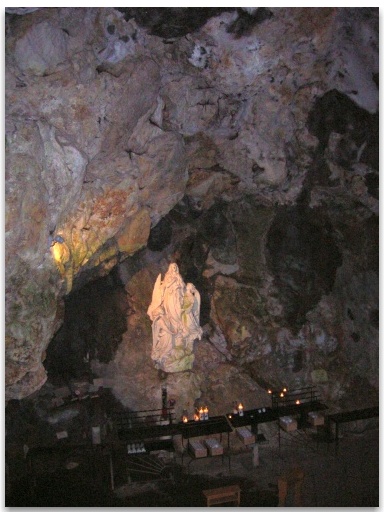
This Dominican Blessed, who was noted particularly for his observance of poverty, lived in the early years of the Order and helped to establish the high reputation of the Spanish religious.
Blessed Dalmatius was born in Aragon, in 1291, and we know nothing else about his life before he entered the Order. He was a member of the province of Aragon and gave a perfect example of strict observance of the rule and the spirit of religious detachment from things of earth. All that we know about him, are a few anecdotes, none of which can be fixed with certainty as to date or place.
We read that his spirit of poverty was so extreme that he never wore a habit or cappa that was not in tatters. He picked up his wardrobe from the cast-offs of his brethren, and, since the spirit of poverty was quite rigid in this providence, the cast-off clothes must have looked a sight. Dalmatius seemed to make a virtue of this, since all the records we have make mention of it. As to food, he never ate fish or eggs, and lived on a diet of hard bread and unseasoned vegetables, to which he added a few ashes during Lent. The beds in the house were hard enough for most people, but not for him. He slept on the bare earth when he could not get into the church to pray and take an occasional nap, his head rested on the altar step.
Dalamtius is credited with several miracles, which included healing and spiritual assistance. At one time, a novice was tempted to leave the Order. Dalmatius, going about it without being told, sought out the novice and solved his difficulties. At another time, a mother whose small child had a serious eye disease came looking for Dalmatius to heal her child. The friar refused, because, he said, this affliction would save her child from serious sin, and that God was waiting till some time in the future to heal him.
During the last forty years of his life, Dalmatius lived in the cave of Saint Mary Magdalene, in the south of France, where he had gone on a pilgrimage of devotion. Here he was favored with numerous ecstasies and great spiritual insight. One time, while he was in the cave, a group of friars from his own province where lost in the woods in a bad storm. They prayed to him to help them, and a young man came with a lantern and guided them home.
Dalmatius died in his own convent in the presence of all the friars and provincials who had gathered for a chapter. He was declared blessed in 1721.
Born: in 1291 near Gerona in Spain
Died: 1341
Beatified: Pope Innocent XIII confirmed his cult in 1721
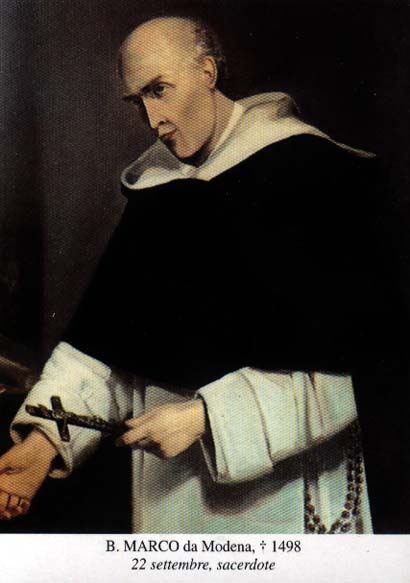
Blessed Mark of Modena
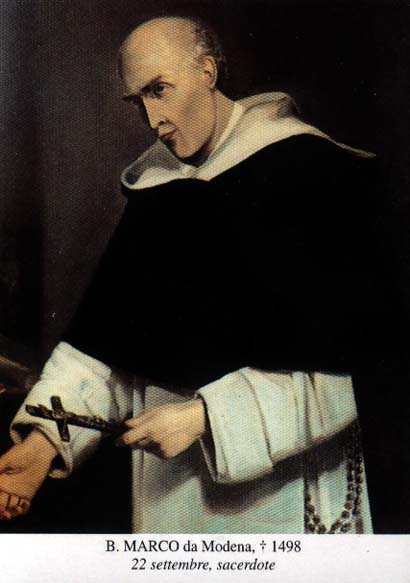
Mark was born in Modena and entered the convent of the order there in young manhood. He observed the rules with great fidelity, and became noted both for his learning and his holiness, which is a sentence that would fit into nearly every Dominican biography written, and tells us nothing in particular about Mark as a person. However, when we recall the times in which he lived , it becomes clearer to us that anyone who kept the Dominican Rule in its entirety is truly to our notice . The abuses which stirred Savonarola to thundering speech in the pulpits of Ferrara and Florence could not have been absent from all of Italy. It look solid virtue to hold out against the opulent worldliness of the times, and Mark of Modena apparently did a thorough job of it, since he has been beatified.
Mark was made prior of the convent of Pesaro, and the only miracle we have on record (he is supposed to have performed many) took place at his convent. A woman’s little boy had died, and she pleaded with Mark to restore the child’s life. After praying for awhile, Mark turned to her and said, “Madam, your little boy is in paradise. Do not try to get him back again, for his second loss will be worse than this one.” However, she insisted on his working the miracle, and he did so. The child returned to life, and, ten years later, covered with disgrace and opprobrium, died a second time, leaving his mother in worse grief than ever.
Mark of Modena died in 1498, the year that the city of Florence burned Savonarola at the stake. It was a time of terrible happenings in Italy and all Europe. The people of Modena mourned the death of Mark, and went to pray at his tomb. Many of their needs were answered there, and a number of prodigies were reported in connection with the translation of his relics to the Rosary chapel of the church. The bells were said to have rung by themselves, and sweet perfume filled the air. Until recently, his relics were still exposed yearly for veneration during the week of Whitsunday.
Born: in Modena at the beginning of the 15th century
Died: in at Pesaro in 1498
Beatified: by Pope Pius IX in 1857
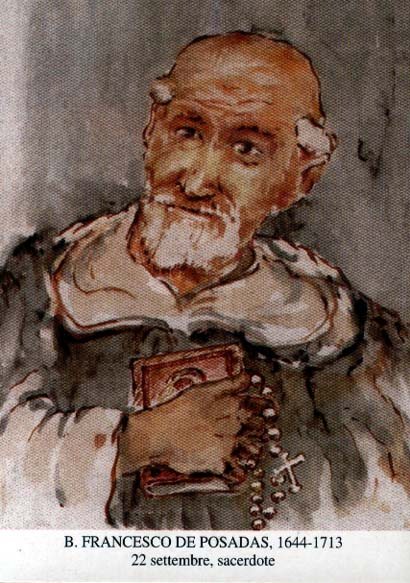
Blessed Francis Posadas
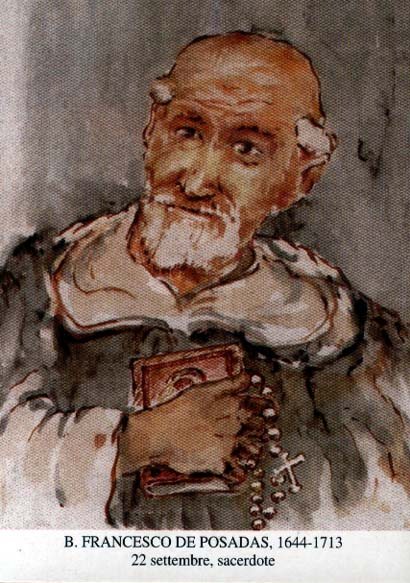
Few Dominicans have had more difficulty getting into the Order than Blessed Francis de Posadas, and he was one of the glories of the convent of the Scala Coeli, in Cordova. It is embarrassing for us to read that the reason for his exclusion was plain and simple snobbery on the part of the superiors of the convent of St. Paul, in Cordova.
Francis was born of a poor young couple who were war refugees, and who had been shunted from place to place until, when Francis was very small, his father’s health failed, and he died in Cordova. The young widow tried several types of work, and finally she was reduced to selling eggs and vegetables at a street stand. She tried to educate her child, for she knew he was very talented, but, without money, it simply was not possible to send him to school. She encourage him to go to the Dominican Church of St. Paul, and he served Mass there every morning from the time he was six or seven years old.
While he was still a very tiny child, he used to gather the other children together for rosary processions or other devotions. The smile of God seemed to rest upon him. For all his poverty, he was a very happy and attractive child, like by everyone; and he was a natural leader among his fellows. Twice during his childhood, he was miracuously saved from death. This fact and his undoubted piety, should have seemed sufficient reason for admitting him into a religious order. However, by the time Francis was old enough, there were two reasons to make his entry difficult: his mother had remarried, and the step-father would not permit him to enter. The Dominicans, moreover, would not have him. They said that they did not want the son of a street peddler.
Francis had friends in the Order, but the prior of the house he wished to enter took a violent dislike to him. It was several years before the young man could overcome the resistance of this man, who, having some influence with the provincial, was stubbornly determined that Francis should not be allowed to enter. Even when the fathers in the convent of Scala offered to take the boy and train him in Latin- so that he could qualify for clerical studies-the vindictive dislike of the prior followed him and almost prevented his acceptance.
Francis was finally accepted, made his novitiate, and gradually overcame all dislike and distrust by his charming manner and his unquestioned talents as student and preacher. After his ordination, he was sent out to preach, and he earned the reputation of being a second St, Vincent Ferrer. His talents as a preacher were rivaled only by his gifts as a confessor. He not only could read hearts and discover sins that had been willfully concealed, but sometimes he was called to one place or another by an interior spirit and shown someone badly in need of the sacraments.
Francis hated the thought of holding authority in the Order. When appointed prior of one of the convents, he remarked that he would much sooner be sentenced to the galleys. He twice refused a bishopric, and he skillfully eluded court honors.
Several remarkable conversions are credited to Francis Posadas. His last tears were a series of miracles wrought in the souls of his penitents. People followed him about to hear him preach, regarding him as a saint and miracle worker. One of his most noted converts was a woman more than one hundred years old- a Moor- with no intention of deserting Mohammedanism.
Francis of Posadas was the author of a number of books which he wrote to assist him in his apostolate. One was a life of St. Dominic. and several were biographies of other saintly people.
After a life filled with miracles, Francis died in 1713. Being forewarned of his death, he made private preparations, but to the last minute he was busy in the confessional before dying suddenly. By the time of his death, not only the Dominicans of Cordova, but the people of all Spain were happy to have him as a fellow countryman. He was beatified a century after his death, in 1818.
Born: Cordona in Spain in 1644
Died: In 1713 of natural causes
Beatified: He was declared Blessed by Pius VII in 1818
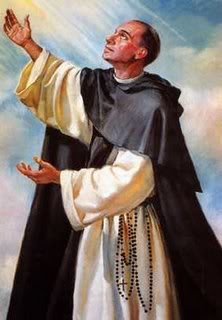
Blessed John of Massias
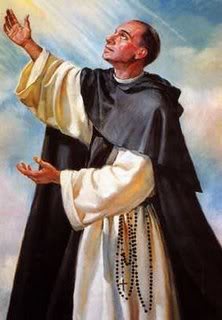
John Masias was born in Ribera, in Spain, and, when very small, he was left as orphan. He was adopted by a kindly uncle who set him to herding his sheep. The little boy was naturally pious, and passed his spare time in sayingthe Rosary. Our Lady and the Christ Child appeared to him several times, and he was often visited by his patron, St. John the Eveangelist, who once showed him a vision of heaven, telling him: “This is my country.”
When John was about twenty, he went to Mass in the church of the Dominicans in a neighboring city. For the moment, it seemed to him that vocation was joining the Friars Preachers now, but St. John appeared to him, telling him he must go elsewhere. In 1619 he embarked for the Indies, where many Spaniards were going, either to convert the natives or to seek a fortune. After a long and hazardous journey, he arrived in Lima.
There were at the time four convents of the Friar Preachers in Lima: the College of St. Thomas; the house of St. Rose, where Sister Rose of St. Mary had died just five years before; Santo Domingo or Holy Rosary, where the holy lay brother, Martin de Porres, was performing such astounding miracles; and the convent of St. Mary Magdalen, which was small and poor. John decided to enter St. Mary Magdalen and, in 1622, he received the habit of a lay brother there. On the night of his profession, devils appeared to tempt and reproach him. He was attacked bodily, and, although he was called on Jesus, Mary and Joseph for help, the demons continued what was to become twelve years of torture, by actually throwing him from one cloister to another.
John was appointed assistant to the porter, and lived in the gatehouse. There the poor came for food, and the rich for advice. He became adept at begging for the poor, always managing to find enough for the more than two hundred people who came daily for help. He had little use for the wealthy and curious, and would sometimes baffle them by simply disappearing while they were looking at hi,. Also, legend relates that he had a little burro that he would send out by itself, with a note asking for what was needed in one of the empty panniers on its back. Told where to go, the burro made his route faithfully; and if the rich man on whom he called was ungracious, or even hid himself to avoid giving alms, the little burro made quite a noise, and it quickly brought the desired results.
Rays of light streamed from the blessed’s face as he taught the catechism to the poor, or prayed by himself in the gatehouse. He said an amazing number of rosaries and made no less than twenty daily visits to the Blessed Sacrament. He is said to have liberated more than a million souls in purgatory, many of whom came back , while he was at prayer , to thank him for his help.
One day a certain ship captain came to the gatehouse and asked to look around. John took him by the arm and led him to the crucifix, warning him to look well on it and think of his sin. Terrified, the captain fell to his knees, confessing that he was an apostate religious, thirty years away from the sacraments, and he begged for a priest. On another occasion, the brothers were building a flight of steps and, having measured a beam wrong, they were annoyed because it did not fit. John took the beam in his hands and stretched it to fit their needs. These, and many other miracles, led people to venerate him as a saint during his lifetime. His recreation was to talk of the things of God with the other holy lay brother, Martin de Porres
At the time of his death, Our Lady, St. Dominic, his patron, St. John and many other saints, came to accompany him to heaven. They were seen by some of the brothers.
Born: March 2, 1585 at Ribera del Fresno, Estramadura, Spain
Died: September 16, 1645 in Lima, Peru of natural causes
Beatified: In 1837 by Pope Gregory XVI


You must be logged in to post a comment.