
Category: Dominican Saints
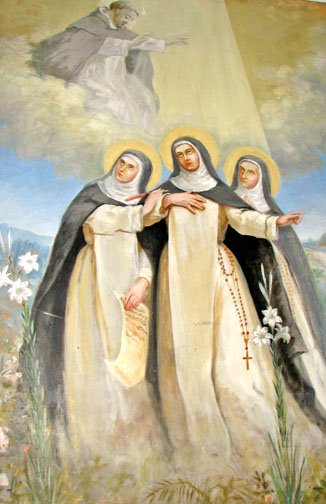
Blessed Diane, Blessed Cicely & Blessed Amata
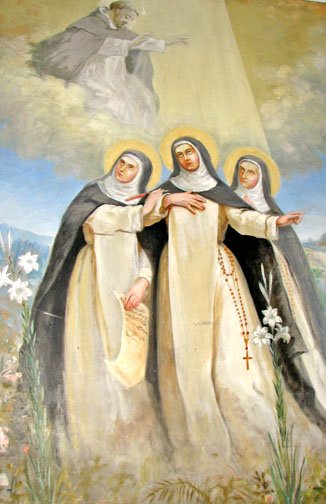
Diana, Caecilia, and Amata were the first members of Saint Agnes Dominican Convent in Bologna, Italy. They all knew Saint Dominic personally. Little is known of Sister Amata except that she was a good friend of Saint Dominic, who, according to legend, gave her the name Amata (‘beloved’). Dominic either sent her to the reformed convent of Saint Sixtus when the nuns left Saint Mary’s across the Tiber during a time of drastic reform, or he was instrumental in allowing her to stay there. There was an Amata from whom Dominic cast out seven devils, but it was probably not this Amata.
Caecilia Caesarini was a high-spirited young Roman of an ancient family; she threw her considerable influence into the reform movement at the time Saint Dominic was attempting to get the sisters into Saint Sixtus and under a strict rule. When the saint came to speak to the sisters at Saint Mary’s, it was Caecilia (then 17) who urged the prioress to support his cause. She was the first to throw herself at Dominic’s feet and beg for the habit and the rule he was advocating, and her hand is evident in the eventual working out of the touchy situation. In 1224, Caecilia and three other sisters from Saint Sixtus, including Amata, went to Saint Agnes in Bologna to help with the new foundation. Sister Caecilia was the first prioress there and proved to be a very strict one.
Caecilia is responsible for relating nearly everything now known about the personal appearance and habits of Saint Dominic. In her extreme old age, she was asked by Theodore of Apoldia to give him all the details of the saint’s personality, and all that she could recall of the early days of the order, so that he could record them for posterity. Though nearly 90, her memory was keen and specific. She recalled how Dominic used his hands, the precise shade of his hair, the exact line of his tonsure. If she erred, there were still people alive who could have corrected her, though there was probably no one with her descriptive power left to tell the tale.
Through a woman’s eyes, she saw the founder from a different angle than his fellow preachers were apt to see, and remarked on his gentleness with the sisters, and the little touches of thoughtfulness so characteristic of him. While the men who worked with him would recall his great mind and his penances, and appreciate the structural beauty of the order he had founded, Caecilia saw the glow of humanity that so many historians miss.
The most colorful of the three was Sister Diana, the spoiled and beautiful daughter of the d’Andalo and Carbonesi families of Bologna, who lost her heart to the ideal of the Dominicans when listening to Reginald of Orléans preach. She espoused the cause of the friars, who were new in Bologna, and begged her father until she obtained from him the church of Saint Nicholas of the Vineyards, of which he had the patronage.
Having established the brethren, she wanted a convent of the Dominican sisters in Bologna. When Saint Dominic came there on his last journey, she talked with him, and all her worries departed. She knelt at his feet and made a vow to enter the Dominicans as soon as it should be possible to build a convent at Bologna. Saint Dominic, going away to Venice on a trip from which he would only return to die, made sure before leaving that the brethren understood about Diana. Four of the fathers from the community of Saint Nichola were under obedience to see that her convent was built.
In the meantime, Diana’s father refused her permission to enter the convent. Stealing a leaf from the life of Saint Clare, she ran away to the Augustinians outside the city. In full armor, her brothers came after he, and Diana was returned, battered but unconvinced, to the paternal home. She nursed a number of broken ribs and several explosive ideas in silence.
The death of Saint Dominic was a great grief to Diana, as she was still living in a state of siege at home, waiting for some action on the question of the new convent. However, she soon acquired a new friend, who was to be her greatest joy in the years of her mortal life–Jordan of Saxony, master general of the order following Dominic. Jordan, as provincial of Lombardy, inherited the job of building the Bologna convent, but his relations with Diana were not to be merely mundane. Their friendship, of which we have the evidence in Jordan’s letters, is a tribute to the beauty of all friendship, and a pledge of its place in religious life.
Diana was resourceful. She made another attempt to elope to the convent. This time her family gave up in despair. She remained peacefully with the Augustinians until the new convent was built. In 1223, Diana and several other young women received the Dominican habit from Jordan of Saxony. Diana was the prioress for a time, but perhaps Jordan felt that she was too volatile for ruling others, because, as soon as the sisters came from Saint Sixtus, he established Sister Caecilia as prioress. Diana, who was used to being not only her own boss, but the one who gave orders to others, seems to have made no protest.
If we had the letters written by Diana, we should possess a fascinating picture of the early years of the order and the people who made it what it is. We are indebted to Diana for what we do have of the correspondence, for she carefully saved all of Jordan’s letters. They tell us of the progress made by the friars in various lands, and ask her to remind the sisters to pray for the missionaries. Jordan counts the successes when many good novices have come into the order, begging her prayers in the low moments when promising novices leave.
More than this, these are letters of spiritual direction, which should give a pattern to all such correspondence, for they infer that Diana is a willing and energetic Christian who will follow the advice she is given, not simply keep the correspondence going for the joy of it.
Diana died in 1236. She was buried in the convent of Saint Agnes. Her remains were transferred when a new convent was built, and Sister Caecilia–who died 60 years later–was buried near her, along with Sister Amata. The relics were transferred several times, all three together. The head of Blessed Diana was placed in a reliquary near the tomb of Saint Dominic.
Born: twelfth century
Died: thirteenth century
Beatified: Pope Leo XIII confirmed their cult in 1891
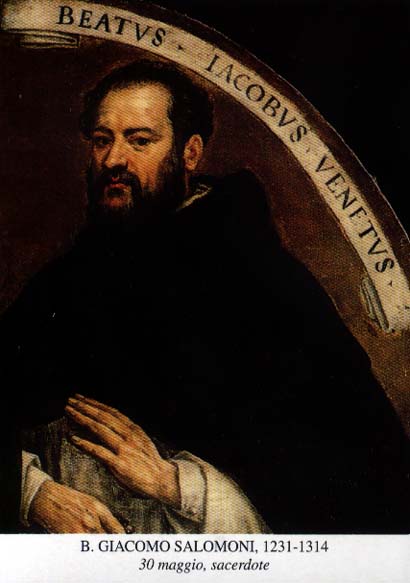
Blessed James Salomonio
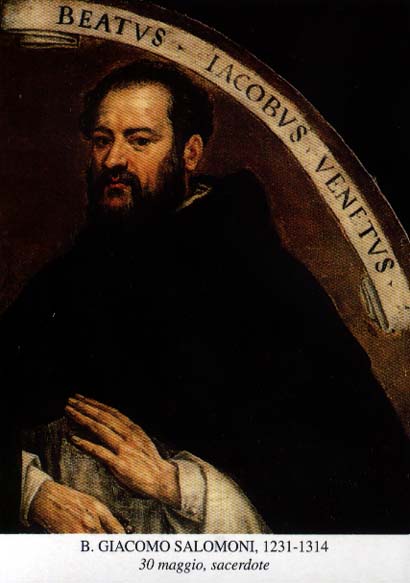
In a little chapel in Forli, built as a tomb for honored dead, there are three Dominicans laid in close proximity. One side is occupied by Blessed Marcolino of Forli. The center position is held by Carino of Balsamo, the assassin of saint Peter Martyr, whose long penance and popular holiness are now under consideration for his possible beatification; the third place is that of Blessed James of Saomomio, who was the spiritual director of Carino.
James was born in Venice, in 1231, the only child of noble parents. His father died when he was very small, and his mother became a Cistercian nun, leaving him to the care of his grandmother. She did well by her orphaned grandson, and James became a good and studious boy who responded eagerly to any spiritual suggestions. Under the direction of a Cistercian monk, he learned to meditate, and on the monk’s counsel, James became a Dominican at the convent of Sts. John and Paul, in Venice, as soon as he was old enough. He gave most of his money to the poor, and arrived at the convent with just enough left to buy a few books. Seeing that one of the lay brothers there was in need of clothing, he gave his small sum to the lay brother and entered empty-handed.
James wore the Dominican habit with dignity and piety, if not with any worldly distinction, for sixty-six years. He was humble and good and obedient, and there was nothing spectacular about his spirituality. He was well-known for his direction of souls, but he fled even from the distinction this work brought him.
Even his retiring habits did not protect him, for the people of Venice beat a path to his door. In self -defense, he transferred to another house, that of Forli. This was a house of strict observance and very poor. Nothing could suit him better. For the remainder of his life he worked and prayed in Forli, going out to visit the sick in the hospitals and spending long hours in the confessional. His charity to the poor and the sick gave him the name ” Father of the Poor.” He is represented in art surrounded by a horde of petitioners of this sort.
Born: 1231 at Venice, Italy
Died: March 31,1314 of cancer at Forli, Italy; buried in the chapel at Forli
Beatified: He was beatified in 1526 by Clement VII
Patronage: invoked against cancer
Representation: Dominican surrounded by a horde of petitioners; Dominican with a staff and book and the Christ-child over his heart; Dominican holding a heart with the letters “IHS” on it.
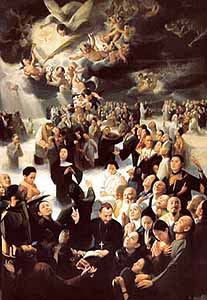
Blessed Peter Sanz, & Companions

The viceroy of Peking wrote this about the five martyrs that included Peter Sanz: “What are we to do with these men? Their lives are certainly irreproachable; even in prison they convert men to their opinions, and their doctrines so seize upon the heart that their adepts fear neither torments nor captivity. They themselves are joyous in their chains. The jailors and their families become their disciples, and those condemned to death embrace their religion. To prolong this state is only to give them the opportunity of increasing the number of Christians.”
Peter Sanz was among the first group of martyrs in Tonkin, which also included Bishop Francis Serrano, Father Joachim Royo, Father John Alcober, and Father Francis Diaz.
Peter Sanz was professed a Dominican at Lerida when he was 18 (1697). He was ordained in 1704, volunteered for the Chinese missions, and was sent to Manila, The Philippines, in 1713. After studying the language for two years, he entered China where he spent 31 years evangelizing the Chinese before he was captured. In 1730, he was nominated vicar apostolic of Fukien and titular bishop of Mauricastro. When a renewed persecution of Christians flared up in 1746, he was accused of breaking the laws by converting thousands to Christianity by a man to whom he had refused to lend money, according to one account.
The five men, bound together by their vows and their work, were brought more closely together during their imprisonment at Foochow. Fathers Serrano, Alcober, and Diaz were captured first, and tortured to reveal the whereabouts of Bishop Sanz. They did not break down, but the bishop and Father Royo, hearing about the torture, surrendered in the hope of sparing their brothers’ suffering, says another account.
The five priests were dragged in chains to the emperor’s court, where they were subjected to frightful torments. All of them, with a catechist named Ambrose Kou, were sentenced to death in December 1746. During the long imprisonment, a Dominican, Father Thomas Sanchez, managed to see them. He brought them some clothes and a little money, and all the news he could find.
On May 25, 1747, Bishop Sanz was beheaded at Fu-tsheu. Even the pagans were impressed with his gentle demeanor as he was led out to die, and a fellow prisoner who had been converted in prison, followed him closely through the mob, openly proclaiming his sanctity. As the headsman prepared to swing the axe, the venerable bishop looked at him and said, “Rejoice with me, my friend; I am going to heaven!”
“I wish I were going with you!” blurted out the unhappy man.
Laying his head upon the block, the bishop preached his last sermon: “If you want to save your soul, my friend, you must obey the law of God!” Pagan friends of the priests scurried through the crowd, gathering up the relics which they saved for the Christians. Many of these people, including the executioner, were later baptized.
On October 20, 1747, after the death of Sanz, word arrived that Father Serrano was had been appointed titular bishop of Tipsa and coadjutor to Blessed Peter Sanz. At that point, he and the others were summarily executed at Fukien.
Born: September 22, 1680 in Ascó, Catalonia, Spain
Died: beheaded on May 26, 1747 in Fuzou, China
Beatified: May 14, 1893 by Pope Leo XIII
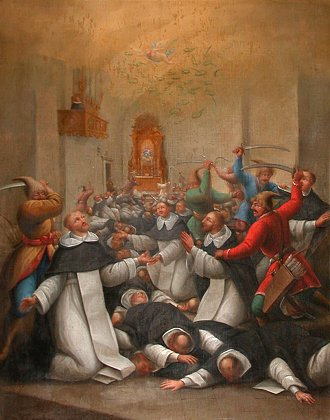
Blessed Sadoc & Companions

Saint Dominic’s dreams of converting the Tartars found realization in his sons. Missionaries did, in fact, go to the North during his lifetime, and many more were sent out by Blessed Jordan of Saxony. The more settles tribes of Poland and Hungary readily accepted the Gospel, and the North was not long in blooming with Dominican convents. But, in the thirteenth century, the restless millions of the East were riding down upon the fertile plains of Central Europe. Wild Tartar tribes soon destroyed what has been done for their more peaceful relatives, and scarcely a missionary survived to preach his message of peace to them.
Paul of Hungary and his band of ninety died as martyrs, probably in 1241. They were popularly honored as saints from earliest times. Soon to follow was the group headed by Blessed Sadoc, which had its headquarters at Sandomir, in Poland. So tragic was the early history of the Dominicans in Poland that, even in that martyred country, it is remembered. Polish Dominicans today wear a red cincture to recall the martyred hundreds who shed their blood that Poland might receive the light of truth.
Blessed Sadoc was a student at the university of Bologna when he met Saint Dominic and was received unto the Order. Being himself a Slav, he was eager to go to the North to preach the word of God. This he was given a chance to do when he and Paul of Hungary were given charge of the northern mission band. He soon accumulated a number of eager young students and novices, and proceeded to Poland with them. On his first night in the mission field, so say the old chronicles, the devil appeared to Sadoc and reproached him for disturbing his works: “And with such children as these,” he said bitterly, pointing to the young novices. With such as these, Sadoc did make havoc with the kingdom of evil: he won many souls to God, and, in Sandomir, he soon had the satisfaction of seeing a large community working for the glory of God.
In 1260, the Tartars made a fresh invasion into Poland and attacked Sandomir. Blessed Sadoc and his community had assembled for midnight Matins when they received warning of their approaching deaths. A novice, reading the martyrology for the following day, was amazed to see, lettered in gold across the pages of the martyrology, the words: ” At Sandomir, the passion of forty-nine martyrs.” On investigation, it was discovered that it was not merely a novice’s mistake, but an actual warning which they understood to be from heaven.
They spent the day in preparation for death. During the singing of the “Salve Regina,” after Compline, the Tarttars broke into the church and the slaughter began. One novice, terrified at the thought of death, fled to the choir loft to hide, but hearing his brothers singing, he realized that they were going off to heaven without him, and he returned to the choir to die with the others.
From this martyrdom came the customs of singing the “Salve Regina” at the deathbed of a Dominican-priest, sister, or brother. It is fitting that a life dedicated to God and Our Lady should end thus, with the battle cry “HAIL HOLY QUEEN!” echoing up from this valley of tears to be joined by the voices of Dominicans in heaven, who can now see forever the clement, loving, and sweet Virgin Mary.
Born: Various years within the Thirteenth century
Died: died 1260
Beatified: Their cult was confirmed in 1807 by Pope Pius VI

Blessed Alphonsus Navarette & Companions

Dominicans were the first missionaries to Japan, and 1530 is given as the date of their martyrdom. However, no conclusive proof exists regarding their names or number, and Saint Francis Xavier rightly holds the title of apostle to this island kingdom.
Following in Xavier’s footsteps came other missionaries, and, for about 40 years, they worked with great results among the people. Then, in the closing years of the century, persecution flared, and the blood of martyrs cried out with a louder voice than that of the preachers.
Ferdinand took the Augustinian habit in Mentilla, and in 1603, was sent to Mexico, and thence to Japan in 1605 as vicar provincial. He worked at Osaka with great success until his capture and execution en route to Omura.
The first Dominican to die in the great persecution was Alphonsus Navarrete. When Alphonsus was very young, he gave up his inheritance to enter the Dominican Order in Valladolid and, after he had completed his studies, was sent to the Philippine missions. The great persecution had just begun in Japan. The year before Alphonsus left Spain, a group of 26 Christians, including many Franciscans and three Japanese Jesuits, were crucified in Nagasaki.
Despite the dangers, the Dominicans, who had been excluded from Japan for several years, yearned to go into the perilous mission field. Alphonsus in particular, after a trip to Europe to recruit missionaries in 1610, begged to be allowed to go to Japan. In the following year his offer was accepted and he was sent as superior of the missionary band. During the short interval of peace, they began their work, and, during six years of growing danger, they instructed the people and prepared them for the dreadful days to come.
The missionary career of Alphonsus was brief, and it was always overshadowed by the threat of death that beset the Christians in that unhappy country. However, in the few years of his apostolate, his accomplishment was immeasurable. Like his Divine Master, he went about teaching and baptizing the people. He is called the “Vincent de Paul of Japan,” because it was he who first began the tremendous task of caring for the abandoned babies there. He anticipated the work of the Holy Childhood Society by gathering up the homeless waifs and providing for their support from money he begged of wealthy Spaniards.
The warning bell of the great persecution was sounded with the martyrdom in Omura of two priests, a Franciscan and a Jesuit. Alphonus Navarrete and his Augustinian companion Ferdinand went to Omura with the intention of rescuing the relics of the martyrs and consoling the Christians. They were captured on the way, and with a young native catechist, were beheaded. Their bodies were thrown into the sea.
Five years later, on the hill of the holy martyrs of Nagasaki, more than 50 Christians sealed their faith with their blood. Some of the martyrs were beheaded, some were burned at the stake. In the group were nine Jesuits, including the famous Father Charles Spinola, nine Franciscans, and nine Dominicans, among whom were the Blesseds Alphonsus de Mena, Angelo Orsucci, and Hyacinth Orphanel. Louis Bertrand, a nephew of the saint of that same name, perished in the same persecution.
Thousands of Japanese Christians, from tiny children to old grandparents, died amid terrible torments in the profession of their faith. The anger of the persecutors was turned against all priests, brothers, and catechists, tertiaries, and Rosarians, and they made fearful attempts to stamp out all traces of the hated religion in the country. Pope Pius IX, in 1867, solemnly beatified 205 of the martyrs, among whom were 59 Dominicans of the first and third orders and 58 members of the Rosary Confraternity. Although all did not die at the same time nor place, they are listed under the name of Alphonsus Navarrete, who was the first to die.
Born: Various dates in the sixteenth century
Died: died the most terrible torments in Japan in 1617
Beatified: Pius IX beatified them in 1867
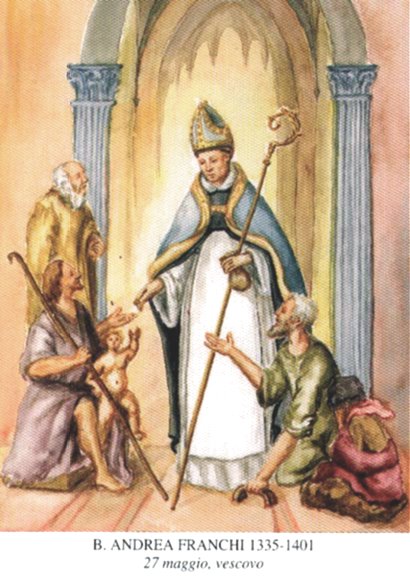
Blessed Andrew Franchi
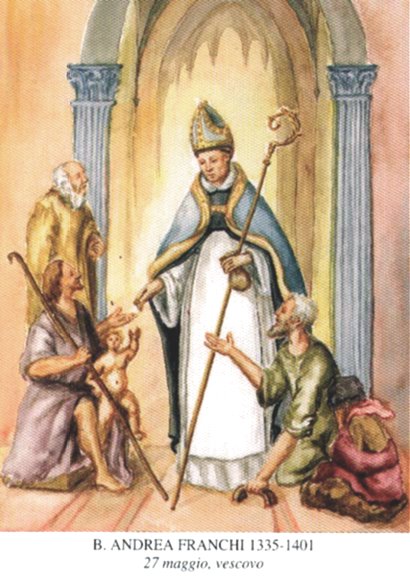
Blessed Andrew was born into the noble dei Franchi Boccagni family. He entered the Dominican Order at Pistoia about 1351, when the Italian peninsula was still under the shadow of the plague and was deeply involved in fratricidal wars. Another theory has it that he entered at Florence in 1348, which was the year the plague reached its peak. Whichever date he entered, he did so to give attention to his immortal soul, at a time when the world around him was apparently falling to pieces.
Andrew proved to be a good religious and an able administrator. He served as prior in three convents while still quite young. In 1378, he was appointed bishop of Pistoia, an office he filled with distinction and holiness for 23 years.
It is written of Andrew that he devoted himself to the poor, and spent his revenues to relieve their misery and to rebuild the ruined churches. He had a great personal devotion to Our Lady, to the Holy Childhood, and to the Three Holy Kings. As bishop, he lived a life of extreme simplicity, retaining his religious habit, and as much as he could of the rule. A year before his death, he resigned his office and retired to die at his old convent of Pistoia.
Born: Born in Pistoia, Italy, in 1335
Died: died 1401
Beatified: Benedict XV in 1921 declared him Blessed

Blessed William Arnaud, O.P. & Companions ~ “The Martyrs of Toulouse”
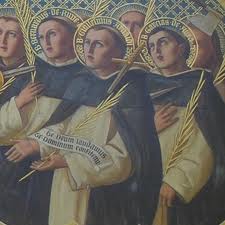
Nothing is known about William’s early life. In 1234, he and two other Dominicans were commissioned as inquisitors by Pope Gregory IX to combat Albigensianism in Languedoc, France. He and his companions were driven out of Toulouse, Narbonne, and several other towns by the heretics.
With him on the preaching mission were a fellow Dominican, Bernard of Rochefort; the Franciscans, Steven of Narbonne and Raymond of Carbonier, and two unnamed others; the Benedictine, Prior Raymond; the clerks, Bernard Fortanier and Admer; and the Dominican lay brother, Garcia d’Aure; and Peter the Notary. There were others who worked with him through the long and difficult years in Toulouse, but these were the ones who died in the martyrdom of Avignonet.
After the death of Saint Dominic, the party of Count Raymond of Toulouse rose to power again. In a short time it regained possession of Toulouse and several armed strongholds nearby. When William Arnaud and his companions came into the vicinity, they found every gate closed against them. None of the cities under the command of Raymond’s troops would allow them to come in, and, by order of the heretic commander, the citizens of Toulouse were forbidden under pain of death to supply the inquisitor’s party with any food. They took refuge in a farmhouse outside of Avignonet and preached around the countryside for some time. Because they had some measure of success, the heretics intensified their efforts to entrap and kill the inquisitors.
The members of the commission realized that they were only one step from death. They might have escaped and gone safely to some other part of the country had they chosen to do so. Instead, they remained where obedience had assigned them, and at the end of May 1242, they were given a heavenly warning that they were about to receive the crown of martyrdom. William was absent from the rest of the group when the plot was formed to kill them. Being told of a vision of martyrdom by one of the brothers, he hurried back to rejoin his group. The heretics completed their plans to massacre the entire party.
Scheming carefully, they set the scene at the country castle of one of the wealthy members of their group. In order to make sure of getting the inquisitors into the trap, they sent word to William that a confirmed heretic of his acquaintance wished to abjure his heresy and return to the faith.
Knowing well that it was a trap, William still could not refuse to go. He and his eleven companions went, on the evening of the Ascension, May 28, to the castle of Count Raymond VII of Toulouse. The soldiers of Raymond were concealed in the great hall. They fell upon the helpless group and killed all but four of the members. These four were taken out by friends who had know about the plot and hurried to the church.
William Arnaud and Steven of Narbonne were murdered in the sanctuary of the church as they sang the Te Deum. This was a crime almost unparalleled in medieval times when the right of sanctuary was one of the few strongholds against barbarism. The bodies of the martyrs were thrown into a deep ravine, and rocks were rolled down on them. During the night, some hours after the martyrdom, bright lights radiating from the bodies of the martyrs brought the faithful to gather up the relics.
The church of Avignonet was placed under interdict because of the sacrilege, and for 40 years no Mass was said there. The doors remained closed. Finally, when the interdict was lifted, the bells rang of themselves, according to legend, to let people know that Avignonet was once more a member of the living Church.
There is a striking footnote to this story of martyrdom. Shortly after the interdict was lifted, there appeared one day on the steps of the church a fairly large statue of the Blessed Virgin. Who had put it there has never been discovered. It is difficult to see how anyone in such a small town could have successfully concealed a statue of that size, for small towns are notoriously poor places to hide secrets. The statue appeared on the steps in broad daylight, yet no one saw it being placed there. The people took it as a sign that they were forgiven for their part in the outrage, and also as a sign that they should rebuild the devotion to Our Lady, which the Dominicans had preached. The statue was named “Our Lady of Miracles,” and they petitioned for a special feast in honor of their own Miracle lady.
Until very recently, a beautiful little ceremony was held in the Church of Our Lady of Miracles on every May 28. It was a night ceremony, in memory of the night martyrdom of William Arnaud and his companions, and it was called “The Ceremony of the Vow.” Carrying lighted candles, the people proceeded across the entire width of the church on their knees, praying for forgiveness for the people who committed the massacre.
Born: ?
Died: 1242
Beatified: Pius IX confirmed their cult in 1866
Patronage: Blessed William Arnaud is invoked by people who suffer from neuralgia, in memory of a miracle of healing which he performed on one of the sisters of Prouille.

Blessed Maria Bartholomew Bagnesi
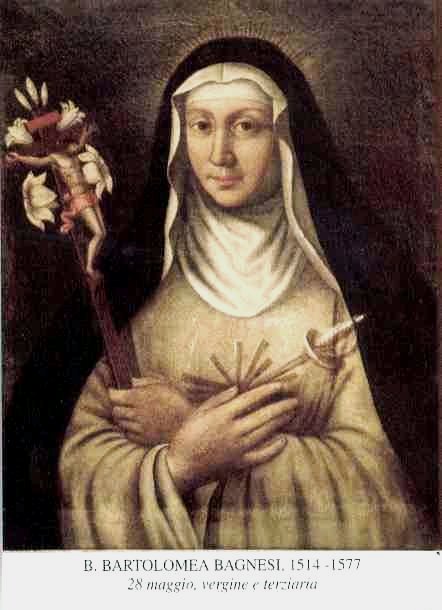
Marietta was a beautiful and appealing child, with big eyes and a constant smile. Because she was tiny, she was always called Marietta, rather than Mary. Her mother neglected her when she was a baby, leaving her to the casual care of others, and the little girl was often hungry and cold. She never protested, but was always gay and charming, and she was the special darling of her sister, who was a Dominican nun.
The sisters made quite a pet of the little girl, and she ran through the cloisters unhampered, singing for the sisters from the throne of the community-room table. What brought about her utter disgust with marriage is hard to tell. When her father proposed that she marry an eligible young man, she reacted with horror. She had been managing the household since the death of her mother, and her father felt that having a home of her own would be the best thing in the world for her. When he suggested this, Marietta fell into a faint, and she remained in that condition for days. When she recovered, she could not stand up, and had to be put to bed.
At this point a strange interlude brings, which can only be explained by the fact that God does not operate in the same fashion we do. Marietta’s father was fond of quack doctors, and quacks of the 16th century were really fantastic. Without protest the girl endured all the weird and frightful treatments they devised, suffering more from the treatments than she ever had from the malady. Today her ailment would probably be diagnosed as some type of spastic nerve malady. Packing her in mud and winding her in swaddling bands until she, according to her own account, “felt like a squashed raisin” could not have helped anything but the quack doctor’s purse. The ailments continued unabated for 34 years.
Marietta had hoped to be a nun; four of her sisters were already in the convent. Because such a life was, of course, impossible for an invalid, her father attempted to better her spirits by having her accepted into the Third Order. A priest came from Santa Maria Novella and received her into the order in 1544, but he excused her from the obligation of saying the Office because of the desperate nature of her illness. When he came the following year, she made her profession. For a little while after her profession, Marietta was able to get out of bed and could even walk a little. She could see and enjoy the beauties of the city. The she fell ill again and went back to bed; this time she had asthma, pleurisy, and a kidney ailment.
The doctors continued their experimentation through all the years of her life. A mystic, who sometimes conversed with the angels, saints, and devils, Marietta was suspected by the neighbors of being in league with the devil. Her protests that “she had seen him all right but he wasn’t a friend of hers,” fell on deaf ears; they obtained permission to have her exorcised. Her confessor left her; he was afraid of becoming involved. Another priest who came to her, mostly out of curiosity, stayed on as her confessor and directed her strange and troubled path for 22 years.
Marietta’s little room became a sort of oratory, and troubled people came there to find peace. She had an unusually soothing effect on animals; several pet cats made her the object of their affection. One of them used to sleep on the foot of her bed, and if she became sick during the night would go out to find someone to care for her. Once, when the cat felt that Marietta was being neglected, it went out and fetched her a large cheese. The cats, according to the legend, did not even glance at the songbirds that she had in a cage beside the bed.
Marietta’s spiritual life is hard to chronicle against such an odd background. In her last years, she was in almost constant ecstasy. The chaplain said Mass in her room, and she went to confession daily. She never discussed the sorrowful mysteries, because she could not do so without crying, but she often talked with great animation and a shining face, about the glorious mysteries. Once she was raised out of her bed in ecstasy. She shared her visions with another mystic, the Carmelite, Mary Magdalen de Pazzi. Because of her devotion to Saint Bartholomew, she added his name to her own, and usually used it instead of her family name.
Born: August 15, 1514 at Florence, Italy
Died: May 28, 1577 at Florence, Italy of natural causes
Beatified: July 11, 1804 by Pope Pius VII
Patronage: loss of parents, sick people, victims of abuse

Feast of the Translation of our Holy Father Saint Dominic
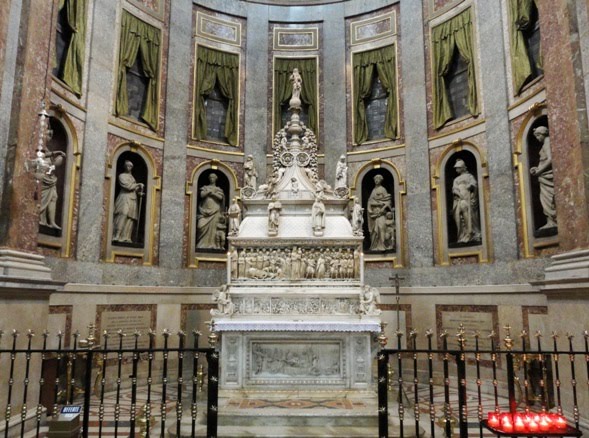
The body of the holy patriarch, Saint Dominic, had been laid to rest, according to his own desire, in the Church of Saint Nicholas at Bologna, beneath the feet of his Brethren, and, in spite of continual prodigies and Divine favors granted to the faithful who prayed day and night at his tomb, his children allowed the sacred deposit to remain under the plain flagstone originally laid over it and took no steps for obtaining his canonization. Lest they should be thought to be seeking their own emolument under the appearance of piety, the Friars even broke and threw away the votive offerings brought by the people and would not permit any exterior marks of devotion to be exhibited. It was necessity which at length compelled them to undertake the first translation of the sacred relics. The ever-increasing numbers of the Community obliged them to enlarge the Convent, and to pull down the old church and build a new and more spacious one. To do this the tomb of Saint Dominic would have to be disturbed. They accordingly applied for the requisite permission to Pope Gregory IX., who was no other than the Saint’s old friend, Cardinal Ugolino. He joyfully granted the petition, at the same time administering a sharp rebuke to the Friars for their long negligence.
The solemn translation accordingly took place on Whit-Tuesday, May 24, 1233 A.D., during the General Chapter, which was held that year at Bologna. The Pope wished to have attended in person, but, being prevented from doing so, he deputed the Archbishop of Ravenna to represent him, in company with a number of other distinguished prelates. Three hundred Friars Preachers from all countries assembled to assist at this function, not without a secret fear on the part of some as to the state in which the sacred remains might be found, as they had long been exposed to rain and heat, owing to the dilapidated condition of the church. The opening of the tomb took place before daybreak, in the presence of Blessed Jordan, then Master-General of the Order, and the fathers of the Chapter, together with the Bishops, Prelates and Magistrates who were to assist at the ceremony. All stood round in silence while the Procurator, Father Rodolph of Faenza, raised the stone. Hardly had he begun to remove the earth and mortar that lay beneath an extraordinary odor became perceptible , which increased in power and sweetness as they dug deeper, until at length, when the coffin appeared and was lifted out of the grave , the whole church was filled with the perfume as though from the burning of some rich and precious gums. The bystanders knelt on the pavement, shedding tears and emotion as the lid was raised, and the exposed to their eyes.
It was the Master-General who raised the body of his beloved father and reverently laid it in a new coffin. The faithful were then admitted, and the Archbishop of Ravenna sang the Mass of the day, while the fragrance diffused from the open coffin flooded the whole of the sacred edifice. Blessed Jordan in his circular letter to the Order thus described the solemn function: “As the choir intoned the Introit, ‘Receive the joy of your glory, giving thanks to God, who was called you to the celestial kingdom,’ the Brethren in their gladness of heart took the words as if spoken from heaven. The trumpets sounded, the people displayed a countless multitude of tapers; and, as the procession moved along, there everywhere resounded the words, ‘Blessed be Jesus Christ!” He goes on to speak of the vast number of miraculous graces which were poured forth both before and after the ceremony. ‘Sight “he says , “was granted to the blind, power of walking to the lame, soundness to the paralyzed, speech to the dumb…..I myself saw Nicholas, an Englishman, who had long been paralyzed, leaping at this solemnity.”
The coffin was then laid in the marble tomb prepared for it. But eight days later, to satisfy the devotion of some distinguished persons who had not been present on the previous occasion. The holy remains were again exposed to view. Then it was that Blessed Jordan, taking the sacred head between his hands, kissed it, while tears of tenderness flowed from his eyes; and, so holding it, he desired all the fathers of the Chapter to approach and gaze at it for the last time. One by one they came and kissed the venerable relics. All were conscious of the same extraordinary fragrance; it remained on the hands and clothes of those who touched or came near the body. Nor was this the case merely when the grave was first opened. The tomb remained unclosed for fifteen days, during which interval it was guarded by officers appointed by the city magistrates; and all this times the same exquisite odor was sensible to all who visited the spot; and Flaminius, who lived three hundred years later, thus writes (1527 A.D.): “This divine odor adheres to the relics even to the present day.”
A second translation of Saint Dominic’s relics took place in the year 1267 A.D., when the holy body was removed to amore richly ornamented tomb. This translation, like the first, was made at a time of the General Chapter; and the head of the Saint, after being devoutly kissed by the Brethren and several Bishops who were present, was exposed to the veneration of the people from a lofty stage erected outside the Church of Saint Nicholas. The tomb was again opened in 1383 A.D., when apportion of the head was placed in a silver reliquary, in order the more easily to satisfy the devotion of the faithful. Finally, 1469 A.D., the remains of the Saint were deposited in the magnificently sculptured shrine in which they now rest, which is regarded as the masterpiece of Nicholas Pisano.

Saint Servatius, Bishop & Confessor
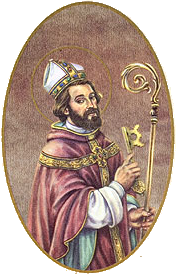
Saint Servatius was of noble birth, and he was renewed alike for his learning and sanctity. He became Bishop of Tongres in Belgium, which then formed part of Gaul, and in that capacity assisted at the Council of Sardica, where he strenuously defended the Catholic Faith against the Arians. He likewise stoutly resisted these heresies at the Council of Rimini, and labored to prevent the ill consequences which threatened the Church through their frauds and the weakness of the Bishops. Being sent by the tyrant Magnentius, together with Saint Maximin, Bishop of Treves, as ambassador to the Emperor Constantius, he was honorably entertained by Saint Athanasius at Alexandria.
Saint Gregory of Tours states that Saint Servatius foretold the invasion of Gaul by the Huns and implored the Divine mercy by watching. fasting, prayers and many tears to avert so great a calamity from the flock entrusted to his care. For this intention he undertook a penitential pilgrimage to the tomb of Saint Peter in Rome. As he was weeping and praying there, the Prince of the Apostles appeared to him and thus addresses him: “Wherefore dost thou importune me? The Lord has decreed that the Huns should enter Gaul and lay it waste in a terrible manner. Take my counsel, therefore; lose no time; set thy house in order, prepare thy grave, make ready a clean winding-sheet. Behold , thou shalt depart this life and shalt not witness the evils which the Huns are to bring upon Gaul, as the Lord our God hath spoken.”
The holy Bishop, therefore returned in all haste to his diocese, and with many tears imparted the sad tidings to his heart-broken flock. “Holy Father , do not abandon us,” they exclaimed; “Good Shepherd, forget us not.” Very shortly afterwards he fell ill, as Saint Peter had foretold, and closed his saintly life by a holy death on May 13th, 384 A.D., after an episcopate of thirty-seven years. It is recorded that when all the country round was white with snow his tomb at Maestricht always remained free from it until the time a church was raised over his holy remains.
Saint Servatius was declared Protector of the Dominican Order in consequences of the following circumstances. In the fourteenth century the Church and the Order of Preachers were suffering bitter persecution from the schismatical Emperor, Lewis of Bavaria. Learning that the General Chapter was convoked to meet in his dominions , at the city of Cologne, 1330, A.D., this prince secretly plotted the death of the capitular Fathers. They had just assembled, when Saint Servatius appeared in a dream to one of their number, a very holy religious, warned him of the danger which threatened himself and his brethren , and bade them to flee to Maestricht. This they accordingly did, thus escaping the snares which had been laid for them. And though their coming to Maestricht was wholly unexpected, God disposed the hearts of the inhabitants to receive them with the utmost kindness.
In gratitude for this providential intervention, the Fathers decreed that the festival of Saint Servatius should henceforth be celebrated in the Order to the end of time. But, as it was at first instituted only under the rite of a Feast of the Three Lessons, the great increase of festivals of higher rank caused it, after the lapse of years, to fall into disuse. To preserve the memory of so great a benefit, the Fathers, therefore, obtained permission from Pope Leo XII that the festival of Saint Servatius should be henceforth celebrated throughout the entire Order with the rank of a Totum Duplex, or Greater Double.
Born: Armenia, unknown date
Died: May 13th 384 at Tongres, Belgium of fever
Canonized: Pre- Congregation
Patronage: against foot problems, against lameness, against leg problems, against mice/rats, against rheumatism, success
Representation: bishop holding a key and accompanied by an angel meeting burghers at a city gate, bishop holding a key in one hand while placing his crozier on a dragon, bishop reading desk where nearby sits a shield with three wooden shoes, bishop with three wooden shoes, man striking water with a staff, pilgrim sleeping in the sun while an eagle fans him
 The Order of Preachers, Independent
You must be logged in to post a comment.