
Category: Dominican Saints
St Martin de Porres, OP

Blessed Martin de Porres was born in the city of Lima, in the Viceroyalty of Peru, on December 9, 1579, the illegitimate son of a Spanish nobleman and a black former slave. He grew up in poverty; when his mother could not support him and his sister, Martin was confided to a primary school for two years, and then placed with a barber/surgeon to learn the medical arts. This caused him great joy, though he was only ten years old, for he could exercise charity to his neighbor while earning his living. Already he was spending hours of the night in prayer, a practice that increased rather than diminished as he grew older. At the age of 15, he asked for admission to the Dominican Convent of the Rosary in Lima and was received first as a servant boy; as his duties grew, he was promoted to almoner. Eventually he felt the call to enter the Dominican Order, and was received as a tertiary. Years later, his piety
and miraculous cures led his superiors to drop the racial limits on admission to
the friars, and he was made a full Dominican. It is said that when his convent was
in debt, he implored them: “I am only a poor mulatto, sell me.” Martin was deeply
attached to the Blessed Sacrament, and he was praying in front of it one night
when the step of the altar he was kneeling on caught fire. Throughout all the
confusion and chaos that followed, he remained where he was, unaware of what
was happening around him.
When he was 34, after he had been given the habit of a Coadjutor Brother,
Martin was assigned to the infirmary, where he was placed in charge and would
remain in service until his death at the age of sixty. His superiors saw in him the
virtues necessary to exercise unfailing patience in this difficult role, and he never
disappointed them. It was not long before miracles were attributed to him. Saint
Martin also cared for the sick outside his convent, often bringing them healing
with only a simple glass of water. He begged for alms to procure necessities the
Convent could not provide, and Providence always supplied.
One day an aged beggar, covered with ulcers and almost naked, stretched out
his hand, and Saint Martin, seeing the Divine Mendicant in him, took him to his
own bed. One of his brethren reproved him. Saint Martin replied: “Compassion,
my dear Brother, is preferable to cleanliness.”
When an epidemic struck Lima, there were in this single Convent of the Rosary
sixty friars who were sick, many of them novices in a distant and locked section
of the convent, separated from the professed. Saint Martin is said to have passed
through the locked doors to care for them, a phenomenon which was reported in
the residence more than once. The professed, too, saw him suddenly beside
them without the doors having been opened. Martin continued to transport the
sick to the convent until the provincial superior, alarmed by the contagion
threatening the religious, forbade him to continue to do so. His sister, who lived in
the country, offered her house to lodge those whom the residence of the religious
could not hold. One day he found on the street a poor Indian, bleeding to death
from a dagger wound, and took him to his own room until he could transport him
to his sister’s hospice. The superior, when he heard of this, reprimanded his
subject for disobedience. He was extremely edified by his reply: “Forgive my
error, and please instruct me, for I did not know that the precept of obedience
took precedence over that of charity.” The superior gave him liberty thereafter to
follow his inspirations in the exercise of mercy.
Martin would not use any animal as food—he was a vegetarian.
In normal times, Saint Martin succeeded with his alms to feed 160 poor persons
every day, and distributed a remarkable sum of money every week to the
indigent. To Saint Martin the city of Lima owed a famous residence founded for
orphans and abandoned children, where they were formed in piety for a creative
Christian life. This lay brother had always wanted to be a missionary, but never
left his native city; yet even during his lifetime he was seen elsewhere, in regions
as far distant as Africa, China, Algeria and Japan. An African slave who had
been in irons said he had known Martin when he came to relieve and console
many like himself, telling them of heaven. When later the same slave saw him in
Peru, he was very happy to meet him again and asked him if he had had a good
voyage; only later did he learn that Saint Martin had never left Lima. A merchant
from Lima was in Mexico and fell ill; he said aloud: “Oh, Brother Martin, if only
you were here to care for me!” and immediately saw him enter his room. And
again, this man did not know until later that he had never been in Mexico.
Martin was a friend of both Saint John de Massias and Saint Rose of Lima. When
he died in Lima on November 3, 1639, Martin was known to the entire city. Word
of his miracles had made him known as a saint throughout the region. As his
body was displayed to allow the people of the city to pay their respects, each
person snipped a tiny piece of his habit to keep as a relic. It is said that three
habits were taken from the body. His body was then interred in the grounds of
the monastery.
Pope Gregory XVI beatified Martin de Porres in 1837. Nearly one hundred and
twenty-five years later, Blessed Martin was canonized in Rome by Pope John
XXIII on May 6, 1962. His feast day is November 3. He is the Patron Saint of
people of mixed race, innkeepers, barbers, public health and more besides.
In iconography, Martin de Porres is often depicted as a young friar of mixed heritage (he
was a Dominican brother, not a priest, as evidenced by the black scapular and
capuce he wears, while priests of the Dominican order wear all white) with a
broom, since he considered all work to be sacred no matter how menial. He is
sometimes shown with a dog, a cat and a mouse eating in peace from the same
dish.
The Feast of St Matthew~The Very Rev Lady Sherwood, OPI

When our Lord Jesus called Matthew (originally named Levi) to follow him, He was a tax collector by profession for the Roman Empire. His profession was at that time extremely hated by the devout Jews as it reminded them of their subjection and also the Pharisees saw his profession which was classed as publican, as work for the typical sinner.
St Mathew is one of the Lord Jesus’ twelve apostles and by christian tradition is also seen as one of the four Evangelists. He was the first to put down in writing as his Gospel the Lord’s teachings and the account of our Lord Jesus’ life. Mathew wrote his Gospel in Aramaic, which is the language which was spoken by Jesus himself.
No one was shunned more than a publican by the devout Jews because a publican was a Jew who in their eyes worked for their enemy, the Romans and who duly robbed their own people making themselves fat cat personal profits. Publicans were despised to the extent that they were not allowed to trade, not to eat or even to pray with other Jews.
One day when Mathew was seated at his table containing his books and his money, Jesus looked at him and said unto him two words, “follow me”. For Mathew, these two words were all it took for him to immediately rise, leaving all his pieces of silver exactly where they lay, to follow our Lord Jesus Christ.
Mathew’s original name was ‘Levi’ which in Hebrew signified ‘Adhesion’ whilst his new name given to him by our Lord Jesus of Mathew means ‘Gift of God’.
The only other major mention of Mathew in the Gospels is regarding the dinner party for Jesus and his companions to which Mathew invited his fellow tax collectors.
The Jews showed surprise at seeing our Lord Jesus eating in the company of a publican, but Jesus explained to the Jews that he had come “not to call the just, but sinners.”
Not much else is known about the life of Mathew but according to tradition, he is reported to have preached in such places as Egypt, Ethiopia and other further Eastern areas.
Some say Mathew lived into his nineties before dying a natural death, but other Christian traditions say he died the death of a martyr.
The Gospel according to Matthew is one of the four canonical gospels, one of the three synoptic gospels, and is the first book of the New Testament. The narrative tells how Messiah, our Lord Jesus was rejected by Israel, and how he finally sends his disciples to preach his Gospel to the whole world. Most Scholars believe the Gospel of Matthew was composed between 80 and 90 CE, with the possibility of between 70110 CE. The Gospel of Matthew is a creative reinterpretation of Mark, stressing Jesus’ teachings as much as his acts, making subtle changes to reveal Jesus’ divine nature for example, Mark’s “young man” who appears at Jesus’ tomb becomes a radiant angel in the Gospel of Matthew. The Gospel of Matthew shows Jesus as the Son of God from his birth, the fulfillment of the Old Testament. The Gospel of Matthew was the favourite Gospel of St.Dominic de Guzman, who always would carry it wherever he went.
Let us pray to St Mathew to ask him to intercede on our behalf:
O Glorious St Mathew, in your Gospel you portray Jesus as the longed-for Messiah who fulfilled the prophets of the Old Covenant and as the new lawgiver who founded a church of the New Covenant. Obtain for us the grace to see Jesus living in his church and to follow his teachings in our lives on earth so that we may live forever with him in heaven. Amen.
Faithfulness and Bearing Fruit: The Feast of St. Dominic~The Rev. Frank Bellino, OPI
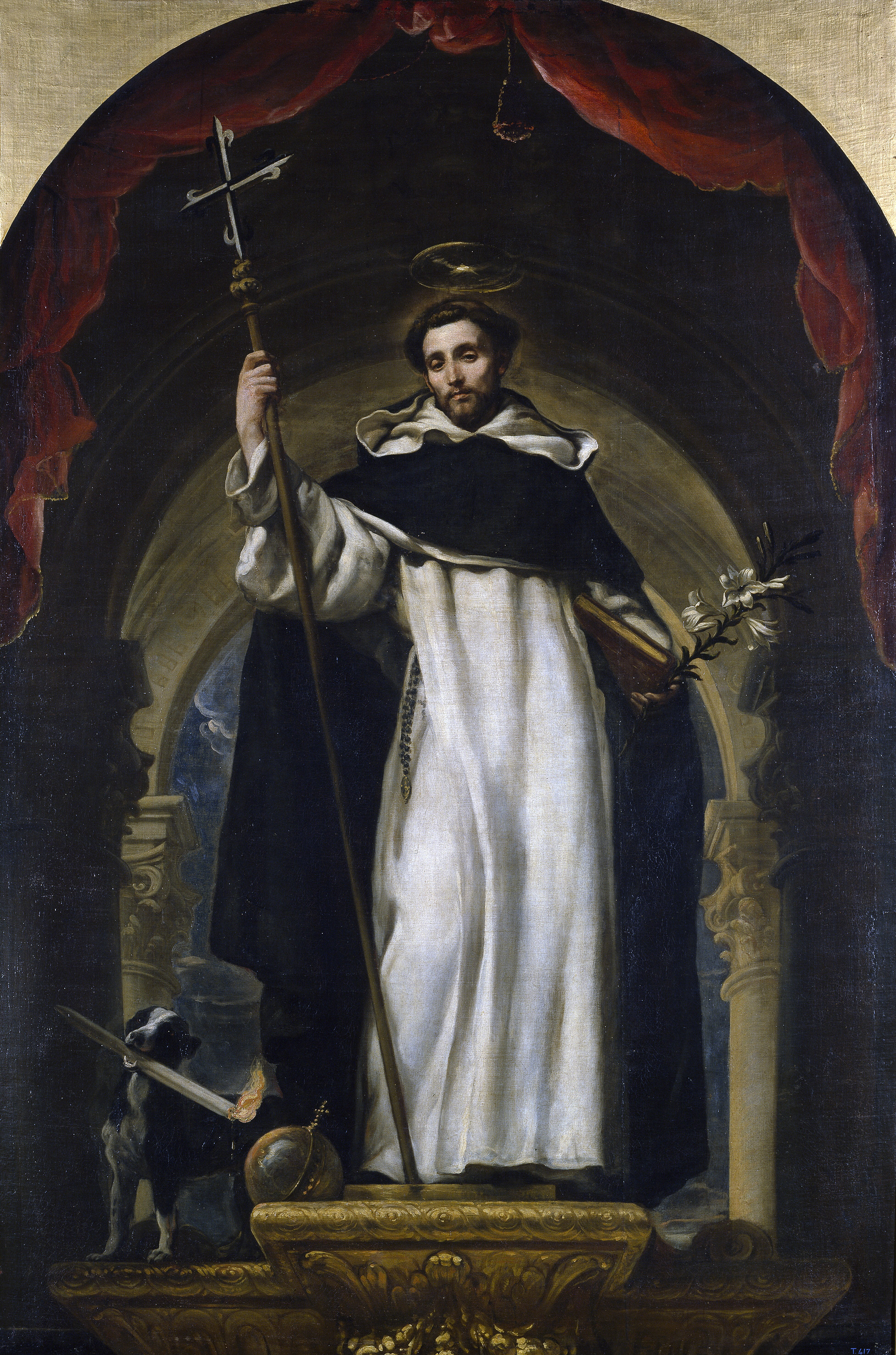
Today is the Feast of St Dominic, the founder of the Order of Preachers. When he was dying, St. Dominic told his brothers that he wanted to be buried in such a manner that the future friars could walk over him.
In the Middle Ages it was the custom to bury people in the abbey. St Dominic did not want to be recognized in a special way. He wanted to rest waiting for the resurrection with his brethren. For him fraternity stretched into heaven.
But St Dominic also wanted to be used.
Every night at the end of Compline, I pray the O Lumen:
O light of the Church, teacher of truth, rose of patience, ivory of chastity, you have freely poured out the waters of wisdom: preacher of grace, unite us to the blessed.
This prayer concludes with:
Pray for us, holy father Dominic. That we may be made worthy of the promises of Christ.
In reciting this prayer, I am reminded that I am a son of St. Dominic. Around the world, thousands of friars, sisters, nuns and lay Dominicans call St. Dominic their holy father, and after 800 years, St. Dominic still continues to bear fruit.
Now the shining example of St. Dominic’s fruitfulness is not something we should simply admire, but it is also something we need to imitate in a way that is proper to our state of life. Indeed, all Christians are called to be fruitful. Sadly, however, many in the Church have deeply failed in this regard. It is very sad that there are many examples of those in Holy Orders who have abandoned their resolve to remain pure for the sake of the kingdom. How many Catholics have become disillusioned with their faith because of such behavior? How many vocations to the priesthood and religious life have been lost? Sexual infidelity is definitely not compatible with Christian fruitfulness.
It is in moments like this, when we struggle with the sin and infidelity that afflicts our Church and society, that we need to turn to the saints such as St. Dominic who exemplified true Christian fruitfulness. Throughout the Bible, fruitfulness is an expression of God’s favor. The very first thing God did after creating Adam and Eve was to bless them and say “be fruitful and multiply.” Likewise, God says to Abraham “I will indeed bless you, and I will multiply your descendants as the stars of heaven.” But these promises of fruitfulness have their true fulfillment in Christ’s life.
On many occasions, Jesus expresses the desire for His disciples to bear fruit. This fruitfulness is manifested in the sacramental life of the Church. Indeed, at the Last Supper, Jesus describes Himself as the true vine; He goes on to tell His disciples “I chose you and appointed you that you should go and bear fruit and that your fruit should abide.” These sayings from St. John’s Gospel account of the Last Supper express the true meaning of the Eucharist. It is in the Eucharist that Christ’s death on the cross is made present, and when we look to the cross, we are to make sense of it in terms of its fruitfulness. Indeed, in the moments before Christ died, with Mary, His mother and the beloved disciple, John, standing before Him, He said to His mother “Woman, behold your son,” and to His beloved disciple “Behold your mother.” Thus, the Virgin Mary who brought Christ to birth in the Incarnation now brings Christ to birth in the beloved disciple and all who see her as their mother. This is indeed the fruit that will stand for eternity.
I hardly believe that St. Dominic knew that his fruit would be still producing 800 years later, and through our faith it will be in heaven.
Saint Mary Magdalene~Br. Milan Komadina
Feast Patroness of Our Order
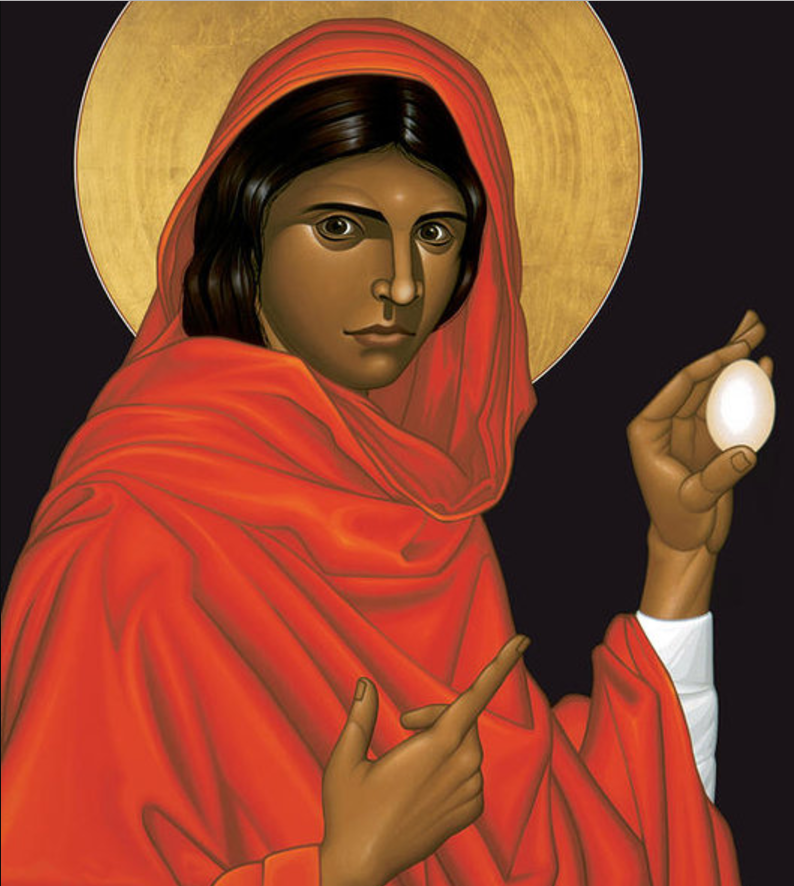
Mary of Magdala, Latin Mary Magdalene – the evangelists mention her as a companion of Jesus and a witness to his crucifixion and resurrection . There is also a series of writings that were rediscovered from the 19th century and in which Mary Magdalene is mentioned. The figure of Mary Magdalene was later embellished with legends. In it her importance was increased, or she was identified as the (nameless) foot-washing sinner in Luke’s Gospel. She has been interpreted as a prostitute or as a lover of Jesus. In fact, little is said about her or her life in the New Testament. It is striking that, according to the Gospel of John, she is said to have been the first to meet the resurrected Jesus. Her epithet refers to the location of Magdala on the Sea of Galilee in the Holy Land.
Today we read in the Gospel about the person who was the first to come to the tomb and see the resurrected Jesus alive. As meet Jesus he was very just person and did not like to make differences between male and female. Any discussion of women’s roles in the church must begin with these two facts: It was a woman, not a man, to whom the Risen Christ first chose to appear. And it was a woman who, for a time, was the sole recipient, carrier and proclaimer of the Good News of the Resurrection. There is a discrimination against women in many Christian denominations, especially in traditional Western Roman Catholic Church and Eastern Orthodox Church. As mainstream churches are famous in their supremacy of white and male dominant people. It is sad that church (that supposed to be a body of Christ) forgets that the words that Jesus personally said to a woman (Mary of Magdala) were:
“Do not hold on to me, for I have not yet ascended to the Father. Go instead to my brothers and tell them, ‘I am ascending to my Father and your Father, to my God and your God.’” John 20/17
Mary was the first person who was invited to be the preacher. The preacher of the Resurrected Jesus, the preacher of the Gospel. At that time, women did not have many rights. They did not have the right to talk freely and the men were those who had authority of preaching. Sadly today in many churches, despite the Gospel’s obvious blessing for equal treatment of men and women there are many churches that are not allowing women to be preachers. There are also many churches that are not allowing gay men to be preachers either. Sadly the dark period of the church is still not finished since the mid-century. Just it has a new form. Church does not kill any more in the name of Christianity as it used to be doing in mid-century but it blesses discrimination and persecution of LGBT+ individuals still treating the women as not worthy enough to be preachers. While some people doubt that Mary was in an emotional relationship with Jesus, others doubt that he was in emotional relationship with another apostle who he loved in a special way as we read in today’s Gospel John 20:1/2:
Early on the first day of the week, while it was still dark, Mary Magdalene went to the tomb and saw that the stone had been removed from the entrance. 2 So she came running to Simon Peter and the other disciple, the one Jesus loved, and said, “They have taken the Lord out of the tomb, and we don’t know where they have put him!”
What we read next is the invitation to preach Gospel, the invitation to preach about Resurrected Jesus. As you read, sisters and brothers, in the Gospel we did not have discussion about Lord’s sexual identity and whether he was in emotional relationship with Mary of Magdala or with the disciple, the one Jesus loved (as it is written in the Bible). God’s Word put the focus not onto our gender, sexual orientation, race and nationality. It puts its focus onto preaching. Preaching the Word about the Living Resurrected Jesus, Our Savior. I would like to let you think about that. I would like you to be also focused on Jesus and the forgiveness of sins that was given to us as a free gift. And my today’s prayer for all those discriminative brothers and sisters is that God may enlighten their hearts to see and feel the real love of God and to understand the real Gospel and the fact that we are all equal in Jesus. And let us all put our entire focus on the Resurrected Lord. Amen.
Song of Songs 3:1-4
1 All night long on my bed
I looked for the one my heart loves;
I looked for him but did not find him.
2 I will get up now and go about the city,
through its streets and squares;
I will search for the one my heart loves.
So I looked for him but did not find him.
3 The watchmen found me
as they made their rounds in the city.
“Have you seen the one my heart loves?”
4 Scarcely had I passed them
when I found the one my heart loves.
I held him and would not let him go
till I had brought him to my mother’s house,
to the room of the one who conceived me.
The Feast of Thomas the Apostle~Br. Christian Ventura, OPI
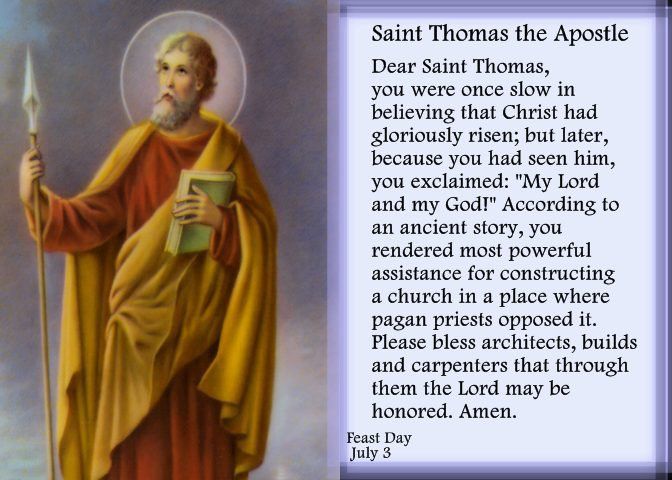
Feast of Thomas the Apostle; John 20: 24-29
03 July 2023
Br. Christian Ventura, OPI
Priory of St. Symeon and St. John
Order of Preachers Independent
Baltimore, MD
Now Thomas (also known as Didymus), one of the Twelve, was not with the disciples when Jesus came. So the other disciples told him, “We have seen the Lord!” But he said to them, “Unless I see the nail marks in his hands and put my finger where the nails were, and put my hand into his side, I will not believe.” A week later his disciples were in the house again, and Thomas was with them. Though the doors were locked, Jesus came and stood among them and said, “Peace be with you!” Then he said to Thomas, “Put your finger here; see my hands. Reach out your hand and put it into my side. Stop doubting and believe.” Thomas said to him, “My Lord and my God!” Then Jesus told him, “Because you have seen me, you have believed; blessed are those who have not seen and yet have believed.”
In the ✠ Name of the Father, and of the Son, and of the Holy Spirit.
Amen.
As members of the human family, it is safe to say that we have all been a “Doubting Thomas” at some point in our own spiritual journey, even if we regret to admit it. I certainly have been there, and frequently have my own theological inquiries with seemingly no clear answers. It appears normative of today’s society to become increasingly secular and atheistic. In some ways, however, it might be a foreign concept to some that doubt can actually be very healthy, if we yield to the Spirit and allow ourselves to be vulnerable in our discernment.
In today’s Holy Gospel, we see doubt as something inherently negative. Hence why the Church for many years has villainized “Doubting Thomas”, framing doubt as something to be irrefutably ashamed of. Thomas is doubtful of Jesus’ resurrection from the dead, the momentous highlight of our Christian faith. That is, until Jesus appears before him and renders tangible evidence of his divinity.
We ought to ponder, however, whether the issue here is actually skepticism, or, being stubbornly relentless. It might be worth wondering whether St. Thomas’ misstep was his natural thought process, or his persistent rejection of Christ until his own criteria for belief was fulfilled.
My brothers and sisters, worry not if doubt crosses your mind. Be gentle with yourself, and pray. Hold mercy that Christ holds for you. Faith is a gift from God that He is so eager to grace us with. It matters whether we choose to accept this faith.
Doubt coupled with sincere inquiry is not sinful, rather, perfectly organic in many ways. In fact, this is what we call theology! Some even say that “theology is how we love God with our minds”, although the original author of this claim is unknown. Furthermore, it only becomes irreverent when we subject Christ unto our own than allow for ourselves to be subject unto Christ.
Dominicans have affirmed throughout centuries the belief that God desires us to know Him in His true essence. This is even captured in St. Catherine’s prayer “Love Undefiled” as attached below. Fr. James Martin, SJ beautifully puts in his book Learning How to Pray “…that which you seek is causing you to seek it”. If there is an inkling in your heart that desires to know God more, be assured that this is of God.
Taking a leap of faith is supposed to be risky, and even in some cases, sacrificial. It is a mere act of bravery to place your eternal salvation in the hands of a God who no one has seen except for the Son. Furthermore, it can be even more difficult to subscribe to the Christian faith in particular when Christians have an infamous reputation for bearing unfaithful fruit. Thankfully, God is his mercy and omniscience knows this, and yet still continues to impart the gift of faith to all those who ask with a sincere heart.
Dearly beloved, the next time you encounter doubt, know that you are not far from God. Quite the opposite, really. Earnestly ask, and be open to His response. Many times we believe God to be absent, because we are out of practice with our listening skills. As our sister Catherine remarks so perfectly, “God is closer to us than water is to fish”!
Love Undefiled
“Eternal God, eternal Trinity, You have made the Blood of Christ so precious through His sharing in Your Divine nature. You are a mystery as deep as the sea; the more I search, the more I find, and the more I find the more I search for You. But I can never be satisfied; what I receive will ever leave me desiring more. When You fill my soul I have an ever-greater hunger, and I grow more famished for Your light. I desire above all to see You, the true light, as you really are. Amen.” – Sr. Catherine of Siena, TOSD
The Nativity of St. John the Baptist~The Very Rev Lady Sherwood, OPI

Reading I: Is 49:1-6
Responsorial Psalm: 139:1b-3, 13-14ab, 14c-15
Reading II: Acts 13:22-26
Alleluia: See Lk 1:76
Gospel: Lk 1:57-66, 80
Liturgical Colour: White
Today, we as a church come together to commemorate the birth of St John the Baptist, often known as the ‘Forerunner’.
John was the son of Zechariah and Elizabeth. In the Gospel of Luke, we are told that Zechariah was told beforehand about the birth, and that he was to be named John. The name John means “God is Gracious” (LK 1 :8=2:3).
John whilst still within his mother’s womb, instantly recognised the presence of Our Lord Jesus, who was also still in his mother’s womb, when Mary went to visit her cousin Elizabeth (LK 1 :41). John leapt for joy in Elizabeth’s womb as soon as Mary and Elizabeth met, and this is when John was cleansed of original sin. This came to pass just as the Angel Gabriel had previously promised Zechariah in LK 1 :15.
When John was older, he left the home of his parents and went to live his life in the desert. He wore only a garment made from camel skin and only had Locusts and wild honey to eat. John would preach in the desert (MK 1:6; Matt 3:4).
John went about preaching and proclaiming about the Kingdom of God and of a time of upcoming judgement. He invited those who wanted to repent, to allow him to baptise them as a sign of their repentance.
John, just like the prophets, disturbed the comfortable and gave much comfort to the disturbed. The message of John soon spread far and wide. The Gospel of Mark tells us that all peoples of both Jerusalem and Judea travelled to him to confess their sins as John baptised them in the river Jordan (MK 1:5).
John shows his humility clearly to us because he never wanted any attention for himself, he always directed people to Jesus. Some wondered if John was the Messiah, but John reassured them that indeed he wasn’t the messiah, and he declared that his ministry was merely a preparation for the coming of the Messiah. John said, “I have baptised you with water, but He will baptise you with the Holy Spirit.” (MK 1:8)
Then Jesus himself came to John to be baptised and John immediately recognised Jesus as the Messiah and he declared, “This is the Lamb of God who takes away the sins of the world”. (JN 1 :29). This statement from John is still used in Mass prayer today, when the Priest holds up the sacred Host as we prepare for the Holy Eucharist, as the Priest says, “This is the Lamb of God who takes away the sins of the world…”.
It was after being baptised by John, that our Lord Jesus began his Earthly ministry. When John had been baptised by John, John again showed his humility as again, he turned his attention to Jesus, declaring, “He must increase, I must decrease”(JN 3:30).
St John the Baptist is an excellent example that we as Christians should take much notice of within our lives of faith. Just as John always showed his humility by turning his attention away from himself and towards our Lord Jesus, we too, also need to show this same humility if we are truly to serve and follow the Lord. We also, must turn attention away from ourselves and towards Jesus. Just as John himself declared, “He must increase, I must decrease”.
Let us pray:
O glorious St John the Baptist, greatest prophet among those born of woman, although you were sanctified in your mother’s womb and lived a most innocent life, nevertheless, it was your will to live in the wilderness of the desert, there to devote yourself to the practice of austerity, penance and humility;
Obtain for us by your intercession, the grace of the Lord to be wholly detached within our hearts, from earthly goods and self attention. Increasing our humility and service, by making ourselves far lesser and in the never ending increasing, to be ever greater within our hearts and lives.
Amen.
The Gift of Faith~Br Milan Komadina
The Feast of St. Catherine of Siena
Our faith is a gift. The older I grow the more sure I become about the fact that our own faith is a gift. And that we do not believe just like that. Or traditionally, if our parents were Christians and we were taught about Christianity as kids and later we decided to become more devoted to our faith when we already have the roots in our family education. There are many people that were born in Christian families and they declare themselves Christians but they never go to church. They never pray to God and they never read Bible. Could we truly tell that a person is a Christian who is only baptized and raised in Christian environment? Being Christian means of course being baptized and have the certificate that we belong to certain denomination but it is not enough. A Christian could someone become even without being baptized because a Christian we should become by our faith. And a baptism should come after as a visible result of what had previously happened. When we first met Jesus in our hearts, declared Him as our savior, accept his sacrifice, repent and get the free grace and salvation and then we become true Christians. What I would like to emphasize, as I consider that very important is that being Christian includes to believe in Christ and being aware of the mercy which is gifted through faith. The salvation is through faith. Baptism we could arrange at the local church and easily we could become baptized members of one church. But faith – we cannot arrange. We cannot as nonbelievers order in the local church and buy our faith for the rest of our lives or for the certain period of time. Because faith is a gift and cannot be scheduled, arranged or booked as a slot for baptism. Here we come to one sentence that has stolen my attention in today’s reading. John 6:60-69
”On hearing it, many of his disciples said, “This is a hard teaching. Who can accept it?” Aware that his disciples were grumbling about this, Jesus said to them, “Does this offend you? Then what if you see the Son of Man ascend to where he was before! The Spirit gives life; the flesh counts for nothing. The words I have spoken to you—they are full of the Spirit and life. Yet there are some of you who do not believe.” For Jesus had known from the beginning which of them did not believe and who would betray him. He went on to say, “This is why I told you that no one can come to me unless the Father has enabled them.” From this time many of his disciples turned back and no longer followed him. “You do not want to leave too, do you?” Jesus asked the Twelve. Simon Peter answered him, “Lord, to whom shall we go? You have the words of eternal life. We have come to believe and to know that you are the Holy One of God.”
Versus number 65 says that NO ONE can come to Jesus unless the Father has enabled them. In everyday Christian life we can experience really special moments. Sometimes we wake up in the morning happy and grateful to be alive, then we do our cross and start singing psalms or Christians songs, or we pray and worship, sometimes we read the Bible feeling every single word of the text and being touched we cry while reading God’s Word. Sometimes we feel holy and away from human lusty desires and we feel like our mind is really pure. Other days we have a big desire to study Bible, read about Jesus or preach the Gospel. But do we sometimes question why we are doing all these? Why we have the desire not to sin? Why we have the gift of tears while reading Gospel and why we feel empathy when we see other people suffer? Why we have inner engine to move us stand for the prayer in the morning? This is the seal of Holy Spirit working in us. This is the gift and this is free gift. As we are saved by grace through our faith now we bring fruits of this faith. But all those fruits are grown in the Holy Spirit.
In Psalm 51:15, king David prays: “O Lord, open my lips, And my mouth shall show forth Your praise.” When I was Orthodox Christian I learnt that in case when we cannot pray (due to lack of motivation) we should read this psalm and it helps. Or at least to repeat several times this sentence. So that the Lord may open our mouth and let us pray. All good things that we are doing we are doing them with God’s help because everything good comes from God. Our faith is a gift, our salvation is a gift, and our presence in the Unified Old Catholic Church is a gift. And it is very important not to be proud because everything that we have is a gift from God. I invite you all to live by faith and to believe in this mercy and to remember that no one can come to Jesus unless the Father has enabled him.
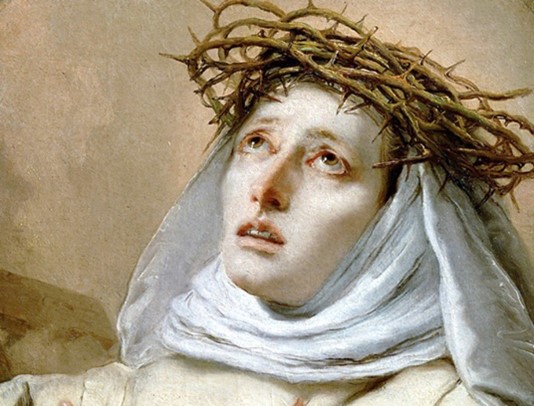
And since today we commemorate St. Catherine of Siena I would like to share a couple of sentences about her life. St. Catherine of Siena, TOSD (Italian: Caterina da Siena; 25 March 1347 – 29 April 1380) was an Italian member of the Third Order of Saint Dominic in the Roman Catholic Church. She was a mystic, activist, and author who had a great influence on Italian literature and on the Catholic Church. Canonized in 1461, she is also a Doctor of the Church. Born and raised in Siena, she wanted from an early age to devote herself to God, against the will of her parents. She joined the “mantellates”, a group of pious women, primarily widows, informally devoted to Dominican spirituality. She died on 29 April 1380, exhausted by her rigorous fasting. Urban VI celebrated her funeral and burial in the Basilica of Santa Maria sopra Minerva in Rome. Devotion around Catherine of Siena developed rapidly after her death. Pope Pius II canonized her in 1461; she was declared a patron saint of Rome in 1866 by Pope Pius IX, and of Italy (together with Francis of Assisi) in 1939 by Pope Pius XII. She was the second woman to be declared a “Doctor of the Church,” on 4 October 1970 by Pope Paul VI – only days after Teresa of Ávila. In 1999 Pope John Paul II proclaimed her a (co-)patron saint of Europe.
St. Catherine of Siena pray for us!
St. Thomas Aquinas, Memorial~Br. Milan Komadina, Novice
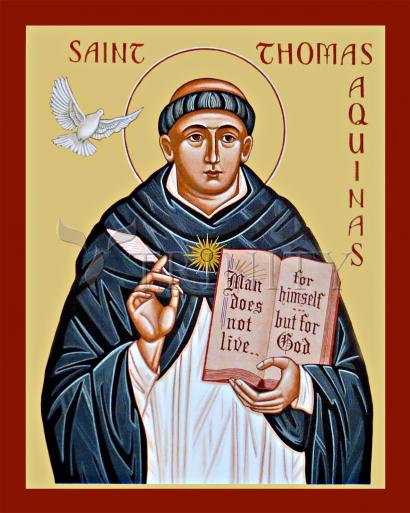
Today we commemorate Saint Thomas Aquinas. He was born in Italy in 1225 (only four years after Saint Dominic’s death). In 1244, he entered the Dominicans and in 1245, he moved to Paris (and later to Naples, Rome, and Cologne) to study, teach and write. Written toward the end of his life, Thomas Aquinas’s most noted work is the Summa Theologica, in which he posits five arguments for the existence of God. But, Saint Thomas’s genius is attributed to much more than a single work. He is honored as a Doctor of the Church, and is the patron saint of scholars, schools, and students. Nearly eight-hundred years after his death, his legacy continues to teach much about grappling with truth, learning, and how both are essential to faith.
Today we read in Hebrews 11 about the importance of having faith. In our everyday life we encounter many problems. These problems could be health issues, financial or job insecurity problems, having a bad relationship with some friends or family members and so on and so forth. However, there is one thing that we, as Christians share and it could help us a lot in those hardships. This is called Faith. Faith in God does not only mean that we believe that there is God who created us. It also means that we believe that God is still present everywhere and at any time in our life. He is timeless and he has no limitation in existing at the same time in the past in the present and in the future. Sometimes we see that in the present the things in our life are not as we would like them to be. We hope we deserve better and we feel that our cross might be a bit bigger that we could carry. In those situations it is good to remember Hebrew 11:8-19 saying about Abraham who trusted God and who had full faith which means that he know that all the hardships he was struggling with were there for some reason. He moved to the Promised Land even though he could not know what this new land would bring him. But he trusted that God is in control of the future and he trusted that God had a plan. This chapter reminds us that God also has a plan for every single person. Especially the verses 11 and 12 –
And by faith even Sarah, who was past childbearing age, was enabled to bear children because she considered him faithful who had made the promise. And so from this one man, and he as good as dead, came descendants as numerous as the stars in the sky and as countless as the sand on the seashore.
This is what we could call the Faith in Action. I guess that we all have struggles with having strong faith in absolutely every period of the life. Sometimes we feel unjust, or we feel hurt or we feel that we do not deserve the things that are happening to us. But still, it is important to remember also that Job was the most righteous man of his time and God allowed the devil to make many temptations, loss and hardship to his life. Yes we know the past, and sometimes it can be hard to remember it, yes, we also live our present and we could sometimes feel blue about it, but what we do not know is the future. God is in the future and he knows why we have certain hardships or temptations. But he gave us the Bible and he thought us that we will always have the cross that we can carry. He gave us the faith and he thought us through Abraham what having faith means. As a perfect example of faith is the readiness of Abraham to sacrifice his own son. As we read in verses 17, 18 and 19 –
By faith Abraham, when God tested him, offered Isaac as a sacrifice. He who had embraced the promises was about to sacrifice his one and only son,even though God had said to him, “It is through Isaac that your offspring will be reckoned.”Abraham reasoned that God could even raise the dead, and so in a manner of speaking he did receive Isaac back from death.
A God example of perfect faith is that Abraham knew that God could even get Isaac back from the death. The lesson about Abraham and the importance of strong faith is the lesson that we all should repeat in our everyday life. People tend to lose or minimize their faith in the moments of hardships. Many years after Abraham, Our Lord Jesus also experienced the lack of faith of his followers when he was sleeping on the boat while there was a storm coming. As we read in Mark 4:35-41. In verse 38 they asked –
“Teacher, don’t you care if we drown?”
This is the sentence we probably often ask when struggling with the storms of our everyday problems. We are not used to let us be guide by Jesus and trust him. But happy news are that we could always rely on Him because he was the one killing down the wind and calming the storm. And he wants us to be always reminded about the question he asked in verse 40 –
He said to his disciples, “Why are you so afraid? Do you still have no faith?”
My prayer for today is that we all could have the faith as Jesus thought us. The faith strong as the one that Abraham had. And to always remember that God is in control. Amen.
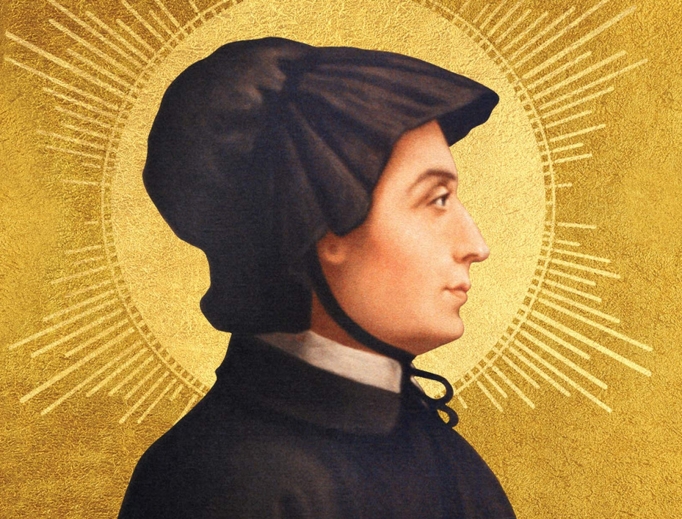
Elizabeth Ann Seton~The Very Rev. Lady Sherwood, OPI
Reading 1: 1 Jn 3:7-10
Responsorial Psalm: Ps 98:1, 7-8, 9
Alleluia: HEB 1:1-2
Gospel: Jn 1:35-42
Liturgical colour: White.
Today we come together as a church and as children of God, to commemorate the Memorial of St. Elizabeth Ann Seton who is my name saint within the Order of preachers Independent, due to our Prior (and Presiding Bishop) feeling there apparently , many similarities between the life of St. Elizabeth Ann Seton and that of my own life.
Throughout Biblical history and even in current times, we sometimes come across people who have endured much within their lives and who, regardless of this, remain strong and devout within their faith. Today we remember St Elizabeth, whom is one such person from whose life, heart and devotion, we can take inspiration within our own spiritual life.
Elizabeth was the very first native-born citizen of the United States to be Canonized to sainthood.
Elizabeth was born as Elizabeth Ann Bayley in New York city on the 28th August in the year 1774, and she was a child of the Revolutionary war. She was raised Episcopalian which was the faith of her parents.
Elizabeth married at the tender young age of only nineteen years old, to a man named William Magee Seton. He was a young but wealthy merchant and together they parented a total of five children.
Elizabeth had a very deep devout faith and concern for the poor even as a very young woman and she shared this devotion with her sister-in-law, who was Rebecca Seton, and with whom she became very close friends. Together, Elizabeth and Rebecca undertook various missions for the poor and for the needy of their region and they adopted the name of the ‘Protestant Sisters of Charity` for their mission works.
Elizabeth’s life changed after only the short time of four years of marriage and her life became rather burdensome in nature. Elizabeth and her husband were left with the responsibility for seven half-brothers and sisters of William’s father when he died in the year 1798.
Elizabeth suffered even further in the year 1801, when her own father with whom she had a very close relationship, especially since the loss of her mother at aged only three, himself passed into the care of the Lord.
Then yet again she suffered after only another two years, when both her husband’s business and his health failed. Filing for bankruptcy, Elizabeth and her husband sailed to Italy to help his health and to try to revive his business.
Whilst in Italy, Elizabeth suffered even further, as William’s condition worsened. He was quarantined and subsequently died of Tuberculosis in December of 1803. Elizabeth remained in Italy for several months after his death and during this time, was more fully exposed to the Catholic faith.
Elizabeth returned to New York city in June of 1804, only to suffer yet again with the loss of her dear friend and sister-in=law, Rebecca Seton, in the very next month.
At only the young thirty years of age, Elizabeth had endured the loss of so many who were close to her and she seemed to have the weight of the world upon her shoulders. Even so, throughout all this, Elizabeth still remained fervent in her faith.
The months ahead were life-changing for Elizabeth and she seemed ever more drawn to the Catholic faith and to the Mother Church, much to the horror of her friends and her remaining family who were firmly Protestant.
Elizabeth Ann Seton was received into the Catholic Church on the 4th March 1805. Her conversion cost her dearly in the areas of her friendships and in the support from her remaining family.
Elizabeth relocated to the Baltimore area and there she established a school for girls. She also founded a religious community along with two other young women and she took vows before the Archbishop Carroll as a member of the Sisters of Charity of St Joseph. From this time forward, Elizabeth was known as Mother Seton and she left a legacy of care and education for the poor. She even established the first free Catholic school of the nation.
In so many ways, the journey into the Catholic faith, helped Elizabeth to much more appreciate and to embrace her faith even more profoundly. Elizabeth was willing to endure all things to follow Christ. In her journal, she even wrote, ‘If I am right Thy grace impart still in the right to stay. If I am wrong Oh, teach my heart to find the better way’.
Many of us who have chosen the Catholic faith have experienced some setbacks and have had to endure issues with relationships, but for this brave and devout woman of faith, the cost was even greater.
Elizabeth died aged only 46 on January 4th 1821 from Tuberculosis and she was Canonized on September 14th 1975.
On this your special day, St Elizabeth Ann Seton, Pray for all of us who follow your pathway of faith. Pray that we likewise to yourself will say yes and will accept all that will come to us in the years ahead, and to allow our earthly endurance to further our faith in our Lord Jesus Christ.
Amen.
The Feast of St. Stephen the Martyr~The Very Rev. Lady Sherwood, OPI
Reading 1:’ACTS 6:8-10; 7:54-59
Responsorial Psalm: PS 31:3CD-4, 6 AND 8AB, 16BC AND 17
Alleluia: PS 118:26A, 27A
Gospel: MT 10:17-22
Liturgical colour: Red.
Feast of St Stephen, The First Martyr
Today, the day after all the joy, and celebration of the birth of Our Lord and Saviour, and after all the traditional enjoyment and pomp of the traditional festive food and of gift giving, we come to the stark contrast, to the Feast of St. Stephen the first Martyr.
Throughout the Old Testament we see faithful Christians persecuted and often even killed by those who are faithless. But it’s not just an Old Testament phenomenon. This is what humans can do in their natural and unredeemed state. We don’t like our sins to be pointed out to us. We manage to convince ourselves that we’re really not all that bad. We work hard to justify our own sins. We find the really, really sinful people in history—men like Nero or Stalin—and we compare ourselves to them and actually start to feel pretty good about our own standing before God. And that’s when one of God’s faithful workers comes along—someone who, while by no means perfect, is living a life renewed by grace and who is indwelt by the Holy Spirit—and suddenly all the illusions we’ve built up about our own goodness dissolve and we get angry. Like Cain, instead of acknowledging our sins and instead of repenting, we torment, persecute, and sometimes even kill God’s people when they show us up.
My brothers and sisters, Our Lord and Saviour has told us:
Blessed are those who are persecuted for righteousness’ sake, for theirs is the kingdom of heaven.
Blessed are we when others revile us and persecute us and utter all kinds of evil against us falsely on his account. Rejoice and be glad, for your reward is great in heaven, for so they persecuted the prophets who were before us.
He prepares us for the fact that as we joyfully follow him, as we joyfully do the work of his kingdom, and as we witness the great Christmas joy we’ve found in the manger and at the cross—as we live a life of joy before our King—we will face the persecution of the world. To submit ourselves to that seems nonsensical. How can we find joy in persecution? We find it there, because when we make Christ our Lord, he gives us that eternal perspective we’ve been hearing about through Advent. Suddenly the things of the world are so much less important. Our focus is on Jesus and on building his kingdom. Our focus is on being witnesses of his new life and taking his Good News to the world. And that change in perspective means that if we can effectively communicate the Gospel to someone while being tormented or even killed, well then, so be it. Our joy in living in and sharing Christ is greater than our joy in the things of this world—even in life itself, because we know that our share in eternal life is so much greater. But it’s not just about joy. It’s about love too. That’s another theme that carried through Advent. We saw Love Incarnate in the manger yesterday. And now because God has so changed our perspective by loving us, we start loving as he did—we can’t help it! And it’s not just that we love God’s Church or that we love our brothers and sisters in Christ, but that we even love our enemies and do good to those who persecute us. That’s the hardest command of all for us to obey, but the reason it’s so hard is because we haven’t been perfect in love ourselves. The closer we grow to Christ, the better able we’ll be to live it. But it’s also true that the better we live it, the closer we will be to Christ!
Living that way is hard. We so often get bogged down in the world. We focus more on life here than we do on life in the New Jerusalem. We fall back into living in fear instead of living in faith. The witness of St. Stephen should focus our eyes on our Lord and Saviour and on living the life he has given us. No one knows for sure why this feast falls on the day after Christmas, but one thing I’ve realised is that it’s easy to be excited about grace and to live as Christmas people on Christmas Day. But friends, we’re incredibly fickle, and the next day we forget about being Christmas people and go back to living in fear and faithlessness. We forget our witness. How often do you come to worship God on a Sunday morning, getting excited about grace, and yet even as you drive home someone on the road does something that makes you angry and you forget all about grace; or you get bad service while you’re out having lunch, and you forget all about grace; or you get a bad news the next morning about your job, and you forget all about grace. The Church reminds us today that being Christmas people requires real commitment on our part and that as much as it’s joyful work, it’s hard work and work that requires real faith in the promises of God.
The story of Stephen actually begins in Chapter 6. He was among the group of seven men appointed the first deacons by the apostles. They were the servant-ministers of the Church in Jerusalem. Stephen was excited about his work. Acts 6:8 tells us:
Stephen, full of grace and power, was doing great wonders and signs among the people.
He was doing what he was supposed to do as a Christmas person and he attracted attention. The problem was that he attracted the attention of Jews who didn’t like what he was doing. Now, I say “the problem”. That just shows how our perspective isn’t fully where it should be. We see it as a “problem” when we face persecution. We forget that God is sovereign and that he’s working everything out for the good of his people and the spread of his kingdom. Persecution is hard and painful, but it’s still “good”. Remember, Jesus tells us that we find blessing in it. So it was a “problem” that the Jews were upset by what Stephen was doing, but it wasn’t really a problem. God was still in control. We need to keep that in mind in our own lives: Christians don’t have “problems”, we have “opportunities” to exercise our faith.
And Stephen knew that, even as these angry men dragged him before the Sanhedrin and produced all sorts of false witnesses who attested that he was as a blasphemer. He was on trial and it wasn’t going in his favour. And yet even as these men told lies about him, St. Luke tells us that Stephen sat there with the face of an angel—he was peaceful even in the face of condemnation. The one other place in Scripture we hear a description like this is of the face of Moses after he had been with God. Stephen was close to his Saviour and was experiencing the “peace of the Lord”.
In fact, when the high priest gave Stephen a chance to defend himself, what did Stephen do? He didn’t try to explain away the things he had said and done that he got him into trouble in the first place. No. He took the opportunity to preach the Gospel to the whole Sanhedrin! He addressed them and started with Abraham and told the story of redemption down through Joseph and Moses. He told them the stories of their fathers who were rescued from slavery in Egypt and then again how God cared for them in the wilderness and drove out their enemies in Canaan to give them a home—and he stressed how all these things were made possible by God and were his gifts. And as he told the story, he noted how over and over the people rejected God—gladly claiming the great things he gave them, but never truly receiving God himself. And with that Stephen brings them right down to Jesus and he says:
You stiff-necked people, uncircumcised in heart and ears, you always resist the Holy Spirit. As your fathers did, so do you. Which of the prophets did your fathers not persecute? And they killed those who announced beforehand the coming of the Righteous One, whom you have now betrayed and murdered, you who received the law as delivered by angels and did not keep it. (Acts 7:51-53)
He doesn’t pull any punches. He tells them that in rejecting Christ, they’re doing the same things that their fathers had done before them in rejecting the grace of God and in being disobedient. We don’t have time this morning to read Stephen’s full sermon, but I urge you to read through it—Acts 7—sometime this next week. This was a man who was full of passion for his Lord. He was full of passion to share the Good News, even when he was in the lion’s den. What strikes me is how what Stephen does here runs counter to so much of what the Church today tells us to do in terms of evangelism. We’re told today not to be confrontational; we’re told not to talk too much about sin—or not to talk about it all—because that might turn people off; we’re told to focus on the positive; we’re told to witness the Gospel with our lives and that we might get into trouble sharing it with our mouths. Look at what Stephen does! Not only does he live the Gospel, but he speaks it out loud and clear! He confronts these men right for being the religious hypocrites they are. Stephen didn’t just sit there, quietly and say to himself: “I’m not going to bother with these guys. I’d just be casting my pearls before swine.” No, he shared the Good News with them and he did it peacefully and joyfully. And he did it because he was living in the grace and love of Christmas. He knew that these men might never come to know the Saviour but for his witness, but he also knew that if they were truly reprobate, their rejection of his Gospel sermon would simply confirm to them and to the world their rejection of the Saviour, and God would have greater glory in their condemnation. God’s Word never returns void. Stephen knew that.
St. Luke continues the story and tells us their response:
Now when they heard these things they were enraged, and they ground their teeth at him. But he, full of the Holy Spirit, gazed into heaven and saw the glory of God, and Jesus standing at the right hand of God. And he said, “Behold, I see the heavens opened, and the Son of Man standing at the right hand of God.” But they cried out with a loud voice and stopped their ears and rushed together at him. Then they cast him out of the city and stoned him. And the witnesses laid down their garments at the feet of a young man named Saul. And as they were stoning Stephen, he called out, “Lord Jesus, receive my spirit.” And falling to his knees he cried out with a loud voice, “Lord, do not hold this sin against them.” And when he had said this, he fell asleep. (Acts 7:54-60)
We might read that story and think, “Wow. Stephen certainly had a bad day!” Our eyes are blind to God at his work. Stephen took a faithful stand for his Lord, and even as they got ready to drag him out to be stoned, God granted him a vision of his own glory and of Jesus enthroned beside him. Stephen’s “bad day” was a good day for the Church, because on that day God set Stephen before the rest of us as a witness—a lesson as to what it means to be Christmas people—people of his grace and his love and his power. He showed himself to Stephen so that Stephen could show himself and his faith in Christ to the rest of us.
But Stephen’s story does more than just encourage us to share the Good News and to stand firm in our faith. He reminds us what it means to witness the Gospel in our deeds. Stephen had that vision of the Lord Jesus before his eyes, and so even as these evil men started hurling stones at him, he responded with Christlike love. When Jesus was hanging on the cross, do you remember what he prayed? He said, “Father, forgive them, for they know now what they do.” To the last Jesus was concerned with the souls and with the eternal state of the people around him—even his enemies. He was an evangelist to the end, even when there were no more words to say to his persecutors and murderers, he was praying for them. And Stephen, with his eyes on Jesus, does the same. There was nothing left to say to these men and there was nothing left for him to do, and so he prayed for them: “Lord, do not hold this sin against them.”
Luke tells us that St. Paul was there that day. He was holding coats so that people could do a better job throwing rocks at Stephen. Of course, this is when he was known as Saul—before he met Jesus on the Damascus Road and had his life changed forever. The next verse, 8:1, tells us that Paul approved of Stephen’s execution. What we don’t know is what impact Stephen’s loving and gracious response had on Paul’s future conversion. But Luke certainly included this detail for a reason.
Brothers and sisters, Stephen reminds us that we need to be living as Christmas people, not just on Christmas, but every day. But he also shows us very dramatically what it means to live in the life and grace of Christmas—especially in light of St. Luke’s note that Paul was there that day. We never know who is witnessing us and how those around us may, or may not, be impacted for the Gospel by what we say and what we do and by how we deal with the circumstances of life. Who would have thought on that day that Saul of Tarsus—Hebrew of Hebrews and member of the Sanhedrin, the man who hunted down Christians and brought them to trial before the Jewish authorities—who would have thought that Stephen’s witness of love and grace that day might change the whole course of Church history as Saul later became Paul, the apostle to the gentiles.
And lastly, Stephen teaches us something about the extreme nature of grace and love and forgiveness. These men were more than just run-of-the-mill enemies. These weren’t just men who didn’t like him or were just angry with him. These were men who saw him as a threat to their existence and wanted to kill him—who did kill him. Stephen didn’t reciprocate their anger. No, he saw them as Jesus saw them: sinful men whom he loved and who would face eternal damnation without the Gospel of love and grace. Stephen knew the love that overcomes a multitude of sins and he knew it because he had experienced it himself through Jesus Christ. St. John reminds us that anyone who claims to love God, but hates his brother is a liar—that you can’t have experienced the redeeming love of God and still hold grudges and hate in your heart against those who have wronged you. Friends, to hold a grudge, to resent the sins of others, to fail to show a forgiving spirit, is to be self-righteous—it’s to ignore what God had done for you! Stephen could look on these angry men with love, precisely because he had himself experienced the love of Christ and God’s forgiveness—and he knew that there was nothing these men could do to him that was as bad as even his own smallest offences against God. God had forgiven him so much—and he realise that so well—that it was a “small” thing for him to forgive these men and to show them love. Lest we think that Jesus and John are just speaking in hyperbole when they tell us to love our enemies, St. Stephen shows us how the love of Christ really does work out in our lives—or at least how it should, if we truly claim to love God and to have experienced his grace and forgiveness.
So remember today: We are a Christmas people, living in the grace and love of God. But remember too that God calls us to be Christmas people every day. The joy of Christmas is something that should permeate every aspect of our lives that we might be witnesses, even to our enemies and even to those who would kill us, of the love and grace that God has shown us through his Son. And so we pray, “Grant, O Lord, that in all our sufferings for the testimony of your truth we may look up steadfastly to heaven and see by faith the glory that is to be revealed and, filled with the Holy Spirit, may learn to love and pray for our persecutors as St. Stephen your first martyr prayed for his murderers to you, blessed Jesus, where you stand at the right hand of God to help all who suffer for you, our only mediator and advocate. Amen.”


You must be logged in to post a comment.