
Category: Lesson
The Feast of All Saints~The Rt Rev Michael Beckett, OPI

Today is the day that drives elementary teachers nuts because most of the kids are on a sugar high. Today is the day that Halloween stuff comes down….and in many instances, Christmas stuff goes up.
And today is a holiday! The entire reason we had Halloween (All Hallows Eve) yesterday is because we celebrate the Solemnity of All Saints (also called All Saints Day) today.
All Saints’ Day, All Hallows Day, or Hallowmas is solemnly celebrated on 1 November by many Western Liturgical Churches to honor, literally, all the saints, known and unknown; those individuals who have attained Heaven; all the holy men and women who have lived their lives for God and for his church, who now have attained Beatific vision and their reward of Heaven.
In early Christian history it was usual to solemnize the anniversary of a Martyr’s death for the Lord at the place of their martyrdom. Frequently there were multiple martyrs who would’ve suffered and died on the same day which led to multiple commemorations on the same day. Eventually, the numbers of martyrs became so great that it was impossible for a separate day to be assigned to each individually, but the church feeling that every martyr should be venerated, appointed a feast day to commemorate them all on the same day.
The origin of the festival of All Saints celebrated in the West dates to the month of May in the year 609 or 610, when Pope Boniface IV consecrated the Pantheon at Rome to the Blessed Virgin and all the martyrs. In the 730’s Pope Gregory III moved the Feast of All Saints to 1 November when he founded an oratory in St. Peter’s for the relics of the holy apostles and of all saints, martyrs and confessors, of all the just made perfect who are at rest throughout the world.”
From our Readings today, we hear of the vision of St. John from the Book of Revelation:
After this, I had a vision of a great multitude, which no one could count, from every nation, race, people, and tongue. They stood before the throne and before the Lamb, wearing white robes and holding palm branches in their hands. They cried out in a loud voice:
“Salvation comes from our God, who is seated on the throne, and from the Lamb.”
All the angels stood around the throne and around the elders and the four living creatures. They prostrated themselves before the throne, worshiped God, and exclaimed:
“Amen. Blessing and glory, wisdom and thanksgiving, honor, power, and might be to our God forever and ever. Amen.”
Then one of the elders spoke up and said to me, “Who are these wearing white robes, and where did they come from?” I said to him, “My lord, you are the one who knows.” He said to me, “These are the ones who have survived the time of great distress; they have washed their robes and made them white in the Blood of the Lamb.”
Who are these nameless saints? Their anonymity teaches us that sainthood is not reached through great achievements or rare acts of bravery. Sainthood comes from simply loving God and doing our best to live our lives in a way consistent with Jesus’ commandment. I would dare say that none of the saints actually set out to be saints. They simply loved God and lived their lives to follow Him.
Revelation goes on to remind us that giving our lives over to God will not protect us or insulate us from hardship. Living in, for, with, and through God, however, will make sure that we can and will endure whatever “great distress” comes our way. In this passage of Revelation, John is speaking specifically of those who have given their lives for their faith. Christians throughout the Middle East are being martyred by forces opposed to Christianity, but in reality, it is very unlikely that any of us will be called upon to sacrifice our lives for our faith.
Our challenge, then, is to live for Christ, rather than to die for Christ. Jesus does ask to lay down our lives for Him. Peter said to the Lord, “I will lay down my life for Your sake,” and he meant it (John 13:37). Has the Lord ever asked you, “Will you lay down your life for My sake?” (John 13:38). It is much easier to die than to lay down your life day in and day out with the sense of the high calling of God. We are not made for the bright-shining moments of life, but we have to walk in the light of them in our everyday ways. For thirty-three years Jesus laid down His life to do the will of His Father. “By this we know love, because He laid down His life for us. And we also ought to lay down our lives for the brethren” (1 John 3:16).
If we are true followers of Jesus, we must deliberately and carefully lay down our lives for Him. It is a difficult thing to do, and thank God that it is, for great is our reward. Salvation is easy for us, however, because it cost God so much. But the exhibiting of salvation in our lives is difficult. God saves a person, fills him with the Holy Spirit, and then says, in effect, “Now you work it out in your life, and be faithful to Me, even though the nature of everything around you is to cause you to be unfaithful.” And Jesus says to us, “…I have called you friends….” Remain faithful to your Friend, and remember that His honor is at stake in your bodily life. We are called to remain faithful, despite the reasons the world gives us to not, despite the “great distresses” in our lives.
Who are these dressed in white robes? It is my prayer to be counted among them. What about you?
The Feast of Sts Simon and Jude~The Very Rev Lady Sherwood, OPI
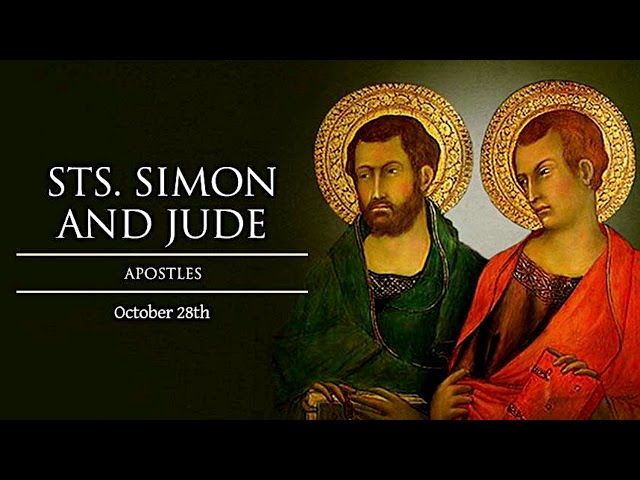
The Feast of Sts Simon and Jude.
My dearest Brothers and sisters-in-Christ:
Today we come together as the church to celebrate the feast day of Saints Simon and Jude. Little is known about either of these saints apart from the fact that they were called by Jesus to be among his band of disciples and were later named amongst the Apostles.
Let us first take a look at St. Simon:
Simon was a simple Galilean, a brother of Jesus, as the ancients called close relatives in those times, including such as uncles and first cousins. He was one of the Saviour’s four first cousins, together with James, Jude and Joseph. These were all sons of Mary, the wife of Alpheus, or Cleophas, both names being a derivative of the Aramaic Chalphai. According to tradition Cleophas was the brother of Saint Joseph, Jesus earthly father. All the sons of this family were raised at Nazareth, close neighbours of the Holy Family.
All were called by Our Lord to be Apostles: pillars of his Church. Saint Mark tells us that Simon was born in Cana, the place, according to Saint John, of Jesus’ first miracle. Some traditions identify Simon as the bridegroom at that wedding and suggest that he became a disciple as a direct response to witnessing that miracle, a miracle that was, after all, performed, at the request of Mary, to get the newly-weds out of a somewhat embarrassing predicament.
Saint Simon is not mentioned anywhere in the New Testament except in lists of the Apostles’ names.
Tradition has it that Saint Simon preached in Mauretania (an area which approximated to present day north-west Africa and southern Spain), in Egypt and in Libya, leaving behind him the fertile hills of Galilee, where he had been engaged in cultivation of the vineyards and olive gardens. He later rejoined his brother Jude in Persia (modern day Iran) where they laboured and died together, probably martyred, hence the change to a red altar frontal in their honour on this their feast day. At first the Persian king respected them, for they had manifested power over two ferocious tigers that had terrorised the land. With their king, sixty thousand Persians became Christians, and churches rose over the ruins of the idolatrous temples. However, when they visited other parts of the Persian kingdom unconverted, pagan hordes commanded them to offer sacrifices to the Sun god. They prayed for mercy and offered their lives to the living God but the idolaters fell on the two Apostles and massacred them, while they blessed God and prayed for their murders.
Now let us take a look at Saint Jude:
Saint Jude is also known by a variety of other names. He is called Lebbaeus in Matthew chapter ten and Thaddaeus in Mark chapter three.
In the end of our Bibles, we find The Epistle of Jude. It is a short work of only one chapter containing just 25 verses. Here we are warned against corrupt influences that have crept into the church.
St. Jude is often and popularly referred to as the patron saint of desperate or lost causes, the one who is asked for help when all else fails. Possibly due to prayers for intercession, to be asked of the other Apostles first. Hence, Jude has come to be called ‘the saint of last resort’, the one whom we ask only when desperate.
What, then, can we in today’s world learn from the lives of these two relatively unknown Apostles? Firstly, they, like the rest of the twelve, ‘forsook all and followed Jesus. Can we be accused of doing that? Could we, and should we, give up some of our modern comforts and privileges and live our lives more like our Lord? Secondly, if tradition tells us, St Simon was the recipient of Jesus’ first miracle. We should be reminded that, even two thousand years later, that miracles still happen. We must always be aware that the Holy Spirit is at work in the world and he does not always do things in the way in which we would have him do them.
Thirdly, judging by his epistle, Saint Jude proved to be an avid supporter of gospel truths.
So then, are we truly passionate enough about the tenets and doctrines of our faith? Do we hold fast to the creedal affirmations of the Church?
Both Sts Simon and Jude, spent their lives preaching the gospel to a very pagan world and it is believed that they died a martyr’s death for their faith. We may not be called to be martyrs like they were (hopefully), but we shall be called to make other sacrifices. Are we ready to suffer for the sake of our Lord and Saviour Jesus Christ?
Let us, thank God for the lives of his Apostles Saint Simon and Saint Jude.
Let us pray:
Father, you revealed yourself to us through the preaching of your apostles Simon and Jude. By their prayers, give your Church continued growth and increase the number of those who believe in you.
Through our Lord Jesus Christ, your Son, who lives and reigns with you in the unity of the Holy Spirit,one God, for ever and ever.
Amen.
Seeing Jesus~The Rev Frank Bellino, OPI
This Sunday’s Gospel passage tells us of the physical healing of a blind man. The gift of sight. Yet it also sets out for us a journey of insight which the man undergoes as he comes into contact with Christ and which leads not just to his being healed of a bodily handicap, but to his becoming a full disciple of Christ, to his following Jesus ‘on the way,’ that ancient phrase for being a Christian. It is as a story of insight that the man born blind becomes a model for all of us as we look to understand what it means for us to be ‘on the way’ to and with Christ.
We see this journey of insight unfold in the different names the blind man uses for Christ, as he calls on Christ with ever increasing determination and as he becomes known to Christ.
At the beginning, the blind man is named Bar Timaeus. Not just a blind man, but someone known. Although Bar Timaeus was known to the early Church as a disciple of Christ, one of the Church’s own members.
At the beginning of the Gospel story, he is just a blind beggar on the roadside from Jericho to Jerusalem. A man who hears that Jesus of Nazareth, the famous healer, is passing by. Now, it is his own chance to get his own physical sight back.
What he cries out is, ‘Jesus son of David, have mercy on me.’ What does he mean? Is it just an honorable title, a way to get attention, or does he recognize Jesus as the Messiah? At least, when others around him try to shut him up, he keeps on ever more loudly and insistently, ‘Jesus, Son of David, have mercy on me.’
The blind beggar has the words of recognition, but if he is aware of their significance, it is another thing. He wants the gift of sight, but at the same time, he is also on the way to understand who the Jesus of Nazareth truly is, but how far he is away from this situation is uncertain. It is at this point that the blind man encounters Christ. He has received Christ’s attention, and, in his enthusiasm, the blind man casts off his cloak and rushes to where Jesus is.
When Christ asks him what he wishes to do for him, the blind man changes the way he addresses Christ. No longer, ‘Son of David, but ‘Master’ – a more intimate and committed term, a term no longer of distant recognition, but of one who confesses himself to be a disciple. In fact, the English of the RSV does not do full justice to the significance of the term being used, for the Greek text preserves the Aramaic ‘Rabbuni,’ ‘My master, my rabbi,’ the same term preserved in encounter between Mary Magdalene and the Risen Christ. ‘My master,’ the one to whom I come to for teaching and insight, the one in whom I have placed my trust and love.
The blind man has shifted to a greater recognition of who the Jesus of Nazareth is. How much he understands the term he is using at this point, again we do not know. He is using the term and is right to do so. Certainly, some changes, some deepening in his understanding of Christ, have occurred. When Christ asks him what he wants, even though he clearly still wants physical sight, he begins to prove that he is open to the gift of insight.
And, thus, when the passage ends, as the man is healed and sees again, he also comes to have the insight that Christ is more than just the miracle worker, more than someone who meets his immediate physical needs, that Christ is the master from whom he wants to know and experience the truth about human life and flourishing. Not to go on his own way, but to follow Christ on Christ’s way, the way of discipleship. The blind man has become the Bar Timaeus of the Church, one who in his encounter with Christ and in his own enthusiastic response to Christ has also to be recognized himself as more than a blind beggar, and as a human being with a distinct identity and value in the sight of God and his fellow human beings.
This journey of insight Bar Timaeus is a model for us. In our own encounter with Christ, we also embark on a journey of increasing recognition of who Christ is and a corresponding purification of our desires. As with Bar Timaeus, it is only when we make demands on Christ and come closer to him and he to us that we discover ourselves confronted with the question of who we truly believe Christ is and what we do desire Christ to do for us. Are we using titles for him without any real grasp of their significance? Or, is Christ the one who teaches us about the proper meaning and reality of human life – and who offers the realization of it.
When we make demands of Christ and as we ask these question, our ideas about him and desires are challenged and purified, as Christ becomes more than a figure of the past or of ancient texts or religious traditions, and becomes, ‘My master.’ And it is at that point that we ourselves start to follow him on ‘his way,’ not ‘our own way.’
Who Are You?~The Rev Frank Bellino, OPI
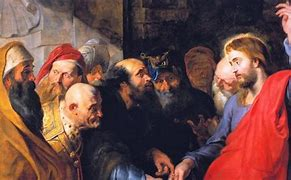
There is a tendency for us to define ourselves by what we do, and not by what we are. ‘What do you do?’ is not just the question; it is part of ordinary small talk. To a certain extent, what we do does indeed define what we are. But at the same time, what we have a certain priority over what we do. I know an educator that when you address her as Mrs., corrects people and says “that is Doctor”. The man who steals is a thief, but he is more than a thief to begin with, and even after the theft he can become something more. He can become a forgiven thief, a restorer of stolen goods.
This temptation to prize doing over being manifests itself in our words. We start to use the word ‘useful’ as a synonym for ‘good.’ We say, ‘I hope you find this useful,” when what we mean is ‘I hope this is good for you.’
An overemphasis on our actions leads us to value our jobs. People are proud of being a manager, a supervisor, a boss, a director. Indeed, the term ‘manager’ has mostly been emptied of its original meaning because of euphemistic over usage. And it is overused precisely because rank and status are confused with our identity, and because they are valued.
No one wants to be the lackey, the understudy, the pee-on. The mistake is to think that important jobs make us important people. They do not. Nor does the lack of such importance make us unimportant. The mistake is to believe that one is either a somebody or one is a nobody.
A similar confusion exists in the Gospels. The rulers among the Gentiles, Jesus says, lord it over them, and their great one’s exercise authority over the lesser ones. The exercise of power to serve one’s needs, no matter how good, is often a terrible thing. But worse is the desire for power as an end in itself. The desire to be a lord – a signor {Italian) – is a misplaced desire. St Catherine of Siena wrote to a particularly pompous prince, saying, ‘You desire lordship (signoria) over others, but have no lordship over yourself.’ There is no point in ‘managing’ other people when we cannot even ‘manage’ ourselves properly. And good intentions cannot justify our bossiness; in fact, it is a greater corruption to boss people around out of good intentions, because we will then make good look evil, and portray love as something hateful and hateworthy.
Jesus offers himself as a model for his disciples. The Son of Man ‘came not to be served but to serve, and to give his life as a ransom for many.’ The words he uses here mean ‘for many,’ in Greek, hoi polloi – for the riffraff, the general ordinary people of humanity. Indeed, it is for ‘the many’ that Jesus sheds his Precious Blood, as the new translation of the Mass conveys to us.
Jesus, who dies for the ordinary people, warns us against seeking lordship, and reminds us that he – Our Lord – came to serve us, the riffraff. He does not remind us of this to humiliate us, but to remind us of how much he loves us. Although he is Lord, he has shared our life with us, as the second reading says, ‘For we have not a high priest who is unable to sympathize with our weaknesses, but one who in every respect has been tempted as we are, yet without sin.’
Our dignity is not drawn from the things we do or can do. We are not valued for our quality of life. Instead, our dignity and value come from what we are, (human beings – rational creatures made in the image of God) and from what we are being made into (the children of God by adoption through grace). The lordship we Christians have is one of service to each other, just like the lordship of Jesus who came to save us, to save the hoi polloi.
Give of Your Best~The Rt Rev Michael Beckett, OPI

Ya know, sometimes Jesus says stuff that is difficult. Sometimes it’s difficult to understand. Sometimes it’s difficult to hear. Usually, it’s difficult to do. Like the Gospel appointed for today: Today’s Gospel relates the story of “The Rich Young Ruler.” It seems this guy kinda had it all. He was a good person, had done well in life, did everything he was supposed to do, and on top of everything else, he was rich! He had it goin’ on! And then, he up and asks Jesus what he needed to do to get into Heaven…….and here’s the upshot. Jesus said to him, he said, “Go, sell what you have, and give to the poor (Jesus sure had a thing for poor folks) and you will have treasure in heaven; then come, follow me.” Well….the dude was NOT best pleased and went away sorrowing, coz, you know, he was rich, and he wanted to stay that way.
So what gives with this? I have to believe that what Jesus is saying to us is this: If we are going to walk with Jesus, we have a price to pay. Sacrifice and suffering and making difficult choices are part of the journey. Jesus is demanding His rightful place in the hearts of His people. Us. We must love Him more than all others, more than anything. Any thing. More than our possessions, more than our bank accounts, more than our precious and dear little sins, and more than our political beliefs. AND, to boot, we have to demonstrate that this is true, especially if we are forced to make a choice.
Jesus does not say “do not love” those other people—or those things, or beliefs, or whatever. What He says is that we ought to love God more. And in so loving God more, in following his path, we sometimes have to be willing to lose those things, whether it be savings accounts, connection to their family members, friends, political party, or long and strongly held beliefs or feelings, in order to continue to follow Jesus and acknowledge to others that He is the Christ. Jesus has to come first.
Loving others is the second greatest commandment, but it is behind the first: to love God with everything we have (Matthew 22:34–40). In making this statement, Jesus continues to make the claim that He is God. Love and obedience to Him must come before obedience to any other person or group (Acts 5:29).
And how do we show that love? That willingness to sacrifice it all for Jesus? Be merciful. Be kind. Show love. It’s pretty much one of the key recurring factors of Jesus’s ministry. Love God. Love people. Love God. Love people. Especially those who are less. The poor. The immigrant. The homeless. The downtrodden. Those who are “other.”
In Matthew 25, Jesus was pretty explicit about this “love God, Love people” thing. He said, “34 “Then the King will say to those on his right, ‘Come, you who are blessed by my Father; take your inheritance, the kingdom prepared for you since the creation of the world. 35 For I was hungry and you gave me something to eat, I was thirsty and you gave me something to drink, I was a stranger and you invited me in, 36 I needed clothes and you clothed me, I was sick and you looked after me, I was in prison and you came to visit me.’ 37 “Then the righteous will answer him, ‘Lord, when did we see you hungry and feed you, or thirsty and give you something to drink? 38 When did we see you a stranger and invite you in, or needing clothes and clothe you? 39 When did we see you sick or in prison and go to visit you?’ 40 “The King will reply, ‘Truly I tell you, whatever you did for one of the least of these brothers and sisters of mine, you did for me.’ 41 “Then he will say to those on his left, ‘Depart from me, you who are cursed, into the eternal fire prepared for the devil and his angels. 42 For I was hungry and you gave me nothing to eat, I was thirsty and you gave me nothing to drink, 43 I was a stranger and you did not invite me in, I needed clothes and you did not clothe me, I was sick and in prison and you did not look after me.’ 44 “They also will answer, ‘Lord, when did we see you hungry or thirsty or a stranger or needing clothes or sick or in prison, and did not help you?’
45 “He will reply, ‘Truly I tell you, whatever you did not do for one of the least of these, you did not do for me.’ 46 “Then they will go away to eternal punishment, but the righteous to eternal life.”
Isn’t it time that we, as Christians, start putting Christ first, start putting his people first? Isn’t it time that we as true followers of the Jesus that we proclaim learn to treasure what we have been given? Work for justice. Work for peace. Work for understanding.
The second verse of that dear old hymn by Howard B Grose, “Give of Your Best to the Master,” sums this up pretty well:
Give of your best to the Master;
Give Him first place in your heart;
Give Him first place in your service;
Consecrate every part.
Every part. All of it. Even when it’s hard. Even when it hurts. Love God. Love people. Amen.
Enemies of the Church~The Rev Frank Bellino, OPI
No one even the Church has complete understanding of Jesus Truth. The truth is always greater than anyone’s understanding of it. Intolerance is a sign of ignorance and arrogance. It is a sign that a man believes there is no truth beyond the one he sees. St Thomas Aquinas warned that we should ‘fear the man of one book’ and I add, ‘even if that book is the Bible’.
In any democracy, freedom of opinion and speech is the hallmark. Voltaire, the brilliant French Philosopher and Scientist, was once criticized and opposed by one of his subordinates. He was very angry with the young man but said to him: ‘I hate what you have said but I can die for your right to say it’. He allowed his critic to become one of his closest friends until he died. In today’s gospel and 1st reading, God seems to be so liberal with the charismatic gifts of prophesy or what looks like from our eyes – like the gifts of tongues today and those of us suffering from ‘stop mania’ – the sickness of stopping this and yet allow the abusing in the Church may need to learn quite allot of lessons!
The disciples complaining to Jesus about the exorcist in today’s gospel who was not in the apostolic fold but casting demons in Jesus’ name could still be likened to the priest, pastor, charismatic brother or sister doing ‘ministrations’ in a queer unorthodox way. He/ she may not be the real enemy of the Church provided he/ she is working in Jesus’ name. But we may need to ask a few critical questions: Why is he/ she ministering? What results is he/ she getting and what fruits do these bear on the growth of the Church? Why are those complaining doing so? Are they complaining because they are jealous of the minister (who may be attracting more attention than themselves) or because they have true love for God and his Church?
Christ seems to say today that ‘Anyone who is not against us is for us’ (The Principle of Inclusive Tolerance) and that it is wrong to say that ‘Anyone who is not with us (i.e. doing it in our own way) is against us (Principle of Exclusive Tolerance). The Christian/ Church leader with the mind of Christ is one who can recognize human needs and minister to them as Jesus did irrespective of race, creed or denominational restrictions. We seem to be in a hurry to identify enemies of Jesus when according to Jesus how many of these do, we not identify as enemies;
1. THE UNCHARITABLE: Today’s 2nd reading shows the uncharitable rich people as the real enemies of the Church; those who cannot share what they have with the poor. Burning fire awaits them and their wealth is gone to rot and rust uselessly.
2. THE EXPLOITERS OF THE POOR: The exploiters of the poor wherever they are found whether outside or inside the Church are the real enemies of the Church; The rich politicians and rulers who loot our public treasuries and refuse to hand over power to others who will do better than them are the real enemies.
3. THE SCANDALIZERS OF THE WEAK: Ministers who confuse and corrupt their flock and abuse the minors sexually are the real enemies of the Church. Teachers who exploit and harass their weak students sexually and through other ways are the real enemies of the Church.
4. THE MURDERERS & THE VIOLENT: Those who promote acts of violence and any form of killing/ molestation of the innocent preventing them from going about their legitimate businesses are the real enemies of the Church.
5. PERPETRATORS OF INJUSTICE: Those who prosecute wrong judgment or bear false witnesses; those who sit in judgement with lies or those unlike them are the real enemies of the Church.
The first lesson we must learn from today’s readings is that salvation is not for any one group of individuals. The Holy Spirit is not the sole property of any denomination. As the Lord took some of Moses’ spirit and put on the 70 elders and they prophesied, he is still putting his Spirit in numerous unconventional places and people. The complaints against Eldad and Medad are still widespread among us as evidence of jealousy and religious hatred. Religious intolerance is ruining the world today and it has both internal (when it is against members of our own faith) and external (when it is against members of other faith) dimensions. We are not proposing doctrinal compromise, but spiritual expansion and maturity of judgment.
We need not worry so much about what we will stop in others as much as what we will stop in ourselves. We must stop all obstacles to our salvation and most importantly, we must stop ourselves from becoming obstacles to others’ salvation especially the minors and vulnerable adults (Christ calls them ‘these little ones of mine), the altar boys and girls around us, the junior Seminarians working under us, our father’s boys and girls, our maids and children, our students and apprentices. We must stop all corrupt influences we exert on them directly or indirectly, covertly or overtly, by commission or by omission.
We should worry more about those we prevent from seeing God because of the way we see him; those we ban/ debar from the sacraments and those we scare away from the Church through our stringent financial, moral or even liturgical rules. We need to worry more about the real enemies of the Church than the weak/ imperfect members of the Church who are trying to find their vocation.
Who’s the Best?~The Rev. Frank Bellino, OPI

In today’ society everyone thinks they know what counts as winning: doing better than other people; we think we know what counts as glory: everyone telling us how great we are and treating us with great respect; we think we know what counts as power: being able to make things happen the way we want them, and people obeying us when we tell them what to do. We want to be big rather than small, strong rather than weak, praised rather than blamed. It’s normal to think like that, isn’t it? (I have said on several occasions that I want everyone to be successful)
Jesus didn’t seem to think so.
It is not that he thought being killed was a lot of fun. We would believe it was the worst thing that could happen to us, Jesus knew that it wasn’t. It was the expense of being obedient to the Father, and it was not the end.
However, try to explain that to the disciples. They didn’t know what he was referring to when he said he was going to be killed and was going to rise again. They didn’t want to ask him. Maybe it was partly because the last time they’d shown they didn’t understand what he was talking about, they got a real telling off for being so obstinately stupid. However, they did not want to understand the terrible thing he was saying. If they were stuck in the belief that success means everyone is praising you, then Jesus was telling them that he was going to be a failure. Who would want to hear that?
Instead, they talked about something sensible to them as they traveled to Capernaum: they argued about which of them was the most important. Now that’s something real you can argue about; that brings us out of this strange world Jesus was showing them, in which the best man they had ever encountered would be killed. Arguing about who’s the greatest gets you back into the real world, of competition, of legends, of big and small, strong and weak, successful and unsuccessful. You know where you stand in this world. You know your place in the pecking order; there’s always someone you can boss around, even if other people boss you around. There are winners and losers. A world like that makes sense, even back then.
When Jesus asked them what they had been discussing, they felt a bit ashamed; they knew they were not thinking his way, even if they couldn’t – or wouldn’t – comprehend how to think his way. They realized they were not truly following Jesus. They couldn’t follow what he said, but more importantly, they didn’t have the attitude he had, so they couldn’t follow his path.
So, he sat down. In those times, the teacher would sit down, and the learners would stand. Jesus sat down to show that he had something very important to teach.
What did he need to say? In a typical Jesus remark, ‘If you want to be first, make yourself last.’ Did he say this just because he liked upsetting people? Could it be that he was simply telling the truth?
Being a good teacher, he used a visual aid. They were in a house, and there were kids around. In that kind of society, children would not have been seen as charming little things. The kids were a nuisance until they could make themselves useful. And Jesus grabbed a little child, who was no use to anyone, and said ‘Welcome this child and you’ll welcome me; and by the way, if you welcome me, you’ll welcome the God who is my Father.’ He chose a child as an icon of God, to show that God does not think in the competitive way the disciples were tempted to think – the way Christ’s disciples in our own day are tempted to think. The child was simply there, no use to anyone, but simply loved by God, precious to God.
That’s what our Christian vocation is about. It’s allowing Jesus to call us into his crazy world of death=glory, weak=strong, leader=servant, child=God. It’s refusing the competition that transforms at least half of the world into failures, to be deceived and written off. It’s saying that obedience to Christ sets you free, that refusing to have power over other people makes you happy, that not having control over your life through such things as wealth makes you fully human.
St Mathew, Apostle, Evangelist~The Very Rev Lady Sherwood, OPI
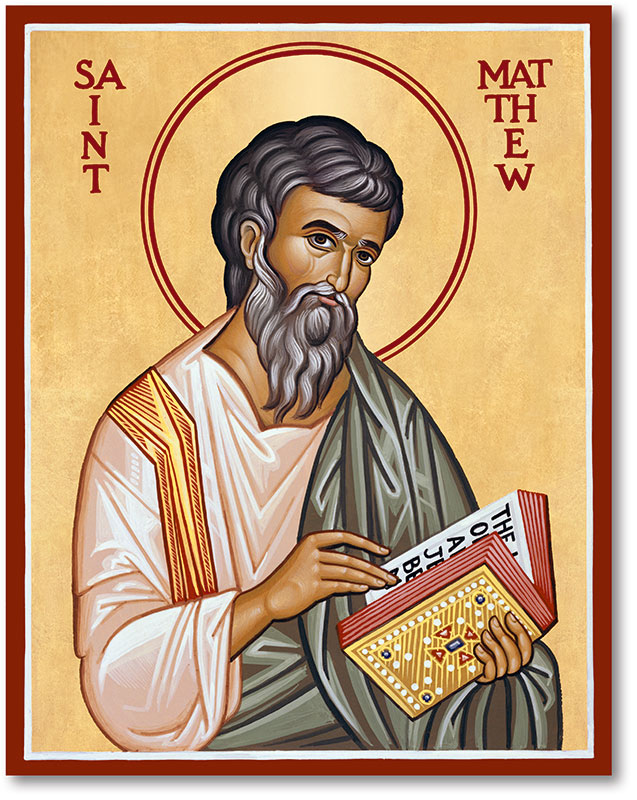
When our Lord Jesus called him to follow him, Mathew was a tax collector by profession for the Romans. His profession was hated by the devout Jews as it reminded them of their subjection and also the Pharisees saw his profession which was classed as publican, as work for the typical sinner.
St Mathew is one of the Lord Jesus’ twelve apostles and by Christian tradition is also seen as one of the four Evangelists. He was the first to put down in writing as his Gospel the Lord’s teachings and the account of our Lord Jesus’ life. Mathew wrote his Gospel in Aramaic, which is the language which was spoken by Jesus himself.
No one was shunned more than a publican by the devout Jews because a publican was a Jew who worked for their enemy, the Romans and who robbed their own people making themselves large personal profits. Publicans were despised to the extent that they were not allowed to trade, eat or even to pray with other Jews.
One day when Mathew was seated at his table of books and money, Jesus looked at him and said unto him two words, “follow me”. For Mathew, these two words were all it took for him to immediately rise, leaving all his pieces of silver to follow our Lord Jesus Christ.
Mathew’s original name was ‘Levi’ which in Hebrew signified ‘Adhesion’ whilst his new name given to him by our Lord Jesus of Mathew means ‘Gift of God’.
The only other major mention of Mathew in the Gospels is regarding the dinner party for Jesus and his companions to which Mathew invited his fellow tax collectors.
The Jews showed surprise at seeing our Lord Jesus eating in the company of a publican, but Jesus explained to the Jews that he had come “not to call the just, but sinners.”
Not much else is known about the life of Mathew but according to tradition, he is reported to have preached in such places as Egypt, Ethiopia and other further Eastern areas.
Some say Mathew lived into his nineties before dying a natural death, but other Christian traditions say he died the death of a martyr.
The Gospel according to Matthew is one of the four canonical gospels, one of the three synoptic gospels, and is the first book of the New Testament. The narrative tells how Messiah, our Lord Jesus was rejected by Israel, and how he finally sends his disciples to preach his Gospel to the whole world. Most Scholars believe the Gospel of Matthew was composed between 80 and 90 CE, with the possibility of between 70110 CE. The Gospel of Matthew is a creative reinterpretation of Mark, stressing Jesus’ teachings as much as his acts, making subtle changes to reveal Jesus’ divine nature for example, Mark’s “young man” who appears at Jesus’ tomb becomes a radiant angel in the Gospel of Matthew. The Gospel of Matthew shows Jesus as the Son of God from his birth, the fulfillment of the Old Testament. The Gospel of Matthew was the favourite Gospel of St.Dominic de Guzman, who always would carry it wherever he went.
Let us pray to St Mathew to ask him to intercede on our behalf:
O Glorious St Mathew, in your Gospel you portray Jesus as the longed-for Messiah who fulfilled the prophets of the Old Covenant and as the new lawgiver who founded a church of the New Covenant. Obtain for us the grace to see Jesus living in his church and to follow his teachings in our lives on earth so that we may live forever with him in heaven. Amen.
Who Are You?~The Rev Frank Bellino, OPI
I don’t believe Jesus is having an identity crisis when he asks the question, ‘Who do people say I am?’ But in presenting this question about himself, he makes us ask the same question of ourselves.
Personal identity is a very modern issue, and people give a different response when asked who they are. It is uncommon for some individuals to describe themselves by their work or profession. It is by saying that they are a doctor or a worker that we can discover all we need to know about them. We can guess their education and their social background. We may be imagining what kind of house they live in and which way they will vote.
Another way in which we name ourselves is by our relationships. The television program, ‘To tell the truth?’ was very popular because we all want to know where we have come from, and someone else’s history will attract an interest in our own story. Nonetheless, the immediate relationships we have are likely more important than ancestors when determining who we are. To say that you are a daughter, a sister and a mother, and a wife, and then to name the relatives, you are in a particular family from which you give and receive life. The family context also allows you to look at the future, particularly through your children.
Certainly, there are many types of relationships that are not only relevant to us in the present and present, but also reflect on the future. The relationship between teacher and child is clear, but there are many others.
In answering Jesus’ questions, his disciples make a number of points about his identity. To suggest that he is John the Baptist is an easy mistake. We discover from the Fourth Gospel that John was preaching at the same time as Jesus, and stories about John would be mixed up with those of Jesus. To say he was Elijah suggests that Jesus is not only a prophet like John, but also a person who is embracing in the end of time because Elijah who went to heaven in a fiery chariot is expected to appear at the end of the world. Just being a prophet also reveals a lot about how God was perceived to be speaking through Jesus. When Peter said that Jesus was the Christ, the anointed one of God, he was claiming more.
It was hoped that the Christ would liberate the Jewish people from the oppression they were suffering under the occupation of the Romans, but Jesus was not a liberator. He began to liberate us from sin and to make us his people; and that is achieved by following him. Following Jesus through thick and thin, living according to his teaching, is not an easy decision.
He promises us everlasting life, but it is only by losing the one that we have will we be able to save our own life. It means being with Christ, and that means rejection by others just as much today as it was in Jesus’ time. By living the Gospel, we will be avoiding current trends, and our values will not be the ones of other people. This means that we will have to stand up for what we believe, and this will provoke a reaction against us. Being a prophet like John the Baptist or Elijah, calling people to see truth in the middle of the all the chaos of the modern world is far from making life easy for yourself, but it is the way to proclaim the kingdom we pray for in the Lord’s prayer. That is what giving up our lives to save it means. However, one thing we can be certain about is who we are. It can be quite exciting, as there should be no identity crisis for Jesus’ followers. No longer will we be searching for the meaning in the dark. We can follow the Christ and know that if we are faithful to him then we have a future that extends beyond this life. We can now define ourselves in a new way. No longer do our profession, job, postcode, and status or salary matter in this life. The values of the world have been turned upside down so that we can see the world the right way, which is with the eyes of Christ.
If anyone asks you who you are, you can say, ‘I am a child of the highest God, the brother or sister of Jesus Christ, and I am heir to eternal life’.
That should clarify any questions about identity for them and for you.
Words and Actions~The Rev Frank Bellino, OPI
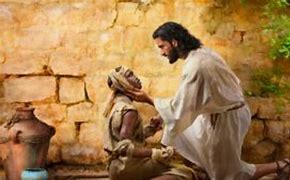
What love, respect, consideration, and faith on the part of those who brought to Jesus the deaf man with the speech impediment? They believed He could heal this person.
Nowadays, we are referring to people being challenged to think and act positively within the limitations of their own situation. Within my own circle of family and friends, in my visiting schools, hospitals and special homes, I have been deeply moved by the loving respect, the supportive, encouraging acceptance that has been shown to those who are in any way challenged – allowing them their own space to be themselves, ‘do’ for themselves and accomplish it themselves.
We all know that this is not always the case. I don’t want to dwell on this now, nor do I wish to rush into reading something spiritual or symbolic into Jesus healing the deaf man with the impediment in his speech. Rather, I welcome the opportunity to record my admiration for teenagers who talk about their future careers and tell me they wish to become professionally involved in teaching physically, emotionally, spiritually challenged children and adults or in caring for the elderly. Here is a call, a vocation, to a lifetime of expressing love in a very practical way. Such care-givers are most surely signs of the Kingdom of God being present here and now before our very eyes. They are sacraments of the compassionate, healing ministry of Jesus vividly present in our midst.
The Gospel of today tells us that Jesus “put His fingers into the man’s ears and touched His tongue with spittle. Then looking up to heaven He sighed; and he said to him, ‘Ephphatha,’ that is, ‘Be opened,’” and that, “And his ears were opened, and at once the impediment of his tongue was loosened and he spoke clearly.” Those who witnessed this were filled with admiration. He has done all the things well, as they saw this to be not only an act of power but also a form of love.
From the early days of Christianity, the Church has seen this healing by Jesus as a sign of the spiritual healing, character shaping, which takes place shortly after a person is baptized. In the Rite of Baptism, it is told that,
‘The celebrant touches the ears and mouth of the child with his thumb, saying, “The Lord Jesus made the deaf hear and the dumb speak. May he soon touch your ears to receive his word, and your mouth to proclaim his faith, to the praise and glory of God the Father.”
In this age of highly sophisticated communication technology, it is possible for small children. I believe that this simple rite of blessing of the ears and mouth is of huge importance and significance.
The ears represent our ability to receive sounds and images that can influence the way we think, feel and act. Our words represent the ability to convey messages that have an impact on the lives of others. Our intake and output of ‘media matter’ will often be for better or worse- morally, spiritually, as well. We must ask ourselves what we are doing to ourselves through what we are listening and reading; what we are doing to others through our words and body language. In both cases, it could be beneficial, or it could be a lot of damage.
The choice is ours. It is a moral and spiritual choice. We may be inclined, enticed or tempted to consume material that is spiritually unfit for human consumption. At baptism the ears are blessed that we may choose to receive the ‘godly word’ and reject the ungodly one. Our mouths are blessed that we may communicate with others inspiring words that are truthful, charitable, and moving and resist the temptation to lie, mislead, and talk nastily about others.
God knows, even if we don’t, how much we all need healing and restraining in the wonderful, terrible world of inter-personal and mass-communication! What a challenge we must face and encourage others to do so!
 The Order of Preachers, Independent
You must be logged in to post a comment.