
Category: Lesson
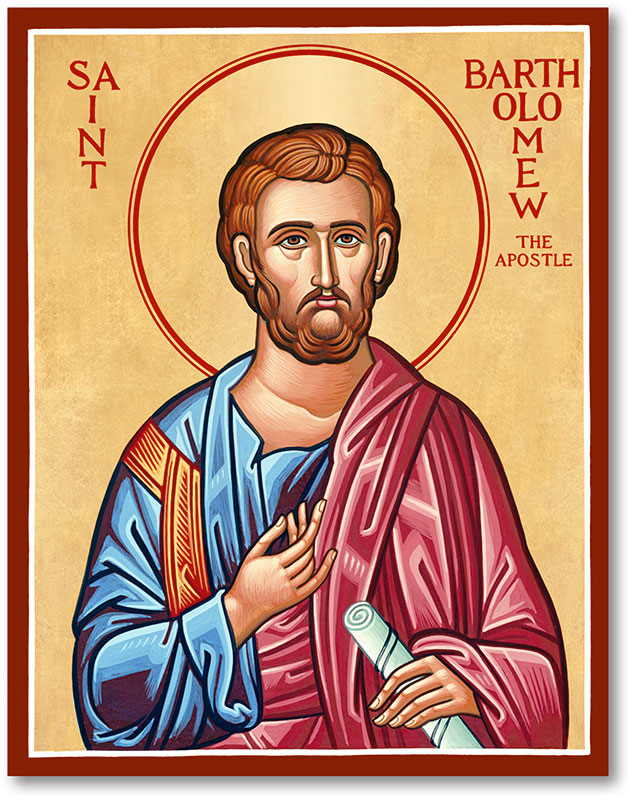
The Feast of St. Bartholomew-The Anonymous Apostle~The Very Rev Lady Sherwood, OPI
My dearest brothers and sisters -in-Christ:
Today, we come together as the Church to commemorate the Feast Day of St Bartholomew the apostle. Bartholomew is a relatively difficult saint to commemorate because we hardly know anything much truly about him. There are some who may believe that Bartholomew is the same person as Nathaniel –but scholars have been known to argue about the truth or otherwise of this. What we do know is that In the Gospels of Matthew, Mark and Luke, that Bartholomew is listed as being one of the twelve Apostles called by Our Lord Jesus Christ.
Ancient writers on the history of the Christian faith have written that Bartholomew was an apostle to India – possibly in the region of Mumbai (Bombay). Along with his fellow apostle Jude, Bartholomew is reputed to have brought Christianity to Armenia in the 1st century. According to church tradition, Bartholomew is said to have been flayed alive, before being crucified upside down, thus becoming the patron saint of Leather-workers. In art paintings and in sculpture form, Bartholomew is often represented as holding a knife, with his own skin neatly draped over his arm. Bartholomew has also always been associated with healing, so there are a number of hospitals which have been named after him because of this
Bartholomew is also believed to have been associated with the small Italian Island of Lipari, where it is thought that he may have been buried. During World War II, the regime looked for ways to finance its activities, and ordered that a silver statue of Saint Bartholomew from the cathedral in Lipari was to be melted down. But when the statue was weighed, it was found to only actually weigh just a few grams so it was returned to its place in the Cathedral of Lipari. However, In reality, this same statue is made wholly of solid silver and therefore should indeed be very heavy in weight. This is a fairly recent miracle that has been associated with St Bartholomew.
About Bartholomew himself we know almost nothing, except that he was an Apostle of Jesus. Far from being a negative thing, I think this is the most important thing about this rather mysterious and anonymous apostle. For this teaches us that the call to serve is not really anything whatsoever to do with worldly status or fame. If we Look around us today, we will see much evidence of the reign of ego and of worldly fame, perhaps it is media stars and celebrities which tend to be the best known for this. An increasing number of children, when asked what they want to do when they grow up, say that they want to be famous, to be a celebrity or a star– and that the goal of reaching fame has become for them their vocation. Some of our politicians can also seem rather the same way. But the church isn’t entirely exempt either: we see evangelists on religious tv stations, pastors of megachurches, and, unfortunately, some bishops and clergy who just love being in the spotlight, have who love self-publicity. I once heard someone say that their church was OK but it was hard to see God because the Vicar always got in the way. It’s a temptation clergy are aware of and must always resist – our job is to point people to God, not towards ourselves.
So Bartholomew’s anonymity shows us ‘it’s not all about us’. Our job as Christians is to get out of the way and to enable people to catch a glimpse of the God and Father whom we serve. We also know, from the life of this mysterious and anonymous apostle, that we actually don’t need worldly fame, because God loves us, and that is all we need – we ought to need no other adulation than that!!
Each and every one of us eventually will join the ranks of anonymous Christians who have served God throughout the ages. In 2000 years’ time – and most likely long before that – we will all have been forgotten, except perhaps by the odd ancestor hunter who might still be digging our names out of archives and searching church registers to find historical information.
This might seem rather disheartening, but it definitely needn’t be such, because we know we are each p of God’s creation and of his redeeming: we are each loved by God more than we could ever hope imagine! Part of our job as Christians, is to try to discover more of this love as we go about living our lives. When we truly understand even a little bit of this love that God our Father and our creator, truly has for us, our anxieties about worldly status, worldly importance and worldly fame, begin to lose their hold over us. In God’s love we truly have everything we need.
So often we see the lives of the rich and famous descend into tragedy or disaster. Worldly riches and fame often don’t bring true and lasting happiness. The ordinariness of our lives is something which we as Christians should celebrate, if, like Bartholomew, our lives are built on the rock of faith and we have the knowledge of God’s true and eternal love, like a hidden jewel, burning deep inside of us.
So Bartholomew is one of us: he is a follower, a disciple, and a servant of Our Lord Jesus Christ. An anonymous, unshowy person who gave of his best. Bartholomew may well be Someone we don’t know all that much about, but we do know that his soul is now residing with God where that great love will, at last, be fully known.
That is all that is needed. All that truly matters. Amen
Two Minute Mendicant~Br. Christian Ventura, OPI

What’s in a name?
Brothers can be friars, monks, or simply just religious brothers. Friars can be monks, but this isn’t always the case, and the terms aren’t exactly interchangeable. Likewise, in new monasticism and mostly outside of the Roman Catholic Church, sisters are not always professed nuns.
Unlike what many people think, “Brother/Sister” is customarily not an honorific title commensurate with Doctor, Reverend, Professor, etc. rather, in our priory at least, it is intentionally supposed to signify the opposite. The goal is to radically disrupt inherent power dynamics, and sincerely invite another person into a loving siblingship. It is a reminder that at the end of the day, we are simply beloved siblings who make up the Body of Christ. In my experience, most have no preference if you call them by their first name or Br./Sr., but this depends on the person and local customs. I have no preference, although I know some who do, and it is always perfectly fine to ask! Because of tradition within the Roman Catholic Church, Br./Sr. has been shaped across history as an ecclesiastical title. In the new monasticism of today, many monastics are trying hard to change the meaning from a pseudo-honorific back to an earnest invitation.
Mendicant generally refers to one of the four main mendicant orders: Franciscans, Carmelites, Dominicans, and Augustinians. there are other mendicant orders, and there are also formerly mendicant orders, such as the jesuits (SJ) who are now considered “clerics regular”
~ br c
Get Some Windex!~Br. James Taylor, Novice
Isaiah 56:1, 6-7
Romans 11:13-15, 29-32
Matthew 15:21-28

It is refreshing to read scriptures that are more connected than they are apart. I mean, there feels like an actual theme running through these passages for a change and I am glad that I got them to work with for this week.
For years, I have felt like an outsider of sorts. On more than one occasion things have happened to put me on the outside of what was considered normal by many others around me. I grew up with six sisters (one older brother) and so I did and learned many things that my sisters did. For so long, it became clear that I was able to do things that they did, or any other girl did, just because I was around them and watched them do it. By the time I was about eight years old, I was twirling a broomstick or a mop handle, marching around our yard as the drum major or majorette of an imaginative marching band; and by the time I was eleven, I was cartwheeling, flipping, doing splits and straddles and even mastered just about every cheer that any cheer leading squad seen on any Saturday or Sunday sports football game (college or national) was doing. My sisters were doing it, so it felt only natural that I was able to do it, too. But, not everyone was okay with this.
My stepfather had no problem hurling names at me from time to time just to make himself feel good. My Boy Scout Troop enjoyed doing the same and then carried the name calling to the halls of our schools. It was all done in an attempt to push me out and make me feel like I was “less than” they were. I was never taught that anyone was “less than” anyone else and I especially never felt that way growing up and listening to the Word of God in church, any church that I attended.
In third grade, my teacher at the time, taught every one of the students who wanted to learn, how to knit. It looked fun and so I decided that I would give it a whirl! I knitted a long purple scarf, and at the end of the school year, along with many of the other students in that class, participated in a fashion show to allow our parents see the work we had done throughout the year. I was not the only boy who learned how to knit but I was the only one who was ridiculed for learning how. And, one of the boys who was the most cruel had learned to knit much more than I did and yet, the other boys in the school thought that what he had done was ‘cool’, I was a ‘sissy’. Anyway, I was as proud of my scarf as he was of the baby outfit that he had knitted for his new little sister.
In our OT reading, we read of how during the reconstruction period after the exile the matter of who was eligible to be a member of the community. Although some wanted to be exclusivists and keep out disqualified people, these verses make clear that the Third Isaiah advocates an inclusive policy that is extended to “eunuchs” and foreigners.
One of the reasons I was strongly attracted to the Episcopal Church and our church is our policy of inclusiveness. I will never forget the first time, not so long ago, when while sitting in the pew of an Episcopal Church, I heard the words “gay” and “people with AIDS” shared from the pulpit! I got all choked up because for so long I wanted to feel like I wasn’t stuck sitting on the margins of my faith.
But up until this moment, and like so many before and after me, sitting on the margins of most things has been the norm. Isaiah 56:5c, 6 says “even the foreigners will not be cut off. They will be given a new name.” and then in verse 6 further says: “And the foreigners who join themselves to the Lord, to minister to him, to love the name of the Lord, and to be his servants, all who keep the sabbath, and do not profane it, and hold fast my covenant – those I will bring to my holy mountain, and make them joyful in my house of prayer; their burnt offerings and their sacrifices will be accepted on my altar; for my house shall be called a house of prayer for ALL peoples. Thus says the Lord God; who gathers the outcasts of Israel. I will gather others to them; beside those already gathered.” And, yet, many ‘churches’ refuse people access to the church or even refuse to give them the Body and Blood of Almighty God. Why?
And still there are well meaning people associated with the church that are quick to cast people aside because they don’t look right, have on the right clothes, smell right, live in the right neighborhoods, drive the right cars, go to the right schools, have the right jobs, and on and on and on. You get what I mean. And, we don’t do anything to try and welcome people into the fold of God where they belong. Our job is to be the example of Christ. The Canaanite woman was doing nothing wrong. She knew who the Almighty was and she wanted to see Him to be with Him to tell Him what was going on with her daughter. Those around Him didn’t want Him to be bothered with that. They didn’t want for Him to have to deal with probably ‘another whiner who just wanted to see Jesus.’ And, what is wrong with that? “Have mercy on me, Lord, Son of David!” I say this prayer more than once a day and I don’t care who hears me. I know that God hears me and in spite of those around (wolves in sheep’s clothing) who are quick to tell me that I am wasting my time, I still pray that prayer because I know that by the precious blood of Jesus, I no longer sit on the sidelines, in the margins, in the ditches, in the background…wherever. I know that my redeemer lives and has delivered me to move to the head of the class, to the front of the line, passed GO, to the foot of the cross and live eternally with Him. This is the message we need to always be willing to share and exemplify. No one should ever be told that they are not good enough. When we get so high and mighty to think that we are even remotely better than anyone else when we look in the mirror, like my 11-year-old niece reminded me when I told her that I was prettier than her, “GET SOME WINDEX!”
May Jesus Christ be praised!
Two Minute Mendicant~Br. Christian Ventura, OPI
On Preaching: Part I
Historically, when Dominicans are taught to preach, we are *generally* told not to view Holy Scripture as historical documents that necessitate eloquent interpretation. Likewise, we are not supposed to read the Holy Gospels with the intention of discovering a hidden meaning or a novel theological epiphany that hasn’t already been debated by biblical scholars and theolo-gicians throughout the ages. While at first glance this might appear seemingly contrary to the very nature of preaching, it calls us to be attentive to the text in a rather mystically intimate way.
When we prepare to preach at the pulpit, our heart is set on discerning how the living Word is speaking to us in the context of today. We ought not to be surprised if an ancient parable helps inform how we see gun violence, or if the Beatitudes can teach us a thing or two about the ongoing climate crisis.
The Spirit kindles our heart, and our heart informs our mind to articulate aspects of the divine essence in human words. This is the same Spirit that bestowed the gift of speaking the language of the people on the day of Pentecost. The Dominican is first called to contemplate, and then consequently, has a responsibility to share the fruits of our contemplation for the salvation of souls.
Our siblings at the United Church of Christ do an excellent job of nurturing this truth that “God is still speaking”. Furthermore, not only do we interact with the living Word, we believe every Christian has an apostolic call to bear witness to how God authors the Gospel in our everyday life as an extension of our shared priesthood that is gifted to us at baptism. In that same sentiment, if we do not strive with our whole heart to preach the Gospel with our everyday actions— the words that come out of our mouth mean nothing.
~ br c
Crossing the Waters~Father Frank Bellino, OPI
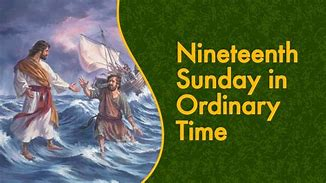
Jesus walks on the waters of the sea of Galilee, one of most famous biblical stories. It is
the middle of the night. By all reports it is what was called “the fourth watch of the
night”, today’s equivalent of 3am.
It had been a busy day by anyone’s standard – to say the least – 5,000 men plus women
and children had followed him into the open countryside. There, in the late afternoon,
in the spring sunlight, on the green slopes above the seashore he had fed them all with
the breaking of the blessed bread and the fish.
As the feast was ending Jesus had ordered his disciples to get into their boat and cross
over to other side of the sea. He stayed behind alone. First, politely, he personally sends
off the crowds back to their homes and their ordinary lives. Then he heads up into the
hills, to pray. At the quiet ending of that momentous day there is a love both of God, his
Heavenly Father, and of his neighbor. An openness to both with all his heart and soul
and strength.
Now in the darkness and the wind he comes to his disciples, walking on the waters. “Do
not be afraid. I am with you. Take heart.” As so often, he believes that the opposite of
faith is not unbelief but fearfulness, anxiety, timidity or paralyzing terror. We all have
experienced that time in our life, where we forget who we are in Christ and that He is
with us.
The disciples on the boat are not at this point caught up in a storm. It is rather a matter
of a strong head wind and high waves battering the boat in the open sea. They have lost
control. They are getting nowhere. Directionless. They have no power. Jesus knows
what we are going through.
You have to ask why Peter says what Peter says. What puts it into his head? It is such a
strange request: “Lord if it is you, tell me to come to you across the waters”. How many
times have you questioned God?
“Come,” says Jesus. Peter steps out of the boat and across the waves towards Jesus.
And then, hit by the blast of the wind and the failure of his faith, he falters and stumbles.
Immediately, without a disruption, Jesus stretches out his arm to save him and leads
him back to the boat. “O man of little faith why did you doubt? We forget the faith that
mustard seeds can move mountains!
Now all of this is happening in the wee morning hours. If you have worked a “dogwatch”
you know nothing good is happening at this time. It is that lonely weak point when our
fragile humanity is at its weakest and most vulnerable to fear. There can be few of us
who have not woken up at this point in the night, appearing from a deep sleep into
confusion and swamped suddenly by anxieties as things from the past flood in on us. Or
fears for the future, or what the next day will bring, overwhelm us. We are incapable of
reasoning as the turbulence overtakes us and terror drags us down. Like Peter trying to
walk on the water, we are in water over our head, drifting and panic filled.
Perhaps then it is at these times that the Christian is to say into the darkness, “Lord if it
is you, tell me to come to you across these dark waters.” And for us to hear the voice of
our compassionate master saying once more, “Come, take courage, I am with you.” And
to feel too the touch of his outstretched hand and the gentle lecture, “O ye of little faith
why do you doubt? I am with you, with an outstretched arm”.
So as this short story ends, something of shimmering beauty has been revealed in the
darkness, and a firm foundation of courage and hope in God has been given in the midst
of the turmoil of the sea. Back in the narrow confines of the boat they worship the
cherishing massiveness of the divine presence: Jesus. Son of God and Son of Mary. I AM
with you.
“Do not be afraid for I have redeemed you. I called you by your name and you are mine.
When you pass through the waters, I will be with you, and through the rivers they will
not overwhelm you. Because you are precious in my sight, and honored, and I love you.
Do not be afraid for I am with you.” (Isaiah 43. 1-5).
Jesus is Jesus, God is God, and the Holy Spirit is the Holy Spirit, it is us that forget the
power we have in the Trinity.
Faithfulness and Bearing Fruit: The Feast of St. Dominic~The Rev. Frank Bellino, OPI
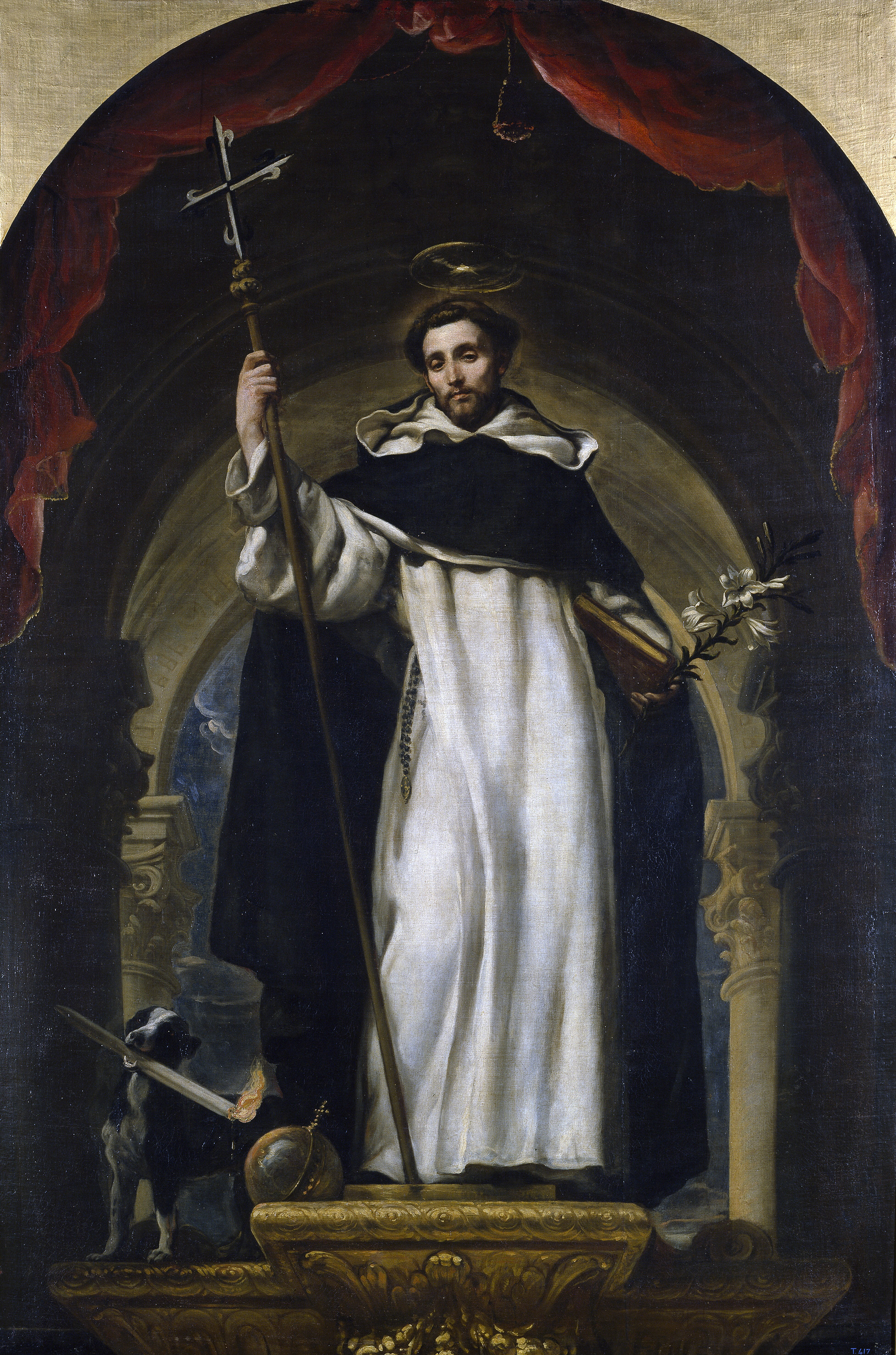
Today is the Feast of St Dominic, the founder of the Order of Preachers. When he was dying, St. Dominic told his brothers that he wanted to be buried in such a manner that the future friars could walk over him.
In the Middle Ages it was the custom to bury people in the abbey. St Dominic did not want to be recognized in a special way. He wanted to rest waiting for the resurrection with his brethren. For him fraternity stretched into heaven.
But St Dominic also wanted to be used.
Every night at the end of Compline, I pray the O Lumen:
O light of the Church, teacher of truth, rose of patience, ivory of chastity, you have freely poured out the waters of wisdom: preacher of grace, unite us to the blessed.
This prayer concludes with:
Pray for us, holy father Dominic. That we may be made worthy of the promises of Christ.
In reciting this prayer, I am reminded that I am a son of St. Dominic. Around the world, thousands of friars, sisters, nuns and lay Dominicans call St. Dominic their holy father, and after 800 years, St. Dominic still continues to bear fruit.
Now the shining example of St. Dominic’s fruitfulness is not something we should simply admire, but it is also something we need to imitate in a way that is proper to our state of life. Indeed, all Christians are called to be fruitful. Sadly, however, many in the Church have deeply failed in this regard. It is very sad that there are many examples of those in Holy Orders who have abandoned their resolve to remain pure for the sake of the kingdom. How many Catholics have become disillusioned with their faith because of such behavior? How many vocations to the priesthood and religious life have been lost? Sexual infidelity is definitely not compatible with Christian fruitfulness.
It is in moments like this, when we struggle with the sin and infidelity that afflicts our Church and society, that we need to turn to the saints such as St. Dominic who exemplified true Christian fruitfulness. Throughout the Bible, fruitfulness is an expression of God’s favor. The very first thing God did after creating Adam and Eve was to bless them and say “be fruitful and multiply.” Likewise, God says to Abraham “I will indeed bless you, and I will multiply your descendants as the stars of heaven.” But these promises of fruitfulness have their true fulfillment in Christ’s life.
On many occasions, Jesus expresses the desire for His disciples to bear fruit. This fruitfulness is manifested in the sacramental life of the Church. Indeed, at the Last Supper, Jesus describes Himself as the true vine; He goes on to tell His disciples “I chose you and appointed you that you should go and bear fruit and that your fruit should abide.” These sayings from St. John’s Gospel account of the Last Supper express the true meaning of the Eucharist. It is in the Eucharist that Christ’s death on the cross is made present, and when we look to the cross, we are to make sense of it in terms of its fruitfulness. Indeed, in the moments before Christ died, with Mary, His mother and the beloved disciple, John, standing before Him, He said to His mother “Woman, behold your son,” and to His beloved disciple “Behold your mother.” Thus, the Virgin Mary who brought Christ to birth in the Incarnation now brings Christ to birth in the beloved disciple and all who see her as their mother. This is indeed the fruit that will stand for eternity.
I hardly believe that St. Dominic knew that his fruit would be still producing 800 years later, and through our faith it will be in heaven.
Trans….formed and figured~The Rt. Rev. Michael Beckett, OPI

Trans…… Trans…… Trans…… Got your attention, didn’t I? But nope. Whilst I’m all about supporting folks who are trans, this isn’t that kind of post. SURPRISE! Nope. This is all about trans…other things. Stop for a sec and think about those five little letters, that one little syllable: trans. It’s a prefix. According to the dictionary, most commonly it means:
- across; beyond. “transcontinental” on or to the other side of. “transatlantic”
- through. “transonic” into another state or place. “transform” surpassing; transcending. “transfinite”
It’s that second one that’s important to us here today: Transform; “into another state or place.”
When I was a kid we had electric trains. There was a transformer that made the electricity transform into another kind of electricity that made the trains go. We all of us have transformers in our homes in one way shape or form. You know those little black boxes that are at the end of a cord, and you have to plug another cord into it before you can plug the whole business into a socket? Yep, those are transformers, too.
Then, there are the Transformers that are toys, which spawned movies and cartoons and a whole wealth of possibilities in entertainment. These are toy line is that the parts can be shifted about to change it from a vehicle, a device, or an animal, to a robot action figure and back again. Great fun!
There are transformers in nature, too! Seeds to plants, caterpillars to butterflies, pollywogs to frogs, and the list goes on. By some miracle of nature, they all transform from one entity into another. Exciting stuff, that!
And then….there is us. We are born and we grow and change for sure. But most of us don’t really “transform” into something completely different. We are simply who we are. Or are we? Can we be transformed into something, someone, other than who we fundamentally are?
In the Gospel reading appointed for today, we read in Matthew of “The Transfiguration of the Lord”: Jesus took Peter, James, and John his brother, and led them up a high mountain by themselves. And he was transfigured before them; his face shone like the sun and his clothes became white as light.
And behold, Moses and Elijah appeared to them, conversing with him. Then Peter said to Jesus in reply, “Lord, it is good that we are here. If you wish, I will make three tents here,
one for you, one for Moses, and one for Elijah.” While he was still speaking, behold, a bright cloud cast a shadow over them,
then from the cloud came a voice that said, “This is my beloved Son, with whom I am well pleased; listen to him.”
When the disciples heard this, they fell prostrate and were very much afraid. But Jesus came and touched them, saying, “Rise, and do not be afraid.” And when the disciples raised their eyes,
they saw no one else but Jesus alone. As they were coming down from the mountain, Jesus charged them, “Do not tell the vision to anyone until the Son of Man has been raised from the dead.”
Well now. There’s a lot to unpack from those few paragraphs, but the big takeaway for today is that Jesus showed those guys his true form. He went from being “plain ol’ Jesus” to “Jesus the Christ, the Son of God.” Like whoa. But wait a sec. Question. Wasn’t he ALWAYS “Jesus the Christ, the Son of God?” Was HE really changed; transformed, if you will? Did he change, or did he just show the world who he already was? I vote for Jesus doing the “show and tell thing” and him cluing the men who were with him into the fact that he wasn’t some second-rate nobody preacher, but that he was SOMEBODY. THE Somebody.
And that brings us right back to the question, “Can we be transformed into something, someone, other than who we fundamentally are?” Mmmmmmm Maybe the question should be, “Who are we and what do we need to do to make us into the person God wants us to be?”
And you ask, “Who does God want us to be and reckon wonder how do we become that?” It’s sorta kinda easy to answer the first part. Who does God want us to be? God wants us to be the best version of the person he created. Be you. Be your best. Be the best you that you can be. Work to become You2.0
The second part? The “how do we do that?” part? He’s told us that, too. In John 13 Jesus says to us, “But I am giving you a new commandment. You must love each other, just as I have loved you. If you love each other, everyone will know that you are my disciples.” We are to continue to work to change (transform!) ourselves and the world by doing the work that Jesus has given us to do, by helping others to see Jesus through and in us, by showing that love that he demonstrated, by bringing that love to everyone.
Jesus told us to love everyone. Love. Everyone. Period. Not just those whose politics are the same as ours. Not only those whose religion is the same as ours, not only those whose lifestyles are the same as ours. Love. Everyone. Period.
We are to remember that there is not one person on this planet who God does not love. Yes, even that…….….fill in your own blank. Democrat? Yep. Republican? Yep. Trans person, gay person, bigot, other-race person, criminal, gossip, and irritating next door neighbor? Yep. Yes. Affirmative. Positively. Absolutely. Yep, and yes again. We who claim to love the Lord, must show that love. And if we act in love, if you actively DO love, that would transform the world. Love. Love others as you love yourself.
Jesus tells us in pretty no uncertain terms and more than once: Love. Here:
A new command I give you: Love one another. As I have loved you, so you must love one another. – John 13:34
This is my command: Love each other. – John 15:17
Love the Lord your God with all your heart and with all your soul and with all your mind and with all your strength. – Mark 12:30
But I tell you: Love your enemies and pray for those who persecute you – Matthew 5:44
My command is this: Love each other as I have loved you. – John 15:12
Greater love has no one than this, that he lay down his life for his friends. – John 15:13
But I tell you who hear me: Love your enemies, do good to those who hate you – Luke 6:27
By this all men will know that you are my disciples, if you love one another. – John 13:35
If you love me, you will obey what I command. – John 14:15
I’ll say it again, you are the only Jesus some folks will ever see, the only Bible some folks will ever read.
Teresa of Avila (1515-1582) said it like this:
Christ Has No Body
Christ has no body but yours,
No hands, no feet on earth but yours,
Yours are the eyes with which he looks
Compassion on this world,
Yours are the feet with which he walks to do good,
Yours are the hands, with which he blesses all the world.
Yours are the hands, yours are the feet,
Yours are the eyes, you are his body.
Christ has no body now but yours,
No hands, no feet on earth but yours,
Yours are the eyes with which he looks
compassion on this world.
Christ has no body now on earth but yours.
We must show that we have, indeed, been transfigured and transformed. Amen.
Good Fish Bad Fish~The Rt. Rev. Michael Beckett, OPI

Kill ‘em all and let God sort ‘em out. Judge not. No gays allowed. Everyone welcome. Separate but equal. Love your neighbor. And on and on and on….
Do y’all get as tired as I do of the back and forth between conservative and liberal, Democrat and Republican, this religious denomination vs. that religious denomination back and forth, my way or the highway babble that goes on and on and on and on, ad infinitum?
Sometimes I just wanna scream STOP It! Other times it’s a quiet “Why can’t we all just get along?” More recently, my thoughts have been, “What the hell is wrong with you?” I find it exhausting, this push and pull and continuous descension, and I find myself wondering, “What if? Why? How can we stop this madness?”
The answer, really, is kinda simple: There’s an app for that! And before you stop reading this and hasten to the App Store to look for this miracle thing that will guarantee you peace of mind forever more, lemme finish. In the Gospel appointed for today, Matthew 13: 47-50, Jesus tells a parable or two, as was his custom, to make a few points. Here:
“Once again, the kingdom of heaven is like a net that was let down into the lake and caught all kinds of fish. When it was full, the fishermen pulled it up on the shore. Then they sat down and collected the good fish in baskets, but threw the bad away. This is how it will be at the end of the age. The angels will come and separate the wicked from the righteous and throw them into the blazing furnace, where there will be weeping and gnashing of teeth.”
See? This is the “Kill ‘em all and let God sort’ em out” thing, only without the “killing” part. What remains to be asked though, much like Glenda asking Dorothy “Are you a good witch or a bad witch?” is, are you a good fish or a bad fish?
We, all of us, need to continually examine ourselves to make sure that we are, indeed, in the ‘good fish’ pile. And how do we know what kinda fish we are? Are you ready? Remember that App I was talking about? Here it is: Love God. Love People. Really, it’s pretty simple and straightforward. We are to love folks in the way that God loves us. We are to treat others the way we want to be treated. Jesus says, again in Matthew 25:
When the Son of Man comes in his glory, and all the angels with him, he will sit on his glorious throne. All the nations will be gathered before him, and he will separate the people one from another as a shepherd separates the sheep from the goats. He will put the sheep on his right and the goats on his left.
“Then the King will say to those on his right, ‘Come, you who are blessed by my Father; take your inheritance, the kingdom prepared for you since the creation of the world. For I was hungry and you gave me something to eat, I was thirsty and you gave me something to drink, I was a stranger and you invited me in, I needed clothes and you clothed me, I was sick and you looked after me, I was in prison and you came to visit me.’
“Then the righteous will answer him, ‘Lord, when did we see you hungry and feed you, or thirsty and give you something to drink? When did we see you a stranger and invite you in, or needing clothes and clothe you? When did we see you sick or in prison and go to visit you?’
“The King will reply, ‘Truly I tell you, whatever you did for one of the least of these brothers and sisters of mine, you did for me.’
“Then he will say to those on his left, ‘Depart from me, you who are cursed, into the eternal fire prepared for the devil and his angels. 4For I was hungry and you gave me nothing to eat, I was thirsty and you gave me nothing to drink, I was a stranger and you did not invite me in, I needed clothes and you did not clothe me, I was sick and in prison and you did not look after me.’
“They also will answer, ‘Lord, when did we see you hungry or thirsty or a stranger or needing clothes or sick or in prison, and did not help you?’
“He will reply, ‘Truly I tell you, whatever you did not do for one of the least of these, you did not do for me.’
“Then they will go away to eternal punishment, but the righteous to eternal life.”
Notice there is no mention of race, gender identity, sexuality, religious preference or lack thereof, gender expression, or anything else that we today us to separate us into an “us versus them” mentality. Nothing except acting in love. There it is. Love God. Love people. Act accordingly. Amen.
Choosing the Correct Priorities: Memorial of Sts Martha, Mary and Lazarus~The Very Rev Lady Sherwood, OPI
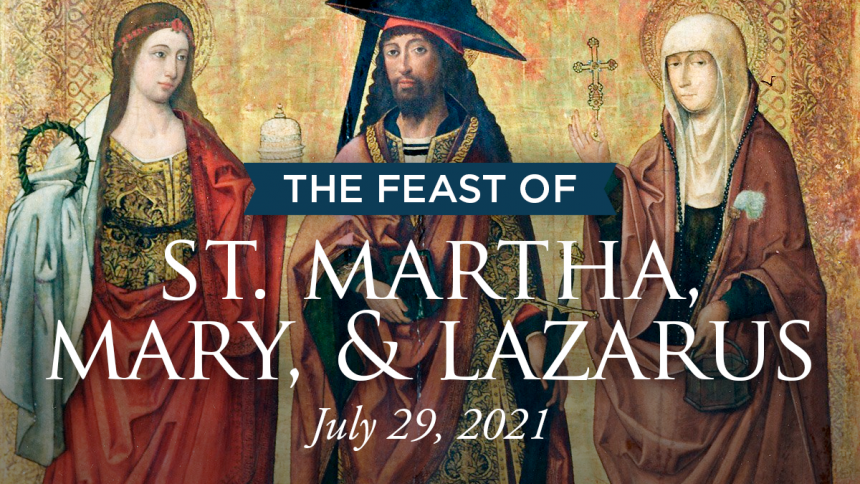
Today my brothers and sisters in Christ, we come together as the church to commemorate the memorials of three siblings, Martha, Mary and Lazarus.
Mary, Martha, and Lazarus were close friends with and were followers of Jesus. Together they hosted Jesus in their home on more than one occasion. Yet, on one such visit from Jesus, they Martha and Mary chose two very different actions, and the way that Jesus reacted to their choices is a very valuable lesson for us today. Let’s review the story (Luke 10:38-42):
Martha is worried
Martha was rushing around, serving and doing her best to make everything good for their beloved guest. And where was Mary when Martha needed a hand? She chose to sit at Jesus’ feet, listening as He spoke.
It’s pretty easy to imagine how that made Martha feel. Irritated, frustrated, resentful. Why should she be doing all the work? Wasn’t it only righteous for Mary to be helping out? In fact, Martha felt so justified in her indignation that she went and talked to Jesus about it. “Lord, do You not care that my sister has left me to serve alone? Therefore tell her to help me,” she said to Him.
But, instead of backing her up in her demand, Jesus rebuked her! “Martha, Martha, you are worried and troubled about many things. But one thing is needed, and Mary has chosen that good part, which will not be taken away from her.”
This must have felt like a slap in the face for Martha. Here she was, doing everything in her power to be hospitable and make it good. And Mary just sat there, and what she was doing was the right thing?
Sound familiar?
Getting our priorities right
It can become so easy for us to get wrapped up in all the things we need to do and the things that need to be accomplished that we lose sight of what the most important thing is. Isn’t it possible that we can get too wrapped up in the cares of life? Jesus makes this even more clear in the parable He told about the sower. “He who received seed among the thorns is he who hears the word, and the cares of this world and the deceitfulness of riches choke the word, and he becomes unfruitful.” Matthew 13:22.
The highest priority in our lives needs to be choosing the good part, as Mary did: to learn of Jesus so that we can become like Him. It’s a love and devotion to Him that makes everything else of secondary importance. It is to seek the riches of wisdom and understanding that are in Him. If we don’t do this, how can we follow Him, how can we be His disciples? A disciple learns of the Master.
This is not an excuse to be lazy, and not take responsibility for anything. That is another trap entirely. We are to be doers of the Word, and not hearers only! (James 1:22) But what we do has to be led by the Spirit, whose voice we learn to hear by choosing the good part. There is no blessing in running our own lives based on our human understanding of what is important. Mary understood that she needed to learn more of her Master and to seek the things that have eternal value. It’s when we do that that we can be a blessing, because then all of our works are Spirit-driven. Love causes us to listen, to learn, and to keep His commandments. (1 John 5:3)
“My sheep hear My voice, and I know them, and they follow Me.” John 10:27.
Take heed to yourself
We can be in danger of falling into the same trap that Martha did. We can be so troubled by what we perceive as negative behavior in others, and become so self-righteous in our good works that we start to judge others for not doing as we do. Satan is the one behind these kinds of thoughts. He whispers lies and accusations, trying to create as much conflict as he can. His aim is to lead people as far in the opposite direction of “the good part” as he possibly can – to lead them away from Jesus. To listen to him and agree with him leads to all kinds of unrest and trouble and worry. We need to slam the door on his deceitfulness!
“Take heed to yourself and to the doctrine. Continue in them, for in doing this you will save both yourself and those who hear you,” it’s written in 1 Timothy 4:16. Only that will do us any good in life. The wrong choice that Martha made wasn’t that she was serving and doing good. It was that in her work she had demands and criticism on Mary, rather than doing what Jesus taught herself! If we are living before the face of God, we have no cause to look around at what others are doing and feel that we have a right to pass judgement on them. We live in obedience to the Spirit’s promptings in our own lives, and what others do is none of our business. We don’t know how He is leading others.
Let’s rise above all the noise and pursuits of this world and seek those things which have eternal value. Like Mary, let’s find that fellowship with the Master and with those who follow Him so that we can learn of Him and become like Him. Through the Word of God, fellowship, and prayer we become rich in our spirit, and God will give us everything we need in abundance.
“Finally, dear brethren, whatever things are true, whatever things are noble, whatever things are just, whatever things are pure, whatever things are lovely, whatever things are of good report, if there is any virtue and if there is anything praiseworthy—meditate on these things.” Philippians 4:8.
Ambition and Service: The Feast of St. James~The Very Rev Lady Sherwood, OPI

We all know some people who have very high ambitions. It can range from wanting to win the lottery maybe, or getting a certain perfect job. Maybe a top-class car, a mansion or lots of wealth and possessions. Even in some churches, I have seen those whose only ambition is to become a Bishop, nothing else is good enough for them, the ambition of power and status.
Whilst some ambition is a good thing, if you are setting goals for yourself or for an organisation, it is when our ambition loses its balance and ignores the consequences for others, that ambition can become toxic and corrupt.
We have an example of over ambition in our Gospel reading today from Matthew. James and his brother John, who together with Peter are the three favoured apostles, approached Jesus together with their mother. According to Matthew, it was indeed their mother who asks Jesus to promise her sons would get the highest places in His heavenly Kingdom. Jesus responds directly to James and John and Jesus recognising the possibility of corruption in their ambition, Jesus puts a stop to it by asking them, “Can you drink the chalice that I am going to drink?” Without truly understanding what they had agreed to, they replied that they could. Jesus knowing full well what awaited them, concurred with their agreement. Just like a good parent will give their teenage children a realistic picture of what to expect in Adult life, Jesus tells them that indeed they will have much to suffer.
James the Apostle that we celebrate today, became the first Martyr amongst the apostles. Jesus knew that ambition wasn’t a bad thing in itself, and he didn’t wish to extinguish his apostles enthusiasm, indeed it’s an enthusiasm about eternal life, it’s a goal that each and every one of is should indeed have as great things are rarely achieved without both enthusiasm and suffering. Jesus just needed to refocus their ambition, so that they would truly understand not just the goal of eternal life, but also the true nature of the pathway that that is required to achieve this goal. Jesus knowing that the Apostles could possibly succumb to the temptations of personal ambition, gave the Twelve apostles a lecture on power and authority to remind them that authority in the kingdom must not imitate the authority that is ever so present in the world.
Jesus tells them that their role as his apostles =the first shepherds of His church, was not to rule but instead was to serve. Jesus didn’t only tell them to serve only each other and the lowly of the world, but offers himself as an example -revealing to them that he will go so far as to sacrifice his very life for the sake of all humanity. “The Son of Man did not come to be served but to serve and to give his life as a ransom for the many”. Jesus is telling James, John and the other apostles that the ambitious are blessed, but that their ambition must not be driven by self=assertion, but by self=extinction. This message also goes the same for us today, that we always act with Thanksgiving and praise :Thanksgiving because all that we have, all that we are, all that we achieve =all of this is solely given to us by the Grace of God, and praise because all that we do must be for the Glory of God and not for ourselves.
Let us pray :
O Gracious God,
We remember before you today thy servant and Apostle James, the first amongst the Twelve to suffer martyrdom for the name of Jesus Christ ; and we pray that you will pour out upon the leaders of your Church that Spirit of self=denying service by which alone they may have true authority amongst thy people, through the same Jesus Christ our Lord,
Who lives and reigns with you and the Holy Spirit, One God, for ever and ever.
Amen.
 The Order of Preachers, Independent
You must be logged in to post a comment.