
Category: Lesson
All Means ALL~The Rt Rev Michael Beckett, OPI

Well y’all…. I have a confession to make. Much to my chagrin and dismay, and to my husband’s shock, I confess to being less than perfect. You know how I talk about showing love all the time? In a lot of ways, I’m preaching to myself. Loving is HARD. I find myself making snarky comments, cracking on folks, getting angry at people who don’t share my views (really they should know better, but still,) and not being as loving as I should be. For example, one of my dearest friends sent me a message this week telling me about one of his (former?) friends who cracked hard on one of his posts. I really wanted to hit the woman with my snark gun, bless her heart. Sigh….. In cases like this, I have to remind myself that there is not ONE person on this planet who God doesn’t love. I need to do better. SO much better. This is why we say we PRACTICE our faith, coz we never, ever, get it right or master those commands Jesus gave us. So practice we must.
What has brought this on, you ask? Well, lemme put on my mitre (pointy bishop hat) and I’ll tell ya.
Today is a great Feast Day in the life of the liturgical church throughout Christendom: The Solemnity of Corpus Christi. This day is celebrated in recognition of the Eucharist, and everything the Eucharist is and means. Today we celebrate, literally, the Body of Christ. We all know that the Eucharist was instituted by Christ at the Last Supper. We all know that we, as Catholics, believe that the bread and the wine become the body and blood of Our Lord. We all know that our Protestant brothers and sisters believe that the bread and the wine are symbolic of the body and blood of our Lord. We all know that wars have been fought over these two basic, yet entirely different, beliefs. We also know that from many, if not most, of the liturgical pulpits in the world, today the Word will be proclaimed concerning the Eucharist.
Today, however, I would like to put a different spin on Corpus Christi. I would like for us to leave the upper room of Christ and the disciples, and jump ahead a few years to Corinth, and to listen to what the Apostle Paul has to say about “the body of Christ” in his first letter to the Corinthians:
12 For as the body is one and has many members, but all the members of that one body, being many, are one body, so also is Christ. 13 For by one Spirit we were all baptized into one body—whether Jews or Greeks, whether slaves or free—and have all been made to drink into[c] one Spirit. 14 For in fact the body is not one member but many.
We, the Church, we, the people of God, we, those of us who confess Christ as our Lord, puny imperfect people that we are, WE are the body of Christ. Some of us dress funny. Some of us talk funny. Some of us have emotional issues. Some of us just have issues. But we, ALL of us, together, make up the body of Christ. Warts and all. Some of us are wildly and multiply talented. Some of us are incredibly intelligent. Some of us have been blessed with physical beauty. Some of us have been blessed with spiritual beauty. Some of us have none of those things. Be we, ALL of us together, make up the body of Christ.
Because we are all of us different, it can be said that we make up different parts of the body of Christ. We each of us have different gifts. Some make up the head, some the heart. Others are the feet and the hands of the body of Christ. Granted there are parts of the body of Christ that we would rather keep hidden, under wraps (oh I want to be snarky here… I’m really trying, y’all.) But are these parts any less important? Do these parts not serve a major and important function in the working of the body? I believe that they do.
My point, here, folks, if I haven’t made it already is simply this: WE, all of us, make up the body of Christ. What one person brings to the table may not be of particular interest or value to another person, but there is someone at that table who needs just that. Perhaps we feel that this person or that person isn’t quite what we would like to see in our church, or in our family, or in our lives, but to someone, somewhere, that person is exactly who is needed. The very person whom we consider to be “less than worthy” to represent Christ and His church may just be the exact one who is needed in certain situations.
There has been much made of certain politicians being excluded from receiving communion because of their political beliefs. Who are we, as clergy, to deny anyone the Body of Christ? I would ask these folks, ‘Did Jesus not sit down and break bread with Judas?’ Who are we to judge who is worthy, if we, all of us, are a part of the body of Christ?
In the words of John D Whitney, SJ:
“I want to write a longer piece about those bishops who seek to keep some from the table of Christ, but for now I will say this: it is not your table (nor mine). Bishops, priests, etc. are neither the hosts nor the bouncers nor the ones who wrote the guest list. The Eucharist is the resurrected body of Christ given for the life of the world. Jesus Christ is the one who invites the guests (‘all you who labor’); he is the host of those who come; he is the setter of the table; and he is the feast which is shared (‘Take this, all of you. . .this is my body, this is my blood’). We are guests at the meal, and sometimes (by his calling) servers. So stay in your lane, please. The wait staff doesn’t get to exclude those who want to come. If you don’t like the company Christ calls (and, admittedly, it is a rag tag bunch of sinners, one and all), it’s you who need to leave the table, not them.”
Along those lines, of course, members of our church, or any church, are not allowed to receive communion in the Roman Church at all, regardless of whether or not we are Christians. Can you imagine Jesus saying to anyone, “You’re not a member of the club. No communion for you.” This is one of the many reasons why we practice an open table at the Eucharist. Believers welcome.
So, that drag queen you’re hating on? That transman or transwoman? That politician? That bigot down the street? That news anchor? Yep. God loves ‘em. They are part of the body of Christ.
The music artist, John Michael Talbot, sums it up nicely:
One bread, one body, one Lord of all, one cup of blessing which we bless.
And we, though many, throughout the earth, we are one body in this one Lord.
Gentile or Jew, woman or man, no more. Many the gifts, many the works, one in the Lord of all.
Grain for the fields, scattered and grown, gathered to one, for all.
One bread, one body, one Lord of all, one cup of blessing which we bless. And we, though many, throughout the earth, we are one body in this one Lord.
As we go along in our daily lives, let us remember the lessons of today, this Feast of Corpus Christi, that we all of us make up the One Bread, the One Body, the One Cup, that is the Body of Christ. Amen.
Triple Trouble~The Rt Rev Michael Beckett, OPI
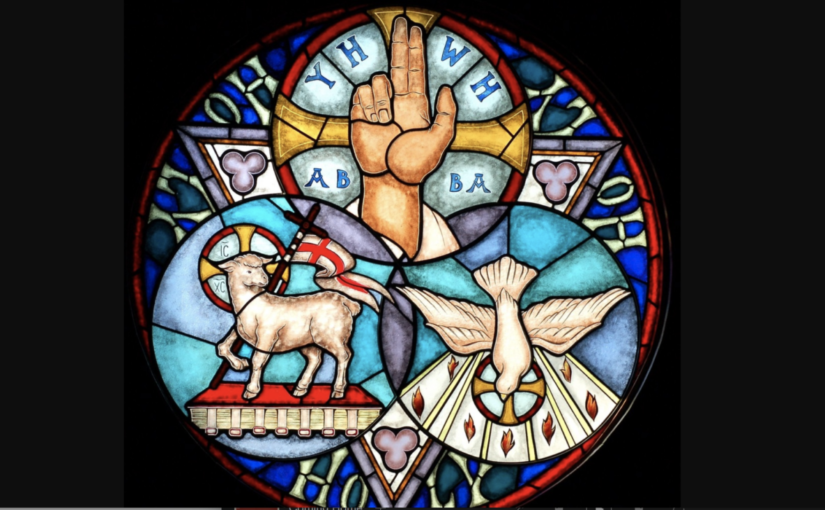
There are a few things about which I could not be more certain: Scott loves me truly, madly, deeply (I really like that song.) My Daddy was the wisest man on the planet. My Momma was the bestest woman to ever draw breath. Jesus loves me and my salvation is secure.
And, conversely, there are things in life that I will never, never fully grasp. Like, why do some people think it’s OK to wear stripes and plaid together? Pi or upper-level mathematics? How things travel a zillion miles a minute in space? Why chocolate isn’t its own food group?
And then, there’s the Holy Trinity. The Holy Trinity is a mystery that we will never fully understand; never even come close to understanding. We believe that the God of the Bible is one God. God has one essence – one substance. In other words, one “stuffness.” However, God exists in three Persons: the Father, the Son, and the Holy Spirit. Each Person in the Trinity (or the Godhead) is fully God and fully a Person. They are equally eternal, powerful, sovereign, and worthy of worship. But they are one God.
Got that? Me, neither, but it is central to our faith.
Many theologians and holy men and women of God have attempted to explain just how this Trinity Thing works. One God, Three Persons. Three in one and one in three. They have, of course, failed. It has been said that if you try to explain the Trinity, you will lose your mind. But if you deny it, you will lose your soul. There are several popular analogies often used to explain the Trinity, but, they don’t work and in reality are heresies. (Uh oh!) Here they are:
God is like water. Now, we know that water can be in three different forms: Liquid, Ice, and Vapor. But this doesn’t work and this particular heresy is called “modalism.” Modalism expresses the belief that God is not, in fact three separate persons, but one God expressed in three different forms. Now, if this were the case, then and the Trinity really is like water, then the story of Jesus (the Son) praying to the Father all those times in the Bible, is just Jesus talking to Himself. This belief denies something central to God that makes Him God. So comparing God to water isn’t really as helpful as one might think.
It’s also been said that The Trinity is like a man: A father, who is a son, who is a husband. Nope. Same as modalism. Won’t work.
Then there is the age-old story-legend-myth of St. Patrick using the shamrock. Or the more modernized versions using an egg or an apple. The shamrock has 3 leaves to make one whole plant, the yolk, shell, and white make up one egg, or the peel, flesh, and core of an apple make up one fruit. Umm…no. Won’t work, because any of these three things that make up one thing will not stand on their own to be a complete thing? Know what I mean? The egg yolk, shamrock leaf, and apple peel don’t make one complete whole. And this particular heresy is called Partialism. Sigh……
Moving on…
The sun has been used to explain the Trinity. This example says that the Father is like the sun. The Son is like the light rays that visibly reveal the sun, as Jesus is the visible image of the invisible God. The Holy Spirit is like the heat that emanates from the sun, unseen yet powerful and effective in making the sun felt. This makes sense, right??? Nope. Sorry. This explanation is fatally flawed in that is describes the Son and Spirit as creations of the Father. This is the error of Arianism (not to be confused with Aryanism, which is also bad). In Arianism, the Son is not eternally equal with the Father, but was the Father’s first and best creation. This would make Jesus something less than fully God. This little gem of heresy is called Subordinationism and was first espoused by Arius who lived in the late 200s/early 300s, and whose modern-day followers are now known as Jehovah’s Witnesses.
A couple more illustrations of the Trinity that aren’t quite so bad, but aren’t great either are these:
American Christian pastor, speaker, author, and widely syndicated radio and television broadcaster in the United States, Tony Evans, has said that the pretzel is a good illustration because it consists of one piece of dough with three holes. Take away any one of the holes and the pretzel isn’t really a pretzel anymore. (According to some people, the pretzel was actually invented in Europe several hundred years ago by a monk who wanted to illustrate the Trinity to the children of his village, so he took some dough, looped into the familiar three-hour shape, based it, and gave it to the children as an edible object lesson.)
Or this from noted scientist Dr. Henry Morris. He notes that the entire universe is trinitarian by design. The universe consists of three things: matter, space, and time. Take away any one of those three and the universe would cease to exist. But each one of those is itself a trinity.
Matter = mass + energy + motion
Space = length + height + breadth
Time = past + present + future
Are we having fun yet? No? OK, I’ll bring this to a close. In so doing I’m gonna end where I started. The Trinity is a doctrine that all Christians believe but no one really understands. That much should be clear from this message. If you try to explain the Trinity, you will lose your mind. But if you deny it, you will lose your soul.
Someone asked Daniel Webster, who happened to be a fervent Christian, “How can a man of your intellect believe in the Trinity?” He said, “I do not pretend fully to understand the arithmetic of heaven now,” he replied. How kewl is that little phrase??? “The arithmetic of heaven.”
The Trinity should cause us to bow in humble adoration before a God who is greater than our minds could ever comprehend.
Today, the Feast of the Holy Trinity, we rejoice that we have a Triune God who has provided for a Trinitarian salvation. When we were lost in sin, our God acted in every Person of his being to save us. The Father gave the Son, the Son offered himself on the Cross, and the Holy Spirit brought us to Jesus. We were so lost that it took every member of the Godhead to save us.
In 1774 a man named Ignaz Franz wrote a hymn of praise to the Trinity: Holy God, We Praise Your Name. This is the fourth verse:
“Holy Father, Holy Son, Holy Spirit, Three we name you;
While in essence only one, undivided God we claim you.
Then, adoring, bend the knee, and confess the mystery.”
Let us pray.
Holy God, above us, among us, within us: we rejoice this day that while you might have chosen to be unknown to us, you have revealed yourself in many ways. Each encounter with you calls us to return blessings with worship, compassion, and service. As we worship you today, we do so in gratitude for all your parental care for us through your creation. As we worship you today , we do so because, in love, you gave us Christ, that through him we might find eternal life. As we worship you today your Spirit leads your church to reach out in compassion, mercy, and grace to all your children everywhere. In gratitude, we celebrate you, three and yet one. Amen.
Pentecost~ Br Milan Komadina
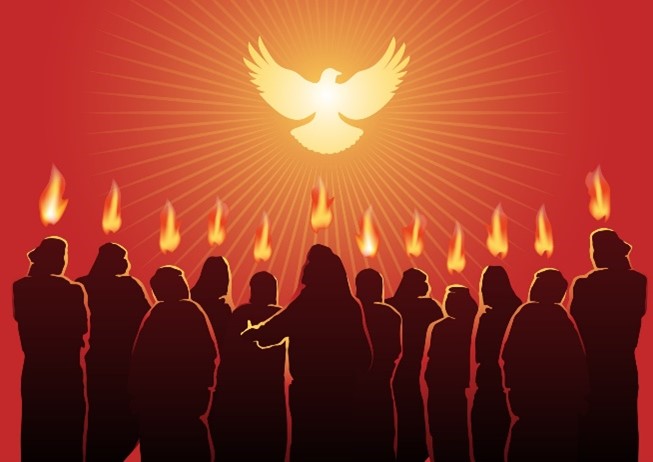
If you go back and read the Old Testament, you will discover that Pentecost was one of the Jewish feast days. Only they didn’t call it Pentecost. That’s the Greek name. The Jews called it the Feast of Harvest or the Feast of Weeks. When the day of Pentecost arrived, they were all together in one place. And suddenly there came from heaven a sound like a mighty rushing wind, and it filled the entire house where they were sitting. And divided tongues as of fire appeared to them and rested on each one of them. And they were all filled with the Holy Spirit and began to speak in other tongues as the Spirit gave them utterance. Now there were dwelling in Jerusalem Jews, devout men from every nation under heaven. And at this sound the multitude came together, and they were bewildered, because each one was hearing them speak in his own language. And they were amazed and astonished, saying, “Are not all these who are speaking Galileans? And how is it that we hear, each of us in his own native language? Parthians and Medes and Elamites and residents of Mesopotamia, Judea and Cappadocia, Pontus and Asia, Phrygia and Pamphylia, Egypt and the parts of Libya belonging to Cyrene, and visitors from Rome, both Jews and proselytes, Cretans and Arabians–we hear them telling in our own tongues the mighty works of God.” And all were amazed and perplexed, saying to one another, “What does this mean?” But others mocking said, “They are filled with new wine.” (Acts 2:1-13). Pentecost was the celebration of the beginning of the early weeks of harvest. In Palestine, there were two harvests each year. The early harvest came during the months of May and June; the final harvest came in the Fall. Pentecost was the celebration of the beginning of the early wheat harvest, which meant that Pentecost always fell sometime during the middle of the month of May or sometimes in early June. There were several festivals, celebrations, or observances that took place before Pentecost. There was Passover, there was Unleavened Bread, and there was the Feast of Firstfruits. The Feast of Firstfruits was the celebration of the beginning of the barley harvest. Here’s the way you figured out the date of Pentecost. According to the Old Testament, you would go to the day of the celebration of Firstfruits, and beginning with that day, you would count off 50 days. The fiftieth day would be the Day of Pentecost. So Firstfruits is the beginning of the barley harvest and Pentecost is the celebration of the beginning of the wheat harvest. Since it was always 50 days after Firstfruits, and since 50 days equals seven weeks, it always came a “week of weeks” later. Therefore, they either called it the Feast of Harvest or the Feast of Weeks. Modern Christians observe Pentecost as a holiday, not to celebrate a wheat harvest, but to remember when the Holy Spirit invaded the Church in Acts 2. On Pentecost Sunday, the Holy Spirit filled the Church with power and added 3,000 new believers. The account in Act 2 reports that, after Jesus ascended into heaven, Jesus’ followers were gathered together for the Feast of Harvest (aka Pentecost), and the Holy Spirit “filled the whole house where they were sitting” (Acts 2:2). “All of them were filled with the Holy Spirit and began to speak in other tongues as the Spirit enabled them” (Acts 2:4). This strange occurrence drew a large crowd, and Peter stood up to speak to them about repentance and the gospel of Christ (Acts 2:14). By the end of the day that the Holy Spirit came, the Church grew by 3,000 people (Acts 2:41). This is why Christians still celebrate Pentecost. The Holy Spirit was prophesied in the Old Testament and promised by Jesus. Jesus promised the Holy Spirit in John 14:26, who would be the Helper for his people. “But the Helper, the Holy Spirit, whom the Father will send in My name, He will teach you all things, and bring to your remembrance all that I said to you.” This New Testament event is also significant because it fulfills an Old Testament prophecy in Joel 2:28-29: “And afterward, I will pour out my Spirit on all people. Your sons and daughters will prophesy, your old men will dream dreams, your young men will see visions. Even on my servants, both men and women, I will pour out my Spirit in those days.”
Ascension~The Rt Rev Michael Beckett, OPI

Today we celebrate the most important day of the year. Wait, lemme try again. TODAY WE CELEBRATE THE MOST IMPORTANT DAY OF THE YEAR!!!!
Yeah, that’s better. And no, it’s not any day that you or I think is the most important day of the year. I’m gonna give you a couple of hints coz I’m a nice guy like that. It’s not Christmas. It’s not Easter. It’s MORE important than either of those days.
“What?” you say to me, mystified. “What could be more important than celebrating our Lord’s birth?” Meh. Without celebrating today’s importance, Jesus’s birth is no more important than any other baby born at any time in history.
“What?” you say to me, getting a bit hot under the collar. “What could be more important than celebrating the Lord’s resurrection, when He died for us all and rose again, saving us all?” Meh. Without celebrating today’s importance, Jesus’s resurrection is no more important than that of those folks Elijah and Elisha raised, or Lazarus of Bethany, or the widow of Nain’s son, or Jairus’s daughter, or Tabitha, or any and all of those other folks who made an encore appearance when Jesus rose from the dead on Easter. “But, but, but…….” you say. OK, calm down….lemme finish. Yeah, it was a pretty great thing that Lazarus was resurrected, as well as those other folks who popped out of their tombs when Jesus did, but super important??? Not so much.
And I can hear you going all “Michael what are you talking about. So…. Imma tell ya. All those resurrected folks? Lazarus and all the others included? THEY DIED AGAIN and stayed that way. They all got up and did whatever it was that newly un-unalived people do, and then, when it was time, they died. Again.
However, Jesus? He did not. He. Did. Not. We read what happened in the Book of Luke (Luke 24:51) and in Acts (Acts 1:1-9) In a nutshell, Jesus kinda levitates and then levitates a bunch more and soon He’s levitated himself so high that He is surrounded by the clouds and goes out of sight. Gone. Ascended into Heaven. Not Dead.
St. Augustine, the great fifth century theologian, called the ascension the most important Christian festival of the year, more important than Christmas, more important than Pentecost, even more important than Easter. (See, told ya. It’s not just me!) For the ascension reminds us just how high Jesus was raised, and what that means. Aquinas states:
‘This is that festival which confirms the grace of all the festivals together, without which the profitableness of every festival would have perished. For unless the Saviour had ascended into heaven, his Nativity would have come to nothing…and his Passion would have borne no fruit for us, and his most holy Resurrection would have been useless.’
What Saint Augustine says here resonates with the passage in Ephesians 4:10, where Saint Paul says that ‘He who descended is he who also ascended far above all the heavens, that he might fill all things’ – i.e.; that by ascending into Heaven, and taking our human nature up with Him into the heavenly places, He completed the process of redemption by reclaiming His place as rightful sovereign of the universe, so that He might be present to us in a different way. If He had not so returned, the process would not have been completed, and as Jesus said in John 16:7, ‘it is to your advantage that I go away, for if I do not go away, the Counselor will not come to you; but if I go, I will send him to you’.
The gospel writer Luke is renowned as a careful historian. When he recorded the birth of Jesus he rooted the event in its historical setting within the Roman Empire. He continues that same preciseness at the end of our Lord’s earthly ministry by recalling the place of the Ascension – at Bethany. He dates the event – 40 days after the resurrection on Easter Day. He emphases the presence of eyewitnesses – the Ascension took place he writes “before their very eyes” (Acts 1:9). Yes, the Ascension was a real event of history.
Some people are puzzled as to why Jesus waited around on Earth 40 days after his resurrection, but that period is no accident, and Jesus had things to do.
Jesus had endured the Devil’s temptation for 40 days in the wilderness at the beginning of his public ministry, but now the tables were turned. In the period after Jesus’ resurrection, He triumphantly paraded his victory over the Satan. During this time, the conqueror of death displayed his supremacy before his faithful followers so that they might share in the joy of his victory. But there was another reason. Those 40 days of his appearing after the resurrection were of immense value to the believers for they established the reality of his lordship. A single sighting of the risen Christ may have been open to question, but his continuous encounters with the disciples would remove the doubts of the most skeptical among them and assure them of his power and authority.
The resurrection of Jesus marked the ending of a chapter in his earthly life. Things could never be the same again and it was essential that there should be a clear-cut event to bring the chapter to a close. It’s true that Jesus was making a series of appearances to his followers, but they couldn’t go on forever.
It would have been odd if Jesus’ post-resurrection appearances had grown fewer until finally they just stopped – that would only cause confusion and even loss of faith. No, there had to be a single, miraculous occurrence, separating the time when the Jesus of Earth would become the Christ of heaven. The Ascension was the only fitting conclusion to the life of Jesus on Earth.
Luke tells us of the disciples with their eyes straining to catch the last glimpse of the cloud bearing up their Lord. But then they were quickly brought back to earth. It would seem that with their eyes heavenward they didn’t notice the two heavenly beings that slipped quietly alongside them until they spoke: “Men of Galilee, why do you stand looking unto heaven?,” as if to remind the disciples of the work that they had been given to do. The angels, for angels they were, had to tell the disciples to get to business.
And so it is with us. Ascension Day reminds us of the Mystery of Faith: “Christ has died, Christ is risen, Christ will come again.”
Christ will come again. And as we await the “coming again” of Christ, we, like the disciples, have a job to do, business to attend to. Although we live in the time between Jesus’ Ascension and his coming again, we have something to do now. In Matthew 28:18-20, Jesus says, “Go to the people of all nations and make them my disciples. Baptize them in the name of the Father, the Son, and the Holy Spirit, and teach them to do everything I have told you. I will be with you always, even until the end of the world.”
Where do we start? Jesus has the answer for that, too. In John 13 Jesus says to us, “ But I am giving you a new commandment. You must love each other, just as I have loved you. If you love each other, everyone will know that you are my disciples.” We are to continue to change the world in the work that Jesus has given us to do by helping others to see Jesus through and in us, by showing that love that he demonstrated, by bringing that love to everyone.
Jesus told us to love everyone. Love. Everyone. Period. Not just those whose politics are the same as ours. Not only those whose religion is the same as ours, not only those whose lifestyles are the same as ours. Love. Everyone. Period.
We would all of us do well to pray:
“Lord, make me an instrument of thy peace.
Where there is hatred, let me sow love;
Where there is injury, pardon;
Where there is doubt, faith;
Where there is despair, hope;
Where there is darkness, light;
Where there is sadness, joy.
Love. Everyone. Period.
Come Lord Jesus.
Amen.
Encountering the Spirit~Br. Christian Ventura

In the ✠ Name of the Father, and of the Son, and of the Holy Spirit.
Amen.
When Dominicans prepare to preach on the Holy Gospel, we are encouraged to meditate and “feed” off of the scripture through an ancient method called “lectio divina” which emphasizes reflection and interaction with the text. We might also employ other tools and exercises to capture the Spirit. A teacher of mine during formation noted the importance of taking a moment to think about which version of God is most notable in the reading. We ought to think about who takes the forefront of our minds when we listen to the Word of the Lord. Is it God the Father as the Creator? Is it the passion and merciful love of the Son? Maybe Christ the Liberator and Redeemer of the world?
When I reflect on today’s Gospel from St. John, I am mostly attuned to the Holy Spirit as the great Advocate (also known as the Paraclete). No, not just because Jesus explicitly refers to this, but because we vividly see the works of the Spirit in this way.
Recall that Jesus was preparing to depart from our earthly realm, and he was very aware that his disciples would be stricken with grief and fear of what was to come. To assuage their anxieties, Jesus made a promise to them that he would never abandon them. He pledged to send them the Holy Spirit, the Advocate, who would provide them with guidance and fortify their faith. This assurance of the Holy Spirit’s presence is a fundamental tenet of our catholic faith, and serves as a reminder of the Almighty God’s tender and merciful love for us.
In this very short excerpt, we also glance into the symbiotic inner workings of the Holy Trinity at play here. We see here that if you love the Son, the Son will ask the Father, and the Father will pour out His Spirit upon you. But there is a conditional that is important to highlight here. The Son will only ask the Father “if you love [him] and keep [his] commandments”. We must remember when we are called to hold up our end of the deal before we hastily petition for favors.
As we navigate the challenges and difficulties of our daily lives, it is not uncommon for our faith to waver or for us to find it hard to keep his commandments. We may experience feelings of isolation and doubt, questioning whether God remains present in our lives. In such moments, however, we can draw solace from Jesus’ promise that the Holy Spirit will abide with us always. By opening ourselves to the Spirit’s guidance and support, we can find reassurance that we are not alone in our struggles. Prayer serves as one means by which we may invite the Holy Spirit into our lives. Through prayer, we create a receptive space within our hearts where the Spirit may dwell. As we offer our prayers, we may ask the Spirit to assist us in making wise choices, to imbue us with fortitude during trials, and to nurture within us a love akin to that of Christ’s. It is through our trust in the Spirit that we may have confidence that our prayers will be answered in ways that are most fitting for us.
Yet another avenue through which we may encounter the Holy Spirit is through the Holy Sacraments. These sacred rituals offer visible and external signs of God’s grace and furnish us with the opportunity to tangibly experience the Spirit’s presence. In the sacrament of Holy Baptism, we are granted the gift of the Holy Spirit and are welcomed as children of God. In the sacrament of Holy Confirmation, we are fortified in our faith and endowed with the Holy Spirit’s blessings. And through the sacrament of the Holy Eucharist, we partake of the true body and blood of Christ, receiving nourishment for our souls and uniting ourselves with our Savior and one another.
And as is timely, I feel it prudent to share one of my favorite prayers to the Holy Spirit that was authored by our dear sister of Dominic, St. Catherine of Siena. “Holy Spirit, come into my heart; draw it to Thee by Thy power, O my God, and grant me charity with filial fear. Preserve me, O ineffable Love, from every evil thought; warm me, inflame me with Thy dear love, and every pain will seem light to me. My Father, my sweet Lord, help me in all my actions.”
The grace of our Lord Jesus Christ, and the love of God, and the fellowship of the Holy Spirit be with you always.
Litany to the Holy Spirit
Lord, have mercy on us.
Lord, have mercy on us.
Lord, have mercy on us. God the Father of Heaven,
Have mercy on us.
God the Son, Redeemer of the world,
Have mercy on us.
God the Holy Spirit,
Have mercy on us.
Holy Trinity, One God,
Have mercy on us.
Divine Essence, one true God,
Have mercy on us
Spirit of truth and wisdom,
Have mercy on us
Spirit of holiness and justice,
Have mercy on us
Spirit of understanding and counsel,
Have mercy on us
Spirit of love and joy,
Have mercy on us
Spirit of peace and patience,
Have mercy on us
Spirit of longanimity and meekness,
Have mercy on us
Spirit of benignity and goodness,
Have mercy on us
Love substantial of the Father and the Son,
Have mercy on us
Love and life of saintly souls,
Have mercy on us
Fire ever burning,
Have mercy on us
Living water to quench the thirst of hearts,
Have mercy on us
From all evil,
Deliver us, O Holy Spirit.
From all impurity of soul and body,
Deliver us, O Holy Spirit.
From all gluttony and sensuality,
Deliver us, O Holy Spirit.
From all attachments to the things of the earth,
Deliver us, O Holy Spirit.
From all hypocrisy and pretense,
Deliver us, O Holy Spirit.
From all imperfections and deliberate faults,
Deliver us, O Holy Spirit.
From our own will,
Deliver us, O Holy Spirit.
From slander,
Deliver us, O Holy Spirit.
From deceiving our neighbors,
Deliver us, O Holy Spirit.
From our passions and disorderly appetites,
Deliver us, O Holy Spirit.
From our inattentiveness to Thy holy inspirations,
Deliver us, O Holy Spirit.
From despising little things,
Deliver us, O Holy Spirit.
From debauchery and malice,
Deliver us, O Holy Spirit.
From love of comfort and luxury,
Deliver us, O Holy Spirit.
From wishing to seek or desire anything other than Thee,
Deliver us, O Holy Spirit.
From everything that displeases Thee,
Deliver us, O Holy Spirit.
Most loving Father,
forgive us.
Divine Word,
have pity on us.
Holy and divine Spirit,
leave us not until we are in possession of the Divine Essence, Heaven of heavens.
Lamb of God, Who takest away the sins of the world,
Send us the divine Consoler.
Lamb of God, Who takest away the sins of the world,
Fill us with the gifts of Thy Spirit.
Lamb of God, Who takest away the sins of the world,
Make the fruits of the Holy Spirit increase within us.
V. Come, O Holy Spirit, fill the hearts of Thy faithful,
R. And enkindle in them the fire of Thy love.
V. Send forth Thy Spirit and they shall be created,
R. And Thou shalt renew the face of the earth.
Let Us Pray
God, Who by the light of the Holy Spirit instructed the hearts of the faithful, grant us by the same Spirit to be truly wise and ever to rejoice in His consolation. Through Jesus Christ Our Lord, Amen.
Feast of Saints Philip and James, Apostles~The Very Rev. Lady Sherwood, OPI
Reading 1: 1 Cor 15:1-8
Responsorial Psalm: Ps 19:2-3, 4-5
Alleluia: Jn 14:6b, 9c
Gospel::Jn 14:6-14
Liturgical Colour: Red
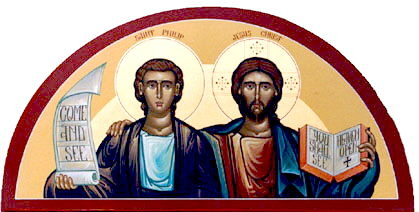
My dearest brothers and sisters-in- Christ, today we come together as the church to commemorate the feast of not just one, but of two of Christ’s Twelve Apostles, these being, St. Philip and St. James. Both of these Apostles worked tirelessly for the sake of the people of God, and just as the other Apostles had done, they spread the Good News to many throughout the world.
St. Philip is also known as Nathanael, he was a learned and a wise man from Israel. He was told he needed to be fluent in the Greek language, and eventually he went on to preach about the Lord and His truth in the regions of Greece and also of Roman Asia, he went from city to city, preaching to the masses and he gained for the Church many new converts and members.
St. Philip even managed to convert the wife of the proconsul of a region in which he ministered, by his miracles and from his preaching. The proconsul was enraged and ordered St. Philip to be arrested, and he together with the other Apostle, St. Bartholomew, and other disciples were crucified upside down. St. Philip preached to the crowd gathering there from his execution cross, in such a way, that they wanted to release him, but St. Philip refused to allow this.
The other Apostle which we celebrate today, St. James the Greater, was the brother of St. John the Apostle, he was a fisherman along the Lake of Galilee, whom Jesus called together with His other Apostles, St. Peter, St. Andrew and St. John his brother. St. James played an important role in the early Church, spreading the Good News of God’s salvation after Christ’s resurrection and ascension into heaven.
St. James went to preach the Good News to such faraway countries such as in the province of Iberia in what today we know as the country of Spain, where he spread the Gospel to the people there and helped to establish the Church far from its origins in Jerusalem. He was renowned especially in the region known as Santiago de Compostela, where his body lies buried, because it was there where he apparently did his works of evangelisation.
King Herod arrested St. James when he returned to the Holy Land, and in order to please the Jewish authorities, the Pharisees and the chief priests, had him executed. St. James was among the first of the Apostles to meet his end on earth through martyrdom.
The tireless works and commitment to the salvation of mankind of St. James and St. Philip can still be felt as making an impact even today. Like these Apostles of the Lord, we need more and more people who are willing to commit themselves to the Lord’s service, and to walk in His path just as these two Apostles did.
Truly, it will not be an easy task for us, as there is worldly opposition against all those who are faithful in the Lord’s service and who keep their faith. But Jesus reminds us yet again in the Gospel, that we who believe in Him, have seen the Lord Himself through Jesus, and by our faith in Him, we have been justified. And because we know the Lord, we will also be obedient to Him, we would be blessed and saved.
During the last remaining part of the season of Eastertide, let us reflect on our own lives, and on how we have acted in our lives so far. Have we been fully committed to our Lord, and have we been truly faithful to Him? Can we call truly ourselves Christians? Do we not only believe in the Lord through our mere words, but also through our actions?
The examples of the lives and service of the Apostles St. Philip and St. James show us that there are still many things that we can do as the followers of Christ in order to fulfil the commands which our Lord has given us, within our lives in His service. Both these Apostles served with tireless zeal and with vigour, and despite the challenges and the difficulties that faced them, these did not prevent them from carrying out the missions which the Lord had entrusted to them.
Let us all therefore look forward, and as we soon will celebrate the Solemnity of Pentecost Sunday, let us all recommit ourselves, and rediscover the true gifts of the Holy Spirit which have been given to us, and to make use of these gifts in order to help those who are still in darkness, by showing them the love of God manifested through each and every one of us as the faithful servants of our Lord, so that more and more souls may see the light of God and be saved.
Let us pray:
O God, who gladden us each year
with the feast day of the Apostles Philip and James,
grant us, through their prayers,
a share in the Passion and Resurrection
of Your Only Begotten Son,
so that we may merit to behold You for eternity.
Through our Lord Jesus Christ, Your Son,
who lives and reigns with You in the unity
of the Holy Spirit,
one God, for ever and ever.
Amen.
The Feast of St. Joseph the Worker~Br. Jesus Marin

54 Coming to his hometown, he began teaching the people in their synagogue, and they were amazed. “Where did this man get this wisdom and these miraculous powers?” they asked. 55 “Isn’t this the carpenter’s son? Isn’t his mother’s name Mary, and aren’t his brothers James, Joseph, Simon and Judas? 56 Aren’t all his sisters with us? Where then did this man get all these things?” 57 And they took offense at him.
But Jesus said to them, “A prophet is not without honor except in his own town and in his own home.”
58 And he did not do many miracles there because of their lack of faith
Brothers and sisters; the Gospel tells us that Jesus returned to his native place. While preaching, many of the people listening to him started to question his knowledge on the subject, simply because of where he was from, because of his family trade, because of who his father and mother were. Many of these people had seen Jesus grow up, yet his wisdom was far greater than anyone there. At this moment it reminds me of the movie, “The Passion of the Christ,” in which one sees flashes of Jesus studying, working, and perfecting his family trade of carpentry. “Isn’t this the carpenter’s son?” (14:55) One must wonder, isn’t God allowed to choose whoever he wants to carry his mission? Why are we so concerned with who God chooses, why do we have to stereotype who can and cannot be worthy to be God’s chosen one?
Sometimes I wonder how St. Joseph felt. If Jesus was being questioned because of his background, now imagine the difficulty that St. Joseph endured. A regular man with no special gifts that had to accept his future wife’s words that her pregnancy was a work of God. He had to stand against his own religious leaders and to trust God. Both of them probably were the talk of town. It must have been said that they were weak in the flesh since Mary was pregnant before they were married. He was responsible not only to raise a son who was God, but to teach him that we are all call to be witness to the dignity of our own labor. He had to do all this based on a dream, a dream that many could have had, but in his heart, it was not a simple dream, rather it was God’s vision, words and will. And yet he did it with strong faith becoming a yes man to God’s will.
Now, take a moment and meditate on how Jesus might have felt. Probably happy and excited at being in his hometown, ready to teach the good news, but instead, he came across people with hardened hearts, with hearts not open to suggestions. My dear brothers and sisters, today’s Gospel manifests for us the difference between believing and not believing. When we truly believe, we let God act in our lives and a true transformation happens, but when we do not believe and close the doors of our hearts to God, our lives are hindered.
Think of your lives, are we accepting God’s word as it should be? Are we giving people the chance that they deserve? Or are we shutting them down? We must be good listeners; Jesus wants us to be builders of his kingdom and not destroyers of his mission. God’s kingdom includes all of his people, you, me, and our neighbor. We must come as a broken individual in need of God’s healing. God invites us to be men and women of faith and to let Him into our lives. We must not question his decision but instead we must ask the Lord to teach us to truly believe in him, to transform our bodies and faith so that others can see the transformation that occurs if one is with God.
Let us take advantage of the opportunities the Lord Jesus Christ affords us, and let God act, let it not be said of us “he did not do many miracles there,” but let it be said that we live in peace because Jesus is with us. Let us be men and women of faith who accept and do God’s will.
Are You Called?~The Rev. Frank Bellino, OPI
The early Church described Christ as a young shepherd lovingly caring for his sheep. In today’s Gospel of John, we find this image once more. Christ, the Good Shepherd, is the one who lays down his life for his sheep. This is in contrast to the hired hand who abandons the sheep, leaving them prey to the dangers at hand.On this Fourth Sunday of Easter, we are reminded that it is Christ, who knows each one of us by name, and that knowing gives us new life. He knows us and he knows the Father whose love He shares with us. This echoes the great command to love God and love our neighbor.
But here the knowing of which Christ speaks is one that binds us together. All those who hear his voice are drawn in unity to that one flock that knows the one true Shepherd. Our knowing Christ makes us one. We are not merely employees.The first reading, from Acts, similarly presents this theme of knowing. Knowing the power of Christ’s name at work in our world is what Peter preaches, knowing that Jesus Christ is the foundation.
But there is a twist. Peter wants us to know the danger, that of rejecting Jesus Christ in our lives. As Christ knows us and loves us, we for our part, can ignore and refuse to acknowledge Christ in our lives.Most of us would be horrified to think of ourselves as rejecting Christ, of abandoning our faith. But there are other lesser ways in which we reject Christ as the basis of our life. The truth is we do grow dim in our knowing the light of Christ. In our busy life we forget all too often. We neglect to set time aside in prayer, or attend a mass or a retreat, or read a book or article on the Christian life.
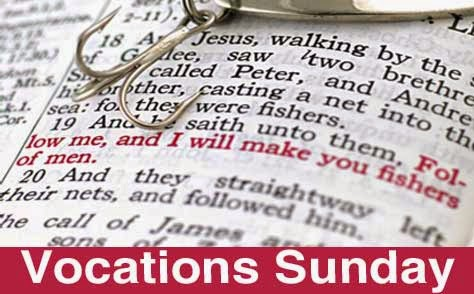
These are all ways to grow in our knowledge of Christ that we take for granted. Other people too help us to know Christ in our life. Who are the people in your life that show you the face of Christ? Do we recognize how Christ is present to us even now? It may be a parent or grand-parent that showed you the love of Christ. For many of us our list will include a priest, or a sister, or a brother.They have all been people who heard the voice of the Good Shepherd and shared that voice with us in our lives. Their vocations help us to grow in knowing Christ. That is why this Sunday, Good Shepherd Sunday, is in many diocese, a day designated as ‘Vocations Sunday’, God’s calling in our lives.
Clearly each of us, as a Christian, has a calling that was born from the font of our baptism. Sadly, we may take this vocation as a Christian for granted. If so, we need once again to hear the Shepherd’s voice calling to us amid our daily concerns and the loud drone of all our activities.The vocation to marriage, with its unique call to parenthood, takes on its richest meaning when we, as spouse or as family, together hear God’s word in our lives. When we make time together in worship at Mass, or at prayer in our homes we hear the Shepherd’s call in our hearts. However, today when the glamour of this world rejects Christ, how do people hear God’s call, that unique sense of who I am in God’s heart?
If you hear God speaking to your heart don’t ignore such gentle voices. I don’t believe that God suddenly stopped calling people to a religious vocation. Rather, today we so easily put God on hold.You might be into the start of your career and still a voice speaks to you. God calls us, but we for our part, must hear his voice. Don’t reject the cornerstone of your life, don’t refuse Christ’s calling for you. Explore and discover if a religious vocation is part of you.
At the end of the day, listening to this call is not wasted time. For the early Church the image of the youthful Christ shepherding his flock was an image of hope, let that same hope be yours. Hear the Shepherd’s voice speaking to your heart.The Gift of Faith~Br Milan Komadina
The Feast of St. Catherine of Siena
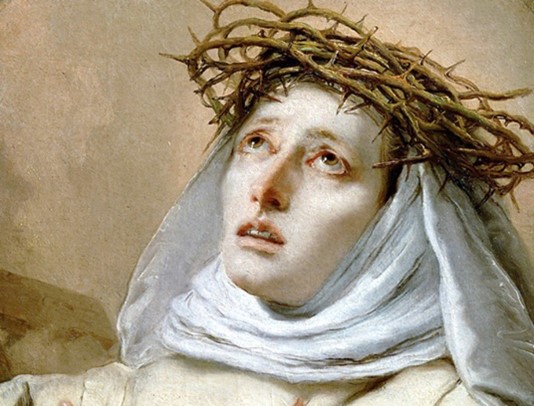
Our faith is a gift. The older I grow the more sure I become about the fact that our own faith is a gift. And that we do not believe just like that. Or traditionally, if our parents were Christians and we were taught about Christianity as kids and later we decided to become more devoted to our faith when we already have the roots in our family education. There are many people that were born in Christian families and they declare themselves Christians but they never go to church. They never pray to God and they never read Bible. Could we truly tell that a person is a Christian who is only baptized and raised in Christian environment? Being Christian means of course being baptized and have the certificate that we belong to certain denomination but it is not enough. A Christian could someone become even without being baptized because a Christian we should become by our faith. And a baptism should come after as a visible result of what had previously happened. When we first met Jesus in our hearts, declared Him as our savior, accept his sacrifice, repent and get the free grace and salvation and then we become true Christians. What I would like to emphasize, as I consider that very important is that being Christian includes to believe in Christ and being aware of the mercy which is gifted through faith. The salvation is through faith. Baptism we could arrange at the local church and easily we could become baptized members of one church. But faith – we cannot arrange. We cannot as nonbelievers order in the local church and buy our faith for the rest of our lives or for the certain period of time. Because faith is a gift and cannot be scheduled, arranged or booked as a slot for baptism. Here we come to one sentence that has stolen my attention in today’s reading. John 6:60-69
”On hearing it, many of his disciples said, “This is a hard teaching. Who can accept it?” Aware that his disciples were grumbling about this, Jesus said to them, “Does this offend you? Then what if you see the Son of Man ascend to where he was before! The Spirit gives life; the flesh counts for nothing. The words I have spoken to you—they are full of the Spirit and life. Yet there are some of you who do not believe.” For Jesus had known from the beginning which of them did not believe and who would betray him. He went on to say, “This is why I told you that no one can come to me unless the Father has enabled them.” From this time many of his disciples turned back and no longer followed him. “You do not want to leave too, do you?” Jesus asked the Twelve. Simon Peter answered him, “Lord, to whom shall we go? You have the words of eternal life. We have come to believe and to know that you are the Holy One of God.”
Versus number 65 says that NO ONE can come to Jesus unless the Father has enabled them. In everyday Christian life we can experience really special moments. Sometimes we wake up in the morning happy and grateful to be alive, then we do our cross and start singing psalms or Christians songs, or we pray and worship, sometimes we read the Bible feeling every single word of the text and being touched we cry while reading God’s Word. Sometimes we feel holy and away from human lusty desires and we feel like our mind is really pure. Other days we have a big desire to study Bible, read about Jesus or preach the Gospel. But do we sometimes question why we are doing all these? Why we have the desire not to sin? Why we have the gift of tears while reading Gospel and why we feel empathy when we see other people suffer? Why we have inner engine to move us stand for the prayer in the morning? This is the seal of Holy Spirit working in us. This is the gift and this is free gift. As we are saved by grace through our faith now we bring fruits of this faith. But all those fruits are grown in the Holy Spirit.
In Psalm 51:15, king David prays: “O Lord, open my lips, And my mouth shall show forth Your praise.” When I was Orthodox Christian I learnt that in case when we cannot pray (due to lack of motivation) we should read this psalm and it helps. Or at least to repeat several times this sentence. So that the Lord may open our mouth and let us pray. All good things that we are doing we are doing them with God’s help because everything good comes from God. Our faith is a gift, our salvation is a gift, and our presence in the Unified Old Catholic Church is a gift. And it is very important not to be proud because everything that we have is a gift from God. I invite you all to live by faith and to believe in this mercy and to remember that no one can come to Jesus unless the Father has enabled him.
And since today we commemorate St. Catherine of Siena I would like to share a couple of sentences about her life. St. Catherine of Siena, TOSD (Italian: Caterina da Siena; 25 March 1347 – 29 April 1380) was an Italian member of the Third Order of Saint Dominic in the Roman Catholic Church. She was a mystic, activist, and author who had a great influence on Italian literature and on the Catholic Church. Canonized in 1461, she is also a Doctor of the Church. Born and raised in Siena, she wanted from an early age to devote herself to God, against the will of her parents. She joined the “mantellates”, a group of pious women, primarily widows, informally devoted to Dominican spirituality. She died on 29 April 1380, exhausted by her rigorous fasting. Urban VI celebrated her funeral and burial in the Basilica of Santa Maria sopra Minerva in Rome. Devotion around Catherine of Siena developed rapidly after her death. Pope Pius II canonized her in 1461; she was declared a patron saint of Rome in 1866 by Pope Pius IX, and of Italy (together with Francis of Assisi) in 1939 by Pope Pius XII. She was the second woman to be declared a “Doctor of the Church,” on 4 October 1970 by Pope Paul VI – only days after Teresa of Ávila. In 1999 Pope John Paul II proclaimed her a (co-)patron saint of Europe.
St. Catherine of Siena pray for us!
Be Like Mark: The Feast of St. Mark the Evangelist~The Rev Dcn Scott Brown, OPI

Today we celebrate St. Mark the Evangelist. So who was he and why do we celebrate him? The short answer is, we really don’t know. According to Wikipedia, we have this:
According to William Lane (1974), an “unbroken tradition” identifies Mark the Evangelist with John Mark, and John Mark as the cousin of Barnabas. However, Hippolytus of Rome in On the Seventy Apostles distinguishes Mark the Evangelist (2 Tim 4:11), John Mark (Acts 12:12, 25; 13:5, 13; 15:37), and Mark the cousin of Barnabas (Col 4:10; Phlm 1:24). According to Hippolytus, they all belonged to the “Seventy Disciples” who were sent out by Jesus to disseminate the gospel (Luke 10:1ff.) in Judea.According to Eusebius of Caesarea (Eccl. Hist. 2.9.1–4), Herod Agrippa I, in his first year of reign over the whole of Judea (AD 41), killed James, son of Zebedee and arrested Peter, planning to kill him after the Passover. Peter was saved miraculously by angels, and escaped out of the realm of Herod (Acts 12:1–19). Peter went to Antioch, then through Asia Minor (visiting the churches in Pontus, Galatia, Cappadocia, Asia, and Bithynia, as mentioned in 1 Peter 1:1), and arrived in Rome in the second year of Emperor Claudius (AD 42; Eusebius, Eccl, Hist. 2.14.6). Somewhere on the way, Peter encountered Mark and took him as travel companion and interpreter. Mark the Evangelist wrote down the sermons of Peter, thus composing the Gospel according to Mark (Eccl. Hist. 15–16), before he left for Alexandria in the third year of Claudius (AD 43).
According to the Acts 15:39, Mark went to Cyprus with Barnabas after the Council of Jerusalem.According to tradition, in AD 49, about 19 years after the Ascension of Jesus, Mark travelled to Alexandria and founded the Church of Alexandria – today, the Coptic Orthodox Church, the Greek Orthodox Church of Alexandria, and the Coptic Catholic Church trace their origins to this original community. Aspects of the Coptic liturgy can be traced back to Mark himself. He became the first bishop of Alexandria and he is honored as the founder of Christianity in Africa.
According to Eusebius (Eccl. Hist. 2.24.1), Mark was succeeded by Anianus as the bishop of Alexandria in the eighth year of Nero (62/63), probably, but not definitely, due to his coming death. Later Coptic tradition says that he was martyred in 68.Isn’t it fitting that the readings for today are all about pride and being humble and submitting to God’s will. We have an example of that in St. Mark. Here you go:
1 Peter 5:5-14 New International Version5 In the same way, you who are younger, submit yourselves to your elders. All of you, clothe yourselves with humility toward one another, because, “God opposes the proud but shows favor to the humble.”6 Humble yourselves, therefore, under God’s mighty hand, that he may lift you up in due time. 7 Cast all your anxiety on him because he cares for you. 8 Be alert and of sober mind. Your enemy the devil prowls around like a roaring lion looking for someone to devour. 9 Resist him, standing firm in the faith, because you know that the family of believers throughout the world is undergoing the same kind of sufferings. 10 And the God of all grace, who called you to his eternal glory in Christ, after you have suffered a little while, will himself restore you and make you strong, firm and steadfast. 11 To him be the power for ever and ever. Amen. 12 With the help of Silas,[b] whom I regard as a faithful brother, I have written to you briefly, encouraging you and testifying that this is the true grace of God. Stand fast in it. 13 She who is in Babylon, chosen together with you, sends you her greetings, and so does my son Mark. 14 Greet one another with a kiss of love. In verses 5,6, and 7 Peter wants us to know that God wants us to clothe ourselves in humility because as Proverbs 3:34 says: God gives grace to the humble and opposes the proud. St. Augustine said: “It was Pride that changed angels into devils, it is humility that makes men as angels.” What is Pride? Pride is the excessive belief in one’s own abilities that interferes with the individual’s recognition of the grace of God. Its has been called the sin from which all other sins arise. Pride is also known as Vanity. It is certainly good to have pride in one’s country, community, and in oneself, but when taken too far these virtues become sins. Trust in God, realize that we are nothing and God is everything. Realize that God is in charge, not us. Trust in God, not yourself because we are proud when we trust in ourselves. When we humble ourselves in these ways, we are worthy of Gods grace. In verses 8-11 Peter tells us to be clear minded, alert during hardships and difficult times as this is when Satan is posed to attack. When we are weak, fearful, and in doubt is when the Devil is at his strongest. He is like a lion on the prowl devouring everything he can. If you knew that a deadly lion had escaped from a zoo and was wandering around your neighborhood, you would not be standing in your front yard. N., you would be inside with your doors and windows locked. Resist him and stand firm in your faith. Know that others are resisting him with you. In conclusion verses 12-14, Peter wants us to take away these points: • Prepare your minds for action, and do not conform to the passions of this world. • Know that you are God’s holy people, chosen, precious, and valuable. • Live honorably, and resist the Devil. • Don’t be surprised that you suffer for the name of Jesus. People will be surprised that you do not act like them. • Don’t be ashamed of that suffering. Place your trust in God who judges justly, just like Jesus did. • Humble yourselves because God gives grace to the humble, not to those who trust in themselves during hard times.
Let us all live so as to follow the example of St Mark. Let us pray:O Almighty God, who hast instructed thy holy Church with the heavenly doctrine of thy Evangelist Saint Mark: Give us grace, that, being not like children carried away with every blast of vain doctrine, we may be established in the truth of thy holy Gospel; through Jesus Christ our Lord. Amen.
 The Order of Preachers, Independent
You must be logged in to post a comment.