
Category: Lesson
The Feast of All Souls~Dcn Igor Kalinski, IPI
DOMINICAN HERMITAGE & ORATORY of St’s Peregrine and Sebastian in Gevgelija, Republic of Macedonia, Europe
I lost one very good intimate friend, two years ago, I lost my dad 17 years ago, my grandparents, my gran grandparents, some school friends too, many neighbors and relatives during my 44 years life on this earth.
This Memorial of ALL SOULS Day, is a day of reflection, day to open and search my family photo albums, the archives, days when I ask some of the oldest members in our family, to refresh their memory with my million questions and details about members of our household that are gone and I want to hear stories about them.
I want to provoke in my family and relatives and friends too to think about our beloved people that are in Heaven.
We will all go in Heaven one day, and what’s hold me in the Divine hope is the Scriptures verses that all are fell in sleep, waiting for the sound of the trumpet.
Some people are sad of the missing of their late beloved friends and family, some reflect on this day with gratitude, some with sadness.
I want us to encourage that its one in a year dedicate memorial for each and every one missing person, for all those who don’t even have a grave mark, those brave soldiers who fought for us today living in peace.
For all those not yet canonized in the church bureaucratic policy but are saints cos each soul living in God’s presence is holy, saved and a saint too.
This is a feast for millions and billions of souls, that only God knows them perfectly by name and origin.
I am thankful for this memorial that exist and for many many who are gone due of covid illness.
This is a memorial day for all of our deceased members of OPI and UOCC, I will mention dear deaconess Dollie, and bishop elect venerable Philip Gerboc, so deeply loved and deeply missed and never forgotten.
We all die, we will suddenly all fell in God’s sleep, to rest until He comes soon again to raise all who patiently believed and hoped for better life in heaven.
Today is a feast of all my family and friends that are gone for all of these years.
The Church is one and holy, one on earth preaching and sharing holy sacraments, the other is the Church in Heaven celebrating God with all martyrs, deceased ancestry, they in Heaven are worshiping, singing, and interceding for the petitions and needs of the Church on earth.
I will say, all souls of God from the beginning of the world until today that are in Heaven saved with the blood of Jesus are holy intercessors for us.
I light the candle and bring some flesh flowers in my oratory’s altar, offering my prayers of thanksgiving for their lives on earth.
The Feast of All Saints~Br. Milan Komadina, Novice

Let us learn something more about All Saints and about some traditions that are popular worldwide on this day. On the Solemnity of All Saints, November 1, the Church celebrates those Christians who achieved spiritual maturity. It is a day to venerate all the holy men and women who have been canonized by the Church. The first evidence for the November 1 date of celebration and of the broadening of the festival to include all saints as well as all martyrs occurred during the reign of Pope Gregory III (731–741), who dedicated a chapel in St. Peter’s, Rome, on November 1 in honor of all saints. On November 1st each year, people flock to their family plots in cemeteries across the country. They also use this holiday to hold a family reunion where groups of an extended family gather together. The day is filled with music and food. There is also prayer and religious traditions. There was also a superstition that All Souls’ night was a time when the dead revisited their homes, therefore some people would leave lit candles outside their homes to help to guide the deceased souls. Meals and wine were also left out as refreshments for them. Much like Halloween in other countries, All Souls’ Day is marked by the consumption of impressive quantities of sugar – particularly in the form of frutta martorana, beautiful marzipan sweets in the shape of fresh fruits and vegetables, and ossa dei morti, almond biscuits.
Today in Revelation 7:9-10 we read the following sentence: `After this I looked, and there before me was a great multitude that no one could count, from every nation, tribe, people and language, standing before the throne and before the Lamb. They were wearing white robes and were holding palm branches in their hands. And they cried out in a loud voice: “Salvation belongs to our God, who sits on the throne, and to the Lamb.”` People from every nation, tribe and language will be standing before the throne and before the Lamb (Jesus). Every person is welcome to serve God and to become holy. God does not make distinction between people or discriminate based on one`s nationality. Here, in Germany I can see many foreigners on the streets. There are many Ukrainian refugees, people from Balkan countries, people from North African countries and other migrants. But not all of them have the same status. In finding a job, using the rights and in everyday life knowing local language is a must, plus bearing the EU citizenship opens many doors. People from third world country have many difficulties in acquiring their visa and also surviving in this country. Similar situation is in many countries worldwide. The language matters, the origin matters, the tribe matters. With Heavenly Jerusalem it will be different. No visa would be needed, no new language course and so on. The only visa for resident permission for eternal stay with God will be our faith in Jesus.
In John 3:1-3 it is written: `See what great love the Father has lavished on us, that we should be called children of God! And that is what we are! The reason the world does not know us is that it did not know him. Dear friends, now we are children of God, and what we will be has not yet been made known. But we know that when Christ appears, we shall be like him, for we shall see him as he is. All who have this hope in him purify themselves, just as he is pure` We are all called children of God and we should all considered each other like brothers and sisters. This is why we also pray to saints. Since today in All Saints Day we also remember all saints it is good to talk about the beauty and blessings of prayers to saints. In some Christian denominations people do not pray to saints fearing that it could look like worshiping them and we know that there is only one God and only God should be worshipped. But what we really do when we pray to saints we ask them to pray to God together with us. It is similar as when we ask our friend from the church to pray for us. Mostly all prayers that we pray to saints end with `pray for us` and this is the right prayer. We can pray and to angels as well. They are all servants of the Lord and we can as them to pray God for us, too.
Here is a beautiful prayer for All Saints Day:
Dear God, thank you for the example of the Saints. I desire to join in their company, worshiping you forever in Heaven. Please help me follow their footsteps, and yours, Jesus Christ. Please help me to conform myself to Your image, seeking Your will in all things, as the Saints did. Please help me to devote myself, and all that I do, to Your glory, and to the service of my neighbors. Amen.

On Bedtime Stories and Sycamore Trees ~ Br. Christian Angelo Ventura, Novice

May we speak the Word and hear it; through the intercession of St. Dominic
and in the ✠ Name of the One who Was, and Is, and is to come. Amen.
To begin, today’s Gospel tells of the story of Zacchaeus, who climbed the sycamore tree in order to see Jesus. Perhaps you are familiar with the children’s song:
Zacchaeus was a wee little man and a wee little man was he. He climbed up in a sycamore tree for the Lord he wanted to see. And as the Saviour passed that way, He looked up in the tree. And He said, ‘Zacchaeus, you come down, for I’m going to your house today.’
Whenever I happen to listen to this excerpt of Luke’s Gospel, I am always reminded of the curious tale of Jack and his beloved beanstalk. Quite frankly, it was my least favorite children’s book, with the Very Hungry Caterpillar taking first place for me, likely due to its friendlier plot. Although I reflect on the former, perhaps, due to the theme of elevating oneself to treacherous heights to get a glimpse of the unknown, out of pure awe and ungovernable curiosity. I mean, how true is this theme in our personal lives? On our own, we are short-handed, and sometimes endeavor on using intermediates to set us on to new heights.
Although unlike Mr. Fee-Fi-Fo-Fum, our Loving Saviour, Christ, does not seek to grind our bones to make his bread. Rather, in today’s Gospel, He calls Zacchaeus by name to come down and feast on the Bread of Life in the company of the Lord Himself and His disciples.
As Halloween approaches in particular, many people innocently entertain mystics and fortune tellers out of a curious impulse to tap into the divine. Maybe it is to seek comfort during hardship or spiritual advice for the path forward. And, while historical Christianity has long condemned the practices of divination as the crime of the century, what is most interesting to me is the spark of curiosity that pushes people to seek in the first place. The “principle spark”, if you will.
Is God constantly calling us to seek a fruitful relationship with Him, abundant in love and mercy? We ought to believe so! In fact, we know this to be very true, that our God is so eager to be in regular relationship with us. I particularly like the way Jesuit priest Fr. James Martin puts it, “the thing you are seeking is causing you to seek it”.
I urge us, in our daily examen, to pause and reflect on what it is that we are truly seeking. Zacchaeus was a corrupt tax collector that defrauded many for his riches before he sincerely turned to Christ by the workings of the Holy Spirit. It begs asking how we are filling our voids, maneuvering our curiosities, and climbing on to our sycamore trees when Jesus stands right there in the foreground before us saying…
“take, eat”(Matthew 26:26).
When He says…
“Do not be afraid…
I have called you by name, you are mine” (Isaiah 43:1).
Whatsoever it is that we are truly seeking; can it only be remedied by the gracious love of our loving Father in heaven? Well, we ought to believe so! Even in our unworthiness, He is steadfast to embrace us wherever we are in our journey with Him.
I am reminded of when the Centurion exclaimed “Lord I am not worthy that you should enter under my roof, but only say the word and my servant shall be healed” (Luke 7: 6-7).
And so, my brothers and sisters, make haste to come down from your sycamore trees, for the Lord is already here to stay at your house and has come to seek and save the lost.
Amen.
The Feast of Sts. Simon and Jude~The Very Rev. Lady Sherwood, OPI
Reading I: Eph 2:19-22
Responsorial Psalm: 19:2-3, 4-5
Alleluia: See Te Deum
Gospel: Lk 6:12-16
Liturgical colour: Red.
My dearest Brothers and sisters=in=Christ:
Today we come together as the church to celebrate the feast day of Saints Simon and Jude. Little is known about either of these saints apart from the fact that they were called by Jesus to be among his band of disciples and were later named amongst the Apostles.
Let us firstly look at Saint Simon:
Simon was a simple Galilean, a brother of Jesus, as the ancients called close relatives in those times, including such as uncles and first cousins. He was one of the Saviour’s four first cousins, together with James, Jude and Joseph. These were all sons of Mary, the wife of Alpheus, or Cleophas, both names being a derivative of the Aramaic Chalphai. According to tradition Cleophas was the brother of Saint Joseph, Jesus earthly father. All the sons of this family were raised at Nazareth, close neighbours of the Holy Family.
All were called by Our Lord to be Apostles: pillars of his Church. Saint Mark tells us that Simon was born in Cana, the place, according to Saint John, of Jesus’ first miracle. Some traditions identify Simon as the bridegroom at that wedding and suggest that he became a disciple as a direct response to witnessing that miracle, a miracle that was, after all, performed, at the request of Mary, to get the newly-weds out of a somewhat embarrassing predicament.
Saint Simon is not mentioned anywhere in the New Testament except in lists of the Apostles’ names.
Tradition has it that Saint Simon preached in Mauretania (an area which approximated to present day north-west Africa and southern Spain), in Egypt and in Libya, leaving behind him the fertile hills of Galilee, where he had been engaged in cultivation of the vineyards and olive gardens. He later rejoined his brother Jude in Persia (modern day Iran) where they laboured and died together, probably martyred, hence the change to a red altar frontal in their honour on this their feast day. At first the Persian king respected them, for they had manifested power over two ferocious tigers that had terrorised the land. With their king, sixty thousand Persians became Christians, and churches rose over the ruins of the idolatrous temples. However, when they visited other parts of the Persian kingdom unconverted, pagan hordes commanded them to offer sacrifices to the Sun god. They prayed for mercy and offered their lives to the living God but the idolaters fell on the two Apostles and massacred them, while they blessed God and prayed for their murders.
Now let us look at Saint Jude:
Saint Jude is also known by a variety of other names. He is called Lebbaeus in Matthew chapter ten and Thaddaeus in Mark chapter three.
In the end of our Bibles, we find The Epistle of Jude. It is a short work of only one chapter containing just 25 verses. Here we are warned against corrupt influences that have crept into the church.
St. Jude is often and popularly referred to as the patron saint of desperate or lost causes, the one who is asked for help when all else fails. Possibly due to prayers for intercession, to be asked of the other Apostles first. Hence, Jude has come to be called ‘the saint of last resort’, the one whom we ask only when desperate.
What, then, can we in today’s world learn from the lives of these two relatively unknown Apostles? Firstly, they, like the rest of the twelve, ‘forsook all and followed Jesus. Can we be accused of doing that? Could we, and should we, give up some of our modern comforts and privileges and live our lives more like our Lord? Secondly, if tradition tells us, St Simon was the recipient of Jesus’ first miracle. We should be reminded that, even two thousand years later, that miracles still happen. We must always be aware that the Holy Spirit is at work in the world and he does not always do things in the way in which we would have him do them.
Thirdly, judging by his epistle, Saint Jude proved to be an avid supporter of gospel truths.
So then, are we truly passionate enough about the tenets and doctrines of our faith? Do we hold fast to the creedal affirmations of the Church?
Both Sts Simon and Jude, spent their lives preaching the gospel to a very pagan world and it is believed that they died a martyr’s death for their faith. We may not be called to be martyrs like they were (hopefully), but we shall be called to make other sacrifices. Are we ready to suffer for the sake of our Lord and Saviour Jesus Christ?
Let us, thank God for the lives of his Apostles Saint Simon and Saint Jude.
Let us pray:
Father,
you revealed yourself to us
through the preaching of your apostles Simon and Jude.
By their prayers,
give your Church continued growth
and increase the number of those who believe in you.
Through our Lord Jesus Christ, your Son,
who lives and reigns with you
in the unity of the Holy Spirit,
one God, for ever and ever.
Amen.

Praying From the Heart~Br. Milan Komadina

There is one parable in the Bible in Luke 18:9-14, where Jesus talked about the Pharisee and the Tax Collector. At that time Pharisees were people who were considered to be very educated and very religious. They had a large knowledge about the books from the Old Testament (especially God`s Law given through Moses). Average people considered them as those who should be very close to God. On the other hand there were tax collectors and this group of people were considered as very bad people and people who were far away from God. Those people normally did not know a lot about God`s Law and religious rituals. I would like to read again this parable because we could learn something very important from this story and it could be applicable for our everyday life. Take a look:
To some who were confident of their own righteousness and looked down on everyone else, Jesus told this parable: “Two men went up to the temple to pray, one a Pharisee and the other a tax collector. The Pharisee stood by himself and prayed: ‘God, I thank you that I am not like other people—robbers, evildoers, adulterers—or even like this tax collector. I fast twice a week and give a tenth of all I get.’“But the tax collector stood at a distance. He would not even look up to heaven, but beat his breast and said, ‘God, have mercy on me, a sinner.’ “I tell you that this man, rather than the other, went home justified before God. For all those who exalt themselves will be humbled, and those who humble themselves will be exalted.
I remember some situations when I was visiting Christian shops, both online and offline. When I lived in Serbia I used to go to Orthodox Christian shops where I could buy many icons, crosses, rosaries, incense or myrrh, candles of pure fax and surely many books. Among them I had my favorite two types of books and those were prayer books and books about saints and holy father`s messages. At the time when I used to live in a monastery I was spending sometimes 3 to 4 hours reading and reading prayers and praying rosaries. But many times something interesting was happening at the time of reading prayers. My thoughts were going here and there and my focus was away. So it was like praying 3 or 4 hours and actually praying for much less period of time. Why I am talking about this example is because I believe that this is happening to everyone. When we pray from prayer books and we think that we actually pray but we do not. I remember I read about some pieces of advice from Christian books. And they were mainly focused on the quality of our prayer not its quantity. God is a real person and our real heavenly father and he wants us to truly talk to him. Rosaries and written prayers are beautiful but they should include our minds and our hearts without that inclusion our `blank` word saying is just like rapping and hipping and hopping. Can be fun, but useless. I remember that I read in some Christian book when I lived in monastery that even one short sentence said from the heart with a pain and desire that God will hear us can be more powerful than reading thousands of Our father without our hearts and minds involved in the prayer. In this reading we had this parable between tax collector and Pharisee. Tax collector did not know any prayer, he did not have any prayer books or religious tools like rosaries or candles. The only thing that he offered to God was his true repentance and his heart. And from the bottom of his heart he prayed `Have mercy upon me, a sinner`. God knows our hearts and he wants our hearts. Religious rituals, prayers from the books, songs, rosaries, candles and incense can help us in our prayer practice. But let us all rather pray like tax collector and avoid praying like Pharisee because God is aiming our hearts rather than regularities, forms, books, etc.
A prayer can be anything we do in the name of Jesus. Feeding the hungry, donating something to those in need, helping a friend, a colleague, showing mercy and love. In my life I am sad to say that many times I saw people who were praying a lot but did not display love and respect or mercy toward the other people. And I was always sad about that. They do similar things like Pharisees. They have the form of religious practice but deep inside they are empty. We should be good and just. It is written in Sirach 35:14-18 about the importance of being just with other people.
Do not offer him a bribe, for he will not accept it; He will not show partiality to the poor; but he will listen to the prayer of one who is wronged. He will not ignore the supplication of the orphan, or the widow when she pours out her complaint. Do not the tears of the widow run down her cheek.
Sometimes we may feel that God is not listening to our prayers. But it is that God always has a plan for all and each one of us. Nothing is happening with no reason and purpose. Let us learn to trust God and learn to pray from the heart. Blessed be the Lord.
Why Pray?~The Rev. Frank Bellino, OPI
What’s the difference between prayer in church and prayer in a casino? In a casino, you really mean it.
Prayer is so woven into the fabric of what it is to live as a Christian that perhaps sometimes we forget to ask that simple question: “why do we pray?”. And if we forget to ask why we pray, then there must be a danger that one day we may simply forget to pray altogether.
This Sunday’s scripture readings can help answer the question “why do we pray?” at several levels.
At a very basic level we pray because we recognize that by ourselves, we are powerless. Moses recognizes that the attack of the Amalekites is a real danger to the people of Israel: by themselves they may not have the wherewithal to resist, and their escape from Pharaoh will have been in vain. They have no military strategy or secret weapon to save them. Moses turns instead to constant prayer “from the rising of the sun to its setting” (Ps 112[113]:3). He does so having faith in God, knowing that Israel’s “help is in the name of the Lord” (Ps 120[121]:2).
So too with the widow in the gospel: she has nobody to defend her rights; only by constant “prayer” – not in this case to God, but to the unjust judge – can she hope for justice.
It is right that we should, in humility, recognize our powerlessness and be constant in bringing our needs before the Lord. But if that were all there were to prayer, we would have to say that the more powerful somebody is, the less he or she would need to pray. Perhaps this is why the unjust judge, entrusted with considerable power and authority, has “neither fear of God nor respect for man” (Lk 18:4). Why bother praying for divine assistance if you already have the military might or the political clout or the money to defend yourself and others against aggressors and injustices?
There is a clue at the end of the gospel passage: after telling us how God will see justice done swiftly in answer to our constant prayer, Christ adds, “But when the Son of Man comes, will he find any faith on earth?” (Lk 18:8)
It seems he will find lots of praying going on, at least from those who recognize their powerlessness; but will he find any faith?
We might initially think that a strange question. If people are praying to God, surely, they have faith in him? But in the gospels even the demons know that God exists, and they implore him to act in certain ways. In that very basic sense, you could even say that they pray to God; though we could not say that the demons have “faith”.
What Christ asks of us is not merely that we should pray insistently for our own needs and for justice to all – though certainly we must pray for that. He asks us to have faith: that is, he calls us to believe in God and his word, and freely to commit our whole selves to him.
Prayer isn’t about persuading God to do what we want, however noble that may be; it is about inviting God to mold us in faith into what he wants for us. Prayer can’t change God; it should change us.
Through our prayer our faith is nourished and deepened: and that is one reason why Christian traditions of prayer – whether liturgical or private – focus on the scriptures. Praying with the scriptures, using words given to us by God, we enter more deeply into “the wisdom that leads to salvation through faith in Christ Jesus” (2 Tim 3:15); we learn more profoundly the holiness to which our Lord calls us.
As Christians we have Christ himself as our model: God made man was himself a man of insistent prayer during his life, and ultimately on the cross, pleading for us and alongside us for our redemption. Ancient Christian tradition sees Moses’ prayer with arms extended as prefiguring the cross (cf. Justin Martyr, Dialogue with Trypho, 97). The self-emptying of the cross is the point around which all the scriptures and all history turn, and it must be the focus of our prayer as we look to answer Christ’s call to follow him.
Why do we pray? To be like Christ and to be with Christ, now and forever.

Say Thank You~The Rt Rev Michael Beckett, OPI

Ya know, one of the things I do every day is to check my “Memories” on Facebook. Sometimes there are little things, silly things. And sometimes there are memories that remind me of milestones, things I’ve done, places we’ve gone, moves we’ve made.
And sometimes there are huge things, not so pleasant things, like memories of some of Scott’s health scares, of people we’ve lost.
And every one of these Memories that Facebook is so happy to remind me of helps me to remember …to be kind….to be thankful.
The Gospel appointed (Lk 17:11-19) for today tells us about Jesus healing ten lepers. And yep, they were all happy and excited, and I’m sure that would have been a pretty major Facebook memory for them. Yay! But ya know, only one of the ten, one, had the grace to turn to Jesus and say, “Thank you.”
As y’all know, I lost my daddy twelve years ago, and Momma died five years ago. And as painful as that was, my sibs and I were privileged to actually be the caretakers for both our parents in their last months and weeks and days. During that time, we all had the chance to thank Momma and Daddy for being the amazing parents that they were. We had the rare opportunity to make sure that we had nothing left unsaid, that our parents knew how much they were loved and honored and appreciated. We had the opportunity, which we grabbed with both hands, to say thank you.
In the past however long I’ve been on Facebook, some of y’all have held my hand through the health scares (terrors?) that Scott has experienced. Heart attacks. Cancer. Mega-major hernia surgery. These things were life changing. Relationship changing too. In any of these scenarios, I could have lost him. And let me tell you, that helped me to learn to appreciate him even more than I already did. These things taught me to be ever and oh so thankful that he is still with me. These things taught me to make sure that he knows just how very much he is loved and appreciated.
The vast majority of folks who know me well know that not only did I teach, but I spent most of my adult life working in flower shops. And yes, while there are many, many happy memories associated with weddings and proms and births and anniversaries, there also are so many sad memories of families and loved ones ordering flowers for someone who has died. And invariably, those who ordered flowers in person for someone close to them, especially family members, almost always said one of two things: The last thing I said to him/her….. or…… The last thing he/she said to me was…. And for the most part not one of those people had expected the last thing said to actually BE the last thing said. Some of the more tragic things I was told was, “We argued.” “I wasn’t very nice.” “She was mad at me.” And of course there was always, “I love you.”
So you can imagine that, there, too, I learned my lesson. One does not get to be 64 years old without losing many, many folks who were loved. It’s for this reason that I almost always end a conversation with folks I care about with an “I love you” or a “Hugs!” or a heart emoji, or something to let them know they are important. You can bet that I want my last words to you to be positive, to let you know that you are loved and important and seen.
In his letter to the church at Ephesus, Paul wrote, “do not let the sun go down on your anger” (Ephesians 4:26.) I’m gonna go one step further here and say, “Do not end a conversation with someone you care for without telling them in some way how important they are to you.”
Now, with all that being said, how much more so does Paul’s Letter to the Thessalonians resonate when he writes in 1 Thessalonians (5:16-18) “Rejoice always, pray continually, give thanks in all circumstances; for this is God’s will for you in Christ Jesus.”
If you were to leave this world suddenly, would the folks you love know that you loved them? Would our God know that you love Him? Let me encourage you to make it so. Say thank you. Say “I love you.” Frequently. By your words, by your actions.
I’m gonna close with this prayer, thought to be written in 1912 by Father Esther Bouquerel, and is more commonly known as “The Prayer of St. Francis.”
Lord, make me an instrument of your peace.
Where there is hatred, let me sow love;
where there is injury, pardon;
where there is doubt, faith;
where there is despair, hope;
where there is darkness, light;
and where there is sadness, joy.
O Divine Master, grant that I may not so much seek
to be consoled as to console;
to be understood as to understand;
to be loved as to love.
For it is in giving that we receive;
it is in pardoning that we are pardoned;
and it is in dying that we are born to eternal life.
Amen.

It Is Well With My Soul~The Rt. Rev. Michael Beckett, OPI

Oh, Y’all…… What a week for so many people. The devastation and loss of life because of that hurricane. Wow. And then a couple of friends of mine got some not so great news health-wise; another friend is battling cancer….. And THEN, yesterday I was looking at the scriptures appointed for today (coz that’s kinda what I do, ya know) and the Reading from the Book of Habakkuk in the Hebrew Scriptures (Old Testament dontcha know) included this:
How long, O LORD? I cry for help
but you do not listen!
I cry out to you, “Violence!”
but you do not intervene.
Why do you let me see ruin;
why must I look at misery?
Destruction and violence are before me;
there is strife, and clamorous discord.
Wow, huh? So many times we feel that God just doesn’t care. That he has abandoned us. That we’re alone in our struggles and there is no help to be had.
Sometimes we want to give up, and we get despondent. And ANGRY. And we hurt. And we wonder WHY in THUNDER God made this happen, or LET this happen. Just like Habakkuk.
Lemme tell ya about my Daddy. Daddy was a man of great faith. Daddy was our family’s pillar of strength. Our hero. There wasn’t a thing he couldn’t fix, be it a boo boo in need of a band-aid, my dryer that only worked when Daddy was at my house, (I hated that dryer) or any vehicle made in his lifetime. And then he got sick. Way sick. Terminally ill. Cancer. Mesothelioma. Daddy couldn’t fix it. The doctors couldn’t fix it. And my father, being the man he was, said, “It is well with my soul.” And he started to teach us.
He taught us that God does not ‘give’ us the terrible, horrible, no good, very bad things that happen in our lives. Life happens. Crap happens. People make poor choices. Natural disasters occur. We get sick. Nowhere does Holy Writ support the claim that any of these things is God’s doing. What kind of God would we worship if he, indeed, sent us all the trials and tribulations and suffering and horror for which He is blamed?
Many Christians have suffered to the point of death at the hands of executioners, (consider the Holy Martyrs.) Many suffer to the point of death at their own hands. All we can say is that “the sufferings of this present time are not worth comparing with the glory that is to be revealed to us” (Romans 8:18). This may not solve our depression, but it does give us perspective. Even if our depression has caused us enormous doubt, this can be helpful.
When “bad” things happen to any of God’s children, God is grieved and suffers with us, and this was experienced most vividly in the hurt and suffering of Jesus Christ for all humanity. Any “bad” thing which happens is never the last word. Rather, God is the deepest and last word, and that word is love and eternal life with God.
The Bible clearly teaches that God does not cause us to suffer. For example, the Bible says that when we go through trials, it would be a mistake to say: “I am being tried by God.” Why? Because “with evil things God cannot be tried, nor does he himself try anyone.” (James 1:13) In other words, God never causes the trials we face or the suffering that follows. To do so would be wicked, but “God does not act wickedly.” (Job 34:12.)
If God does not cause us to suffer, then who or what does? Sadly, humans are often victimized by other imperfect humans. (Ecclesiastes 8:9) Additionally, we may face calamities because of “unexpected events”—that is, because of simply being in the wrong place at the wrong time. (Ecclesiastes 9:11) The Bible teaches that ultimately “the ruler of this world,” Satan the Devil, is responsible for human suffering, for “the whole world is lying in the power of the wicked one.” (John 12:31; 1 John 5:19) It is Satan—not God—who causes people to suffer.
God is aware of our suffering. From the very start of human suffering, not a single teardrop has gone unnoticed by our loving Father, whose “watchful eyes” see everything. (Psalm 11:4; 56:8) For example, when his worshippers in ancient times were being oppressed, God said: “I have certainly seen the affliction of my people.” But was he only vaguely aware of their pain? No, for he added: “I well know the pains they suffer.” (Exodus 3:7) Many people have found comfort in that truth alone—the thought that God is aware of everything we suffer, even the trials that we or others may not be aware of or fully understand. (Psalm 31:7; Proverbs 14:10.)
God feels for us when we suffer. Our Heavenly Father is not only aware of human suffering but also deeply moved by it. For example, God was sincerely troubled when his ancient worshippers faced trials. “During all their distress it was distressing to him,” says the Bible. (Isaiah 63:9) Although God is vastly superior to humans, he feels empathy for those who suffer—as if their pain were in his heart! Indeed, “Our Heavenly Father is very compassionate and merciful.” (James 5:11) Additionally, Our Heavenly Father helps us to bear our suffering. (Philippians 4:12, 13.)
We must also remember that our Lord Jesus knows what it is to suffer, to mourn. He wept at the grave of Lazarus, he wept over Jerusalem, and he suffered horrifically during His Passion.
God will end all human suffering. According to the Bible, God will bring an end to the suffering of every human on the planet. By means of His Heavenly Kingdom, God will drastically change the human condition—for the better. Regarding that time, the Bible promises that God “will wipe out every tear from their eyes, and death will be no more, neither will mourning nor outcry nor pain be anymore. The former things have passed away.” (Revelation 21:4) What about those who have already died? God will bring them back to life here on earth so that they too can enjoy life free from suffering. (John 5:28, 29) Will anyone be plagued by painful memories of past suffering? No, for Our Heavenly Father promises: “The former things will not be called to mind, nor will they come up into the heart.” (Isaiah 65:17.)
When he was first diagnosed, Daddy said that, if he got better, he got more time with Momma. If he didn’t, he got to see Jesus. It was a win/win for him. And he said, “It is well with my soul.”
Let me share the lyrics to “It Is Well With My Soul” with you.
It Is Well With My Soul (Song by Bob Kauflin and Sovereign Grace Music)
When peace like a river attendeth my way
When sorrows like sea billows roll
Whatever my lot, Thou hast taught me to say
It is well, it is well with my soul
It is well With my soul
It is well, it is well with my soul
Though Satan should buffet, though trials should come
Let this blest assurance control
That Christ has regarded my helpless estate
And has shed His own blood for my soul
It is well With my soul
It is well, it is well with my soul
My sin, oh the bliss of this glorious thought
My sin, not in part, but the whole
Is nailed to the cross, and I bear it no more
Praise the Lord, praise the Lord, O my soul
It is well With my soul
It is well, it is well with my soul
And Lord, haste the day when my faith shall be sight
The clouds be rolled back as a scroll
The trump shall resound, and the Lord shall descend
Even so, it is well with my soul
It is well With my soul
It is well, it is well with my soul
‘Cause of You, Jesus, it is well
It is well With my soul
It is well, it is well with my soul
Songwriters: Christopher C. C. Stafford / Philip Paul Bliss
It Is Well With My Soul lyrics © Bethel Music Publishing, Capitol CMG Publishing, Integrity Music, Universal Music Publishing Group, Walt Disney Music Company, Warner Chappell Music, Inc
I guess what my point here is, no matter what happens to us, God is with us. We may not see him. We may not hear him. But he is there for us to give us peace. To comfort us. To help us say, “It is well with my soul.”
Amen.
The Feast of the Archangels~Br. Milan Komadina,Novice
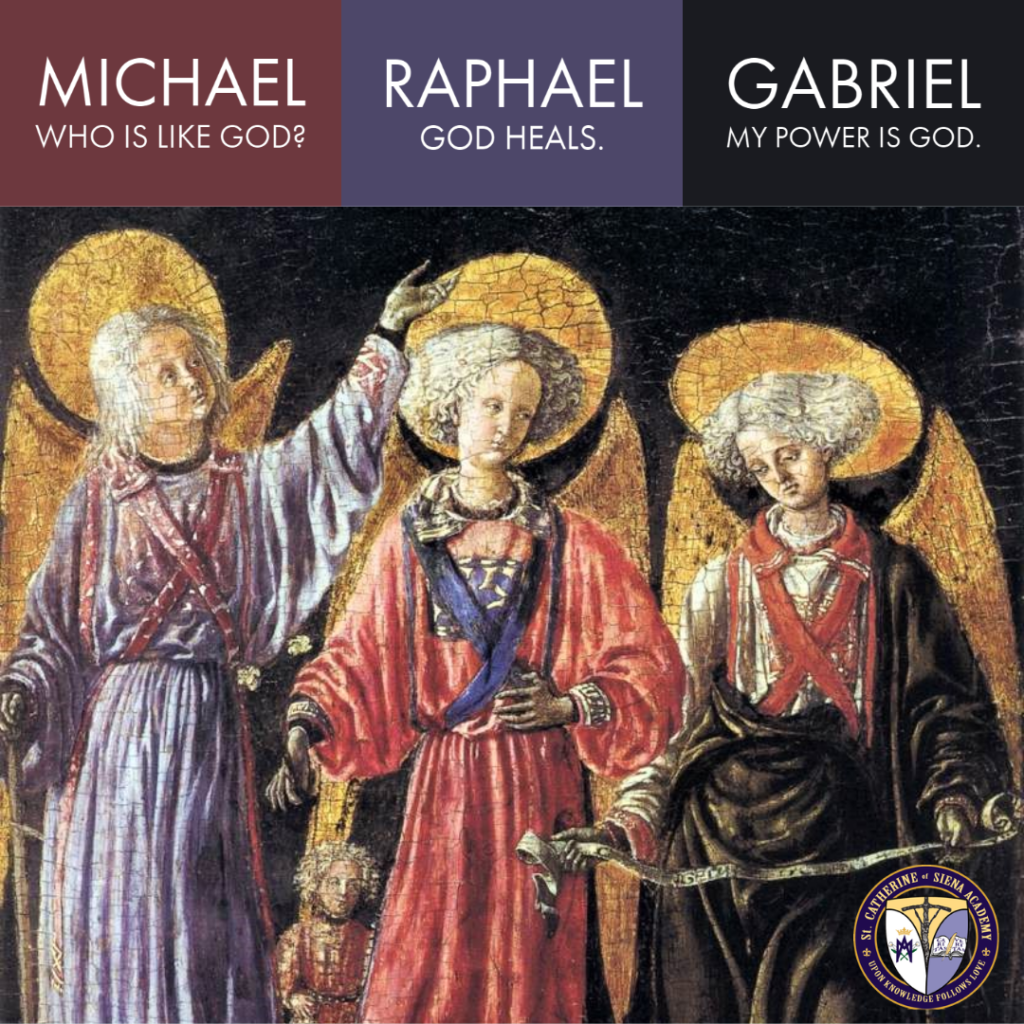
Today we commemorate archangels Michael, Gabriel and Raphael. In the past I didn’t know much about them. And in order to write this sermon I investigated and I found out interesting information that is useful for all of us who are Christian. In my native country, however, people celebrate Saint Archangel Michael as a special saint. There is a tradition called – Slava which is the day when family celebrate a saint or an angel believing that they are their family protector. My grandparents also celebrate Slava in commemoration of Saint Archangel Michael. Let me say a bit more about this custom. Slava (Serbian Cyrillic: Слава, lit. ‘Glory, Celebration’, pronounced [ˈslâʋa]) is a tradition of the ritual of glorification of one’s family’s patron saint, found mainly among Serbian Orthodox Christians. The family celebrates the Slava annually on the saint’s feast day. During the year there are hundreds of saints, but the most of the Slava celebrations occur during the winter. Dates and saints that are most common are: November 8th Sveti Dimitrije (St. Demetrius ), November 21th Sveti Arhanđel Mihailo (St. Archangel Michael), December 19th Sveti Nikola (St. Nicolas). This custom of honoring a family patron saint, celebrated chiefly by the Serbs, but also by some Macedonians, Montenegrins, Bulgarians and Gorani. If we look further, angels are not only celebrated in Orthodox Church. They are celebrated worldwide. If we investigate more we can find out more details in Christian sources about angels and demons.
Who are angels in Christianity?
Angels are represented throughout Christian Bibles as spiritual beings intermediate between God and humans: “Yet you have made them [humans] a little lower than God, and crowned them with glory and honor.” (Psalms 8:4–5). Christians believe that angels are created beings, based on (Psalms 148:2–5; Colossians 1:16). There are 4 types of angels: First Sphere, Seraphim, Cherubim and Thrones. However, chapter 20 of the Book of Enoch mentions seven holy angels who watch, that often are considered the seven archangels: Michael, Raphael, Gabriel, Uriel, Saraqael, Raguel, and Remiel. The Life of Adam and Eve lists the archangels as well: Michael, Gabriel, Uriel, Raphael and Joel. It is also good to know about bad (fallen) angels who are called demons. 7 fallen angels are named after entities from both Christian and Pagan mythology, such as Moloch, Chemosh, Dagon, Belial, Beelzebub and Satan himself. Following the canonical Christian narrative, Satan convinces other angels to live free from the laws of God, thereupon they are cast out of heaven. Some medieval scholars of demonology ascribed to a hierarchy of seven archdemons the seven deadly sins: Lucifer (Pride); Mammon (Avarice); Asmodeus (Lechery); Satan (Anger); Beelzebub (Gluttony); Leviathan (Envy); and Belphegor (Sloth).
In today reading we read: Daniel 7:9-10, 13-14, Revelation 12:7-12 and John 1:47-51 where angels and archangels are mentioned, too. I would like to share these verses in order to let us learn more about the Bible prospect of angels.
Daniel 7:9-10, 13-14
I beheld till the thrones were cast down, and the Ancient of days did sit, whose garment was white as snow, and the hair of his head like the pure wool: his throne was like the fiery flame, and his wheels as burning fire. A fiery stream issued and came forth from before him: thousand thousands ministered unto him, and ten thousand times ten thousand stood before him: the judgment was set, and the books were opened.
In my vision at night I looked, and there before me was one like a son of man, coming with the clouds of heaven. He approached the Ancient of Days and was led into his presence. He was given authority, glory and sovereign power; all nations and peoples of every language worshiped him. His dominion is an everlasting dominion that will not pass away, and his kingdom is one that will never be destroyed.
Revelation 12:7-12
Now war arose in heaven, Michael and his angels fighting against the dragon. And the dragon and his angels fought back, but he was defeated, and there was no longer any place for them in heaven. And the great dragon was thrown down, that ancient serpent, who is called the devil and Satan, the deceiver of the whole world—he was thrown down to the earth, and his angels were thrown down with him. And I heard a loud voice in heaven, saying, “Now the salvation and the power and the kingdom of our God and the authority of his Christ have come, for the accuser of our brothers has been thrown down, who accuses them day and night before our God. And they have conquered him by the blood of the Lamb and by the word of their testimony, for they loved not their lives even unto death. Therefore, rejoice, O heavens and you who dwell in them! But woe to you, O earth and sea, for the devil has come down to you in great wrath, because he knows that his time is short!
John 1:47-51
When Jesus saw Nathanael approaching, he said of him, “Here truly is an Israelite in whom there is no deceit.” “How do you know me?” Nathanael asked. Jesus answered, “I saw you while you were still under the fig tree before Philip called you.” Then Nathanael declared, “Rabbi, you are the Son of God; you are the king of Israel.” Jesus said, “You believe because I told you I saw you under the fig tree. You will see greater things than that.” He then added, “Very truly I tell you, you will see heaven open, and the angels of God ascending and descending on the Son of Man.
I would like to conclude that in one hand we have fallen angels who are tempting us. Many sins that we commit we do with demons` help even though we might not be aware of it. Here are their names and sins they help us to commit – : Lucifer (Pride); Mammon (Avarice); Asmodeus (Lechery); Satan (Anger); Beelzebub (Gluttony); Leviathan (Envy); and Belphegor (Sloth). But as Christians we are blessed with angels and archangels who are also praying for us and helping us in doing well. As mentioned in chapter 20 of the Book of Enoch there are seven holy angels who watch, that often are considered the seven archangels: Michael, Raphael, Gabriel, Uriel, Saraqael, Raguel, and Remiel. This means that we should also pray to archangels and angels the same way that we pray to saints and Holy Mary in order to pray for us and to help us in our daily life. Wishing you a blessed celebration of archangels in the name of the Father and of the Son and of the Holy Spirit. Amen.
Prayer to Your Guardian Angel
Angel of God,
my guardian dear,
To whom God’s love
commits me here,
Ever this day,
be at my side,
To light and guard,
Rule and guide.
Amen.
(‘From infancy to death human life is surrounded by their (the angels) watchful care and intercession. Beside each believer stands an angel as protector and shepherd leading him to life. Already here on earth the Christian life shares by faith in the blessed company of angels and men united to God. ‘ – from the Catechism of the Catholic Church; 336.)

You Have Time? ~ The Rev. Frank Bellino, OPI

There were two major league baseball players, a catcher and a pitcher. They were not only good friends but also men of faith. They both loved baseball so much, that they could not imagine being happy in heaven if there were no baseball there. So, they made a pact that whoever would die first would try to come back and report whether there was baseball in heaven or not.
Shortly after this agreement, the catcher suddenly died and entered his eternal reward. A couple months later, being a man of his word, he appeared in a dream to his friend. “I have good news and I have bad news,” he said. “Which do you want to hear first?” The pitcher responded, “I’ll take the good news”. “Well, the good news is this: there definitely is baseball in heaven. The field is perfect, the crowd is always supportive, and I play every day.” “Wonderful,” said his friend. “What’s the bad news?” “Well, the bad news is, I’m looking at the line-up for tomorrow’s game, and you are scheduled to pitch.”
It is going to happen to all of us sooner or later, with warning or unexpectedly. We will need to pass from this life to the next and make an account of the life we have lived. That is why it would be wise for us to listen to Jesus’ teaching in today’s parable. In this disturbing but important parable we hear how a rich man did not reach eternal life, even though he had been abundantly blessed.
Why did he fail? There is nothing in the parable that shows he was a dishonest man or a mean man. Nothing that says he was unthankful for what he received. He seemed to be a person who enjoyed life and who shared what he had with his family and friends as he feasted sumptuously every day. Nor is there anything in the parable that shows that he mistreated the poor man Lazarus who was at his gate. He did not insult him or abuse him. In fact, it seems that he never even noticed him.
This is what I would suggest is the failure of the rich man: he did not notice Lazarus at his gate. The two of them did not live far apart. Lazarus was sitting at his very door. Yet the rich man lived his life isolated from the poor man. There was a gap between them. The rich man lived his life without noticing the poor man who was close at hand. After his death, the rich man certainly noticed Lazarus. Not only did he notice him, but he wanted to bridge the gap between them. He begged that Lazarus would bring but a bit of water to cool his tormented tongue. But after death we discover that the gulf becomes a chasm, and it is no longer possible to cross it.
Obviously then, the point of the parable is to notice Lazarus at our door and to reach out to him while there is still time.
Lazarus is at our gate. He is one of the more than one million children who are homeless in America, who sleep every night on our streets. He is one of the many fellow Americans who are afflicted with and dying from AIDS. Lazarus is at our door. She is one of the millions of Americans who have no access to health care, who must choose between buying her heart medicine and putting food on her table. Lazarus is at our gate. He is an acquaintance who lost his job through downsizing and has just taken out a second mortgage. She is an elderly woman who is in a nursing home now for ten years where no one visits.
Lazarus is at our door. He is the person in our school or in our office that cries out for respect but must face ridicule every day. She is the person struggling with mental illness who comes off a bit odd and is discounted as a person of value. He is our next door neighbor who recently lost his wife of forty years and hangs around the driveway as we come home, looking for company.
Jesus calls us to notice Lazarus at our door, and to reach out and cross the gulf that isolates us from him. He calls us to do this in a very personal and specific way. It is important to notice in the parable that the rich man did not ignore all the beggars in Israel, but only Lazarus who was closest to him.
We cannot be expected to reach out to the millions of people without health care or the tens of millions who are dealing with grief. But we can be expected to notice the Lazarus who sits at our gate. Who is he? What is her name? You know it. The name is coming to your mind right now. That person is the person that the gospel calls you to recognize, to notice, and to touch. Do not ignore him or her. Do not pretend that the need of one so near to you is not your concern.
There is good news and bad news in today’s gospel. The bad news is that we are very likely ignoring people who are close to us and who are in need. The good news is that there is still time to change. Lazarus is at our door. Jesus calls us to notice him and let our love have influence. Reach out, cross the gulf that presently separates you from him. After death, it will be too late.
 The Order of Preachers, Independent
You must be logged in to post a comment.