
Category: Lesson
Called to Transfigured Service ~ The Rev. Dcn. Mark G. Dickson-Patrick, Novice

Reading 1 – Genesis 12:1-4A
The LORD said to Abram:
“Go forth from the land of your kinsfolk and from your father’s house to a land that I will show you. “I will make of you a great nation,
and I will bless you; I will make your name great, so that you will be a blessing. I will bless those who bless you and curse those who curse you. All the communities of the earth shall find blessing in you.” Abram went as the LORD directed him.
Responsorial Psalm – Psalm 33:4-5, 18-19, 20, 22
- (22) Lord, let your mercy be on us, as we place our trust in you.
Upright is the word of the LORD, and all his works are trustworthy. He loves justice and right; of the kindness of the LORD the earth is full.
R. Lord, let your mercy be on us, as we place our trust in you.
See, the eyes of the LORD are upon those who fear him, upon those who hope for his kindness, To deliver them from death
and preserve them in spite of famine.
R. Lord, let your mercy be on us, as we place our trust in you.
Our soul waits for the LORD, who is our help and our shield. May your kindness, O LORD, be upon us who have put our hope in you.
R. Lord, let your mercy be on us, as we place our trust in you.
Reading 2 – 2 Timothy 1:8B-10
Beloved: Bear your share of hardship for the gospel with the strength that comes from God. He saved us and called us to a holy life,
not according to our works ut according to his own design and the grace bestowed on us in Christ Jesus before time began, but now made manifest through the appearance of our savior Christ Jesus, who destroyed death and brought life and immortality to light through the gospel.
Gospel – Matthew 17:1-9
Jesus took Peter, James, and John his brother, and led them up a high mountain by themselves. And he was transfigured before them;
his face shone like the sun and his clothes became white as light. And behold, Moses and Elijah appeared to them, conversing with him.
Then Peter said to Jesus in reply, “Lord, it is good that we are here. If you wish, I will make three tents here, one for you, one for Moses, and one for Elijah.” While he was still speaking, behold, a bright cloud cast a shadow over them, then from the cloud came a voice that said,
“This is my beloved Son, with whom I am well pleased; listen to him.” When the disciples heard this, they fell prostrate and were very much afraid. But Jesus came and touched them, saying, “Rise, and do not be afraid.” And when the disciples raised their eyes, they saw no one else but Jesus alone.
As they were coming down from the mountain, Jesus charged them, “Do not tell the vision to anyone until the Son of Man has been raised from the dead.”
St. Mother Teresa of Calcutta, the great foundress of the Missionaries of Charity who ministered to the sick, the poor, and the dying in the streets of Calcutta, India, has inspired thousands of people through her life of service to the outcast. Many have been inspired to take up her mantle and continue her work as a member of her order or through their own acts of charity and outreach to the poor, the marginalized, and the oppressed. Many thought that her good works were done in order to help people, that she was called to help people. To this claim, the great saint said, “Many people mistake our work for our vocation. Our vocation is the love of Jesus.” This saint who experienced spiritual darkness for a vast majority of her religious life, and yet still devoted her life and the life of her community to aiding the poor stated that her vocation is “the love of Jesus,” her whole being and calling in life was geared to the love of Jesus alone. How beautiful!
To what are we called? What is our vocation? In our readings today, we are given a good visualization to help us to evaluate our own personal individual calls, our vocations, and how they are lining up with what we are doing in our lives. Are we doing what God is calling us to do? In our first reading, we hear the calling of Abraham, previously known as Abram, as God tells him “I will make your name great, so that you will be a blessing.” Abraham’s calling was to be a great nation, a blessing to all the world. Called to be a Dominican deacon on the road to priesthood, I am called to prayer, study, preaching, and teaching in the spirit of St. Dominic de Guzman.
St. Paul tells Timothy in our second reading that we are to “bear your share of hardship for the gospel with the strength that comes from God.” Because of our salvation, our Lord calls us to a life of particular service to the Kingdom of God. How do we discern this? This is something that my husband, Alex, struggled with particularly as he got involved with the local Church. Through prayer and invitation of the Holy Spirit, he has discovered that he really loves teaching little kids in Sunday school. That is where he finds his inspiration, his niche for the growth of the Kingdom of God. Praise God!
Whatever our calling, whether it be to the priesthood, diaconate, religious life, teaching, lay reader, preaching, or any other form of service to the Kingdom of God, I propose today that we are called to live a life of transfigured service. In our Gospel reading, our Lord takes Peter, James, and John atop the mountain and is there transfigured before them, gleaming white and giving them a foretaste of His resurrection and life after the resurrection. In doing so, our Lord called them and so too calls us, to life of transfigured service, transfigured by His grace and His love and bringing that gift to all people.
Let us ask the Lord to daily transfigure us by His goodness, love, mercy and grace, that we might discover and fully live out the duties of our callings in this life, that we might enter our heavenly reward having accomplished all that the Lord has put before us and we are welcomed home, as the Lord says, “Well done, good and faithful servant. Enter into your rest, prepared for you from before the foundation of the world.”

Blessed Peter Geremia
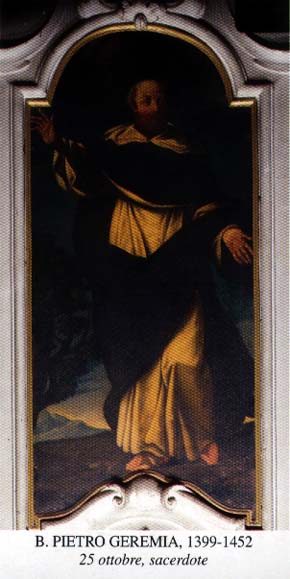
God has a mission for each of us and has given us the gifts to successfully complete the purpose for which He created us. Our job is to discern our role in His creation. The gifts He has given us can be the instrument of our damnation when used against His purposes; when we discern correctly through prayer and spiritual direction these same talents and abilities can sanctify us and those around us. It’s not too late to seek God’s will for your life–in fact, we should attempt to understand His will for our every action, each day, using all the gifts his has given us.
Peter Geremia was unusually gifted. He was sent early to the University of Bologna, where he passed his studies brilliantly, and attracted the attention and praise of all. On the brink of a successful career as a lawyer, he experienced a sudden and total conversion.
Having retired one night, he was pleasantly dreaming of the honors that would soon come to him in his work, when he heard a knock at the window. As his room was on the third floor, and there was nothing for a human to stand on outside his window, he sat up, in understandable fright, and asked who was there.
A hollow voice responded that he was a relative who had just died, a successful lawyer who had wanted human praise so badly that he had lied to win it, and now was eternally lost because of his pride. Peter was terrified, and acted at once upon the suggestion to turn, while there was still time, from the vanity of public acclaim. He went the next day to a locksmith and bought an iron chain, which he riveted tightly about him. He began praying seriously to know his vocation.
Soon thereafter, God made known to him that he should enter the Dominican Order. He did so as soon as possible. His new choice of vocation was a bitter blow to his father, who had gloried in his son’s achievements, hoping to see him become the most famous lawyer in Europe. He angrily journeyed to Bologna to see his son and demanded that he come home. The prior, trying to calm the excited man, finally agreed to call Peter. As the young man approached them, radiantly happy in his new life, the father’s heart was touched, and he gladly gave his blessing to the new undertaking.
Peter’s brilliant mind and great spiritual gifts found room for development in the order, and he became known as one of the finest preachers in Sicily. He was so well known that Saint Vincent Ferrer asked to see him, and they conversed happily on spiritual matters. He always preached in the open air, because there was no church large enough to hold the crowds that flocked to hear him.
Being prior of the abbey, Peter was consulted one day when there was no food for the community. He went down to the shore and asked a fisherman for a donation. He was rudely refused. Getting into a boat, he rowed out from the shore and made a sign to the fish; they broke the nets and followed him. Repenting of his bad manners, the fisherman apologized, whereupon Peter made another sign to the fish, sending them back into the nets again. The records say that the monastery was ever afterwards supplied with fish.
Peter was sent as visitator to establish regular observance in the monasteries of Sicily. He was called to Florence by the pope to try healing the Greek schism. A union of the opposing groups was affected, though it did not last. Peter was offered a bishopric (and refused it) for his work in this matter.
At one time, when Peter was preaching at Catania, Mount Etna erupted and torrents of flame and lava flowed down on the city. The people cast themselves at his feet, begging him to save them. After preaching a brief and pointed sermon on repentance, Peter went into the nearby shrine of Saint Agatha, removed the veil of the saint, which was there honored as a relic, and held it towards the approaching tide of destruction. The eruption ceased and the town was saved.
This and countless other miracles he performed caused him to be revered as a saint. He raised the dead to life, healed the crippled and the blind, and brought obstinate sinners to the feet of God. Only after his death was it known how severely he had punished his own body in memory of his youthful pride (Benedictines, Dorcy).
Born: Palermo, Sicily, Italy, in 1381
Died: March 7, 1432
Beatified: Pius VI confirmed cultus in 1784
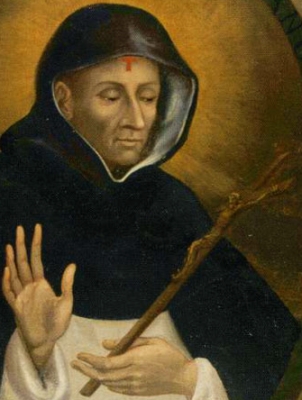
Blessed Jordan of Pisa
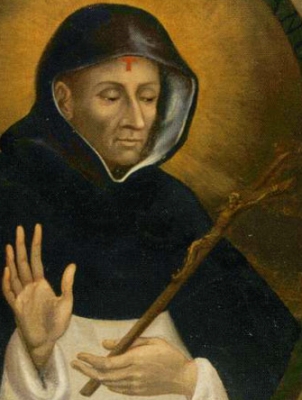
At a time when scholars believed that no colloquial tongue could ever replace Latin as a gentleman’s language, Jordan worked to make Italian the beautiful tongue that it is today. That’s not the reason he was beatified by the Church but it’s interesting and sometimes overlooked.
Jordan attended the University of Paris where he first encountered the Dominican friars in 1276. Four years later, probably after obtaining his degrees, he returned to Italy and took the habit. He began a long teaching career there as soon as he was qualified to do so.
Because of the excellence of his preaching in Florence, Jordan was appointed first lector there in 1305. He seems to have been fascinated with the whole question of preaching as an apostolic tool, and to have been one of the first to make a scientific study of it. He pointed out that the Greek church was “invaded by a multitude of errors,” because the Greeks had no preachers; he could never say enough in praise of Saint Dominic’s farsightedness in establishing an order specifically for preaching.
Jordan studied methods of making sermons more effective, both by using examples that would reach the people, and by the use of the vernacular. This latter was a much-disputed subject in his day (they had Dan Amon’s then, too); Jordan was considered a daring innovator. Because it was controversial, he strove to make Italian a beautiful instrument on which he could play the melodies of the Lord.
Blessed with an extraordinary memory, Jordan is supposed to have known the breviary by heart, as well as the missal, most of the Bible (with its marginal commentary), plus the second part of the Summa. This faculty of memory he used in his sermons, but he was quick to point out to young preachers that learning alone can never make a preacher. By the holiness of his own life he made this plain, and continually preached it to those he was training to preach.
Jordan of Pisa had two great devotions–to Our Blessed Mother and to Saint Dominic. Once he was favored with a vision of Our Lady; she came into the fathers’ refectory and served at table. Jordan, who was the only one who could see her, could barely eat for excitement. He spoke often of her in his sermons, and also of Saint Dominic. He founded a number of confraternities in Pisa, one of which has lasted until now.
Jordan died on his way to Paris to teach at Saint Jacques. His body was returned from Piacenza, where death overtook him, to rest in the church at Pisa (Benedictines, Dorcy).
Born:1255 at Pisa, Italy
Died: August 19, 1311 at Piacenza of natural causes while on his way to teach in Paris; relics venerated at the church of Saint Catalina at Pisa, Italy
Beatified: August 23, 1833 (cultus confirmed) by Pope Gregory XVI; 1838 (beatification)
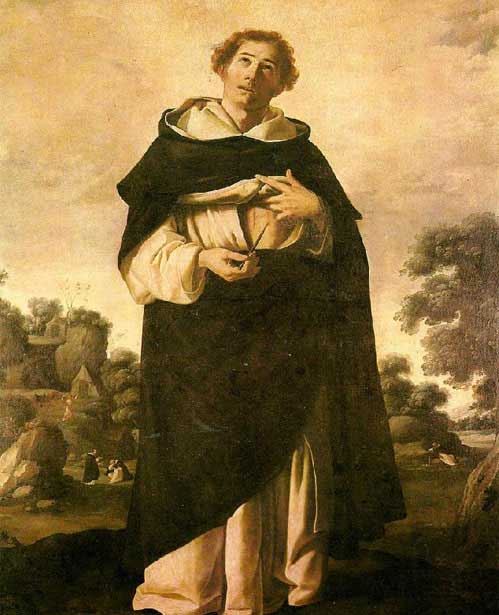
Blessed Henry of Suso ~ Servant of the Eternal Wisdom

His father belonged to the noble family of Berg; his mother, a holy woman from whom he took his name, to a family of Sus (or Süs). When thirteen years of age he entered the Dominican convent at Constance, where he made his preparatory, philosophical, and theological studies.
From 1324 to 1327 he took a supplementary course in theology in the Dominican studium generale at Cologne, where he sat at the feet of Johann Eckhart, “the Master”, and probably at the side of Tauler, both celebrated mystics. Returning to Constance, he was appointed to the office of lector, from which he seems to have been removed some time between 1329 and 1334. In the latter year he began his apostolic career. About 1343 he was elected prior of a convent, probably at Diessenhofen. Five years later he was sent from Constance to Ulrn where he remained until his death.
Suso’s life as a mystic began in his eighteenth year, when giving up his careless habits of the five preceding years, he made himself “the Servant of the Eternal Wisdom”, which he identified with the Divine essence and, in a concrete form, with the personal Eternal Wisdom made man. Henceforth a burning love for the Eternal Wisdom dominated his thoughts and controlled his actions. He had frequent visions and ecstasies, practised severe austerities (which he prudently moderated in maturer years), and bore with rare patience corporal afflictions, bitter persecutions and grievous calumnies.
He became foremost among the Friends of God in the work of restoring religious observance in the cloisters. His influence was especially strong in many convents of women, particularly in the Dominican convent of Katherinenthal, a famous nursery of mysticism in the thirteenth and fourteenth centuries, and in that of Toss, where lived the mystic Elsbeth Stagel, who turned some of his Latin into German, collected and preserved most of his extant letters, and drew from him the history of his life which he himself afterwards developed and published.
In the world he was esteemed as a preacher, and was heard in the cities and towns of Swabia, Switzerland, Alsace, and the Netherlands. His apostolate, however, was not with the masses, but rather with individuals of all classes who were drawn to him by his singularly attractive personality, and to whom he became a personal director in the spiritual life.
It has often been incorrectly said that he established among the Friends of God a society which he called the Brotherhood of the Eternal Wisdom. The so-called Rule of the Brotherhood of the Eternal Wisdom is but a free translation of a chapter of his “Horologium Sapientiae”, and did not make its appearance until the fifteenth century.
HIS WRITINGS
The first writing from the pen of Suso was the “Büchlein der Wahrheit”, which he issued while a student at Cologne. Its doctrine was unfavourably criticized in some circles — very probably on account of its author’s close relations with Eckhart, who had just been called upon to explain or to reject certain propositions — but it was found to be entirely orthodox.
As in this, so in his other writings Suso, while betraying Eckhart’s influence, always avoided the errors of “the Master”. The book was really written in part against the pantheistic teachings of the Beghards, and against the libertine teachings of the Brethren of the Free Spirit. Father Denifle considers it the most difficult “little book” among the writings of the German mystics.
Whereas in this book Suso speaks as a contemplative and to the intellect, in his next, “Das Büchlein der ewigen Weisheit”, published early in 1328, he is eminently practical and speaks out of the fullness of his heart to “simple men who still have imperfections to be put off”. Bihlmeyer accepts Denifle’s judgment that it is the “most beautiful fruit of German mysticism”, and places it next to the “Homilies” of St. Bernard, and the “Imitation of Christ” by Thomas à Kempis. In the second half of the fourteenth and in the fifteenth century there was no more widely read meditation book m the German language.
In 1334 Suso translated this work into Latin, but in doing so added considerably to its contents, and made of it an almost entirely new book, to which he gave the name “Horologium Sapientiae”. Even more elevating than the original, finished in language, rich in figure, rhythmic in movement, it became a favourite book in the cloisters at the close of the Middle Ages, not only in Germany, but also in the Netherlands, France, Italy, and England.
To the same period of Suso’s literary activity may belong “Das Minnebüchlein” but its authenticity is doubtful.
After retiring to Ulm Suso wrote the story of his inner life (“Vita” or “Leben Seuses”), revised the “Büchlein der Wahrheit”, and the “Büchlein der ewigen Weisheit”, all of which, together with eleven of his letters (the “Briefbüchlein”), and a prologue, he formed into one book known as the “Exemplar Seuses”.
Suso is called by Wackernagel and others a “Minnesinger in prose and in the spiritual order.” The mutual love of God and man which is his principal theme gives warmth and colour to his style. He used the full and flexible Alamannian idiom with rare skill, and contributed much to the formation of good German prose, especially by giving new shades of meaning to words employed to describe inner sensations. His intellectual equipment was characteristic of the schoolmen of his age. In his doctrine there was never the least trace of an unorthodox tendency.
For centuries he exercised an influence upon spiritual writers. Among his readers and admirers were Thomas à Kempis and Bl. Peter Canisius.
The Catholic Encyclopedia, Volume VII
Nihil Obstat, June 1, 1910, Remy Lafort, S.T.D., Censor
Imprimatur. +John Cardinal Farley, Archbishop of Ne
Born: March 21, 1295 at Uberlingen, Germany as Heinrich von Berg
Died: January 25, 1361 at Ulm, Germany
Beatified: 1831 by Pope Gregory XVI
Representation: Dominican with the Holy Name on his chest
Works: Book of the Eternal Wisdom, The Thirst of God
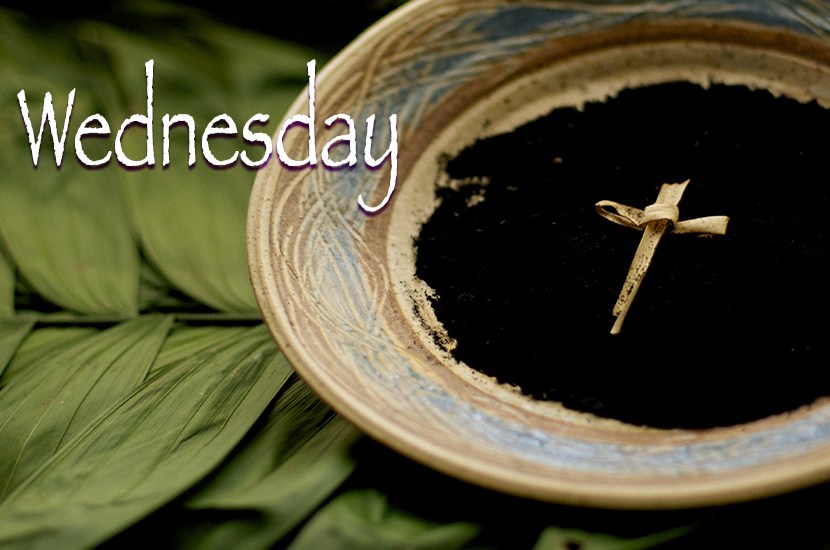
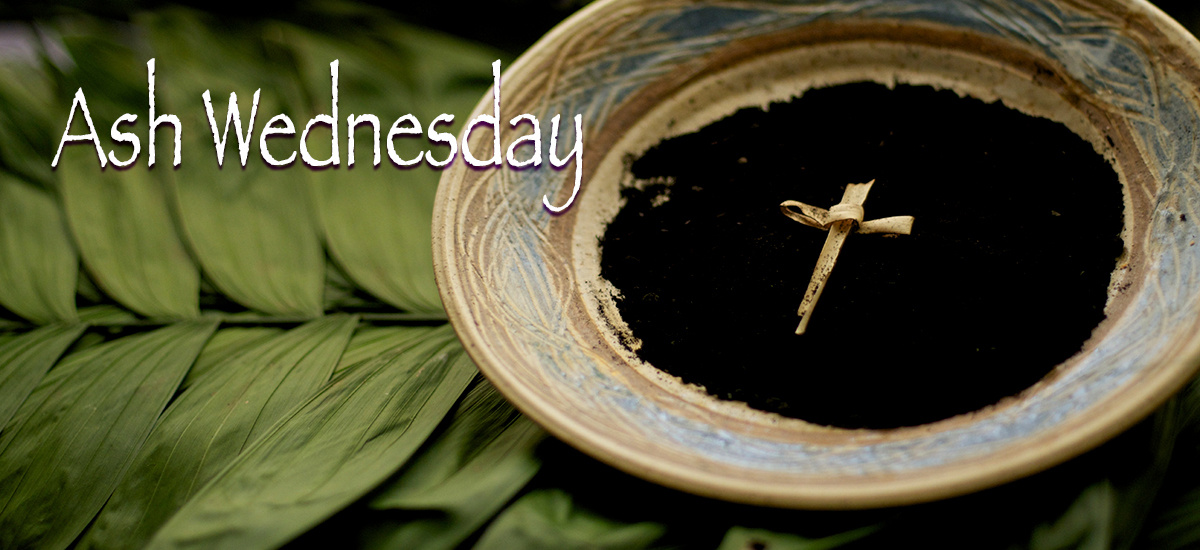
Ashes Thou Art ~ Ash Wednesday ~ Br. Brent Whetstone
Blessed Villana
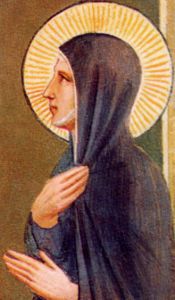
Blessed Villana was the daughter of Andrew de’Botti, a Florentine merchant, and was born in 1332. When she was thirteen she ran away from home to enter a convent but her attempts were unsuccessful and she was forced to return. To prevent any repetition of her flight, her father shortly afterwards gave her in marriage to Rosso di Piero. After her marriage she appeared completely changed; she gave herself up to pleasure and dissipation and lived a wholly idle and worldly life. One day, as she was about to start for an entertainment clad in a gorgeous dress adorned with pearls and precious stones, she looked at herself in a mirror. To her dismay, the reflection that met her eyes was that of a hideous demon. A second and a third mirror showed the same ugly form.
Thoroughly alarmed and recognizing in the reflection the image of herself sin-stained soul, she tore off her fine attire and, clad in the simplest clothes she could find, she betook herself weeping to the Dominican Fathers at Santa Maria Novella to make a full confession and to ask absolution and help. This proved the turning point of her life, and she never again fell away. Before long Villana was admitted to the Third Order of St. Dominic, and after this she advanced rapidly in the spiritual life. Fulfilling all her duties as a married woman, she spent all her available time in prayer and reading. She particularly loved to read St. Paul’s Epistles and the lives of the saints. At one time, in a self-abasement and in her love for the poor, she would have gone begging for them from door to door had not her husband and parents interposed. So completely did she give herself up to God that she was often rapt in ecstacy, particularly during Mass or at spiritual conferences; but she had to pass through a period of persecution when she was cruelly calumniated and her honor was assailed.
Her soul was also purified by strong pains and by great bodily weakness. However, she passed unscathed through all these trials and was rewarded by wonderful visions and olloquies with our Lady and other saints. Occasionally the room in which she dwelt was filled with supernatural light, and she was also endowed with the gift of prophecy. As she lay on her deathbed, she asked that the Passion should be read to her, and at the words “He bowed His head and gave up the ghost”, she crossed her hands on her breast and passed away. Her body was taken to Santa Maria Novella, where it became such an object of veneration that for over a month it was impossible to proceed with the funeral.
People struggled to obtain shreds of her clothing, and she was honored as a saint from the day of her death. Her bereaved husband use to say that, when he felt discouraged and depressed, he found strength by visiting the room in which his beloved wife had died.
Born: 1332 in Florence, Italy
Died: December of 1360 of natural causes; body taken to Santa Maria Novella; the Fathers were unable to bury her for a month due to the constant crowd of mourners
Beatified: March 27 1824 (cultus confirmed) by Pope Leo XII
Blessed Constantius
Constantius Bernocchi is as close to a ‘sad saint’ as it’s possible for a Dominican to get; he is said to have had the gift of tears. However, that is not his only claim to fame. Constantius had a remarkable childhood, not only for the usual signs of precocious piety, but also for a miracle that he worked when he was a little boy. Constantius had a sister who had been bedridden most of her nine years of life. One day, the little boy brought his parents in to her bedside and made them pray with him. The little girl rose up, cured, and she remained well for a long and happy life. Naturally, the parents were amazed, and they were quite sure it had not been their prayers that effected the cure, but those of their little son.
Constantius entered the Dominicans at age 15, and had as his masters Blessed Conradin and Saint Antoninus. He did well in his studies and wrote a commentary on Aristotle. His special forte was Scripture, and he studied it avidly. After his ordination, he was sent to teach in various schools in Italy, arriving eventually at the convent of San Marco in Florence, which had been erected as a house of strict observance. Constantius was eventually appointed prior of this friary that was a leading light in the reform movement. This was a work dear to his heart, and he himself became closely identified with the movement.
Several miracles and prophecies are related about Constantius during his stay in Florence. He one day told a student not to go swimming, because he would surely drown if he did. The student, of course, dismissed the warning and drowned. One day, Constantius came upon a man lying in the middle of the road. The man had been thrown by his horse and was badly injured; he had a broken leg and a broken arm. All he asked was to be taken to some place where care could be given him, but Constantius did better than that–he cured the man and left him, healed and astonished.
Constantius was made prior of Perugia, where he lived a strictly penitential life. Perhaps the things that he saw in visions were responsible for his perpetual sadness, for he foresaw many of the terrible things that would befall Italy in the next few years. He predicted the sack of Fabriano, which occurred in 1517. At the death of Saint Antoninus, he saw the saint going up to heaven, a vision which was recounted in the canonization process.
Blessed Constantius is said to have recited the Office of the Dead every day, and often the whole 150 Psalms, which he knew by heart, and used for examples on every occasion. He also said that he had never been refused any favor for which he had recited the whole psalter. He wrote a number of books; these, for the most part, were sermon material, and some were the lives of the blesseds of the order.
On the day of Constantius’s death, little children of the town ran through the streets crying out, “The holy prior is dead! The holy prior is dead!” On hearing of his death, the city council met and stated that it was a public calamity.
The relics of Blessed Constantius have suffered from war and invasion. After the Dominicans were driven from the convent where he was buried, his tomb was all but forgotten for a long time. Then one of the fathers put the relics in the keeping of Camaldolese monks in a nearby monastery, where they still remain (Benedictines, Dorcy, Encyclopedia).
Born: Born in the early part of the 15th century in Fabriano, Marches of Ancona, Italy
Died: 1481 of natural causes; the local senate and council assembled at the news of his death, proclaimed it a “public calamity”, and voted to pay for the funeral
Beatified: 1821 (cultus confirmed) by Pope Pius VII
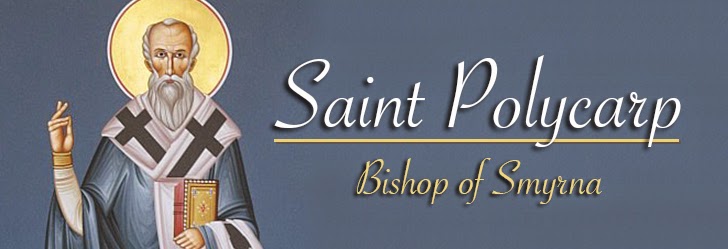
St. Polycarp: Counting the Cost ~ The Very Rev. Lady Sherwood, OPI
Reading 1: SIR 5:1-8
R psalm: PS 1:1-2, 3, 4+6
Gospel: MK 9:41-50
Do not be afraid of those who kill the body but cannot kill the soul. Rather, be afraid of the one who can destroy both body and soul in hell.(MT 10:28 NIV)
We are not of this world if we are of Christ, and are only temporarily passing through. The world does not understand us and has hate for us. To be truly of Christ means that like he did, we must take up our crosses and follow him no matter what the world thinks of us. The minimum we are likely to get is to be called heretic, but at the worst, we could be called to suffer death to follow our Lord, and this is what happened to St Polycarp who we commemorate today.
Polycarp was a disciple of John the Apostle and it was John who consecrated Polycarp as Bishop of Smyrnia. Together with Clement of Rome and Ignatius of Antioch, Polycarp is regarded as one of the three chief Apostolic Fathers.
Polycarp was 86 years old when he was called to give his life for the Lord. It was a time in Rome, when the Roman Emperor was seen as a God and was worshipped, but Polycarp refused to denounce Christ and to follow this false God.
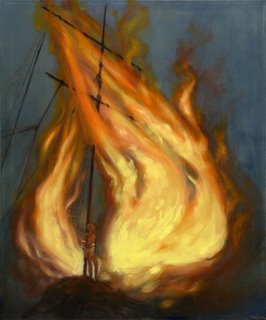
Polycarp was threatened by the men of Caesar that he would be thrown into a pit of wild animals if he did not denounce Christ, but Polycarp refused to budge. He escaped and hid on a farm and it was there that he had a dream about his pillow catching fire, and he knew it meant the Lord’s will for him was to be burned alive. Polycarp was resigned to his fate and in prayer, he even thanked God and praised him.
Polycarp was found, arrested, tied, and the fire was lit to burn him, but the flames formed an arch over him and his body was untouched. Instead of the expected look and smell of burning flesh, Polycarp glowed like golden baking bread and the fragrance was sweet like perfume. Because the fire didn’t touch him, they then stabbed Polycarp with a dagger, he succumbed to bodily death, and his blood poured and extinguished the flames of the fire.
After the death of Polycarp, his bones were stolen from the remains of the fire to celebrate his martyrdom. Polycarp gained the Crown of martyrdom on February 23rd 156.
Polycarp is an excellent example of living for God, accepting his will and trusting in him completely. He knew that Christ by giving his own earthly life for our salvation, meant that whilst the body may be harmed, the Spirit is eternal for a true follower of God and that there is nothing to fear.
Let us take the example of Polycarp into our lives, and fully live the will of God without complaint and with joy of thanks and praise to our heavenly Father.
Let us pray:
Saint Polycarp, sometimes Christ seems so far away from us. Centuries have passed since he and the Apostles walked upon the earth. Help us to realize that he is close to us always and that we keep him close by imitating his life as you did.
Amen.
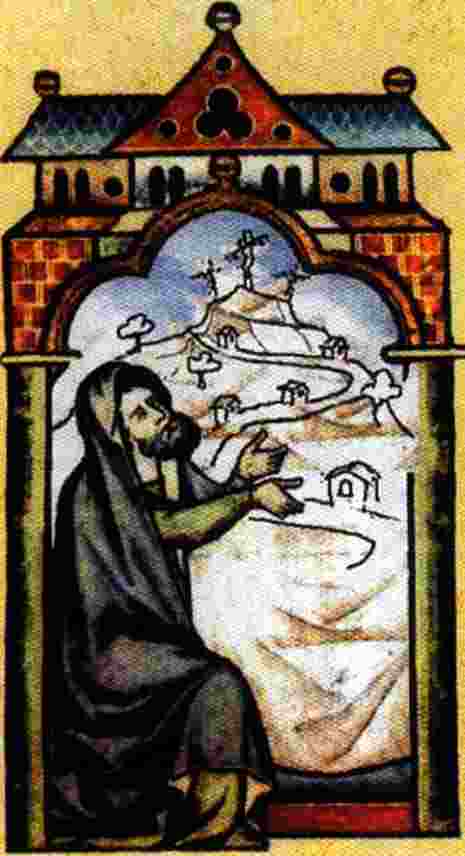
Blessed Alvarez of Cordova
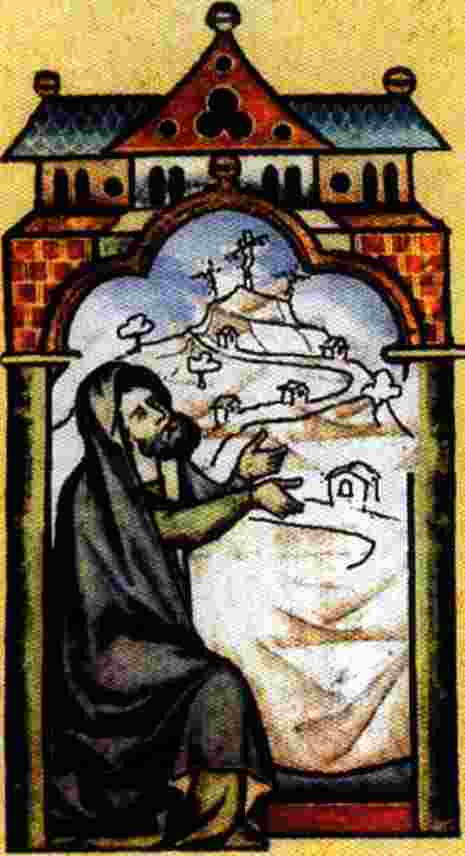
Blessed Alvarez is claimed by both Spain and Portugal. He received the habit in the convent of Saint Paul in Cordova in 1368, and had been preaching there for some time in Castile and Andalusia when Saint Vincent Ferrer began preaching in Catalonia. Having gone to Italy and the Holy Land on a pilgrimage, Alvarez returned to Castile and preached the crusade against the infidels. He was spiritual advisor to the queen-mother of Spain, Catherine daughter of John of Gaunt, and tutor to her son John II. Alvarez had the work of preparing the people spiritually for the desperate effort to banish the Moors from Spain. He also opposed the Avignon pope Peter de Luna.
Blessed Alvarez is probably best remembered as a builder of churches and convents, an activity which was symbolic of the work he did in the souls of those among whom he preached. He founded, in one place, a convent to shelter a famous image of Our Lady, which had been discovered in a miraculous manner. Near Cordova he built the famous convent of Scala Coeli, a haven of regular observance. It had great influence for many years. His building enterprises were often aided by the angels, who, during the night, carried wood and stones to spots convenient for the workmen.
The austerities of Alvarez were all the more remarkable in that they were not performed by a hermit, but by a man of action. He spent the night in prayer, as Saint Dominic had done; he wore a hairshirt and a penitential chain; and he begged alms in the streets of Cordova for the building of his churches, despite the fact that he had great favor at court and could have obtained all the money he needed from the queen. He had a deep devotion to the Passion, and had scenes of the Lord’s sufferings made into small oratories in the garden of Scala Coeli.
On one occasion, when there was no food for the community but one head of lettuce left from the night before, Blessed Alvarez called the community together in the refectory, said the customary prayers, and sent the porter to the gate. There the astonished brother found a stranger, leading a mule; the mule was loaded with bread, fish, wine, and all things needed for a good meal. The porter turned to thank the benefactor and found that he had disappeared.
At another time, Blessed Alvarez was overcome with pity at a dying man who lay untended in the street. Wrapping the man in his mantle, he started home with the sufferer, and one of the brothers asked what he was carrying. “A poor sick man,” replied Alvarez. But when they opened the mantle, there was only a large crucifix in his arms. This crucifix is still preserved at Scala Coeli.
Blessed Alvarez died and was buried at Scala Coeli. An attempt was made later to remove the relics to Cordova, but it could not be done, because violent storms began each time the journey was resumed, and stopped when the body was returned to its original resting place.
Founded Escalaceli (Ladder of Heaven), a Dominican house of strict observance in the mountains around Cordova; it became a well known center of piety and learning. Alvarez spent his days there preaching, teaching, begging alms in the street, and spending his nights in prayer. In the gardens of the house he set up a series of oratories with images of the Holy Lands and Passion, similar to modern Stations of the Cross.
A bell in the chapel of Blessed Alvarez, in the convent of Cordova, rings of itself when anyone in the convent, or of special not in the order, is about to die (Benedictines, Dorcy).
There are many wonderful stories attached to Alvarez, which include:
|
||
|
||
|
||
|
||
|
Born: Born about the middle of the 14th century in Cordova, Spain
Died: 1420
Beatified: Cultus confirmed September 22 by Benedict XIV in 1741
Perfection Through Perfect Love ~ Br. Brenden Humberdross, Novice

Open our ears, O Lord, to hear your word and know your voice. Speak to our hearts and strengthen our wills that we may serve you now and always. Amen.
Anyone perusing the stories of the Old Testament for the first time will quickly come to realise that the history of Israel is full of stories of violence, revenge and bitter rivalries. In numerous places Israel is allowed to take revenge for the wrongs done to them and in today’s Gospel reading Jesus highlights this fact twice by saying:
“You have heard that it was said,
An eye for an eye and a tooth for a tooth” and
“You have heard that it was said,
You shall love your neighbor and hate your enemy”
To the Jew of Christ’s time these would have been familiar ideas, and principles that their lives have been lived by. In hearing Christ use these words those listening would have likely been awaiting to hear a discourse of the righteous judgements of Israel and their right to punish those who have wronged them and to resists the evils perpetrated against them. However, in His typical style the message that the Saviour delivers to the gathered crowd is absolutely counter to their cultural experience.
In the words of Jesus those of us who are called to follow His path are called not to lives of vengeance and righteous retribution but to love, and this love extends to all of humanity, friend and enemy alike. This life of love is not only transformative for the world and people around us but is an essential part of the path that will lead to our salvation.
I’m sure that each and every one of us has been faced with a situation where we’ve been treated badly or someone’s done something to hurt us. If we allow our minds to wonder through these events and are honest with ourselves I’m sure we’d find that our first thoughts are often of how to even the score, how to get our own back and level the playing field. It seems that there’s nothing more natural than for a person to want what’s often seen as natural justice to occur, for the thief to have to return their spoils and have their freedom stolen through imprisonment, for the violent individual to be the recipient of violence or for the murderer to receive the punishment of State sanctioned execution.
I‘ve even heard Christians justify their convictions in these matters by quoting the very Old Testament scriptures that Jesus did in today’s Gospel. It seems that when we’re faced with hurt that the most natural human state is revenge, however, Jesus clearly points out to us that this seeking of revenge and “natural justice” is far from natural at all and is in fact part of our fallen condition.
In fact the Saviour points out to us that the most natural and perfect state for the hurt and the wronged is the exact opposite of revenge and hate; it’s love! In the reading this morning Jesus tells us directly that when we encounter evil we’re not to resist it, that we should welcome it and “turn the other cheek” to take a double portion of the evil being delivered.
It seems so counter intuitive to me to do this, why on earth would we ever let someone strike us a second time? Why would we let a thief not only take the expensive watch from our wrist but, unprompted, take the wallet from our pocket and give that to them to? It’s because of that higher law that I spoke of last week, the law of love. I have heard our Eastern Brethren share a story of the Desert Fathers to illustrate this point.
One day a Desert Father is away from his shack wandering the deserted paths, praying and contemplating. When he returns home he finds that there are strangers there stripping his dwelling of what few possessions he has. The Father is perturbed and concerned and falls to his knees in the corner of his small dwelling and instead of praying for deliverance, he begins to pray for the thieves, their safety and their wellbeing. At this the thieves are confused and worried, so they grab the last of the things from the dwelling and get out of there.
The story doesn’t end here though, on rising from his prayers for the thieves the Father notices that his walking stick has been left behind. He moves over to it, picks it up, and sets off out the door. Instead of going to find one of his fellow hermits and lament his position he sets off in pursuit of the thieves. It takes the Desert Father many days to catch up to the thieves and when he does, instead of chastising them he hands them his walking stick and tells them they forgot it.
The thieves are perplexed by this ragged old man of the desert and his actions but they are touched by his love. Instead of fighting them off, he prayed for them, instead of chasing them and demanding the return of his possessions the Desert Father gives them his last earthly good. The Desert Father has given himself over totally to loving humanity as God does and through this action these thieves are converted to Christ.
And so it can be with each and every one of us; loving our neighbours and our enemies isn’t about flowery, abstract feelings, it’s about real life decisions and actions. It’s about deciding to look on our fellow human beings through the eyes of God. It’s about taking the love that God has given us and letting it well up and overflow through us onto fallen humanity.
If each and every one of us committed to freeing ourselves from hate, sadness and anger can you imagine the impact that we could have on the world? How many of those that come in contact with us would be touched by the transformative love of God if we chose to reject evil and its outward manifestations and impacts? Now don’t get me wrong, I’m not saying that this is an easy path, or one that I have even begun to master, but it’s the path that each and every one of us, as followers of Christ are called to tread.
Each one of us is called to be a vessel of the perfect Love of God; one of Jesus’ greatest wishes was that we could all be perfect as God is perfect. The start of the path that leads to this perfection is the rejection of the resistance of evil that Christ speaks about today. If we can begin now to empty ourselves of hate, of sadness and of our anger we can begin to be filled with the perfect love of God and be ready to unite ourselves with God and become one with him in the perfect bonds of salvation!
It’s my prayer this day, for each and every one of us, that we can recognise within ourselves those times when we are giving ourselves over to hate and anger and begin to deliver ourselves from these and create a world of love paving the way for not only our own salvation but for the salvation of the whole world.
In the name of the Father, and of the Son and of the Holy Spirit. Amen.


You must be logged in to post a comment.