
Category: Lesson

Follow Me ~ The Rev. Dennis Klinzing, Novice

When Jesus left the Pharisee’s house, great crowds followed Him, but He was not impressed by their enthusiasm. He knew that most of those in the crowd were not the least bit interested in spiritual things. Some wanted only to see miracles, others heard that He fed the hungry, and a few hoped He would overthrow Rome and establish David’s promised kingdom. They were expecting the wrong things.
Jesus turned to the multitude and preached a sermon that deliberately thinned out the ranks. He made it clear that, when it comes to personal discipleship, He is more interested in quality than quantity. In the matter of saving souls, He wants His house to be filled, but in the matter of personal discipleship, He wants only those who are willing to pay the price.
A ‘disciple’ is a learner, one who attaches himself or herself to a teacher in order to learn a trade or a subject. Perhaps our nearest modern equivalent is ‘apprentice,’ one who learns by watching and by doing. The word disciple was the most common name for the followers of Jesu Christ and is used 264 times in the Gospels and the book of Acts.
Jesus seems to make a distinction between salvation and discipleship. Salvation is open to all who will come by faith, while discipleship is for believers willing to pay a price. Salvation means coming to the cross and trust Jesus Christ, while discipleship means carrying the cross and following Jesus Christ. Jesus wants as many sinners saved as possible, but He cautions us not to take discipleship lightly, and in the three parables He gave, He made it clear that there is a price to pay.
To begin with, we must love Christ supremely, even more than we love our own flesh and blood. The word hate does not suggest positive antagonism but rather ‘to love less.’ Our love for Christ must be so strong that all other love is like hatred in comparison. In fact, we must hate our own lives and be willing to bear the cross after Him.
What does it mean to ‘carry the cross?’ It means daily identifications with Christ in shame, suffering, and surrender to God’s will. It means death to self, to serve Him as He directs. A ‘cross’ is something we willingly accept from God as part of His will for our lives. The Christian who called his noisy neighbors the ‘cross’ he had to bear certainly did not understand the meaning of dying to self.
Jesus gave three parables to explain why He makes such costly demands on His followers: the man building a tower, the king fighting a war, and the salt losing its flavor. The usual interpretation is that believers are represented by the man building the tower, the king fighting the war, and we had better ‘count the cost.’ Truthfully the builder and the king represents not the believer but Jesus Christ. He is the one who must ‘count the cost’ to build the church and battle the enemy. He cannot get the job done with halfhearted followers who will not pay the price.
Discipleship is serious business. If we are not true disciples, then Jesus cannot build the tower and fight the war. If we will tell Jesus that we want to take up our cross and follow Him as His disciples, then He wants no false expectancy, no illusions, no bargains. He wants to use us as stones for building His church, soldiers for battling His enemies, and salt for bettering His world, and He is looking for quality.
After all, He was on His way to Jerusalem when He spoke these words, and look what happened to Him there! He does not ask us to do anything for Him that He has not already done for us.
To some Jesus says, ‘You cannot be MY disciple.’ Why? Because they will not forsake all for Him, bear shame and reproach for Him, and let their love for Him control them. They are the losers. Will you be His disciple?
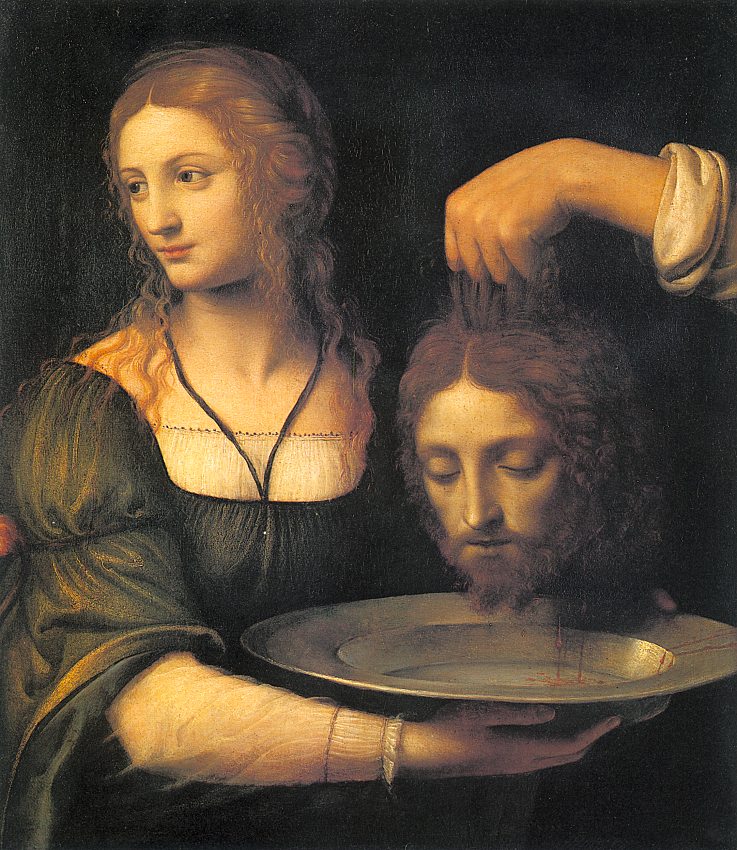
Beheading of John the Baptist~ The Rev. Dcn. Dollie Wilkinson, OPI
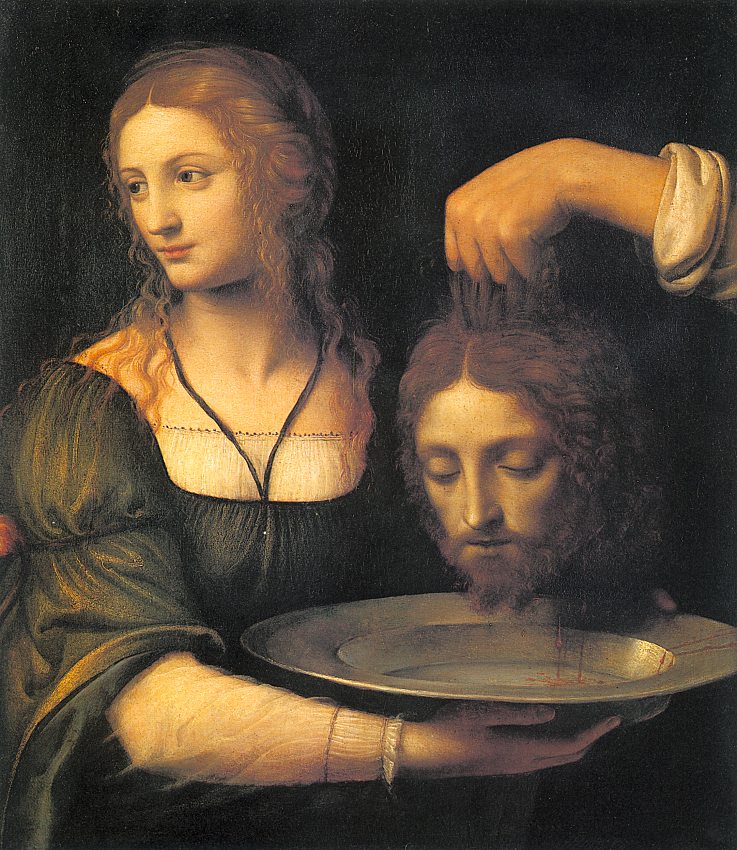
While reading of the beheading of John the Baptist, I am reminded of such violence that occurs today. While not widely accepted, there are still individuals being beheaded. This may be by random violence (such as murder), or acts committed by individuals who are following a particular religious or cultural belief. But even in this digital age of violent video games, movies, and television shows, beheadings are still viewed as a gruesome spectacle. Can you imagine how such a thing was perceived during the time of Jesus? Yet this is what occurred, all to appease the whims of a young girl.
Mark 6:17-29 (KJV)
“For Herod himself had sent forth and laid hold upon John, and bound him in prison for Herodias’ sake, his brother Philip’s wife: for he had married her. For John had said unto Herod, It is not lawful for thee to have thy brother’s wife. Therefore Herodias had a quarrel against him, and would have killed him; but she could not: For Herod feared John, knowing that he was a just man and an holy, and observed him; and when he heard him, he did many things, and heard him gladly. And when a convenient day was come, that Herod on his birthday made a supper to his lords, high captains, and chief estates of Galilee; And when the daughter of the said Herodias came in, and danced, and pleased Herod and them that sat with him, the king said unto the damsel, Ask of me whatsoever thou wilt, and I will give it thee. And he swore unto her, Whatsoever thou shalt ask of me, I will give it thee, unto the half of my kingdom. And she went forth, and said unto her mother, What shall I ask? And she said, The head of John the Baptist. And she came in straightway with haste unto the king, and asked, saying, I will that thou give me by and by in a charger the head of John the Baptist. And the king was exceeding sorry; yet for his oath’s sake, and for their sakes which sat with him, he would not reject her. And immediately the king sent an executioner, and commanded his head to be brought: and he went and beheaded him in the prison. And brought his head in a charger, and gave it to the damsel: and the damsel gave it to her mother. And when his disciples heard of it, they came and took up his corpse, and laid it in a tomb.”
Here we have Herod Antipas, smiling and nodding with approval, as his step-daughter swayed and twirled in front of him and his birthday party guests, her graceful figure filling them with longing. When her performance was done, Herod and the guests applauded. What a dance! So entranced by her perforrmance and the mood of the moment, Herod cried, “Ask me what you want, up to half my kingdom, and it is yours!” And he swore a great oath to confirm his promise. As a Tetrarch (ruler of one quarter of a Roman province) Herod was more than able to provide a handsome gift even by first century standards. Would his step daughter ask for a jeweled necklace? A dowry? A house? Herod and the guests waited to hear her request. The girl herself hesitated. Uncertain what to ask for, she whispered with her mother.
Down in the dungeons of Herod’s fortress (named Machaerus) a man’s fate was about to be decided. John the Baptizer was under lock and key in one of those gloomy holds. The cause was this: he had rebuked Herod for stealing another man’s wife, namely Herodias. This woman had been married to Herod’s quiet half brother, Phillip. Herodias was furious, and convinced Herod to arrest John. Herod was only too willing because he was suspicious of the large crowds John attracted.
However, once Herod got John in his lockup, he talked with him and found he liked the guy. He didn’t understand what John was saying about holiness and salvation, but it seemed to be something he should hear. Instead of executing John, he gave him visitation privileges. Execution would be a bad idea anyway. John had a lot of followers; why make them mad and risk rebellion?
Having made up her mind, Herod’s stepdaughter approached him. The guests and the king turned to hear what she would ask. “Give me now the head of John the Baptizer on a platter!” said the girl. Even the reckless, hardened lot must have drawn sharp breaths at the gruesome request. How quickly the indulgent mood melted. Did Herod’s face change? Here was an awkward demand! Used to thinking of people as objects, used to beheading men at a whim, it never occurred to him to say, “An incorruptible prophet like John the Baptizer is worth more than my whole kingdom.” Looking around at his guests, he saw only one thing. If he was to save face, he must fulfill his promise. He ordered the execution.
According to a long-standing tradition, John was beheaded on this day, August 29, probably around the year A.D. 28. What happened to John’s head, we do not know. His disciples came and buried the body. Remains alleged to be his were later taken to Alexandria, Egypt and placed in a specially built church. When John’s cousin Jesus heard the news, we imagine it hit him as hard as it would any of us. He tried to get away by himself for a time. John, who had preached Christ’s coming and prepared for His messianic ministry was needlessly dead in the prime of his life.
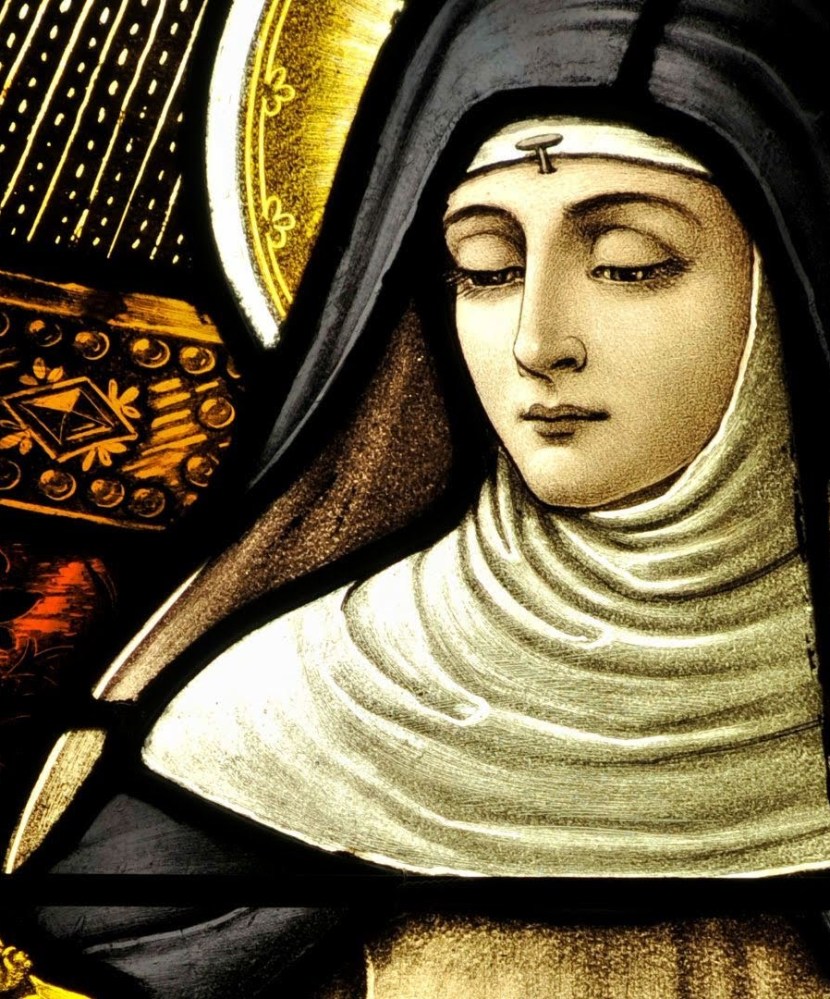
All in God’s Time ~ The Feast of St. Monica ~ The Rev. Lady Sherwood, OPI
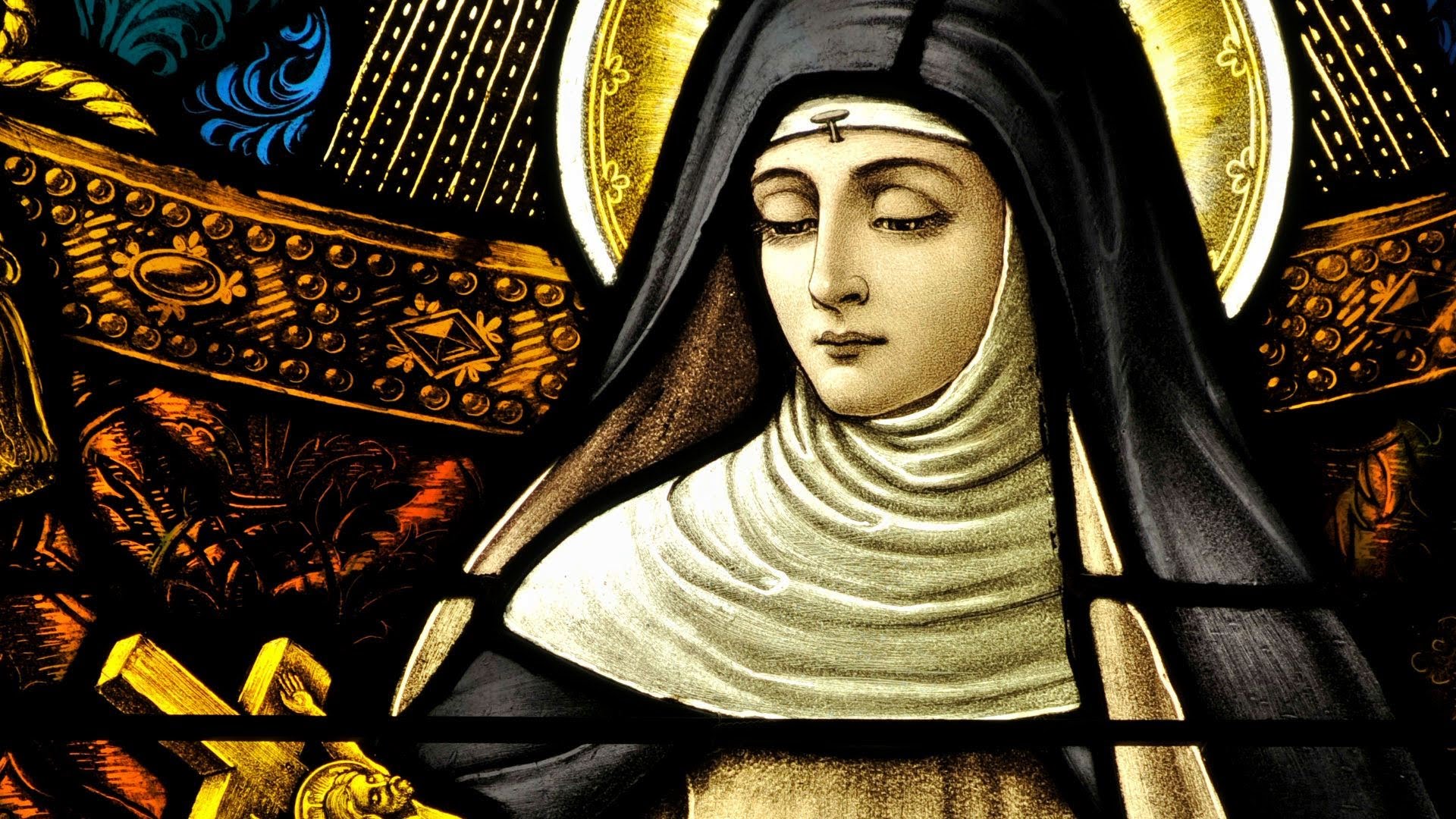
St. Monica.. All in God’s Time
Today we celebrate the Memorial of St. Monica. Although she is usually mainly thought of as the Mother of St. Augustine, who we celebrate tomorrow, Monica is truly a Saint in her own right. Her life clearly shows us why she is known as one of the Patron Saints of tolerance and patience. We can all definitely learn from the example of St. Monica within our lives.
Monica’s life shows us the true realism that still exists in many families even today. She could be seen by some as an obsessive, overbearing mother who drove her son crazy chasing after him until he would convert. She would’ve probably driven her bishop crazy with all her tears. The example of Monica’s life and her tolerance and patience clearly shows us how we should ourselves be living for a more full and true relationship with God Our Father. We need to stop wanting a personal genie, or instant answers to the prayers we send when we feel we need help or change within our lives. The Lord does listen to all of our prayers and will always do that which is best for us, even if not the response we may be seeking. However, God our Father answers in His own time and not in ours.
When most people think of St. Monica, several things probably come to mind: Her determination in prayer, her amazing dedication as a mother, her patient, long-suffering as the wife of an adulterous pagan with a mean-spirited pagan mother-in-law.
St Monica reminds me of the persistent widow in the gospel of Luke 18:1-8:
And he told them a parable to the effect that they ought always to pray and not to lose heart. 2. He said, “In a certain city there was a judge who neither feared God nor respected man. 3. And there was a widow in that city who kept coming to him and saying,
‘Give me justice against my adversary.’ 4 For a while he refused, but afterward he said to himself, ‘Though I neither fear God nor respect man, 5 yet because this widow keeps bothering me, I will give her justice, so that she will not beat me down by her continual coming.’” 6 And the Lord said, “Hear what the unrighteous judge says.7 And will not God give justice to his elect, who cry to him day and night? Will he delay long over them? 8 I tell you, he will give justice to them speedily. Nevertheless, when the Son of Man comes, will he find faith on earth?”
So with this in Our Minds, let us pray:
St. Monica,
troubled wife and mother,
many sorrows pierced your heart during your lifetime.
Yet, you never despaired or lost faith.
With confidence, persistence, and profound faith,
you prayed daily for the conversion
of your beloved husband, Patricius,
and your beloved son, Augustine;
your prayers were answered.
Grant us that same fortitude, patience,
and trust in the Lord.
Intercede for us, dear St. Monica,
and grant us the grace to accept His Will in all things,
through Jesus Christ, our Lord,
in the unity of the Holy Spirit,
one God, forever and ever.
Amen.

Will Only a Few Be Saved? ~ The Very Rev. Jay Van Lieshout, OPI

“Will only a few be saved”? How this question must have annoyed Jesus! Here He was speaking of the good news of God’s love and revealing the path to God’s kingdom here on Earth and this bean counter wants to talk numbers; well not really numbers, this man wanted to know who will be saved and more specifically was he probably included in the saved group. From Jesus’ reply it is evident that He saw right through the veiled question and deep into the man’s self righteous heart. So, instead of answering the question, Jesus gives allegorical directions then a warning of the outcome if one fails to take His advice and, of course, a description of the reward for those who do walk the righteous path.
Jesus tells the man, and those listening to “strive to enter through the narrow gate”. The word translated as strive in the Greek is agonizesthe, meaning to contend for. So just like an Olympian who struggles to surmount all obstacles to win the gold we too must rise up to the challenge and it will not be easy to get through this narrow gate. Why is passing through this gate so challenging? Is it really, really narrow or perhaps has some complicated lock? Remember ancient cities were protected by walls, and in these walls were openings, the gates which were closed at night and during battle. The main gate was large and allowed carts of merchandise, people riding donkeys or horses and crowd of people to easily enter or exit. The main gate was also where the triumphant and royal would process in or out as a form of spectacle. The narrow or pedestrian gate was small and had sharp turns which made it difficult to navigate in armor let alone to draw ones sword and attack; this was the gate for the common people, the beggar, the slave to use. And when these gates are closed, as say during attack, entrance to the city is impossible, you are stuck out in the open, a victim to the raiding army.
But WHY must we agonize and struggle to enter the pedestrian gate, can’t we just walk in? Think about any adventure movie you have ever seen. After hauling all their precious equipment past impediments along the way, fighting off competitors and then finding the treasure, reaching the apex of the adventure the glorious moment always falls apart. After all their struggles and perils, our team of adventurers must hasten to escape or they will surely die; the only means of escape requires them to abandon their treasure, leave their evidence of victory and shed everything but the scraps of clothes on their back in order to survive. Inevitably there is one member who refused to leave the treasure behind, who agonizes over whether to relinquish the riches and fame and flee to safety or hold one to them and hope for the best.
This is the moment Jesus is speaking of, this is the struggle we must face if we wish to walk the path to the Father. We must be willing to divest ourselves of the baggage that weighs us down, holds us back, blocks us from escaping the impending trials of what life throws at us: greed, hate, envy, gluttony, the fear that we might lose out and someone else might beat us. It is a competition, but one where we only battle our own flaws and insecurities. We must always be ready to open our hands and let things go when we face life’s choices; release our treasures for not only our own sake but for the benefit of those around us, those in need, who have less and ask for little. Here too, we might be willing to let those people go who cannot escape the grip of their own fears, those who drag us down instead of lifting us and others up. In essence we must set ourselves free from the worldly desires to be at the top, first in line, best in show, greatest of all, so that we, like the adventurers in the movies, the heroes and heroines of book and film, might escape and find a different sort of reward in telling the stories of our journey’s true success. For it is only when we take a more humble place in line and allow others to go first that’s we begin to shed the armor of our own fears and desires in lieu of a more ignoble and simple garment of altruism, forgiveness and love which easily slips through that narrow gate into the God’s kingdom.
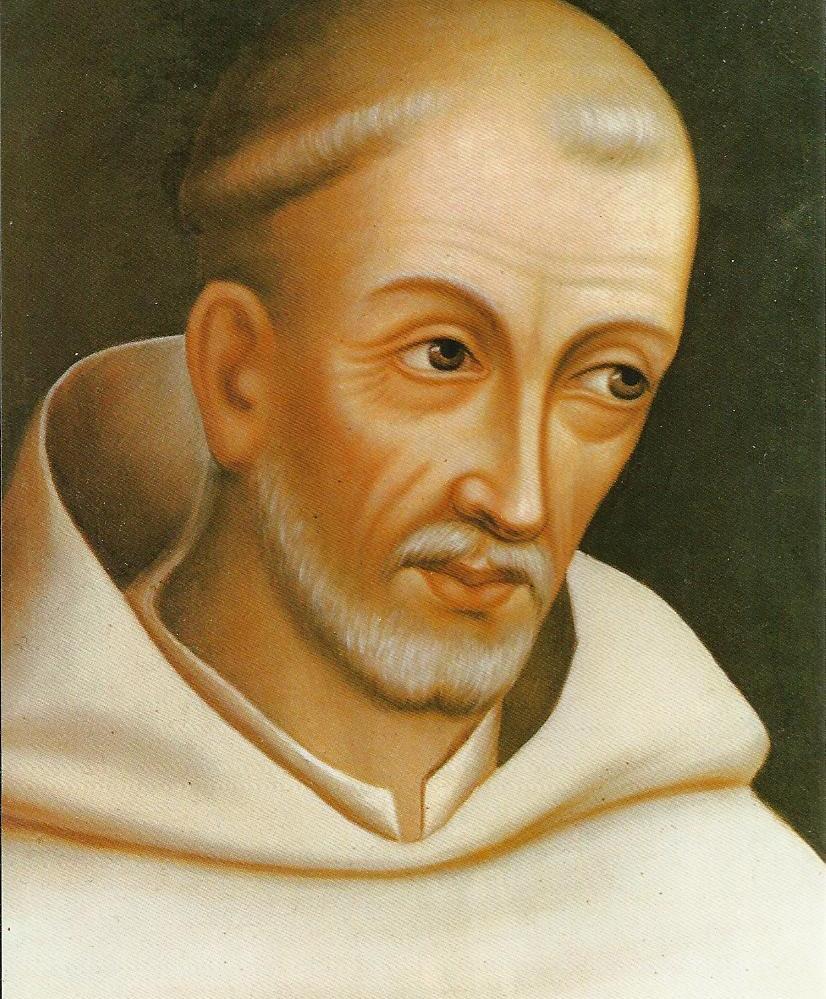
St. Bernard of Clairvaux ~ Br. Chip Noon, Novice
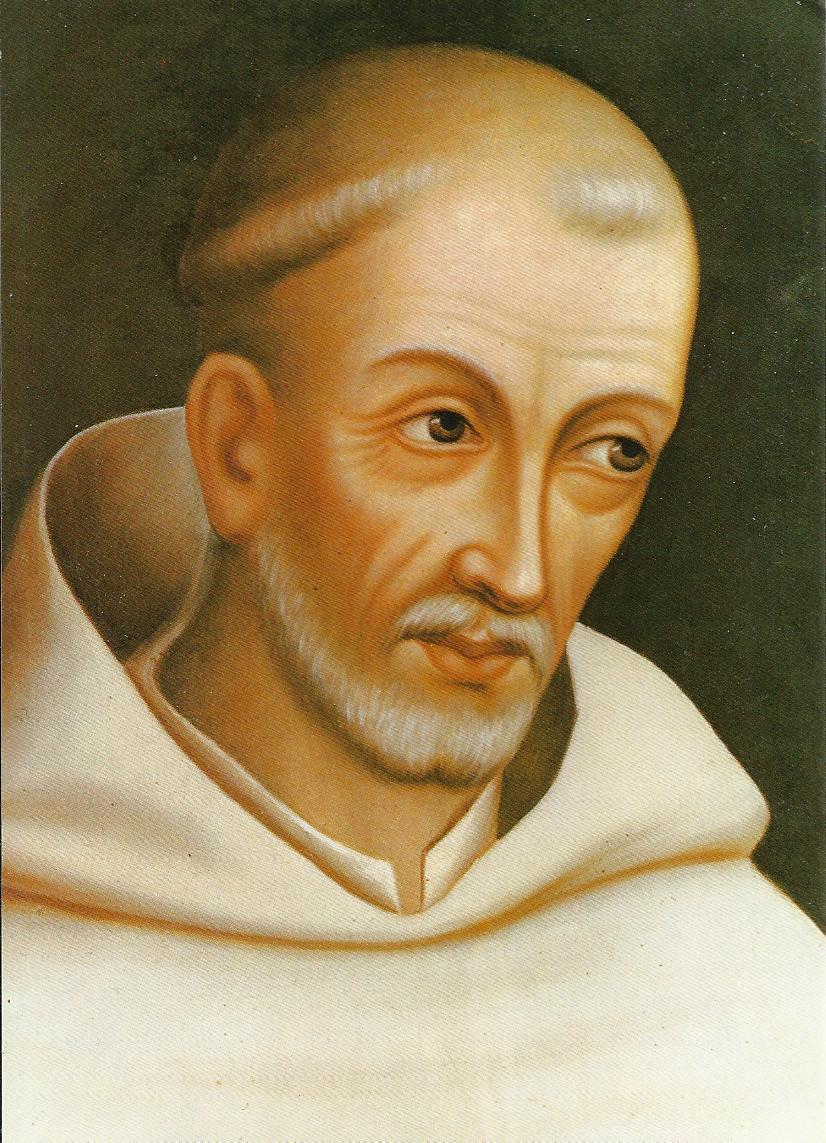
Today is the Memorial of St. Bernard of Clairvaux. He was born in 1090 in France, and died there in 1153. He was the abbot of a monastery in what became known as Clairvaux, a confessor, and a Doctor of the Church. From our vantage point today, looking back 800 years, we recognize that he was a man of sincere beliefs, a lover of God and the Blessed Mother, a mediator and salesman for the Roman Catholic Church, and a man of contradictions.
First, let us look at the reading from today’s Mass, Ezekiel, Chapter 43, Verses 1 through 7.
The angel led me to the gate which faces the east,
and there I saw the glory of the God of Israel
coming from the east….
It continues to describe the vision he had of the temple, and of the calamities befalling the Holy Land and its inhabitants, and in this passage illustrates the temple itself and what happened to him there. God was speaking to him: “…here I will dwell among the children of Israel forever.”
And in the Responsorial Psalm, we see the echo of these words:
- The glory of the Lord will dwell in our land.
The LORD himself will give his benefits;
our land shall yield its increase.
Justice shall walk before him,
and salvation, along the way of his steps.
How fitting that these readings should be found in the memorial mass of St. Bernard.
Isn’t it true that we tend to look backwards in time and see only a few highlights? Don’t we think of the early Middle Ages as a time of kings and queens and knights and pages and wars and the beginnings of the crusading spirit? Don’t we see it as a time fixed in amber, with what we consider “history” encapsulating a small insect or artifact representing the whole era?
In reality, St. Bernard lived in a time about as tumultuous as our own. Yes, there were kings and queens and all the characters of our historical novels and movies. But just as today, there were disputes over territory, the wording of Bible passages, the meaning of life…all the issues we face but with considerably more complexity since the forms of governance and separation of powers and cultural norms were not nearly as codified as we know them today.
And in this mix is St. Bernard, a man of God who had all the temptations and misdirections and questions we have. He was a man of such intellect, charisma, and organizational expertise that the monastery he founded at Clairvaux grew so rapidly that they had to send out monks to other parts of Europe to relieve the overflow in the founding house.
He travelled around France and Italy and Sicily to garner support for the legitimacy of Pope Innocent II, disputed with Peter Abelard, and preached the Second Crusade, among his many activities. His disagreement with Abelard centered on what he said was the application of logic where logic didn’t belong and was therefore illogical. Admittedly, this is a major condensation of the argument, but it points to an important contribution of St. Bernard to the time.
St. Bernard was not one to close his eyes to the new applications of philosophical thinking, but with Abelard showed that while reason and logic were valuable to the growth of our intellect, there are certain truths, embodied in the teachings of Jesus and the scriptures that should not be disputed “logically.” One example of this kind of thinking can be found in his complete devotion to the Blessed Mother. St. Bernard referred to her as the Mediatrix, but did not believe in the Immaculate Conception. Faith and reason residing in the same person. It was his desire to bring order and sense to the tumult which was the 12th Century that resonates with the first reading where Ezekiel is showing God’s desire to set things aright after a period of chaos.
Which brings me to today’s Gospel.
To me, this completely encapsulates St. Bernard’s life and work. All worldly show, all human knowledge, all accomplishments and discoveries, in fact, everything that humans strive for are nothing as compared to the love of God and one’s neighbor. Whatever we show to the world and desire from the world must be put to this test: “You have but one teacher, and you are all brothers.” So no matter how learned he was, how fervent in his warlike desire to protect the Holy Land, how partisan he was in backing one pope over another, beneath all this he was a servant of man and of God. And he remained true to this devotion to Jesus and Mary to the end of his life.
Would that we could all be like this.
Lord, move in us the desire to search out new vistas, new knowledge, new advancements. But keep us always mindful of your humility and grace, and give us the courage and logic of St. Bernard that after 800 years still holds truth as that precious artifact within the gemstone of amber.
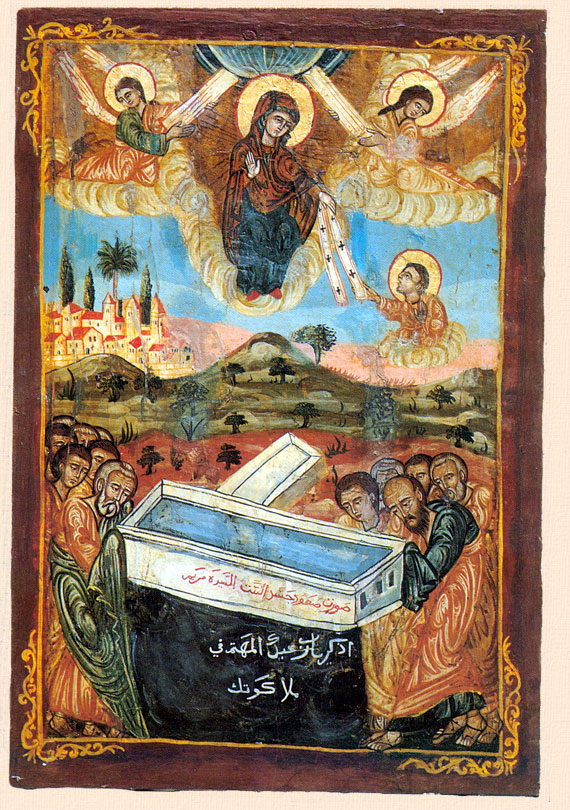
Assumption of the Blessed Virgin Mary ~ Br. Michael Marshall, Novice

As human beings, we are able to think about the future and make plans, we can remember past events, and we even have the ability to be creative and be problem solvers. But more importantly, we are created in God’s image; and because we are made in His own image, we possess the understanding of spirituality; and that God has a plan for each of us, even before we are born. That being said, I need to point out that even though God has a plan for each of us, He does not choose who gets an illness, and who does not; but rather there is a mission given to each of us. We often do not understand what it is, but we all have one.
And so as we celebrate the Solemnity of the Assumption, we need to understand that Mary too had received a mission even before she was conceived. She had not understood that mission until later. God was already thinking of her, and as some believe, was conceived without original sin, which is one of the reasons it was so fitting for God to assume her directly into heaven when her earthly mission was finished, as we celebrate today. She is part of the plan for our salvation. Just as the death on the cross is an act of love for us, Mary has a special place in the ongoing history of salvation, because he wants to tell us something about his love for us. Like the love that our birth mother provides us, God’s love is gentle, patient, and always watching over us.
A lot of people get caught up in the image of a woman which is described in Revelation and with whom we associate with Mary; the twelve stars and all of that stuff. Yet more importantly, another thing which is special about Mary is her faith and devotion through prayer. This is evident within the Gospel reading, as we read about Mary’s visit to Elizabeth. When Mary hears Elizabeth tells Mary that there is somebody special within her womb, she praises God in prayer; a prayer which we recite during Evening Prayer every evening:
“My soul proclaims the greatness of the Lord;
my spirit rejoices in God my Savior
for he has looked with favor on his lowly servant.
From this day all generations will call me blessed:
the Almighty has done great things for me
and holy is his Name.
He has mercy on those who fear him
in every generation.
He has shown the strength of his arm,
and has scattered the proud in their conceit.
He has cast down the mighty from their thrones,
and has lifted up the lowly.
He has filled the hungry with good things,
and the rich he has sent away empty.
He has come to the help of his servant Israel
for he has remembered his promise of mercy,
the promise he made to our fathers,
to Abraham and his children forever.”
In this prayer, she has a conversation with God, which this great faith, along with accepting God’s will for us, is one of the reasons Mary was rewarded the Assumption. She teaches us that we need to also have a prayerful life in order to understand and accept our mission which God has called us to fulfill. It is not easy to pray always, especially when we do not know how to pray or are facing trials which seem overwhelming. But she is a model in which we need to follow in order to build a good relationship with God. The question is whether we are going to follow her example or not.
Lord, may we look to Mary as a model and example of how to trust God through our faith, and build our relationship with you with prayer. We ask this through Christ, Our Lord. Amen.

Got Stuff? ~ The Rev. Dcn. Dennis Klinzing, Novice

Someone in the crowd said to Jesus, “Teacher, tell my brother to share the inheritance with me.” He replied to him, “Friend, who appointed me as your judge and arbitrator?”
Then he said to the crowd, “Take care to guard against all greed, for though one may be rich, one’s life does not consist of possessions.”
Then he told them a parable. “There was a rich man whose land produced a bountiful harvest. He asked himself, ‘What shall I do, for I do not have space to store my harvest?’
And he said, ‘This is what I shall do: I shall tear down my barns and build larger ones. There I shall store all my grain and other goods and I shall say to myself, “Now as for you,
you have so many good things stored up for many years, rest, eat, drink, be merry!”’
But God said to him, ‘You fool, this night your life will be demanded of you; and the things you have prepared, to whom will they belong?’ Thus will it be for all who store up treasure for themselves but are not rich in what matters to God.” Luke 12:13-21
At this point, a man in the crowd interrupted Jesus and asked Him to solve a family problem (feud). Rabbis were expected to help settle legal matters, but Jesus refused to get involved. Why? Because He knew that no answer He gave would solve the real problem, which was covetousness in the hearts of the two brothers. As long as both men were greedy no settlement would be satisfactory. Their greatest need was to have their hearts changed. Like too many people today, they wanted Jesus to serve them, but not save them.
Covetousness is an unquenchable thirst for getting more and more of something we think we need in order to be truly satisfied. It may be a thirst for money or the things that money can buy, or even a thirst for position and power. Jesus made it clear that true life does not depend on an abundance of possessions. He did not deny that we have certain basic needs. He only affirmed that we will not make life richer by acquiring more of these things.
Mark Twain once defined ‘civilization’ as ‘a limitless multiplication of unnecessary necessities,” and he was right. In fact, many Christians are infected with covetousness and do not know it. They think that Paul’s admonition in 1 Timothy 6 applies only to the ‘rich and famous.’ Measured by the living standards of the rest of the world, most believers in America are indeed wealthy people.
Jesus told this parable to reveal the dangers that lurk in a covetous heart. As you read it, test your own responses to this farmer’s various experience.
How do you respond to the wealthy farmer’s dilemma? Here was a man who had a problem with too much wealth! If we say, “I certainly wish I had that problem! we may be revealing covetousness in our hearts. If suddenly you inherited a great deal of wealth, would it create a problem for you? Or would you simply praise God and ask Him what He wanted you to do with it?
There are perils to prosperity. Wealth can choke the Word of God, create sinners and temptations, and give you a false sense of security. People say that money does not satisfy, but it does satisfy if you want to live on that level. People who are satisfied only with the things that money can buy are in great danger of losing the things that money cannot buy.
This farmer saw his wealth as an opportunity to please himself. He had no thoughts of others or of God.
How do you respond to the decisions of the rich man? Are you saying, “Now that is a shrewd business!”Save and have it ready for the future!” But Jesus saw selfishness in all that this man did, and He said the man was a fool. The world’s philosophy is “Take care of Number One!” But Jesus does not endorse that philosophy.
There is certainly nothing wrong with following good business principles, or even with saving for the future. Jesus does not encourage waste. But neither does Jesus encourage selfishness motivated by covetousness.
How do you respond to the farmer’s desires? Are you saying, “This is the life! The man has success, satisfaction, and security! What more could he want?” But Jesus did not see this farmer enjoying life; He saw him facing death! Wealth cannot keep us alive when our time comes to die, nor can it buy back the opportunities we missed while we were thinking of ourselves and ignoring God and others.
Jesus has made it clear that true life does not come from an abundance of things, nor does true success or security. This man had a false view of both life and death. He thought that life came from accumulating things and that death was far away.
Finally, how do you respond to the death of the boastful farmer? We are prone to say, “Too bad this fellow died just when he had everything going for him! How tragic that he could not finish his great plans.” But the greatest tragedy is not what the man left behind, but what lay before him; eternity without God! The man lived without God and died without God, and his wealth was but an incident in his life. God is not impressed with our money.
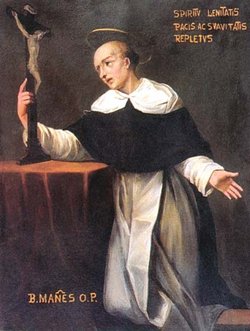
Blessed Mannes de Guzman
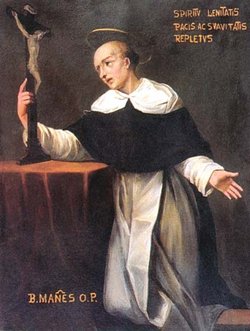
None of the early historical writers of the Order fail to mention Blessed Mannes. His stock was not the least noble among the grandees of Catholic Spain. His parents were Felix Guzman and Jane of Aza, in whose veins also ran some of the best blood of Old Castile. On both sides Mannes could count brave defenders of his country. But what was of infinitely greater importance to him were the holy lives of his own immediate family. His father was a splendid type of the Christian gentleman. His mother has been raised to the honors of the altar under the name of Blessed Jane. His eldest brother, Anthony, became a model priest, who devoted his life to the care of souls, the welfare of the poor, and the aid of the sick, and died with a great reputation for sanctity. Dominic, the youngest and perhaps the only other child, became the founder of the Friars Preacher. He is canonized. Surely this is a record of which any one might well be proud.
Blessed Mannes first saw the light of day in the ancestral castle, Caleruega, Old Castile. The date of his birth can only be estimated from that of Saint Dominic (1170), than whom, we are told, he was a number of years older. Like Anthony, he chose the ecclesiastical state at an early age. Of his ordination to the priesthood and where he made his studies we know nothing. However, Spain was most likely the theater of both. The earlier writers of the Order, while reticent about these things, all tell us that he was of a retiring disposition, and much given to prayer and contemplation.
Yet an apostolic zeal evidently burned in his breast. Almost immediately after the return to Spain of the Right Rev. Didacus (or Diego) de Azebes (often called de Azevedo), bishop of Osma, whom Saint Dominic had accompanied to Rome, Mannes set out for France. From the bishop he learned the need of missionaries in Languedoc, where Dominic had been left to combat the errors of the Albigenses. Possibly de Azebes, for he was a saintly prelate, suggested that Mannes should also take up this work. At any rate, we find him with his younger brother before the close of 1207. From this time the two men, for they were cast in the same spiritual mold, toiled hand in hand for nearly ten years that they might free the Church of southern France from the poison and turmoil of heresy, and restore it to its former peace and beauty.
Not once in all this time did Mannes take a vacation, or pay a visit to his native land, which he loved none the less because he had dedicated himself to the service of God. He felt that his place was where religion needed his attention so sadly. His zeal was tireless; his efforts unceasing. Perhaps on no other did Dominic depend so much. Doubtless, if the full truth were known, history would have to associate Mannes more closely with the saint’s success, as well as give him more credit for the part he played in the conversion of the Albigenses. No danger or hardship could cause him to falter in his labors. He was a splendid preacher. Like Dominic, he intermingled prayer with his sermons and instructions. By his shining virtues and mortified life he wielded a stronger influence for good, whether among the faithful or those who had wandered from the path of truth, than by his eloquence.
One of Blessed Mannes’ most striking traits seems to have been his humility. He knew not the meaning of the word pride or jealousy. The one thing he sought was the glory of God and the salvation of souls. Although older in years, he obeyed his brother as a dutiful son does the will of his father. When Saint Dominic established his Order, Mannes was among the first to place himself under his standard, and to receive the habit. Thus we find him among the “sixteen” zealous men whom God selected as the foundation stones on which to build the Order of Friars Preacher. One would be perfectly safe in the assertion that, when (August 15, 1217) the chosen little band took their religious vows on bended knees before the patriarch, not one of them entered into the ceremony with a better heart, or in more of a spirit of self-sacrifice, than Blessed Mannes.
This event took place in the conventual church of the Dominican Sisters, Prouille, southern France. The annals of Prouille are very explicit in the matter. From their statement and that of Father John of Navarre about the time of his entrance into the Order, which he made in his testimony to the holy life of Dominic to the papal commission appointed to examine the saint’s cause for canonization, it would seem that the sixteen brethren had taken their vows at Saint Romanus’, Toulouse, after Innocent III sanctioned the foundation of the Order. However, after its confirmation by Honorius III, Dominic had them renew their profession. Such was his love for Prouille, around which so much of his work centered, that he chose this place for the ceremony, and as the point of their departure for the various countries to which he sent them.
Blessed Mannes was chosen as one of those who were to start a house of the new Order in Paris. He had six companions — Matthew of France, who was the superior; Bertrand of Garrigue, so called from the place of his birth, a little town in southern France; Lawrence of England; the two Spaniards, John of Navarre and Michael de Fabra; and Oderic of Normandy. The last mentioned has the distinction of being the Order’s first lay brother. They travelled in two parties. That composed of Mannes, Michael, and Oderic reached their destination first, September 12, 1217, being the day of their arrival in the great French capital.
For a while the fathers were obliged to live in a house near Notre Dame Hospital, in the center of the city. But their zeal, eloquence, and model lives soon won them many friends. Among these was John de Barastre, a celebrated master of the University of Paris, dean of Saint Quentin, and a royal chaplain. The noted ecclesiastic had established a hospice for strangers near the gate of the city called “Porte d’Orleans.” The hospice bore the name of Saint James. This he now conferred on the homeless Friars Preacher, and they took possession of it August 6, 1218. It became the famed Saint James’ Convent and Studium, than which none is more celebrated in the Order.
Thus Blessed Marines was one of the founders of this well-known institution, which played a conspicuous part in the history of the University of Paris. His sermons are said to have borne rich fruit in the French capital, for he had a splendid gift of oratory. Besides, he was endowed with an extraordinary personal magnetism; while his kindly, open, and friendly disposition exercised a strong influence over souls. Few could resist his appeals for a better life.
Just when the subject of this sketch left Paris, where he was much beloved, the writers do not tell us. But it is known that Saint Dominic himself sent him from there to Madrid, Spain; and from this we can form a most reasonable conjecture as to the time when Mannes returned to his native land, which he does not appear to have seen since 1207. While in Spain in connection with affairs of his Order, Dominic found Peter of Madrid organizing some pious ladies for a religious community in that city. The saint gave them the habit, admitted them to their vows, and started the construction of a convent for them. This was early in 1219. From Spain he made his way to Paris. While in this city, which he reached before the middle of the same year, he evidently appointed Blessed Mannes to take charge of the sisters in Madrid, and sent him to the Spanish capital; for we find him there shortly afterwards.
Several things, no doubt, conspired to bring about the choice of Mannes for this position. He was growing old, and long years of hard missionary labor must have begun to tell upon his strength. He was a most spiritual, devout, and prudent man, which recommended him for such a charge. His disposition led him to prefer a quiet, retired life, in which he could give himself more to prayer and contemplation, to one of activity among the people. Besides, his practical turn of mind rendered him a suitable person to superintend the temporal affairs of the sisters, whose cloistered state made this difficult for themselves. The holy man called their convent Saint Dominic of Silos, which he doubtless did because his own brother was named after the Cistercian abbot.
From Madrid Blessed Mannes attended the second general chapter of the Order, which was held at Bologna in 1221. Through him, on his return, Saint Dominic sent a letter to the youthful community of Spanish sisters, which is of no little interest because it is the only authentic writing of the saint which has survived the ravages of time. In it he tells them, briefly, of the joy it gave him to hear, through his brother Mannes, of their piety and of the completion of their convent. Both the one and the other are largely due to Mannes’ exertions. He is, therefore, constituted their ecclesiastical superior, with almost plenary powers.
Very probably the holy man held this position the rest of his days, for we find no record of him elsewhere. With this work, we doubt not, he combined no little preaching in and around Madrid. At times perhaps his confrères took his place at the sisters’ convent, while he labored in more distant localities. His life as a religious is said ever to have been edifying to his brethren and useful to his fellow man. Some place his death in 1230. Others say that he died about this time (“circiter 1230″).
But the Année Dominicaine informs us that Roderic “de Cerrate,” a Spanish Dominican of the thirteenth century, states (in his Vitae Sanctorum) that, after Saint Dominic’s canonization, Mannes went to Caleruega and persuaded the people to erect a church in honor of his brother; that he told them a modest edifice would do for the time being, for Dominic would see that a larger one should be built later; and that this prophecy was fulfilled some thirty years later. This would make the holy Friar Preacher die, at the earliest, in 1234 or 1235. It would also explain how he came to be buried in the Church of Saint Peter attached to the Cistercian monastery near Gumiel de Izan. The monastery is not far from the birthplace of Dominic and Mannes, whose ancestors were laid to rest in its temple of prayer. Most probably, therefore, Mannes became sick while engaged in this work of piety, died with the Cistercians, and was buried in their church, for the simple reason that his own Order had no house in that part of Spain.
During life the missionary bad been considered a saintly man and a perfect imitator of the virtues of his brother, Saint Dominic. Not long after his death, miracles began to be wrought at his tomb in such numbers that it became a place of pilgrimage. Because of this his relics were transferred to a more honorable place. Strange to say, Father Chrysostom Henriquez, a Cistercian writer, (in his Menologium Cistersiense) represents the Friar Preacher as a Cistercian. However, this author has been criticized more than once for inaccuracies and carelessness. Not only did Dominican writers correct him in this instance; for Mamachi, who says that Henriquez could not have read the epitaph on Blessed Mannes’ tomb, informs us that another Cistercian author, Father Angelus Manrique, states most positively (in his Annales Cistercienses) that he was a Dominican and a brother of Saint Dominic Guzman.
Reports of the cures obtained through intercession to the man of God soon became widespread. Devotion towards him grew particularly pronounced throughout Spain. In the Diocese of Osma, and especially around Caleruega, he was considered one of the popular saints. More than once petitions for at least his beatification were forwarded to Rome. Although these were not acted upon, the veneration in which Mannes was held rather waxed stronger than decreased with the course of time. For this reason, some six hundred years after his death, the former Camaldolese monk, Mauro Cappellari, who ascended the throne of Peter in 1831 under the name of Gregory XV1, beatified him, and granted his office and mass to the Order of Preachers. July 30 was set apart as his feast day.
Born: in Calaruega, Burgos, Spain
Died: at Saint Peter’s Monastery, Gumiel d’Izan, near Calaruega, in 1230 (there is a possibility that he may not have died until 1235)
Beatified: cultus approved by Pope Gregory XVI in 1834.
Service: The Feast of St. Martha ~ The Rev. Lady Sherwood, OPI
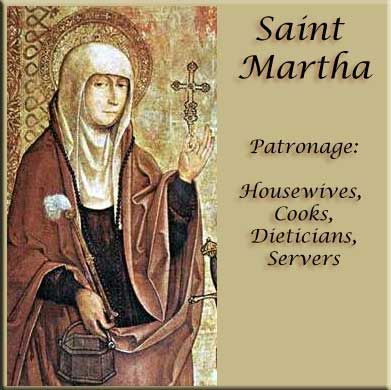
Today we come together to commemorate the life of St Martha.
We should all have knowledge about the story of Martha and Mary who welcomed Jesus into their home. Martha busies herself with the hospitality needs of our Lord Jesus whilst Mary sits at the feet of Jesus listening to his words. Martha complains to Jesus because she wanted Mary’s help but Jesus replies to her, “Martha, Martha, you are worried and distracted by many things; there is need of only one thing. Mary has chosen the better part, which will not be taken away from her.” (Lk 10:38-42)
Jesus’ reply was all about listening to his message. We can then see in ourselves and in our lives, what Jesus points out in Martha – is that we can be easily distracted and worried by worldly tasks and Through Martha’s story, Jesus is reminding us that there is one thing that is of importance: that is to follow Jesus’ message and his individual calling that he has for each of us.
In John 11:17-27, Martha meets Jesus as soon as she learns he is coming after hearing that her brother Lazarus had died. Immediately we see a change in Martha. She purposefully goes to Jesus and when he asks her about his belief in him she responds, “Yes, Lord, I believe that you are the Messiah, the Son of God, the one coming into the world.”
Martha has the opportunity to serve Jesus again.
Six days after the Passover (John 12:1-8). She does so with quiet humility. We come to understand Martha’s role is a different calling than that of Mary and this is much like it is in our own lives. we are each called into different service for the Lord’s glory, we each are blessed with different skills and talents with which to serve him. Martha chose to serve with love instead of with bitterness and arrogance.
Martha’s story gives us hope and is a good example for our own lives. Even though we can fall into the trap of trying to complete tasks without God’s assistance, there is opportunity in the Grace of the Lord to retry. When Jesus speaks to Martha, he is not unkind. His response is one of love. As the sinners we each are, we can only strive to learn and grow from our mistakes to make the next opportunity filled with Christ.
Martha is known as the patron saint of cooks, homemakers, and servants, St. Martha reminds us to thank all in our lives who serve us in whatever way. This can be our parents or those who cook for us, those who work in public service, our friends, our church clergy or even indeed anyone at all. As a way to celebrate St. Martha’s feast day today, we can pray to serve Jesus better:
Saint Martha, pray for us that we might serve Jesus better. Help us to overcome any distractions and worries that we may face in this world and to listen to his words and be present to him in our daily lives. May we remember that although we are called and blessed in different ways, that we are still all members of the same one body of our Lord Jesus Christ.
Amen.
Guest Post: Our Lady of Mt. Carmel ~ Maggie Brown

I was tasked with developing a sermon to educate people on Our Lady of Mt. Carmel. The task itself seems as large as Mt. Carmel itself. I will start at the beginning. Mount Carmel is a mountain line in Galilee between Tyre and Caesarea, which places it close to (about 20 miles from) Nazareth. That by itself gives you a clue as to its importance; it’s near the place where our Lord was raised. This mountain has been a holy place for longer than I can say, even in the old testament Elijah proves his faith in God on this mountain, “As the Lord of hosts lives, before whom I stand, I will surely show myself to him today” (I Kings 18:15). For some time the Carmelite order existed as an order that followed the teachings of Elijah and they weren’t called Carmelites. They lived a monastic life of prayer, penance and evangelization. However in 1215 Pope Innocent III decreed there were to be no new religious orders in the church and being that the Carmelite order wasn’t officially founded it made things confusing. Pope Honorius III followed Pope Innocent III and was to suppress the order that was growing around Mount Carmel. He was going to do so when he received a vision of the Blessed Virgin Mary who told him to take the Order of Carmel under his special protection, to honor and favor “her Order” and to confirm their rule. He then decreed on January 30, 1226 the approval of “The rule of Hermits of Mount Carmel”. There was a lot of trouble in the order in its early years simply because of the location it was in and so it moved but trouble seemed to follow it. In 1251 St. Simon Stock whom was the Prior General (head of the order) at that time prayed fervently to Our Lady Mother for help “flower of Carmel, fruitful vine, splendor of Heaven, Mother of the Son of God.
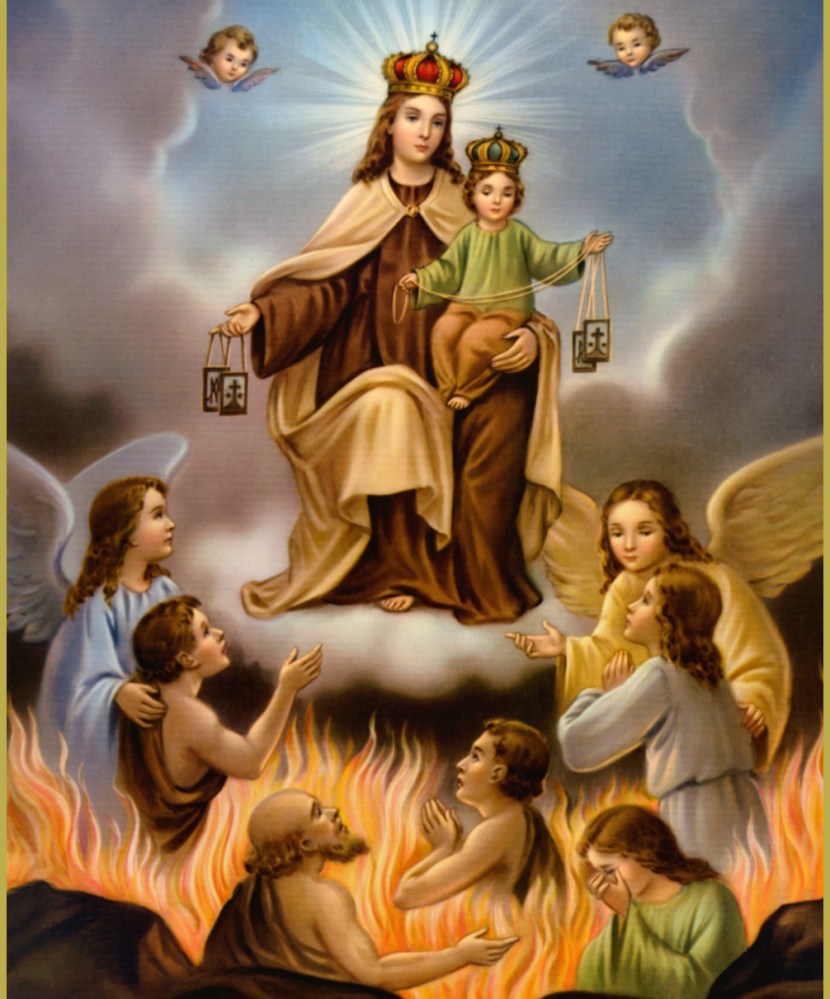
Amiable Mother, ever Virgin, give to the children of Carmel the privilege of thy protection, star of the sea.” A mother never ignores her children’s pleas for help, neither did she. At the end of this prayer she appeared to him holding the Brown Scapular in her hands and said to him “This will be the sign of the privilege that I have obtained for thee and for the children of Carmel; whoever dies clothed with this habit will be preserved from the eternal flames”. She had him send a deputation to the Holy Father (Pope Innocent IV) and said he wouldn’t fail to assist the order. Her constant protection of this order is what gave her the title “Our Lady of Mt. Carmel”. She asks for our devotion to her Immaculate Heart and teaches us how to conform out lives to total devotion to God.
I recently had a baby and he has learned to scoot where he wants to go. He goes all over the living room getting stuck and crying for help and I always get up, and help him get back to where he needs to be. My older son is 6 and I am constantly reminding him to pray, teaching him right from wrong, forgiving him for the bad things he does, worrying about him and protecting him even from himself.
The Blessed Virgin Mary, Our Lady of Mount Carmel, is our Mother, forever teaching, guiding, and stepping in when we need the extra help. The feast of Mt. Carmel is a celebration of all that our mother, The Blessed Virgin Mary, does for us and for all of her children.
O God, you have given us Mary as our Mother
and through the Order of Carmel
we learn to call her sister.
May we imitate her goodness and faith,
and be ever joyful in the wonderful things
you have done for us.
May Mary watch over and protect us
on our pilgrim way to your holy mountain,
Christ the Lord.
We make our prayer through the same Christ,
our Lord. Amen.
Sources:
 The Order of Preachers, Independent
You must be logged in to post a comment.