
Category: Lesson
It’s the Little Things~The Rev Frank Bellino,OPI
In John Le Carré’s novel, The Secret Pilgrim, a young intelligence officer visits East Germany to meet a spy. Anxiously, he carries cards with spy network details, which go missing after the visit, likely having fallen out of his pocket. Shortly afterwards, the spy network is discovered, resulting in torture and loss of life. This leads to the young man having a mental crisis and confessing to his superior in the intelligence services what he had done. The superior in question is the narrator, and in the novel, there are these words about the narrator’s reaction to what he had just heard: “Then the appalling triviality of what the young man had told me got through to me: that you could lose a [spy] network as easily as you could lose a bunch of keys.”
Although sin involves free choice and decision, it often resembles careless, unthinking behavior, much like losing keys due to a lack of thought and care. World history is filled with sins that are significant, systematic, and destructive.
Sin renders us blind and insensitive; sin stops us from being truly free. When sin gets into the system, when our whole way of thinking is touched by it, we can find ourselves almost sleepwalking into sin, shoring up the patterns of sin. We can find ourselves almost sleepwalking into hurting others and hurting ourselves, thoughtlessly, committing all those acts of petty cruelty and betrayal, that despite their banality and carelessness leave a trail of hurt and damage in their wake.
People often focus on significant wrongdoings such as cruelty, tyranny, and hate. However, the origins of these issues might lie in smaller actions that infiltrate systems subtly, diminishing awareness and leading to destructive outcomes. This can occur quite easily due to desires for physical satisfaction, power, or psychological complexity, where individuals play mind games and seek quick gratification. In the desert, Jesus is tempted in these ways, revealing the nature of temptation.
While many of the temptations we encounter are likely to be relatively minor, it is crucial not to exaggerate their significance. It is also important to acknowledge that our desires often aim for things that are genuinely beneficial. We should strive to avoid excessive scrupulosity and anxiety, as these can have negative effects. Conversely, we must guard against complacency, which can also be detrimental, as it might lead us to inadvertently engage in actions that harm ourselves and others.
Christ being tempted by Satan shows us hope and true happiness. Jesus resists turning stones into bread, yet he also eats and drinks with his disciples. Perhaps one lesson to draw from this is that it is only the one who can eat his food with self-control and without greed who can enjoy it fully. Greedy people are too busy thinking about what they do not have to enjoy, what they already possess.
Sin is a complex business that stops us from living as we ought, and so Lent is a wonderful opportunity to ask ourselves hard but realistic questions about true human happiness, questions that involve reflecting on the role of sin in our lives. To take up this opportunity is to ask if we have been sleepwalking through life, sleepwalking into patterns of sin and destruction, perhaps not so much out of active malice or greed, but almost carelessly, unthinkingly, almost like losing a bunch of keys through lack of thought and care.
Lent serves as an opportunity to open our eyes and, through the grace of God, embrace life and love—precious gifts offered by God that are never acknowledged by Satan.
Heads, Hands, and Ashes: Ash Wednesday~ The Rt Rev Michael Beckett, OPI

Y’all…..today is Ash Wednesday, and you’re prolly gonna see a bunch of folks running around with dirty foreheads today. Reckon wonder what’s that all about? Since you asked so nicely, I’ll tell ya!
Today, Ash Wednesday, marks the first day of Lent. You know, that season where “What are you giving up for Lent?” is an incredibly common question. It’s when we’re expected to give up something as a sacrifice, for us to use that sacrifice to remember what Jesus sacrificed for us. For most of us, Lent is the time of sometimes painful self-examination, during which we scrutinize our habits, our spiritual practice, and our very lives – hoping to make ourselves better, trying to make ourselves worthy of the love of God. We “step up” our prayer, fasting, and self-denial in order to remove worldly distractions from our lives.
On Ash Wednesday, we wear ashes, and not because we forgot to wash our faces. The spiritual practice of applying ashes on oneself as a sign of sincere repentance goes back thousands of years. Frequently in the days of the Old and the New Testament, when someone had sinned, he clothed his body with sackcloth and covered himself with ashes. [Jer. 6:26] The sacramental that we are observing today arises from that custom, the spiritual practice of observing public penitence. Church history tells us that the liturgical practice of applying ashes on one’s forehead during the Lenten Season goes back as far as the eighth century. This was accompanied by different forms of fasting, prayer, sacrifices, charity towards others, etc… The writings of St. Leo, around 461 A.D., tell us that during the Lenten Season, he exhorted the faithful to abstain from certain food to fulfill with their fasts the Apostolic institution of forty days. In the days of the Old Testament, many tore their clothing as a sign of repentance.
Today, we use the ashes as a reminder of who we are. The Bible tells us that we came from the dust and to the dust we shall return. The first human was formed out of the dust of the earth by God and then God breathed life into that dust. That is a powerful image. One that is meant to remind us that without the breath or Spirit of God moving in us, we are just like these ashes: lifeless – worthless.
So….what are you giving up for Lent? I have a suggestion or three. Instead of giving up chocolate, or sweets, or cola, or whatever other dear little thing we may indulge in, what about doing something that will actually make a difference, not only in your life, but in the lives of those around you? In this day and age, isn’t it time that we, as Christians, start putting Christ first, start putting his people first? Isn’t it time that we as true followers of the Jesus that we proclaim learn to treasure what we have been given? Work for justice. Work for peace. Work for understanding. Work to love the unlovable, the least, the lost, the forgotten.
Fred Kaan, the lyricist, has written a hymn that is especially meaningful for today:
Put peace into each other’s hand and like a treasure hold it;
protect it like a candle flame, with tenderness enfold it.
Put peace into each other’s hand with loving expectation;
be gentle in your words and ways, in touch with God’s creation.
Put peace into each other’s hand like bread we break for sharing;
look people warmly in the eye: Our life is meant for caring.
Give thanks for strong yet tender hands, held out in trust and blessing.
Where words fall short, let hands speak out, the heights of love expressing.
Put peace into each other’s hand he is love’s deepest measure;
in love make peace, give peace a chance and share it like a treasure.
Let us pray:
God, we pray that Your Spirit may rule over all things. May Your Spirit rule over kings and presidents, over prime ministers and generals, over CEOs and party bosses, over the legislatures and over the bureaucrats, over all citizens. May Your Spirit guide us on the way of peace on the way of honest dialogue on the way of reconciliation between peoples, on the way of disarmament and justice, on the way of freedom and life for all.
May Your Spirit lead us on the journey of blessings shared with all on the journey of educational opportunity for all our children on the adventure of research and study that helps all men and women, on the road to meaningful work for all people, on the path of solidarity and love between all our brothers and sisters.
May Your Spirit help us to speak up with courage to share what we have and what we are to challenge the powers that be to offer a message of liberation and life. May your Spirit help us to have a holy and meaningful Lent. We make this prayer through Christ, our Lord. Amen.
The Choices We Make~The Rt Rev Michael Beckett, OPI

Y’all…..
Do y’all get as tired as I do of the back and forth between conservative and liberal, Democrat and Republican, right vs. left, this religious denomination vs. that religious denomination back and forth, my way or the highway babble that goes on and on and on and on, ad infinitum?
Sometimes I just wanna scream STOP It! Other times it’s a quiet “Why can’t we all just get along?” More recently, my thoughts have been, “What the hell is wrong with you?” I find it exhausting, this push and pull and continuous descension, and I find myself wondering, “What if? Why? How can we stop this madness?”
Well, Imma tell ya. We can’t. We simply can’t stop folks from doing what they’re gonna do and being who they’ve shown to us they actually are. But, as he so often did, Jesus gives us a bit of direction that we can apply here. In Matthew 10, often called “The Great Commission,” Jesus is telling the twelve disciples what’s up, just how they’re supposed to proceed with the “actually being disciples thing,” and what they can expect. And in the middle of this oral handbook he’s delivering, he includes this little zinger: “Whoever will not receive you or listen to your words—go outside that house or town and shake the dust from your feet.” To put a more modern spin on it, in the film “Frozen,” Elsa sings, “Let It Go.”
Along those lines, a dear friend of mine sent me an article this week in which the “Let Them” theory is explained. He summed it up like this:
I used to tolerate a lot because I didn’t want to lose people. But I learned the hard way if they were really my people, they would never treat me poorly. Don’t make the mistake of being so understanding and forgiving that you overlook the fact that you’re being repeatedly disrespected. Let them be upset. Let them judge you. Let them misunderstand you. Let them gossip about you, let them ignore you. Let them be “right.” Let them doubt you. Let them not like you. Let them not speak to you. Let them run your name in the ground. Let them make you out to be the villain. Whatever it is that people want to say about you, let them! Kindly step aside and LET THEM. You can still be kind. You can even still love them deeply. But do it from the distance they created with their words and actions. Access to you is a privilege they have proven they can’t be trusted with. Let them go.
Now, having said all that, what are we left with? In the Gospel reading for today, Jesus tells us to make sure that we are the folks who need to “Let them go,” rather than being the folks who are let go: Jesus told his disciples a parable.
“Can a blind person guide a blind person? Will not both fall into a pit? No disciple is superior to the teacher; but when fully trained, every disciple will be like his teacher. Why do you notice the splinter in your brother’s eye, but do not perceive the wooden beam in your own? How can you say to your brother, ‘Brother, let me remove that splinter in your eye,’ when you do not even notice the wooden beam in your own eye? You hypocrite! Remove the wooden beam from your eye first; then you will see clearly to remove the splinter in your brother’s eye. “A good tree does not bear rotten fruit, nor does a rotten tree bear good fruit. For every tree is known by its own fruit. For people do not pick figs from thornbushes, nor do they gather grapes from brambles. A good person out of the store of goodness in his heart produces good, but an evil person out of a store of evil produces evil; for from the fullness of the heart the mouth speaks.”
So the bottom line here is, much like Glenda asking Dorothy, “Are you a good witch or a bad witch?” Are you letting go, or are you being let go? What kind of fruit are we bearing? Are we being Jesus for folks? Are we acting in love? Coz love is what Jesus teaches us we are supposed to do. Again from Matthew: When the Son of Man comes in his glory, and all the angels with him, he will sit on his glorious throne. All the nations will be gathered before him, and he will separate the people one from another as a shepherd separates the sheep from the goats. He will put the sheep on his right and the goats on his left.
“Then the King will say to those on his right, ‘Come, you who are blessed by my Father; take your inheritance, the kingdom prepared for you since the creation of the world. For I was hungry and you gave me something to eat, I was thirsty and you gave me something to drink, I was a stranger and you invited me in, I needed clothes and you clothed me, I was sick and you looked after me, I was in prison and you came to visit me.’
“Then the righteous will answer him, ‘Lord, when did we see you hungry and feed you, or thirsty and give you something to drink? When did we see you a stranger and invite you in, or needing clothes and clothe you? When did we see you sick or in prison and go to visit you?’
“The King will reply, ‘Truly I tell you, whatever you did for one of the least of these brothers and sisters of mine, you did for me.’
“Then he will say to those on his left, ‘Depart from me, you who are cursed, into the eternal fire prepared for the devil and his angels. For I was hungry and you gave me nothing to eat, I was thirsty and you gave me nothing to drink, I was a stranger and you did not invite me in, I needed clothes and you did not clothe me, I was sick and in prison and you did not look after me.’
“They also will answer, ‘Lord, when did we see you hungry or thirsty or a stranger or needing clothes or sick or in prison, and did not help you?’
“He will reply, ‘Truly I tell you, whatever you did not do for one of the least of these, you did not do for me.’
“Then they will go away to eternal punishment, but the righteous to eternal life.”
Notice there is no mention of race, gender identity, sexuality, citizenship or immigrant, religious preference or lack thereof, gender expression, or anything else that we today use to separate us into an “us versus them” mentality. Nothing except acting in love. There it is. Are you gonna be ‘let go’ like a goat, or loved like a sheep?
John Bell has written the hymn, “The Summons.”
Will you come and follow me if I but call your name?
Will you go where you don’t know and never be the same?
Will you let my love be shown? Will you let my Name be known?
Will you let my life be grown in you and you in me?
Will you leave your self behind if I but call your name?
Will you care for cruel and kind and never be the same?
Will you risk the hostile stare should your life attract or scare?
Will you let me answer prayer in you and you in me?
Will you let the blinded see if I but call your name?
Will you set the prisoner free and never be the same?
Will you kiss the leper clean, and do such as this unseen?
And admit to what I mean in you and you in me?
Will you love the ‘You’ you hide if I but call your name?
Will you quell the fear inside and never be the same?
Will you use the faith you’ve found to reshape the world around
through my sight and touch and sound in you and you in me?
Christ, your summons echoes true when you but call my name.
Let me turn and follow you and never be the same.
In your company I’ll go where your love and footsteps show,
thus I’ll move and live and grow in you and you in me?
Love God. Love people. Act accordingly. Amen.
We Have Work to Do~The Rt Rev Michael Beckett, OPI

Y’all….all few things……
Way, WAY back when I was but a teeny lad in the nursery and kindergarten at church, we were taught a song: Jesus loves the little children, all the children of the world…..
So yeah. ALL the children of the world. Now, Mr. Webster, that brilliant purveyor of dictionaries, defines “all” as this: “including everyone or everything without exception.”
And, Mr. Webster, in his brilliance, defines “the world” as: “the earth, together with all of its countries, peoples, and natural features.”
Ya put these two together, and there is a whole lot of loving we have to do. Reckon wonder how do we do that? Especially in today’s tumultuous world. Funny thing, tho. We have an answer for that. It’s not often that I quote directly from the Scriptures, but today? Yeah, Imma do that, coz today we have the answer for our “how do we do that” question straight from the mouth of Jesus:
Jesus said to his disciples:
“To you who hear I say, love your enemies, do good to those who hate you, bless those who curse you, pray for those who mistreat you.
To the person who strikes you on one cheek, offer the other one as well, and from the person who takes your cloak, do not withhold even your tunic.
Give to everyone who asks of you, and from the one who takes what is yours do not demand it back.
Do to others as you would have them do to you. For if you love those who love you, what credit is that to you? Even sinners love those who love them.
And if you do good to those who do good to you, what credit is that to you? Even sinners do the same.
If you lend money to those from whom you expect repayment, what credit is that to you? Even sinners lend to sinners, and get back the same amount.
But rather, love your enemies and do good to them, and lend expecting nothing back; then your reward will be great and you will be children of the Most High, for he himself is kind to the ungrateful and the wicked. Be merciful, just as your Father is merciful.
“Stop judging and you will not be judged. Stop condemning and you will not be condemned. Forgive and you will be forgiven. Give, and gifts will be given to you; a good measure, packed together, shaken down, and overflowing, will be poured into your lap. For the measure with which you measure will in return be measured out to you.” Luke 6:27-38
I’d say, based on this little nugget of scripture, we all of us, every single solitary one of us, has some work to do. Ya see, it seems to me that we let things divide us, we let our differences get in the way of what matters, and we, selfishly, want things to go our way and in doing so, we step on and over folks, and sometimes we just wanna knock them out of our way. But ya know what? Paul teaches us in Galatians that, “There is neither Jew nor Greek, slave or free, male nor female, for you are all one in Christ Jesus”. (Galatians 3:28) And again in Colossians, “Here there is not Greek and Jew, circumcised and uncircumcised, barbarian, Scythian, slave, free; but Christ is all, and in all.” (Colossians 3:11)
Oops? If this is the case, then we have some work to do. Y’all are smart enough to figure out how to apply what Jesus has said to your own lives without me telling ya, and you can certainly figure out what Paul was saying on your own. The trick here is to actually apply it. To live it.
Like I just said, we, all of us, have some work to do.
Amen.
Blessed Are…~The Rev Frank Bellino,OPI
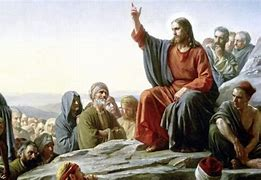
Nobody wants suffering, loneliness, or illness. Various professionals and individuals, regardless of their beliefs, strive to eliminate these problems. The gospels depict Jesus as a healer who cures people and alleviates their burdens, highlighting the importance of a savior who makes a practical difference.
So, in the story told in today’s passage from Luke’s gospel, a crowd of people was following Jesus, a man who had a reputation for being able to heal people’s illnesses and take away their problems. They came from all over the place looking for help, practical help. And what did they get? A sermon!
That probably sounds all too familiar for many people who have approached religious groups for help. And the sermon or the talking-to that they have to listen to is often about what they must have done wrong to deserve all that has been happening to them. People suggest, for example, that AIDS is a punishment from God for a lifestyle they can’t approve of, or that poverty is the product of laziness and so on.
But that is not the line that Jesus takes. He starts his sermon by saying, ‘Blessed are you poor…, blessed are you that are hungry…’ Now the word that is usually translated as ‘blessed’ or ‘happy’ doesn’t mean the sort of happiness you might experience at a good party. It comes originally from a word that describes the straight flight of an arrow. I think the best translation of it would be ‘on the right track’. So, Jesus is not saying you’ve done something wrong if you’re poor or hungry or are bullied and so on. Quite the opposite: you’re probably on the right track if things like that are happening to you. I don’t think he’s suggesting that suffering of any kind is a good thing or that you’ve got to go looking for it. It’s a message of encouragement. Problems come along to everyone, but when things do go wrong it doesn’t mean it’s your fault, God hasn’t given up on you.
The sermon goes on to give some guidance about how to cope with life in general. It’s all based around an idea of love. It is a kind of love that is free and generous. It’s a matter of trying to respond well even when people are unkind to us; trying to heal damaged situations by forgiveness where that’s possible; trying to improve our own reactions instead of just being critical of what other people are doing. It gives a whole framework for life. Nothing in the sermon comes across as being superficial or easy. Trying to be as open to people as it suggests means being prepared to allow ourselves to be very vulnerable. We are going to be hurt, we are going to be taken advantage of. But, says Jesus, when that happens, we are probably on the right track.
Maybe it is because so many people were following him, expecting him to take their problems away, that Jesus put the question back to them in the sermon. He was suggesting that they could free themselves from the weight of carrying around too much guilt for everything. They could give some shape to their lives by taking on board some of the ideals that he was presenting. They could heal their own lives without necessarily having their illnesses or their problems taken away from them.
The miracles of healing that we hear about in the gospels and elsewhere are spectacular, even if they do seem a bit out of reach. But the sermon is more practical, more possible. Thank God we can still rely on healing in various forms, some more or less miraculous, but there’s something just as important and more within the reach of everyone. To be able to love and accept ourselves, to give someone else the support of love and maybe some guidance if it is needed, even to be able to make someone feel better about themselves, is to bring a kind of healing that is very real and very important. It may not be spectacular, but it can still be a miracle.
Gone Fishin’~The Rt Rev Michael Beckett, OPI

Way back when, when I was but a wee lad, one of the most exciting things in the world was when my papaw would take my brother and I fishing. We’d go about a mile from Papaw’s house to a wide spot in the creek, and spend many happy hours catching sunfish and then letting them go. Or we would spend a short time catching nothing because my little brother insisted on throwing rocks into the creek, scaring the fish away, but that was a good time, too. Anyway, the point of the whole thing is, we went fishing, for the fun of it.
Now, way, way, way back when folks didn’t just “fish for the fun of it,” they had to fish to actually earn a living and just to have something to eat. Or so it was with Simon, and his buds, James and John. Now, I don’t know if any of them had little brothers who were wont to throw rocks into the sea and scare the fish away, but on this particular day, no matter how much they fished, they caught nothing. Bummer. So they packed up their nets, returned to the shore and started to clean up their stuff so they could try again the next day.
Now, not too far away from there, there was a crowd of folks listening to this new preacher dude, who apparently was pretty great. So great in fact that the crowd started pressing in on him so to get closer to him. Since the preacher dude didn’t have a security team at the time, and being the observant type, he took a short break and trotted down the beach to our guys, Simon, James, and John, and asked them to row him out a bit so he could continue his preaching gig, and not be trampled in the process. So they did.
Now, after preacher dude was done dispensing his words of wisdom, my guess is he was kinda hungry and asked our guys to catch him a fish. And nope. They told Jesus, who was the preacher dude (but you already knew that, didn’t ya?) that they hadn’t caught anything all night long. And Jesus said, “Try again, only lemme help ya a bit.” And so they did. And hoo-whee. They caught them a heap of fish! So much so that they had to ask for help to get their haul back to shore.
Because of all of this, Simon recognized Jesus as being more than just a preacher dude, and was pretty tripped out. He told Jesus he wasn’t good enough to hang around with Jesus, and Jesus told him, “Dude. Stick with me, and I will have you catching men.” I can imagine that our guys, Simon, James, and John, were even more freaked out, but they left everything and followed Jesus. (Luke 5:1-11)
Kewl story, huh? So, you ask, what does that have to do with us? Imma tell ya. In the past few weeks, how many of us have said/posted/read/agreed with things that would most definitely not be considered Christ-like? How many of us have let our personal political beliefs get in the way of acting like the “little Christ” we are called to be? Sure we can disagree, often vehemently, but under no circumstances can we allow ourselves to allow those differences of opinions to get in the way of our witness for our Lord. (You gotta remember that even Peter and Paul argued, but they didn’t let that stand in the way of building Christ’s Kingdom.)
Let us not forget that in many cases, we are the only Bibles that many folks will ever read, and we are the only Jesus that some folks will ever see. It is up to us to see the Jesus in everyone, regardless of political belief, race, creed, color, sexual orientation, whether we cheer for the Chiefs or for the Eagles, or anything thing else that can be used to divide us. We are all of us HIS people, the sheep of HIS pasture, and we have far more in common than we do the things that divide us, if we truly identify as HIS.
As Christians, have we lost our focus of what is truly important? Regardless of politics, of whether we are ‘blue’ or ‘red’ or ‘rainbow,’ we are to remain focused on the one thing that really matters in this world and the next: Spreading and sharing the love of and for our Lord and Savior Jesus Christ. No matter who sits in the Oval Office, our job, our mission, our focus, has not changed and will not change: We are called to love and to serve the Lord with gladness and singleness of heart. We are called to care for each other, regardless of our politics. We are commanded to ‘bless those who persecute us’ and we are called to ‘pray for our enemies.’ We are called to feed the hungry, clothe the naked, house the homeless. (Matthew 25:31-46). It is up to each of us to conduct ourselves in a manner fitting our faith. Look at what you say. Look at what you post. If you were accused of being a Christian, would your timeline bear witness to the fact?
What are you doing to actually become a “fisher of men?” Does what you say or do truly make folks want to come to Jesus? In the movie “Sister Act” the nuns sing another song that we’re all familiar with. “I Will Follow Him.”
“I must follow him, ever since he touched my hand I knew that near him I always must be And nothing can keep him from me He is my destiny.” (Songwriters: Arthur Altman / Franck Pourcel / Jacques Plante / Norman Gimbel / Paul Mauriat)
So, having said all of the above, shouldn’t we, like the nuns, like Simon Peter and James and John actually do what we are called to do?
Follow Him. In EVERY word that we speak. Follow Him. In EVERY post that we make. Follow Him. In EVERY action we take. Follow Him. Amen.
Guest Post: The Feast of St Agatha~The Rev Seminarian Peri Jude Radecic
Hebrews 12:14. “Pursue peace with everyone. Pursue sanctity, without which no one shall see God.”
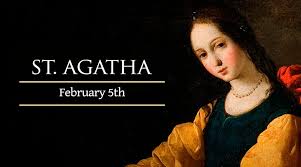
We are blessed with the opportunity to reflect on the powerful messages found in our reading and the inspiring life of St. Agatha, whose feast day we celebrate. These messages offer us insights into living a life of faith and holiness, even amidst challenges and rejection. In the Gospel of Mark 6:1-6, Jesus returns to Nazareth. The people in Nazareth have known Jesus since he was a child. His hometown listens to Him teach in the synagogue and many are astonished by His wisdom. Yet their astonishment quickly turns to skepticism. They ask, “Is now this the carpenter, the son of Mary?” The question they ask reveals their struggle to reconcile the Jesus they knew with the profound teacher before them. Their familiarity blinds them to His divine mission. Since Jesus did not fit the people’s notion of who he is, they resisted his ministry, even though they were amazed. As a result, Jesus could do no mighty work back home, except to heal a few sick people. Their lack of faith in who Jesus had become limits the blessings they could have received. Hearing the word of God and being amazed is not the same as faith. Do we limit the blessings we could be receiving from God because we allow familiarity and skepticism of God to cloud our vision of the miracles he can perform for us every day?
Turning to Hebrews 12:14-17, 11-15, we are urged to “pursue peace with everyone, and holiness without which no one will see the Lord.” The readers of this letter were faced severe persecution for their faith and were tempted to abandon Christianity. The writer encourages the reader to endure discipline and to strive for a life that reflects God’s holiness. This call to perseverance is not easy, but it is essential for our spiritual growth and the spiritual growth others. Today, we also honor St. Agatha, a young Christian martyr, whose life exemplifies the messages from Mark and Hebrews. Agatha lived in 3rd century Sicily, part of the Roman Empire. She was born into a rich, noble Christian family and was well educated. She was known for her virtue and beauty. At the age of 15, she felt a call and dedicated herself as a consecrated virgin for Jesus. Becoming a consecrated virgin was seen as a special way to show your love to Jesus. She would eventually go onto become a deaconess. A young politician becomes obsessed with Agatha and she rejects him. He tortures her in humiliating and disfiguring ways. Despite the trials and suffering she endured, she remained steadfast in her commitment to Christ, even in her martyrdom. Her courage and unwavering faith in the face of adversity serve as a powerful testament to the strength that comes from a life rooted in holiness and trust in God.
As we reflect on the Feast of St. Agatha and our readings today, we are called to examine our own lives. Are we, like the people of Nazareth, allowing doubt and familiarity to hinder our faith? Or are we, like St. Agatha, embracing the challenges of living a holy life, trusting that God is with us every step of the way? Today, let us strive to cultivate a heart open to God’s presence, ready to see His hand at work in both the ordinary and extraordinary moments of our lives. May we pursue peace and holiness, drawing strength from the examples of Jesus and the saints who have gone before us. May we open our hearts to look deep, beyond the surface of prayer to find the reality of God’s plan for us. May we recognize God, not just in the familiar moments of our life but in the extraordinary ways Jesus has guided and blessed us. We pray for the grace to accept the truth of His plan right before our eyes. Amen.
Candlemas~The Rt Rev Michael Beckett, OPI
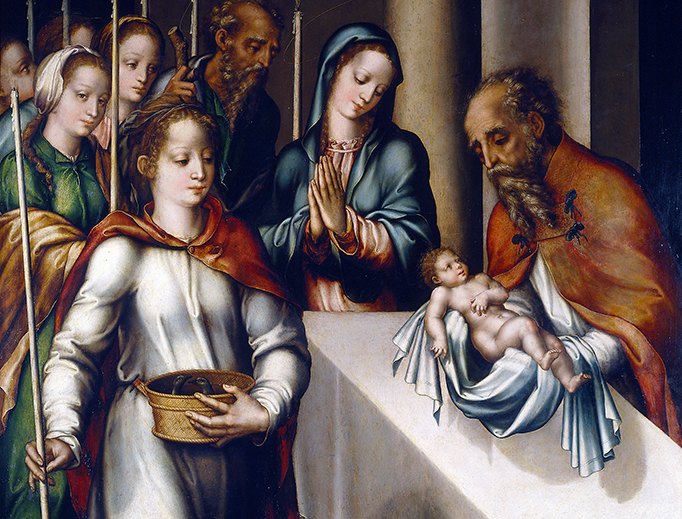
Well, y’all, Christmas is over. Officially. And before you start to think that I’ve finally lost my mind, lemme tell ya what I mean. Today, 2 February, is the 40th day of the liturgical Christmas/Epiphany season, and marks the presentation of Jesus in the temple in Jerusalem and the purification of Mary. Way back then, and in many instances still today, 40 days after giving birth to a son is when a mother was blessed and gave thanks for safely making it through childbirth. This was called “purification.” It was less about a mother being somehow impure and more about giving thanks and giving time for recovery from birth.
Today is the day that Jesus was presented in the temple. According to the law of Moses, presenting the firstborn male as an offering to God was done for all livestock animals. This was to remember and give thanks to God for delivering Israel from slavery in Egypt. The final plague in Egypt was the death of the firstborn, but the Israelites were saved at that first Passover with the sacrifice of a lamb. A firstborn son is dedicated to God and redeemed at the temple 40 days after birth with an offering.
Now, at the temple lived a priest who was very, very old. His name was Simeon and he was very, very faithful to God, and God had told Simeon that he would not die before he had been able to meet the Savior. Well, lo and behold, when Mary and Joseph got to the temple, Simeon KNEW that Jesus was the Savior he had been waiting a very, very long time to meet. The Gospel according to St Luke tell us that Simeon took the baby into his arms and blessed God, saying:
“Now, Master, you may let your servant go
in peace, according to your word,
for my eyes have seen your salvation,
which you prepared in the sight of all the peoples:
a light for revelation to the Gentiles,
and glory for your people Israel.”
Well, you can imagine that Mary and Joseph were kinda tripped out, especially when Simeon continued to Mary:
“Behold, this child is destined
for the fall and rise of many in Israel,
and to be a sign that will be contradicted
-and you yourself a sword will pierce-
so that the thoughts of many hearts may be revealed.”
Great story, huh? But, you ask, “What in the world does this have to do with us today?” Well, as is my custom, I’m gonna tell ya. We all of us know that that baby that Simeon was very, very excited about grew up and, indeed, became the “light for revelation to the Gentiles,” and whilst he was at it, he gave us some very, very specific instructions. He told us, no, commanded us, to go into the world and preach the gospel. And reckon wonder how do we do that? Jesus told us how to do that, too. He told us, no, commanded us, to love. Period. He even said, “A new command I give you: Love one another. As I have loved you, so you must love one another. By this everyone will know that you are my disciples, if you love one another.” (John 13:34-35)
Now, you’ll notice that the scripture says, by this everyone will know that you are my DISCIPLES. Today, there are SO SO SO many folks who claim to be “Christian,” but are nowhere near to being a “disciple.” What’s the difference, you may ask? My friend, Rainbow Joseph, explained it best when he wrote:
“You were called by Christ to be a disciple, not a Christian. A disciple is an apprentice. A disciple learns from a teacher how to be like the teacher. A disciple learns by doing. A disciple practices the skill that is learned, over and over, improving a little more each day. Jesus THE Christ has called you to be a christ to those around in your own personal Israel. If you are not the Christ to those around you, then you do not serve THE Christ and you have learned nothing. If you are not the Christ to those around you, then you are not a disciple, and if not a disciple, you are certainly not a Christian.”
Period. Hands down. Those who claim to be Christians, and who are not disciples, do a disservice to the gospel message by watering down his message to one of religious platitudes. We like to generalize the words of Jesus and transform his life into a one-size-fits-all model that can apply to all of humanity. He intentionally, purposefully, and passionately addressed very specific causes. He radically addressed the diverse and complicated conflicts of the time and shattered the status quo. Are we, as Christians, not called to do the same? By addressing racism, immigration, gender equality, and a litany of other issues, we are following in the steps of Jesus. By remembering that there is not one person on this planet that God does not love, that Jesus did not die for, and acting with that love that Jesus talks about, we are disciples. By working for the change that would better the entire world, and each individual, we are disciples. By asking for mercy, working toward that mercy, by loving those who are oppressed, by loving those who are hard to love, those who are opposed to everything that we (not necessarily Jesus) want, we are disciples.
“A new command I give you: Love one another. As I have loved you, so you must love one another. By this everyone will know that you are my disciples, if you love one another.” (John 13:34-35)
Amen.
Trust In God~The Rev Frank Bellino,OPI
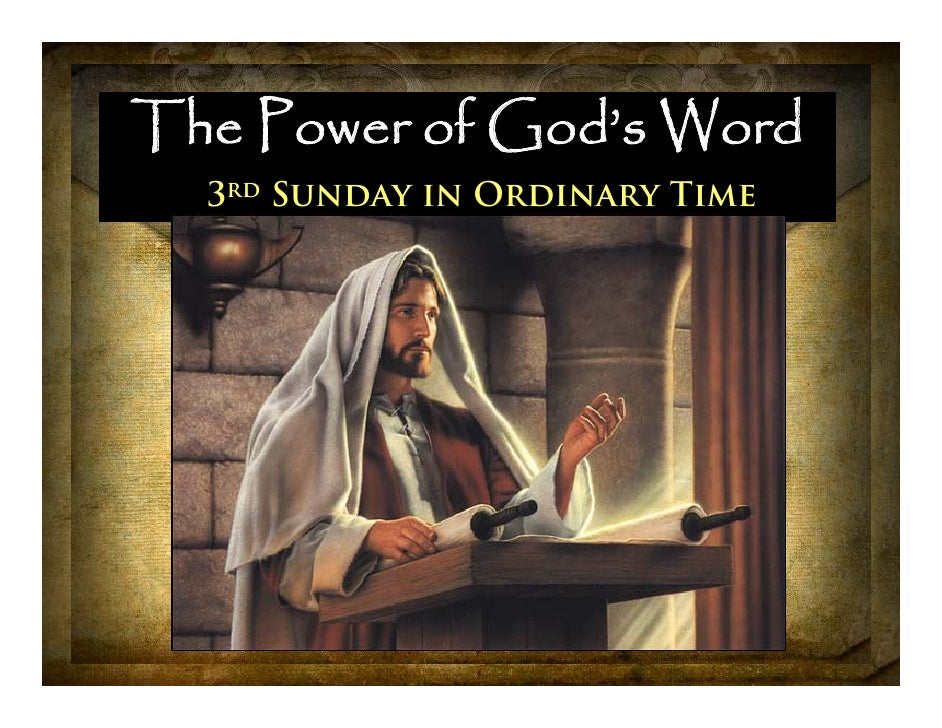
In an era filled with trivial chatter, where tweets broadcast mundane activities, politicians lie without shame, and words like justice, love, and God are diluted by arrogance, we forget the power of words.
We mistrust each other and settle for superficial interactions, avoiding the risk of genuine loving. We distract ourselves with busyness, ignoring others’ needs. Words can deceive us, trapping us in falsehoods. The lie that deceived humanity continues to mislead us today. Our modern arrogance claims we can control the world with science and ingenuity. Are we smarter than Jesus?
Even in our pride, we know something is amiss. We yearn for eternal words full of meaning, spirit, and life—to hear them, break free from our falsehoods. The 5,000 who journeyed with Ezra from captivity heard the sweet truth, felt God’s word pierce their hearts, making them weep and washing away the lies that bound them.
Centuries later, people who heard the voice of a young man reading from the scroll likely desired freedom. The act of Christ reading the prophet’s text may have held significant power. His audience was attentive to his words. In the modern age, are people, are you still interested in hearing the words of the Galilean preacher. Every Sunday they are read and yet I see people not listening, they may hear but there is a difference,
Our emotions are similar to those who mourned with Ezra or experienced renewal through Christ. We want to cleanse falsehoods with our tears, but language fails us. Thus, we must rely on faith to lead us to the living Word.
St Paul sensed this reality, this consoling Gospel, and although his words at first seem mundane, they speak to us of a reality that breaks the chains of self-centered isolation and draws us into relation with one another. Listen without distraction! By Baptism and the Eucharist that we share, the Body of Christ speaks of our solidarity, our call to play an integral part in one another’s lives. It is the lie of this age that tells us that I am my own master, that the ego is absolute. We will never be free, never find true happiness locked as we are in the isolation of our self-absorption. No matter how many gadgets we have or how much we tell ourselves that we are socially networked, it is all a lie if we fail to be the mystical Body of Christ. Community and communion complete us, incorporate us into the Body of Christ.
Paul struggled to find a way to help us realize that our lives each play a unique role in the Body. He knew that we understand ourselves not in isolation but in relation with one another. We all take part in Christ, we all manifest God’s call, God’s Word made flesh dwelling among us. It shatters our deceptions and sets us into the drama of God’s saving act in history. By the waters of Baptism, we were given our Christian names and given a share in the divine name itself.
Words do have power to heal us, to set us free, to restore our sight, to give us comfort, if we but hear the Master’s voice. Listen. Put away your earbuds, turn off the noise, listen with an inner stillness and you will hear the Word of everlasting life. This mysterious Body is made real in our Eucharistic ‘Amen,’ a word that bids us to become what we receive. The power of the prophetic word hits us even today amid earthquakes and wars, amid poverty and neglect. Do you hear it? Does it speak to your soul and call you into caring? For there is its power, our being the Body of Christ.
Water, Wine, and Wonder~The Rev Frank Bellino, OPI

Today is the story where we find out that Mother Mary is not Latina or Italian! Son of God or not, if I had told my mother or grandmother “woman,” they would still be finding pieces of my rear end.
‘On the third day there was a wedding at Cana in Galilee.’ (“What might “on the third day” stand for in John 2:1?”) In context, then, the third day after leaving Judaea, way down south, where Jesus had been involved in the movement associated with his cousin John the Baptist and had undergone the what we now know is baptism into the waters, with extraordinary effect, at John’s hands.
The journey on foot up the Jordan valley to Galilee takes about two days, so this makes sense. Cana – Khirbet Qana – is nine miles north of Nazareth on the road into the hills, west from the Sea of Galilee, so most likely there was time to stop and pick up our Mother Mary. As we read, ‘The mother of Jesus was there, and Jesus himself and his disciples had also been invited to the celebration’. In this period, it seems, Jewish weddings took place on Wednesdays and the celebrating lasted for seven days.
Naturally, the wine ran out (perhaps some of those invited, had not contributed anything), was about to cause humiliation, a minor disaster, for the newlyweds. Mary gets her Son’s attention to the redness of the groom’s face, an expression, we can suppose, of a natural response. ‘They have no wine.’ Her Son refuses to help with the issue at first. Was it for family situations such as this that he had been set apart for his mission as the Christ, the Lamb of God, the Suffering Servant who was to actualize the Messianic promises? His hour had not yet come, he tells her, replying with a seeming roughness, ‘Woman’.
Consider speaking from a son to a mother, that way of talking to her has no present parallel in Hebrew or Greek. That should alert us to the fact that something more is going on here than meets the eye. The phrase ‘my hour’ has in this Gospel-book a technical significance: it means the time of the Passion, Death, Resurrection, and Ascension of Christ. In particular, it means the moment of the Crucifixion, the power and glory hidden in the Cross being manifested in the Resurrection. And at the Cross the Son will say the same word to his mother in the same way as he does at Cana. He will look down from the Cross and call out, ‘Woman’ – not just to gain her attention, but to tell her she will be the mother and protectress of the infant Church. She is the Mother of the Messiah, and her place now is in the struggle against the satanic serpent as prophesied in Genesis to the Mother of all the living: she whom the Fall narrative indeed calls ‘the Woman’, the first Eve. Mary appears at the Cross’s foot to be given new offspring in the shape of the beloved disciple who stands here for all Christians: it will be her task to protect these offspring in the ongoing contest between Satan and the followers of Christ.
So back to Cana, then: there is no rudeness here, but a revealing of the significance of an internal problem in the light of the destiny she is to share with her Son in the plan of God.
Yet, he agrees to do something. She says to the waiters, ‘Do whatever he tells you’. The spiritual assurance the grace of her Immaculate Conception gives her allows her to rely on a response. The generosity of God can embrace things as small as local disappointments as well as things as large as the salvation of the world, and in any case this little domestic drama is, as it happens, filled with symbolic possibilities which the Messiah now exploits in his first ‘sign’. The result is one hundred and twenty gallons of what an enthusiast found to call quite excellent wine.
The Church of course accepts the possibility of miracle. Creation, we say, is not a completely closed system, but is open to its Creator at a range of points. It should be said, however, that the miraculous element is not in itself the climax of this story. The climax is the disciples’ belief of what the miracle symbolizes. The abundance of this splendid wine symbolizes the unheard of, profuse, generosity of God that is now, in Jesus, to be crucified. This overwhelming generosity became incarnate in him, and the story marks the moment when the change began to drop. ‘What Jesus did at Cana in Galilee marked the beginning of his signs; thus, he revealed his glory, and his disciples believed in him.’
 The Order of Preachers, Independent
You must be logged in to post a comment.