
Category: Member Posts
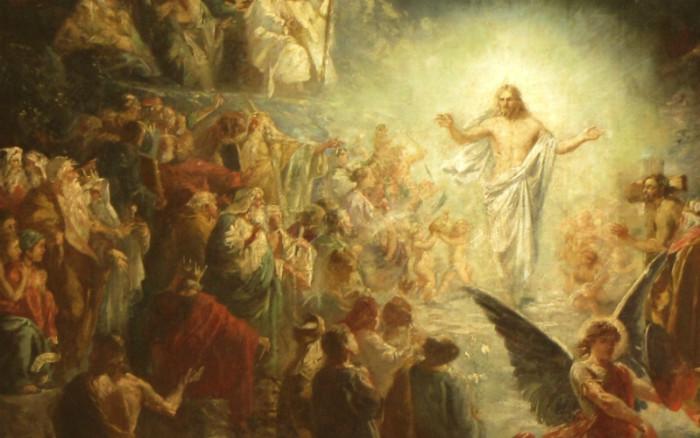
Hell, Vigils, and Lullabys ~ Br. Chip Noon, Novice

Holy Saturday. Sabbatum Sanctum. The day after Good Friday and the day before Easter.
As children, we were taught that on this day, Jesus went down to Hell. It is in the Creed as “He descended into Hell.” As a child myself, this day was one of sadness, fear, and anticipation.
In Sunday School (where we who did not attend a parochial school were forced to go), the nuns depicted this day to us as the time during which Jesus freed all the righteous people who had lived before his time from bondage in darkness and distance from God. We were told that everyone from Adam and Eve was unable to enter heaven because Jesus had not opened it for them.
You can imagine what went through my mind thinking about this day. The nuns in my parish did not always do a good job of explaining what was going on this day and how it affected people in hell. So we kids made up lots of interesting stories. I always thought back to the hymns that sang about our longing for Christ to save us from our sins and the “sins of the world.”
Still, what were those people doing in hell before Jesus came to free them? We were assured that they did not suffer the same fate as sinners, who were tormented by the devil and the fires of hell. Eternal hellfire. That was a pretty scary concept.
It was only later as a youth that I found out about the “harrowing of hell.” Growing up in rural Maryland, I knew what a harrow was. To me, it was always a disc harrow, a bunch of metal discs in a row used to break up clods of dirt after ploughing. And so Jesus used this instrument to open up the soil of hell to let the dead ascend, finally, into heaven. Of course, this was always done in a dark, murky atmosphere suitable to that part of hell that wasn’t on fire.
Holy Saturday…that was quite a fearsome day!
Back then, in the 1950’s, we either didn’t have Easter Vigil as we do today, or my parents never took us to it. Easter Sunday was always THE day for us and Mass was always THE most important ceremony of the year. So from Good Friday to Easter Sunday was a time of agitation.
Of course, the agitation and anticipation was all about the Easter Baskets with colored hard-boiled eggs, candy, and especially jelly beans. And the fact that the solemnity of Lent was at last gone, and maybe the nuns would let up on us…
What must have been going through the minds of the Apostles and the women disciples? I never heard this discussed growing up, but in my adult life, it became one of the things I thought about on Holy Saturday. We know it as anticipation. They experienced it as the utter destruction of their whole world.
Their Teacher was tortured and died a horrible death on a cross. Now what?
For all of the Apostles but John, there must have been intense shame. They had all deserted their Teacher and his mother and had gone into hiding. Imagine their feelings on this day.
What we know today was all taught to them, so there should have been no surprise. But we can say that from the distance of two millennia and the evidence of the empty tomb. This group of grieving souls had none of that.
“But these are written that you may believe that Jesus is the Messiah, the Son of God, and that by believing you may have life in his name.” John 20:31
Written many years after Holy Saturday.
Now what?
Although all of this was presented to them by Jesus, they really didn’t know what was happening.
They weren’t anticipating Easter eggs, baskets, jelly beans, the solemn joy of the Easter Sunday Mass.
They were deserted, bereft, scared, ashamed, and deeply sorrowful.
We get some or all of these feelings at times of crisis in our own lives. I’ve had them during and after a crisis, and believe me, the sinking feeling in my stomach is quite real and quite frightening.
But wait. We were told the Gospel stories so that we might believe that Jesus is the Messiah, the Christ, the Son of God. The disciples thought they had nothing. We have the Word. They had despair. We have triumphant anticipation.
It’s probably a good thing we were never taken to the Vigil. I can’t imagine I’d have done well sitting through all those readings. Seven readings, six psalms, an Epistle, the Gospel…it just goes on forever, doesn’t it?
“When I was a child, I spoke and thought and reasoned as a child.”
Now I know that the Vigil is actually the most calming lullaby God could ever sing to me. It tells our whole story, from the beginning of time to the Resurrection. Everyone is created, everyone goes through bad times, everyone sees glimmers of hope, everyone in some way gets through the troubles, everyone can pray these words from one of those psalms:
O LORD, my God, you are great indeed!
You are clothed with majesty and glory,
robed in light as with a cloak.
Because we know that while now we may shed tears, dawn will bring incomparable gladness.
We have Holy Saturday to teach us how to live through all our times of despair and fear. We have salvation history in all those readings, we have the stories of a small group of terrified disciples who on Sunday will experience that incomparable gladness. We have the anticipation we remember as children and the delight we see in our own children’s eyes on Sunday. And we have the words of John, the disciple who stayed with his Teacher through all the horror and who was told to care for the Blessed Mother:
“But the Advocate, the Holy Spirit, whom the Father will send in my name, will teach you all things and will remind you of everything I have said to you. Peace I leave with you; my peace I give you. I do not give to you as the world gives. Do not let your hearts be troubled and do not be afraid.”
We have come through the dark nights of our souls and we will be able, finally to say Alleluia.
Lord, help us to remember that your son suffered, died, and was buried for our sakes. Help us to remember that even as we face crisis and trouble, the next day will bring incomparable gladness if we trust in you. Help us to remember that Easter comes after Holy Saturday.
Amen.
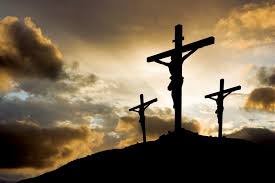
He Died! The Great Redeemer Died ~ Br. Brenden Humberdross
Good Friday of the Lord’s Passion 2017 Reading: John 18:1 – 19:42
The Great Redeemer Died!
He died; the great Redeemer died,
And Israel’s daughters wept around;
A solemn darkness veiled the sky,
A sudden trembling shook the ground.
Come, saints, and drop a tear or two
For him who groaned beneath your load;
He shed a thousand drops for you,
A thousand drops of precious blood.
Here’s love and grief beyond degree,
The Lord of glory died for men:
(Isaac Watts)
Today, we stand at the centre of the holiest week in the Christian calendar, and of the most important event in human history. Today we remember not only the death of the man Jesus, not only humankind’s rejection of God, but of the opening of the way for all of humanity to a full relationship with God.
In less than 24 hours we have seen Jesus betrayed by one of his closest followers, interrogated, beaten and humiliated, and finally brutally murdered upon the cross of Calvary. At this point, the disciples would have been despairing; their master, who had seemed to promise so much, was gone. What were they to think of his message? Was he really the messiah or were they wrong? I’m sure that doubt and fear would have been at the forefront of their minds as they grieved for their spiritual leader. However, for us, with the hindsight that distance brings these events take on a different meaning. We should be able to see in the events of Good Friday a different message, not one of despair and fear, but one of hope.
On Thursday night, Jesus left the relative security of the Upper Room where the Eucharist had been instituted and went to the Garden of Gethsemane. The gospel reading today makes it clear to us that Judas, the betrayer, was well aware that this was a place that Jesus and His followers frequented, so why go there? This action is the start of a number of signs in today’s reading that point out for the keen observer that Jesus was totally in control of the events surrounding His passion.
Jesus knew very well that Judas would be able to find him and yet still went to the Garden. When the betrayer and the soldiers appeared Jesus didn’t run, He stood his ground. When approached He asked the mob who they were looking for, to which they responded “Jesus the Nazarene”; and it’s here that we see the first miracle of the Passion. Jesus responded with the words “I AM”. These words were so powerful that they caused the mob to turn away and fall to the ground; but why? Jesus was revealing to the mob, to His disciples and to us his true identity; I AM is the very name of God! When God appeared in the Burning Bush to talk to Moses what name did he give? I AM…Jesus was revealing through the power of His name that he was the Lord God and that no matter what was to follow we shouldn’t fear, but have confidence that all was in His control.
When the mob had recovered Jesus handed himself over to them and it was at this point that Peter leapt to his aide and cut off the ear of the servant; was Peter arrested with Jesus? Surely he should have been for such a violent crime? However, we know that he wasn’t; why? The answer is simple, the Lord of the Passion didn’t allow it. Before handing himself over Jesus said to the soldiers, “…so if you are looking for me, let these men go”; and instead of ignoring the “Nazarene criminal” the soldiers obeyed; the Lord of the Passion exerted His will to control the events.
If the Apostles and Disciples were able to see these events through our eyes their attitude towards what followed may have been totally different. Instead of seeing the acts of brutality performed against their friend, their Master, and their Messiah degrading Him and diminishing Him they may have been able to rest in the knowledge that Jesus has revealed himself as the Great I Am. They may have been able to stand firm knowing that He was in control of events and was truly Lord of all that was happening. They may have even had the foresight that in some way, the Messiah would overcome whatever seemingly earth shattering events were overtaking them.
And thus it should be for us; we should mourn, we should feel grief at the rejection of the Saviour of the whole human family however, we should also rest firm in the knowledge that Jesus is the Lord of the Passion and it is all part of the great plan for the redemption of humanity.
Maundy Thursday and Miracles ~ The Rev. Dcn Brett Whetstone

I received from the Lord what I also handed on to you, that the Lord Jesus on the night when he was betrayed took a loaf of bread, and when he had given thanks, he broke it and said, “This is my body that is for you. Do this in remembrance of me.” In the same way he took the cup also, after supper, saying, “This cup is the new covenant in my blood. Do this, as often as you drink it, in remembrance of me.” For as often as you eat this bread and drink the cup, you proclaim the Lord’s death until he comes.
Maundy Thursday is perhaps the worst day in church history. In fact it is probably the worst day in the history of all humanity. Maundy Thursday is the day that the embodiment of Gods perfect love came to us in the person of Jesus and we rejected him. It was on that last night that there was no hope left for Jesus. One of his best friends had just betrayed him for money, and another was about to deny him three times, and all the rest of his disciples would run away in fear for their lives. It was in a moment of hopelessness, that Jesus gave us a sign of hope , when he said “this is my body and I give it to you”. He was letting us know it would be ok, that he had a plan.
In the establishment of the Eucharist Jesus gave the church many things, but the most important thing he gave was the assurance that God had a plan.
I was listening to a sermon that was given by one of my favorite authors, a Roman Catholic Dominican Priest from England, and he was talking about this very moment in church history, and he asked the question: ” have you ever thought how odd it is, that every Sunday we gather to remember the moment that the community ran away, when they were dispersed?” He continued on to say that, “we gather in hope to remember the worst moment, because it is when it is darkest that God comes to us” or to rephrase that I like to say that it is when it is darkest that God comes to us and we start to see his plan.
Several years ago a friend of mine posted a cryptic post on Facebook. She and I had gone to Bible school together and had reconnected online. In her post she simply said, “If you pray I need you to pray.” So that evening I spent some time praying for her, and the next morning I woke up and checked Facebook as I do every morning and saw her post, she said that her husband’s cancer had returned and that it was going to take a miracle for him to make it. Several months later, at the age of 32 her husband had passed away.
So here is my friend, she and her husband fellow ministers doing exactly what God wants them to do and tragedy strikes. Where is God’s plan in all of this? That’s the question that I was asking, but not her. She said despite this being painful, and despite her feelings of sadness and anger, she knew that God had a plan, and she wanted everyone else to know this as well.
Time went on, as if does in these situations and I happened across another Facebook post from her several months later. This one caught me off guard. She had just announced that she was pregnant.
She had explained that they had trouble conceiving their first child and they sought out help from a fertility specialist. In doing so the specialist had fertilized several eggs, and as luck would have it the first egg was all they needed to have for a healthy pregnancy. Because they went to a Christian hospital for the procedure, the hospital froze he remaining fertilized eggs in case they needed them again in the future. Well the future arrived, and even though her husband had passed away she moved forward with getting pregnant again, because he wanted her too, and he time was right. She got pregnant and experienced a normal pregnancy.
After nine long pregnancy months, she gave birth to a beautiful baby girl. Baby and mom were healthy and sent home from the hospital and to a brother who was anxiously awaiting their arrival. But then after three shot days of being at home, the unthinkable happened. My friend’s newborn daughter spiked a high fever, and no amount of medicine was brining it down. They rushed to the emergency room, where dozens of tests were run. Then the news came. My friend’s daughter had somehow contracted meningitis. Her daughter was hooked up to breathing machines and all sorts of monitors. She was not expected to make it.
So there sat my friend who had just lost her husband a short time ago, about to lose her daughter. She was desperate and didn’t know what to do. Then faced with the decision that no parent should have to face, she made the decision to take her daughter off of the ventilator. She didn’t want to see her baby suffer any longer.
She removed her daughter from the ventilator and held her close to her, cuddling her, crying and praying. Then the unthinkable….the unexplainable happened. Her daughter, who just moments ago was not able to breath on her own took a breath. Then another, and another and then minutes turned into hours and hours turned into days. The miracle that she had prayed for was happening right before her eyes.
Through all of this she never lost hope, she pressed on knowing that no matter what, God had a plan, and that He was going to see her through it., and He did.
I believe that God had his hand in all of this, the entire time he was there with her giving her the strength that she needed to make it through the loss of her husband, and the near loss of her daughter, and now you can see the fruits of that plan, because she travels all over the country talking to groups large and small about grief and trusting in Gods plan. She has been interviewed by people magazine and has a best selling book. So when Jesus said those words 2000 years ago this is my body and I give it to you, it was Him letting us know that he had a plan, it was Him letting us know that He has us covered and that no matter what happens he will see us through it.
Let us pray:
Almighty Father, whose dear Son, on the night before he
suffered, instituted the Sacrament of his Body and Blood:
Mercifully grant that we may receive it thankfully in
remembrance of Jesus Christ our Lord, who in these holy
mysteries gives us a pledge of eternal life; and who now lives
and reigns with you and the Holy Spirit, one God, for ever
and ever. Amen.
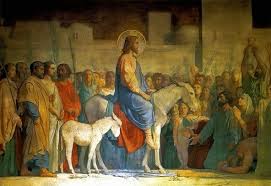
Salvation on a Donkey ~ The Rev. Dcn. Dollie Wilkinson, OPI
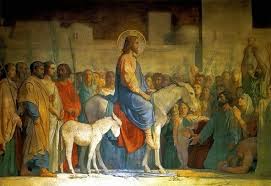
Today is Palm Sunday……but what does that really mean? Palm Sunday is the final Sunday of Lent, the beginning of Holy Week, and as told in Matthew 21:1-11, commemorates the triumphant arrival of Christ in Jerusalem, days before he was crucified.
“When they had come near Jerusalem and had reached Bethphage, at the Mount of Olives, Jesus sent two disciples, saying to them, “Go into the village ahead of you, and immediately you will find a donkey tied, and a colt with her; untie them and bring them to me. If anyone says anything to you, just say this, ‘The Lord needs them.’ And he will send them immediately.” This took place to fulfill what had been spoken through the prophet, saying, “Tell the daughter of Zion, Look, your king is coming to you, humble, and mounted on a donkey, and on a colt, the foal of a donkey.” The disciples went and did as Jesus had directed them; they brought the donkey and the colt, and put their cloaks on them, and he sat on them. A very large crowd spread their cloaks on the road, and others cut branches from the trees and spread them on the road. The crowds that went ahead of him and that followed were shouting, “Hosanna to the Son of David! Blessed is the one who comes in the name of the Lord! Hosanna in the highest heaven!” When he entered Jerusalem, the whole city was in turmoil, asking, “Who is this?” The crowds were saying, “This is the prophet Jesus from Nazareth in Galilee.” “
Palm Sunday is known as such because the faithful will often receive palm fronds which they use to participate in the reenactment of Christ’s arrival in Jerusalem. In the Gospels, Jesus entered Jerusalem riding a young donkey, and to the lavish praise of the townspeople who threw clothes, or possibly palms or small branches, in front of him as a sign of homage. This was a customary practice for people of great respect. Palm branches are widely recognized symbol of peace and victory, hence their preferred use on Palm Sunday.
So here we have Jesus, basically riding to His death, not in a carriage, or on a magnificent horse, but on an humble donkey. But this serves to remind us that even though He is the Son, our Savior, He chooses to come to us where we are, as a humble servant for His people. The use of a donkey instead of a horse is also highly symbolic, it represents the humble arrival of someone in peace, as opposed to arriving on a steed in war. A week later, Christ would rise from the dead on the first Easter.
During Palm Sunday Mass, palms are distributed to parishioners who carry them in a ritual procession into church. The palms are blessed and many people will fashion them into small crosses or other items of personal devotion. These may be returned to the church, or kept for the year. Because the palms are blessed, they may not be discarded as trash. Instead, they are appropriately gathered at the church and incinerated to create the ashes that will be used in the follow year’s Ash Wednesday observance. The colors of the Mass on Palm Sunday are red and white, symbolizing the redemption in blood that Christ paid for the world.
I love the picture represented in Matthew. Everyone around are taking off their coats, and laying it in front of Jesus, as He rides in on the donkey. Even those too poor to have a fine coat, gather branches or palms off the trees, to lay at Jesus” feet. This reminds me of a fairy tale prince, who discards his cloak, covering a puddle so the dainty princess may cross without getting her feet wet. Yet in Matthew, the people are clearly showing their support, and adoration, for the Lord, Jesus Christ. I wonder how many of them knew what was to happen just a few days later. But Jesus knew, and yet He didn’t enter the city under cover of darkness. He rode in on a donkey, an humble symbol of peace.
Palm Sunday Prayer:
Almighty God,
On this day, your Son Jesus Christ entered the holy city of Jerusalem and was proclaimed King by those who spread garments and palm branches along His way. Let those branches be for us signs of His victory, and grant that we who bear them in His name may ever hail Him as our Lord, and follow Him in the way that leads to eternal life.
In Jesus’ Name We Pray,
Amen.

Where’s the Proof? ~ Br. Chip Noon, Novice

Jesus wept.
He was human, after all. We can presume he laughed too, can’t we? He loved to have children around him, and they wouldn’t come to him if he were always glum. And casting out beams from our eyes to me is certainly humorous in a sardonic way.
And he “groaned within” or “groaned in the spirit” so we know he was capable of deep emotion.
But when we think of Jesus, we are guided by Isaiah—“he was a man of sorrows, and acquainted with grief.” Fasting, marathon praying, casting out evil spirits, admonishing his followers and others… we know this was a serious guy.
And we can presume he had one thing on his mind: our salvation. This man of sorrows wanted us to be joyful.
But in today’s readings and Gospel, we come up against a real stumbling block, one that dogs us even to this day. Our unbelief.
In fact, that’s a theme throughout the New Testament. Our unbelief.
“OK, you say all these things can happen. Give me some proof!” We doubt everything. We fear to trust. We cower in uncertainty, just as almost everyone in the Bible does at one time or another.
Jesus wept. He wept for his dead friend Lazarus. He wept for the unbelievers. He wept for the believers who would become backsliders. He wept for the condition of humankind then, before, and now.
“Give me proof.”
It is sad, isn’t it? We all need reassurance, proof, pats on the back.
What Jesus gave as proof was what we call miracles. He raised Lazarus from the dead. He turned water into wine. He cured lepers. He made the blind see. He cast out devils.
This is how he taught his followers and his doubters.
And in a few weeks, we will hear from the pulpit that when he showed himself to thousands after his death, they became believers too.
Why do we need these proofs? We certainly don’t get them today. We don’t see people raised from the dead. We don’t see the blind made to see. We don’t…we don’t…or do we?
What is a miracle? The Bible gives us healings, serpents, transfigurations, resurrections. But that was thousands of years ago. What do we have today?
Do you need to see your dead brother brought to life? Do you think it’s even possible? Do you need to see the cancer sufferer cured? Do you think it’s even possible? Do you need to see your life turned around? Do you think it’s even possible?
Let me tell you for a minute one of my own “miraculous” experiences. Eight years ago my son called me and told me that the sonographer could not detect a heartbeat in the baby in his wife’s womb. He was distraught. His wife was distraught. My wife and I were distraught. But Mike did tell me that the doctor wanted to wait a week and have the sonogram taken again.
That was a bad week. What did I do? Yes, I worried. Yes, I was distraught too. But then I thought, “I’ll pray to my mother in heaven and see if she can help.” Let me tell you now that I think my mother is truly a saint in heaven. And since I firmly believe in the communion of saints, I got right on the prayer train to her. Our Fathers, Hail Marys, Rosaries, lots of made up prayers and supplications.
Of course I included Jesus and Mary in the prayers, figuring I should go direct as well.
And the next week…they heard a heartbeat.
Do I know if this was a miracle? I have no idea…that is, I have no proof. But to me, that was a miracle and proof of God’s continuing presence in our lives.
Now I have quite a few friends who take all this as malarkey, and figuratively pat me on the head and say, “whatever makes you happy.” You know the comments. But even in my own doubt (Lord I believe. Help thou mine unbelief.) I figured that this was a true miracle and my mother had one in the win column. But you know it takes two miracles to make a saint, so a year later, there was a similar event that needed divine intervention. Down to the station, back on the prayer train, and more supplications to Jesus, Mary, and Doris, my mother.
Sure enough, another miracle, my sister recovered. Doris has had several more miracles over the years. Maybe I should call the Vatican…
But back to the sermon, the First and Second Readings and the Gospel are talking about life and death, and coming back to life and being alive in the spirit. These are our wishes. In fact, this is what we all hope will happen after we die. We believe there is no end, but a continuation in another realm.
However, let me call your attention back to Psalm 130 from this morning.
Out of the depths I cry to you, O Lord,
Lord, hear my voice!
O let your ears be attentive
to the voice of my pleading.
If you, O Lord, should mark our guilt,
Lord, who would survive?
But with you is found forgiveness:
for this we revere you.
My soul is waiting for the Lord,
I count on his word.
My soul is longing for the Lord
more than watchman for daybreak.
Let the watchman count on daybreak
and Israel on the Lord…
Here the psalmist is not asking for proof, miracles, signs. He knows that God will forgive us and he counts on the Lord. That’s the essence for today. We can ask for, we can rely on miracles, but if the Kingdom of Heaven is within us, do we need those signs?
I love them, actually. I firmly believe I have experienced miracles, but I also know that God speaks to us without signs and symbols. So the miracles for me are a comfort. But the daily comfort is there, if only I ask.
Amen.
Lord as you show us your miracles every day, hear us as we pray, Lord, we believe. Help thou our unbelief.
A Shepherd For the Lost! ~ The Rev. Dcn. Dollie Wilkinson, OPI
We all know the twenty-third Psalm, the Psalm of David. I imagine most of us can recite it almost word for word. But, have you ever thought about what it really means, what it is really saying? It seems with our fast paced, frantic world, people are feeling increasingly stressed, depressed, or lost. And while there are drugs, and therapy to help us deal with any issues we may face, there is also a very powerful tool, a special gift that our heavenly Father has given us – Psalm 23. Let’s take it line by line, and explore how just by reciting, and praying, on each part, it will provide us with a way to cope with the stresses of this world.
Psalm 23 (KJV)
“The Lord is my shepherd; I shall not want.”
What is the purpose of a shepherd? To guide his flock of sheep, to gather any little ones who wander astray. He also must make sure they are well fed, and cared for, to insure they live a long life, so their purpose is assured (the gift of their wool). Isn’t this exactly what God does? He provides us with all of our needs, even if we don’t realize at times what exactly we need. Even if we ask Him for nothing, He still provides. We can be assured that will shall never want. He is our Shepherd!
“He maketh me to lie down in green pastures”
I tend to go throughout my day as if it’s a race. I have a mental to-do list in my head, and on top of that I also care for my ailing husband, babysit my granddaughter once a week, and most days run errands, such as go to the store. So you can imagine, I get pretty tired and worn down. Though my best friend cautions me to rest, I don’t always listen. But just as a shepherd knows that his flock must rest at times, so too does our heavenly Father. I’ve noticed that sometimes it takes a major illness, or injury, to get us to stop, to get that much needed rest. And there should be no shame in slowing down at times, and allowing our body, and mind, to recuperate.
“he leadeth me beside the still waters.”
If you know anything about sheep, they are timid creatures. And just like all God’s creatures, they get thirsty. But, they are afraid of fast moving streams. So the shepherd will lead them to a calm pool of water. He doesn’t make fun of the sheep for being afraid, he doesn’t push them in to a place where they are not comfortable. Our Shepherd does the same for us. If we are afraid, He makes a way to calm our fears. He leads us in to the calm pool, and away from the rapids of life.
“He restoreth my soul”
I had a chaotic childhood. My parents divorced when I was little, my mother committed suicide, and now I care for my ailing husband. It has taken me many years to learn to trust people, and to trust myself. When a shepherd takes his flock out for the day, when they pause to rest, I imagine the sheep wander close to the shepherd, maybe for a snack, but I also believe for just a simple ear scratch, or to be petted. This makes the sheep feel loved and cherished, it makes them happy. We cannot be happy all the time, because life has a way of knocking us down. Our soul can feel crushed in the midst of all life’s troubles. But just like the sheep who come to the shepherd for love and care, so too can we go to our Father. He will help restore what has been broken in us.
“he leadeth me in the paths of righteousness for his name’s sake.”
Imagine a flock of sheep, on a farm, beside a busy street. What would happen if there were no shepherd? Sheep tend to wander off, if left on their own. Well aren’t we the same? How many times have you made a decision, that on looking back, you realized that was not the best decision at the time. But we have a Shepherd, just like the sheep, who will lead us down the right path.
“Yea, though I walk through the valley of the shadow of death, I will fear no evil: for thou art with me”
This one line provides so much comfort, if you will only hear the message. Talking to many people who suffer from depression, or other mental illness, they almost always describe their illness as a black hole, a dark place. And don’t we always fear the dark, the night, at times? I imagine sheep are the same way. But think of the shepherd’s light, which guide the sheep at night, as God’s love and protection, leading us out of the darkness. When you feel darkness, gloom, the bad stuff, all around you, recite this simple prayer. And know, you are never alone in that darkness, because He is always near.
“thy rod and thy staff they comfort me.”
I love the pictures of baby sheep (lambs)! They are so cute, but also so helpless. When we see pictures of shepherds, usually they carry a staff. Have you ever wonder why it is curved at the top? When the sheep, or lamb, has wondered off, possibly fallen down a hill, the curved end of a shepherd’s staff allows him to grasp the lamb who is out of arm’s reach. And bring it to safety. Our Father carries a rod and staff, so to speak. The rod is to protect us against harm, the staff is used to rescue us when we stray.
“Thou preparest a table before me in the presence of mine enemies”
How does the shepherd know where the best grasses are, to graze for his flock? What would happen if he wasn’t as vigilant, and they became poisoned by something? We are not always as careful as we should be, in where we go, what we eat, who we meet, etc. As parents, we always, always try to guard our children from the dangers of life. This isn’t always easy. But, because we have a constant Shepherd who goes before us, preparing a way which is safe from our enemies, we, and our children, can continue to come to no harm.
“thou anointest my head with oil; my cup runneth over.”
At the end of the day, I imagine as the shepherd brought his herd inside the barn, he checked each one for any cuts or scrapes. My granddaughter will be the first to tell you if she has a boo-boo. She then demanded I kiss it first, as if that had some magical healing properties. Then the offending cut was anointed with medicine, and bandaged. Just as I imagine the shepherd does for any hurt ones in his flock. Like the sheep, and my granddaughter, we all need medicine when we are sick. But we also need the anointing grace of our loving God. Only then are we healed, and our cup of blessings will overflow.
“Surely goodness and mercy shall follow me all the days of my life”
I’m a worry-wart! I can take a mole hill, and make it a huge mountain. Does what I picture in my mind, actually happen? Most days the answer is NO. But it doesn’t stop me from worrying. We all carry pictures in our head of what we think may happen. For some reason, we always picture the worse. But in this humble verse, we are reminded that God’s goodness and mercy is always with us. It does not leave us…..so when you feel yourself picturing the worse that could happen, remember you are promised His love and mercy, for “all the days of your life”.
“and I will dwell in the house of the Lord for ever.”
I love this simple declaration by David. He doesn’t say maybe I will, or I hope I will. He declares, “I will”! He gets it, he knows who his shepherd is. Just as the sheep put their absolute trust in the shepherd, so does David put his trust in the Lord. As we should do also, because like sheep in the field, we would be lost without our Shepherd.
Be Prepared for a Life of Miracles! ~ Br. Brenden Humberdross, Novice
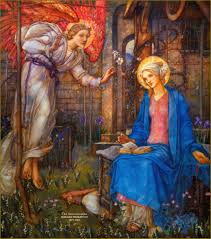
Feast of the Annunciation 2017 Reading: Luke 1:26-38
May the words of my mouth and the meditations of our hearts be always acceptable to you O Lord, our God and our Redeemer.
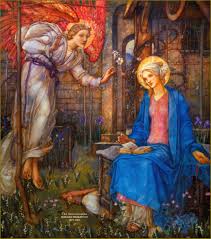
Today is a most blessed day for those of us who find ourselves with the Catholic branch of the Christian family; on this day Churches of both the East and the West celebrate the Feast of the Annunciation. Today, all of the Catholic work can forget the divisions amongst us and come together to celebrate the visit of the Archangel to the Blessed Virgin Mary and her humble submission to God’s will.
I’ve heard many a sermon preached on this day over the years and many of them have focussed on what, for many, seems like the obvious message of today’s Gospel but I’m going to take us on a little bit of a different track. However, first for those of you who may not have heard a “traditional” Annunciation sermon I will highlight the usual points.
Tradition tells us that Mary was but a young girl at the time that these events took place and from scripture we know that she was unmarried but betrothed (think of it as engaged), it’s stated clearly twice and implied another time in today’s reading that she was a Virgin. Can you imagine for a second that you’re a young girl, engaged to an older man, in a society with a strict moral code and a penchant for stoning harlots to death and someone tells you (albeit an angel) that you are going to fall pregnant? What would you do? I can tell you what I would do…after changing my soiled clothes I’d either pack up and get out of there or run away screaming thinking I’d lost my mind (and from Gospel stories we know how the mad were treated!). But is that what Mary did? She didn’t, to her credit she appears to have listened calmly to the message, maybe she played it over in her mind and she replied with a resounding “May it be done to me according to your word”.
The traditional Annunciation sermon will often branch of now to talk about how we must all strive to have the faith of Mary; how we too must be ready to answer the call when God comes knocking. Now don’t get me wrong, this is a lovely idea for a sermon and it is one message that can be taken from this event in the life of the Blessed Virgin and our Saviour, however there is a much deeper message to be found within the words of today’s gospel that goes right to the heart of what it is that we believe as Christians and it is this that I want to draw out today.
There are two truths that the Archangel Gabriel’s message highlights in today’s reading; one is that Mary will conceive in her womb, she will find herself with child, and the second is that the child she will bear will not be that of her future husbands but will instead be the very son of God. Now I know right now you’re all thinking I’m a bit loopy, we all know that the reading says that, we all heard it and we all believe it, but it really hasn’t always been the case.
In the days of the early Church there was a Bishop called Nestorius who was Patriarch of Constantinople one of the great leadership roles in the early Church. Nestorius however, did not believe that Jesus was born the Son of God. Nestorius taught that when Jesus was conceived in the womb he was a man human, like you and I; it wasn’t until later that the Son of God, something divine, came down from heaven and joined with the human Jesus. Now, to the rational of mind this might sound more rational, Jesus was born the normal way and then he got a super spiritual hit of Holy Ghost from God to become our Saviour, no need to reject what we know about human conception. However, is this what the scriptures tell us? Is this the faith that the Apostles and Early Christians bled and died for? It most certainly is not!
The Archangel said to Mary, “”The Holy Spirit will come upon you, and the power of the Most High will overshadow you. Therefore the child to be born will be called holy, the Son of God.” The Archangel did not call Jesus the Son of Joseph, nowhere in the accepted teaching of the Church has this ever been the case. The child that was conceived in the womb of Mary was a miracle, the product of God’s divine intervention in this world. As Christians we need to not be afraid of standing up for this long held and defended belief.
Some of you may know that amongst other things, I am a science teacher, and as someone with a love for the natural sciences we need to not be afraid of saying things that seem “odd” not everything in the world can be explained by Science. In fact, take the idea of the Big Bang, do you know that it was first suggested by a Catholic Priest of the Roman Church? His name was Georges Lemaitre and Einstein thought his physics was atrocious though now many accept his work as truths.
It may shock some of you to know that I have actually heard clergy deny the idea of the Virgin Birth, that it was even possible. It seems to me that we are all too quick to try and explain the miraculous away with rationalism. Nowhere in the Scriptures and words of Christ are we told that our God is a rational God who only works according to our finite understanding of the universe! Instead, we see evidence of a God that is bigger than us all, a God who stands outside of the realms of our finite minds and is the author of the laws of this Universe. I’m most sure that when we stand before his throne we will be amazed at the natural laws that exist that we have no idea about.
So there are two things that I want you to take away from today’s celebration of the Annunciation to the Blessed Virgin Mary. The first is that it was indeed a real event, that the Church has always taught it and that if we are to be true to our Christian heritage we too must accept it and keep teaching it. The second is to always be open to the miraculous, Mary knew that her faith in God could not be limit by her finite understandings, she didn’t need to question the miraculous, she understood that all our finite minds can do is say yes to God and be prepared for the life of miracles that is sure to follow.
In the name of the Father, and of the Son and the Holy Spirit. Amen.
Blessed Sybil Biscossis
Sybillina’s parents died when she was tiny and as soon as she was old enough to be of use to anyone, the neighbors, who had taken her in at the time she was orphaned, put her out to work. She must have been very young when she started to work, because at the age of 12, when she became blind and could not work any more, she already had several years of work behind her.
The cause of her blindness is unknown, but the child was left doubly destitute with the loss of her sight. The local chapter of the Dominican tertiary sisters took compassion on the child and brought her home to live with them. After a little while of experiencing their kind help, she wanted to join them. They accepted her, young though she was, more out of pity than in any hope of her being able to carry on their busy and varied apostolate.
They were soon agreeably surprised to find out how much she could do. She learned to chant the Office quickly and sweetly, and to absorb their teaching about mental prayer as though she had been born for it. She imposed great obligations of prayer on herself, since she could not help them in other ways. Her greatest devotion was to Saint Dominic, and it was to him she addressed herself when she finally became convinced that she simply must have her sight back so that she could help the sisters with their work.
Praying earnestly for this intention, Sybillina waited for his feast day. Then, she was certain, he would cure her. Matins came and went with no miracle; little hours, Vespers–and she was still blind. With a sinking heart, Sybillina knelt before Saint Dominic’s statue and begged him to help her. Kneeling there, she was rapt in ecstasy, and she saw him come out of the darkness and take her by the hand.
He took her to a dark tunnel entrance, and she went into the blackness at his word. Terrified, but still clinging to his hand, she advanced past invisible horrors, still guided and protected by his presence. Dawn came gradually, and then light, then a blaze of glory. “In eternity, dear child,” he said. “Here, you must suffer darkness so that you may one day behold eternal light.”
Sybillina, the eager child, was replaced by a mature and thoughtful Sybillina who knew that there would be no cure for her, that she must work her way to heaven through the darkness. She decided to become a anchorite, and obtained the necessary permission. In 1302, at the age of 15, she was sealed into a tiny cell next to the Dominican church at Pavia. At first she had a companion, but her fellow recluse soon gave up the life. Sybillina remained, now alone, as well as blind.
The first seven years were the worst, she later admitted. The cold was intense, and she never permitted herself a fire. The church, of course, was not heated, and she wore the same clothes winter and summer. In the winter there was only one way to keep from freezing–keep moving–so she genuflected, and gave herself the discipline. She slept on a board and ate practically nothing. To the tiny window, that was her only communication with the outside world, came the troubled and the sinful and the sick, all begging for her help. She prayed for all of them, and worked many miracles in the lives of the people of Pavia.
One of the more amusing requests came from a woman who was terrified of the dark. Sybillina was praying for her when she saw her in a vision, and observed that the woman–who thought she was hearing things–put on a fur hood to shut out the noise. The next day the woman came to see her, and Sybillina laughed gaily. “You were really scared last night, weren’t you?” she asked. “I laughed when I saw you pull that hood over your ears.” The legend reports that the woman was never frightened again.
Sybillina had a lively sense of the Real Presence and a deep devotion to the Blessed Sacrament. One day a priest was going past her window with Viaticum for the sick; she knew that the host was not consecrated, and told him so. He investigated, and found he had indeed taken a host from the wrong container.
Sybillina lived as a recluse for 67 years. She followed all the Masses and Offices in the church, spending what few spare minutes she had working with her hands to earn a few alms for the poor (Attwater2, Benedictines, Dorcy).
Born: 1287 at Pavia, Lombardy, Italy
Died: 1367 of Natural Causes: Her body remains Incorrupt
Beatified: 1853 (Cultus confirmed); 1854 beautified
Patronage: Children whose parents are not married, illegitimacy, loss of parents
Quick Facts
- Orphaned when very young.
- Uneducated.
- Worked as a domestic servant by age 10.
- Blind by age 12; the cause of her blindness has not come down to us.
- Adopted by a community of Dominican tertiaries at Pavia.
- Developed a devotion to Saint Dominic in hopes that his intervention would return her sight; when it didn’t she came to accept it as her lot in life.
- Received a vision of Saint Dominic as confirmation of her desire to join the order.
- At age 15 she became a recluse, living in a walled up cell.
- She spent her time in prayer and devotion, and her cell soon became a point of pilgrimage for Pavians seeking advice and healing; she lived there for over 60 years, doing penance, performing miracles, and spreading devotion to the Holy Spirit.
- Sybillina could sense the Presence in the Blessed Sacrament.
- Once a priest passed her window on his way to a sick call.
- She told him that the host was not consecrated; he checked and found he had taken a host from the wrong container.
Incorruptable
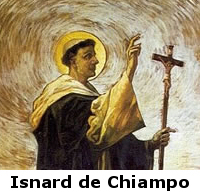
Blessed Isnard de Chiampo
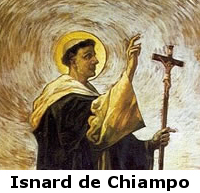
Blessed Isnard is another very distinguished and saintly first disciple of Saint Dominic whom Father Touron somehow overlooked. Of Isnard’s life up to the time he entered the Order practically nothing is known with certainty; whilst some of the statements anent his debut as a Friar Preacher are irreconcilable among themselves, and contrary to facts which have been ascertained in later years. Chiampo, a small town not far from Vicenza, Italy, was most likely the place of his birth; yet there are those who give the latter city this honor. Some think he was born of poor parents, and spent his youth in poverty. Others suggest that he belonged to a wealthy family by the name of Isnardi, which has been long extinct.(1)
It is beyond doubt that the future wonder-worker received the habit in Bologna, from Saint Dominic, in 1219; for this is a point on which nearly all the early authors are in accord. This truth seems certainly to prove that he was a student at the university there, and far advanced in his studies, At that time only such applicants were accepted; and this fact is a strong proof that his parents were well-to-do, for only the sons of this kind were given a higher education. Without exception the writers tell us of his singular purity of heart and religious disposition. His mind had been carefully guarded against the evils of the day, and in Bologna he proved faithful to the lessons of his earlier youth. Association with the holy man from Caleruega quickened his efforts for holiness of life and the salvation of souls.
For ten years after he entered the Order of Saint Dominic, we have no positive knowledge of where Isnard made his home. Yet the indications are that he spent this time between Bologna and Milan. In which case, of course, he labored energetically in those parts of Italy. Although a quite corpulent man, we are told, he was endowed with extraordinary energy, and was very gracious in action as well as in word. San Eustorgio, Milan, was most likely his convent for the greater part of this decade. So at least thinks Rudolph Majocchi, Blessed Isnard’s latest hagiographer.(2)
In more than one of our sketches, but especially in that of Saint Peter of Verona, we have seen how the Albigenses and kindred sects overran northern Italy at that date. Milan was one of the centers of Dominican activity against them; and it was from Milan that the convent of the Order in Pavia was founded. At Pavia the heretics were long in the ascendancy. The city was also a stronghold of Frederic II, whose Ghibellines, always opposed to the Holy See, constantly persecuted those who favored the authority of the Church. When, in 1230, zealous Rodobald Cipolla became bishop of Pavia, he found religion in a sad plight in his diocese, and began at once to seek means for a reformation.
Blessed Isnard’s reputation for holiness of life, zeal, eloquence, power over the souls of others, and fearlessness was broadcast. Most likely he had already preached in the Diocese of Pavia — perhaps many times; for the Friars Preacher of Milan carried their work in every direction. Possibly, too, he and Bishop Cipolla, himself an energetic character, had become friends at a prior date. Anyway, one of the new prelate’s first steps for the spiritual betterment of his flock was to invite the subject of our narrative from Milan, that he might establish a house of the Order at Pavia. This was in 1231; and before the close of the year we find the fathers actively engaged in their apostolate under the leadership of the man of God from Chiampo.(3)
The convent, which Rodobald Cipolla generously helped to erect, stood in the little village of Ticino, a short distance outside the walls of Pavia, and was given the name of Saint Mary of Nazareth. Throughout Italy the Friars Preacher were known as an effective aid to the hierarchy against the evils of the day. Thus Bishop Cipolla felt that, at least under Isnard, they would be an immense help to him in putting an end to the inroads of the enemy, and in freeing his diocese from the many ills in which it was enmeshed. He had not long to wait before he saw that his choice of auxiliaries was no mistake.
However, the task proved difficult, trying, and full of danger. On the one hand, the faithful, through long bad associations, had become so cold, careless, and wayward in the practice of their religious duties that it was exceeding hard to arouse them to a sense of their obligations. On the other, the Ghibellines and sectarians, ever of stubborn mood as well as violent in their methods, were even less subject to management. These possessed little or no faith. Besides they were loath to change their views, to amend their lives, or to part with the earthly goods which they had obtained by robbery or dishonesty.
As is ever the case in such conditions, the Friar Preacher’s success began with the poor and the laboring classes. For these he had a special love. He gathered them around him at the conventual church, instructed them in their religion, and inspired them with a love of its practice. Although he met with much opposition at first, it was not long before he had completely changed their lives. Reports of the good thus effected soon spread near and far. Meanwhile, he and his confrères preached throughout the City of Pavia and its environments — in churches, public squares, market places, or wherever they could find a space large enough for an audience. Gradually the wealthier Guelfs, and even not a few of the Ghibellines, began to harken to the call of grace and to receive the sacraments.
Among the little band of missioners Isnard shone with special brilliancy for his saintliness, zeal, and eloquence. The influence which he soon began to wield over the people caused the leaders of the heretics to single him out for their hatred. They mocked and ridiculed him, publicly spurned him, laughed at his corpulent figure, defamed him, threatened him, did everything in their power either to bring him into disrepute or to make him desist from his tireless apostolate. All was in vain. His sermons were incessant. He challenged his enemies wherever he met them. If they undertook to answer him, his inexorable logic put them to shame, or reduced them to silence. Never was he known to be ill natured, or to lose his patience; yet he showed the fire of divine love that glowed within his breast.
No doubt as much to demonstrate the holiness of His faithful servant as for the benefit of those to whom he preached, God blessed Isnard with the gift of miracles. The early writers mention many wrought by him both before and after his death.(4) These, quite naturally, quickened and strengthened the faith of the Catholics. They also gradually undermined the influence and broke the spirit of the heretics, many of whom were brought into the Church. By the time of the holy man’s death, the Diocese of Pavia was free from attacks by Albigenses, Catharists, and similar sects. They bad gone to other parts, been converted, or held their peace. No one could be found who would profess their principles. It was a glorious apostolate brought to a successful termination.
The Ghibellines, or adherents of Emperor Frederic II, gave Christ’s ambassador no end of worry and trouble. These were the rich who were not guided by their consciences in the acquisition of wealth; politicians without scruples; and soldiers of fortune, whose restless spirits ever led them into the service in which they might expect the greatest booty, license, and excitement. The machinations of the German monarch helped to keep them in keen antagonism to ecclesiastical authority and the interests of religion; which, of course, rendered them less responsive to our blessed’s impelling eloquence or the strong influence of his holiness and miracles. We may judge of the contempt of these friends of Frederic for the Holy See from the fact that their acts more than once led to a papal interdict on Pavia.
Still these men, who could laugh at an excommunication and interdict from the highest authority in the Church, perforce loved and admired Father Isnard. His charity, his zeal, his gentle goodness, his purity of heart, his constant efforts for the right, which they witnessed day by day, simply wrung respect from them. His dealings with Frederic II must have been much like those of John of Wildeshausen. Even when Bishop Cipolla was driven into exile, Isnard and his band of missionaries were left to continue their fruitful labors. In the absence of the ordinary, the clergy who still remained in the diocese seem to have gathered around the subject of our sketch for guidance. Possibly the saintly prelate, at the time of his departure, placed him in charge of his spiritual vineyard.(5)
Despite the turbulence and the anti-ecclesiastical spirit of the day, the holy Friar Preacher from Chiampo effected untold good even among this class of citizens. Documents which have escaped the ravages of time show that some, who deferred conversion until on their deathbeds, made him the instrument of their restitution. Others entrusted him with their charity and benefactions. Historians call him an apostle of Pavia, and largely attribute the preservation of the faith in the city to his zeal.
Another proof of the respect and confidence which Isnard enjoyed among all classes, as well as of his reputation abroad, is found in the incident which we have now to tell. From early times the Diocese of Tours, France, possessed landed estates in and around Pavia. Because of the political disturbances and the Ghibelline spirit, to which we have referred, the canons of the Tours cathedral found it impossible to collect their rents. In this dilemma, they appointed our Friar Preacher their agent; for they felt that he was the only man in northern Italy who either could obtain their dues for them, or would dare undertake the task. This was in 1240, the year after the historic excommunication of Frederic 11 by Gregory IX. The affair shows bow wisely Isnard steered his course, how all venerated him at home, and how well his courage and prudence were known even in France.(6)
Like a number of the early disciples of Saint Dominic whose lives we have outlined, the apostle and reformer of Pavia did not feel that he had done his all for the benefit of religion until he established a community of Dominican Sisters. These he placed in the immediate vicinity of his own convent, that he might the better look after their spiritual welfare. Their house bore the same name as that of the fathers — Saint Mary of Nazareth. Although he had perhaps never seen Prouille, his double institution at Pavia must have been much like that with which the Order started in southern France. The dowries of many of these sisters indicate that he founded them, in part, so that wealthy worldly dames, whom he had converted, might have a place in which they could more completely give themselves to the service of God. Saint Dominic, it will be recalled, established the community of Prouille principally with women converted from Albigensianism. When, some years after our blessed’s death, the fathers moved into the city proper, the original Saint Mary of Nazareth was turned over to the sisters.
Isnard had a profound devotion towards the Mother of God. He perpetually preached her protection over the faithful. In every way he propagated love and veneration for her. Father Majocchi thinks that this apostolate was of immense aid to him in his work of reformation; for no other piety seems to be more congenital to the affectionate Italian character. He labored zealously on almost to the very last. At least the Lives of the Brethren (Vitae Fratrum) say his final sickness was a matter of only a few days. The manuscript annals, or chronicles, of the old Friar-Preacher convent at Pavia tell us that he surrendered his pure soul to God on March 19, 1244. He knew that the end was near, prepared for it, and died as holily as he had lived.(7)
We have no account of the funeral of the man of God. Yet the great love and admiration in which he was held justify one in the belief that the Pavians attended it in immense numbers. Perhaps the sad event plunged the city in no less grief than his own community. He was buried in the Church of Saint Mary of Nazareth, where his tomb became at once a place of pilgrimage for the city and province of Pavia. Not a few miracles were wrought in answer to prayers to him. The name Isnard was often given to children at their baptism.
Later, for various reasons, the fathers moved into the city proper. First (1281), they took possession of San Marino, but gave up this place the next year for Saint Andrew’s. There they remained until 1302, when they exchanged Saint Andrew’s for Saint Thomas’, which was better suited to their purposes. At this last location they at once began a splendid temple of prayer, which was completed between 1320 and 1330. The body of Blessed Isnard, which had been brought from the extra-urban Church of Saint Mary of Nazareth to Saint Andrew’s, while the fathers lived in the latter convent, was again translated and enshrined in a marble sarcophagus built for the purpose in a chapel of the new Saint Thomas’ Church. The devotion of the people followed his relies to both of these places of rest. Nor is it any stretch of fancy to imagine that the two translations were times of great fervor for all Pavia.
Unfortunately, in a spirit of zeal and friendship, the fathers gave the use of Blessed Isnard’s Chapel, as it was called, to the University of Pavia for religious functions. Although its walls were afterwards decorated with paintings commemorative of the chief events in his life, these academic associations tended rather to decrease veneration for the saintly Friar Preacher. The misfortunes of Pavia during the Spanish-Austrian reigns of Charles V and Philip III, which lasted almost throughout the sixteenth century, well-nigh caused him (or rather his final resting-place) to be forgotten even by some members of his own Order, and his relies to be scattered to the winds. Happily the researches of Pavian historians helped to avert such a disaster.
In spite of the most thorough identification, however, and to the great sorrow of the fathers, the rector and senate of the university, though without authority in the matter, later compelled our blessed’s sarcophagus to be taken from the chapel and destroyed. This was in 1763. But, before its removal, the community reverently gathered up his relies and placed them in a wooden chest. All this was done in the presence of Cardinal Charles Francis Durini, who then closed the box, and fastened it with his seal. Thence until the suppression of Saint Thomas’ Convent by Emperor Joseph II, in 1785, Isnard’s relies were carefully preserved in the archives. The fathers then took the chest, with its precious contents, to Saint Peter’s. When, in 1799, they were also forced to leave this abode, they gave their spiritual treasure to Bishop Joseph Bertieri, O. S. A. This prelate, after an official examination, not only entrusted Isnard’s relies to the Church of Saints Gervasius and Protasius, but even ordered them to be exposed for public veneration.
It looks providential that, under all these changes and difficulties, popular devotion for Saint Dominic’s early disciple did not completely die out. That it continued to exist shows the unalterable love in which the Pavians held him. Bishop Bertieri’s act gave it new life. In 1850 portions of his relies were given to Chiampo and Vicenza. Old paintings of him here and there, which represented him as a saint, also helped the cause. In 1907 the diocesan authorities of Pavia approved of his cult, and requested the Holy See to accept their decision. The late Benedict XV, of happy memory, after a thorough investigation by the Sacred Congregation of Rites (that is, in 1919), granted his office and mass to the Friars Preacher and the Diocese of Pavia. March 22 was appointed as his feast day.
Isnard is the last of the original disciples of Dominic to be accorded the honors of the altar. The late date of his beatification affords the hope that several others of them may yet he similarly dignified by the Church.
Ambrose of Siena
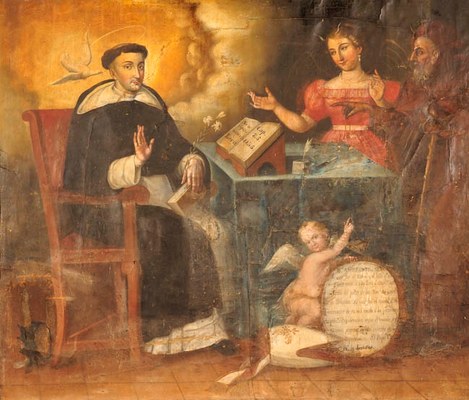
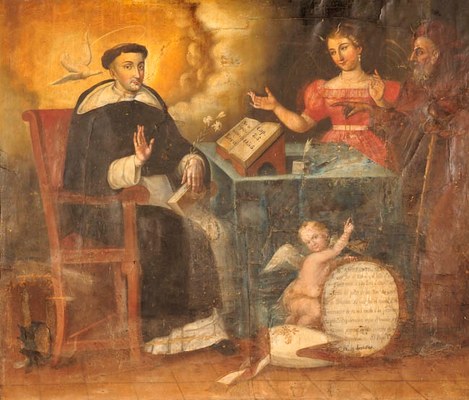
Ambrose was born at Siena on 16 April 1220, of the noble family of Sansedoni. When about one year old, Ambrose was cured of a congenital deformity, in the Dominican church of St. Mary Magdalene. As a child and youth he was noted for his love of charity, exercised especially towards pilgrims, the sick in hospitals, and prisoners. He entered the novitiate of the Dominican convent in his native city at the age of seventeen, was sent to Paris to continue his philosophical and theological studies under Albert the Great and had for a fellow-student there, St. Thomas Aquinas.
In 1248 he was sent with St. Thomas to Cologne where he taught in the Dominican schools. In 1260 he was one of the band of missionaries who evangelized Hungary. In 1266 Sienna was put under an interdict for having espoused the cause of the Emperor Frederick II, then at enmity with the Holy See. The Siennese petitioned Ambrose to plead their cause before the Sovereign Pontiff, and so successfully did he do this that he obtained for his native city full pardon and a renewal of all her privileges. The Siennese soon cast off their allegiance; a second time Ambrose obtained pardon for them. He brought about a reconciliation between King Conradin of Germany and Pope Clement IV.
About this time he was chosen bishop of his native city, but he declined the office. For a time, he devoted himself to preaching the Eighth Crusade; and later, at the request of Pope Gregory X, caused the studies which the late wars had practically suspended to be resumed in the Dominican convent at Rome. After the death of Pope Gregory X he retired to one of the convents of his order, whence he was summoned by Innocent V and sent as papal legate to Tuscany. He restored peace there between Florence and Pisa and also between the dogal republics of Venice and Genoa, another pair of commercial rivals within Italy.
He died at Sienna, in 1286. His name was inserted in the Roman Martyrology in 1577. His biographers exhibit his life as one of perfect humility. He loved poetry, and many legends are told of victories over carnal temptations.
He was renowned as a preacher. His oratory, simple rather than elegant, was most convincing and effective. His sermons, although once collected, are not extant
 The Order of Preachers, Independent
You must be logged in to post a comment.