
Category: Member Posts

Got Stuff? ~ The Rev. Dcn. Dennis Klinzing, Novice

Someone in the crowd said to Jesus, “Teacher, tell my brother to share the inheritance with me.” He replied to him, “Friend, who appointed me as your judge and arbitrator?”
Then he said to the crowd, “Take care to guard against all greed, for though one may be rich, one’s life does not consist of possessions.”
Then he told them a parable. “There was a rich man whose land produced a bountiful harvest. He asked himself, ‘What shall I do, for I do not have space to store my harvest?’
And he said, ‘This is what I shall do: I shall tear down my barns and build larger ones. There I shall store all my grain and other goods and I shall say to myself, “Now as for you,
you have so many good things stored up for many years, rest, eat, drink, be merry!”’
But God said to him, ‘You fool, this night your life will be demanded of you; and the things you have prepared, to whom will they belong?’ Thus will it be for all who store up treasure for themselves but are not rich in what matters to God.” Luke 12:13-21
At this point, a man in the crowd interrupted Jesus and asked Him to solve a family problem (feud). Rabbis were expected to help settle legal matters, but Jesus refused to get involved. Why? Because He knew that no answer He gave would solve the real problem, which was covetousness in the hearts of the two brothers. As long as both men were greedy no settlement would be satisfactory. Their greatest need was to have their hearts changed. Like too many people today, they wanted Jesus to serve them, but not save them.
Covetousness is an unquenchable thirst for getting more and more of something we think we need in order to be truly satisfied. It may be a thirst for money or the things that money can buy, or even a thirst for position and power. Jesus made it clear that true life does not depend on an abundance of possessions. He did not deny that we have certain basic needs. He only affirmed that we will not make life richer by acquiring more of these things.
Mark Twain once defined ‘civilization’ as ‘a limitless multiplication of unnecessary necessities,” and he was right. In fact, many Christians are infected with covetousness and do not know it. They think that Paul’s admonition in 1 Timothy 6 applies only to the ‘rich and famous.’ Measured by the living standards of the rest of the world, most believers in America are indeed wealthy people.
Jesus told this parable to reveal the dangers that lurk in a covetous heart. As you read it, test your own responses to this farmer’s various experience.
How do you respond to the wealthy farmer’s dilemma? Here was a man who had a problem with too much wealth! If we say, “I certainly wish I had that problem! we may be revealing covetousness in our hearts. If suddenly you inherited a great deal of wealth, would it create a problem for you? Or would you simply praise God and ask Him what He wanted you to do with it?
There are perils to prosperity. Wealth can choke the Word of God, create sinners and temptations, and give you a false sense of security. People say that money does not satisfy, but it does satisfy if you want to live on that level. People who are satisfied only with the things that money can buy are in great danger of losing the things that money cannot buy.
This farmer saw his wealth as an opportunity to please himself. He had no thoughts of others or of God.
How do you respond to the decisions of the rich man? Are you saying, “Now that is a shrewd business!”Save and have it ready for the future!” But Jesus saw selfishness in all that this man did, and He said the man was a fool. The world’s philosophy is “Take care of Number One!” But Jesus does not endorse that philosophy.
There is certainly nothing wrong with following good business principles, or even with saving for the future. Jesus does not encourage waste. But neither does Jesus encourage selfishness motivated by covetousness.
How do you respond to the farmer’s desires? Are you saying, “This is the life! The man has success, satisfaction, and security! What more could he want?” But Jesus did not see this farmer enjoying life; He saw him facing death! Wealth cannot keep us alive when our time comes to die, nor can it buy back the opportunities we missed while we were thinking of ourselves and ignoring God and others.
Jesus has made it clear that true life does not come from an abundance of things, nor does true success or security. This man had a false view of both life and death. He thought that life came from accumulating things and that death was far away.
Finally, how do you respond to the death of the boastful farmer? We are prone to say, “Too bad this fellow died just when he had everything going for him! How tragic that he could not finish his great plans.” But the greatest tragedy is not what the man left behind, but what lay before him; eternity without God! The man lived without God and died without God, and his wealth was but an incident in his life. God is not impressed with our money.
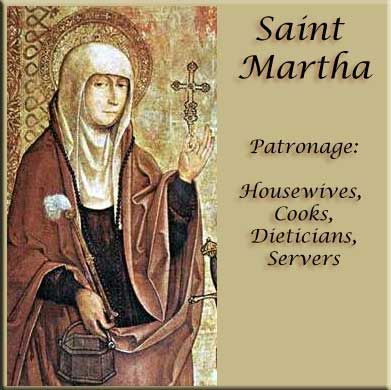
Service: The Feast of St. Martha ~ The Rev. Lady Sherwood, OPI
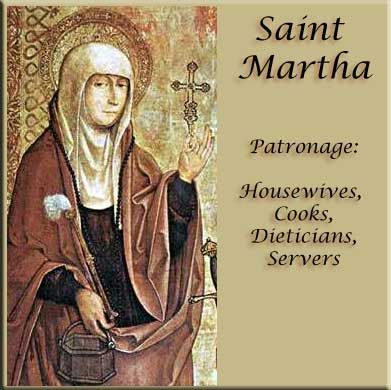
Today we come together to commemorate the life of St Martha.
We should all have knowledge about the story of Martha and Mary who welcomed Jesus into their home. Martha busies herself with the hospitality needs of our Lord Jesus whilst Mary sits at the feet of Jesus listening to his words. Martha complains to Jesus because she wanted Mary’s help but Jesus replies to her, “Martha, Martha, you are worried and distracted by many things; there is need of only one thing. Mary has chosen the better part, which will not be taken away from her.” (Lk 10:38-42)
Jesus’ reply was all about listening to his message. We can then see in ourselves and in our lives, what Jesus points out in Martha – is that we can be easily distracted and worried by worldly tasks and Through Martha’s story, Jesus is reminding us that there is one thing that is of importance: that is to follow Jesus’ message and his individual calling that he has for each of us.
In John 11:17-27, Martha meets Jesus as soon as she learns he is coming after hearing that her brother Lazarus had died. Immediately we see a change in Martha. She purposefully goes to Jesus and when he asks her about his belief in him she responds, “Yes, Lord, I believe that you are the Messiah, the Son of God, the one coming into the world.”
Martha has the opportunity to serve Jesus again.
Six days after the Passover (John 12:1-8). She does so with quiet humility. We come to understand Martha’s role is a different calling than that of Mary and this is much like it is in our own lives. we are each called into different service for the Lord’s glory, we each are blessed with different skills and talents with which to serve him. Martha chose to serve with love instead of with bitterness and arrogance.
Martha’s story gives us hope and is a good example for our own lives. Even though we can fall into the trap of trying to complete tasks without God’s assistance, there is opportunity in the Grace of the Lord to retry. When Jesus speaks to Martha, he is not unkind. His response is one of love. As the sinners we each are, we can only strive to learn and grow from our mistakes to make the next opportunity filled with Christ.
Martha is known as the patron saint of cooks, homemakers, and servants, St. Martha reminds us to thank all in our lives who serve us in whatever way. This can be our parents or those who cook for us, those who work in public service, our friends, our church clergy or even indeed anyone at all. As a way to celebrate St. Martha’s feast day today, we can pray to serve Jesus better:
Saint Martha, pray for us that we might serve Jesus better. Help us to overcome any distractions and worries that we may face in this world and to listen to his words and be present to him in our daily lives. May we remember that although we are called and blessed in different ways, that we are still all members of the same one body of our Lord Jesus Christ.
Amen.
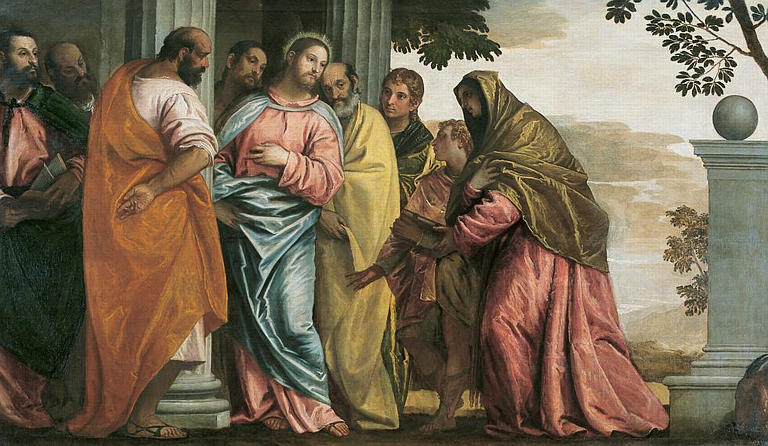
Contradictions and Commitment ~ Br. Chip Noon, Novice
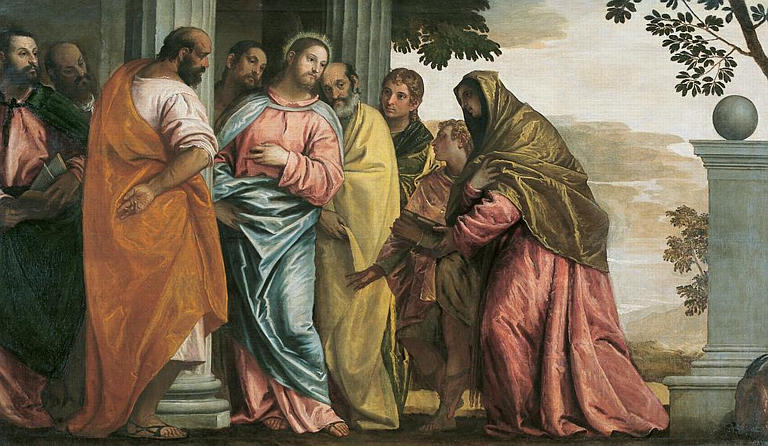
“So the last shall be first, and the first last.”
In Saint James, whose feast we celebrate today, we have a complex character and an important lesson. The Gospel today recounts the incident where the Apostle’s mother, Salome, beseeches Jesus for a favor: that her sons, James and John, be seated at his right hand and left hand in the kingdom.
If Jesus were to answer in today’s vernacular he might say, “You still don’t get it!”
Yes, James was a fisherman who, along with his brother John, was called by the Lord to drop everything and follow him. But he was not so poor, because we know that his father was successful in the family business and his mother was one of the women who were financiers of Jesus’ mission. So perhaps he felt a little superior to some of the other disciples? He did get to witness the Transfiguration, he offered to call down fire on a Samaritan town, he was the first Apostle to be martyred, and he and his brother were called “Sons of Thunder,” probably for his fiery temper. So he was something of a big deal.
But he was also trying to put himself first. He and his brother put his mother up to asking Jesus for a favored position, probably because he knew it was bold and misguided. Jesus rebuffs the request.
James was also the target of one of the Eight Rebukes of Jesus in the incident of offering to destroy the Samaritan town mentioned before.
And yet even though he still didn’t “get it,” he was one of the twelve Apostles and important to the mission of Jesus. And so he is an important lesson to us: nobody’s perfect, but we are still loved by the Lord – and even given great responsibility to spread his word.
Throughout the Gospels, we learn that your station in life, your wealth or lack of it, your talents or lack of them make no difference in the final calling. And what proof do we have of this teaching? It is the life of Jesus…and his suffering and death. Time and again we are taught that we must be servants, even those of us who are of the highest station, and we must be willing to sacrifice ourselves for others, rather than seek glory and riches. Because that is exactly what our Lord did: he sacrificed himself on the cross for our sins and our redemption. His was the ultimate commitment, and he asks no less of us.
Just as Saint James embodies contradictions of pride and humility, so we find Paul, in the first reading, telling us that we will also be faced with, and live within, contradictions. Our weak bodies, breakable earthen vessels, will be
afflicted in every way, but not constrained;
perplexed, but not driven to despair;
persecuted, but not abandoned;
struck down, but not destroyed;
always carrying about in the body the dying of Jesus,
so that the life of Jesus may also be manifested in our body.
The last shall be first, and the first last.
Paul says, “We who live are constantly being given up to death for the sake of Jesus.” In other words we may fall over and over, we may succeed over and over, but what we are living is the spirit of redemption every hour of every day. And so if we fall, we know intimately that we will be raised up if we ask for it, because God’s mercy is everlasting.
Although this life may seem like the life of Sisyphus, constantly pushing a boulder uphill only to have it roll to the bottom time after time, when we really contemplate our lot, we can always remember that Jesus told us the truth: our yoke is easy and our burden is light.
Lord, help us today to renounce our pride or our consternation, our smugness or our fears, our complacency or our anxiety and remind us that everything is for you and you are everything for us. And like Saint James, though we may at times deserve rebuke, we can be assured of our salvation.
Amen.
ABC’s and Priorities: Prayer ~ The Rev. Dcn. Scott Brown, OPI
When you pause to consider that God is infinitely strong and can do all that he pleases; that he is infinitely righteous so that he only does what is right, and that he is infinitely good so that everything he does is perfectly good; that He is infinitely wise so that he always knows perfectly what is right and good, and that he is infinitely loving so that in all his strength and righteousness and goodness and wisdom He raises the eternal joy of His loved ones as high as it can be raised — when you pause to consider this, then the lavish invitations of this God to ask Him for good things, with the promise that He will give them, is unimaginably wonderful.
Everyone seeks something.
We are all by nature seeking people. Some people seek for money, others for fame, others for pleasure, others for self-validation, others for worldly power. We may seek a husband or a wife or we may seek children or a new job or a better education or a new home or new friends or a new church. The tragedy of our time is that so many people are wasting their lives chasing after three things that can never satisfy—money, possessions and power.
There is an easy test to find out what you seek in life.
There is a simple test to help you discover what you truly seek in life. This test is absolutely foolproof. You tell me how you spend your time and your money and I’ll tell you what you are seeking. You can say anything you like, you can come to church and look very religious, but your time and your money don’t lie. Time is life and money is nothing but the time it takes to make the money. Show me your calendar and your checkbook and I’ll know the truth about your priorities.
Whatever righteous thing you seek in the spiritual realm, you can have it, if you want it badly enough.
“Blessed are those who hunger and thirst for righteousness, for they will be filled” (Matthew 5:6). This is one of the most stupendous promises in the Word of God. If you are hungry and thirsty for the righteousness that God provides, you will be filled.
If you want it, you can have a close walk with God.
If you want it, you can have a better marriage.
If you want to, you can do God’s will.
If you want to, you can witness for Christ.
If you want to, you can learn to pray.
If you want to, you can grow spiritually.
If you want to, you can walk in the Spirit.
If you want to, you can become a man of God or a woman of God.
If you want to, you can change deeply ingrained habits.
If you want to, you can break destructive patterns of behavior.
A: Ask God for what you want in life – if it is in his plans, you will receive.
B: Be patient, God doesn’t work on your time schedule. When He is ready it will happen.
C: Constantly pray: ask once and you may receive, but continuous prayer lets God know that you are serious about this.
One final thought. Jesus’ appeal is always personal. He never says, “Come and join the church” or “Come and be baptized” or “Come and give money.” He simply says, “Come unto me.” When Jesus says, “You will be filled,” he means, “You will be filled with Jesus himself!”
If you are hungry, come and eat of the Bread of Life.
If you are thirsty, come and drink of the Water of Life.
If you are weary, come and find rest.
If you are guilty, come and be forgiven.
If you are far from God, come back home again.
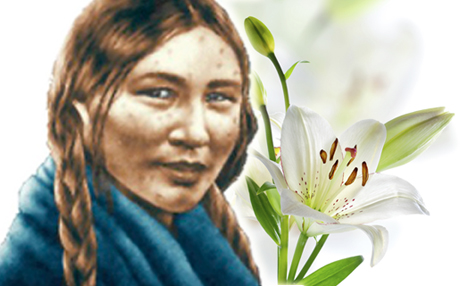
Memorial of Saint Kateri Tekakwitha ~ Br. Michael Marshall, Novice

Saint Kateri Tekakwitha was a Native American from the Algonquin-Mohawk tribes. She lived during a time when European colonists interacted with Native Americans in the fur trade. The Dutch allied with the Mohawk, while the French allied with the Huron. This led to conflict among the tribes, which made the living environment difficult for her people. She contracted smallpox as a child. This epidemic killed her family, and it left her face scarred. At the age of 19, she converted to Catholicism and was baptized in honor of Saint Catherine of Sienna. She did not marry, and moved to a Jesuit mission where she lived for the last 5 years of her life because many of her tribe shunned her for her decision to convert to Catholicism. She took the vow of perpetual virginity. Saint Kateri truly believed in the value of suffering as part of religious penance. It is said that the scars on her face disappeared upon her death at the age of 24. What led to her cause for sainthood were events of relics healing sick people. She was beatified by John Paul II in 1980, and canonized by Benedict XVI on October 21, 2012. She is the first Native American to be canonized.
First Reading – Isaiah 26:7-9, 12, 16-19
The way of the just is smooth;
the path of the just you make level.
Yes, for your way and your judgments, O LORD,
we look to you;
Your name and your title
are the desire of our souls.
My soul yearns for you in the night,
yes, my spirit within me keeps vigil for you;
When your judgment dawns upon the earth,
the world’s inhabitants learn justice.
O LORD, you mete out peace to us,
for it is you who have accomplished all we have done.
O LORD, oppressed by your punishment,
we cried out in anguish under your chastising.
As a woman about to give birth
writhes and cries out in her pains,
so were we in your presence, O LORD.
We conceived and writhed in pain,
giving birth to wind;
Salvation we have not achieved for the earth,
the inhabitants of the world cannot bring it forth.
But your dead shall live, their corpses shall rise;
awake and sing, you who lie in the dust.
For your dew is a dew of light,
and the land of shades gives birth.
Responsorial Psalm – Psalm 102:13-14AB and 15, 16-21
- From heaven the Lord looks down on the earth.
You, O LORD, abide forever,
and your name through all generations.
You will arise and have mercy on Zion,
for it is time to pity her.
For her stones are dear to your servants,
and her dust moves them to pity.
R. From heaven the Lord looks down on the earth.
The nations shall revere your name, O LORD,
and all the kings of the earth your glory,
When the LORD has rebuilt Zion
and appeared in his glory;
When he has regarded the prayer of the destitute,
and not despised their prayer.
R. From heaven the Lord looks down on the earth.
Let this be written for the generation to come,
and let his future creatures praise the LORD:
“The LORD looked down from his holy height,
from heaven he beheld the earth,
To hear the groaning of the prisoners,
to release those doomed to die.”
R. From heaven the Lord looks down on the earth.
Gospel: Matthew 11:28-30
Jesus said:
“Come to me, all you who labor and are burdened,
and I will give you rest.
Take my yoke upon you and learn from me,
for I am meek and humble of heart;
and you will find rest for yourselves.
For my yoke is easy, and my burden light.”
We can see that Saint Kateri Tekakwitha had a very hard life, with many struggles of tribal conflict, an illness which significantly affected her physical appearance, and the death of her direct family; yet despite all of these situations, God rewarded her with glory upon and after her death. Based upon the history that White people have with Native Americans due to prejudice, it might seem strange that we can look to Saint Kateri Tekakwitha as an example of how to overcome struggles in life, BUT her life is a clear illustration of what the readings for today are telling us. When she converted to Catholicism and took the vow of perpetual virginity, she put all trust in God; even understanding that suffering is a form of penance for the greater glory of God. The Gospel is exactly what this is all about.
In today’s context, we all have our own struggles in life which we can allow to overtake us, or we can choose to trust in God to overcome them; these challenges might be a disability, ongoing family conflict, financial troubles, or even a spiritual crisis. It is just a matter of how we handle these situations. Not everybody is able to overcome obstacles in life, and reach the point of throwing in the towel because the sight of God’s love and recognizing that the yoke is not as heavy as it may seem when trusting in God. Ultimately, we have to ask ourselves if we will be like Saint Kateri Tekakwitha in turning to God, hearing the words of Jesus:
“Come to me, all you who labor and are burdened,
and I will give you rest.
Take my yoke upon you and learn from me,
for I am meek and humble of heart;
and you will find rest for yourselves.
For my yoke is easy, and my burden light.”
Lord, help us to recognize when we need to turn to you in times of struggle, and allow the yoke to be lightened by turning to you. May we follow the example of Saint Kateri Tekakwitha by trusting in you. This we ask through Christ, Our Lord. Amen.
The Firstborn of All Creation ~ Br. Chip Noon, Novice
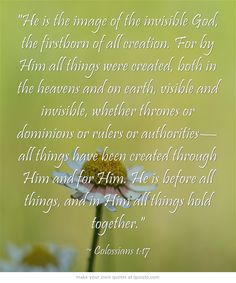
“Christ Jesus is the image of the invisible God, the firstborn of all creation.”
This first sentence of today’s second reading holds all things together in today’s readings, psalm, and Gospel. And it holds all things together in our lives and in our beliefs.
Let me explain.
In today’s first reading, Moses is instructing the people about the laws of God, and how they are to understand and obey them. They are finally approaching the Promised Land and he seems to be urgently trying one last time to impart the glory of God to this stiff-necked people. He has been giving a long and complicated sermon on their duties and responsibilities, then he stops and assures them that what he has been teaching is “not too mysterious and remote” for them. It is not up in the sky, nor across the sea, nor anywhere distant and hard to obtain. He says,
“No, it is something very near to you,
already in your mouths and in your hearts;
you have only to carry it out.”
Then, in the second reading the Apostle Paul is telling the Colossians that Christ Jesus is everything…everything around us, everything from the beginning to the end, everything that we are looking for and that is looking for us.
The third reading likewise gives a similar lesson: Love God and love your neighbor. And the legal scholar then asks, “And who is my neighbor?”
So just as Moses says, we don’t have to search for what is right and holy, it is already within us; and as Paul tells us everything that is can be found in Christ Jesus; so Jesus himself is saying we don’t have to look around and search for those whom we should love because everybody is worthy of this love.
“My task is easy and my burden is light” once again echoes in our ears from today’s readings.
“Christ Jesus is the image of the invisible God, the firstborn of all creation.”
Years ago, when I was questioning everything, believing nothing, wracking my brain for answers that always seemed to be too hard to grasp, especially the existence of God and my place in the scheme of things, my mother told me a story. She said that when she and her older sister were teenagers, they would have discussions about religion, God, the Church, the commandments…you know, everything that youngsters do to find their own place in the world. Her sister, my Aunt Mary, was always the one to be disputatious. She never let a moment go by when she wasn’t throwing doubt in my mother’s direction. She never seemed at peace, my Aunt Mary, and let everyone in the family know it. And it was after one of these contentious talks that my mother decided, without telling her sister, that she was through with questioning. She said she just decided to accept what she had been taught, and what she felt in her heart was right.
And from then on, that’s how she lived. She trusted in God, she trusted her fellow man, she trusted everything. I did ask her about the possibility of being taken in by unscrupulous people and she told me that happened very seldom. She was not naïve about life, but she put her energy into the positive things around her: We don’t need to search for God and the commandments of God. Jesus is the image of God and is always with us, and every single person is someone to love and be kind to.
She could disarm the most hostile store clerk with a simple, “Gosh, you must be having a really bad day.” And peace would descend. It was amazing to watch!
So why is it that I, and I suspect you too, have to remind myself every day of these lessons? Maybe that’s the way I’m built…just a little thicker in the skull than I should be. But one thing I do know, that when I finally wake up after wrestling with a problem and realize that the solution is right there, it is God whom I have invoked, either subconsciously or consciously. And I know, from years of experience, that calling on God, on Jesus, on the Holy Spirit may not solve that problem, but it certainly allows me to put it in perspective and return to a measure of serenity.
One more thing: in today’s Responsorial Psalm from the daily readings of the USCCB which I use for my sermons, the response is written: “Turn to the Lord in your need, and you will live.”
See, an easy task and a light burden!
Lord, help us today and every day to turn first to you in our need. Help us all to know that you are here in our hearts, and that all of our neighbors carry you within their hearts Help us to love our neighbors, even those who persecute us, as you love us all. In Jesus’ name we ask this.
Amen.
Different But the Same ~ The Rev. Lady Sherwood, OPI
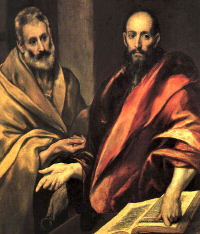
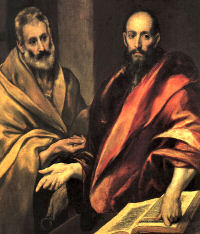
Today we as a church and as Christians come together to commemorate St Peter and St Paul.
Many, when thinking about the early church, mistakenly believe that in the times of Peter and Paul, that the church was filled with love, respect and agreement; but in fact, it was much the same in many ways as the experience we have in churches today. However, there was turmoil, dissension, and disagreement. In the times of Peter and Paul, it was even more difficult than we have it today to iron things out, to come to an agreement that it is today, as we have two thousand years of experience helping us to to deal with issues that the church. In the time of Peter and Paul they didn’t have a history to draw upon to assist them.
Let us look at Peter and Paul. Both Peter and Paul were very gifted church leaders, however both came from entirely different backgrounds. They each had different educational backgrounds and distinct personalities. Due to this, some of the churches, mostly in Corinth, were divided into rival parties depending on whether they preferred Peter or Paul.
What made them so different from each other, these two great church leaders and Apostles?
Peter was a person who had much less education than Paul. He was a fisherman by trade and was married with a family. Peter had the blessed privilege of having both known and worked alongside Jesus during his earthly ministry. Peter was a simple man, who our Lord Jesus chose to lead the other Apostles, but he was also a rather impulsive by nature and would often speak and act without thinking first.
Peter was passionately sincere in his love of our Lord, but seemed to find it difficult to put things into writing and this can be seen if you compare his letters with those of Paul.
Paul, by contrast, was a graduate of the universities of that day. He had been tutored by Gamaliel, who was a famous leader of a school of Rabbis. Largely due to this, Paul knew the scriptures inside-out and was a person who lived strictly by Jewish law. He was fluent in Greek, and knew enough Latin to get by. Paul had spent his early years persecuting Christians, so because of his experience, he was able to see things both from the Jewish and the Christian perspectives.
Because of their differences, Peter and Paul didn’t always get along of agree with each other and we know from Paul’s letter to the Galatians that the two had a major row in Antioch about the question of whether Jews who had converted to Christianity could eat separately from their Gentile brethren.
Paul was firmly in favour of the principle that both Jews and Gentiles should eat together, because he saw that unless this happened, it would lead to two separate Eucharists, one for the Jews and a separate one for the Gentiles in each church and that from there it would only be a short step to rebuilding the division which Our Lord Jesus, through his cross and resurrection had broken down.
Peter, however, felt differently. He felt sorry for the Jewish Christians because they were expected to leave behind the habits they had done all their lives upon becoming Christian. So, he agreed to eat with the Jews separately and even persuaded Paul’s friend, Barnabas to join him.
So although both Peter and Paul had the best of intentions, they both came to see each other as one who was letting the side down.
However, years later, both Peter and Paul were able to make up their differences.
Even in our churches today we see similar issues. We have the people like St Peter, who are kind and generous, and who want the church to be a welcoming place where everyone gets on happily together, but in doing so, are a bit too lenient and cause the message of Christ’s salvation to be blurred.
Then we have people like St Paul, who realise that if the truth which is in Jesus is allowed to be obscured or rejected in the cause of kindness, generosity and inclusion, that the church could end up more like a club of kind people and less like the living Body of Christ on earth, losing the message of salvation.
From their disagreement, we can see that, regardless of our personal beliefs, there are specific truths to which we must cling in order to fully serve the Lord. As our Lord prayed, so do we: That we all may be one, as Christ and the Father are One.
Both Peter and Paul were put to death in a great persecution that had broken out in Rome under the Emperor Nero, following a great fire in AD 64, which Nero probably started and blamed upon the Christians.
We know that before this, Peter had wrote his second letter and had come to realise the importance of Paul, just as Paul had also realised the importance of Peter.
Grant, we pray, O Lord our God, that we may be sustained by the intercession of the blessed Apostles Peter and Paul, that, as through them you gave your Church the foundations of her heavenly office, so through them you may help her to eternal salvation. Through our Lord Jesus Christ, your Son, who lives and reigns with you in the unity of the Holy Spirit, one God, for ever and ever. Amen
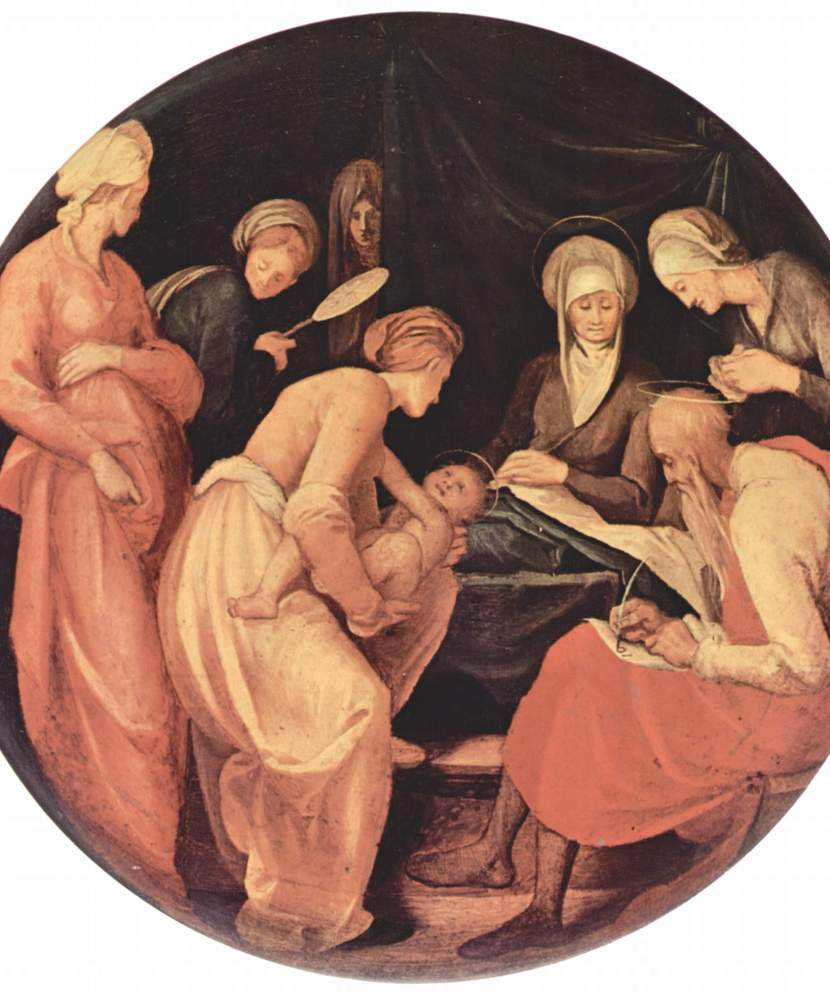
The Nativity of John the Baptist
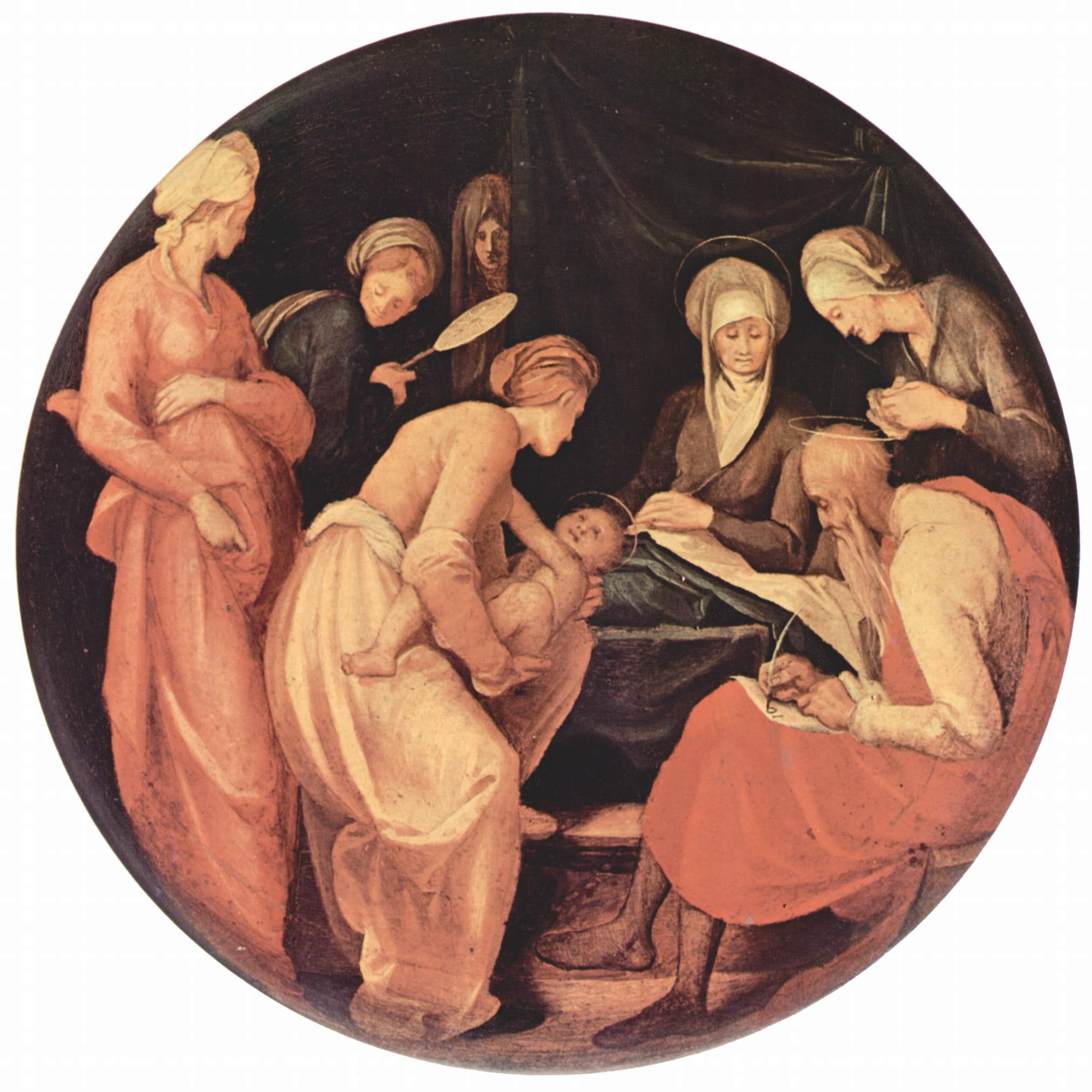
Today, we celebrate the birth of St John the Baptist, the forerunner to the Lord Jesus.
Firstly, let us look together at what the holy scriptures tell us about this blessed and miraculous event in Lk 1:5=25 (NIV):
5 In the time of Herod king of Judea there was a priest named Zechariah, who belonged to the priestly division of Abijah; his wife Elizabeth was also a descendant of Aaron. 6 Both of them were righteous in the sight of God, observing all the Lord’s commands and decrees blamelessly. 7 But they were childless because Elizabeth was not able to conceive, and they were both very old. 8 Once when Zechariah’s division was on duty and he was serving as priest before God, 9 he was chosen by lot, according to the custom of the priesthood, to go into the temple of the Lord and burn incense. 10 And when the time for the burning of incense came, all the assembled worshipers were praying outside. 11 Then an angel of the Lord appeared to him, standing at the right side of the altar of incense. 12 When Zechariah saw him, he was startled and was gripped with fear. 13 But the angel said to him: “Do not be afraid, Zechariah; your prayer has been heard. Your wife Elizabeth will bear you a son, and you are to call him John. 14 He will be a joy and delight to you, and many will rejoice because of his birth, 15 for he will be great in the sight of the Lord. He is never to take wine or other fermented drink, and he will be filled with the Holy Spirit even before he is born. 16 He will bring back many of the people of Israel to the Lord their God. 17 And he will go on before the Lord, in the spirit and power of Elijah, to turn the hearts of the parents to their children and the disobedient to the wisdom of the righteous—to make ready a people prepared for the Lord.” 18 Zechariah asked the angel, “How can I be sure of this? I am an old man and my wife is well along in years.” 19 The angel said to him, “I am Gabriel. I stand in the presence of God, and I have been sent to speak to you and to tell you this good news. 20 And now you will be silent and not able to speak until the day this happens, because you did not believe my words, which will come true at their appointed time.” 21 Meanwhile, the people were waiting for Zechariah and wondering why he stayed so long in the temple. 22 When he came out, he could not speak to them. They realized he had seen a vision in the temple, for he kept making signs to them but remained unable to speak. 23 When his time of service was completed, he returned home. 24 After this his wife Elizabeth became pregnant and for five months remained in seclusion. 25 “The Lord has done this for me,” she said. “In these days he has shown his favour and taken away my disgrace among the people.”
So let us now try to picture this joyous scene:
We have the parents, the Jewish Priest Zechariah and Elizabeth who were both advanced in age and were beyond the child=bearing years. Also, Elizabeth was barren and unable to conceive. The blessings and sheer joy at the birth of their son must have been immeasurable! All the family would have been there celebrating this wonderful event because in those days, the birth of a Son was a major celebration of joy and music. This sadly wasn’t the case in those days for female births. The Lord our God truly blessed his parents by giving them and also us as a world, John.
But the significance of John’s birth,his life and ministry goes way beyond that of a usual birth. John was sent with a purpose, he was sent to be the forerunner who would pave the way for the coming into the world of Our Lord Jesus Christ, and who would also be the person who later baptised our Lord. John the baptist shows us by his life how we truly should be living as a child of God, and there are several lessons we can learn from him. Firstly, whole-hearted belief in Jesus Christ is possible. John could have chosen to believe in and worship any number of gods available to him before Jesus arrived on the scene. But in his life John knew that the Messiah was coming. He believed this with his whole heart and spent his days “preparing the way” for the Lord’s coming (Matthew 11:10). But the road was not an easy one to prepare. Daily he faced doubters of various influence and popularity who did not share his enthusiasm for the coming Messiah. Under hard questioning from the Pharisees, John shared his belief: “‘I baptize with water,’ John replied, ‘but among you stands one you do not know. He is the one who comes after me, the thongs of whose sandals I am not worthy to untie’” (John 1:26-27). John believed in the Christ and his great faith prepared him for hardships, but it kept him steadfast on his course until the time when he could say as he saw Jesus approach, “Look, the Lamb of God, who takes away the sin of the world!” (John 1:29). As believers, we can all have this steadfast faith.
Secondly, anyone can be a strong and devoted witness for Jesus Christ. John’s life is an example to us of the seriousness with which we are to approach the Christian life and our call to ministry, whatever that may be. We pattern our lives after John’s by first examining ourselves to be sure we are truly in the faith (2 Corinthians 13:5). Second, like John, we are to know and believe that “to live is Christ and to die is gain” (Philippians 1:21), so we can be fearless in the face of persecution and death. John lived his life to introduce others to Jesus Christ, and knew the importance of repenting of one’s sins in order to live a holy and righteous life. And as a follower of Jesus Christ, he also was unafraid of calling out people such as Herod and the Pharisees for their sinful behaviour.
Thirdly, John shows us how to stand firm in our faith no matter what the circumstances. Paul reminded Timothy that “everyone who wants to live a godly life in Christ Jesus will be persecuted” (2 Timothy 3:12). But for many of us who live in freedom, persecution takes on a very mild form. As he lived in an occupied country, John had to be aware that anything contrary to utter devotion to the king or emperor was asking for trouble. Yet his message was unchanging, bold and strong. It was John’s belief, his message, and his continual rebuke of King Herod that landed him in prison. While it is hard to know for sure what John was feeling as he sat in prison, we can be sure that he might have had some doubts about the Lord who tested his faith.
Let us look at the examples that we can learn from the birth and life of John the baptist and let us incorporate these lessons more fully within our own lives as the children of God.
Let us pray:
Father, we thank you for sending John the Baptist into the world to prepare the way for the coming of your Son, Our Lord Jesus Christ.
Help us to learn from the examples of his life and to more fully incorporate them into our own lives, so that just as the life of John the Baptist gave you glory, that our lives may also glorify you.
Amen.

Asking Price – Br. Michael Marshall, Novice
 Come undone, surrender is stronger
I don’t need to be the hero tonight
We all want love we all want honor
Nobody wants to pay the asking price
Fall on my knees, fall on my pride
I’m tripping over all the times I’ve lied
I’m asking please, but I can see in your eyes
You don’t need tears for alibis
It’s true what they say
Love must be blind
It’s why You’re still standing by this sinner’s side
You’re still by my side when all the things I’ve done have left you bleeding
Come undone, surrender is stronger
I don’t need to be the hero tonight
We all want love we all want honor
Nobody wants to pay the asking price
This excerpt of lyrics is from one of my favorite Christian songs titled “Undone” by the band FFH. The lyrics are quite bold, are they not??? We may think it is easy being a Christian, yet while the reality is that it is easy to SAY we are Christian, BUT it is not easy to BE a Christian. People open up the Bible to “read” it, throw a couple bucks in the offering plate, and say “I will pray for you”; while in reality they are just looking at the words, give a couple bucks because they feel obligated instead of doing it with the right intention, and the “I will pray for you” is just a phrase that rolls off the tongue to console another person, when no prayer is actually said at all.
In Paul’s Letter to the Galatians, he tells the people that through baptism in Christ the people have become clothed in Christ. He is making a point that they have chosen not only say they have faith, but also are to follow the teachings of Jesus and by doing so they are in God’s favor. Within Christianity, we see people preaching about following Jesus yet not putting what they are preaching into practice. Paul is talking to the Galatians about that very thing. He is instructing the Galatians that there is a responsibility by following Christ, as much as they have faith. Paul is reminding the Galatians, and us, that Jesus said:
“If anyone wishes to come after me, he must deny himself
and take up his cross daily and follow me.
For whoever wishes to save his life will lose it,
but whoever loses his life for my sake will save it.”
In our world today, for example, let us look at condemnation of different groups of people; there is hatred toward them. Love is not being shown toward one’s neighbor, often because a person may be afraid of being persecuted by another “Christian peer”. But is that not what the point Jesus is trying to make??????? We can feel comfortable in saying, “I believe that Jesus died for my sins so I was baptized to show it, I read the Bible and go to church, and I put money in the offering plate.” Sure that is part of being a Christian, but that is merely a “one-way street!” That is saving one’s own life. There is more to it when it comes to being a Christian… We must listen to what God asks of us; do what is right to not save our life, but do what it takes to lose it so that Jesus will save it.
Jesus is quick to boldly tell his disciples not to say in public that he is “The Christ of God”. There is good reason for that related to what we read further in the passage from the Gospel of Luke; where not only does foretelling of the persecution and Passion of Christ will take place, but also will those who choose to believe and follow Jesus will be persecuted for their actions. Jesus bluntly puts it that there is going to be an “asking price” by choosing to follow Christ, and that one has to be willing to accept the negative consequences imposed by humanity; yet that asking price will lead to glory if people choose to accept the consequences.
Now back to the song… The lyrics, “Love must be blind, It’s why You’re still standing by this sinner’s side, You’re still by my side when all the things I’ve done have left you bleeding” is the story of humanity since Jesus’ death and Resurrection. Humanity has continued to mess up, even myself. We have seen it in the Crusades, in racism, in discrimination against women, our LGBTQ brothers and sisters, against minorities, and in oppression of the poor. As much as God continues to love us despite our continual mistakes, people often just use that as an excuse; “God will forgive me”. Or there is some other “justification” like, “The Bible SAYS…” trying to prove some point that people are sinning. The message that Jesus died for our sins is not missed, yet following the example which Christ set before us is totally being missed; the message of love for our neighbor, helping those in need, not pointing the finger. As in the song, if love is blind, then should we not also love everyone blindly, in the way that Christ loves us?
Everybody wants to say they follow Christ, wants others to see it, and wants reward for proclaiming they follow Christ. YET that is not the “asking price”!!! The asking price is truly doing what is right and even facing persecution for doing so. It is not about reading the Bible and spouting out Bible verses to prove one knows the Bible, but rather putting what is read into practice and action, even if it goes against the norm.
Lord, may we truly recognize the asking price which Your Son boldly stated to the disciples and to us through Your Word. Help us to have the courage to put the teachings into action, as much as it is not always easy. This we ask through Christ our Lord. Amen.
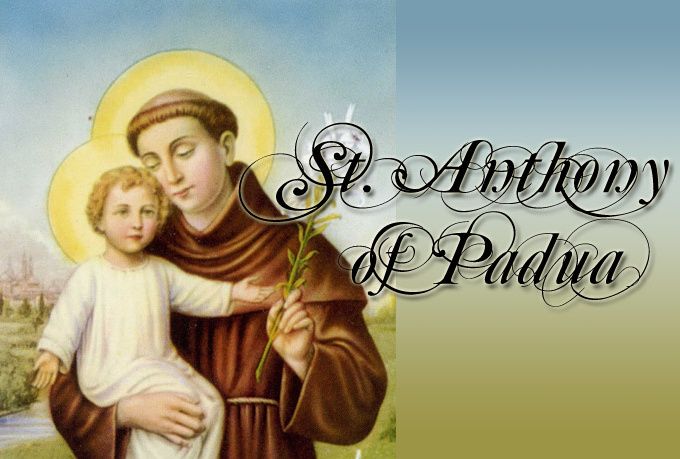
St. Anthony of Padua

St. Anthony of Padua is one of the Catholic Church’s most popular saints. Saint Anthony of Padua, patron saint of lost and stolen articles, was a powerful Franciscan preacher and teacher. He’s typically portrayed holding the child Jesus—or a lily—or a book—or all three—in his arms. Anthony of Padua, also venerated as Saint Anthony of Lisbon, was born in Lisbon, Portugal, which was then a part of Spain, in 1195 A.D., and named Fernando de Bulhoes. He is one of the most beloved Catholic saints today, and he was much loved even in his own time. Saint Anthony’s physical appearance was unremarkable; he was short and slightly plump, but everyone who heard him speak was drawn to him. St. Anthony was known to have a winning smile, a loud voice and a prodigious memory. His fervent faith must have been apparent from a young age, for by fifteen, he had entered the Augustinian Abbey of St. Vincent at Lisbon against his well-to-do family’s wishes.
Then, in 1219, St. Anthony had a portentous meeting with five Franciscans who were on their way to preach to the Muslims in Morocco. The friars were martyred during their mission, and their mutilated bodies brought back to Spain where they were carried in solemn procession. St. Anthony was apparently very moved by the Franciscans’ sacrifice and their simple lifestyle. He asked his order for permission to join the Franciscans, and in the summer of 1220, received his habit. He took the name Anthony, after St. Anthony the Great.
Saint Anthony greatly desired to follow in the footsteps of the five Franciscans who had so affected him, and preach in Morocco, but ill health forced him to return soon after his arrival there. However, his home bound ship was never to reach Spain; a storm forced it to land instead on the coast of Italy. Franciscans there had pity on the ailing Anthony and assigned him to the rural hospice of San Paolo outside of Bologna. In that location, St. Anthony lived as a hermit and worked in the kitchen, his educated background either unknown or ignored.
The hermitage was, in time, visited by a gathering of Dominicans. As that order was known for its preaching, the Franciscans did not prepare a homily themselves. When it was found that the Dominicans had expected their hosts to provide a preacher, the head of the hermitage, in desperation, called upon Anthony to speak some simple words from his heart. The friars were probably hoping at most for a minimal amount of embarrassment in front of the more learned Dominicans. Instead, the whole company was awestruck by the brilliant words emanating from the mouth of St. Anthony. It was the beginning of his fame as a preacher. St. Francis himself learned of St. Anthony’s extraordinary speaking abilities and sent Anthony a note exhorting him to preach to the other Franciscans.
In 1226 the Franciscans chose St. Anthony as an envoy to Pope Gregory IX from the general chapter, and on May 30, 1227 he was elected minister provincial of part of Italy. St. Anthony humbly served as directed but in June of 1230 he asked for release from his duties in order to devote himself to preaching. His request was granted, and from then on, St. Anthony resided in the monastery at Padua where he wrote, among other things, his famous sermons on the saints.
The beloved preacher became ill with dropsy in 1231 and on June 13, now his feast day, he died at the Poor Clare convent in Arcella at the young age of 36. Legend has it that children cried and angels rang bells when St. Anthony died. His body was buried in a chapel, which is now enclosed by the Basilica of St. Anthony in Padua. In 1263, when his relics were transferred to the Basilica, his tongue was found to be still fresh and red in color. Saint Anthony’s was the second fastest canonization in history; he was declared a saint 352 days after his death, by the same Pope Gregory he had met in life .In canonizing Anthony in 1232, Pope Gregory IX spoke of him as the “Ark of the Testament” and the “Repository of Holy Scripture.” That explains why St. Anthony is frequently pictured with a burning light or a book of the Scriptures in his hands.
 The Order of Preachers, Independent
You must be logged in to post a comment.