
Category: Member Posts

It’s a Wonderful Life! ~ Br. Matt Pepple, Novice

I recently saw the movie, “It’s a Wonderful Life”, directed by Frank Capra; it debuted in the post-war period of 1947. Now, it’s aired primarily by the NBC network during the holiday season. For a black and white movie, a lot of the movie’s themes are still relative for the world today.
Meet George Bailey, a young man, who is also the son of a banker. George has so many hopes and dreams that he wants to accomplish in his life. Then, after his father dies, he is left with the family business, “The Bailey Building and Loan”, and comes to the realization that many of his most cherished dreams may not come to pass. George gets married and has a family.
Things take a “sour turn” halfway through the film, when Mr. Potter, the film’s villain; makes a dishonest move against George’s uncle.
As a result of this, George is feeling miserable and hopeless. Enter the angel Clarence. George was willed with so much grief and despair that he has contemplated throwing his life away.
Clarence presents George with a remarkable gift; a life he has never lived.
If you were to take a step back and analyze your life to this date. Though it’s probably safe to assume that our life hasn’t been as dramatic as the fictional character of George Bailey, we do have a lot of power to affect positive change. So, how many lives have you affected? How have you helped people? What have you been able to do to affect positive change? What things could you make better? How would your friends and family be different?
Going further, imagine, now, what the world would have been like if Christ had never come into it. Our world, would have remained a very dark place. The birth of Jesus was a changing point. The Son of God was a gift that was given to us by God the Father. And as such, we must be thankful for this gift and look at our lives as gifts as well. God saw how dark the world was becoming, but as much, he was able to see the darkness inside of people’s lives.
In John 3:16, St. John writes, “For God so loved the world that he gave his one and only Son, that whoever believes in him shall not perish but have eternal life.” That’s right, God loves the world and all of us so very much, that he bundled up and placed his “gift” in swaddling clothes and placed him in that manger in that cave. And he gave us an eternal “gift” to spend it with him.
And it is up to us as Christians to continue to be that ‘gift.’ We must remember that often, we are the only Jesus people will see. We are the only Bible some people will read. The holidays and Christmas time can be a somewhat depressing time for many people, and as Christians it is important for us to never lose hope or our faith, but to exhibit that faith on a grander scale.
As much as Clarence gave George some perspective on his life, and his accomplishments already, I urge you to not lose hope or your faith. If self-analysis grants you great conviction or satisfaction, please know that you can still change your life. Our life on this Earth is truly a most wonderful and gracious gift. So make it a great one! Amen.
“A Little Child Shall Lead Them” ~ The Rev. Dcn. Dollie Wilkinson, OPI
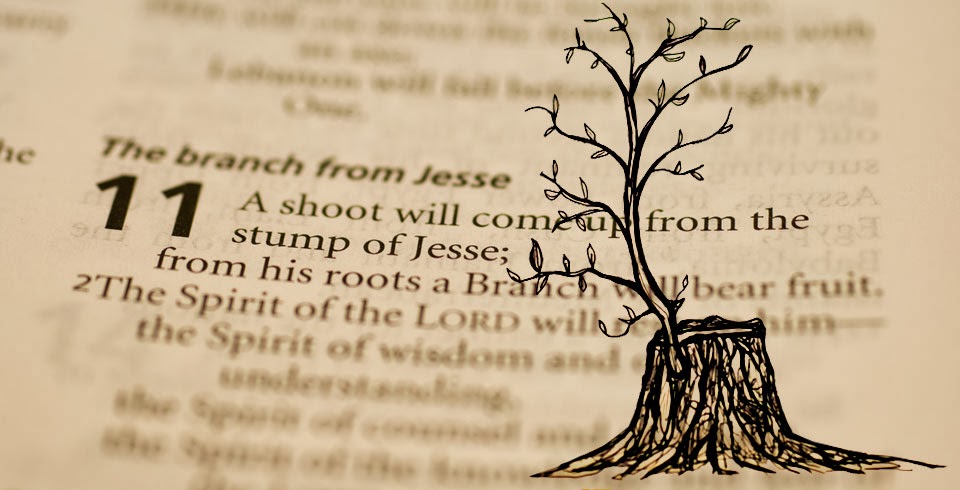
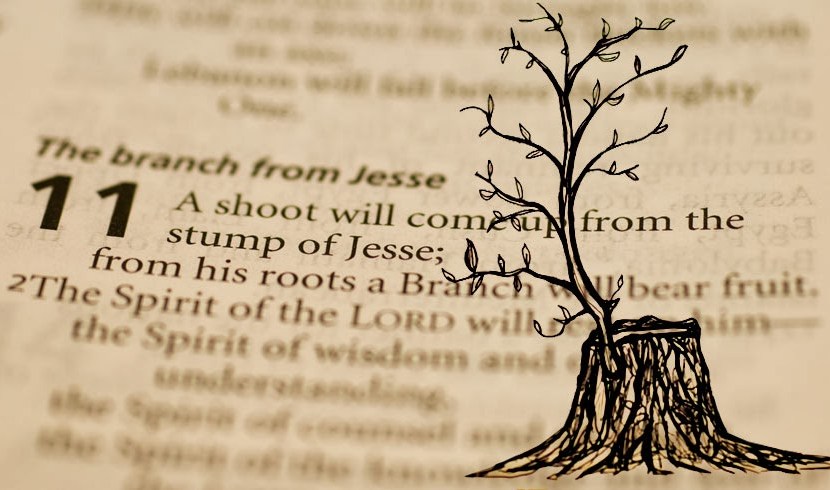
I love to garden, but often get frustrated when the small seedlings I have planted in the ground, do not take root. What usually happens is maybe one or two plants will survive my clumsy gardening, while the rest wither and die. I usually leave the dying stumps in the ground, figuring they will help fertilize the new plants trying to grow. In the beginning of Isaiah 11, we are offered a picture of the future that reminds us of how new growth springs from a solid root.
“A shoot shall come out from the stump of Jesse, and a branch shall grow out of his roots.”
This vision of the future offers us hope, with the upcoming birth of baby Jesus. And further goes on to describe just exactly how the Messiah will lead His people. Why does the Holy Spirit, who gave Isaiah these visions of the future, want you and me to see this? Because we need to understand what kind of king we find in the manger of Bethlehem.
“The spirit of the LORD shall rest on him, the spirit of wisdom and understanding, the spirit of counsel and might, the spirit of knowledge and the fear of the LORD. His delight shall be in the fear of the LORD. He shall not judge by what his eyes see, or decide by what his ears hear; but with righteousness he shall judge the poor, and decide with equity for the meek of the earth; he shall strike the earth with the rod of his mouth, and with the breath of his lips he shall kill the wicked. Righteousness shall be the belt around his waist, and faithfulness the belt around his loins.’”
We recently had a presidential election in the United States. And though we know that only one person can win, that didn’t prevent some people from being upset when their favorite candidate didn’t win. Everyone can describe in detail why their candidate is the best person to lead this country. But I imagine, if they were honest with themselves, they could also tell you the faults of this or that person. This is because no one person is perfect. But the prophet Isaiah described the most perfect leader, not just of a country, but of all time. Not only does this offer us hope for the coming Messiah, but also serves as inspiration for those who have lost heart in their daily struggles. What once seemed dying, lost, gone ….. now offers hope. All is not lost! This new vision of the future, as detailed in Isaiah 11:6-10, offers us a glimpse of God’s promises for the future.
“The wolf shall live with the lamb, the leopard shall lie down with the kid, the calf and the lion and the fatling together, and a little child shall lead them. The cow and the bear shall graze, their young shall lie down together; and the lion shall eat straw like the ox. The nursing child shall play over the hole of the asp, and the weaned child shall put its hand on the adder’s den. They will not hurt or destroy on all my holy mountain; for the earth will be full of the knowledge of the LORD as the waters cover the sea. On that day the root of Jesse shall stand as a signal to the peoples; the nations shall inquire of him, and his dwelling shall be glorious.”
Paints a pretty picture, doesn’t it? I can here you mumbling though: “But, how will all this be possible?” We already know that God can work miracles. After all, who created all you see, touch, smell, hear? It certainly didn’t materialize out of thin air. So is it so hard to imagine a future where there will be no strife, no discord among animals and man? Oh, I know looking at the world today, that might be hard to understand and even harder to imagine. But Matthew 19:26 clearly states, “Jesus looked at them and said “With men this impossible, but with God all things are possible.”” So next time you find yourself losing heart, ready to give up, remember the One who created you, who decided you were worth something. All of us are special, worth saving, and it will take a little baby, a small child, to show us the way.
A Life of Hope: St. Francis Xavier ~ Br. Matt Pepple, Postulant

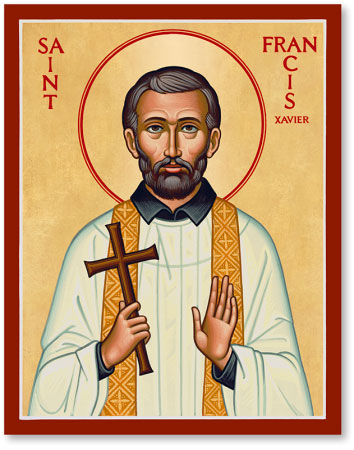
St. Francis Xavier was born in the family castle of Xavier, in Pamplona in the Basque area of Spanish Navarre in 1506. He was sent to the University of Paris in 1525 and obtained his licentiate in 1528. He met with St. Ignatius Loyola and was one of the seven, who in 1534 founded the Society of Jesus. He intended to join Ignatius in Venice and then they would go as missionaries to Palestine, a trip which did not occur. He was ordained in 1537 and went to Rome in 1538 and 1540 when the Pope formally recognized the Society of Jesus. At that time, he, alongside Father Simon Rodriguez, was ordered to the Far East as the first Jesuit missionaries.
King John the 3rd retained Fr. Simon in Lisbon but Francis, spent six months preaching in Mozambique along with giving some assistance to the sick. He eventually arrived in Goa, India in 1542 with Fr. Paul of Camerino and Francis Mansihas. He began evangelizing the natives and attempted to reform the Europeans by adopting their customs on his many travels. He converted tens of thousands to Christianity in the subsequent decade.
He visited Paravas in India, Malacca, near New Guinea, Morotai near the Philippines and Japan. In 1551, the East and India was dedicated as a separate province and Ignatius designated Francis as its first provincial. In 1552 he went to China and landed on Sancian; where he died before he could reach the mainland. Working against excessive complications, language problems, he had no proficiency in foreign speaking, insufficient monies, and lack of assistance, often actual confrontation, even from European representatives; he left the mark of his missionary enthusiasm and vigor on areas which adhered to Christianity for centuries. He was beatified in 1622 and declared patron of all foreign missions by Pope Pius X. on Dec. 3.
Our scripture for the week, Romans 15:4-13; St. Paul is speaking to us on what was written in the old days being relevant even today for our instruction. “So that by determination and encouragement of the scriptures that we may have hope.” We need to live more in an attitude of hope and inspiration from the direction of the scriptures. Paul also tells us that our God wants us to live in harmony and peace with our neighbors, as Christ did. And that all of us in this harmony and unison may glorify the God and Father of our Lord, Jesus Christ. We are to be welcoming of our neighbors as Christ has welcomed us. Jesus became a servant to the circumcised on the behalf of the truth of God in order that he might authorize the promises known to the fathers, so that the Gentiles may exalt God for his kindness and compassion. For it is written, “Therefore I will confess you among the Gentiles, and sing praises to your name.” Again, he said, “Rejoice, O Gentiles, and let all of the peoples praise Him.” Paul refers to the prophet Isaiah, “The root of Jesse shall come, the one who rises to rule the Gentiles; in him the Gentiles shall hope.” May the God of hope fill you with all joy and peace in believing, so that you may prosper in hope by the power of the Holy Spirit.
It was this hope that served as an inspiration for St. Francis Xavier. To have been a Missionary at his time, or really at the present time, was a very dangerous time. Things may have appeared very daunting to him, in the tasks that he was set forth. At any time, he and companions could have just given up. Hope, on the other hand, can be a very inspirational tool. God wants us to live and act in a spirit of hope, to be hopeful of the future and instill the hope of Christ in the present. We all have a certain desire for things to happen, for a certain situation to improve and get better, for a loved one who is sick to become healthier again, or for a better job. For as long as we live in hope, we can greet our neighbors, friends and relatives in an attitude of hope. As long as we have hope centered in Christ, there is always a chance for things to change. Jesus wants to be the light in your darkness and to be your hope for better things.
The Feast of St. Andrew ~Br. Mark G. Dickson-Patrick – Novice
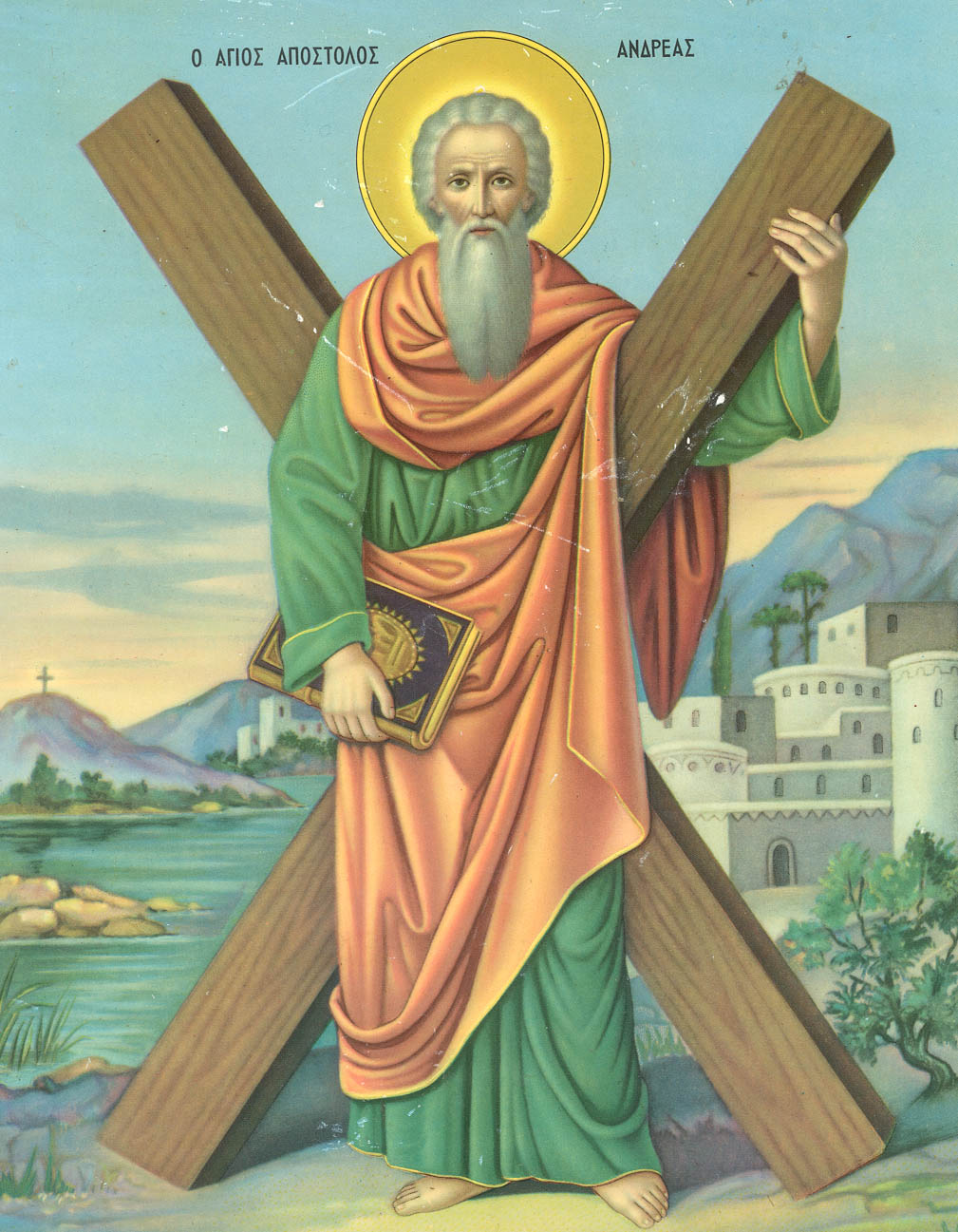
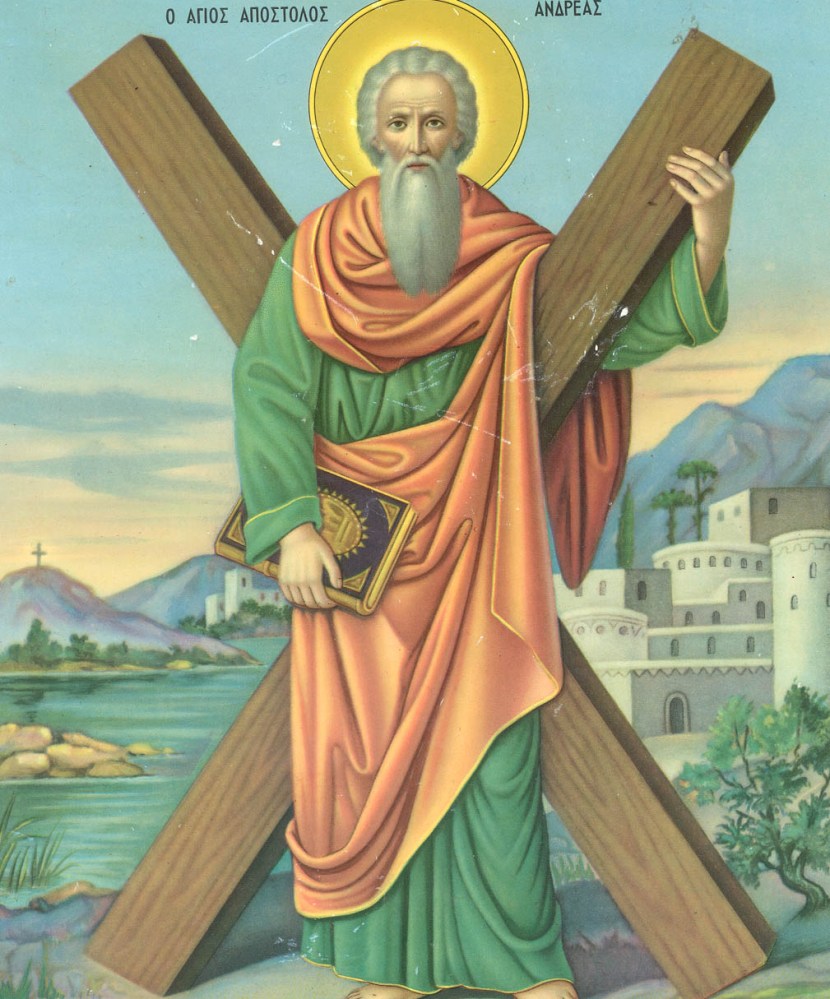
Today the Church celebrates the great feast of St. Andrew the Apostle, the brother of St. Peter. Andrew was a fisherman by trade, working alongside his brother before being called by Jesus to follow after Him. He became one of Jesus’ 12 apostles, and after His death and resurrection went out into various regions to preach the Good News of salvation. He was eventually martyred on an X-shaped cross, tied to the cross until death. As he was led to the cross, an ancient tradition attributes this quote to the Saint:
“Hail, O Cross, inaugurated by the Body of Christ and adorned with his limbs as though they were precious pearls. Before the Lord mounted you, you inspired an earthly fear. Now, instead, endowed with heavenly love, you are accepted as a gift…
O blessed Cross, clothed in the majesty and beauty of the Lord’s limbs!… Take me, carry me far from men, and restore me to my Teacher, so that, through you, the one who redeemed me by you, may receive me. Hail, O Cross; yes, hail indeed!”
Saint Andrew holds a special place for me, as he was the patron of the Roman Catholic College Seminary I attended for 4 years. Countless hours were spent praying before the image of this great saint, who was cradling an image of our seminary in his arms. This saint, who we deemed a brother, we would beg to intercede for the brothers of our house, for ourselves, and for an increase of vocations to the priesthood and to the religious life. Now, every year, I take it upon myself to pray a Novena to my brother, St. Andrew, for the state of the Church and the world.
Our Gospel reading this morning presents us with the moment that Andrew and his brother Peter are called by Jesus for the great work of preaching the Gospel. Fishermen by trade, they were mending their nets by the edge of the sea, when this teacher walks by and says “Come after me, and I will make you fishers of men.” We are told that they immediately left their nets and followed Jesus, not knowing at all what was to come. In a retreat on this topic to seminarians, Bishop Robert Morlino the Roman Catholic Bishop of Madison, WI, once said “When the Lord and Savior of the world comes up to you, looks you in the eye, and says ‘Follow me,’ why in the world would you ever stand still?” Andrew and Peter felt the call of conviction that the Lord laid on their hearts and as we know became two of the great apostles, preaching the Good News of salvation to the death.
There are times, I’d venture, that we often feel the call and conviction that Peter and Andrew felt, the call to preach the Gospel to all who will listen. We picture setting out on a grand crusade, bringing thousands to Christ and to salvation, bringing them home into the arms of God and away from the pain of heresy and death. But then we realize that with our busy lives in an increasingly secular world, we don’t have the time to go on these grand crusades that we have formulated in our mind. Notice what the Lord does with Peter & Andrew, and what He does with us as well. Jesus didn’t say, “Leave your nets, and you’re going to go on huge crusades.” No, he said, “Come follow me, and I will make you fishers of men.” Jesus took what they knew how to do, and enhanced it, for the work of ministry. So, too, does he do that with us. He takes our abilities, to teach, to pray, to work in the ordinariness of our lives, and enhances them for His uses, to preach the Gospel. That is how we can lead these lives of religious devotion in a secular and busy world.
My friends, there is work to be done. The harvest is plentiful, and the labors are few. Pray for an increase in vocations to the priesthood, diaconate, and religious life, that the Lord may take people in their ordinariness and enhance their gifts to serve His glory, that we may build up the Kingdom of God together. Like Peter & Andrew, heed the conviction that He is placing on your heart.
Amen.
Novena Prayer to St. Andrew
Saint Andrew, strong and powerful, intercede and pray for us.
Andrew, apostle of Christ, help me to rejoice in Jesus and so bring others to Him. May my words and deeds lead others to deeper faith in him. Bold missionary and evangelist, guide me where the Lord would have me preach his gospel. Companion of the Lord Jesus, send us people called to be priests, deacons, & religious. Saint Andrew, in your kindness hear and answer our prayer.
Amen.

Presents and Gifts ~ The Rt. Rev. Michael Beckett, OPI

What you are is God’s gift to you.
What you become is your gift to God.
We have survived Black Friday and made it through Cyber Monday!!!!! As always at this time of the year, our thoughts turn to gifts: giving and receiving, what we want to give, what we want to receive, what will please those we love, the shopping, the ordering, the wrapping, the general hustle and bustle of the Christmas season centering around gifts ad infinitum, donating to the people with the red kettles and bells so the less fortunate can have gifts…..
And then there’s the practice of ‘re-gifting,’ passing along that unwanted or unusable gift that we were given, to someone else, so that they will have SOMETHING, and so that they too, can possibly pass that pink and orange and green plaid scarf along, re-gifting it themselves to someone else who won’t use it either….and sometimes by some freak chance that unwanted item comes back to us several years later….and not much too worse for the wear…. And is re-gifting, as amusing (and cheap) as it may seem, necessarily a bad thing?
Why all this focus on gift-giving and gift-receiving at this time of year? The union of Christmas and gift giving was a gradual one; actually, the full story of the bright packages beneath the tree, like most of our Christmas customs, begins in the days before the birth of Christ. In ancient Rome, gifts were exchanged during the New Year’s celebrations. At first these gifts were simple, such as a few twigs from a sacred grove and small items of food. Many gifts were in the form of vegetables in honor of the fertility goddess Strenia. During the Northern European Yule, (yep, the yuletide season is a pagan thing) fertility was celebrated with gifts made of wheat products, such as bread and alcohol.
Like many of the old and pagan customs, exchanging gifts was difficult to get rid of even as Christianity spread and gained official status. Early church leaders tried to outlaw the custom, but the people cherished it too much to let it go. St. John Chrysostom urged no compromise with heathen abominations, but he, too, failed in this tenacity of hanging on to the tradition of gift giving. Since there was no general agreement about the exact date of the birth of Jesus, it must have seemed helpful to have it supersede the Saturnalia, so the rebirth of the sun became instead the birth of the Son of God, and the church leaders looked for a Christian justification for the practice of all this gift giving. This justification was found in the Magi’s act of bearing gifts to the infant Jesus, and in the concept that Christ was a gift from God to the world, bringing in turn the gift of redemption and everlasting life.
What you are is God’s gift to you.
What you become is your gift to God.
Wikipedia defines a gift as the transfer of something without the expectation of receiving something in return. Although gift-giving might involve an expectation of reciprocity, a gift is meant to be free. By extension the term “gift” can refer to anything that makes the other happier or less sad, especially as a favor, including forgiveness and kindness.
God’s gifts to us are free and clear. He has given us the gift of His Son, Our Lord and Savior Jesus Christ. He has given us the gift of eternal life: “For the wages of sin is death, but the gift of God is eternal life in Christ Jesus our Lord.” Romans 6:23 (NIV); The gift of salvation: “For it is by grace you have been saved, through faith—and this is not from yourselves, it is the gift of God.” Ephesians 2:8 (NIV); And the gifts that are unique to each of us: “We each of us have our own individual gifts: But each of you has your own gift from God; one has this gift, another has that.” 1Corinthians 7:7 (NIV)
Besides the obvious gift of His Son, and the forgiveness that we receive through Him whom we receive by faith, what other gifts has God given specifically to you? What talents have you received? What blessings have been given to you?
We learn about the 7 Gifts of the Spirit in Isaiah 11:2-3: “2 The Spirit of the LORD will rest on him— the Spirit of wisdom and of understanding, the Spirit of counsel and of might, the Spirit of the knowledge and fear of the LORD— 3 and he will delight in the fear of the LORD. He will not judge by what he sees with his eyes, or decide by what he hears with his ears;” (NIV)
And more importantly, what are you doing with those gifts? What are you giving back to God? What are you “becoming” as you use your gifts and talents? Which of the gifts that you have been given are you “regifting?” In other words, when we’ve received a gift from God, do we share that gift with others? Do we “regift?” We are told in 1 Peter 4:10, “Each one should use whatever gift he has received to serve others, faithfully administering God’s grace in its various forms.” (NIV) Jesus himself addresses this very thing in the parable of the talents in Matthew 25:14-30. By using our gifts, they multiply and we bring others to know God, and by recognizing what we have been given and using them for God’s glory, we are giving back to God.
What is the most precious thing we can give to God? The most precious gift we can give is what God wants the most. God wants us to make the fervent attempt to repent, get right with Him, and not lead a double life, trying to follow two contradictory paths, but living our lives according to His will. God simply wants us to give ourselves to Him. This is the best gift we can give! Our gift to Him is how we respond to the gifts He has given us which are the gifts of life and of grace. We can best do this when we are headed in His direction, following His precepts with a grateful, willing heart and mindset, and by striving to be the best that we can be by becoming what it is that He wants us to be.
Barbara Streisand sings in “The Best Gift:”
The best gift
That I ever got
Didn’t really weigh a lot
It didn’t have a ribbon ’round
And it sometimes made a terrible sound
The best of all it seems to me
It wasn’t ‘neath the Christmas tree
And yet, I guess I’d have to say
That it made all the other presents twice as gay
The best gift that I’ve ever known
I’d always wanted most to own
Yet in my dreams of sugar and spice
I never thought it could be so nice
The best gift that I ever get
Was sometimes dry and sometimes wet
Was usually pink but oftentimes red
As it lay so innocently in it’s bed
The best gift of the year to me
The one I hold most dear to me
A gift that simply drove me wild
Was a tiny new born child…
As we celebrate the birth of THE tiny newborn Child, God’s greatest and best Gift to us, let us strive to make ourselves the best gift we can give to others, and to God. Amen.

Stay Awake!!!!! ~ Br. Mark G. Dickson-Patrick – Novice

Today begins the Church’s new liturgical year, as we enter into the holy season of Advent. Advent, which in Latin means “coming,” is a time set aside by the Church for remembrance and anticipation: to remember His coming as a baby in the manger of Bethlehem, to be the Savior of the world, and to look forward with great anticipation to His promised second coming as Lord, ruler, and judge, when He will bring all of His people into Himself. Both of these comings were prophesied: His first coming by the prophets of old and the angel Gabriel to His mother Mary, the second coming by Our Lord Himself. This season reminds us of His coming and helps prepare us to look forward to His coming again in glory.
The Scripture readings that we are presented with on this first day of this holy season exhort us in a very powerful way to stay awake and alert for the second coming of Our Lord. They call us to alert living, and a daily conversion of life, that we may be ready for that time when Our Lord shall come again to His people as He promised. St. Paul, in his letter to the Romans, writes, “It is now the moment for you to wake from sleep…the night is far gone, the day is near…put on the Lord Jesus Christ, and make no provision for the flesh, to gratify its desires” (Rom. 13:11b-12, 14). Paul urged the church at Rome that Our Lord is coming, and that they should prepare themselves for that great and powerful day. Our Lord Himself, in the Gospel reading today, tells His disciples: “Keep awake therefore, for you do not know on what day your Lord is coming…For the Son of Man is coming at an unexpected hour” (Matthew 24:42, 44).
We are urged to stay awake, for we do not know the day nor the hour when Our Lord will come.
Stay awake, and daily repent of our sins and daily commit ourselves anew to Christ.
Stay awake, and see Christ in our neighbor, our family, our friend, our enemy, the immigrant, the orphan, the poor, the sick, the widowed, the persecuted.
Stay awake, and live in the life and love of the Holy Spirit.
Stay awake, and give of ourselves in service to one another in love and common humanity.
Stay awake, and preach the Good News of salvation to all the world through our lives.
Stay awake, and be ready, that Our Lord may not catch us off guard when He returns.
On that day when He returns, and He will return, our Lord will ask if we stayed awake, if we were ready for Him. And what will our answer be? I know that I can’t say with confidence that I have been constantly awake. I know that I can sometimes get sleepy, much like the disciples in the Garden of Gethsemane, in my effort to stay awake to His presence and to His coming. Maybe you do too? Let us pray with and for one another, and build one another up, that Christ may be built up and glorified. Let us come together as His Church, that we may all be one as He desired, one in prayer, in faith, and in holy anticipation. Let us worship with one another, laugh with one another, weep with one another, and build with one another, recognizing in one another the image of God and the image of His Church. Let us be a beacon of hope, of love, of joy, of acceptance, of holy peace to our often scattered and fragmented world. Let us be an image of Christ to a world that often looks right past Him. Let us prepare together, a world, a kingdom, for Our Lord. Let us stay awake together, that together we might see our salvation as Our Lord comes again.
May this Advent season be one of blessed peace, anticipation, and fruitful joy for you and your family. When Christmas comes, I pray that we are awake and ready to welcome the Christ child in our hearts and into our homes anew, that we might be ready to welcome again Him who comes as Ruler of Heaven of Earth.
The Presentation of Mary ~ Br. Michael Marshall, Novice
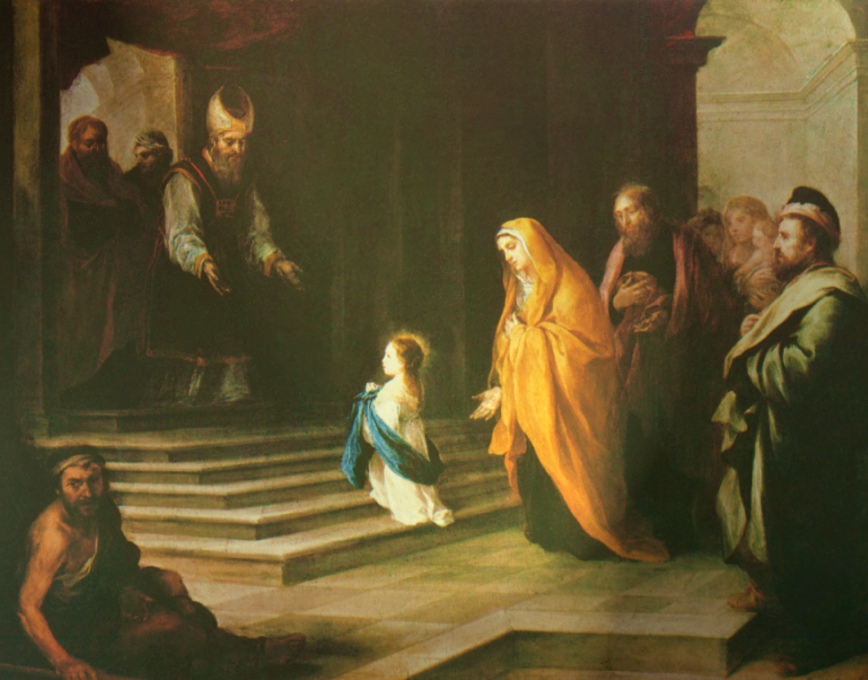
As Christian Doctrine teaches us, the Blessed Virgin Mary was without sin, and that is why she was chosen to be the mother of Jesus. This would be just the beginning of her “ministry.” Today is the Presentation of the Blessed Virgin Mary, so let us get to that subject… Various sources indicate that Mary was presented at the Temple when she was three years old by her parents; and at that event a vow to have her become educated was made. This presentation just happened to be another step in her ministry as the mother of Jesus, as much as she was not aware of it until later in her life.
Now, let us move forward in the timeline of Mary’s life; the event in which the angel appeared to her explaining that she would bear a son who would be the Messiah, which was the will of God. This was a huge sacrifice to submit to the will of God; totally giving of herself in the fulfillment of her ministry. In the Gospel, we read about Jesus noticing people giving their surplus wealth away while a woman was giving two coins. This woman was living in poverty, therefore giving away everything on which she had to survive. Mary was like this woman.
How does all of this apply to us? In this era of rapidly changing technology and demands of being available 24/7 through cell phones and Internet, we often get so wrapped up in all of that to the point that we are not giving adequate time to our spiritual life; not devoting enough time to God. Some of us participate in leisure activities before taking time to pray, when it ought to be the other way around. We need to look to Mary as an example of totally giving of ourselves.
Father, just as Mary selflessly gave of her entire self, may we recognize that we need to put you first before other things in our life; even if it means giving up wasteful leisure pleasures. This we ask through Christ, our Lord. Amen.
Christ the King! ~ The Rev. Lady Sherwood, OPI
Today’s Readings:
Reading 1: 2 SM 5:1-3
R Psalm PS 122:1-2, 3-4, 4-5
Reading 2: COL 1:12=20
Holy Gospel reading:LK 23:35=43 (NIV)
35 The people stood watching, and the rulers even sneered at him. They said, “He saved others; let him save himself if he is God’s Messiah, the Chosen One.” 36 The soldiers also came up and mocked him. They offered him wine vinegar 37 and said, “If you are the king of the Jews, save yourself.” 38 There was a written notice above him, which read: this is the king of the jews. 39 One of the criminals who hung there hurled insults at him: “Aren’t you the Messiah? Save yourself and us!” 40 But the other criminal rebuked him. “Don’t you fear God,” he said, “since you are under the same sentence? 41 We are punished justly, for we are getting what our deeds deserve. But this man has done nothing wrong.” 42 Then he said, “Jesus, remember me when you come into your kingdom.” 43 Jesus answered him, “Truly I tell you, today you will be with me in paradise.”
In today’s Gospel reading we meet Jesus on the cross paying for the sins of the world, and the two thieves who hung on crosses at either side of him who were there to pay the penalty of their crimes. Jesus was being mocked and sneered at by the rulers and the soldiers in full view of the gathered and watching crowd.
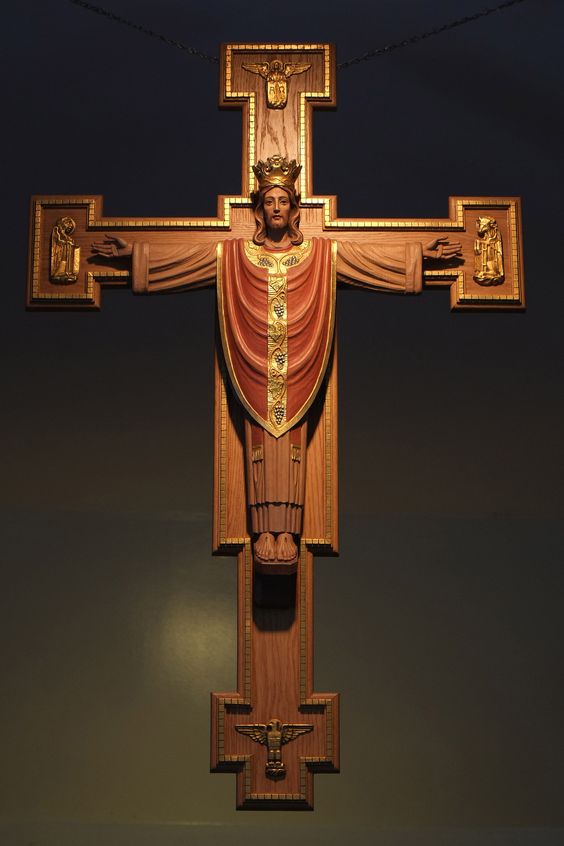
Today we reflect on the Kingship of Christ in relation to the Three Crosses of Calvary, the Cross of Rejection, the Cross of Reception and the Cross of Redemption.
We begin with the cross of Rejection, a cross upon which hangs a man who is dying in sin. On this cross, is a thief who by his actions towards Jesus, represents those who still refuse to repent, even after having experienced the love of God. Even now, hanging from his cross, this man rejects the Divine grace of Christ our Lord and King, and joins in the brutal vocal attack on him. This thief, the soldiers and the vast majority of the watching crowds, failed to recognise Jesus the promised King, who had come down to earth amongst us to be a Shepherd and to serve rather than to be served, and who ultimately would give his life for the price of all of our sins.
Next, we have the cross of Reception which holds a man who is dying to sin. The difference with this thief to the previous one, is that he allows Divine Grace to enable him at the end to see the vast difference between good and evil. Knowing he deserved to suffer, he was moved by the quiet Majesty of our Lord and King, and completely unifies with him, trusting in his power over both life and death, and asking Jesus to remember him when he comes into his Kingdom. Jesus grants his request, telling him, “today, you will be with me in paradise.”
Finally, we come to the cross of Redemption. This cross holds our Lord and King who is dying for sin=for the sins of the world. Jesus defeated the kingdom of darkness and death through the cross of Redemption and has regained for us the chance of eternal salvation and paradise, that was lost by the sin of mankind. Our dear Jesus, suffered death in agony for us and for our salvation, whilst always showing the grace and majesty of what he truly was, is and ever shall be Our Lord and King!!
Let us pray:
Almighty, everlasting God, Who in Thy beloved Son, King of the whole world, hast willed to restore all things anew; grant in Thy Mercy that all the families of nations, rent asunder by the wound of sin, may be subjected to His most gentle rule. Who with Thee lives and reigns world without end. Amen.
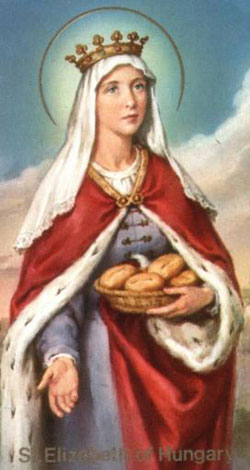
St. Elizabeth of Hungary~The Rev. Dcn Dollie Wilkinson, OPI
(1207 – November 17, 1231)
“She opens her arms to the poor and extends her hands to the needy.” Proverbs 31:20
In her short life, Elizabeth manifested such great love for the poor and suffering that she has become the patroness of Catholic charities and of the Secular Franciscan Order. The daughter of the King of Hungary, Elizabeth chose a life of penance and asceticism when a life of leisure and luxury could easily have been hers. This choice endeared her in the hearts of the common people throughout Europe.
She was born in Hungary in 1207, the daughter of Andrew, King of Hungary. From the beginning of her life, she was ridiculed by people who were jealous of her. They noticed that she was always trying to be holy. As she would play games with the other children, she would always contrive little ways to sneak into the chapel and have a visit with Jesus.
Betrothed to Louis of Thuringia at four years of age, Elizabeth married the 21-year-old Louis when she was 14 years old. Later, they had three children Herman, Sophia and Gertrude. Early in their marriage, Louis rebuked Elizabeth because she was always serving people. Although Elizabeth was Queen, she longed to live the life of poverty she heard about through the Franciscans. She constantly gave her jewels and best clothes to the poor. Sometimes she gave everything away and had nothing to wear, but Jesus always provided for her. When she emptied the castle storehouses of grain for the poor, Jesus would miraculously fill them up again. “That’s no work for a Queen,” Louis reprimanded her. Once he demanded to know what she was carrying in her cloak. When he pulled it open, instead of finding provisions for the poor as he expected, out cascaded lovely red and white roses. Louis knew then that she was indeed a holy woman and from that point on he dedicated his life to sharing her ministry.
After only six years of marriage, Louis died of the plague while on a crusade and Elizabeth was devastated. Louis’ greedy brother, Henry, drove Elizabeth and her children out of Wartburg Castle the winter Louis died. She suffered great hardships until she was taken in by her uncle, the Bishop of Bamberg, who wanted her to remarry. Elizabeth refused, having promised Louis that she would not marry again.
Seeing that her children were taken care of by relatives, Elizabeth entered the Order of St. Francis. Master Conrad of Marburg, who was assigned to be her mentor and confessor, was very strict and harsh with her. But, Elizabeth continued her works of charity among the poor, the sick and the homeless. She fished at the river to earn more money to help them. Elizabeth was especially concerned about the orphans and the elderly and built hospitals with her own funds to take care of them. She had so much compassion toward them that she herself tended to their needs, cleaning their homes and spinning yarn for their clothes.
Elizabeth lived with great austerity and worked continually in her hospice and in the homes of the poor. Saint Elizabeth of Hungary, or Thuringia, is the first royal Franciscan tertiary to be canonized. She died at only twenty-four years old, and the world lost of one of the most pious women to ever live. Within four short years, Pope Gregory IX named her a Saint (in May of 1235). She is most remembered for her gentle, charitable nature and complete devotion to God’ s will. Her popularity was immediate, with most of her followers living in the regions in and around Germany and Hungary. Because St. Elizabeth’s dedication to the poor, the sick and the homeless so closely exemplifies the work of Catholic Charities, she was chosen to be its patroness saint.
St. Elizabeth is the patron saint of bakers, countesses, death of children, falsely accused, the homeless, nursing services, tertiaries, widows, and young brides. Her symbols are alms, flowers, bread, the poor, and a pitcher.
Prayer to St. Elizabeth:
O God, by whose gift Saint Elizabeth of Hungary recognized and revered Christ in the poor, grant, through her intercession, that we may serve with unfailing charity the needy and those afflicted. Through our Lord Jesus Christ, your Son, who lives and reigns with you in the unity of the Holy Spirit, one God, for ever and ever.
Amen.
Living for Jesus: The Vocational Life ~ Br. Igor Kalinski, OPI

Are you willing to trust God with everything?
What steps can you take to develop a deeper trust in God’s provision?
As I look in the passage in today’s Gospel and Epistle, I put myself in the same position, how to react and what to do as Christian person who follows Christ.
As a friar living a life of vows, professed totally to God and my superior’s will, and offering prayers for the needs of those who needs me, I must take St. Paul as an example. The Apostle St Paul tells us today in the Epistle to the Thessalonians that with his own hands he provided funding for his existence, for food and for his missions that he must accomplish and traveling to all of those places he must visit.
In following his example, I have prayed a lot for the last two years for a stable job, so I can finance my work within the Dominican Order and the Church, and God answered my prayers for the glory and proclamation of his Kingdom. We as Independent Old Catholic clergy and religious follow this example to supply what we need for our spiritual work, firstly with work that will provide us money so we can invest in those abandoned and marginalized people who often are forgotten from their dominant parishes in our cities and towns. In today’s Gospel we read about all these natural signs from one side and from another side all what occur in today’s world scene full of hatred, criminal benefit of business with weapons making wars, destroying countries, making millions of refugees scattered in every corner in the globe, destroying families and homes into ruins. This all must be fulfilled as a sign that our God will return in this world one more time to give His righteous judgement for all acts of evil to be put in end and give punishment or redemption to those that their names are written in the Book of Life or eternal separation from the light for those that have followed their evil deeds of the devil.
We go back in the old testament where the Prophet Malachi has written this:
“But for you who fear my name, there will arise the sun of justice with its healing rays”
That’s what God desires for us, not because he needs our money or time or whatever else we can offer him, instead, he doesn’t want us to miss the blessing that comes from giving as St Paul showed us. We don’t get paid for our work as clergy because it is not some kind of occupation but it is life of vocation, we don’t get paid by someone higher than us, but we work here or there to provide food for us and those that we take care of, and then after we get home in our oratories we put our habits as visible sign of our dedicated vowed life and we continue with our work in and at our ministry that we are called to serve. This often reminds me that in the 21st century we yet live like in the time of St Apostle Paul. We don’t live or work or ministry so we wait to be paid. Our rewards and provisions come only from God. We are of those who must do our best to accommodate and help our neighbors in need, that is real ministry.
Let me compare another example, like that one when Jesus and his disciples decided to eat the Passover lamb, they payed someone for a rented room, and there in that rented room, we received our most important sacrament: the gift of holy Eucharist, the first mass. This, again, reminds me of my poor humble oratory with altar in the center, few candles, crucifix, one bed, few books. This is how I work for Jesus. There does not come a huge congregation, and I don’t stand up in a huge crowd of people. We minister to those who need us, one or two or three persons at a time, and yet there in between stands Jesus giving us a clear statement that two or three gathered in His name, showing that he remains with us invisible with Holy Spirit or visible in the Altar under the sign of bread and wine.
But let us stand bold, do not get discouraged, having his name written in our hearts, baptized in his name, we belong to Him. As he was seized, persecuted, we must realize that the same could occur to us as today we see how our brothers and sisters face persecutions and martyrdom in Syria, Iraq, Nigeria and many other places.
Praise the Lord for the peace this the places where live and support petitions for the persecuted brothers and sisters as many will be crowned as martyrs, let’s not get discouraged, or to live in fear that comes from the wicked devil, but rejoice, we will inherit Heaven! Let us continue to share the good news to many, so all of us can enter there and share God’s love and eternal life.
As a friar in the Dominican Order, I am called to serve and live by the charism of our father St Dominic de Guzman as preacher of the Gospel and truth, not with preaching long sermons, but that what we share with others to correspond with the way of our life that we daily walk the path of thrones in this valley of tears.
We must not be afraid, but stay bold in Jesus, he is our doctor, physician, healer, our Lord and Redeemer.
I am reminded of the American hymn, “Living for Jesus”:
“Living for Jesus”
Thomas O. Chisholm
Living for Jesus a life that is true, striving to please him in all that I do,
yielding allegiance, glad-hearted and free, this is the pathway of blessing for me.
O Jesus, Lord and Savior, I give myself to thee, for thou, in thy atonement, didst give thyself for me;
I own no other master, my heart shall be thy throne, my life I give, henceforth to live,
O Christ, for thee alone.
Now take few minutes to imagine what Jesus would say about your Christian life to this point. What does he think about your faith, what does he think about your accomplishments for his kingdom, would he describe you as someone growing closer to him every day?
Amen.


You must be logged in to post a comment.