
Category: Member Posts
Heartbreak and Happiness, Compassion and Faith ~ Br. Chip Noon, Novice
What is a parent’s worst nightmare? Those of us who are parents know the answer immediately: the death of a child. What could be more heartbreaking? How could we live the rest of our lives with such grief? How could God let such a thing happen?
Two of today’s readings tell of the death of a child and its return to life. In the first, Elijah “stretched himself out upon the child three times and called out to the LORD: O LORD, my God, let the breath return to the body of this child.” And the child revived and Elijah gave him back to his mother.
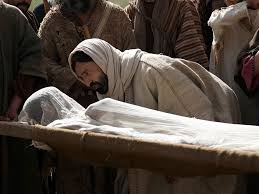
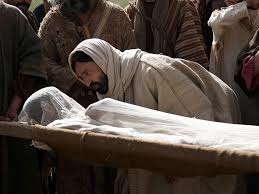
In the second, Jesus sees a funeral cortège and stops the coffin bearers with the touch of his hand on the bier. He says to the mother, a widow of the town of Nain, “Do not weep.” And then he says to the dead man, “Young man, I tell you, arise!” And Jesus gave him to his mother.
How can this be? A worst nightmare comes true, and then is driven away by the resurrection of two dead children?
Now notice in the first reading, the mother berates Elijah. She thinks he has killed her son because of some past transgression of hers. She does not blame God, neither Elijah’s God nor her own, but accuses her guest, whom she acknowledges as a “man of God.”
Without being asked, Elijah takes the boy to the upper room and revives him. This is the first instance of a resurrection in Scripture and it causes the widow of Zarephath to recognize and acknowledge, ““Now I know that you truly are a man of God and that Jehovah’s word in your mouth is truth.”
God, through the actions of Elijah and the declaration of the widow, demonstrates his power on earth.
And so it was in Nain, where Jesus revives another widow’s son. In this Gospel story, Jesus approaches the dead man on his own volition. No one asked him to, no one accused him of causing the death of the young man. But he has pity on her and gives her back her son.
This story is from Luke, Chapter 7. You might remember in Luke 4 Jesus, talking to the people of Nazareth, says:
For instance, I tell you in truth: There were many widows in Israel in the days of Elijah when heaven was shut up for three years and six months, and a great famine came on all the land. Yet Elijah was sent to none of those women, but only to a widow in Zarephath in the land of Sidon.
Why were these women chosen? Why should they be the recipients of a divine miracle and not many others? How does God’s favor fall upon some while some suffer pain and death?
Let us turn to the second reading, Paul’s Epistle to the Galatians. This story too is one of resurrection. Paul’s “revelation” that Jesus is the Christ and that Saul, who persecuted the Christians, will, under a new name, awaken in many a new life with the good news of Jesus Christ. Here also, Saul did not ask for divine assistance. It was thrust upon him as he falls to the ground.
Three different stories, three separate returns to new life, three unasked-for benefits from God.
What could be more joyful? How wonderful to live the rest of their lives with such astonishment? Why did God sanction such things to happen?
The same questions, in reverse, so to speak, we asked at the beginning of this sermon.
Perhaps there is an answer in the Responsorial Psalm:
Hear, O LORD, and have pity on me;
O LORD, be my helper.
You changed my mourning into dancing;
O LORD, my God, forever will I give you thanks.
But even here there is no answer…no clue as to why one is saved and another is thrust down into the pit.
The question that rings through all the ages: “Why me?” And its obverse, “Why not me?” For the good we bear in life and for the troubles we also know. Why? Why not?
But as we pray for an answer, let us go into our own rooms, shut the door, and contemplate. This is what we consider, as Tennyson speaks to us:
Her eyes are homes of silent prayer,
Nor other thought her mind admits
But, he was dead, and there he sits,
And he that brought him back is there.
That is what we know. That is all we know. The rest is faith, isn’t it? He that brought him back is there with her…and with us, is he not?
The readings these last few days in the Liturgy of the Hours have been following the story of Job. Didn’t his friends ask the same questions? But Job says simply, “I know that my redeemer liveth.” He has faith.
Perhaps some need proofs. Perhaps some need miracles. Perhaps some only need faith. What we do know is that God expects us to have faith. Jesus asks us to have faith, and that is what his followers preach to us. The peace that passeth all understanding.
And now, as my prayer, I should like to sing this song with you:
How Great Thou Art
O Lord my God, When I in awesome wonder,
Consider all the worlds Thy Hands have made;
I see the stars, I hear the rolling thunder,
Thy power throughout the universe displayed.
Then sings my soul, My Saviour God, to Thee,
How great Thou art, How great Thou art.
Then sings my soul, My Saviour God, to Thee,
How great Thou art, How great Thou art!
Amen.
The Shepherd’s Sacred Heart ~ The Rev Dcn Dennis Klinzing, Novice
In our Gospel reading today Luke 15: 3-7, Jesus shares the parable of the lost sheep with us. Today we also celebrate the Sacred Heart of Jesus. I would like to take this chance to spend some time to explore today’s Gospel message with meaning of the Sacred Heart of Jesus. Jesus spoke to us today about a lost sheep. There is an additional parable that Jesus taught that I apply to the Sacred Heart of Jesus. That is the parable about the wedding necklace (Luke 15: 8-10). In both parables we are able to see the Sacred Heart of Jesus each time. Those of us who are parents, or are in constant interaction with children, are able to easily understand the joy the heart feels and expresses when a child who is thought to have been lost is found. The heart’s expression is even more intense when a soul or child is truly lost and then found again.
The story about the lost sheep would touch the hearts of the men and boys in the crowd, and the women and girls would appreciate the story about the necklace that was lost. Jesus sought to reach everybody’s heart.
The sheep was lost because of its foolishness. Sheep have a tendency to go astray, and that is why they need a shepherd. The scribes and Pharisees had no problem seeing the publicans and sinners as ‘lost sheep,’ but they would not apply that image to themselves! And yet the prophet made it clear that all of us have sinned and gone astray, and that includes religious people.
The shepherd was responsible for each sheep; if one was missing, the shepherd had to pay for it unless he could prove that it had been killed by a predator. This certainly explains why he would leave the flock with the other shepherds, go and search for the missing animal, and then rejoice when he found it. Not to find the lost sheep meant money out of his own pocket, plus the disgrace of being known as a careless shepherd.
By leaving the ninety-nine sheep, the shepherd was not saying they were unimportant to him. They were safe, but the lost sheep was in danger. The fact that the shepherd would go after one sheep is proof that each animal was dear to him.
There is a fourfold joy expressed when a lost sinner comes to the Savior. Though nothing is said in the story about how the sheep felt, there is certainly joy in the heart of the person found. Both Scripture (Acts 3:8; 8:39) and our own experience verify the love of salvation.
But there is also the joy of the person who does the finding. Whenever you assist in leading a lost soul to faith in Christ, you experience a wonderful joy within. Others join with us in rejoicing as we share the good news of a new child of God in the family, and there is also joy in heaven (Luke 15:7; 10). The angels know better than we do what are saved from and to, and they rejoice with us.
Jesus illustrates this joy of finding the lost in another way. When a Jewish girl married, she began to wear a headband of ten silver coins to signify that she was now a wife. It was the Jewish version of our modern wedding ring, and it would be considered a calamity for her to lose one of those coins. Palestinian houses were dark, so she had to light a lamp and search until she found the lost coin, and we can imagine her joy in finding it.
We must not press parabolic images too far, but it is worth noting that the coin would have on it the image of the ruler. The lost sinner bears the image of God, even though that image has been marred by sin. When a lost sinner is ‘found’ God begins to restore that divine image through the power of the Holy Spirit, and one day, the believer will be like Jesus Christ.
These two parables help us understand something of what it means to be lost. To begin with, it means being out of place. Sheep belong with the flock, coins belong on the chain, and lost sinners belong in fellowship with God. But to be lost also means being out of service. A lost sheep is of no value to the owner, and a lost sinner cannot experience the enriching fulfillment God has for them in Jesus Christ.
But to turn this around, to be ‘found’ (saved) means that you are back in place (reconciled with God), back in service (life has a purpose), and out of danger. No wonder the shepherd and the woman rejoiced and invited their friends to rejoice with them!
It is easy for us today to read these two parables and take their message for granted, but the people who first heard them must really have been shocked. Jesus was saying that God actually searches for sinners! No wonder the scribes and Pharisees were offended, for there was no place in their legalistic theology for a God like that. They had forgotten that God had sought out Adam and Eve when they had sinned and hidden from God. In spite of their supposed knowledge of Scripture, the scribes and Pharisees forgot that God was like a father who pitied his wayward children.
These are few joys that match the joy of finding love and bringing them to the Savior.
Why do these scriptures mean so much to us on the Feast of the Sacred Heart? The Solemnity of the Sacred Heart of Jesus presents us with the opportunity to reflect on the relevance of this venerable symbol in our daily lives. The image of the Sacred Heart is never mentioned as such in Sacred Scripture, but its meaning can be found spanning each page of Genesis to Revelation.
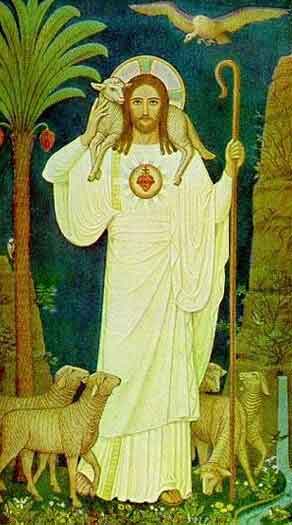
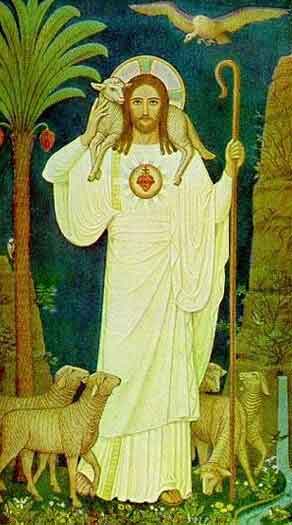
Today’s readings point to this fact and frame the Sacred Heart in terms of two central themes: love and closeness. They speak of the love of God as a shepherdly love, an involved loved, a powerful love; a love that is up-close and personal, that seeks out the lost, heals the afflicted, strengthens the contrite, upholds the humble, and calls mend and woman of every time and place to all they can be, to love in return, to have life in abundance: to be holy. We see here that the image of the Sacred Heart is intimately linked with the image of the Good Shepherd.
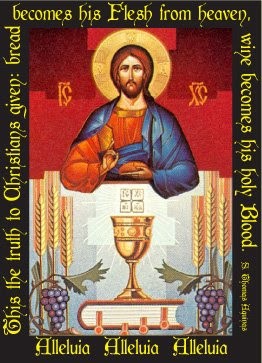
Remembrances and Reminders: The Feast of Corpus Christi ~ The Ven. Fr. Jay Van Lieshout, OPI
Souvenirs, mementos, remembrances, heirlooms, treasures, artifacts, chachkies, knickknacks, memories; tokens of the people, places and memories out of our past which we cling to and carry with us as we move on into the future. Grandma’s handkerchief which she always carried in her purse, granddad’s which still smells of his favorite tobacco, the pressed violets you gave mom for Mother’s Day and she always kept in the family Bible, the note wishing you a good morning from a loved one who has gone home; to others they are just “things” but to you they are the most precious relics in the world. We all have them, some more than others. Personally, I do not like a lot of “stuff” but you would never know it. My home is filled with the bits and pieces of the lives of loved ones who have passed on far to soon. Of course I say I am going to clean out the house and attic and only keep the most important things and I start, but haven’t really made much progress these past few years. It’s difficult; each item brings back memories of good times and laughter, and then comes the tears. Why do we collect these mementos and why are they so hard to part with? After all we always have our memories don’t we?
Memories are how we record our own history and where we keep our loved ones alive. We hold their smiles, laughter, hugs and all the little things close to our heart, letting our mind’s eye relive and cherish them over and over. But, alas, we live in a world created by our senses of touch, smell, sight, sound and even taste; memories are ethereal wisps of images and echoes of sound which blur and fade. Yet, when we hold these most sacred artifacts, our past springs back to life crisp and clear. The faint sweet smell of granddad’s pipe transports us back to sitting on his knee while he told his silly stories. Or the texture of grandma’s kerchief as we hold it against our cheek elicits the click of her purse opening up and the wafting smell of peppermint candies and face powder. Yes, these seemingly simple objects are perform miracles in our hands, they erase the years, veil the present, allowing us to revisit our past and bringing our loved ones back to us as if they had never even left.
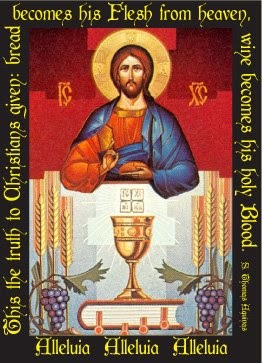
On this 2nd Sunday of Pentecost, we commemorate Corpus Christi-the solemnity of the most Holy Body and Blood of our Lord Jesus Christ. It may seem odd to have a day set aside for that which we celebrate at each and every Eucharist, but it is important to remind us of the gift which we have been given. We call to mind His promises, “I tell you truly that if two of you on the earth agree about anything you ask for, it will be done for you by My Father in heaven. For where two or three gather together in My name, there am I with them” (Matthew 18:20) and “be sure of this: I am with you always, even to the end of the age” (Matthew 28:20). Jesus is with us always, our constant companion, our guide and protector; we carry Him inside us, in our hearts and minds for He is part of who we are as Christians. Each Sunday we relive these promises in the sacrament of His Body and Blood, we hold Him in our hands, we see Him in the Bread and His blood in the Wine and we taste His presence on our tongues; and then, all too quickly, the reality of His presence fades and the Mass ends. Unlike the saints, and the moments of our past, there are no relics of our Lord to cling to, no concrete evidence of Him once walking among us; He ascended into the sacred realm and, though still with us spiritually, we long for a physical presence. Today, we bring to the forefront the reality of God’s covenant, the promise of the real presence of the Son of Man in the ritual of the Eucharist, the living presence of God in the flowing of our blood and His life giving spirit breathing life into us. Today we do more than just eat the bread of life and drink from the cup of the new covenant, we stop, gaze upon, contemplate, adore and most importantly we remember the good news he brought us and gift we have been given in breaking of His body, the surrender of His blood, the redemption in His sacrifice and the hope in His resurrection: Our Lord is with us here, now and always!
Relationships ~ Br. Michael Marshall, Novice
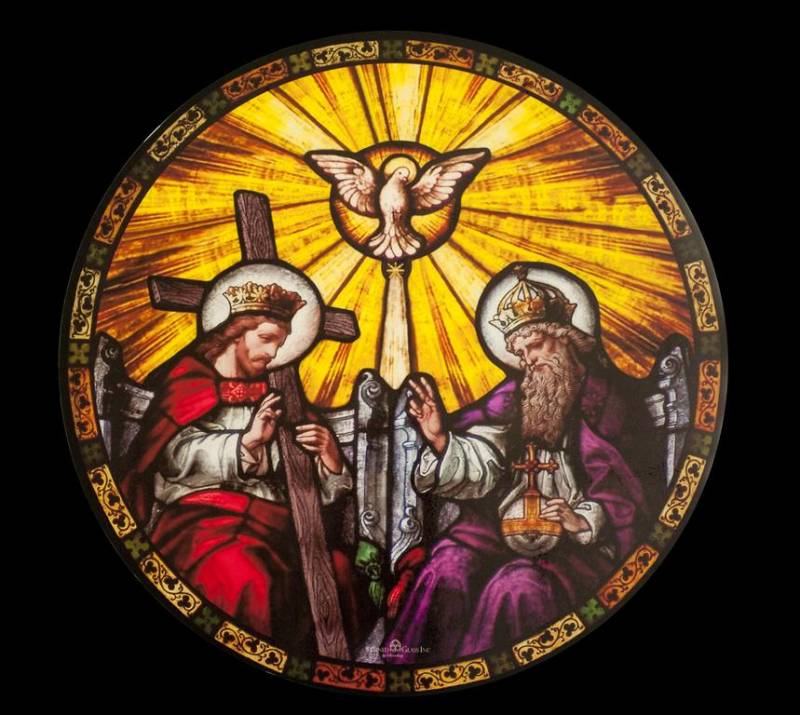
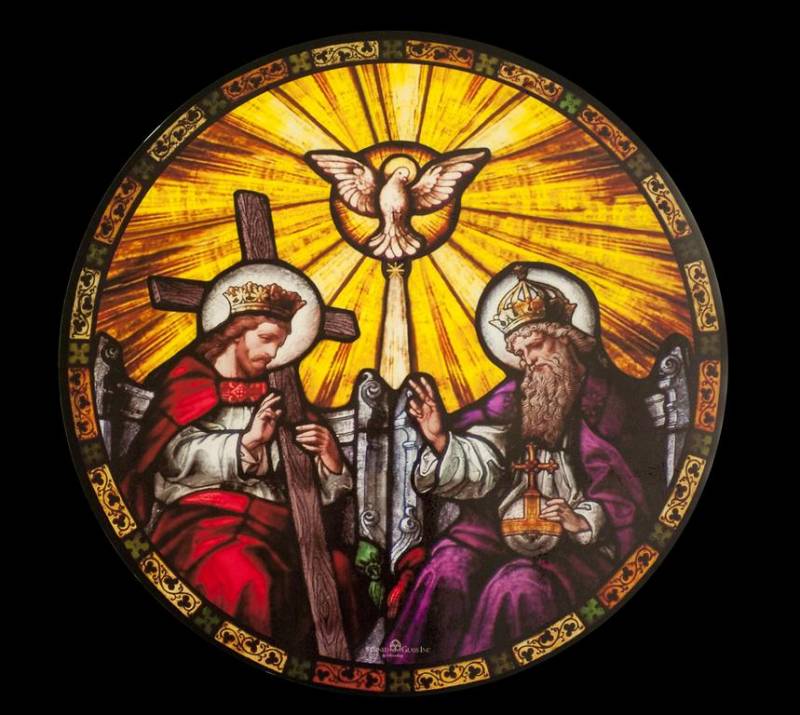
Relationship… What is a relationship? What is the purpose of a relationship? A relationship is a connection and interaction between two or more people. The purpose of a relationship is to share with and learn from others. Today is about relationships. The Holy Trinity is a relationship of one God in three persons working in different ways but with one purpose. What is that purpose??? That purpose is to be in relationship with US!!!
Throughout the Old Testament, we find Scripture which speaks to God seeking a relationship with humanity, even though there were many occasions of falling away from God through negative actions and sin. The devil tried to step in and destroy the relationship, but failed. After all, God created us in His own image, so he was not going to abandon us despite our errors of judgment because He loves us unconditionally. And out of His love for humanity, even though we did not “get it,” He sent us his Son to live among us and try to teach us what this relationship with humanity was all about; the relationship was all about love! Humanity is to love God, ourselves, and our neighbor. God made the ultimate sacrifice to save us from our sins, by dying on the cross as the Son. How much more love could there be for humanity than that??? Even though Jesus died, was buried, and was ascended; our relationship with God still remains because we have the Holy Spirit with us, and is all around us. At the Last Supper, Jesus tells his disciples that there would be more to learn, but it would come from the Spirit of truth, which we would call the Holy Spirit. So God as the Holy Spirit is all around us, and working through others to teach us over and over about His love for humanity.
So as we make the sign of the cross and say, “In the name of the Father, the Son, and the Holy Spirit,” let us remember that is a relationship of a triune God for the purpose to be in relationship with us. We need to recognize that the relationship has a purpose, more than to just know us as His creation, but we are to share in that relationship by taking what have been taught through Scripture, and still learning today through the Holy Spirit. The relationship with Him is about building relationships with others and loving others just as much as God has loved us, to teach others about God’s love.
“Lord, as we pray with the sign of the cross, may we keep in mind the relationship that we share and remember your great love for us, which we are to spread in our ministry.” Amen.
The Neglected Feast ~ The Rt. Rev. Michael Beckett, OPI
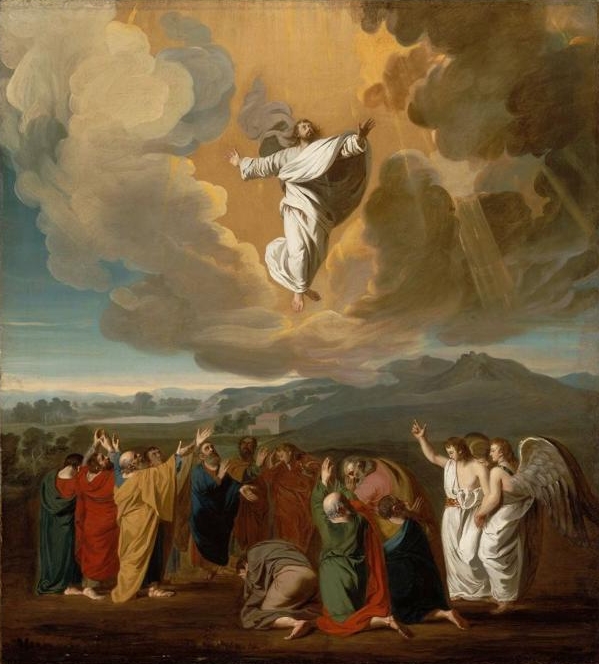
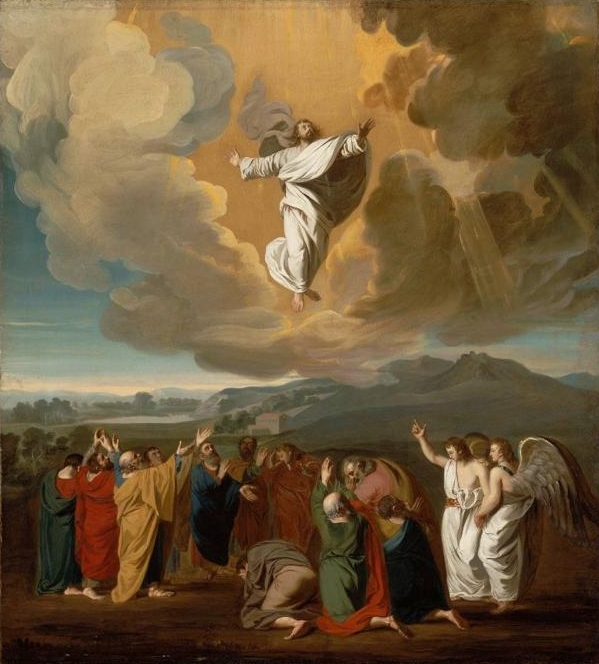
While Ascension Day is a Day of Holy Obligation, it is one of the most neglected feast days of the Christian church. This is sad enough in itself, but in ignoring this festival, the opportunity is lost for reflecting on what the Ascension means. Maybe we tend to ignore Ascension Day because it falls on a weekday. Is this the reason it doesn’t get the attention it deserves? This is a pity because it is full of significance in the historical life of Jesus when on Earth – and his continuing ministry for us in heaven. As a weekday event it reminds us that Christianity isn’t just something for Sunday – it’s an experience for every day. As Christians, we are to celebrate Our Lord every day, every second of our being. If we gloss over its truth we rob ourselves of a most important doctrine, for without the Ascension, the work of Christ would be incomplete. Because we do not place as much emphasis on the Ascension, we miss its tremendous truth.
St. Augustine, the great fifth century theologian, called the Ascension the most important Christian festival of the year, more important than Christmas, more important than Pentecost, even more important than Easter. For the Ascension reminds us just how high Jesus was raised, and what that means:
‘This is that festival which confirms the grace of all the festivals together, without which the profitableness of every festival would have perished. For unless the Saviour had ascended into heaven, his Nativity would have come to nothing…and his Passion would have borne no fruit for us, and his most holy Resurrection would have been useless.’
What Saint Augustine says here resonates with the passage in Ephesians 4:10, where Saint Paul says that ‘He who descended is he who also ascended far above all the heavens, that he might fill all things’ – i.e.; that by ascending into Heaven, and taking our human nature up with Him into the heavenly places, He completed the process of redemption by reclaiming His place as rightful sovereign of the universe, so that He might be present to us in a different way. If He had not so returned, the process would not have been completed, and as Jesus said in John 16:7, ‘it is to your advantage that I go away, for if I do not go away, the Counselor will not come to you; but if I go, I will send him to you’.
The gospel writer Luke is renowned as a careful historian. When he recorded the birth of Jesus he rooted the event in its historical setting within the Roman Empire. He continues that same preciseness at the end of our Lord’s earthly ministry by recalling the place of the Ascension – at Bethany. He dates the event – 40 days after the resurrection on Easter Day. He emphases the presence of eyewitnesses – the Ascension took place he writes “before their very eyes” (Acts 1:9). Yes, the Ascension was a real event of history.
Some people are puzzled as to why Jesus waited around on Earth 40 days after his resurrection, but that period is no accident, and Jesus had things to do. Jesus had endured the Devil’s temptation for 40 days in the wilderness at the beginning of his public ministry, but now the tables were turned. In the period after Jesus’ resurrection, He triumphantly paraded his victory over the Satan. During this time, the conqueror of death displayed his supremacy before his faithful followers so that they might share in the joy of his victory. But there was another reason. Those 40 days of his appearing after the resurrection were of immense value to the believers for they established the reality of his lordship. A single sighting of the risen Christ may have been open to question, but his continuous encounters with the disciples would remove the doubts of the most skeptical among them and assure them of his power and authority.
The resurrection of Jesus marked the ending of a chapter in his earthly life. Things could never be the same again and it was essential that there should be a clear-cut event to bring the chapter to a close. It’s true that Jesus was making a series of appearances to his followers, but they couldn’t go on forever. It would have been odd if Jesus’ post-resurrection appearances had grown fewer until finally they just stopped – that would only cause confusion and even loss of faith. No, there had to be a single, miraculous occurrence, separating the time when the Jesus of Earth would become the Christ of heaven. The Ascension was the only fitting conclusion to the life of Jesus on Earth.
Luke tells us of the disciples with their eyes straining to catch the last glimpse of the cloud bearing up their Lord. But then they were quickly brought back to earth. It would seem that with their eyes heavenward they didn’t notice the two heavenly beings that slipped quietly alongside them until they spoke: “Men of Galilee, why do you stand looking unto heaven?,” as if to remind the disciples of the work that they had been given to do. The angels, for angels they were, had to tell the disciples to get to business.
And so it is with us. Ascension Day reminds us of the Mystery of Faith: “Christ has died, Christ is risen, Christ will come again.” Christ will come again. And as we await the “coming again” of Christ, we, like the disciples, have a job to do, business to attend to. Although we live in the time between Jesus’ Ascension and his coming again, we have something to do now. In Matthew 28:18-20, Jesus says, “Go to the people of all nations and make them my disciples. Baptize them in the name of the Father, the Son, and the Holy Spirit, and teach them to do everything I have told you. I will be with you always, even until the end of the world.”
Where do we start? Jesus has the answer for that, too. In John 13 Jesus says to us, “ But I am giving you a new command. You must love each other, just as I have loved you. If you love each other, everyone will know that you are my disciples.” We are to continue to change the world in the work that Jesus has given us to do by helping others to see Jesus through and in us, by showing that love that he demonstrated, by bringing that love to everyone.
Jesus told us to love everyone. Love. Everyone. Period. Not just those whose politics are the same as ours. Not only those whose religion is the same as ours, not only those whose lifestyles are the same as ours.
Love. Everyone. Period.
We would all of us do well to pray:
“Lord, make me an instrument of thy peace.
Where there is hatred, let me sow love;
Where there is injury, pardon;
Where there is doubt, faith;
Where there is despair, hope;
Where there is darkness, light;
Where there is sadness, joy.
Love. Everyone. Period.
Come Lord Jesus.
Amen.
The Feast of Sts. Philip and James ~ The Rev. Lady Sherwood, OPI

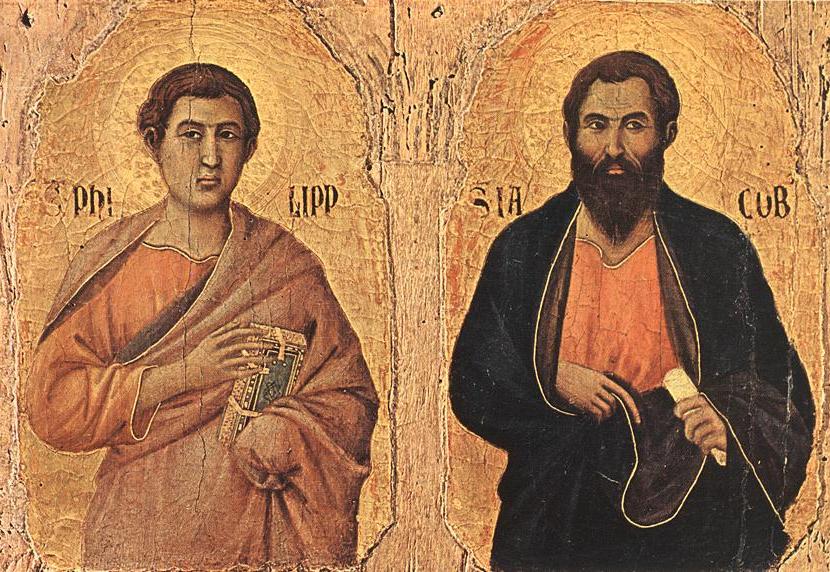
Today as a church and as Christians we celebrate the double feast of the Apostles St. Philip and St. James.
St. Philip
Philip was born in Bethsaida, Galilee. He may have been a disciple of John the Baptist and is mentioned as one of the Apostles in the lists of Matthew, Mark, Luke, and in Acts. Aside from the lists, he is mentioned only in John in the New Testament. He was called by Jesus Himself and brought Nathanael to Christ. Philip was present at the miracle of the loaves and fishes, when he engaged in a brief dialogue with the Lord, and was the Apostle approached by the Hellenistic Jews from Bethsaida to introduce them to Jesus. Just before the Passion, Jesus answered Philip’s query to show them the Father, but no further mention of Philip is made in the New Testament beyond his listing among the Apostles awaiting the Holy Spirit in the Upper Room. According to tradition he preached in Greece and was crucified upside down at Hierapolis under Emperor Domitian.
St. James
St. James the Less, the author of the first Catholic Epistle, was the son of Alphaeus of Cleophas. His mother Mary was either a sister or a close relative of the Blessed Virgin, and for that reason, according to Jewish custom, he was sometimes called the brother of the Lord. The Apostle held a distinguished position in the early Christian community of Jerusalem. St. Paul tells us he was a witness of the Resurrection of Christ; he is also a “pillar” of the Church, whom St. Paul consulted about the Gospel.
According to tradition, he was the first Bishop of Jerusalem, and was at the Council of Jerusalem about the year 50. The historians Eusebius and Hegesippus relayed that St. James was martyred for the Faith by the Jews in the Spring of the year 62, although they greatly esteemed his person and had given him the surname of “James the Just.”
Tradition has always recognised him as the author of the Epistle that bears his name. Internal evidence based on the language, style, and teaching of the Epistle reveals its author as a Jew familiar with the Old Testament, and a Christian thoroughly grounded in the teachings of the Gospel. External evidence from the early Fathers and Councils of the Church confirmed its authenticity and canonicity. The date of its writing cannot be determined exactly. According to some scholars it was written about the year 49 A.D. Others, however, claim it was written after St. Paul’s Epistle to the Romans (composed during the winter of 57-58 A.D.). It was probably written between the years 60 and 62 A.D.
St. James addresses himself to the “twelve tribes that are in the Dispersion,” that is, to Christians outside Palestine; but nothing in the Epistle indicates that he is thinking only of Jewish Christians. St. James realises full well the temptations and difficulties they encounter in the midst of paganism, and as a spiritual father, he endeavours to guide zero direct them in the faith. Therefore, the burden of his discourse is an exhortation to practical Christian living.
Both St. Philip and St. James have their joint feast day on May 3rd.
Let us pray:
As we remember the apostles Philip and James we are reminded that God calls us all and sends us out into the world to be his hands and his feet. We thank you Jesus for the tasks you have entrusted to us. Help us each day to become more aware of our calling to serve you.
Lord in your mercy – hear our prayer
We pray for the needs of the world, remembering particularly those parts of the world where people live in daily fear of violence and oppression. We call to mind those parts of the world particularly on our hearts today.
Lord in your mercy – hear our prayer
We remember that Philip opened the scriptures to the Ethiopian eunuch helping to bring him to Christ. Let us also bring others to the full knowledge and love of Christ.
Amen.

Saved ~ The Rev. Dcn. Dennis Klinzing, Sr., Novice

Unless you are circumcised you cannot be saved. SAY WHAT?! Moving right along, what do stringent requirements have to do with salvation? Anyone want to take a stab at this? Welcome to suspense, we will get that answer a little later. Do not worry, I am feeling very long winded today, we should have an intermission in about 45 minutes.
In our first reading today, we see that there were some people from Judea that were causing some problems in Antioch. We are able to see that some of the people were insisting on the stringent requirements for salvation (The Mosaic Law). Ultimately what happens is the church in Antioch sends a convoy to Jerusalem, which thankfully an agreement was settled. The church in Jerusalem said, “Uh, guys, no extra burdens are to be laid on the new converts. That is no burdens that are unnecessary.”
Sounds fair enough, right? But what was considered necessary? Abstention from meat sacrifices to idols, the non-consumption of blood and the meat of strangled animals, and yes the avoidance of inappropriate sexual relations (unlawful marriages).
What is rather interesting is, not only for what is mentioned but also for what is not. In trying to be sure, the community of Jerusalem was presupposing dedication to the cause of the Lord Jesus, but they were also rather reluctant to pile on additional obligations on the new converts. Ya Jerusalem huh?
What about those strangled animals and blood? Are they still prohibited? Now what about idolatry? There just might be a contemporary parallel to this, when animals are slaughtered and sacrificed for the golden calves of money and power? Keep in mind now, that if these practices were currently permissible, there would have been others to take their place in the catalogue of what is strictly necessary?
We read in the First Letter to Timothy that women were not to speak in the church. Then there is the letter to Titus, for its part, directs, that bishops must be of irreproachable character. They should not be heavy drinkers (coffee is the exception) or money grubbers. And, yes, they should only be married once – their children solid believers and respectful. What about today, what are the practices that we have that seem strictly necessary? Inclusive language? Latin Masses? Male priests? Short sermons?
Probably one of the most seductive temptations of the believer is to identify the will of God with the will of the believer, and not the other way around. God’s will is sadly squeezed into patriotism, rightism, capitalism, feminism, hiearchry, civil law, financial success, ecclesiastical tradition, feminism. Even in extreme cases, the supposed will of God can be harnessed to justify leaving a spouse, breaking a promise, even killing someone, whether communist, criminal or oppressor. As we see today, the supposed will of God is used to hate people who do think like everyone else, or identify as everyone else.
The delusion has occurred when philosophers have mauled the eternal and necessary ‘law of nature’ on behalf of cultural prejudice, class interest, or personal preference. Natural law has sometimes been used to justify the most horrendous of crimes. More often it has been manipulated to legitimate slavery, domination of women, and the exploitation of the poor.
Among the churches, has it ever been heard that a certain practice can never be changed, since it is the will of God? And yet, has the practice been much more significant than the act of circumcision? Clearly circumcision was an important issue. However, some of the antagonists seem to have given it the status of an unchangeable law.
Question of the hour, how do we escape fooling ourselves? How do we avoid servitude to merely human laws while we neglect the law of God? How do we guard against the tendancy to worship our temporal and cultural fabrications?
Jesus, in the fourth Gospel, promises the Holy Spirit to instruct us in everything and reminds us of all He revealed. Is this what led the Jerusalem community to forswear putting heavy burdens on its new believers?
It is Jesus and His word that we first and always remember. Therefore, the Holy Spirit instructs us. When we look at Christ primarily in Scripture, it is clear what He is saying: We need repentance; salvation is offered us in His redeeming death and resurrection; and we are called to imitate Him in our mission to the world. We likewise encounter Him in our community, under the blessing of the Holy Spirit. So also came our foundational creeds. Moreover, our holy sacramental signs recall and reenact Jesus’ saving power.
One bright truth, we should never forget. All ideologies and requirements, all popes and rituals, all theologians and mystics, all laws and traditions, would mean nothing to us as Catholics, if Christ is not risen and has not saved us.
St. Mark the Evangelist ~ The Rev. Lady Sherwood, OPI
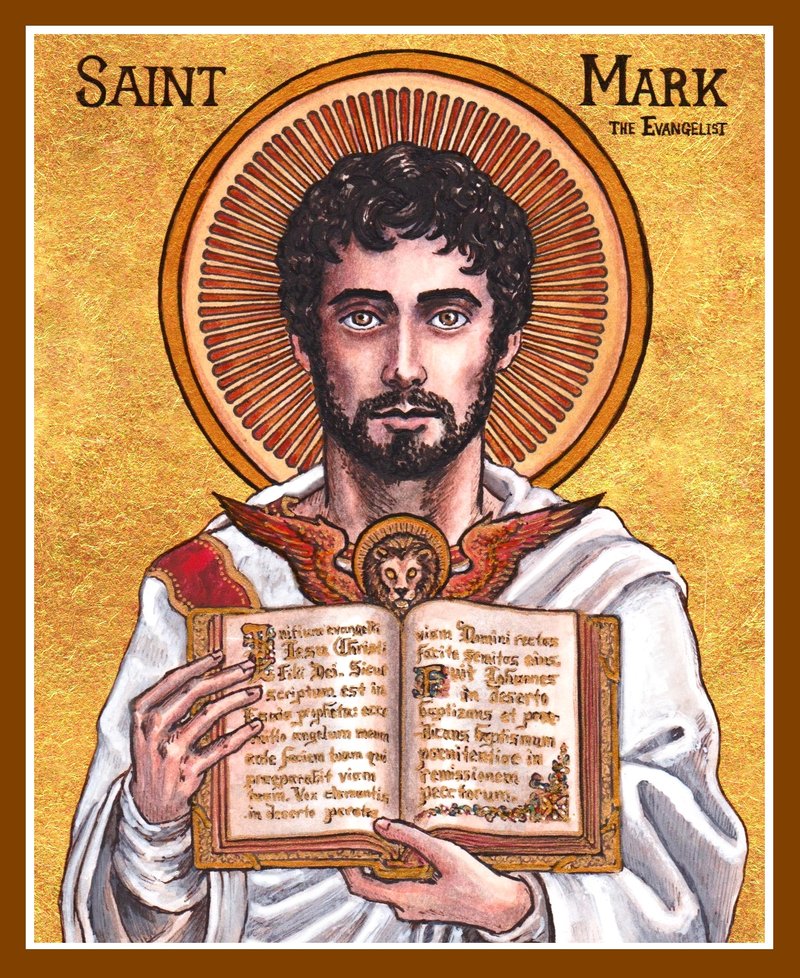
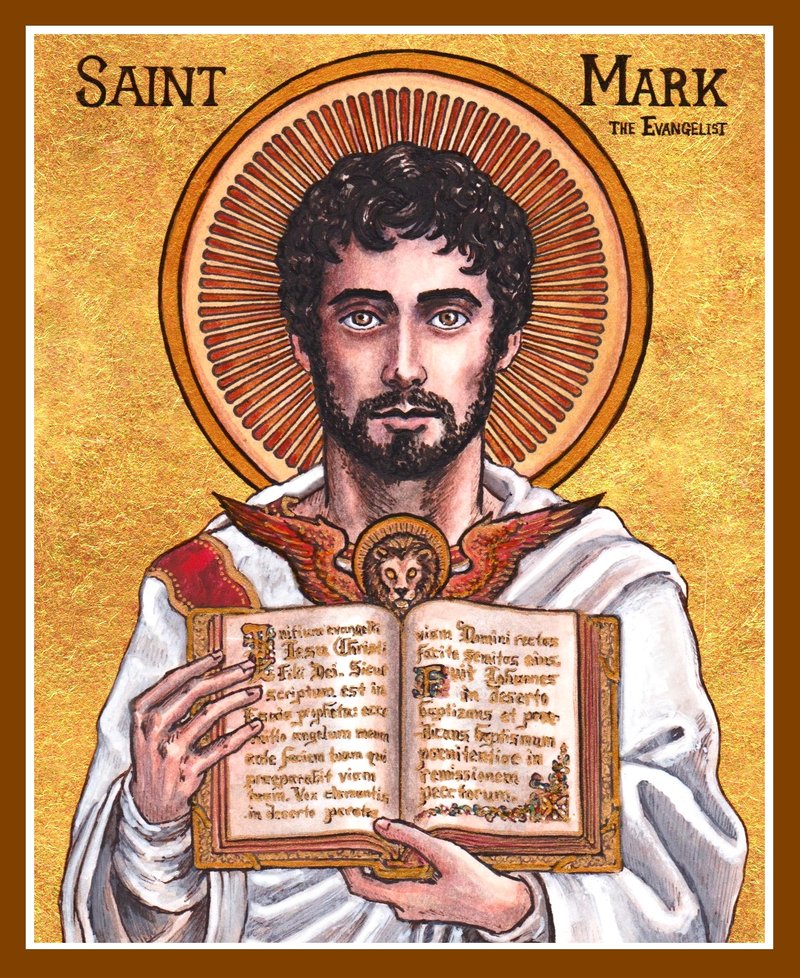
St Mark was one of the disciples of Jesus and an Evangelist who was the author of the Second Gospel in the New Testament (The Gospel of Mark). This is believed to been written by Mark (also sometimes named in the scriptures as John Mark), probably in Rome before the year 60 AD. Mark was an African and was born in Cyrene in Libya and was the child of Jewish parents who belonged to the Levites tribe. They lived in Cyrene until they were attacked by some barbarians which resulted in the loss of their property. So his parents and their son John Mark moved to Jerusalem (Acts 12:12, 25; 15:37). Mark received a good background education and became conversant in the languages of Greek, Latin as well as Hebrew.
Mark came from a very religious family and they had a close relationship with our Lord Jesus. Mark`s cousin was Barnabas and Peter was his father`s cousin.
Mary, Mark`s mother, was an important person in the development of the early days of the church in Jerusalem. It is believed that it was Mary`s upper room that became the first Christian church and was also the place where our Lord Jesus Christ himself instituted the Holy Eucharist (Mk 14:12=26). This was also the place in which the Lord appeared to his disciples after his resurrection and where the Holy Spirit came upon them.
Mark is mentioned in the scriptures in several events including that he was present at the wedding of Cana of Galilee and he was also the jar carrier when two disciples went to prepare a place for the feast of Passover (Mk 14:13=14, Lk 22:11). At first, Mark accompanied Peter on his missionary journeys inside the regions of Jerusalem and Judea. Later, he accompanied both Peter and Barnabas on their first missionary journey to Antioch, Cyprus and Asia Minor but for some reason Mark left them and returned home (Acts 13:13).
When Peter and Barnabas were due to travel on their second journey, Peter refused for Mark to travel with them due to his leaving them on their previous journey, so Barnabas decided to travel with Mark to Cyprus where Barnabas was called home to the Lord and was buried by Mark.
Later, Mark was needed by Paul so both he and Paul traveled and preached together in Colosse (Col 4:10), Rome (Phil 24:2, Tim 4:11) and also possibly, though this not certain, to Venice. Mark had his real labours in Africa. He left Rome and traveled to Pentapolis and after planting there the seed of faith and performing several miracles, he proceeded to Egypt and then on to Alexandria.Upon returning to Alexandria in 65 AD, Mark finding his people firm in faith, revisited Pentapolis where he spent two years preaching, performing miracles, ordaining both bishops and priests as well as winning more converts into faith.
Finally, Mark once again returned to Alexandria and there he was overjoyed to find that the number of Christians had flourished to the extent that they were able to build a considerably sized church in the suburban district of Baucalis.
In 68 AD, Easter fell on the same day as the Seraphis feast and an angry mob descended upon the Christians who had gathered in the Seraphis temple. The mob seized Mark and dragged him by a rope through the streets of the city before throwing him into prison at nightfall. Whilst in the prison Mark saw the vision of an angel and this strengthened him. The next day, again Mark was taken and dragged through the streets of the city, this time until his death. Christians stole his body and secretly buried him in a grave under the altar of the church.
Mark was an evangelist for our Lord. He traveled and preached the Good news of Our Lord Jesus Christ far and wide. As Children of God and as Christians, we can take the example of the life of St. Mark and also become the evangelists for the Lord that we indeed ought to be. As the Word of the Lord himself tells us in Mk 16:15, He said to them, “Go into all the world and preach the gospel to all creation.”
Let us pray:
Lord, help us to follow in the footsteps of St Mark and to love you so totally and completely, desiring only your will in our lives. Help us to hear your voice and to be guided by the Holy Spirit to do all that you ask of us. Amen.
Through the prayer and intercession of St. Mark on our behalf, may the Lord Jesus Christ have mercy on us. Amen.
The Shepherd ~ The Rev. Dcn. Sister Dollie Wilkinson, OPI
We all know the twenty-third Psalm, the Psalm of David. I imagine most of us can recite it almost word for word. But, have you ever thought about what it really means, what it is really saying? It seems with our fast paced, frantic world, people are feeling increasingly stressed, depressed, or lost. And while there are drugs, and therapy to help us deal with any issues we may face, there is also a very powerful tool, a special gift that our heavenly Father has given us – Psalm 23. Let’s take it line by line, and explore how just by reciting, and praying, on each part, it will provide us with a way to cope with the stresses of this world.
Psalm 23 (KJV)
“The Lord is my shepherd; I shall not want.”
What is the purpose of a shepherd? To guide his flock of sheep, to gather any little ones who wander astray. He also must make sure they are well fed, and cared for, to insure they live a long life, so their purpose is assured (the gift of their wool). Isn’t this exactly what God does? He provides us with all of our needs, even if we don’t realize at times what exactly we need. Even if we ask Him for nothing, He still provides. We can be assured that will shall never want. He is our Shepherd!
“He maketh me to lie down in green pastures”
I tend to go throughout my day as if it’s a race. I have a mental to-do list in my head, and on top of that I also care for my ailing husband, babysit my granddaughter once a week, and most days run errands, such as go to the store. So you can imagine, I get pretty tired and worn down. Though my best friend cautions me to rest, I don’t always listen. But just as a shepherd knows that his flock must rest at times, so too does our heavenly Father. I’ve noticed that sometimes it takes a major illness, or injury, to get us to stop, to get that much needed rest. And there should be no shame in slowing down at times, and allowing our body, and mind, to recuperate.
“he leadeth me beside the still waters.”
If you know anything about sheep, they are timid creatures. And just like all God’s creatures, they get thirsty. But, they are afraid of fast moving streams. So the shepherd will lead them to a calm pool of water. He doesn’t make fun of the sheep for being afraid, he doesn’t push them in to a place where they are not comfortable. Our Shepherd does the same for us. If we are afraid, He makes a way to calm our fears. He leads us in to the calm pool, and away from the rapids of life.
“He restoreth my soul”
I had a chaotic childhood. My parents divorced when I was little, my mother committed suicide, and now I care for my ailing husband. It has taken me many years to learn to trust people, and to trust myself. When a shepherd takes his flock out for the day, when they pause to rest, I imagine the sheep wander close to the shepherd, maybe for a snack, but I also believe for just a simple ear scratch, or to be petted. This makes the sheep feel loved and cherished, it makes them happy. We cannot be happy all the time, because life has a way of knocking us down. Our soul can feel crushed in the midst of all life’s troubles. But just like the sheep who come to the shepherd for love and care, so too can we go to our Father. He will help restore what has been broken in us.
“he leadeth me in the paths of righteousness for his name’s sake.”
Imagine a flock of sheep, on a farm, beside a busy street. What would happen if there were no shepherd? Sheep tend to wander off, if left on their own. Well aren’t we the same? How many times have you made a decision, that on looking back, you realized that was not the best decision at the time. But we have a Shepherd, just like the sheep, who will lead us down the right path.
“Yea, though I walk through the valley of the shadow of death, I will fear no evil: for thou art with me”
This one line provides so much comfort, if you will only hear the message. Talking to many people who suffer from depression, or other mental illness, they almost always describe their illness as a black hole, a dark place. And don’t we always fear the dark, the night, at times? I imagine sheep are the same way. But think of the shepherd’s light, which guide the sheep at night, as God’s love and protection, leading us out of the darkness. When you feel darkness, gloom, the bad stuff, all around you, recite this simple prayer. And know, you are never alone in that darkness, because He is always near.
“thy rod and thy staff they comfort me.”
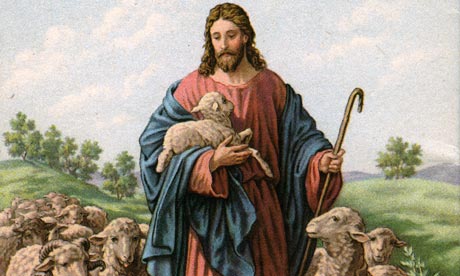
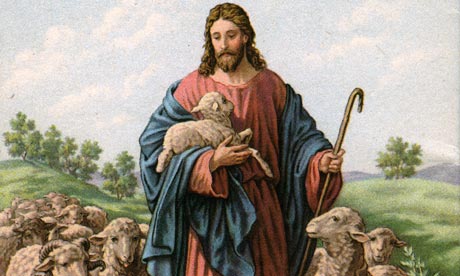
I love the pictures of baby sheep (lambs)! They are so cute, but also so helpless. When we see pictures of shepherds, usually they carry a staff. Have you ever wonder why it is curved at the top? When the sheep, or lamb, has wondered off, possibly fallen down a hill, the curved end of a shepherd’s staff allows him to grasp the lamb who is out of arm’s reach. And bring it to safety. Our Father carries a rod and staff, so to speak. The rod is to protect us against harm, the staff is used to rescue us when we stray.
“Thou preparest a table before me in the presence of mine enemies”
How does the shepherd know where the best grasses are, to graze for his flock? What would happen if he wasn’t as vigilant, and they became poisoned by something? We are not always as careful as we should be, in where we go, what we eat, who we meet, etc. As parents, we always, always try to guard our children from the dangers of life. This isn’t always easy. But, because we have a constant Shepherd who goes before us, preparing a way which is safe from our enemies, we, and our children, can continue to come to no harm.
“thou anointest my head with oil; my cup runneth over.”
At the end of the day, I imagine as the shepherd brought his herd inside the barn, he checked each one for any cuts or scrapes. My granddaughter will be the first to tell you if she has a boo-boo. She then demands I kiss it first, as if that had some magical healing properties. Then the offending cut is anointed with medicine, and bandaged. Just as I imagine the shepherd does for any hurt ones in his flock. Like the sheep, and my granddaughter, we all need medicine when we are sick. But we also need the anointing grace of our loving God. Only then are we healed, and our cup of blessings will overflow.
“Surely goodness and mercy shall follow me all the days of my life”
I’m a worry-wart! I can take a mole hill, and make it a huge mountain. Does what I picture in my mind, actually happen? Most days the answer is NO. But it doesn’t stop me from worrying. We all carry pictures in our head of what we think may happen. For some reason, we always picture the worst. But in this humble verse, we are reminded that God’s goodness and mercy is always with us. It does not leave ya all, so when you feel yourself picturing the worst that could happen, remember you are promised His love and mercy, for “all the days of your life”.
“and I will dwell in the house of the Lord for ever.”
I love this simple declaration by David. He doesn’t say maybe I will, or I hope I will. He declares, “I will!” He gets it, he knows who his shepherd is. Just as the sheep put their absolute trust in the shepherd, so does David put his trust in the Lord. As we should do also, because like sheep in the field, we would be lost without our Shepherd.
Psalm 23:
“The Lord is my shepherd; I shall not want.
He maketh me to lie down in green pastures: he leadeth me beside the still waters.
He restoreth my soul: he leadeth me in the paths of righteousness for his name’s sake.
Yea, though I walk through the valley of the shadow of death, I will fear no evil: for thou art with me; thy rod and thy staff they comfort me.
Thou preparest a table before me in the presence of mine enemies: thou anointest my head with oil; my cup runneth over.
Surely goodness and mercy shall follow me all the days of my life: and I will dwell in the house of the Lord for ever.”
Book Review: Sacred Space for Lent ~ The Rev. Lady Sherwood, OPI
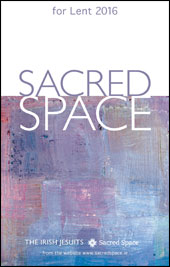
Sacred Space for Lent was written by the Irish Jesuits, and was the basis for my Lenten Studies.
This book was an excellent resource for this Lenten season that we have just journeyed through. As well as the Gospel reading for each day throughout the season, it also had daily reflections on the readings, so it was easy to picture the scene and to place yourself within the scriptures. It also focused on our failings and offered prayers for the appropriate Gospel sections.
Each week there was a deeper reflection and guidance for several topics on which we could think and pray for that particular week of Lent.
I found these very good to help me to keep focused on the true meaning of Lent and to journey through the Lenten season in a way that made me feel even closer to our Lord.
The book was very descriptive, well written and was very easy to follow on a daily basis.
I would score it 4 stars for the content that was obviously well thought through. The reason for me that it doesn’t get a 5 star score is because I like to see illustrations of what is being said as well as the writing as for me the two together give a fuller picture. This book was well worth reading but I would have also added the illustrations that were not presented within the book.
 The Order of Preachers, Independent
You must be logged in to post a comment.