
Category: Sermon
St Mathew, Apostle, Evangelist~The Very Rev Lady Sherwood, OPI
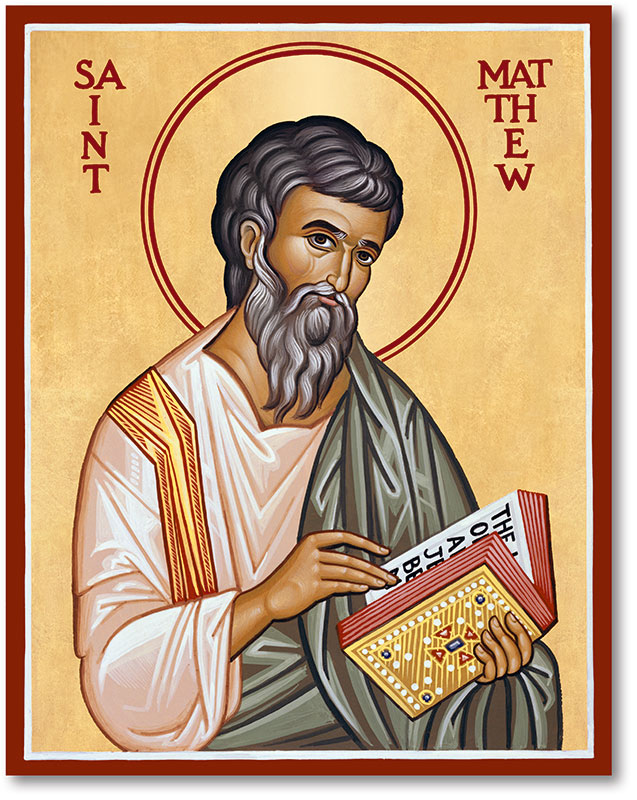
When our Lord Jesus called him to follow him, Mathew was a tax collector by profession for the Romans. His profession was hated by the devout Jews as it reminded them of their subjection and also the Pharisees saw his profession which was classed as publican, as work for the typical sinner.
St Mathew is one of the Lord Jesus’ twelve apostles and by Christian tradition is also seen as one of the four Evangelists. He was the first to put down in writing as his Gospel the Lord’s teachings and the account of our Lord Jesus’ life. Mathew wrote his Gospel in Aramaic, which is the language which was spoken by Jesus himself.
No one was shunned more than a publican by the devout Jews because a publican was a Jew who worked for their enemy, the Romans and who robbed their own people making themselves large personal profits. Publicans were despised to the extent that they were not allowed to trade, eat or even to pray with other Jews.
One day when Mathew was seated at his table of books and money, Jesus looked at him and said unto him two words, “follow me”. For Mathew, these two words were all it took for him to immediately rise, leaving all his pieces of silver to follow our Lord Jesus Christ.
Mathew’s original name was ‘Levi’ which in Hebrew signified ‘Adhesion’ whilst his new name given to him by our Lord Jesus of Mathew means ‘Gift of God’.
The only other major mention of Mathew in the Gospels is regarding the dinner party for Jesus and his companions to which Mathew invited his fellow tax collectors.
The Jews showed surprise at seeing our Lord Jesus eating in the company of a publican, but Jesus explained to the Jews that he had come “not to call the just, but sinners.”
Not much else is known about the life of Mathew but according to tradition, he is reported to have preached in such places as Egypt, Ethiopia and other further Eastern areas.
Some say Mathew lived into his nineties before dying a natural death, but other Christian traditions say he died the death of a martyr.
The Gospel according to Matthew is one of the four canonical gospels, one of the three synoptic gospels, and is the first book of the New Testament. The narrative tells how Messiah, our Lord Jesus was rejected by Israel, and how he finally sends his disciples to preach his Gospel to the whole world. Most Scholars believe the Gospel of Matthew was composed between 80 and 90 CE, with the possibility of between 70110 CE. The Gospel of Matthew is a creative reinterpretation of Mark, stressing Jesus’ teachings as much as his acts, making subtle changes to reveal Jesus’ divine nature for example, Mark’s “young man” who appears at Jesus’ tomb becomes a radiant angel in the Gospel of Matthew. The Gospel of Matthew shows Jesus as the Son of God from his birth, the fulfillment of the Old Testament. The Gospel of Matthew was the favourite Gospel of St.Dominic de Guzman, who always would carry it wherever he went.
Let us pray to St Mathew to ask him to intercede on our behalf:
O Glorious St Mathew, in your Gospel you portray Jesus as the longed-for Messiah who fulfilled the prophets of the Old Covenant and as the new lawgiver who founded a church of the New Covenant. Obtain for us the grace to see Jesus living in his church and to follow his teachings in our lives on earth so that we may live forever with him in heaven. Amen.
Who Are You?~The Rev Frank Bellino, OPI
I don’t believe Jesus is having an identity crisis when he asks the question, ‘Who do people say I am?’ But in presenting this question about himself, he makes us ask the same question of ourselves.
Personal identity is a very modern issue, and people give a different response when asked who they are. It is uncommon for some individuals to describe themselves by their work or profession. It is by saying that they are a doctor or a worker that we can discover all we need to know about them. We can guess their education and their social background. We may be imagining what kind of house they live in and which way they will vote.
Another way in which we name ourselves is by our relationships. The television program, ‘To tell the truth?’ was very popular because we all want to know where we have come from, and someone else’s history will attract an interest in our own story. Nonetheless, the immediate relationships we have are likely more important than ancestors when determining who we are. To say that you are a daughter, a sister and a mother, and a wife, and then to name the relatives, you are in a particular family from which you give and receive life. The family context also allows you to look at the future, particularly through your children.
Certainly, there are many types of relationships that are not only relevant to us in the present and present, but also reflect on the future. The relationship between teacher and child is clear, but there are many others.
In answering Jesus’ questions, his disciples make a number of points about his identity. To suggest that he is John the Baptist is an easy mistake. We discover from the Fourth Gospel that John was preaching at the same time as Jesus, and stories about John would be mixed up with those of Jesus. To say he was Elijah suggests that Jesus is not only a prophet like John, but also a person who is embracing in the end of time because Elijah who went to heaven in a fiery chariot is expected to appear at the end of the world. Just being a prophet also reveals a lot about how God was perceived to be speaking through Jesus. When Peter said that Jesus was the Christ, the anointed one of God, he was claiming more.
It was hoped that the Christ would liberate the Jewish people from the oppression they were suffering under the occupation of the Romans, but Jesus was not a liberator. He began to liberate us from sin and to make us his people; and that is achieved by following him. Following Jesus through thick and thin, living according to his teaching, is not an easy decision.
He promises us everlasting life, but it is only by losing the one that we have will we be able to save our own life. It means being with Christ, and that means rejection by others just as much today as it was in Jesus’ time. By living the Gospel, we will be avoiding current trends, and our values will not be the ones of other people. This means that we will have to stand up for what we believe, and this will provoke a reaction against us. Being a prophet like John the Baptist or Elijah, calling people to see truth in the middle of the all the chaos of the modern world is far from making life easy for yourself, but it is the way to proclaim the kingdom we pray for in the Lord’s prayer. That is what giving up our lives to save it means. However, one thing we can be certain about is who we are. It can be quite exciting, as there should be no identity crisis for Jesus’ followers. No longer will we be searching for the meaning in the dark. We can follow the Christ and know that if we are faithful to him then we have a future that extends beyond this life. We can now define ourselves in a new way. No longer do our profession, job, postcode, and status or salary matter in this life. The values of the world have been turned upside down so that we can see the world the right way, which is with the eyes of Christ.
If anyone asks you who you are, you can say, ‘I am a child of the highest God, the brother or sister of Jesus Christ, and I am heir to eternal life’.
That should clarify any questions about identity for them and for you.
Words and Actions~The Rev Frank Bellino, OPI
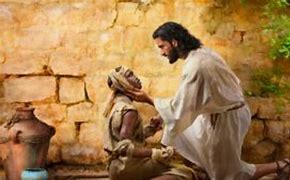
What love, respect, consideration, and faith on the part of those who brought to Jesus the deaf man with the speech impediment? They believed He could heal this person.
Nowadays, we are referring to people being challenged to think and act positively within the limitations of their own situation. Within my own circle of family and friends, in my visiting schools, hospitals and special homes, I have been deeply moved by the loving respect, the supportive, encouraging acceptance that has been shown to those who are in any way challenged – allowing them their own space to be themselves, ‘do’ for themselves and accomplish it themselves.
We all know that this is not always the case. I don’t want to dwell on this now, nor do I wish to rush into reading something spiritual or symbolic into Jesus healing the deaf man with the impediment in his speech. Rather, I welcome the opportunity to record my admiration for teenagers who talk about their future careers and tell me they wish to become professionally involved in teaching physically, emotionally, spiritually challenged children and adults or in caring for the elderly. Here is a call, a vocation, to a lifetime of expressing love in a very practical way. Such care-givers are most surely signs of the Kingdom of God being present here and now before our very eyes. They are sacraments of the compassionate, healing ministry of Jesus vividly present in our midst.
The Gospel of today tells us that Jesus “put His fingers into the man’s ears and touched His tongue with spittle. Then looking up to heaven He sighed; and he said to him, ‘Ephphatha,’ that is, ‘Be opened,’” and that, “And his ears were opened, and at once the impediment of his tongue was loosened and he spoke clearly.” Those who witnessed this were filled with admiration. He has done all the things well, as they saw this to be not only an act of power but also a form of love.
From the early days of Christianity, the Church has seen this healing by Jesus as a sign of the spiritual healing, character shaping, which takes place shortly after a person is baptized. In the Rite of Baptism, it is told that,
‘The celebrant touches the ears and mouth of the child with his thumb, saying, “The Lord Jesus made the deaf hear and the dumb speak. May he soon touch your ears to receive his word, and your mouth to proclaim his faith, to the praise and glory of God the Father.”
In this age of highly sophisticated communication technology, it is possible for small children. I believe that this simple rite of blessing of the ears and mouth is of huge importance and significance.
The ears represent our ability to receive sounds and images that can influence the way we think, feel and act. Our words represent the ability to convey messages that have an impact on the lives of others. Our intake and output of ‘media matter’ will often be for better or worse- morally, spiritually, as well. We must ask ourselves what we are doing to ourselves through what we are listening and reading; what we are doing to others through our words and body language. In both cases, it could be beneficial, or it could be a lot of damage.
The choice is ours. It is a moral and spiritual choice. We may be inclined, enticed or tempted to consume material that is spiritually unfit for human consumption. At baptism the ears are blessed that we may choose to receive the ‘godly word’ and reject the ungodly one. Our mouths are blessed that we may communicate with others inspiring words that are truthful, charitable, and moving and resist the temptation to lie, mislead, and talk nastily about others.
God knows, even if we don’t, how much we all need healing and restraining in the wonderful, terrible world of inter-personal and mass-communication! What a challenge we must face and encourage others to do so!
Religion and Faith~The Rev Frank Bellino, OPI

Every so often it’s worth asking ourselves do we mean when we say certain things; and this perhaps even more so when we are dealing with religious language, or indeed, with the word ‘religion’ itself which appears in today’s second reading from the letter of St James.
We are used, in these days of secularism, to people rejecting or ignoring ‘religion’. I was particularly struck by the fact that a friend, not a Catholic, informed me that he did not believe in religion. This surprised me because my friend is not an atheist: he believes in God, goes to church, says his prayers and tries to be good; yet he says he doesn’t believe in organized “old” religion. Well, it seems that he must mean by ‘religion’ something rather different from what St James means.
The Greek word used by St James is derived from a notion of fear of God – or indeed the gods – and usually refers to acts of worship. We believe that Christians engage in acts of worship and speak of ‘fearing God’ in a positive manner. This is just right and correct, and indeed commanded by God in the scriptures. But St James makes it clear that ‘religion that is pure and undefiled’ is much more than that.
Religion can be used to refer to the religious organization and discipline, so that ‘catholic religion’ refers to Church structures, norms and regulations. We are often called to worship God as a community, structured and governed in a particular manner – that is right and proper. However, true religion is much more than that. Those notions of religion as belief in God, acts of worship or structures and discipline are the ones you are likely to find in a dictionary; however, they are not the ones you find in the New Testament.
Understanding religion in those dictionary terms is a risk of the kind of pharisaism that we hear about in today’s Gospel. The Pharisees, to be fair, have a clear concern for the commandments of God, which is commendable. They have a strong sense of the closeness of God as emphasized by Moses in today’s first reading. All that is well and good. However, their application of those commandments is so rigid that it loses the real meaning. The point of all those commandments is that we might be holy, that what comes from the inside might be pure, and not make us unclean, and that we might shun all those vices mentioned in the gospel passage.
I wonder whether when our contemporaries reject ‘religion’ it is in fact this ‘pharisaism’, or at least perceived pharisaism, that they are rejecting. More than likely they are.
True religion, as the Church understands it, is essential for us to do our duty to God. That certainly includes worshipping him, and being active members of Christ’s body, the Church. It also entails striving for holiness, for that is what God created us for and redeemed us. It includes, therefore, aiding the afflicted, looking for the good, avoiding those things from the inside that make us unclean. ‘Religion that is pure and undefiled… is this: to visit orphans and widows in their affliction, and to keep oneself from the world’ (James 1:28).
We may go to church regularly; we may seem, from the outside, to be living our lives in accordance with the commandments of God and the Church; we may seem to be people who do not murder, steal and so on; we may hear the word of God, and even endure the homily without complaining. Well done, if you do; but if that is all we do, then we deceive ourselves and are unaware of the word only and not “doers”. If that is all we do, then it is not surprising that ‘religion’ has a bad name.
We must, of course, put the word into practice. Not just seem’ religious, but be holy, helping the poor and suffering, and being pure in what comes from inside. We must be referred to as ‘religious’ and only then can we hope for the virtue of true religion to be seen and looked for what it is.
An Invitation~The Rev Frank Bellino, OPI

Today brings us to the conclusion of this long chapter of St John’s Gospel, and Jesus’ sermon on himself as the bread of life. Today, we are invited to decide on our own responses to the extraordinary claims Christ makes for himself, and to the extraordinary language in which he expresses himself.
We are informed that the response of many of those disciples of Jesus who listened to this language was to abandon Jesus. The way Jesus speaks of himself is ‘hard’. The New Revised Bible, which most Catholic churches in United States use, translates it as ‘This is unbearable language’, which sounds rather like someone writing to the New York Times to complain about swearing on any of the major networks, but at least captures the sense that they are driven away from Jesus by the way he speaks.
And this is quite understandable: we have been told that we must eat the flesh of Jesus and drink his blood, or we cannot have life in us. Jesus’ flesh and blood are life-giving because he is sent by the Father and draws the life from the Father (verse 56). This illustrates the central mystery of Christ’s identity. He is completely flesh and blood, as we are, living and breathing, sweating and thirsting when it is hot, bleeding when he is pierced and dying when he is hung on the cross. At the same time, he is truly united to the Father, enduringly coming from him and with him and the Holy Spirit, the source of all life, all existence.
He invites all people to share in his union with the Father through sharing, in the most intimately intimate manner of eating and drinking, in his human life, his death, and his human rising from the dead. This invitation is presented, in this sermon recorded by St John, in words both beautiful and frightening, both delightful and appalling.
Little wonder, then, that most people turn away. This invitation seems too magnificent to be real and too horrible to accept. As it was in the beginning, so it is now: if the Christian Gospel is authentically preached, preached as it was first preached, it will eventually meet with this reaction, and we know that it has been done since the earliest days of the Church. Neither should we be ashamed if this same reaction arises in our hearts too. The mystery of who Christ is, and of the life he provides us, is deeper than the ocean and higher than the heavens. It is like the sun bursting in, and if we find ourselves trying to put the pillow over our heads, which is only natural. However, the warmth of this sun draws us from our hiding places, and its brightness enables us to gaze at it, until we can do so unblinkingly in the glorious light of heaven. St John’s Gospel is a challenge to enter into the light, for all that it will show up our faults and failures, and not to be like those who prefer to scurry off into the darkness.
There is a third possible response that the Gospel does not anticipate. Perhaps it was not possible at the time, when Jesus was walking the earth, but it is possible and common enough now. That is to imply that Jesus did not say what he said or did not mean what he said. It is the temptation to reduce the mystery to a manageable size, to reassure ourselves that of course Jesus doesn’t really offer us his flesh to eat and his blood to drink… of course Jesus isn’t really saying that the sacramental sharing in his life and death are how we enter into the eternal life of God.
However, these words of Jesus are, as said by St Peter, ‘the words of eternal life. We can say with him that ‘we have believed, and have come to know, that you are the Holy One of God.’ It doesn’t matter that we cannot comprehend the mystery of the Eucharist; all will become clear in a short period (God’s time, not ours). It is important that we acknowledge the reality of the invitation it offers us. To whom else, after all, shall we go?
St. Bartholomew, The Anonymous Apostle~The Very Rev. Lady Sherwood, OPI
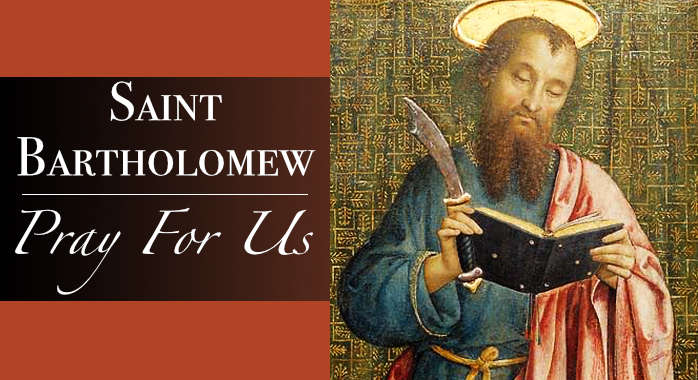
Today, the Church commemorates The Feast of St. Bartholomew the apostle. Bartholomew is a relatively difficult saint to commemorate because we hardly know anything truly about him. There are some who may believe that Bartholomew is the same person as Nathaniel –scholars have been known to argue about the truth or otherwise of this. What we do know is that In the Gospels of Matthew, Mark and Luke, that Bartholomew is listed as being one of the twelve Apostles of the Lord.
Ancient writers on the history of the Christian faith write that Bartholomew was an apostle to India – possibly is the region of Mumbai (Bombay). Along with his fellow apostle Jude, Bartholomew is reputed to have brought Christianity to Armenia in the 1st century. By tradition, Bartholomew is said to have been flayed alive, before being crucified upside down, thus becoming the patron saint of Leather-workers. In painting and sculpture, Bartholomew is often represented as holding a knife, with his own skin neatly draped over his arm. Bartholomew has also always been associated with healing, so there are a number of hospitals which have been named after him.
Bartholomew is also believed to be associated with the small Italian Island of Lipari, where he may have been buried. During World War II, the regime looked for ways to finance its activities, and ordered that a silver statue of Saint Bartholomew from the cathedral in Lipari was to be melted down. But when the statue was weighed, it was found to only actually weigh just a few grams so it was returned to its place in the Cathedral of Lipari. However, In reality, this same statue is made wholly of solid silver and therefore should indeed be very heavy in weight. This is a fairly recent miracle that has been associated with St Bartholomew.
About Bartholomew himself we know almost nothing, except that he was an Apostle of Jesus. Far from being a negative thing, I think this is the most important thing about this rather mysterious and anonymous apostle. For this teaches us that the call to serve is not really anything whatsoever to do with worldly status or fame. If we Look around us today, we will see much evidence of the reign of ego and of worldly fame, perhaps it is media stars and celebrities which tend to be the best known for this. An increasing number of children, when asked what they want to do when they grow up, say that they want to be famous, to be a celebrity or a star– and that the goal of reaching fame has become for them their vocation. Some of our politicians can also seem rather the same way. But the church isn’t entirely exempt either: we see evangelists on religious tv stations, pastors of megachurches, and, unfortunately, some bishops and clergy who just love being in the spotlight, have who love self-publicity. I once heard someone say that their church was OK but it was hard to see God because the Vicar always got in the way. It’s a temptation clergy are aware of and must always resist – our job is to point people to God, not towards ourselves.
So Bartholomew’s anonymity shows us ‘it’s not all about us’. Our job as Christians is to get out of the way and to enable people to catch a glimpse of the God and Father whom we serve. We also know, from the life of this mysterious and anonymous apostle, that we actually don’t need worldly fame, because God loves us, and that is all we need – we ought to need no other adulation than that!!
Each and every one of us eventually will join the ranks of anonymous Christians who have served God throughout the ages. In 2000 years’ time – and most likely long before that – we will all have been forgotten, except perhaps by the odd ancestor hunter who might still be digging our names out of archives and searching church registers to find historical information.
This might seem rather disheartening, but it definitely needn’t be such, because we know we are each p of God’s creation and of his redeeming: we are each loved by God more than we could ever hope imagine! Part of our job as Christians, is to try to discover more of this love as we go about living our lives. When we truly understand even a little bit of this love that God our Father and our creator, truly has for us, our anxieties about worldly status, worldly importance and worldly fame, begin to lose their hold over us. In God’s love we truly have everything we need.
So often we see the lives of the rich and famous descend into tragedy or disaster. Worldly riches and fame often don’t bring true and lasting happiness. The ordinariness of our lives is something which we as Christians should celebrate, if, like Bartholomew, our lives are built on the rock of faith and we have the knowledge of God’s true and eternal love, like a hidden jewel, burning deep inside of us.
So Bartholomew is one of us: he is a follower, he is a disciple, and a servant of Our Lord and Saviour Jesus Christ. An anonymous, unshowy person who gave of his best. Bartholomew may well be Someone we don’t know all that much about, but we do know that his soul is now residing with God where that great love will, at last, be fully known.
That is all that is needed. This is what truly matters. Amen.
Let us pray:
Strengthen in us, O Lord, the faith, by which the blessed Apostle Bartholomew clung wholeheartedly to your Son, and grant that through the help of his prayers your Church may become for all the nations the sacrament of salvation. Through our Lord Jesus Christ, your Son, who lives and reigns with you in the unity of the Holy Spirit, God, for ever and ever.
Amen.
This Is Me~The Rev Frank Bellino, OPI

If you don’t eat the flesh of the Son of Man and drink his blood, you will not have a life in you.
This is disgusting, of course, it is disgusting. It is not the language of religion, but the language of the slaughterhouse and the butchers, for a start; sides of meat hanging on hooks and blood all over the floor – that’s what this is about. It is not a church-like language.
St John is often referred to as a writer who takes some basic thoughts about Jesus and turns them into poetry. Well, this isn’t poetic, not at all!
Could I remind you, though, of something that was obvious 2,000 years ago might not be so obvious now. When the Temple in Jerusalem was still standing, however, not since, Jewish religion was a very flesh and blood conflict. Many animals were slaughtered and burned, and sometimes just cooked and eaten as a holy meal. This was the foundation of Jewish religion. In the Old Testament, you can read all of it. The last supper was this type of holy meal, with roast lamb on the table. Everyone had a taste of God’s goodness. It made them grateful for all His blessings to them. If there is nothing to thank God for, why bother at all.
“If you don’t have my flesh and blood to eat and drink” doesn’t mean “unless you’re a cannibal”, then. It means, rather than replacing one type of worship with another. Take away the slaughter of animals for sacrifices in the temple. Here is a human being who will lay down his life for his friends. Here are three hours on the Cross which Jesus experiences as worship. Here is a human suffering and not an animal.
You can see that this is an even more disgusting idea than you thought it was in the first place. Offering almighty God an animal is foolish enough but why murder a perfectly decent human being. What kind of religion is that?
I am aware of some people who can understand this with the heart, if not with the head. There are people for whom just to be alive is extremely terrible. There are people in a lot of difficulty. Only Christ who can reach them is one who can understand what they are going through. The only God who can be God for them is a God who is on the Cross.
Our first reading emphasized the Wisdom of God offering hospitality, inviting visitors to come and eat, as the waiters do on the doorsteps of restaurants in some of those tourist destinations. Those who feel depressed by life have a certain sense of wisdom. They are aware that the God who died in Jesus is understanding them. They are aware that in their Lord, a wise and loving God has come down to suffer with them. Jesus is still on the Cross, with them.
Today Jesus our Lord, who is referred to as the Wisdom of God, stands here and says, come eat my bread and drink the wine that I have prepared, for all is now ready. At the last supper, he discussed sacrifice, about giving your life to your friends. He discussed suffering, about being killed on Good Friday. He put the meaning of his suffering and death and sacrifice into the bread and into the wine, so that afterwards, his disciples would remember it.
Jesus said about the bread, this is my body. Just what a Jew would say. A modern English-speaker would have said, this is me, this is me. This is my blood, my lifeblood. The body will be broken, and the blood will be splattered tomorrow, as in a slaughterhouse, on Calvary. Forever you are to eat bread and drink wine and take the meaning of what I have done for you. Do it to remember me – he does not mean simply, as though it were a token or shade of what I do for you, a wee token. Do it that you may have life in you, I in you and you in me. Every time you eat this bread and drink this cup, St Paul explains, you are proclaiming his death.
The Mass then is that kind of meal. All there is to see is the bread and the cup on the table, instead of the lamb. Nothing to kill: the killing stopped on Good Friday for on that day Jesus died out on death and was revealed to them on Easter as the crucified and risen one, who was made known to them in the breaking of the bread.
Everyone who believes can taste on their lips the goodness of Christ who loves and who suffers. This is our thanksgiving to God made known in Jesus, who wills to live and to suffer in each of us.
Listen, Watch, Learn~The Rev Frank Bellino, OPI

I’m almost certain I’m not the only preacher who has a difficult sermon preparation when this part of the lectionary’s three-year cycle comes to an end. I can see how I have struggled with it over the past years. Many times, there is a temptation to preach on a moral or a pastoral issue, or on a series of them. This year, I have decided to listen to this discourse a bit more closely, and to be patient with it.
We’re in the middle of the series of Sundays when this discourse is proclaimed. I believe that one of the difficulties with preaching about it week after week is that the discourse itself is a kind of carefully crafted sermon. The first part focuses on the Book of Exodus – he gave them bread from heaven to eat. This is part of the verse we sometimes use in Benediction of the Blessed Sacrament, and that led me to think. Benediction of the Blessed Sacrament is a time for us to reflect on what the Lord does for us in Holy Communion; to be thankful for it and to prepare for our next Holy Communion. The Lord has been reflecting on the Bread of Life as the revelation of God. It is the same way that the Liturgy of the Word prepares our hearts and minds to receive the Lord in Holy Communion when we attend Mass.
When we reach the end of today’s Gospel, we begin to hear about the feast of the Bread of Life. It’s a feast that is devoted to us for the abundance of life. That’s the promise that comes at the end of the passage; however, for us this week, it is presented as a ‘pledge of future glory’ – there is need for preparation.
If you’re like me, and you’re anxious for these weeks to come and we can return to listening to St Mark, take heart. At the beginning of the first proclamation of this discourse, by the Lord Himself, there was confusion. They rebuked him, so he had to tell them to listen – “they will all be taught by God” – a quote from the prophet Isaiah. This is a reminder to each of us that the Father brings each one of us to Himself through Jesus through a close personal relationship which is devoted to prayer. We need patience, prayerfulness, contemplation, and silence for that. We will be nourished beyond our wildest expectations, transformed beyond our most lavish longings, as our Creator brings all things to Him. It is his great love for us that drives this, and it is that experience that we are called to experience as we listen to the Lord in the Mass during these weeks.
St Catherine of Siena reflects on this same theme in her reflections on Divine Providence in the dialogue. Seeing the devastating consequences of sinfulness on herself and on others who are called to the Church, she wonders how the fullness of life could ever be enjoyed by those who have deceived God’s great majesty by such weakness and depravity. However, she asks for a measure of His Love, to be able to contemplate with His Merciful Eyes. It was remarkable that our Creator made us in His Own Image, which was a remarkable gift we received. So freely did He create us that we have the freedom to choose sinfulness, which we did in our weakness. As a result, deserving we were then of the loss of that dignity. However, the same overflowing and superabundant love sought our reconciliation. His Only Son takes on our form so that he can be rejected and despised by us so that we can understand what His Glory does for us through that wonderful love. To eat that, we must listen to the Word. We have to watch and learn. This is what will transform the world – they will all be taught by God.
Bread~The Rt Rev Michael Beckett, OPI

Carbs. Ugh! Carbs! YUM! Carbs! Not so very many years ago, I lost a heap of weight by cutting out most carbs. THAT didn’t last. Pasta! How can anyone live without pasta? And yes, I know all about spaghetti squash and zoodles and wheat pasta (major yuk) and anything else that can be substituted for the honest to goodness yumminess that is pasta. And then there’s bread! BREAD! We have three bread machines and Scott has become a true Bread Guru. Egg bread, white bread, rye bread, oat bread, honey bread, and the list goes on and on and on. And very rarely does any of said bread go to waste. We like bread.
Sadly, though, no matter how much or how often we eat bread, or pasta, or bread, or cake, or bread, we get hungry again. Our bodies crave that fuel that keeps us going. Not feeling like yourself? Eat. Have something to celebrate? Eat. And hey, in SO many restaurants, what do they bring to the table as soon as you’re seated? Yup. Bread.
So, what is bread? Basically, it’s a paste of flour and water, cooked over or surrounded by heat.
According to history, the earliest bread was made in or around 8000 BC in the Middle East, specifically Egypt. The quern was the first known grinding tool. Grain was crushed and the bakers produced what we now commonly recognize in its closest form as chapatis (India) or tortillas (Mexico).
And we all of us know about manna, the bread from heaven the slaves from bondage in Egypt ate whilst they meandered in the desert looking for the Promised Land. In fact, bread is mentioned at least 492 times in the Bible beginning in Genesis and continuing right through Revelation with a variety of meanings and symbolism.
So. Bread. We know our bread. Jesus even talked about bread. Several times. In the single most important sacrament we have, that of the Eucharist, bread becomes the body of Christ.
In today’s Gospel, John 6:41-51, Jesus says, “I am the bread of life. Your ancestors ate the manna in the desert, but they died; this is the bread that comes down from heaven so that one may eat it and not die. I am the living bread that came down from heaven; whoever eats this bread will live forever; and the bread that I will give is my flesh for the life of the world.”
So what’s up with this? What does Jesus mean? At that point in history, especially in Jesus’ culture, bread would have been understood as a nutritional necessity. Bread was one of the most accessible foods for people of all wealth and social status, even the poor had bread.
Now, for Jesus to say He IS bread? What’s up with that? Jesus is explaining to the crowds gathered around Him, and to us, just who He is. And a lot of folks weren’t exactly impressed. The Bible tells us of the people complaining, and even some of His disciples leaving, unable to understand the metaphor, or unwilling to accept Jesus’s explanation of who He is. So what DOES Jesus mean? Simply put, if we put our faith in Him, then we will have eternal life. When Jesus says He is the bread of life, He is saying that He is essential to our salvation. Salvation is essential to human existence and necessary for eternity. When Jesus says He is the bread of life, He is saying He is essential, that HE is the means to our Salvation and eternal life.
Jesus identified Himself as the bread of life, the way. He did not present Himself *A* source of salvation but as THE only way to salvation. Without Him, without the bread of life, there is no hope for salvation. By identifying Himself as the source of forgiveness, Jesus makes the path to repentance and a relationship with God, plain, simple, and available for everyone.
So what do we do? You say to me, “But I’m a good person. I try to do the right thing.” Well, yeah. OK. But ya see, the trick is, if Jesus is to be our “bread,” not only do we have to believe it, we have to live it. And therein, as Mr. Shakespeare said, “lies the rub.” The Bread of Life will sustain the us, we who believe. In our daily lives, in order to continue to be fed by Him, we must pray regularly. We must study the Word (“the Word” being Jesus, not necessarily the Bible as some believe.)
We must do our best to live according to what Jesus has taught us. And reckon wonder, how do we do that? Love as Jesus loved. As I have said over and over and over again, ad infinitum, you are the only Bible some folks will ever read, the only Jesus some folks will ever see. And I’m gonna add a new one:
For some folks, you are the only server who brings the Bread of Life to the table.
As Jesus said to Peter in John 21:15-17: So when they had eaten breakfast, Jesus said to Simon Peter, “Simon, son of Jonah, do you love Me more than these?” He said to Him, “Yes, Lord; You know that I love You.” He said to him, “Feed My lambs.” He said to him again a second time, “Simon, son of Jonah, do you love Me?” He said to Him, “Yes, Lord; You know that I love You.” He said to him, “Tend My sheep.” He said to him the third time, “Simon, son of Jonah, do you love Me?” Peter was grieved because He said to him the third time, “Do you love Me?” And he said to Him, “Lord, You know all things; You know that I love You.” Jesus said to him, “Feed My sheep.””
Can we be, or do, less? Again, for those in the back, for some folks, you are the only server who brings the Bread of Life to the table. Know what you’re saying. Speak only the truth and do not, for the love of all that is holy, repeat or post misinformation. Love without judgement. Recognize your own faults and work to correct them. Give freely to those who are in need. Love. Love. Love.
In the closing prayers of many church services we hear, “Let us serve Him with gladness and singleness of heart.”
So let us do that. Let us “serve” Him, the Bread of Life, with gladness and singleness of heart. Amen.
Are we Getting Our Priorities Right?~ The Memorial of Sts Martha, Mary and Lazarus~The Very Rev Lady Sherwood, OPI
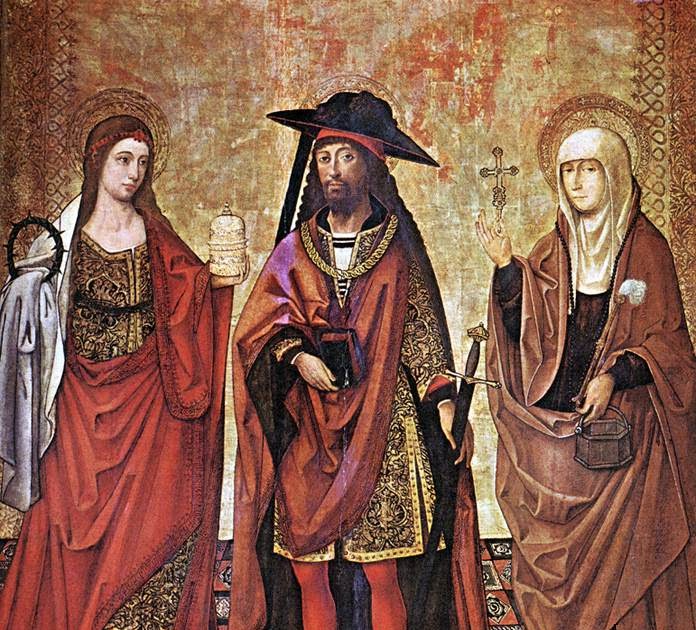
Today my brothers and sisters in Christ, we come together as the church to commemorate the memorials of three siblings, these being Sts Martha, Mary and Lazarus.
Sts Mary, Martha, and Lazarus were very close friends with and were very devout followers of The Lord Jesus. Together they hosted Jesus in their home on many occasions. Yet, on one such visit from Jesus, they Martha and Mary chose two very different actions, and the way that Jesus reacted to their choices is a very valuable lesson for us today. Let’s review the story (Luke 10:38-42):
Martha is worried
Martha was rushing around, serving and doing her best to make everything good for their beloved guest. And where was Mary when Martha needed a hand? She chose to sit at Jesus’ feet, listening as He spoke.
It’s pretty easy to imagine how that made Martha feel. Irritated, frustrated, resentful. Why should she be doing all the work? Wasn’t it only righteous for Mary to be helping out? In fact, Martha felt so justified in her indignation that she went and talked to Jesus about it. “Lord, do You not care that my sister has left me to serve alone? Therefore tell her to help me,” she said to Him.
But, instead of backing her up in her demand, Jesus rebuked her! “Martha, Martha, you are worried and troubled about many things. But one thing is needed, and Mary has chosen that good part, which will not be taken away from her.”
This must have felt like a slap in the face for Martha. Here she was, doing everything in her power to be hospitable and make it good. And Mary just sat there, and what she was doing was the right thing?
Sound familiar?
It can become so easy for us to get wrapped up in all the things we need to do and the things that need to be accomplished that we lose sight of what the most important thing is. Isn’t it possible that we can get too wrapped up in the cares of life? Jesus makes this even more clear in the parable He told about the sower. “He who received seed among the thorns is he who hears the word, and the cares of this world and the deceitfulness of riches choke the word, and he becomes unfruitful.” Matthew 13:22.
The highest priority in our lives needs to be choosing the good part, as Mary did: to learn of Jesus so that we can become like Him. It’s a love and devotion to Him that makes everything else of secondary importance. It is to seek the riches of wisdom and understanding that are in Him. If we don’t do this, how can we follow Him, how can we be His disciples? A disciple learns of the Master.
This is not an excuse to be lazy, and not take responsibility for anything. That is another trap entirely. We are to be doers of the Word, and not hearers only! (James 1:22) But what we do has to be led by the Spirit, whose voice we learn to hear by choosing the good part. There is no blessing in running our own lives based on our human understanding of what is important. Mary understood that she needed to learn more of her Master and to seek the things that have eternal value. It’s when we do that that we can be a blessing, because then all of our works are Spirit-driven. Love causes us to listen, to learn, and to keep His commandments. (1 John 5:3)
“My sheep hear My voice, and I know them, and they follow Me.” John 10:27.
Take heed to yourself
We can be in danger of falling into the same trap that Martha did. We can be so troubled by what we perceive as negative behavior in others, and become so self-righteous in our good works that we start to judge others for not doing as we do. Satan is the one behind these kinds of thoughts. He whispers lies and accusations, trying to create as much conflict as he can. His aim is to lead people as far in the opposite direction of “the good part” as he possibly can – to lead them away from Jesus. To listen to him and agree with him leads to all kinds of unrest and trouble and worry. We need to slam the door on his deceitfulness!
“Take heed to yourself and to the doctrine. Continue in them, for in doing this you will save both yourself and those who hear you,” it’s written in 1 Timothy 4:16. Only that will do us any good in life. The wrong choice that Martha made wasn’t that she was serving and doing good. It was that in her work she had demands and criticism on Mary, rather than doing what Jesus taught herself! If we are living before the face of God, we have no cause to look around at what others are doing and feel that we have a right to pass judgement on them. We live in obedience to the Spirit’s promptings in our own lives, and what others do is none of our business. We don’t know how He is leading others.
Let’s rise above all the noise and pursuits of this world and seek those things which have eternal value. Like Mary, let’s find that fellowship with the Master and with those who follow Him so that we can learn of Him and become like Him. Through the Word of God, fellowship, and prayer we become rich in our spirit, and God will give us everything we need in abundance.
“Finally, dear brethren, whatever things are true, whatever things are noble, whatever things are just, whatever things are pure, whatever things are lovely, whatever things are of good report, if there is any virtue and if there is anything praiseworthy—meditate on these things.” Philippians 4:8.
Let us pray:
Saints Martha, Mary, and Lazarus, you befriended Jesus as your Lord and God, and as the Son of Man, to Whom you opened your home and your lives. Please pray for us, that we will also open the home of our souls so as to befriend Him Who is my God and is the Resurrection and the Life. Saints Martha, Mary, and Lazarus, pray for us. Jesus,
In Jesus holy name we pray,
Amen.
 The Order of Preachers, Independent
You must be logged in to post a comment.